OLEACEAE
Reading edition
SUMMER KEY TO THE SPECIES OF FRAXINUS
a. Lateral leaflets sessile. F. nigra, p. 221.
aa. Lateral leaflets petioluled.
b. Twigs, petioles and lower sides of leaves pubescent. F. pennsylvanica, p. 215.
bb. Twigs, petioles and lower sides of leaves essentially glabrous.
c. Twigs prominently 4-angled. F. quadrangulata, p. 219.
cc. Twigs terete.
d. Lower sides of leaves essentially of the same color as the upper; leaflet-margins rather finely sharp-serrate. F. pennsylvanica lanceolata, p. 217.
dd. Lower sides of leaves paler than the upper; leaflet-margins entire or obscurely serrate. F. americana, p. 213.
WINTER KEY TO THE SPECIES OF FRAXINUS
a. Twigs prominently 4-angled; fruit falling in early autumn. F. quadrangulata, p. 219.
aa. Twigs terete; fruit often persistent on the tree until mid-winter or the following spring.
b. Buds rusty-tomentose; twigs more or less downy. F. pennsylvanica, p. 215.
bb. Buds not tomentose; twigs not downy.
c. Terminal bud black or nearly so, showing 3 pairs of scales in cross-section; bud-scales apiculate at the apex; samaras with broad wings, the seed portion flattish; bark flaky, rubbing off on the hand. F. nigra, p. 221.
cc. Terminal bud brownish, showing 4 pairs of scales in cross-section; bud-scales rounded at the apex; samaras with narrow wings, the seed portion terete; bark ridged, not flaky and rubbing off on the hand.
d. Upper margin of leaf-scars deeply concave. F. americana, p. 213.
dd. Upper margin of leaf-scars not concave, but straight across or projecting upward. F. pennsylvanica lanceolata, p. 217.
White Ash
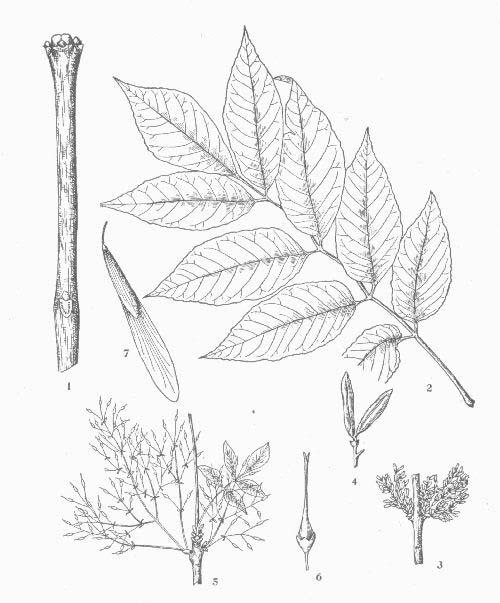
1. Winter twig, × 1. 2. Leaf, × 1/4. 3. Staminate flowering branchlet, × 1/2. 4. Staminate flower, enlarged. 5. Pistillate flowering branchlet, × 1/2. 6. Pistillate flower, enlarged. 7. Fruit, × 1.
OLEACEAE
White Ash
Fraxinus americana L.
HABIT.—A large tree 50-75 feet high, with a trunk diameter of 2-3 feet; forming an open, pyramidal crown of long, slender, lateral branches and a stout, rather sparse spray.
LEAVES.—Opposite, pinnately compound, 8-12 inches long. Leaflets usually 7-9, 3-5 inches long, 1-2 inches broad; short-stalked; ovate to oblong-lanceolate; entire or obscurely serrate; thick and firm; glabrous, dark green above, paler beneath. Petioles glabrous, stout, grooved.
FLOWERS.—May, before the leaves; dioecious; borne in loose panicles on shoots of the previous season; calyx campanulate, 4-lobed; corolla 0; stamens 2, rarely 3; ovary 2-celled.
FRUIT.—August-September, persistent on the branches until mid-winter or the following spring; samaras 1-2 inches long, in crowded, drooping, paniculate clusters 6-8 inches long.
WINTER-BUDS.—Short, rather obtuse; bud-scales apiculate, keeled, 4 pairs, rusty-brown.
BARK.—Twigs at first dark green, becoming gray or light brown, often covered with a glaucous bloom; gray, deeply furrowed into firm, narrow, flattened ridges on the trunk.
WOOD.—Heavy, hard, strong, close-grained, tough, brown, with thick, lighter colored sapwood.
DISTRIBUTION.—Of common occurrence throughout the state.
HABITAT.—Prefers a rich, moist, loamy soil, but grows in any well-drained situation; common along stream-beds.
NOTES.—Grows rapidly. Easily transplanted. Fairly free from disease. Leaves appear late in spring.
Red Ash
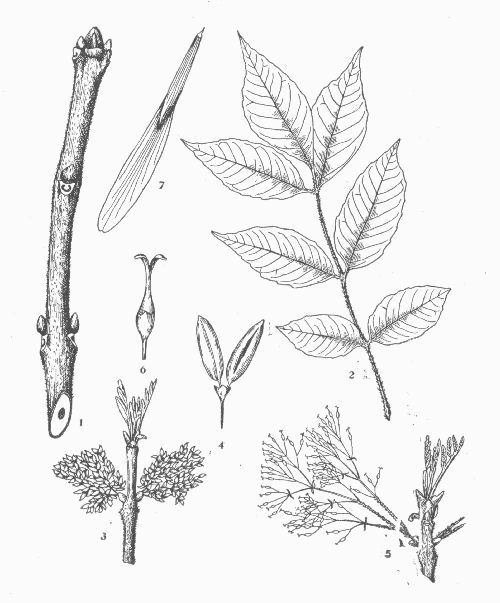
1. Winter twig, × 1. 2. Leaf, × 1/3. 3. Staminate flowering branchlet, × 1/2. 4. Staminate flower, enlarged. 5. Pistillate flowering branchlet, × 1/2. 6. Pistillate flower, enlarged. 7. Fruit, × 1.
OLEACEAE
Red Ash
Fraxinus pennsylvanica Marsh. [Fraxinus pubescens Lam.]
HABIT.—A medium-sized tree 30-50 feet high, with a trunk diameter of 1-2 feet; stout, upright branches and slender branchlets form a compact, broad, irregular crown.
LEAVES.—Opposite, pinnately compound, 10-12 inches long. Leaflets 7-9, 3-5 inches long, 1-1-1/2 inches broad; short-stalked; oblong-lanceolate to ovate; slightly serrate or entire; thin and firm; glabrous, yellow-green above, pale and silky-downy beneath. Petioles stout, pubescent.
FLOWERS.—May, with the leaves; dioecious; borne in compact, downy panicles on shoots of the previous season; calyx cup-shaped, 4-toothed; corolla 0; stamens 2, rarely 3; ovary 2-celled.
FRUIT.—Early autumn, persistent on the branches throughout the winter; samaras 1-2 inches long, in open, paniculate clusters.
WINTER-BUDS.—Small, rounded; bud-scales rounded on the back, 3 pairs, rusty-brown, tomentose.
BARK.—Twigs pale-pubescent at first, lasting 2-3 years or often disappearing during the first summer, finally ashy gray or brownish and often covered with a glaucous bloom; brown or dark gray on the trunk, with many longitudinal, shallow furrows; somewhat scaly.
WOOD.—Heavy, hard, strong, brittle, coarse-grained, light brown, with thick, yellow-streaked sapwood.
DISTRIBUTION.—Not a common tree. Most frequent in the southern half of the Lower Peninsula, but has been reported further north, i.e., Drummond’s Island and Keweenaw County, Upper Peninsula.
HABITAT.—Prefers wet or moist, rich loam; river-banks; swampy lowlands.
NOTES.—A rapid grower in youth. Fairly immune from insect and fungous diseases.
Green Ash
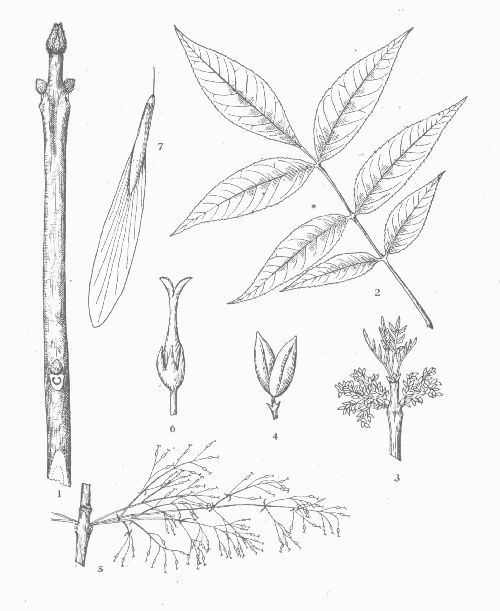
1. Winter twig, × 1. 2. Leaf, × 1/3. 3. Staminate flowering branchlet, × 1/2. 4. Staminate flower, enlarged. 5. Pistillate flowering branchlet, × 1/2. 6. Pistillate flower, enlarged. 7. Fruit, × 1.
OLEACEAE
Green Ash
Fraxinus pennsylvanica lanceolata (Borkh.) Sarg. [Fraxinus lanceolata Borkh.] [Fraxinus viridis Michx. f.]
Considered by some authors to be a distinct species, and by others a variety of F. pennsylvanica Marsh., which it resembles. The main points of difference are:
The usual absence of pubescence from the branchlets, the underside of the leaflets, and the petioles.
The rather narrower, shorter, and more sharply serrate leaflets.
The color of the leaves, which is bright green on both sides.
A very hardy tree, of rapid growth and desirable habit, making it useful for ornamental and street planting. Easily transplanted.
Of rare occurrence in Michigan, but has been reported from several localities.
Blue Ash
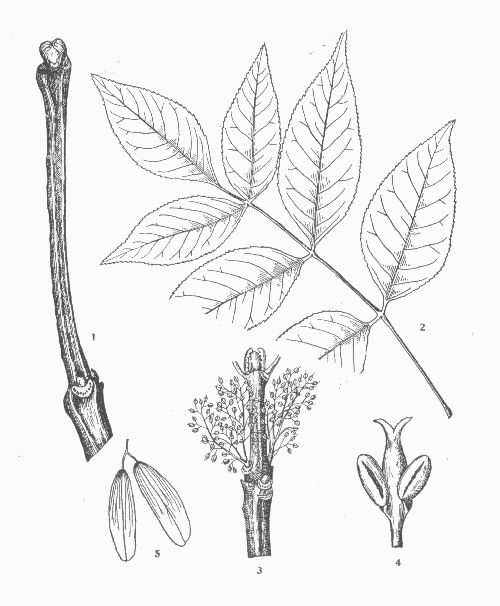
1. Winter twig, × 1. 2. Leaf, × 1/2. 3. Flowering branchlet, × 1. 4. Flower, enlarged. 5. Fruit, × 1/2.
OLEACEAE
Blue Ash
Fraxinus quadrangulata Michx.
HABIT.—A large tree 50-80 feet high, with a trunk diameter of 1-3 feet; small, spreading branches and stout, 4-angled, more or less 4-winged branchlets form a narrow crown.
LEAVES.—Opposite, pinnately compound, 8-12 inches long. Leaflets 5-9, usually 7, 3-5 inches long, 1-2 inches broad; short-stalked; ovate-oblong to lanceolate, long-pointed; coarsely serrate; thick and firm; yellow-green above, paler beneath, glabrous. Petioles slender, glabrous.
FLOWERS.—April, before the leaves; perfect; borne in loose panicles on shoots of the previous season; calyx reduced to a ring; corolla 0; stamens 2; ovary 2-celled.
FRUIT.—September-October, falling soon after; samaras 1-2 inches long, in long, loose, paniculate clusters.
WINTER-BUDS.—Short, rather obtuse; bud-scales rounded on the back, 3 pairs, dark red-brown, somewhat pubescent.
BARK.—Twigs orange, rusty-pubescent, becoming brownish or grayish; on the trunk light gray tinged with red, irregularly divided into large, plate-like scales, often with the shaggy appearance of a Shagbark Hickory.
WOOD.—Heavy, hard, close-grained, brittle, light yellow streaked with brown, with thick, light yellow sapwood.
DISTRIBUTION.—Occasionally in the southern half of the Lower Peninsula. Nowhere abundant.
HABITAT.—Prefers rich, limestone hills, but grows well in fertile bottom-lands.
NOTES.—Hardy and grows rapidly. A blue dye is made by macerating the inner bark in water.
Black Ash
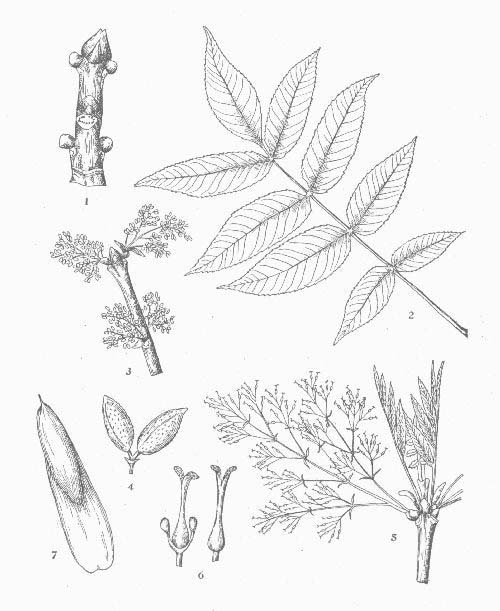
1. Winter twig, × 1. 2. Leaf, × 1/3. 3. Staminate flowering branchlet, × 1/2. 4. Staminate flower, enlarged. 5. Pistillate flowering branchlet, × 1/2. 6. Pistillate flowers, enlarged. 7. Fruit, × 1.
OLEACEAE
Black Ash
Fraxinus nigra Marsh. [Fraxinus sambucifolia Lam.]
HABIT.—A tall tree 60-80 feet high, with a trunk diameter of 1-2 feet; slender, upright branches form in the forest a narrow crown, in the open a rounded, ovoid crown.
LEAVES.—Opposite, pinnately compound, 12-16 inches long. Leaflets 7-11, 3-5 inches long, 1-2 inches broad; sessile, except the terminal; oblong to oblong-lanceolate, long-pointed; remotely, but sharply serrate; thin and firm; dark green above, paler beneath, glabrous. Petioles stout, grooved, glabrous.
FLOWERS.—May, before the leaves; polygamo-dioecious; borne in loose panicles on shoots of the preceeding season; calyx 0; corolla 0; stamens 2; ovary 2-celled.
FRUIT.—August-September, falling early, or sometimes hanging on the tree until the following spring; samaras 1-1-1/2 inches long, in open, paniculate clusters 8-10 inches long.
WINTER-BUDS.—Ovoid, pointed; bud-scales rounded on the back, 3 pairs, almost black.
BARK.—Twigs at first dark green, becoming ashy gray or orange, finally dark gray and warted; thin, soft ash-gray and scaly on the trunk. Bark flakes off on rubbing with the hand.
WOOD.—Heavy, tough, coarse-grained, weak, rather soft, dark brown, with thin, lighter colored sapwood.
DISTRIBUTION.—Common throughout most portions of Michigan.
HABITAT.—Prefers deep, cold swamps and low river-banks, but grows in any good soil.
NOTES.—Hardy throughout the state. Not easily transplanted. Foliage falls early in autumn.