PLATANACEAE
Reading edition
Sycamore. Button-wood. Buttonball-tree
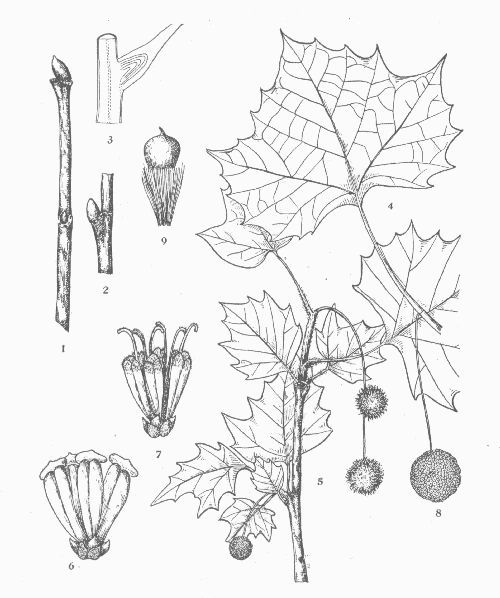
1. Winter twig, × 1. 2. Portion of twig, side view, × 1. 3. Vertical section of twig, summer bud and leaf petiole, enlarged. 4. Leaf, × 3/8. 5. Flowering branchlet, × 1/2. 6. Staminate flower, enlarged. 7. Pistillate flower, enlarged. 8. Fruit, × 3/8. 9. Achene, enlarged.
PLATANACEAE
Sycamore. Button-wood. Buttonball-tree
Platanus occidentalis L.
HABIT.—A large tree 70-100 feet high, with a trunk diameter of 3-8 feet; commonly dividing near the ground into several large secondary trunks, forming a broad, open, irregular crown of massive, spreading branches.
LEAVES.—Alternate, simple, 5-10 inches long and broad; broadly ovate in outline; more or less 3-5-lobed by broad, shallow sinuses, the lobes sinuate-toothed; thin and firm; bright green above, paler beneath, glabrous both sides; petioles stout, puberulous, 1-2 inches long.
FLOWERS.—May, with the leaves; monoecious; borne in dense heads; the staminate dark red, on short, axillary peduncles; the pistillate greenish, on long, slender, terminal peduncles; sepals 3-6, minute; petals 3-6, minute; stamens 3-6, usually 4; styles long, incurved, red.
FRUIT.—October, persistent on the limbs through the winter; brown heads about 1 inch in diameter, on slender, glabrous stems 3-6 inches long.
WINTER-BUDS.—Terminal bud absent; lateral buds 1/4-3/8 inch long, conical, blunt, lustrous, pale brown; forming in summer within the petiole of the leaf.
BARK.—Twigs pale green and tomentose, becoming smooth, dark green, finally grayish; thick, red-brown on the trunk and broken into oblong, plate-like scales, separating higher up into thin plates which peel off, exposing the greenish or yellowish inner bark.
WOOD.—Heavy, tough, hard, rather weak, coarse-grained, difficult to split, light red-brown, with thick, darker colored sapwood.
DISTRIBUTION.—Lower Peninsula as far north as Roscommon County.
HABITAT.—Prefers rich bottom-lands along the borders of rivers and lakes.
NOTES.—Rapid of growth. Bears transplanting well. Often planted as a shade tree. Fungous diseases disfigure it seriously.