ROSACEAE
Reading edition
SUMMER KEY TO THE SPECIES OF PYRUS
a. Leaves simple; fruit a light green pome an inch or more in diameter; branches contorted, bearing many short, spur-like branchlets. P. coronaria, p. 145.
aa. Leaves compound; fruit berry-like, 1/4 inch in diameter, bright red; branches not contorted, not bearing many short, spur-like branchlets. P. americana, p. 147.
WINTER KEY TO THE SPECIES OF PYRUS
a. Bundle-scars 3 or in 3 compound, but distinct groups; buds 1/8-1/4 inch long; branches contorted, bearing many short, spur-like branchlets; fruit a pome an inch or more in diameter, light green. P. coronaria, p. 145.
aa. Bundle-scars 4-many in a single U-shaped line, not forming 3 distinct groups; buds about 1/2 inch long; branches not contorted, not bearing many short, spur-like branchlets; fruit berry-like, 1/4 inch in diameter, bright red. P. americana, p. 147.
Sweet Crab. American Crab
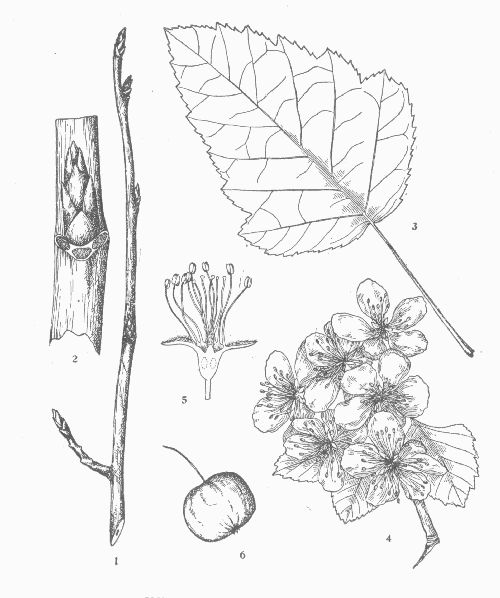
1. Winter twig, × 1. 2. Portion of twig, enlarged. 3. Leaf, × 3/4. 4. Flowering branchlet, × 1/2. 5. Vertical section of flower with petals removed, × 1/2. 6. Fruit, × 1/2.
ROSACEAE
Sweet Crab. American Crab
Pyrus coronaria L. [Malus coronaria Mill.]
HABIT.—Often a bushy shrub, but frequently a small tree 15-25 feet high, with a trunk 8-12 inches in diameter; forming a broad, rounded crown of rigid, contorted branches bearing many short, spur-like branchlets.
LEAVES.—Alternate, simple, 3-4 inches long, almost as broad; ovate to nearly triangular; sharply and deeply serrate, sometimes lobed; membranaceous; bright green above, paler beneath, glabrous both sides; petioles long, slender, often with two dark glands near the middle.
FLOWERS.—May, after the leaves; perfect; 1-1/2-2 inches across; very fragrant; borne on slender pedicels in 5-6-flowered umbels; calyx urn-shaped, 5-lobed, tomentose; petals 5, rose colored to white; stamens 10-20; ovary hairy; styles 5.
FRUIT.—October; a depressed-globose pome, 1-1-1/2 inches in diameter, pale green, very fragrant, with a waxy surface.
WINTER-BUDS.—Terminal bud 1/8-1/4 inch long, obtuse, bright red; lateral buds smaller.
BARK.—Twigs at first hoary-tomentose, becoming glabrous, red-brown; thin, red-brown, breaking into longitudinal fissures on the trunk.
WOOD.—Heavy, rather soft, close-grained, weak, red-brown, with thick, yellow sapwood.
DISTRIBUTION.—Southern portion of the Lower Peninsula as far north as Roscommon County.
HABITAT.—Rich, moist, but well-drained soil in thickets and along streams.
NOTES.—An excellent ornamental tree or shrub for small gardens and shrubberies. The fruit is sometimes gathered for making preserves.
Mountain Ash
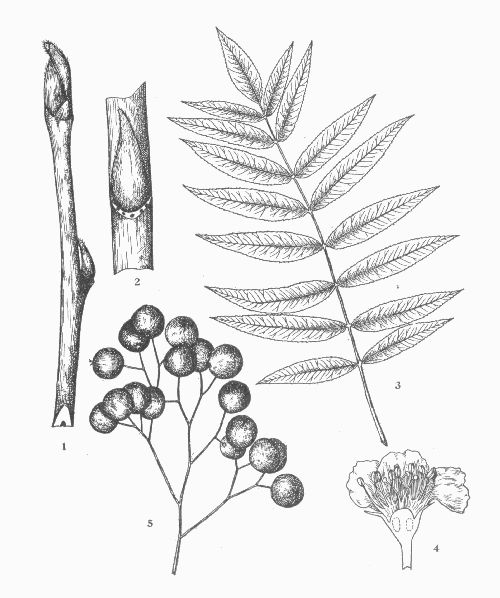
1. Winter twig, × 1. 2. Portion of twig, enlarged. 3. Leaf, × 1/3. 4. Vertical section of flower, enlarged. 5. Portion of a fruiting cyme, × 1.
ROSACEAE
Mountain Ash
Pyrus americana (Marsh.) DC. [Sorbus americana Marsh.]
HABIT.—A small tree 15-20 feet high, with a trunk diameter of not over a foot; branches slender, spreading, forming a narrow, rounded crown.
LEAVES.—Alternate, compound, 6-9 inches long. Leaflets 9-17, 2-3 inches long and 1/2-3/4 inch broad; sessile or nearly so, except the terminal; lanceolate to oblong-lanceolate, taper-pointed; finely and sharply serrate above the entire base; membranaceous; glabrous, dark yellow-green above, paler beneath, turning clear yellow in autumn. Petioles slender, grooved, enlarged at the base.
FLOWERS.—May-June, after the leaves; perfect; 1/8 inch across; borne on short, stout pedicels in many-flowered, flat cymes 3-5 inches across; calyx urn-shaped, 5-lobed, puberulous; petals 5, white; stamens numerous; styles 2-3.
FRUIT.—October, but persistent on the tree throughout the winter; a berry-like pome, subglobose, 1/4 inch in diameter, bright red, with thin, acid flesh; eaten by birds in the absence of other food.
WINTER-BUDS.—Terminal bud about 1/2 inch long, ovoid, acute, with curved apex; lateral buds smaller, appressed; scales rounded on the back, purplish red, more or less pilose above, gummy.
BARK.—Twigs at first red-brown and hairy, becoming glabrous, dark brown; thin, light gray-brown on the trunk, smooth, or slightly roughened on old trees; inner bark fragrant.
WOOD.—Light, soft, close-grained, weak, pale brown, with thick, lighter colored sapwood.
DISTRIBUTION.—Ludington and northward, principally along the shore of L. Michigan, but common throughout the Upper Peninsula.
HABITAT.—Prefers rich, moist soil on river-banks and on the borders of cold swamps; rocky hillsides and mountains.
NOTES.—More often a shrub. Easily transplanted, but slow of growth. One of the most beautiful trees of our northern forests.
Serviceberry
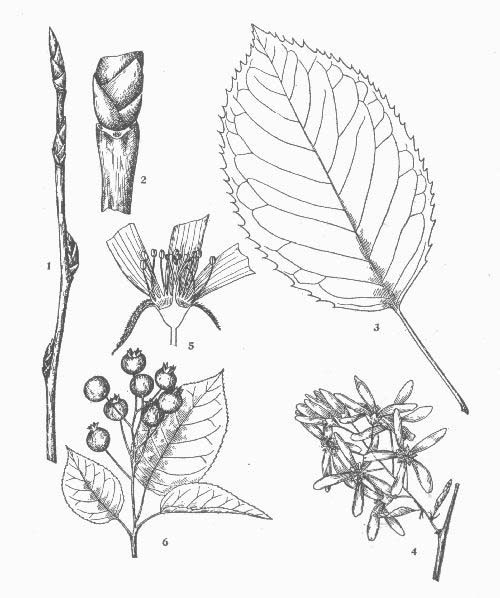
1. Winter twig, × 1. 2. Portion of twig, enlarged. 3. Leaf, × 1. 4. Flowering branchlet, × 1/2. 5. Vertical section of flower, enlarged. 6. Fruiting branchlet, × 1/2.
ROSACEAE
Serviceberry
Amelanchier canadensis (L.) Medic.
HABIT.—A small tree 25-40 feet in height, with a tall trunk 6-12 inches in diameter; forming a narrow, rounded crown of many small limbs and slender branchlets.
LEAVES.—Alternate, simple, 3-4 inches long and about one-half as broad; ovate to obovate; finely and sharply serrate; glabrous, dark green above, paler beneath; petioles slender, about 1 inch long.
FLOWERS.—April, when the leaves are about one-third grown; perfect; large, white, borne in drooping racemes 3-5 inches long; calyx 5-cleft, campanulate, villous on the inner surface; petals 5, strap-shaped, white, about 1 inch in length; stamens numerous; styles 5, united below.
FRUIT.—June-August; globular, berry-like pome, 1/3-1/2 inch long; turning from bright red to dark purple with slight bloom; sweet and edible when ripe.
WINTER-BUDS.—Yellow-brown, narrow-ovoid to conical, sharp-pointed, 1/4-1/2 inch long; bud-scales apiculate, slightly pubescent.
BARK.—Twigs smooth, light green, becoming red-brown; thin, pale red-brown on the trunk, smoothish or divided by shallow fissures into narrow, longitudinal, scaly ridges.
WOOD.—Heavy, very hard, strong, close-grained, dark red-brown, with thick, lighter colored sapwood.
DISTRIBUTION.—Common throughout the state.
HABITAT.—Prefers rich soil of dry, upland woods and hillsides.
NOTES.—Hardy throughout the state. Grows in all soils and situations except in wet lands.
Dotted Haw Crataegus punctata Jacq.
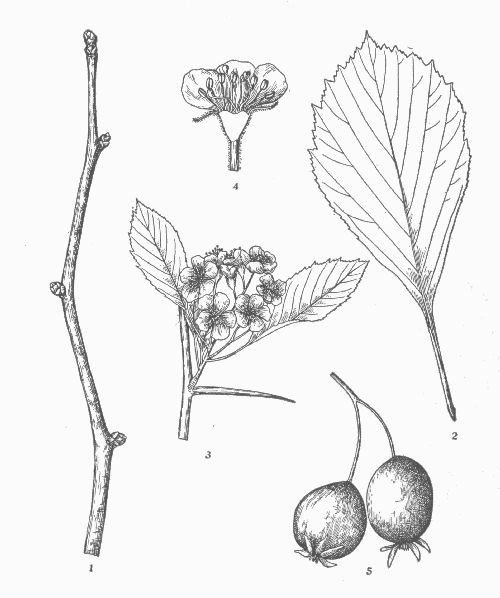
1. Winter twig, × 1. 2. Leaf, × 1. 3. Flowering branchlet, × 1/2. 4. Vertical section of flower, enlarged. 5. Fruit, × 1.
ROSACEAE
The Haws, Thorns, Hawthorns or Thorn-apples
Crataegus L.
Owing to the complexity of the various forms in this group, the present state of uncertainty as to the value of certain characters, and the questionable validity of many of the assigned names, it is thought to be beyond the scope of this bulletin to give more than a general description of the group as a whole, recommending the more ambitious student to the various manuals and botanical journals and papers for more detailed information.
The Crataegi are generally low, wide-spreading trees or shrubs, with strong, tortuous branches and more or less zigzag branchlets usually armed with stiff, sharp thorns. The bark varies from dark red to gray and is shallowly fissured or scaly. The leaves are alternate, simple, generally serrate, often lobed, with short or long petioles. The flowers appear in May or June, with or after the leaves, in simple or compound corymbs, whitish or pinkish, perfect. The fruit is a red to yellow, sometimes blue or black pome, subglobose to pear-shaped, with usually dry and mealy flesh and 1-5 seeds. The winter-buds are small, nearly globose, lustrous brown. Crataegus produces wood which is heavy, hard, tough, close-grained, red-brown, with thick, pale sapwood. The Haws are trees of the pasture-lands, the roadside, the open woods and the stream-banks, and are more common in the southern than in the northern portions of the state. Some of the species are desirable as ornaments in parks and gardens on account of their beautiful and abundant flowers and showy fruits.
SUMMER KEY TO THE SPECIES OF PRUNUS
a. Leaves oblong-ovate to obovate, abruptly acuminate at the apex; marginal teeth not incurved.
b. Margin of leaves sharp-serrate with spreading teeth; leaves not rugose, the veins not prominent; fruit 1/4-1/2 inch long, bright red, racemose, July-August; bark of trunk brown, smooth or only slightly fissured; usually a large shrub. P. virginiana, p. 157.
bb. Margin of leaves crenate-serrate; leaves more or less rugose, the veins prominent; fruit about 1 inch long orange-red, clustered, August-September; bark of trunk gray-brown, early splitting off in large, thick plates; a small tree. P. nigra, p. 161.
aa. Leaves oval to oblong-lanceolate, taper-pointed at the apex; marginal teeth incurved.
b. Fruit light red, clustered, July-August; twigs usually less than 1/16 inch thick; pith of twigs brown; tree northern. P. pennsylvanica, p. 139.
bb. Fruit black, racemose, August-September; twigs usually more than 1/16 inch thick; pith of twigs white; tree southern. P. serotina, p. 155.
WINTER KEY TO THE SPECIES OF PRUNUS
a. Terminal bud present; bark of young trunks rather smooth.
b. Buds clustered at the tips of all shoots; twigs usually less than 1/16 inch thick; pith of twigs brown. P. pennsylvanica, p. 159.
bb. Buds not clustered, or clustered only on short, spur-like branchlets; twigs usually more than 1/16 inch thick; pith of twigs white.
c. Buds usually 1/4 inch or less in length; bud-scales uniform in color, apiculate at the apex; bark on old trunks blackish, rough-scaly; small to large tree. P. serotina, p. 155.
cc. Buds usually 1/4-1/2 inch long; bud-scales grayish on the margins, rounded at the apex; bark on old trunks brown, smooth or only slightly fissured; usually a large shrub. P. virginiana, p. 157.
aa. Terminal bud absent; bark of young trunks early splitting off in large, thick plates. P. nigra, p. 161.
Black Cherry
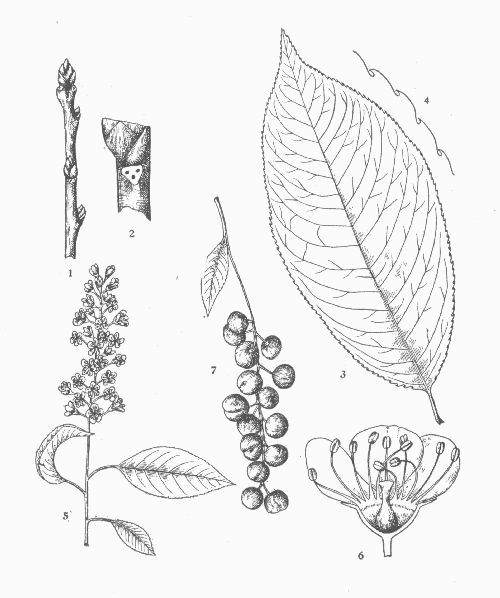
1. Winter twig, × 1. 2. Portion of twig, enlarged. 3. Leaf, × 3/4. 4. Margin of leaf, enlarged. 5. Flowering branchlet, × 1/2. 6. Vertical section of flower, enlarged. 7. Fruiting branchlet, × 1/2.
ROSACEAE
Black Cherry
Prunus serotina Ehrh. [Padus serotina (Ehrh.) Agardh.]
HABIT.—A medium-sized tree 40-50 feet high and 8-36 inches in trunk diameter; branches few, large, tortuous, forming a rather spreading, oblong or rounded crown.
LEAVES.—Alternate, simple, 2-5 inches long, about one-half as broad; oval or oblong to oblong-lanceolate; finely serrate, with teeth incurved; subcoriaceous; dark green and very lustrous above, paler beneath, glabrous both sides; petioles short, slender, usually bearing 2 red glands near the blade.
FLOWERS.—May-June, when the leaves are half grown; perfect; 1/4 inch across; borne on slender pedicels in many-flowered, loose racemes 4-5 inches long; calyx cup-shaped, 5-lobed; petals 5, white; stamens 15-20; stigma thick, club-shaped.
FRUIT.—August-September; a globular drupe, 1/3-1/2 inch in diameter, nearly black, with dark purple, juicy flesh; slightly bitter, edible.
WINTER-BUDS.—Terminal bud about 1/4 inch long, ovoid, blunt to acute; scales keeled on the back, apiculate, light brown.
BARK.—Twigs and branches red to red-brown; young trunks dark red-brown, smooth; blackish on old trunks and rough, broken into thick, irregular plates; bitter, aromatic.
WOOD.—Light, rather hard, strong, close- and straight-grained, light brown or red, with thin, yellow sapwood.
DISTRIBUTION.—Frequent in the southern half of the Lower Peninsula, rare in the northern half and the Upper Peninsula.
HABITAT.—Prefers a rich, moist soil, but grows well on dry, gravelly or sandy soils.
NOTES.—Grows very rapidly in youth.
Choke Cherry
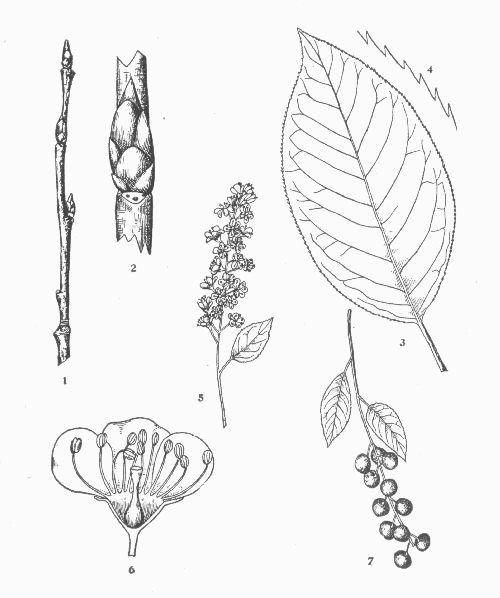
1. Winter twig, × 1. 2. Portion of twig, enlarged. 3. Leaf, × 1. 4. Margin of leaf, enlarged. 5. Flowering branchlet, × 1/2. 6. Vertical section of flower, enlarged. 7. Fruit, × 1/2.
ROSACEAE
Choke Cherry
Prunus virginiana L. [Padus virginiana (L.) Roemer]
HABIT.—Usually a large shrub, but sometimes a small tree 15-25 feet high, with a crooked, often leaning trunk 5-6 inches in diameter; forming a spreading, somewhat rounded crown.
LEAVES.—Alternate, simple, 2-4 inches long, one-half as broad; obovate to oblong-obovate or oval, abruptly acuminate at the apex; finely and sharply serrate; dull dark green above, paler beneath, glabrous both sides; petioles short, slender, glandular at the apex.
FLOWERS.—May, when the leaves are half grown; perfect; about 1/2 inch across; borne on short, slender pedicels in many-flowered racemes 3-6 inches long; calyx cup-shaped, 5-lobed; petals 5, white; stamens 15-20; stigma broad, on a short style.
FRUIT.—July-August; a globular drupe, 1/4-1/2 inch in diameter, usually bright red, often yellow to almost black, with dark red flesh; astringent, but edible.
WINTER-BUDS.—Terminal bud 1/4-1/2 inch long, conical, acute; scales rounded at the apex, light brown, smooth.
BARK.—Twigs at first light brown or greenish, becoming red-brown, finally dark brown; thin, dark brown on the trunk, slightly fissured.
WOOD.—Heavy, hard, close-grained, weak, light brown, with thick, lighter colored sapwood.
DISTRIBUTION.—Common throughout the entire state.
HABITAT.—Prefers a deep, rich, moist loam, but is common on less favorable sites.
NOTES.—The most widely distributed tree of North America, extending from the arctic circle to Mexico, from the Rocky Mountains to the Atlantic Ocean.
Wild Red Cherry. Pin Cherry
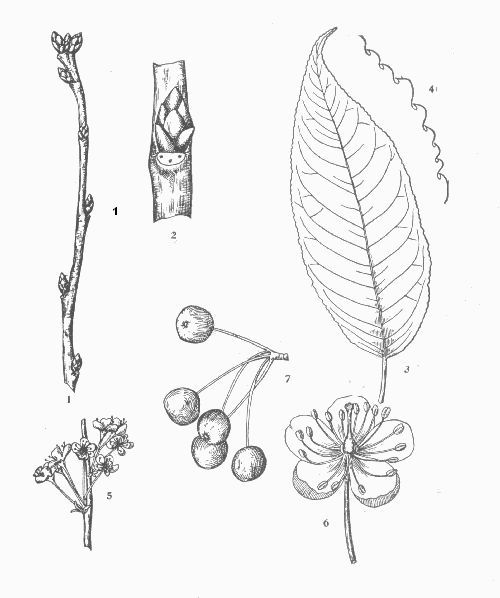
1. Winter twig, × 1. 2. Portion of twig, enlarged. 3. Leaf, × 1. 4. Margin of leaf, enlarged. 5. Flowering branchlet, × 1/2. 6. Flower, enlarged. 7. Fruit, × 1.
ROSACEAE
Wild Red Cherry. Pin Cherry
Prunus pennsylvanica L. f.
HABIT.—A slender tree, seldom over 30 feet high, with a trunk diameter of 8-10 inches; crown rather open, narrow, rounded, with slender, regular branches.
LEAVES.—Alternate, simple, 3-5 inches long, 3/4-1-1/4 inches broad; oblong-lanceolate; finely and sharply serrate; bright green and shining above, paler beneath; petioles slender, 1/2-1 inch long, glandular near the blade.
FLOWERS.—May-June, with the leaves; perfect; about 1/2 inch across, borne on slender pedicels in 4-5-flowered umbels, generally clustered, 2-3 together; calyx 5-cleft, campanulate; petals 5, white, 1/4 inch long; stamens 15-20.
FRUIT.—July-August; a globular drupe, 1/4 inch in diameter, light red, with thick skin and sour flesh.
WINTER-BUDS.—Terminal bud 1/8 inch long, broadly ovoid, rather blunt, brownish, smooth.
BARK.—Twigs at first lustrous, red, marked by orange colored lenticels, becoming brownish; red-brown and thin on the trunk, peeling off horizontally into broad, papery plates; bitter, aromatic.
WOOD.—Light, soft, close-grained, light brown, with thin, yellow sapwood.
DISTRIBUTION.—Throughout the northern portion of the state, extending southward to Ionia County.
HABITAT.—Abundant on sand-lands; roadsides; burned-over lands; clearings; hillsides.
NOTES.—Rapid of growth. Short-lived.
Canada Plum. Red Plum
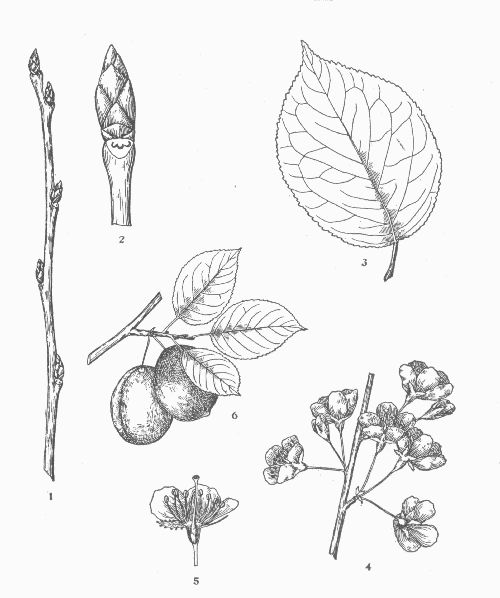
1. Winter twig, × 1. 2. Portion of twig, enlarged. 3. Leaf, × 1/2. 4. Flowering branchlet, × 1/2. 5. Vertical section of flower, × 1. 6. Fruiting branchlet, × 1/2.
ROSACEAE
Canada Plum. Red Plum
Prunus nigra Ait. [Prunus americana, v. nigra Waugh]
HABIT.—A small tree 20-25 feet high and 5-8 inches in trunk diameter; usually divides 5-6 feet from the ground into a number of stout, upright branches, forming a narrow, rigid crown.
LEAVES.—Alternate, simple, 3-5 inches long and one-half as broad; oblong-ovate to obovate, abruptly acuminate at the apex; doubly crenate-serrate; thick and firm; glabrous, light green above, paler beneath; petioles short, stout, bearing 2 large red glands near the blade.
FLOWERS.—May, before the leaves; perfect; slightly fragrant; about 1 inch across; borne on slender, glabrous, red pedicels in 2-3-flowered umbels; calyx 5-lobed, dark red; petals 5, white; stamens 15-20, with purple anthers; ovary 1-celled; style 1; stigma 1.
FRUIT.—August-September; a fleshy drupe, about 1 inch long, oblong-ovoid, with a tough, thick, orange-red skin nearly free from bloom, and yellow flesh adherent to the flat stone. Eaten raw or cooked.
WINTER-BUDS.—Terminal bud absent; lateral buds 1/8-1/4 inch long, ovate, acute, chestnut-brown.
BARK.—Twigs green, marked by numerous pale excrescences, later dark brown; thin, gray-brown and smooth on young trunks, but soon splitting off in large, thick plates, exposing the darker inner bark.
WOOD.—Heavy, hard, strong, close-grained, light red-brown, with thin, lighter colored sapwood.
DISTRIBUTION.—Upper Peninsula and the Lower Peninsula north of Lansing.
HABITAT.—Prefers rich, alluvial soil along streams.
NOTES.—Suckers freely, forming low, broad thickets.