SALICACEAE
Reading edition
SUMMER KEY TO THE SPECIES OF SALIXD
a. Leaf-petioles without glands.
b. Leaves 1/4-3/4 inch broad; petioles broad and flat. S. nigra, p. 37.
bb. Leaves 3/4-1/4 inches broad; petioles slender and terete. S. amygdaloides, p. 39.
aa. Leaf-petioles glandular above.
b. Leaves 1/4-1/2 inch broad, sharp-serrate; tree with weeping habit. S. babylonica, p. 43.
bb. Leaves 1/2-1-1/2 inches broad, blunt-serrate; tree with upright habit. S. fragilis, p. 41.
WINTER KEY TO THE SPECIES OF SALIX
The classification of the Willows is a task for the specialist, even when leaves and both staminate and pistillate flowers are obtainable. It is impractible for the novice to attempt the determination of species of Salix with winter characters alone. Consequently the usual winter key is omitted.
SALICACEAE
Willow
Salix (Tourn.) L.
The genus Salix is represented in Michigan by thirty or more distinct species, and there are many more hybrids. The majority of these are shrubs, only a few becoming truly arborescent. Because of the similarity of their botanical characters, the frequency with which they hybridize, and the facility with which they respond to their environment only an expert is competent to identify the species so abundant along our water courses and on the banks of our lakes and swamps. The scope of this work being necessarily limited, it has been deemed best to describe but two of our native willows and two of our foreign neighbors which are frequently planted.
Black Willow
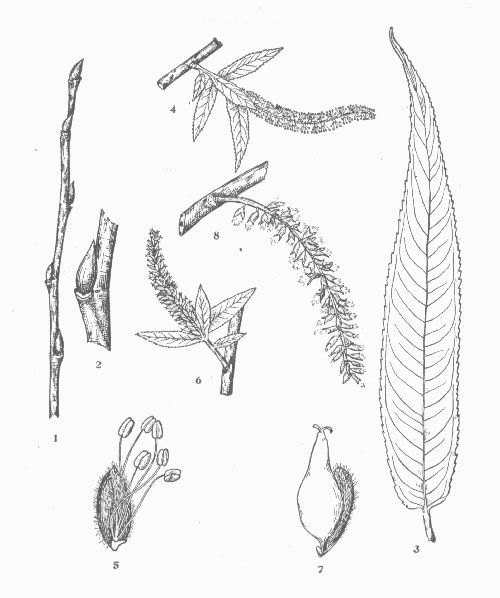
1. Winter twig, × 1. 2. Portion of twig, enlarged. 3. Leaf, × 1. 4. Staminate flowering branchlet, × 1. 5. Staminate flower, enlarged. 6. Pistillate flowering branchlet, × 1. 7. Pistillate flower, enlarged. 8. Fruiting branchlet, × 1.
SALICACEAE
Black Willow
Salix nigra Marsh.
HABIT.—A tree 30-50 feet high, with a short trunk, 1-2 feet in diameter; stout, spreading branches form a broad, rather irregular, open crown. Often a shrub.
LEAVES.—Alternate, simple, 3-6 inches long, 1/4-3/4 inch broad; lanceolate, very long-pointed, often curved at the tip; finely serrate; thin; bright green and rather lustrous above, paler and often hairy beneath; petioles very short, more or less pubescent.
FLOWERS.—April-May, with the leaves; dioecious; borne in crowded, slender, hairy catkins, 1-3 inches long; calyx 0; corolla 0; scales yellow, villous, stamens 3-6; ovary ovoid-conical, short-stalked, with stigmas nearly sessile.
FRUIT.—June; ovoid-conical capsule, 1/8 inch long, containing many minute seeds which are furnished with long, silky, white hairs.
WINTER-BUDS.—Terminal bud absent; lateral buds narrow-conical, acute, lustrous, red-brown, 1/8 inch long.
BARK.—Twigs glabrous or pubescent, bright red-brown, becoming darker with age; thick, dark brown or nearly black on old trunks, deeply divided into broad, flat ridges, often becoming shaggy.
WOOD.—Light, soft, weak, close-grained, light red-brown, with thin, whitish sapwood.
DISTRIBUTION.—Common throughout the state.
HABITAT.—Banks of streams and lake-shores.
NOTES.—Branchlets very brittle at the base, and these, broken off by the wind, are carried down stream, often catching in the muddy banks and there taking root.
Almondleaf Willow
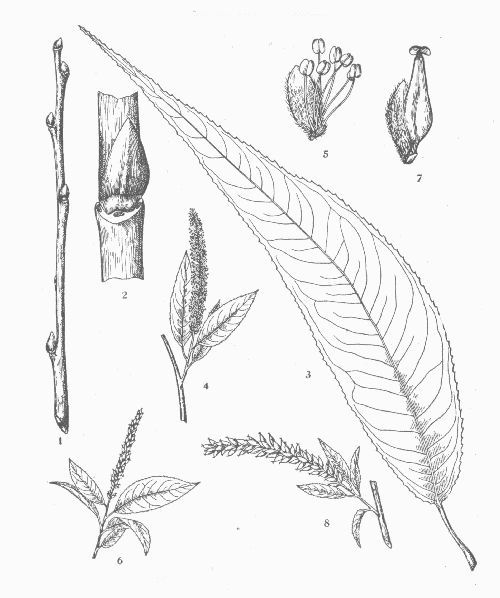
1. Winter twig, × 1. 2. Lateral bud, enlarged. 3. Leaf, × 1. 4. Staminate flowering branchlet, × 1/2. 5. Staminate flower, enlarged. 6. Pistillate flowering branchlet, × 1/2. 7. Pistillate flower, enlarged. 8. Fruiting branchlet, × 1/2.
SALICACEAE
Almondleaf Willow
Salix amygdaloides Anders.
HABIT.—A tree 30-40 feet high, with a straight, columnar trunk 1-2 feet in diameter; straight, ascending branches form a rather narrow, rounded crown.
LEAVES.—Alternate, simple, 2-6 inches long, 3/4-1-1/4 inches broad; lanceolate to ovate-lanceolate, long-pointed; finely serrate; thin and firm; light green and shining above, pale and glaucous beneath; petioles slender, 1/2-3/4 inch long.
FLOWERS.—April, with the leaves; dioecious; borne in crowded, slender, pubescent catkins 2-3 inches long; calyx 0; corolla 0; scales yellow, villous both sides; stamens 5-9; ovary oblong-conical, with stigmas nearly sessile.
FRUIT.—May; 1-celled, globose-conical capsule, 1/4 inch long, containing many minute seeds which are furnished with long, silky, white hairs.
WINTER-BUDS.—Terminal bud absent; lateral buds broadly ovoid, gibbous, lustrous, dark brown, 1/8 inch long.
BARK.—Twigs glabrous, lustrous, dark orange or red-brown becoming darker orange-brown; thick and brown on old trunks, irregularly fissured into flat, connected ridges.
WOOD.—Light, soft, weak, close-grained, light brown, with thick, whitish sapwood.
DISTRIBUTION.—Common throughout the state.
HABITAT.—Banks of streams.
NOTES.—Hybridizes freely with other willows, making its identification difficult.
Crack Willow. Brittle Willow
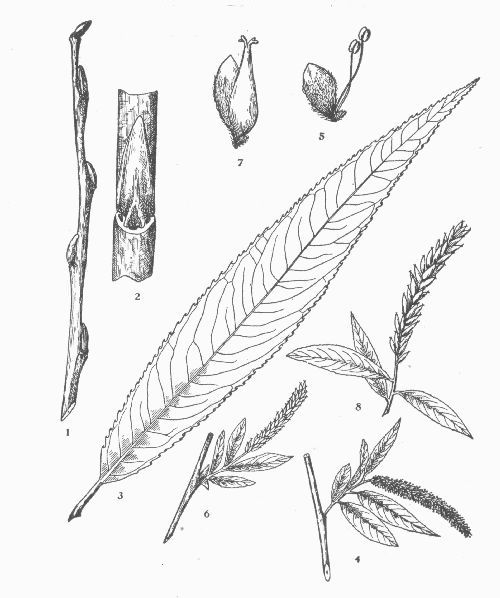
1. Winter twig, × 1. 2. Portion of twig, enlarged. 3. Leaf, × 1. 4. Staminate flowering branchlet, × 1/2. 5. Staminate flower, enlarged. 6. Pistillate flowering branchlet, × 1/2. 7. Pistillate flower, enlarged. 8. Fruiting branchlet, × 1/2.
SALICACEAE
Crack Willow. Brittle Willow
Salix fragilis L.
HABIT.—A tree 50-60 feet high, with a short, stout trunk 3-4 feet in diameter; stout, spreading branches form a broad, open crown.
LEAVES.—Alternate, simple, 3-6 inches long, 1/2-1-1/2 inches broad; lanceolate, long-pointed; finely glandular-serrate; thin and firm; lustrous, dark green above, paler beneath, glabrous both sides; petioles short, stout, with 2 glands at the junction of blade and petiole.
FLOWERS.—April-May, with the leaves; dioecious; borne in slender, pubescent catkins 1-3 inches long; calyx 0; corolla 0; scales blunt, somewhat pubescent; stamens usually 2; ovary abortive, with stigmas nearly sessile. Staminate trees rare.
FRUIT.—April-May; 1-celled, long-conical, short-stalked capsule, about 1/4 inch long, containing many minute seeds which are furnished with long, silky, white hairs.
WINTER-BUDS.—Terminal bud absent; lateral buds long-conical, pointed, glabrous, bright red-brown, about 1/4 inch long.
BARK.—Twigs pubescent, yellow-green, often reddish, becoming glabrous, lustrous, brown; thick, gray on the trunk, smooth in young trees, very rough, irregularly scaly-ridged in old trees.
WOOD.—Light, soft, tough, close-grained, red-brown, with thick, whitish sapwood.
NOTES.—A native of Europe and Asia, where it is a valuable timber tree. Hardy throughout the state and of very rapid growth. Thrives in rich, damp soil. Easily grown from cuttings. The twigs are very brittle at the base and are easily broken by the wind, hence the name Brittle Willow.
Weeping Willow. Napoleon’s Willow
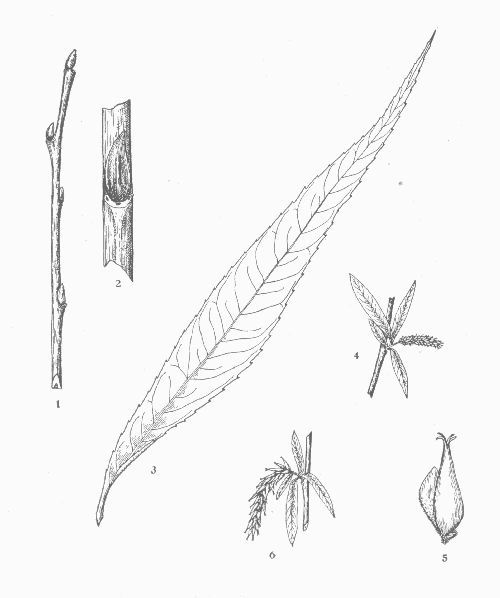
1. Winter twig, × 1. 2. Portion of twig, enlarged. 3. Leaf, × 1. 4. Pistillate flowering branchlet, × 1/2. 5. Pistillate flower, enlarged. 6. Fruiting branchlet, × 1/2.
SALICACEAE
Weeping Willow. Napoleon’s Willow
Salix babylonica L.
HABIT.—A tree 40-50 feet high, with a short, stout trunk 3-4 feet in diameter; the long, slender branchlets, often many feet in length, droop in graceful festoons, giving to the tree a weeping habit.
LEAVES.—Alternate, simple, 3-7 inches long, 1/4-1/2 inch broad; linear to linear-lanceolate, long-pointed; finely sharp-serrate; thin and firm; glabrous, dark green above, paler beneath; petioles 1/2 inch or less in length, glandular above, often hairy.
FLOWERS.—April-May, with the leaves; dioecious; borne in slender, nearly glabrous catkins 1-2 inches long; calyx 0; corolla 0; scales ovate-lanceolate, slightly hairy; ovary ovoid-conical, very short-stalked, with stigmas longer than the style. Staminate trees apparently do not occur in the United States.
FRUIT.—May-June; 1-celled, narrow-ovoid, sessile capsule, about 3/16 inch long, containing many minute seeds which are furnished with long, silky, white hairs.
WINTER-BUDS.—Terminal bud absent; lateral buds narrow-conical, sharp-pointed, somewhat flattened, brownish, 1/8-1/4 inch long.
BARK.—Twigs glabrous, olive-green; thick and gray on old trunks, rather smooth, or irregularly fissured into shallow, firm ridges.
WOOD.—Light, soft, weak, close-grained, light brown, with thick, whitish sapwood.
NOTES.—A native of Europe and Asia. Often grown in cemeteries. Easily propagated by cuttings. Rapid of growth in rich, damp soil. Sometimes winter-killed because the wood is not ripened.
SUMMER KEY TO THE SPECIES OF POPULUS
a. Leaf-petioles essentially terete.
b. Petioles and lower sides of leaves pubescent; leaves heart-shaped. P. candicans, p. 55.
bb. Petioles and lower sides of leaves glabrous; leaves ovate-lanceolate. P. balsamifera, p. 53.
aa. Leaf-petioles strongly flattened.
b. Petioles and lower sides of leaves tomentose; twigs pubescent. P. alba, p. 47.
bb. Petioles and lower sides of leaves glabrous; twigs glabrous.
c. Leaves distinctly deltoid in shape.
d. Leaves broader than they are long, abruptly acuminate at the apex; marginal teeth not conspicuously incurved; branches erect and more or less appressed to the main stem, forming a narrow, spire-like crown. P. nigra italica, p. 59.
dd. Leaves longer than they are broad, more or less taper-pointed at the apex; marginal teeth rather conspicuously incurved; branches spreading, forming a broad crown. P. deltoides, p. 57.
cc. Leaves ovate to nearly orbicular in shape.
d. Margin of leaves coarsely sinuate-toothed; leaves 3-5 inches long. P. grandidentata, p. 51.
dd. Margin of leaves finely serrate; leaves less than 3 inches long. P. tremuloides, p. 49.
WINTER KEY TO THE SPECIES OF POPULUS
a. Branches erect, more or less appressed to the main stem, forming a narrow, spire-like crown. P. nigra italica, p. 59.
aa. Branches spreading, forming a broad crown.
b. Terminal buds 1/8-1/4 inch long, not resinous.
c. Buds and twigs more or less conspicuously white-downy; twigs green. P. alba, p. 47.
cc. Buds and twigs not conspicuously white-downy; twigs usually red-brown.
d. Terminal buds about 1/8 inch long, puberulous, dusty-looking; lateral buds widely divergent; twigs rather coarse. P. grandidentata, p. 51.
dd. Terminal buds about 1/4 inch long, glabrous, lustrous; lateral buds more or less appressed; twigs rather slender. P. tremuloides, p. 49.
bb. Terminal buds 1/2-1 inch long, sticky-resinous.
c. Terminal buds about 1/2 inch long; buds not fragrant; twigs usually yellow, more or less strongly angled. P. deltoides, p. 57.
cc. Terminal buds nearly 1 inch long; buds fragrant; twigs usually red-brown and seldom strongly angled. P. balsamiferaE p. 55. P. candicansE p. 55.
White Poplar
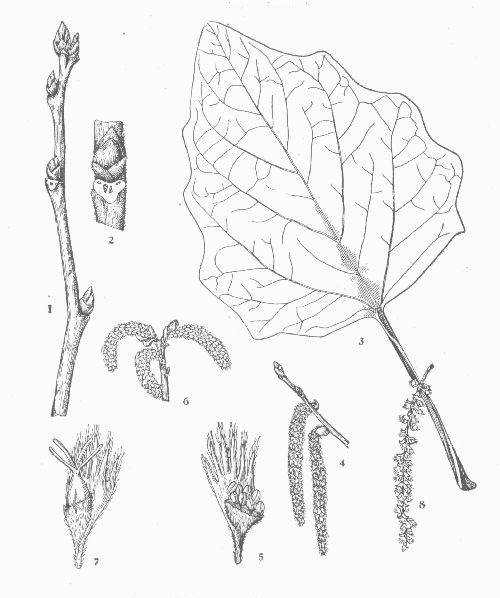
1. Winter twig, × 1. 2. Portion of twig, enlarged. 3. Leaf, × 2. 4. Staminate flowering branchlet, × 1/2. 5. Staminate flower, enlarged. 6. Pistillate flowering branchlet, × 1/2. 7. Pistillate flower, enlarged. 8. Fruit, × 1/2.
SALICACEAE
White Poplar
Populus alba L.
HABIT.—A large tree 60-80 feet high, with a trunk diameter of 2-4 feet, forming a large, spreading, rounded or irregular crown of large, crooked branches and sparse, stout branchlets.
LEAVES.—Alternate, simple, 2-4 inches long and almost as broad; broadly ovate to suborbicular; irregularly toothed, sinuate, or sometimes 3-5-lobed; glabrous, dark green above, white-tomentose to glabrous beneath; petioles long, slender, flattened, tomentose.
FLOWERS.—April-May, before the leaves; dioecious; the staminate catkins thick, cylindrical, 2-4 inches long; the pistillate catkins slender, 1-2 inches long; calyx 0; corolla 0; stamens 6-16, with purple anthers; stigmas 2, branched, yellow.
FRUIT.—May-June; ovoid, 2-valved capsules, 1/8-1/4 inch long, borne in drooping catkins 2-4 inches long; seeds light brown, surrounded by long, white hairs.
WINTER-BUDS.—Ovoid, pointed, not viscid, downy, about 1/4 inch long.
BARK.—Twigs greenish, covered with a white down, becoming greenish gray and marked with darker blotches; dark gray and fissured at the base of old trunks.
WOOD.—Light, soft, weak, difficult to split, reddish yellow, with thick, whitish sapwood.
NOTES.—A native of Europe and Asia. Hardy in Michigan. Grows rapidly in good soils; thrives in poor soils and exposed situations. Roots deep, producing numerous suckers for a considerable distance from the tree.
Aspen
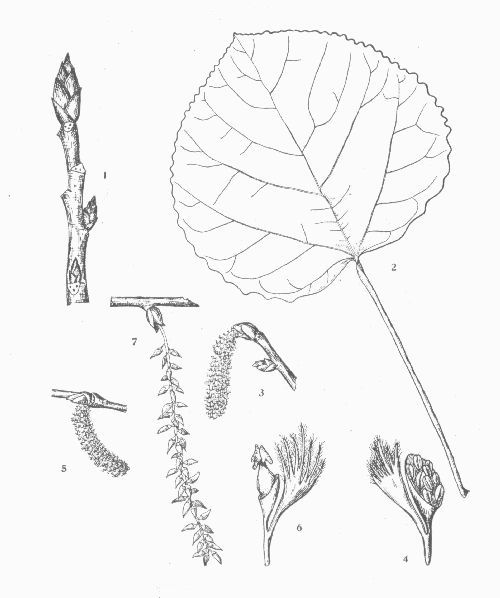
1. Winter twig, × 2. 2. Leaf, × 1. 3. Staminate flowering branchlet, × 1/2. 4. Staminate flower, enlarged. 5. Pistillate flowering branchlet, × 1/2. 6. Pistillate flower, enlarged. 7. Fruit, × 1/2.
SALICACEAE
Aspen
Populus tremuloides Michx.
HABIT.—A small, slender tree generally 35-45 feet high, with a trunk diameter of 8-15 inches; forming a loose, rounded crown of slender branches.
LEAVES.—Alternate, simple, 1-1/2-2-1/2 inches long and broad; broadly ovate to suborbicular; finely serrate; thin and firm; lustrous, dark green above, dull and pale beneath; petioles slender, laterally compressed. Tremulous with the slightest breeze.
FLOWERS.—April, before the leaves; dioecious; the staminate catkins 1-1/2-3 inches long, the pistillate at first about the same length, gradually elongating; calyx 0; corolla 0; stamens 6-12; stigmas 2, 2-lobed, red.
FRUIT.—May-June; 2-valved, oblong-cylindrical, short-pedicelled capsules 1/4 inch long; seeds light brown, white-hairy.
WINTER-BUDS.—Terminal bud about 1/4 inch long, narrow-conical, acute, red-brown, lustrous; lateral buds often appressed.
BARK.—Twigs very lustrous, red-brown, becoming grayish and roughened by the elevated leaf-scars; thin, yellowish or greenish and smooth on the trunk, often roughened with darker, horizontal bands or wart-like excrescences, becoming thick and fissured, almost black at the base of old trunks.
WOOD.—Light, soft, weak, close-grained, not durable, light brown, with thin, whitish sapwood.
DISTRIBUTION.—Common throughout the state, but most abundant in the Upper Peninsula.
HABITAT.—Prefers moist, sandy soil and gravelly hillsides.
NOTES.—One of the first trees to cover burned-over lands. Grows rapidly. Usually short-lived. Propagated from seed or cuttings.
Largetooth Aspen
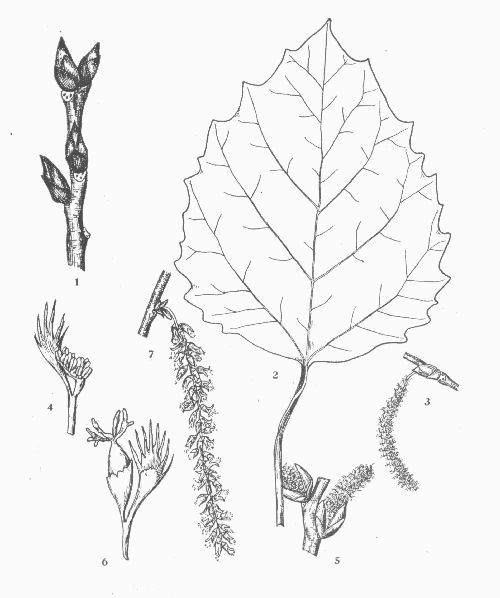
1. Winter twig, × 2. 2. Leaf, × 1. 3. Staminate flowering branchlet, × 1/2. 4. Staminate flower, enlarged. 5. Pistillate flowering branchlet, × 1/2. 6. Pistillate flower, enlarged. 7. Fruit, × 1/2.
SALICACEAE
Largetooth Aspen
Populus grandidentata Michx.
HABIT.—A medium-sized tree 30-50 feet high, with a slender trunk 12-20 inches in diameter; forming a loose, oval or rounded crown of slender, spreading branches and coarse spray.
LEAVES.—Alternate, simple, 3-5 inches long, two-thirds as broad; orbicular-ovate; coarsely and irregularly sinuate-toothed; thin and firm; dark green above, paler beneath, glabrous both sides; petioles long, slender, laterally compressed.
FLOWERS.—April, before the leaves; dioecious; the staminate in short-stalked catkins 1-3 inches long; the pistillate in loose-flowered, long-stalked catkins at first about the same length, but gradually elongating; calyx 0; corolla 0; stamens 6-12, with red anthers; stigmas 2, 2-lobed, red.
FRUIT.—May; 2-valved, conical, acute, hairy capsules 1/8 inch long, borne in drooping catkins 4-6 inches long; seeds minute, dark brown, hairy.
WINTER-BUDS.—Terminal bud 1/8 inch long, ovoid to conical, acute, light chestnut, puberulous, dusty-looking.
BARK.—Twigs greenish gray and at first hoary-tomentose, becoming lustrous, orange or red-brown and finally greenish gray; thick, dark red-brown or blackish at the base of old trunks, irregularly fissured, with broad, flat ridges.
WOOD.—Light, soft, weak, close-grained, light brown, with thin, whitish sapwood.
DISTRIBUTION.—A common tree in the northern portions of the Lower Peninsula, but rare in the Upper Peninsula.
HABITAT.—Prefers rich, moist, sandy soil; borders of swamps; river-banks; hillsides.
NOTES.—Grows rapidly in many soils. Easily transplanted. Short-lived. Useful for temporary effect. Propagated from seed or cuttings.
Balm of Gilead. Balsam
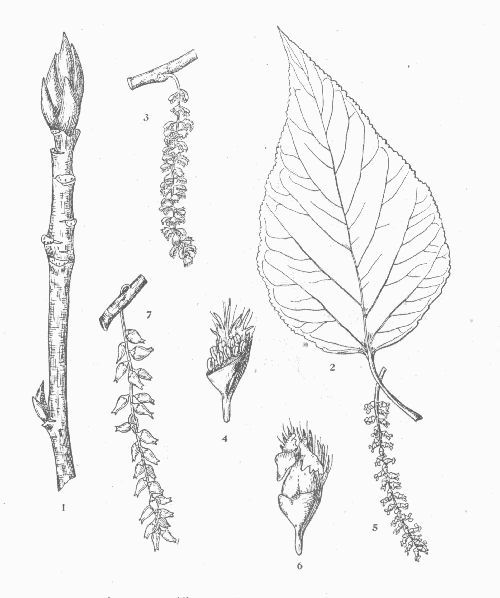
1. Winter twig, × 1. 2. Leaf, × 3/4. 3. Staminate flowering branchlet, × 1/2. 4. Staminate flower, enlarged. 5. Catkin of pistillate flower, × 1/2. 6. Pistillate flower, enlarged. 7. Fruit, × 1/2.
SALICACEAE
Balm of Gilead. Balsam
Populus balsamifera L.
HABIT.—A tree 60-75 feet high, with a trunk diameter of 1-3 feet; forming a rather narrow, open, pyramidal crown of few, slender, horizontal branches.
LEAVES.—Alternate, simple, 3-6 inches long, about one-half as broad; ovate to ovate-lanceolate; finely crenate-serrate; thin and firm; lustrous, dark green above, paler beneath; petioles 1-1/2 inches long, slender, terete, smooth.
FLOWERS.—April, before the leaves; dioecious; the staminate in long-stalked catkins 3-4 inches long; the pistillate in loose-flowered, long-stalked catkins 4-5 inches long; calyx 0; corolla 0; stamens 20-30, with bright red anthers; ovary short-stalked; stigmas 2, wavy-margined.
FRUIT.—May-June; 2-valved, ovoid, short-pedicelled capsules 1/4 inch long, borne in drooping catkins 4-6 inches long; seeds light brown, hairy.
WINTER-BUDS.—Terminal bud about 1 inch long, ovoid, long-pointed, brownish, resin-coated, sticky, fragrant.
BARK.—Twigs red-brown, becoming dark orange, finally green-gray; thick, grayish on old trunks, and shallowly fissured into broad, rounded ridges, often roughened by dark excrescences.
WOOD.—Light, soft, weak, close-grained, light red-brown, with thick, nearly white sapwood.
DISTRIBUTION.—Occurs throughout the entire state, but is more abundant and of greater size in the northern portions.
HABITAT.—Prefers river bottom-lands and borders of swamps.
NOTES.—Rapid in growth. Spreads from the roots. Most useful for shelter belts. Easily transplanted. Propagated from cuttings.
Hairy Balm of Gilead. Balsam
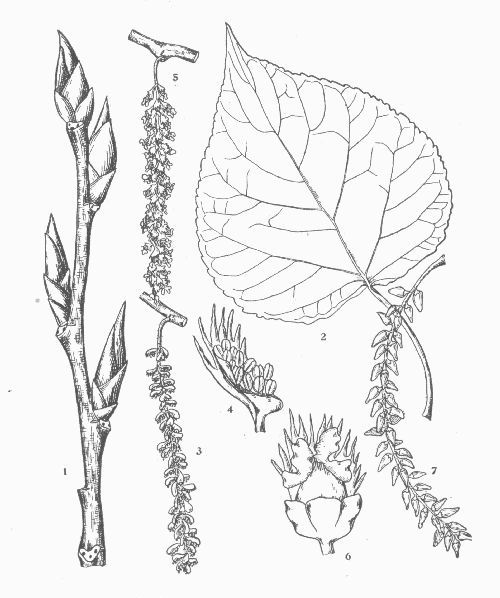
1. Winter twig, × 1. 2. Leaf, × 1/2. 3. Staminate flowering branchlet, × 1/2. 4. Staminate flower, enlarged. 5. Pistillate flowering branchlet, × 1/2. 6. Pistillate flower, enlarged. 7. Fruit, × 1/2.
SALICACEAE
Hairy Balm of Gilead. Balsam
Populus candicans Ait. [Populus balsamifera candicans (Ait.) Gray]
HABIT.—A tree 50-70 feet high, with a trunk diameter of 1-3 feet; more spreading branches than in P. balsamifera, forming a broader and more open crown.
LEAVES.—Resemble those of P. balsamifera, but more broadly heart-shaped and more coarsely serrate; more or less pubescent when young; petioles pubescent.
FLOWERS.—Similar to those of P. balsamifera.
FRUIT.—Similar to that of P. balsamifera.
WINTER-BUDS.—Terminal bud about 1 inch long, ovoid, long-pointed, dark red-brown, resinous throughout, viscid, very aromatic.
BARK.—Twigs reddish or olive-green, with occasional longitudinal gray lines, covered with a fragrant, gummy secretion, becoming gray-green; dark gray, rough, irregularly striate and firm on old trunks.
WOOD.—Resembles that of P. balsamifera, but is somewhat heavier.
DISTRIBUTION.—Indigenous to the northern portions of the state, but often cultivated and occasionally escaping in the southern portion.
HABITAT.—In a great variety of soils and situations.
NOTES.—Grows rapidly in all soils and situations. Suckers readily from the roots. Propagated from cuttings.
Cottonwood
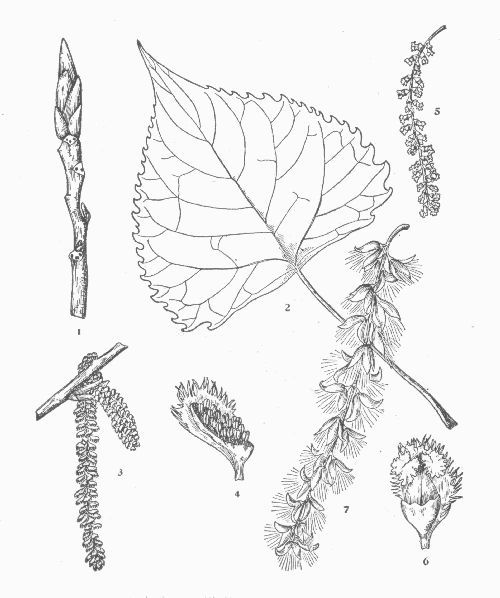
1. Winter twig, × 1. 2. Leaf, × 1/2. 3. Staminate flowering branchlet, × 1/2. 4. Staminate flower, enlarged. 5. Pistillate catkin, × 1/2. 6. Pistillate flower, enlarged. 7. Fruit, × 1/2.
SALICACEAE
Cottonwood
Populus deltoides Marsh. [Populus monilifera Ait.]
HABIT.—A stately tree attaining a height of 70-90 feet and a trunk diameter of 3-5 feet; forming a spreading, open, symmetrical crown of massive, horizontal branches and stout, more or less angled branchlets.
LEAVES.—Alternate, simple, 3-6 inches long, nearly as broad; broadly deltoid-ovate; coarsely crenate-serrate above the entire base; thick and firm; lustrous, dark green above, paler beneath; petioles 2-3 inches long, slender, compressed laterally.
FLOWERS.—April-May, before the leaves; dioecious; the staminate in short-stalked, densely-flowered catkins 3-4 inches long; the pistillate in short-stalked, few-flowered catkins elongating to 6-8 inches; calyx 0; corolla 0; stamens very numerous, with red anthers; stigmas 3-4, spreading.
FRUIT.—May; 2-4-valved, short-stalked capsules, borne in drooping catkins 5-10 inches long; seeds light brown, densely cottony.
WINTER-BUDS.—Terminal bud 1/2 inch long, conical, acute, very resinous, shining, brownish.
BARK.—Twigs and young stems smooth, yellow-green; old trunks ashy gray, deeply divided into straight furrows with broad, rounded ridges.
WOOD.—Light, soft, weak, close-grained, dark brown, with thick, whitish sapwood; warps badly and is difficult to season.
DISTRIBUTION.—Entire Michigan; rare in the northern portions.
HABITAT.—Prefers rich, moist soil; river-banks; river-bottoms; lake-shores; grows well in drier situations.
NOTES.—Rapid of growth, consequently an excellent tree for immediate effect. Propagated from cuttings.
Lombardy Poplar
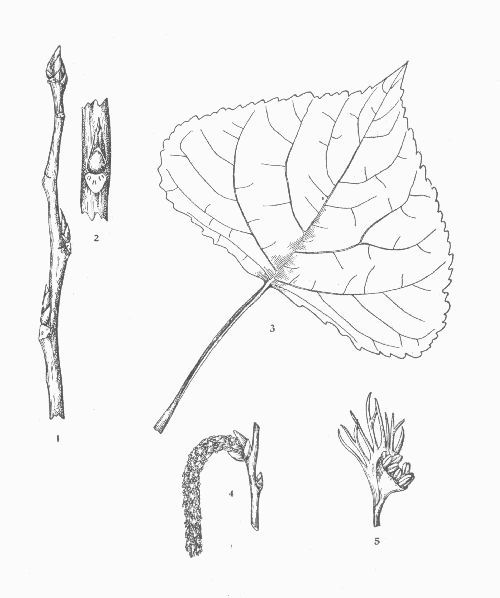
1. Winter twig, × 1. 2. Portion of twig, enlarged. 3. Leaf, × 3/4. 4. Staminate flowering branchlet, × 1/2. 5. Staminate flower, enlarged.
SALICACEAE
Lombardy Poplar
Populus nigra italica DuRoi [Populus fastigiata Desf.] [Populus dilatata Ait.]
HABIT.—A tree 75-100 feet high, with a short, ridged and buttressed trunk 4-6 feet in diameter and a narrow, spire-like crown of erect branches.
LEAVES.—Alternate, simple, 2-4 inches long, and usually somewhat broader than long; broad-deltoid, abruptly acuminate; finely but bluntly crenate-serrate; thick and firm; dark green and shining above, lighter and more or less lustrous beneath; petioles slender, laterally compressed, 1-2 inches long.
FLOWERS.—April-May, before the leaves; dioecious; the staminate in sessile, dark red, cylindrical catkins about 3 inches long; the pistillate not present in the United States; calyx 0; corolla 0; stamens about 8, with white filaments and purple anthers.
FRUIT.—Not formed in the United States in the absence of pistillate flowers.
WINTER-BUDS.—Terminal bud conical, slightly angled, taper-pointed, glutinous, about 3/8 inch long; lateral buds smaller, appressed.
BARK.—Twigs glabrous, shining yellow, becoming gray; thick and gray-brown on old trunks, deeply and irregularly furrowed.
WOOD.—Light, soft, easily worked, not liable to splinter, weak, not durable, light red-brown, with thick, nearly white sapwood.
NOTES.—Thought to be a native of Afghanistan. Very rapid in growth. Short-lived. Spreads by means of suckers and fallen branches. Useful for ornamental purposes. Because of crowding the limbs die early, which remain and cause the tree to look unsightly.