SAPINDACEAE
Reading edition
SUMMER KEY TO THE SPECIES OF AESCULUS
a. Leaflets usually 5; foliage ill-smelling when bruised; bark broken into thick plates; prickly bur about 1 inch in diameter. A. glabra, p. 199.
aa. Leaflets usually 7; foliage not ill-smelling when bruised; bark broken into thin plates; prickly bur about 2 inches in A. hippocastanum, p. 197.
WINTER KEY TO THE SPECIES OF AESCULUS
a. Terminal bud about 2/3 inch long; bud-scales covered with a glaucous bloom, not conspicuously resinous; bark broken into thick plates; prickly bur about 1 inch in diameter. A. glabra, p. 199.
aa. Terminal bud 1-1-1/2 inches long; bud-scales conspicuously sticky-resinous, glistening; bark broken into thin plates; prickly bur about 2 inches in diameter. A. hippocastanum, p. 197.
Horse-chestnut
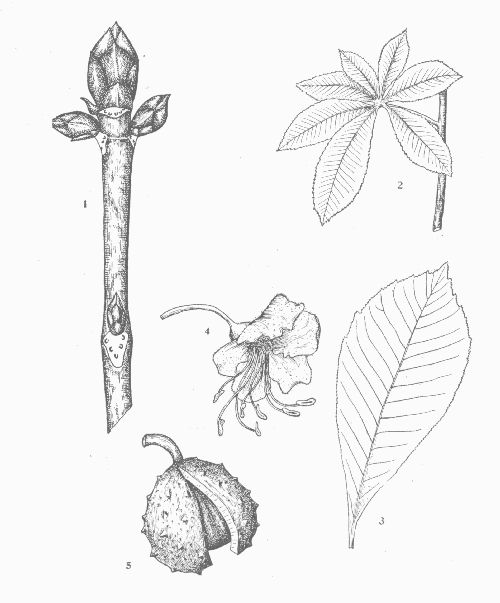
1. Winter twig, × 3/4. 2. Leaf, × 1/6. 3. Leaflet, × 1/2. 4. Flower, × 1. 5. Fruit, × 1/2.
SAPINDACEAE
Horse-chestnut
Aesculus hippocastanum L.
HABIT.—A handsome tree, with a height of 40-60 feet and a trunk diameter of 1-2 feet, forming a broad, conical crown. The regularly occurring branches ascend from the trunk at first, gradually bend downwards as they lengthen, and end in a thick, upturning spray.
LEAVES.—Opposite, digitately compound. Leaflets usually 7, rarely 5, 5-7 inches long, 1-1/2-2-1/2 inches broad; obovate, wedge-shaped at the base; irregularly and bluntly serrate; thick; rough, dark green above, paler beneath, turning a rusty yellow in autumn. Petioles long, grooved, swollen at the base.
FLOWERS.—May-June, after the leaves; polygamo-monoecious; large, whitish, in showy, upright, terminal thyrses 8-12 inches long; pedicels jointed, 4-6-flowered; calyx campanulate, 5-lobed; petals 5, white, spotted with yellow and red, clawed; stamens 7, thread-like, longer than the petals.
FRUIT.—October; a leathery, globular capsule about 2 inches in diameter, roughened with short spines; containing 1-3 large, smooth, lustrous, brown nuts, marked by large, pale scars.
WINTER-BUDS.—Terminal buds 1-1-1/2 inches long, acute, brownish, covered with glistening, resinous gum; inner scales yellowish, becoming 1-1/2-2 inches long in spring, remaining until the leaves are nearly half grown.
BARK.—Twigs smooth, red-brown; trunk dark brown and broken into thin plates by shallow fissures; rich in tannin, bitter.
WOOD.—Light, soft, close-grained, weak, whitish, with thin, light brown sapwood.
NOTES.—A native of Greece, extensively cultivated throughout Europe and America, where it is a favorite shade tree. A double-flowered variety, Aesculus hippocastanum, v. flòre plèno, which bears no fruit is a common garden form.
Ohio Buckeye
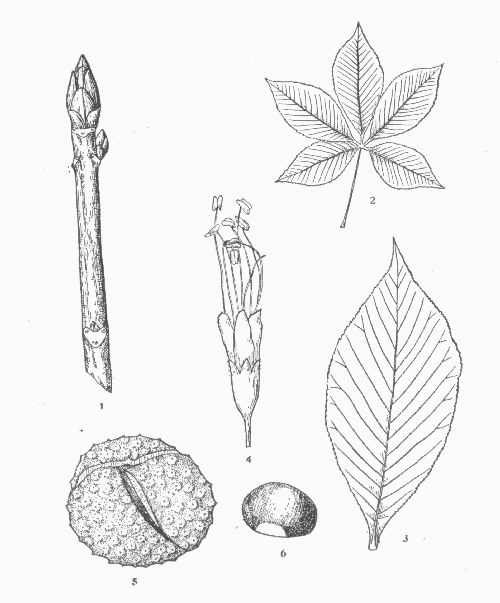
1. Winter twig, × 1. 2. Leaf, × 1/6. 3. Leaflet, × 1/2. 4. Flower, × 2. 5. Fruit, × 1/2. 6. Nut, × 1/2.
SAPINDACEAE
Ohio Buckeye
Aesculus glabra Willd.
HABIT.—A medium-sized tree 30-50 feet in height, with a trunk not over 2 feet in diameter; usually much smaller; slender, spreading branches, forming a broad, rounded crown; twigs thick.
LEAVES.—Opposite, digitately compound. Leaflets usually 5, rarely 7, 3-6 inches long, 1-1/2-2-1/2 inches broad; ovate or oval, gradually narrowed to the entire base; irregularly and finely serrate; glabrous, yellow-green above, paler beneath, turning yellow in autumn. Petioles 4-6 inches long, slender, enlarged at the base. Foliage ill-smelling when bruised.
FLOWERS.—April-May, after the leaves; polygamo-monoecious; small, yellow-green, in terminal panicles 5-6 inches long and 2-3 inches broad, more or less downy; pedicels 4-6-flowered; calyx campanulate, 5-lobed; petals 4, pale yellow, hairy, clawed; stamens 7, with long, hairy filaments.
FRUIT.—October; a thick, leathery, prickly capsule, about 1 inch in diameter, containing a single large, smooth, lustrous, brown nut. A large pale scar gives the name “Buckeye.”
WINTER-BUDS.—Terminal buds 2/3 inch long, acute, resinous, brownish; inner scales yellow-green, becoming 1-1/2-2 inches long in spring and remaining until the leaves are nearly half grown.
BARK.—Twigs smooth, red-brown, becoming ashy gray; old trunks densely furrowed and broken into thick plates; ill-smelling when bruised.
WOOD.—Light, soft, close-grained, weak, whitish, with thin, light brown sapwood.
NOTES.—A native of the Mississippi River Valley. Occasionally planted in southern Michigan for ornamental purposes, but is less popular than the Horse-chestnut.