CORNACEAE
Reading edition
SUMMER KEY TO THE SPECIES OF CORNUS
a. Leaves mostly alternate; branches usually greenish; flowers not surrounded by large petal-like bracts; fruit globular, blue, borne many in loose clusters. C. alternifolia, p. 207.
aa. Leaves opposite; branches usually reddish or yellowish; flowers surrounded by large petal-like bracts; fruit ovoid, scarlet, borne in close clusters of 3-4. C. florida, p. 205.
WINTER KEY TO THE SPECIES OF CORNUS
a. Leaf-scars mostly alternate; buds light brown; branches usually greenish. C. alternifolia, p. 207.
aa. Leaf-scars opposite; buds greenish; branches usually reddish or yellowish. C. florida, p. 205.
Flowering Dogwood. Dogwood. Boxwood
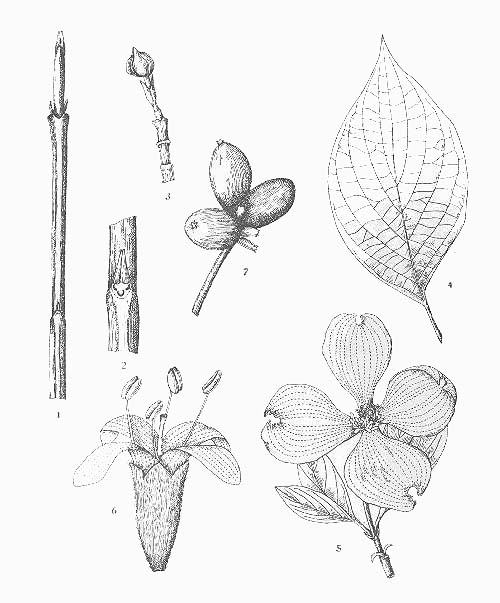
1. Winter twig, with leaf buds, × 1. 2. Portion of twig, enlarged. 3. Winter twig, with flower bud, × 1. 4. Leaf, × 1/2. 5. Flowering branchlet, × 1/2. 6. Flower, enlarged. 7. Fruit, × 1.
CORNACEAE
Flowering Dogwood. Dogwood. Boxwood
Cornus florida L.
HABIT.—A bushy tree with a height of 15-30 feet and a short trunk 8-12 inches in diameter; slender, spreading branches form a flat-topped crown.
LEAVES.—Opposite, closely clustered at the ends of the branchlets, simple, 3-5 inches long, 2-3 inches broad; ovate to elliptical; obscurely wavy-toothed; thick and firm; bright green, covered with minute, appressed hairs above, pale and more or less pubescent beneath, turning bright scarlet in autumn; petioles short, grooved.
FLOWERS.—May, with the leaves; perfect; greenish; in dense clusters, surrounded by 4 large, white or pinkish, petal-like bracts (often mistaken for the corolla), borne on short, stout peduncles; calyx 4-lobed, light green; petals 4, yellow-green; stamens 4, alternate with the petals; ovary 2-celled.
FRUIT.—October; an ovoid, scarlet drupe, borne in close clusters of 3-4; flesh is bitter.
WINTER-BUDS.—Leaf-buds narrow-conical, acute, greenish; flower-buds spherical or vertically flattened, grayish.
BARK.—Twigs pale green, becoming red or yellow-green their first winter, later becoming light brown or red-gray; red-brown or blackish on the trunk, often separating into quadrangular, plate-like scales.
WOOD.—Heavy, hard, strong, tough, close-grained, brownish, with thick, lighter colored sapwood.
DISTRIBUTION.—Southern Michigan as far north as the Grand-Saginaw Valley.
HABITAT.—Prefers rich, well-drained soil, usually under the shade of other trees.
NOTES.—A valuable species for ornamental purposes. Rather slow of growth.
Blue Dogwood. Alternate-leaved Dogwood
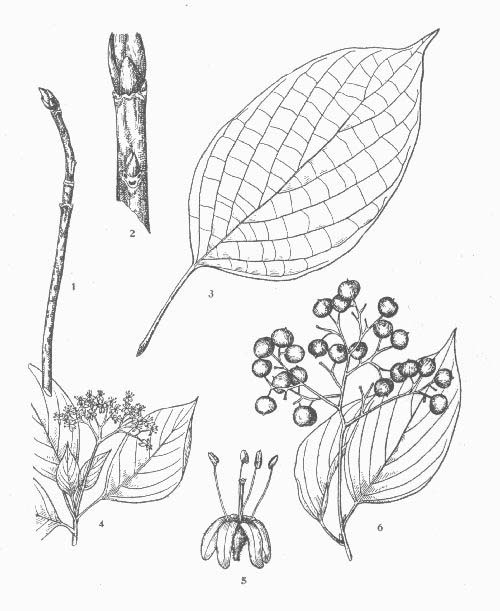
1. Winter twig, × 1. 2. Portion of twig, enlarged. 3. Leaf, × 3/4. 4. Flowering branchlet, × 1/2. 5. Flower, enlarged. 6. Fruiting branchlet, × 1/2.
CORNACEAE
Blue Dogwood. Alternate-leaved Dogwood
Cornus alternifolia L. f.
HABIT.—A small tree or large shrub reaching a height of 25-30 feet and a trunk diameter of 6-8 inches; more often smaller than this. The long, slender branches are arranged in irregular whorls, forming flat, horizontal tiers, giving the tree a storied effect.
LEAVES.—Mostly alternate and clustered at the ends of the branchlets; simple, 3-5 inches long, 2-1/2-3 inches broad; oval or ovate, long-pointed, wedge-shaped at the base; obscurely wavy-toothed; thin; dark green, nearly glabrous above, paler and covered with appressed hairs beneath, turning yellow and scarlet in autumn; petioles slender, grooved, hairy, with clasping bases.
FLOWERS.—May-June, after the leaves; perfect; borne on slender pedicels in many-flowered, irregular, open cymes from the season’s shoots; calyx cup-shaped, obscurely 4-toothed, covered with fine, silky, white hairs; petals 4, cream colored; stamens 4; ovary 2-celled.
FRUIT.—October; a globular, blue-black drupe, borne in loose, red-stemmed clusters; flesh bitter.
WINTER-BUDS.—Leaf-buds small, acute, light brown; flower-buds spherical or vertically flattened.
BARK.—Twigs greenish or reddish, becoming smooth, dark green; thin, dark red-brown and shallowly fissured on the trunk.
WOOD.—Heavy, hard, close-grained, red-brown, with thick, lighter colored sapwood.
DISTRIBUTION.—Scattered throughout both peninsulas.
HABITAT.—Prefers moist, well-drained soil on the borders of streams and swamps, often in the shade of other trees.
NOTES.—Hardy throughout the state. Easily transplanted. The only Cornus with alternate leaves and branches.
Black Gum. Pepperidge
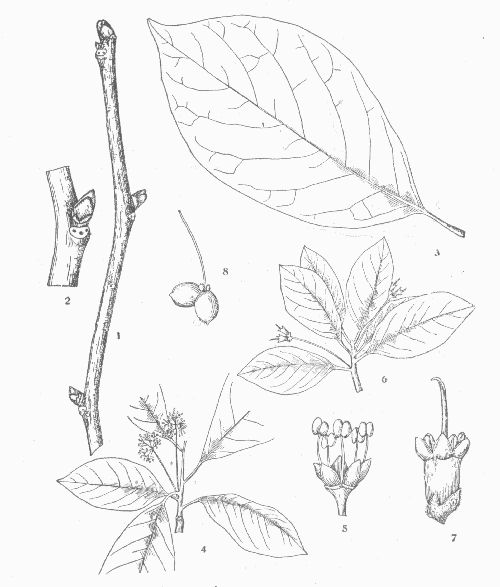
1. Winter twig, × 1. 2. Portion of twig, enlarged. 3. Leaf, × 3/4. 4. Staminate flowering branchlet, × 1/2. 5. Staminate flower, enlarged. 6. Pistillate flowering branchlet, × 1/2. 7. Pistillate flower, enlarged. 8. Fruit, × 1/2.
CORNACEAE
Black Gum. Pepperidge
Nyssa sylvatica Marsh. [Nyssa multiflora Wang.]
HABIT.—A medium-sized tree 40-50 feet high, with a trunk diameter of 1-2 feet, forming a rounded to cylindrical crown of slender, spreading, pendulous branches and a stiff, flat spray.
LEAVES.—Alternate, simple, 2-5 inches long, one-half as broad; oblong-obovate to oval; entire, or sometimes wavy-margined; thick and firm; very lustrous and dark green above, pale and often hairy beneath, turning bright scarlet, on the upper surface only, in autumn; petioles short.
FLOWERS.—May-June, with the leaves; polygamo-dioecious; greenish; borne on slender, downy peduncles; the staminate slender-pedicelled, in many-flowered heads; the pistillate sessile, in several-flowered clusters; calyx cup-shaped, 5-toothed; petals 5; stamens 5-10; stigma stout, terete, recurved.
FRUIT.—October; fleshy drupes, ovoid, blue-black, about 1/2 inch long, sour, in clusters of 1-3.
WINTER-BUDS.—1/8-1/4 inch long, ovoid, obtuse, dark red.
BARK.—Twigs greenish or light brown, smooth or often downy, becoming smooth, dark red-brown; thick, red-brown on old trunks, deeply furrowed.
WOOD.—Heavy, soft, strong, very tough, difficult to split, not durable in contact with the soil, pale yellow, with thick, whitish sapwood.
DISTRIBUTION.—Frequent in the southern half of the Lower Peninsula. Has been reported as far north as Manistee.
HABITAT.—Prefers the borders of swamps and low, wet lands. Rarely flourishes in exposed situations.
NOTES.—Of great ornamental value. Not easily transplanted. Pith of twigs with thin, transverse partitions.