THE NOTTINGHAM MINT By Frank E. Burton, F.R.N.S., J.P.
Reading edition
In contributing a paper upon the coins and tokens either relating to or struck in the city of Nottingham, or in the county of Nottingham, it is quite impossible for me to give a complete history or even a brief description of each coin or token, or to describe all the different dies from which they were struck in the space kindly allotted to me by the editor; but the illustrations taken from amongst those specimens in my possession should, I hope, give the reader a very good idea of what these coins and tokens are like, and although there are many varieties, these in most cases only differ in detail in wording and dates; in fact, generally some small alterations in the die.
The Nottingham Mint.—In Saxon and Norman times this mint must have been an important one, considering that we know of eleven kings who coined silver pennies here. No coins were struck above the value of one penny, and the coinage of the whole kingdom at this period practically consisted of silver pennies.
In 924 Edward the Elder captured the town from the Danes, and afterwards rebuilt it, but we do not know if he established a mint, as no coins of his are known to have been struck at Nottingham; but the mint was in operation in the reign of his successor, Athelstan, 925–940.
According to Domesday Book there were two moneyers in Nottingham in the days of Edward the Confessor, and they paid to the King the sum of forty shillings.
This amount had been increased to ten pounds by the Conqueror when Domesday Book was written, thus showing that the Nottingham Mint was then a royal one.
One pound sterling was understood to be a pound weight of silver coined into about 240 pennies. One penny would, in Saxon times, more than pay a workman for his day’s labour, so that ten pounds was a large sum of money in those days.
When we consider that the yield from this mint and these moneyers had increased from two pounds to ten pounds, I think we may rightly assume that they were looked upon as a considerable source of income by the Exchequer.
Accepting this and knowing that such a large number of varieties of coins were struck during the long period of about 230 years, in which this mint is known to have existed, it is rather strange that these early coins should be so seldom met with, and that some should be so excessively rare. I know of no coins struck in Nottingham by any king after the reign of Stephen.
The Newark Mint.—As far as is known, only one Saxon King is supposed to have struck money here, and only two Kings of later periods.
The first coin said to have been struck at Newark is that of King Edwy, 955–959. Although the British Museum describes it as Newark, Northamptonshire, there is little doubt that it was struck at Newark, Notts, as Newark, Notts, is the only Newark mentioned in Domesday Book.
The next two Kings who were supposed to have issued pennies were Henry I., 1100–1135, and Henry II., 1154–1189, and the place of minting Ne, short for Newark. It is questionable if any coins were struck at Newark in the reign of Henry I. It is probable that Henry I. granted a charter to the Bishop of Lincoln to coin money at Newark, as we know a charter to this effect was confirmed by Stephen, and coins of Stephen’s reign struck at Newark are known to exist.
Henry II.—It is extremely doubtful if any coins of this reign were struck at Newark.
The Torksey Mint.—Ethelred II. (979–1016) is supposed to have struck money here, but opinions differ upon this question. Turc being short for Torksey, I am very much of opinion that these coins were struck at Torksey, for in Saxon times Torksey was probably the most important town between Nottingham and the Humber.
The Shelford Mint.—Earl Sitric, who was killed in the battle of Ashdown, A.D. 870, is understood to have struck coins here.
The first coin illustrated is that of Athelstan, 925–940. (No. 1.)
Obverse. Edelnod on Snotenceham.
Reverse. Edelnod on Snotenceham.
There is a coin of this reign in the British Museum with this same reading on the reverse, and on the obverse—Edelstan re Saxorum.
This coin is rare and extremely interesting. It does not bear the King’s name or any of his titles. Edelnod is the moneyer’s name, and he was the moneyer for Nottingham and also for Derby. It has the same reading on both sides, which is exceptional, and it is the first authenticated coin struck at Nottingham, and the only coin having the full reading Snotenceham; in all other Saxon or Norman coins struck in Nottingham by any other Kings, the name of the city is abbreviated.
This abbreviation of the name of the city often occurred in deeds of the period; in fact, we find it as late as in the charter granted by Henry II., 1155, to Nottingham, and where the name reads “Noting” and “Notingh.”
The “S” in the name of Nottingham was first dropped in the foundation charter of Lenton Priory about the year 1108.
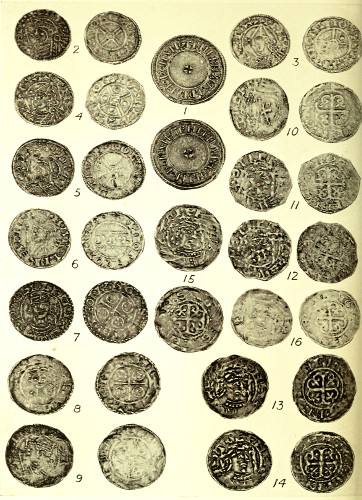
Coins: Athelstan to Stephen.
From photographs by Mr. S. Barlow Vines.
Athelstan was the first monarch who paid any considerable attention to his coinage, and it is from his laws that we first obtain any authentic information about the mints.
In 928 he held a grand synod, at which Wulfhelme, Archbishop of Canterbury, and all the great and powerful men of the kingdom were assembled. They decided that the whole coinage of the realm should be alike, and should bear the King’s portrait only, withdrawing the privilege from the bishops, abbots, barons, &c., of having their portraits struck upon the coins.
They also agreed that money should only be minted in a town, and decided that each burg was entitled to one moneyer, but certain places, on account of their importance, were entitled to two or more. Nottingham had two, London eight, Canterbury seven, Winchester six, and Rochester three. The penalty for establishing a private mint was death. Considering that in these days Nottingham was divided into two burgs, it is extremely probable that there were two mints—one for each burg.
The names of sixty different towns are known where money was minted.
From the fact that the coin illustrated has no portrait upon it, it leads one to suppose it was struck in the early part of Athelstan’s reign before the above law was enacted.
Ethelred II., 979–1016, issued money from Nottingham.
The sceptre first appeared on the coins of Ethelred in front of the profile, and this usage in subsequent reigns became general.
Canute, 1016–1035.
Obverse. Cnut recx. Head crowned to left with sceptre.
Reverse. Blamiam O Sno. (No. 2.)
Obverse. Cnut recx a. Head to left having on a conical helmet, with sceptre.
Reverse. Bruninc on Snoti. (No. 3.)
Obverse. Cnut recx a. Head to left with sceptre; on head is a conical helmet.
Reverse. Blacaman on Sno. (No. 4.)
All the coins of this reign have the place of mintage and the moneyer’s name mentioned. The moneyer was responsible for the purity of the coins and their just weight, under various penalties—firstly, his hand was cut off, secondly, death; but in some few cases fines were imposed, as instanced in the case of Swein, who was a moneyer at Nottingham during the reign of Henry I. and Stephen. He was fined 100 shillings.
Numerous varieties of this coin are known, of which the three illustrated show two different dies and three different moneyers. It is not surprising to find coins of this monarch struck at Nottingham, as his coins bear the names of more places of mintage than those of any other reign.
Harold I., 1035–1040.
Two coins of this reign are known with the reading: Harold Rex and the Moneyer Blacaman or Sacgrim. The abbreviated name was Sn.
Hardicanute, 1040–1042.
Although this King is mostly styled Harthacnut or Harthecnut, Re or Rex, with the mint and moneyer always mentioned, in a known example struck at Nottingham the reading is “Hardacn” and on the reverse, “Plunod on Snot.”
Edward the Confessor, 1042–1066.
Obverse. Edpard Re.
Reverse. Blaceh on snotine. (No. 5.)
On all coins the Saxon “P” is used for “W” with one or two rare exceptions.
His coins are very varied. On some of them the head is bearded. They vary exceedingly in size and weight, but all appear to have had the same nominal value.
Considering that eight different varieties of coins exist, which were struck at Nottingham, with the place of minting Sn., Sno., Snoti., Snotih, and Znot, it seems strange that they should be so seldom met with. During this reign halfpennies and farthings were first formed by cutting the pennies in two or four parts, but none are known relating to Nottingham.
Harold II., 1066.
Obverse. Harold Rex angl. Bust to left with sceptre.
Reverse. Forna on Snotn, and Pax between two beaded parallel lines (No. 6).
Several varieties of these coins are known, but they are uncommon.
William I., 1066–1087.
When the rule of England changed from Saxon to Norman there was no alteration in the style of the coinage, and silver pennies continued to be the sole current coin of the realm.
William I., 1066–1087.
William II., 1087–1100.
Obverse. Pillelm Rex.
Reverse. Iitsere on Snotin. (No. 7.)
Obverse. Pillelm Rex.
Reverse. Mana on Snoti. (No. 8.)
In the reigns of the two Williams the number of moneyers increased considerably and at least ten are known, and the following abbreviated readings of Nottingham are found on the coins:—Sn, Sno, Snot, Snoti, Snotin, Snotig, Snotine, Snotinc, Snotinge, Snotigne.
Many varieties of coins were struck, but it is somewhat difficult to assign the coins to their respective issuers.
Henry I., 1100–1135.
Obverse. Henricus R. Front face with sceptre; at the side of the neck is a cross of four pellets.
Reverse. Aldene on Sno. Quatrefoil inclosing cross of pellets with a star in the centre. Fleur de lis in the angles. (No. 9.)
Stephen, 1135–1154.
The coins of this reign are of very great interest, and more is known about them since two hoards were found—one in 1867 at the old Hall at Sheldon, near Bakewell, the other in 1880 in Rose Yard, Bridlesmith Gate, Nottingham; a large portion being of the reign of Stephen and of the Nottingham Mint, amongst them some few not previously known. During this reign money is supposed to have been much debased, but none of these debased specimens exist.
Obverse. Stiefne.
Reverse. Spein on Snot. (No. 10.)
Obverse. Stiefne: Re.
Reverse. Spein on Snot. (No. 11.)
Obverse. Stiefne: Re.
Reverse. Spein on Snot. (No. 12.)
Swein was the moneyer, the Saxon “P” being used for “W.”
It will be noticed that the obverse of each is defaced with a small cross over the King’s face.
In Nos. 11 and 12, which are from the Nottingham find, we have, in addition to the cross, a small pellet and a line cut in the die, and so almost obliterating the King’s head.
It is now a very generally accepted fact that the partisans of Matilda, having no dies except Stephen’s, used his dies, but did not wish to acknowledge his title, and so cut a cross in the die to deface the King’s head.
Probably these coins were issued by William Peverel II. of Nottingham during Stephen’s captivity in 1141. Peverel, being Governor of Nottingham and holding the Castle, would no doubt have control of the mint during this troublous time. Examples exist with larger shaped crosses and different from the above.
Obverse. Stiefner.
Reverse. Spein on Snot. (No. 13.)
Obverse. Stiefne: R.
Reverse. Spein on Snot. (No. 14.)
Obverse. Stiefne: Rex.
Reverse. Spein on Snot. (No. 15.)
Obverse. Stiefne.
Reverse. Spein on Snotig. (No. 16.)
Nos. 13, 14, 15 are from the Nottingham find, and have very fine large profile busts, and are exceptionally fine specimens for coins of Stephen. In No. 16, though the lettering is somewhat worn, the portrait is good, but quite different from the others, it being struck in the early part of his reign. It has the rare name of the place of minting “Snotig.”
Other varieties exist struck at Nottingham, also cut halfpennies.
Newark Siege Pieces.—During the years 1645 and 1646, the Royalist party held Newark and set up a mint.
Many Royalist supporters gave their silver and silver gilt cups, flagons, dishes, and family plate for the Royalist cause; others sold their family plate for so much per ounce to be coined into money. This coining down of thousands of ounces of silver plate belonging to the nobility and gentry of the surrounding districts must have caused a barbarous destruction of many ancient, rare, and valuable relics of the highest interest to the towns of Nottingham and Newark.
Extract from the Kings Proclamation at York.
“And such of our subjects as shall come to us—either to our said town of Nottingham or to any other place where we shall happen to encamp—and whosoever shall in this our danger and necessity supply us either by gift or loan of money or plate.”
From the circular letter of Loan which was sent about and delivered by Troopers:—
“... desire you forthwith to lend us the sum of Twenty Pounds or the value thereof in Plate, touched Plate at five shillings, untouched Plate at four shillings and fourpence per ounce ... which we promise to repay as soon as God shall enable us.”
Charles I. was quite an old and experienced hand at borrowing money as instanced in the private instructions sent to the Commissioners of Nottingham some years previous to the siege of Newark:—
“That in your treating with your neighbours, about this businesse, yee shew your own discretions and affections, by making choice of such to begin with, who are likely to give the best examples; and when yee have a competente number of hands to the roll or liste of the lenders, that yee shew the same to others as they come before yee, to lead them to lend in like manner.”
In the Memoirs of Hampden we read:—
“The Midland Counties of England, however, undertook with great alacrity to bear this charge. They voluntarily subscribed their money and their plate. The Cities of London and Westminster were forward and liberal in their contributions. The women brought in their rings and jewels; the goldsmiths and silversmiths their stock.”
In 1642 the King when at Nottingham, just about the breaking out of the Civil War, received as a loan from the Universities nearly all their plate, which was to be repaid at so much per ounce for white silver and so much extra for the gilt silver. Most of this silver was minted at York, but some was paid out in its original form to be sold for the pay of the troops.
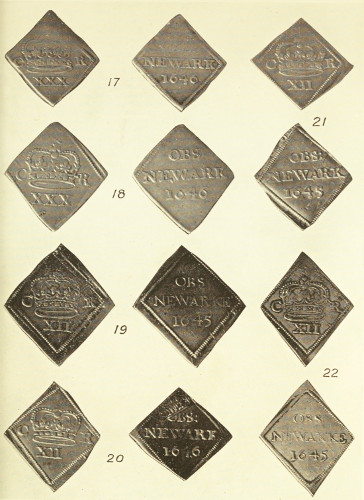
Newark Siege Pieces: Half-crowns and Shillings.
From photographs by Mr. S. Barlow Vines.
In 1644 Parliament ordered all the King’s plate to be melted down and coined, notwithstanding a remonstrance from the Lords alleging that the curious workmanship of these ancient pieces of silver made them worth more than the metal.
To such dire necessity were the Royalist party put for money, that even at Newark some “regal” service of plate was used. These pieces of money were roughly cut and curiously shaped. The city being besieged, there would no doubt be an urgent demand for money, and the Royalists, not having any dies or skilled workmen who could make them, they made the best they could; for even if a man could not cut the likeness of the King, he might not have much difficulty in cutting a crown, a few letters, and figures. They were all struck upon lozenge-shaped flans, which flans were cut direct from the silver plate.
The coins were of the value of 2s. 6d., 1s., 9d., and 6d., and must have been struck from various dies, as several varieties exist dated 1645/1646. Numerous specimens are found gilt, showing they must have been cut from services of gilt plate.
The general design of these coins is the same, namely:—
Obverse. C.R. (Carolus Rex) with a crown between, with value expressed beneath in Roman numerals all within a single pearled border.
Reverse. Obs. (Obsidium-Siege) Newark, with date beneath in Arabic figures.
The two half-crowns, Nos. 17 and 18, show differently designed crowns.
On No. 18 may be seen marks of the pattern of the cup or salver from which it was hastily cut.
The four shillings, numbered 19, 20, 21, and 22, show four distinct crowns. On No. 19 a double pearled border may be traced.
On the reverse of No. 20, part of the Royal Arms may be seen; undoubtedly this silver at one time formed part of some regal service of plate. This is an extremely uncommon and interesting piece.
No. 21 has the letter “L” beneath the date 1645, which appears to be a silversmith’s private stamp indicating the source from whence it originally came.
On Nos. 19 and 22 the reading is “Newarke.”
The four ninepences, numbered 23, 24, 25, and 26, show three different crowns, Nos. 25 and 26 being replicas. On the obverse of No. 25 there are two “K’s” at the end of the word “Newarke,” showing this coin was doubly struck.
The sixpences, numbered 27 and 28, are alike.
Tokens.—During the seventeenth century money continued to be extremely scarce, especially that of small denomination, probably owing to the exactions made for the wars and to the poverty of the inhabitants, and tokens—chiefly halfpennies and farthings of copper or brass—were struck by corporate bodies, chamberlains, and all descriptions of tradesmen with the names of the owners thereon to facilitate easy purchase and ready settlement. These tokens were superseded, after 1672, by the coinage of the realm.
A token in money is understood to be a coin issued by a private individual or firm above its real value, but intrinsically a guarantee of good faith of the issuer that he will pay the nominal value when demanded.
The first mention of tokens is by Ruding. He quotes from the writer of the History of Allchester in 1622:—“King Edward, 1272–1307, his leathern money bearing his name, stamp, and picture, which he used in the building of Carnarvon, Beaumarish, and Conway Castles.”
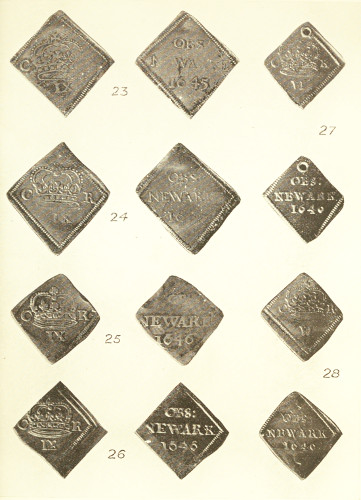
Newark Siege Pieces: Ninepences and Sixpences.
From photograph by Mr. S. Barlow Vines.
In Nottinghamshire 121 tokens are known representing halfpennies and farthings, all of which were issued between the years 1650 to 1670. I only illustrate a few:—
Nottingham.
Obverse. Nottingham halfe penny chainged by ye Chamberlain 1669.
Reverse. Arms of the Town of Nottingham. (No. 29.)
Obverse. Thomas Burrowes. A rose with Sm above.
Reverse. In Nottingham. A. Castle. (No. 30.) ½
Obverse. John Blunt at the Weeke. A man on horseback with panniers.
Reverse. Day Cross of Nottingham Baker his halfpenny. (No. 31.)
Obverse. Roger Hawksley 1666. Merchant Tailors’ Arms.
Reverse. in Nottingham. His halfpenny. (No. 32.)
Obverse. George Borzowes 1669. In Nottingham.
Reverse. Salathyell Groves. ½ under three goats’ heads. (No. 33.)
Bingham.
Obverse. Thomas Markham Chandler 1669.
Reverse. in Bingham his halfepenny. (No. 34.)
Collingham.
Obverse. Thomas Ridge his halfpenny. The Grocers’ Arms.
Reverse. of Collingham Mercer 1664. The Mercers’ Arms T.R. (No. 35.)
Mansfield.
Obverse. Samuel Haulton. A pair of scales hanging from chief wavy part of the Bakers’ Arms.
Reverse. of Mansfield 1664. His halfpenny. (No. 36.)
Newark.
Obverse. Joshua Clarke Mercer in. Grocers’ Arms.
Reverse. Newark his halfpenny 1666. The Mercers’ Arms I.C. (No. 37.)
Retford.
Obverse. William Hall. His halfpenny.
Reverse. of Rettforde 1668—W.A.H. (No. 38.)
Southwell.
Obverse. Gregory Silvester. Southwell.
Reverse. William Leaver 1664. G.S. W.L. (No. 39.) ½
Worksop.
Obverse. Thomas Lee 1666. The Grocers’ Arms.
Reverse. in Wourksop—T.F.L. (No. 40.) ¼
During the latter part of the eighteenth century the coinage of copper and silver money by the Government was totally inadequate for the nation’s needs. This caused the revival of tokens. They were again issued in very large numbers by all kinds of tradesmen, manufacturers, and banks. The Bank of England alone in 1811 and 1812 issued no less than fourteen million silver tokens of the value of 3s. and 1s. 6d.
Sir Edward Thomason, in his Memoirs, states:—
“The copper and silver change became so extremely scarce that the demand for the manufacture of tokens to enable the masters to pay their workmen their weekly wage was so great that I had endless applications for both. I manufactured during this year silver and copper tokens for Wales, Brecon, Gainsborough, Newcastle-on-Tyne, and for many different establishments. In 1811 I manufactured above two million copper tokens for Samuel Fereday, the great ironmaster, who employed 5000 people.”
Perhaps the most interesting tokens of this period were those of the firm of Messrs. Robert Davison & John Hawksley of Arnold. Both belonged to old Nottingham families; they were important business men and well-known philanthropists, Mr. Hawksley being presented with the freedom of the town of Nottingham.
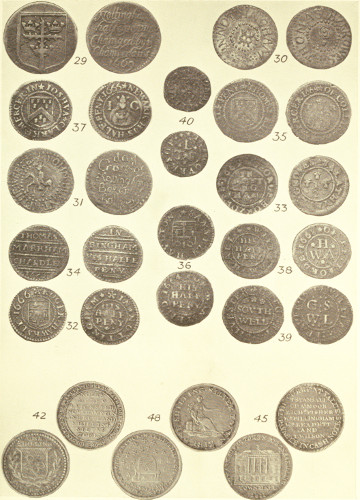
Tokens.
From photograph by Mr. S. Barlow Vines.
The Hawksleys were maltsters, the Davisons hosiery manufacturers. Mr. Davison gave up the hosiery business and joined Mr. Hawksley in building a factory near Leen Side, Nottingham, for worsted spinning. This factory was burned down in January 1791. They at once commenced building new works at Arnold. These works were running before the end of the year. They were situated near the site of Arnot Hill House in which Mr. Hawksley lived. They did not prove a success, and the machinery was sold and the factory demolished.
Mr. Hawksley died in 1815 and Mr. Davison in 1807.
The issuing of these tokens of such high value in copper wherewith to pay their workpeople was exceptional.
It is strange that, although they issued these tokens in Arnold, I know of none being issued from their Nottingham works. They were of the value of 5s., 2s. 6d., 1s., and 6d., and all copper, but I have some of the tokens plated in silver and in gilt. The crowns and half-crowns are the most rare of all the Nottinghamshire tokens of this period. The shillings and sixpences are not uncommon.
Obverse. Davison and Hawksley, and fleece suspended from a tree.
Reverse. The Roman Fasces with the axe, spear, and a cap of liberty in saltire, Arnold works. A. crown 1791. (No. 41.)
The 2s. 6d., 1s., and 6d. pieces are similar, except in size and value.
A token for 5s. was issued from East Retford. This token was countermarked on a Spanish dollar.
The Treasury and many firms throughout the Kingdom countermarked these Spanish dollars and enormous numbers were in circulation, but this is the only Nottinghamshire one known.
Messrs. Bolton & Whatt at their Soho Mint, Birmingham, countermarked over three millions previous to 1804.
On one occasion forty tons of dollars were taken from two Spanish frigates captured by the British fleet. This specie was taken to Plymouth and then forwarded on to the Bank of England.
A silver token for 1s. was issued by the timekeepers.
Obverse. A griffin, with wings displayed, gorged, issuant from a ducal coronet; legend, one shilling token sterling silver.
Reverse. For the use of the inns at Derby, Ashbourne, Chesterfield, Nottingham, Leicester, Lichfield, Burton, &c.
H. Morgan issued shillings and sixpences:—
Obverse. The arms of Leicester, vert, a cinquefoil, between two sprigs of olive. One shilling silver tokens.
Reverse. Notts, Derby, Leicester, Northampton, and Rutland shilling silver tokens. The outer legend—Morgan, licensed manufacturer, 12 Rathbone Place, London. (No. 42.)
Messrs. Donald & Co. issued a halfpenny token:—
Obverse. Donald & Co., stocking manufacturers, wholesale and retail. Promissory halfpenny, payable Nottingm, or
Reverse. A beehive with bees, No. 29 Hull Street, Birmingham, 1792. (No. 43.)
There are five or six varieties of these copper tokens. When the first die was made it was found that the word “promissory” was spelt “promissary.” This error was rectified by cutting “o” over the “a.” Afterwards fresh dies were made with the word spelt correctly.
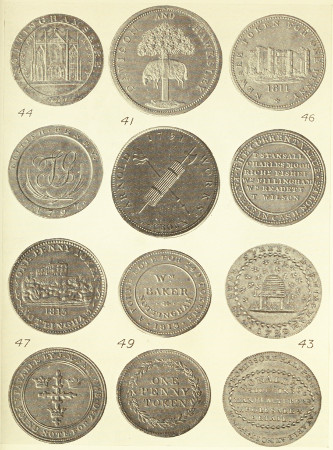
Tokens.
From photographs by Mr. S. Barlow Vines.
The Newstead Abbey token for one penny:—
Obverse. A view of Newstead Abbey. The words Newstead Abbey, and on the raised outer circle “Nottinghamshire,” and in small letters the name of the engraver Jacobs.
Reverse. Two palm branches and the letters “T.G.”, and on the raised outer border “British Penny” and the date 1797. Round the edge of the coin is impressed the words—“I promise to pay on demand the bearer one penny.” (No. 44.)
In 1811 silver tokens were issued at Newark, value 1s. There are four varieties of these. Probably the issuing of these pieces by a number of tradesmen was done in order to share the cost of the die and to procure a quantity of tokens at a cheaper rate, and also to inspire confidence.
Obverse. A view of the Town Hall with inscription—“Town Hall, 1811.” Newark silver token for one shilling.
Reverse. The current value payable in cash notes. T. Stansall, Chas Moore, Richd Fisher, Wm Fillingham, Wm Readitt, and T. Wilson. (No. 45.)
Thomas Stansall was a grocer, Charles Moore a chemist, Richard Fisher and William Fillingham drapers, William Readitt a grocer, Thomas Wilson a brazier.
Copper tokens for one penny were also issued in 1811, of which three varieties exist:—
Obverse. A view of Newark Castle and the river, with date 1811. “Newark token for one penny.”
Reverse. The current value payable in cash notes. T. Stansall, Charles Moore, Richd Fisher, Wm Fillingham, Wm Readitt, T. Wilson. (No. 46.)
J. M. Fellows & Co., bankers, of Bridlesmith Gate, issued penny tokens, of which there are five varieties, dated 1812 and 1813:—
Obverse. A view of Nottingham Castle. One penny token, 1812.
Reverse. The arms of the borough in a circle, payable by J. M. Fellows, a pound note for 240. (No. 47.)
Mansfield silver shillings:—
Obverse. Beehive and bees, C. & G. Stanton, Hancock; Wakefield & Co., and Wm Ellis, Mansfield.
Reverse. Female seated on a bale with scales and cornucopia. One shilling silver token, 1812. (No. 48.)
Two varieties of this exist. Messrs. Stanton, Hancock, and Wakefield & Co. were cotton manufacturers; William Ellis a draper and woollen salesman.
In 1813, W. Baker, hosier, of Fletcher Gate, issued penny tokens:—
Obverse. W^m Baker, Nottingham, an ornament between Baker and Nottingham. Legend—a pound note for 240 tokens, 1813.
Reverse. One penny token within a wreath of oak and laurel. (No. 49.)