NOTTINGHAMSHIRE POETS By John Russell, M.A.
Reading edition
The appreciation of poetry would appear to be as various and uncertain as its definition. For while, on the one hand, the cynic, confusing cause with effect, has defined it as a “disease of the intestines,” on the other, a great critic, himself an excellent poet, has written: “Poetry is nothing less than the most perfect speech of man, that in which he comes nearest to being able to utter the truth. It is no small thing, therefore, to succeed eminently in poetry”; and again, “The noble and profound application of ideas to life is the most essential part of poetic greatness”: so that when a poet has established his claim to real glory, “that real glory is good and wholesome for mankind at large, good and wholesome for the nation which produced the poet crowned with it.”
The county of Nottingham cannot claim the credit of having produced many such glorious poets. Only three of her poetic children stand out very conspicuously—Byron, Kirke White, and Philip James Bailey. But she can claim a fair number of minor poets, with whom this paper will more especially deal. It might, indeed, have been expected that the county and the county town would be prolific in poetic achievement. For they have had a remarkable history and have been the scene of many stirring incidents in the great drama of the nation’s life. Some, indeed, may say that the inhabitants have been men of action rather than of words.
As for the scenery of the county, though it may seem tame to the dwellers in the Lake District or the Peak, or amid the combes and moors of the south-west, yet Sherwood Forest, Clifton Grove, and the long reaches of the Trent have a peculiar beauty of their own, and the homely charm of fields and hedgerows appeals strongly to Nottinghamshire men, so that amid grander scenes they can feel as Ulysses of old felt:—
“Non dubia est Ithaci sapientia, sed tamen optat Fumum de patriis posse videre focis.”
This pleasure in their home has found plentiful and apt expression in the county poets. Kirke White sings:—
“In woods and glens I love to roam, When the tired hedger hies him home; Or by the woodland pool to rest, When pale the star looks on its breast.”
He does but express in verse what any sensitive mind would feel in walking, while the early autumn twilight is fading into dark, say along the field path between Thoroton and Orston. The scope of this article forbids any detailed account of the lives of the several writers and their works, or lengthy criticism; it must be enough to relate a few facts about each, mention their chief writings, and occasionally, where it seems desirable, add a few lines of illustrative quotation.
Henry Constable.—The first to claim our attention is Henry Constable [1562–1613]. Anthony Wood says of him “that he was born (or at least descended from a family of the name of Constable) in Yorkshire.” It seems, however, to be accepted now that he was born at Newark, and was the son of Sir Robert Constable, Lieutenant of the Ordnance to Queen Elizabeth. He was educated at St. John’s College, Cambridge, a fact with which it is somewhat difficult to reconcile Wood’s statement “that he spent some time among the Oxonian muses.” He became a Roman Catholic at an early age, and his zeal for the cause of his religion brought him many difficulties and made him an exile for many years of his life. He died at Liège. His poetical ability was fully recognised by his contemporaries. In a letter from abroad he is described as “One Constable, a fine poetical wit, who resides in Paris”; and in the same letter he is said “to have had in his head a plot to draw the Queen to be a Catholic.” Wood eulogizes him as “a great master of the English tongue,” and adds that “there was no gentleman of our nation had a more pure, quick, and higher delivery of conceit than he.” Sonnets of conceits, that is, quaint or humorous fancies elaborately wrought out till they were exhausted of suggestion, were a favourite form of composition at that time, and with Constable’s work may be compared Drayton’s Idea, Daniel’s Delia, and other similar collections. In 1584 appeared Diana, or the Excellent Conceitful Sonnets of H. C. Augmented with divers quatorzains of honourable and learned personages. Divided into VIII. Decades. And in 1592 was issued a small quarto volume entitled Diana, the Praises of his Mistress in certain Sweete Sonnets by H. C. In illustration of his style may be quoted:—
“My Lady’s presence makes the roses red, Because to see her lips they blush for shame. The Lily’s leaves, for envy, pale became; And her white hands in them this envy bred. The Marigold the leaves abroad doth spread; Because the sun’s and her power is the same. The Violet of purple colour came, Dyed in the blood she made my heart to shed. In brief, All flowers from her their virtue take; From her sweet breath, their sweet smells do proceed; The living heat which her eyebeams doth make Warmeth the ground, and quickeneth the seed. The rain, wherewith she watereth the flowers, Falls from mine eyes, which she dissolves in showers.”
Michael Drayton’s Idea appears in 1619. Though he was a Warwickshire man, he perhaps deserves a passing mention here because of his praises of “the Crystal Trent, for fords and fish renowned,” and the “silver Trent near to which Sirena dwelleth, she to whom Nature lent all that excelleth.”
“Tagus and Pactolus Are to thee debtor, Not for their gold to us Are they the better; Hence forth of all the rest, Be thou the river, Which as the daintiest Puts them down ever. For as my precious one O’er thee doth travel, She to pearl paragon Turneth thy gravel.”
Gervase Markham [1568–1637], a member of a very distinguished Nottinghamshire family, was the son of Sir Robert Markham of Cotham. After serving as a soldier in the Low Countries and with the Earl of Essex in Ireland, he applied himself to writing, for which he was well qualified, being a scholar and knowing four or five languages. He had a practical knowledge of agriculture and horse-breeding, on which subjects he wrote several treatises. In association with William Sampson he published in 1622 a drama, The True Tragedy of Herod and Antipater, and in 1633 he produced another, The Dumbe Knight. His poem, The Most Honourable Tragedie of Sir Richard Grenvile, Knight, should be noticed because it probably gave suggestions to Tennyson in writing his ballad of The Revenge. In point of length there is a considerable difference between these works of the two poets. Markham also wrote some religious poems.
William Sampson, about whom very little is known, was probably born at South Leverton near Retford, at the end of the sixteenth century. On the title page of the play which was written by him in conjunction with Gervase Markham, he is described as a “Gentleman.” It is said that he was a retainer in the family of Sir Henry Willoughby of Risley. In support of this it may be mentioned that he dedicated one of his plays, The Vow Breaker, or the Faire Maide of Clifton, to “The Worshipfull and most vertuous Gentlewoman Mistress Anne Willoughby Daughter of the Right Worshipfull and ever to be Honoured Henry Willoughby of Risley in the County of Derby, Baronet.”
In his volume of poems, many of which are of the nature of epitaphs or elegies, he gives some anagrams. Making of these was “then the fashionable amusement of the wittiest and most learned,” as Disraeli says. From “William Cavendish,” Sampson makes “All my will is Heaven”; from “John Curson” or “Cursone,” “So I ranne on,” and “Honour is sure,”
“Which Anagrammized thus, ’tis cleere and pure, So hee ranne on. His honour now is sure.”
Among the subjects of his verse may be noted the Countess of Shrewsbury (“Bess of Hardwick”), “ould Sir John Byron of Newstead Abbey,” Sir George Perkins of Bunny, Henry Lord Stanhope, and “the right Honourable Henry Peirpoint,” father of the first Earl of Kingston.
Thomas Shipman [1632–1680] was the eldest son of William Shipman of Scarrington, by his second wife, Sara, daughter of Alderman Parker of Nottingham. Thoroton speaks of him as “a good Poet, and one of the Captains of the Trained Bands of this County.” His father was an enthusiastic Royalist. In spite of this partisanship, Thomas succeeded in “saving a small estate amid the calamities of the last rebellion,” which indicates shrewdness and capacity in business. His wife, daughter of John Trafford, brought him an estate at Bulcote. Their son William was high sheriff of Notts in 1730. Among his literary associates were Denham and Oldham.
He published a rhymed tragedy, Henry the Third of France, stabbed by a Fryer, with the Fall of Guise, and a volume of Loyal Poems called Carolina. He made grateful acknowledgments to his friend Abraham Cowley, and was a poetical friend of the third Lord Byron.
An address to the reader by Thomas Flatman, in 1682, describes him as “a man every way accomplished: To the advantages of his birth, his education had added whatsoever was necessary to fit him for conversation, and render him (as he was) desirable by the best wits of the age.” Some of his writings were not free from the moral blemishes which disfigure much of the writing of that period.
John Oldham [1653–1683], though born in Gloucestershire, is often numbered among Nottinghamshire writers because of his connexion with the Earl of Kingston, who was his patron and gave him a home for a time at Holme Pierrepoint.
In the church of that village there is a tablet to the poet’s memory. That he was a man of distinction among his literary contemporaries is clear from the fact that both Waller and Dryden paid tribute to him at his death: and his work seems to have had considerable influence upon Pope and other eighteenth-century poets. He is called in the introduction to the Ode on St. Cecilia’s Day, “the late ingenious Mr. John Oldham,” and in a Dictionary published in 1694 in London he is described as “The darling of the Muses, a pithy, sententious, elegant, and smooth Writer.”
He wrote Satires and Pindaric Odes, and based his work largely on imitation of such classical authors as Horace and Juvenal.
His appreciation of the schoolmaster’s calling was not very high—
“A Dancing-Master shall be better paid, Though he instructs the Heels, and you the Head.”
Oldham’s works do not allow much satisfactory quotation; but these lines may be given as a specimen of him:—
“’T has ever been the top of my Desires, The utmost height of which my wish aspires, That Heaven would bless me with a small estate, Where I might find a close obscure retreat; There, free from noise and all ambitious ends, Enjoy a few choice books, and fewer friends; Lord of myself, accountable to none, But to my conscience and my God alone: There live unthought of, and unheard of die, And grudge mankind my very memory. But since the blessing is, I find, too great For me to wish for, or expect of Fate: Yet maugre all the spite of destiny, My thoughts and actions are, and shall be free.”
From the Pindaric Ode to the memory of Mr. Charles Morwent may be cited:—
“Thy soul within such silent pomp did keep, As if humanity were lulled asleep, So gentle was thy pilgrimage beneath Time’s unheard feet scarce make less noise, Or the soft journey which a planet goes. Life seemed all calm as its last breath; A still tranquillity so husht thy breast, As if some Halcyon were its guest, And there had built her nest: It hardly now enjoys a greater rest.”
The life of Robert Dodsley [1703–1764], publisher and poet, has in it a touch of romance in that, by ability, perseverance, and integrity, he raised himself from the comparatively servile position of a footman to be the friend and helper of many of the greatest men of his age, men distinguished by high birth and position or by genius, or by all three combined; and it will appear from what follows that he played no small or insignificant part in the literary life of the eighteenth century.
Dodsley was born on the 13th February 1703. The date of his birth is not recorded in the Mansfield register, but has just been discovered in an old memorandum book kept by the parish clerk, John Lodes. The omission of his birth entry from the registers suggests that his parents were perhaps Dissenters.
He is said to have been apprenticed at first to a stocking-weaver, but, disliking the trade or the conditions in which he had to work, he gave it up and became a footman. At this period of his life he published a volume of verse entitled The Muse in Livery. He received encouragement and support from his employer and her friends. Ultimately, with the help of £100 from Pope, who befriended him also in other ways, he set up a bookseller’s shop in Pall Mall, and from the profits of this business and his writings he was able to retire towards the close of his life with a comfortable competence. He died at Durham and was buried there.
That Dodsley held a respectable position in the world of letters is evident from the fact that Pope patronised his play of The Toyshop, which was put on the stage in 1735; while of his tragedy of Cleon Johnson says, “if Otway had written this play, no other of his pieces would have been remembered,” praise which even Dodsley himself thought rather above the merit of his work.
As a bookseller and publisher he succeeded well. It was Dodsley who discerned the merit of Johnson’s London for which he paid the author ten guineas. Later on he paid fifteen guineas for The Vanity of Human Wishes, and he was one of the publishers who bought Rasselas. Johnson alludes to him affectionately as “Doddy my patron,” and says “Dodsley first mentioned to me the scheme of an English Dictionary.” To Dodsley’s enterprise the Annual Register, which is continued to this day, owed its origin. This is not the place to give a full list of his works, but mention must not be omitted of his two plays, The King and the Miller of Mansfield, and Sir John Cockle at Court, which show shrewd observation of men and affairs. Dodsley’s character seems to have been very agreeable and estimable. He is described by Boswell as “worthy, modest, and ingenious,” and we have it on the testimony of Johnson and Walpole that he had the manly merit of not being ashamed to recall “the limits of his narrower fate.” He honoured the memory of his friend Shenstone the poet by publishing an edition in two volumes of his works, both prose and verse.
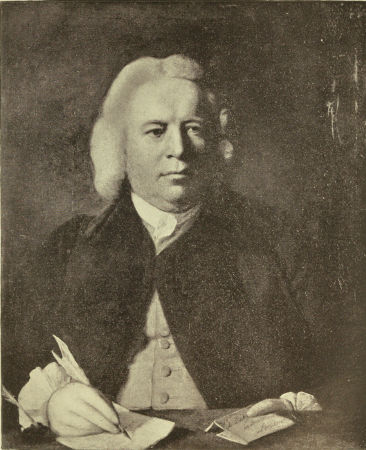
Photo: Mr Emery Walker.
Robert Dodsley.
By kind permission of Yates Thompson, Esq.
One or two quotations must serve to illustrate his manner of thought and diction. In the Miller of Mansfield he says: “Why we are all of us lost in the dark every day of our lives, knaves keep us in the dark by their cunning, and fools by their ignorance. Divines lose us in dark mysteries, lawyers in dark cases, and statesmen in dark intrigues. Nay, the light of reason, which we so much boast of, what is it but a dark lanthorn, which just serves to prevent us from running our nose against a post perhaps, but is no more able to lead us out of the dark mists of error and ignorance, in which we are lost, than an ignis fatuus would be to conduct us out of this wood.”
In the same play the countryman describes London:—
“O! ’tis a fine place! I have seen large houses with small hospitality, great men do little actions, and fine ladies do nothing at all. I have seen the honest lawyers of Westminster, and the virtuous inhabitants of Change Alley; the politic madmen of coffee-houses, and the wise statesmen of Bedlam. I have seen merry tragedies, and sad comedies; devotion at an opera, and mirth at a sermon; I have seen fine clothes at St. James’s, and long bills at Ludgate Hill. I have seen poor grandeur and rich poverty; high honours and low flattery; great pride and no merit. In short, I have seen a fool with a title, a knave with a pension, and an honest man with a thread-bare coat.”
He wrote several songs, one of the best known of which is “The Parting Kiss.”
Dodsley sat for his portrait to Sir Joshua Reynolds in 1760. From the interesting life of Dodsley, recently written by Mr. Ralph Straus, it is abundantly clear that the bookseller was a remarkable and very worthy man, and that English literature is greatly indebted to him in many ways. It is indeed a cause for surprise that his life has not been more fully written before. He not only had a keen discernment of the literary merit of work submitted to his judgment, but he had an equally keen discernment of what the public taste required at the moment. He therefore very seldom failed in his publishing ventures. He had also a high conception of the dignity of literature, and of his responsibility as author and publisher. His conduct in respect of his partnership in the London Chronicle is deserving of the highest praise, and his letter announcing his intention of relinquishing his share in that periodical is worthy, for its manly sincerity and straightforwardness, to be compared with the famous letter of Dr. Johnson to Lord Chesterfield. Says Dodsley: “However, as I am but a single person, I desire you will take the sense of the Partners on all I have said, only assuring you that if the Paper cannot be carried on without giving any of these cause of offence, I shall desire to dispose of my share, being determined not to sacrifice my character to other people’s indiscretions, nor to any lucrative consideration whatsoever.” From the few private letters given in Mr. Straus’s book, we get a pleasing glimpse of his good nature and humour in the relations of ordinary family life, and can quite easily understand that he was popular and much esteemed by his friends. Shenstone said of him, “Of his simplicity, benevolence, humanity, and true politeness, I have had repeated and particular experience.” Though Dodsley had not the advantage of a good early education, yet, in the words of Mr. Straus, “a long life spent in the society of literary and artistic people, and much reading, had educated him more surely than a five years’ course at one of the universities might have done. The education that comes to the man in love with life is of far more importance than the forced, if polite, education that is given to the boy.” With the exception of his early want of opportunity, his life was singularly full and complete.
Erasmus Darwin [1731–1802], the bearer of a name which his illustrious grandson has made for ever famous in the history of scientific speculation, was himself a man of distinction, “the worthy grandfather of a far more eminent contributor to human knowledge.” He was born at Elston, near Newark, educated at Chesterfield and St. John’s College, Cambridge, and finished his medical education at Edinburgh. He practised in Lichfield and at Derby. His book, The Botanic Garden, appeared in 1781, and consists of two parts, the “Economy of Vegetation,” and “Loves of the Plants.” His work is full of classical allusions, and he may be looked upon as one of the last exponents of the classical tradition in English verse. As Ovid, in his Metamorphoses, had set forth the change of human beings into plants and animals, Darwin, reversing the process, undertook to “restore some of them to their original animality, after having remained prisoners so long in their vegetable mansions.” In other words, he personified and allegorised the forms and natural properties of plants. The effects, for instance, of a decoction of laurel or Laura, are represented in a figure of Nightmare.
One quotation from his lengthy poems must suffice:—
“Press’d by the ponderous air the Piston falls Resistless, sliding through its iron walls; Quick moves the balanced beam, of giant birth, Wields his large limbs, and nodding shakes the earth ... Soon shall thy arm, Unconquered Steam! afar Drag the slow barge, or drive the rapid car; Or on wide-waving wings expanded bear The flying chariot through the fields of air. Fair crews triumphant, leaning from above, Shall wave their fluttering kerchiefs as they move, Or warrior bands alarm the gaping crowd, And armies shrink beneath the shadowy cloud.”
Mention should also be made of his Song to May.
The close of the eighteenth century brings us to the age of Byron and Kirke White, who were born within a year or two of each other.
George Gordon Noel, Lord Byron [1788–1824] is a man whose life and writings are so well known to educated Englishmen, and have been the theme of so much criticism and controversy, that it seems superfluous to set down many details in this short notice. He was born in London, educated at Aberdeen Grammar School, at Harrow, and at Trinity College, Cambridge. He lived some time at the family home of Newstead, and after a life of much dissipation, disappointment, and varied travel, he died at Missolonghi, in Greece, while rendering chivalrous help to the Greeks in their struggle to recover what they had lost—the freedom which their forefathers had been able to preserve against seemingly overwhelming odds so many centuries before. It was fitting that his life should end in a country and amid a people for whose scenery and history he had so great an affection.
It cannot be said that he has been enthusiastically honoured in his own county. At Nottingham there is now a fine bronze bust of him at the entrance to the Castle Art Museum; but otherwise there is no conspicuous memorial, such as a statue or public building, to perpetuate openly his fame. Yet by the quality and boldness of his thought and the splendour of his diction he stands in the front rank of our national poets; and his genius is recognised and acclaimed far beyond the limits of his own island and Europe.
For this neglect he has perhaps mainly himself to blame. The irregularities of his life, and his disregard of conventional morality, so offended soberer minds and puritan instincts that the imperfections of his character have been allowed by many to overshadow the greatness of his poetic achievement. This is a pity. Where shall we find a finer poem than Childe Harold, impressive alike by the truth and beauty of its descriptions and the pathos of its reflexions?
Byron’s excesses and eccentricities were a not unnatural consequence from his ancestry and bringing up. His was a nature that needed from the very first wise guidance and discipline if it was to be nurtured to self-control and regulated usefulness. Such discipline he seems not to have had. Of his ancestry and inherited characteristics it is well said in English Men of Letters: “Burns had only the fire of his race: the same is true of Byron, whose genius, in some respects less genuine, was indefinitely and inevitably wider. His intensely susceptible nature took a dye from every scene, city, and society through which he passed; but to the last he bore with him the marks of a descendant of the sea-kings, and of the mad Gordons in whose domains he had first learned to listen to the sound of the two ‘mighty voices’ that haunted and inspired him through life.” He loved “the mountain’s shaggy side and sought the rocks where billows roll.” This love is connected with his passion for liberty. It will be remembered that he pleaded the cause in Parliament of the Luddite frame-breakers. It is dangerous to argue, in the case of a great poet or novelist, from their works to their personality. By their imagination they can realise adequately situations and characters of which they may have had no personal experience. Like the skilled anatomist they can construct the whole from a small part. Still it is possible that the gloom and self-abandonment and vivid pictures of remorse which we find in parts of Byron, may have been partly due to a remorseful feeling he was too proud to own except indirectly. Scott says:—
“High minds of native pride and force Most deeply feel thy pangs, Remorse. Fear for their scourge mean villains have: Thou art the torturer of the brave.”
Byron also says:—
“Full many a stoic eye and aspect stern Mask hearts where grief hath little left to learn; And many a withering thought lies hid, not lost, In smiles that least befit who wear them most.”
“None are all evil,” and whatever Byron’s faults may have been and their cause, the fact remains that he has enriched his country’s literature with noble poetry, and invested the ancestral home of Newstead with undying fame. He was not afraid that he would be forgotten:—
“But I have lived, and have not lived in vain: My mind may lose its force, my blood its fire, And my frame perish even in conquering pain; But there is that within me which shall tire Torture and time, and breathe when I expire.”
Pollok’s estimate of his powers, given in The Course of Time, not inadequately sums up his wayward genius:—
“All passions of all men, The wild and tame, the gentle and severe; All thoughts, all maxims, sacred and profane; All creeds, all seasons, Time, Eternity; All that was hated, and all that was dear; All that was hoped, all that was feared by man, He tossed about, as tempest-withered leaves, Then smiling, looked upon the wreck he made. With terror now he froze the cowering blood, And now dissolved the heart in tenderness: Yet would not tremble, would not weep himself; But back into his soul retired, alone, Dark, sullen, proud, gazing contemptuously On hearts and passions prostrate at his feet.”
In a paper written for a book on Nottinghamshire, it is not inappropriate to add that plates to illustrate Murray’s edition of Childe Harold were taken from sketches supplied by Sir Charles Fellows, the Lycian traveller, and a member of a well-known Nottingham family.
After Byron we may take Henry Kirke (or Kirk) White [1785–1806], the son of a butcher, afterwards articled to a firm of solicitors, and for the last year of his short life a student at St. John’s College, Cambridge. He fell a victim to consumption, aggravated, it is thought, if not actually brought on, by premature and excessive devotion to his studies. Hence Byron’s beautiful and pathetic lines on him:—
“Unhappy White! while life was in its spring, And thy young muse just waved her joyous wing, The spoiler came; and all thy promise fair Has sought the grave, to sleep for ever there.”
In one of his letters White says of himself: “My mind is of a very peculiar cast. I began to think too early; and the indulgence of certain trains of thought, and too free an exercise of the imagination, have superinduced a morbid kind of sensibility; which is to the mind what excessive irritability is to the body.” Gray’s lines are particularly applicable to White:—
“Fair Science frowned not on his humble birth, And Melancholy marked him for her own.”
Matthew Arnold remarks that “much good poetry is profoundly melancholy,” that condition of mind being natural to a sensitive and poetic temperament in contact with the difficulties and disappointments of life. “The eternal note of sadness” strikes too keenly on such a mind in view of the “turbid ebb and flow of human misery.”
But White’s melancholy is often due mainly to the depression of illness. This makes all the more admirable the spirit of resignation with which he faced his end:—
“God of the Just, Thou gavest the bitter cup; I bow to Thy behest, and drink it up.”
Speculations upon the “might have been” of a writer dying long before his prime are a somewhat useless exercise of the imagination, and it is impossible to say what White would have produced had his mind been filled, expanded, and matured by more reading, by travel and experience.
Keats, with whom White was “equalled in fate,” if not in renown, has left us an example of what genius can accomplish in even a short span of years; but his life was prolonged some four years longer than White’s, a not inconsiderable period in the years of growth, and he was happier in his early opportunities. White was barely past the time of imitative work, and shows many traces of the influence of Milton and Gray. He has, however, left enough to show that he was not a mere writer of pretty verse, but was capable of conceiving and sustaining a higher flight. His Clifton Grove, and Christiad fragment will illustrate this statement. And he will always have a charm for Nottingham readers, because his inspiration, when not religious, was mainly derived from the sights and sounds and association of his own country side; he was a home-bred poet.
A poem “To an early primrose,” written, he says, at the age of thirteen, seems a natural outcome of his feelings and circumstances. The flower—
“Mild offspring of a dark and sullen sire! Whose modest form, so delicately fine, Was nurs’d in whirling storms, And cradled in the winds,”
is taken as symbolical of virtue hardened by “chill adversity.”
When his age and circumstances are duly considered, the extent and maturity of his production fully entitle White to be called a genius. His letters are well worth reading for their sound sense, and for the light they throw on his thoughtful regard for the best interests of his family.
The first half of the nineteenth century was remarkable for its output of local writings. In Wylie’s Old and New Nottingham, to which this paper is much indebted for information and suggestions, it is said: “Fifteen years ago, i.e. in 1838, Nottingham was the residence of a more brilliant literary circle than was probably ever drawn together in a town of the like extent.” Perhaps Norwich may be fitly compared with it in this respect, and it is singular that the migration thence of several families established what was in literary matters perhaps partially causal, a connexion between the two cities.
This literary activity need cause no great surprise. Men were living “mid the stir of the forces whence issued” the modern world. The French Revolution, the rise and fall of Napoleon, the struggle for religious and political emancipation, scientific discoveries and inventions, the diffusion of cheap literature, were all having their effect upon the more thoughtful minds of the time. And there was less distraction of amusement and multitudinous publication. Men had to be content with fewer books; they made them, however, their own by study and quiet reflexion; life was less diffuse and “scrappy.” It is evident from the history of many of the writers that the literary life of Nottingham was much helped and stimulated by such papers as Dearden’s Miscellany, Sutton’s Review, and the Nottingham Journal, to the pages of which many fugitive pieces were contributed, as well as others which have survived in book form. Not much of the verse is of the type usually known as religious, though some of the writers handle religious topics. The ordinary religious poem is not difficult to write, dealing as it does with a stock-in-trade of emotions common to the race handed down through the ages, and to a large extent realized in each man’s personal experience, having besides a form of expression of the finest kind familiar to every Englishman from childhood. But to adapt by strenuous thought and long reflexion the old faith to new conditions, to state its eternal verities in terms of fresh science and advancing ideas is another and a more difficult matter; and such adaptation is what several of our local writers have attempted after the manner of Clough and Matthew Arnold.
A remarkable thing about many of the writers is the largeness of their conceptions, the ambitious scale on which they essayed to write. Another noteworthy fact is that many of them were of humble origin, and did their literary work in circumstances which might well have smothered their nascent aspirations. Millhouse, Ragg, and Miller are all examples of this pursuit of knowledge under difficulties. They “broke their birth’s invidious bar,” and of them may be truly said what Millhouse said of Richard Booker—
“In yonder humble grave there lies a Man.”
Chief of these nineteenth-century poets is Bailey, the son of Thomas Bailey [1785–1856], who was himself an industrious writer and journalist. Besides poems Thomas Bailey wrote the Annals of Nottinghamshire. Among his poems are Ireton, dedicated to Lord John Russell; the Carnival of Death; What is Life? In business he was first in the stocking-trade, and afterwards a wine merchant.
Philip James Bailey [1816–1902], the author of Festus, was fortunate in having a father whose literary interests enabled and induced him to sympathize with the poetic aspirations of his son, and the poem is very appropriately dedicated by the son to the father:—
“My Father! unto thee to whom I owe All that I am, all that I have and can; Who madest me in thyself the sum of man In all his generous aims and powers to know, These first fruits bring I.”
Bailey studied for the bar, and was called, but did not practise. His education at the University of Glasgow was perhaps a better training for his future career than residence at the old English universities might have been; it was wider and less purely classical. He is remarkable for having deliberately resolved to be a poet, for having prepared himself most scrupulously to rise to “the height of his great argument,” and for having refused to court popularity by following a lower aim in his verse. Such a work as Festus can not be popular; it is too long and difficult for that. It does not lend itself readily to quotation, but must be read and studied as a whole. The lines most commonly cited from it are these:—
“Life’s more than breath and the quick round of blood: It is a great spirit and a busy heart, The coward and small in soul scarce live. One generous feeling; one great thought; one deed Of good, ere night, would make life longer seem Than if each year might number a thousand days, Spent as is this by nations of mankind. We live in deeds, not years; in thoughts, not breaths; In feelings, not in figures on a dial. We should count time by heart-throbs. He most lives Who thinks most; feels the noblest; acts the best. And he whose heart beats quickest lives the longest, Lives in one hour more than in years do some Whose fat blood sleeps as it slips along their veins. Life is but a means unto an end; that end, Beginning, mean and end to all things—God.”
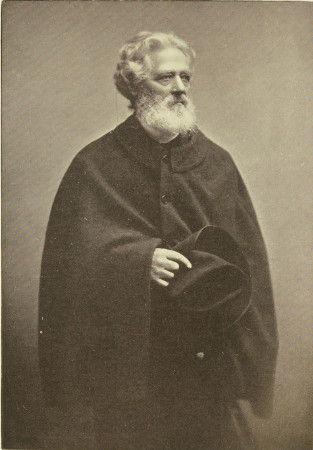
Philip James Bailey. “Festus.”
By kind permission of Miss Carey.
We may note also for its quiet humour—
“He sleeps! The fate of many a gracious moral This to be stranded on a drowsy ear;”
and this, as indicating Bailey’s aim as a writer—
“Write to the mind and heart, and let the ear Glean after what it can. The voice of great Or graceful thoughts is sweeter far than all Word-music; and great thoughts, like great deeds, need No trumpet. Never be in haste in writing. Let that thou utterest be of nature’s flow, Not Art’s; a fountain’s, not a pump’s.”
Bailey’s work has hitherto been more appreciated in America than in England. On the death of Tennyson, in 1892, it was suggested that he should be made Poet Laureate; and he was one of the distinguished men on whom the University of Glasgow conferred an honorary degree at its Jubilee Celebration in 1901.
In 1901 Mr. James Ward, of Nottingham, published a pamphlet entitled Recollections of Philip James Bailey, in which was published for the first time a poem called “Liberty, a Poetical Protocol,” which begins:—
“Time was when Liberty came down From the high seat Where, by God’s feet, With Law, she claims one same and sacred crown; And to the dominant nations of the earth, Massed in the West, Where most her votaries dwell, who own her worth, And love her best These words addressed:—”
Of criticism Festus has had plenty. Tennyson said, “I can scarcely trust myself to say how much I admire it, for fear of falling into extravagance.” Gilfillan says “Shelley’s Prometheus is the argument of Faust extended from man the individual to man the species; while Festus is the argument of Job applied in the like manner to the whole human family; Festus is to the one as Job to the other, a type of the fall and recovery of all men. The scene of Faust and Prometheus is on earth; that of Job and of Festus is (essentially) in eternity.”
Luke Booker [1762–1835] and Thomas Ragg [1808–1881] may be mentioned together with Spencer T. Hall as friends and helpers of the weaver poet, Robert Millhouse [1788–1839], whom they assisted by writing on his behalf and in other ways.
Booker was vicar of Dudley, and besides his poems (“Sacred, Moral, and Entertaining”), wrote a didactic poem called The Hop Garden, and a Descriptive and Historical Account of Dudley Castle; this was published in 1825, and is described as “a good piece of work.”
Ragg, after being in his father’s printing office and then apprentice to a hosier, became a bookseller’s assistant, and finally, having attracted by his Christian apologetics the attention of some Church dignitaries, took orders. He died vicar of Lawley, in Shropshire. Among those interested in him were James Montgomery, Isaac Taylor, and Robert Southey. His poem, The Deity, in twelve books, appeared in 1834, and was called in the Times “a very remarkable production.” In 1855 he produced Creation’s Testimony to its God, the Accordance of Science, Philosophy and Revelation. Ragg has been termed “the adopted poet of the Evangelic Muse.”
Spencer Timothy Hall [1812–1885], “the Sherwood Forester,” had a remarkable history, and was—
“A man so various that he seemed to be Not one, but all the world’s epitome.”
He said of himself that he “could dig, plough, reap, stack, thresh, and winnow, make a stocking and a shoe, write a book and print and bind it, or give a lecture, or take stock of a man’s body and mind and furnish him with an inventory of the same!” He gave exhibitions of mesmerism, helped to edit a newspaper, was once a postmaster, was secretary to the Society for Abolishing Capital Punishment, and a poet to crown it all!
In his steady determined struggle upwards from obscurity and uncongenial occupations to literary recognition and success he resembled his great exemplar Benjamin Franklin, and his versatility recalls his fellow-townsman Samuel Parrott the painter, whose boast it was that he could do three things well—build a tall factory chimney, play the violin, and paint an Academy picture. Among Hall’s writings were, The Forester’s Offering, The Upland Hamlet, and other Poems, and The Peak and the Plain. He was born at Sutton-in-Ashfield, and died at Blackpool. His epitaph on Robert Millhouse will bear quoting again:—
“When Trent shall flow no more, and Blossoms fail On Sherwood’s plains to scent the spring tide gale, When the Lark’s lay shall lack its thrilling charm, And song forget the Patriot’s soul to warm— When Love o’er youthful hearts hath lost all sway; His fame may pass, but not till then away: For Nature taught, and Freedom fired his Rhyme, And Virtue dedicated it to Time.”
William Howitt [1792–1879], Mary Howitt [1799–1888], and Richard Howitt [1799–1869] were a remarkable trio, who among them produced a considerable amount of work of various kinds.
It seems unnecessary to say much in detail of William and Mary Howitt. What child is not familiar with The Spider and the Fly and The Ant and the Cricket? They published together in 1821 the Forest Minstrel, and in their literary activity they were as indefatigable as Southey. Among William’s works were Homes and Haunts of British Poets, the Ruined Abbeys and Castles of Great Britain, a Popular History of England, and a History of Priestcraft, the last of which dragged the writer into politics as an advocate of popular liberty, and caused him to be made an alderman of Nottingham. Mary Howitt dedicated her Ballads and other Poems, published in 1847, to “My best counsellor and teacher, my literary associate for a quarter of a century, my husband and my friend.” In the light of this dedication the bronze plaque at the Nottingham Castle Museum is invested with peculiar interest. On it husband and wife are represented as poring together over the pages of an open book, and there is a moving pathetic tenderness in the artist’s work. Mary Howitt’s reception at the close of her life into the Church of Rome suggests that she had been “voyaging through strange seas of thought alone.”
Richard Howitt published in 1840 The Gipsy King and other Poems, and in 1868 Wasp’s Honey: or Poetic Gold and Gems of Poetic Thought. These contain much beautiful verse. The Athenæum said of him, “He is healthfully English in his composition,” while Tennyson said, “Nature has been bountiful to you.” He won also the appreciation of Wordsworth, Leigh Hunt, and Christopher North. A characteristic poem showing his delight in simple nature is On a Daisy, first seen by him in Australia. He died at Edingley, near Southwell. Interesting illustrative quotations from the works of the Howitts, Robert Millhouse, and other writers may be found in Wylie’s book already mentioned. Millhouse has been called “the Burns of Nottinghamshire,” and his sonnets have a simplicity and directness that indicate strength.
Edward Hawksley published in 1829 some poems entitled Colonel Hutchinson and other Poems. In a poem on the Trent he makes special mention of Thomas Bailey—
“Last, Bailey tuned his sedgy reed, And gave thee, rolling Trent, thy meed.”
In 1825 Mary Ann Cursham produced a long poem on Martin Luther, in three parts, containing altogether well over two thousand lines; and from Southwell, in 1844, came The Eastern Princess and a drama entitled Walberg, or Temptation, by Sophia Mary Smith. The publisher was W. Bunny. Henry Hogg’s verses, published in 1852, have a pleasant smoothness and melody due to a close imitation of his poetic master, Tennyson, who at that time was evidently influencing considerably the local writers. In Tennyson’s Memoir it is recorded: “Towards the end of the year (1855) an unknown Nottingham artisan came to call. My father asked him to dinner, and at his request read Maud.” This artisan, it appears, had sent Tennyson his poems beforehand to read.
In illustration of Hogg’s style may be quoted these lines:—
“Till Knowledge from the statelier ranks Shall come down unto earth, and lend The faith to look beyond those banks That skirt the life which has no end. Whence some who look see nought but night, And some feel nought but idle fears; And grope in darkness for the light, And waste a useless life in tears. And some see lights that burn afar, And hear a still voice wisely teach; And live, and grasp their better star, And rise on stronger wings, and reach Unto the foremost fruits of time Where Wisdom walketh, gathering Grace, And swelling heaven-ward.”
Edwin Atherstone [1788–1872] was a voluminous writer. Among his works were the Fall of Nineveh in thirty books; Israel in Egypt, containing nearly twenty thousand lines; and the Last Days of Herculaneum. He was a friend of John Martin the painter. He died at Bath, being at the time of his death in receipt of a pension of £100 a year.
In 1859 Joseph Truman published a volume of verse “inscribed to the author of Festus by his friend J. T.” The poems are pleasant reading and the work of a thoughtful man.
In some lines on Fox How we have:—
“Reverential earnest Arnold, Warmly human, wisely good; O! for more of Arnold-spirit, In our age’s feverish blood! More of conscience in the Nation, More of Manhood in the Man, Statutes in a fairer fashion, Churches on a broader plan!”
And these lines give the spirit of the writer’s creed:—
“Sooner or later all souls shall be saved, Else God’s love is defeated, or not rich Like God’s, and still the pleading Christ must stand In human earnest raising unto Him Pathetic eyes dim with eternal tears. For life is like a circle drawn by God, And closes in the place it came from—heaven.”
Did space allow, many beautiful thoughts might be set down here from the poems of H. Septimus Sutton [1825–1901], who has left behind him a volume of verse distinguished by delicate sentiment and much beauty of diction. He was educated at first for the medical profession, but finding some of the work incidental to it distasteful, he became a journalist and devoted himself to the cause of temperance, being editor of the Alliance News for more than forty years. He was intimate with most of the writers of the “Sherwood Forest School,” and has left slight sketches of some of those writers in his Clifton Grove Garland.
The “modest” White—
“A youth, slow pacing, unawares impelled By blind thought,”
who
“Lifted from the grass his meditative eyes”;
Philip James Bailey, who
“Came down the grove, dark-haired, deep-eyed, And groundward looking; but I will be bound, Not seeing aught he looked at on the ground”;
Miller, “the basket-maker”; Hall “with many a merry smile.”
Sutton’s poems won the appreciation of such judges as Francis William Newman, Frances Power Cobbe, Christina Rossetti, and George Macdonald.
One of his most exquisite productions is Rose’s Diary. What can be more beautiful than these lines?—
“SORROW
“The flowers live by the tears that fall From the sad face of the skies, And life would have no joys at all Were there no watery eyes. Love thou thy sorrow; grief shall bring Its own excuse in after years; The rainbow!—see how fair a thing God hath built up from tears.”
And to the question, “Is life worth living?” hear Sutton’s answer:—
“How beautiful it is to be alive! To wake each morn as if the Maker’s grace Did us afresh from nothingness derive That we might sing ‘How happy is our case! How beautiful it is to be alive!’ To read in God’s great book, until we feel Love for the love that gave it: then to kneel Close unto Him Whose truth our souls will shrive, While every moment’s joy doth more reveal How beautiful it is to be alive. Rather to go without what might increase Our worldly standing, than our souls deprive Of frequent speech with God, or than to cease To feel, through having wasted health or peace, How beautiful it is to be alive. Not to forget, when pain and grief draw nigh, Into the ocean of time past to dive For memories of God’s mercies, or to try To bear all sweetly, hoping still to cry ‘How beautiful it is to be alive!’ Thus ever towards man’s height of nobleness Strive still some new progression to contrive; Till, just as any other friend’s, we press Death’s hand; and, having died, feel none the less How beautiful it is to be alive.”
William Frank Smith [1836–1876]. In 1864 a small volume was published by Smith, Elder & Co., Poems by William Frank Smith. It is dated from The Park, Nottingham, July 1864, and is dedicated to “W. W. Gull, Esq., M.D.,” the author being led to dedicate it thus “by a sense of gratitude for this, that among the hours of your laborious life you found time to encourage and appreciate my efforts when encouragement was indeed of great price to me.”
Smith was educated at Bromsgrove School. He became a doctor, and held the post of physician to the Sheffield Infirmary. His health broke down, and he died at the early age of forty.
The poems are sixteen in all, the most important being a trilogy—Saint Bruno the Believer, Spinoza the Thinker, and Meister Cornelius the Worker. They are evidently the production of a cultivated man with refined tastes and feelings, sensitive to the charms and varying moods of nature, and brooding, perhaps unhealthily, over the unsolved “riddle of this painful earth.”
There is in them much vividness of conception and beauty of description. The writer seems to have drawn his inspiration largely from the Ancient Classics and the Bible, from Tennyson, and mediæval speculations and pageantry.
A second edition of the poems appeared in 1879, with a memoir of the author by Dr. Pye Smith, and additional poems, including some translations from the Classics. To illustrate the style and spirit of the work, we quote from Saint Bruno:—
“But soon the music filled my thirsting ears With richer harmonies, The movement swifter grew, and then I saw A curtain rise. With sound of tinkling anklet bells there came A train of laughing girls, Dark-eyed, their braided raven tresses twined With wreaths of pearls; The silken rustling folds of Eastern robes Half hid the glancing white Of limbs divinely moulded; noiselessly As flakes of light From boughs in sunlight waved, their arching feet Beat on the velvet ground In time to that enchanted melody That breathed around. And sweetly chimed the silver anklet bells While hand in hand they came, Now bending towards me, now retiring poised Like waving flame; But still their dark enticing eyes were fixed On mine unceasingly, I might not turn away, I could not shun Their witchery.”
As his death draws near, Spinoza soliloquises:—
“The polyp dies, his coral house remains, The fragile ocean creatures melt away, Their hollow spiral shells remain, perchance For cycles hidden down beneath the earth. I also pass away, and men no more Shall hear my voice, but still my work remains. In ages yet to come, high souls shall dwell Within my palace, echoing my name With reverence, As one that draweth near A fall of mighty waters in a pass, What time the vale becomes a sunless chasm, The overhanging rocks around him close, He hears the awful thunder-voice more loud Each step; even so, while now I draw more near The awful presence, all my human life Grows dark and narrow, all my soul is weak With solemn awe,—with awe, but not with fear.”
The end of Meister Cornelius is impressively told. Perhaps these lines from a sonnet on the death of T. W. Buckle indicate Smith’s outlook upon life:—
“The strong right hand hath fallen from the standard, To him, a man, was given to see the long And dark world drama with unclouded eyes Even as a God. Through centuries of wrong, And sounding wars, and splendid tyrannies, He saw the growth of thought august and strong, The slow advance to mightier destinies.”
Of Thomas Miller a good notice appeared in the literary supplement of the Nottingham Daily Guardian of the date December 18, 1906. Only passing mention can be made of John Hicklin, editor and part proprietor of the Nottingham Journal; of Ann Taylor, afterwards Mrs. Gilbert, of Ongar [1782–1866], a well-known writer of hymns and poems for children; of Samuel Collinson, whose Autumn Leaves, a small volume published in 1867, deserves mention if only for its graceful lines of dedication; of F. R. Goodyer, who wrote to the local journals many amusing parodies and comic verses on passing events, and was besides associated with William Bradbury in the production of a burlesque acted at Nottingham, Ye Faire Maide of Clifton.
Among translators are Gilbert Wakefield the Scholar [1756–1801], who made translations from Juvenal, Horace, and Virgil, and wrote metrical versions of one or two of the Psalms: and Ichabod Charles Wright [1795–1871], the translator of Homer and Dante. Wakefield’s translations are not very remarkable, and in his Horace renderings he does not attempt to reproduce the original metres. His Tenth Satire of Juvenal ends thus:—
“One blessing on ourselves we may bestow: ’Tis peace: and Virtue is our peace below: No power hast thou where Wisdom’s altars rise; We, Fortune! build thee shrines, we station in the skies.”
It seems strange that for one of the exercises of his muse he should have chosen a Psalm the last verse of which in his translation is:—
“Thrice blest the man, whose ruthless ears Heed not the struggling mother’s moans: Who from the breast her infant tears, And dashes on the bleeding stones.”
George Hickling, of Cotgrave [1827–1909], is better known perhaps to Nottinghamshire readers by his pen-name of “Rusticus.” Of lowly origin and circumstances and practically self-educated, he attained a respectable position in the local world of letters, and, if he did not achieve greatness, he produced work which showed that he had a sensitive and observant mind, and that he had by perseverance won a most creditable victory over limited opportunities. Much of his verse was contributed to the Nottingham newspapers, to which, towards the close of his life, he sent also communications in prose on agricultural and meteorological matters. Two collected volumes of his verse were published: The Pleasures of Life, and other Poems, which appeared in 1861. It was dedicated to the Duke of Newcastle, and has some introductory lines signed H. B., M.A., and dated Nottingham Park, September 22, 1859. The other, Echoes from Nature; or the Song of the Woodland Muse, a Poem for the People, is dated 1863, and dedicated to Frederick Webster, Esq. They consist largely of descriptive and reflective pieces, suggested by the village and its neighbourhood in which his life was spent. They contain also patriotic verse called forth by the current events of his time. There are in some of these poems, naturally, unconscious echoes of more illustrious writers, such as Goldsmith. This does not mean a charge of plagiarism; far from it: the thoughts of “Rusticus” were his own, and he clearly endeavoured to express them in his own simple words. But he would be as profoundly influenced by the books he read in his early days as boys are by the personal teaching of a vigorous and stimulating master. Characteristic quotation from him is not easy. Perhaps the following lines will give a fair idea of his style and thought. But his poems should be read whole and one with another.
“WHAT IS LOVE?
“Ah, What is love? No mortal tongue can tell: It is the power that saves the earth from hell! It is the spring of many a noble deed, It shines refulgent in the Christian’s creed; It smiles in every bursting bud and flower, It has a voice in every passing hour; It compasses the whole creation round, And by its tendrils hearts to hearts are bound. ’Tis the pulsation of the universe, It counteracts the evils of the curse; The golden cord that pendent hangs from heaven; The mystic ladder-way to mortals given; It is the breath of blessed spirit throngs When round the earth they breathe eternal songs.”
The Nottingham Athenæum said of him that “he was the truest poet in our locality, and his present volume bears us out in our assertion”; and the London Athenæum: “Some of Mr. Hickling’s poems are excellent, and show great poetic power”; while the Telegraph describes the verse as a pearl “as pure and priceless as any of the glittering gems that Nottingham genius has hitherto offered.”
In 1859 James Blackwood, of Paternoster Row, published a small volume of poems entitled, The Flirting Page, a Legend of Normandy, and other Poems, by Charles Dranfield and George Denham Halifax. “Charles Dranfield” was the pen-name of Richard Foster Sketchley, who was born at Newark on 23rd July 1826. He was of far-reaching Newark ancestry, and was educated at the Magnus Grammar School, from which he proceeded to Exeter College, Oxford. In 1864 he was appointed Assistant-Keeper of the Science and Art Department of the Victoria and Albert Museum at South Kensington, and held that post for thirty years. He was on the staff of Punch for many years. A memorial notice of him was contributed to the Magnus Magazine by Mr. T. M. Blagg, another old Magnus boy. It is clear from the testimony of his friends that Sketchley was a man of great charm of manner and singular modesty; his serious poems show that he had a cultured mind, refined and sensitive; that he had no common gift for humorous writing is evident from his connexion with such a paper as Punch, He died at Seaford in Sussex, and was buried there.
His chief poem in the volume mentioned above is The Flirting Page, in the style of the Ingoldsby Legends. It is amusing and well written, with a great command of rhyme, and shows that the writer had an extensive acquaintance with men and things. The more serious poems deal with incidents in the Crimean War, or with feelings aroused by memories of the far-off days of happy youth. Quotation is not easy; the poems should be read as wholes. These lines, from the Introduction to The Flirting Page, will illustrate the author’s gift of rhyme:—
“Leave business, and bullion, and British Bank bubbles For woods and plantations, for fallows and stubbles: Leave barracks and chambers, the clubs, and ‘the House’ For the mountains and moor, for the deer and the grouse, For jungles and prairies, and lonely savannahs, With rifles and pale ale, and lots of ‘Havanahs’; Leave the porter of Barclay, the water of Thames, For vin ordinaire and the waters of Ems: Leave station and bridges, by railway and steamer, For Keswick or Conway, for Antwerp or Lima; For the Rhine or the Rhone, Or the winding Saone: For the valley of Chamouni, bent on pic-nicing On the top of Mont Blanc with champagne and chicken; For Rome to buy bronzes and gaze at the Pope; For Naples whose king’s not so good as its soap; For the Dove or the Danube, for Malvern or Mecca; For the banks of the Wye, or the banks of the Neckar.”
And as specimen of the shorter poems, we may take to illustrate the writer’s sympathetic insight, two contrasted verses from “Peace and War (Sunday, November 5, 1854)”:—
“In the carved chancel stalls Knelt a maiden in the sun; And the marble on the walls Told of fields her fathers won: She was pleading in her love That her lover might not die: And the angels wept above For they heard his dying cry. **** Underneath the pollard oaks, Clustered on a grassy knoll Where the woodman’s ringing strokes Never slash the slender bole; Meeting death among his men, Grasping still his father’s sword, Never more to charge again, Lay the loved one on the sward.”
It is clear that Sketchley’s work is too good to pass over without remark. He had the gift of rousing the emotions and kindling the imagination by a skilful touch of scenic colour, as when he speaks of “the grange beyond the wold” (perhaps a recollection of Tennyson’s “old mill across the wold”), and again,
“Where the rectory roses cluster, where the whitened cottage peers, In the old manorial mansion, eyes were filled with thankful tears.”
The mention of Newark calls up the names of several writers whose works were published in that town when it was a publishing centre. For a more detailed account of these authors and their works the reader is referred to Mr. T. M. Blagg’s chapter on “Newark as a Publishing Town,” in his little book of Newark history.
In 1810, Besthorpe, a Descriptive Poem by a Young Native, was printed by Hage. Charles Snart, solicitor, angler, and poet, brought out a Selection of Poems, containing several pieces by himself. They have many allusions to the Trent and the writer’s love of the rod and line.
In 1823 John Atkin, of North Muskham, published Jonah Tink, the title being an anagrammatic transposition of the letters of the writer’s name. In 1830 appeared Cambria, Raymond, and other Poems, by a Lady; and in the same year The Power of Gold, by H. N. Bousfield, undergraduate of Queen’s College, Cambridge; and in 1862 Sonnets, by Thomas Lester, a schoolmaster at Ossington. At an earlier date (1793) Allen and Ridge had produced Miscellaneous Poems, by R. P. Shilton.
Jonah Tink has no claim to the title of poetry as the elegant expression of subtle or deep feeling, and the idealized description of nature, character, and action; it is merely a rhymed and not over-grammatical account of the rise of an industrious and well-conducted farm-servant to wealth and an influential position; it is a kind of rhymed commentary on Hogarth’s Industrious Apprentice. Its value lies in its descriptive touches of the life of a certain section of society at the time it was written, and its incidental allusions to social abuses and customs. From the preface it appears that Atkin was originally a carpenter and joiner by trade, and afterwards became master of the Free School in his native village. He mentions a visit to a “personally unknown bard,” Mr. Benjamin Kemp, of Farnsfield. He had his full share of pedagogic authoritativeness, and it is amusing to read that he “disbelieved the theory” of Sir Isaac Newton as to gravitation. He makes a disparaging reference to Southey,
“I should ’tis sure Like S—th—y gain a sinecure,”
adding in a note, “In the year 1818 no fewer than four Marriages of the Royals took place, which formerly would have caused the Laureate to invoke the Sackbut, but not a line had been produced by the State Poet.”
Bousfield’s Power of Gold is more literary in its form. It deals with the warping and corrupting influence of wealth on naturally good dispositions, and is religious in tone, as are many others of Bousfield’s poems. Among the subscribers to the book were Michael Thomas Sadler, M.P.; Dr. Sleath, Master of Repton; and Henry Willoughby, M.P. One line in the poem on wealth, “To temper earth with antepast of heaven,” suggests by its archaism that the writer was familiar with the earlier writers of verse. It is perhaps not without interest to mention that, as the scientific imagination of Erasmus Darwin anticipated the invention of aeroplanes, so John Atkin foreshadowed the era of the bicycle and motor car by his allusion to the actual use in his time of the “velocipede”—a beast which “wanted neither corn nor hay.”
Other local verse-writers who in this paper must be only names are:—Matthew Unwin [1755–1786], Sidney Giles [1814–1846], Charles Hooton [1810–1847], Edward Hind, Lucy Joynes [1781–1851], William Calvert, John Wright, Frank Browne, Mary Ann Carter, William Powers Smith, E. G. Pickering, Samuel Mullen, and H. Bradbury Mellors. Nor should we forget David Love [1750–1827], packman and ballad-monger. He was a Scotchman by birth. Two portraits of him were exhibited by the Thoroton Society at the conversazione held in 1900.
A cursory glance at the work of our local poets will make it plain that they reflect the dominant literary tendencies of various epochs, “the spacious times of great Elizabeth,” when sonnets expressed the amours and gallantries of the Queen’s Court; the dramatic impulse and fantastic compositions of the early Stuart period; the satirical poems of the age of Dryden; the simplicity, fondness for nature, and reflective poetry of Wordsworth and Browning. There do not appear any clear traces of the influence of Keats and Shelley.
It may be objected that much of the verse spoken about is not poetry at all. But the objection is scarcely valid. Great gifts of vivid imagination and creative genius, with the power of apt, vigorous, and melodious expression, are granted to few. Minor writers can, however, act the part of the ancient pædagogos by leading us on to the great masters of thought and song; or, to vary the figure, they dig from the deep mines of thought gems to polish and set for daily use by busy, practical, unlearned men. They change the pure gold into current coin. And though Spedding speaks “of the tricks of these versifying times (about 1842) born of superficial sensibility to beauty and a turn for setting to music the current doctrines and fashionable feelings of the day,” it will be found that, with few exceptions, our writers are honourably distinguished for their independence of thought, and truthful spontaneous naturalness.
In conclusion, this paper lays no claim to exhaustive treatment of its subject, either in respect of the writers enumerated or the short notices of some of them. Time, space, and opportunity have been against both the one and the other. The writer has done his work amid a pressure of other occupations; and he craves the indulgence which is usually shown towards errors or omissions—
“Quas aut incuria fudit, Aut humana parum cavit natura.”
If his work should be another step onwards towards a complete anthology of the native verse, and should lead Nottinghamshire men to a fuller knowledge and keener appreciation of their county writers, it will have its full reward.