THE FOREST OF SHERWOOD By Rev. J. Charles Cox, LL.D., F.S.A.
Reading edition
There is abundant evidence that the central and western parts of the county of Nottingham was well wooded in the earliest historical times. It was otherwise with the eastern or Clay division of the shire. Among other evidences of this may be mentioned the place-names, a single example of which may be here noticed. The terminal “field”—which is usually spelt feld in olden times—signified a place where trees had been felled, so as to make a clearing for cultivation. Such place-names are invariably to be found in the western half of the shire, as at Ashfield, Balkfield, Basingfield, Eastfield, Farnsfield, Haggonfield, Highfield, Lynsfield, Mansfield, Northfield, Plumfield, Southfield, Wilfield, and a score or two of others which will be found marked on the larger ordnance maps. Such names are looked for in vain on the eastern side of the county.
This well-timbered portion of Nottinghamshire probably served as a great hunting district for the later Saxon kings, and is well known to have been thus used in the earliest Norman days. It is, perhaps, hardly necessary to emphasise the fact that the old term “forest” had no particular connection with woods, great or small. The word was used for many centuries to denote a wild district reserved for the hunting of royalty, or of those specially licensed by the Crown, which was placed under special legislation in order to preserve the deer. Such tracts of country always included a certain amount of woodland or undergrowth, which served as shelter or covert for the larger game; but it was equally essential that there should be open glades and stretches of moorland for the feeding and general sustenance of the deer. Neither red nor fallow deer could possibly live in a district exclusively woodland. Many of these royal forests had but a scanty amount of timber of any kind, such as the western forests of Exmoor and Dartmoor, or the central forest of the High Peak, where the red deer used to swarm in almost fabulous numbers. Of all the royal forests of England, Sherwood, on the contrary, seems to have been exceptionally abundant in timber, and hence the red deer were not nearly so numerous at any time in her history as in the wilder parts of Derbyshire. The Forest of Sherwood, or Nottingham as it was sometimes called, probably gained its name of Shirewode or Shirwood from the fact that a considerable length of the forest boundary was also the boundary between the two shires of Derby and Nottingham.
The Forest of Sherwood embraced at one time upwards of a fourth of the whole county. The Doomsday Survey shows that not a few of the places which were afterwards within the forest limits were members of the King’s great manor of Mansfield; hence it became a comparatively easy matter for the early Norman kings to extend this large amount of royal demesne into a large forest. The first precise historic notice of the forest occurs in the year 1154, when William Peverel the younger had it in his control and held the profits under the Crown. On the forfeiture of the Peverel estates, in the early days of Henry II., Sherwood Forest lapsed to the King, and it was for some time administered by the successive sheriffs of the joint counties of Nottingham and Derby. In the days of Richard I., Sherwood was held by his brother John, Earl of Morton. John made a charter grant of all the liberties and custody of the Forest of Sherwood to Maud de Caux and her husband Ralph Fitzstephen. This charter included permission to hunt hare, fox, wild cat, and squirrel, with dogs and hounds; the right to all cablish or wind-fallen wood; the valuable inner bark or bast of the lime trees; a skep (basket) out of every cartload of salt passing through the forest, and half a skep for a half load; the pannage dues for pigs; the fees for unlawed dogs; and also all goods and chattels belonging to “brybours” taken by them without the forest. Bribour was a mid-English term for a robber or pickpocket. The charter also sanctioned the holding of a park at Laxton by Ralph and Maud, wherein they might hunt deer without molestation by the forest ministers.
This definite mention of robbers, whose presence was evidently not uncommon within the dense thickets and woodlands of Sherwood towards the close of the twelfth century, is instantly suggestive of the name of the world-famous Robin Hood. Although this great ballad hero is pretty closely associated in legend and tradition with the north of Yorkshire and other parts of England, he is emphatically the outlawed chieftain of the glades of Sherwood. There are but few English-speaking youths who have not revelled in the tales of Robin Hood, with Little John, Friar Tuck, Will Scarlet, and his other lawless associates, and more particularly in their delightful adventures with the Sheriff of Nottingham, and other purse-proud travellers. Although it is always admitted that Robin Hood was an outlaw and a robber, the reason why he has gained such well-merited fame is on account of the whole garland of ballads always representing him as an advocate of humane though socialistic principles and a protector of the oppressed. As Drayton sings in his Polyolbion, at the close of the sixteenth century:—
“From wealthy abbots’ chests and churches’ abundant store What oftentimes he took he shared among the poor; No lordly bishop came in lusty Robin’s way, To him, before he went, but for his pass must pay; The widows in distress he graciously relieved, And remedied the wrongs of many a virgin grieved.”
Up to the present no earlier mention of this hero has been found than that which is contained in the Vision of Piers Plowman, written about 1377, wherein the character of sloth is introduced saying:—
“I can noughte perfitly my paternoster, as the prest it syngeth; But I can rymes of Robyn hood and Randolf erle of Chestre.”
In the next century the references are fairly numerous, the most interesting of which is a petition to Parliament in 1439 complaining that one Piers Venables of Derbyshire, after rescuing a prisoner, had assembled unto him many misdoers and “in manure of insurrection weinte into the wodes in that countrie like as it hadde be Robyn Hode and his meyne.”
The ballads pertaining to Robin Hood were so esteemed by our forefathers, that one of the earliest ventures of printing in England was the issuing by Winken de Worde, about 1495, of a sheaf of these rhymed stories under the title A Lyttel Geste of Robyn Hode.
A few learned pedants have ingeniously argued that Robin Hood was but a visionary being, his very name, according to a German critic, being but a corruption of Woden, whilst Mr. Sydney Lee has come to the conclusion that he was but a “mythical forest elf.” Doubtless a variety of legends of widely differing dates have centred round this Sherwood hero which could not possibly pertain to the same individual, but it is impossible to believe that there was not a real outlaw of this name who gained this almost immortal celebrity. More or less ingenious attempts have been made to identify him exactly with some particular epoch or individual; but most of these attempts, such as that of Mr. Hunter in 1854, who thought that he had found him under the guise of a porter of Nottingham Castle in the time of Edward II., are put forth regardless of the fact that Hood was, as is now the case, a fairly common name, and Robert (with its diminutive Robin) was about the third favourite Christian name in all England. There is no room here to debate this matter at any length, but on the whole the probabilities are strong that the original Robin Hood flourished in the days of Richard Cœur de Lion.
At all events, it is quite impossible to dissociate Sherwood from thoughts of Robin Hood, and for our own part we feel satisfied that the weight of evidence is strongly in favour of the reality of his existence, although a modern poet says:—
“Sherwood in the twilight is Robin Hood awake? Gray and ghostly shadows are gliding through the brake: Shadows of the dappled deer dreaming of the morn, Dreaming of the shadowy man that winds the shadowy horn.”
Those who make a careful study of the old royal forest districts of England, should always refer to the details respecting the tremendous storm that swept over England in the winter of 1222, which are to be found in the Close and Patent Rolls of that date. Trees were overthrown in every part of the kingdom in such vast numbers that the old customs, whereby, for the most part, wind-fallen boughs or root-fallen trees were the perquisites of forest ministers, were suspended, and special writs were issued to the authorities directing the sale of all this overthrown timber with a return of the proceeds. Writs to this effect were forwarded to the verderers and foresters of the Forest of Sherwood; to the like officials of the enclosures or parks within Sherwood; to Maud de Caux, then a widow, as keeper of the Forest of Sherwood and of Clay; and to Philip Marc, as “keeper of the parks of Sherwood.” The title of “keeper of Sherwood and Clay” was a survival of the time when the districts, under the then cruelly severe forest laws, had been much extended by Henry II. and John. At that time a considerable part of the Clay division in the north-east of the shire, as well as in the northern part of Hatfield above Worksop, had been declared forest; but the great Charter of John, and the forest charter of the boy-king, Henry III., restored these parts to the common lord of the land. The earliest extant perambulation of Sherwood, of the year 1232, closely coincides with the still more precise perambulation of the year 1300. The forest was at that time, roughly speaking, twenty miles in length by eight in breadth. At the one extremity was the county town of Nottingham, and at another was Mansfield, whilst Worksop was close to the northern boundary. In other words, the forest contained approximately 100,000 acres, or about a fifth of the whole shire. These bounds were still maintained according to a perambulation of 30 Henry VIII., but the forest began to be broken up before the close of the sixteenth century.
Maud de Caux died in the year after the great storm, and as the office of keeper was hereditary, according to the charter of the Earl of Morton, she was succeeded by her son John de Birkin, and he in his turn by his son Thomas de Birkin. In 1231 the office came to Robert de Everingham, in right of his wife, Isabel, daughter and heiress of Thomas. His grandson, Robert de Everingham the younger, forfeited his keepership in 1286, owing to the grievous abuse of his position as keeper of the King’s deer; he was imprisoned for some time in Nottingham gaol for venison trespass. After his disgrace, the position of chief forester or keeper of Sherwood was granted to various persons of high position as a mark of royal favour, but it was no longer hereditary and usually held at will.
Among the vast store of forest proceedings in the Public Record Office, in Chancery Lane, is an exceptional amount pertaining to this important Nottingham forest. Some attempts have been made at analysing this information, and in occasionally setting forth certain details; but the story of Sherwood Forest yet remains to be written, and if done in any satisfactory fashion, might be readily extended to several volumes of the size of the one in which this essay appears. It would not be difficult to make such a record full of interesting and valuable information from end to end.
The most fascinating of these records is the full story of the various forest offences which came to light when the Forest Pleas or Eyres, presided over by the King’s justices, were held at Nottingham. These courts, originally supposed to be held every seven years, were in reality summoned at much longer and fitful intervals. The earliest of these of which details are extant was held in 1251, when the forest was divided into three keepings or wards, each of which had their own verderers, foresters and agisters, the last of whom regulated the pasturage and the pannage of pigs permitted within the ward. At the Eyre of 1267, several hundred vert offences were brought before the court for damage to the growing timber. The most serious of these presentments was with regard to the Abbot of Rufford, who was charged with having felled four hundred and eighty-three oaks for building purposes since the last Eyre; but the abbot was able to plead successfully a charter of Henry II. as justifying his action. It does not appear that the justices held another Forest Court until 1286–87. It was then set forth that in the previous year there had been a grievous outbreak of murrain amongst the deer, both red and fallow, from which three hundred and fifty had perished. On this occasion Sir William de Vescy and his two brother-justices laid down a variety of special injunctions to be observed in the future administration of Sherwood. Among these it may be mentioned that any dweller in the forest felling a green tree was to be attached (summoned) for the next attachment court, there to find bail till the next Eyre, and to pay the price to the verderers; for a second offence he was to be dealt with in a like manner, but for a third offence he was to be imprisoned at Nottingham, and there be kept until delivered by the King or a justice of the forest. Any one dwelling outside the forest cutting any kind of green wood, was at once to be committed to prison until delivered by the warrant of the King or forest justice; but for a third offence he was also to forfeit his horses and cart, or his oxen and waggon.
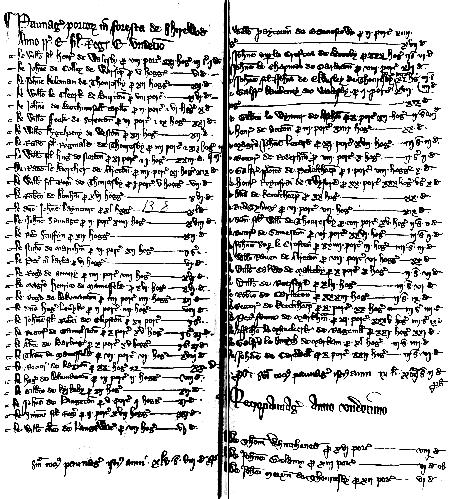
Specimen of Sherwood Forest Roll.
Among other injunctions, it was laid down that the verderers were to assemble every forty days, in accordance with the charter of the forest, to hold Attachment Courts for vert and venison, and other small pleas. There is abundant evidence that this Forty-Day Court, also known as the Attachment Court, and sometimes as a “Swaynmote,” was held by the verderers with much regularity for a long period in Sherwood. These courts were usually held at four different centres, viz., at Calverton, Edwinstowe, Linby, and Mansfield, on successive days of the same week. The Roll of 1292–93 shows that green oak was usually valued at 6d., a dry oak at 4d., a sapling from 1d. to 3d., and a stubb, or dry trunk of a pollarded tree at 2d. These local courts also took cognisance of beast trespassing, the usual fine being 1d. for a straying cow or stirk, and 3d. for five sheep.
The Close Rolls bear abundant evidence of the generosity of successive sovereigns in the thirteenth and fourteenth centuries with royal gifts of both timber and venison from the stores of Sherwood. We may take as an example of such royal gifts those made by Henry III. from different parts of Sherwood between the years 1231 and 1234. The venison during this period included three roes to Robert de Lexington; three bucks and four does to the Earl of Huntingdon; five bucks and twenty does to the Bishop of Carlisle for his park at Melbourne; three bucks to the Dean of St. Martin’s, London; six bucks to Walter de Evermuth; two bucks and eight does to Hugh Despenser; a buck to John, son of Geoffrey; two harts to John de Stuteville; two bucks to Robert de Hareston; seven bucks to the Bishop of Carlisle; five bucks to William of York; three bucks to William Bardolph; five bucks and a hart to William de Albini; and ten bucks to the Bishop of Lincoln.
During the same period the gifts of wood included five oaks to Gilbert Spigurnel, to make a mill; five oaks and thirty tie-beams to the chaplain of Hugh de Burgh; thirty oaks to the Priory of Lenton, for the works of their church; twenty oaks to Brian de Insula; five lime trees to the Franciscan Friars of Nottingham to make their stalls; thirty oaks to the Dean of St. Martin’s, London, for timber for his chancel at Elm; forty rafters to Brother Robert de Dyva; ten oaks to Robert Lupus; and fifteen oaks to William de Albini, for making rafters.
In connection with timber, it may be mentioned that a great provision of wood was made from Sherwood early in the year 1316, when the Parliament was held at Lincoln. The Archbishop of York’s great wood at Blidworth was at that time in the King’s hands, as the see was vacant, and Edward II. ordered the forest-keeper to deliver to the sheriff fifty leafless oaks out of that wood, to be used for making charcoal, and for boards for trestle tables. Thirty oaks from parts of the forest near the Trent were to be despatched to Nottingham for firewood in the King’s hall against the ensuing Parliament, and thirty more for the King’s chambers. It should always be remembered in connection with woods in private ownership within royal forests, that there was no power of felling timber or cutting wood, save for immediate personal use, without a direct warrant. Thus, in 1316, it is entered on the Close Rolls that Edward II. authorised Ralph de Crumbwell to fell and sell as he pleased twenty acres of his wood at Lambley within Sherwood Forest, as a compensation for his losses when engaged in the King’s service in Scotland.
A particularly interesting and exceptional use of the excellent timber of this forest occurs on the Close Rolls towards the end of the year 1323–24, when an expedition was about to be undertaken into the Duchy of Aquitaine. The Sheriff of Nottingham and his carpenters were instructed to procure as many oaks and other suitable trees out of the forest, as were necessary for the construction of nine springalds and a thousand quarels. Springalds were military engines of the catapult kind, whilst quarels were a heavy form of arrows with iron heads which these engines discharged.
Continuing a brief account of some of the more important circumstances with regard to the timber of Sherwood, it may be mentioned that at the Forest Pleas of 1334, the Roll of amercements of persons convicted of vert trespass at the Attachment Courts at more than fourpence (which could only be amerced at the Eyre), embraced upwards of seven hundred and fifty trespassers, varying in value from sixpence for green boughs or dry trunks, to two shillings for a single oak. These values had been paid to the verderers at the time when the Attachment Court had been held; the additional fines imposed by the justices varied from one to two shillings. This list of vert trespasses is after all not a very serious one, when it is remembered that it was about half a century since the last Eyre had been held. In the following century the supreme courts of the justices were held with almost equal rarity, and by the time of Henry VII. the complaints as to the gradual destruction of the oaks of Sherwood, both young and old, became numerous.
The general custom which prevailed in most of England’s royal forests, of the tenants within the jurisdiction being permitted to use wood for the repair or rebuilding of their houses, for the construction of hedges, and for the purposes of fuel, obtained throughout Sherwood. At the last regular Eyre, held in 1538, the justices made two special orders affecting the forest timber, namely, that no hedgebote nor firebote was to be taken by the tenants themselves, but only by the deliverance of the woodward, nor any housebote without the deliverance of the keeper as well as the woodward; and in the second place it was ordered that no one was to fell any even of his own wood for any intent “without the especiall lycense of the kynge his highnesse, or the justice of the foreste, and that none from hencesforthe do take aine woode for bleaching.”
An exact inventory of the trees of the most valuable part of this forest was taken in the year 1609. There were at that time 21,009 oak trees in Birkland, and 28,900 in Bilhagh; but the majority of them are described as being past maturity. In August 1624 a most destructive forest fire occurred, arising from some carelessness in the preparation of charcoal. This fire spread rapidly over an area four miles in length by one and a half in breadth. The abatement of the wind, and the trenches dug by a whole army of men with spades, picks, and shovels, happily checked the fire just as it was approaching the great wood which then stretched from Mansfield to Nottingham.
Both trees and venison suffered severely during the disturbances that preceded the establishment of the Commonwealth. During the days of Oliver Cromwell, and with still greater frequency at subsequent dates, a considerable number of Sherwood oaks were felled for the navy. Various other grants for exceptional purposes on a large scale contributed to the rapid reduction of the forest timber. Thus, in 1680, the inhabitants of Edwinstowe were permitted to fell 200 oaks in Birkland and Bilhagh for the repair of their parish church, which had been seriously damaged by the fall of the spire. In 1686, the oak trees of this part of the forest, including a number that were hollow or decayed, only totalled 37,316, and by 1790 they were still further reduced to 10,117.
“From 1683 onwards, the area of the forest was being constantly curtailed; and in that year 1270 acres out of the hays of Bilhagh and the White Lodge, were sold to the Duke of Kingston to be enclosed within his park of Thoresby. At the beginning of the next century, about 3000 acres of the previous open forest were impaled to protect the deer under the auspices of the Duke of Newcastle, who was their keeper; this was called the New Park, and is now known as Clumber Park. Between 1789 and 1796 inclusive, Acts were passed for the enclosure of Arnold Forest, Basford Forest, Sutton in Ashfield Forest, Kirkby in Ashfield Forest, and Lenton and Radford Forest, whereby 8248 acres were brought into cultivation. When Major Rooke published his interesting Sketch of the Ancient and Present State of Sherwood Forest in 1799, the parts of the forest that still remained to the Crown were the hays of Birkland and Bilhagh, which had a total extent of 1487 acres.”[46]
A most notable use of the grand oaks of Sherwood occurred in the days of Charles II., when the largest and most substantial of the beams used in the construction of the new St. Paul’s, by Sir Christopher Wren, came from this district. The papers at Welbeck Abbey include a letter from the great architect, of April 4, 1695, addressed to the steward of the Duke of Newcastle. Therein he states the measurements of the “great Beames” which he then required. They were to be “47 ft. long, 13 inches at the small end, of growing timber and as near as can be without sap.”
Though the glories of Sherwood as a vast open forest land have long since passed away, there is still much fine timber to be noted on the old forest stretches of Birkland and Bilhagh, as well as a few noble groups of ancient oaks, as at Haywood, near Blidworth. Within, too, the present five deer parks of the county, all of which were within the forest confines in ancient days—namely, the parks of Thoresby, Welbeck, Rufford, Wollaton, and Annesley—portions of the ancient forest timber undoubtedly remain. In some cases the relics of the grand old oaks are but shattered fragments of their original magnificence. The Methuselah of the forest, the Greendale oak in Welbeck Park, would have perished long ago had it not been for the extreme care taken to prop and bind up its shattered members; but it still possesses considerable vitality. In 1724 the great gap hollowed through its centre by age and decay was cut away to such a height and width that “a carriage and six, with cocked-hat coachman on the box, drove through the tree with the bride of the noble owner; three horsemen riding abreast were able to pass through, a feat which has been often accomplished.” Several of the greater and more venerable oaks in other parts of the forest have had fanciful names assigned to them, perpetuated during recent years by means of picture postcards; but these titles are for the most part of recent origin. Such are the Major Oak, the Parliament Oak, and the Shambles Oak.
The deer of Sherwood were of three kinds—red, fallow, or roe. The roe deer seem never to have been numerous, and they died out at a comparatively early date, not finding sufficient quietude owing to the nearness of Nottingham, Mansfield, and other fairly populous places. These small timid deer require a considerable amount of rarely-disturbed covert, and Sherwood, notwithstanding its extent, was intersected by a frequency of roads and byroads. At the Eyre of 1288, there was a single presentment for killing a roebuck.
The red deer were undoubtedly indigenous to this and other parts of England, and roamed at large throughout the forest. The royal gifts of Sherwood deer made by Henry III. and the first three Edwards, consisted mainly of fallow deer; but it need not be considered from this that the red deer were few or far between, because the fallow deer were so much more easily killed or taken alive within the parks where they were sustained. The majority of cases of venison, as recorded in the presentments at the different Eyres, were also concerned with fallow deer; but a fair number of venison transgressors, particularly in the case of those of good position, were summoned for hunting the wild red deer. Thus, in 1334, Lord John Grey was found running a herd of hinds with six greyhounds at Bestwood, of which he killed two; and at the same court Henry Curzon of Breadsall was fined for killing a hind at Clipstone. At various different dates in the fourteenth century, royal releases from prison were granted to offenders who had been caught hunting the red deer. It may here be noted, as it is often forgotten, that the terms for red deer are harts and hinds, whilst the fallow deer are described as bucks and does. The survival at the present day in this county of eleven public-houses which bear the sign of the White Hart is an indirect evidence of the former number of the wild deer; there is also a single instance of a White Hind. This may appear to be a confusion of terms, but from the earliest days there were occasional instances of white harts and hinds, as at the present time among red deer.[47]
The fallow deer were as a rule kept within parks, though, of course, they naturally strayed at times into the open parts of the forest. The two oldest of the hays or parks of Sherwood were those of Clipstone and Bestwood, and there were also those of Birkland, Linby, and Welby, as early as the days of Henry III.
Among venison offenders it was not at all unusual to find the secular clergy. Thus, at the Eyre of 1334, the rector of Annesley and the vicar of Edwinstowe were among the culprits, and fully a score of other beneficed offenders were presented at different dates. Popular notions, encouraged by more or less scurrilous ballads, have long ago marked down the monks and canons of the religious orders as prime offenders in this respect; but the forest Rolls, which cannot lie, in Sherwood as elsewhere, prove the very small basis upon which such charges rest. “Throughout the length and breadth of England, in the extant forest documents extending over several centuries, only four or five charges of venison trespass against the religious have been found, and about a like number for the receipt of venison, or the harbouring of forest offenders. It is not to be understood that the examination has been quite thorough, save of a certain number of forests; but it is highly improbable that the charges against monks or canons regular, if the search was exhaustive, could not be counted on the fingers of both hands. And yet at the same time the charges against rectors, vicars, or parochial chaplains, and the heavy fines, sometimes exceeding a whole year’s income, are fairly common. No charges have been noticed against the monks of Rufford or the canons of Newstead, though they were in the very midst of Sherwood; and yet there was hardly a parish pertaining to that forest whose vicar or rector was not, at some time, convicted of deer-slaying with bow and arrows, or with greyhounds.”[48]
When the sixteenth century is reached, definite statistics can usually be found as to the number of deer in the various royal forests of England. Henry VIII. appointed a commission in 1531, to view and certify the number of the deer in the forest and parks of Sherwood. The red deer at that date numbered 4280, and the fallow deer 1131. The red deer ranged throughout the forest, with the exception of some 200 in Bestwood Park. The fallow deer were within the four parks of Bestwood, Clipstone, Nottingham, and Thorney. Another less detailed return of 1538 of all the deer in the King’s forests and parks north of the Trent, gives the number of red deer in Sherwood Forest as about 1000; in Bestwood Park, 700 fallow and 140 red; in Clipstone, 60 fallow and 20 red; in Gringley, 150 fallow.
Queen Elizabeth, in 1599, granted the keepership of the forest district of Thorneywood, to the north of Nottingham, to John Stanhope, with licence to hunt, chase, and kill the deer, provided he always found a hundred head for the use of the Queen.
A considerable amount of detailed information with regard to the rapidly lessening area of Sherwood Forest, from this date down to 1793, is to be found in the Fourteenth Report of Woods and Forests which was issued at the latter date. In 1616, it was reported that there were 1263 red deer in Sherwood Forest, in addition to those in Thorneywood; another estimate of 1635 made the total 1367. A very large number of the royal deer not unnaturally disappeared during the Commonwealth days. In 1661, considerable expenses were incurred by the transporting of both red and fallow deer from Germany to restock the forests of Sherwood and Windsor.
Charles II., in 1662, did his best to revive the forest laws of Sherwood, and appointed his faithful friend William, Earl of Mansfield and Marquis of Newcastle (afterwards known as the loyal duke) to act as Lord Chief Justice in Eyre. The business before this revived Forest Court was so complicated, and required so much legal investigation, that, though opened at Mansfield in February 1662–63, the proceedings were not concluded until 1676; they provided a right royal harvest for the lawyers and attorneys. Claims to special privileges were put forward by a great variety of persons, including the Archbishop of York and divers others, such as Sir George Savile of Rufford and Lord Byron of Newstead, who had succeeded to properties wrenched from monastic hands. Hosts of minor claimants came from all parts of the forest and its surroundings, pleading privileges that pertained in old days to particular townships or parishes. Some of these humbler folk were unable to resist the attractions of the game as they traversed the old forest grounds; thus one Thomas Cotton, a blacksmith of Edwinstowe, was convicted of shooting a hart when actually journeying to attend this court. He was fined 40s., and had to obtain a bondsman for £40 for his good conduct during the twelve months.
In 1708 a strongly worded petition was drawn up at Rufford by representative gentlemen of the north of the county, addressed to the Crown, complaining of the grievous and almost intolerable burden under which the landowners laboured by reason of the increase during late years of the red deer in the Forest of Sherwood. They complained that so many of the woods had been granted or given away by the Queen’s predecessors, that but little harbour remained for the deer in the forest, and that the deer in consequence were scattered about in the county eating up corn and grass; that their tenants in severe weather had often to watch all night to keep the deer off; that their servants were terrified by new keepers, who threaten them if they so much as set a little dog at the deer. At the same time another general petition to the like effect obtained 400 influential signatures. It was therein stated that the red deer had recently increased from 300 to 900, and that their chief depredations were carried on “in the district called Hatfield and the whole district of the Clay,” which were parts of the county outside the forest limits. These petitions met with no favour at the hands of the Crown; it was argued that to attempt to stint the number of deer through Parliament would be detracting from the Queen’s liberties and rights.
The forest, however, was far from being a source of profit during Anne’s reign. There were four well-paid “forest keepers” and four “deputy forest rangers”; the winter hay for the deer averaged £100 a year; whilst £1000 a year was granted to maintain the deer and the new park at Clumber, and to hunt with two horsemen, forty couple of hounds, eleven horses, and four grooms.
Reports presented to the Commissioners of Woods and Forests in 1793 showed that there were then no deer in the forest save in Thorney Woods, of which Lord Chesterfield was keeper. But evidence was given to the effect that there were a great many deer in Birkland and Bilhagh until about 1770, when they were killed off, with the assistance of the inhabitants, by the Dukes of Newcastle and Kingston, and in a short time the value of the forest farms had materially increased, and the wheat fields no longer needed to be guarded by horns in the daytime and by fires at night.
Though the glories of Sherwood as a vast open forest district have long since passed away, several noble parks occupy some of its choicest portions. Five of these parks are stocked with deer—namely, Thoresby (Earl Manvers), Welbeck (Duke of Portland), Rufford (Lord Savile), Wollaton (Lord Middleton), and Annesley (J. P. Chaworth Musters, Esq.). The first two of these have herds of red as well as of fallow deer. It is quite possible that some of these may fairly claim to be the descendants of those which used to roam at will through the woods and glades of old Sherwood Forest in medieval days.