THE CIVIL WAR IN NOTTINGHAMSHIRE By Everard L. Guilford, M.A.
Reading edition
The Civil War has so unique a character that its study gives us a far deeper insight into the thoughts and feelings of the average Englishman than we should gain by turning our attention to any other outstanding episode in the history of England.
Though the war was general throughout England, yet it was really composed of a number of small local wars, which went on irrespective of the general war, except when the tide of this greater drifted the armies within the sphere of the less.
To understand clearly the nature of the Civil War in any one county, it is necessary to grasp the basic characteristics of the war in general, and to gauge the extent of local influences. There is a great temptation to compare the Civil War with the French Revolution. The ends were similar, in that both resulted in the execution of the reigning monarch and the institution of a republic. And yet beyond this there is little or no similarity. After studying the French Revolution, we feel that the Civil War was merely playing at revolution, and when we come to examine the facts more closely, we find that our Civil War cannot be called a revolution at all. It is only a rebellion—a great rebellion. Here were no downtrodden rebels fighting for the wealth of the upper classes, but instead a body of intellectual and prosperous men struggling for the retention of what they believed to be their religious and political rights. It was not a war of classes. Without the religious differences there would have been no war: for without the religious fervour there could have been no Parliamentary force of sufficient strength to combat the inborn and ingrained reverence for the name of King. Elsewhere in Europe, where religion had been the mainspring of war, brutality and cruelty had been ever to the front; but this was not so in England, for, to quote Mr. G. M. Trevelyan, “two minorities were fighting under critical inspection for the favour of all England, and when rivals duel they take care not to wound their mistress.”
Local jealousy might cause cruelty, but, as a rule, the war was as kind and merciful as a war can be. Another point that needs emphasis is, that it was a war between two minorities. The majority of Englishmen took no active part in the struggle—at any rate at first—though later the non-combatants found that they were plundered by both sides alike, and consequently joined that which they believed would best protect their homes. One class held aloof altogether. The hired labourer had no interest either way. If he joined in the war, it was either because of local influence or because he was forced into service by the ever-present pressgang.
We have no space here to give an outline of the events preceding the outbreak of the Civil War; nor indeed would such an account be pertinent to the matter in hand.
Charles’s failure in foreign wars was followed by an inevitable desire for money, which was not forthcoming by constitutional means. Forced loans, free gifts, and ship-money were resorted to, with little success. Much bitterness was caused, and soon there appeared a small party of men who realised that if the liberty of England was to be saved, Charles must be released from the chains thrown round him by such counsellors as Strafford. This body of constitutionalists, as they considered themselves, included men like the Earl of Essex, Pym, Hampden, and others, who played prominent parts during the coming war.
Feelings gradually became more embittered, and when in March 1642 Parliament tried to deprive Charles of his command of the militia, the quarrel became irreconcilable. Charles was in the North, and on April 23 arrived at Hull, where a large store of munition was awaiting transhipment to London. The Governor of the town, Sir John Hotham, refused the King admission to the town, and Charles called on the trained bands of the neighbouring counties to help him to force his way into this rebellious seaport.
The impracticability of the whole question is well seen when, on June 2, the Parliament sent their Nineteen Propositions to the King. No possible basis of discussion could result from so one-sided a document.
Negotiations of a kind were entered into, and Charles undertook to make no further attempt to capture Hull until July 27. Meanwhile he visited Doncaster, Newark, Nottingham, and Leicester. At Newark, where he reviewed the county trained bands, he showed his trust in this loyal borough—a trust which events proved was not misplaced. His speech to the citizens of Newark was as follows:—
“Your honest resolutions and affections to me and your country, for the defence of my person and the laws of the land, have been and are so notable, that they have drawn me hither only to thank you: I go to other places to confirm and undeceive my subjects, but am come hither only to thank and encourage you: you who have made the best judgment of happiness by relying on that foundation which the experience of so many hundred years hath given such proof of—the assurance and security of the law: and assure yourselves when laws shall be altered by any other authority than that by which they were made, your foundations are destroyed, and though it seems at first but to take away my power, it will quickly swallow all your interest. I ask nothing of you (though your demeanour gives me good evidence that you are not willing to deny), but to preserve your own affections to the religion and laws established. I will justify and protect those affections and will live and die with you in that quarrel.”
To obtain a clear understanding of this war, a few statistics are necessary. The population of England was about five millions, of whom six-sevenths lived south of the Trent, and out of this whole number not more than 2½ per cent. took any part in the struggle. London, of course, was the largest town, with 500,000 inhabitants, and Bristol and Norwich were next, with some 30,000 each, while no town in the north had half this number. Roughly stated, it may be said that the strength of the King lay in the north and west, and that of the Parliament in the south and east. Thus it will be seen that the predominance, as far as population (and consequently commercial prosperity) went, was with the Parliament. Do not let us imagine for one moment that the Houses of Parliament were unanimous in their antagonism to the Royalists. Professor Firth calculates that 30 peers supported the Parliament and 80 the King. Of the Lower House, 300 were Parliamentarians and 175 Royalists.
All through the struggle, the difficulty on both sides was to find recruits for the army. There was no standing army and no regular troops, with the exception of a few garrisons. The only forces were the trained bands, and, except those in London, who were strongly Parliamentarian, these took little or no share in the struggle, refusing in most cases to leave the counties in which they had been raised. Thus the party with the longest purse was sure to win. At first the generosity of his adherents gave Charles a great financial predominance, but in the end the steady flow of wealth from the commercial centres threw the balance on to the other side.
Parliament tried to raise an army and pay for it by means of weekly assessments on the counties. Nottinghamshire was assessed at £187, 10s., Leicestershire at the same figure, Derbyshire at £175, while Lincolnshire had to find £812 and London £10,000. In Nottinghamshire the raising of regiments was entrusted to Sir Francis Thornhaugh of Fenton, near Sturton le Steeple; Sir Francis Molineux, who declined to act; and Mr. Francis Pierrepont, son of the Earl of Kingston.
Before we go any further, it may not be amiss to give a list of the gentry who sided with the King, and of those who were Parliamentarians.
Royalists: the Earl of Newcastle and his son, the Earl of Kingston and his eldest son, Lord Chesterfield and all his family, Lord Chaworth, Mr. Golding and other Catholic gentry, Sir John Byron and all his brothers, Sir John Savile, Sir Gervase Eyre, Sir John Digby, Sir Matthew Palmer, Sir Thomas Williamson, Sir Roger Cooper, Sir W. Hickman, Sir Hugh Cartwright, Sir T. Willoughby, Sir Thomas Smith, Sir Thomas Blackwell, and members of the following lesser families: Markham, Parkyns (Thomas and his son Isham), Tevery, Pearce, Wood, Staunton, Saunderson, Moore, Mellish, Butler, Rolleston, Lascelles, Neville, Burnell, Holder, Wyld, Leek, Clay, Gilby, Lee, Shipman, North, Apsley, Colley, Newport, Holland, Hacker, Holden, Pocklington, and Green.
Parliamentarians: Mr. Sutton (afterwards Lord Lexington), Sir Gervase Clifton (who became a royalist), Mr. William Pierrepont (who did not serve in Nottinghamshire), Mr. Thomas Hutchinson and his sons John and George, Mr. Henry Ireton, Mr. Edward Whalley, Mr. Gilbert Millington, Mr. Francis Hacker, Sir Francis Thornhaugh and his son, Mr. Pigott, Mr. Wright, Mr. Widmerpool, Mr. Scrimshire, and Mr. Acklom of Wiseton Hall.
From this list it will readily be seen that Nottinghamshire was strongly Royalist—so predominantly so, that it is difficult to account for the fact that Charles’s summons to his supporters to meet him at Nottingham was so scantily answered. This summons was issued from York on August 12, and the meeting was to be on August 22, when the standard would be raised.
At this point we are met by several problems which require consideration. Why did Charles raise the standard of war before he was ready to fight? Why did he choose Nottingham for that purpose? And why was he so badly supported in this very Royalist county?
At no time during the war did Charles ever really want to fight. He was the victim of circumstances: he was blind to facts, and he under-estimated his opponents’ strength, as they did his. He thought, doubtless, that such a direct challenge as the raising of the standard would frighten the Houses into submission. The sacred name of King would be a rallying point. Men might criticise, but they would not fight against their King. The reverence for the person of the monarch, which had reached its height during Elizabeth’s reign, was still great, notwithstanding a steady decline, and there is no doubt that many men were influenced by this feeling. They agreed with the theory of the Parliament’s demands; but when it came to practice, they would fight for their King, even against their better judgment. Charles hoped that the challenge would prove a lifebelt in the sea of his difficulties; he found that it was a millstone. But this does not explain why he raised the standard before he had an army. He felt that many places, and especially the seaports, were slipping away from him, and he hoped to save them by this step. His hope was false, and before long the fleet and all the great seaports were in the hands of his enemies. Charles’s choice of Nottingham was probably due, in the first place, to his belief in the loyalty of the gentry in the county, and, in the second place, he had doubtless heard that Nottingham was a strong military position, with its Castle standing high above the Trent, which was only to be crossed at the Hethbeth Bridge—a position easily defended—and possibly also at Wilford. He must have been very disappointed to find that the river was very low, and was easily fordable at various points close to the town. Of the ruinous condition of the Castle and town defences he must have been aware, for he was no stranger to the town. The reason for the bad support accorded him is difficult to discover. Perhaps most of the gentry were already at Nottingham, but if so, they had brought few followers; probably many wished to remain neutral, though later events caused them to throw in their lot with Charles.
Much has been written of the raising of the standard, and here, since space is limited, we must not go into details. The King arrived at Nottingham on August 19, and almost immediately was compelled to set out for Coventry, which, he heard, was in danger of capture. His journey was futile, and he returned crestfallen on August 22. That evening the standard was raised, probably on a slight eminence in a field to the north of the Castle, now in the grounds of the General Hospital, and after the ceremony it was carried into the Castle, this procedure being repeated every day till the 25th.
Charles’s position was not enviable. He had thrown down the formal challenge, and was now finding, when too late, that he had not the forces at his back to uphold such a challenge. The general feeling of most Englishmen at this time was truly expressed by Lord Savile when he wrote: “I would not have the King trample on the Parliament, nor the Parliament lessen him so much as to make a way for the people to rule us all.”
A Parliamentary army of 20,000 men was stationed at Northampton, heavily outnumbering the forces assembled at Nottingham. Prince Rupert was stationed at Queensborough, between Leicester and Melton Mowbray, with his cavalry. Unable to fight, Charles fell back upon negotiations. Though he had little hope of any success by this means, he recognised that by forcing the Parliament to refuse offers of peace, he would bring over to his side many who viewed the prospect of open war with horror. The first message left Nottingham on August 25, in the hands of the Earls of Southampton and Dorset, Sir John Culpepper, and Sir William Uvedale. Even before any answer was received, Charles had issued some “Instructions to his Commissioners of Array,” which show what he thought would be the result of the deputation. The expected happened. The Houses sent an unfavourable answer, and further messages were sent, though all this time both sides were preparing for war. At first Charles would not avail himself of the services of the Roman Catholics, who were only too willing to lend him aid and money. This was a wise step, for Catholics were looked upon with considerable hatred, and their adhesion would result in the alienation of many. Eventually, however, the King gave way, for Catholic money was as good as any other, besides being more plentiful in this time of scarcity. The leading Catholic in this district was Mr. Golding, who held large estates at Colston Bassett.
On September 10 the Earl of Essex joined the Parliamentarian forces at Northampton, and, had he marched at once on Nottingham, it is difficult to see how Charles could have avoided capture. But Essex dallied for some unknown reason, and the golden opportunity to end the war at one stroke passed by and never came again. Charles saw his danger, and recognised the fact that Nottingham was no longer a safe shelter. On September 13 he marched to Derby and thence to Shrewsbury, where he was able to collect such forces as placed him more nearly on an equality, numerically, with his opponents.
Freed from the presence of the King, Nottingham was open to occupation by either party. The citizens were divided in their opinions, and neither party was yet strong enough to take possession of the town.
Thus matters continued until the Battle of Edgehill, after which Sir John Digby, the High Sheriff of Nottinghamshire, made an attempt to secure the county for the King. A meeting was called at Newark, at which all the gentry were requested to be present. Though the best interests of the county were the ostensible object of this meeting, the Parliamentarian gentry grew suspicious and absented themselves, and it was as well for them that they did so, for it was the intention of Sir John Digby to capture all those who were likely to oppose him. Gradually John Hutchinson had come to the front, and henceforward he took over the command of affairs locally in the interests of the Parliament, aided by a committee with whom he was not always in agreement. His family lived at Owthorpe, and those who wish to see him through the idealising eyes of his wife cannot do better than refer to the famous memoirs. Recognising the fruitlessness of all negotiations, Hutchinson summoned all those well affected to the cause of Parliament to come to him at Nottingham. By Christmas 1642 a sufficient number were assembled for the fortification of the town to be pushed on apace. New gates replaced those which had fallen down, and Nottingham was made as strong as the shortage of time and men permitted. Hutchinson with a small force occupied the Castle.
Meanwhile the Royalists were occupying and strengthening Newark, which was in better repair than Nottingham. The Duke of Newcastle garrisoned it with a force under the leadership of Sir John Henderson. This occupation of Newark by the Royalists was of paramount importance, for there were but three regular fords on the Trent, one at Nottingham, one at Newark, and the third at “Wilden Ferry,” in Derbyshire, where the Cavendish Bridge is now, and further, Newark served to divide the parliamentary forces in South Lincolnshire from those in Yorkshire under Lord Fairfax, besides acting as an ever-present thorn in the side of the Parliamentary garrison at Nottingham. Soon after Newark was garrisoned, an attack was made on it by the Lincolnshire forces, but this was beaten off. This attack was followed by another, planned on a larger scale, which came within an ace of being successful. It was decided to make an assault on Newark from all sides at Candlemas 1643. Forces from Nottingham and Derby, under the command of Colonel John Hutchinson and Sir John Gell respectively, were to attack the town on the western side, while the Lincolnshire forces, under one Ballard, were to attack on the east. Ballard was to be commander of the whole force. This soldier was a man whose days of prosperity were behind him, and who, having many friends among the Newarkers, was unwilling to be the cause of their undoing. He took up his position on Beacon Hill, and began to bombard the town at a distance too great to effect any appreciable damage. However, matters were going well for the attackers: a street had been captured on the east, and on the west the townsmen had been driven from their position. At this point Ballard hesitated, and refused to move. The Newarkers were quick to profit by his weakness, and the enemy were driven off. But this narrow escape served as a warning to the Cavaliers, who began immediately to strengthen the defences of Newark. Shelford Manor and Wiverton Hall were fortified, and Sir Roger Cooper and the Duke of Newcastle put their houses, at Thurgarton and Welbeck respectively, into a state of defence; while about the same time Newstead Priory, Felley Priory, and Kirkby Hardwick were occupied by the Royalists. In May of this year Oliver Cromwell first appears in this district. His forces and those of Lincolnshire were allied, and in the several skirmishes that took place, the Newarkers appear always to be the losers. Cromwell’s force numbered 2000 men, and we find there the beginnings of that discipline and uprightness which was to be later so important a factor in the organisation of the army of the eastern association and the new model. The Kingdomes Weekly Intelligencer, referring to this force, says: “No man swears, but he pays his 12d.; if he be drunk, he is set in the stocks; or worse, if one calls the other ‘Roundhead,’ he is cashiered, in so much that the countries where they come leap for joy of them, and come in and join with them.” What a contrast this is to the irregularities practised in many of the Royalist camps, where debauchees like Goring were in command! There were many earnest men who withheld their hands from their swords rather than serve in a force commanded by such creatures as these. Nor was this looseness the only weakness in the Royalist army. The King was unwilling to entrust the whole command to any one man, and so, while making Lindsey general-in-chief, he had left the cavalry in the hands of Prince Rupert. Concerted action was impossible, jealousies were prevalent, and distrust and disorder resulted. It was about this time that the Queen arrived from abroad with help for the King. In June she was at Newark, whence she sent the following letter:—
“My Dearest Heart,—I received just now your letter by my Lord Saville, who found me ready to go away, staying but for one thing, for which you will pardon two days’ stop, it is to have Hull and Lincoln. Young Hotham having been put in prison by order of the Parliament, is escaped, and hath sent to 260 (the Earl of Newcastle?) that he would cast himself into his arms, and that Hull and Lincoln should be rendered. He is gone to his father, and 260 writes for your answer; so that I think I shall go home Friday or Saturday, and shall go lie at Werton (Wiverton), and from thence to Ashby, where we will resolve which way to take; and I will stay there a day, because that the march of the day before will have been somewhat great, and also to know how the enemy march, all their forces at Nottingham, at present, being gone to Leicester and Derby, which makes us believe it is to intercept our passage. As soon as we have arrived I will send you word. At this present I think it right to let you know the state in which we march, and what I leave behind for the safety of Lincolnshire and Nottinghamshire. I leave two thousand foot and wherewithal to arm five hundred more; twenty companies of horse, all to be under the command of Charles Cavendish, whom the gentlemen of the country have desired me not to carry with me against his will, for he desired extremely not to go. The enemy have left within Nottingham one thousand. I carry with me three thousand foot, thirty companies of horse and dragoons, six pieces of cannon, and two mortars. Harry Germyn commands the forces that go with me, as colonel of my guard; and Sir Alexander Lesly the foot under him, and Gerard the horse, and Robert Legge the artillery, and her she majesty generalissimo over all and extremely diligent, with one hundred and fifty waggons of baggage to govern. In case of battle have a care that no troop of Essex’s army incommode us: for the rest I hope that I shall be strong enough, for we have had the experience at Nottingham, one of our troops having beaten six of theirs, and made them fly. I have received your proclamation, or declaration, which I wish you had not made, being extremely disadvantageous for you, for you show too much fear, and do not what you had resolved upon. Farewell, my dear heart. From Newark, 27th June 1643.”
Meanwhile Colonel Hutchinson at Nottingham was becoming apprehensive for the safety of the town, which was now surrounded by Royalist garrisons. Moreover, the energetic Newarkers were always ready to take advantage of any weakness Nottingham might show. In these circumstances, Colonel Hutchinson was despatched to London to inform Parliament of the danger, with the result that Cromwell, Hubbard, Lord Grey, and Sir John Gell were ordered to unite their forces at Nottingham. Besides the strengthening of the town, this order had another object. It was known that the Queen would pass close by Nottingham in her attempt to join the King, and it was hoped that she might be intercepted. With this object in view, the force of some 5000 men, now in Nottingham, were divided as stated in the Queen’s letter, some being stationed at Derby, and others at Leicester. All these precautions proved futile, for after waiting two days at Southwell, in doubt whether to attack Nottingham or not, the Queen passed on to Ashby-de-la-Zouch.
The Queen’s escape was followed by the departure of the troops concentrated at Nottingham.
The Newarkers were by no means content to wait to be attacked. They preferred to fill in their time by annoying their opponents as far as lay in their power. During May an escort had been sent to Oxford to convoy some arms, and this force, some 2000 in number, on its return made an unsuccessful attack on Northampton. Later in the year a night march to Melton Mowbray resulted in the capture of the Parliamentary Committee of Leicester, who were there with the object of raising money.
About the middle of 1643 two changes of leaders took place. Sir John Meldrum superseded Lord Grey, and Sir John Henderson surrendered the governorship of Newark to Sir Richard Byron. On July 20 Lord Willoughby of Parham had taken Gainsborough by surprise from the Royalists, and on the 25th Meldrum and Cromwell were ordered to go to his assistance, for he was menaced by a force of Newarkers under Charles Cavendish, the Royalist commander in Notts and Lincolnshire. Gainsborough was an important place, for, to quote Mr. Gardiner: “It stood in the way of an attack by the Royalists on Lincoln or of an attempt to help Newark.” Mr. Gardiner continues: “Cromwell and Meldrum joined hands at Grantham, and a body of troops met them from Lincoln at North Scarle. On the 28th they arrived at Gainsborough, and the battle was fought to the S.E. of the town, and resulted in the defeat of the Royalists and relief of Gainsborough.
“A Royalist force is reported, and Cromwell advances to meet it. He finds it is the army under Newcastle, and has to retire to Gainsborough, which he leaves to its fate, and on the 30th it capitulates. This battle was the turning point of the war, for it showed the Parliament where to look for cavalry and a great leader.” During this battle Charles Cavendish was slain, a great loss to the Royalists.
After this Sir John Meldrum joins the main army and leaves Lieut.-Colonel Hutchinson in command at Nottingham, which was neglected by Parliament and left to its own devices, for even troops commanded by such local men as Henry Ireton and Whalley are taken from this neighbourhood.
Before proceeding to detail the events at Nottingham, it may be as well to give a description of the condition of the Castle at this time, which Bailey quotes in his Annals of Nottinghamshire:—
“The castle was built upon a rock, and nature had made it capable of very strong fortification; but the buildings were very ruinous and uninhabitable, neither affording room to lodge soldiers nor provisions. The castle stands at one end of the town, upon such an eminence as commands the chief streets. There had been enlargements made to this castle after the first building of it. There was a strong tower, which they called the old tower, built upon the top of all the rock.... In the midway to the top of this tower, there is a little piece of rock on which a dovecote has been built; but the Governor took down the roof of it, and made it a platform for two or three pieces of ordnance, which commanded some streets and all the meadows better than the higher tower. Under that tower, which was the old castle, there was a larger castle, where there had been several towers, and many noble houses, but the most of them were down, only it was situated upon an ascent of the rock, and so stood a pretty height above the streets. And there were the ruins of an old pair of gates, with turrets on each side. Before the castle, the town was on one side of a close (Standard Hill and parts adjacent), which commanded the fields approaching the town; which close the Governor afterwards made a platform. Behind it was a place called the Park, that belonged to the castle, but then had neither deer nor trees in it.... In the whole rock, there were many large caverns, where a great magazine and many hundred soldiers might have been disposed, if they had been cleansed and prepared for it, and might have been kept secure from any danger of firing the magazines by any mortar pieces shot against the castle. It was not flanked, and there were no works about it, when Mr. Hutchinson undertook it, but only a little breastwork before the outmost gate. It was as ill provided as fortified, there being but 10 barrels of powder, 1150 pounds of butter and as much cheese, 11 quarters of bread corn, 7 beeves, 214 flitches of bacon, 560 fishes, and 15 hogsheads of beer.”
The position of the town was critical. Girded with fortifications which could only be sufficiently defended by 3000 men, Nottingham was riddled through and through by jealousies and dissensions. Hutchinson was not popular, and many Parliamentarians disapproved of his carrying the cannons up into the Castle. Eventually a meeting of the townspeople was held, at which Colonel Pierrepont propounded these three alternatives: (1) To leave the town and go to other garrisons; (2) to stay in the Castle; (3) to stay in the town works and have their throats cut. Many left the town, and but 300 joined Hutchinson in the Castle. These were all good men, and when the place had been provisioned, the position was one of no little strength. The town defences were left in the hands of the municipality. Of the garrison in the castle two-thirds were quartered in the town.
Before long Newcastle sent Major Cartwright with a summons to surrender. He was met with a refusal, and a similar answer was carried back by Mr. Ayscough, whom Sir Richard Byron sent with the offer of a bribe to the Governor.
Meanwhile hostilities had been continuing round Gainsborough, with the result that the Royalists suffered a severe loss by the deaths of the Earl of Kingston and Colonel Thomas Markham of Ollerton.
On the morning of September 19, Nottingham Castle narrowly escaped capture. During the night a force of 600 Newarkers, led by Sir Richard Byron, had gained access to the town, surprised the 200 of the garrison who were quartered outside the Castle, and either captured or drove them off. Thus Hutchinson found his garrison reduced to 100, and the enemy at his gates. For five days the town was plundered and the Castle fired at from the tower of St. Nicholas’s Church. On September 23 the invaders withdrew, and at the same time help arrived from Derby and Leicester, but the Royalists and their prisoners were allowed to depart, leaving Captain Hacker[50] with a small force to hold the newly erected fort at the Trent Bridge. The menace of this force annoyed the Governor, who planned its dispersal. Acting contrary to the advice of the commander of the Derby forces, Hutchinson began to lay siege to this bridge fort, and after five days he was so far successful that Hacker withdrew to Newark, after breaking down two arches of the bridge behind him. But Hutchinson’s troubles were by no means at an end. Unpopular, and at odds with the Committee, he was called upon, in January 1644, to face another attack upon the Castle. This time the attack was made by some 3000 troops, 1000 of whom entered the town, with intent to occupy it, another 1000 remained outside to guard against any attack by neighbouring Roundhead troops, while the third body, recruited largely from the garrisons of Belvoir and Wiverton, were to gain possession of the all-important passage over the Trent. The town force, led by Sir Charles Lucas, was surprised in the streets of the town by a fierce attack of the garrison, and fled without making much attempt to fight. A month later the Newarkers made an attempt to gain possession of the Trent Bridge by entering in the disguise of market women. Their ruse failed, and more than half of this heroic force of nine were slain.
But this state of affairs could not go on. It was incredible that the Parliament would allow themselves to be the butt of frequent attacks without making some reprisals. Early in 1644 the Committee of both kingdoms made up their minds to deal severely with Newark. Sir John Meldrum, a Scotsman, was placed in command of the expedition, and the forces of Nottingham and Derby were to co-operate with him. The condition of the garrison was not enviable. Reduced in numbers by the departure of several expeditionary forces, it was composed largely of the townspeople and neighbouring gentry, while in addition to their fewness of numbers, the capture of a food convoy rendered it likely that soon they would be in want of provisions. The besieging army numbered about 8500 men; but for all this the Newarkers were not going to await their fate without doing all in their power to annoy the enemy, for early in March a sudden sortie proved very disastrous to the besiegers. But notwithstanding this, Sir John Meldrum expected almost daily to gain possession of the town. But it was fated otherwise, and the minister of fate was Prince Rupert, whom the King sent to do his utmost to save the loyal borough. That he was not expected by the Parliamentarians is evident, for his rapid cavalry attack delivered from Coddington was successful, and the siege was raised before Sir John Meldrum had time to find out the size of the force opposed to him.
The disputed ownership of Newark settled, Prince Rupert turned his attention to Nottingham, and sent a demand for the surrender of that town. The answer was a direct refusal; and evidently the Royalists did not consider themselves strong enough, for though they advanced to within three miles of that town, they changed their course and journeyed to Oxford. But the Parliament had received a severe scare, for when it was thought that Rupert might arrive at Nottingham any minute, the Parliamentarians set to work to strengthen the fortifications with the utmost haste. The meadows were flooded, and even on Sunday no pause was permitted. But the moral effect of the relief of Newark was so great, that even Mrs. Hutchinson, who saw little good even in the majority of the supporters of the Parliament and none at all in the Royalists, wrote: “Such a blow was given to the Parliament interest, in all these parts, that it might well discourage the ill-affected, when even the most zealous were cast down, and gave up all for lost.”
The Newarkers were wise. They were not buoyed up with any false opinion of their future security. The Parliament was still as determined as ever, and in July, the Earl of Manchester was quartered at Retford watching Newark. Mr. Cornelius Brown quotes the following letter from one Will Goode in the army of the Earl. It refers to events which took place between July 27 and August 16, 1644:—
“On Monday morning came an alarm to our quarters (at Retford) from Tuxford that our horse there were beaten up with great loss to us, whereupon Lieutenant-General Cromwell speedily rode thitherwards to prove the truth, whereupon he found that Newark, by obscure ways through the forest, unknown to our horse guards, being two troops which stood two miles from Tuxford towards Newark, had fallen suddenly into Tuxford upon our three troops, of whom they killed a lieutenant and a quartermaster and took with them eight prisoners and some horse, and so speedily retreated to Newark. On Monday, his Lordship advanced from Retford to Gainsborough, and then rode to Lincoln, where he yet remains, having sent 2000 horse and 150 foot to lie at Beckingham and Claypole, and some troops within two or three miles of Newark to hold them in.... Our horse lies between Newark and Belvoir, and will prevent all relief on this side of the Trent to that town. Newark now expects a siege.”
The first of the Royalist garrisons in the valley of the Trent which fell into the Parliament’s hands was Thurgarton Hall, the residence of Sir Roger Cooper, which was carried by assault by the force under Colonel Thornhaugh, which had assembled at Mansfield and marched by way of Thurgarton to assist in the watching of Newark.[51] This Royalist disaster occurred at the end of 1644. In Nottingham itself the quarrel between Hutchinson and the Committee had by the beginning of 1645 become so acute that in April we find both parties in London pleading their cause at headquarters. Hutchinson’s visit was cut short by the receipt of the news that the Newarkers had captured the fort at Trent Bridge. One who signs himself T. H., writing to the Weekly Account, April 16–23, 1645, says:—
“I doubt not but you have heard of the sad condition of these parts; the King’s Forces from Newark of late have been more active than ever, and their opposition as little. They have plundered us of our Goods and Cattle on this (the south) side of the River, and on Saturday last a Partee of the Newark Horse and Dragoons, when it was not yet duske, fell on Nottingham Bridge, which is not many furlongs from the Town, cut off the Centinell, and surprised the whole Guard, except 3 men which narrowly escaped; the whole Guard consisted of 33 Persons, those that got not away were most inhumanly cut to pieces, notwithstanding desire of Quarter, &c., and it may please God that some of those which committed this massacre, may be met with in the like Hands.”
This was a serious matter, for the loss of this fort closed the road for all provisions into Nottingham from the south. Accordingly, Colonel Rossiter was sent with a force of nearly 2000 men to recapture the position. No fight was necessary, for the Newarkers, recognising the numerical superiority of the enemy, and hearing that the Scotch army would shortly arrive at Nottingham, retreated home.
The Weekly Account, May 4, 1645, states: “The Scots will keep their rendezvous at Nottingham to-morrow”; but it seems doubtful whether they did, for it is the middle of June when The Kingdomes Weekly Intelligence announces: “The Scots are come to Nottingham with 7000 foot, and 4000 horse, expecting command of their removal.” As a matter of fact, they appear to have left on July 1.
Meanwhile the King and Prince Rupert had determined to capture Leicester, the most important Parliamentary position in the Midlands. A large force was collected, among them the celebrated regiment of Newark cavalry led by Colonel Page, and by the beginning of June the town was in Royalist hands. But their triumph was short-lived, for on June 14 the battle of Naseby proved that the time of the Parliament had come, and that the question now was how long the few isolated Royalist garrisons could hold out. Of these towns Newark was the most important, and the numbers of its garrison were swelled by the arrival of many fugitives from Naseby. With increased strength came greater activity, and the raids of the Newarkers became even more galling to the Parliament than they had hitherto been. The energetic forces dashed in all directions, turning up where they were least expected and leaving before any concerted attack could be made upon them. Among their exploits at this time was the capture of Welbeck House, together with 200 prisoners. Each month saw special efforts being made to capture this energetic town, which received fresh encouragement on August 22 from a short visit of the King, who passed through on his way to Huntingdon. The town was now governed by Sir Richard Willis, who had succeeded to the post in 1644. Under his leadership the raids on the surrounding country were continued until October, when on the 4th the arrival of the King gave a new turn to affairs. Charles’s object appears to have been to make his enemies leave the Welsh border and compel them to attack him in a strong position from which he could escape whenever he might wish to do so. That the Parliament did not look on the matter in the same light, is evident from the following extract from The Diary, or an Exact Journal, October 23–30:—
“Major General Poyntz hath blocked up Newark on the North side of it; and to make his men more circumspect and eager in the siege thereof, hee is certainly assured that the King is there, and with him the two German Princes Rupert and Maurice: the London Brigade, under the Command of Colonel Man Waring is now there with him, with whom are joyned the Horse and Foot of Nottinghamshire under the Command of Colonell Thornehaugh. On the South Side of the Towne Colonell Rossiter is quartered with his owne Regiment; and he hath with him the Northampton Horse under the Command of Colonell Lidcot, so that it is conceived, it is altogether impossible for the king to escape through them either by force or stealth, for hee hath not with him above 800 Horse, the Truth of which may easily be collected by the strength which he brought with him into Newarke, which were at the most not above 1800 horse, sixteen hundred whereof were so sorely shaken at Sherbourne, that it is thought very few of them returned to Newarke, to bring the sadde tydings of their overthrow, so that he hath now but 200 remaining with him, which being put to the troopes of the Garrison, which are but nine troopes, and are 3 score in every troope doe make up just 800.”
But dissension was about to appear in the little garrison of Newark. Prince Rupert had lost Bristol, and had, on this score, been abused. Contrary to the King’s wishes, he came to Newark to explain his side of the question. The position was further complicated by the King choosing this time to supplant Sir Richard Willis in the governorship of the town, and to put in his place Lord Belasyse. This, taken with other private jealousies, brought matters to a climax. The Princes, Rupert and Maurice, sided with Willis when at a feast given by Lord Belasyse the quarrel became open. “Thereupon they all drew in the King’s presence, and within an hour the Princes, Genl. Willis, and many others cald to Horse, and went away that night on the South side of the Town (to Wiverton Hall). Colonell Rossiter lyeing on that side must needs know of their action. Bellasis is made Governor of Newarke, the onely creature of note with his Majesty.
“Newark is full of discontent, and most of the gentry wavering, desire their liberty.”
The sequel of this quarrel was that the discontented Royalists applied to Parliament for passes to leave the country, promising not to take any further part in the war. Their request was granted, yet not all seem to have taken advantage of it, for some at any rate were reconciled to the King. Prince Rupert, however, passes altogether from the local stage.
At the end of October, Poyntz undertook the suppression of the Royalist garrisons at Shelford and Wiverton. Shelford, commanded by Lord Stanhope, son of the Earl of Chesterfield, refused to surrender. A bloody struggle was the result, and it was not until their general was slain that the plucky defenders capitulated. Within a week Wiverton and Welbeck, awed by the fate of Shelford, surrendered without waiting to be stormed. Thus was Newark becoming gradually surrounded by hostile garrisons, and now Belvoir Castle alone remained in Royalist hands. The King realised that if he wished to escape before the net was drawn quite tightly round Newark he must delay no longer, and on November 6, Colonel-General Poyntz had to report “that the King was come from Newarke and gotten by him.”
Siege was laid to Belvoir Castle, its outworks were captured, and its water-supply almost cut off, yet it appears to have held out for two months, until December 30, when the Governor, Sir Gervase Lucas, surrendered.
Meanwhile a formal siege had been laid to Newark, and the town was all but surrounded; for now that the Earl of Montrose was defeated in Scotland, and the Royalists in the west of England dispersed, all that remained to be done was to capture the King and his towns of Oxford and Newark.
Mr. Cornelius Brown, in his History of Newark, draws attention to the fact that while the King was at Newark he was in communication with the Scottish leaders—a fact to be noticed in view of the course events afterwards took.
This last siege of Newark was a much more serious affair than either of the others had been. A large army was collected for the purpose, and an attempt was made to surround the town and establish a blockade, with the object of preventing the introduction of provisions into it. The arrangement of the besieging forces can be well seen from the contemporary plan. Colonel Rossiter at Balderton, and General Poyntz at Farndon, were watched by the Newarkers established in the Queen’s Sconce, of which notable remains can still be seen. Colonel Theo. Gray at Coddington, and Colonel Henry Gray at Winthorpe, were, in their turn, watched by the garrison of the King’s Sconce, now unfortunately destroyed. It had been arranged that the Scots, when they arrived, should take up their position at Kelham, and by occupying the island from Kelham to Muskham Bridge they would complete the ring of besiegers. At the beginning of December the Scots arrived, and immediately a council of war was held by the English and Scottish generals. As a result Muskham Bridge was stormed and a sconce near it captured. It is difficult to point to the exact place where the Scots had their main camp, called Edinburgh. Undoubtedly it was a very large enclosure, and one would expect it to have been defended by some kind of earthworks; yet a careful search of this part of the island has failed to reveal more than a few isolated banks and ditches, insufficient to give us any idea of the shape or extent of this camp.
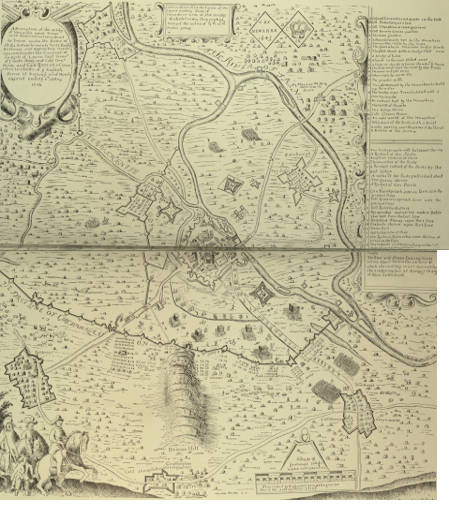
Siege Plan of Newark.
Notwithstanding the arrival of the Scots, the circuit would not seem to have been complete, for the Newarkers still continued to carry provisions into the town, and not infrequently they would sally forth and fiercely attack one or other of the enemy. The following graphic account from the Cities Weekly Post, January 6–13, 1646, must serve to describe one of these frequent sallies:—
“Major Generall Poyntz continues his Quarters at Stoake; the Nottingham forces did keep their Guards in the Church, where unfortunately happened so great a fire, which took hold of the straw, that they could not quench it until it had devoured all that was combustible by the fire, and nothing on the next morning but the walls remaining, a sad spectacle to the beholders; whether this gave any encouragement to the Enemy in Newarke we cannot tell; but not long afterwards, the Nottingham forces being many of them gone to Nottingham upon some business (as wee heare) of publicke concernment, the Enemy sallyed forth from Newarke, being about 800 Horse and betwixt 200 or 300 Foot, and were making up to Major Gen. Poyntz his quarters at Stoak, which they did with so much fury and eager speed, that his Horse Guard began to flye, and were in that disorder, that two Horses fell down as they were passing through the turn Pike, by which means the more neare approaches of the Enemy and the Allarum they did give us could not so perfectly bee apprehended until they had entered into our Quarters, and Major Gen. Poyntz his own Chamber, which they made hast to plunder. In the meantime Major Gen. Poyntz using all dilligence to re-colect his men, did deport himselfe with so much resolution, that many of the Enemy were killed, nine prisoners taken, and about fifty wounded. In this service, it is said, we had not above three slaine, and seven hurt. The Enemy retyred in disorder to Newark, and the rather because they heard that Collonel Rossiter with a new body of 1000 Horse and foot was cumming down from Claypoole towards them, but perceiving that the Enemy had notice of their cumming, and were got into Newark, he onely gave an alarum to their Garrison, and returned safe to his own quarters.”
Even the turning of the river out of its course was not able to break down the defences of the gallant town, and so matters went on, until in May the end came suddenly and dramatically.
Negotiations between Charles and the Scotch Commissioners appear to have been in progress for some time, the intermediary being Montreuil, a Frenchman in the King’s confidence. There is a certain amount of mystery attached to the whole affair, but at any rate Charles thought that he could not do better for his cause than join the Scotch army. How far the negotiations had gone, and how far the Scotch generals were privy to these negotiations, is not clear, but at any rate when the King suddenly appeared at Kelham on May 5, 1646, General Leslie professed complete astonishment and embarrassment. But it is instructive to inquire how Charles reached Kelham, for considerable uncertainty exists as to the course he took after entering Nottinghamshire at the south. We hear that the King reached Stamford in disguise, accompanied by Dr. Hudson and John Ashburnham, on May 3, and left again on the 4th, travelling all night. The only detail of his journey to Southwell, where he arrived early on the 5th, that we have been able to meet with, is that he crossed the Trent near Gotham. This statement is confusing rather than otherwise, for the Trent does not pass within two miles of this isolated village. The reason why it was necessary to cross the river to the west of Nottingham would be that the country between Nottingham and Newark was quite unsafe for Royalists, while there was quite a possibility of a safe circuit round Nottingham by the north, and so by forest roads to Southwell. But the exact spot where the Trent was crossed still remains to seek. Arrived at the King’s Arms (now the Saracen’s Head), Southwell, Montreuil’s headquarters, Charles rested for a short time, and after dinner marched on to Kelham. Though seemingly embarrassed by their royal prisoner, the Scots had no intention of letting him escape. He was closely guarded at Kelham Hall—so closely, indeed, that no one could correspond with him. No sooner was he at Kelham than Charles set about to arrange for the surrender of Newark. The Newarkers begged that they might hold out as long as they could, but Charles insisted on their surrender, and Belasyse had to make the best terms he could. The terms were favourable, for the garrison marched out with all the honours of war. The arrangements for the surrender of the town were made “neere Maj. Gen. Poyntz headquarters.” The Perfect Occurrences of both Houses of Parliament, Week ending May 8th, gives the following list of treators:—
“Treators for the Parliament are Col. Alex. Popham, Col. Fras. Thornhaugh, Col. John Hutchinson, Col. Henry Gray, Col. Richard Thornton, Maj. Phil. Twisleton, and Maj. John Archer—English; Col. Walter Scott, Lieut.-Col. Gil. Carre, Maj. Archib. Douglas—Scots.
“Sir Thos. Ingram, Sir Bry. Balmes, Sir. Ger. Nevile, Mr. Robt. Sutton (not allowed to be a lord), Sir Simon Fanshaw, Maj.-Gen. Eyre, Col. Gilsby, Col. Darcy, Col. Atkins, Alderman Standish—for Newark.
“The clerks are Mr. Thos. Bristoe for us, and Mr. Coudy for them.”
On May 8 the Governor of Newark marched out, and on the same day the Scotch army and the King went northwards, spending the first night at Markham. With the surrender of Newark an order came from Parliament for the pulling down of all strong places in Nottinghamshire, including Southwell Palace and the Minster. The Palace was already in a ruinous condition, but Mr. Cludd managed to save the Minster, while Nottingham Castle was spared till 1651, on account of its steady adhesion to Parliament. But Newark Castle was “slighted,” and by the end of July was such a ruin as we see to-day.
Little more remains to be said with regard to the struggle in Notts. In July 1648 a rising of Notts and Lincolnshire Royalists was led by Sir Gilbert Byron. A skirmish was fought near Willoughby on the Wolds, and the Royalists were totally routed by Colonel Rossiter. Early in 1649 the King was brought to trial before a court of sixty-seven members. Five names connected with our county are prominent: Whalley, Ireton, Hutchinson, Millington, and Goffe; while to Colonel Francis Hacker was given the task of seeing that the sentence was carried out.
With the death of the King it is fitting that this short sketch of the Civil War should cease. It has not been possible to go into any details, and in order to preserve the due proportion it has been necessary to omit much that might have proved interesting. England passed through a severe crisis in her history—a crisis which was almost sure to occur at one time or another—and though its course might have been less bloody had the ruler of England been a stronger man, yet it doubtless served a good purpose in providing a wide outlet for all the seething schisms engendered by Puritanism.