TOPOGRAPHY OF DURHAM By Miss M. Hope Dodds Hist. Tripos, Cantab.
Reading edition
The Great North Road.
THE Great North Road crosses the Tees by Croft Bridge, on which the boundary between Yorkshire and Durham is marked by a stone dated 1627. This road is the "Darnton Trod," along which criminals from the South sought refuge all through the Middle Ages. Once across the Tees the fugitive was safe, for the King’s writ did not run in the Bishopric. Moreover, this was the road to the great sanctuary of St. Cuthbert at Durham, where a man was safe from the vengeance of his enemies; and so it happened that Darlington became a great resort of evil-doers, and in 1311 Bishop Kellaw issued a proclamation threatening with the terrors of excommunication all those who molested merchants going to and returning from Darlington market. The ill-name of the neighbourhood was not lost after the Bishop had been deprived of his own writs in 1536. The little inn of Baydale was the resort of the gentlemen of the road in the seventeenth and eighteenth centuries, the rendezvous of Catton’s gang, the haunt of Barwick and of Sir William Browne, all noted highwaymen of the North.
The first hamlet in Durham through which the road passes is Oxneyfield, where, in the fields by the wayside, may be seen the Hell Kettles, four dark, still pools, formed by the natural sinking of the soil over the salt measures in the north bank of the Tees. There is a tradition that an Eastern diver, a black man, plunged into one of the pools, and reappeared in the Skerne, having discovered a subterranean connection between the two waters. The Black Man in North Country legends is usually the devil, and this story may be connected with the belief that the Hell Kettles sometimes grow boiling hot, and that the devil "seethes the souls of sinful men and women in them," at which times the spirits may be heard to cry and yell about the pools.
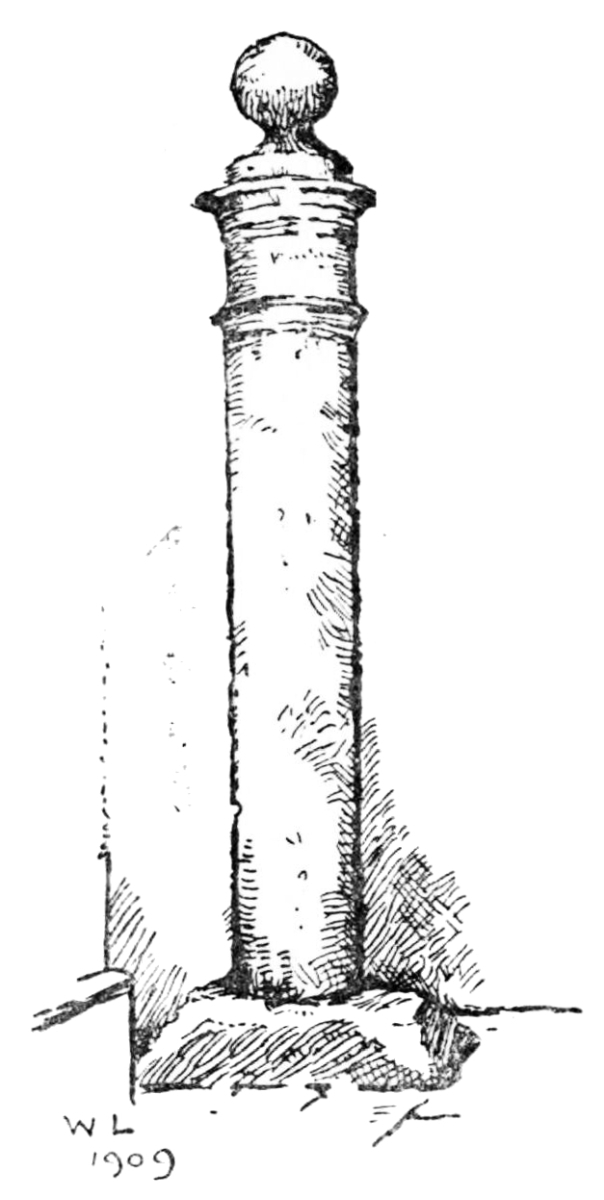
The Market-Cross at Darlington.
Passing by this haunted place the road leads on to Darlington, a borough full of historical relics, from the Bulmer Stone in Northgate to the first locomotive at Bank Top Station. The Bulmer Stone is a large boulder of Shap granite, which was borne down to its present resting-place on a glacier in the Ice Age. Lying in the midst of the level, marshy plains of the Skerne, it formed a landmark for the men of the Bronze Age, and was perhaps the origin of the town. An Anglian burial-ground, probably pre-Christian, was discovered in the town in 1876. After the conversion of the North a church was built, and two Saxon crosses from it are preserved in the present Church of St. Cuthbert. The history of this beautiful building does not come within the scope of the present section. To the west of the church lies the market-place, where in 1217 Stephen de Cantuaria purchased half a pound of pepper at the fair on the Feast of All Saints, which he rendered to Roger Fitzacris as service for this land in Milneflach and elsewhere. From the market-cross in 1312 was read the Bishop’s order that a tournament which had been proclaimed at Darlington should not be held, as it was forbidden by the laws of the land. That market-cross is not standing now, but its successor may be seen in the modern covered market, a plain column surmounted by a ball, which was erected in 1727 by Dame Dorothy Brown, the last descendant of the family of Barnes, whose members had held the office of bailiff of Darlington for over a hundred years. The old toll-booth, in which the bailiffs held their courts, was pulled down in 1806 and replaced by the present Town Hall. Ever since 1197, Darlington enjoyed the title of borough, and yet it possesses no early charters and had no corporate government; it was not visited by the municipal commissioners in 1833, and was only incorporated in 1868. Until its incorporation the Bishop of Durham appointed a bailiff, who held the old manorial court of the borough. Darlington enjoys the distinction of having retained its bailiff until the middle of the nineteenth century, whereas in the other Durham towns the Bishop had ceased to appoint bailiffs by the end of the seventeenth century. The fame of Darlington rests on the fact that the first passenger railway-line in England was laid between Darlington and Stockton by George Stephenson, who was supported by the capital and influence of Edward Pease of Darlington; the line was opened in 1825. This is surely glory enough for any town!
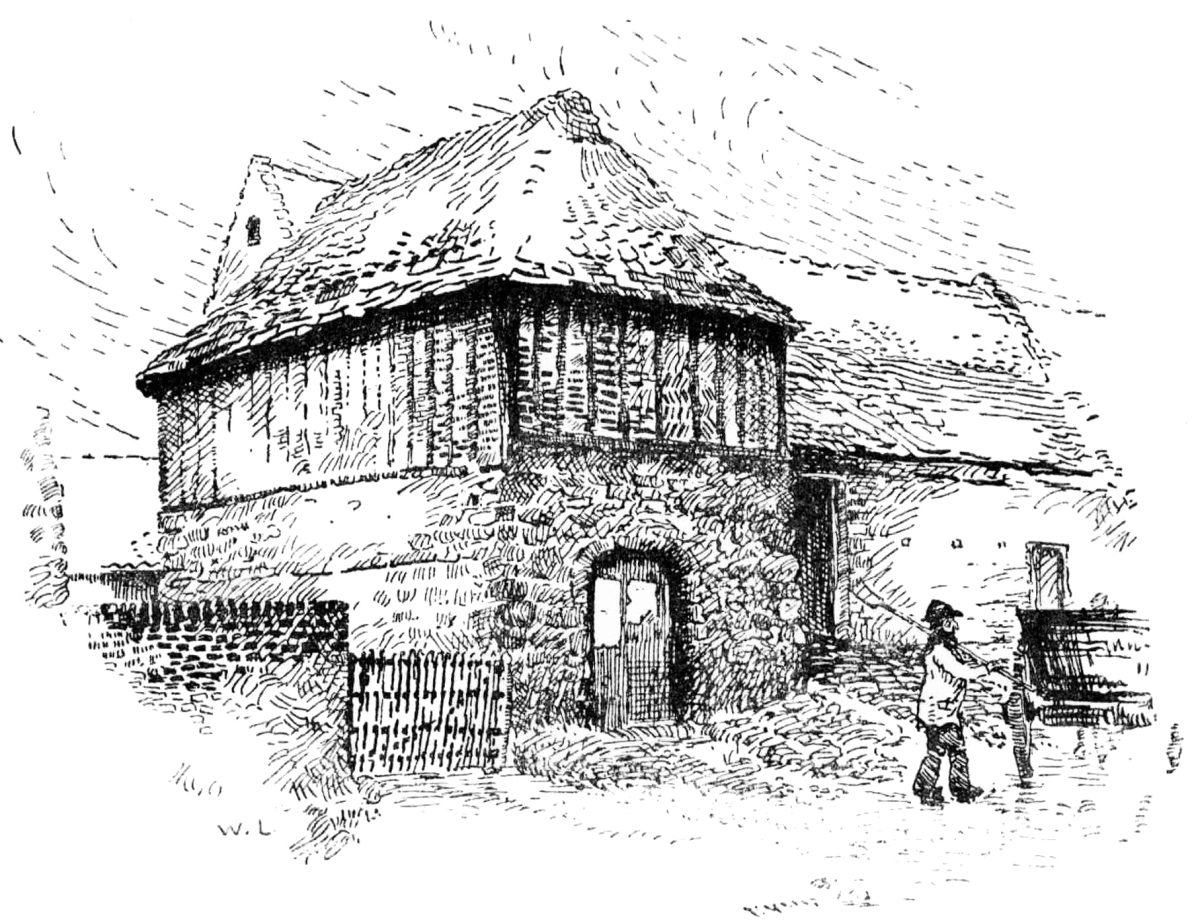
An Old Tithe-Barn at Durham.
Great Aycliffe, lying five miles north of Darlington on the highroad, was once one of the lesser forests of the Bishopric. About four miles north of Aycliffe the road crosses a little stream by the hamlet of Rushyford. This was a desolate spot in 1317, when on September 1 Lewis Beaumont, Bishop-elect of Durham, and the Cardinals Gaucelin John and Luke Fieschi, with a numerous train of attendants, travelled towards Durham, Beaumont to be consecrated in the cathedral, the Cardinals to negotiate a truce between England and Scotland. They had been warned at Darlington that the road was beset, and this warning, which they disregarded, proved only too true, for as they crossed the gloomy little burn at Rushyford, they were set upon by the notorious freebooter, Sir Gilbert Middleton, and his men. The Cardinals and their servants were stripped of their goods and allowed to continue their journey, but the borderers carried off the Bishop-elect to their fortress of Mitford Castle, and there held him to ransom, until the Prior and Convent of Durham by great sacrifices succeeded in redeeming him.
The next place of importance on the road is Ferryhill, a large modern village six and a half miles south of Durham. Few traces of the past survive here, except the fragment of an old stone cross, Cleve’s Cross, which is traditionally held to commemorate the slaying of a great wild boar, which ravaged Durham once upon a time, by a certain valiant Roger de Ferry, whose family long dwelt in the neighbourhood in great honour. About a mile to the south-east of Ferryhill is Mainsforth, the estate of Robert Surtees, the historian of Durham.
Midway between Ferryhill and Durham the highroad crosses the River Wear by Sunderland Bridge, and passes through the suburbs into the city of Durham.
A bird’s-eye view of the city of Durham even at the present day is surprisingly beautiful. In the Middle Ages it would have served as a model for one of those fascinating little Jerusalems or Bethlehems, walled, towered, and pinnacled, which the old Italian masters loved to perch on the craggy hills in the background of some sacred picture. The river sweeps round three sides of the crag, which is crowned by the cathedral and the castle, and the narrow neck of land on the fourth side was defended by a moat. The Prior’s borough of Elvet and the merchants’ quarter of Framwellgate lay on the opposite bank of the river, and were connected with the citadel itself by their bridges.
The monastic chroniclers of the see were chiefly interested in the doings of the Bishop in his castle and the Prior in his cathedral, and the occasional interventions of the Lord King in the quarrels of these august persons; they tell comparatively little of the life and affairs of the burgesses themselves, the descendants of the men from between Coquet and Tees, who obeyed the summons of Earl Ucthred in 995, and hastened to Durham to raise a shrine worthy of St. Cuthbert, who cleared the thick forest on the crag of Durham, divided the land by lot, and became the Haliwerfolc, the people of the Saint. Twice during the eleventh century they were besieged by the Scots, and each time the enemy was routed. The heads of the slaughtered Scots were exposed in the market-place, where the great fair of Durham was held on September 4, the Feast of the Translation of St. Cuthbert. There was also a fair on the saint’s other festival, March 20; but the September fair was the more important. The laws of the special peace of St. Cuthbert, which was proclaimed by the thanes and drengs before the fair opened, were written in an ancient Gospel-Book, and a copy of them is still preserved.
In the winter of 1068-69 Robert Cumin, the newly created Norman Earl of Northumberland, advanced to Durham with his troops, but as the Normans lay there they were surprised by a sudden rising of the whole population, and slain almost to a man. A year later news came that William himself was approaching Durham to avenge the death of Cumin, whereupon Bishop Egelwin and the priests took the sacred body of St. Cuthbert and such of the treasures of the church as they could carry and fled to Lindisfarne, followed by the people of the city, who dared not remain without the sacred relic. The whole multitude took refuge on the island while William devastated Durham and Northumberland. At length peace was made, and St. Cuthbert and his followers returned to the desolate city. In 1072 William visited Durham, and installed the foreigner, Bishop Walcher, in the see. About this time also the first Norman castle was built in the city to keep the people in check; but when Bishop Walcher ventured out of his stronghold in 1080 he was murdered. Again William ravaged Durham, and the see was filled by Bishop William de St. Carileph, who began to build the present cathedral, and who founded the Benedictine monastery connected with it. To the new monastery he gave forty merchants’ houses in Elvet, which formed the nucleus of the Prior’s borough of Elvet. The troubles of Durham recommenced in 1140, when, the see being vacant, Durham Castle was seized by William Cumin, a nominee of King David of Scotland, who hoped through Cumin to annex the Bishopric. In the course of the struggle between the usurper and the new Bishop, William de St. Barbara, the greater part of the city of Durham was reduced to ashes. There were four years of desperate warfare before Bishop William entered his cathedral town, and at last received the submission of Cumin. Even then there could be no true peace while England was torn with civil war, and it was not until after the death of Bishop William that a brighter day dawned with the election of Bishop Hugh Pudsey. Bishop Hugh rebuilt the ruined city, restored the fortifications, and added to the cathedral. He granted the burgesses a charter, by which the customs of Newcastle-on-Tyne were confirmed to them, besides freedom from merchet, heriot, and toll. The city of Durham stands first in Bishop Pudsey’s great survey of the Bishopric (Boldon Book, compiled in 1183), when the city was at farm for 60 marks. Records which relate to the actual life of the citizens do not begin until the fourteenth century. The earliest are various charters of murage, dated 1345, 1377, 1385, which authorized the citizens to levy certain tolls, and to devote the proceeds to the repair of the walls and streets. The city was governed
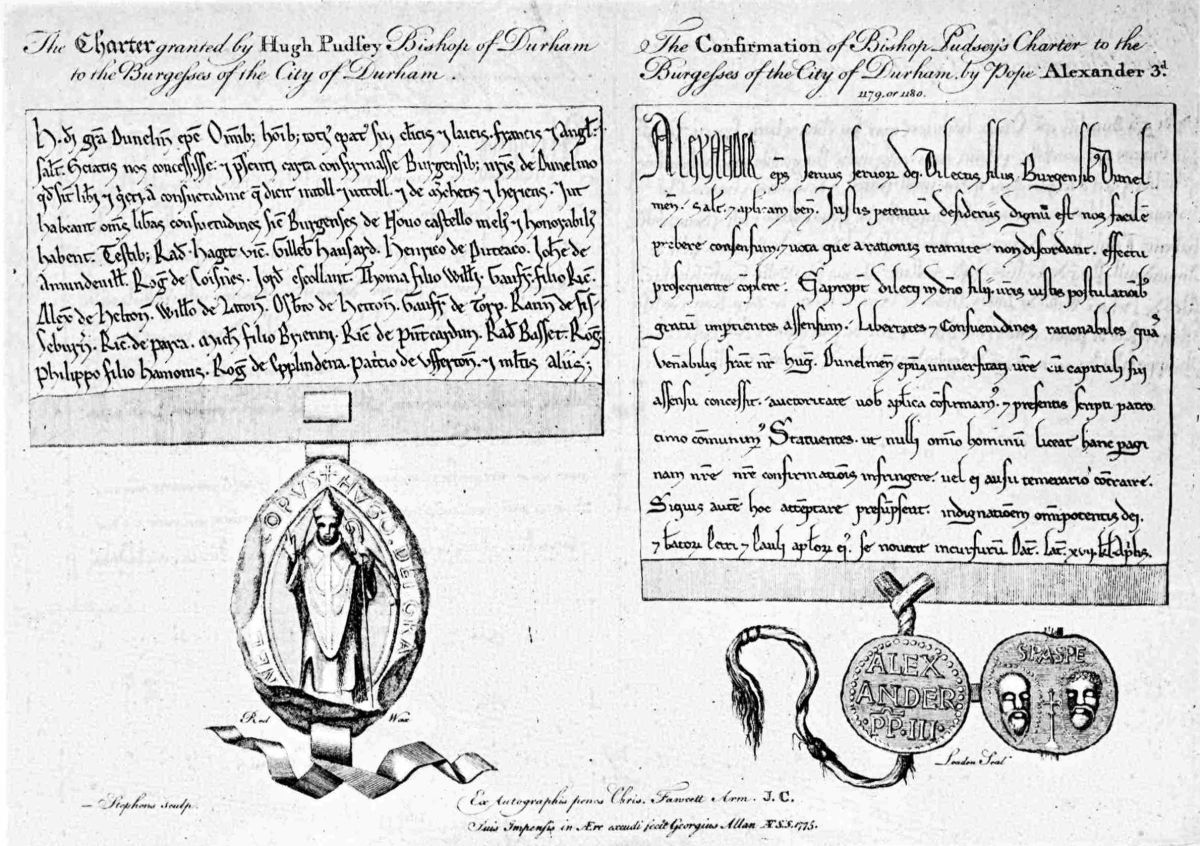
Bishop Pudsey’s Charter.
by a bailiff, appointed by the Bishop, in the same way as Darlington. It is not until the fifteenth century that gilds are heard of in Durham. In 1436 Bishop Langley granted a licence to several of the principal inhabitants to form the religious gild of Corpus Christi in the Church of St. Nicholas, in the market-place. This gild was closely connected with the craft gilds of the town, which must have been in existence at the beginning of the century. The first records of the gilds occur in 1447, when the Shoemakers (Cordwainers) and the Fullers each gave recognizances to the Bishop that they would forfeit 20s. to him and 20s. to the light of Corpus Christi if any member took a Scot as an apprentice. The ordinances of the Weavers were enrolled and confirmed by the Bishop in 1450, and in them reference is made to the play which was to be played when they went in procession on Corpus Christi Day. The gilds were not merely a picturesque feature of town life, they had also a powerful influence on the development of the city. The corporation granted by Bishop Pilkington’s charter of 1565—the first charter of incorporation which the city obtained—was probably modelled on the governing body of the Corpus Christi Gild. The governing charter of the city until 1770 was granted by Bishop Toby Matthew in 1602, and by this charter the Common Council of the town was to consist of twenty-four persons, two being chosen from each of the twelve principal companies by the mayor and aldermen. When the city of Durham obtained Parliamentary representation in 1678, the franchise of the borough could only be obtained by membership in one of the companies, and the procedure of admission was therefore carefully regulated by the mayor and corporation. But in 1761 Durham experienced two elections within a few months of each other, and the political excitement completely demoralized the city. All restraints were thrown to the winds, and numbers of new freemen were admitted in a most irregular manner. The reaction of this exciting time on municipal affairs was such that, in 1770, more than half the number of the twelve aldermen had resigned or been removed, and it was therefore impossible to elect a mayor under the charter of 1603, which consequently lapsed. The various feuds having been cooled by an interval of ten years, Bishop Egerton granted a new charter in 1780, with provisions closely resembling those of the old one, and under this charter Durham was governed until it was included in the Municipal Corporations Act of 1835.
The North Road, on leaving Durham, follows the course of one of the Roman roads which passed through the county. It leads northward over Framwellgate Moor, and six miles from Durham passes through Chester-le-Street, which lies on the banks of the Cone Burn. As the name indicates, a Roman camp was situated here, and numerous Roman remains have been found. The monks who had fled from Lindisfarne in 876 with the body of St. Cuthbert settled at Chester-le-Street after seven years’ wandering, when peace had been confirmed by the agreement between Alfred and Guthred the Dane. It was the principal city of the see until 995, when Bishop Aldhune fled once more before the renewed invasions of the Danes. In Chester-le-Street the old custom is still kept up of playing a football-match, in which the whole village takes part, on Shrove Tuesday.
The borough of Gateshead lies on the Tyne, eight miles north of Chester-le-Street. The south end of Tyne Bridge was the site of a Roman camp, and afterwards, in the seventh century, of a Saxon monastery, which was destroyed by the Danes. A little church which stood there in 1080 was the scene of the murder of Bishop Walcher, who was killed by the infuriated populace while he was trying to pacify a feud between his Norman followers and the Saxon nobles. The church was set on fire, and the Bishop was killed as he rushed from the burning building. The traces of early Norman work in the present building show that it must have soon been rebuilt. The new church is first mentioned in 1256, when a prisoner who had escaped from the castle of Newcastle took refuge in Gateshead Church. Gateshead’s only charter was granted by Bishop Hugh Pudsey at some time between 1154 and 1183, and confirmed by his successor, Bishop Philip of Poitou. The little borough lay on the outskirts of the Bishop’s forest of Gateshead, and the charter freed the burgesses to some extent from the tyranny of that very great man, the Bishop’s Head Forester. In its form of government the borough was similar to Darlington. Gateshead has always been one of the principal commercial centres of the county, and, though there are no signs of craft gilds there, trade companies second in importance only to those of Durham existed from the reign of Elizabeth till the end of the eighteenth century. The prosperity of Gateshead very early excited the alarm of Newcastle, and the history of the town is studded with the attempts of its jealous neighbour to suppress its trade. In the fourteenth century the efforts of the Newcastle Corporation were directed against the fisheries and staithes on the south bank of the Tyne, which were frequently destroyed by "the malice of the men of Newcastle." In 1553 the two towns were united, but the Act was repealed by Queen Mary, who came to the throne in the same year. It was proposed to renew the union in 1568, but the anxious petitions of Gateshead, and the opposition of several influential persons in the Palatinate, frustrated the scheme. There are, however, several cases in the sixteenth and seventeenth centuries of the interference of Newcastle with the trade of Gateshead. These troubles were the price that Gateshead had to pay for its advantageous position by the side of the greater town. Gateshead was given one representative in the House of Commons by the Reform Act of 1832, and was incorporated by its inclusion in the Municipal Corporations Act of 1835.
The boundary of Durham is now the south bank of the Tyne, but formerly the Bishop’s jurisdiction extended over one-third of the river, and was marked by a blue stone on Tyne Bridge. The old bridge, which stood where the Swing Bridge is now, was built in 1248 to replace the Roman bridge, Pons Ælii, which dated from circa 119. In 1389 the burgesses of Newcastle carried off the Blue Stone, seized the whole of the bridge, and built a tower on the south end, which they held against the Bishop. It was not until 1415 that Bishop Langley at length obtained judgment against the Corporation of Newcastle, and took possession of the tower with all his chivalry. The tower stood until the great flood of 1771, when part of the bridge was swept away. After this catastrophe the whole was rebuilt, the new bridge being completed in 1781. The High-Level Bridge was built in 1849, and the present Swing Bridge replaced the old stone one in 1876. Meanwhile, the conservation of the River Tyne had been placed in the hands of commissioners, and the jurisdiction of the Bishop over the river came to an end.
Durham to South Shields.
The city of Durham, lying almost in the centre of the county, is an excellent point of departure from which to visit the other towns and places of interest in the Bishopric. The road which leads from the city to the mouth of the Tyne runs north-east from Framwellgate Bridge. The principal village through which it passes is Houghton-le-Spring, six and a half miles from Durham. The place is closely associated with the name of Bernard Gilpin, the Apostle of the North, who in the reigns of Edward VI., Mary, and Elizabeth, was Rector of Houghton-le-Spring, and the chief instrument in spreading Protestant doctrines through the North. From here it is seven miles to the mouth of the Wear, where stands the flourishing port of Sunderland. In early records the town
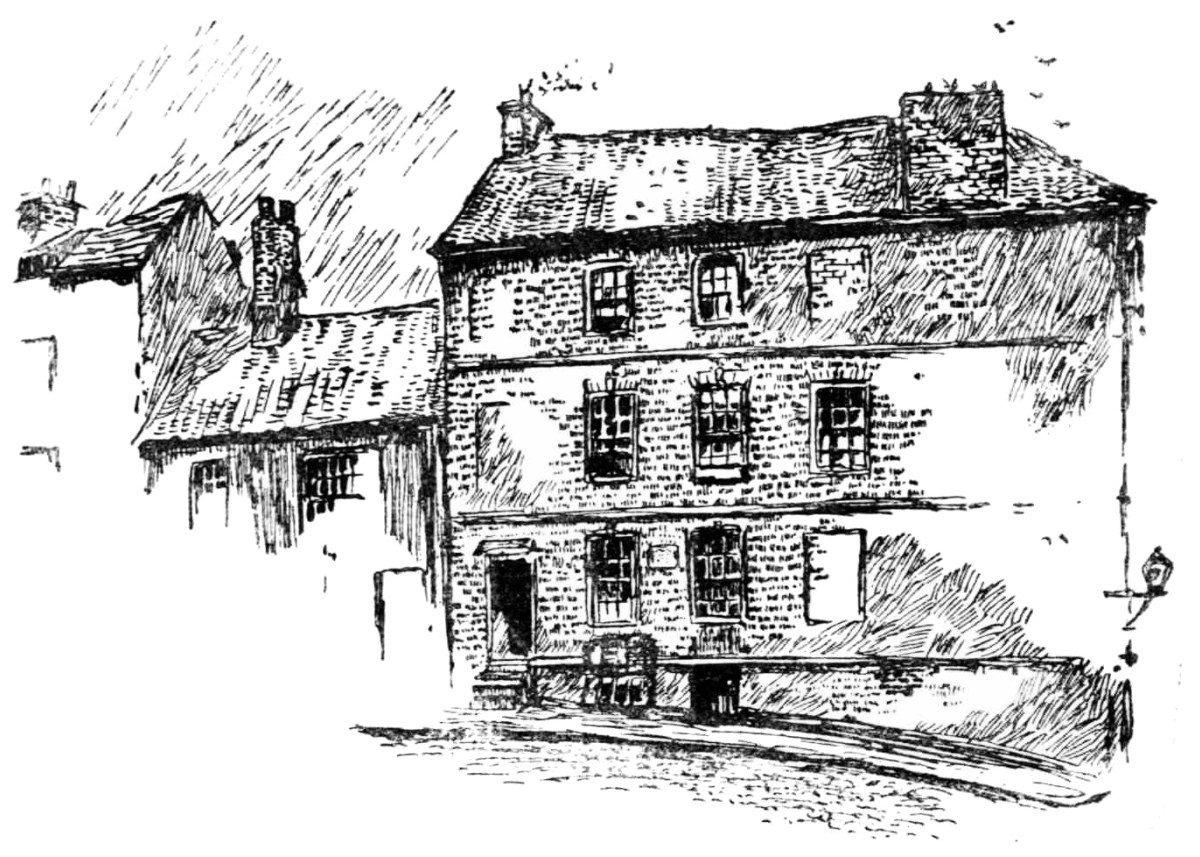
Jack Crawford’s Birth-place, Sunderland.
is usually called Wearmouth. It possesses two very interesting charters, dated respectively 1180-83 and 1634; nevertheless, it did not rise above the level of a manorial borough until 1835, when it was included in the Municipal Corporations Act. During the Civil War Sunderland was the principal centre of the Parliamentarians in Durham, which was on the whole a Royalist county. The fact that Sunderland was an exception was due to the influence of the family of Lilburne in the town, George Lilburne, the uncle of the famous John Lilburne, being the only magistrate in the borough during the war. At the same time the siege of Newcastle diverted the coal trade to Sunderland, and thus laid the foundation of its present prosperity. The town is famous in naval and military history as the birthplace of two heroes—Jack Crawford, who "nailed the colours to the mast" at the Battle of Camperdown, 1797, and Sir Henry Havelock, who relieved Lucknow in 1857. The Sunderland Orphan Asylum was founded in 1853 by the Freemen and Stallingers of Sunderland, and endowed with the proceeds of the sale of the Town Moor, which had become exceedingly valuable in consequence of the building of the railway. The road crosses the Wear, and enters the parish of Monkwearmouth.
The history of Monkwearmouth goes back to 674, when Benedict Biscop founded there the monastery of St. Peter. The early history of the monastery was recorded by the Venerable Bede, who relates how Benedict brought over foreign masons and glass-workers to build his church, and beautified it with sacred pictures brought from Rome. It was destroyed by the Danes towards the end of the ninth century, refounded by Bishop Walcher, circa 1075, and finally annexed to the Convent of Durham by Bishop William de St. Carileph in 1083. A cell of the convent was maintained there until the Reformation, and Monkwearmouth continued to be a manor belonging to the Dean and Chapter of Durham until it was incorporated with Sunderland.
From Monkwearmouth the road runs parallel with the coast-line to South Shields. Shield Lawe, at the mouth of the Tyne, was occupied in pre-Roman times; an important Roman camp was built there; and later it was one of the fortresses of the Saxon Kings of Northumbria, and the site of St. Hilda’s first religious house, founded circa 650. The little convent was overshadowed by Benedict Biscop’s great monastery of St. Paul at Jarrow, and both fell before the onslaughts of the Danes. Jarrow subsequently became a cell of the Convent of Durham, and the Chapel of St. Hilda at South Shields kept alive the name of the foundress. After centuries of struggle with the burgesses of Newcastle, who put down the trade of South Shields with a high hand, the borough obtained Parliamentary representation in 1832, and incorporation in 1850. In the seventeenth century the salt-pans of South Shields were a flourishing industry, but its chief importance is now its harbour. The first lifeboat was built and used there in 1790.
Durham to Hartlepool.
The twenty miles of road between Durham and Hartlepool is of an uninteresting character; but the town of Hartlepool itself has a long history, which begins in 640, when St. Hieu founded a convent there, of which St. Hilda was afterwards abbess. The house was destroyed by the Danes, and Hartlepool disappears from history, to reappear at the end of the twelfth century as a flourishing port belonging to Robert de Bruce, Lord of Annandale. Hitherto it had not been included in the Bishopric of Durham, but in 1189 the overlordship of the whole district of Hartness was bought by Bishop Hugh Pudsey from Richard I. The succeeding Bishop, Philip de Poitou, obtained possession of the town, but not until the burgesses had bought a charter from King John in 1200, granting to them the customs of Newcastle-on-Tyne, while the same King granted to William de Bruce, Lord of Hartlepool, the right to hold a weekly market and a fair at the Feast of St. Lawrence (August 10). The burgesses obtained another charter from Bishop Richard le Poore in 1230, in which he conceded to them the right to form a Merchant Gild and to elect a mayor. From this time the burgesses of Hartlepool were able to manage their own affairs in their own way, and enjoyed more independence than there was in any of the other towns of Durham. Their chief misfortunes befell them after Robert de Bruce became King of Scotland in 1305. Hartlepool escheated to the King of England, and in consequence the Scots felt a special enmity against it. The town was attacked more than once in the ensuing wars, but the walls and ramparts, which had been built by Robert de Bruce (1245-95) made it one of the strongest places in the Bishopric. At the beginning of the nineteenth century these fortifications were still among the finest specimens of Edwardian architecture in the kingdom, but when the trade of the town revived later in the century, the ancient walls were pulled down to make way for the new pier and docks, and hardly any trace of them now remains. In 1599, by the good offices of Lord Lumley, the burgesses of Hartlepool obtained from Queen Elizabeth a charter of incorporation, under which the town was governed until 1834, when the conditions of the charter were not fulfilled, and it lapsed. The present governing charter of the town was obtained in 1850. The borough of West Hartlepool has grown up in the nineteenth century on the south side of the bay on which Hartlepool stands.
Durham to Stockton.
The Durham and Stockton road passes through Bishop Middleham, where one of the Bishop’s manor-houses used to stand, and through Sedgefield, about eleven miles from Durham, a market-town which received the grant of a weekly market and fair at the Feast of St. Edmund the Bishop (November 16) from Bishop Kellaw in 1312.
The borough of Stockton lies on the north bank of the Tees, twenty miles south of Durham. It is situated in the district which in early times formed the wapentake of Sadberg, and comprised all the lands lying along the north bank of the river. The wapentake, which was purchased by Bishop Pudsey in 1189, at the same time as Hartlepool, had a separate organization from the rest of the Bishopric, and its courts were held at Sadberg, which is now a small village about three miles east of Darlington. Stockton itself, however, seems to have come into the Bishop’s hands before the purchase of the wapentake, as it is included in the Boldon Book, 1183. The date of the incorporation of the borough is unknown, but there are grants by several of the Bishops, dated 1310, 1602, and 1666, of a weekly market and a fair at the Feast of St. Thomas à Becket (December 29). There is also an interesting letter relating to the customs practised both at Newcastle and at Stockton, which was sent by the Mayor of Newcastle
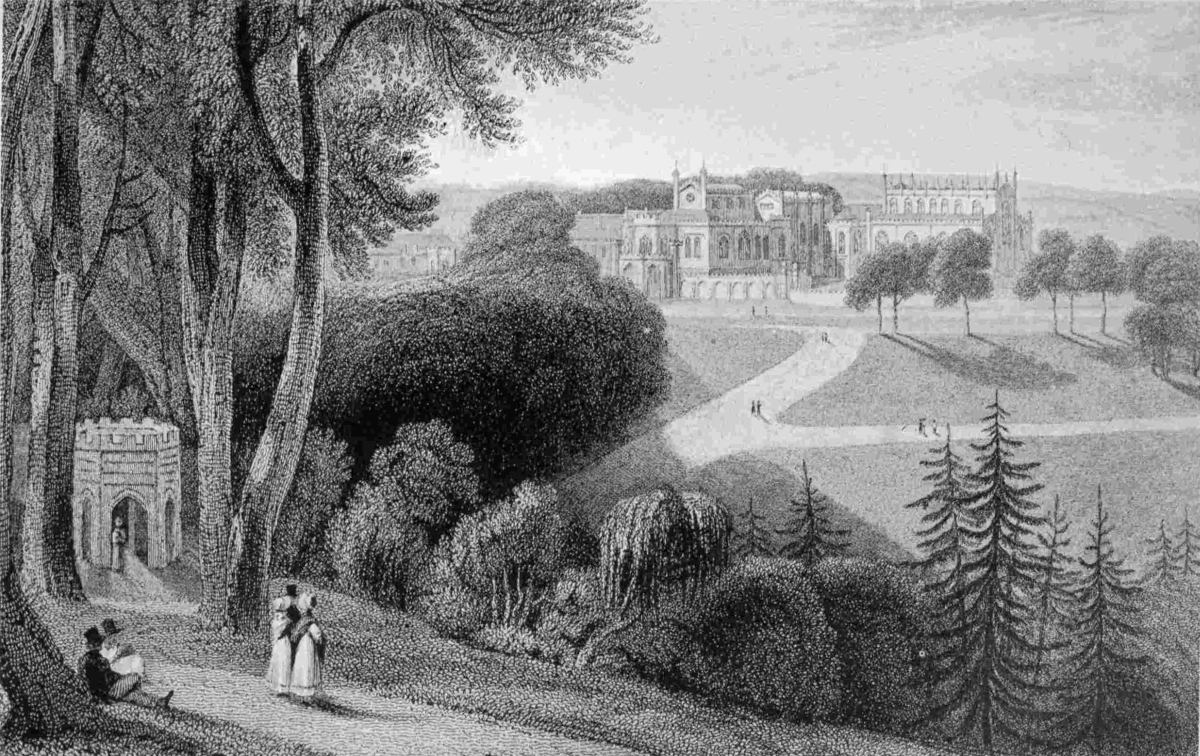
The Palace, Bishop Auckland.
to the Mayor of Stockton in 1344 in reply to certain questions which the people of Stockton had addressed to Newcastle as their mother town. The municipal government of the borough was in the hands of the mayor and the borough-holders, seventy-two in number, until Stockton was included in the Municipal Corporations Act of 1835.
Durham to Barnard Castle.
The road to Barnard Castle branches off from the North Road about a mile south of Sunderland Bridge, and travels south-west into Aucklandshire. This district included Binchester, Escomb, Newton, and all the Aucklands, Bishop Auckland, St. Andrew’s Auckland, St. Helen’s Auckland, and South Auckland. Aucklandshire lay on the borders of the Bishop’s great forest of Weardale, and the services of the tenants, as described in Boldon Book, were closely connected with the Bishop’s great hunting-parties in the forest. All the tenants had to provide ropes for snaring the deer, and to help to build the Bishop’s hall in the forest, with a larder, a buttery, a chamber, a chapel, and a fence round the whole encampment, when the Bishop went on the great hunt. They also kept eyries of falcons for the Bishop, and attended the roe-hunt when summoned. In return for their services at the great hunt they received a tun of beer, or half a tun if the Bishop did not come, and 2s. "as a favour." The little town of Bishop Auckland was called a borough in the fourteenth century, when the weekly markets and the fairs held on Ascension Day, Corpus Christi Day, and the Thursday before October 10, formed the chief commercial centre of the neighbourhood, but it has never been incorporated, and is now an urban district.
To the south of Aucklandshire lies the barony of Evenwood, about a quarter of a mile west of the road. This was one of the early baronies of the Bishopric, held by the family of Hansard. Evenwood was bought by Bishop Bek in 1294, and his successors maintained a manor-house and park there. After passing by Evenwood, the road leads through Raby Park to Staindrop.
Staindrop was one of the vills over which the Bishop and the Convent of Durham disputed at the beginning of the twelfth century. Bishop Ralph Flambard restored it to the monks by the charter of restitution which he executed on his death-bed; and they kept it out of the clutches of succeeding Bishops by granting it in 1131 at an annual rental of £4 to Dolphin, son of Ughtred, one of the progenitors of the family of Neville. Henceforward, Staindrop remained part of the Neville estates in the Bishopric. In 1378 Bishop Hatfield granted to John Lord Neville the right to hold a weekly market and a fair there at the Feast of St. Thomas the Martyr (December 21). The whole of the Neville estates were confiscated in 1570, after the rebellion of the Earls of Northumberland and Westmorland in 1569, and Staindrop remained in the hands of the King until 1632, when it was purchased by Sir Henry Vane, from whom the present owner, Lord Barnard, is descended.
Barnard Castle is twenty-five miles from Durham, and lies on the north bank of the Tees. It did not form part of the Bishopric at the time of the Conquest, and was granted by William Rufus to Guy Balliol in 1093. Barnard Balliol, his son, built the castle circa 1132, and apparently founded the borough, for the first extant charter, granted by his son Barnard to the burgesses of Barnard Castle circa 1167, refers to the elder Barnard’s concessions to them. By this charter the burgesses were granted the customs of Richmond (Yorks). Barnard Castle was a manorial borough, and is now an urban district. The burgesses obtained charters from Hugh (1212-28), John (circa 1230), and Alexander, third son of John. All the Balliol estates in England were forfeited by John Balliol, sometime King of Scotland, in 1295. Barnard Castle was claimed by Bishop Bek, but Edward I. granted it to Guy
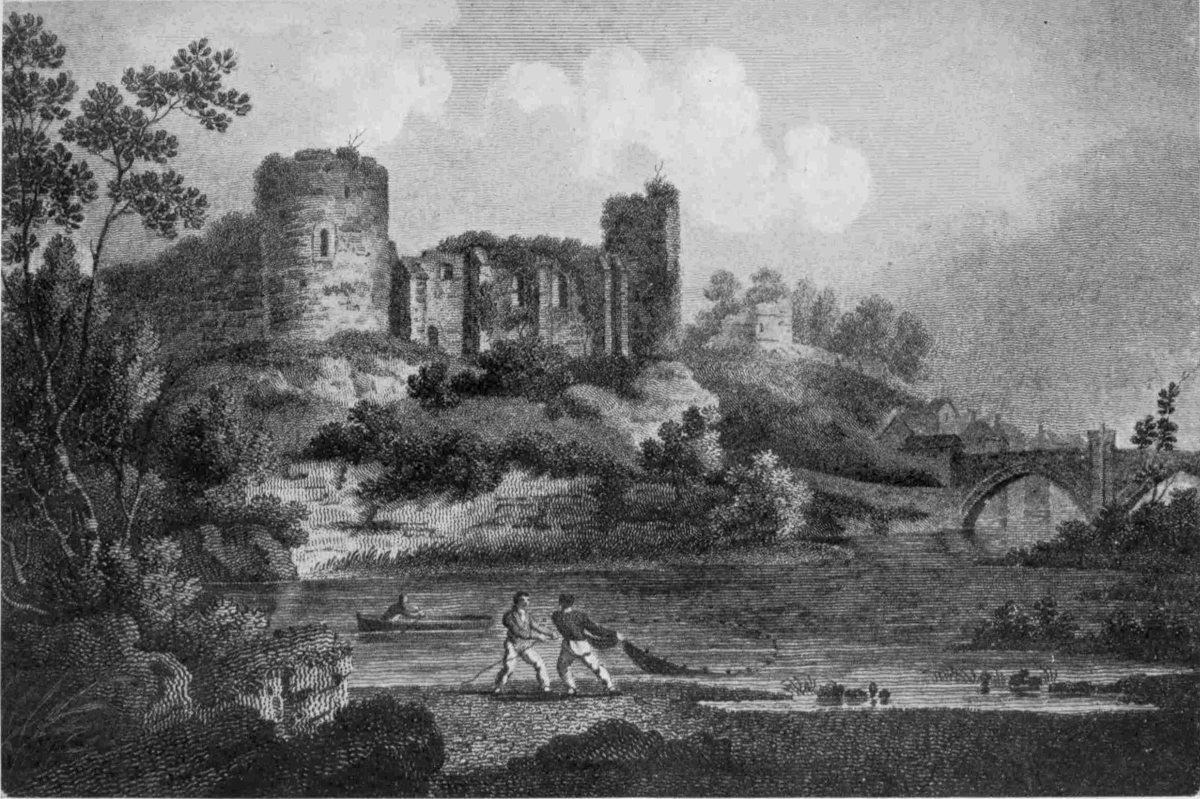
Barnard Castle.
Beauchamp, Earl of Warwick. The Bishops of Durham made frequent efforts to obtain possession of the town, and although they were unsuccessful, they obtained Parliamentary recognition of the fact that Barnard Castle was part of the Bishopric. Richard III., by his marriage with Lady Anne of Warwick, became lord of the town, which Lady Anne inherited from her father, the King-maker. Barnard Castle escheated to the crown in 1485, and was finally granted to the Earl of Westmorland. In 1569, on receiving the news that the northern Earls had risen against the Queen, Sir George Bowes of Streatlam seized and garrisoned the castle, where he was besieged by the rebels; and although he was forced to surrender after a ten days’ siege, the delay had given the royal troops time to come up, and insured the defeat of the insurgents. After the rebellion Barnard Castle escheated to the crown again, and was leased to the valiant Bowes. It was finally purchased by Sir Henry Vane in 1632 (see above).
Durham to Alston.
The road from Durham to Alston, in Cumberland, passes by the field of the Battle of Neville’s Cross, fought on St. Luke’s Eve, October 17, 1346, in which David of Scotland, who had invaded England while Edward III. and all his forces were in France, was defeated by the troops which he contemptuously called "an army of women and priests," because they were raised by Queen Philippa, and the four divisions were commanded by the Archbishops of Canterbury and York, and the Bishops of Lincoln and Durham. The cross which Ralph, Lord Neville, erected on the battle-field was destroyed in 1589.
The next place of interest on the road is Brancepeth, which lies four and a half miles south-west of Durham. The family of Bulmer of Brancepeth held one of the early baronies of the Bishopric (see under Evenwood); the estate finally descended to an heiress, the first of the many noble ladies whose stories lend interest to the place. She married Geoffry de Neville, circa 1150. Sixty years after, in 1227, there was again a sole heiress to Brancepeth; she married Robert FitzMeldred, Lord of Raby, and her son assumed his mother’s name, becoming the first Neville of Raby and Brancepeth. When the Neville estates were forfeited in 1570, the Countess of Westmorland was allowed to remain at the castle, and there, though beset by spies, she contrived her husband’s escape to Flanders. The surveys of the estate that were made in 1597 and 1614 mention that wild cattle were preserved in Brancepeth Park, as they still are at Chillingham. The escheated lands passed from one owner to another. In 1769 they were again inherited by an heiress, Bridgit, the only daughter of William Bellasis. She died five years after coming into her inheritance. The story goes that she pined away for love of a neighbouring squire, Robert Shafto, who had wooed and forsaken her; and the old Bishopric song of "Bobby Shafto" is said to be the record of the brief happiness of the lovelorn lady.
The market-town of Wolsingham lies sixteen miles west of Durham. It was one of the Bishop’s forest vills, lying on the moors of Weardale; and in the entry about it in Boldon Book mention is made of Ralf the Beekeeper, who held six acres for his service in keeping the bees, which were sent out on to the blossoming heather in the twelfth century, as they are to this day. Wolsingham lies on the north bank of the Wear, and, after passing through the village, the road follows the course of the river westward to Stanhope, which lies in the lead-mining district of West Durham. Half-way between Wolsingham and Stanhope lies Frosterley, where are the quarries of Frosterley marble.
Stanhope itself lay in the heart of the forest of Weardale, and was the spot to which all those who owed hunting-service must make their way when the Bishop’s great hunt was proclaimed. In 1327 the English and
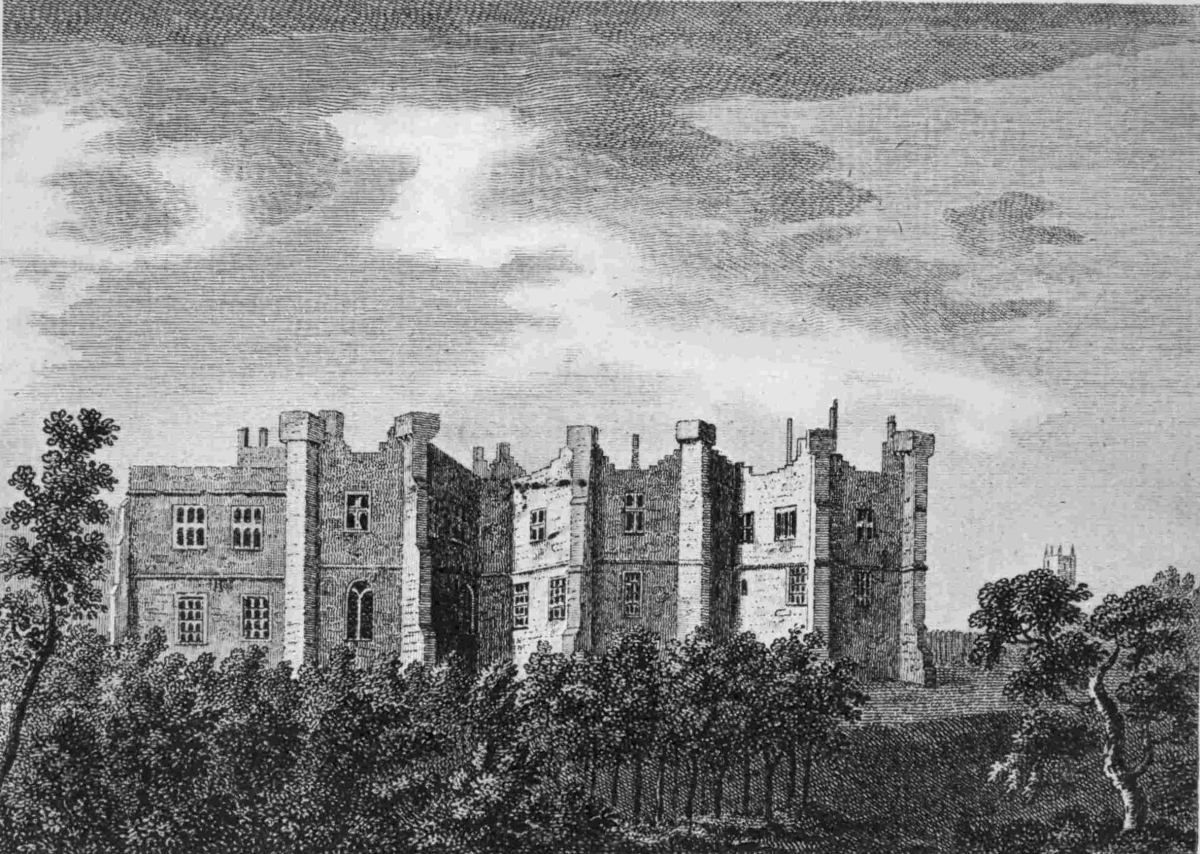
Brancepeth Castle in 1777.
Scottish armies, commanded on the one side by Edward III., and on the other by the Earl of Murray and Sir James Douglas, lay encamped for some days over against each other on the hills round Stanhope. No battle was fought, and the Scots withdrew by night, having deceived Edward by false intelligence. The remains of the earthworks in which the two armies entrenched themselves may still be seen.
St. John’s Chapel, seven miles west of Stanhope, is the last considerable village on the road to Alston before it crosses the boundary of Durham. The chapel is mentioned in the fifteenth century, and a market and annual fair were held there, but there were few inhabitants until the end of the eighteenth century. From St. John’s Chapel the road leads up over the moors, past the sources of the Wear, and crosses the county boundary on Killhope Moor.