THE LEGENDS[6] OF DURHAM By Miss Florence N. Cockburn
Reading edition
THE LEGENDS[6] OF DURHAM By Miss Florence N. Cockburn
THE northern counties are all rich in legendary history, and the county of Durham has its full share.
Curiously, instead of most of the legends being of an ecclesiastical nature, as one would naturally expect in a county where the Church has predominated for many centuries, the contrary is the case. All the best-known legends are of deadly war waged with some uncouth or venomous monster, in which, without exception, some local hero, Jack-the-Giant-Killer-like, comes off victorious.
The Dun Cow.
Visitors to Durham rarely leave without having the sculptured panel representing the famous Dun Cow on the cathedral front pointed out to them.
The legend runs that the monks, having fled from Chester-le-Street and rested with the body of the saint for some time at Ripon, were desirous of returning to Chester. "Coming with him (St. Cuthbert) on the east side of Durham to a place called Ward-lawe, they could not with all their force remove his body from thence, which seemed to be fastened to the ground, which strange and unexpected accident wrought great admiration in the heart of the bishops, monks, and their associates, and, ergo, they fasted and prayed three days with great reverence and devotion, desiring to know by revelation what they should do with the holy body of St. Cuthbert, which thing was granted unto them, and therein they were directed to carry him to Dunholme (Durham). But being distressed because they were ignorant where Dunholme was, see their good fortune. As they were going a woman that lacked her cow did call aloud to her companion to know if she did not see her, who answered with a loud voice that her cow was in Dunholme, a happy and heavenly echo to the distressed monks, who by that means were at the end of their journey, where they should find a resting-place for the body of their honoured saint."
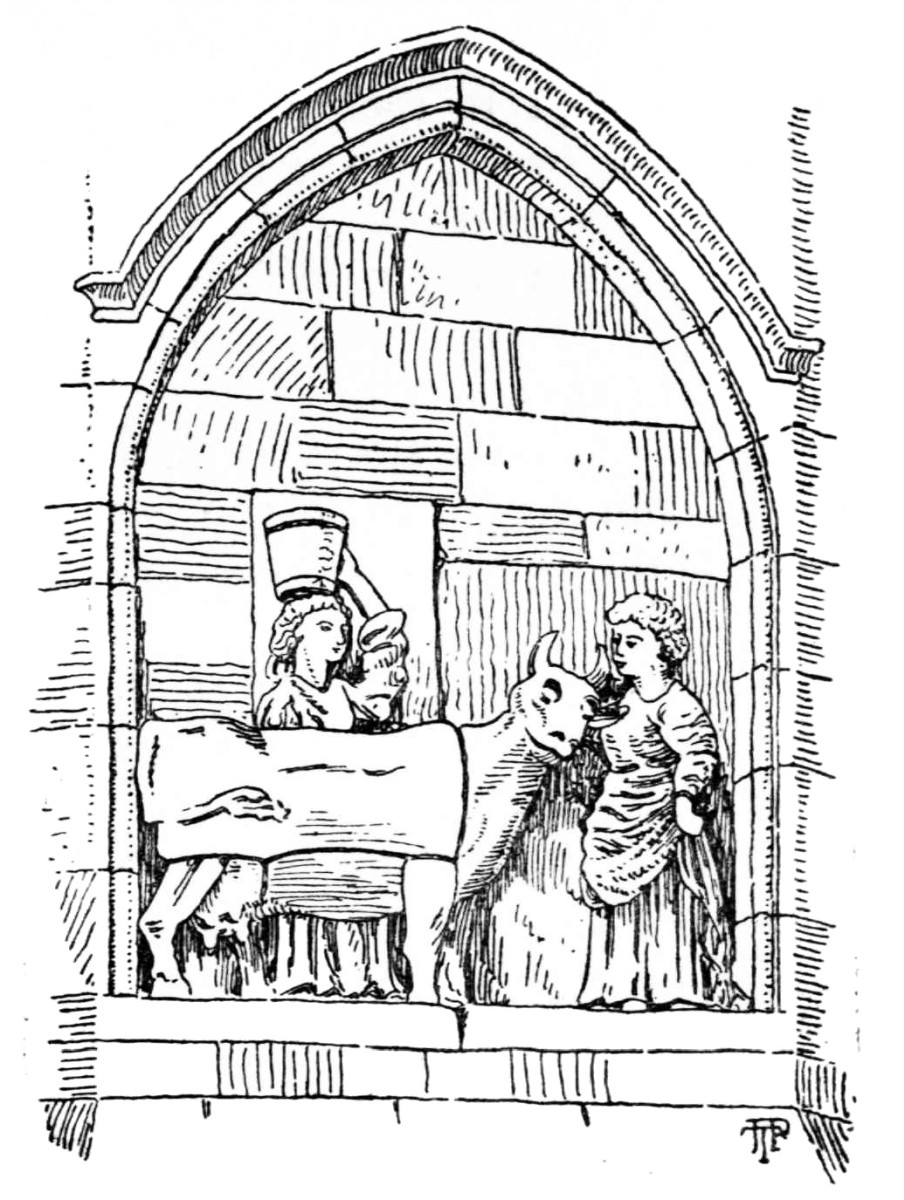
The Dun Cow.
The Brawn of Brancepeth.
At what time the brawn, or boar, ceased to exist as a wild animal in Britain is uncertain, but it was at one time a common inhabitant of our British forests, and protected by the law in the tenth and eleventh centuries.
The village of Brancepeth (a corruption of Brawn’s path) is said to have derived its name from a formidable brawn of vast size, which made his lair on Brandon Hill, and walked the forest in ancient times, and was a terror to all the inhabitants from the Wear to the Gaunless. The marshy, and then woody, vale extending from Croxdale to Ferry Wood was one of the brawn’s favourite haunts. According to tradition, Hodge of Ferry, after carefully marking the boar’s track near Cleves Cross, dug a pitfall, slightly covered with boughs and turf, and then, toiling on his victim by some bait to the treacherous spot, stood, armed with his good sword, across the pitfall—“at once with hope and fear his heart rebounds."
At length the gallant brute came trotting on its onward path, and, seeing the passage barred, rushed headlong on the vile pitfall to meet its death. It is generally believed that this champion of Cleves sleeps in Merrington churchyard, beneath a coffin-shaped stone, rudely sculptured with the instruments of the victory—a sword and spade on each side of a cross.
Another stone, supposed to be the remnant of a cross, stands on the hill near the farm of Cleves Cross, and is said to have probably been raised on the same occasion. It was not unusual, in England or abroad, when a man had slain a boar, wolf, or spotted pard, to bear the animal as an ensign in his shield. We believe that the seal of Roger de Ferry still remains in the treasury at Durham, exhibiting his old antagonist, a boar passant. The seal of his daughter Maud, wife of Alan of Merrington, shows the boar’s head erased.
The Pollard Boar.
A family of the name of Pollard was seated at an early period in the parish of Bishop Auckland; and one of their estates was called Pollard’s Dene, and the ceremony of presenting a falchion to the Bishop soon after his entrance into the See was performed by the possessors of Pollard’s lands.
The legend of how a Pollard gained this land runs as follows:
The King offered to anyone who would bring the head of a wild boar, which destroyed man and beast, to his palace "a princely guerdon," and the Bishop of Durham, who passed the greater part of the year at Auckland Castle, having also promised a large reward, a member of the ancient family of Pollard determined to kill the brute, or die in the attempt. So this courageous knight armed himself, mounted his trusty steed, and rode to the lair of the boar, and noted its track. After tying his horse to a tree, out of its regular course, he climbed a beech-tree under which the monster often passed, and shook down a large quantity of ripe beechmast.
There he waited until the boar came, and had the satisfaction of seeing it make a good meal. In time it showed signs of drowsiness, and commenced moving from the place. Pollard, feeling that the time had come for action, made an onslaught on the boar. After so hearty a meal, it was not in a fighting humour, but nevertheless made a fierce resistance, and taxed to the utmost the prowess of the knight. The encounter lasted the greater part of the night, and the welcome rays of the sun burst forth as he severed the head from the trunk of the boar. Having cut out its tongue and placed it in his wallet, he decided to rest for a short time under a tree; but a deep sleep overcame him, and led to a serious disappointment, for when he awoke he discovered that the head had been taken away. He was in great despair, for he had not the trophy to take to the King to obtain the promised prize; so, mounting his horse, he rode to the Bishop and told his tale, and, showing the tongue, his lordship, who was about to dine, rejoiced to hear the good news, and, as a reward, promised the knight as much land as he could ride round during the hour of dinner. When he next came before the prelate, he startled the latter by intimating that he had ridden round his castle, and claimed it and all it contained as his meed. The Bishop was loath to part with his stronghold, but was bound to admit the validity of the claim, and eventually made a compromise by granting him an extensive freehold estate known to this day as Pollard’s Land. These broad acres were given with the condition attached that the possessor should meet every Bishop of Durham on his first coming to Auckland, and present to him a falchion with this speech: "My lord, I, in behalf of myself as well as several others, possessors of the Pollard’s lands, do humbly present your lordship with this falchion, at your first coming here, wherewith, as the tradition goeth, he slew of old a mighty boar, which did much harm to man and beast; and by performing this service we hold our lands."
Hutchinson, rather curiously, quotes a letter signed "R. Bowser," commencing: "Sir, inclosed you have the speech my brother Pewterer gave me out of Lord Bishop Cosin’s old Book," in which the boar is described as "a venomous serpent."
Dr. Longley, created Bishop of Durham in the year 1856, was the last Bishop to whom the falchion was presented.
The crest of the Pollard family is an arm holding a falchion. As to the missing head, it is related that while Pollard slept the head of the Northumbrian family of Mitford passed, saw what had occurred, seized the head, and rode with all speed to the King, and gained the reward. The champion Pollard also sought an interview with His Majesty, and giving the facts, showed that the head presented had not a tongue; he was, however, dismissed without any recompense, the King declining to entertain a second claim.
There is in the parish church of St. Andrew’s Auckland an old wooden effigy representing a knight in a suit of chain armour, cross-legged, with his feet resting on a boar, and it is generally believed that this monument was erected in memory of our hero.
In sequel it should perhaps be added that the Mitfords have for many centuries borne as their crest two arms holding a sword pierced through the head of a boar; and as a commentary, perhaps, upon the principle that fortune
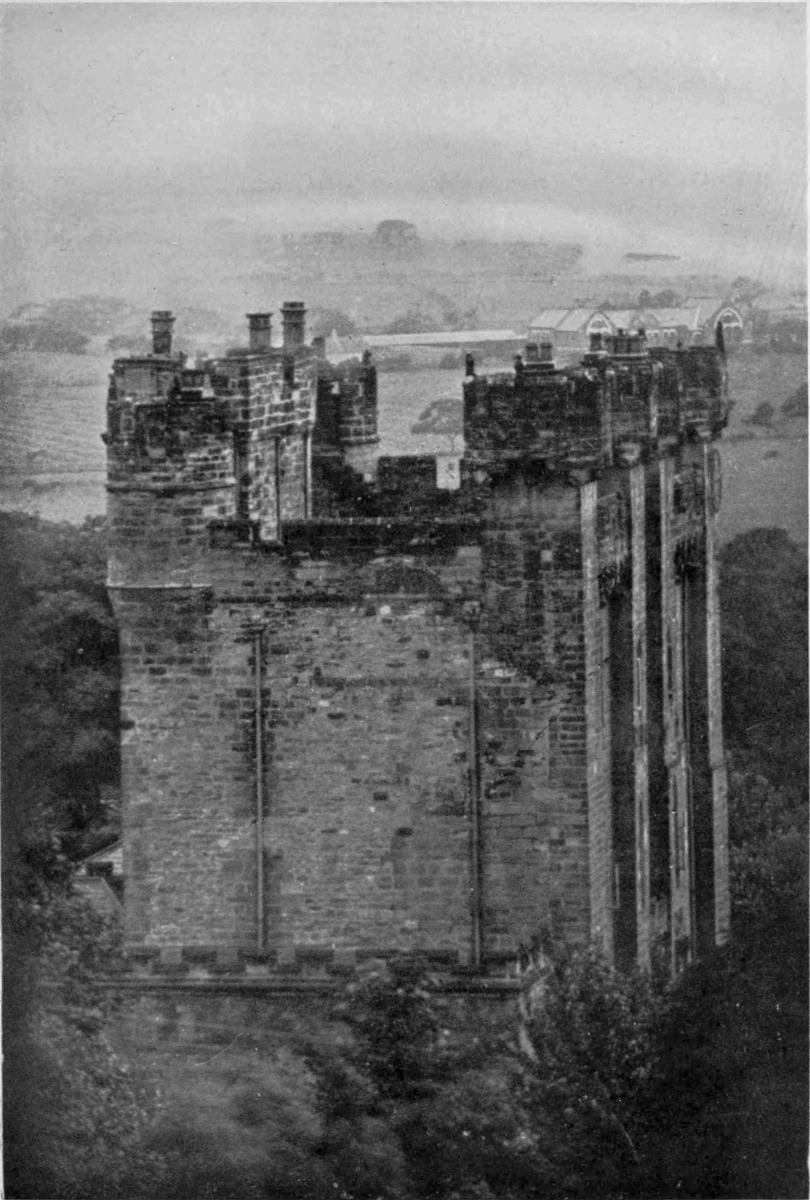
Hilton Castle from the North.
helps those who help themselves, they flaunt the pious motto:
GOD + CARYTHE + FOR + US.
The Cau’d Lad of Hilton.
The grey old castle of Hilton has long had the reputation of being haunted by a bar-guest, or local spirit, known as the "cau’d lad of Hilton," or "cowed lad of Hilton." His history, however, seems to be rather mixed, and to partake of the nature of the genuine ghost as well as that of a brownie. This brownie was seldom seen, but often heard engaged in playing pranks in the great hall, or in the kitchen after the servants had retired for the night. If they left the kitchen orderly and clean, the brownie, angered at having his work taken out of his hands, would throw all the crockery and kitchen utensils about the room, so that when the servants appeared in the morning a picture of confusion met their eyes. Of course, as a rule, they found it worked best not to attempt to leave things tidy, and then the brownie would exert himself through the night, and all would be straight and clean for the maids when they rose.
The servants, however, engaged by the last Baron thought his pranks rather wearisome, and determined to attempt his banishment by the usual means employed in such cases—that is, by leaving for his express use some article of clothing, or some toothsome delicacy to tempt his palate. They resorted to a green cloak and hood as the best means of driving him away. However, the brownie knew what they were after, and many a time during the making of the cloak and hood could be heard singing in the dead of night—
"Wae’s me, wae’s me! The acorn is not yet Grown upon the tree, That’s to grow the wood, That’s to make the cradle, That’s to rock the bairn, That’s to grow the man, That’s to lay me."
The green cloak and hood were finished at length; the servants laid them down before the fire in the great kitchen, and watched at a prudent distance. At midnight the "cau’d lad" glided in, surveyed the garments, put them on, frisked about, and when the cock crew disappeared, saying—
"Here’s a cloak and there’s a hood: The Cau’d Lad of Hilton will do no more good."
And so disappeared for ever.
The appearance of this brownie seems to have been confused with another ghost.
The apparition of a boy who was killed by one of the Barons often used to be seen—sometimes, it is said, with his head under his arm.
A Baron of Hilton, many years ago, ordered his horse to be got ready. He was a passionate man, and a fearsome one to cross. The stable-boy foolishly fell asleep. For awhile the lord waited for his horse, and then, in a lively temper, went off to the stable and found the sleeping boy. He struck the boy with a hay-fork and killed him there and then. Horrified at what he had done, he covered the body with straw till night, and then threw it into a pond at the south side of the park, where, many years afterwards, the skeleton of a boy was discovered. So runs the legend.
It is interesting to note that a boy named Roger Skelton was killed by Robert Hilton, a brother of the then Baron, in July, 1609.[7]
There was a haunted room in the castle called the "cau’d lad’s room," which was never used. Here, it is said, the spirit of the murdered boy made its residence. For many years there has been no appearance of the ghost, though there are persons who affirm that, if they have not actually seen it, they have heard it about the castle.
The Lambton Worm.
In Plantagenet days the Lord of Lambton had a godless son, who desecrated the Sabbath by fishing in the Wear, and while so doing he hooked a strange worm with nine breathing-holes on either side of its throat. This queer find he threw into a well near by, since known as "the Worm Well," and here the worm grew until it was too large for the well. It then emerged, and betook itself by day to the river, where it lay coiled round a rock in the middle of the stream, and by night to a neighbouring hill, round whose base it would twine itself. Meanwhile it continued to grow so fast that it soon could encircle the hill three times. This hill, which is on the north side of the Wear, and about a mile and a half from old Lambton Hall, is oval in shape and still called the Worm Hill. In the meantime the heir of Lambton had turned over a new leaf, and departed as a Crusader to the Holy Land. The worm still grew, and came daily ravaging for food. The milk of nine cows hardly sufficed it for a meal, and if this were not forthcoming it slayed both man and beast. Many knights tried their prowess against the worm, but with no avail, for no sooner was the worm cut in two than the pieces grew together again. The poor Lord of Lambton was in sore trouble when, after seven long years, the heir of Lambton returned home, a much sadder and wiser man. Seeing the result of his former evil practices, he determined to kill the enormous beast. Several attempts he made without success, because the parts would come together whenever he cut it in two. At last he consulted a witch of the neighbourhood, and she told him if he came to the fight clothed in armour studded with razors, and stood in the swift stream, he would conquer; but that he, like Jephthah, must kill the first living creature that met him after the victory. So to meet this latter difficulty he told his old father to listen, and when he gained the victory he would blow three notes upon his bugle, then his father was to loosen his favourite greyhound, which would come to the bugle’s call.
Having made all preparations, the heir started on his mission. Standing in midstream, he waited the onset of the worm. It came, and seeing its enemy, wound itself about him; but as it tightened its hold, the razors cut it into many pieces, which, falling into the water, were swept away by the current, and so were unable to grow together again. Thus the victory was won, and the bugle sounded; but the old lord, overjoyed at the thought of his son’s victory, forgot to let loose the hound, and ran himself to meet the conqueror. Here now arose a difficulty; the son would not be a parricide. He went again to the witch, and she told him that the only alternative was the doom that none of his family should die a peaceful death, to the seventh, or some say the ninth, generation. Tradition sayeth that this alternative was accepted, and that no head of the family died on his bed for several centuries after.
There are two stone figures of some antiquity preserved at Lambton Castle. One of these is apparently an effigy of our hero in the middle of the fray, only the worm has ears, legs, and a pair of wings. The other figure is a female one, and marked by no very characteristic features.
The Sockburn Worm.
The legend of the Sockburn worm is very similar to that of the Pollard boar. It is recorded in an old manuscript that Sir John Conyers, knight, slew a monstrous and poisonous wyvern, or worm, which had devoured many people in fight, for the scent of the poison was so strong no person could stand it. But before making this enterprise,
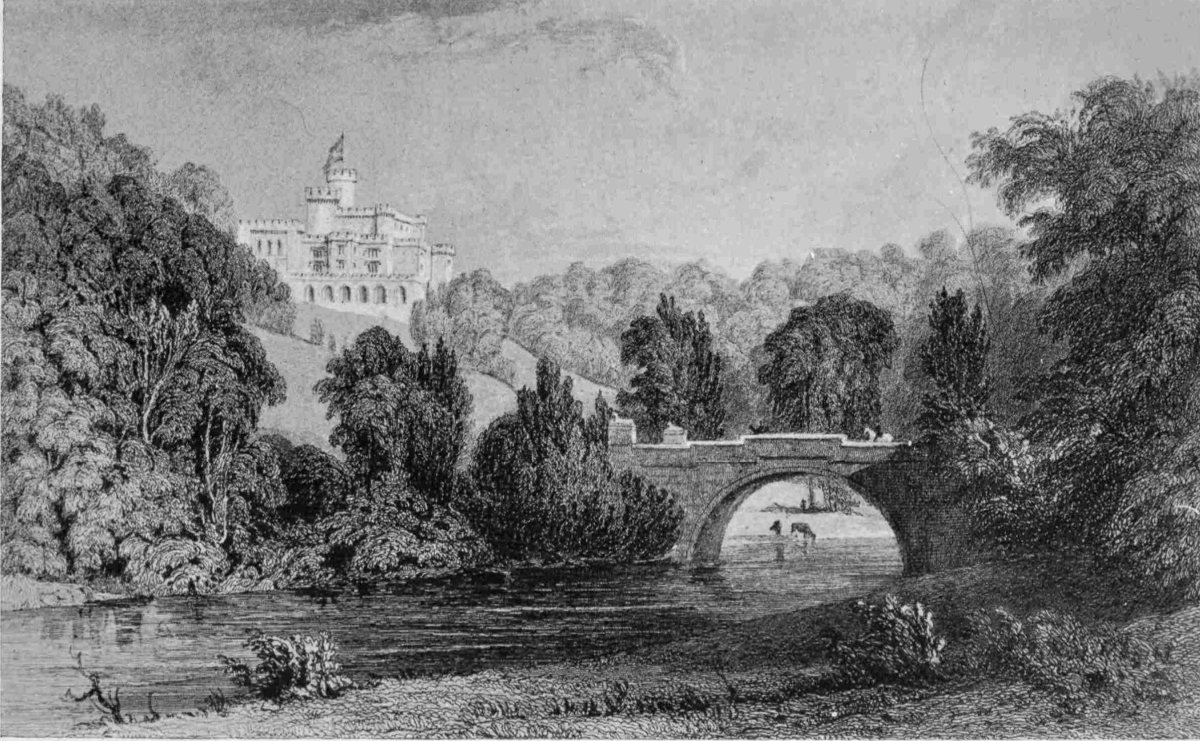
Lambton Castle in 1835.
having but one son, he went to the church of Sockburn in complete armour, and offered up his only son to the Holy Ghost. The place where this great serpent lay was called Graystane. The gray stone is still pointed out in a field near the church. For more than six hundred years the manor of Sockburn was held by the singular service of presenting a falchion to the Bishop of Durham on his first entering the diocese, and it was the duty of the Lord of the Manor of Sockburn, or his representative, to meet His Grace at the middle of Sockburn Ford, or on Croft Bridge, which spans the River Tees, and after hailing him Count Palatine and Earl of Sadberge, to present him with a falchion, saying: "My Lord Bishop, I here present you with the falchion wherewith the champion Conyers slew the worm, dragon, or fiery flying serpent which destroyed man, woman, and child, in memory of which the King then reigning gave him the manor of Sockburn, to hold by this tenure, that upon the first entrance of every Bishop into the county this falchion should be presented." The Bishop, after receiving the weapon in his hand, promptly and politely returned it, and at the same time wished the Lord of Sockburn health and a long enjoyment of the manor.
This ceremony was last performed in April, 1826, when the steward of Sir Edward Blackett, the Lord of Sockburn Manor, met, on Croft Bridge, Dr. Van Mildert, the last Prince-Bishop of Durham. The tenure is mentioned in the inquisition post-mortem held on the death of Sir John Conyers in the year 1396. The falchion was formerly kept at the manor-house of Sockburn: the blade is broad, and 2 feet 5 inches long, and on the pommel of the weapon, which is of bronze, are two shields; on one side are the three lions of England, as borne by the Plantagenet monarchs from John to Edward III., and the eagle displayed on the other side is said to belong to Morcar, the Saxon Earl of Northumberland. This relic was also represented on one of the stained-glass windows of Sockburn Church. On a marble monument, placed to the memory of an old member of the Conyers family, the serpent and falchion were sculptured.
The Pickled Parson.
The present rectory house at Sedgefield, erected by the Rev. George, Viscount Barrington, was preceded by a castellated edifice, which, after serving the purpose of a rectory house for some years, was burnt down in 1792. During a lengthened period previous to the destruction of the old house the inhabitants of Sedgefield appear to have been greatly disturbed by the visits of an apparition known as the "Pickled Parson," which, it was confidently declared, wandered in the neighbourhood of the rector’s hall, "making night hideous." Whose wandering shade the ghost was supposed to have been is explained as follows: A rector’s wife had the ill-luck to lose her husband about a week before the farmer’s tithes fell due. Prompted by avarice, she cunningly concealed his death by salting the body of her departed spouse, and retaining it in a private room. Her scheme succeeded, she received the emoluments of the living, and the next day made the decease of the rector public.
The Picktree Brag.
Picktree, near Chester-le-Street, is famous for two reasons—first, because it was the home of the heroine of the popular song, "Ailsie Marley," and, secondly, because it was the haunt of one of those mischievous goblins known as the Picktree Brag. Sir Cuthbert Sharp gives an account of the apparition, as told by an old woman of respectable appearance, of about ninety years of age, living near the spot, probably at Pelton. The old woman said: "I never saw the Brag distinctly, but I frequently heard it. It sometimes appeared like a calf with a white handkerchief about its neck, and a bushy tail. It came also like a galloway, but more often like a coach-horse, and went trotting along the lonnin, afore folks, settin’ up a great nicker and a whinney every now and then; and it came frequently like a dickass, and it always stopped at the pond at the four lonnin ends, and nickered and whinnied. My brother saw it like four men holding up a white sheet. I saw then sure that some near relation was going to die, which was true. My husband once saw it in the image of a naked man without a head. I knew a man of the name of Bewick that was so frightened that he hanged himself for fear on’t. Whenever the midwife was sent for it always came up with her in the shape of a galloway. Dr. Harrison wouldn’t believe in it, but he met it one night as he was going home, and it ’maist killed him; but he never would tell what happened, and didn’t like to talk about it, and whenever the Brag was mentioned he sat tremblin’ and shakin’ by the fireside. My husband had a white suit of clothes, and the first time he ever put them on he met the Brag, and never had them on afterwards but he met with some misfortune; and once when he met the Brag, and he had his white suit on (being a bold man), and having been at a christening, he was determined to get on the Brag’s back, but when he came to the four lonnin ends the Brag joggled him so sore that he could hardly keep his seat, and at last it threw him off into the middle of the pond, and then ran away, setting up a great nicker and laugh, just for all the world like a Christian. But this I know to be true of my own knowledge, that when my father was dying the Brag was heard coming up the lonnin like a coach and six, and it stood before the house, and the room shaked, and it gave a terrible yell when my father died, and then it went chatterin’ and gallopin’ down the lonnin as if yeben and yerth was comin’ together."
These northern ghosts or goblins have been very well described in the following verse attributed to Ben Jonson:
"Sometimes I meete them like a man, Sometimes an ox, sometimes a hound, And to a horse I turn me can, To trip and trot about them round. But if to ride My backe they stride, More swift than wind away I go; O’er hedge and lands, Through pools and ponds, I whirrey laughing, ho, ho, ho!"