MONUMENTAL INSCRIPTIONS OF THE COUNTY OF DURHAM By Edwin Dodds
Reading edition
THE earliest-known burial-place in the county of Durham has no monumental inscriptions in it. It is a barrow opened at Copt Hill, near Houghton-le-Spring, which contained Neolithic remains, and it is interesting inasmuch as it has also vestiges of burials made again after the lapse of many years, when the Bronze Age had superseded the period in which men warred and worked with weapons of stone only. There is no memento known of the Paleolithic Age in the county, and only thirteen places of burial used by Neolithic man have been investigated. Of the Bronze Age about a dozen burial-places have been examined, many of them containing those small rudely fashioned earthenware vessels, from three to six inches high, roughly ornamented with simple lines and dots, which are known as "food-vessels" and "incense-cups."
Of the monumental inscriptions left by the Romans, two of the most interesting were found near the Roman station in South Shields. One of them is an elaborately carved slab, four feet long, which bears the figure of a woman seated, with a work-basket at her left hand and a jewel-case at her right; she seems to be occupied in needlework. Below is the Latin inscription: "To the Divine Shades of Regina, of the Catuallaunian Tribe, a freed woman, and the wife of Barates the Palmyrene. She lived thirty years." Below this is a line in Syriac: "Regina, the freed woman of Barate. Alas!" The district of Catuallauna is said to have extended from Gloucestershire to Lincolnshire. It is strange that affinity of souls should have brought together as man and wife a merchant from Syria and a slave from the centre of England. Another Roman gravestone from South Shields, found in 1885, reads: "To the Divine Shades of Victor. He was by nation a Moor: he lived twenty years: and was the freed man of Numerianus, a horseman of the first ala of Asturians, who most affectionately followed [his former servant to the grave]." This stone probably dates from about A.D. 275; it bears the half-recumbent figure of a man on a couch, with a canopy above and the inscription below. At Binchester, near Bishop Auckland—the Vinovia of the Romans—a plain slab with ansated ends was found inscribed: "Sacred to the Divine Shades. Nemesius Montanus the Decurion lived forty years. Nemesius Sanctus, his brother, and his coheirs, erected this in accordance with the provisions of his will." This slab was also probably carved and set up in the third century. In Roman epitaphs no mention of death is ever made; it is stated that the person commemorated had lived so many years, but the fact that he died and the date of his death is not recorded.
Of Anglo-Saxon memorial crosses there are a large number in the county of Durham, all of them of great interest, and some of beautiful workmanship. The most notable are those at Aycliffe, Billingham, Chester-le-Street, Coniscliffe, Darlington, Dinsdale, Durham (where, in the Dean and Chapter Library, there is a fine collection both of original stones from several places and of facsimile copies), Elwick, Escomb, Gainford, Great Stainton, Haughton-le-Skerne, Hurworth, Kelloe, Norton, Sockburn, and Winston-on-the-Tees. None of them are perfect; most of them are fragments of monuments which have at some time been broken up and used as building stones.
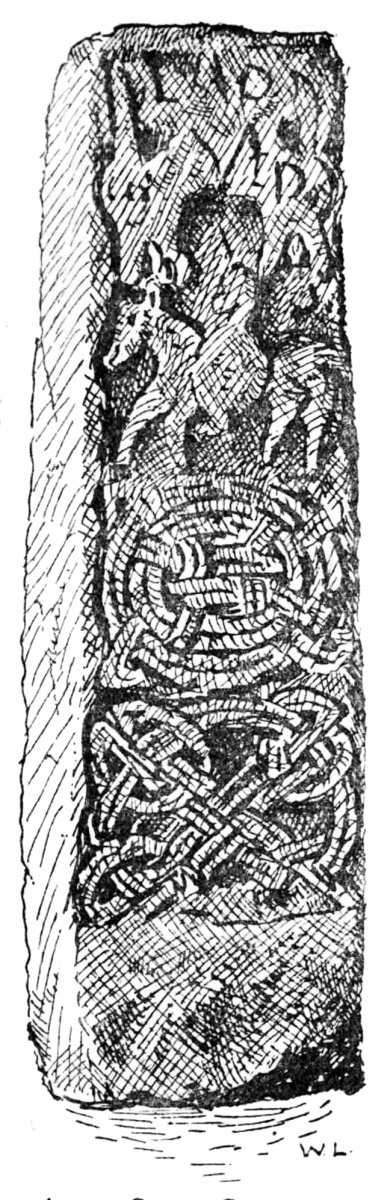
Anglo-Saxon Stone at Chester-le-Street.
The cross at Kelloe is made up of pieces now carefully joined together; it is a very fine example. Most of these crosses have the characteristic knot-work ornament, and many of them have human figures, crucifixions, monsters, warriors, animals, and birds, carved upon them, the sculpture and design being of the Anglian school. Very few of them have any lettering. One at Chester-le-Street has EADMUND in mixed Runic and Roman letters, but this may be an addition by a later hand. The hog-backed stones of this period, of which some very fine specimens were discovered at Sockburn in 1900, bear similar knot-work ornaments. In 1833 a burial-place at Hartlepool, and in 1834 one at Monkwearmouth, were discovered; they both yielded memorial stones, small in size, but of great interest. A stone from the latter place, now in the British Museum, bears the name TIDFIRTH in Runic characters. Tidfirth was the last Bishop of Hexham, and was deposed about the year 821. The stones found at Hartlepool are known as pillow-stones; they are almost square, and only from 9 to 12 inches across by about 2 inches thick. Only seven of them have been saved. They all bear a cross, sunk in some stones and raised on others, and several of them have short inscriptions in Saxon minuscules. One reads: "ORATE PRO EDILUINI ORATE PRO UERMUND ET TORTHSUID."
Those effigies, or early statues, generally recumbent, and made sometimes of wood, but more often of stone, which were placed in churches from the twelfth to the sixteenth centuries, are to be found in many places in the county, sometimes decently and carefully preserved in the church, sometimes left to weather and decay in the churchyard, or in the rectory garden. Among the more noticeable of them are the following:
At the west end of Staindrop Church is the "altar-tomb of alabaster," with an effigy of Ralph Neville, first Earl of Westmorland, in plate armour, and with figures of his two wives, one on either hand. Surtees, in his History of Durham, describes it as "this noble tomb, which is in the purest style of the best age of sepulchral monuments." Its date is probably about 1425. There is in the same church another tomb with effigies, in wood, of the fifth Earl of Westmorland and his two wives; it is dated 1560.
Barnard Castle Church has an effigy of a priest attired in chasuble, stole, dalmatic, alb, and amice. The inscription is in Lombardic lettering, and reads: "ORATE PRO AIA ROBERTI DE MORTHAM QNDM VICARII DE GAYNFORD." This Robert de Mortham founded a chantry at Barnard Castle in 1339.
At Bishopwearmouth there was formerly the effigy of Thomas Middleton of Chillingham, the founder of the family of Silksworth. It represented Middleton in complete armour, with his hands raised. It bore the inscription: "Hic jacet Thom’ Middylton Armiger — — — MCCC." At one time this statue lay on an altar-tomb in the north aisle of the church; later it was placed upright against the wall of the aisle; later, again, it is recorded that it lay, broken into two pieces, in the porch; to-day it cannot be found.
In the Church of St. Giles, in the city of Durham, there is a wooden effigy in complete armour, which is supposed to represent the first John Heath, of Kepier, who was buried in the chancel of that church in 1590.
The Lumley monuments are a collection of fourteen effigies which lie in the north aisle of Chester-le-Street Church. They were placed there by a Lord Lumley about 1594. They represent the Lords of Lumley from Liulph, who lived in the days of William the Conqueror, down to the John, Lord Lumley, who fought at Flodden Field in 1513. Probably only three of the fourteen monuments are genuine; the others were either manufactured or, more probably, collected from other places.
The old chapel at Greatham was pulled down in 1788. In a recess in the south wall of the transept there was a wooden effigy of an ecclesiastic. During the rebuilding of the chapel a stone coffin containing his bones and a chalice of pewter was found near the foot of the wall.
In the Pespoole seats in the south aisle of Easington Church there is an elegant recumbent figure of a woman, carved in Stanhope marble. On it are carved the three popinjays which were carried on the coat of arms of the ancient owners of Horden. At Heighington Church there are two female effigies, one of which has been very fine, but they are both much weathered and decayed; they are probably of fourteenth-century date. In the same church there is a medieval pulpit, the only one remaining in the county. It is of oak, and on it there is inscribed in black letter: "orate p’ aiabz Alexandri flessehar et agnetis uxoris sue." To commemorate oneself by giving a pulpit to the church seems a practical and useful form of memorial. As this is the only medieval pulpit the county has left, it seems likely that its preservation is due to the inscription it bears.
When Neasham Abbey, in the north of Yorkshire, fell into ruin, two of its effigies were moved over the Tees to the church at Hurworth. One of them was a remarkably fine figure of a knight in armour, his head covered with a coat of mail, his body clad in a shirt of mail, over which there is a surcoat. His shield has "barry of eight, three chaplets of roses." The armour is of the style in use in the early part of the fourteenth century, and the effigy probably represents the Robert FitzWilliam who was Warden of the Marches in the time of the just King Edward I., and who died in 1316.
In Lanchester Church, under an arch in the wall of the south aisle, lies a recumbent effigy of a canon secular, his raised hands clasping a chalice. This is believed to represent Stephen Austell, Dean of Lanchester, who died in 1464. In Monkwearmouth Church, under a canopy which bears the shields of the Hiltons and Viponds, there is a very interesting effigy of a knight in plate armour of the early part of the fifteenth century. This is probably the Baron William Hilton, who built Hilton Castle on the Wear, with its wonderful armorial front. He died in 1435. At Norton, near Stockton, there is a magnificent effigy of a knight in chain armour; over the head there is a rich canopy of tabernacle-work; the hands are raised and the legs are crossed, the feet resting on a lion. It is sometimes assumed that this representation of a knight with his legs crossed one over the other indicates that the person portrayed was a Crusader, but there are many cases where the attitude is used in which it is known that the effigy was that of one who could not have taken any part in those Holy Wars. This monument is further noticeable as it is one of the very few which give us even a slight hint as to the personality of the sculptor; it bears what is believed to be his mark in the shape of a small squiggle, which looks like a short length of chain, in front of which is the letter "I," and it is supposed that this punning rebus means that the effigy is the handiwork of one John Cheyne. It would be very interesting to know who commissioned Cheyne to carve this monument, for another curious feature in it is that the shield of the knight bears six coats of arms—Blakeston, Surtees, Bowes, Dalden, Conyers, and Conyers—which mean that the knight was a Blakeston of Blakeston. But the Blakestons bore these arms in the sixteenth century, probably not later than the year 1587, whereas the armour of the effigy is of the time of Edward I., 1272-1307. Boyle suggests that probably the monument is to one of the De Parks, and that a Blakeston took it, scraped off the De Park arms, and put on his own coat. Whatever its vicissitudes may have been, it remains a noble piece of work.
In Redmarshall Church, in the Claxton Porch, there are effigies of Thomas Langton de Wynyard and of Sibil Langton, his wife. They are admirably carved in a rather soft alabaster, and the delicacy and clearness of detail in the costumes is very remarkable. The lady’s hair is dressed in the extraordinary horns which were fashionable in the days of Henry V. She wears a long, loose kirtle, with a surcoat and mantle; round her neck is a string of pearls, and round her waist is a jewelled belt. The knight wears a suit of plate armour, probably of Italian make, the fashion of which suggests that the effigy was carved several years after the death of Thomas de Langton in 1440.
Effigies of men who had devoted themselves to a religious life, but who died before attaining the order of priesthood, are very rare. There is one of a deacon within the altar-rails of Ryton Church, carved in green marble from Stanhope.
Whitburn Church holds a singular effigy of comparatively late date. Attired in the full stiff dress of the time of William and Mary lies a plump, elderly gentleman. He wears a full periwig, a neckcloth with square ends, a coat with large buckramed skirts and wide sleeves, rolled breeches, and square-toed laced shoes ornamented with immense bows of ribbon. His head rests on a pillow, and his right hand holds a book, which is open at the text, "I shall not lye here, but rise." There is a skull between the feet. On the uprights of the tomb the same figure is carved in bas-relief, kneeling, and on each side of him is a lady in the dress of the same period. A tablet on the wall states that this is "the burial-place of Mr. Michael Mathew of Cleadon, and his wife, who had issue three sons and two daughters, of which only Hannah survives."
Brasses.—In many of the older churches of the county there are remaining the stone matrices which formerly held monumental brasses, but in most cases the brasses themselves have disappeared, the sanctity of a church, and the contiguity of a Table of the Ten Commandments not having prevailed against the temptation to steal a substance so portable and so readily saleable as brass.
In the floor of the chapel at Greatham Hospital there is a large slab of stone, 90 by 43 inches in size, with an inscription in brass Lombardic letters round the edge commemorating William de Middleton, a master of the Hospital in 1312. On the wall is another inscription, in raised black-letter with chasing, asking for prayers for the souls of Nicholas Hulme, who was master in 1427, of John Kelyng, 1463, and of William Estfelde, who died in 1497.
At Sherburn Hospital there is a small brass let into the chancel steps, which reads: "THOMAS . LEAVER . PREACHER . TO KING EDWARD . THE . SIXTE. HE . DIED . iN . iVLY . i577."
In the church at St. Andrew’s Auckland there is a finely cut brass with the figure of a priest, of which the head is, unfortunately, missing. There is no inscription, but the date of it is probably about 1400. In the same church there is a unique brass, small in size, but about ½ inch thick; it bears a small Greek cross with a backing of plant decoration, and it has three lines of inscription across the plate and a legend round the margin. It is dated April 8, 1581, and was put up to the memory of Mrs. Fridesmond Barnes, who was the wife of the second Protestant Bishop of Durham, Richard Barnes. We know the cost of this brass, for in the Bishop’s accounts there is the entry, "To the gould-smyth at Yorke for a plate to sett over Mrs. Barnes, 32ˢ."
At St. Helen’s Auckland there is a brass which portrays the figure of a man in a long tunic edged with fur; his wife lies by his side, and below are figures of his sons and daughters. The inscription is lost, but the date of it is probably about 1460.
In Sedgefield Church there is a curious brass giving the crest of William Hoton, 1445, with a black-letter inscription below: "Hic iacet willm̄s Hoton . qui . obijt . xviº die Septebr’ Anno . dni . Millm̄o . ECCCº . xlvº . cui’ aie ppicietur de’ ame’." In the same church there are two of the objectionable brasses which were not uncommon in the fifteenth century, which portrayed skeletons in shrouds.
Chester-le-Street Church has a very pleasing brass, giving the full-length figure of a woman attired in the costume of the first half of the fifteenth century. The lines of the composition are simple and bold, and the effect is very graceful. The brass has no inscription, but it is known that it was put up to the memory of Alice Salcock of Salcock in Yorkshire, who married William Lambton, and who died in 1434.
At Dinsdale, on the southern margin of the county, close to the River Tees, there is in the church a late, small, but beautifully worked brass, only about 11 inches by 8 inches in size. It bears the coat of arms of eight quarterings, and records the merciful benefactions to the poor of the parish of Dinsdale of Mary, the wife of Thomas Spennithorne. She died in 1668, and was buried at Spennithorne.
In the magnificent cathedral of Durham most of the sepulchral monuments were destroyed either at the Dissolution of the Monasteries in the reign of Henry VIII., or when the cathedral church was used as a prison for Scotch prisoners of war after the Battle of Dunbar in 1650. In 1671 Davies wrote his book on The Rites and Monuments of the Church of Durham, with the motto Tempora mutantur—on the title-page, giving a sad description of the past glories of the church. "Lodovic de bello Monte, Bishop of Durham," he says, "lieth buried before the high Altar in the Quire, under a most curious and sumptuous Marble stone, which he prepar’d for himself, before he died, being adorned with most excellent workmanship of Brass, wherein he was most excellently and lively Pictur’d, as he was accustomed to sing, or say Mass." This Bishop de bello Monte, or Beaumont, died at Brantingham, near Hull, in 1333. His gravestone, which was said to be the largest in England, still lies before the high-altar in Durham Cathedral, but the "most excellent workmanship of Brass" has utterly disappeared.
In Hartlepool Church there is a brass with the figure of a lady in a large hat, with ruff and farthingale; on another brass below it is the inscription:
HERE VNDER THiS STONE LYETH BVRiED THE BODiE OF THE VERTVOUS GENTELLWOMAN IANE BELL, WHO DEPTED THiS LYFE THE . vi. DAYE OF IANVARIE 1593 BEiNGE THE DOWGHTER OF LAVERANCE THORNELL OF DARLINGTON GENT & LATE WYFE TO PARSAVAL BELL, NOWE MAiRE OF THIS TOWEN OF HARTiNPOOELL. MARCHANT
whos vertues if thou wilt beholde peruse this tabel hanginge bye which will the same to thee vnfold by her good lyfe learne thou to die.
In Haughton-le-Skerne Church there is a curious figure on a brass, representing a lady, who holds a baby on each arm. She was Dorothy, the wife of Robert Perkinson of Whessey, and she died, with her twin sons, in 1592.
At Houghton-le-Spring there is a brass to the memory of Margery, wife of Richard Bellasis. It pictures the kneeling figure of a woman with her eight sons and three daughters behind her. The Bellasis coat of arms is on the brass: the date is 1587.
In Sedgefield Church there is a rudely engraved, early brass, probably cut about the year 1300. It shows a small female figure, kneeling, and it has a coat of arms on both sides of the figure. From the shape of the two coats of arms, and from the conventional treatment of the features of the face, which is more carefully executed than the rest of the figure, it is believed that this is one of the oldest sepulchral brasses now remaining in England.
The tombstone to Dean Rudde, which lies in the floor of the chancel of Sedgefield Church, still carries its inscribed brass. The stone is a very large one. The black-letter epitaph is so much worn by the tread of the feet of many generations that it can only be read with some uncertainty. It seems to run:
Orate p aīa m̄ri Joh̄is Rudde in decretis baccalarii quondm̄ decani hui’ loci qui obiit xxix die decēbr’ Anno dn̄i Mº CCCCº lxxxx cui’ āīē ppiciet de’ amen.
This John Rudde gave to the church of Esh the only medieval service-book belonging to any church in the diocese of Durham which is now known to exist. It is in the library of the Roman Catholic College of Ushaw, near Durham.
The beautiful memorials to the dead which were known as grave-covers were used in England and Ireland from the ninth to the sixteenth century. Though they are abundant in the county, Durham cannot boast of the possession of specimens equal in merit to those found in some other parts of England. At Sedgefield Church there is a fine thirteenth-century grave-cover with a double, eight-rayed cross; it has the rare feature of a double row of dog-tooth ornament at the head; and it is the only stone known in the county which has the whole surface covered with a tracery of foliage. It is, unfortunately, much weathered. Built into the tower of the same church, and only partly visible, is another richly ornamented cover, dating probably from the middle of the fourteenth century, the foliated ornament being more naturally shown, or less conventionalized, than in earlier examples. It bears a sword and a cross moline on a small shield.
The symbolism used on grave-covers is not well understood. A key is said to indicate a woman, a sword a man; shears sometimes represent a woman, sometimes a wool-stapler; a chalice or a book, or both, are placed on the gravestone of a priest or other ecclesiastic. Craftsmen are often indicated by some sign of their business, as a square for a mason, a horseshoe or a hammer for a smith. Sometimes a merchant uses his trade-mark much as an armigerous person uses his coat of arms. Built into the south porch of St. Mary’s Church in Gateshead there are two large grave-covers bearing incised crosses. One of them, a fourteenth-century slab, has at one side of the stem of the cross a key, and at the other side a fish. Most authorities think that the fish is the mystic symbol of our Saviour, which was so dear to the early Christians, and which is frequently found on the gravestones in the catacombs at Rome; but other antiquaries consider that the stone is to be more literally interpreted, and that it covered the remains of a fish-wife.
The earlier grave-covers were stone lids for stone coffins, but after the use of stone coffins was discontinued, and wooden coffins were substituted, the remains of the dead were often covered by these carved stone slabs. The larger part of them are uninscribed, but grave-covers with a few lines cut on them are by no means uncommon. At Gainford there is a perfect grave-cover of the fourteenth century which bears a chalice and three floreated crosses, one large and two small. It has been suggested that these prove this to have been the burial-place of an ecclesiastic and two children, for burial in a monk’s frock or in the grave of a priest was long considered by all classes of people to be desirable. This stone, though it is of early fourteenth-century period, bears an inscription to Laurence Brockett, Regius Professor of Modern History at Cambridge, who died in 1768. His executors seem to have thought that an old gravestone was just as good as a new one.
Of quaint sepulchral inscriptions there are many in the county. The one in Monkwearmouth Church to the memory of a Mrs. Lee is on a small marble tablet on the vestry wall. It reads:
HEERE VNDER LYETH Yᴱ BODDYE OF MARY LEE DAVGHTER TO PETER DELAVALE LATE OF TINMOVTH GENT SHEE DIED IN CHYLDBED YE 23 OF MAY 1617 HAPIE IS Yᵀ SOVLE Yᵀ HEERE ON EARTH DID LIVE A HARMLESS LYFE & HAPPIE MAYD Yᵀ MADE SOE CHAST AN HONNEST WIFE.
It is strange that a lawyer "of ability and integrity" should not be able to make himself a sound will. In Greatham Chapel there is an inscription: "In memory of Ralph Bradley, Esq. an eminent Councillor at Law, born in this parish, who bequeathed a large fortune, acquired in a great measure by his abilities and integrity, to the purchasing of books calculated to promote the interests of virtue and religion, and the happiness of mankind. He died the 28th day of December 1788, in the 72d year of his age...." Below, on a copper plate, is: "By a decree of Edward Lord Thurlow, Lord High Chancellor of Great Britain, on the 2ᵈ day of August 1791, the charitable intention mentioned above was set aside in favour of the next of kin."
In Stockton Church we may read that on "Wednesday the 19th of May 1773 was here interred the body of Mrs. Sarah Baker ... aged 59. Do thou reflect in time; death itself is nothing, but prepare to be you know not what, to go you know not where."
At Houghton-le-Spring stands the massy altar-tomb of the great Bernard Gilpin, "the apostle of the North," that sweet-natured, fearless, and humble-minded man who so narrowly escaped a martyr’s death at the stake. The tomb bears his coat of arms and the following:
BERNERD OBIT QVA
GILPIN RE[A bear with a crescent on its side,RTV DIE M
CTOR HVleaning against a tree.]ARTII AN.
IVS ECCLIÆ DOM. 1583.
See here his Dust shut up whose Generous mind No stop before in Honours path could find. Truth Faith and Justice, and a Loyall Heart In him Showd Nature, which in most is Art.
In the same church of Houghton-le-Spring there is the following epitaph: "Here Lyes interr’d the Body of Nicolas Conyers Esqʳ. High Sheriff of this County Chiefe of yᵉ Family of Conyers of the House of Boulby in Yorkshire. He dyed at South Biddick Mar: 27 A.D. 1689 his age 57." Below is his crest.
At Houghton Hall Robert Hutton, a zealous Puritan and a Captain in Cromwell’s army, was buried in his own orchard, where his altar-tomb is inscribed: "HIC JACET ROBERTVS HVTTON ARMIGER QVI OBIIT AVG. DIE NONO 1681 ET MORIENDO VIVIT."
In the Galilee Chapel at the west end of Durham Cathedral there is a stone on the floor inscribed:
JOHN BRIMLEIS BODY HERE DOTH LY, WHO PRAY SED GOD WITH HAND AND VOICE; BY MUSICKES HEAVENLY HARMONIE DULL MINDS HE MAID IN GOD REJOICE. HIS SOUL INTO THE HEAVENS IS LYFT TO PRAISE HIM STILL THAT GAVE THE GYFT.
This Brimley was master of the Song School at Durham Cathedral.
That mighty builder, Hugh Pudsey, who was Bishop of Durham from 1153 to 1195, seems to have had a fellow-worker who pleased him in the person of Christian the Mason, whose grave-cover is at Pittington. One wonders whether it was after Christian had built for the Bishop the stout fortifications of Durham Castle, or whether it was when he had finished the beautiful Galilee Chapel of the cathedral, that Pudsey gave him, as we know he did, forty acres in the moor at South Sherburn, besides other lands, "quit of all rent whilst he should remain in the service of the bishop." Pudsey’s own tomb in Durham Cathedral is broken and dispoiled, but Christian the Mason’s grave-cover at Pittington can still be read:
✠NOMEN ABENS CRISTI TVMVLO TVMVLATVR IN ISTO ✠QVI TVMVLVM CERNIT COMMENDET CVM PRECE CRISTO,
which may be interpreted: "One having the name of Christ is buried here. Let him who beholds the grave commend himself with prayer to Christ."
In the churchyard of St. Hild’s at Hartlepool, about 6 feet from the east wall of the modern chancel, there is an old altar-tomb covered with a very large slab of bluish stone. If it has ever been inscribed the lettering is now utterly weathered off, but it has the lion of Bruce on the uprights at the sides still faintly visible. This is the resting-place of the fathers of Robert Bruce. They owned Hart and Hartlepool for many generations before Robert Bruce claimed the crown of Scotland in 1306. His lands in the county of Durham were then seized and given to the Cliffords. In Easington Church there is an effigy of a lady in thirteenth-century costume, which probably represents Isabella, first wife of John Fitz-Marmaduke. She was the daughter of Robert de Brus of Skelton, and the sister of Robert Bruce, King of Scotland.
Coming last to the ordinary inscriptions on the tombstones and headstones of our churchyards, one of the first things that strikes an observer is the large number of cases where, though the stone remains, the inscription is wholly or partly weathered off and lost; such cases are an occasion of woe to the genealogist. In looking through a country churchyard it will often be found that 10 per cent. of the stones are unreadable. This is generally because a soft and unsuitable stone has been used. Some slate-stones stand well; limestones and marbles only last while they are in a church, rain and slight traces of acid in the atmosphere soon disintegrate them out of doors. Granite will probably endure very long, but it has been little used in Durham churchyards, and only since about 1860. Sandstones are most generally used, and some of these, of a close-grain and of a dark colour when old, stand exceedingly well. The fell sandstones, or hassells, used in the west of the county, are almost as hard as granite. They are very difficult to cut, so the lettering on them is often quite shallow; but stones 200 years old are quite unaffected by weather. Soft sandstones, which are easily cut, either crumble and decay gradually, or in some cases they scale off in flakes and perish very quickly. It is common to see two stones of about the same date, standing side by side, one of which is sound and clear, while the other cannot be read. Frequently one finds a stone where, owing to differences of hardness, one part of the inscription is sharp and legible, while other parts are completely gone.
Along the parishes on the coast of the county the wanderer cannot fail to be struck with the constant repetition of the words, "Lost at sea," and if he should turn to the registers of these parishes and read the many entries like, "A woman at ye sea side found drowned," "A man cast upon our sands by the sea," "Foure Duchmen wth a woman and a childe being drowned by shipwrack were buried in this Churchyard," he will learn what a heavy tithe the sea takes from the land, and how high is the price that man pays for the sovereignty of the sea.
Punning epitaphs are, fortunately, not numerous in the county. Here is one, from Stockton, to the memory of two masons, "Ralph Wood, who departed this life Oct. 22, 1730, in the 67th year of his age. Here lieth the Body of Ralph Wood, aged 67, 1743.
"We that have made tombs for others, Now here we lie; Once we were two flourishing Woods, But now we die."