FOLK-LORE OF THE COUNTY OF DURHAM By Mrs. Newton W. Apperley
Reading edition
WHOEVER makes a study of the folk-lore of a county will find that its customs, beliefs, and superstitions, have their origin in immemorial antiquity. To find out the reason for many a curious and apparently frivolous observance it is necessary to go back many centuries, to the time when a nature-worship, already immeasurably old, was practised; when the sun and moon, fire, water, and earth, were personified by gods and goddesses. Festivals were held in honour of each, and stones and trees, wells and rivers, had their temples and devotees. These were overlaid by and mingled with the successive rituals of Roman, Saxon, and Dane, and finally were almost, but not quite, conquered by Christianity. The older faiths made a stubborn resistance to the reformer, and though adapted and altered, many of their usages survive to this day.
The four great Fire Festivals of Spring, Summer, Autumn, and Winter were Christianized and dedicated anew; some of the gods and goddesses were re-named as saints; and many of the rites belonging to their worship were modified into Christian observances.
But the people kept their old superstitions, and placed their faith in the charms and amulets belonging to the ancient worship. In the North especially the old beliefs lingered long, and even now, in the twentieth century, many quaint customs are to be found. Most of the people who practise them could give no reason for so doing, and have certainly no knowledge of their origin. It is "lucky" to do this, and "unlucky" to do that, is all they can say.
The county of Durham, though the especial patrimony and property of St. Cuthbert, is particularly rich in legends and traditions, in places both haunted and hallowed, and in old-world observances of all kinds. Many are the stories of giants, brownies, fairies, ghosts, witches, and "worms" or dragons, told of and in it.
The Gabriel Hounds—those monstrous human-headed dogs, whose pause over a house is said to bring death or misfortune to its inmates—are still heard traversing the air, though they are seldom seen.
Tales of the Hand of Glory—that unhallowed taper made of the hand of a hanged man, holding a candle made of the fat of a murderer, whose light would send all the inhabitants of a house to sleep, and enable a burglar to make his easy way throughout it—are still told.
And the Fairy Hills near Castleton, Hetton-le-Hole, Middridge, and other places where fairies used to dance their nightly rounds, are still pointed out. Cattle were often shot by their tiny arrows, and children frequently wore necklaces of coral or of peony seeds, as otherwise they might have been stolen and taken away to Fairyland.
Mr. Henderson, in his Folk-lore of the Northern Counties, is convinced that there is firm faith in ghosts and their power of revisiting the earth throughout the whole county of Durham.
Witchcraft is to some extent believed in. It is not long since an old woman reputed to be a witch died at Aycliffe, and charms against their power have been, and are still, practised; indeed, they are still "crossed-out" by those who make the sign of the cross on loaves before they are put in the oven, and by the butchers who make, or used to make, a cross on the shoulder before selling it. A crooked sixpence, a piece of rowan-wood, or a four-leaved clover worn in the pocket, will keep them away. A self-bored stone or a horseshoe hung over the bed or in the byre will prevent their evil influence from harming either person or property; and should you be so unfortunate as to meet a reputed witch, it is well to close your fingers round your thumb, and repeat the rhyme:
"Witchy, witchy, I defy thee, Let me go quietly by thee!"
And there were wise men, and especially wise women, who knew many spells of might to be used against them and against fairies.
It is clear that a child born into this haunted country, and surrounded from his birth by signs, portents, and auguries, must carry through his life a belief in the superstitions of his forefathers.
The day of birth is most important, for it always influences the character and fortunes of the child.
"Monday’s child is fair of face, Tuesday’s child is full of grace, Wednesday’s child is full of woe, Thursday’s child has far to go, Friday’s child is loving and giving, Saturday’s child works hard for its living; But the child that’s born on Sabbath-day Is wise and bonny and good and gay."
Children born during the hour after midnight see spirits, and this uncanny gift continues through life. If born with a caul, the child will always be lucky. Children born in May are said to be seldom healthy.
A cake and cheese should always be provided before the birth of an infant. These are cut by the doctor, and all present partake of them, on pain of the poor child growing up ugly. The nurse keeps some of this cake and cheese, and when she takes the child to be christened she gives them to the first person whom she meets of opposite sex to that of the child. If boys and girls are being christened at the same time, the boys must be christened first, as otherwise the girls would have beards, the boys none!
Baptism is thought to be good for a child, and it is often said that children never thrive till they are christened. It is well if they cry during the ceremony, for it means that "the devil is going out of them." There is some warrant for this belief, for until the time of Edward VI. a form of exorcism, in order to expel the evil spirit from the child, was still used in the Baptismal Service.
A child who does not cry at baptism will not live.
It is unlucky to call a child by its future name until it has actually received it, and most especially should one avoid naming it after a dead brother or sister. The child will probably die also, or, if it lives, will never prosper.
Some nurses will never put a child’s dress over its head until it is christened, but always draw it up over the feet. I never could hear why. And the inside of the hands should not be washed during this time. Some go so far as to say that the right hand should not be washed for a year, so as not to "wash the luck away."
But before taking a child out of its mother’s room the careful nurse will see that it does not go downstairs first, as that would mean a descent in life for it. If it is impossible for it to go upstairs, she must take it in her arms, and mount a chair or stool with it, thereby assuring it of a rise in life.
The mother should go nowhere till she has been churched, as she would carry ill-luck to the house she entered.
The baby should receive three, sometimes four, presents when it first visits another house. These are its "almison," and consist of an egg, bread, salt, and sometimes a piece of money. The bread and salt are things used in sacrifices; the egg has always been a sacred emblem; the money is for luck, and should be carefully kept.
Never rock a cradle when empty, or you may rock another baby into it. And this is very likely to be the case if the reigning baby cuts its teeth very early, for, as the proverb says, "Soon teeth, soon toes" (another set of them). If it tooths first in the upper jaw, that means death in infancy. Later, on losing a tooth, the cavity should be filled with salt, and the tooth thrown into the fire with the words:
"Fire, fire, burn bane, God send me my tooth again!"
It is an ancient custom, when a family is sold up, to except the cradle, and leave it in the possession of its original owner.
The nails should not be cut for a year, or the child will become a thief. Bite them off, and all will be well.
When the child grows older, the nails should never be cut on Friday or Sunday. These are unlucky days, but, as the rhyme tells us, other days do very well:
"Cut them on Monday, cut them for health; Cut them on Tuesday, cut them for wealth; Cut them on Wednesday, cut them for news; Cut them on Thursday, a pair of new shoes; Cut them on Friday, cut them for sorrow; Cut them on Saturday, a present to-morrow; But he who on Sunday cuts his horn, Better that he had ne’er been born!"
Still later in life, another verse says:
"Sunday shaven, Sunday shorn, Better hadst thou ne’er been born!"
The hair should always be cut when the moon is waxing, and all clippings and combings should be burnt, or "the birds will take it for their nests." Probably the original idea, like that attached to the clippings of the nails, was that they should be destroyed, lest some enemy should use them to work an evil spell against the owner.
If the hair burn brightly when thrown into the fire, it means long life to the owner; if it smoulder, it is a sign of death.
If you swallow a hair, it will wrap itself round your heart and kill you. Howitt tells this seriously as having caused the death of Herbert Southey.
The mother should be careful to see that no child is allowed to jump over the head of another, as in that case the overleapt infant would never grow. The Kafirs have the same idea, and some tribes will not play leap-frog for that reason.
When a seventh son is born, it is still said that he ought to be a doctor. He was anciently supposed to be able to cure the "king’s evil" by touching; and the seventh son of a seventh son had still higher and more Divine attributes. If a seventh daughter appeared without any boy intervening, she was to be a witch.
When the boy is old enough to put his instilled and inherited beliefs into practice, he may charm the butterfly to alight on his hand by saying (it must be said often enough!):
"Le, la let, ma bonnie pet!"
If he wishes for fine weather, he may sing:
"Rain, rain, go to Spain! Fair weather come again!"
The snail will look out from its shell if he says:
"Snail, snail, come out of your hole, Or else I’ll beat you as black as a coal!"
And when stung by a nettle, dock-leaves are laid on the stung place, and this rhyme chanted:
"Nettle in, dock out; Dock in, nettle out; Nettle in, dock out; Dock rub nettle out!"
If he puts a horse-hair into water, it will turn into an eel.
Durham schoolboys used, when they saw a rainbow, to make a cross of straws or twigs upon the ground, in order to send it away, or, as they said, to "cross out the rainbow."
Borrow tells of "the gipsy mystery of the trus’hul, how by making a cross of two sticks the expert in occultism could wipe the rainbow out of the heavens"; and the charm might have its roots still farther back in the cross of Thor, anciently used to dispel rain and thunderstorms.
In Confirmation, those who are touched by the Bishop’s left hand will never marry.
When the time for marriage comes, it is important to choose a lucky day and season. The days of the week are thus fated:
"Monday for wealth, Tuesday for health, Wednesday the best day of all; Thursday for losses, Friday for crosses, And Saturday no luck at all."
It is well to avoid marriage in Lent, for
"If you marry in Lent, You’ll live to repent."
And May is an unlucky month for weddings, as for births. But the time being happily settled, the bride must not hear the banns given out, or her children will be deaf and dumb, and neither she nor any of the guests must wear anything green. She should wear
"Something old, something new, Something borrowed, and something blue."
The day of the marriage should be fine, "for happy is the bride whom the sun shines on." The bridal party is escorted to church by men armed with guns, which they continually fire. After the ceremony it is the clergyman’s privilege to kiss the bride; and outside the church people are probably waiting with "hot-pots," of which the whole party must taste.
At St. Helen’s Auckland, and other villages, the "race for the bride-door" for a ribbon or kerchief is still customary.
And it was formerly the custom to address complimentary verses to the bridal couple before they left the church. This was called "saying the Nominy." The verses differed, were of no great poetical merit, and always ended with, "Pray remember the Nominy sayer."
The word is evidently derived from nomen, the bride having received a new name.
The loss of the wedding-ring means the loss of the husband’s love, and its breaking forbodes death.
Of portents of death there are many. The howling of dogs; the flight of jackdaws or swallows down the chimney; "a winding-sheet" in the candle; the crowing of a cock at the dead of night; the hovering of birds round the house, or their resting on the window-sill, or flapping against the pane; and three raps given by an invisible hand, are all auguries of death.
If thirteen persons sit down to a meal together, one of them will die before the year is out.
The custom of keeping the Vigil of St. Mark is not unknown. They who wish to know who of their fellow-parishioners will die during the coming year must keep watch in the church porch from eleven to one, on St. Mark’s Eve, for three successive years; then the doomed company will pass into the church. But if the watcher fall asleep during his vigil, he will himself die during the year.
At the time of death the door should be left open to afford free passage to the departing spirit. It is held that no one can die on a bed or pillow containing the feathers of pigeons or of game of any kind; and all along the East Coast it is said that people usually die during the falling of the tide.
When the corpse is "laid out," the death-chamber is shrouded in white, the clock is stopped, and the looking-glass covered, to show that for the dead time is no more and earthly vanity departed. There is also the dread that if the mirror were left uncovered the ghost of the dead man might be reflected in it.
A plate of salt is also placed upon the breast as an emblem of eternity.
Those who come to see the corpse are expected to touch it, in token that they are in peace with the dead. It is often said that if you do not touch it you will dream of it. The coffin must be carried to the church by the old-established "church-road," and the notion still prevails that the way over which a body is carried to its burial thereby becomes a highroad. Therefore in the case of private roads or bridges (the Prebend’s Bridge at Durham, certainly) a small toll is levied when a funeral procession passes over it. The coffin-bearers are usually chosen so as to correspond with the deceased in sex, age, and position. In the case of children and young girls, white scarves and gloves are worn; and if the dead person were a young unmarried woman, a "maiden garland" used to be laid on the coffin, and hung up in the church after the funeral. There are, or were, some of these garlands hanging in the church of Witton-Gilbert, near Durham. These have a glove, cut out of white paper, in the midst.
When arrived at the churchyard, the dead must be carried to the grave the way of the sun (east, by south, west, and north, for "ye wad no hae them carry the dead again the sun; the dead maun aye go wi’ the sun." This is an old British usage, and in the Highlands is called "making the deisul." It is practised to bring good luck; to go round in the opposite direction (or "withershins") is an evil incantation, and brings ill-fortune.
It should rain a little during the procession, for "happy is the corpse that the rain rains on!"
It used to be customary for anyone meeting a funeral to stop for a moment and take his hat off. This is still occasionally done.
The survivors should not grieve too much for the dead, as this hinders their repose.
When the head of a house dies, the bees should be told of their master’s death, and asked to accept the new one, or they will all die.
It is said that if a loaf of bread weighted with quicksilver be allowed to float in the water, it will swim towards, and stand over the place where the body of a drowned person lies.
There is a remedy for most diseases in the shape of a spell or charm.
Whooping-cough may be cured by passing the child under an ass; or by taking some milk, giving half to a white ferret, letting the child drink the rest. In Sunderland, the crown of the head is shaved and the hair hung upon a bush, so that the birds, carrying it to their nests, may take the cough with it.
For epilepsy, a half-crown may be offered at Communion and then asked for again, and made into a ring to be worn by the person affected.
For cramp, garter the left leg below the knee, or tie an eel’s skin round it.
A more unpleasant remedy is that for a wen, for the touch of a corpse’s hand will cure it. "Andrew Mills’s stob" (gibbet) was once thought sovereign against toothache.
Warts can be charmed away by taking a piece of raw meat (it ought to be stolen), rubbing the warts with it, and throwing it away. As the meat decays the warts will vanish.
If anyone is bitten by a dog, the animal should be destroyed, for, should it go mad at any time, the person bitten would be attacked by hydrophobia.
St. Agnes’s Fast (January 21) is thus practised: Two girls, each wishing to see their future husbands, must fast and be dumb through the whole of St. Agnes’s Eve. At night, in the same silence, they must make "the dumb cake," aided by their friends, then divide it in two parts, one of which each girl takes, walks backwards upstairs, cuts the cake, and retires to bed. Then dreams of the future husband should follow.
And girls will stick a candle-end full of pins to bring their lovers to them. Or, taking an apple-pip, and naming the lover, will put it in the fire. If it burst with a noise he loves, but if it burns silently his love is nought.
If a girl wishes to meet her future husband, she must carry an ash-leaf having an even tip, and say—
"The even ash-leaf in my hand, The first I meet shall be my man."
If it is found difficult to rear calves, the leg of one of the dead animals should be hung in the chimney. In Yorkshire, the dead calf is buried under the threshold of the byre, either practice being (unconsciously) a sacrifice to Odin.
"To work as though one was working for need-fire," is a common proverb in the North, and refers to the practice of producing fire by the friction of two pieces of wood. This was done when the murrain prevailed among cattle, and the diseased animals were made to pass through the smoke raised by this holy fire. This was considered a certain cure. When cattle have foul in the feet, the turf on which the beast treads with the affected foot is taken up and hung in the open air. As it crumbles away, so will the diseased foot recover.
And the water in which Irish and other stones have been steeped has been used in the Bishopric as a cure for disease for cattle.
If you seize the opportunities, which are many, you may have what you please by wishing for it. But the condition is in every case the same: the nature of the wish must be kept secret. You may journey to Jarrow, and sitting in Bede’s chair, make your wish; or, nearer at hand, there is a stone seat at Finchale Priory credited with the same power. If you see a horseshoe or a nail, pick it up, throw it over your left shoulder and wish; and wish also if you see a piebald horse, but you must manage to do so before you see its tail.
You may wish, too, when you first hear the cuckoo, and when you see the new moon.
Much reverence has in all ages been paid to wells. The Worm Well at Lambton was once in high repute as a wishing-well, and a crooked pin (the usual tribute of the "wishers") may be sometimes still discovered sparkling among the clear gravel of the bottom of the basin.
As late as 1740 children troubled with any infirmity were brought to the Venerable Bede’s Well, at Monkton, near Jarrow. A crooked pin was put in, and the well laved dry between each dipping.
Pins may sometimes be seen in Lady Byron’s Well at Seaham. There was a custom (which cannot now be practised, as the monument is railed in) of walking nine times round Neville’s Cross. "Then if you stoop down, and lay your head to the turf, you’ll hear the noise of the battle and the clash of the armour."
The weather-wise will tell you that if the leaves remain long upon the trees in autumn it is going to be a hard winter, and will bid you notice how the wind blows on New Year’s Eve:
"If on New Year’s Eve the night wind blow south, It betokeneth warmth and growth; If west, much milk and fish in the sea; If north, much cold and storms there will be; If east, the trees will bear much fruit; If north-east, flee it, man and brute."
Candlemas Day (February 2) should also be observed:
"If Candlemas Day be fair and bright, Winter will have another flight; If Candlemas Day be clouds and rain, Winter is gone, and will not come again."
Some pretend to prophesy the coming weather from that of the last three days of March. These are called the "borrowing days."
"March borrowed from April Three days and they war ill; The first o’ them war wind and weet, The next o’ them war snaw and sleet, The last o’ them war wind and rain, Which gar’d the silly puir ewes come hirpling hame."
Of Michaelmas Day it is said: "So many days old the moon is on Michaelmas Day, so many floods after."
If it rains on Friday it is sure to rain on Sunday—“wet Friday, wet Sunday."
Watch the cat as she washes her face, and if she passes her paw over her ear it will rain to-morrow.
The oak and ash-trees are considered to prophesy the weather:
"If the oak bud before the ash, We shall be sure to have a splash; But if the ash bud before the oak, We shall have weather as hard as a rock."
If you will begin the year auspiciously, be careful that your first foot "is a fair man." Men still go about to "bring the New Year in," and their guerdon is usually a glass of whisky. On no account should a woman be the first foot, for she would bring misfortune. But before this the New Year has been ushered in by the ringing of church bells, and sounding of buzzers from all the collieries.
Nothing should be allowed to go out of the house on this day, for that would mean a year of poverty, but as much as possible should be brought in, as that will insure a year of plenty; and for the same reason a new dress should be worn with money in its pocket.
Be careful to avoid seeing the first moon of the year through glass; courtesy to her, and wish.
The day before Shrove Tuesday is known as Collop Monday, and on it eggs and bacon should be eaten.
Pancakes, of course, are appropriate to Shrove Tuesday; in fact, it is better known in the North as Pancake Tuesday. Durham children still believe that on this day pancakes fall out of the mouth of the great medieval knocker fixed on the north door of the cathedral, and are sometimes seen bringing plates or baskets to receive the dole, and sugar with which to eat it.
The Pancake Bell still rings from the cathedral to call the faithful to confession, though neither confessional nor pancakes are existent.
Football usually begins now and continues till Easter.
Carlings, or grey peas soaked in water and fried in butter, are eaten on Carling Sunday.
"He who hath not a palm in his hand on Palm Sunday must have his hand cut off," so "palm crosses" were always made for Palm Sunday of willow catkins, tied up with ribbon, and kept till next year.
On Good Friday "hot cross buns," a sort of teacake made with spice and sugar, and marked with a cross, are always made; and fig pudding, or "fig sue," is eaten, in memory of the fig-tree cursed by our Lord when He rode to Jerusalem.
No blacksmith in the county of Durham would at one time drive a nail on this day, in memory of our Lord’s crucifixion.
Good Friday and Easter Sunday were both thought lucky days on which to cast the coats and caps of young children, or to short-coat them.
You must put on something new on Easter Sunday, or the birds will spoil your clothes.
Paste-eggs boiled hard and dyed with ribbons or wool, whinblossoms or onion peelings, are rolled on the grass, or "jauped" against each other till broken, and tansy puddings should be eaten.
Balls are often given to children and played with by them, this being a relic of the custom of playing at "handball" at Easter.
On Easter Sunday the boys may pull off the girls’ shoes; but on Easter Monday the girls may retaliate by pulling off the caps of the boys.
"All Fools’ Day" is still kept to some extent, chiefly by schoolboys, who send their victims to the chemist for oil of hazel, or "strap oil," which they receive in a dry form from the irate shop-keeper!
They also wear oak-leaves on Royal Oak Day; and the choristers of Durham Cathedral go to the top of the central tower and sing anthems. This, though now done in honour of the Restoration, was originally in thanksgiving for the victory of Neville’s Cross, and used to take place in October.
And it is schoolboys, too, who keep Guy Fawkes’ Day in remembrance, for the noise of crackers and fireworks and the excitement of a bonfire do very much appeal to them. Guys are now seldom carried about, but are sometimes burnt.
The "mell-supper" in the county of Durham (from the Norse melr, corn) is akin to the Northumbrian "kirn-feast," and is held when the last sheaf is brought in. When this is done, the farmer’s headman proceeds to "shout the mell":
"Blest be the day that Christ was born. We’ve getten mell o’ Mr. ——’s corn. Weel won and better shorn. Hip, hip, hip, huzza, huzza!"
This last sheaf used to be dressed in finery and crowned with wheatears, hoisted on a pole, and all the harvesters danced round this "kern-baby," or harvest-queen, who afterward presided over the supper. Mummers, or "guisers," used to attend the feast, but all these usages are dying out, and the master often gives the harvesters money or ale instead of the supper. This is the old autumn feast of the ingathering of the corn, and in Brito-Roman times the image was that of the goddess Ceridwen, answering to Ceres. Later, it stood for the Virgin Mary.
You must not gather brambles after October, or the devil will come after you! He is evidently about at this time, for when the brambles are spoilt at the end of the season, it is said that "the devil has set his foot on the bummelkites," this being their local name.
Hallow E’en sports are still practised, the mystic apple so often appearing in Celtic fairy-lore, playing a great part in them. Apples are ducked for in a tub of water with the mouth, the hands being clasped behind the back. A small rod of wood is sometimes suspended from the ceiling, a lighted candle being fixed at one end, and an apple at the other. The apple has to be caught by the teeth when it passes before them, and if it is carefully pared, so that the peel comes off in one strip, and this is flung over the left shoulder, it will form the initials of the loved one’s name. Or it may be eaten before a mirror, and the lover’s face will be reflected therein; but on no account must the worker of this spell look backwards.
At Christmas-tide Yule cakes and "Yule dollies" are made, these last being quaint figures made of dough, with currants to mark their features and the outlines of their dress. Furmety (wheat boiled in milk) is eaten, the Yule log is burnt, and the Christmas stocking is hung up that gifts may be placed in it. Candles are still given by grocers; the fruiterer presents a bunch of mistletoe; children come round and sing carols, bearing a box containing figures of the Virgin and Child. The sword-dancers or "guisers" come, perform a dance and sing a song, the words of which vary considerably.
Finally, as many mince-pies as you eat at Christmas, so many happy months will you have.
Here is "a copious catalogue of things lucky and unlucky," at least of those considered as such in the Bishopric:
If you accidentally put on a stocking, or indeed any garment, inside out, it is most fortunate, and the mistake should not be rectified, you will turn the luck.
But if you put a button or hook into the wrong hole while dressing in the morning, something unpleasant will happen to you during the day.
"Sing before breakfast, cry before supper," is an oft-quoted proverb, perhaps deduced from the common belief that unusually high spirits portend coming misfortune.
When a child first puts on a dress with a pocket in it, its father should put some money into it; this means lifelong riches.
On putting on a new dress, a well-wisher will say to the owner, "I wish you health to wear it, strength to tear it, and money to buy another."
Similarly, when a young tradesman first dons his apron, it is well to say to him: "Weel may ye brook your apron." This, if said by a lucky person, will insure the young man’s success in life.
If a spider is found on the clothes, it means that money is coming to you; and if clothes must be mended while being worn, you will lose money.
If the hem of your dress persistently turns up, a letter is coming to you.
If your apron falls off, someone is thinking of you.
Those who can always guess the time accurately will never be married.
If the nose itches, you will be annoyed; if the foot, you will travel.
Itching of the right hand, money is coming to you; of the left, that you will have to pay money; of the ear, hearing sudden news.
If the right ear tingles, someone is defaming you.
If you shiver, someone is walking over your grave.
A blessing is still invoked on people when they sneeze.
Meeting eyebrows are fortunate; so is a mole on the neck, at least, it means health to the owner, but some say that it brings him in danger of hanging.
Always enter a house with your right foot first; to enter with the left foot brings ill luck to the inhabitants, and you must go back and repair the mistake.
If you stumble, by accident, in going upstairs, you will be married the same year; the same if you snuff out the candle (this omen is becoming rarer with the decline of tallow candles).
If two people wash their hands in the same basin, they are sure to quarrel before bedtime, but this may be prevented by making the sign of the cross over the water.
If your eyes are weak, have your ears pierced, it will benefit them.
If a loaf be turned upside down after cutting, it is unlucky. Along the coast they say that it causes a ship to be wrecked. The same if three candles are placed upon the table.
If a loaf breaks in the hand while cutting it, you part man and wife.
And spilling the salt is as ominous here as elsewhere, but you may amend your luck by throwing a pinch three times over your left shoulder with your right hand.
"Help me to saut, help me to sorrow," would be the answer to the person who should offer to place salt on the plate of another.
To cross the knife and fork is a sign of bad luck. To give a knife cuts love; it should always be paid for. Only last Christmas I gave a knife to an old friend, and she punctiliously sent a penny to me in payment for it.
Do not lend a pin, your friend may take one, but it is unlucky to give it.
Never begin anything on Friday, it will not prosper.
If you must pass under a ladder, cross your fingers and wish. The unsophisticated spit; and if you are walking with anyone wait for him to speak first, and any ill luck that may be coming will fall on his head.
"Spitting for luck" is still common enough. Hucksters and fish-women spit on the handsel (the first money they receive), and many horsedealers do the same. Colliers, when considering a strike, used to spit on one stone together, by way of cementing their confederacy, and schoolboys used to spit their faith when making a challenge to fight. This was considered a sacred pledge which it was thought a point of honour to fulfil.
It is wrong to point at the stars, or even to count them; you may be struck dead for doing so.
Hawthorn blossoms should not be brought into the house; they are as unlucky as peacock’s feathers, which also should never be brought indoors.
And evergreens should not be burnt.
"If you burn green, Your sorrow’s soon seen."
The luck of three is much believed in. If you fail twice in trying to do a thing, you will probably succeed in the third trial. "The third time’s catchy time."
Servants say that if they break one thing they are sure to break three, a foreboding which not seldom comes true.
And when the minute-bell of the cathedral rings once it is bound to ring three times.
If you break a looking-glass, you will have no luck for seven years. Some say that it betokens a death in the house, probably that of its master.
If a black cat enters the house, it must by no means be turned away, for it brings good luck.
"Wherever the cat of the house is black, The lasses of lovers will have no lack."
Kittens born in May are unlucky and useless, never keep them.
It is lucky, when you see the first lamb of the year, if its head is turned towards you; but unlucky, if its tail.
It is thought that hedgehogs suck cows as they lie asleep.
A toad is poisonous; do not touch it.
In all ages the flight and behaviour of birds have been thought worthy of notice.
When setting hens, the number of eggs should be odd (generally eleven or thirteen); if the number be even, you will have no chickens. A hen that crows brings ill luck, just as does a woman who whistles.
If the hens come into the house, or if the cock crows on the threshold, a visitor is coming. If you have money in your pocket and turn it when you first hear the cuckoo you will be rich all that year; but if your pocket be empty so it will remain. There is a small bird attending on the cuckoo, generally a meadow-pipit. It is called in Durham the cuckoo’s sandy, and is supposed to provide its patron with food.
When the peacock screams, it is going to rain.
The magpie is an unlucky bird because it would not go into the ark with Noah, but sat outside, "jabbering at the drowned world."
"One is sorrow, two mirth, Three a wedding, four a birth, Five heaven, six hell, Seven the de’il’s ain sel’!"
But if you have the misfortune to see one magpie you may nullify the omen by making the sign of the cross, or, as some do, by waving a hand at the evil bird, and saying, "Mag, I defy thee."
The raven is thought to be an unlucky bird, though here in Durham city we should think better of it, for one made the fortune of Sir John Duck by dropping a gold piece at his feet when he was a poor out-of-work butcher-boy. He became a rich coal-owner, and in his memory coals are often called "ducks" in Durham; and the "Old Duck Main" still exists at Rainton.
If rooks, or crows, as we call them here, desert a rookery, it means the downfall of the family on whose property it is. Swallows, once sacred to the Penates, and honoured as the heralds of the spring, are lucky, and their nests must never be pulled down, as they bring good fortune to the place where they build, and it bodes ill luck if they leave a place they have once tenanted.
Naturally, much local lore has gathered round the cathedral, the great Mother-Church of the diocese. The death superstition relating to the minute-bell, the ringing of the Pancake Bell, and the legend of the knocker, have already been mentioned. The Curfew Bell still rings at nine (the hour of compline), not at eight, as in other places, but never on Saturday, because on the night of that day a man, who went alone to ring, was spirited away, and never seen again.
When, on May 29, the choristers go to the central tower, they sing anthems on three sides only, and except the western side, because it was from this point that the man leaped whose tombstone is seen below. It is a mutilated effigy of Frosterly marble, and is said to represent Hob of Pelaw, holding the purse of money for which he risked and lost his life, and the fossils in the marble are said, by schoolboys, to be the coins contained in it. Country people come, for some unknown reason, to draw their foot over the purse.
Curiously, the churchyard here is on the north side of the church. The cloisters are ceiled with Irish oak, so that they never harbour dust or cobwebs, and the saying goes that if the Protestants were not always doing something to the cathedral the Catholics could take it away from them!
There is no church at Butterby, and you will often hear a man who is not in the habit of attending Divine worship spoken of as a "Butterby churchgoer."
These old-world beliefs and stories are fast fading away before the advance of the schoolmaster; but they linger yet in the minds of old people, and it will be long before they are quite forgotten.
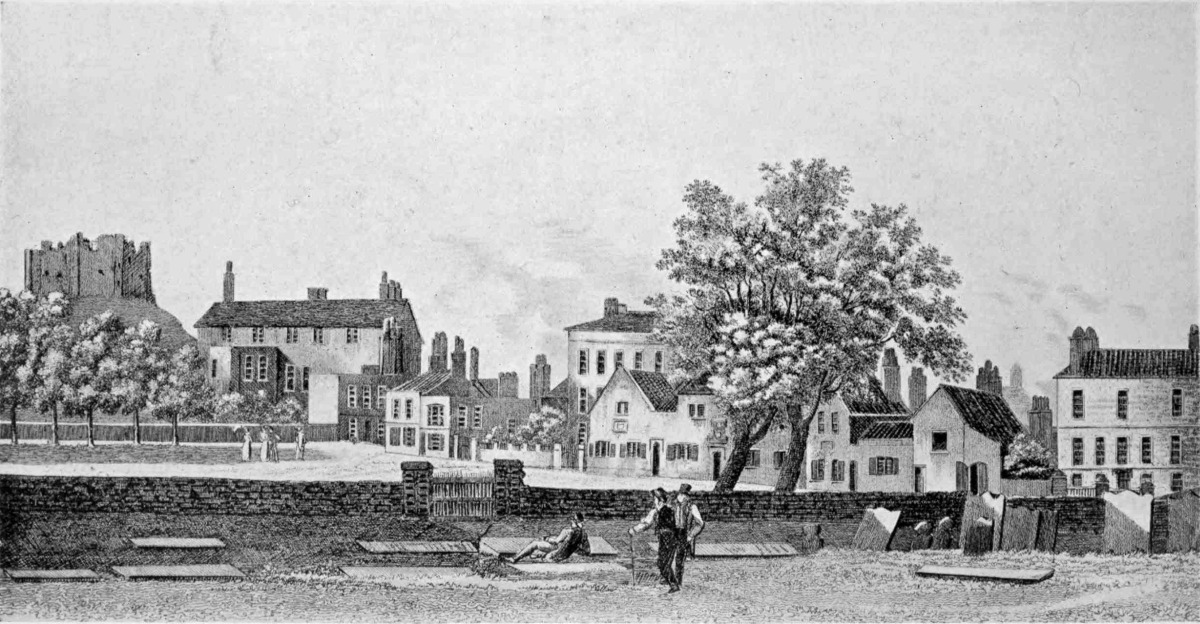
The Palace Green, Durham.