MONKWEARMOUTH AND JARROW By the Rev. D. S. Boutflower, M.A.
Reading edition
IT is almost impossible for the student of history to dissociate the two names. In their earliest origin, in the ups and downs of their long existence, and almost, if not quite, in their present conditions, the sister churches have met with one and the same experience. Their foundations were laid within the short period of ten years; they have arisen and decayed and revived (and that more than once) almost simultaneously. They have shared together honour and neglect, wealth and poverty. In all things and at all times the supreme desire of their great founder has been fulfilled, and Monkwearmouth and Jarrow have been one. Planted long ago as outposts of religious culture brought oversea to the mouths of the Wear and the Tyne, the Churches of St. Peter and St. Paul are now the centres of populous districts. Like other churches around them, they have their own busy church life; but, unlike to and above the rest, these two stand as witnesses of the antiquity and continuity of the Christian faith in England. The churches where Bede worshipped are still, at least in part, the churches of the twentieth century. The Gospels which he expounded are heard at their Communion services to-day.
Much of their history must be sought for and read in the buildings themselves. The first thing they will tell us is that they belong to a very early period of Saxon art. We have other evidence to assure us that these were
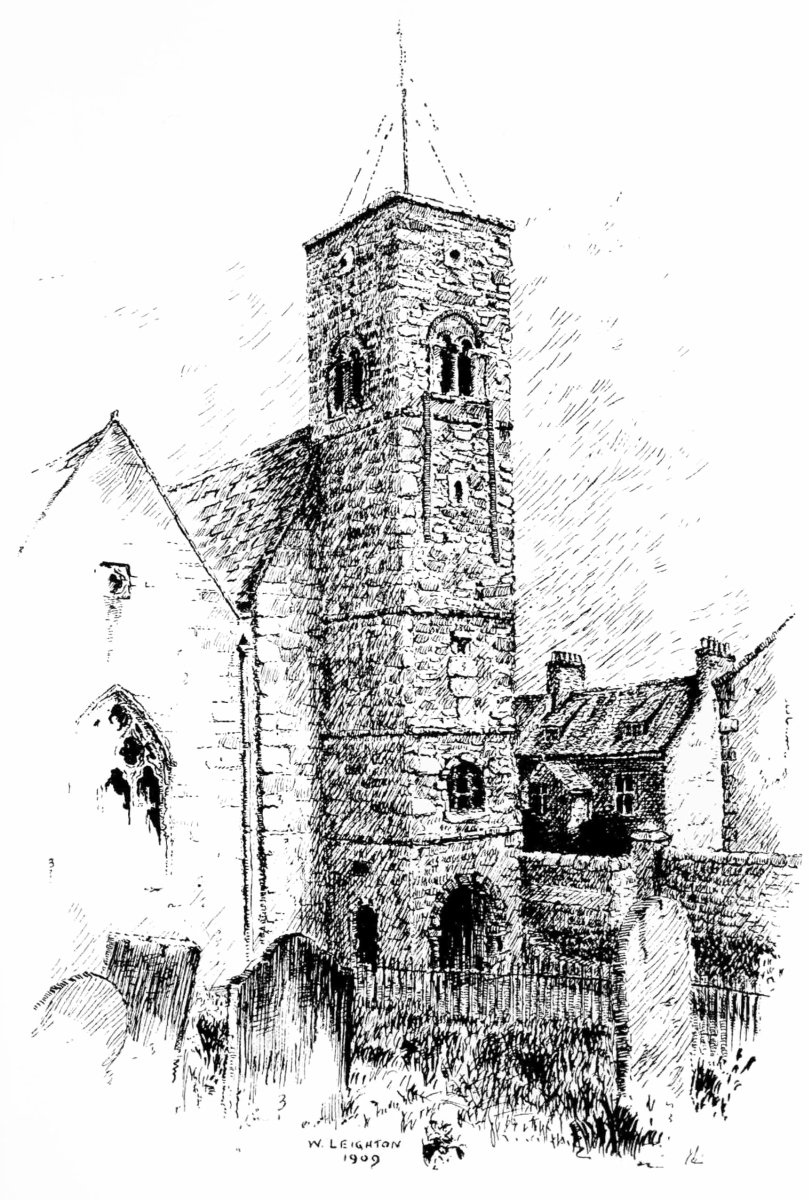
Monkwearmouth Church.
among the first stone churches in England, and to tell how masons were brought from the Continent to erect them. The singular height of the church at Monkwearmouth would lead us to the same conclusion. They were thus churches of quite a peculiar type, a type destined to undergo many modifications in later times. In Monkwearmouth and Jarrow you are face to face with the earliest form of English ecclesiastical architecture.
We have no need to ask about the builders, or to wrangle over the date of their foundation. There are darker and lighter periods in any history; Monkwearmouth and Jarrow have, indeed, known much of both. But the light shines clearly enough upon their early days. For Monkwearmouth saw the birth and Jarrow the death of the patriarch of English historians. Both places claim him as altogether their own. In the united convent of St. Peter and St. Paul he spent practically the whole of his life. Like all great men, he said little about himself; but he has much to tell us about his twofold home. We turn gladly enough to the writings of Bede, and specially to his Lives of the Abbots. We find ourselves at once in the presence of one who knew how to observe and to describe, to admire but never to condemn; one who loved to dwell upon the beautiful in the characters and works of men; a conscientious man withal, who sought out and told the truth. It is he that relates to us how Monkwearmouth and Jarrow grew.
It was not fifty years since the Christian faith had been first taught to the Northumbrians, and less than forty since its permanent establishment by the preaching of the gentle Aidan, when there came back to his native kingdom of Northumbria a man of noble birth and cultured training, Biscop, called Benedict. He had wealth and interest at his command, and, above all things, a fervent zeal concentrated upon a definite purpose. It was an age that had recently witnessed a revival of monasticism; the life of contemplation had led on to study; orthodoxy
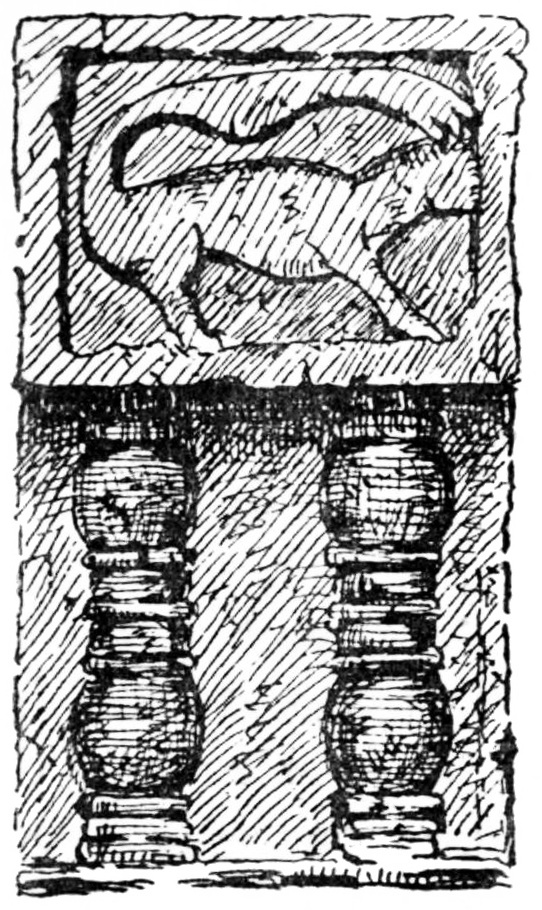
Old Stone at Monkwearmouth.
was the aim of trained thinkers; emotional minds dwelt on the devotedness of the saintly life. Biscop himself was a traveller and a student; he desired to found his own monastery, and to bring to it treasures from foreign lands. His relative, King Ecgfrid, granted him for this purpose an estate at the mouth of the Wear (A.D. 672). There he built the Church of St. Peter, of which the western wall and porch still remain. He brought with him (as we have seen) masons, and also glaziers, who restored to England a science that had long been lost. The building was quite peculiar in its dimensions—some 60 feet long, 30 high, and 20 broad. The singular proportions of Monkwearmouth Church, which have long puzzled antiquaries, appear to be explained by a sermon in the now printed works of Bede, and possibly preached in the church itself on some anniversary of its dedication. They correspond with those of Solomon’s Temple, the units in this last case being cubits. There was a truly mathematical love of numbers in the mind of Bede, and he is evidently pleased to explain how the three dimensions above mentioned set forth in allegory the three Christian virtues of faith, hope, and charity. The windows were small, and set high in the walls of the building. You may see two of them, their splays adorned with baluster shafts, in the western wall of the church. The south wall was adorned with paintings representing scenes from the Gospel of St. John; a series of pictures illustrating the Apocalypse occupied the northern wall. The roof was adorned with portraits of the Virgin and of the Twelve Apostles; the presumption is that it was in the form of a flat ceiling. The whole arrangement of the building thus gave fair scope for light, shelter, and decoration.
There was a second church soon afterwards erected at Monkwearmouth, dedicated to St. Mary. There were also dining-rooms and porches and sleeping apartments, in connection with the last of which there was an oratory dedicated to St. Lawrence. Where these other buildings lay is uncertain. Tradition says that they were to the west of the present church. St. Mary’s Church was probably very much in this direction. In the fourteenth century "the old kirk" was used as a granary.
The house at Monkwearmouth grew and prospered, a home of arts and science and religion. There Bede began to acquire his wonderful knowledge, and John the Chanter founded his great school of music. Seven years after its foundation (A.D. 681) expansion became a necessity, and a new grant of land was obtained, this time at Jarrow, on the south bank of the Tyne. Seventeen persons, clerical and lay, were sent thither, their leader being Ceolfrid, to whose care Bede, already for two years an inmate of the older monastery, was committed. Soon after this event Biscop departed on his last visit to Rome, leaving his stalwart kinsman Eosterwini to rule at Monkwearmouth. He was absent for more than three years, an eventful time, during which both houses suffered grievously from a visitation of the plague. Eosterwini was its most notable victim, whilst at Jarrow nearly the whole convent was stricken down. At that place, as an anonymous writer informs us, only Ceolfrid and one boy, obviously Bede, were left to chant the daily services. The above facts will explain the delay in the consecration of the great church at Jarrow, which, according to a contemporary inscription still preserved, was not dedicated till the fourth year of Ceolfrid’s presidency.
Of this church only some stones now remain. A smaller church had, however, been first built and consecrated, and it is this which forms the chancel of Jarrow Church to-day. Its dimensions do not suggest any special meaning. Twenty-eight feet to the west of it, and lying precisely in the same right line, stood at one time a fabric precisely similar to that of St. Peter’s, Monkwearmouth, the same, apparently, in length and breadth and height, and lighted by windows of the same type and in the same position. Annexed to it on the north and south were a number of apartments, undoubtedly to be identified with the porches in Bede’s account of Monkwearmouth, chambers opening by round-headed arches into the church itself. The arches on the north side, and vestiges of three rooms on the south, remained as late as the year 1769. Probably one such porch as this stood at the eastern end of the building; this we know was the case at Monkwearmouth. These apartments, walled off as they were from each other, would be used for prayer and study, and sometimes as places of sepulture. They were probably constructed in imitation of the chambers round Solomon’s temple.
This, then, appears to have been the church which it took so long to complete, and in this building was set up the dedication stone above mentioned. It was erected and consecrated under the auspices of King Aldfrid (brother and successor to Ecgfrid), and the Abbot Ceolfrid. Biscop himself was still abroad, but soon afterwards returned to England, bringing with him many books and pictures, one series of which, depicting the events of our Lord’s life, was ranged as a crown round the Church of St. Mary in the greater monastery; another, representing the Gospel story by type and antitype, adorned the monastery and Church of St. Paul. Biscop’s last homecoming had its sorrows. He found Eosterwini dead, and his successor Sigfrid slowly dying of consumption. Then there came to himself a stroke of paralysis. Very touching is the story told us of the last days of the two Abbots. The greater man feels the greater anxiety. His much-prized library is not to be dispersed, but before all things the unity of the double foundation is to be maintained. Before his end comes he appoints Ceolfrid to govern the united monastery of St. Peter and St. Paul.
The narrative continues till the year 716, when the aged Ceolfrid resigned his charge, and departed to die, as he hoped, at Rome. But this was not to be. His last moments were spent at Langres, near Lyons. But one great work of Northumbrian art passed on by other hands to Italy—the splendid manuscript of the Vulgate, now known as the Codex Amiantinus, and preserved in the Medicean Library at Florence.
Bede himself lived on in his old home till the year 735. The story of his end is too well known to need repetition here. Before his death Northumbria had fallen from its former glory. A period of darkness supervenes, broken here and there by the lurid light of Danish invasions. Yet the churches of Monkwearmouth and Jarrow lasted on, sacked, it might be, burned and desolated, but still saved from total destruction.
The period of depression that followed the golden days of the twin monasteries has left us but scanty memorials of their history. We begin to hear of times of insecurity, of attacks made upon the eastern coast of England by Danish pirates. The situations of the two churches would, under these circumstances, be distinctly against them. Jarrow is to this day conspicuous; it is probably less well known that Monkwearmouth Church stood for centuries upon the top of a hill. This is shown quite clearly in the engraving of the year 1785. The sea rovers would take their own survey of the coast and its harbours, and would make for any place that offered promise of pillage. There is much good and rich land between the Wear and the Tyne, and the monks of early days were assiduous cultivators. The country of Wilfrid and Biscop and Bede was no uncivilized or neglected part of the world. To a pagan race there would be no impediment in the form of religious scruples. The wealth of the Church would but invite the spoilers to their prey.
And so the Danes came first to Northern England, to begin with, somewhat tentatively, in the year 793, harrying the island of Lindisfarne, plundering its monastery, and burning the church. The next year their ships put into the Tyne. On the hill overlooking the slake, just where that river receives its tributary the Don, stood the monastery of Jarrow, Egfrid’s Port lying immediately below it. Here they landed, and took such booty as they found. But the people of the neighbourhood rallied, and drove back the invaders to their ships. Few of them made good their escape, for the wind was against them. The storm came up into the river, and the fugitives were driven to the shore, where they and their chieftain, Ragner Lodbrog, met with the vengeance they deserved.
It is quite clear that the lesson thus given was not forgotten. We hear no more of Danish invasions for well on to sixty years. When they recommenced, they were directed elsewhere. In the year 851 the Danes landed in Sheppey, and this time they came to stay. The chroniclers have much to say about the Army; but it was not till the year 875 that it marched into Northern England, and then probably not much beyond York; it moved south two years later. But meanwhile there had no doubt been many a raid upon the settlements on the coast. The year 866 was marked by one of the most serious of these. At that date Hingvar and Hubba burned the church of Monkwearmouth. The traces of this conflagration are still distinctly perceptible. Again in the year 875 the fleet of Halfdan was in the Tyne. Contemporaneously with this event took place the flight from Lindisfarne, and the commencement of the journeyings of the body of St. Cuthbert.
How the Danish power was driven back by Alfred, how his wise policy reclaimed the half of his kingdom, is a well-known part of our national history. The final triumph was not so much one of war as of peace. The wisdom of a very great King effected much; the growing strength of recovering Christianity did the rest. Never did any ruler so effectually combine the forces of secular and spiritual power, or hold them more truly in balance and co-operation. The invaders became settlers, and have left this part of their history in the names of their new homes. This is especially true of Lincolnshire; then, hardly less decidedly, of York. But north of the Tees the English population simply retained lands which they had never ceased to occupy. Danish place-names in the county of Durham are few and far between.
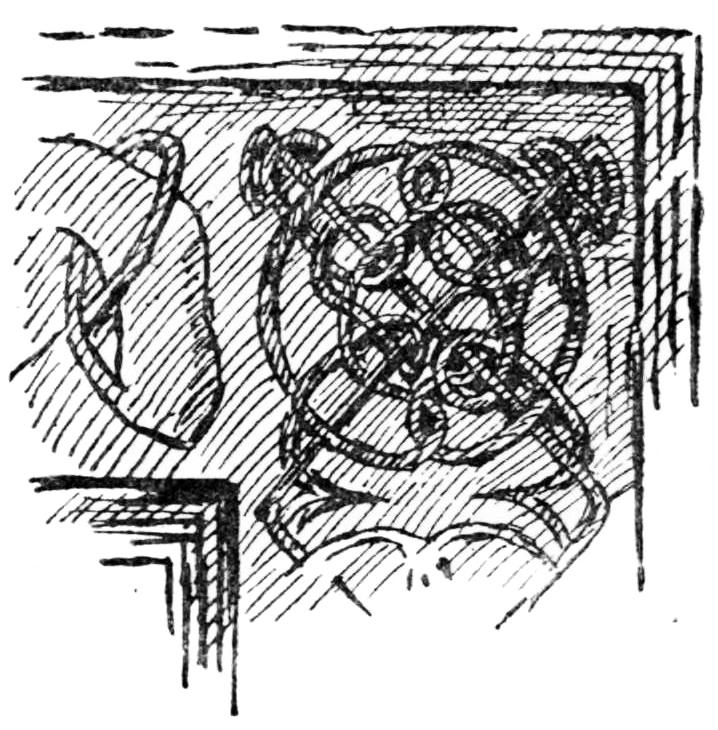
Ornamental Stonework, Monkwearmouth Church.
This is so much evidence—and it is worth something—in favour of the supposition that the sister churches of Monkwearmouth and Jarrow were not left to permanent ruin. The population of the neighbourhood was, and remained, English, and would no doubt be warmly attached to the ancient sanctuaries. Their hearts and minds would be as faithful to the sacred memories of the past as were those of the wanderers who guarded the body of St. Cuthbert. That there was no revolution in the history of this particular district may be presumed from the silence which veils this part of the story of their two great churches. The theory here advocated appears to be further confirmed by the one incident recorded at this period in connection with the church of Jarrow.
The old faith in the potency of the relics of the saints remained unshaken through all periods of sunshine or of gloom. Respect for the past and for the good clings to the devoted Churchman of every age; it may sometimes even be strong enough to overpower his moral principle. It was so undoubtedly in the case of Ælfred, a monk of Durham in the early part of the eleventh century. This man conceived himself to be divinely commissioned to visit the sites of ancient monasteries and to gather together the remains of departed martyrs and confessors. He was very successful in his quest. Hexham and Melrose were laid under contribution, and Jarrow was not likely to be forgotten. To it he paid an annual visit on the anniversary of the death of Bede. At least once he prolonged his stay for several days, fasting and praying in the church. Then one morning he departed at a very early hour, and he returned no more. What he had done may be inferred from the assurance with which he stated in after-years that the remains of Bede were resting in the grave of St. Cuthbert. From what we know of the man and of the age there seems little room for dispute about the matter: it appears, moreover, to have been corroborated at a later date by visual evidence.
The story is of interest to us mainly as bearing witness to the fact that in the year 1022 the church of Jarrow remained a popular centre of worship. In the case of Monkwearmouth history and legend alike fail us; we must judge for ourselves. The tower of the church was evidently built at two distinct periods. The porch and the parvise over it appear to belong to the age of the founder. They also show traces of the fires of the Danes. This is not the case with the superstructure. Incontestably of Saxon work, it belongs to the same period which saw the erection of at least four church towers in the valley of the Tyne. As it exhibits no traces of the burning of the year 866, its date and theirs must be looked for somewhere in the next two centuries. The reign of the Northumbrian Guthred (A.D. 884-894) has been ascertained to be a period when relations between Church and State were more than ordinarily friendly. At this time the tower of Monkwearmouth Church may well have been completed. It can hardly have been built at a much later date, for there is other and different work in the
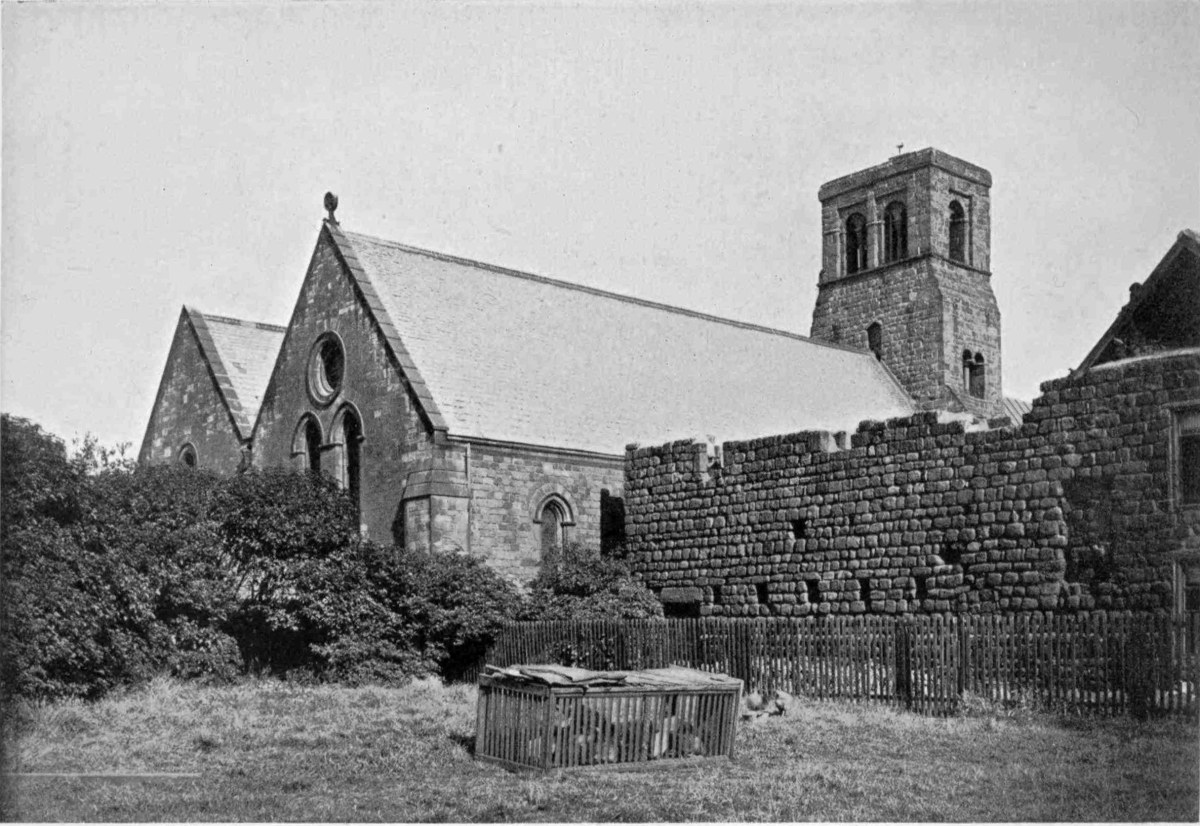
Jarrow Church.
same church which appears to belong to the age before the Conquest. The modern arch between nave and chancel rises on its south side from an ancient substructure, of which one feature is the cushion moulding at its base. There is something here begun by Anglo-Saxon masons, but carried out apparently by Norman builders. It was possibly a work of the reign of Edward the Confessor, and apparently implies some contemporaneous reconstruction of the early porch or chancel.
Subject, then, to the chances of time and of warfare, the churches of Monkwearmouth and Jarrow still carried on their existence. The latter was certainly in use at the date of the Conquest. This was a period of trouble and disaster. Oswulf, the Earl of Northumberland, is displaced, and soon after murders his successor. Gospatric next buys the earldom, and forthwith rebels. The Conqueror marches northward in person, and appoints Robert Cummin to the vacant office. He, too, is assassinated in the city of Durham. This event is followed by the King’s return, and the wholesale devastation of the lands north of York. Ethelwin the Bishop, accompanied by his canons, flees northward with the body of St. Cuthbert. They rest for a night in the church at Jarrow. Their pursuers follow on their track and set the building on fire. Northumbria is devastated by Norman and Scottish enemies at once; and for nine years the land lies waste. During this period we may well believe that both our churches stood unroofed and desolate; their walls, on the other hand, certainly resisted the flames, and were preserved to be ere long the home of a new band of settlers.
The Norman Conquest brought in its train a very distinct revival of monasticism. This was part of the general movement in favour of order and authority which then prevailed. It came, no doubt, originally from Rome. It was, in fact, the characteristic of Rome from very early days. It made itself felt in the eleventh century by the growth of the military spirit, and later on by the gradual development of law. It affected more immediately the religious side of national life. Clerical celibacy began to be enforced, and the foundation of monasteries was encouraged. The foreigners took the lead in this matter, amongst them Walcher of Lorraine, Bishop of Durham. Hearing of a small party of missionary monks who had just arrived at Monkchester (now Newcastle), he made haste to invite them to settle in his own territory at Jarrow. We are told that he gave them the churches there (the plural number is significant). They were soon joined by others who had followed them from the South—the men of the North stood aloof; they had at this time good reason to be suspicious of Southern visitors. The numbers of the monks grew, and their patron enlarged their estate to meet their increased needs. Besides a large property in land on both sides of the Tyne, they received a grant of the church of Monkwearmouth. Briers and trees were standing within its walls; much the same thing was probably true of Jarrow. But they set to work with energy to repair and to acquire and to establish.
What they did at Monkwearmouth we are not able to say. Probably they extended the eastern porch into the form of a chancel. Two centuries later that chancel attained its present peculiar form—long and narrow—as became the custom in this part of England; it is also decidedly lofty, being apparently intended thus to correspond with the ancient nave. Undoubtedly respect was from the first shown to those who designed the original church. The same right sentiment may be observed much more evidently in the case of Jarrow, with which as their first and more important possession Bishop Walcher’s monks proceeded to deal at once.
We have mentioned above the existence of two churches at Jarrow, and have observed that there exists written corroboration of this. The smaller church which stood to the east is the chancel of the present building. Twenty-eight feet to the west of it was the termination of the nave or main block of the western church, built precisely on the quite mathematical lines of the elder fabric at Monkwearmouth. We may presume of this building what we know to have been the case at St. Peter’s, that there was a porch behind the altar, a building, that is to say, with three walls and one open side. Such a building still exists in the chancel of the Saxon church at Escomb, near Bishop Auckland. Assuming that the porch at Jarrow was like that at Escomb, square, and of proportionately larger dimensions, there would be a space of some thirteen feet intervening between it and the eastern church. It was here that the Norman builders would be disposed to erect their tower, and here the tower was accordingly built, not foursquare after the Norman model, but in an oblong form. The site occupies a rectangle of thirteen by twenty-one feet. The lower stages of this structure are essentially massive and very distinctly Norman in character. The highest storey, on the other hand, less well executed as some think, has its own ornateness; it was probably erected in the succeeding generation. If so, we understand the better the set-back of its northern and southern sides; the architect employed had, no doubt, his own opinion to the effect that the tower ought to have been square.
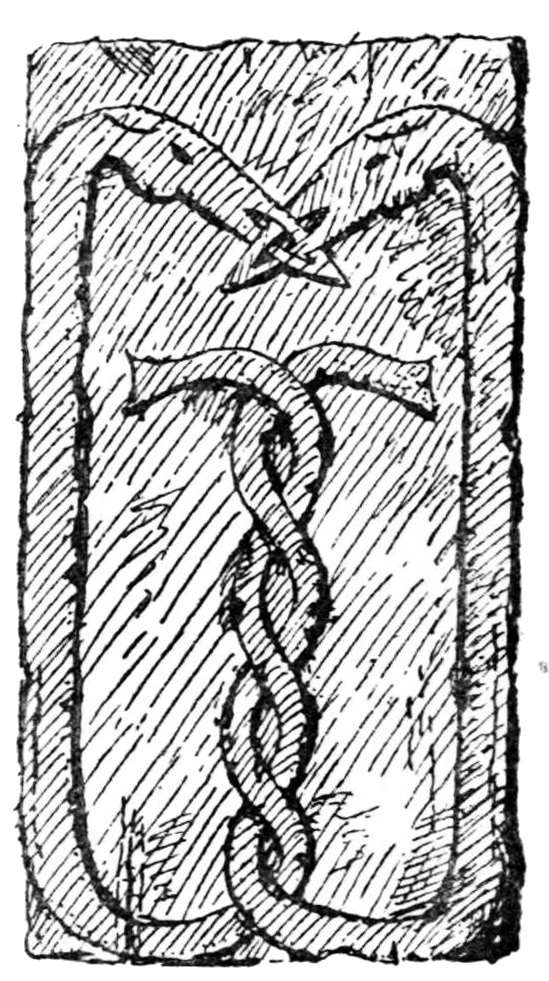
Early English Snakes, Monkwearmouth Church.
The principle adopted by Bishop Walcher’s monks appears to have been that of reverent adaptation to immediate needs. They wished to repair and to add, but not to destroy. Had their stay at their new home been prolonged, the case would in time have been altered. Large medieval buildings would have taken the place of the more primitive original structures. But their sojourn at Jarrow lasted for only eight years. In the year 1083 Bishop William of St. Carileph transferred them to his cathedral. The extruded canons were placed at Auckland and Darlington, and the Evesham Benedictines occupied the mother-church of the diocese.
It was all done in haste. It was repented of, no doubt, at leisure. In the enthusiasm of the moment Bishop William founded the one and only abbey in the Bishopric of Durham. His successors, we may well believe, deplored what was politically and ecclesiastically a great mistake. But what was done could not be undone by anything less than a revolution. The Abbey of Durham grew and was strong. The magnificence of its buildings tells of the wealth of the builders. The Durham Household Book speaks of the stir and pomp and cheerfulness of its daily life. Meanwhile, the two more ancient sanctuaries were reduced to the insignificant condition of Cells. They were left with their old estates, each under the rule of a master, appointed or removed by the Prior of Durham at his will. Each master had one monk with him for company, sometimes two, and very rarely three. The masters appear to have taken but little interest in the spiritual affairs of their churches. The naves of these buildings were considered the property of the parishioners, who executed repairs at their own cost; an ill-paid stipendiary, called the chaplain or parish priest, discharged all parochial duties. The church of Jarrow had its chapels at Wallsend, at Shields, and at Westoe. The first named of these was left very much to itself; the very altar-fees of the other chapels, as well as those of the churches, were the perquisite of the master, while the services of the chaplain were remunerated at very much the same rate as those of the monastery barber.
The result as regards the fabrics was much what might have been expected. The nave at Monkwearmouth was left to itself; that at Jarrow was at some time extended so as to include the ground occupied by its eastern porch. The other porches or chapels that once flanked this building may have served for a while as parts of the parish church; then they fell one after another by a lingering process of decay. On the other hand, Monkwearmouth Church was in course of time enlarged; a north aisle was added in the thirteenth century; its very pleasing doorway has been fortunately preserved. About the same time two rather large windows were set to lighten the east end of the nave of Jarrow.
The case was different with the conventual part of the two churches. At Monkwearmouth, as we have seen, the choir was made long and lofty. Two Decorated windows were placed on its southern side; a third, similar to the others, stood in the north wall, all traces of which seem to have been destroyed in quite recent times. The date of these windows is fixed by an entry in the account rolls under the year 1347. A little later an east window of five lights was erected; it has been reproduced from its fragments, and is not without merit. The design at Monkwearmouth is, however, far better than the workmanship.
In the case of Jarrow it was not necessary to find a new chancel; the old eastern church was quite sufficiently roomy. What was required was light, and this was provided first by a north-east window and an east window, each of three lights, and afterwards by two additional windows of three lights, one on each side of the western end of the chancel. The latest of these was inserted in the year 1350.
The two houses conducted their financial affairs in an easy way. They wanted enough to live upon, but had no further ambitions. They did not develop their estates, and were careless as to their fisheries. Jarrow was the richer house, but Monkwearmouth was reckoned the healthier; thither came the monks of Durham to enjoy the bracing air. Once, at any rate, Jarrow had to contribute to their maintenance. The usual donations were made—subscriptions to subsidies and to the needs of scholars at Oxford. A singular entry is often repeated in the rolls—the cost of wine for the parishioners’ Communion.
Such was the uneventful life of Jarrow and Monkwearmouth till the revolution of 1536, which brought an end to the existence of the smaller monasteries. These two were valued at £38 14s. 4d. and £26 9s. 9d. respectively.
The property of both the cells passed thenceforth into lay hands, and the churches became poorer still. To Jarrow was preserved the meagre endowment of ten marks; to Monkwearmouth two marks less. The former church had, moreover, Easter offerings and a small parsonage. The incumbents of both had, of course, an uncertain income from fees. No attempt to mend matters was made till the commencement of the nineteenth century.
Before that period had arrived the neglected churches had at last fallen quite into decay. The parishioners had had to do something; what they did was to destroy the nave of Jarrow, and the southern (or Saxon) wall of Monkwearmouth. These demolitions took place in 1782 and 1806 respectively. The result of the alterations and rebuildings no doubt commended itself to those then concerned with such matters. We find a picture of the new Monkwearmouth Church accompanied with a note of much satisfaction in a contemporary number of the Gentleman’s Magazine.
Restorations followed in 1861 and 1873, but they could not give back the past. What was spared has been treated with reverence. The west front of Monkwearmouth still remains. The church, now apparently sunk into a hollow, is surrounded by poor and crowded tenements, built upon ballast brought from the Thames. The medieval chancel is there, its restored windows now filled with Kempe’s beautiful glass. The music of its services is worthy of the church of John the Chanter. Only we regret the loss of the Saxon Church as it once stood upon its hill overlooking river and sea. Jarrow has been more fortunate; it still crowns the hill above its wide slake—a landmark well known to all those who use the waterways of the Tyne. It, too, has its points of interest, its Saxon chancel and its Norman tower. Much, of course, is missing in both places. But there is still more than enough to attract and to fascinate the mind of the Englishman and the Christian, who looks back to the glories of that good old time that gave to Northumbria and to the world the life of the one man that was Venerable—the learning and the labours of Bede.