SPECULATION AS TO EMIGRATIONAL HISTORY OF THE MAMMALS
Reading edition
The present fauna of the state of Washington was derived in part from Asia and in part from native forms. Great changes occurred in early Pleistocene through emigration. By the late Pleistocene most of the mammals now occurring in the state of Washington were as they are today. The greatest changes that seem to have occurred in the late Pleistocene are the extinctions of numerous groups, locally or totally. Among the carnivores, Matthew (1902: 321) reports remains of the great lion, Felis atrox, associated with such familiar species as the badger, cougar, lynx and mountain goat. The great lion was very similar to the modern African lion but was fully a fourth larger. Associated with the great lion in the California tar pits are the carnivorous short-faced bears (Tremarctotherium), as large as the Alaskan brown bears; dire wolves (Aenocyon), larger than timber wolves; and saber-tooth tigers (Smilodon). These forms were probably also present in Washington in the late Pleistocene. Matthew (loc. cit.) reports remains of the giant beaver, Castoroides, from the Silver Lake deposit of Oregon. This great beaver, as large as a black bear, was doubtless a resident of Washington also. Peccaries, camels, bison, horses and giant ground sloths have been recorded from Pleistocene deposits of Washington and nearby areas. Of the elephant tribe, the mastodon and several species of mammoths were present.
These extinct forms have doubtless exerted some influence on the past distribution of mammals in Washington and possibly have had an effect on the distribution of members of the living fauna. One species of the mammoth, at least, existed in Washington in postglacial time. Remains of this form, Elephas columbi, have been found in Vashon till.
The three faunas of Washington can be placed in two categories. One is Sonoran, essentially a desert type, and occupies the Columbian Plateau. The other two are forest faunas, predominantly boreal in complexion, and are closely related. The Rocky Mountain Fauna is found in the Blue Mountains and in northeastern Washington. The Pacific Coastal Fauna is found in western Washington.
The ice sheets of Vashon-Wisconsin time descended southward to southern Puget Sound and to the northern edge of the Columbian Plateau. If the area of the ice sheet be superimposed on a map of distributional areas of Washington, it is seen that the area occupied by the Rocky Mountain Fauna in northeastern Washington is eliminated. Thus, at the maximum descent of Wisconsin ice, the Rocky Mountain type of mammalian fauna was found only in extreme southeastern Washington. No point of contact between the forest fauna of the Rocky Mountains and the fauna of the Pacific coast exists, anywhere, because desert areas, or at least barren plains, lie between them from the border of the glaciers south to Mexico. For the entire period, perhaps thousands of years long, while the glaciers were in place, the two forest faunas were separated. Repeated separation of the faunas by successive glaciations is thought to be responsible for many of the differences now existing between them.
Following the retreat of the ice, the Pacific Coastal Fauna extended its range northward to the Fraser River and, in part, into the Cascade Mountains. The Rocky Mountain Fauna invaded northeastern Washington and boreal Canada, including the Pacific Coast north of the Fraser River. Certain parts of the Rocky Mountain Fauna also invaded the Cascade Mountains.
Inasmuch as the Cascades were invaded by species from both faunas, a detailed analysis of the mammals existing there now seems justified. Several significant features of the composition of the mammal fauna of the Cascades are apparent. First, several species typical of the Pacific Coastal Fauna are present, such as Neurotrichus gibbsii, Sorex trowbridgii, Sorex bendirii, Tamias townsendii, Microtus oregoni and Aplodontia rufa. Each of these species has no close relatives in the Rocky Mountain Fauna and, save perhaps Sorex trowbridgii, occupies a unique ecological niche and has no counterpart in the Rocky Mountain Fauna.
A second group includes species with close relatives in both the Rocky Mountain and Pacific Coastal faunas. This group is remarkable in that it is composed of either very closely related species or very strongly differentiated subspecies in each fauna. For example, the golden-mantled ground squirrel (Citellus saturatus) of the Cascade Mountains is specifically distinct from Citellus lateralis. Supposedly the Cascade form was isolated in the southern Cascades during Vashon-Wisconsin time. The Douglas squirrel (Tamiasciurus douglasii) of the Cascades, which has a red belly, is the same as the squirrel of the lowlands of western Washington but is specifically distinct from the red squirrel (Tamiasciurus hudsonicus) of the Rocky Mountain Fauna, which has a white belly. In the extreme northeastern Cascades the two species come together. They do not interbreed but seem to compete, for they do not occur together. The flying squirrel (Glaucomys sabrinus fuliginosus) of the Cascades is only slightly differentiated from other races of the Rocky Mountain Fauna but is much different, as are all Rocky Mountain races, from the western Washington subspecies (Glaucomys s. oregonensis). The red-backed mouse of the Cascades is Clethrionomys gapperi, a species distinct from Clethrionomys californicus of western Washington. The jumping mouse of the Cascades is Zapus princeps trinotatus, the same race that occurs in western Washington. It is quite distinct from, and has previously been considered a species separate from, the races of the Rocky Mountain Fauna. The snowshoe rabbit of the Cascades is closely related to other races of the Rocky Mountain Fauna but is distinct from L. a. washingtonii of western Washington. The pika (Ochotona princeps) of the Cascades was apparently isolated in the southern part of the range during the glaciation. After the retreat of the glaciers it extended its range northward. Competition between two subspecies has resulted in parallel distributions due to relative body size. The two races freely intergrade and the differences between them are not so great as in the other forms mentioned.
The third group of mammalian species of the Cascades is composed of species typical of the Rocky Mountain Fauna such as: Marmota caligata, Synaptomys borealis, and Orcamnos americanus. Each has no ecological counterpart in the Pacific Coastal Fauna. Each is absent from the Cascades of Oregon.
We interpret the mixture of faunas in the Cascades as follows: The Vashon-Wisconsin ice sheet was in place for a long period of time, longer, probably, than the Recent. During this time, forest mammals of the Pacific Coast were isolated from forest mammals farther east by glaciers to the north and desert to the east. Changes took place in both of the separated forest faunas. Certain species, perhaps, such as the mammoth, became extinct. Other forms were exterminated then or at an earlier time in one fauna or the other. If Aplodontia, Neurotrichus or Scapanus occurred in the Rocky Mountain faunal area, it lived in an inland area of rigorous climate, and disappeared there because it was unable to adapt itself to the cold. In the mild climate caused by proximity of the ocean, mild even in Vashon-Wisconsin time to judge from evidence yielded by study of fossil pollens, primitive forms such as moles, the Bendire shrew, and mountain beaver persisted along the coast, where there were no boreal conditions. Some alpine forms, such as Marmota olympus, Ochotona princeps brunnescens and Citellus saturatus persisted in the Olympic or Cascade mountains as relic species. On the whole, however, the glacial divergence resulted in a boreal forest fauna and a temperate forest fauna.
In addition to change in component species, there were evolutionary changes in the species themselves. In some these were considerable, as shown by the differences between related forms of the two faunas. In most species, however, evolutionary changes have resulted in only subspecific differences.
Following the retreat of the glaciers and the establishment of vegetation on the deglaciated areas, movements of the faunas occurred. The Rocky Mountain Fauna spread northward and westward, to northeastern Washington and, in Canada to the Pacific, occupying most of the land exposed by the glaciers. The Pacific Coastal Fauna spread northward only as far as the relatively slight barrier of the Fraser River. The Cascade Mountains became a "no-man's land." The pika and golden-mantled ground squirrel of the southern Cascades spread northward. Boreal Rocky Mountain forms with no ecologic competitors from the Pacific Coastal Fauna occupied the Cascades. Also, coastal species with no Rocky Mountain competitors occupied the Cascades. Nevertheless, some competition between members of the two faunas ultimately occurred, and in instances where closely related forms occurred in the two faunas, one or the other prevailed in the Cascade Range. For example, the Douglas squirrel and big jumping mouse are now established in that range, but the relative of each occurring in the Rocky Mountains is present in the extreme northeastern Cascades. It is possible that in these two cases, the related form occurring in the Rocky Mountains has just entered the area and that competition has just begun. With regard to the flying squirrel, red-backed mouse and snowshoe rabbit, the more boreal Rocky Mountain representatives have definitely displaced the coastal forms.
Certain mass movements of mammals are popularly believed to have occurred with the advance of the ice sheets of the Pleistocene. The boreal birds and plants on higher peaks of the Cascades and the Sierra Nevada of California are thought to represent relics of faunas that moved northward. Such mass movements probably did occur and there is some evidence of their occurrence in Washington. Probably the pre-Wisconsin flora of coastal British Columbia consisted of coniferous forest similar to that of western Washington today. If this were the case, the mammalian species in British Columbia corresponded closely to those of western Washington. An influx of such a fauna into coastal Washington would scarcely be evident today if, indeed, it was noticeable even then. In eastern Washington, forest species forced southward would come upon the barren, inhospitable plains and deserts of the Columbian Plateau.
The greater part of the southward moving forms found refuge in the Cascade Mountains where, for most of Wisconsin time, they were isolated in the southern Cascades. Examples are Sorex palustris, Martes caurina, Martes pennanti, Gulo luscus, Vulpes fulva, Lynx canadensis, Tamias amoenus, Thomomys talpoides (douglasii group), Phenacomys intermedius, Microtus richardsoni and Ochotona princeps. In each of these species little or no subspecific variation has occurred between the populations in the Cascades of Washington and the Cascades of Oregon.
While the ice sheet existed in Washington there may have been relatively little movement of the mammalian fauna. There is definite evidence of a brief contact between the Rocky Mountain Fauna of the Blue Mountains and the fauna of the southern Cascades. For example, the pocket gopher of southeastern Washington (Thomomys talpoides aequalidens) is most closely related to the gopher of the Simcoe Anticline, and the long-tailed meadow mouse (Microtus longicaudus halli) of the Blue Mountains closely resembles the meadow mouse of the Yakima Valley.
Mammals of the Blue Mountains and those of the southern Cascades may have come into contact on the Simcoe-Horseheaven Hills Anticline, which now stretches 150 miles from the Cascades to the Wallula Water Gap. Excepting the easternmost 40 miles, it is timbered. East of the Columbia, a continuation of the anticline and other hills reaches to the Blue Mountains. Supposedly, in Wisconsin Time, this anticline possessed a more humid climate and the habitat was essentially the same as that of an alpine meadow today. The forms on the two ends of the anticline that are closely related inhabit humid, meadow habitat. In an earlier paper, Dalquest and Scheffer (1944: 316) named this connection the Simcoe Bridge. Its existence was so strongly indicated by the distribution of pocket gophers in Washington that we supposed that the study of many other species would show that they crossed this bridge. However, study of additional species shows that for them the Simcoe Bridge was of only slight importance; there appears to have been but little mingling of the fauna of the Blue Mountains and the Cascades by way of the bridge. The Columbia River probably acted as an effective barrier to many forms that might otherwise have utilized it. The forms that did cross on this bridge are species known to be active in winter and to emigrate over considerable areas through tunnels under the snow (Davis, 1939: 257). The pocket gopher and long-tailed meadow mouse may have crossed the Columbia, under a cover of snow, when the river was frozen over. The Columbia has frozen over at the Wallula Water Gap in historic times.
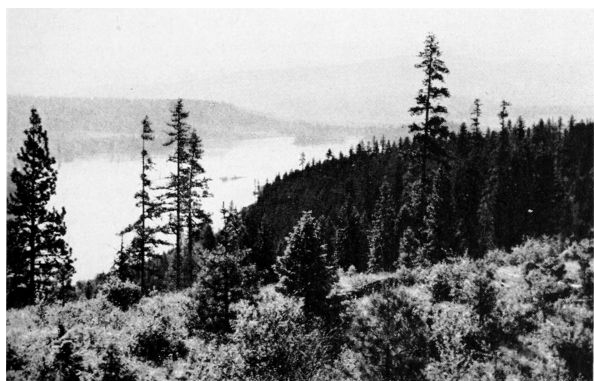
Fig. 19. Pend Oreille River (or Clark Fork of the Columbia) from a point near Newport, Washington, looking south, June 13, 1938. (Fish and Wildlife Service photo by Victor B. Scheffer, No. 67.)
Great movements of mammal species came after the retreat of the Vashon-Wisconsin ice. The greatest of these was the spread of the Rocky Mountain Fauna northward and eastward to the Pacific. In this process, northeastern Washington was inhabited by animals that probably came from Idaho and Montana. Some of the species from farther north, as for example the caribou, may first have been forced into Idaho and Montana by the glaciers. The invasion of northeastern Washington probably was not a mass movement of an entire fauna, because invasion seems to be still going on. As yet the woodchuck and striped ground squirrel of the Pend Oreille Mountains have not crossed the Columbia River, a relatively minor barrier in northeastern Washington. The mountains west of the Columbia are occupied instead by the yellow-bellied marmot, a member of the Great Basin Fauna, and there is no ecologic counterpart in these mountains of the golden-mantled ground squirrel.
Also the invasion of the Cascade Mountains by a number of Rocky Mountain species may have been an intermittant or gradual movement. The red squirrel and Rocky Mountain subspecies of jumping mouse now are present in the extreme northeastern Cascades, where they possibly arrived relatively recently. The squirrel is competing with the coastal species already present and may eventually supplant it. The same may be true of the two forms of jumping mouse.
The invasion by the Rocky Mountain Fauna was rapid as compared with that of the Pacific Coastal Fauna. Evidence of this was presented in an earlier paper (Dalquest and Scheffer, 1944: 310), where it was shown that the gophers of the douglasii group, isolated during the Vashon time in the southern Cascades, made only a few feeble postglacial movements and then only when conditions were ideal. In this same time the fuscus group of gophers moved from Idaho and virtually surrounded the range of the douglasii group. This tendency to immobility seems to have been characteristic of every member of the Pacific Coastal Fauna. If the retreat of the Vashon and Wisconsin glaciers occurred at the same time, both faunas had an equal opportunity to invade the deglaciated area. Yet, the Pacific Coastal Fauna actually moved northward along the coast only to the Fraser River area, and slightly farther in the Cascades.
Possibly the two glaciers retreated at different times. The Wisconsin Glacier was a piedmont glacier, fed by valley glaciers to the west and east, and may have disappeared when the feeder glaciers dried up. The Vashon Glacier was instead an ice cap, supposedly self-supporting much in the same manner as is the Greenland Ice Cap, and may have persisted longer than the Wisconsin glacier. If it did persist longer it formed a barrier to the northward emigration of coastal species of mammals.
Possibly, also, the whole of the Pacific Coastal Fauna possessed an inherent sluggishness resulting from their long residence in the uniform climate and habitat of the Pacific Coast. Certainly the species show today great habitat specialization as compared with species of the Rocky Mountain Fauna. Also, there are fewer individual mammals per unit of area in western Washington than in northeastern Washington. The persistence of the Vashon Glacier, an inherent lack of incentive to emigrate, or retention of a favorable environment, may account for the relatively small area invaded by the Pacific Coastal Fauna.
The Olympic Mountains, on the Olympic Peninsula, rise above the timber-line and are surrounded by forested lowlands which in a sense isolates this mountain range. Early workers, notably Elliot, obtained specimens of mammals from the Olympics and described numerous races, principally, it appears, on the supposition that because the range was somewhat isolated it should possess a unique fauna. Subsequent revisions of groups of mammals have indicated that most of the names proposed, on the basis of specimens from the Olympics, were either invalid or pertained to mammals found also in the Cascades.
The mammals of the Olympic Peninsula appear to be divisible into three groups. A majority of them fall within the first group, namely coastal races possessing wide ranges in the lowlands of western Washington. The second group consists of species of the Rocky Mountain Fauna but with close relatives in the Cascades. The third group includes but two forms, both unique and found only on the Olympic Peninsula.
The first group includes nonalpine forms of the lowlands surrounding the Olympic Mountains. For the most part these are identical with races of the Puget Sound area. A few are slightly differentiated from the mammals of the Puget Sound area but are the same as mammals from southwestern Washington. As will be shown later, some differentiation in the Pacific Coastal Fauna has occurred. This is thought to be evolution in situ, rather than the result of mass movements. Many nonalpine Coastal mammals occur in alpine habitat in the Olympics.
The second group consists of species of the Rocky Mountain Fauna. Their relationship to the mammals of the Cascades is indicated in the two parallel columns below.
Olympics Cascades
Sorex palustris navigator Sorex palustris navigator
Martes caurina caurina Martes caurina caurina
Martes pennanti Martes pennanti
Tamias amoenus caurinus Tamias amoenus ludibundus
Phenacomys intermedius oramontis Phenacomys intermedius oramontis
Clethrionomys gapperi nivarius Clethrionomys gapperi saturatus
Only two of these are racially distinct from their relatives in the Cascades. Of these the chipmunk is a plastic species and breaks down into many races in Washington. The chipmunks of the Olympics and of Mt. Rainier are so similar that Howell (1929: 77) considered them as identical and mapped Mount Rainier as an isolated part of the range of the Olympic form (see account of T. a. caurinus). The relationship of the red-backed mice, also, is close, but has been obscured by the usual assumption of relationship between californicus (occidentalis) and gapperi. The principal difference between the alpine forms is the pallor of nivarius. This pallor of mammals in general from the Olympic Mountains is noteworthy, but in the red-backed mouse is exceptionally noticeable. This pallor is discussed beyond in the paragraphs dealing with differentiation. Mention should be made here of Myotis keenii. This is a species which seems to have extended its range to Washington from the north. The power of flight, of course, removes it from consideration in attempting to reconstruct routes followed by terrestrial mammals.
The route of the pocket gopher (Thomomys) in emigrating from the Cascades to the Olympics (Dalquest and Scheffer, 1944: 310), was over the outwash train of the Mount Rainier Glaciers, especially the Nisqualli Glacier, to the extensive outwash aprons of the Vashon Glacier around southern Puget Sound, and thence into the Olympic Mountains. Under the conditions in early postglacial time this invasion route, hereinafter termed the Puget Bridge, around the Pleistocene Lake Russell (present Puget Sound), is thought to have been mainly an alpine meadow. Indeed, the isolated prairies remaining today are the unforested remnants of the outwash aprons (see Dalquest and Scheffer, 1942: 69) and possess several species of alpine plants, notably the shooting star, camas, and bear grass.
If the Vashon Glacier remained in place considerably longer than the Wisconsin Glacier, these Rocky Mountain species may have invaded the Cascades from northeastern Washington and travelled around the southern edge of the Puget Glacier or of Lake Russell. The close relationship of the races involved, however, suggests that the emigration took place much more recently. The barriers to such movement even today are slight, consisting principally of narrow areas of forest. For the water shrew, an almost continuous water habitat still exists, by way of the Nisqualli River, streams in the Puget Sound area, and the Satsop River in the Olympics. Tree-living forms such as the fisher and marten might easily travel the intervening distance today, and, by going along the forests north of the Chehalis River, reach the Olympics without crossing more than small streams and virtually without descending to the ground. Chipmunks and mice probably utilized the prairie or meadow area of the Puget Bridge, as did the gophers.
Considering the long existence of the Puget Bridge, it is surprising that such forms as the pika, water rat and golden-mantled ground squirrel did not cross to the Olympics. These forms are, however, species of the higher or eastern slopes of the Cascades.
The third group of Olympic mammals includes the white-bellied water shrew and the Olympic marmot, both indigenous forms.
The Bendire water shrew, Sorex bendirii albiventer, is not restricted to alpine habitat but occurs throughout the Olympic Peninsula. Its nearest relative is S. b. bendirii of the rest of western Washington. S. b. albiventer differs from bendirii only in possessing a partially white ventral surface. We can only conclude that the white belly of albiventer is a mutation that the local environment has favored and that the characters have, therefore, spread through the population on the Olympic Peninsula. Occasional specimens are taken with dark bellies characteristic of bendirii (Jackson, 1928: 199).
The Olympic marmot, Marmota olympus, specifically distinct, and apparently the only preglacial relic species of alpine mammal in the Olympics, is most nearly related to Marmota vancouverensis of the unglaciated mountains of Vancouver Island, British Columbia. Both olympus and vancouverensis are close relatives of Marmota caligata which ranges southward into the Cascades of Washington.
The Columbia River in its course westward through the Cascade Mountains, might be expected to act as a highway for the movement of mammals, but the extent to which it has done so seems to be slight, at least in postglacial time. The pocket gopher of southwestern Washington reached the area about Vancouver from the southern Cascades by way of meadows on the gravel terraces of Wisconsin glacial drift. No other mammal seems to have extended this far. Several Great Basin species, such as the cottontail, extend westward in the valley of the Columbia to the vicinity of Bingen.
The mammals of western Oregon and southwestern Washington are closely similar as are the plants and climate, despite the fact that the broad Columbia River courses through the area and did so all through Recent and Pleistocene times. Many species would be expected to have crossed this barrier by swimming and rafting, and that they did so is indicated by the large number of mammals which are identical or very closely related on the two sides of the river.
Mammals which seem not to differ on the two sides of the river include:
Scapanus townsendii Citellus beecheyi
Scapanus orarius Tamias townsendii
Sorex trowbridgii Sciurus griseus
Sorex vagrans Glaucomys sabrinus
Canis lupus Castor canadensis
Felis concolor Microtus townsendii
Lynx rufus Microtus oregoni
Mephitis mephitis Ondatra zibethicus
Spilogale gracilis Zapus princeps
Procyon lotor Odocoileus hemionus
Ursus americanus
The following mammals are subspecifically distinct in western Washington and western Oregon:
Washington Oregon
Sorex bendirii bendirii Sorex bendirii palmeri
Sorex obscurus setosus Sorex obscurus bairdi
Neotoma cinerea occidentalis Neotoma cinerea fusca
Peromyscus maniculatus austerus Peromyscus maniculatus rubidus
Clethrionomys californicus occidentalis Clethrionomys californicus californicus
Microtus longicaudus macrurus Microtus longicaudus abditus
Aplodontia rufa rufa Aplodontia rufa pacifica
The following species are found in western Oregon but do not occur in western Washington:
Vulpes fulva Phenacomys albipes
Urocyon cinereoargenteus Microtus canicaudus
Neotoma fuscipes Thomomys bulbivorus
Phenacomys silvicola Lepus californicus
Phenacomys longicaudus Sylvilagus bachmani
Several of these mammals which occur south of the river but not north of it are common on the south bank, a few miles from favorable but uninhabited territory on the north.
Seemingly the pre-Vashon faunas of western Oregon and Washington were similar. Some species became extinct in Washington in the course of Vashon isolation. Others persisted. The very close relationship of the mammals of the first group indicates some crossing of the river. The best known of such crossings was that of the Beechey ground squirrel which, previous to 1915, was unknown in Washington. In 1915, when there was no man-made bridge at White Salmon, it crossed the river and since has spread over an area of at least 50 square miles. The distribution of the mountain beavers is unusual in that the form in the lowlands of Washington is indistinguishable from the subspecies in the Cascades of Oregon.
The mammals that are racially distinct on the two sides of the Columbia River merit careful scrutiny. The Peromyscus of the two sides more closely resemble one another than those of southern Oregon resemble those of northern Oregon or than those of southern Washington resemble those of northern Washington. For Peromyscus maniculatus, the Columbia River is simply a convenient boundary for the separation of two slightly different races. The Oregon race of the bushy-tailed wood rat is a coastal type but the Washington form is the same as that of eastern Washington. Seemingly the more eastern race spread to an unoccupied habitat in western Washington. Other races that differ on the two sides of the Columbia probably developed while separated by the river.
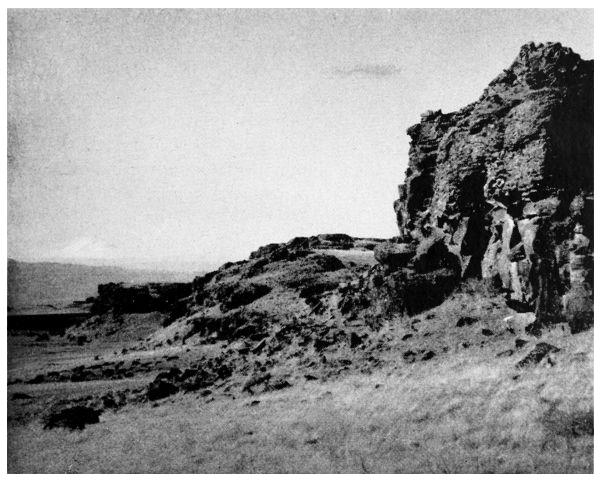
Fig. 20. Rocky bluff along north bank of the Columbia River near Lyle. Washington. March 20. 1939. Habitat of Beechey ground squirrel and yellow-bellied marmot. (Fish and Wildlife Service photo by Victor B. Scheffer. No. 640.)
The San Juan Islands now possess a limited mammalian fauna. Unfortunately the activities of man have somewhat changed the native populations, especially by the introduction of the domestic rabbit which is now a serious pest in the islands. The Douglas squirrel, present on Blakeley Island, is said to have been introduced and one resident claims to have first brought it to the island. Two different persons claim credit for introducing the Townsend chipmunk on Orcas Island but do not account for its presence on Lopez Island. The three mammals most abundant and widely distributed in the islands are Sorex vagrans, Peromyscus maniculatus and Microtus townsendii. These species, at least, probably reached the islands at an early time. The two last named are now subspecifically distinct from their mainland relatives. Other mammals which probably were established before the arrival of the white man include the mink, otter, beaver, muskrat, raccoon and black-tailed deer.
The Great Basin Fauna of eastern Washington exists as three units, one on the Columbian Plateau, another in southeastern Washington and the third in the Yakima Valley area. The desert species of the Yakima Valley are more closely related to the species of eastern Oregon than they are to those of the Columbian Plateau. In a number of respects the Columbian Plateau gives indications of age. The ground squirrel, Citellus washingtoni, is related to, but specifically distinct from Citellus townsendii of the Yakima Valley and eastern Oregon. Perognathus parvus lordi is a well-marked race, as is Microtus pennsylvanicus kincaidi and Thomomys talpoides devexus. We suppose that these species were present on the Columbian Plateau at least through the Recent and probably through all of Wisconsin Time. The loess deposits of eastern Washington seem to have been laid down in Wisconsin and Recent times. These indicate an arid climate which, although probably cool, was probably not so cold as to exterminate these species. On the other hand, some species that are now abundant on the Columbian Plateau seem to have arrived there relatively recently. The black-tailed jack rabbit, for example, was unknown in eastern Washington before 1870 when it appeared in Walla Walla County. In 1905 it crossed the Snake River on ice and invaded the Columbian Plateau where it rapidly spread over the whole area. In January, 1920, it crossed the Columbia in two places and spread over the Yakima Valley.
The known facts of this movement were sufficiently impressive to cause the author to study rather closely the distribution of mammals in this area. The collection of bones from a cave along the Columbia River near Vantage, Grant County, on the Columbian Plateau, is especially helpful in this respect. This cave was first visited in 1938. It had been the habitat of owls, bats, and primitive man. The floor of the cave was buried under from one to three feet of bat guano, much of which had been hauled away for fertilizer. Here and there we found traces of fire and occasional piles of mussel shells. Some arrowheads and one beautiful obsidian spear head were found, all buried in guano and about midway between the floor and the top of the deposit. Remains of mammals were abundant through the bat guano, and apparently had been brought to the cave both by man and owls. The jaw of a mountain sheep was found. This species was known to be present when the first settlers reached the area (Cowan, 1940: 558). The remains of smaller mammals included gopher, pocket mouse, muskrat, meadow mouse, deer mouse, coyote and white-tailed jack rabbit. No remains of cottontail, black-tailed jack rabbit or harvest mouse were found. The absence of the cottontail was especially surprising, in that fully thirty skulls of white-tailed jack rabbits were noted. The grasshopper mouse (Onychomys) was also absent, but this species is not common. The two rabbits and the harvest mouse, however, are abundant in the area today. The cottontail and harvest mouse have only recently been recorded from the Okanogan Valley of British Columbia (Cowan and Hatter, 1940: 9). The black-tailed jack rabbit has never been taken there.
Apparently then, some species have only recently entered the Upper Sonoran Life-zone of eastern Washington. They have, of course, reached the state from Oregon. The first step in the invasion probably was the occupation of southeastern Washington. No barrier prevents mammals from reaching southeastern Washington from eastern Oregon but the Columbia to the north and west prevents them from occupying the Yakima Valley, and the Snake River prevents them from reaching the Columbian Plateau. The kangaroo rat, Great Basin striped skunk and Great Basin spotted skunk now are at this stage of invasion. The second stage was the crossing of the Columbia River to the Yakima Valley. This has been accomplished by the black-tailed jack rabbit and, earlier, by the pocket mouse, Perognathus parvus parvus, and ground squirrel, Citellus townsendii. The third stage was the crossing of the Snake River and occupation of the Columbian Plateau. The final stage is the crossing of the northern Columbia River and occupation of the Okanogan Valley.