ACCOUNTS OF SPECIES AND SUBSPECIES (continued 4)
Reading edition
The habits of this race in California have been studied by Grinnell and Dixon (1919: 595-807). Burrows have been excavated near Eugene, Oregon, and the findings published (Edge, 1934: 189-193). Burrows were dug on sloping or well-drained ground. Mounds of earth at the entrances were usually inconspicuous but well-worn trails led to the burrows. The burrows entered the ground at an angle of 35° for about two feet, then flattened out horizontally for six feet or more. The burrows were from 1 to 4 feet deep, usually about 2 feet. Ordinary burrows had a single entrance but some older burrows had two or more. Burrows branched frequently. Nest chambers were of the shape of a flattened sphere 10 inches in diameter. Frequently more than one nest was found in a burrow, but only one was in use at a time. Some nests were infested with fleas. Nests frequently contained food. Most of the burrows observed by me had their entrances beside rocks or oak roots. In alfalfa fields near Bingen and Lyle, Klickitat County, the burrows were in open fields and the entrances were marked by large mounds of earth. In actual diameter the burrows seemed smaller than those of Citellus columbianus.
Aestivation and hibernation of the ground squirrels in the lower Columbia River Valley seem unnecessary, for the climate is temperate and humid. It is not established that douglasii hibernates in other parts of its range where the climate is mild. Specimens shot at White Salmon in early March were lean and gave no evidence of having hibernated.
The Beechey ground squirrel is an excellent climber; I have seen individuals in oak trees on a number of occasions. They like to sit on fence posts and when alarmed descend head foremost, with speed and agility. In running on the ground their movements are more graceful than those of Citellus columbianus but are unlike the flowing, bounding run of tree squirrels.
Near White Salmon and Lyle, these ground squirrels were eating burr clover (Medicago), grasses (Bromus), and alfalfa. In some places they do considerable damage to alfalfa fields. They probably eat acorns and are said to eat some insects.
In California the young are born in May and number five to seven.
No disease has been recorded for this subspecies but a related form in California (Citellus b. beecheyi) is known to harbor plague (Kellogg, 1935: 857) and tularemia (McCoy, 1911: 53-71).
Citellus lateralis (Say) Golden-mantled ground squirrel
Description.—The head and body measure about 6 inches and the tail about 4 inches. The head is large and rounded with eyes and ears of moderate size. The body is stouter than that of a chipmunk. The tail is long and well furred. Upper parts are buffy gray with one pale stripe bordered by two black stripes extending from shoulders to rump, and the underparts are buffy. The head and shoulders are tawny. The tail is buffy beneath and darker above.
Externally golden-mantled ground squirrels somewhat resemble chipmunks but actually are no more closely related to chipmunks than are other ground squirrels. They are larger than chipmunks and their stripes differ in that there is but one pale stripe on each side bordered with black stripes rather than two pale stripes, and in that the stripes end at the shoulders rather than continuing on to the face.
These ground squirrels are distributed in mountainous areas of western North America from central British Columbia south to central Arizona and New Mexico. A closely related species (Citellus madrensis) occupies a limited area in northern Mexico and another lives in the Cascades of Washington. There are two subspecies of lateralis in Washington, each with a major part of its range outside of Washington.
This species inhabits mountain clearings, parks and talus slides, where it is most common about rocks, stumps, and logs. Its fondness for talus slides and outcrops has earned it the common name of "rock squirrel" in some places.
Entrances to burrows are usually beside a rock, stump, or root, or are concealed under talus slides. A burrow excavated by Hatt (1927) in Colorado was three inches in diameter at the entrance and uniformly two inches in diameter for the rest of its length. Most of the burrow was 8 inches beneath the surface. The tunnel branched twice and contained one pocket, probably a turning or passing chamber, in addition to the nest. "A runway surrounded the nest on three sides, from which there were four passages leading in. The nest cavity was 4 inches deep, the nest not filling the space available, but occurring more as a mat in the bottom of a cup."
The habits of this ground squirrel in Washington are little known. Since it occupies areas that are cold and under deep snow in winter, it probably hibernates. According to Howell (1938: 32) these animals become fat in the fall and must retire for the winter about the middle of September.
The food habits of these ground squirrels in Washington are little known. In the Pend Oreille Mountains, Pend Oreille County, I found them eating the fruit of the western raspberry (Rubus leucodermis). Howell lists, as food of this species, the seeds of yellow pine and douglas fir, serviceberries, other berries and seeds, grain, mushrooms, and several kinds of insects.
Citellus lateralis tescorum (Hollister)
Callospermophilus lateralis tescorum Hollister, Smithsonian Misc. Coll., 56 (no. 26):2, December 5, 1911.
Citellus lateralis tescorum Elliot, Check-list Mamm. N. Amer., Supp., p. 29, 1917.
Type.—Obtained at the head of Moose Pass Branch, Smoky River, Alberta (near Moose Pass, British Columbia), 7,000 ft., by N. Hollister on August 2, 1911; type in United States National Museum.
Racial characters.—Large size, gray color.
Measurements.—A female from Pass Creek Pass, Pend Oreille County, measures: total length 257; length of tail 90; hind foot 40; ear 14.
Distribution.—Known only from the Pend Oreille Mountains, Pend Oreille County, at Pass Creek Pass (W. W. D.).
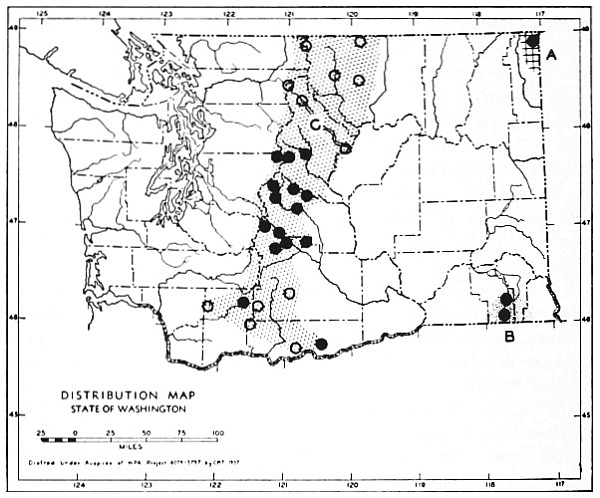
Fig. 86. Distribution of golden-mantled ground squirrels in Washington. A. Citellus lateralis tescorum. B. Citellus lateralis connectens. C. Citellus saturatus.
Citellus lateralis connectens (Howell)
Callospermophilus chrysodeirus connectens Howell, Jour. Mamm., 12:161, May 14, 1931.
Citellus lateralis connectens Howell, N. Amer. Fauna, 56:205, May 18, 1938.
Type.—Obtained at Homestead, Oregon, by H. H. Sheldon on June 1, 1916; type in United States National Museum.
Racial Characters.—Similar to C. l. tescorum but browner, more buffy and less grayish, mantle brighter, size slightly smaller.
Measurements.—Seven males from northeastern Oregon average (Howell, 1938: 206): total length 266; length of tail 92; hind foot 41.7; ear 14.8 (dry). An adult female from Godman Springs, Columbia County, measures: total length 257; length of tail 87; hind foot 37; ear 14.
Distribution.—The Blue Mountains of extreme southeastern Washington.
Remarks.—This race differs markedly from the subspecies that occupies northeastern Washington, but differs but little from Citellus l. chrysodeirus of the Cascades of Oregon.
Citellus saturatus (Rhoads) Golden-mantled ground squirrel
Tamias lateralis saturatus Rhoads, Proc. Acad. Nat. Sci. Philadelphia, 1895:43, April 9, 1895.
[Spermophilus lateralis] saturatus Elliot, Field Columb. Mus. Publ. 45, zoöl. ser., 2:83, 1901.
Citellus lateralis saturatus Elliot, Field Columb. Mus. Publ. 105, zoöl. ser., 6:106, 1905.
Callospermophilus lateralis saturatus Miller, U. S. Nat. Mus. Bull., 79:316, December 31, 1912.
Citellus saturatus Howell, N. Amer. Fauna, 56:212, May 18, 1936.
Type.—Obtained at Lake Keechelus, 3000 ft., Kittitas County, Washington, by A. Rupert, in September, 1893; type in Academy of Natural Sciences of Philadelphia.
Measurements.—Ten males from the Cascade Mountains average: total length 305; length of tail 110.9; hind foot 46.5; ear 17 (dry). The weights of 3 males and 5 females average, respectively: 281 grams; 259.4 grams.
Distribution.—The higher and eastern Cascade Mountains from Barron (Howell, 1938: 213) and Bauerman Ridge (Howell, 1938: 213) south to Cleveland (Howell, 1938: 213) and Goldendale (W. W. D.).
Remarks.—The golden-mantled ground squirrel of the Cascades is similar to Citellus lateralis but is larger and duller-colored. Head and body are about 8 inches in length and the tail is about 4-1/2 inches long. The upper parts are brownish gray with one pale and two dark stripes on each side. Head and shoulders are tawny. The underparts are dull buffy gray.
Citellus saturatus occupies the Cascade Mountains of Washington and southern British Columbia. It inhabits talus slides and clearings. The rock embankment of the Great Northern Railroad between the Cascade Tunnel and Leavenworth, Chelan County, is a favored habitat and the population along the railroad probably averages one squirrel each hundred yards. To the east it extends well into the Transition Life-zone, being abundant in clearings in the open forest of yellow pine. In places its range nearly reaches the Upper Sonoran Life-zone. A few miles east of Leavenworth, Chelan County, we found this squirrel in chapparal and brush, principally composed of Ceanothus creneatus. Here the animals were unusually abundant and formed a colony almost as dense as colonies of Citellus washingtoni.
Entrances of burrows are usually placed beside rocks, stumps or logs. In the area near Leavenworth, mentioned above, entrances to burrows were in the open or among roots of bushes. The entrances to many burrows are doubtless concealed under talus slides. No complete records of excavations of burrows are available. One burrow, uncovered by road construction operations three miles east of Scenic, Chelan County, was dug in the earth-filled cleft of a great granite boulder. The cleft was 5 feet wide at the surface of the ground but narrowed until at a depth of six feet the stones were in contact. The cleft was at least 10 yards long. The burrow descended at an angle of 45 degrees, to a depth of three feet. Here the construction work had passed the cleft, but digging into the almost vertical wall uncovered the nest at the end of a horizontal tunnel two feet farther on. It was a matted cup of dry grass with two fresh, green fern fronds lying loose in the cup. Two divergent burrows emerged on opposite sides of the nest cavity, but a fall of the loose, gravelly soil prevented further observation. The body of the occupant, crushed and mangled by the steam-shovel scoop, was that of a small male.
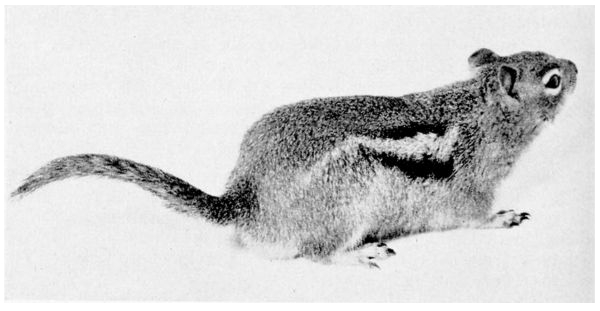
Fig. 87. Golden-mantled ground squirrel (Citellus saturatus), captured when young at Tye, Washington, by Earl J. Larrison, June 20, 1940; photographed February 1, 1941. (Fish and Wildlife Service photo by Victor B. Scheffer, No. 1139.)
In spite of their vivacious appearance, these squirrels are rather sedentary. When undisturbed they move leisurely over rocks and stumps, pausing often, and occasionally sitting on their hindquarters to gaze about for minutes at a time. They are good climbers and often ascend smooth-barked trees to heights of 20 feet or more. At the approach of danger they descend and enter the nearest burrow. In August these ground squirrels become exceedingly fat and by late September only a few may be seen, basking in the midday sun. These take alarm at the slightest excuse. All have usually gone into hibernation by October 15.
The food includes the berries of salal, huckleberry, mountain ash, and seeds of lupine. Near Liberty, Kittitas County, a squirrel killed by a car had its cheek pouches stuffed with garden peas. The source of its loot was doubtless the garden of a farmhouse 100 feet away. Numerous individuals are run over by cars, and on many occasions I have found other individuals eating the sun-dried flesh of their mates, parents, or young. These cannibals are often run over while so engaged, and it is not unusual to find two or three dead on a section of pavement 20 feet in length.
Economically this species is of little importance. Its principal enemies probably include hawks, weasels, martens, bobcats and coyotes.
Sciurus griseus griseus Ord Western gray squirrel
Sciurus griseus Ord, Jour. de phys., 87:152, 1818.
Sciurus griseus griseus Miller, U. S. Nat. Mus. Bull., 128:222, April 29, 1924.
Type.—None. Described from a squirrel seen by Lewis and Clark. Type locality, The Dalles, Wasco County, Oregon.
Measurements.—A female from midway between Satus Pass and Goldendale, Klickitat County, measured: total length 560; length of tail 264; hind foot 76; weight 897 grams.
Distribution.—Southwestern Washington north to the glacial prairies near Tacoma (W. W. D.); the Columbia River Valley of the southern Cascades; the eastern edge of the Cascades north to Lake Chelan (Taylor and Shaw, 1929: 18).
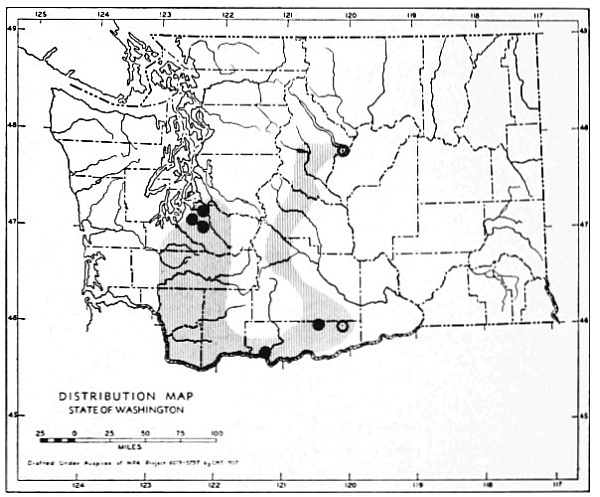
Fig. 88. Distribution of the western gray squirrel, Sciurus griseus, in Washington.
Description.—This is the largest tree squirrel found in Washington. The head and body measure about 12 inches, and the tail about 11 inches. The body is long and slender. The fur is long and soft, that on the tail being exceptionally long. The upper parts are silvery gray and the underparts white.
The western gray squirrel is restricted to the region of the Pacific Coast and ranges from central Washington south to northern Lower California. Three subspecies are recognized, only one of which occurs in Washington. Like the red squirrels, the western gray squirrel is arboreal. Its favored habitat is the oak woods rather than coniferous forest. Its range in Washington is largely regulated by the distribution of oaks, especially the garry oak (Quercus garryana). Altitudinally it ranges from near sea level at Puget Sound to above 2,500 feet elevation in the eastern Cascade Mountains. It seems to be restricted to the Transition Life-zone.
The habits of the western gray squirrel are modified by its arboreal existence. Homes consist of holes in hollow trees or outside nests of sticks and twigs. It is extremely active in trees and travels from tree to tree on branches that seem scarcely strong enough to bear the weight of so large an animal. The oak woods in Washington are usually rather open and the trees more scattered than is the case in coniferous forests. Consequently gray squirrels must more often descend to the ground than Douglas and red squirrels. On the ground, western gray squirrels travel in smooth leaps each of two feet or more in length. The long tail is held out behind and "follows through" the animal's leaps in a remarkable way. The tip of the tail may be descending from the previous leap while the animal's fore parts are already at the height of a new jump. This results in a "flowing" movement that is extremely graceful. The squirrel may stop momentarily to dig in the ground or search for an acorn. At such times the tail is immediately switched up, over the back.
The western gray squirrel is able to drop unharmed for considerable distances. Near Fort Lewis, Pierce County, a gray squirrel was cornered in a tall fir tree and an agile friend volunteered to climb the tree. The squirrel ascended to the very topmost branches. When only a few feet separated them the squirrel leaped far out into the air. Its legs were stretched out stiffly, the tail was extended and the body slightly arched. It struck the ground with an audible thud and bounced fully 18 inches. At the height of its bounce, the squirrel's legs began moving rapidly, and it struck the ground the second time at a full run.
The principal food is acorns, although the seeds of the Douglas fir and probably other conifers are eaten. Four embryos were found by Victor B. Scheffer in a specimen from Klickitat County on March 20, 1939.
Sciurus carolinensis hypophaeus Merriam Eastern gray squirrel
Sciurus carolinensis hypophaeus Merriam, Science, 7:351, April 16, 1886.
Type.—Obtained at Elk River, Sherburne County, Minnesota.
Description.—Size large, slightly smaller than the western gray squirrel; color of upper parts less silvery, more reddish, especially on the dorsal area and top of the tail.
Remarks.—The eastern gray squirrel was introduced at Woodland Park, Seattle, in 1925. The original stock (7 pairs) came from Minneapolis, Minnesota. It has spread through the nearby woods, around Green Lake, Cowan Park, and to the woods on the University of Washington Campus. Occasional individuals are found outside the city limits, but the species seems not to spread away from the city.
Sciurus niger Linnaeus subsp? Fox squirrel
[Sciurus] niger Linnaeus, Syst. Nat., 1 (10th ed.):64, 1758.
Description.—Similar in size and appearance to the eastern gray squirrel but upper parts more reddish and underparts reddish orange rather than white.
Remarks.—Occasional fox squirrels are encountered near Seattle where they have been introduced from the southeastern United States. The source and date of the introduction are unknown.
Tamiasciurus hudsonicus (Erxleben) Red squirrel
Description.—The head and body of the red squirrel measure about 7-3/4 inches, the tail about 5 inches. It may be recognized by its trim body, bushy tail and white underparts. The upper parts are reddish gray, reddest on the dorsal area. The red color of the center of the back extends to the tail. A black line separates the dark upper parts from the white underparts.
Red squirrels range over North America from the northern limit of tree growth south through the United States to Tennessee and North Carolina. A related species, douglasii, is found along the Pacific coast from British Columbia to California. The genus Tamiasciurus differs from Sciurus of Washington in lacking a penis bone or baculum. There are other fundamental differences in anatomy (see Mossman, Lowlah and Bradley, 1932: 89-155).
The habitat of the red squirrels is the coniferous forests from which they rarely stray. Zonally they range through the Transition and Canadian life-zones into the Hudsonian Life-zone. Red squirrels are arboreal and most of their habits are modified by arboreal existence. They are swift and agile climbers, able to travel from tree to tree on slender twigs or by leaping as much as ten feet to span the distance from one branch to another. They ascend and descend trees head first. They hang by their hind feet, high in the air, to clip the cones of conifers. If cornered in a tree they leap far out and, by extending the legs and tail stiffly, fall to the ground unharmed by leaps of fifty feet or more.
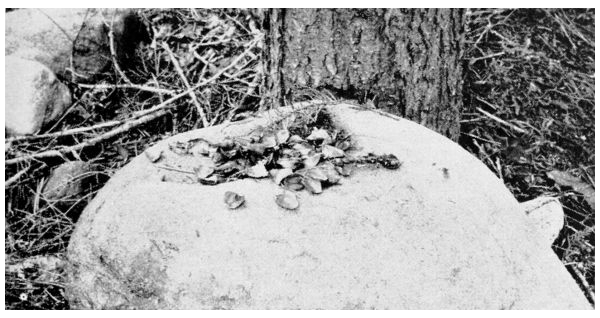
Fig. 89. Douglas squirrel (Tamiasciurus douglasii douglasii): feeding station with remnants of Douglas fir cone, Longmire, Washington, elevation 2,700 feet, June 25, 1937. (Fish and Wildlife Service photo by Victor B. Scheffer, No. 268.)
The homes of red squirrels are woodpecker holes or other holes in hollow trees. More rarely they build outside nests of twigs and branches, about two feet in diameter, or add onto old nests of crows or jays. Most nests and holes are some distance from the ground but some holes are between roots on the ground itself.
The food consists principally of the seeds of coniferous trees, especially Douglas fir and various species of pines. Cones are clipped when green or just before ripening and are either allowed to fall to the ground to be retrieved later or are at once carried to a favored feeding place to be consumed. Cones are held between the forepaws while the squirrel sits on its hind feet, tail curved up over its back, and rapidly clips the cone apart to get the seeds it contains. The cone is rotated between the paws and a steady stream of husks drops to the ground. Soon only the core is left and this too joins the husks on the ground. Favored feeding stations are used continually, perhaps by generation after generation of squirrels, and debris from thousands of cones accumulates in great piles.
Cones are stored. In the vicinity of a favored feeding place, at times virtually every hiding place is filled with green cones. Cones may be jammed into cracks or crevices in logs or stumps without effort at concealment or may be carefully covered with leaves or dry needles. Many are placed in craterlike pits dug in the ground. Most of these pits probably are later covered over but many are left open to the weather. Hollows in trees are probably also used for storage, as are holes dug into the piles of accumulated cone debris beneath feeding stations. Other food eaten by squirrels includes hazelnuts, berries, maple seeds, and mushrooms. A variety of fruits and seeds are doubtless eaten when opportunity offers.
Red squirrels do not hibernate. In the lowlands they are active all winter long but are noticeably shy and quiet. In the mountains they disappear after the snow falls but tracks may be seen in the snow about their dens and occasional individuals are seen. Specimens collected at this time are not fat, as would be the case if hibernation had been interrupted. Seemingly they stay close to their homes and feed on stored food.
The call of the red squirrel is harsher, more metallic, than that of the Douglas squirrel. The common call is a rolling "bur-r-r," starting loud but fading out entirely in a half minute. A lower-pitched "pauf" is uttered at intervals when the squirrel is going about its business. The danger cry is a loud "pee-ee," not unlike the call of a red-tailed hawk but less shrill. A low pitched "chauf-chauf-chauf," repeated at intervals of about two seconds, is occasionally given in the fall of the year.
Tamiasciurus hudsonicus streatori (Allen)
Sciurus hudsonicus streatori Allen, Bull. Amer. Mus. Nat. Hist., 10:267, July 22, 1898.
T[amiasciurus]. h[udsonicus]. streatori Howell, Proc. Biol. Soc. Washington, 49:135, August 22, 1936.
Type.—Obtained at Ducks, British Columbia; type in American Museum of Natural History.
Racial characters.—Similar to richardsoni but smaller and darker, redder above.
Measurements.—Seven males from north-central Washington average: total length 330; length of tail 129; hind foot 51; ear 23.
Distribution.—Northeastern Washington. Marginal occurrences are (from Taylor and Shaw, 1929: 17): Beaver Creek, Ruby Creek, and head of Lake Chelan.
Remarks.—This race reaches Washington from the interior of British Columbia. Intergradation between hudsonicus streatori and h. richardsoni takes place over much of northeastern Washington.
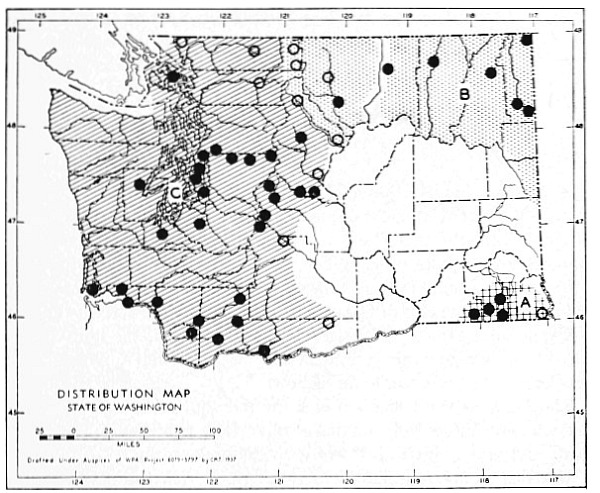
Fig. 90. Distribution of the red squirrel and Douglas squirrel in Washington. A. Tamiasciurus hudsonicus richardsoni. B. Tamiasciurus hudsonicus streatori. C. Tamiasciurus douglasii douglasii.
Tamiasciurus hudsonicus richardsoni (Bachman)
Sciurus richardsoni Bachman, Proc. Zoöl. Soc. London, p. 100, 1838.
Sciurus hudsonius Richardsoni True, Proc. U. S. Nat. Mus., 7:595, 1884.
Sciurus hudsonius Richardsoni Allen, Bull. Amer. Mus. Nat. Hist., 10:265, July 22, 1898.
Sciurus hudsonicus richardsoni Miller, U. S. Nat. Mus. Bull., 128:211, April 29, 1924.
Tamiasciurus hudsonicus richardsoni Svihla and Svihla, Murrelet, 21:55, December 20, 1940.
Type.—Obtained at the head of Big Lost River, Custer County, Idaho.
Racial characters.—Color paler, especially on back.
Measurements.—Four males and 4 females average, respectively: total length 339, 339; length of tail 133, 131; hind foot 54, 51; ear 24, 24; weight 256, 266.
Distribution.—The Blue Mountains of southeastern Washington.
Tamiasciurus douglasii douglasii (Bachman) Douglas squirrel
Sciurus douglasii Bachman, Proc. Zoöl. Soc. London, p. 99, 1838.
Sciurus hudsonius Douglasii True, Proc. U. S. Nat. Mus., 7:595, 1884.
Sciurus douglasii douglasii Miller, U. S. Nat. Mus. Bull., 128:212, April 29, 1924.
Sciurus douglasii cascadensis Taylor and Shaw, Occ. Papers Chas. R. Conner Mus., no. 2:18, December, 1929.
Tamiasciurus douglasii Holdenried, Jour. Mamm., 21:406, November 14, 1940.
Type.—Obtained near the mouth of the Columbia River by David Douglas.
Measurements.—Fifteen males and 10 females from the lowlands of western Washington average, respectively: total length 317, 320; length of tail 121, 126.7; hind foot 50, 49.4; ear 23.2, 22.6; weight 204, 202 grams.
Distribution.—From the eastern base of the Cascade Mountains westward to the Pacific. Marginal occurrences are: Nooksack River (Taylor and Shaw, 1929: 18), Lake Wenatchee (W. W. D.) and Wenatchee (Taylor and Shaw, 1929: 18).
Remarks.—Squirrels from the Puget Sound area are slightly less intensely colored than specimens from the ocean coast and the Olympic Mountains. Those from the higher and eastern Cascade Mountains are paler still. When, however, squirrels from the Cascades of Washington are compared with individuals of the race inhabiting the Cascades of Oregon, it is apparent that the Washington squirrels are nearest to douglasii. The pale tips of the hairs in the tail of the Oregon race are strikingly white while in Washington specimens they are orange or yellow.
The Douglas squirrel resembles the red squirrel in size and proportions but differs in being dusky olive (less reddish) on the upper parts and orange instead of white on the underparts.
Douglas squirrels range from southern British Columbia southward to Lower California. They are confined to the Pacific Coastal region. Although closely related to Tamiasciurus hudsonicus, no intergradation with that species has been found.
The rich coloration of the Douglas squirrel matches the background of the humid forests it inhabits. It occurs at sea level along the ocean coast, the shores of Puget Sound and on some islands in Puget Sound. It ranges through the Transition and Canadian life-zones well into the Hudsonian.
It makes its home in holes in trees or in nests constructed of conifer twigs, needles and bark. Old nests of birds may be modified and taken over, but most outside nests seem to have been made entirely by the squirrel. Nests are usually placed near the top of denser fir and cedar trees. Nests are hemispherical in shape, 12 inches or more in diameter, and open on top. The central cup, 4 inches in diameter, is lined with strips of inner bark of red cedar coiled but unshredded. Nests in holes are usually some distance from the ground, but the entrances to some are at ground level.
The habits of the Douglas squirrels vary with the season. In spring they are shy. They rarely call and are skillful in keeping branches or tree trunks between themselves and persons. In June and July they become bolder, calling more frequently and moving about more. In September and October they become exceptionally bold. They call almost incessantly from late morning until early afternoon, and spend considerable time on the ground.
The call notes of the Douglas squirrel are similar to those of the red squirrel but are softer, more slurred. The common call is the long, trilling "burr," loud at first and becoming gradually softer. On hot afternoons in late summer a barking "pauf" note is given. This sound is repeated several times at intervals of a minute or so. It has remarkable carrying power. The danger signal is a loud, explosive "pe-ee." Another common call is a short barking or chirping "bauf" with a musical, questioning sound. This is repeated at intervals of a few seconds when the presence of danger is suspected. At times it, rather than the loud danger signal, is given also when a person is sighted. A low chirping note is often given while the squirrel is busily at work. This is made while the squirrel is moving about. Other calls described are made from a standing or sitting position and are accompanied by a jerk or a flick of the tail.
The Douglas squirrel eats seeds of the Douglas fir, seeds of maple, hazelnuts, dogwood berries and mushrooms. The berries of forest shrubs, such as the red huckleberry, salal and Oregon grape, may also be eaten.
Two broods of young may be born in a year. The first is born in early June. Embryos found from June 11 to 28 varied in number from 6 to 8. A nursing female was taken as early as June 10, 1938, and one was taken as late as October 10, 1938.
Douglas squirrels commonly have a few fleas and 2 to 5 ticks at the bases of the ears. No lice, cases of mange, or serious infestations of parasites have been seen.
Glaucomys sabrinus (Shaw) Northern flying squirrel
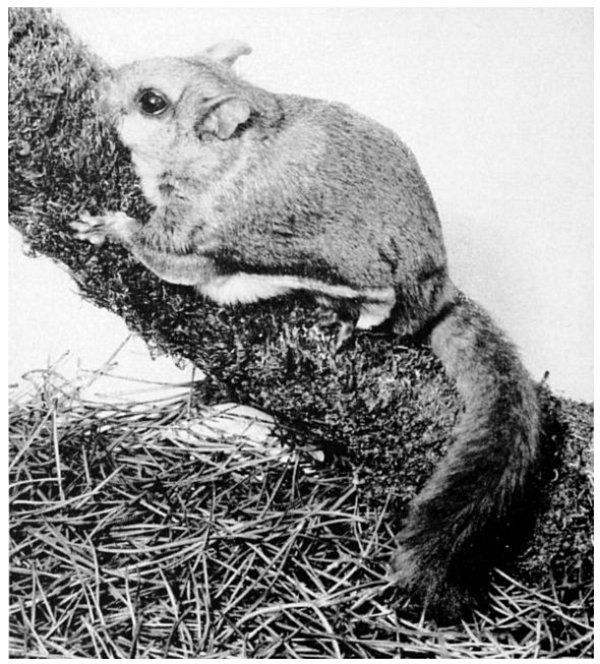
Fig. 91. Northern flying squirrel (Glaucomys sabrinus), probably from near Seattle, in Woodland Park Zoo, Seattle, Washington, January 28, 1941. (Fish and Wildlife Service photo by Victor B. Scheffer, No. 1137.)
Description.—The northern flying squirrel is slightly smaller than the red squirrel (Tamiasciurus). The head and body measure about 7 inches and the tail about 5 inches. The most distinctive feature is the loose fold of skin that stretches from the wrist of the foreleg to the ankle of the hind leg. The fur is extremely soft and plushlike. It is not separated into guard hair and underfur, and because all hairs are of approximately the same length, the fur appears extremely sleek. The fur of the tail is of the same texture as that on the body but is dorso-ventrally compressed. The eyes are large and dark. The color of the upper parts varies from reddish brown in some races to brownish gray in others. The underparts are buffy gray.
Flying squirrels range over the forested parts of North America from Guatemala to Alaska and northern Canada and from the Atlantic to the Pacific. A closely related genus (Pteromys) occurs in Europe. Two species are found in North America. The small volans ranges in eastern United States, Mexico, and Guatemala, while the larger sabrinus occurs in parts of the western United States, most of Canada, and central Alaska. Near the Great Lakes the two species occur in the same area, probably in different habitats.
Howell (1918: 16) recognized 18 subspecies of sabrinus, five of which were recorded in the state of Washington. One of these (olympicus) proves to be a synonym of an earlier-named subspecies but another form (bangsi), not recorded for Washington by Howell, has been found in the Blue Mountains in the southeastern corner of the state (Taylor and Shaw, 1929: 18).
Flying squirrels are strictly arboreal and occur only in woods and forests. They prefer areas where trees grow close together and to considerable heights. Older woods with dead stubs and hollow trees are preferred. They occasionally invade attics of cabins and other habitations of man. The old Forestry Building on the University of Washington Campus, later the home of the Washington State Museum, was inhabited by flying squirrels for many years. Several specimens preserved in the Museum prove the poor judgment of the animal in choosing a natural history museum as a home.
Relatively little is known of the detailed habits of Glaucomys sabrinus although the life history of the eastern Glaucomys volans has been described. Flying squirrels are active all winter, even in the high mountains. They are often caught in traps set for fur bearers and, where trapping is an important means of livelihood, they are serious pests. Flying squirrels do not actually fly but only glide through the air. The loose fold of fur between their limbs is stretched by extending the legs. With it the flying squirrel is able to sail 50 yards or more. The flat tail serves as a rudder and allows the squirrel to change direction while in flight. Glides end with an upward swoop, allowing the squirrel to alight, head upwards, on a tree trunk slightly lower than their starting point.
Unlike other members of the squirrel family, flying squirrels are completely nocturnal. They are seen in the daytime only when frightened from their retreats. Homes consist principally of old woodpecker holes or other cavities in trees. They are said to build outside nests, similar to those of tree squirrels, but I have found none of these in Washington. The animals can be frightened from their holes by pounding on the bases of trees in which their nests are situated. Certain holes seem to be preferred nesting places. Near Cottage Lake, King County, two flying squirrels were taken from a woodpecker hole in succeeding years. Cowan (1936B: 58) discovered remains of 14 nests of flying squirrels in a single hollow tree near Alta Lake, British Columbia. According to Cowan, hollow trees are used in winter but the young are born in outside nests of shredded bark and lichens. The young usually number 3 and are born in May and June.
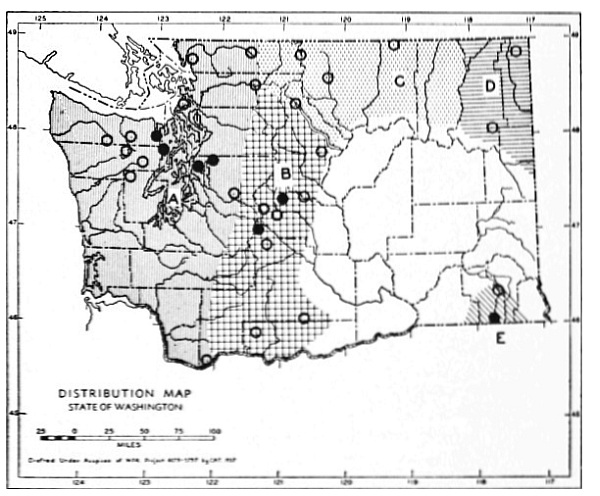
Fig. 92. Distribution of flying squirrel in Washington. A. Glaucomys sabrinus oregonensis. B. Glaucomys sabrinus fuliginosus. C. Glaucomys sabrinus columbiensis. D. Glaucomys sabrinus latipes. E. Glaucomys sabrinus bangsi.
Only once have I heard the voice of a flying squirrel. Near Dewey Lake, Yakima County, the squirrels were unusually abundant in the black hemlock and Douglas fir forests of the mountain sides. Here a birdlike twittering note caught my attention and occasional dark, sailing shapes were glimpsed against the clear sky. Eight traps set in the afternoon and visited at 11 p. m. held two flying squirrels. In the morning another was in a trap. Seemingly the squirrels are active most of the night.
The food consists principally of conifer seeds and probably other nuts, seeds, and fruit. They eat the meat bait of traps set for fur bearers and probably eat the eggs of birds.
Glaucomys sabrinus oregonensis (Bachman)
Pteromys oregonensis Bachman, Jour. Acad. Nat. Sci. Philadelphia, 8:101, 1839.
Sciuropterus alpinus oregonensis Rhoads, Proc. Acad. Nat. Sci. Philadelphia, p. 324, June, 1897.
Sciuropterus alpinus olympicus Elliot, Field Columb. Mus. Publ. 30, zoöl. ser., 1:225, February 1, 1899 (type from Happy Lake, Clallam County, Washington).
Glaucomys sabrinus oregonensis Howell, N. Amer. Fauna, 44:44, June 13, 1918.
Glaucomys sabrinus olympicus Howell, N. Amer. Fauna, 44:49, June 13, 1918.
Type.—Obtained "in pine [= conifer] woods of the Columbia near the sea" by J. K. Townsend in 1839. Probably near St. Helen, Columbia County, Oregon (Rhoads, 1897:324).
Racial characters.—Small size, rich color.
Measurements.—A male from Cottage Lake, King County, measured: total length 287; length of tail 125; hind foot 38. A female from 5 miles southeast of Sequim, Clallam County, measured: 303; 133; 41; ear 27. A male from Quilcene, Jefferson County, measured: 311; 140; 41.
Distribution.—Western Washington west of the Cascade Mountains. The locality records for flying squirrels in the northern Cascade Mountains, given by Taylor and Shaw (1929: 18), when plotted on a distribution map, show overlapping of ranges in this area. The ranges of the three races involved have been drawn on the accompanying map (fig. 92) on the basis of geographic probability and are subject to revision because the specimens from this area have not been examined.
Marginal records that may apply to G. s. oregonensis are, from Taylor and Shaw (1929: 18): Nooksack River, Rockport, North Bend and Skamania.
Remarks.—Of all the races occurring in Washington, oregonensis is the most distinct. Glaucomys s. olympicus Elliot must be regarded as a synonym of oregonensis.
Glaucomys sabrinus bangsi (Rhoads)
Sciuropterus alpinus bangsi Rhoads, Proc. Acad. Nat. Sci. Philadelphia, p. 321, June, 1897.
Glaucomys sabrinus bangsi Howell, N. Amer. Fauna, 44:38, June 13, 1918.
Type.—Obtained in Idaho County, Idaho, by Harbison and Bargamin on March 8, 1897; type in Philadelphia Academy of Natural Sciences.
Racial characters.—Similar to oregonensis but larger and paler throughout.
Measurements.—A female from Wildcat Spring, Columbia County, measured: total length 333; length of tail 147; hind foot 45; ear 29; weight 151 grams.
Distribution.—Found only in the Blue Mountains of extreme southeastern Washington.
Glaucomys sabrinus columbiensis Howell
Glaucomys sabrinus columbiensis Howell, Proc. Biol. Soc. Washington, 28:111, May 27, 1915.
Type.—Obtained at Okanogan, British Columbia, by Allan Brooks on May 9, 1898; type in United States National Museum.
Racial characters.—Larger than oregonensis and paler. Similar to bangsi but paler, especially beneath, and less reddish above.
Measurements.—Howell (1918: 46) gives the average of two subadult topotypes as: total length 313; length of tail 143; hind foot 42.
Distribution.—Northeastern Washington, probably extending, from records of Taylor and Shaw (1929: 18), west to Mazama and Stehekin and east to Molson.
Glaucomys sabrinus latipes Howell
Glaucomys sabrinus latipes Howell, Proc. Biol. Soc. Washington, 28:112, May 27, 1915.
Type.—Obtained at Glacier, British Columbia, by J. A. Loring, on August 13, 1894; type in United States National Museum.
Racial characters.—Similar to bangsi and columbiensis but with larger feet and grayer color.
Measurements.—Howell (1918: 49) gives the average of 10 specimens as: total length 342; length of tail 153; hind foot 41.5.
Distribution.—The Pend Oreille Mountains of extreme northeastern Washington, north (from records of Taylor and Shaw, 1929: 18-19, as revised) to Sullivan Lake and south to Loon Lake.
Glaucomys sabrinus fuliginosus (Rhoads)
Sciuropterus alpinus fuliginosus Rhoads, Proc. Acad. Nat. Sci. Philadelphia, p. 321, June, 1897.
Glaucomys sabrinus fuliginosus Howell, N. Amer. Fauna, 44:47, June 13, 1918.
Type.—Obtained at Martin Station, Kittitas County, Washington, by Allan Rupert in March, 1893; type in Philadelphia Academy of Natural Sciences.
Racial characters.—Similar to columbiensis but underparts darker and tail paler. Larger and paler than oregonensis.
Measurements.—Three females from the Cascades average: total length 327; length of tail 145; hind foot 40.7; ear 25.
Distribution.—The Cascade Mountains, according to Taylor and Shaw (1929: 18), as revised here, east to Entiat River and south to Carson.
Perognathus parvus (Peale) Great Basin pocket mouse
Description.—Great Basin pocket mice are slightly larger than house mice. The ears are tiny and round; the tail is relatively long, slightly longer than the head and body; the forefeet are small but the hind feet are large and powerful, more than one-fourth as long as the head and body. They have relatively large, fur-lined, external cheek pouches. The color of the upper parts varies with the subspecies from blackish olive-gray to buffy olive-gray; a line of clear buff or buffy-olive extends along the lower part of side, separating the darker color of the upper parts from the white underparts; the tail is short-haired, blackish above, olive beneath.
Pocket mice of the genus Perognathus range from Mexico northward to British Columbia. Only one species, parvus, occurs in Washington where it is represented by three subspecies. Pocket mice are most common in the Upper Sonoran Life-zone in sandy areas dotted with desert shrubs. They are found occasionally in dry, grassy places in the Arid Transition Life-zone. They may be locally abundant in rocky areas and are often trapped high on talus slides, many yards from the nearest soil. Gray (1943: 191-193) estimates their numbers on the sagebrush areas of the Yakima Valley at 32 per acre. They are completely nocturnal. Their ordinary movements are rather slow and specimens studied by the aid of a searchlight usually crept quietly into the protection of the nearest desert shrub. The trail of a pocket mouse in soft sand may be recognized by the distinctive mark left by the dragging tail.
Burrows of pocket mice usually are at the bases of shrubs where tough roots furnish protection. They are kept closed during the day by means of a plug of fresh earth or sand. Openings may often be recognized by a fan-shaped pile of fresh sand before the hole. Burrows excavated were usually less than four feet in length and branched from two to four times. No nests were found in the burrows but one contained a few fresh stalks of desert annuals. The air in the burrows seemed warm and humid.
The pouches of pocket mice from Washington often contain the fresh, green tips of desert plants, grass seeds, seeds of plants other than grasses, and plant leaves. Because of their occasional great abundance, pocket mice may be a menace to agriculture. Fortunately much of their habitat is unsuited to farming.
In Washington pocket mice breed in March and April. From 4 to 8 embryos were found in pregnant females.
Perognathus parvus parvus (Peale)
Cricetodipus parvus Peale, U. S. Explor. Exped., 8 (mamm. and ornith.):53, 1848.
Perognathus parvus Cassin, U. S. Explor. Exped., 8 (mamm. and ornith.):48, 1858.
Perognathus parvus parvus Miller, Bull. U. S. Nat. Mus., 128:278, April 29, 1924.
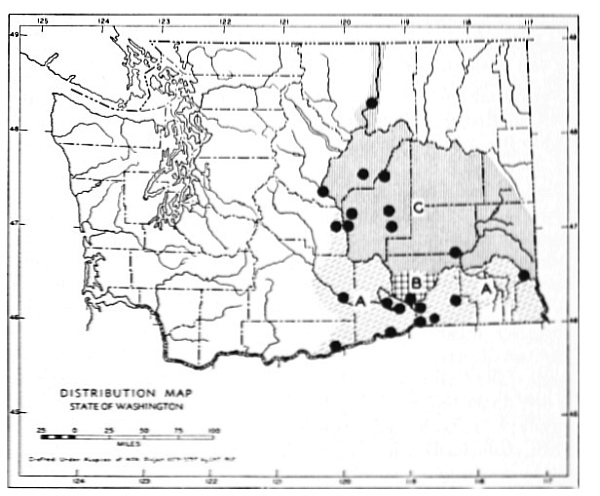
Fig. 93. Distribution of the Great Basin pocket mouse in Washington. A. Perognathus parvus parvus. B. Perognathus parvus columbianus. C. Perognathus parvus lordi.
Type.—Probably obtained in the neighborhood of The Dalles, Wasco County, Oregon.
Racial characters.—Size small; upper parts brownish-buff washed with blackish or, in gray phase, ashy gray washed with blackish; sides buffy yellow; a buffy spot often present on throat; tail blackish above, olive below; facial markings usually brownish-buff but in older animals indistinct and washed with blackish.
Measurements.—Thirty-one males and 19 females from Washington average, respectively: total length 169, 164; length of tail 90, 86; hind foot 22.6, 21.8; ear 5, 5.
Distribution.—Southeastern Washington south of the Snake River, the area on the north side of the Columbia River in Klickitat County, and the Yakima Valley area as far north as the Vantage, Kittitas County (W. W. D.). Other marginal records are: Kennewick (W. W. D.), Atilla (W. W. D.) and Walla Walla (E. S. B.).
Remarks.—Dichromatism seems to be rather common in Perognathus p. parvus—so common that Osgood (1900: 35) recognized both a "red" and a "gray" phase. Anderson (1932: 102) found no dichromatism in P. p. lordi in British Columbia. A single specimen from the Grand Coulee at Dry Falls, Grant County, does show dichromatism. It is even more red than the reddest topotypes of parvus examined.
Seemingly the recessive gene for red is still present in lordi, or has mutated anew. When present, the color is deeper and brighter than in the parent population, in keeping with the heavier pigmentation of the race lordi.
Perognathus parvus lordi (Gray)
Abromys lordi Gray, Proc. Zoöl. Soc. London, p. 202, 1868.
Perognathus lordi Merriam, N. Amer. Fauna, 1:28, October 25, 1889.
Perognathus lordi lordi Miller, U. S. Nat. Mus. Bull., 128:279, April 29, 1924.
Perognathus parvus lordi Davis, Recent Mamm. of Idaho, p. 266, Caxton Printers, Caldwell, Idaho, April 5, 1939.
Type.—Obtained in southern British Columbia (probably near Lake Osoyoos) by J. K. Lord, probably in 1860.
Racial characters.—Size large; color of upper parts buffy-olive, washed with blackish; sides buff-olive; facial markings absent or, if present, indistinct and pale olive; tail blackish above, olive below.
Measurements.—Twenty-nine males and 10 females average, respectively: total length 175, 171; length of tail 93, 89; hind foot 23.4, 22.9; ear 5.3, 5.1.
Distribution.—Okanogan Valley and the Columbian Plateau, except for the southwestern part. Marginal localities are: Vantage, Grant County (W. W. D.), 10 mi. S. Moses Lake (W. W. D.), Washtucna (M. V. Z.) and Pullman (M. V. Z.).
Remarks.—There are constant differences between Perognathus parvus parvus and Perognathus parvus lordi. The latter is larger, darker, and differs slightly in average cranial measurements. The Snake River, the Columbia River, and the Wenatchee Mountains separate the geographic ranges of the two subspecies and prevent intergradation between them. Nevertheless their close similarity and probable common origin indicate that both belong to one species, namely parvus.
Perognathus parvus columbianus Merriam
Perognathus columbianus Merriam, Proc. Acad. Nat. Sci. Philadelphia, p. 263, September 27, 1894.
Perognathus lordi columbianus, Osgood, N. Amer. Fauna, 18:40, September 20, 1900.
Type.—Obtained at Pasco, Franklin County, Washington, by Clark P. Streator on May 9, 1891; type in United States National Museum.
Racial characters.—Size and color as in lordi but skull considerably wider in mastoid region.
Measurements.—Twenty-one male and 9 female topotypes average, respectively: total length 173, 168; length of tail 91, 89; hind foot 23.9, 22.8; ear 5, 5.
Distribution.—The vicinity of the type locality and the part of the Columbian Plateau north of the Snake and east of the Columbia rivers.
Remarks.—This race is separated from parvus by river barriers and the two do not intergrade. It differs significantly from lordi only in the wider mastoid region. No barrier separates the range of lordi from that of parvus, and the two races intergrade over a wide area (north to Moses Lake, east to Washtucna). The race columbianus must have originated in situ from lordi. The habitat of columbianus seems not to differ from that of parvus or lordi.
Dipodomys ordii columbianus (Merriam) Ord kangaroo rat
Perodipus ordi columbianus Merriam, Proc. Biol. Soc. Washington, 9:115, June 21, 1894.
Dipodomys ordii columbianus Grinnell, Jour. Mamm., 2:96, May 2, 1921.
Type.—Obtained at Umatilla, Umatilla County, Oregon, by C. P. Streator on October 18, 1890; type in United States National Museum.
Measurements.—Fourteen males and 9 females from Walla Walla County average, respectively: total length 261.5, 248.4; length of tail 137.2, 139.1; hind foot 40.6, 40.8; ear 13.1, 13.0; weight 52.1, 49.0 grams.
Distribution.—Western Walla Walla County from the Oregon boundary north to the Snake River and on Blalock Island in the Columbia River, Benton County.
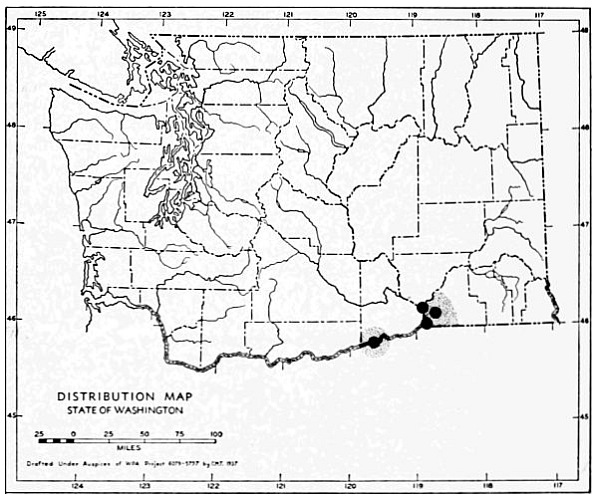
Fig. 94. Distribution of the Ord kangaroo rat, Dipodomys ordii columbianus, in Washington.
Description.—The kangaroo rat with a body about the size of that of a chipmunk has an exceptionally large head and large, black eyes. The forelegs and forefeet are tiny but the hind feet and legs are large and powerful. The hind foot is almost a third as long as the head and body. The tail is long, longer than the head and body. Kangaroo rats possess fur-lined, external cheek pouches, like those of the pocket mice. The upper parts are soft buff in color. The underparts and a stripe on each flank are white. The tail is dusky above and below, with white sides; it is tufted at the tip.
Kangaroo rats are typical of the desert regions of the southwestern United States, where numerous species and subspecies are found. A single subspecies of the wide-ranging species ordii occurs into southeastern Washington, where it is restricted to sandy areas in the Upper Sonoran Life-zone. In the soft, drifted sand along the Columbia River where sagebrush and other desert shrubs are low and widely spaced kangaroo rats are abundant.
These rats are strictly nocturnal. When individuals are dug from their burrows in the daytime they usually hop about in a dazed manner and appear to be blinded by sunlight. Near Wallula, Walla Walla County, these rats were caught at night with a butterfly net as they stood "paralyzed" in the beam of a powerful searchlight. Such night hunting was unsuccessful on cloudy or windy nights when kangaroo rats seem not to move about.
As might be guessed from their powerful hind legs, kangaroo rats travel in bounds. Near Wallula, where we watched them in their natural habitat, they traveled, when unfrightened, in slow hops, each hop followed by a pause. As they struck the surface of the ground an audible thud could be heard for a distance of several feet. After each jump they paused for a second or so, perhaps to allow a pursuing enemy to over-run them.
Near Wallula the burrows of kangaroo rats were dug in large mounds of wind-blown sand. The burrows entered these natural mounds horizontally and branched two or three times. Their average length was about five feet. No nests or food stores were discovered although several kangaroo rats were caught as they burst from entrances at sides of the mounds. All entrances to burrows were plugged with soft sand. The air in the burrows seemed warm and humid.
Food found in the cheek pouches of kangaroo rats from Washington included the seeds of desert annuals, short sections of sprouts of an unidentified plant, grass seeds, and the leaves of the hop-sage.
A female taken March 22, 1939, contained 3 embryos.
Thomomys talpoides (Richardson) Northern pocket gopher
Description.—The pocket gopher is a fossorial animal, being but slightly less adapted to an underground existence than the moles. The body is stout, the legs short and the head broad. The tail is short, sparsely haired, cylindrical and blunt-ended. The fur is soft and dense. The eyes are small and the ears tiny and naked. The incisor teeth are external, being separated from the mouth cavity by a furry strip of skin. Like the pocket mouse and kangaroo rat, the pocket gopher possesses external, fur-lined cheek pouches. The openings of these begin just below and posterior to the nostrils, sweep out and down in a semicircle, and end at the chin posterior to the base of the lower incisors. They extend laterally to the shoulders and easily accommodate a fifty-cent piece.
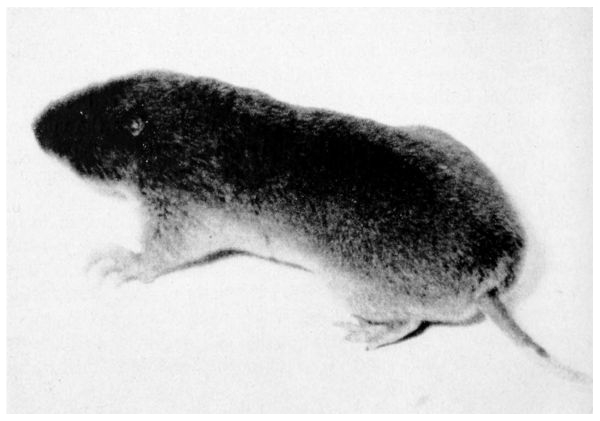
Fig. 95. Northern pocket gopher (Thomomys talpoides yelmensis), from two miles southwest of Tenino, Washington, January 28, 1941. (Fish and Wildlife Service photo by Victor B. Scheffer, No. 1133.)
The family Geomyidae is composed of eight genera, so similar in appearance that the name "pocket gopher" is applied to all of them. The family is confined to North and Central America. Three genera occur in the United States but only one, Thomomys, occurs in Washington. Thomomys is restricted to western North America where it ranges from central Canada south to the southern edge of the table land of Mexico.
Several hundred kinds of Thomomys have been described and as systematic work with this genus has been continued, more and more kinds, originally thought to be species, are found to intergrade and to be only subspecies. All of the 17 kinds of pocket gophers occurring in Washington belong to a single species.
The pocket gopher is principally nocturnal or crepuscular but sometimes it is active at midday, especially if the day be dark and cloudy. Pocket-gopher activity is indicated by fresh mounds of earth on the surface of the ground. Rarely, an observer may see movement of plants as the gopher molests the roots of the plants, or even see the head and shoulders of an animal that partly emerges from an open burrow. The ordinary gopher mound consists of less than a cubic foot of earth. The earth is forced up from a single opening and usually is pushed out in one direction. In consequence it forms in a fan-shaped pile about the opening, and the last load forms a circular plug above and to one side of the burrow opening. When so much earth has been forced out of one opening that expulsion of additional loads of earth is overly difficult, the burrow is extended slightly to one side, or even extended into the newly formed mound, and another fan formed. Usually not more than three coalesced fans form a mound, but where the soil is exceedingly soft and fluffy, hundreds of fans may form a composite mound and the one mound may include a cubic yard of earth. Large composite mounds probably are formed gradually over a period of weeks or even months.
The earth in a fresh gopher mound is usually "scratched," and gives the appearance of having been sieved. Pebbles weighing more than 100 grams are included in material ejected from burrows. The entrances to the burrows of gophers are usually solidly plugged with earth. The plug may be from a few inches to more than a foot in length. At times a burrow entrance may appear to be open, but in such cases investigation will usually reveal it to be plugged some distance back—sometimes several feet.
In contrast to the gopher mounds described above, the mounds of moles are not fan-shaped but volcano-shaped. The earth from a mole's burrow is forced straight upwards, whence it falls to either side. Later loads are pushed up from beneath, raising the entire mound, with the last material ejected at the center and bottom. The earth of a fresh mole-mound is not of fine texture but instead is "clotted" and, if damp, gives the mound a fractured appearance. When mounds are older, perhaps changed by rain and sun, their identity as of mole-origin or pocket gopher-origin is more difficult to establish. In such cases, if no fresh mounds can be found, the observer must rely on the spacing of the mounds. Mole-mounds are spaced along a burrow, about as far apart as a man can step. Gopher mounds are irregularly spaced, and the course of the burrow cannot be traced merely by observing the arrangement of the mounds as can that of the mole.
In addition to mounds, gopher burrows have plugged openings where a gopher has come to the surface, probably to cut plants. Such entrances are marked by a plug of earth several inches long. Mounds and feeding entrances of the gopher burrow are usually not constructed in the main burrow system itself, but at the ends of lateral burrows of varying length. If one traces the burrow back from the mound, a junction with the main, better-constructed burrow is found. The junction is usually T-shaped, with the lateral burrow at right angles to the main burrow. More rarely the junction has a Y-shape.
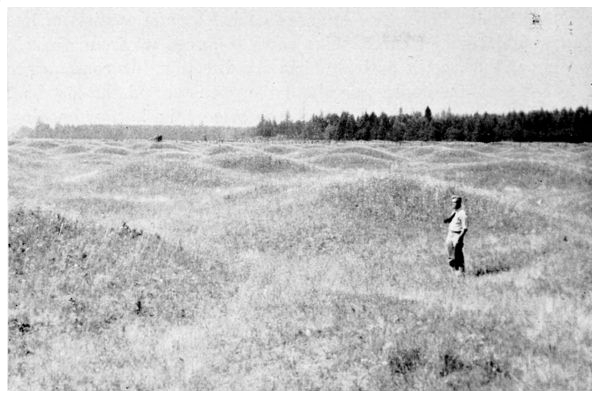
Fig. 96. Giant mounds raised by pocket gophers on Mima Prairie, Thurston County, Washington, July 13, 1941. (Fish and Wildlife Service photo by Victor B. Scheffer, No. 1209.)
The burrow system of the pocket gopher may be divided into three main parts. These are the laterals, just discussed, the main burrow, and the deep nesting burrow. The main burrow is a sinuous tube or tunnel at a relatively uniform depth, that marks the extent of the gopher's home territory. This tunnel may branch, or even intersect. As it is extended in one direction, the earth excavated by the gopher may in part be thrust into an unused portion of the burrow.
The deep, nesting burrows may be used only in the breeding season. They are connected with the main tunnel system but descend to a greater depth. Usually they descend into the harder, consolidated layers of soil below the zone where plant roots penetrate. Here chambers are constructed in which nests and food are stored. Usually a vertical shaft is dug in the burrow ahead of the nest to lead rain water away from the nest.
In areas where gophers live in a thin layer of soil underlain by a more or less impenetrable layer of rock, clay or gravel, it has been suggested that they form unique structures known as Mima Mounds. The formation of these mounds has been discussed in detail elsewhere (Dalquest and Scheffer, 1942: 68-84). At least in the breeding season the gophers work mainly and make their nest where the soil is deepest. In the vicinity of this nest, considerable mounding and cultivation of soil ensues. This stimulates plant growth in the area. Much observation indicates that cultivation of earth by gophers stimulates plant growth to a greater extent than the depredations of the gopher deplete the ensuing growth. Thus the gopher, by cultivation of the soil in the area about its burrow, stimulates the growth of vegetation and so increases his own food supply. Consequently there is but little incentive for the gopher to leave the vicinity of the nest. The gopher does, however, construct lateral tunnels into surrounding areas. Earth from these lateral tunnels is, in part, thrown to the surface in mounds and in part transported back to fill the abandoned burrows near the nest. The earth from the burrows about the nest was earlier ejected on the surface. Slowly, then, earth is transported from surrounding areas to burrows in the vicinity of the original nest. Each succeeding generation finds in the vicinity of the original nest, better food and deeper soil, while areas surrounding the nest possess thinner soil and less vegetation. Over a period of thousands of generations of gophers, large mounds, known as Mima Mounds, are formed. Since the removal of earth from the surrounding areas and its accumulation in the Mima Mound are chance affairs, the contours of the mound are smooth and flowing while the contours of the intermound areas are smoothly convex.
The pocket gophers in Washington are economically important. In truck and flower gardens they are a pest, especially if the crop be bulb plants. In grain fields they are a pest because their mounds cover considerable grain and are apt to clog or dull the knife of the mower. In fields of young alfalfa they are apt to crop back the plant more rapidly than it can grow. Once the alfalfa plant is well established, however, the cultivation resulting from activities of gophers, some persons believe, stimulates the plant to such an extent that it grows larger and healthier in spite of the gopher's feeding on it. In the White Salmon Valley, Klickitat County, I examined numerous alfalfa fields. The most luxuriant growth was invariably in fields where gophers were common. In these fields, the largest plants were those in the immediate vicinity of gopher activity. The commensal relation between the gopher and alfalfa was understood by many farmers, who forbade us to take gophers for specimens from their fields. Several told us that they always trapped the gophers from the fields of young alfalfa and from hay meadows but encouraged their presence in fields of older alfalfa.
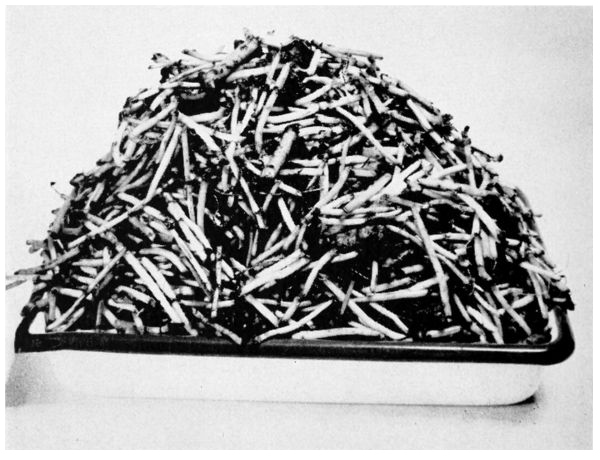
Fig. 97. Food cache of northern pocket gopher (Thomomys talpoides tacomensis), from chamber four inches below surface of ground, Tacoma, Washington, December 1, 1940. Contents 575 grams (about 2 liters) of roots, principally quackgrass, Agropyron repens. (Fish and Wildlife Service photo by Victor B. Scheffer, No. 1119.)
Another economic factor is the gopher's removal of certain weeds from grazing land. A number of introduced weeds form dense rosettes that prevent the growth of grass from several square inches of ground and themselves lie so close to the ground as to be unavailable as food to grazing stock. These weeds seem to be favored food of gophers which cut not only the rosettes but the roots of the weeds as well.
In irrigated parts of eastern Washington the gopher is a serious pest. It burrows in the banks of the main ditches, causing cave-ins and occasional breaks with resultant water loss. The mounds of gophers fill in the smaller channels and divert the streams. Constant attention is necessary to keep the ditches free of gopher mounds.
In uncultivated land the gopher is a distinct asset unless the land is near enough to cultivated land to serve as a reservoir of pests. In the mountains and on the desert the gopher cultivates and keeps the soil soft and stimulates the growth of water-retaining vegetation, thus preventing rapid run-off and erosion and keeping the flow of springs and streams constant. Boulders, logs, and other obstructions are undermined and, as a result of gopher activity, in time sink under the surface of the ground. Thus a larger surface is available for plant growth. Lastly the gopher furnishes an important food source for certain fur-bearing mammals and eases the predator pressure on game species.
The subspecies of pocket gopher occupying the Puget Sound area are highly restricted in their habitat preference; they occur only on the grassy prairies of the glacial outwash aprons. They do not occur in woods, brush or even small openings on the borders of the prairies. The alpine forms occupy the mountain meadows and are slightly less selective in their habits. It should be noted that in western Washington the forests are far more open at higher altitudes than at low elevations. The races inhabiting the desert are found in open areas, often in sandy places. They occur more rarely in areas where the soil is baked and claylike, and then usually in the vicinity of springs or watercourses. The race T. t. fuscus has a wide range of tolerance as regards environmental factors; it occurs near Wenatchee in essentially desert conditions, in alpine meadows of northeastern Washington, and in many habitats at intermediate elevations. It occurs also in brushy areas and is often abundant in open pine forests.
Since the gopher usually has a narrow range of tolerance as regards its environmental adaptations, this has resulted in considerably more isolation than is the case with other mammals, and has probably contributed to the formation of the many subspecies. Within the range of almost every race, microgeographic races, or local populations with distinctive characters, are found. Many subspecies of Thomomys are probably the result of chance fixation of genetic characters already present in a more genetically variable ancestral population, and the loss of other genetic factors. Such races might be considered degenerative (see Dalquest and Scheffer, 1944: 24).
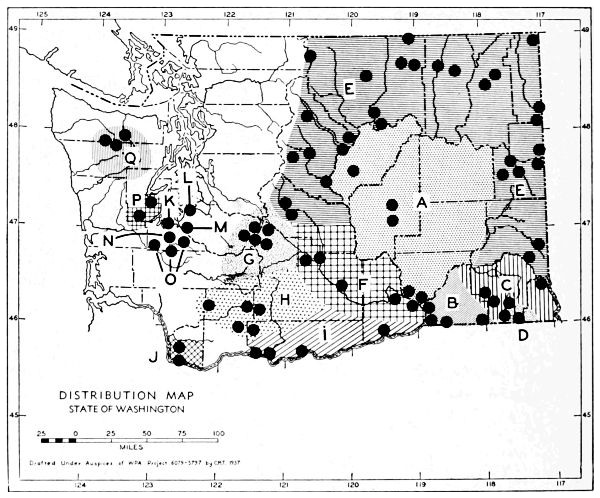
Fig. 98. Distribution of the northern pocket gopher in Washington. A. Thomomys talpoides devexus. B. Thomomys talpoides columbianus. C. Thomomys talpoides aequalidens. D. Thomomys talpoides wallowa. E. Thomomys talpoides fuscus. F. Thomomys talpoides yakimensis. G. Thomomys talpoides shawii. H. Thomomys talpoides immunis. I. Thomomys talpoides limosus. J. Thomomys talpoides douglasii. K. Thomomys talpoides pugetensis. L. Thomomys talpoides tacomensis. M. Thomomys talpoides glacialis. N. Thomomys talpoides tumuli. O. Thomomys talpoides yelmensis. P. Thomomys talpoides couchii. Q. Thomomys talpoides melanops.
The history of the pocket gophers of Washington has been traced previously (Dalquest and Scheffer, 1942, 1944). It may be briefly summarized as follows: At the close of Vashon-Wisconsin times, gophers were found in the southern Cascades, on the Simcoe Bridge, the Columbian Plateau, and in southeastern Washington. Following the retreat of the ice, the gophers in the Mount Rainier area spread westward on the outwash of the Nisqually and perhaps other glaciers to the Vashon Outwash about southern Puget Sound and thence to the Olympic Mountains. In the southern Cascades, gophers spread westward on glacial terraces of the Columbia River to the vicinity of Vancouver, Clark County. The establishment and growth of the forests split up the original populations, and continued spread of forest has exterminated many units. All the races in the lowlands of western Washington face extermination as the prairies are reclaimed by forest.
Pocket gophers also invaded northeastern Washington from Idaho and spread westward to the Cascades, thence southward until the native gophers were encountered north of Mount Rainier and in the Yakima Valley. The invading gophers nearly surrounded the Columbian Plateau.
T. H. Scheffer (1938B: 220-224) found the gestation period of the pocket gopher to be approximately 28 days. No second brood is raised in Washington. Near Kennewick, Yakima County, the young are born from February to April. The average number of embryos found in 76 female gophers was 6.3. Near Olympia, Thurston County, the young are born from March to June. The average number of embryos from 312 females was 5.0.
Thomomys talpoides devexus Hall and Dalquest
Thomomys talpoides devexus Hall and Dalquest, Murrelet, 20:3, April 30, 1939.
Thomomys talpoides ericaeus Goldman, Jour. Mamm., 20:243, May 15, 1939 (type from Badger Mountains, Douglas County, Washington).
Type.—Obtained 1 mile west-southwest of Neppel (now Moses Lake), Grant County, Washington, by W. W. Dalquest on May 30, 1938; type in Museum of Vertebrate Zoölogy.
Racial characters.—Size medium; ears tiny; color of upper parts pale brownish gray; underparts white; postauricular spots dark.
Measurements.—Two male and 4 female topotypes average, respectively: total length 184, 184; length of tail 54, 55; hind foot 25, 25; weight 89, 71 grams.
Distribution.—The Columbian Plateau. Marginal occurrences of the races of pocket gophers occurring in Washington are not listed here because they have recently been placed on record (Dalquest and Scheffer, 1944: 308-333, 423-450).
Remarks.—This is the smallest and palest race of pocket gopher found in Washington.
Thomomys talpoides columbianus Bailey
Thomomys fuscus columbianus Bailey, Proc. Biol. Soc. Washington, 27:117, July 10, 1914.
Thomomys columbianus Bailey, N. Amer. Fauna, 39:106, November 15, 1915.
Thomomys talpoides columbianus Goldman, Jour. Mamm., 20:234, May 15, 1939.
Type.—Obtained at Touchet, Walla Walla County, Washington, by C. P. Streator on September 10, 1890; type in United States National Museum.
Racial characters.—Larger and brighter in color than devexus. Near ochraceous orange in color.
Measurements.—Five male and three female topotypes average, respectively: total length 213, 209; length of tail 60, 58; hind foot 29, 28.
Distribution.—Walla Walla County, between the Snake River and the Oregon boundary and from the Columbia River east to the Columbia County line.
Thomomys talpoides aequalidens Dalquest
Thomomys talpoides aequalidens Dalquest, Murrelet, 23:3, May 14, 1942.
Type.—Obtained at Abel Place, 2,200 ft., 6 miles south-southeast of Dayton, Columbia County, Washington, by S. H. Lyman, on April 6, 1934; type in Museum of Vertebrate Zoölogy.
Racial characters.—Large size, very dark color.
Measurements.—The average of four male topotypes and the measurements of one female topotype are, respectively: total length 202, 201; length of tail 57, 59; hind foot 26, 27.
Distribution.—Southeastern Washington east of the range of columbianus and north of the higher parts of the Blue Mountains.
Thomomys talpoides wallowa Hall and Orr
Thomomys quadratus wallowa Hall and Orr, Proc. Biol. Soc. Washington, 46:41, March 24, 1933.
Thomomys talpoides wallowa Goldman, Jour. Mamm., 20:234, May 15, 1939.
Type.—Obtained at Catherine Creek, 7 miles east of Telocaset, 3,500 ft., Union County, Oregon, by R. T. Orr on June 29, 1932; type in Museum of Vertebrate Zoölogy.
Racial characters.—Similar to devexus but much darker. Similar (in Washington) to aequalidens but much smaller.
Measurements.—Four males and 4 females from Mountain Top and Stay-a-while Spring, Columbia County, average, respectively: total length 191, 180; length of tail 56, 52; hind foot 26, 25.
Distribution.—The higher parts of the Blue Mountains.
Remarks.—Washington specimens referred to this race are intermediate between wallowa and aequalidens but are colored like aequalidens.
Thomomys talpoides fuscus Merriam
Thomomys clusius fuscus Merriam, N. Amer. Fauna, 5:69, July 30, 1891.
Thomomys myops Merriam, Proc. Biol. Soc. Washington, 14:112, July 19, 1901 (type from Conconnully, Okanogan County, Washington).
Thomomys fuscus fuscus Bailey, N. Amer. Fauna, 39:126, November 15, 1915.
Thomomys talpoides fuscus Hall and Dalquest, Murrelet, 20:4, April 30, 1939.
Type.—Obtained at the head of Big Lost River, Custer County, Idaho, by B. H. Dutcher on September 23, 1890; type in United States National Museum.
Racial characters.—Similar to devexus but upper parts rich tawny in color.
Measurements.—Three males and 2 females from Newport, Pend Oreille County, average, respectively: total length 189, 186; length of tail 54, 57; hind foot 27, 26.
Distribution.—Along the eastern border of the state to the north of the Snake River, northeastern Washington, and the northeastern Cascades.
Thomomys talpoides yakimensis Hall and Dalquest
Thomomys talpoides yakimensis Hall and Dalquest, Murrelet, 20:4, April 30, 1939.
Thomomys talpoides badius Goldman, Jour. Mamm., 20:242, May 15, 1939 (type from Wenatchee, Chelan County, Washington).
Type.—Obtained at Selah, Yakima County, Washington, by P. Burgner, on November 27, 1938; type in Museum of Vertebrate Zoölogy.
Racial characters.—Similar to fuscus but more orange, less red.
Measurements.—Four male and 3 female topotypes average, respectively: total length 209, 191; length of tail 60, 56; hind foot 27, 26.
Distribution.—The eastern edge of the Cascades from the Wenatchee Mountains south to the Simcoe Anticline.
Thomomys talpoides shawi Taylor
Thomomys douglasii shawi Taylor, Proc. Biol. Soc. Washington, 34:121, June 30, 1921.
Thomomys talpoides shawi Hall and Dalquest, Murrelet, 20:4, April 30, 1939.
Type.—Obtained at Owyhigh Lakes, Mount Rainier, Pierce County, Washington, by G. G. Cantwell, on August 9, 1919; type in United States National Museum.
Racial characters.—A large, tan-colored pocket gopher, similar to aequalidens but paler.
Measurements.—Two male and 7 female topotypes average, respectively: total length 227, 213; length of tail 72, 64; hind foot 32, 30.
Distribution.—The higher Cascade Mountains from Mount Rainier southward. Southern limits of range unknown.
Thomomys talpoides immunis Hall and Dalquest
Thomomys talpoides immunis Hall and Dalquest, Murrelet, 20:4, April 30, 1939.
Type.—Obtained 5 miles south of Trout Lake, Klickitat County, Washington, by W. W. Dalquest on July 27, 1937; type in Museum of Vertebrate Zoölogy.
Racial characters.—Similar to shawi but paler and grayer.
Measurements.—Two males and 2 females from Morrison Springs Ranger Station, Skamania County, average, respectively: total length 211, 212; length of tail 64, 58; hind foot 28, 29.
Distribution.—The Cascade Mountains from the vicinity of Mount Adams north. The zone of intergradation between shawi and immunis is in the rugged, inaccessible mountains between Mount Rainier and Mount Adams.
Thomomys talpoides limosus Merriam
Thomomys limosus Merriam, Proc. Biol. Soc. Washington, 14:116, July 19, 1901.
Thomomys talpoides limosus Goldman, Jour. Mamm., 20:235, May 15, 1939.
Type.—Obtained at White Salmon, Klickitat County, Washington, by J. A. Loring on June 26, 1897; type in United States National Museum.
Racial characters.—Similar to immunis but darker with smaller, shorter skull.
Measurements.—One male and 13 female topotypes average, respectively: total length 210, 198; length of tail 55, 56; hind foot 30, 28.
Distribution.—The lower Columbia River Valley, from the type locality east to the Columbian Plateau.
Thomomys talpoides douglasii (Richardson)
Geomys douglasii Richardson, Fauna Boreali-American, 1:200, 1829.
Geomys fuliginosus Schinz, Syn. Mamm., 2:136, 1846 (type from "Habitat ad fluvium Columbia").
Thomomys douglasii Allen, Bull. Amer. Mus. Nat. Hist., 5:66, April 28, 1893.
Thomomys douglasi douglasi Bailey, N. Amer. Fauna, 39:116, November 15, 1915.
Thomomys talpoides douglasii Goldman, Jour. Mamm., 20:234, May 15, 1939.
Type.—Obtained at Fort Vancouver (now the city of Vancouver), Clark County, Washington, by David Douglas, probably in 1825. Probably not now in existence.
Racial characters.—A medium-sized, yellowish gopher with tiny, pointed ears and very small postauricular patches.
Measurements.—Two male and 10 female topotypes average, respectively: total length 227, 213; length of tail 68, 63; hind foot 30, 30; and weight 148, 117 grams.
Distribution.—Known only from Clark County.
Thomomys talpoides glacialis Dalquest and Scheffer
Thomomys talpoides glacialis Dalquest and Scheffer, Proc. Biol. Soc. Washington, 55:97, August 13, 1942.
Type.—Obtained 2 miles south of Roy, Pierce County, Washington, by W. W. Dalquest, on December 19, 1941; type in United States National Museum.
Racial characters.—A dark, yellowish-brown gopher with orange-tinged underparts.
Measurements.—Twenty male and 17 female topotypes average, respectively: total length 225, 220; length of tail 72, 71; hind foot 30, 30; and weight 128, 116 grams.
Distribution.—Known only from Roy Prairie, Pierce County.
Thomomys talpoides tacomensis Taylor
Thomomys douglasii tacomensis Taylor, Proc. Biol. Soc. Washington, 32:169, September 30, 1919.
Thomomys talpoides tacomensis Goldman, Jour. Mamm., 20:235, May 15, 1939.
Type.—Obtained 6 miles south of Tacoma, Pierce County, Washington, by G. G. Cantwell on December 24, 1918; type in United States National Museum.
Racial characters.—A large, dark form; rich hazel in color with large, black postauricular patches and ochraceous underparts.
Measurements.—Thirteen male and 15 female topotypes average, respectively: total length 224, 196; length of tail 71, 57; hind foot 31, 29; and weight 127, 104 grams.
Distribution.—Restricted to the area about Steilacoom and Tacoma, Pierce County, Washington.
Thomomys talpoides pugetensis Dalquest and Scheffer
Thomomys talpoides pugetensis Dalquest and Scheffer, Proc. Biol. Soc. Washington, 55:96, August 13, 1942.
Type.—Obtained 4 miles south of Olympia, Thurston County, Washington, by W. W. Dalquest, on December 31, 1941; type in United States National Museum.
Racial characters.—Similar to glacialis but underparts not tinged with orange and conspicuous dusky areas present on sides of neck.
Measurements.—Fourteen male and 19 female topotypes average, respectively: total length 223, 205; length of tail 62, 59; hind foot 30, 29; and weight 123, 96 grams.
Distribution.—Known only from the type locality.
Thomomys talpoides tumuli Dalquest and Scheffer
Thomomys talpoides tumuli Dalquest and Scheffer, Proc. Biol. Soc. Washington, 55:96, August 13, 1942.
Type.—Obtained on Rocky Prairie, 7 miles north of Tenino, Thurston County, Washington, by W. W. Dalquest on January 2, 1942; type in United States National Museum.
Racial characters.—Similar to pugetensis but grayer, less yellow.
Measurements.—Eleven male and 14 female topotypes average, respectively: total length 225, 216; length of tail 60, 64; hind foot 31, 30; and weight 140, 118 grams.
Distribution.—Known only from the type locality.
Thomomys talpoides yelmensis Merriam
Thomomys douglasi yelmensis Merriam, Proc. Biol. Soc. Washington, 13:21, January 31, 1899.
Thomomys douglasii yelmensis Taylor, Proc. Biol. Soc. Washington, 32:169, September 30, 1919.
Thomomys talpoides yelmensis Goldman, Jour. Mamm., 20:235, May 15, 1939.
Type.—Obtained at Tenino, Thurston County, Washington, by C. P. Streator on October 24, 1891; type in United States National Museum.
Racial characters.—A rather small, yellowish race with whitish underparts.
Measurements.—Twenty-one male and 21 female topotypes average, respectively; total length 213, 202; length of tail 64, 61; hind foot 29, 28; and weight 121, 101 grams.
Distribution.—Known only from Grand Mound Prairie (type locality), Vail Prairie, near Vail, and Rochester Prairie, near Rochester, all in Thurston County.
Thomomys talpoides couchi Goldman
Thomomys talpoides couchi Goldman, Jour. Mamm., 20:243, May 15, 1939.
Type.—Obtained on Scotts Prairie, 4 miles north of Shelton, Mason County, Washington, by L. K. Couch, on June 27, 1922; type in United States National Museum.
Racial characters.—A small race; rich hazel in color.
Measurements.—Thirteen male and 9 female topotypes average, respectively: total length 196, 191; length of tail 55, 53; hind foot 27, 27; and weight 87, 79 grams.
Distribution.—Known only from the type locality and from Lost Lake Prairie, near Satsop, Mason County.
Thomomys talpoides melanops Merriam
Thomomys melanops Merriam, Proc. Biol. Soc. Washington, 13:21, January 31, 1899.
Thomomys douglasi melanops Bailey, N. Amer. Fauna, 39:119, November 15, 1915.
Thomomys talpoides melanops Goldman, Jour. Mamm., 20:235, May 15, 1939.
Type.—Obtained at head of Sol Duc River, Clallam County, Washington, by V. Bailey on August 28, 1897; type in United States National Museum.
Racial characters.—Most like shawi but smaller, with larger postauricular patches and dusky areas on side of head.
Measurements.—A male topotype measures: total length 211; length of tail 67; hind foot 28.
Distribution.—Higher Olympic Mountains.
Castor canadensis Kuhl Beaver
Description.—The beaver is the largest rodent occurring in Washington. Large individuals weight approximately 50 pounds. They are heavily-built, robust animals with large heads and short necks. The large, flat, naked tail immediately separates them from all other mammals occurring in the state. The forelegs are short and the forefeet handlike. The hind legs are long, thick and powerful. The hind feet are large and webbed for swimming. The ears are small and the eyes, although of moderate size, are not prominent. The incisors are large and prominent with a distinct yellow or orange color. The close, dense underfur is overlaid with long, lax, rather stiff overfur or guardhairs.
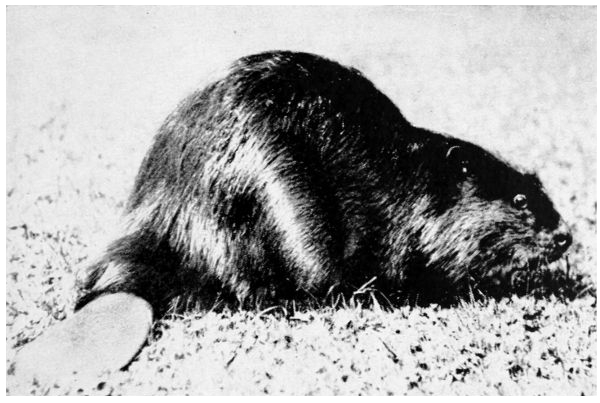
Fig. 99. Beaver (Castor canadensis). Silvana, Washington, August 15, 1921. (Fish and Wildlife Service by Leo K. Couch, No. B-21912.)
Beavers are found in Europe, Asia and North America. In America they range from Alaska to Mexico and from the Atlantic to the Pacific. Many American subspecies have been described, all thought to belong to a single species.
Beavers live in streams and lakes of Washington under diverse climatic conditions. They are perhaps most abundant in the western Washington lowlands where there are numerous watercourses. In the Cascade Mountains they are found well up into the Canadian Life-zone, where the streams are swift and clear with stony bottoms. The highest altitudinal record known to us is Reflection Lake, Mt. Rainier, 4,861 feet (Brockman, 1939: 71). Farther east, in the timbered regions of the eastern Cascades and in northeastern Washington, beavers live in deeper, more sluggish streams. Abundant beaver signs were noted at the junction of the Snake and Columbia rivers where the animals were occupying one of the hottest, most desertlike portions of the state. They are found in Moses Lake, in the center of the arid Columbian Plateau. Beavers once occurred in the San Juan Islands and have recently been reintroduced there.
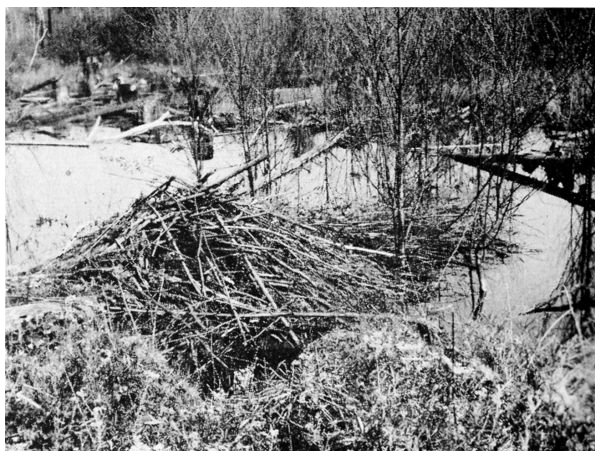
Fig. 100. Beaver (Castor canadensis): lodge and beaver pond, Elbe, Washington, August 24, 1926. (T. H. Scheffer photo.)
The part the beaver played in man's exploration of the state of Washington is a story in itself. The establishment of Fort Vancouver and Fort Spokane and other settlements was principally due to the trade in beaver pelts. These forts served as headquarters for Douglas, Suckley, Townsend, Nuttall and other early naturalists who contributed so greatly to the knowledge of the mammalian fauna of the western United States.
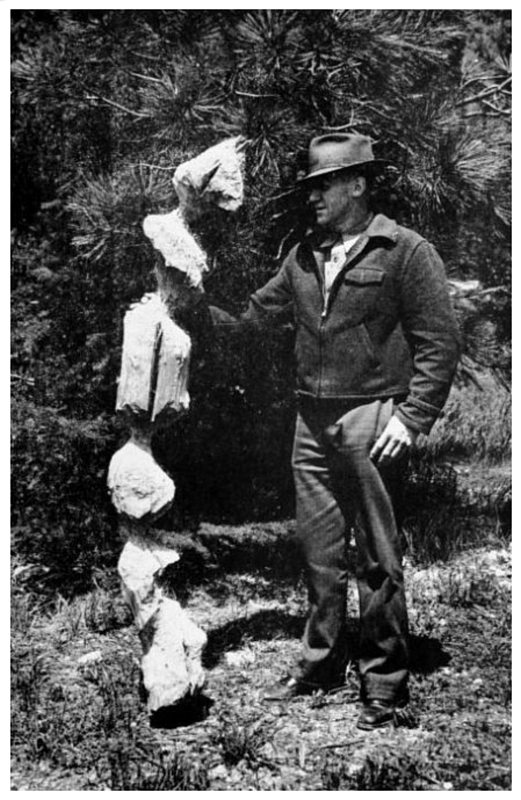
Fig. 101. Cottonwood pole carved by beaver, Lake Wenatchee, Washington, May 13, 1938. (Fish and Wildlife Service photo by Victor B. Scheffer, No. 33.)
Trapping for fur drastically reduced the number of beavers in Washington. After trapping was prohibited they were slow in recovering and, until about 1930, they were uncommon. After that date they seemed to increase rapidly, becoming abundant about 1940. The present system of removing beavers only from areas where they are doing damage, and then only under strict supervision from the State Department of Game, has held their numbers at a high level.
The food of the beaver varies greatly with locality. Along the Columbia River, in eastern Washington, cottonwood (Populus hastata) and willow (Salix sp.) seem to constitute favorite foods. Few other trees grow in this arid region. On Puget Island, near the mouth of the Columbia, willow, alder (Alnus oregonus) and probably other shrubs are eaten. In the many streams that run from the western Cascade Mountains to Puget Sound, various species of willow seem to be the principal food eaten. Some alder, cascara, Douglas fir, red huckleberry and salmonberry are eaten. In some streams on the eastern slope of the Cascades, coniferous trees, including Douglas fir, yellow pine (Pinus ponderosa), and red cedar (Thuja plicata) are used.
Beaver dams are abundant in certain sections of Washington, notably the area between the Cascade Mountains and Puget Sound. Dams several hundred feet in length were seen in the valley of Cherry Creek, 7 miles northeast of Duvall, King County. However, in most parts of the state few dams are built. No dams are necessary in the larger streams and lakes while the smaller mountain streams possess a gradient too steep for successful damming. Spring floods and high water following rains would destroy such dams.
True beaver houses, or lodges, are seldom seen in Washington. In the larger streams, rivers and lakes the beavers are "bank beavers," living in burrows with underwater entrances. In the mountain streams, log jams furnish protection. Great piles of logs and debris accumulate at bends of streams in periods of high water. These jams commonly contain large, well-anchored key logs and persist for years. Back-cutting by the stream often forms deep pools before the jams while the sloping bank opposite may support willows and alders. Thus beavers may find a home, food, and a protecting pool of deep water at a log jam. In periods of low water, and when meandering of the stream causes it to leave the log jam, canals are constructed by the beavers to connect the log jam with the stream.
Where dams are built a few lodges may occur. For the most part, however, the beavers dig holes in the bank or in small islands that result from their dam-building activities. Burrows are occasionally easy to locate because of the mud and sticks laid on the ground above. At best these sticks form a layer only a few inches thick and are too loosely packed to furnish any additional protection. They probably represent a concession to the beavers' lodge-building instincts.
The beaver probably breeds in January. A specimen from Cle Elum, taken on March 1, contained 4 embryos and one from the Teanaway River near Cle Elum held 2 embryos on February 28. One from Swauk Creek, Kittitas County, on the eastern slope of the Cascades, had 3 embryos on February 12. A young beaver was born to a captive animal on May 18. Its mother was taken at Soos Creek in southeastern King County. This baby weighed 884 grams.
The majority of the beavers trapped are small animals, measuring from 725 to 900 mm. (total length) in February, and weighing from 10 to 20 pounds. These are kits, probably one and two years old. It is rather difficult to divide these animals into two age groups but probably the first year young (7 to 11 months old) weigh from 10 to 15 pounds and measure between 725 and 800 mm. in total length. Two-year olds (19 to 23 months) measure from 800 to 925 mm. and weigh from 15 to 25 pounds. They measure approximately 1050 mm. the third year, when they become adult, and weigh in the neighborhood of 45 pounds. Individuals occasionally weigh more than 50 pounds; these are probably old adults.
Damage by beavers is limited. Their dams occasionally flood roads and rarely fields. In some parts of eastern Washington, where fruit raising is an important industry, an individual beaver may cause considerable damage by cutting valuable trees. Ornamental trees may be damaged near the larger cities. Beavers living in Lake Washington in almost the center of the city of Seattle, caused some damage to ornamental trees on the University of Washington Golf Course. Canals and dams in small streams and ditches in areas where stock raising is practiced, flood stock food and sometimes form mudholes or bogs where stock might be trapped. Where individual beavers are doing damage they are trapped and killed, or are live-trapped and transported to more favorable habitats. In places where any beaver may be potentially dangerous, as in the fruit-growing areas of eastern Washington or stock-raising areas in western Washington, their numbers should be kept down by continued trapping.
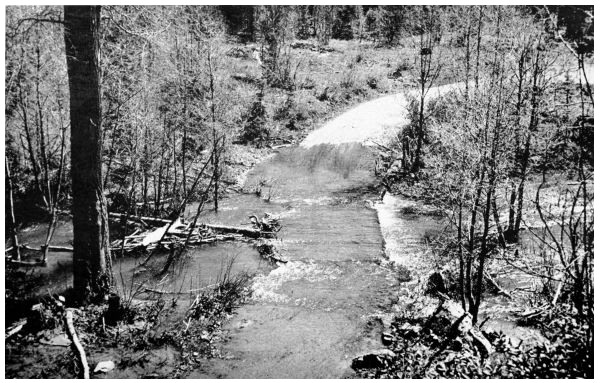
Fig. 102. Forest road flooded by beavers which built a dam on the upstream (left) side of a bridge; Tronson Creek, Blewett Pass, Wenatchee National Forest, May 13, 1938. (Fish and Wildlife Service by Victor B. Scheffer, No. 30.)
Probably the greatest value of beavers lies in the impounding of water by their dams. This is especially true in the arid mountains of eastern Washington and in the logged-off or burned-over parts of western Washington. These ponds prevent erosion, raise the water table and so stimulate the growth of vegetation, insure greater regularity of stream flow, provide suitable water for trout and muskrats as well as some breeding grounds for waterfowl. On burned-over or logged-off land, the greatest, and often the only, growth of new conifers is in the vicinity of beaver ponds. In the vicinity of beaver dams, rich growths of willows and other deciduous vegetation provides food and cover for deer and fur-bearing mammals.
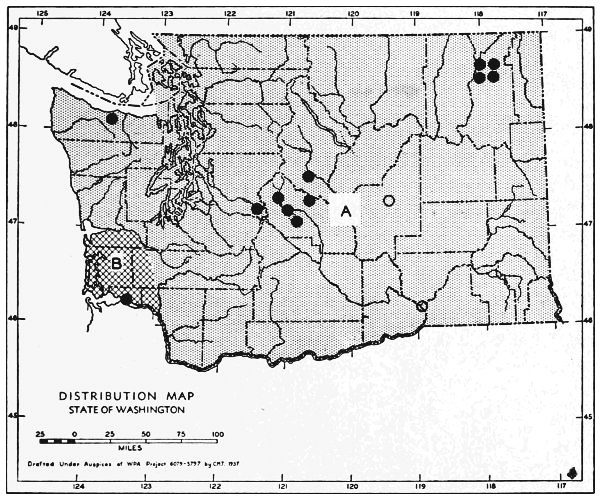
Fig. 103. Distribution of the beaver in Washington. A. Castor canadensis leucodonta. B. Castor canadensis idoneus.
Trapping of beaver for their fur at present is not a private enterprise but controlled trapping by the state adds to public funds.
Castor canadensis leucodonta Gray
Castor canadensis leucodonta Gray, Ann. and Mag. Nat. Hist., 4 (ser. 4):293, October, 1869.
Castor canadensis pacificus Rhoads, Trans. Amer. Philos. Soc., 19 (n. s.):422, September, 1898 (type from Lake Keechelus, Kittitas County, Washington).
Type.—Obtained by Dr. Robert Brown, probably on Vancouver Island, British Columbia.
Racial characters.—Large size; reddish color; elongate skull.
Distribution.—Found over all but the southwestern corner of the state. The most westward locality from which specimens have been examined is Lake Crescent (U. S. N. M.).
Remarks.—The good series of beaver skulls available from several areas of Washington has led to careful comparison of Washington material with specimens from Vancouver Island. Skulls from extreme southwestern Washington are small and decidedly short, being referable to the race idoneus. No satisfactory way of distinguishing between the others could be found and all are consequently referred to the earliest named form, leucodonta.
Castor canadensis idoneus Jewett and Hall
Castor canadensis idoneus Jewett and Hall, Jour. Mamm., 21:87, February 15, 1940.
Type.—Obtained at Foley Creek, tributary to Nehalem River, Tillamook County, Oregon, by C. Leach on December 15, 1914; type in California Museum of Vertebrate Zoölogy.
Description.—Similar to leucodonta but smaller, darker, with shorter and wider skull.
Distribution.—Lowlands near the mouth of the Columbia River. Specimens from Puget Island (U. S. N. M.) have been examined.
Onychomys leucogaster fuscogriseus Anthony Northern grasshopper mouse
Onychomys leucogaster fuscogriseus Anthony, Bull. Amer. Mus. Nat. Hist., 32: 11, March 7, 1913.
Type.—Obtained at Ironside, Malheur County, Oregon, by H. E. Anthony, in 1912; type in American Museum of Natural History.
Measurements.—Nine males and 5 females from Franklin, Benton, and Walla Walla counties, Washington, average, respectively: total length 132.3, 133.0; length of tail 35.8, 35.6; hind foot 19.2, 19.6; ear 17.6, 17.6; weight 23.3, 24.1 grams.
Distribution.—The Columbian Plateau, southeastern Washington, and the Yakima Valley, ranging north to Douglas (Taylor and Shaw, 1929: 21), west to Yakima (M. V. Z.), east to Asotin (Taylor and Shaw, 1929: 21) and south to Wallula (Taylor and Shaw, 1929: 21).
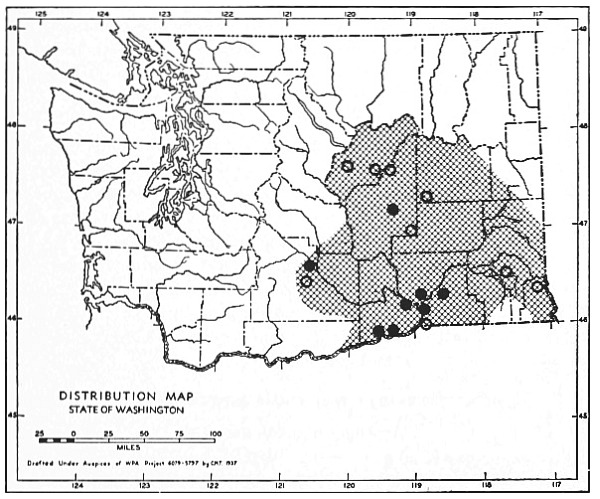
Fig. 104. Distribution of the northern grasshopper mouse, Onychomys leucogaster fuscogriseus, in Washington.
Description.—A mature grasshopper mouse is slightly larger than a house mouse; the head and body measure about 4 inches and the tail about 1-1/4 inches; it may be recognized by the rather plump body, naked ears, short, thick and tapering tail and soft, dense fur. The upper parts of adults are buffy. Younger animals are blue-gray above. Underparts and tail are white.
Grasshopper mice of two species range over much of northern Mexico and the western United States. The species occurring in Washington, leucogaster, is found from southern Manitoba to northern Mexico, and from the Pacific states east to North Dakota. This species is characteristic of the Upper Sonoran Life-zone, and usually is associated with sagebrush and greasewood. It prefers open areas of sand and avoids heavy cover, and seems to be strictly nocturnal. It eats vegetation, seeds, insects, or the flesh of other mice. According to Bailey (1936: 178), grasshopper mice pursue, catch and kill other mice. They hunt by scent and follow tracks like a wolf. They make a sound, or "call," like a miniature wolf howl. They are said to be rather docile and make friends with humans quickly.
On some occasions grasshopper mice are locally abundant, but for the most part they are rather uncommon over their range. Usually one is taken in about 200 traps set in suitable habitats. They do not hibernate; one was caught at Moses Lake, Grant County, on a freezing winter night.
The grasshopper mouse is almost always associated with the pocket mouse (Perognathus parvus), deer-mouse (Peromyscus maniculatus), and often the harvest mouse (Reithrodontomys megalotis). The same snakes, owls, and carnivorous mammals that prey on these mice doubtless eat also the grasshopper mouse.
R. D. Svihla (1936: 172) determined the gestation period of 3 lactating grasshopper mice captured at Lind, Adams County, as 33, 39 and 47 days. A non-lactating female gave birth to a litter in 32 days. Young varied from 2 to 5 in number and were pink and hairless at birth, with eyes and ears closed.
Reithrodontomys megalotis megalotis (Baird) Western harvest mouse
Reithrodon megalotis Baird, Mamm. N. Amer., p. 451, 1857.
Reithrodontomys megalotis nigrescens Howell, N. Amer. Fauna, 36:32, June 5, 1914 (type from Payette, Idaho).
Reithrodontomys megalotis megalotis Bailey, N. Amer. Fauna, 55:189, August 29, 1936.
Type.—Obtained between Janos, Chihuahua, and San Luis Springs, New Mexico, by C. B. R. Kennerly, in 1855; type in United States National Museum.
Measurements.—Five males and 6 females, showing moderate wear on the third upper molars, from Walla Walla County, average, respectively: total length 141, 137.5; length of tail 71.8, 68.1; hind foot 17.2, 16.7; weight (males only) 10.5 grams. A female, 136 mm. long, from Grant County, weighed 9.5 grams. Over the range of megalotis in the United States, males average consistently larger than females in length of the hind foot and consistently less in length of head and body.
Distribution.—The Columbian Plateau, the Upper Sonoran Life-zone area west of the Columbia River and south of the Wenatchee Mountains in Kittitas, Yakima, and Benton counties, the north side of the Columbia River in Klickitat County, and Okanogan County east of the Okanogan River. Marginal localities are: Timentwa (W. W. D.) on the north, Maryhill (M. V. Z.) on the west, Wallula (M. V. Z.) on the south, and Colfax (Taylor and Shaw, 1929: 21) on the east.
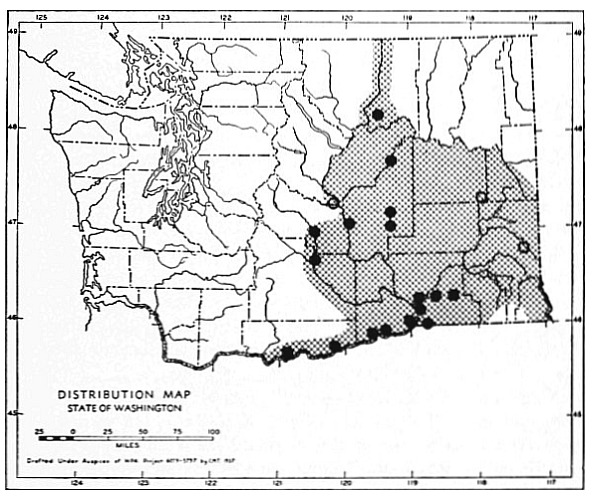
Fig. 105. Distribution of the western harvest mouse, Reithrodontomys megalotis megalotis, in Washington.
Remarks.—Harvest mice from the states of Washington, Oregon, Idaho, Utah, Nevada, California, Arizona, and New Mexico were examined to ascertain the validity of the name Reithrodontomys megalotis nigrescens Howell (type from Payette County, Idaho). No cranial characters or measurements could be found to separate nigrescens from megalotis. Specimens from Washington, Oregon, and west-central Idaho, within the range ascribed to nigrescens, averaged slightly darker in color with a more distinct, blackish dorsal line than specimens from New Mexico. This difference is slight, and specimens from any one locality vary greatly in color. Some Washington specimens are as pale as the palest material from New Mexico, and some of the darkest nigrescens can be matched by specimens of megalotis from Arizona and New Mexico. This slight color variant is not worthy of recognition as a distinct subspecies, and I agree with Howell (1939: 390) that nigrescens is a synonym of megalotis.
Description.—The western harvest mouse is about the size and shape of the common house mouse. The length of the tail is approximately equal to the length of the head and body. The tail is slim and lightly haired. The upper parts are brownish buff lightly washed with blackish. A faint but distinct dark dorsal stripe is usually present. The underparts are white. From Mus and Peromyscus, Reithrodontomys can be distinguished by the grooves on the anterior face of the upper incisors and the long brown hairs at the bases of the ears.
This genus reaches the extreme northern limit of its distribution in the state of Washington, where it ranges to the Canadian border. A single subspecies occurs in Washington. The harvest mouse is a resident of the Upper Sonoran Life-zone and it is most abundant in dense growths of grass, weeds, and other vegetation. Along the Yakima River, near Ellensburg, it was abundant in thick, river-side jungle. Near Yakima many specimens were taken in a marsh of cattails and tules. In the Grand Coulee they live in thick grass. Near Moses Lake several were found in their nests in a thick growth of tumbleweed. Harvest mice occur also, although never in great numbers, in relatively open areas. At the Potholes near Moses Lake, Grant County, a few were caught on sand dunes among scattered bushes of sage. They were taken on sagebrush flats in several localities. Gray (1943: 191) estimates their numbers in the sagebrush area of the Yakima Valley at 5 per acre.
Where harvest mice live in dense vegetation they make small runways and food piles similar to those of Microtus but in more open areas they leave no perceptible signs. Near Yakima the nest of a harvest mouse was found among the roots of an overturned apple tree. This nest was an irregular ball composed of fine grasses and shredded bark closed above, with a side entrance and a central cavity three inches in diameter. Near Moses Lake three nests of harvest mice were discovered on the ground under cover of a dense growth of tumbleweed, and six live harvest mice were captured in the same area. These nests were cuplike, open above, and were composed of dry grasses, bits of weeds, and newspaper. The smoothly rounded inner cups measured about three inches in diameter.
Embryos were found in harvest mice in Washington from March to April and numbered 3 to 6.
Peromyscus maniculatus (Wagner) Deer mouse
Description.—The deer mouse is slightly larger than the house mouse, the head and body measuring from 3-1/2 to 4 inches. The length of the tail varies considerably in the several races, ranging from approximately 2-1/2 inches in gambelii to 4 inches or more in some individuals of oreas. The eyes are large and protrude slightly. The ears are large, erect and naked. The tail is sparsely furred with short, posteriorly directed hairs. The color of the upper parts varies from yellowish buff in gambelii to reddish brown in oreas and dusky in austerus. Young deer mice are gray or bluish gray above. Underparts and feet are white. The tail is bicolored, being dusky above and white below.
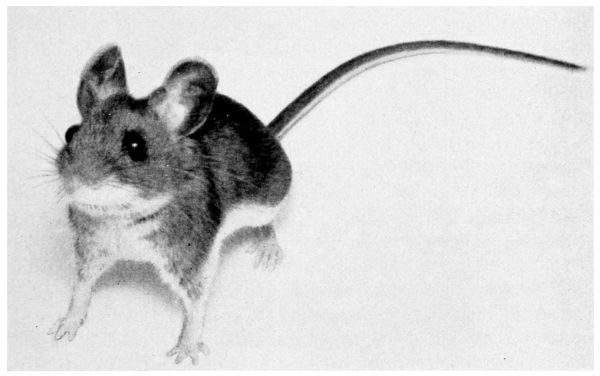
Fig. 106. Deer mouse (Peromyscus maniculatus austerus), in captivity, Seattle, Washington, September 18, 1939. (Fish and Wildlife Service photo by Victor B. Scheffer, No. 723.)
In Washington Peromyscus may be separated from other naked-eared mice by ungrooved teeth and slightly tapering, bicolor tail. Nearly every part of North America is inhabited by one or more kinds of Peromyscus. The single species, maniculatus, which occurs in Washington, ranges from the Atlantic to the Pacific and from the Arctic to tropical Mexico. Osgood (1909: 17) remarks: "... it is probable that a line, or several lines, could be drawn from Labrador to Alaska and thence to southern Mexico throughout which not a single square mile is not inhabited by some form of this species."
Deer mice are the most abundant mice in Washington. They occur at sea level on the ocean beaches and above timber-line, even breeding in the Arctic-alpine Life-zone. They occur on the islands in Puget Sound, the lowland marshes and deciduous thickets of western Washington, the great conifer forests, the alpine cirques and mountain parks, and the deserts of eastern Washington. Almost everywhere they are the commonest mammal encountered. They make their homes in city dwellings, under logs or in hollow trees in the forest, in the burrows of larger rodents and, if necessary, in burrows of their own construction.
Nests are usually cup-shaped masses of soft material, 4 to 8 inches in diameter with central cavities 2 to 3 inches in diameter. Materials utilized include dry grass, shredded bark, rope, rags, newspaper, moss, cattail fluff, fur, wool, and feathers. One nest discovered in the attic of an old building near Coulee City, Grant County, consisted of the mummified body of a wood rat (Neotoma cinerea). The fur of the arched body of the rat formed one side of the nest, while the fur of the far side of the body had been plucked to form the remainder. In the extensive marshes along Lake Washington, King County, deer mice occupy the ball-shaped nests of tule wrens (Telamtodytes palustris). These are constructed entirely of fragments of cattail leaves and cattail fluff and are placed in the cattail rushes about four feet above the wet ground of the marsh. Other deer mouse nests were found in an unused typewriter, in the pocket of an old coat, in a window frame, under a piece of tar paper on the ground, in a cavity in the ground under a board, between a ceiling and a loose bit of roofing paper, under rocks and logs, in hollows in logs, and in an unused nest of a wood rat. Where plant cover is dense, nests are placed on the surface of the ground, as under thick growths of tumbleweed (Salsola) in eastern Washington.
Deer mice are definitely nocturnal. Of thousands of specimens trapped only a few were taken in the daytime. Two of these were taken in a rock slide at Pass Creek Pass, Pend Oreille County, on the same day, and some unusual conditions may have incited them to travel in daylight. Deer mice are active throughout the winter and their lacy footprints are seen on the snow in below-freezing weather. They are mainly terrestial but one race (oreas) is at least partly arboreal for it is often taken in traps set in trees for flying squirrels. One was caught in a trap set 50 feet from the ground. All are good climbers, and oreas is perhaps the best. One was watched as it climbed the rough cedar shake wall of a cabin, ran upside-down across three feet of rough ceiling, and descended the opposite wall head first. They are equally agile in climbing rocks and cliffs.
The ordinary gait of the deer mouse is a steady run. When frightened it may leap a distance of one foot or more. When surprised in its nest it usually remains in the vicinity, hopping about in confusion, returning time after time to the exposed nest.
The food of deer mice consists principally of vegetable material such as seeds, nuts, berries, and the soft parts of fleshy plants. Mushrooms and lichens are eaten. Insect remains are present in small quantities in most stomachs examined. Flesh is also eaten and small mammals caught in traps are often eaten by deer mice. Cannibalism appears to be common only in captivity.
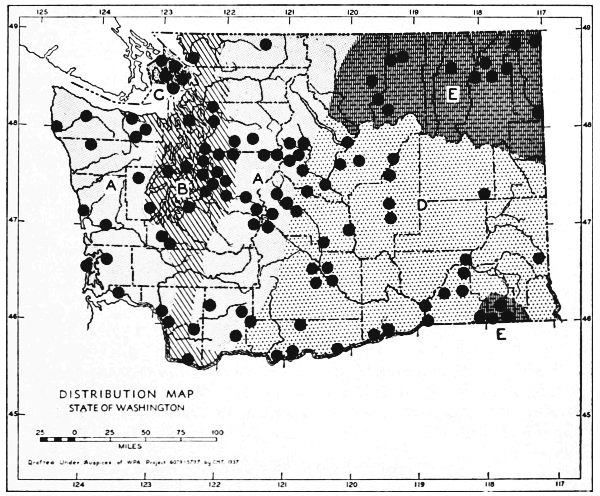
Fig. 107. Distribution of the deer mouse in Washington. A. Peromyscus maniculatus oreas. B. Peromyscus maniculatus austerus. C. Peromyscus maniculatus hollisteri. D. Peromyscus maniculatus gambelii. E. Peromyscus maniculatus artemisiae.
Deer mice are often heavily parasitized by tapeworms and roundworms. Virtually all of the deer mice taken on Jones Island in the San Juan Islands had livers so infected by the eggs of a nematode worm as to be swollen to several times their natural size, and had a yellow, crystalline appearance. The maggots of parasitic flies often occur in the anal and genital region of deer mice, effectively sterilizing some individuals.
Predatory snakes, birds, and mammals doubtless kill and eat deer mice. Strangely enough, although deer mice may be the commonest mammal in an area, the pellets of owls collected in the same area usually contain the remains of relatively few deer mice. The impact of owls seems to be greatest upon mice, such as Microtus, which follow definite runways.
The breeding season of the deer mouse extends over most of the spring and summer. Growth and development of the young of Peromyscus m. oreas have been discussed by A. Svihla (1936A). Embryos found varied in number from 2 to 8 with a mean of 4.5.