ACCOUNTS OF SPECIES AND SUBSPECIES (continued 3)
Reading edition
One shrew was found in the stomach of a coyote from Washington, and two stomachs contained moles. A house cat was eaten by one Washington coyote, and another coyote had eaten a raccoon. Birds occurred in 13 per cent of the stomachs examined but formed only a small part by volume. Poultry formed one-fourth of this volume. Reptiles formed 0.08 per cent of the food eaten by coyotes and occurred in 3 per cent of the stomachs. A coyote from Washington had eaten a garter snake. No frogs were found in coyote stomachs. A coyote from Washington had eaten a salamander. Another had eaten a fish. Insects formed 1.08 per cent of the total food eaten by coyotes. Fruit formed 3.63 per cent. Carrion constituted 25.2 per cent of the total food eaten.
It is extremely difficult to draw conclusions regarding the economic value of any species. Much depends on the outlook of the individual, his occupation, the locality where the animal occurs and local conditions there. Furthermore it is impossible to understand and fairly weigh all the factors involved.
Coyotes destroy game and stock. They also eat carrion and destroy sick animals, thus preventing the spread of disease. They eat jack rabbits which are pests, and snowshoes and cottontails which are game. They eat mice, which are a pest in agricultural areas, a benefit on rangelands where they destroy weed seeds, and of neutral importance elsewhere. To analyze the economic value of the coyote, the economic importance of all animals on which it feeds must be considered and the "good" and "bad" balanced—a well-nigh impossible task.
In any event, the coyote has been judged and found guilty. Coyotes are controlled by poison, trapping, and bounty. In spite of control measures the coyote is holding its own in numbers or increasing.
Stimulated in part by the bounty, professional trappers take many coyotes each year in Washington. The pelts fluctuate in value from year to year but a large, prime skin usually brings from 5 to 10 dollars.
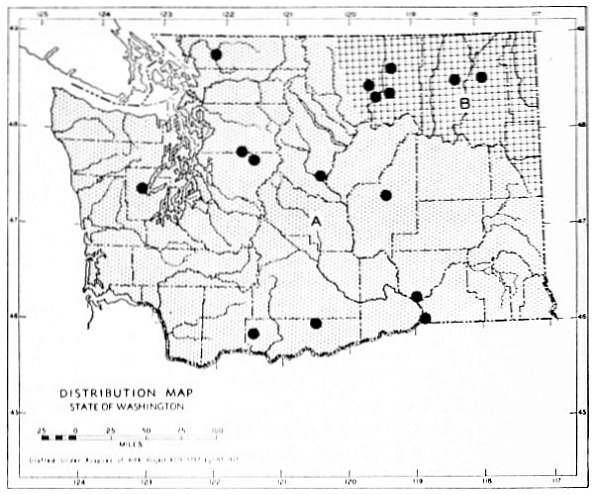
Fig. 70. Distribution of the coyote in Washington. A. Canis latrans lestes. B. Canis latrans incolatus.
Canis latrans lestes Merriam
Canis lestes Merriam, Proc. Biol. Soc. Washington, 11:25, March 15, 1897.
Canis latrans lestes Taylor and Shaw, Mamm. and Birds Mt. Rainier Nat. Park, p. 41, 1927.
Type.—Obtained in the Toyabe Mountains near Cloverdale, Nye County, Nevada, by V. Bailey on November 21, 1890; type in United States National Museum.
Racial characters.—Frontal region of skull only slightly concave.
Measurements.—A male from 20 miles south of Ephrata, Grant County, on the Columbian Plateau, measures: total length 1185; length of tail 365; hind foot 198; ear 125; weight 26-1/2 lbs. A female from 10 miles northeast of Goldendale, Klickitat County, in the southern Cascades, measured: 1105; 280; 197; weight 19 lbs. A female from Cashmere, Chelan County, in the northern Cascades, measured: 1209; 410; 210; 131. A female from the middle fork of the Nooksack River, Whatcom County, in western Washington, measured: total length 1185; length of tail 358.
Distribution.—Suitable areas of the entire state, except for northeastern Washington.
Remarks.—Pending a revision of the coyotes, those of western Washington are referred to lestes.
Canis latrans incolatus Hall
Canis latrans incolatus Hall, Univ. California Publ. Zoöl., 40:369, November 5, 1934.
Type.—Obtained at Isaacs Lake, 3,000 ft. elevation, Bowron Lakes Region, British Columbia, by T. T. and E. B. McCabe on October 23, 1928; type in Museum of Vertebrate Zoölogy.
Racial characters.—Similar to lestes but frontal region more concave.
Measurements.—A male from 20 miles east of Tonasket, Okanogan County, measures: total length 1033; length of tail 291; hind foot 163; ear 110.
Distribution.—Northeastern Washington, west to Okanogan and Conconully (W. W. D.).
Remarks.—Several series of coyote skulls from northeastern Washington are more variable than series of lestes from California and incolatus from British Columbia. The "dish-faced" character of incolatus is more strongly represented in some coyotes from northeastern Washington than in topotypes of incolatus but others are more like lestes. In average measurements they are nearer incolatus.
Canis lupus fuscus Richardson Timber Wolf
Canis lupus var. fusca Richardson, Mammalia, Zoölogy, Captain Beechey's voyage of the Blossom, p. 5, 1839.
Lupus gigas Townsend, Jour. Acad. Sci. Philadelphia, 2:75, November, 1850 (type from near Vancouver, Clark County, Washington).
Canis gigas Miller, Smithsonian Misc. Coll., 59 (no. 15):4, June 8, 1912.
Canis occidentalis gigas Taylor and Shaw, Birds and Mamm. Mt. Rainier Nat. Park, p. 39, 1927.
Canis lycaon gigas Bailey, N. Amer. Fauna, 55:272, August 29, 1936.
Type locality.—Banks of the Columbia below The Dalles in Oregon or Washington.
Racial characters.—A large, relatively dark colored wolf with wide skull and heavy dentition.
Distribution.—Probably occurred from the eastern base of the Cascades westward to the Pacific. Now extinct over most of its range.
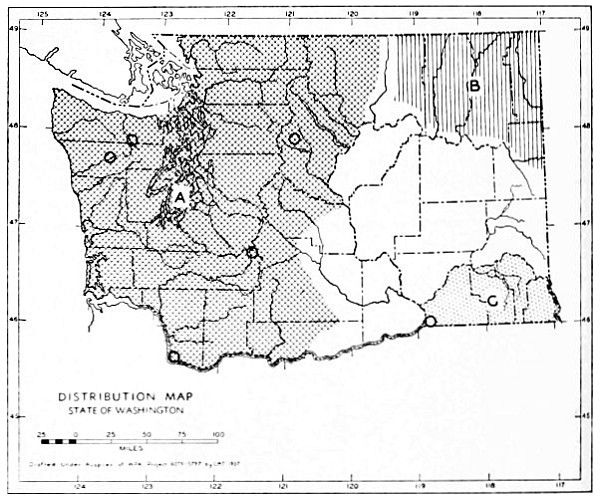
Fig. 71. Probable past distribution of the wolf in Washington. A. Canis lupus fuscus. B. Canis lupus columbianus. C. Canis lupus irremotus.
Description.—The wolf is a large carnivore of the general proportions of a large collie dog. Wolves closely resemble coyotes but are larger, with stouter body, larger feet, thicker muzzle and more massive, powerful skull and teeth. The fur of wolves is long and rather stiff. In general color of the body they resemble coyotes, but the underparts are less white and the legs and feet are more contrastingly reddish.
Wolves of the species Canis lupus range over the northern parts of both the Old and New World. In America they are found from the Arctic south into Mexico.
Wolves occurred in western, northeastern and southeastern Washington. They seem not to have occurred on the Columbian Plateau. Wolves are generally associated with the larger, hooved mammals upon which they feed. In Washington these probably once included the elk, deer, mountain sheep and mountain goat. Hooved animals, except mountain sheep and deer, may not have occurred on the Columbian Plateau in historic times, and even the deer and sheep probably were scarce. There was probably little food for wolves on the Plateau.
The early settlers found wolves to be common and a serious pest. By 1900 they had nearly disappeared. In the settled parts of western Washington they were doubtless exterminated at an early date but it is difficult to account for their disappearance on the Olympic Peninsula. To the best of my knowledge, two wolves killed on the north fork of the Quinault River in 1920, or a few years earlier, were the last ones from that peninsula. Previously they were common and I doubt that man killed them all; perhaps some introduced disease, such as rabies, brought about their extinction.
In the Cascade area they probably still exist in small numbers and in remote places. There are said to be some near Mount Adams. They have been reported from Mount Rainier as recently as 1920. Trappers state that there are a few in the northern Cascades, between Lake Chelan and Mount Baker. There are no recent records for southeastern Washington. The last wolves killed on the Columbian Plateau were two taken at Wahluke, Grant County, on September 17, 1917. Only rumors—no authentic reports—of wolves are available from northeastern Washington in recent years. The reappearance of the caribou there may attract wolves from British Columbia.
Any report of wolves, even from experienced trappers, is open to some question. An unusually large coyote often is mistaken for a wolf. A large, wild and wolflike dog is even more likely to be mistaken for a wolf.
The wolf no longer is an important element in the mammalian fauna of Washington and will probably never be so again. The species, like the grizzly bear, is nearly extinct in the state.
Canis familiaris Linnaeus Dog
Canis familiaris Linnaeus, Syst. Nat., ed. 12, 1:56, 1766.
Type locality.—Sweden.
Dogs were present with aboriginal man in Washington, previous to the arrival of the white man. For greater detail see Bailey (1936), Suckley and Gibbs (1860) and Allen (1920).
Felis concolor Linnaeus Cougar or mountain lion
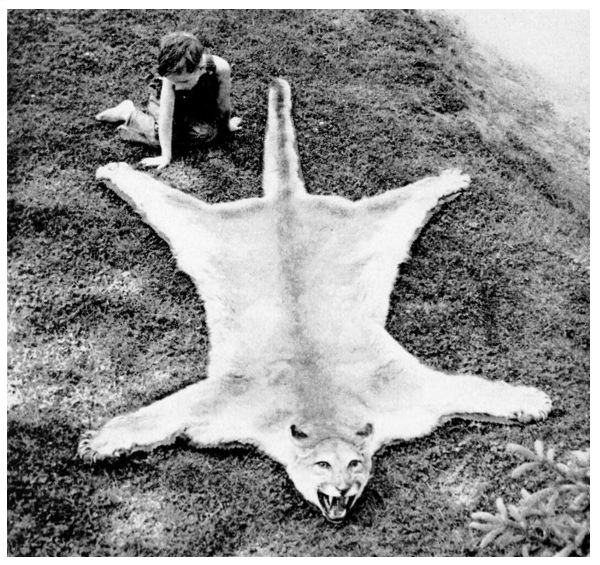
Fig. 72. Cougar or mountain lion (Felis concolor missoulensis), skin mounted as a rug; shot on Mill Creek, Pend Oreille County, Washington, February 13, 1935, by Ralph Johnson. Skin now measures: snout to tip of tail 252 cm., span between tips of forepaws 157 cm., tail 89 cm.; male. (Fish and Wildlife Service photo by Victor B. Scheffer, No. 66.)
Description.—The cougar is a large cat and has the general proportions of the house cat. Large cougars measure more than seven feet in length of which the tail comprises two feet. Large males weigh more than 150 pounds. Females are smaller and lighter than males. In color the head, back, tail and outside of the legs are reddish brown. The throat, underparts and inside of the legs are white. The tip of the tail, or area near the tip, is black or blackish.
Cougars, often called mountain lions, pumas and panthers, range from Canada to southern South America.
The cougar feeds extensively upon deer and its habits and habitat are accordingly specialized. It is active in both winter and summer and zonally ranges from the Transition through the Canadian to the Hudsonian life-zones.
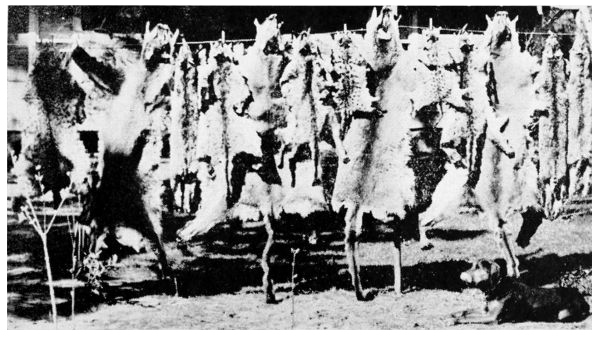
Fig. 73. Cougar or mountain lion (Felis concolor oregonensis), adults and young taken by Dewey Schmid in White Salmon Valley, Washington, about December 1, 1937, and January 1, 1938. Two bobcats show at extreme right. (Dewey Schmid photo.)
The number of deer killed by the average cougar is unknown. Some trappers believe that a cougar kills a deer at least every other day while others feel that only one a week is taken. Other food is eaten when available. Because cougars kill deer, they are incessantly warred upon by hunters and sportsmen. Bounties, often generous, have long been paid in Washington. Although many cougars are killed each year they are still numerous in many areas. So many remote areas in the mountains are not easily accessible to man and dogs that the cougar, as a species, probably will persist for many years.
A cougar is one of the most secretive animals in the wilds. Rarely are individuals seen by man. They are difficult to trap, principally because they are such wide-ranging animals and partly because they prefer to feed on fresh deer meat and hence are not apt to be attracted to trap bait. For these same reasons they are difficult to poison. By using poisoned hamburger, a government agent did poison one near Leavenworth, Chelan County. The principal method of killing cougar is to hunt them with packs of especially trained hounds which pursue the cougar until it takes refuge in a tree or other supposed place of safety, where it is shot.
A common gait is a swift, smooth trot in which the body is kept low and the tail droops with the terminal part bent backwards. A wild cougar seen near Leavenworth, Chelan County, traveled with effortless speed until fired upon. At the sound of the shot it made two great bounds and disappeared into the brush fringing a canyon.
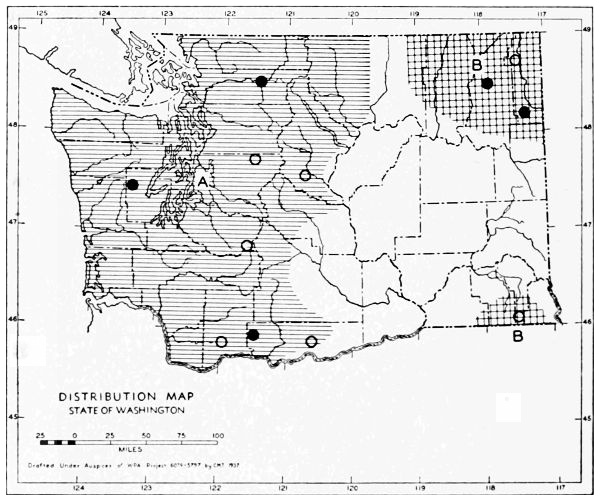
Fig. 74. Distribution of the cougar in Washington. A. Felis concolor oregonensis. B. Felis concolor missoulensis.
Although the cougar is a large and powerful carnivore it almost never makes unprovoked attacks upon man. An exception was the cougar that partially devoured a thirteen-year old boy near Lake Chelan, Chelan County (Finley, 1925: 197-199).
The hunting range of an individual cougar is many miles in extent. These ranges are traveled periodically and any particular area may be visited regularly every few days. The cougars may travel many miles each night in search of deer. Their ranges must overlap to a certain extent for as many as 12 have been taken from a single drainage area. Over most of the year they are solitary but breeding females may attract several males and hunters occasionally capture a female and several males at one locality. Breeding occurs in almost any month of the year. The young are cared for by the female and follow her for perhaps a year. Young individuals have been taken at the same time and in the same locality as an adult female and several adult males that supposedly were breeding. There are from one to three young in a litter. For the first months of their life cougar kittens are spotted. In this they differ from the young of the bobcat which are plain or slightly mottled and do not become spotted until later in life. Cougar kittens differ further from bobcat kittens in possessing a long tail.
The pelage of the cougar is short and of no value as fur although the skins often are sold at a good price as trophies when prepared as rugs.
Felis concolor oregonensis Rafinesque
Felix [sic] oregonensis Rafinesque, Atlantic Journal, 1:62, 1832.
Felis hippolestes olympus Merriam, Proc. Biol. Soc. Washington, 11:220, July 15, 1897 (type from Lake Cushman, Mason County, Washington).
Felis oregonensis Stone, Science, n. s., 9:35, January 6, 1899.
Felis oregonensis oregonensis Miller, U. S. Nat. Mus. Bull., 128:158, April 29, 1924.
Felis concolor oregonensis Nelson and Goldman, Jour. Mamm., 10:347, November 11, 1929.
Type locality.—"Oregon Mountains, or east or west of them."
Racial characters.—Light, rounded skull, dark color, extensive black on tip of tail and short, rather coarse fur.
Distribution.—From the eastern base of the Cascade Mountains westward to the Pacific. Marginal records are (trappers' specimens): Ruby, Leavenworth, and Goldendale.
Felis concolor missoulensis Goldman
Felis concolor missoulensis Goldman, Jour. Mamm., 24:229, June 8, 1943.
Type.—Obtained 10 miles southwest of Missoula, Missoula County, Montana, by R. and C. Thompson, on December 30, 1936; type in United States National Museum.
Racial characters.—A large cougar with heavy, wide skull, pale color and rather long, soft fur.
Distribution.—Northeastern Washington west at least to Republic (W.W.D.) and the Blue Mountains of southeastern Washington.
Remarks.—Goldman (1943: 229) states "Between the Rocky Mountains and the Cascade Range missoulensis intergrades with oregonensis." My own comparison of specimens reveals differences of considerable magnitude between the cougars of western and northeastern Washington. I suppose that intergradation takes place in a limited area in, and west of, the Okanogan River Valley in Washington.
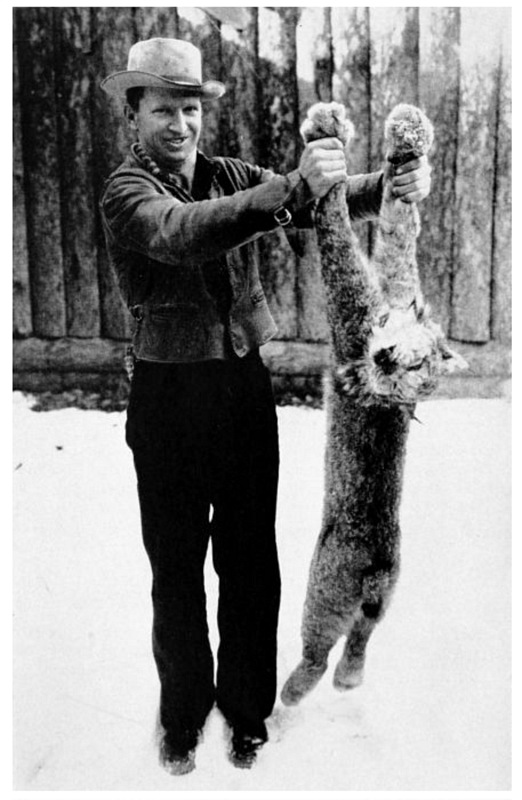
Fig. 75. Canadian lynx, Lynx canadensis, male, taken February 16, 1939, on Baldy Mountain, northwest Idaho, by Lloyd Robinson of Sandpoint. (Ross A. Hall photo.)
Lynx canadensis canadensis Kerr Canadian lynx
Lynx canadensis Kerr, Anim. Kingd., 1: systematic catalogue inserted between pages 32 and 33 (description, p. 157), 1792.
Lynx borealis canadensis True, Proc. U. S. Nat. Mus., 7:611, 1885.
Lynx canadensis canadensis Miller, U. S. Nat. Mus. Bull., 128:160, April 29, 1924.
Type locality.—Eastern Canada.
Measurements.—A female from Buttermills Creek, Twisp River, Okanogan County, measured: total length 900; length of tail 95; hind foot 205.
Distribution.—Higher parts of the Cascade Mountains, Blue Mountains and mountains of northeastern Washington, recorded from Oroville on the north (W. W. D.) to Mount Adams (Taylor and Shaw, 1929: 13) on the south.
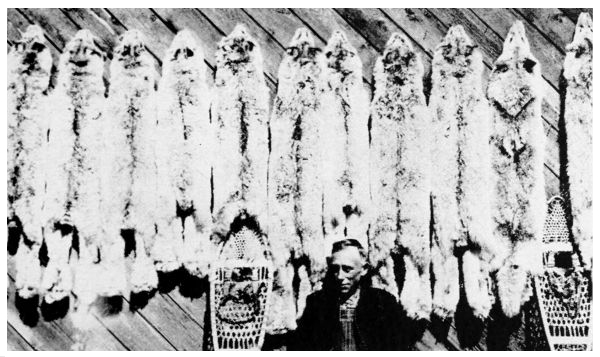
Fig. 76. Canadian lynx (Lynx canadensis), catch of nine, with two coyotes, taken by Lester Fairbrother in hills west of Oroville, Washington, March, 1938. (Lester Fairbrother photo.)
Description.—The Canadian lynx weighs about 20 pounds and is catlike in general proportions but differs in possessing longer, stouter legs, much larger feet, a short tail, tufted ears and long, very soft fur. The pelage of the upper parts is soft gray with a slightly yellowish tone; the ears and tail are black; and the underparts are gray with indistinct black spots. The pelage is shorter and more reddish in summer. Bailey (1936: 271) records a maximum weight of 28 pounds.
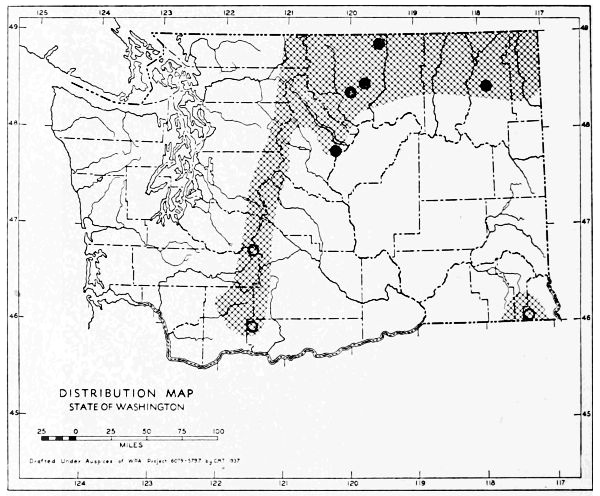
Fig. 77. Distribution of the Canadian lynx, Lynx canadensis, in Washington.
The lynx ranges over the forested parts of North America from the Arctic south into the northern United States. It has a restricted range in Washington, occurring in the same areas as does the red fox. Although the lynx is an important fur bearer in Canada and Alaska, it is unimportant in Washington because only a few are trapped each winter. Most of the natural range is in the remote and wilder parts of the mountains. Here, each of several trappers regularly takes a dozen or more each year. Mr. Lester Fairbrother of Oroville, Okanogan County, regularly traps lynxes in the northern Cascades. They are taken in wooded areas where snowshoe rabbits, their principal food in winter, are abundant. In the more accessible parts of the animal's range, such as the Blue Mountains and the mountains of northeastern Washington, lynxes are rare. As much as sixty dollars each is offered for large skins.
Lynx rufus (Schreber) Bobcat
Description.—The average male bobcat weighs approximately 20 pounds. The female is about one-fourth lighter. A bobcat has longer, stouter legs and larger feet than a house cat and a short tail. The ears are short, with pointed tufts of hair.
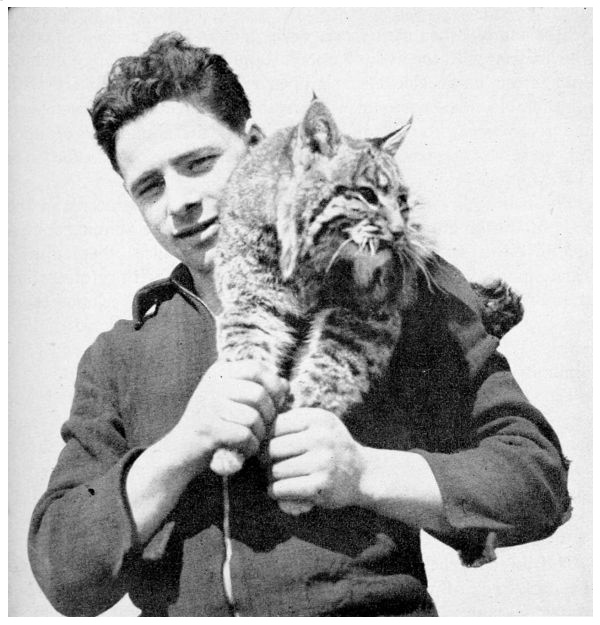
Fig. 78. Bobcat (Lynx rufus fasciatus), two-year-old male captured as a kit near Lyman, Washington, in the spring of 1937, by Earl Scott; photographed March 9, 1939. (Fish and Wildlife Service photo by Victor B. Scheffer, No. 588.)
Bobcats range from southern Canada south to central Mexico. Whereas the Canadian lynx occupies the boreal region, the bobcat occupies the temperate region. It is thought to be principally nocturnal but is occasionally active by day. One that I watched near Lake Samamish, King County, when it was unaware of my presence, was decidedly uncatlike as it strolled with a smooth but stiff-legged gait on a forest trail, with head held up, short tail erect and wagging back and forth with each step. The general impression was of a large, extremely long-legged animal. There was nothing stealthy in its movements. Another individual seen in the same locality on a later date saw me. As it bounded away the body was kept low and the legs were bent with the forelegs appearing almost bowlegged.
Like many other carnivores, each bobcat has a home range which varies with the available food supply. The range may include deep forest, dense thickets and open grasslands, but country with considerable edge-environment seems to be preferred to dense cover, and rocky areas to smooth soil. Perhaps the abundance of mice and wood rats attracts bobcats to the rocks, but the cover afforded is also a factor.
The bobcat is almost universally regarded as a predator and the state of Washington now offers a bounty on it. The animals doubtless do kill a certain amount of game, but kill also other animals which man regards as pests because they interfere with reforestation and growing of food crops. One of the best natural checks on these pests is the bobcat which, in certain areas, does more good than harm. Where doing damage to game or livestock bobcats may be eliminated by trapping or hunting with dogs.
Trappers report that bobcats have a poor sense of smell but very keen sight. They are easily trapped. The fur is soft and handsome but does not wear well. Fur buyers designate the large, pale bobcats of eastern Washington as lynx cats and reserve the name bobcat for the more reddish race of western Washington. Immature and unprime pelts from eastern Washington also are classed as "bobcat."
The difference between the pale bobcat of eastern Washington and the dark race of western Washington is greater than that which separates many subspecies. Dewey Smith of Guler, Klickitat County, showed me skins of bobcats taken on his trap-line along the White Salmon River, which drains southward to the Columbia, and over into the watershed of the Lewis River. Bobcats from the White Salmon River were pale and gray, and those from along the Lewis River were more reddish. The difference was striking. A very few intermediate skins indicated that interbreeding occurs. The geographic variation between the two races is reminiscent of that in the snowshoe rabbits of the western Cascades.
Lynx rufus fasciatus Rafinesque
Lynx fasciatus Rafinesque, Amer. Monthly Mag., 2:46, November, 1817.
Lynx fasciatus fasciatus Miller, U. S. Nat. Mus. Bull., 128:160, April 29, 1924.
Lynx rufus fasciatus Bailey, N. Amer. Fauna, 55:269, August 29, 1936.
Type locality.—Near mouth of the Columbia River on "Netul" River (Lewis and Clark River) near Astoria (Bailey, 1936: 269).
Racial characters.—Size moderate; fur short; color distinctly reddish.
Measurements.—A male from Forks, Clallam County, measured: total length 890; length of tail 190; hind foot 167; ear 80; weight 24-1/2 pounds.
Distribution.—From the Cascade Mountains westward, including the valleys of rivers draining westward in the Cascades. Marginal occurrences are: Skykomish (W. W. D.), Mt. Rainier (Taylor and Shaw, 1927: 60) and headwaters of Lewis River (W. W. D.).
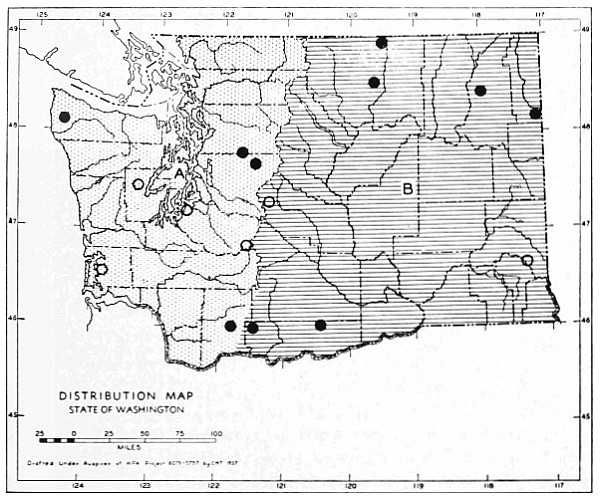
Fig. 79. Distribution of the bobcat in Washington. A. Lynx rufus fasciatus. B. Lynx rufus pallescens.
Lynx rufus pallescens Merriam
Lynx fasciatus pallescens Merriam, N. Amer. Fauna, 16:104, October 28, 1899.
Lynx rufus uinta Bailey, N. Amer. Fauna, 55:267, August 29, 1936.
Lynx rufus pallescens Bailey, N. Amer. Fauna, 55:268, August 29, 1936.
Type.—Obtained at Trout Lake, Klickitat County, Washington, by D. Kaegi on January 10, 1895; type in United States National Museum.
Racial characters.—Size large; skull heavy with extensive crests and ridges; fur long and soft; color pale, more grayish and less reddish than in fasciatus.
Distribution.—From the Cascade Mountains eastward, including the valleys of rivers in the Cascades which drain southward and eastward. Marginal records of occurrences are Oroville (W. W. D.), Lake Keechelus (Taylor and Shaw, 1929: 15) and Trout Lake (W. W. D.).
Zalophus californianus (Lesson) California sea lion
Otaria californiana Lesson, Dict. Class Nat. Hist., 13:420, 1828.
Zalophus californianus Allen, Monogr. N. Amer. Pinnipeds, U. S. Geol. and Geogr. Surv. Terr., Misc. Publ., 12:276, 1880.
Type locality.—California.
Distribution.—Rare or casual along the coast of Washington.
Description.—Adult males are 7 to 8 feet in length and females about 6 feet. Bulls weigh as much as 1,000 pounds, and females up to 600 pounds. Both fore and hind limbs are modified for swimming; they are flippers directed posteriorly. The body is cylindrical and streamlined, the neck thick and the head small. Adult males possess a high sagittal crest resulting in a high forehead. Eyes and ears are small. The reddish brown pelage is short and coarse. Females are darker than the males.
The California sea lion occurs along the Pacific Coast from Mexico to northern California and has been recorded from Oregon (Bailey, 1936: 332), Washington and British Columbia (Greenwood, Newcombe, and Fraser, 1918: 1-39). It is of rare or casual occurrence along the coast of Washington.
Eumetopias jubata (Schreber) Steller sea lion
Phoca jubata Schreber, Säugthiere, 3:300, 1776.
Eumetopias Stelleri True, Proc. U. S. Nat. Mus., 7 (1884):607, 1885.
Eumetopias jubata Allen, Bull. Amer. Mus. Nat. Hist., 16:113, March 15, 1902.
Type locality.—North Pacific Ocean.
Distribution.—Ocean coast, breeding on small, rocky islets such as the Quillayute Needles.
Description.—The Steller sea lion resembles the California sea lion but is larger. Old bulls are from 10 to 12 feet in length and weigh from 1,200 to 1,500 pounds, perhaps even a ton. Females are 8 to 9 feet in length and may weigh up to 1000 pounds. The female Steller sea lion is nearly as large as the male of the California sea lion. The bull Steller sea lion lacks the high forehead characteristic of the California sea lion, and the body is heavier and stouter, especially in the neck and chest. Bulls are distinctly bicolored, the head, neck and chest being cinnamon and the rest of the body darker. Females are a uniform dark brown color. The Steller sea lion makes a loud, deep roaring sound.
Steller sea lions occur along the coast of Asia south to Japan and the coast of North America from the Bering Strait south to central California. The range thus meets and overlaps that of the California sea lion.
Steller sea lions are splendid swimmers and spend much of their time in the surf. They often lie in the water a few yards from where the waves pound some jagged cliff, retaining their dangerous position without discernible effort. They are curious and will raise their head and neck vertically out of the water to observe a passing boat. Much time is spent beneath the surface, presumably hunting fish. They sometimes leap up out of the water in an arching dive or may simply lower their heads beneath the surface and appear several minutes later at another place. They may come to the surface with a porpoiselike roll, breathe, and again dive. Many of their actions seem inspired by playfulness—a means of working off excess energy.
Sea lions haul out on a number of rocky islands along the coast. They are slow and clumsy on land. Their rear flippers can be directed forward and so give them some assistance in moving about. When startled they are able, with much struggling, to move with fair speed to the water. They can dive from considerable heights.
The studies of Greenwood, Newcombe and Fraser (1918: 1-39) show that the Steller sea lions eat a great variety of marine fish and other sea life. Included in their diet are squid, starfish, crabs, clams, mussels, salmon, herring, flounder, rock cod, sea bass and dogfish. They seem not to be selective in their food habits but eat the food most easily available at the time. Unfortunately this is occasionally salmon in nets or traps and for this reason fishermen usually kill sea lions on sight. The number of sea lions along the coast of Washington has been greatly reduced by shooting and dynamiting the animals on their hauling-out grounds. There is no doubt that sea lions do occasionally eat salmon, especially in traps or nets. They also become entangled in the nets, and damage them. On the other hand, investigations of their food habits have shown that they do not eat any great number of salmon or other important food fishes. They are a relatively harmless and exceedingly interesting animal and might well be preserved in numbers exceeding their present population.
Until relatively recent times the sea lion was an important source of food to the Indians living along the ocean coast. The bones of sea lions are often the most numerous vertebrate remains in shell mounds.
The Steller sea lion now breeds only in a few places along the coast of Washington. They are polygamous and each of the stronger bulls has eight or ten cows in his harem. Fierce battles between bulls are said to take place in the breeding season, late in May. A single pup is born after a gestation period of about one year. Pups are darker in color than adults.
Callorhinus ursinus cynocephalus (Walbaum) Alaska fur seal
Siren cynocephalus Walbaum, Petri Artedi Sueci Genera Pisc., p. 560, 1792.
Callorhinus ursinus True, Proc. U. S. Nat. Mus., 7 (1884):607, 1885.
Callorhinus alascanus Jordan and Clark, Fur Seals and Fur Seal Islands of the North Pacific, pt. 3, p. 2, November, 1899.
Callotaria ursina cynocephala Stejneger, George Wilhelm Steller, Harvard Univ. Press, p. 285, 1936.
Type locality.—Pribilof Islands, Alaska.
Distribution.—Breeds on the Pribilof Islands, Alaska. Abundant off the coast of Washington on migration.
Description.—The difference in the size of male and female fur seals is great. Males are about 8 feet in length when fully grown but the females are only about 4 feet long. Males weigh up to 700 pounds but females only about 100 pounds. In general appearance the fur seal resembles the sea lion but the fur is longer, denser and softer. Males are very dark brown in color. Females and young are grayish brown. The fur seal, like the sea lion, can reverse its hind flippers and use them to a certain extent in walking.
The Alaskan fur seal breeds on the Pribilof Islands, Alaska. The seals emerge from the water to certain favored hauling-out places in May and June. They leave the Islands in November to begin their long migration. The bulls spend the winter off the coast of Alaska south of the Aleutians but the females and young travel south to the ocean off California. In the spring they start north, arriving off the coast of Washington in February, March and April. Young, rarely adults, are washed up on the ocean beaches of Washington (Scheffer, 1939: 43).
The United States Government, by international treaty, manages the fur seal herds on a sustained yield basis and pelagic sealing by independent hunters is prohibited. Indians are allowed to take the fur seals on migration but are subject to certain restrictions. Modern boats, outboard motors and guns are prohibited. Indians living on the coast of Washington hunt the fur seals from dugout canoes. The weapons are double-headed harpoons with long cedar shafts. One harpoon head is at the tip of the shaft and the other is on a short fork that projects downward and forward at a 30° angle from the main shaft. The harpoon is thrown with the aid of hand grips at the end of the shaft. The seal is recovered by rawhide lines connected to the harpoon heads. The hunters leave shore at dawn and travel ten to twenty miles from land, at which distance the seal herds are usually encountered. The hunting is dangerous work and is carried on only by skilled and brave men. Relatively calm weather is required. The flesh of the seals is eaten and the skins sold.
Schultz and Rafn (1936: 13-15) examined the stomachs of 41 fur seals taken within 30 miles of La Push, Washington, in March, April and May, 1930. Food found included squids, shrimps, herring and lampreys.
Phoca vitulina richardii (Gray) Hair seal or harbor seal
Halicyon richardii Gray, Proc. Zoöl. Soc. London, p. 28, 1864.
Phoca richardii Allen, Bull. Amer. Mus. Nat. Hist., 16:491, December 12, 1902.
Phoca richardii richardii Miller, U. S. Nat. Mus. Bull., 128:164, April 29, 1924.
Phoca vitulina richardii Doutt, Ann. Carnegie Mus., 29:117, May 12, 1942.
Type.—Described from a specimen obtained at the Fraser River, British Columbia, probably on March 23, 1861, by C. B. Wood and another obtained by Wood at Queen Charlotte Sound, British Columbia, in 1862 (see Scheffer and Slipp, 1944: 374); type in British Museum of Natural History.
Distribution.—Puget Sound, the Strait of Juan De Fuca and the coast of Washington, extending at times up the Columbia River to The Dalles. Has been recorded in Lake Washington, Seattle (Bonham, 1942: 76).
Description.—Adults are about 5 feet in length and weigh up to 250 pounds; males are approximately a quarter larger than females. The hair seals differ from the sea lions and fur seals in a number of respects. The body is widest in the midsection rather than in the chest. The neck is short and slim. The eyes are large and there are no external ears. The hind flippers are not reversible but are permanently directed posteriorly. The pelage is short, stiff, and directed posteriorly. The ground color is silver gray or yellow; usually it is yellow, blotched and marbled with black, dusky or gray.
Hair seals range over the northern Atlantic and Pacific oceans, occurring southward along the Pacific Coast of North America to central Mexico. Six races are recognized by Doutt (1942: 115).
The hair seal is the common seal in Puget Sound, the Strait of Juan De Fuca and on the ocean coast. Scheffer and Slipp (1944: 373) estimate that 5,000 live along the coast of Washington. Hair seals are social to some degree but are often seen singly. In Puget Sound, where there are relatively few hauling-out areas, they rarely leave the water but on the ocean coast they emerge to bask on the reefs. On Destruction Island, Jefferson County, V. B. Scheffer and I watched a herd of about 20 animals that lay on a reef exposed by low tide. According to the lighthouse keeper the reef was occupied daily by these seals. Scheffer and Slipp (loc. cit., p. 388) report herds of up to 200 hair seals. In Puget Sound 10 to 20 seals seem to be the usual number in a herd, but occasionally there are as many as 50.
Hair seals often exhibit curiosity concerning small boats; the seals lie in the water with only their round heads above the surface, staring at the boat for many minutes. Constant shooting has made them shy and any quick movement will cause them to dive; several dived instantly when I pointed either a stick or gun at them.
Hair seals are less spectacular than sea lions. When basking on rocks the seals are silent. When an observer is yet a long distance away the seals raise their small heads and remain on the alert. When they take to the water, they travel with a jerking motion. In the water one rarely sees more than their heads. When they dive they usually sink below the surface, never making the spectacular arching dive so typical of the sea lions.
At Useless Bay, Whidby Island, Island County, a herd of five or six hair seals was studied in July, 1936. These animals played and slept in the shallow water beneath a high, forested bluff and could be watched from the bluff above. The seals seemed to gather here in the early afternoon. Much of their time was spent sleeping on the surface with the body in a bowed position and drifting freely. Occasional waving of the rear flippers kept them from drifting away. They played a great deal, splashing, diving and swimming in circles or spirals. Occasionally one would dive down to swim slowly along just above the bottom. At times one would put on a sudden burst of speed, apparently in pursuit of some fish, rarely continued for more than 30 or 40 feet after which the seal usually rose to the surface to resume play. Never did I see one with a fish in its mouth and these pursuits, if pursuits they were, seemed to have been prompted more by a spirit of play than by hunger.
A young seal was kept as a pet for several weeks at Friday Harbor, San Juan County. It was tame and affectionate but decidedly temperamental. It demanded constant attention and whimpered, cried or moaned if left alone. It was more active by night than by day and made a characteristic mooing cry, which continued at intervals throughout the night. This habit led to its eventual disposal. The temper of this young seal was shown by its actions when it encountered strands of kelp while swimming. If the kelp strands held back its progress it would turn back, seize the kelp in its teeth and bite viciously. Never did it attempt to bite persons.
The hair seal was generally thought to feed almost exclusively on salmon, but the work of Scheffer (1928: 10-16) showed this view to be incorrect. Of 14 hair seal stomachs examined, all of which were full, only two contained salmon. In a later study (Scheffer and Sperry, 1931: 214-226), only two of 100 stomachs examined contained salmon. Other food items were tomcod, flounder, sculpin, herring, shiner, hake, skate, blenny, unidentified fish, squid, octopus, shrimp, crab and starfish. In spite of Scheffer's work, hair seals are killed at every opportunity by fisherman and boatman. Bounties were paid on their scalps for many years, and more than 1,000 bounties were paid for each of several years previous to 1930. Their small, round heads bobbing on the waves offer a poor target and many seals, after having been fired at, become extremely shy. They seem to be holding their own in numbers at the present time.
Scheffer and Slipp (1944: 401) found that the young were born in late May along the ocean coast and in June and July in Puget Sound. The young seal mentioned as having been kept captive at Friday Harbor was obtained from an Indian on July 26, 1938, and was said to be two weeks old at the time. The Indian said that he had watched the birth of the young and then killed the mother for bounty. On July 28 the young seal weighed approximately 20 pounds and was in good health. The seal could swim well. It was said to have been born "on the rocks" at Long Island, San Juan County. The seal drank milk from a baby's bottle but refused fresh scallops, clams and fish of several species. When put into a large, screened box sunk in the water it at once investigated the other animals in the box. It showed no fear of a large bull cod weighing 50 pounds, or of a 20-pound skate and several sharks 5 feet long but seemed to be frightened by a large octopus weighing about 30 pounds. In swimming, the front flippers were held flat against the body and the actual swimming was accomplished by the vertically-held rear flippers and the rapid swinging of the hips. Its eyes were very dark brown, almost black, but soft and appealing. The bases of the vibrissae were thick and soft. The belly was silvery white and unspotted. The sides and back were iron gray spotted with dark, bluish gray, the whole overlaid with a silvery tint. The claws were long, round, and sharply pointed.
When sleeping, the seal usually lay on its side, occasionally upon its back or belly. The front flippers were held tight to its sides but the back flippers were held straight back with the digits bent inward at right angles and laid so that the right digits were against the left. In moving on land the front flippers were folded into fists and used to push the animal forward while the body was moved by snakelike motions of the hips. It breathed in short gasps.
Genus Tamias Illiger Chipmunks
The chipmunks of Asia and western North America have usually been separated under the generic name Eutamias from those of the genus Tamias of eastern America. Ellerman (1940: 428) placed both in the same genus and Bryant (1945: 257-390) reached the same conclusions after intensive study of American sciurids. Bryant's treatment is followed here. The sciurid genera as they occur in Washington, are listed by Bryant as follows: Tamias, Marmota, Citellus, Sciurus, Tamiasciurus, Glaucomys. This order, rather than that of Miller (1924) is used here. Four species of Tamias are listed for Washington: minimus represented by two subspecies; amoenus, by six; ruficaudus by one; and townsendii, by two.
Chipmunks from Washington vary in size from less than 8 inches in total length to more than 10 inches in total length. Some race of chipmunk occurs in almost every part of Washington. Their striped color pattern serves as a universal recognition mark. The somewhat similarly striped mantled ground squirrel is often mistakenly called chipmunk. The mantled ground squirrel is larger than any chipmunk, has but two dark stripes as compared with five dark stripes of chipmunks, and has a plain, reddish head unlike the distinctly striped head of Tamias.
Like most members of the squirrel family, chipmunks are active by day and are therefore better known to man than are most of the other kinds of small mammals, most of which are nocturnal. The attractive color and sprightly actions of chipmunks make them a delightful feature of the outdoors. They feed on fruit, seeds, and fungus and eagerly eat food that can be begged or stolen from man. They have been known to kill mice and they have been accused of destroying nests and eggs of birds. They often eat insects and occasionally eat the flesh of mice or other chipmunks held in collector's traps.
Chipmunks climb trees and bushes readily but only townsendii can be called arboreal, and even it prefers to climb on stumps and dead trunks rather than in living trees. All species are fond of climbing about rocky outcrops and talus slides.
The call of the chipmunks is a birdlike cheep. In minimus it is shrill and uttered rapidly, but it is low-pitched and is uttered by townsendii with longer intervals between the notes. The call of amoenus is of an intermediate nature.
Young of chipmunks vary in number from four to six. Nests are constructed of dry grass and are placed under rocks, logs, and in burrows in the ground. There are four pairs of mammae, one pectoral, two abdominal, and one inguinal.
Tamias minimus Bachman Least chipmunk
Description.—The least chipmunk is the smallest chipmunk found in Washington. The head and body of adults measure about 3-1/2 inches; the tail about 3-1/2 inches. Its fur is short and sleek. The dorsal stripe is black; the upper pale stripe is buffy gray; the lower dark stripe is rich brown; the lower stripe is white. The sides are pale buff and the head, rump and thighs are buffy gray. The tail is brownish above, yellowish beneath.
Tamias minimus has a wide range, being found from the Cascade-Sierra Nevada Chain to the Great Lakes and from northern Canada to central Arizona and New Mexico. Two races occur in Washington, both in the sagebrush desert area.
Least chipmunks are only locally common in Washington. I have found them in areas where the soil was firmly packed and sagebrush the dominant vegetation. All were far from water. Two miles west of Vantage, Kittitas County, several were found near an old sheep corral, where one took shelter in a pile of boards. In my experience, least chipmunks are wary and difficult to collect. Many times as I crept silently through the sagebrush chipmunk after chipmunk scampered with tail aloft into a hole at the base of same sage bush, each far out of gunshot, voicing alarmed chirps. The extreme caution of least chipmunks, as compared with other species, is doubtless a necessary adaptation to living in an exposed situation. The open sagebrush desert is a favored hunting place of hawks and eagles; also coyotes, wildcats, and badgers sometimes abound there. All these probably find the least chipmunk a suitable food item and only the most cautious chipmunk survives to reproduce. The least chipmunk has been timed at a speed of 10 miles per hour (Cottam and Williams, 1943: 262).
The food of the least chipmunk in eastern Washington is almost entirely seeds of the annuals that flourish briefly in the spring. Insects probably are eaten and one specimen had the remains of two scorpions in its stomach.
Tamias minimus scrutator (Hall and Hatfield)
Eutamias minimus pictus Howell, N. Amer. Fauna, 52:39, November 30, 1929.
Eutamias minimus scrutator Hall and Hatfield, Univ. California Publ. Zoöl., 40:321, February 12, 1934.
Tamias minimus scrutator Ellerman, Fam. and Genera of Living Rodents, British Mus. Nat. Hist., p. 432, June 8, 1940.
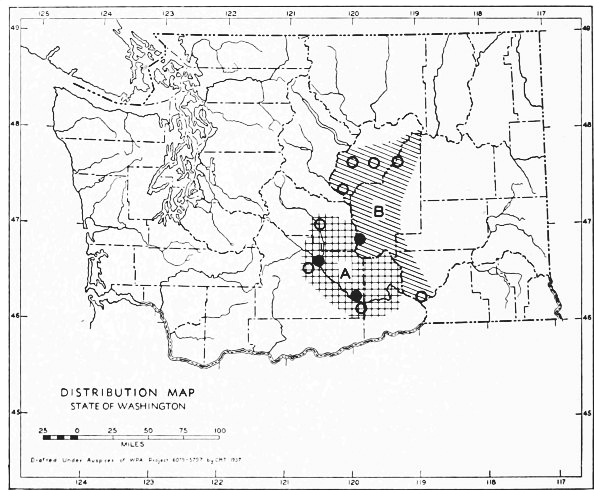
Fig. 80. Distribution of the least chipmunk in Washington. A. Tamias minimus scrutator. B. Tamias minimus grisescens.
Type.—Obtained near Blanco Mountain, 10500 ft. elevation, Mono County, California, by J. Grinnell on July 28, 1917; type in Museum of Vertebrate Zoölogy.
Racial characters.—Buffy color; wide dark stripes and narrow pale stripes.
Measurements.—A male and a female from Sunnyside, Yakima County, measure respectively; total length 186, 186; length of tail 81, 82; hind foot 31, 31; ear 9, 10.
Distribution.—The sagebrush areas west of the Columbia River. Present in scattered and widely separated areas, ranging, according to Howell (1929: 41), north to Ellensburg and south to Wiley City.
This species is a member of the Great Basin Fauna that entered the state from Oregon. The population in Washington is now isolated north and west of the Columbia River but seems not to differ from least chipmunks from Oregon and Nevada.
Tamias minimus grisescens (Howell)
Eutamias minimus grisescens Howell, Jour. Mamm., 6:52, February 9, 1925.
Tamias minimus grisescens Ellerman, Fam. and Genera of Living Rodents, British Mus. Nat. Hist., p. 431, June 8, 1940.
Type.—Obtained at Farmer, Douglas County, Washington, by J. A. Loring, on July 31, 1897; type in United States National Museum.
Racial characters.—Similar to scrutator but smaller; more grayish, less buffy in color, dark stripes narrower and pale stripes wider.
Measurements.—Seven topotypes and near topotypes average: Total length 177; length of tail 78.7; hind foot 26.8; ear 10.6.
Distribution.—Known only from the Columbian Plateau. This race is rare and though we hunted for it in localities where specimens have been collected, including the type locality, it was found but twice. Ranchers living in the area know the chipmunk but see individuals only occasionally. Marginal occurrences are Douglas (Howell, 1929: 41), Vantage (V. B. S.) and Pasco (Howell, 1929: 41).
Remarks.—The geographic range of this race is separated from that of scrutator by the Columbia River and many miles of country uninhabited by chipmunks of this species.
Tamias amoenus Allen Yellow-pine chipmunk
Description.—The yellow-pine chipmunk resembles the least chipmunk but is larger. The underside of the tail is more ochraceous, less yellowish. The color of the sides varies considerably in the various races. The stripes are narrow and sharply delineated, the dorsal one being black. Next lower is a grayish stripe, followed by one of brownish black. The lower stripe is white. The underparts, in most races, are white but in luteiventris are buffy.
The geographic range of the species is west of the Great Plains from central British Columbia to central California. There are twelve races, six of them occurring in Washington.
The yellow-pine chipmunk is a small animal, being but little larger than the least chipmunk, and much smaller than townsendii. Externally it may be separated from the Townsend chipmunk by its small size, sleek, appressed pelage and brighter color. Separation from minimus is more difficult but, in the Washington races of minimus, the colored fur of the underside of the tail is pale yellowish while in amoenus it is more ochraceous or buffy. So far as is known, the two species do not occur together in Washington.
The yellow-pine chipmunks live in open woods, brushy areas, clearings, and rocky outcrops. Suitable conditions are abundant in mountainous areas and the distribution of mountain ranges affects the distribution of these chipmunks. Where yellow pine forests descend to relatively low altitudes, the chipmunks enter the lowlands. Such conditions are present in some places along the eastern base of the Cascades, the inter-mountain river valleys of northeastern Washington, and along the central-eastern border of the state.
Yellow-pine chipmunks are sprightly and active. They seem always to be moving restlessly about, running, investigating for food, and watching for enemies. They are far tamer than the least chipmunks, usually allowing the observer to approach within twenty feet or closer. Some, after coaxing, will take food from a person's hand.
Near Stevens Pass, King County, numbers of Tamias townsendii cooperi and Tamias amoenus ludibundus, apparently on good terms, were feeding together on blue huckleberries which grew in abundance on an extensive snowslide area. The yellow-pine chipmunks had been drawn from surrounding open areas by the berries, while the Townsend chipmunks had been attracted from the forest by the same food. The nervous movements of amoenus contrasted strongly with the more sedate behavior of townsendii. At the observer's close approach the yellow-pine chipmunks went scampering off through the brush and tangles of logs and branches, to emerge again and watch from a hundred feet away. The same individuals, when repeatedly followed, always remained in sight. Most of the Townsend chipmunks, when frightened, ran into the nearest dense cover and vanished, not to appear again. A goodly number, perhaps ten per cent, climbed high up in fir trees. None of the yellow-pine chipmunks took refuge in trees.
The yellow-pine chipmunk is usually found at considerable altitude and consequently there is deep snow and bitter cold in winter where it lives. Hibernation is probably complete. Seemingly these chipmunks depend on stored food rather than on accumulated fat to tide them over the winter, for animals collected in autumn are no fatter than those taken in the spring. Svihla (1936B: 290) found that Tamias a. canicaudus, hibernating in captivity at Pullman, Whitman County, awoke at intervals to eat stored food. The time of retirement of yellow-pine chipmunks for the winter seems to coincide with the coming of winter weather. In mid-November of one year, when no snow had yet fallen in the Cascades, yellow-pine chipmunks were common near Stevens Pass, although their actions were noticeably slow. In another autumn, when the winter snows came early, I looked in vain for chipmunks in October where they had been common earlier. George C. Cantwell noted a yellow-pine chipmunk at Republic, Ferry County, on November 9, 1903, after the ground was "well frozen," but apparently free of snow (Howell, 1929: 7). Like other species that hibernate, they, at times, seem to become active in winter; J. B. Flett reported seeing a yellow-pine chipmunk at Longmire, Mt. Rainier, on February 14, 1920, and again on March 31 (Howell, loc. cit., p. 7). At Deer Park, Clallam County, at timber-line, several Tamias townsendii cooperi were active in early April, 1938, but only one Tamias amoenus was seen. In the previous June they were abundant there and townsendii was scarce.
I have watched these chipmunks eat the berries of the red huckleberry (Vaccinium parvifolium), salmonberry (Rubus spectabilis), thimbleberry (Rubus parviflorus), devil's club (Fatsia horrida), and mountain ash (Sorbus cascadensis and S. occidentalis). Of these, the blue huckleberry (Vaccinum occidentale and V. membranaceum) are probably the most important to the chipmunks. At Sherman Creek Pass, in the Kettle River Mountains, Ferry County, I watched a pika (Ochotona) busily harvesting wild raspberry plants (Rubus leucodermis), and laying them in a pile under a rock. A yellow-pine chipmunk waited under the rock and ate the ripe berries from each branch as it was laid away.
A brood nest of the yellow-pine chipmunk was discovered by Shaw (1944: 274) at Hurricane Ridge, Clallam County. The entrance was a hole 1-1/2 inches in diameter constructed among the grass and alpine flowers of a meadow at 6,450 feet elevation. The burrow itself was 2 inches in diameter, and had a turning-around pocket 9 inches from the entrance. The nest was situated just beneath the sod, 4 feet from the entrance. The nest chamber was 7 inches high by 7-1/2 inches in diameter and in the shape of a "round-bottomed flask." It was filled snugly with nest material composed of a grasslike sedge (Carex spectabilis) mixed with feathers of the blue grouse. Earth excavated from the nest cavity had been forced upwards through the sod in the manner of a mole in forming mounds. The single burrow was unbranched. Seven young of about 16 to 18 days of age were found in the nest.
Tamias amoenus caurinus (Merriam)
Eutamias caurinus Merriam, Proc. Acad. Nat. Sci. Philadelphia, p. 352, October 4, 1898.
Eutamias amoenus caurinus Howell, Jour. Mamm., 3:184, August 4, 1922.
Tamias amoenus caurinus Ellerman, Fam. and Genera of Living Rodents, British Mus. Nat. Hist., p. 432, June 8, 1940.
Type.—Obtained at timber-line, head of Sol Duc River, Olympic Mountains, Clallam County, Washington, by C. H. Merriam and Vernon Bailey on August 27, 1897; type in United States National Museum.
Racial characters.—Small size and pale color.
Measurements.—Seven males and 3 females from Deer Park, Clallam County, average: total length 207.4; length of tail 93.2; hind foot 32.5; ear 16.
Distribution.—Higher parts of the Olympic Mountains, from Deer Park (W. W. D.) south to head of Dosewallips River (Howell, 1929:77).
Tamias amoenus felix Rhoads
Tamias quadrivittatus felix Rhoads, Amer. Nat., 29:941, October, 1895.
Eutamias quadrivittatus felix Miller and Rehn, Proc. Boston Soc. Nat. Hist., 30:44, December 27, 1901.
Eutamias amoenus felix Howell, Jour. Mamm., 3:184, August 4, 1922.
Tamias amoenus felix Ellerman, Fam. and Genera of Living Rodents, British Mus. Nat. Hist., p. 432, June 8, 1940.
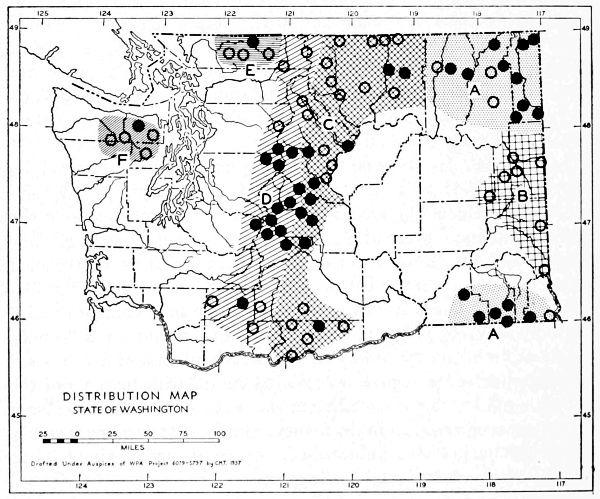
Fig. 81. Distribution of the yellow-pine chipmunk in Washington. A. Tamias amoenus luteiventris. B. Tamias amoenus canicaudus. C. Tamias amoenus affinis. D. Tamias amoenus ludibundus. E. Tamias amoenus felix. F. Tamias amoenus caurinus.
Type.—Obtained at Church Mountain, British Columbia, near the United States boundary by Allan Brooks on August 13, 1895; type in Philadelphia Academy of Natural Sciences.
Racial characters.—Large size and rich, dark color.
Measurements.—Ten topotypes average: total length 224.7; length of tail 98.8; hind foot 34.1; ear 14.4.
Distribution.—The extreme northwestern Cascades, north and west of Mt. Baker.
Remarks.—This richly-colored coastal race barely enters Washington. It is abundant near Goldrun Pass and Tomyhoi Lake, Whatcom County, just south of the international boundary.
Tamias amoenus ludibundus (Hollister)
Eutamias ludibundus Hollister, Smithsonian Misc. Coll., 56 (no. 26):1, December 5, 1911.
Eutamias amoenus ludibundus Howell, Jour. Mamm., 3:184, August 4, 1922.
Tamias amoenus ludibundus Ellerman, Fam. and Genera of Living Rodents, British Mus. Nat. Hist., p. 432, June 8, 1940.
Type.—Obtained at Yellowhead Lake, 3,700 ft., British Columbia, by N. Hollister on August 29, 1911; type in United States National Museum.
Racial characters.—Moderate size, brownish rump, ochraceous sides.
Measurements.—Five males and 4 females from the higher parts of the Cascades average, respectively: total length 210, 217; length of tail 89, 90; hind foot 33, 33; ear 17.4, 16.7; weight 50, 59.7 grams.
Distribution.—The higher Cascade Mountains. Marginal records are: Barron (Howell, 1929:75), Lyman Lake (Howell, 1929:75), Cascade Tunnel (W. W. D.), Mt. Stuart (W. W. D.), Lake Kachees (W. W. D.), Boulder Cave (W. W. D.), and Mt. St. Helens (Howell, 1929:75).
Remarks.—At the higher altitudes this race seems to be the equivalent of affinis. The latter race lives in relatively arid yellow pine forests and ludibundus occupies more moist and varied habitats higher in the mountains.
Tamias amoenus affinis Allen
Tamias quadrivittatus affinis Allen, Amer. Mus. Nat. Hist. Bull., 3:103, June, 1890.
Eutamias quadrivittatus affinis Miller and Rehn, Proc. Boston Soc. Nat. Hist., 30:44, December 27, 1901.
Eutamias amoenus affinis Howell, Jour. Mamm., 3:184, August 4, 1922.
Tamias amoenus affinis Ellerman, Fam. and Genera of Living Rodents, British Mus. Nat. Hist., p. 432, June 8, 1940.
Type.—Obtained at Ashcroft, British Columbia, by C. P. Streator on July 3, 1889; type in United States National Museum.
Racial characters.—Small size, grayish color including rump, and white underparts.
Measurements.—Fourteen males and 7 females from Washington average: total length 201.5; length of tail 86.5; hind foot 31.7; ear 17.2.
Distribution.—The eastern slope of the Cascade Mountains. Marginal records on the west are: Bald Mountain (Howell, 1929:73), Mazama (Howell, 1929:73), Hart Lake (Howell, 1929:73), Lake Wenatchee (W. W. D.), 10 mi. S. Dryden (W. W. D.), Blewett Pass (W. W. D.), 10 mi. N. W. Ellensburg (W. W. D.), Wenas Creek (W. W. D.), Mt. Adams (Howell, 1929:73), and Lyle (Howell, 1929:73). Marginal occurrences on the east are: Mt. Chopaka (Howell, 1929:73), 20 mi. E. Tonasket (W. W. D.) and Omak Lake (Howell, 1929:73).
Tamias amoenus canicaudus (Merriam)
Eutamias canicaudus Merriam, Proc. Biol. Soc. Washington, 16:77, May 29, 1903.
Eutamias amoenus canicaudus Howell, Jour. Mamm., 3:184, August 4, 1922.
Tamias amoenus canicaudus Ellerman, Fam. and Genera of Living Rodents, British Mus. Nat. Hist., p. 432, June 8, 1940.
Type.—Obtained at Spokane, Spokane County, Washington, by C. P. Streator, on April 11, 1891; type in United States National Museum.
Racial characters.—Large size, pale color, grayish tail, white or buffy underparts.
Measurements.—Thirteen topotypes average: total length 227.2; length of tail 104.4; hind foot 33.7; ear 14.
Distribution.—The pine-covered lowlands along the central-eastern border of the state, ranging, according to Howell (1929: 71), from Spokane County south to Pullman.
Tamias amoenus luteiventris Allen
Tamias quadrivittatus luteiventris Allen, Amer. Mus. Nat. Hist. Bull., 3:101, June, 1890.
Eutamias quadrivittatus luteiventris Miller and Rehn, Proc. Boston Soc. Nat. Hist., 30:44, December 27, 1901.
Eutamias amoenus luteiventris, Howell, Jour. Mamm., 3:179, August 4, 1922.
Tamias amoenus luteiventris Ellerman, Fam. and Genera of Living Rodents, British Mus. Nat. Hist., p. 432, June 8, 1940.
Type.—Obtained at Chief Mountain Lake (Waterton Lake), Alberta (3-1/2 mi. N. United States boundary) by Elliott Coues on August 24, 1874; type in United States National Museum.
Racial characters.—Small size, rich color, buffy underparts.
Measurements.—Twelve males and 12 females from the Blue Mountains, Columbia County, average respectively: total length 212, 219; length of tail 96.7, 101; hind foot 31.7, 32.5; ear 17.3, 18; weight 46.5, 52.8 grams.
Distribution.—The Blue Mountains of southeastern Washington, and the Pend Oreille Mountains of northeastern Washington, west to Eureka, in the Kettle River Mountains, Ferry County (Howell, 1929: 69), and south to Newport (W. W. D.).
Tamias ruficaudus simulans (Howell) Red-tailed chipmunk
Eutamias ruficaudus simulans Howell, Jour. Mamm., 3:179, August 4, 1922.
Tamias ruficaudus simulans Ellerman, Fam. and Genera of Living Rodents, British Mus. Nat. Hist., p. 434, June 8, 1940.
Type.—Obtained at Coeur d'Alene, Kootenai County, Idaho, by C. P. Streator on June 1, 1891.
Measurements.—Six males and 3 females from northeastern Washington average: total length 234; length of tail 109; hind foot 31.6; ear 18.
Distribution.—Northeastern Washington, reported from Pend Oreille, Stevens and Ferry counties by Howell (1929: 98).
Description.—The red-tailed chipmunk closely resembles Tamias amoenus. From T. a. luteiventris and T. a. canicaudus it differs principally in larger size, wider brain case and especially in its pure white underparts. From T. a. affinis it differs in richer coloration, especially the brownish rather than gray rump. The differences separating it from amoenus are slight, and only adult specimens can be identified in the field.
According to Howell (1929: 81) this species occurs in northern Idaho, western Montana, northeastern Washington, southeastern British Columbia and extreme southwestern Alberta. Two subspecies are recognized, only one of which occurs in Washington.
A number of large, white-bellied chipmunks have been taken in northeastern Washington that answer well to the description of ruficaudus. Also, there are a number of specimens that I cannot definitely identify as either amoenus or ruficaudus. Some buff-bellied chipmunks from Idaho are as large, and possess brain cases as wide, as specimens from Washington unhesitatingly called ruficaudus, while some white-bellied individuals match amoenus luteiventris in all other characters. When all the specimens available from Pend Oreille, Stevens and Ferry counties are separated into amoenus and ruficaudus and the skulls are examined, it is noticeable that all the ruficaudus are old, fully adult animals and that most of the amoenus are younger, showing less wear on the teeth. Perhaps the buffy underparts are lost with increasing age.
This leads to the suspicion that ruficaudus, as applied to chipmunks in Washington, is a synonym of amoenus. Until considerable material is collected in northeastern Washington, showing individual and age variation, it seems best to retain the name ruficaudus.
Most of the specimens referable to ruficaudus were taken in talus slides high in the Pend Oreille Mountains. A smaller series was collected at a lower altitude in open pine forests near Pend Oreille Lakes, Stevens County. I could detect no difference between amoenus and ruficaudus in habitat or habits.
Tamias townsendii Bachman Townsend chipmunk
Description.—The Townsend chipmunk is the largest of the chipmunks that occur in Washington. Head and body measure about 5-1/2 inches; the tail about 4-1/2 inches. The fur of the Townsend chipmunk is more lax and less sleek than that of other species. The upper parts are duller and darker ochraceous. Stripes are wide and not sharply delineated. The dark stripes are deep chestnut or blackish. The upper pale stripe is pale buffy gray; the lower is whitish. The tail is blackish frosted with white above and rich ochraceous below. Underparts are dull white.
The Townsend chipmunk ranges from the Fraser River in southern British Columbia through western Washington and Oregon, to central California. Like other members of the Pacific Coastal Fauna which extend southward to California, its geographic range extends farther inland to the south and geographic variation is greater; 3 races are listed by Johnson (1943: 114) in California.
The Townsend chipmunk is the largest and darkest chipmunk in Washington. Over much of its range it is the only chipmunk found although in some mountainous areas both townsendii and amoenus occur together. The larger size and richer coloration, especially the rich tawny color of the underside of the tail, separate Townsend chipmunks from amoenus.
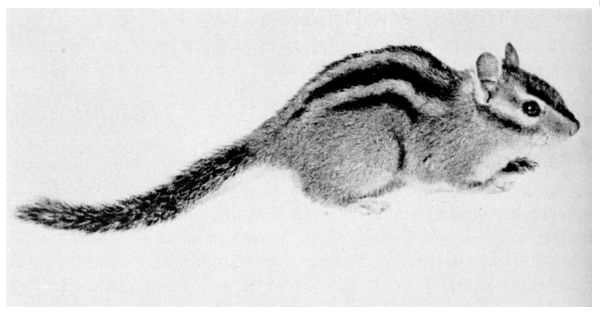
Fig. 82. Townsend chipmunk (Tamias townsendii cooperi), captured on Goat Creek, 3,000 feet, western Cascade Mountains near Chinook Pass, Washington, September 16, 1940, by Earl J. Larrison; photographed February 1, 1941. (Fish and Wildlife Service photo by Victor B. Scheffer, No. 1139.)
Townsend chipmunks are closely associated with the coniferous forest where they live in clearings and tangles of underbrush such as on steep hillsides, fire slashings, snowslide areas or mountain glades. Though capable of swift movement, they are less nervous and active than other chipmunks. Rarely are they as abundant, even locally, as other species, and the home range of an individual seems to be larger than that of an amoenus or a minimus. Rarely are more than two seen in a locality. Their more sedentary habits make them less conspicuous than other species. In the fall, when berries are dried out and seeds are ripe, they are most often seen. The Townsend chipmunk seems to be the most arboreal species found in Washington and individuals are not uncommonly seen in trees.
The brushy cover inhabited by Townsend chipmunks protects them from most hawks while their diurnal habits prevent owls from feeding on them. Predatory mammals probably constitute their greatest menace. A weasel (Mustela frenata) was seen to follow a Townsend chipmunk into a pile of timbers near Cottage Lake, King County, and another was seen carrying a dead Townsend chipmunk at Stevens Pass, King County. Tracks around an area of blood and fur showed where a mink (Mustela vison) had killed a Townsend chipmunk near Cottage Lake, King County.
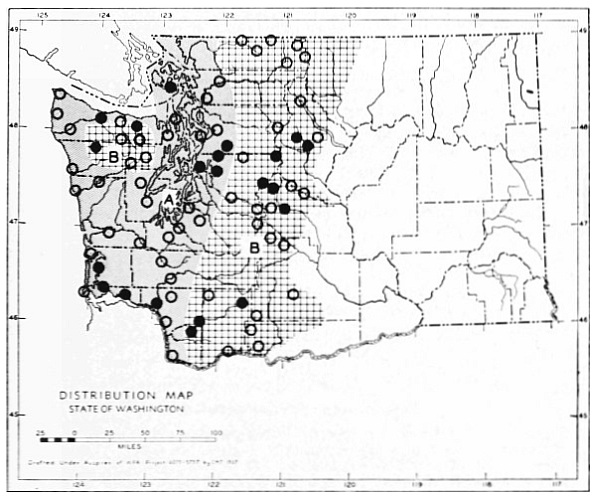
Fig. 83. Distribution of the Townsend chipmunk in Washington. A. Tamias townsendii townsendii. B. Tamias townsendii cooperi.
Shaw (1944: 278) discovered the brood nest of a Townsend chipmunk on Hurricane Ridge, Clallam County, 4,500 feet elevation. The burrow was in a cool, damp area among surface runs of moles (Scapanus), and led to an underground nest among the roots of a tree. The nest was formed of the gray, moss-like lichen (Usnea), lined within with sedge leaves (Carex spectabilis) and covered outside with leaves of the same sedge. A turning-about chamber was constructed near the entrance. The burrow was single and not branched. Three young, only two or three days old, were in the nest.
Tamias townsendii townsendii Bachman
Tamias townsendii Bachman, Jour. Acad. Nat. Sci. Philadelphia, 8 (pt. 1):68, 1839.
Tamias quadrivittatus townsendii Allen, Proc. Boston Soc. Nat. Hist., 16:290, 1874.
Tamias asiaticus var. townsendii Allen, Monog. N. Amer. Rodentia, Rept. U. S. Geol. Surv. Terr., 11:794, 1877.
Eutamias townsendii Merriam, Proc. Biol. Soc. Washington, 11:195, July 1, 1897.
Type.—Lectotype obtained near the lower mouth of the Willamette River, Multnomah County, Oregon, by J. K. Townsend in 1834; in Philadelphia Academy of Natural Sciences.
Racial Characters.—Color of sides rich tawny; dark stripes black or dark brown, and pale stripes cinnamon; underside of tail tawny.
Measurements.—Fifteen males and 10 females from western Washington average, respectively: total length 254.7, 258.6; length of tail 116, 122; hind foot 36.7, 37.1; ear 20.5, 20.4; weight 72, 81.2 grams.
Distribution.—The humid coastal belt of western Washington, from the western base of the Cascade Mountains to the Pacific, exclusive of the Olympic Mountains. When A. H. Howell revised the chipmunks in 1929, he employed a concept of a subspecies different from the writer's own. The locality records listed by Howell (1929: 109-112) for Tamias townsendii townsendii and T. t. cooperi are not in agreement with Howell's own distribution map (op. cit.: 107). When the localities listed by Howell are plotted on a map of Washington, the ranges of the two races overlap in some critical areas. Not all of the material examined by Howell was seen by the writer, and, consequently, the ranges shown in Fig. 83 are plotted, in part, on geographic grounds.
Marginal localities on the east, so plotted, for T. t. townsendii, are: Hamilton (U. S. N. M.), 5 mi. E. Monroe (W. W. D.), Redmond (W. W. D.), Roy (U. S. N. M.), and Vancouver (U. S. N. M.).
Tamias townsendii cooperi Baird
Tamias cooperi Baird, Proc. Acad. Nat. Sci. Philadelphia, 7:334, 1855.
Tamias townsendii var. cooperi Baird, Mamm. N. Amer., p. 737, 1857.
Eutamias cooperi Lyon, Smithsonian Misc. Coll., 50:89, June 27, 1907.
Eutamias townsendii cooperi Howell, Jour. Mamm., 3:184, August 4, 1922.
Type.—Cotypes obtained at Klickitat Pass, 4,500 ft., Skamania County, Washington, by J. S. Cooper in July, 1853; in United States National Museum.
Racial Characters.—Similar to T. t. townsendii but paler with pale stripes whitish rather than cinnamon.
Measurements.—Ten males and 10 females from the Cascades average, respectively: total length 246.4, 246.8; length of tail 111.7, 107.6; hind foot 35, 35.4; ear 20, 20; weight 77, 89.9 grams.
Distribution.—The higher and eastern Cascade Mountains and the Olympic Mountains. Marginal localities along the Cascades probably include: Swamp Creek (U. S. N. M.), Index (W. S. C.), North Bend (U. S. N. M.), Mt. St. Helens (U. S. N. M.), and Yacolt (M. V. Z.).
Marmota monax petrensis Howell Woodchuck
Marmota monax petrensis Howell, N. Amer. Fauna, 37:33, April 7, 1915.
Type.—Obtained at Revelstoke, British Columbia, by W. Spreadborough on May 12, 1890; type in United States National Museum.
Measurements.—Howell (1915: 33) gives the measurements of an adult male (the type) as: total length 540; length of tail 127; hind foot 76. An adult female from Barkerville, British Columbia, measured: total length 505; length of tail 125; and hind foot 68.
Distribution.—The Pend Oreille Mountains. Pend Oreille County. The woodchuck was seen and positively identified in northeastern Washington but no specimens were collected.
Description.—The woodchuck is the smallest member of the genus Marmota that occurs in Washington. Adults are about 22 inches in length, of which the tail comprises 5 inches. The body is stout and plump. The legs are short. The ears are low and rounded. The eyes are large but not prominent. The fur is rather stiff but dense. The upper parts are cinnamon, frosted with white-tipped guard hairs. The underparts are tawny. There is no white bar across the nose.
Woodchucks occur from Alaska to Idaho and eastward to the Atlantic, extending southward in the eastern United States. Miller (1924: 173-175) lists seven subspecies, one of which enters the extreme northeastern corner of Washington.
The habits of the eastern woodchuck (Marmota monax rufescens) have been studied by Hamilton (1934: 85-178), but the northern races are less well known. Cowan (1939: 77-79) gives observations on the habits, nests and burrows of Marmota monax canadensis.
Marmota flaviventris avara (Bangs) Yellow-bellied marmot
Arctomys flaviventer avarus Bangs, Proc. New England Zoöl. Club, 1:68, July 31, 1899.
[Marmota flaviventer] avarus Trouessart, Catal. Mamm., viv. foss., suppl., p. 344, 1904.
Marmota flaviventris avara Miller, U. S. Nat. Mus. Bull., 128:175, April 29, 1924.
Type.—Obtained at Okanogan, British Columbia, by A. C. Brooks on July 17, 1897; type in Museum of Comparative Zoölogy.
Measurements.—A male from 5 miles north of Entiat, Chelan County, measured: total length 610; length of tail 182; hind foot 70; ear 28.
Distribution.—From the eastern edge of the Cascade Mountains eastward, except, apparently, extreme northeastern Washington. Marginal records are:
Okanogan (W. W. D.) in the north, Wenas (W. W. D.) in the west, Pasco (M. V. Z.) in the south, and 14 mi. S. W. Pullman (Howell, 1915: 42) in the east.
Description.—The yellow-bellied marmot is similar to the woodchuck but is slightly larger. It is decidedly paler in color, less reddish, but possesses white-tipped hairs on the dorsal surface, as does the woodchuck. The yellow-bellied marmot also differs from the woodchuck in having a distinct white bar on the nose. Its pelage is coarse and rather thin.
The yellow-bellied marmot is typically an animal of the basalt talus of eastern Washington but occurs in mountainous areas in northeastern Washington. These animals are usually found near streams, ponds, lakes, or rivers. They wander considerably, however, and are often found far from water. Their wandering habits probably account for their presence near temporary streams and ponds on the Columbian Plateau. When these temporary sources of water dry up in July or early August, the marmots go into hibernation. Edson (1935: 68) records a marmot from Bellingham, Whatcom County, far west of the usual range of the species.
The "ground hog" is often hunted for sport and sometimes for food. Near centers of human population the yellow-bellied marmots are extremely shy. Along the highways of the Columbia River on any Sunday in June, it is not unusual to see a dozen cars in an hour, moving slowly past a talus slide while eager hunters scan the rocks for marmots. In the late afternoon, when the marmots leave the protection of the talus slides to drink at the river, they fall easy prey to rifles with telescope sights. Near cities in eastern Washington yellow-bellied marmots have become partially nocturnal.
Couch (1930: 2-6) attempted to excavate several dens of yellow-bellied marmots, but decided to leave the task "to some future road-building crew." Embryos found by Couch numbered three to six. Couch thought the young were born about March 15 in the Snake River area and about April 15 in the upper Okanogan area. The young appear above ground approximately 30 days after birth.
The yellow-bellied marmots enter aestivation from late June to early August, depending on the locality and local conditions. They are active longer in northeastern Washington. Couch records a yellow-bellied marmot seen in Okanogan County on October 10, but regards this as exceptional. The marmots near Wenatchee, Chelan County, emerge from their burrows in early March (March 5 to 10, from reports of residents in 1937, 1938). Couch (1930: 5) gives February 20 to March 15 as the date of appearance.
A principal requirement for marmots is the presence of rocks. At Cle Elum, Kittitas County, I took a marmot from an alfalfa field where a farmer had placed all the surface stones in a loose pile. Fifteen miles east of Tonasket, Okanogan County, marmots were living in the stones piled by road builders to support the ends of a small bridge. A hundred feet away another marmot was living under an abandoned building. A high, convenient rock near their burrow serves the yellow-bellied marmots as a look-out post. These look-out posts seem, in many cases, to have been used by many generations of marmots, for their feces sometimes fill nearby crevices to a depth of several feet and cover the look-out rock itself. The glacial boulders on the plateau between the Okanogan River and Omak Lake, Okanogan County, furnish the best examples of look-out posts. These numerous isolated boulders, ten to fifty feet in diameter and ten to thirty feet high, each seem to furnish shelter to one or more marmots. Well-worn trails lead from the boulders to burrows and feeding areas.
The food of the yellow-bellied marmot includes grasses and succulent plants found in their habitat. Fondness for alfalfa makes them a serious pest in some areas, for their large size enables them to make considerable inroads on a field. Natural enemies probably include most larger predaceous mammals. Hawks and eagles probably kill their young. Near Tonasket, Okanogan County, Robert Dalquest surprised a coyote as it ran across a small wash. A shot caused the coyote to drop a half-grown marmot which it had been carrying.
Marmota caligata cascadensis Howell Hoary marmot
Marmota caligata cascadensis Howell, Proc. Biol. Soc. Washington, 27:17, February 2, 1914.
Type.—Obtained on Mt. Rainier, 6,000 ft., Pierce County, Washington, by A. K. Fisher on August 11, 1897; type in United States National Museum.
Measurements.—A young adult male from Stevens Pass, King County, measures: total length 773; length of tail 221; hind foot 93; ear 27.
Distribution.—The Cascade Mountains, ranging from Mt. Baker (W. W. D.) and Mt. Chopaka (Taylor and Shaw, 1929: 15) south to Mt. Adams (Taylor and Shaw, 1929: 15).
Description.—The hoary marmot is the largest of the American marmots; adults are 28 inches or more in length, of which the tail makes up about 8 inches. The pelage is dense and rather woolly. The upper parts are not frosted with white-tipped hairs, but are gray washed with blackish. The head is blackish with white facial markings, and the shoulders, legs and underparts are gray. The tail is dark reddish brown.
Hoary marmots range from Alaska south to Washington and Idaho. Howell (1915: 57-67) recognizes seven races of this species.
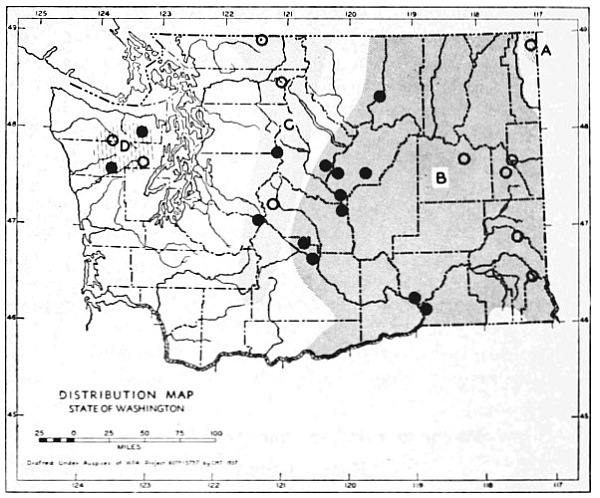
Fig. 84A. Distribution of marmots in Washington. A. Marmota monax petrensis. B. Marmota flaviventris avara. C. Marmota caligata cascadensis. D. Marmota olympus.
This mammal of the higher altitudes rarely goes below the Hudsonian Life-zone. It is most common in the talus slides at the lower edge of the Arctic-Alpine Life-zone. Like other marmots, it prefers to live amid loose boulders. The steep talus or "scab rock" slides in the glacial cirques provide an ideal habitat. The crevices and caves beneath the rocks offer concealment for young and adults. A large boulder with a flat top is usually selected as a look-out. Well-worn trails lead from the talus slides to nearby grassy slopes. When surprised in the open, the hoary marmot exhibits a peculiar bounding run, reminiscent of that of tree squirrels. The short tail "follows through" in the leaps. In the rock slides the hoary marmot is surprisingly agile.
The clear, shrill whistle of the hoary marmot is familiar to all who penetrate its haunts. The whistle is remarkably similar to the whistle of a person. Locally the hoary marmot is known as "whistler" or "whistle pig." Individuals emerge from hibernation early in June; most adults retire again by the middle of September. On September 14, 1937, a young of the year was shot and few were seen where they had been common in June. All were shy. Only one adult was seen.
Large hawks and eagles commonly hunt over the rock slides inhabited by marmots, and probably kill very young individuals. Only the larger predators such as bear, cougar, wolf, coyote, lynx, and bobcat would be expected to kill an adult hoary marmot.
Marmota olympus (Merriam) Olympic marmot
Arctomys olympus Merriam, Proc. Acad. Nat. Sci. Philadelphia, p. 352, October 4, 1898.
[Marmota] olympus Trouessart, Catal. Mamm., viv. foss. suppl., p. 344, 1904.
Type.—Obtained at timber-line, head of Sol Duc River, Clallam County, Washington, by C. H. Merriam, on August 27, 1897; type in United States National Museum.
Measurements.—Two small but adult females from Deer Park, Clallam County, measure respectively: total length 758, 691; length of tail 163, 161; hind foot 106, 97; ear 31, 29.
Distribution.—This species is confined to the Olympic Mountains.
Description.—The Olympic marmot closely resembles the hoary marmot, and differs in being slightly larger, and reddish or rusty brown where the hoary marmot is gray. It lacks the blackish overwash of the hoary marmot. The nose is whitish.
Although the Olympic marmot belongs to the hoary marmot group it is a distinct species, most closely related to the marmot of the mountains of Vancouver Island. Its habits differ but little from those of the hoary marmot. It lives in burrows in talus slides and boulder piles near timber line. A few burrows are dug beneath logs. Well worn trails lead from burrows to feeding grounds on nearby grassy slopes and heather meadows. High rocks or logs serve as lookouts. The alarm whistle is similar to that of the hoary marmot.
Citellus townsendii townsendii (Bachman) Townsend ground squirrel; sage rat
Spermophilus townsendii Bachman, Jour. Acad. Nat. Sci. Philadelphia, 8:61, 1839.
Spermophilus mollis yakimensis Merriam, Proc. Biol. Soc. Washington, 12:70, March 24, 1898.
[Citellus mollis] yakimensis Trouessart, Cat. Mamm., Sup., p. 339, 1904.
Citellus townsendii townsendii Howell, N. Amer. Fauna, 56:60, May 18, 1938.
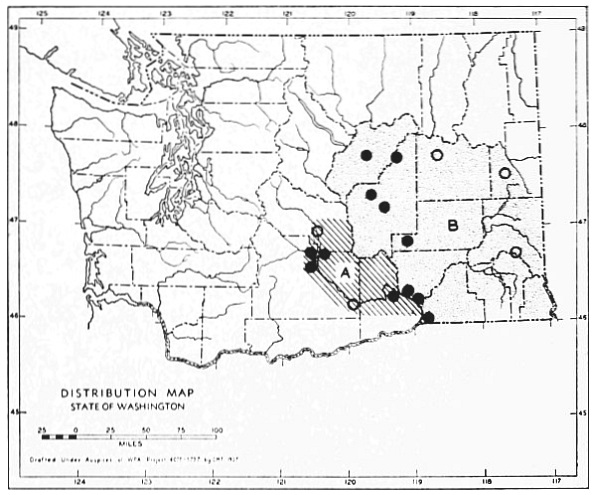
Fig. 84B. Distribution of the Townsend and Washington ground squirrels in Washington. A. Citellus townsendii townsendii. B. Citellus washingtoni.
Type.—Obtained on the western bank of the Columbia River "about 300 miles above its mouth" (probably near the mouth of the Walla Walla or Touchet river; more exactly, opposite Wallula, in Benton County, Washington) by J. K. Townsend in July, 1836; type in Academy of Natural Sciences of Philadelphia.
Measurements.—Ten adults from Mabton and North Yakima, Yakima County, average: total length 212.2; length of tail 45.7; hind foot 33.9.
Distribution.—The Upper Sonoran Life-zone area of the Yakima Valley from Ellensburg (Howell, 1938: 63) south to the Columbia at Kennewick (W. W. D.).
Remarks.—This race is probably derived from C. t. mollis of Oregon, from which it is but slightly differentiated. It was known for many years as Citellus mollis yakimensis. For use of the name townsendii see Howell (1938: 62).
The head and body are about 6-1/2 inches long and the tail is about 2 inches in length. The head is large with low, rounded ears and large eyes. The neck is distinctly constricted and the body is plump. Adults are "pot-bellied." The legs are short and the feet small. The tail is short, round at the base but bushy throughout the rest of its length. The pelage is short and rather harsh. In color the upper parts are yellowish gray flecked with tiny, pale dots. The underparts are buffy. The face, thighs and tail are reddish buff.
Ground squirrels occur in parts of Europe, Asia, and much of western North America. Howell (1938: 36-37) recognizes eight subgenera and thirty-one species in North America. Three subgenera occur in Washington, namely: Citellus, the spotted ground squirrels, represented by Citellus townsendii, Citellus washingtoni and Citellus columbianus; Otospermophilus, the long-tailed ground squirrels, represented by Citellus beecheyi; and Callospermophilus, the striped ground squirrels, represented by Citellus lateralis and Citellus saturatus.
All ground squirrels are diurnal and consequently are familiar to man. Most species bear local names and the striped or mantled ground squirrels are often mistaken for chipmunks. Some species are destructive to crops, especially grain. In addition they harbor sylvatic plague. Economically the genus Citellus is of great importance in Washington.
All Washington ground squirrels live in burrows which they construct themselves. The life histories of the two striped species are less well known than those of the more economically important species. All species hibernate. The striped species disappear in October and reappear the following March. This can be called true hibernation. The long-tailed ground squirrels probably hibernate at high altitudes but aestivate in more arid localities. In Washington the Douglas ground squirrel occupies an area that is relatively temperate and humid. They may hibernate or aestivate, depending on local conditions, or they may remain active all year. The spotted ground squirrels disappear in midsummer and sleep (aestivate) until the following spring, for in their arid habitat the disappearance of green food in late summer and fall makes living conditions almost as unfavorable as in winter.
Townsend ground squirrels range from central Washington south to southern Nevada and from the Cascade Mountains east to eastern Idaho and central Utah. Five races are recognized, only one of which occurs in Washington, where it is confined to the Upper Sonoran Life-zone. It occupies the sagebrush area, being most common where the sage is in scattered clumps separated by grassy areas. Occasionally these squirrels occupy extensive grasslands where sage is scarce and in the Yakima area may enter pastures and fields. They live in colonies, often with more than ten separate burrows to the acre.
Burrows are dug in dusty ground, either near sage bushes or in openings among them. Well-worn trails lead from feeding places to openings of burrows. Mouths of burrows are usually situated on flat ground and are surrounded by a rim of excavated earth four to six inches high. If located on a slope, the excavated earth collects as a mound on the lower side, and serves as a look-out post for the squirrels. Burrows excavated by Scheffer are described by Howell (1938: 5). One reached a depth of 5-1/4 feet at a point where it branched 11 feet from the entrance. One branch led to the nest chamber three feet to the right of the main tunnel. The other reached a depth of six feet at a point 14 feet from the entrance, then turned upwards at a 70 degree angle and reached the surface through a partly obstructed entrance, 12 feet from the original entrance. The nest chamber was 6-1/2 inches in diameter and filled with a perfectly dry nest of fine grass, partly broken and shredded.
Food consists of soft green vegetation and seeds. Foods listed by Howell (1938: 5) include: Sphaeralida munroana, Plantago purshii, Bromus tectorum, Agropyron pauciflorum, Oryzopsis hymenoides, Norta altissima, Artemisiae spinescens, sunflower, alfalfa, wheat, barley, potato, beets, carrots, lettuce, and insects (grasshoppers, cicadas). In 1917, these squirrels were reported to have practically destroyed a ten-acre field of beets at White Swan, Yakima County.
Aestivation of older individuals begins in late May and the last young disappear in early June. The squirrels appear again in late January, before the snow has disappeared (Scheffer, 1941: 272).
The voice of the Townsend ground squirrel is a faint, high pitched "pe-eee-ep," of remarkable carrying power for so faint a sound, and extremely difficult to trace to its source. Scheffer (in Howell, op. cit., p. 6) mentions also a chirping sound and a chatter of alarm which I have not heard.
Five to seven embryos were found in specimens collected near Yakima. Scheffer (1941: 270) found the number of fetuses in 52 pregnant females from the Kennewick area to vary from 4 to 16 with an average of 8.6. Francis (1922: 5) reported tularemia in this species. They probably harbor also sylvatic plague.
Citellus washingtoni Howell Washington ground squirrel; sage rat
Citellus washingtoni washingtoni Howell, N. Amer. Fauna, 56:69, May 18, 1938.
Citellus washingtoni loringi Howell, N. Amer. Fauna, 56:71, May 18, 1938 (type from Douglas, Douglas County, Washington).
Type.—Obtained at Touchet, Walla Walla County, Washington, by C. P. Streator on May 18, 1891; type in United States National Museum.
Distribution.—The Columbian Plateau and southward into Oregon, ranging from Farmer (Howell, 1938: 71) and Moses Coulee (W. W. D.) south to Wallula (M. V. Z.).
Measurements.—Fifteen specimens from the vicinity of the type locality average: total length 229.2; length of tail 50; hind foot 35.3. A male from 4 miles west of Pasco, Franklin County, weighed 201 grams.
Remarks.—Citellus w. loringi allegedly differs from typical washingtoni in smaller size. The specimens collected by us from within the range of loringi are as large as those from farther south. C. w. loringi is regarded as a synonym of C. w. washingtoni.
Description.—The Washington ground squirrel closely resembles the Townsend ground squirrel in size and appearance. It differs principally in color. The upper parts are brownish gray marked with distinct white spots, and the underparts are buffy. The face, thighs and tail are dull reddish.
This species is closely related to the Townsend ground squirrel but its habitat is more varied. It is most common in areas of low sage bushes surrounded by grasslands and on extensive grasslands, but occurs also in sandy places, wheat fields, and rocky hillsides. The animals live in colonies, in some places 50 or more individuals to the acre. They occur also as scattered individuals or small colonies in smaller areas of suitable habitat. For example, along the highway from Farmer, Douglas County, to Waterville, a distance of 15 miles, a band of natural grass, 50 feet or less in width, lies between the road and the extensive wheat fields beyond. This strip of natural cover possessed about one Citellus to each 200 feet along most of its length. The squirrels were often seen sitting on rolls of wire drift fence, used to keep snow drifts from the road in winter but in summer rolled into bundles 3 feet in diameter and left standing at intervals of one each 100 feet. The squirrels had constructed their burrow entrances beneath these rolls and used the rolls as look-out posts. At my approach they would dodge into the rolls of wire and, unless scared, remained in the wire roll. By approaching carefully and overturning the rolls I was able to trap and capture a good series of living specimens.
Burrows, nests, habits, and food of this species seem identical to those of townsendii. Aestivation dates seem to be the same (Scheffer, 1941: 270-279). The hibernation of this species has been discussed in detail by Svhila (1939: 6-10). Food species listed by Scheffer at Wallula (Howell, 1938: 8) are identical to those of townsendii at Kennewick, across the Columbia River (see account of townsendii).
Scheffer (1941: 270-279) examined 26 pregnant females of this species and found the fetuses to vary from 5 to 11 in number, with an average of 8.
Citellus columbianus (Ord) Columbian ground squirrel
Description.—The Columbian ground squirrel has the general body proportions, large head, large eyes, low, rounded ears, plump body and short tail of the Townsend ground squirrel, but is much larger. The head and body of an adult measure about 10 inches and the tail about 4 inches. The upper parts are grayish buff mottled with round white dots. The underparts and forefeet are pale ochraceous. The back of the head and neck are gray. The face, thighs and tail are reddish.
The Columbian ground squirrel occupies inland mountainous areas from central British Columbia to central Oregon and Idaho and from eastern Washington and Oregon to western Montana and southwestern Alberta. It is closely related to the arctic ground squirrels of the Citellus parryii group, which are in turn related to the Siberian forms, buxtoni and stejnegeri.
The habitat of the Columbian ground squirrel is varied but is usually more humid than that of the Townsend and Washington ground squirrels. The most arid of the lands occupied by them in Washington are the grasslands and wheat fields of the Poulouse country and the eastern border of the state. In northeastern Washington they live in meadows and grasslands in the valleys, in openings in the coniferous forest at higher altitudes and in parks and alpine meadows almost to timber-line on the mountains. Some individuals were in brushy places or even in forests, far from grassy clearings. Near Republic, Ferry County, a Columbian ground squirrel was killed as it ran along a log in dense larch woods. Its burrows were found in a tangle of brush and fallen logs. No clearings, meadow or grassland existed nearby. Narrow bands of cleared land beside roads and railroad tracks are extensively used by these squirrels. Where small meadows or pastures occur, this species lives in dense colonies. If grasslands are extensive it lives in loose colonies, often with considerable distances between individual burrow systems. In the mountains the squirrels are scattered or live in small groups.
Burrows of the Columbian ground squirrel are often constructed in the open. Mouths of burrows, especially if the animals are living in colonies, usually are marked by a large pile of excavated earth. If, however, there is some large object on the surface of the ground, such as a stone, stump, or log, the entrance to the burrow is located beside this. Such objects are often undermined and made to settle, eventually becoming buried. The squirrels live under houses, and the yards of abandoned ranch buildings are often infested with them.
The burrows of the Columbian ground squirrel have been described by Shaw (1919, 1924B, 1925, A, B, E, 1926) and Bailey (1918: 47). Two types of burrows are constructed, summer burrows and hibernation dens. Summer burrows are used year after year, perhaps by succeeding generations of squirrels. They vary considerably but usually are 3 or 4 inches in diameter and possess several entrances. The depth to which the burrow descends, as well as the number of forks and subsidiary burrows, depends to some extent on the whims of the individual squirrel and the length of time the burrow has been occupied. Usually the burrow reaches a depth of four feet and two or more branches are present. A turning-about chamber is present, not far from the entrance. Here a startled squirrel can turn about and watch the entrance and, if the alarm was false, the squirrel resumes its activities above ground. Nests are above the level of the main burrow system and thus are protected from flooding by rain or melting snow. Stored food and excrement are deposited in separate compartments. Escape entrances, concealed in grass and weeds, for use in case the burrow is invaded, are dug from beneath the surface of the ground and thus are unmarked by any telltale mound of earth.
Separate dens are used for aestivation. While the squirrel is in aestivation the entrances to the summer burrow are solidly plugged with tamped earth. Aestivation dens are short and may or may not communicate with the summer burrow. Shaw (1925B: 58) measured 50 such dens and found the aestivation cell to average 2 feet 6 inches beneath the surface with extreme depths of 6 inches and 4 feet 11 inches. Ordinarily a drainage burrow is dug beneath the level of the nest.
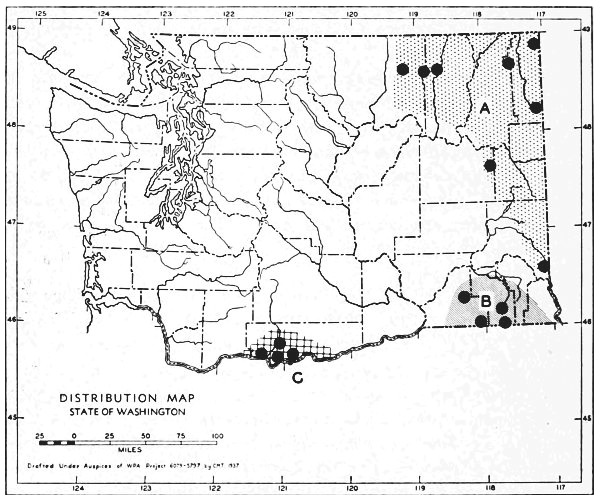
Fig. 85. Distribution of the Columbian and Beechey ground squirrels in Washington. A. Citellus columbianus columbianus. B. Citellus columbianus ruficaudus. C. Citellus beecheyi douglasii.
The time and length of aestivation is variable. Old males enter aestivation before the females and young, and emerge earlier in the spring. In the lowlands, as about Pullman, Whitman County, the squirrels begin to disappear in mid July. In the mountains of northeastern Washington they are active until late August. They emerge again in late February or early March. Shaw (1925B) mentions that food is occasionally stored in aestivation dens of male squirrels. This food is not eaten in the winter but in the spring, when the squirrels awaken.
The gestation period was determined by Shaw (1925C: 108) as 24 days. Two to five, rarely seven, young are born. The average litter is about 3.5. Mating occurs in late March and the young are born about the middle of April.
Most green vegetation occurring in its habitat is food for the Columbian ground squirrel. Bulbs, seeds, fruit, berries, grain, clover, alfalfa, and garden truck are eagerly eaten. The squirrels are especially fond of wheat and great damage results from their depredations. In northeastern Washington some wheat fields are almost entirely destroyed. Shaw (1925G) showed that one squirrel destroyed an average of more than 50 pounds of wheat in a season. When populations range as high as ten squirrels to the acre, little wheat is left.
In Montana the Columbian ground squirrel is a known reservoir of Rocky Mountain spotted fever (Birdseye, 1912: 1-46) while sylvatic plague has been reported in this species in Oregon (Meyer, 1936: 965). Control of the Columbian ground squirrel by traps, poison, and shooting is only locally successful.
Citellus columbianus columbianus (Ord)
Arctomys columbianus Ord, Guthrie's Geography, 2d American Edition, 2:292 (description, p. 303), 1815.
Spermophilus columbianus Merriam, N. Amer. Fauna, 5:39, July 30, 1891.
Citellus columbianus Allen, Bull. Amer. Mus. Nat. Hist., 19:536, October 10, 1903.
Type.—None designated. Description based on Lewis and Clark's account of animals taken by them between the forks of the Clearwater and Kooskooskie rivers, Idaho.
Racial characters.—Smaller size and paler color than in ruficaudus.
Measurements.—Five females from northeastern Washington average: total length 346; length of tail 77; hind foot 48.6; ear 20.
Distribution.—Northeastern Washington, from 15 mi. E. Tonasket (W. W. D.) east to Pass Creek Pass (U. S. N. M.) and south to Pullman (W. S. C.) along the eastern edge of the state.
Citellus columbianus ruficaudus Howell
Citellus columbianus ruficaudus Howell, Proc. Biol. Soc. Washington, 41:212, December 18, 1928.
Type.—Obtained at Wallowa Lake, Wallowa County, Oregon, by G. G. Cantwell on April 13, 1919; type in United States National Museum.
Racial characters.—Similar to Citellus columbianus columbianus but tail redder, especially above, and red color everywhere deeper.
Distribution.—Restricted to the Blue Mountains of extreme southeastern Washington.
Remarks.—This is at best a slightly differentiated race and upon further study, animals assigned to it may prove unworthy of recognition as a distinct subspecies.
Citellus beecheyi douglasii (Richardson) Beechey ground squirrel
Arctomys? (Spermophilus?) douglasii Richardson, Fauna Boreali-Americana, 1:172, 1829.
Spermophilus douglasii F. Cuvier, Sup. a l'hist. natur. Buffon, 1:333, 1831.
[Spermophilus grammurus] var. douglasii Allen, Proc. Boston Soc. Nat. Hist., 16:293, 1874.
Citellus v[ariegatus]. douglasii Elliot, Field Columb. Mus. Publ. 76, zoöl. ser. 3:183, May, 1903.
Citellus beecheyi douglasi Grinnell, Proc. California Acad. Sci., 3 (ser. 4):345, August 28, 1913.
Otospermophilus grammurus douglasii Miller, U. S. Nat. Mus. Bull., 128:18, April 29, 1924.
Citellus douglasii Taylor and Shaw, Occ. Papers Chas. R. Conner Mus., no. 2:15, December, 1929.
Citellus beecheyi douglasii Howell, N. Amer. Fauna, 56:150, May 18, 1938.
Type.—None. Description based on a hunter's skin from "Banks of the Columbia," probably near The Dalles, Wasco County, Oregon.
Measurements.—A male and 6 females from Klickitat County, average, respectively: total length 469, 480; length of tail 181, 198; hind foot 58, 62; ear 26, 26.
Distribution.—The Columbia River Valley from Goldendale (W. W. D.) west to the White Salmon River (W. W. D.).
Remarks.—Ground squirrels have been common on the Oregon side of the Columbia River for a long time. The specimen upon which the description was based was presumably obtained there in the early 1800's. Yet the species did not become established in Washington until 100 years later, in about 1915.
The head is large with eyes and ears of moderate size. The body is rather stout; thicker than that of a tree squirrel but slimmer than that of the Columbian ground squirrel. Head and body are about 11 inches in length and the tail is about 7 inches long. The upper parts are dark brownish or blackish gray heavily marked with white spots. A triangular area at the shoulders is clear black outlined in whitish. The head and neck are grayish brown. The underparts are buffy. The tail is gray above and buffy beneath.
This species belongs to the subgenus Otospermophilus. Externally the species beecheyi differs from Citellus washingtoni, townsendii, and columbianus, all of which belong to the subgenus Citellus, in possessing more slender limbs, a longer, thinner body, a rather bushy tail that is nearly two-thirds, rather than less than half, the length of the body, and larger, more prominent ears. The Beechey ground squirrel lacks also the hazel color of nose and thigh that is characteristic of the subgenus Citellus in Washington.
Citellus beecheyi ranges from the southern edge of the state of Washington southward through western Oregon and California into northern Lower California. It is a western coastal species and reaches eastward only as far as Nevada. A related species, Citellus variegatus, occurs farther inland, from Utah, Colorado, and Texas, southward to central Mexico. Eight subspecies of Citellus beecheyi are recognized by Howell (1938), all but three of which are restricted to California.
At present the Beechey ground squirrel occupies a limited area of Washington, which it has invaded in recent years (Scheffer and Dalquest, 1939: 44). However, it is extending its range and may be expected eventually to occupy a considerable part of the state.
The habitat of this ground squirrel is varied. It occupies a more humid terrain than do most members of the genus. At the present time it is most common in grassy fields and rocky outcrops along the Columbia River. It is common also in the open oak groves on the hillsides back from the river valley and some individuals were seen near Guler, well up on the slopes of Mount Adams. As observed in Washington, its favored habitat is about rock outcrops and talus slides near extensive fields or grasslands. In California and Oregon, however, it occurs among other places, in scattered fields and meadows of the coniferous forests in the humid subdivision of the Transition Life-zone. The range of tolerance of the species is such that it might extend its range into much of western Washington, including the Puget Sound area. It may be expected to move northward through the eastern Cascades.
Because of its limited range and the short time of its establishment, the Beechey ground squirrel has been studied little in Washington. According to Howell (1938: 28), this race is less prolific and abundant than other members of the species. Of the Beechey ground squirrel, certainly the subspecies C. b. douglasii, is less common, locally and over wide areas, in its range in California and Oregon, than are the subspecies C. b. beecheyi and C. b. fisheri in California. In Washington, on the other hand, douglasii is locally abundant, perhaps more so than elsewhere.