ACCOUNTS OF SPECIES AND SUBSPECIES (continued 6)
Reading edition
The principal enemies of the white-tailed jack rabbit are the eagle, coyote, and bobcat. Of 1,186 stomachs of coyotes from Washington, Sperry (1941: 11) found that 27 percent contained rabbits, including jack rabbits, snowshoe hares, and cottontails.
In the daytime, white-tailed jack rabbits hide in forms which consist of shallow holes dug at the bases of bushes or beside rocks. They feed in the morning, evening, and in the night along wide, well-defined trails through the bunchgrass. If startled from their forms they dash off in bounding, erratic leaps, skimming away until lost to sight. A whitetail has been timed at a speed of 34 miles per hour (Cottam and Williams, 1943: 262).
The early explorers and settlers found the white-tailed jack rabbits abundant in eastern Washington. With the invasion and spread of the black-tailed jack rabbit, and the reduction of native bunchgrass through overgrazing by livestock, the whitetail has become rare. In several years of field work on the Columbian Plateau, I saw none. Near Wallula, the type locality, residents had not seen whitetails for years, but thought there might be a few left "back in the hills." There are thought to be a few left near Ellensburg and Yakima.
Only in the Okanogan Valley are the whitetails holding their own; they are reasonably common there. In winter they come down from the hills on to the sagebrush flats along the Okanogan River in Okanogan County. In January it is not unusual to see as many as five in a day's drive. When, as will most certainly occur, the black-tailed jack rabbit enters the Okanogan Valley, the splendid whitetail may be expected to disappear from Washington.
Because this species has been so reduced in numbers, no distributional map has been included. Taylor and Shaw (1929: 28) give its range as: "north to Oroville, east to Pullman, south to Asotin, Walla Walla, and Kennewick, and west to Lake Chelan (Manson), Yakima Valley, and Klickitat County." This range is similar to that of the Nuttall Cottontail (Fig. 129).
Lepus americanus Erxleben Snowshoe rabbit
Description.—The appearance, size, and proportions of the snowshoe rabbit are similar to those of the Belgian hare. The body is about 16 inches in length, the ears are midway in size between those of the cottontail and the jack rabbit, and the feet are relatively long and the tail is short. In summer the color of the upper parts is reddish brown, varying with the subspecies. The winter pelage of Lepus a. washingtonii is a slightly paler brown than the summer coat. In the other three races in Washington the winter coat is entirely white, except for the dusky borders of the ears.
Snowshoe rabbits occur in Alaska, Canada, and the northern United States, from the Atlantic to the Pacific. They are absent in desert or prairie regions but range far southward in the United States in mountainous areas. They are found throughout Washington, except on the Columbian Plateau and in the Okanogan River Valley. None of the four races found in Washington is restricted exclusively to the state. Snowshoe rabbits live only in wooded areas. Their habitat varies from dense, impenetrable rain-forests along the ocean to the alpine parks, dotted with trees, of the Hudsonian Life-zone. They occur in humid and arid subdivisions of the Transition, Canadian, and Hudsonian life-zones. Altitudinally they range from sea level to 6,000 feet (Mt. Rainier).
Enemies of the snowshoe rabbit include the coyote, bobcat, lynx, long-tailed weasel, and great horned owl.
Snowshoe rabbits are largely nocturnal or crepuscular in habit. They are secretive and slip away quietly at the least threat of danger. Persons often live for years in localities where snowshoe rabbits are abundant without seeing a live individual. Those that are seen ordinarily have been startled from their forms at midday, or surprised while feeding on clover along a highway in the early morning. More commonly they are seen crossing a road in the lights of an automobile. Tracks, easily found after a fresh snowfall, give some indication of their numbers in any locality.
Little information is available on the fluctuations of numbers of snowshoe rabbits in Washington. Floyd Thornton, a trapper living at Forks, Clallam County, states that they were numerous in 1924, scarce in 1930-31, and fairly common in 1938-39. More rabbits are seen shortly after the breeding season than at other times of the year. From April 8-10, 1941, I saw none on a highway extending about 100 miles along the west coast of the Olympic Peninsula, but on June 4-5 here counted 3 dead on the road and saw 3 running across it. One was about one-third grown and another two-thirds grown.
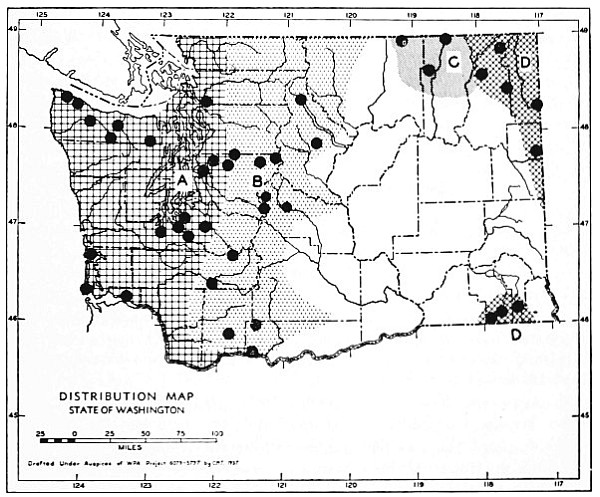
Fig. 127. Distribution of the snowshoe hare in Washington. A. Lepus americanus washingtonii. B. Lepus americanus cascadensis. C. Lepus americanus columbiensis. D. Lepus americanus pineus.
The snowshoe rabbits are classed as game animals in Washington but few people hunt them. Their winter food includes buds and needles of hemlock, Douglas fir, and probably other evergreens. Annuals, grasses, and shrubs, as well as Douglas fir needles, are eaten in the summer. Snowshoe rabbits do some damage by eating the bark of trees and the boughs of newly planted evergreens. Together with rodents they are responsible for serious damage to plantations of Douglas fir and hemlock on the Olympic Peninsula.
At least in summer, they are heavily parasitized by fleas and ticks and may in addition carry tularemia, or rabbit fever.
Scheffer (1933: 77-78) found that the young were born from May 5 to July 4 in the Puget Sound area and that there were from 2 to 5, usually 5 per litter.
Lepus americanus washingtonii Baird
Lepus washingtonii Baird, Proc. Acad. Nat. Sci. Philadelphia, 7:333, 1855.
[Lepus americanus] var. Washingtoni J. A. Allen, Proc. Boston Soc. Nat. Hist., 17:434, February 17, 1875.
Lepus americanus Washingtoni True, Proc. U. S. Nat. Mus., 7:601, 1885.
Type.—Obtained by G. Suckley at Steilacoom, Pierce County, Washington, on April 1, 1854; type in United States National Museum.
Racial characters.—Size small for a snowshoe rabbit; color of upper parts dark, in summer between Sayal Brown and Cinnamon, in winter slightly paler, near Pale Cinnamon Buff (capitalized color terms in the accounts of the lagomorphs are after Ridgway, Color Standards and Color Nomenclature, Washington, D. C., 1912); underparts white; soles of feet usually stained yellowish, brownish, or blackish.
Measurements.—Two males and 6 females from the Olympic Peninsula average, respectively: total length 407, 402.5; hind foot 114, 119. Weight of a 408 mm. male from the same locality 2-1/4 lbs.
Distribution.—This snowshoe rabbit occupies the humid subdivision of the Transition Life-zone of western Washington from the British Columbian boundary south to the Columbia River. Marginal occurrences are (from Dalquest, 1942: 175): Mt. Vernon, Paradise Lake, Lake Kapowsin, and White Salmon.
Lepus americanus cascadensis Nelson
Lepus bairdi cascadensis Nelson, Proc. Biol. Soc. Washington, 20:87, December 11, 1907.
Lepus americanus cascadensis Racey and Cowan, Ann. Rept. Provincial Mus. British Columbia, p. H 18, 1935.
Type.—Obtained by W. C. Colt near Hope, British Columbia, on June 12, 1894; type in Museum of Comparative Zoölogy.
Racial characters.—Size medium for a snowshoe rabbit; color of upper parts in summer near Orange Cinnamon; head paler, sharply marked off from body; underparts white. Color in winter: entire body pure white except for dusky borders of ears and eyelids.
Measurements.—Three males and 5 females from Kittitas County, Washington, average, respectively: total length 405, 440; hind foot 124, 133.
Distribution.—The Cascade Mountains from the British Columbia boundary south to Mount Adams. Marginal occurrences are: Skykomish (Dalquest, 1942: 177), Vance (Dalquest, 1942: 177) and 7 mi. W Guler (W.W.D.).
Lepus americanus pineus Dalquest
Lepus americanus pineus Dalquest, Jour. Mamm., 23:178, May 14, 1942.
Type.—Obtained by P. G. Putnam at Cedar Mountain (now Moscow Mountain), Latah County, Idaho, on May 29, 1921; type in University of Michigan, Museum of Zoölogy.
Racial characters.—Size small for a snowshoe rabbit; in summer, upper parts Cinnamon Brown, with sides slightly paler and rump patch blackish; color of the head between Sayal Brown and Cinnamon; hips Light Olivaceous Buff; chest-band light Cinnamon; ears blackish, often edged with white. In winter the color of the entire body is white, save for the dusky edges of the ears and the blackish eyelids. The color of the underfur in winter is usually Pale Pinkish Cinnamon, rarely Light Vinaceous Cinnamon or Orange Cinnamon, with the basal portion slaty.
Measurements.—Two males and 5 females, from northeastern Washington, average, respectively: total length 419, 439; hind foot 138.5, 138. The average measurements of 3 males and 7 females from the Blue Mountains are: 407, 422; 128, 131.
Distribution.—The pine forests of the arid subdivision of the Transition Life-zone along the eastern border of Washington, in the Blue Mountains, and in the forested parts of northeastern Washington as far west as the Kettle River Range. Western records of occurrence are (Dalquest, 1942: 179): Deep Lake, Colville, Calispel Peak.
Lepus americanus columbiensis Rhoads
Lepus americanus columbiensis Rhoads, Proc. Acad. Nat. Sci. Philadelphia, p. 242, June, 1895.
Type.—Obtained by S. N. Rhoads at Vernon, British Columbia, on July 29, 1892; type in Philadelphia Academy of Natural Sciences.
Racial characters.—Size large; color in summer: upper parts near Cinnamon Brown, sides and head slightly paler; top of tail and small rump-patch blackish; chest-band pale Cinnamon Brown; hips light Ochraceous Buff; chin and belly white.
Measurements.—A male from Molson, Okanogan County, measures: total length 435; length of tail 150. A male and a female from Danville, Ferry County, measure, respectively: 460, 430; 150, 142.
Distribution.—Only a small part of the range of this rabbit lies within the state of Washington; the greater part is in British Columbia. In Washington it occupies the timbered areas north of the Columbia River, east of the Okanogan River, and west of the Kettle River Range. Records are (Dalquest, 1942: 182): Molson, Danville and Republic. In the 1942 paper, the latter locality was erroneously listed under pineus.
Lepus californicus deserticola Mearns Black-tailed jack rabbit
Lepus texianus deserticola Mearns, Proc. U. S. Nat. Mus., 18:564, June 24, 1896.
Lepus texianus wallawalla Merriam, Proc. Biol. Soc. Washington, 17:137, July 14, 1904 (type from Touchet, Walla Walla County, Washington).
Lepus californicus deserticola Nelson, N. Amer. Fauna, 29:137, August 31, 1909.
Type.—Obtained at western edge of Colorado desert, Imperial County, California; type in American Museum of Natural History.
Measurements.—Three males and 4 females from Union Gap, Yakima County, average, respectively: total length 538, 539; length of tail 72, 71; hind foot 128, 124; ear 120, 124. Two females from the same locality weighed 5 and 6-1/2 pounds, respectively.
Distribution.—The Columbian Plateau, southeastern Washington, and the Yakima Valley area. The northernmost locality record is Moses Coulee (W.W.D.).
Remarks.—The blacktail is the commonest jack rabbit of the West. It is larger than the domestic rabbit and its enormous ears, long, gangling legs, and bounding gait make it appear even larger than it really is. Its iron-gray color, black tail and black ear tips match its sagebrush habitat.
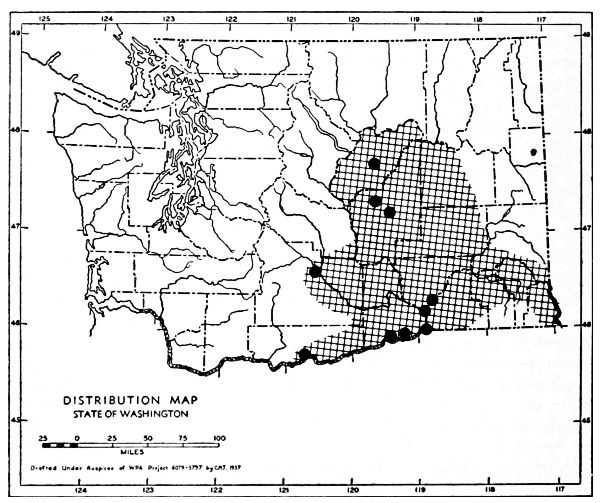
Fig. 128. Distribution of the black-tailed jack rabbit, Lepus californicus deserticola, in Washington.
Black-tailed jack rabbits reach the northern limit of their distribution on the Columbian Plateau of eastern Washington. They extend from Washington south to the Valley of Mexico and from the Pacific Coast east to Missouri (Nelson, 1909: 127). About 20 races are recognized, of which only one is native to Washington.
The blacktail is restricted to the Upper Sonoran Life-zone. Seldom is it found far from sagebrush (Artemisia) and rabbitbrush (Chrysothamus). It is well adapted to desert life, and is able to withstand the bitterly cold winters and hot, dry summers of eastern Washington. Blacktails are active in the evening, night, morning, and cooler parts of the day. In the daytime they crouch in forms consisting of shallow depressions at the bases of shrubs.
Blacktails eat the twigs and leaves of sagebrush, rabbitbrush, other desert shrubs, and grasses. They are particularly fond of alfalfa and cultivated crops, of which they destroy great quantities. They are serious pests during periodic years of abundance. Some measure of their abundance may be gained by counting the bodies of jack rabbits killed by cars on well-traveled highways through sagebrush areas. In years of abundance these may number 50 to 100 per mile, while in years of scarcity these may number only one or two.
Black-tailed jack rabbits are susceptible to numerous parasites and diseases including tularemia. Diseased rabbits are especially noticeable during years of abundance. Jack rabbits are almost never used as food although many are shot for sport or to protect crops.
The black-tailed jack rabbit is a swift runner. Cottam and Williams (1943: 263) timed 6 individuals while running under varying conditions. Full speeds for 50 to 300 yards varied from 27 to 38 miles per hour. The maximum speed was attained by two individuals, each for 100 yards.
Embryos found in March numbered 4, 5 and 6.
Sylvilagus nuttallii nuttallii (Bachman) Nuttall cottontail
Lepus nuttallii Bachman, Jour. Acad. Nat. Sci. Philadelphia, 7:345, 1837.
Lepus artemisia Bachman, Jour. Acad. Nat. Sci. Philadelphia, 8:94, 1839 (type from Wallula, Walla Walla County, Washington).
[Lepus sylvaticus] var. Nuttallii Allen, Proc. Boston Soc. Nat. Hist., 17:434, February 17, 1875.
Lepus sylvaticus Nuttalli True, Proc. U. S. Nat. Mus., 7:601, 1885.
Sylvilagus (Sylvilagus) nuttallii Lyon, Smithsonian Misc. Coll., 45 (no. 1456):336, June 15, 1904.
Sylvilagus nuttalli Nelson, N. A. Fauna, 29:201, August 31, 1909.
Type.—Obtained near mouth of Malheur River, Malheur County, Oregon. by T. Nuttall in August, 1834; type in Philadelphia Academy of Natural Sciences.
Measurements.—Two males and 4 females from Moses Lake, Grant County, average, respectively: total length 355, 348; length of tail 33, 35; hind foot 83, 83; ear 63.5, 60.
Distribution.—The Columbian Plateau, Okanogan Valley, Yakima Valley and Columbia Valley in southeastern Washington; in general, the sagebrush area of eastern Washington; north in the Okanogan River Valley to Oroville and in the Columbia Valley to Kettle Falls (W.W.D., records not all shown on map).
Remarks.—Nuttall cottontails are small, grayish-brown rabbits with relatively short, rounded ears and short legs. Their small size and small ears, which lack black tips, distinguish them from jack rabbits where the two occur together.
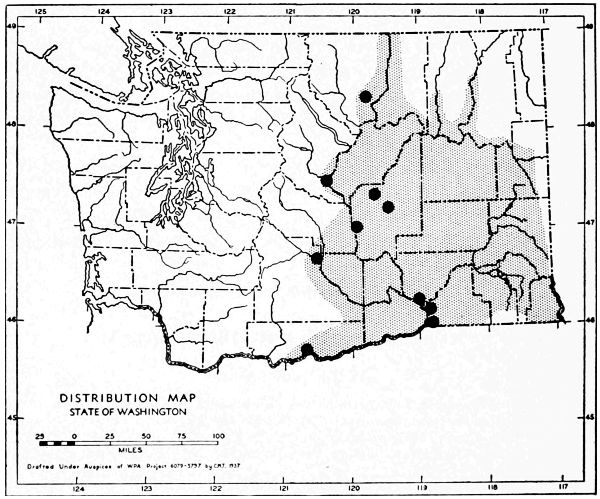
Fig. 129. Distribution of the Nuttall cottontail. Sylvilagus nuttallii nuttallii, in Washington.
The genus Sylvilagus is found in both North and South America. The species nuttallii, with three subspecies, is restricted to the western part of the United States. It ranges from southern Canada south to central New Mexico and from western South Dakota west to the Cascades. A single race occurs in Washington. Nuttall cottontails depend on cover for concealment from enemies. They frequent thick stands of tall sagebrush, riparian thickets, or rocky coulees. Seldom are they encountered in the open. In the sand-dune areas near Moses Lake cottontails were abundant in the dense, thorny thickets about potholes and in areas of tall sagebrush. They are especially common near the talus at the bases of the walls of Grand Coulee, and Moses Coulee where they do not hesitate to enter crevices in rock slides for protection. Indeed, cottontails are abundant everywhere within their range in the state of Washington, where suitable cover and food are present. They seem to be confined to the Upper Sonoran Life-zone.
Cottontails are most active at night, as is attested by the number killed then by automobiles on highways. The greatest number are seen by observers in the morning and evening but it is not unusual to see an animal feeding at midday. When startled they dash for the nearest thicket or pile of rocks with their tiny white tails erect. They travel in relatively straight lines and do not dash from side to side in flight as do jack rabbits. They sometimes seek concealment by "freezing" motionlessly in plain sight. When feeding undisturbed they travel by slow hops.
The trails of cottontails are characteristic of thickets in sagebrush country. The trails are narrow, less than four inches wide, and often enter thickets of strong, thorny growths which can scarcely be penetrated by man. Near Okanogan Lake the trails of cottontails were found among greasewood bushes on hard-packed gravel. Trails are usually most abundant in thickets near water. Permanent trails are not made through low sagebrush or over sandy areas where the animals prefer to pick their way when traveling from one clump of cover to another.
Nuttall cottontails probably eat many desert grasses, annuals, and shrubs; observation indicates that sagebrush (Artemisiae tridentata) and rabbit brush (Chrysothamnus nauseosus) are particularly important as food.
The young of cottontails in Washington seem to vary from one to four per litter and are born between April and June.
Sylvilagus floridanus (Allen) subsp.? Florida cottontail
Lepus sylvaticus floridanus Allen, Bull. Amer. Mus. Nat. Hist., 3:160, October 8, 1890.
Sylvilagus floridanus Lyon, Smithsonian Misc. Coll., 45 (no. 1456):322, June 15, 1904.
Description.—Slightly larger than the sagebrush cottontail; smaller than the snowshoe rabbit; ears small; color of upper parts pinkish cinnamon-brown; sides pale grayish-cinnamon; underparts white; nape of neck cinnamon; chest band paler cinnamon; tail brown above, white beneath; forefeet and sides of hind feet cinnamon.
Remarks.—The Florida cottontail is not native to the state of Washington but has been introduced at several localities. It is spreading rapidly at the present time. Points of introduction include Pullman, Whitman County (1926-1927); Battleground, Clark County (1933); Auburn, King County (1927); and Whidby Island, Island County (1931). At least two subspecies (mearnsi, alacer) have been introduced and a third (similis) may have been introduced.
For further information on introduced cottontails see Dalquest (1941B: 408-411).
Sylvilagus idahoensis (Merriam) Pigmy rabbit
Lepus idahoensis Merriam. N. Amer. Fauna, 5:75, July 30, 1891.
Brachylagus idahoensis Lyon, Smithsonian Misc. Coll., 45 (no. 1456):323, June 15, 1904.
Sylvilagus idahoensis Grinnell, Dixon and Linsdale, Univ. California Publ. Zoöl., 35:553, October 10, 1930.
Type.—Obtained in the Pahsimeroi Valley, Custer County, Idaho, by V. Bailey and B. H. Dutcher on September 16, 1890; type in United States National Museum.
Distribution.—Known only from the central part of the Columbian Plateau.
Description.—The pigmy rabbit is a tiny species, differing from the cottontail in smaller size, paler, grayer color, shorter ears and smaller legs.
The pigmy rabbit is restricted to the Great Basin region. No subspecies has been described. It is rare and of local occurrence in Washington, having been recorded only from the central part of the Columbian Plateau. Orr (1940), who studied the species in California, found them only in stands of tall, dense sage (Artemisiae tridentata). It is a burrowing form, not straying far from its hole.
Cervus canadensis (Erxleben) Elk or wapiti
Description.—The elk, next to the moose, is our largest deer. The legs of the elk are slender. The tail is a short, pointed stub a few inches long. The neck is thick in proportion to the head. Both males and females possess the canine teeth familiar as "elk tooth charms." Only the males possess antlers. These are huge, slender beams that curve up, out and back with the basal tine or "dog killer" and four to six points on each antler. The antlers are deciduous and are shed annually. The body is grayish or tan in color. The head, neck, chest and legs are rich, dark brown, strongly contrasting with the paler body. The distinctive rump patch is pale tan or white.
In the past the elk was found over most of the forested areas of Washington. Lumbering, agriculture and settlement as well as excessive hunting removed it from parts of eastern Washington and all except the most inaccessible parts of the lowlands of western Washington. Only in the Cascade and Olympic Mountains and the coastal strip between the Columbia River and the Olympic Mountains, did the elk survive in appreciable numbers. Conservationists and a more enlightened game policy began to protect the elk at the turn of the century. It was already too late to save the species in eastern Washington, where it seems never to have been truly abundant and where relatively open country afforded little protection from the high-powered rifle. In the dense, rugged forests of western Washington a sizable number remained on the Olympic Peninsula and these, under protection, increased to their present numbers. The dense, tangled forests of the southwestern coastal area and the western Cascades lack conditions suitable to support truly large elk herds. These areas probably now have as large an elk population as can safely be supported and fed.
The elk of eastern Washington had disappeared or nearly disappeared by 1910. The race originally occurring there was the Rocky Mountain form; it has been reintroduced from Montana and Wyoming into northeastern Washington and the Blue Mountains area. These plantings have not been very successful. Introduced in the eastern Cascades, however, the Rocky Mountain elk thrived and increased on what was probably once the peripheral range of the coastal elk.
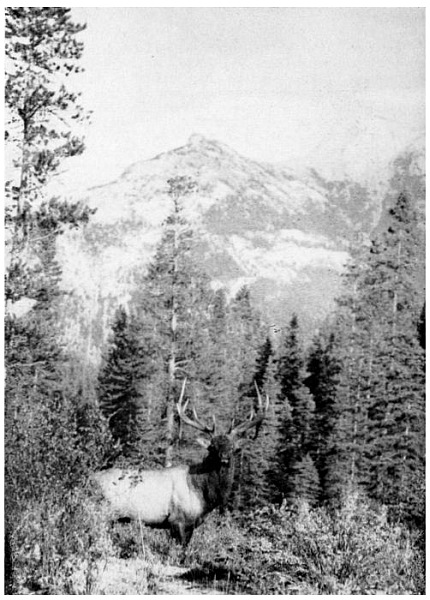
Fig. 130. Elk or wapiti (Cervus canadensis nelsoni), Banff, Alberta, October, 1939. (G. A. Thomas photo.)
The habits of the elk are best known from the herds in the Olympic Mountains and on the Rattlesnake Game Refuge in the eastern Cascade Mountains. Here the animals are numerous and relatively tame. Their habits seem to differ somewhat in the forests of the lowlands from those of the animals in the higher Olympics where the topography and climate are very different.
The elk is a social animal, gathering in herds over most of the year. The old males leave the herds in the spring but seem to stay in small bands while their antlers are growing. In the Olympic Mountains, herds of 100 or more animals have been seen. In the lowlands there are ordinarily from five to ten in a herd.
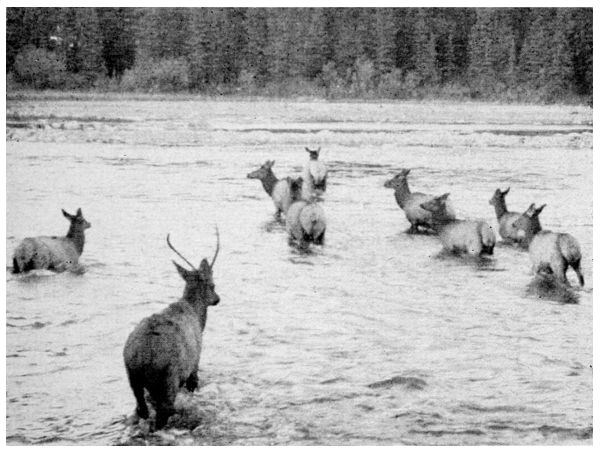
Fig. 131. Group of elk or wapiti (Cervus canadensis nelsoni), Banff, Alberta, October 10, 1939. (G. A. Thomas photo.)
The elk is a browsing animal, feeding on twigs and leaves of deciduous trees, shrubs and evergreens. In spring and summer it eats grasses and succulent annuals, but in winter twigs and needles of evergreens, perennial ferns, dry grass and even moss is utilized. To a certain extent the elk are migratory, ascending to the open meadows of the Hudsonian Life-zone in the early summer and returning to the dense forests of the Transition and lower Canadian Life-zones with the winter snows. The lowland elk make no such migrations, merely leaving the riverbottom jungles when the leaves are off the deciduous plants growing there, and live in the coniferous timber.
In the forests the elk is capable of swift and almost silent movement. It is an eerie experience to trail a herd of elk through a dense forest in a winter rain, knowing that a number of the large animals are within a few feet, moving swiftly but silently away. When a herd is feeding and does not suspect the presence of an observer, the animals rustle branches, break twigs, snort and wheeze as they breathe.
The antlers of the males are shed in March. The bulls retire from the herd until the new horns are well grown, in late August or September. Breeding takes place in September or October and the young are born the following April or May.
Cervus canadensis roosevelti Merriam
Cervus roosevelti Merriam, Proc. Biol. Soc. Washington, 11:272, December 17, 1897.
Cervus canadensis occidentalis Taylor and Shaw, Occ. Papers Chas. R. Conner Mus., 2:29, December, 1929.
Type.—Obtained on Mount Elaine, Mason County, Washington, by H. and C. Emmet on October 4, 1897; type in United States National Museum.
Racial characters.—A large, dark elk with short, heavy antlers.
Measurements.—The type measured, in the flesh (Bailey, 1936:81): total length 2,490; tail 80; ear (dry) 208.
Distribution.—From the Cascade Mountains westward; possibly occurred formerly in the eastern Cascades, and perhaps still present there, in places, or mixed with introduced nelsoni.
Remarks.—For use of the name roosevelti rather than occidentalis see Bailey (1936:81).
Cervus canadensis nelsoni Bailey
Cervus canadensis canadensis Taylor and Shaw, Occ. Papers Chas. R. Conner Mus., 2:29, December, 1929.
Cervus canadensis nelsoni Bailey, Proc. Biol. Sec. Washington, 48:188, November 15, 1935.
Type.—Obtained at Yellowstone National Park, Wyoming, by J. Pitcher; died in captivity on September 21, 1904; type in United States National Museum.
Description.—Smaller and paler than roosevelti with longer, slimmer antlers.
Distribution.—Formerly occurred in northeastern Washington and the Blue Mountains of southeastern Washington. Since then exterminated and reintroduced to both areas from the Rocky Mountains. Also introduced and established in the eastern Cascades.
Odocoileus virginianus (Boddaert) White-tailed deer
Description.—The white-tailed deer differs from the black-tailed and mule deer in several anatomical details. The tail is long, wide, and when the animal is frightened is carried upright with the long, white hair of the underside spread out. The antlers of the buck are not of a biramous system of branching but instead consist of a main beam which curves sharply out and forward, remaining low. All subsidiary tines, save the basal one, emerge from the dorsal side of the main beam. The basal tine is usually a spurlike point arising vertically from the main beam not far from the base of the antler. In exceptional specimens the basal tine is large and divided into several points. The body of the "whitetail" is more smoothly rounded, and more graceful, than that of the mule deer.
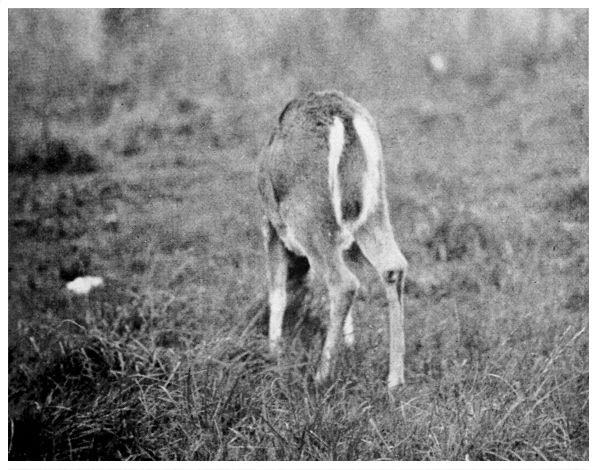
Fig. 132. White-tailed deer (Odocoileus virginianus leucurus), doe at least nine years old, kept as a pet by Mrs. Jack Hovis, Puget Island, Washington, December 16, 1939. (Fish and Wildlife Service photo by Victor B. Scheffer, No. 750.)
White-tailed deer range from Canada south to Panama and from the Atlantic to the Pacific. Their range is much more extensive to the east and south than that of the "blacktail" and mule deer. In western Washington the whitetail occupies a limited habitat near the mouth of the Columbia River. Its geographic range was probably somewhat greater in the past. Its habitat includes the low, damp, marshy islands and floodplain of the Columbia. Blacktail range in the wooded hills surrounding the whitetail's range but rarely enter it to compete with the whitetail (Scheffer, 1940A: 282).
In northeastern Washington the whitetail shows the same tendency to occupy low, marshy areas and valleys. The habitat preference of the whitetail in northeastern Washington is less exact than in western Washington, for the species ranges up from the valleys into the forests of larch and cottonwood of the Transition Life-zone. Its habitat includes denser forest and brushy areas. Rarely does it occur in the open type of forest occupied by the mule deer.
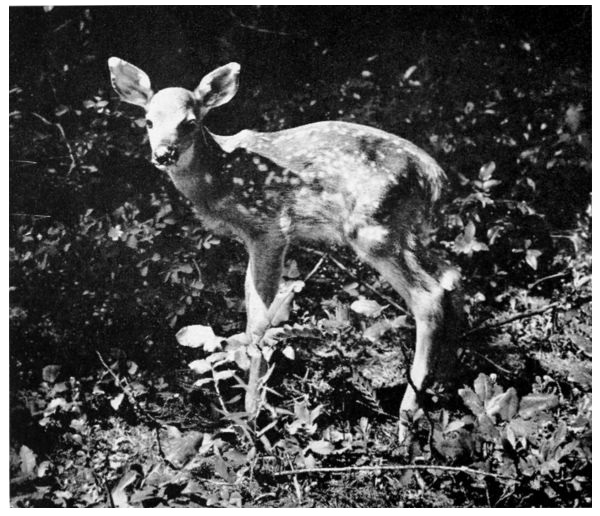
Fig. 133. White-tailed deer (Odocoileus virginianus ochrourus): fawn kept as a pet by L. E. Borud, Ione, Washington, June 13, 1938. (Fish and Wildlife Service photo by Victor B. Scheffer, No. 69.)
In Washington the whitetail is not an important game animal. The race occurring in western Washington is characterized by small size and small antlers. Further, its total population is estimated at but 400 to 900 individuals. The whitetail of northeastern Washington is larger and possesses larger antlers. Indeed, some antlers from Ferry County are the largest antlers of whitetail that I have ever seen. Nevertheless, the whitetail of northeastern Washington is smaller than the mule deer and far less common. The habitat is dense and difficult to traverse. The animal is shy and silent, fleeing soundlessly when approached. For these reasons most hunters in northeastern Washington prefer to hunt the mule deer.
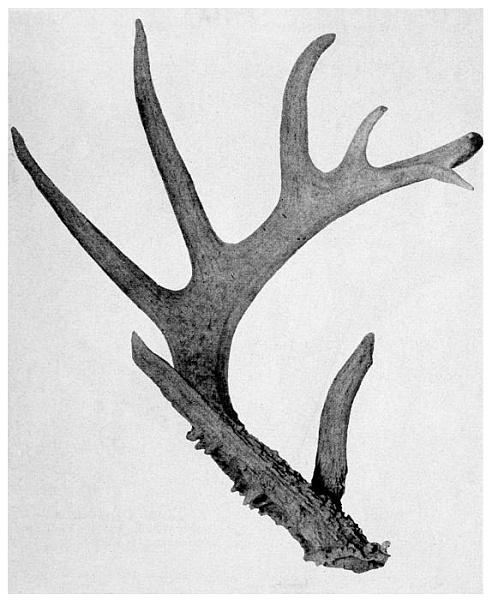
Fig. 134. White-tailed deer (Odocoileus virginianus ochrourus): left antler found on ground at Park Rapids, Pend Oreille County, Washington, October 1, 1937. (Fish and Wildlife Service photo by Victor B. Scheffer, No. 756.)
Odocoileus virginianus ochrourus Bailey
Odocoileus virginianus macrourus Taylor and Shaw, Occ. Papers Chas. R. Conner Mus., 2:30, December, 1929.
Odocoileus virginianus ochrourus Bailey, Proc. Biol. Soc. Washington, 45:43, April 2, 1932.
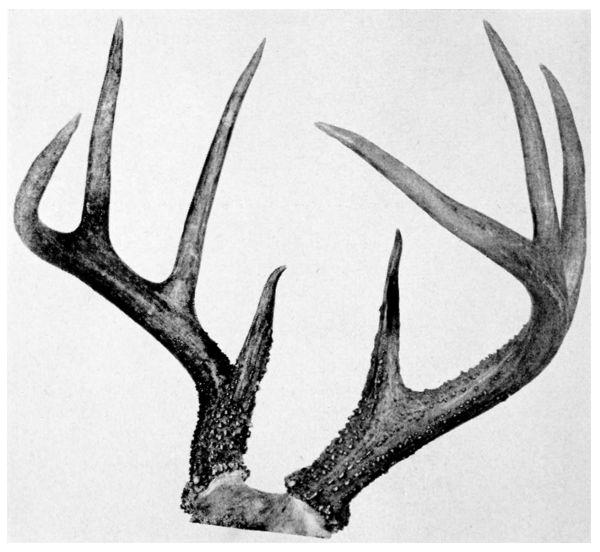
Fig. 135. White-tailed deer (Odocoileus virginianus leucurus), antlers of large buck killed in the fall of 1939 at Cathlamet, Washington, by Paul Lewis. (Fish and Wildlife Service photo by Victor B. Scheffer. No. 752.)
Type.—Obtained at Coolin, south end of Priest Lake, Bonner County, Idaho, by F. Lemmer on December 27, 1908; type in United States National Museum.
Racial characters.—A large, pale white tail with large, low antlers and distinctive cranial features.
Measurements.—The type, an adult male, measures (Bailey, 1936. p. 43): total length 1,752; tail 265; hind foot 483; ear (dry) 120.
Distribution.—Northeastern Washington. Probably once occurred in southeastern Washington.
Odocoileus virginianus leucurus (Douglas)
Cervus leucurus Douglas, Zoöl. Jour., 4:330, 1829.
Odocoileus leucurus Thompson, Forest and Stream, 51:286, October 8, 1898.
Odocoileus virginianus leucurus Lydekker, Cat. Ung. Mamm. British Mus., 4:162, 1915.
Type.—Obtained on the North Umpqua River, Oregon, by David Douglas on October 17, 1826; type originally, and perhaps still, in British Museum.
Racial characters.—A small, handsome whitetail with slender, erect antlers and brownish or grayish color.
Measurements.—A young adult female from 1 mile south of Skamokawa, Wahkiakum County, measured: total length 1,545; length of tail 250; hind foot 458; ear 143; weight 88 pounds.
Distribution.—Previously occurred over much of southwestern Washington; now confined to the banks and islands of the Columbia River in Wahkiakum County.
Odocoileus hemionus (Rafinesque) Mule deer and black-tailed deer
Description.—The mule and black-tailed deer are among deer of medium to large size. Adult mule deer may weigh up to 400 pounds while some fully adult blacktail bucks may weigh as little as 100 pounds. The body is heavily muscled, the legs long and the tail only about 6 inches in length. The ears are long, from 6 to 8 inches from notch to tip. The head is long and the male has well-developed antlers. The first antlers are almost straight spikes. Those of the second year are bent slightly outward and forward and are equally or subequally forked with the anterior branch usually the stouter. In the third year the anteriolateral curvature is more pronounced and one or both of the forks again fork. In succeeding years forks are larger and more numerous but the essential biramous arrangement of forking is maintained. The "blacktail" and mule deer are strongly marked races. The blacktail differs from the mule deer in: smaller size; darker color, especially on face and tail; tail dark brown above with dark tip rather than whitish with black tip; tail haired beneath, not naked for half its length; antlers smaller and lighter; and skull and teeth smaller.
Mule deer and black-tailed deer range over western North America from southeastern Alaska southward into northern Mexico. They inhabit forested parts of the state of Washington. Blacktails occupy the San Juan Islands, the islands in Puget Sound, the Olympic Mountains, the lowlands of western Washington, and the Cascade Mountains. Mule deer occupy the Cascades, including their eastern slope, northeastern and southeastern Washington and parts of the Columbian Plateau. Over this large range there is considerable local geographic variation.
Jackson (1944: 1-56) estimated that 109,600 blacktail and 175,725 mule deer live in Washington. Thus Washington is second only to California in number of blacktail and ranks fifth in number of mule deer.
Individual variation over the range of the mule deer is considerable but no trends of variation are distinguishable. Mule deer from the Blue Mountains, northeastern Washington and the eastern Cascades are essentially similar.
There is geographic variation as well as great individual variation in the black-tailed deer of Washington. The deer of the San Juan Islands and the islands of Puget Sound are smaller and darker than those of the mainland and possess smaller, lighter antlers. The deer of Whidby Island are sometimes contemptuously referred to by residents as jackrabbit deer. Fully grown bucks on the Islands weigh in the neighborhood of 100 pounds, rarely exceeding 150 pounds, whereas bucks on the mainland commonly weigh more than 150 pounds dressed.
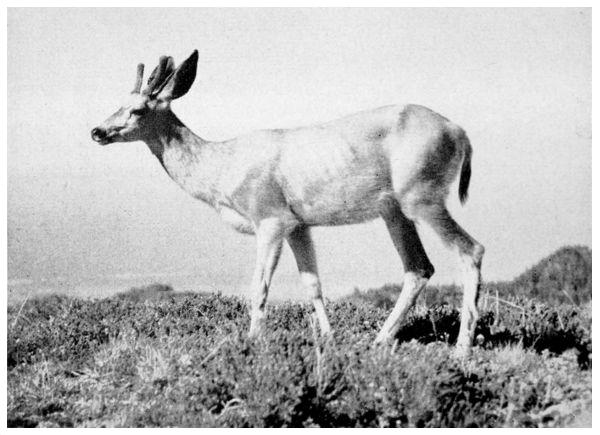
Fig. 136. Mule deer (Odocoileus hemionus hemionus), subadult male from Okanogan County, Washington, raised in captivity; photographed June 29, 1938, on Hurricane Ridge, Olympic National Park. (Fish and Wildlife Service photo by Victor B. Scheffer, No. 99.)
The dividing line between the ranges of the black-tailed and mule deer in general is the summit of the Cascade Mountains. In summer the two races come together and doubtless mingle in the Cascades but as fall approaches they migrate. The mule deer moves eastward to the yellow-pine areas on the lower slopes while the blacktails descend westward to the denser Douglas fir and hemlock forests on the western flanks of the Cascades. In the breeding season the two races are separated. However, as shown by Cowan (1936A: 219), in the Pemberton Valley, British Columbia, the two forms occur together during the breeding season and intergradation occurs there. Intergradation occurs also in the Lake Wenatchee area of Chelan County. Observation of hunters' specimens showed some undoubted intergrades among the more abundant, typical mule deer.
Both the mule deer and blacktail have a characteristic bounding gait, unlike the smooth run of the white-tailed deer. The tail is usually held down, rarely erect. When not frightened they move with dainty steps, making little noise.
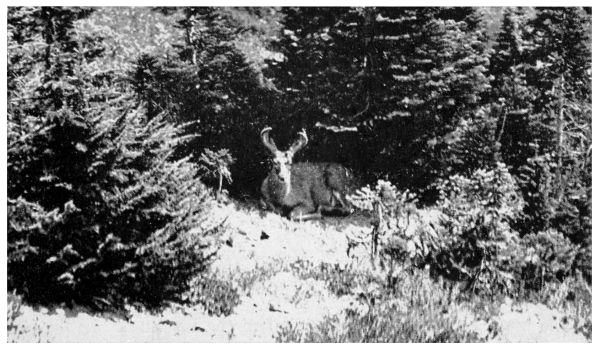
Fig. 137. Black-tailed deer (Odocoileus hemionus columbianus), buck resting at midday, Van Trump Park, Mt. Rainier, Washington, August, 1931. (Fish and Wildlife Service photo by Victor B. Scheffer, No. 260.)
The black-tailed deer in certain areas is more nocturnal than diurnal. They feed principally in the early morning and evening. In the Olympic Mountains, on the North Fork of the Quinault River, in July, 1937, blacktails were watched feeding and playing until midnight. Also in December, 1939, deer, near the forks of the Skykomish River, were moving about, browsing as late as 11 p. m. while a light snow was falling. In the San Juan Islands, in the summer of 1939, deer were observed feeding at all hours of the day.
The blacktail lives in some of the most dense jungle areas of western Washington. On Whidby Island and some of the San Juan Islands the brush and vines grow so densely that a man can scarcely penetrate them. Were it not for the deer trails, formed by generations of deer, our small mammal investigations would have been far more difficult. The blacktail lives also in the dense forests where fir, hemlock and cedars grow to heights of more than 150 feet. Here lack of light allows only ferns and moss to form an understory vegetation. These forests often clothe the steep glacial hills and the trails of the deer on such hills show them to be adept climbers. Deer trails generally avoid fallen trees and other obstacles. When startled, however, a stump, fence or log is easily leaped by a blacktail. Often they are in small bands of 6 to 10 individuals, but almost as often are solitary, or in pairs.
The habitat of the mule deer is generally more open than that of the blacktail. In the summer, it may occupy rough and rugged country; in the higher Cascades individuals were found in the rocky and brushy country and in open glades and meadows. Farther east they were in the open yellow-pine forests where extensive grassy slopes, free of trees, existed. In some parts of northeastern Washington they lived in the larch and lodgepole pine forests almost dense enough to be "blacktail country." In the Okanogan Valley and on the northwestern corner of the Columbia Plateau mule deer lived in open prairie country where a few cottonwoods and willows were the only trees.
The mule deer seem more social than the blacktail. In the late summer they gather in bands of 10 to 20 or more. In winter, under pressure of hunger, they gather in herds and raid haystacks and pastures. Farmers in the Methow Valley, Okanogan County, report herds of 200 to 400 mule deer about a single haystack.
The mule deer and blacktail are the principal game mammals of the state of Washington. Thousands of hunters enter the woods each year in search of a buck. Eastern Washington is the favored hunting grounds for that is the home of the mule deer, the larger size of which makes it a more desirable trophy. Also the open country which it inhabits makes hunting more productive. Sums spent on equipment, gasoline and hunting licenses are tremendous but the feeling is that the return in recreational value and venison are worth the cost. A few casualties result each year among the army of deer hunters.
Odocoileus hemionus hemionus (Rafinesque)
Cervus hemionus Rafinesque, Amer. Month. Mag., 1:436, October, 1817.
Cariacus macrotis True, Proc. U. S. Nat. Mus., 7:592, 1885.
Odocoileus hemionus Merriam, Proc. Biol. Soc. Washington, 12:100, April 30, 1898.
Odocoileus hemionus macrotis Bailey, National Geographic, 20:64, 1932.
Type locality.—Vicinity of Big Sioux River, South Dakota.
Racial characters.—Large size, pale color.
Measurements.—Two adult males from Stay-a-while Spring, Columbia County, measure respectively: total length 1,751, 1,559; length of tail 172, 205; hind foot 515, 485; ear 210, 211; length of metatarsal gland 150, 135.
Distribution.—Summit of Cascades eastward, in forested areas, exact limits not certainly known.
Odocoileus hemionus columbianus (Richardson)
Cervus macrotis var. columbiana Richardson, Fauna Boreali-Americana, 1:257, 1829.
Cariacus columbianus True, Proc. U. S. Nat. Mus., 7 (1884):592, 1885.
Cervus columbianus Baird, U. S. Pacific R. R. Exp. and Surveys, p. 659, 1857.
Eucervus columbianus Gray, Ann. and Mag. Nat. Hist., 18 (ser. 3):338, 1866.
Odocoileus columbianus Merriam, Proc. Biol. Soc. Washington, 12:100, April 30, 1898.
Odocoileus columbianus columbianus Swarth, Univ. California Publ. Zoöl., 10:85, February 13, 1912.
Odocoileus hemionus columbianus Cowan, California Fish and Game, 22:215, July, 1936.
Type.—Obtained at Cape Disappointment, Pacific County, Washington, by Lewis and Clark on November 19, 1805 (Cowan, 1936A: 218).
Racial characters.—Small size, dark color.
Distribution.—Summit of Cascades westward, including islands in Puget Sound and San Juan Islands; exact limits of range uncertain.
Alce americana shirasi Nelson Moose
Alces americanus shirasi Nelson, Proc. Biol. Soc. Washington, 27:72, April 25, 1914.
Type.—Obtained near the Snake River, Lincoln County, Wyoming, by J. Shire on December 11, 1913; type in United States National Museum.
Distribution.—Casual wanderer into northeastern Washington from Canada.
Remarks.—The moose is the largest North American deer. Its large size and huge, palmate antlers serve to separate it from any other member of the deer tribe.
Moose range from northern United States to central Canada and Alaska. The European elk and the American moose are subspecies of the same species. The moose is of only casual occurrence in Washington. The latest authentic record for Washington is a bull that wandered southward and westward from Canada until it was killed on an Indian reservation in Ferry County. Other moose are reported to have wandered into northeastern Washington from Canada in past years.
Dice (1919) was told that moose once occurred in the Blue Mountains of southeastern Washington but there is no confirmation of this report.
Rangifer arcticus montanus Seton-Thompson Caribou
Rangifer montanus Seton-Thompson, Ottawa Naturalist, 13:129-30, August, 1899.
Rangifer arcticus montanus Jacobi, Erganzungsband, Zoöl. Anz., 96:92, November, 1931.
Type.—Obtained near Revelstoke, Selkirk Range, British Columbia.
Distribution.—Rare or casual along the Canadian boundary in northeastern Washington.
Remarks.—The caribou is a rather stout-bodied deer with large hoofs, short, rounded muzzle and long, erect, flattened antlers.
Caribou and their relatives, the reindeer, range over Arctic Europe, Asia, Greenland and America. In North America they range from the Atlantic to the Pacific and from the northern border of the United States northward into the Arctic. The caribou was, until recent years, a regular winter resident in small numbers in northeastern Washington near the Canadian Boundary. Their wintering grounds in Washington were said to have been destroyed by fire in 1915 and the species has appeared in the state only casually since then. Two were killed in 1940 by hunters who thought they were deer. Caribou are protected by law in Washington.
Bison bison oregonus Bailey Bison
Bison bison bison Taylor and Shaw, Occ. Papers Chas. R. Conner Mus., 2:31, December, 1929.
Bison bison oregonus Bailey, Proc. Biol. Soc. Washington, 45:48, April 2, 1932.
Type.—Skull and skeleton picked up at Malheur Lake, Oregon, by G. M. Benson in November, 1931; type in United States National Museum.
Distribution.—Perhaps casual in eastern Washington before coming of the white man.
Remarks.—Bison, or buffalo, occurred in southeastern Oregon but disappeared before white men reached the country (Bailey, 1936: 57). Gibbs (1860: 138) was told by an Indian hunter in 1853 that a lost bull had been killed in the Grand Coulee (state of Washington) 25 years before but that "this was an extraordinary occurrence, perhaps before unknown." In the days before horses reached the Indian tribes of eastern Washington and Oregon, wandering bison from herds in Oregon probably strayed into Washington, in somewhat the manner that the moose today stray in from Canada.
Ovis canadensis Shaw Mountain sheep
Description.—The mountain sheep is the size of a small deer. The horns of the males are massive spirals. Those of the females are smaller, curve upward and backward, rarely forming a semicircle. The horns are permanent structures, enlarged each year by growth at the base. Growth is irregular, probably as the result of seasonal reproductive activities. As a result the horns are "ringed" with concentric ridges. The color of the upper parts is dark, grayish brown. The face is paler, yellowish brown. The outer sides of the legs are dark brown. The rump, abdomen, and insides of legs are white.
Mountain sheep of the genus Ovis are abundantly represented in Asia. Two species occur in North America, Ovis dalli in Alaska, and Ovis canadensis in western North America. They range from Alaska south to northern Mexico.
In the past the mountain sheep inhabited most of the eastern Cascade Mountains, the Blue Mountains, Pend Oreille Mountains, and the cliffs of the Columbia River Valley in eastern Washington. They occurred on the eastern or Columbian Plateau side of the river and therefore probably occupied the cliffs of Moses Coulee and the Grand Coulee. Their habitat seems thus to have included rocky areas from the Upper Sonoran to the Hudsonian life-zones. At the present time they are extinct over most of their range. A small band still remains in the extreme northeastern Cascades near Mount Chopaka.
Little has been published concerning the habits of the mountain sheep in Washington. In caves along the Columbia River in Grant County, bones of sheep are found in association with stone arrowheads and other human artifacts. Presumably the sheep were killed and eaten by the Indians.
The history of the mountain sheep in North America is outlined by Cowan (1940: 506). The genus is thought to have crossed from Asia to America by the land bridge now under Bering Strait in the early Pleistocene and spread southward through the Rockies. The advance of the glacial ice forced them farther southward and the southern (canadensis) sheep were separated from their relatives farther north. The present differences between the Rocky Mountain and western sheep seem to have resulted from separation by glaciers during Wisconsin Time.
Ovis canadensis canadensis Shaw
Ovis canadensis Shaw, Nat. Misc., vol. 15, text to pl. 610, about December, 1803.
Type.—Obtained in the mountains on Bow River; W. B. Davis (1939: 377) gives Dew River near Exshaw, Alberta.
Racial characters.—Large size; heavy, closely coiled horns.
Measurements.—Cowan (1940: 533) gives the measurements of a fully adult (6-year old) ram from Colorado as: total length 1,953; length of tail 127; hind foot 394; ear (dry) 63.
Distribution.—Now extinct in Washington. Cowan (op. cit.: 535) refers to this race as the sheep that formerly occurred in the Blue Mountains. This view seems logical but I feel that the sheep formerly occurring in the Pend Oreille Mountains of extreme northeastern Washington should, on the basis of geographic probability, also be referred to canadensis.
Ovis canadensis californiana Douglas
Ovis californianus Douglas, Zoöl. Jour., 4:332, 1829.
Ovis californica Richardson, Fauna Boreali-Americana, 1:272, 1829.
Ovis californiana Biddulph, Proc. Zoöl. Soc. London, p. 683, 1885.
Ovis canadensis californiana Lydekker, The Sheep and its Cousins, p. 288, 1912.
Type.—Obtained from near Mount Adams, Yakima County, Washington, by D. Douglas on August 27, 1826; type in British Museum.
Racial characters.—Similar to canadensis but smaller with more slender, spreading horns and horn tips less blunt.
Measurements.—Cowan (1940: 545) gives the measurements of a ram, five years old, from Owens Valley, California, as: total length, 1,582; length of tail, 110; hind foot, 240.
Distribution.—Formerly occupied the eastern Cascades, the valley of the Columbia and possibly the cliffs bordering Moses Coulee and The Grand Coulee. Now it is found only near Mt. Chopaka in the extreme northeastern Cascades.
Oreamnos americanus (Blainville) Mountain goat
Description.—The mountain goat is of deer-size, with a stout body and a pronounced hump on the shoulders. The legs are short but the hoofs are large with large dewclaws. The neck is short and thick. The head is large and goatlike in appearance. The tail is tiny. The horns are slim, round and curve up and slightly backwards. They are hollow and are permanent structures, added to each year. The body is snow white, consisting of long, soft wool, which is longer and coarser on forelegs, neck and chin than on the body. Males have a distinct beard.
Mountain goats range from Washington and Idaho north to Alaska. Their nearest relatives are the Old-World antelopes, especially the alpine species of Europe and Asia.
The mountain goat is an animal of the high mountains. Their habitat is the bare-rock cliffs and rock-strewn slopes of the Arctic-alpine and Hudsonian Life-zones. Where extensive, open rocky areas occur they descend to the Canadian Life-zone. Even in winter they keep to the high cliffs where steep slopes and strong winds keep the snow from the plants on which they feed.
Mountain goats are considered a game animal in Canada and Idaho. The species has been protected in Washington for many years. As a result they are common, although not present in numbers sufficient to withstand hunting. The high country which they occupy is unsuited to any of man's domestic animals and no reason is apparent at present why the mountain goat should not be protected and conserved for many years.
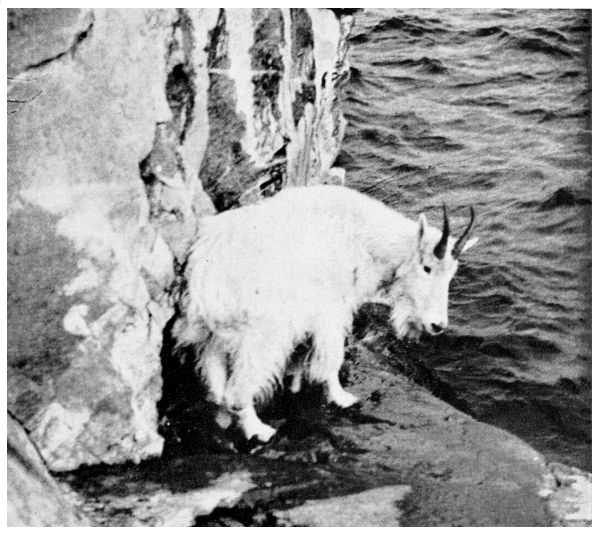
Fig. 138. Mountain goat (Oreamnos americanus americanus), old female, Lake Chelan, Washington, March 6, 1937. (Forest Service photo by Oliver T. Edwards, No. 348491.)
In spite of the protection accorded them, the mountain goat has not become tame. In driving over Stevens Pass, King County, one can, with the aid of glasses, usually pick out one or more mountain goats on nearby mountains. Nevertheless, I have never seen one within 100 yards of a highway, nor heard of one being killed by cars on a highway.
The mountain goat does not, as a rule, allow close approach by man. At Goat Basin, Deception Creek, King County, circumstances are particularly favorable for goats and several are usually to be seen. While studying them on several occasions, I was never able to get truly close to them. On the few occasions when I came upon a band unexpectedly, they rapidly went over the mountain or up the nearest cliff.
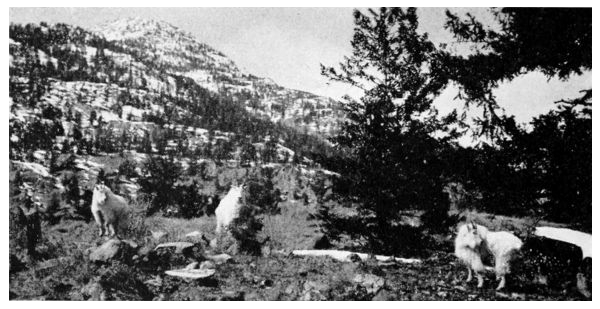
Fig. 139. Group of mountain goats (Oreamnos americanus americanus), northern Cascade Mountains, Washington. (Forest Service photo, No. 348490.)
When unfrightened, these mountain goats spent much time standing, or lying with forefeet folded under them, looking into space. For such large animals they seemed to spend little time feeding. At intervals of about five minutes they plucked the ferns or other plants that grew in abundance on ledges or in tiny crevices in the cliffs. Some animals did browse for several minutes at a time. They seemed rather particular as to their food, plucking only one or two stems from a clump of vegetation.
The ordinary movements of the mountain goats are deliberate. They rarely move more than a few feet at a time. They climb with sure-footed ease but usually slowly. In climbing, the forelegs are spread and the knees are bent. The animal moves as if it were climbing steps. The greatest action is in the knee joints. If surprised in the open they run with a smoother gait, the legs moving from the shoulder and hip. If near a cliff they climb rapidly, jumping when necessary, and rarely stop while in sight. Evidence of the presence of mountain goats is usually seen in the form of tufts and strands of wool. Their wool becomes caught in bushes and rough rocks and seemingly pulls out easily.
The range of the mountain goat in Washington includes the entire Cascade range from Mt. Adams and Mt. Saint Helens north to the Canadian boundary. They extend west to Mt. Baker, Mt. Higgins and Mt. Index and east to Lake Chelan and, in the Wenatchee Range, east of Mt. Stuart, perhaps almost to the Columbia River.
Dice (1919: 21) was told that mountain goats once occurred in the Blue Mountains of southeastern Washington. We know of no suitable goat country in the Blue Mountains of Washington and feel that the report was probably based on an erroneous identification.
There is a single record, supported by specimen, of a mountain goat from northeastern Washington. This individual probably wandered into Washington from northern Idaho, Montana, or adjacent British Columbia.
Oreamnos americanus americanus (Blainville)
Ovis montanus Ord, Guthrie's Geol., 2d Amer. Ed., p. 292, 1815 (preoccupied).
R[upicapra]. americana Blainville, Bull. Sci. Soc. Philomath, Paris, p. 80, 1816.
Mazama dorsata Rafinesque, Amer. Month. Mag., 2:44, 1817 (new name for Ovis montanus Ord).
Mazama montana True, Proc. U. S. Nat. Mus., 7 (1884):592, 1885.
Oreamnos montanus Merriam, Science, n. s., 1:19, 1895.
Oreamnos montanus montanus Miller, U. S. Nat. Mus. Bull., 79:398, December 31, 1912.
Oreamnos americanus americanus Hollister, Proc. Biol. Soc. Washington, 25:186, December 24, 1912.
Type.—None. Descriptions all based on Ovis montanus Ord who, in turn, based his description on the account of skins seen by Lewis and Clark on the Columbia River of Washington or Oregon. As the mountain goat is not known to have ever occurred in Oregon in Recent times, the type locality is probably near Mt. Adams, Washington, the point where goats come nearest the Columbia.
Measurements.—The measurements of a large male killed "west of North Yakima" were reported by A. S. Harmer as: 8 feet 3 inches from tip of nose to tip of tail; horns 10 inches; weight 507 pounds (Outdoor Life, 1915: 459).
Distribution.—Throughout the higher Cascade Mountains.
Oreamnos americanus missoulae Allen
Oreamnos montanus missoulae Allen, Bull. Amer. Mus. Nat. Hist., 20:20, February 10, 1904.
Oreamnos americanus missoulae Hollister, Proc. Biol. Soc. Washington, 25:186, December 24, 1912.
Type.—Obtained at Missoula, Missoula County, Montana; type in American Museum of Natural History.
Distribution.—A single record for northeastern Washington. Seemingly a rare wanderer from outside the state.