ACCOUNTS OF SPECIES AND SUBSPECIES (continued 2)
Reading edition
Ursus chelan Merriam Grizzly bear
Ursus chelan Merriam, Proc. Biol. Soc. Washington, 29:136, September 6, 1916.
Type.—Obtained in Township 30 N. Range 16 E. Willamette Meridian, Wenatchee National Forest, Chelan County, Washington, by D. S. Rice on September 1, 1913; type in United States National Museum.
Measurements.—The skull of the type, an old male, measures: basal length 314; occipito-nasal length 323; palatal length 170; zygomatic breadth 225; interorbital breadth 86.
Distribution.—Probably once from the Stevens Pass area north to British Columbia. Possibly still remaining in the mountains between Mount Baker and Lake Chelan.
Remarks.—Grizzly bears occurred in the lowlands of Oregon (Bailey, 1936: 324) and California (Grinnell, Dixon and Linsdale, 1937: 67) but there is no record of their ever having occurred in the lowlands of western Washington.
Bears of the genus Ursus range over Europe, Asia and North America. No less than 75 kinds of grizzly and big brown bears are recognized for North America by Merriam (1918). They are closely related to the brown bears of Asia. The 13 kinds of black bears of North America are now thought to belong to but one species, namely americanus, and have no close relatives in Eurasia.
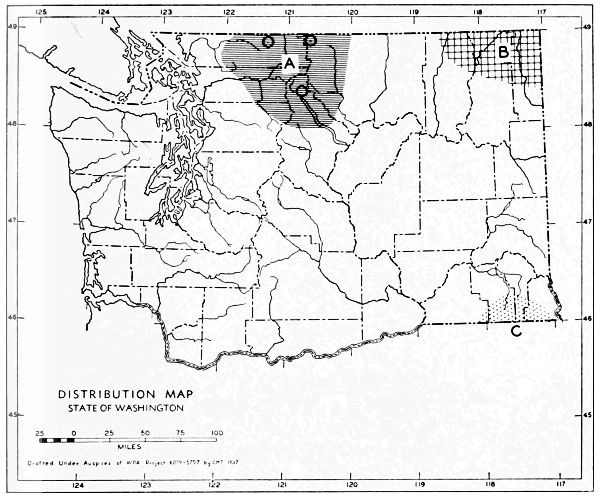
Fig. 51. Probable past distribution of grizzly bears in Washington. A. Ursus chelan. B. Ursus canadensis. C. Ursus idahoensis.
The grizzly is the largest carnivorous mammal in North America. From the black bear the grizzly may be distinguished in life by the prominent muscular hump on the shoulders. Another feature is the long, slim, gently curved claws of the forefoot as compared with the shorter, stouter and sharply curved or hooked foreclaws of the black bear. The grizzly is much larger than the black bear. Cranially, the grizzly differs in possessing a larger skull with lower frontal area, higher, more extensive sagittal crest, more posteriorly jutting occipital condyles and much longer tooth row. The color of both species is variable. Some grizzly bears from Alaska and British Columbia are dark brown, almost as black as a black bear. Others are pale cinnamon with the longer guard hairs pale gray. Individuals of this frosted appearance popularly are known as "silver tips." In Washington, the black bear varies in color from glossy black, through various shades of brown to a pale cinnamon.
The grizzly bear is extinct over most of Washington. A few may remain in remote parts of the northern Cascades, and are regularly listed on the game census reports of the Mount Baker National Forest. Nevertheless, I have found no one who has seen an undoubted grizzly bear in Washington. The type specimen was obtained well up in the Cascade Mountains where the animals, like those in British Columbia, feed on roots, berries, marmots, pikas and other vegetable and animal life.
Procyon lotor (Linnaeus) Raccoon
Description.—The raccoon is a relatively large carnivore with a stout, heavy body. Large adults measure three feet in length and weigh up to 20 pounds. The legs are of moderate length. The broad head tapers sharply to a pointed muzzle. The ears are erect, broad, low and rounded; the tail is long, about one-half the length of the head and body, bushy and round; the hind feet are large, flat and naked-soled but the forefeet are smaller with long, slim, handlike toes. The color of the body is a grizzled gray heavily washed with black on the back and sides. A jet-black "mask" across the eyes, sharply outlined by white muzzle and forehead, is the most distinctive feature of the head. The tail is alternately marked with six or seven black and five or six yellowish gray bands. The long, loose guard hairs give the body a shaggy appearance. The fur of the wrists is short, smooth, coarse, and directed downward.
The raccoon is not an aquatic mammal, yet it is closely associated with water, whether it be streams, rivers, lakes or the ocean. The favored habitat of the raccoon is the shore line. It is a wader and, if it can be considered as specialized for any occupation, it is wading in mud and shallow water. Its long toes, naked feet, and short-haired wrists are admirable adapted for walking on muddy bottoms or in shallow water. The coon is also at home on land. It moves swiftly and silently and when chased by dogs can cover miles in a few hours. It is an agile climber and lives in dens well up in trees.
The raccoon is almost completely nocturnal. Individuals are occasionally seen in the morning or evening, especially, when the tide is low along the ocean beach or Puget Sound. Near Fall City, King County, a small raccoon was seen eating a crayfish at 3:30 p.m. on a warm, sunny June day. In the eastern United States raccoons sleep during much of the winter, and probably they do the same in eastern Washington. In western Washington they are active most of the winter. Some trappers stated that the animals "hole up" in spells of unusually cold weather. Along the Tolt River, 10 miles southeast of Duvall, King County, their tracks were seen daily in January, 1936, although the temperature fell well below freezing each night.
Washington is near the northern limit of the range of the raccoon. The animal is reasonably common in western Washington, and ranges well up into the Cascade Mountains. The highest altitudinal record available is Longmire, Mount Rainier National Park (Taylor and Shaw, 1927). Raccoons are not uncommon in southeastern Washington and in the Yakima Valley. They follow the Columbia River northward, as shown by tracks at Wenatchee on two occasions. The river valleys that flow into the Columbia in northeastern Washington seem admirably adapted for raccoons but the animal is rare there. Trappers who have lived and trapped in northeastern Washington for many years tell of seeing tracks at intervals of years along the Okanogan, San Poil, Colville and Kettle rivers. Several stated that tracks had been seen more often in recent years. Northeastern Washington seems to be the peripheral range of the species, occupied at rare intervals by animals wandering north from the Columbia River.
The food habits of raccoons are almost as varied as those of black bears. Animal matter forms their diet over most of the year; along stream courses crayfish, fish, thin-shelled fresh-water mussels, frogs (Hyla and Rana), and aquatic insects are eaten. Along beaches fish brought in by the tide, crustaceans, and mussels (Mytilus edulis) are taken; small sharks appear not to be eaten. A recently dead dogfish that lay on the beach at Whidby Island, Island County, was ringed by the tracks of a raccoon but had not been eaten. The shore crabs (Hemigrapsus nudus and Hemigrapsus oregonensis) are a favored food and regular items of diet. The edible crab (Cancer productus) is also eaten and in the San Juan Islands the porcelain crab (Petrolisthes eriomerus) was commonly eaten. Small mammals and birds are eaten regularly by this race of raccoon in California (Grinnell, Dixon and Linsdale, 1937: 157), and the eggs and young of wild birds are sought in the spring (op. cit.: 158). The ability of the raccoon as a climber makes it a particular menace to nesting birds. Berries, including domestic blackberries and salmonberries, are eaten in quantity when available. Apples are dearly loved and the trees and orchards of abandoned ranches are regularly visited. The fondness of the raccoon for green corn is well known. Insects are present in small quantities in most droppings and in the late summer some feces were composed entirely of the remains of grasshoppers. Chickens, ducks, young turkeys and eggs are stolen and individuals become extremely adept at raiding hen-houses.
At one time, about 1920, the raccoon became scarce in western Washington as a result of heavy trapping and high price of the pelts. A closed season was strictly enforced until it again became common. The price received by the trapper for raw furs of raccoon has since been rather low, from two to ten dollars. With fur prices in this range, the number of raccoons probably will not be reduced to a dangerously low level by trapping, but instead may be expected to furnish a regular winter income to the trappers who do trap for it.
Raccoons are known to breed in their first year of life (Pope, 1944: 91).
Procyon lotor psora Gray
Procyon psora Gray, Ann. and Mag. Nat. Hist., 10: 261. December, 1842.
Procyon psora pacifica Merriam, N. Amer. Fauna, 16: 107, October 28, 1899 (type from Lake Keechelus, Kittitas County, Washington).
Procyon proteus Brass, Aus dem Reiche der Pelze, p. 564, 1911.
Procyon lotor pacifica Taylor and Shaw, Occ. Pap. Chas. R. Conner Mus., no. 2: 10. December, 1929.
Procyon lotor psora Grinnell, Dixon, and Linsdale, Fur-bearing Mamm. California, Univ. California Press, Berkeley, p. 137, July 22, 1937.
Type locality.—Sacramento, Sacramento County, California.
Racial characters.—Medium size; dark color; smoothly rounded skull.
Measurements.—A female from Forks, Clallam County, measures: total length 905; length of tail 355; hind foot 125; ear 50; weight 14-1/2 lbs. A female and 6 males, young animals of the year, taken between November 15 and December 15, average: 772; 284; 114; weight (of 3) 8-2/3 lbs.
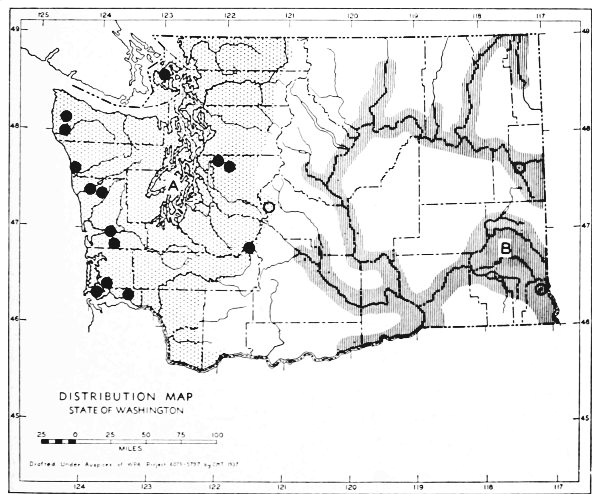
Fig. 52. Distribution of the raccoon in Washington. A. Procyon lotor psora. B. Procyon lotor excelsus.
Distribution.—From the western slope of the Cascade Mountains westward. Marginal occurrences are Lake Keechelus (type locality) and Mount Rainier (Taylor and Shaw, 1927: 45).
Remarks.—The range of variation in color and cranial characters of coastal raccoons is large. I am unable to find any character or average difference to separate the raccoons of western Washington from those of northern California.
Procyon lotor excelsus Nelson and Goldman
Procyon lotor excelsus Nelson and Goldman, Jour. Mamm., 11:458, November 11, 1930.
Type.—Obtained on upper Owyhee River, near the mouth of the North Fork in southeastern Oregon by J. W. Fisk on April 15, 1920; type in United States National Museum.
Racial characters.—Similar to psora but larger; body paler and grayer; skull larger, heavier and more angular.
Distribution.—Southeastern Washington, the valleys of the Snake and Yakima rivers and the valley of the Columbia River north to northeastern Washington. Marginal records, from reports of trappers, include the Okanogan River, Okanogan County, Wenatchee, Chelan County, and Selah, Yakima County.
Remarks.—The assignment of the raccoons of northeastern Washington to excelsus is tentative for I have seen no specimens.
Martes caurina Merriam Western marten
Description.—The marten is slightly smaller and slimmer than a house cat, and at first glance resembles a large squirrel. The legs are longer, the body stouter and the fur more fluffy than those of a mink or weasel. Adult males weigh from two to two and a half pounds, and females from one and a half to two pounds. Males are slightly more than two feet in total length and females about 18 inches, the tail comprising one-third or more of the total length. The head is broad and narrows rapidly to a sharp muzzle. The ears are large, erect and prominent. The feet are large with stout toes and long, sharply curved pinkish-white claws. The body and head are rich golden brown, the tail, wrists, feet and muzzle being darker.
The western marten ranges from British Columbia southward through Idaho and Washington to California. A closely related species, americana, is found in Alaska, the eastern United States and Canada. Martens and fishers may be distinguished from weasels and minks by the presence of 18 rather than 16 teeth in the upper jaw and 20 instead of 18 teeth in the lower jaw.
The western marten is arboreal. Its principal habitat in Washington is the Canadian Life-zone forests of the Olympic, Cascade and Blue mountains and the various ranges in the northeastern part of the state. At one time it ranged near sea level along the densely forested coastal belt and may still do so in the more rugged parts of the Willapa Hills.
The marten is both diurnal and nocturnal. In Mount Rainier National Park the species has become quite tame and may be seen in the daytime. Many of the small mammals upon which it feeds are diurnal, but others are nocturnal. The marten is active throughout the year. Trappers report that during a storm the marten "holes up in rock slides" where it lives on conies and chipmunks until the storm passes. It spends a large part of its time in trees, and travels through them for long distances. It climbs more skillfully than the tree squirrels upon which it feeds. On the ground or on snow the marten travels in bounds, a yard at a leap, and its characteristic bounding gait forms tracks that are distinctive and easily followed.
Mammals of the weasel family mostly are not gregarious but the marten is exceptional in that in the winter it travels in bands of 6 to 10 animals. Individuals composing these bands are inclined to wander but nevertheless the whole band travels in a definite general direction at a good rate of speed. Travel-ways or "runs" may be used by more than one band, and a run may extend for many miles, perhaps for as many as 50. A band of martens may take two weeks to complete the circuit, but usually returns to the starting point in less than a week. Most runs are about "half-way up the mountain," or midway between the crest of the hill or timber-line and the floor of the stream valley below. In summer the marten ranges higher; it lives in the trees just below timber-line and in the talus slides near timber-line. When the snows are unusually late the martens may keep to these higher areas until November.
The food of the marten consists principally of small mammals and probably birds; the staple food in winter is the Douglas squirrel. In summer they feed on pikas, mantled ground squirrels and chipmunks. Mice, also, are eaten. The deer mouse, Peromyscus maniculatus, is usually abundant about old cabins and is successfully used as bait by trappers. Wood rats and flying squirrels are also eaten, the latter being especially important in certain areas. The tracks of martens that had been following snowshoe rabbits were seen on several occasions but the martens had turned off before a kill was made. In every instance the rabbit tracks indicated that the animals were hopping leisurely and browsing; apparently the tracks were made some time before the marten began to follow them.
Martens are inquisitive, and to judge from their tracks in snow they investigate almost every object that they pass; a fallen mound of snow, branch, bit of moss, log or isolated tree is apt to be visited. Failing to find a meal in or around one of these objects, the marten visits the next object that catches its eye. Seemingly the animal always is giving concentrated attention to some definite object although the attention can shift in an instant when a more interesting object comes in to view. As a result the trail of a marten in the snow is an intricate affair composed of numerous straight lines and sharp turns.
The trapping of martens is specialized work, engaged in by professional trappers that follow trap lines many miles in length. Trappers commonly have a base cabin and one or two shelters situated a day's march apart, The trap-line is set in a circle, requiring one to three days' travel by the trapper to complete the circuit.
The standard "set" for marten in the Cascades consists of an opening 8 to 10 inches wide, 4 inches high and 6 inches deep chopped into the side of a dead stub. The hole is cut as high as the trapper can reach. A trap is set in the opening and bait is placed in the back of the hole. A sapling 1 to 3 inches in diameter inclined at an angle of 45° from the ground to the hole completes the set. As the snow deepens, new holes are chopped higher up on the stub. Such sets seen in the summer may consist of six or seven holes spaced a foot apart. The chips from the holes are left lying on the snow and are said to attract the animals. Bait commonly consists of flying squirrel, red squirrel or deer mouse.
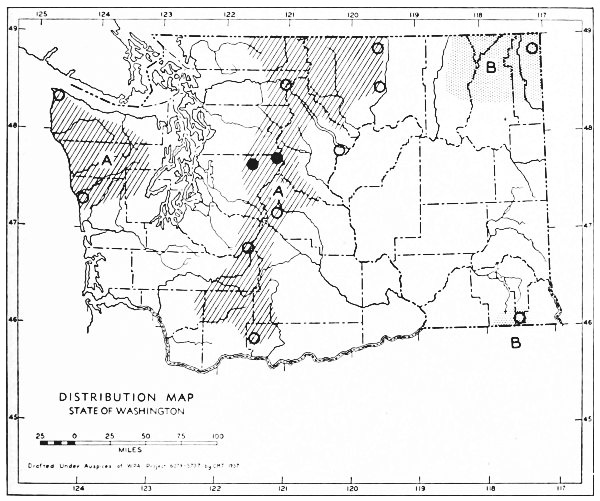
Fig. 53. Distribution of the western marten in Washington. A. Martes caurina caurina. B. Martes caurina origenes.
The value of the marten's pelt fluctuates from year to year. In recent years average pelts have sold at from ten to twenty dollars each. The number of individuals taken by a trapper varies with the trapper's skill and energy and the location of the trap line. The largest catch made by one trapper in a single winter, of which I know, was 300 animals, taken near Mt. Adams.
Martes caurina caurina (Merriam)
Mustela caurina Merriam, N. Amer. Fauna, 4:27, October 8, 1890.
Martes caurina caurina Miller, U. S. Nat. Mus. Bull., 79:93, December 31, 1912.
Type.—Obtained near Grays Harbor, Grays Harbor County, Washington, by L. C. Toey on February 4, 1886; type in United States National Museum.
Racial characters.—Color dark; throat patch bright orange or brownish.
Distribution.—From the Cascade Mountains westward. Marginal localities are (from Taylor and Shaw, 1929: 10) head of Cascade River, Riverside, Chelan, Easton and Trout Lake. The record from Chelan seems doubtful, and the specimen may have come from somewhere around Lake Chelan, rather than from the town of that name.
Remarks.—Skulls of martens from many localities in western North America were studied in an effort to determine the relationship of the eastern pine marten (Martes americana) and the western marten. East of the Rocky Mountains the ranges of the two species approach closely, but each retains distinctive characters, notably the shape of the auditory bullae. The two species have not been taken together and the possibility of intergradation exists. On the basis of the evidence at hand, the two should be regarded as full species until positive proof of intergradation is established.
In the absence of sufficient material, the marten of the Cascades is referred to Martes caurina caurina. Fur graders distinguish between a dark "coast marten" and a paler "Cascade marten."
Martes caurina origenes (Rhoads)
Mustela caurina origenes Rhoads, Proc. Acad. at Sci. Philadelphia, 1902:458, September 30, 1902.
Martes caurina origenes Miller, U. S. Nat. Mus. Bull., 79:93, December 31, 1912.
Type.—Obtained at Marvine Lodge, Garfield County, Colorado, by E. T. Seton on September 16, 1901; type in Academy of Natural Sciences of Philadelphia.
Racial characters.—Paler than caurina with grayer head and yellow or white rather than deep orange or brown throat patch.
Distribution.—Mountainous areas of northeastern Washington and the Blue Mountains of southeastern Washington. Trappers have reported this marten from the mountains near Republic, Ferry County.
Martes pennanti (Erxleben) Fisher
[Mustela] pennanti Erxleben, Syst. Regni. Anim., 1:470, 1777.
Martes pennanti pennanti Miller, U. S. Nat. Mus. Bull., 79:94, December 31, 1912.
Mustela canadensis pacifica Rhoads, Trans. Amer. Philos. Soc., n.s., 19:435, September, 1898 (type from Lake Keechelus, Kittitas County, Washington).
Martes pennanti pacifica Miller, U. S. Nat. Mus. Bull., 79:94, December 31, 1912.
Martes pennanti Grinnell, Dixon and Linsdale, Fur-bearing Mamm. California, Univ. California Press, Berkeley, p. 211, July 22, 1937.
Type locality.—Eastern Canada.
Distribution.—Originally forested areas from the eastern base of the Cascades westward and possibly the Blue Mountains of southeastern Washington and the mountains of northeastern Washington; now probably confined to the Cascade and Olympic mountains.
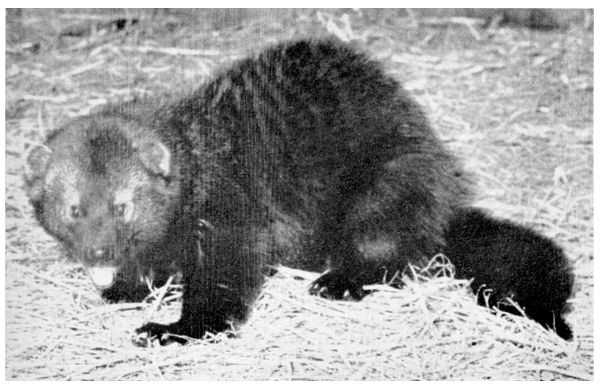
Fig. 54. Fisher (Martes pennanti). 2-year-old male in captivity; New Westminster, B. C., March 7, 1939. (Fish and Wildlife Service photo by Victor B. Scheffer, No. 598.)
Remarks.—The fisher is the size of a large cat. In general proportions it resembles the marten. Adult males measure about 3-1/2 feet in length; the tail comprises 16 inches of this. Adult females are slightly less than 3 feet in length of which the tail makes up approximately 15 inches. Males weigh up to 10 lbs. and females about 5-1/2 pounds (Grinnell, Dixon and Linsdale, 1937: 213). The fisher has a slim body, bushy tail, short legs, large feet, and wide, low and triangular head. The ears are low, wide, rounded and erect. The fur is an ashy, brownish gray in color with an overwash of blackish caused by long, dark hairs. The head is slightly paler than the body. The feet, rump and tail are darkest. The claws are strong and sharply curved.
The fisher is found in wooded parts of North America, extending southward in the Cascade-Sierra Nevada Chain to central California. Its near relatives are the martens. It is active all year. Like the marten, it is active by day and probably also by night. In spite of absolute protection for several years, the fisher is rare in Washington, and seems never to have been common. In consequence relatively little is known of its habits, and the little that is known has been reported by fur-trappers.
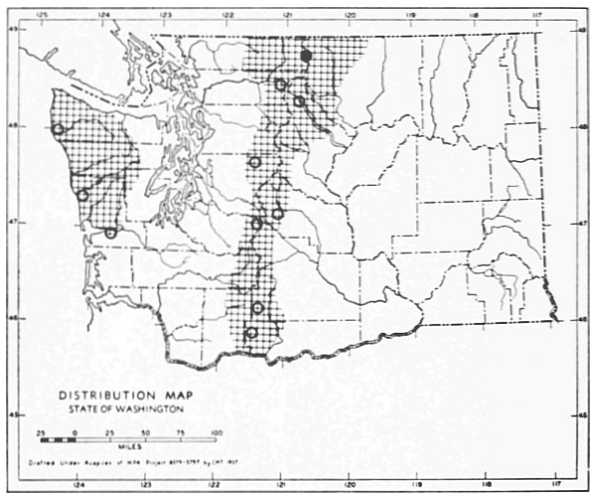
Fig. 55. Distribution of the fisher, Martes pennanti, in Washington.
The fisher seems not to live in bands as does the marten. Most of the actual records of fishers trapped are at higher altitudes but are misleading because most trappers agree that the fisher occupied a lower zone, altitudinally, than does the marten. There are old records of its occurrence near sea level (Scheffer, 1938: 9). The animals are usually taken in marten sets or in traps set especially for fishers by trappers who find their tracks on their marten trap lines. Since marten trappers are almost the only persons who travel in the mountains in winter, and since they operate mostly above the areas where fishers live, relatively few fishers are reported.
Fishers are said to feed on chipmunks, squirrels, mice, birds and other small, warm-blooded animals, and to climb trees and catch squirrels in their natural habitat. Also, fishers are said to catch and kill martens. Their tracks in the snow resemble the marten's in that the hind feet land in the same places as the forefeet; both animals bound rather than walk.
The pelt of the fisher commands a high price. The smaller sized, females, are the more valuable. The price paid for pelts fluctuates widely and has ranged from as low as twelve dollars to as high as one hundred dollars in recent years.
In Washington more fishers live in the Olympic Peninsula and the northern Cascade Mountains than elsewhere. A few may occur in northeastern Washington, the Blue Mountains and the Willapa Hills.
The name pacifica was regarded by Grinnell, Dixon, and Linsdale (1937: 217) as a synonym of pennanti.
Mustela erminea Linnaeus Ermine
Description.—Though it is similar in general characters and proportions to the long-tailed weasel, the ermine is much smaller and has a relatively shorter tail. It is darker and less reddish or yellowish in summer. Adult males measure about 10 inches in length, of which 3-1/2 inches is the length of the tail. Females measure about 8 inches and have tails 2 inches long. The upper parts are chocolate brown; the underparts are white or pale yellow. Along the coast of Washington, the pale color of the underparts is more restricted in the ermine than in the long-tailed weasel. The dark brown tail has a black tip. Ermines east of the summit of the Cascades become pure white in winter, save for the black tail tip. West of the summit of the Cascades the winter pelt is similar to the summer pelt but is slightly paler with denser underfur.
Ermines in America range from the Arctic southward, in mountainous areas, to the southern end of the Sierra Nevada in California, and in the Rocky Mountains to northern New Mexico. In Washington they are found over the entire state except the arid parts of eastern Washington, where only the long-tailed weasel occurs. So far as my observations go, the ermine is principally nocturnal in Washington; I have seen only one abroad in the daytime. It dashed from a roadside thicket near Glacier, Whatcom County, and was crushed beneath the wheels of a car. Taylor and Shaw (1927: 53) note several instances of diurnal activity of the ermines at Mount Rainier National Park.
The ermine seems to feed principally upon mice. Its small size adapts it to entering burrows that larger weasels cannot enter. It probably eats chipmunks, birds, and other small, warm-blooded animals. Ermines climb readily and are often taken in traps set in trees for martens. Near Skykomish, King County, William Hoffman took two ermines in traps set in burrows of mountain beavers. The mountain beavers were needed for use as bait on his trap line. The traps were reset and later caught mountain beavers. Seemingly the ermines were traveling through the burrows, perhaps to catch the mice which utilize the burrows as highways, rather than to prey upon mountain beavers. It is difficult to see how the tiny ermine could kill an adult mountain beaver, which outweighs it many times. Should the incisors of the mountain beaver close even once upon an ermine it would most certainly be seriously wounded or killed. Judging by the forest habitat occupied by the ermine in Washington, one might expect its principal food to consist of deer mice (Peromyscus maniculatus), red-backed mice (Clethrionomys) and meadow mice (Microtus).
In observing the activities and habits of mammals in their natural habitat, I have often relied on tracking in fresh snow. Strangely enough, tracks of ermines were seldom found, and the few that were seen came from beneath a log, bush or wind-fall and disappeared beneath similar cover, rarely extending 20 feet on the surface of the snow. The larger, long-tailed weasels often traveled for miles on the surface of the snow. Possibly the ermines were following the burrows of mice through the snow, or perhaps they kept beneath the surface from fear of owls. This suggests a reason why ermines are so seldom seen abroad. They may be following burrows and runways of mice and seldom come to the surface of the ground.
On November 18, 1936, we saw three ermines and two long-tailed weasels taken by a trapper on Deception Creek near Stevens Pass, King County. All were in the white winter coat. In December, 1938, we obtained two ermines at Skykomish, King County, 18 miles west of Stevens Pass. These were in the brown winter coat. In that area the break between the brown and white winter coat seems to come just west of the main Cascade Summit, or at the same point that the break occurs between the brown and white winter coats of the long-tailed weasel.
Ermine skins have little value and usually bring from 10 to 35 cents. They are saved incidentally by trappers, for it takes but a few moments to skin and prepare them. They possess the strong, musk odor so typical of the long-tailed weasel.
Mustela erminea invicta Hall
Mustela erminea invicta Hall, Jour. Mamm., 26:75, February 27, 1945.
Type.—Obtained at Benewah, Benewah County, Idaho, by W. T. Shaw on October 24, 1926; type in Museum of Vertebrate Zoölogy.
Racial characters.—Largest of the Washington ermines; winter coat entirely white; upper lips white; black of tail more than half length of tail vertebrae.
Measurements.—Ten males and 5 females from central Idaho average, respectively (Hall, 1945): total length 291, 255; length of tail 86, 71; hind foot 40, 32. 3.
Distribution.—Northeastern Washington and the northeastern Cascades, west to Chilliwack River and Hannegan Pass (Hall, 1945: 78).
Mustela erminea fallenda Hall
Mustela erminea fallenda Hall, Jour. Mamm., 26:79, February 27, 1945.
Type.—Obtained at Huntingdon, British Columbia, by C. H. Young on May 21, 1927; type in National Museum of Canada.
Racial characters.-Size large; winter coat usually brown; pale color of underparts much restricted; color of upper parts dark; color of lips variable; tail with more than distal half black.
Measurements.—Seven males and 2 females average, respectively (Hall, 1945: 79): total length 278, 232; length of tail 77, 60; hind foot 36.5, 27.
Distribution.—The extreme north coast of Washington, from the Canadian boundary south through Whatcom County (Hall, 1945: 80-81).
Remarks.—The range of this ermine is similar to that of the yellow-pine chipmunk, Eutamias amoenus felix.
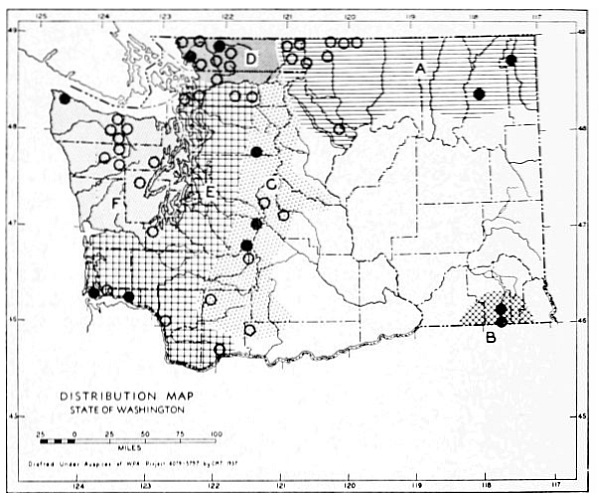
Fig. 56. Distribution of the ermine in Washington. A. Mustela erminea invicta. B. Mustela erminea murica. C. Mustela erminea gulosa. D. Mustela erminea fallenda. E. Mustela erminea streatori. F. Mustela erminea olympica.
Mustela erminea olympica Hall
Mustela erminea olympica Hall, Jour. Mamm., 26:81, February 27, 1945.
Type.—Obtained near head of Sol Duc River, Clallam County, Washington, by V. Bailey, on April 28, 1897; type in United States National Museum.
Racial characters.—Similar to streatori but smaller, especially females.
Measurements.—Twelve males and 6 females average, respectively: total length 243, 196; length of tail 65, 52; hind foot 31, 23.4 (Hall, 1945: 81).
Distribution.—The Olympic Peninsula, extending southeastward to Olympia.
Mustela erminea streatori (Merriam)
Putorius streatori Merriam, N. Amer. Fauna, 11:13, June 30. 1896.
Mustela streatori streatori Miller, U. S. Nat. Mus. Bull., 79:96, December 31, 1912.
Mustela cicognanii streatori Taylor and Shaw, Occ. Pap. Chas. R. Conner Mus., no. 2:11, December, 1929.
Mustela erminea streatori Hall, Jour. Mamm., 26:76, February 23, 1945.
Type.—Obtained at Mount Vernon, Skagit County, Washington, by D. R. Lucky on February 29, 1896; type in United States National Museum.
Racial characters.—Similar to fallenda but pale color of underparts less restricted; tail with less than distal half black.
Measurements.—Two males and 2 females from extreme southwestern Washington average, respectively: total length 245, 210; length of tail 72, 54; hind foot 31.5, 25.5; ear 17, 14; weight 72.3, 46.
Distribution.—The lowlands of western Washington; north to Skagit County and Whidby Island (Taylor and Shaw, 1929: 11), southward and westward to Ilwaco (M.V.Z.) and eastward to Carson (U.S.N.M.).
Mustela erminea gulosa Hall
Mustela erminea gulosa Hall, Journ. Mamm., 26:84, February 27, 1945.
Type.—Obtained at Trout Lake, Klickatat County, Washington, by P. Schmid on February 3, 1897; type in United States National Museum.
Racial characters.—Similar to invicta but smaller; winter coat usually white; tail less than one-half black; upper lips white.
Measurements.—Five males from Mount Rainier, and 4 females from the Cascade Mountains, average, respectively (Hall, 1945: 84): total length 253, 208; length of tail 76, 54; hind foot 30.2, 24.3.
Distribution.—The Cascade Mountains. Known from Skykomish (W.W.D.) and southward to Mount Adams (Trout Lake, Hall, 1945: 85).
Mustela erminea murica (Bangs)
Putorius (Arctogale) muricus Bangs, Proc. New England Zoöl. Club, 1:71, July 31, 1899.
Mustela muricus Miller, U. S. Nat. Mus. Bull., 79:96, December 31, 1912.
Mustela cicognanii lepta Taylor and Shaw, Occ. Pap. Chas. R. Conner Mus., no. 2:11, December, 1929.
Mustela cicognanii muricus Bailey, N. Amer. Fauna, 55:292, August 29, 1936.
Mustela erminea murica Hall, Jour. Mamm., 26:77, February 27, 1945.
Type.—Obtained at Echo, El Dorado County, California, by W. W. Price and E. M. Nutting on July 15, 1897; type in Museum of Comparative Zoölogy.
Racial characters.—Similar to invicta but smaller and paler.
Measurements.—A young female from Stay-a-while Spring, Columbia County, measured: total length 201; length of tail 46; hind foot 24; ear 14; weight 45.8. A female from Butte Creek, Columbia County, measured: 185; 50; 26. A male from Baker Creek, White Pine County, Nevada, measured: 220; 56; 26; 14.5; weight 57.7.
Distribution.—The Blue Mountains of southeastern Washington.
Remarks.—Two specimens available from the Blue Mountains are darker than typical murica.
Mustela frenata Lichtenstein Long-tailed Weasel
Description.—Male long-tailed weasels measure about 16 inches in total length of which 6 inches is the length of the tail. Females are smaller, measuring about 14 inches in length with a tail 5 inches long. The body is long and exceedingly thin. The legs are short and stout with rather large feet and strong, curved claws. The tail is well-furred, not tapered, but lacks the bushy appearance of the tail of the fisher. The head is low, wide at the base and abruptly tapering to the muzzle. The ears are erect, low and rounded. The fur is short but dense and rather soft. In summer the color of the head, back, sides and outside of the legs is brown. The throat, chest, underside of body and insides of legs are yellow or orange. In winter they may be entirely white, save for the black tip of the tail. The tail is slightly darker than the back in summer and possesses a long black tip.
Long-tailed weasels do not hibernate even in the coldest parts of Washington. They are active both by day and by night, apparently doing their hunting at the time of day or night when they can most easily obtain food. In the Cascade Mountains where diurnal mammals such as squirrels, chipmunks and pikas are common, weasels are not uncommonly seen by day. In the lowlands of western Washington, where they feed on more nocturnal mammals, they are seldom seen.
The long-tailed weasel is relatively unspecialized in habits. They climb readily and skillfully. They are active on the surface of the ground and follow the burrow systems of fossorial animals such as gophers and mountain beavers.
Weasels seen in the wild rarely exhibit fear of man but rather are curious and apt to watch his actions. Weasels are also often hit by cars and the number so killed seems to me to be out of proportion to their actual numbers.
In moving on the surface of the ground the weasel arches its back and contracts the body until the four feet are rather close together. When the long neck and small head are held upright the animal presents a surprisingly giraffelike appearance. When climbing, the long, slim body has a snakelike appearance. A weasel travels swiftly and erratically in a series of bounds and seems always to know where the next hole is situated.
The weasel has been accused of killing birds and doubtless does so when opportunity presents itself. However, in Washington I have no actual evidence of its killing birds other than domestic fowls. At Republic, Ferry County, a companion and I saw a weasel enter the burrow of a ground squirrel (Citellus columbianus). The following day we returned to the area. The weasel was not seen but a ground squirrel dashed into the hole at our approach. Seemingly the ground squirrel had eluded the weasel. At Conconully, Okanogan County, we set a number of gopher traps in an alfalfa field. The following morning an adult male long-tailed weasel was found in a trap but not a gopher was taken. Near Moses Lake, Grant County, an adult male weasel was caught in a gopher trap, but no gophers were taken. At Shelton, Mason County, 50 gopher traps were set. At daylight the following morning the first trap visited was found to be pulled into the burrow. When a gentle tug was given the wire fastening the trap, a decisive jerk at the other end showed that the catch was alive. If trapped gophers that pull the traps back into their burrows are pulled out by main strength, their skins are often torn and damaged. Therefore an attempt was made to reach into the burrow and pull back the sod. An adult female long-tailed weasel promptly fastened its teeth into my forefinger and clung on, bulldog fashion, to be lifted into the air with the attached trap swinging. When the left hand was used to force the animal to release its grip, it fastened onto the left thumb. With right thumb and forefinger I forced it to release its grip, but was unable to elude its teeth which again fastened to my right forefinger. Only by laying it on the ground and crushing its chest with my foot could I free myself from the vicious little beast. No gophers were taken in traps set less than 150 feet from where the weasel was trapped. In the three instances mentioned above, weasels had seemingly killed all the gophers in their immediate vicinity. As regards the gophers near Moses Lake, none was found a year later in the area where the weasel was taken and only old, abandoned burrows were seen. T. H. Scheffer (1932: 54) records other instances of the capture of weasels in gopher burrows.
At the northern limits of the city of Seattle, steel traps were set for mountain beavers in a rather dense colony of these mammals. Well-used burrows indicated that approximately 10 individuals were present. The following morning an exceptionally large male weasel was found in a trap, but all others were empty. The traps were left out for two additional nights but no mountain beavers were taken. A month later the colony seemed abandoned and no evidence of recent digging was noted. It could only be concluded that the weasel had killed the animals comprising the colony. A large mountain beaver weighs three or four pounds, which is 6 or 8 times as much as a weasel. Edson (1933: 76) recounts trapping 7 weasels in burrows of mountain beavers near Bellingham, Whatcom County.
Near Forks, Clallam County, a weasel was seen pursuing a young snowshoe rabbit (Lepus americanus washingtonii) along the edge of a concrete highway. As our car approached and passed the animals, they separated, the weasel retreating to the cover of horsetail (Equisetum) beside the road. The car was stopped 50 feet ahead. As we emerged the weasel dashed from cover to intercept the rabbit in the center of the road. The weasel knocked the rabbit to its side and, placing its feet on the rabbit's shoulders, bit fiercely at its neck. It then dashed back to the cover of the horsetails. The rabbit stood up, made two hops and died. It was approximately two weeks old.
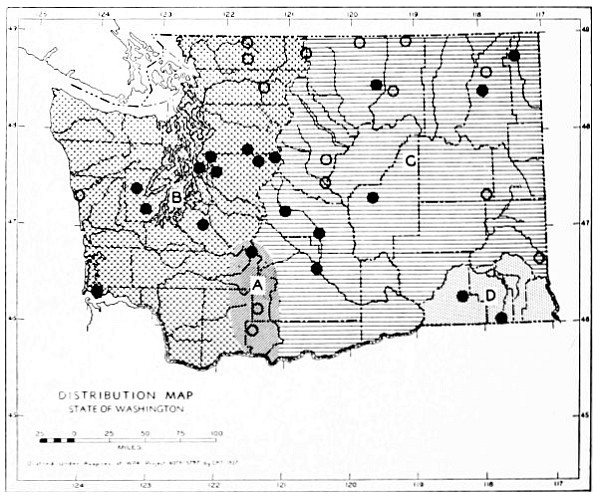
Fig. 57. Distribution of the long-tailed weasel in Washington. A. Mustela frenata washingtoni. B. Mustela frenata altifrontalis. C. Mustela frenata nevadensis. D. Mustela frenata effera.
The pelts of weasels bring the trapper from twenty-five cents to a dollar and a half. Only skins in the white winter coat command the higher price. They are usually taken in traps set for other animals.
In the western part of the state, long-tailed weasels do not turn white in the winter; the back is slightly less reddish than in summer and the underparts are pale yellow or white or may be both yellow and white. From the summit of the Cascades eastward weasels become white. The break in winter color seems to occur slightly west of the main summit of the Cascades. Specimens taken by marten trappers at Tye and Scenic, near Stevens Pass, were white on November 15, 1936, but specimens from Skykomish and Baring, 18 miles to the west, were brown.
The long-tailed weasel possesses a distinctive odor. It results from a glandular secretion and, although it has no great carrying power or lasting quality, it does affect some persons strongly. It is a heavy, rather sickening scent.
The gestation period of Mustela f. nevadensis has been recorded as more than 131 days (Hall, 1938B: 250). The gestation period of the long-tailed weasel of eastern United States has been recorded as more than 70 days. Three to five young are born in a litter, usually four.
Mustela frenata nevadensis Hall
Mustela arizonensis Taylor and Shaw, Occ. Pap. Chas. R. Conner Mus., no. 2:11, December, 1929.
Mustela washingtoni Taylor and Shaw, in part, Occ. Pap. Chas. R. Conner Mus., no. 2:11, December, 1929.
Mustela frenata nevadensis Hall, Carnegie Inst. Washington, Publ. 473:91, November 20, 1936.
Type.—Obtained 3 miles east of Baker, White Pine County, Nevada, by E. R. Hall and W. C. Russell on May 30, 1929; type in Museum of Vertebrate Zoölogy.
Racial characters.—Size medium; colors pale; back near Brussels Brown in summer, chin white and underparts yellow, rarely orange; color in winter white with black tip on tail.
Measurements.—A male from Neppel, Grant County, measures: total length 412; length of tail 151; hind foot 43; ear 19. Two males from Yakima, Yakima County, average: 379; 135; 42.5; 21; weight 176.5. A female from Ellensburg and one from 4 miles east of Ellensburg, Kittitas County, average: 284; 98; 33; 17.
Distribution.—From the high Cascades eastward, save for the Blue Mountains area. Marginal occurrences are Barron (Hall, 1936: 93) and Easton (W. W. D.).
Remarks.—Specimens from the northern Cascades are intergrades between nevadensis and the form to the west, altifrontalis. Specimens from extreme northeastern Washington might be referred to oribasa Bangs as readily as to nevadensis.
Mustela frenata effera Hall-
Mustela frenata effera Hall, Carnegie Inst. Washington, Publ. 473:93, November 20, 1936.
Type.—Obtained at Ironside, Malheur County, Oregon, by H. E. Anthony on September 8, 1912; type in American Museum of Natural History.
Racial characters.—Similar to nevadensis in color but smaller, with smaller, lighter skull. Color in winter white with black tip on tail.
Measurements.—A female from Prescott, Walla Walla County, measures: total length 310; length of tail 105; hind foot 34.
Distribution.—Southeastern Washington, south of the Snake River. Specimens from Walla Walla and Prescott have been examined.
Mustela frenata washingtoni (Merriam)
Putorius washingtoni Merriam, N. Amer. Fauna, 11:18, June 30, 1896.
Mustela washingtoni Miller, U. S. Nat. Mus. Bull., 79:98, December 31, 1912.
Mustela frenata washingtoni Hall, Carnegie Inst. Washington, Publ. 473:106, November 20, 1936.
Type.—Obtained at Trout Lake, Skamania County, Washington, by D. N. Kaegi on December 15, 1895; type in United States National Museum.
Racial characters.—Color rich, dark; hind feet free of color of underparts.
Measurements.—A male from Spray Park, Pierce County, measures: total length 423; length of tail 164; hind foot 52.
Distribution.—Higher Cascades from Mt. Rainer (M. V. Z.) south to Mt. Adams (Taylor and Shaw, 1929: 11).
Mustela frenata altifrontalis Hall
Mustela saturata Taylor and Shaw, Occ. Papers Chas. R. Conner Mus., no. 2:11, December, 1929.
Mustela frenata altifrontalis Hall, Carnegie Inst. Washington, Publ. 473:94, November 20, 1936.
Type.—Obtained at Tillamook, Tillamook County, Oregon, by A. Walker on July 10, 1928; type in Museum of Vertebrate Zoölogy.
Racial characters.—Similar to nevadensis but darker above in summer and richer orange beneath; winter color of upper parts dark brown, underparts pale yellow or white.
Measurements.—Four males and 2 females from western Washington average, respectively: total length 411.5, 267; length of tail 145, 137.5; hind foot 50, 43; ear 26, 21.5; weight 227, 136.7 grams.
Distribution.—From the Cascade Mountains to the Pacific. Marginal occurrences are Rockport (Hall, 1936: 95) and Tye (W. W. D.).
Mustela vison energumenos (Bangs) Mink
Putorius vison energumenos Bangs, Proc. Boston Soc. Nat. Hist., 27:5, March, 1896.
Mustela vison energumenos Miller, U. S. Nat. Mus. Bull., 79:101, December 31, 1912.
Type.—Obtained at Sumas, British Columbia, by A. C. Brooks on September 23, 1895; type in Museum of Comparative Zoölogy.
Measurements.—A male from Seattle, King County, measures: total length 540; length of tail 180; hind foot 66; weight 1 pound, 15 ounces.
Distribution.—Throughout the state save for the Columbian Plateau; recorded from Neah Bay (Taylor and Shaw, 1929: 11) in the northwest, Ilwaco (M.V.Z.) in the southwest, Metaline (W.W.D.) in the northeast, and the Blue Mountains (Dice, 1919: 12) in the southeast.
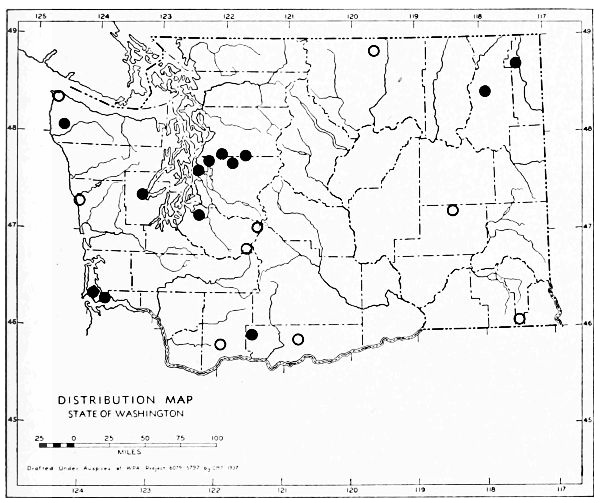
Fig. 58. Distribution of the mink, Mustela vison energumenos, in Washington.
Description.—Because of the value and lasting popularity of its fur, the mink is known to all. Few persons, however, recognize the animal in the wild. The mink possesses the long, slim body and short, rather stout legs of a weasel but has a more bushy tail. The mink is larger than the weasel. Large males weigh up to 3 pounds; females 1-1/2 pounds. Males measure about 2 feet in length, of which the tail comprises eight inches. Females measure about 20 inches and have tails 7 inches long. The color is rich, dark reddish or chocolate brown. The underparts are slightly paler than the back. There are usually small white markings on the chin, chest or other part of the ventral surface. These markings sometimes take the form of narrow white lines.
The mink ranges from the Atlantic to the Pacific and from Alaska south to Florida, New Mexico and central California. It is active throughout the year and is principally, though not exclusively, nocturnal. McMurry (1940: 47) records three mink seen at 3:30 p. m. on August 8, 1939, at Packwood Lake, Lewis County, one of which was carrying a garter snake two feet in length. This mustelid is semiaquatic, living along rivers, streams, lakes and salt water and spends most of its time along the shore, on muddy or sandy beaches. In this respect it resembles the raccoon. Whereas the raccoon spends a part of its time on the land, the mink spends a corresponding amount of its time in the water. It is an excellent swimmer, able to overtake and capture fish in the water.
In the San Juan Islands minks have forsaken the shoreline and roam over the uplands, feeding on the abundant, feral domestic rabbits. I found evidence of their presence far inland, miles from water, in grassy and bushy wastes; along the beaches their tracks were rarely seen. Along Puget Sound, minks spend part of their time on the beaches, feeding on dead fish and other marine animal life. These animals, however, seem to live along the rivers and streams flowing into the sound. Along the ocean coast, some minks seem to live exclusively in the marine shoreline habitat.
The mink ascends some distance into the Cascade and Olympic mountains along the larger watercourses. There are reliable reports of minks from Heart Lake and Lake Dorothy, King County, high in the Cascades. These animals were seen in the summer but they may live in higher parts of the Cascades, at least about some of the larger lakes throughout the year. As far as is known there are no minks on the Columbian Plateau.
The food probably varies with locality. Along the ocean beaches they eat dead sea birds, stranded fish, crustaceans, and mollusks. Along Puget Sound their tracks are commonly seen following the caked, decaying seaweed and debris that collects at the high tide mark. Svihla and Svihla (1931: 22) captured a mink that was feeding on the beach of the Olympic Peninsula. This individual, in captivity, was able to open and feed on clams. Fur trappers report that minks feed on mountain beavers, and that the flesh of the mountain beaver is the best bait for attracting minks. Along streams and lakes, minks are thought to feed on mice, birds, fish, crayfish and thin-shelled, fresh-water mussels. The muskrat forms an important item of diet near the larger lakes and streams. Muskrats trapped near Seattle were often attacked by minks and either eaten or so slashed and torn that their pelts were worth but a fraction of what they would bring in an undamaged condition.
The tracks of a mink noted in freshly fallen snow about a garbage dump on the shore of Lake Washington, Seattle, indicated that the animal had been hunting house rats, which were numerous there. Minks are not uncommon in the marshes along Lake Washington near the University of Washington campus, Seattle, where I discovered evidence of their preying on ducks and coots. The ducks included mallards and green-winged teal, species most apt to alight in small pools in the rushes where a mink might find cover. I found the fresh tracks of one mink about a half-eaten golden tench 8 inches long. The tench is a fish of the sucker tribe, introduced into the lake. Tracks of minks are not uncommonly seen along rivers and streams under conditions that indicate they were hunting crayfish.
The raw pelt of the mink sells usually at from 10 to 20 dollars. The fur is in constant demand and fluctuates in price less than most furs. The average trapper takes a few minks each year along with his catch of muskrats, raccoons, and skunks but some trappers have taken as many as 100 minks in a winter in areas where the animal is especially numerous.
Gulo luscus luteus Elliot Wolverine
Gulo luteus Elliot, Field Columb. Mus., Publ. 87, zoöl. ser. 3:260, December, 1903.
Gulo luscus luteus Grinnell, Dixon, and Linsdale, Fur-bearing Mamm. California, Univ. California Press, Berkeley, p. 251, July 22, 1937.
Type.—Obtained on Mt. Whitney, Tulare County, California, by E. Heller; type in Field Museum of Natural History.
Measurements.—The dried skin of a wolverine taken 3 miles south of Riverside, Okanogan County, was 4 feet in length. The animal weighed 40 pounds (Scheffer, 1941: 37).
Distribution.—Timber-line region of the Cascades Mountains. From Robinson Creek (Scheffer, 1938: 8) south to Mount Rainier (Taylor and Shaw, 1929: 12).
Remarks.—Specimens from Washington are intermediate in character between luteus and the race inhabiting British Columbia, although available skulls are closer to luteus.
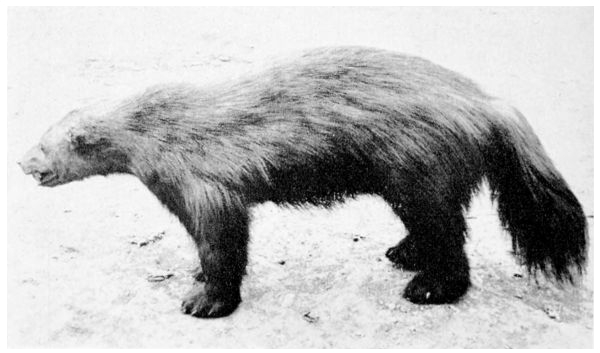
Fig. 59. Wolverine (Gulo luscus), mounted specimen, male, trapped by Billy Robinson about 1902 on Billy Robinson Creek, Okanogan County, Washington. (Fish and Wildlife Service photo by Victor B. Scheffer, No. 76.)
Description.—Large males measure more than three feet in length, of which the tail makes up 10 inches; they weigh as much as 50 pounds (Grinnell, Dixon and Linsdale, 1937: 253). The body is wide and stocky; the tail is short; the legs, especially the forelegs, are short, thick and powerful; the feet are large and are armed with long, curved claws; the head is wide; the jaws are powerful with heavy teeth. The pelage is long and rather shaggy. Face, legs, back and terminal portion of the tail are dark, blackish brown but the forehead is grayish, contrasting with the dark color of face and top of the head. Two broad, yellowish-brown bands begin on the side of the shoulders and pass back, low on the sides, to the hips where they join across the back and base of the tail.
The wolverines, nominally of several species, form a compact group that ranges over the boreal regions of the Old and New world. In North America they range southward from the Arctic to California and Colorado.
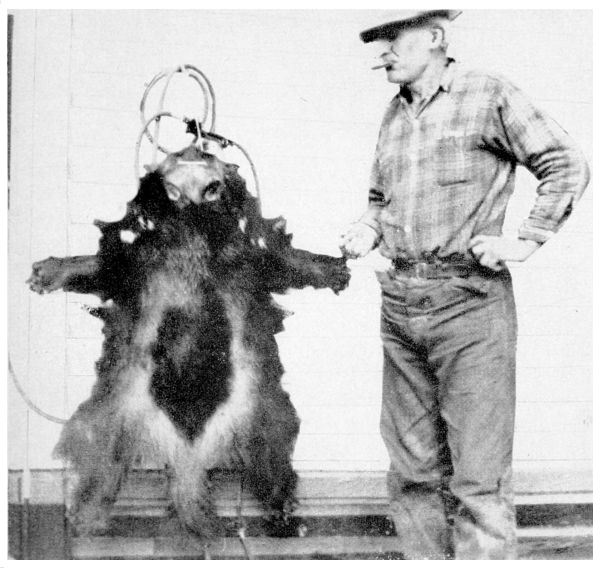
Fig. 60. Wolverine (Gulo luscus), male, trapped by Reuben R. Lamb, March 22, 1941, three miles south of Riverside, Washington; reported to weigh 40 pounds; dried pelt 3 × 4 feet. (Reuben R. Lamb photo.)
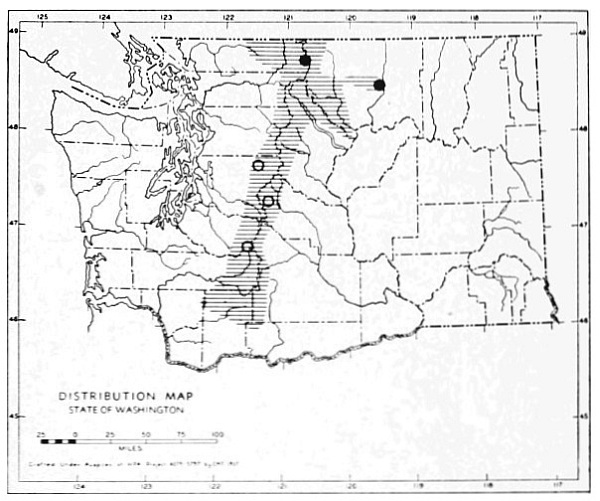
Fig. 61. Distribution of the wolverine, Gulo luscus luteus, in Washington.
The wolverine is adapted to boreal conditions and is most abundant in the arctic. In the Cascades it occurs only at or near timber-line. Except the wolf and the possibly extinct grizzly bear, the wolverine is the rarest carnivore in Washington. Probably it has been rare since the retreat of the continental glaciers, for suitable habitat for wolverines is not abundant and each animal requires a large area over which to range. An unusual record, possibly of a wandering animal, is given by Scheffer (1941: 37). This is of an adult male taken in the Okanogan Valley 3 miles south of Riverside, Okanogan County, on March 22, 1941.
Lutra canadensis (Schreber) River otter
Description.—The otter has the long body of many mustelids, but is specialized for aquatic life. Males are slightly larger than females. Large adults measure more than 3-1/2 feet in length, of which the tail comprises 18 inches. The largest adults may weigh as much as 25 pounds. The body is elongate but rather plump. The forelimbs are small and laterally placed. The hind legs are the heavier, and are situated posteriorly. The feet are large and webbed for swimming. The tail is long, thick at the base and gradually tapering to a narrow tip. The head is small and rounded. The ears are tiny and the eyes are of moderate size. The upper lips are large, somewhat spaniel-like, and support a mustache of stiff vibrissae. The fur is short, dense and soft. The tail is sleek with short, posteriorly-directed fur, and is not bushy. The fur is rich, dark chocolate brown in color, slightly paler on the animal's underparts than on its upper parts.
Otters range over Eurasia, North America and South America. Those occurring in North America north of Mexico are thought to belong to a single species, canadensis. Several species from tropical America may eventually be shown to also be races of canadensis.
The aquatic habits of the otter allow it to exist in several life-zones, in both marine and fresh-water habitats. The principal environment is the streams, rivers and lakes of the Transition Life-zone, but along the larger rivers, otters range up into the Canadian Life-zone and along the Snake and Columbia rivers they enter the Upper Sonoran Life-zone. They are active throughout the year. As we have observed them, they are principally nocturnal.
Otters are extremely powerful swimmers. Tracks along the North Fork of the Tolt River, King County, showed where otters had entered water that flowed over a stony bottom at the velocity of rapids. Their occurrence in the Tolt, Skykomish and Snoqualmie rivers where these are swift mountain streams indicates exceptional swimming ability. After emerging from the water, an otter often follows along the shore, sometimes for miles.
In the San Juan Islands the otters have taken to a marine existence. In the summer of 1938, abundant opportunity offered to observe the otters at Thatcher Bay, Blakely Island. Here, in the evening, bats were shot as they flew over the calm water of the bay. Specimens killed were retrieved by rowing out to them with a dory. For the first two nights bats were collected and retrieved without incident. On the third night, several of the bats vanished between the time they were killed and the time that the boat was launched from the rocky beach. The presence of a shark or other large fish was at first suspected, but observation showed a group of three or possibly four otters to be the thieves. On succeeding nights the animals became bolder. A dead bat became the object of a race between otters and collector. They completely ignored shouts, dodged stones hurled at them, and stole almost all the bats shot. Only a sense of humor and desire to study the animals saved them from a load of fine shot. Bat collecting was given up in disgust.
These otters were remarkably seallike in many actions. In swimming their heads, shoulders and part of their back were exposed. In resting in the water, only the round head remained above the surface. They were never seen to float prone on the surface or rest on their backs, as does the sea otter. They were noisy swimmers, splashing with paws or heads as they dived. Their eyesight was remarkable. Stones the size of a walnut were hurled at them from distances as short as 25 feet. All were dodged with little effort. In this connection the experience of two trappers who caught an otter in the Samamish River near Woodinville, King County, is interesting. The trap holding the otter had been attached by a wire 6 feet long to a pole on the bank. The wire was detached from the pole; while one trapper held the wire, the other tried to strike the otter with an oar as the boat drifted over deep water. The otter was free to swim and dive for the length of the wire and trap chain. It detected, and evaded by dodging or diving, every blow directed at it and not until the animal tired, a half hour later, could it be killed. The trappers then noted that the splashing of oars and otter had nearly filled the boat with water. The trappers were exhausted.
The otters of Blakely Island were not unique in occupying a marine habitat. At Strawberry Bay, Cypress Island, on July 5, 1938, fishermen brought in a "strange animal" caught by them at Black Rock, a tiny bare and isolated islet 5 miles to the west. The heavy box holding the animal was opened, disclosing a very frightened young otter. Questioned, the fishermen stated that four young and one adult had been seen in the surf. They had thought the animals a species of seal, and were somewhat surprised at being successful in their attempts to catch one. The otter was too young to fare for itself and was kept in camp in the hope that it might be reared and released. It ate a few fresh herring and candlefish and drank some condensed milk. It refused whole salmon and sea bass but ate some skinned and boned strips of these fish. It died a week after it was captured. This young otter made a ticking sound, almost a chirp. A variety of crying and whimpering sounds were also made, and when petted it grunted in satisfaction. If surprised or when first picked up it gave a deep harsh growl, unexpectedly vicious in sound, for such a small animal.
The otters at Blakely Island fed on a great variety of food. The only food they were actually seen to eat was candlefish, a slim silvery fish 6 inches in length. On several occasions an otter was seen swimming with the head of a candlefish held fast in its mouth and the fish's body extending out in a silvery bow. Many feces of these otters were composed entirely of the feathers of grebes and scoters. These birds were probably not killed by the otters but died a natural death or were shot by men. At that camp scarcely a day passed in which at least one person was not seen firing a .22 caliber rifle from a cabin cruiser into the flocks of scoters at the mouth of the bay. Dead sea birds were common on the shore and doubtless furnished food for otters as they did for crows and eagles. The majority of the otter feces examined at Blakely Island were composed of the remains of invertebrates. The small mussel (Mytilus edulis) was most abundant. Crabs formed an important part of their diet. Strangely enough the shore crab (Hemigrapsus nudus) and the porcelain crab (Petrolisthes eriomerus) were seldom eaten though they were abundant beneath the rocks upon which the feces were found, and formed the principal food item of raccoons. These species of invertebrates live beneath rocks and the raccoon probably reaches beneath the rocks to catch the crabs with its handlike forefeet, as the otter is unable to do. The edible crab (Cancer productus) and kelp crab (Telmessus cheiragonus) were most often eaten by otters. Also eaten were snails (Margarites, Littorina), bitter oysters (Pododesmus macroschisma), unidentified pelecypods, barnacles (Balanus), one chiton (Mopalia muscosa), and once a starfish. The invertebrate remains, save for the snails, were crushed and broken.
Fish of many species were abundant in these waters. Salmon were often seen leaping near the playing otters. Yet no scales or other remains of fish were detected in the feces. Candlefish possess tiny scales that could probably be seen by microscopic examination only. As for the bird remains, the quantity of feathers consumed is notable. The otters apparently do not pluck birds, as do minks. Indeed, of the material eaten, the food value by volume seems extraordinarily low. A great quantity must be eaten to nourish an animal as large and as active as an otter. The number of fecal droppings seen each morning indicates that this is the case.
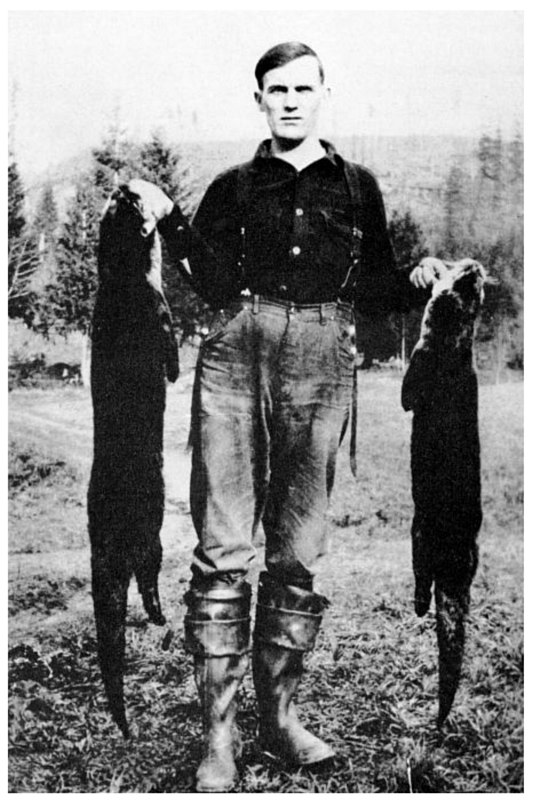
Fig. 62. River otter (Lutra canadensis pacifica), trapped in Columbia National Forest, Washington, February, 1937. (Adolph Roth photo.)
The favored food of the otter in fresh water streams and lakes is the crayfish. The greater part, perhaps 80 per cent, of otter feces seen in the lowlands of western Washington, were composed of crayfish remains. Some fish are also eaten and locally otters may do damage among the steelhead trout. Even worse, from the fisherman's standpoint, they frighten and scatter the schools of steelhead trout. Frogs are eaten, as well as the thin-shelled mussels. The feathers of coots were twice seen in otter feces near Cottage Lake, King County.
The fur of the otter is dense and beautiful but the skin is rather heavy. Changes in styles cause great fluctuation in the value of the otter's pelt.
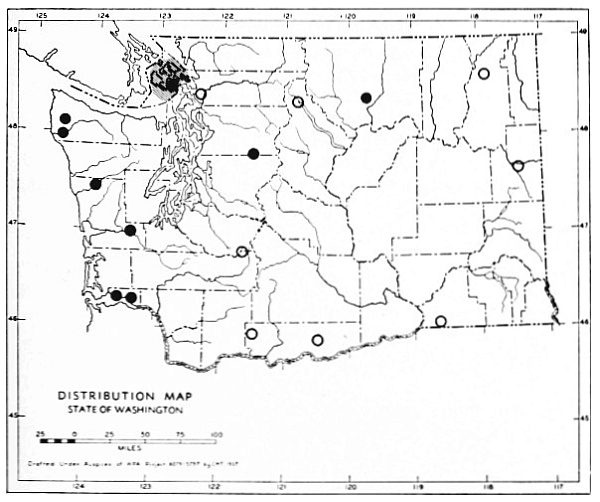
Fig. 63. Distribution of the river otter in Washington. Unshaded Lutra canadensis pacifica. Shaded Lutra canadensis vancouverensis.
Lutra canadensis pacifica Rhoads
Lutra hudsonica pacifica Rhoads, Trans. Amer. Philos. Soc., n. s., 19: 429, September, 1898.
Lutra canadensis pacifica Allen, Bull. Amer. Mus. Nat. Hist., 10: 460, November 10, 1898.
Type.—Obtained at Lake Keechelus, Kittitas County, Washington (altitude 3,000, rather than 8,000 feet as stated in original citation); type in Academy of Natural Sciences of Philadelphia.
Measurements.—An adult male from the Lower Calawah River, near Forks, Clallam County, measured (skinned carcass): total length 1205; length of tail 490; weight (entire) 23 pounds. A male from Puget Island, Wahkiakum County, measured (skinned carcass): total length 1250; length of tail 490. A female from Satsop, Grays Harbor County, measured (skinned carcass): total length 1205; length of tail 440. A female from Calawah River near Forks, Clallam County, measured: total length 1062; length of tail 430; hind foot 120; ear 23; weight 14-3/4 pounds.
Distribution.—Watercourses throughout the state, scarcer east of the Cascades; recorded at Forks (V. B. S.) in the northwest, Puget Island (V. B. S.) in the southwest, Colville (Taylor and Shaw, 1929: 12) in the northeast, and Touchet (Taylor and Shaw, 1929: 12) in the southeast.
Lutra canadensis vancouverensis Goldman
Lutra vancouverensis Goldman, Proc. Biol. Soc. Washington, 48: 186, November 15, 1935.
Type.—Obtained at Quatsino, Vancouver Island, British Columbia, by H. O. Berg in 1905; type in United States National Museum.
Racial characters.—No adults, referred to this race from Washington, have been examined. Said to have broader skull than pacifica.
Measurements.—The only available specimen, a young female from Black Rock, San Juan County, measured: total length 792; length of tail 247; hind foot 103; ear 22.
Distribution.—The San Juan Islands of northern Puget Sound and adjacent marine waters.
Remarks.—The otters of the San Juan Islands are referred to this race on geographical grounds. Numerous islands connect Vancouver Island with the San Juan Islands, and intervening channels are not too wide for otters to swim. Adult material may show that the otters of the San Juan Islands are referable to pacifica or to an undescribed race rather than to vancouverensis.
Enhydra lutris nereis (Merriam) Sea otter
Latax lutris nereis Merriam, Proc. Biol. Soc. Washington, 17: 159, October 6, 1904.
Enhydra lutris nereis Grinnell, Univ. California Publ. Zoöl., 21: 316, January 27, 1923.
Type.—Obtained on San Miguel Island, Santa Barbara Islands, by G. M. McGuire in 1904; type in United States National Museum.
Distribution.—Formerly occurred along the ocean coast of Washington. Now extinct there.
Description.—Adult sea otters reach a length of six feet. The body is stout, long and round; the tail is short, flattened and about a foot in length. The legs are short and thick. The hind feet are webbed for swimming. The head is rounded with small eyes and ears, and a seallike mustache of stiff bristles on the muzzle. The upper lip is thick and heavy, drooping over the sides of the mouth in a spaniel-like fashion. The fur is long, soft and extremely dense. The color of the body is various shades of rich, dark brown. Scattered white hairs often give the coat a frosted appearance. The heads of the adults are pale grey, occasionally almost white.
The sea otter once ranged from the Gulf of California north along the west coast of North America to Alaska, the Aleutian Islands, Siberia and Japan. It is now found only in a small area along the coast of California and in remote islands of the north Pacific. Once abundant along the coast of Washington, it is now completely extinct there.
The habits of sea otters living on the California Coast in the vicinity of Carmel have been described by Fisher (1939: 21-36). Available information on the sea otter in Washington has been given by Scheffer (1940B: 369-388). The search for sea-otter skins influenced the exploration and settlement of the northwest. Captain James Cook obtained skins of sea otter at Nootka Sound, Vancouver Island, in 1778. The mouth of the Columbia River was discovered by Captain Robert Gray on May 11, 1792, while trading for sea otter skins.
According to Scheffer, the bulk of the sea-otter population on the Washington coast was concentrated between the mouth of the Columbia River and Point Grenville at the mouth of the Quinault River. The otters were found several miles from land in extensive kelp beds. The principal food of the sea otter in Washington seems to have been the short-spined purple sea urchin (Strongylocentrotus purpuratus). The animals were social, living in herds of up to 400 individuals. They never came out on land, living, sleeping, and bringing forth their young on the kelp beds of the open ocean. The single young was born at any month of the year.
Spilogale gracilis Merriam Civet cat or spotted skunk
Description.—The civet cat is slightly less than 18 inches in total length, of which the tail constitutes 6 inches. Large, fat animals may weigh more than a pound. The body is long and moderately stout, heavier than that of the weasel but slimmer than that of the striped skunk. The tail is long with long, plumelike fur. The legs are slender and of moderate length. The feet are small with long claws. The head is small and triangular with low, erect ears and large, bright eyes. The fur is short but soft and silky. The ground color of the civet cat is black. Wavy lines and spots of white or salmon intercept the black in a complex pattern. Variations in color patterns include width of stripes, waviness of stripes, and breaking up of the stripes into spots.
Spilogale is restricted to America; it ranges from southern British Columbia south into Central America. Several species are now recognized, but additional material probably will show intergradation between some of them and reduce the number.
The name "spotted skunk" is seldom used by trappers or other persons familiar with the animal. Nor is it appropriate, for the distinctive color pattern is composed of short stripes. Neither is the term "civet cat" appropriate, for the true civet is found in Asia. The name civet cat is well established, however, and will doubtless remain in general use.
The civet cat is principally a lowland animal, but has been recorded from the Nisqually entrance of Mt. Rainier National Park (Brockman, 1939: 70). Its rather generalized habits allow it to exist in areas that will not support larger carnivores or species with specialized food habits. It dwells in areas of thickets, brushy tangles or deep woods. In southeastern Washington it lives in rocky places as well as in river-side thickets of willow and cottonwood. Where conditions are suitable it ranges up into the Canadian Life-zone but is most abundant in the Transition Life-zone.
The civet cats, in contrast to the striped skunks, are exclusively nocturnal. They are active the year around in western Washington but move about less in spells of unusually cold weather. We have taken them, however, in freezing weather.
In spite of their abundance and wide range, civet cats are known to few persons other than trappers, perhaps because of their exclusively nocturnal habits. They do occasionally make people aware of themselves by taking up residence about old buildings. They are rather noisy at times. At the Tolt River, 10 miles southeast of Duvall, King County, we were asleep in an old building when a stamping noise from the next room awakened us. Investigation revealed a civet cat indulging in a series of short, stiff-legged hops. The forefeet were held slightly ahead and six or eight hops made. The animal would then relax, turn, and prance off in a new direction. The amount of noise made by its feet striking the board floor was surprising. The civet cat seemed to enjoy the noise it made, and the prancing may have been a method of playing. Trapped civet cats have been seen to make a similar but shorter series of hops at the trapper's approach, which might have been a warning. In the case described, however, the noise of the animal's actions was heard before the animal was seen and presumably when it was unaware of human presence. The civet cat also makes a drumming noise similar to the drumming of a wood rat. This was heard twice from wild animals that did not suspect an observer's presence, and once from a captive animal. While an animal was drumming I never had the opportunity to watch the actions closely enough to describe them. Apparently the drumming is done with the forefeet.
The civet cat is said to be a good climber and to do some of its hunting in trees. One trapped civet cat climbed to the limit of a trap chain and wire in a low bush near Cottage Lake, King County, but, in Washington, I have no other evidence of this animal climbing. Near Cottage Lake, we took a civet cat in a trap set beneath 2 inches of water at the side of a stream. The animal had either been swimming or wading.
Trapped civet cats rarely dig holes near the traps, as striped skunks often do. One caught near Ocean Park, Pacific County, did dig a hole beneath a log and forced earth and leaves over the entrance. I walked within a few feet of the animal in searching for the trap. Not until the trap chain was seen did I find the civet cat. None was taken in traps set in mountain beaver burrows, although I have caught both striped skunks and weasels in such burrows.
Some trappers state that the musk of the civet cat smells different from that of the striped skunk. I think the odor is slightly more acrid and that it does not carry so far as the skunk musk. The civet cat is far more active and nervous than the striped skunk. Whereas the striped skunk almost never throws its scent when trapped, the civet cat almost invariably does so, apparently when the trap closes about its legs. Striped skunks in traps move slowly and steadily but civet cats jump, roll and squirm erratically.
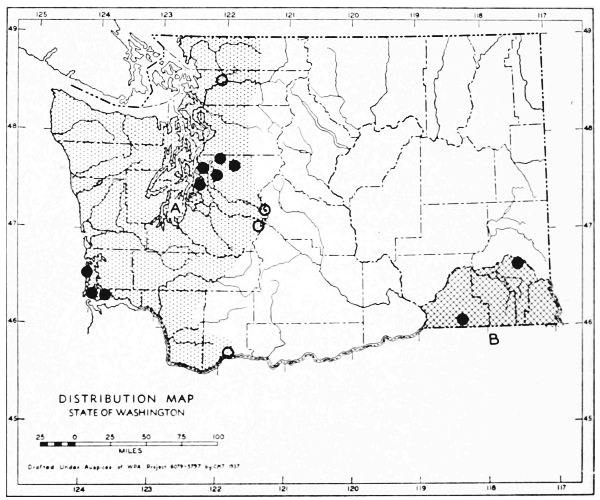
Fig. 64. Distribution of the civet cat in Washington. A. Spilogale gracilis latifrons. B. Spilogale gracilis saxatilis.
In the winter of 1934 a large male civet cat was taken near Cottage Lake, King County. It had been killed and partially eaten in the trap. The ground about the set was torn up, indicating that the civet cat had put up a fight. The area for many feet about smelled of skunk musk. The body of the civet cat was used for bait and the trap reset. The following morning a large male striped skunk was in the trap. Its skin bore superficial cuts in several places about its neck and rump, and it was doubtless the animal that had killed the civet cat. Under ordinary circumstances a striped skunk could scarcely catch the far swifter and more agile civet cat. One civet cat in a trap was killed and partly eaten by a horned owl. Save for dislodging a few feathers, the civet cat seemed to have done little damage to the owl. The thick cover inhabited by the civet cat ordinarily protects it from owls. Dead civet cats run over by cars on the highway are rarely seen.
The stomach of a specimen from Ocean Park, Pacific County, contained the remains of three red-backed mice (Clethrionomys californicus). The stomachs of most specimens trapped were empty. Mice, birds and insects probably constitute the bulk of the food.
Notes on the early life of Spilogale interrupta, a species related to the one occurring in Washington, have been published by Crabb (1944: 213-221).
The fur of the civet cat is of little value; in recent years trappers have received from fifteen cents to a dollar for large pelts. Because of its habit of throwing scent when in the traps, most trappers discard the animals without skinning them.
Spilogale gracilis saxatilis Merriam
Spilogale saxatilis Merriam, N. Amer. Fauna, 4:13, October 8, 1890.
Spilogale gracilis saxatilis Howell, N. Amer. Fauna, 26:23, November 24, 1906.
Type.—Obtained at Provo, Utah County, Utah, by V. Bailey on November 13, 1890; type in United States National Museum.
Racial characters.—Size small; white areas extensive, especially on tail but white triangle on head small; white areas less often tinged with salmon or orange than latifrons.
Measurements.—Howell (1906: 32) gives the measurements of a male from Harney, Oregon, and the average of 3 females from Oregon as, respectively: total length 455, 360; length of tail 155, 129; hind foot 50, 40.
Distribution.—Southeastern Washington, north to Kamiak Butte (Taylor and Shaw, 1929: 12).
Spilogale gracilis latifrons Merriam
Spilogale phenax latifrons Merriam, N. Amer. Fauna, 4:15, October 8, 1890.
Spilogale olympica Elliot, Field Columb. Mus., Publ. 32, zoöl. ser. 1:270, March, 1899 (type from Lake Sutherland, Clallam County, Washington).
Spilogale phenax olympica Howell, N. Amer. Fauna, 26:33, November 24, 1906.
Spilogale gracilis latifrons Grinnell, Dixon and Linsdale, Fur-bearing Mamm. California, Univ. California Press, Berkeley, p. 301, July 22, 1937.
Type.—Obtained at Roseburg, Douglas County, Oregon, by T. S. Palmer on July 13, 1889; type in United States National Museum.
Racial characters.—Larger than saxatilis with less extensive white markings, especially on tail, but white markings on head larger; white usually tinged with salmon or pale orange.
Measurements.—Means for four males, from Pacific County, are total length 411; length of tail 136; hind foot 47.5; ear 27. One weighed 784 grams.
Distribution.—Western Washington from the western edge of the Cascades westward. Marginal records, given by Taylor and Shaw (1929: 12) are Hamilton, on the north; Lake Keechelus, on the east; and Carson, on the south.
Remarks.—Comparison of adult specimens of civet cats from western Washington and western Oregon shows no reliable character for recognition of two races. No difference in tail length exists. Narrowness of rostrum was the only diagnostic character found by Howell (1906: 34) to separate latifrons and olympica. We have carefully compared civet cats from western Oregon, southwestern Washington and the area about Seattle. Some local variation exists but overlapping is great and specimens from Washington do not have rostra that average narrower than specimens from Oregon.
Mephitis mephitis (Schreber) Striped skunk
Description.—The striped skunk is a heavy-bodied animal about the size of a house cat. The legs are of moderate length and stout and the hind feet are large. The claws of the forefeet are long, strong and curved. The head is small and pointed, with small eyes and ears. The tail is long, nearly equal in length to the head and body. The fur is long, soft and shiny, and is jet black with sharply contrasting white markings. These consist of a narrow stripe on the forehead, a broad band on the neck that diverges into two stripes on the back. The two lateral stripes fuse on the rump. The tail has long black hairs some of which are white at the base.
Striped skunks range over North America from central Canada southward to southern Mexico. Two species are recognized by Hall (1936: 64), namely mephitis and macroura. The latter species is found in Mexico and parts of the southwestern United States.
Skunks are principally nocturnal but are sometimes active in the morning and evening, especially on cloudy days. They prefer relatively open country such as logged-over land, old fields and river-side and streamside thickets. Their dens usually consist of old Aplodontia burrows or burrows which they, themselves, dig under stumps or log jams, the floors of old buildings or among rocks. They feed on a variety of animals and wild fruit. Along Puget Sound they wander over the beaches when the tide is out, eating stranded fish, crustaceans and other marine animals. The purple shore crab (Hemigrapusus nudus) forms a staple article of diet. Along streams and rivers they wander along low, muddy banks and sand bars searching for fish, crayfish, insects and insect larvae. The larger water beetles (Dytiscidae) are often eaten; feces are at times composed entirely of their shells. For the most part, however, skunks have no regular food habits but eat such insects, small mammals, birds or refuse as are available.
The skunk is famous for the musk which it uses as a defensive weapon. This highly volatile liquid is ejected from two small, nipplelike ducts situated in the edge of the anus. The consistency, color, and distance to which the musk can be discharged varies with the amount thrown. The first discharge or two is usually a fine, pale yellow spray, which can be accurately directed to a distance of 25 feet. The third discharge consists of small drops of heavy, bright-yellow liquid that travels an arching curve, 5 feet high, reaching a maximum distance of about 10 feet. Later discharges consist of heavy yellow mucus and can be thrown only a few feet. As many as seven or eight discharges are possible. Skunk musk is acrid and pungent in order. In quantity or at close range it is choking. In small quantities it is not unpleasant. It is extremely lasting, sometimes being noticeable for months on clothes or buildings. It is soluble in gasoline and clothes may be de-scented by several washings in that fluid.
The striped skunk is an even-tempered animal. Its defensive fluid is discharged only when it is cornered or attacked. A trapped skunk rarely releases musk. A man, by speaking softly and moving slowly, can come within a distance of six feet of a trapped skunk. Experienced trappers utilize this fact to approach and shoot trapped skunks through the head or neck and so produce odorless furs.
The skunk is potentially a source of considerable income to trappers in Washington. The value of their furs varies with the demand but large prime skins usually bring from $1 to $4. In eastern Washington, where trapping for coyotes and other terrestrial mammals is carried on, the skunks taken incidentally are an important source of revenue. In western Washington they are often abundant but are seldom trapped. The most sought pelts in western Washington are the mink, muskrat and raccoon; all semiaquatic species. Skunks are rarely taken in traps set for these mammals and few trappers bother to set overland trap lines for skunks.
The young of the striped skunk usually number four to six. They are born in late May or early June in western Washington; possibly later in eastern Washington.
Mephitis mephitis hudsonica Richardson
Mephitis americana var. hudsonica Richardson, Fauna Boreali-Americana, 1:55, 1829.
Mephitis hudsonica Bangs, Proc. Boston Soc. Nat. Hist., 26:536, July 31, 1895.
Chincha hudsonica Howell, N. Amer. Fauna, 20:24, August 31, 1901.
Mephitis mephitis hudsonica Hall, Carnegie Inst. Washington, Publ. 473:65, November 20, 1936.
Type.—Obtained on the "plains of the Saskatchewan, Canada."
Racial characters.—Size moderate; stripes diverging anteriorly on back of neck; tail long with white stripe reaching well out, nearly to tip; zygomatic arches nearly parallel.
Measurements.—Howell (1901: 24) gives the average of 3 males from Saskatchewan, Montana and Wyoming, and of 3 females from Montana and Idaho, as, respectively: total length 726, 602; length of tail 268, 250; hind foot 82, 71.
Distribution.—Northeastern Washington and the eastern edge of the northern Cascades, south probably to the Wenatchee Mountains. Recorded west to Oroville (W. W. D.) and Timentwa (W. W. D.) and south to Spokane (Taylor and Shaw, 1929: 12).
Mephitis mephitis major (Howell)
Chincha occidentalis major Howell, N. Amer. Fauna, 20:37, August 31, 1901.
Mephitis mephitis major Hall, Univ. California Publ. Zoöl., 37:2, April 10, 1931.
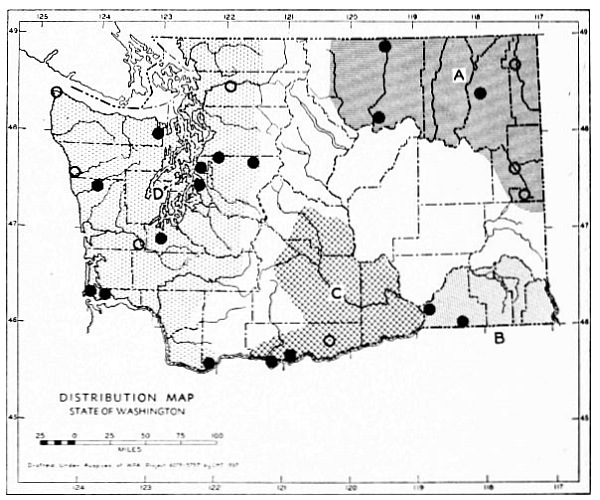
Fig. 65. Distribution of the striped skunk in Washington. A. Mephitis mephitis hudsonica. B. Mephitis mephitis major. C. Mephitis mephitis notata. D. Mephitis mephitis spissigrada.
Type.—Obtained at Fort Klamath, Klamath County, Oregon, by B. L. Cunningham on January 5, 1898; type in United States National Museum.
Racial characters.—Slightly larger than hudsonica with white stripes diverging on shoulders rather than neck.
Measurements.—A young male from 1 mile north of Burbank, Walla Walla County, measures: total length 474; length of tail 205; hind foot 68; ear 30; weight 815 grams.
Distribution.—Southeastern Washington, south of the Snake River and east of the Columbia River, occurring west to Burbank (M. V. Z.).
Mephitis mephitis notata (Howell)
Chincha occidentalis notata Howell, N. Amer. Fauna, 20:36, August 31, 1901.
Mephitis mephitis notata Hall, Carnegie Inst. Washington, Publ. 473:67, November 20, 1936.
Type.—Obtained at Trout Lake, south base of Mt. Adams, Klickitat County, Washington, by P. Schmid on March 22, 1897; type in United States National Museum.
Racial characters.—Similar to hudsonica but larger; stripes narrower, diverging anteriorly on neck or back of head; tail shorter, sometimes without long, white hairs.
Measurements.—Howell (1901:37) gives the average of 3 adult males from Trout Lake, Klickitat County, as: total length 633; length of tail 249; hind foot 76.
Distribution.—The Columbia River Valley of the southern Cascades from the Wind River east to the Snake River and the Yakima Valley area (trappers' reports).
Mephitis mephitis spissigrada Bangs
Mephitis spissigrada Bangs, Proc. Biol. Soc. Washington, 12:31, March 24, 1898.
Mephitis foetulenta Elliot, Field Columb. Mus., Publ. 32, zoöl. ser., 1:269, March, 1899 (type from Laguna, near Port Angeles, Clallam County, Washington).
Chincha occidentalis spissigrada Howell, N. Amer. Fauna, 20:35, August 31, 1901.
Mephitis mephitis spissigrada Hall, Carnegie Inst. Publ. 473:67, November 20, 1936.
Type.—Obtained at Sumas [prairie], British Columbia, by A. Brooks on September 30, 1895; type in Museum of Comparative Zoölogy.
Racial characters.—Similar to hudsonica but larger; stripes broader, usually diverging on shoulders; hairs of stripes often cream color or yellowish near base; end of tail usually white.
Measurements.—An adult male from 2-1/2 miles southeast of Chinook, Pacific County, measures: total length 578; length of tail 260; hind foot 30. A female from the same place and one from Renton, King County, average: 575; 233; 72; 27.
Distribution.—Lowlands of western Washington. This form rarely goes far into the mountains except along the valleys of the larger rivers. Marginal records are Skykomish (W. W. D.) and Washougal River (W. W. D.).
Taxidea taxus taxus (Schreber) Badger
Ursus taxus Schreber, Saugethiere, 3:520, 1778.
Taxidea taxus Rhoads, Amer. Nat., 28:524, June, 1894.
Taxidea taxus neglecta Taylor and Shaw, Occ. Pap. Chas. R. Conner Mus., no. 2:12, December, 1929.
Taxidea taxus taxus Hall, Carnegie Inst. Washington, Publ. 473:78, November 20, 1936.
Type.—None. Type locality probably southwest of Hudson Bay (Hall, 1936: 78).
Measurements.—Two males from northern Nevada measure, respectively: total length 780, 762; length of tail 113, 150; hind foot 136, 120; ear 55, 54; weight 15, 11 pounds.
Distribution.—Of general distribution over open country east of the Cascades. Marginal records are Wauconda (Taylor and Shaw, 1929: 12), Chelan (Taylor and Shaw, 1929: 13), Goldendale (W. W. D.) and "Divide above Trout Lake" (trapper's photograph).
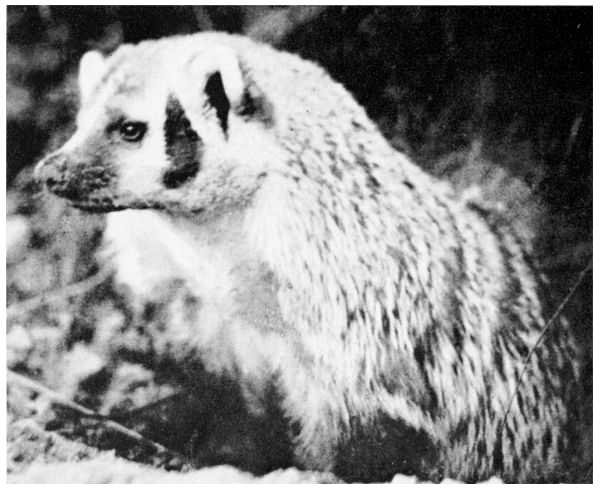
Fig. 66. Badger (Taxidea taxus taxus), tame animal in Seattle, Washington. January 29, 1938. Captured at Lakeside, Chelan County, and photographed at approximate age of ten months; subadult male. (Eloise Kuntz photo).
Description.—The badger is the size of a small dog, measuring up to 32 inches in total length and weighing up to 20 pounds. The body is heavy, powerful and remarkably flat and compressed. The tail and legs are short. The forelegs are thick and strong, armed with long heavy claws for digging. The ears are wide and low. The color of the upper parts is a grizzled yellowish brown, not unlike the color of the yellow-bellied marmot. The underparts are buffy, often with a white area on the abdomen. The legs, feet, top of head, ears, and small areas on the cheeks are blackish. Triangular areas about the eyes are buffy. A white stripe extends from the nose pad backwards, between the eyes, to the shoulders and serves as the best recognition mark.
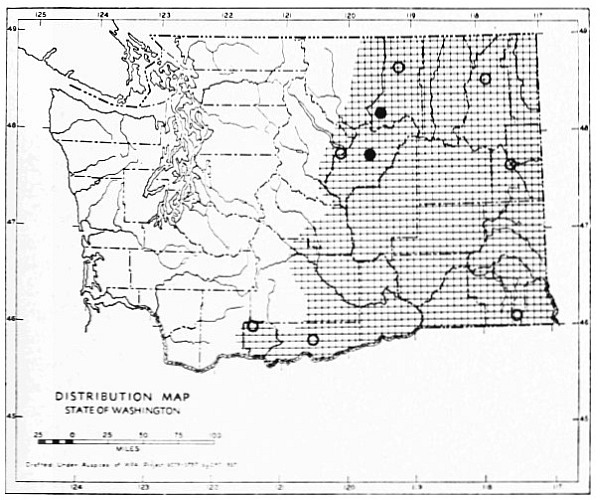
Fig. 67. Distribution of the badger, Taxidea taxus taxus, in Washington.
Badgers are found over central and western United States, Canada and northern Mexico. They are commonest on the plains and desert, principally because the burrowing mammals upon which they feed are most abundant there. The badger is a powerful and rapid digger, being able to overtake and capture mice, ground squirrels, and even pocket gophers. Perry (1939: 49-53) in her interesting accounts of the habits of a pet badger obtained at Lakeside, Chelan County, found the animal powerful enough to dig through a concrete floor! Evidence of badger's activities are usually seen at any ground squirrel colony in eastern Washington. This evidence consists of large holes in the ground. Rarely a horizontal tunnel begins at the depth of two to four feet and extends for an unknown distance. Earth removed in excavating is heaped beside one or both of the narrower sides of the surface opening.
In examining badger workings in ground squirrel colonies I have been impressed by the fact that most of the holes ended not more than four or five feet from the entrances—perhaps at the places where the ground squirrel nests were located, although it may be that the digging of the badger so terrified the squirrels that they dashed out in an attempt to escape past the badger, before he reached the nests. Kangaroo rats and pocket mice often attempt to escape by dashing past a person when he is excavating their burrows.
The power of the short, thick and slightly bowed foreleg of the badger is tremendous. The claws are stout and fully an inch long. The animal is able to break up and remove at a scoop, the baked, claylike loess of the Columbian Plateau. Clods of this same material are so firm that only by twisting and exerting considerable power was I able to break them. The soil a foot beneath the sunbaked crust is softer and more easily worked.
It is difficult to estimate the size of badger populations. In the arid land of eastern Washington their diggings may exist almost unchanged for many years. Interviews with professional trappers serve to indicate their range and numbers as follows: southeastern edge of the Cascades and Yakima Valley, not common, rarely straying up into mountains—average trapper's catch, only one to three a year; Okanogan Valley and northeastern edge of Cascades, not common—average trapper's catch is six to ten a year, occasional trappers catching as many as 35; Columbia, Kettle River, and other valleys in northeastern Washington, uncommon, a few records only; Columbian Plateau, fairly common—average professional trapper's yearly catch includes 10 to 20 badgers; southeastern Washington, now rare because of overtrapping, formerly common.
Trappers state that the badgers taken in northeastern Washington are usually classified as "hair badger" by fur buyers and bring only a dollar or two. The badgers of the eastern Cascades are "fur" badgers but do not bring top prices. The badgers of the Columbian Plateau bring the best prices. Seemingly some geographic variation exists among badgers in Washington. Those from the more humid areas of northeastern Washington and the eastern Cascades are darker and bring poorer prices than the paler "silver" badgers of the more open desert areas.
The principal food of the badger in Washington seems to be ground squirrels, Citellus washingtoni, townsendii, columbianus, or saturatus, depending on locality. Pocket mice, gophers, and other mammals are also eaten, as are grasshoppers, sword-tailed crickets, other insects, and birds.
Young of badgers number 3 to 5 and are born in late April, May, or early June.
Vulpes fulva cascadensis Merriam Red fox
Vulpes cascadensis Merriam, Proc. Washington Acad. Sci., 2:665, December 28, 1900.
Vulpes fulvus cascadensis Bailey, N. Amer. Fauna, 55:281, August 29, 1936.
Type.—Obtained at Trout Lake, Klickitat County, Washington, by P. Schmid on March 3, 1898; type in United States National Museum.
Racial characters.—Skull heavy, narrow; color yellowish.
Measurements.—A male from Crater Lake, Klamath County, Oregon, measures: total length 1113; length of tail 441; hind foot 180; ear 112; weight 9 pounds.
Distribution.—From Trout Lake northward, through the higher Cascades, to Loomis (Taylor and Shaw, 1929: 13).
Description.—The red fox of the Cascades is large and measures about 4 feet in total length, of which the tail comprises 15 inches. The body is slender and doglike; the legs long and slim; the tail thick and bushy, and the ears are large and erect. In the red phase the red fox of the Cascades is distinctly more yellowish than the red fox of the eastern United States; the head is especially yellow. The body has more red on the shoulder area than posteriorly, and is darkest on the rump. The tail is rather pale with a dusky, not black, area distally and a white tip. The ears are dusky. The lower legs and feet are black. The throat, chest and underparts are white. The "cross" phase, according to Cowan (1938: 202-206), is rather common in the Cascades. In cross foxes the color is darker, brown rather than yellowish, and the area from the nape of the neck back between the shoulders, including a bar across the shoulders, is deep blackish or grayish brown. In a pelt that is stretched out a cross is formed by the dark areas. The black and silver phases of the red fox are also said by Cowan to be relatively common in the Cascades, constituting 48 per cent of the population. Of 3,163 foxes traded at Fort Colville, in northeastern Washington, only 19 per cent were silver or cross. One fox, trapped in Okanogan County, is said by its captor to have been black above and straw colored beneath, with no white on the body.
Red foxes range from Alaska and northern Canada well southward into the United States. Related forms occur in Eurasia.
The red fox of Washington is an alpine animal, ranging at or slightly below timber-line. Here food is abundant in summer and fall but must be scarce in winter. In winter its habitat is difficult for man to reach and few persons penetrate the dangerous terrain where the fox lives. A few professional trappers regularly catch foxes in the Cascades but know little of their habits.
The feces of red foxes examined by Taylor and Shaw on Mt. Rainier contained remains of insects and berries (Taylor and Shaw, 1927: 43).
The red fox is rare in Washington; it lives in inaccessible territory and its fur is not especially valuable. The animal is of relatively little economic importance.
The brood den of a red fox found by Livezey and Evendan (1943: 500) near Corvallis, Oregon, was two-thirds of the way up a 300-foot hill in a strip of oaks (Quercus garryana). Well-packed trails led to an entrance concealed in poison oak (Rhus diversiloba). Remains of a turkey, 5 ground squirrels, and a jack rabbit were found near the den. The entrance was 8 inches wide and 15 inches high. The tunnel tapered to 5 inches in diameter and was 47 feet long. Seven pups, 4 males and 3 females, were found in the den.
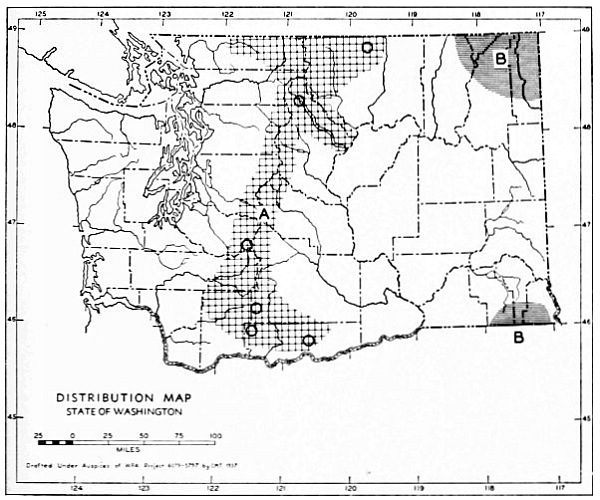
Fig. 68. Distribution of the red fox in Washington. A. Vulpes fulva cascadensis. B. Vulpes fulva macroura. (See p. 450.)
Canis latrans Say Coyote
Description.—The coyote is a large carnivore, about the size and general proportions of a small collie dog but with bushier tail, and more slender body. Adults measure about four feet in length, of which the tail comprises a fourth. Adult males weigh about 30 pounds. The color is somewhat variable, yellowish, buffy, or grayish. The muzzle and backs of the ears are more reddish, and the legs brown. The tail is yellowish gray with a dusky tip. The throat, chest and underparts are white.
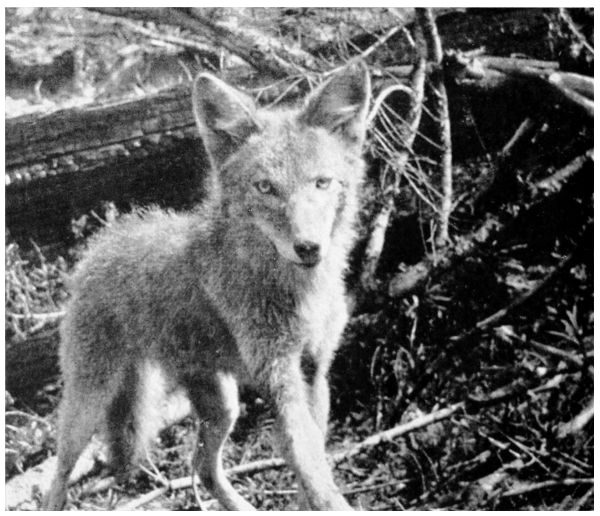
Fig. 69. Coyote (Canis latrans lestes), in trap, 5 miles southeast of McKenna, Washington, April 10, 1924. (Fish and Wildlife Service photo by G. R. Bach, No. 26901.)
The coyote ranges from Alaska southward, over western North America, to Central America.
At the present time the coyote ranges over almost all of Washington, except for the highest parts of the mountains and the dense forest areas of western Washington. According to available information it was not found about Puget Sound or the Olympic Peninsula until relatively recent times. Some old trappers are of the opinion that coyotes did not come into western Washington until the timber wolves became rare there. The scarcity of the timber wolves seems to coincide with settlement, clearing and lumbering. Probably coyotes did not become common in western Washington until lumbering provided extensive clearings and open areas more suitable to them than forest. Certainly coyotes and wolves existed together in eastern Washington.
It is difficult to determine whether coyotes were completely absent from western Washington in the early days or simply scarce. The glacial prairies of the Puget Sound area provide suitable habitat for coyotes and coyotes are abundant there at the present time. If coyotes were present at all in western Washington in the early days it is reasonable to suppose that they would have been common on the prairies. Yet I was told by an old trapper who had lived near Scotts Prairie, Mason County, for many years, that he had never seen or heard coyotes there until about 1910. Although a coyote might be mistaken for a small wolf, the call, as this trapper pointed out, is distinctive.
The principal habitat requirement of the coyote seems to be extensive areas of open country. This it finds in the desert area of the Columbian Plateau, the open forests of northeastern Washington and the eastern Cascades, and in the extensive timbered and burned-over lands in western Washington. In summer coyotes range well up into the Hudsonian Life-zone of the Cascade and Olympic mountains. Their principal range is lower, in the Transition and Upper Sonoran life-zones.
The coyotes are both nocturnal and diurnal. In the vicinity of human habitations they are most active at night. In the heat of the day they take refuge in brushy areas or small gullies. Many actions of the coyote are doglike, and were it not for the large, round, bushy tail, a coyote might easily be mistaken for a dog. The tail is carried in a drooped position with the tip bowed slightly backwards. When badly frightened and running at full speed the tail is stretched out straight behind. The ordinary gait is a purposeful trot with the head held erect, the ears pricked up, and the legs moving smoothly and effortlessly. Near Moses Lake, Grant County, I watched a coyote trot along the side of one of a series of small sand dunes. At the report of the small shotgun fired at it, the coyote's dignified trot changed to terrified bounds, its feet dug into the dune, throwing showers of sand into the air, as it crossed several successive dunes in full flight before turning to take advantage of the shelter of a draw between two dunes. A coyote chased by an automobile attained a speed of 43 miles an hour for a short distance (Zimmerman, 1943: 400).
I have not watched a coyote stalk game, but as described to me it creeps up to within a few yards of its prey and catches it with a sudden dash. In hunting a jack rabbit, the coyote is said to pursue it, taking advantage of short cuts, until close enough to seize it.
Better known than the coyote itself is its howl—several doglike barks, each successive one of a series shorter and higher pitched, the last one ending in a long, drawn-out howl. In the winter of 1936 the coyotes near Cottage Lake, King County, were especially vociferous. They ordinarily began to howl about 9 p.m., but could be induced to howl earlier by imitating their call. Their howling was a signal for all nearby ranchers' dogs to howl in reply. In the desert areas of eastern Washington I heard coyotes most often just at dusk or at dawn.
The coyote is principally carnivorous, feeding on any mammals and birds easy to kill. It willingly eats carrion, even when much decayed. Large insects such as grasshoppers and crickets are eaten when they are abundant and easily caught. Fruit and berries are eaten when available.
Sperry (1941) reported on the analysis of the contents of 8,339 coyote stomachs from various places in the United States, 1,186 of the stomachs being from Washington. The following information is from his report on all of the 8,339 stomachs: rabbits formed one-third of the food; Microtus was found in 7 per cent of the stomachs; Peromyscus in 6 per cent; Neotoma in 4 per cent. Reithrodontomys were found in 53 of the 8,339 stomachs and in insignificant numbers. Onychomys occurred in 11 of the 8,339 stomachs; Clethrionomys in 8. Ondatra occurred in 8 of the 8,339. Two muskrats were in stomachs obtained from Washington. Citellus (exclusive of beecheyi, lateralis, and saturatus) were found in 4 per cent and were locally important; Citellus beecheyi occurred in 84 stomachs, including 1 from Washington; Citellus lateralis and saturatus occurred in 50 stomachs, including 5 from Washington. Marmota were found in 1 per cent of the stomachs. They were included in stomachs from Washington but the number was not reported. Tamias (= Eutamias) were found in 43 stomachs from western United States and were present in 1 per cent of the 1,186 stomachs from Washington. Sciurus and Tamiasciurus occurred in 33 stomachs. Included were 3 Tamiasciurus douglasii, a Tamiasciurus hudsonicus, and a Sciurus griseus from Washington. Glaucomys occurred in 6 Washington-taken coyotes, of a total of 11 from the entire United States. Perognathus occurred in 3 per cent of the stomachs, and 274 individuals were represented. They were found in 10 per cent of the 1,186 Washington stomachs. Thomomys occurred in 4 per cent of the stomachs examined and in 7 per cent of the stomachs from Washington. Erethizon appeared in 2 per cent of the stomachs (135 records), including some from Washington. Aplodonta occurred in only 11 stomachs, all taken in Washington. Locally, it is concluded, mountain beavers are important coyote food. House mice occurred in but five stomachs, including 2 from Washington. Zapus did not occur in coyote stomachs from Washington. Domestic sheep and goats formed 7 per cent of the food of Washington coyotes. Calves occurred in 3 stomachs of coyotes from Washington. Pigs occurred in 8. Deer formed 3 per cent, by volume, of coyote food in Washington. A part of the stock and deer reported was doubtless carrion.