ACCOUNTS OF SPECIES AND SUBSPECIES
Reading edition
Didelphis virginiana virginiana Kerr Opossum
Didelphis virginiana Kerr. Anim. Kingd., p. 193, 1792.
Type locality.—Virginia
Description.—Slightly smaller than a house cat; body in older animals heavy and fat; tail long, naked, scaled and prehensile. Ears large, naked and black with white tips; muzzle elongate and pointed; color of fur variable; overhair usually white and underfur white tipped with black; guard hairs long and coarse but underfur soft and dense; forefoot with opposable thumb; females with abdominal pouch.
Remarks.—The opossum has been introduced from the eastern United States into California and Oregon and has become well established in those states. Recent records from Clear Lake, Skagit County, and South Bend, Pacific County, indicate that the opossum is now resident in Washington and it may be expected to increase and spread (Scheffer, 1943). The animals may also enter the area about Walla Walla from Oregon. The source of the opossums which have appeared in Washington is not yet known.
Of this animal, Dr. Carl Hartman (1923: 347) has written:
"In the popular mind, the generation of no animal is so shrouded in mystery as that of the opossum. Throughout the country, among both whites and negroes, deeply rooted tradition has it that the opossum copulates through the nose and that the female blows the fruit of conception into the pouch. Other myths relating to details of the reproductive process in this species are current among the people.
"The growth of such legends need not surprise one, however, for the early birth of the embryos and the use of the pouch as an incubator certainly challenge the imagination. These phenomena attract the attention because they are unique, differing from the familiar method of rearing the young obtaining among the higher mammals, including man. Familiarity breeds contempt; the ordinary ceases to be marvelous. Thus on account of its rareness and its 'different' character the opossum, our only marsupial, figures in the folklore to a prominent degree."
Neurotrichus gibbsii
Gibbs shrew-mole
Description.—The shrew-mole is tiny, possessing a head and body 2-1/2 to 3 inches long and a tail about 1-1/2 inches in length. The body is relatively stout but is less cylindrical than that of Scapanus. The eyes are nearly buried in the fur. The nose is long and pointed. The legs are short and the forefeet wide and powerful. The tail is thick, constricted at the base and clothed with short, stiff bristles. The fur is short and posteriorly directed. In color the shrew-mole is dark slate, almost black.
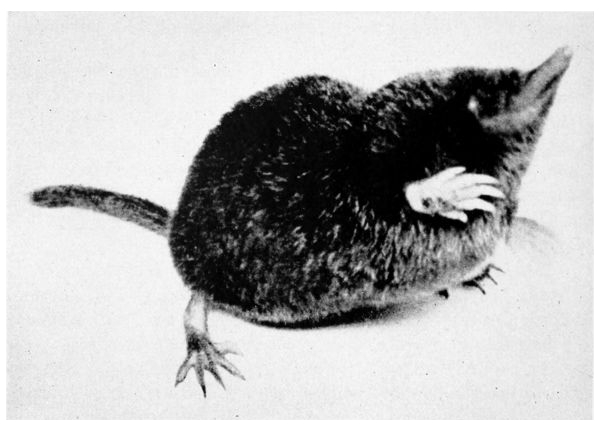
Fig. 21. Gibbs shrew-mole (Neurotrichus gibbsii minor), female in captivity; Seattle, Washington, September 12, 1939. (Fish and Wildlife Service photo by Victor B. Scheffer, No. 719.)
Remarks.—Shrew-moles inhabit moist habitats from sea level to 8,000 feet. They are burrowing mammals and prefer to live in soft earth, free of sod. In the lowlands of western Washington, shrew-moles are most abundant in damp, shady ravines where the vegetation includes deciduous trees and dense underbrush with but little grass. In the mountains, shrew-moles are usually found near streams or rock slides, where the larger annuals grow densely on soil that is deep, soft, and free of turf. Vertically they range from the Humid Transition Life-zone through the Canadian, and well into the Hudsonian Life-zone.
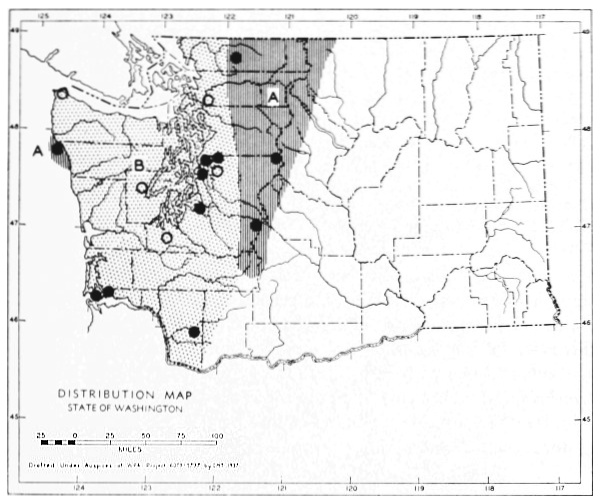
Fig. 22. Distribution of the Gibbs shrew-mole in Washington. A. Neurotrichus gibbsii gibbsii. B. Neurotrichus gibbsii minor.
Shrew-moles are both diurnal and nocturnal. They rest or sleep periodically, the length of their rest or sleep being longer when much food is eaten, and the intervals between their periods of rest or sleep is longer when less food is eaten. Owls and snakes appear to be their principal enemies. Predatory mammals eat some shrew-moles, and probably kill many that they do not eat. Shrew-moles are completely blind, and their long, prehensile nose guides all their activity. Their ordinary movements on the surface of the ground are slow and cautious. When frightened they break into a scuttling rush which ends beneath a leaf or bit of bark where the animal becomes motionless. Shrew-moles, on the surface of the ground, make considerable noise. They construct molelike burrows, but these are not as extensive or complicated as those of moles. The shrew-mole hunts for food in shallow trenches that it makes just under the layer of dead leaves and vegetable debris that covers the ground in their habitat. The food of the shrew-moles includes earthworms, isopods, insect larvae, soft-bodied insects, and other animal matter. Some vegetable matter is eaten.
Breeding takes place at all seasons of the year, save perhaps in December and January. Embryos vary from one to four. The nest of a shrew-mole at Seattle, King County, consisted of a handful of damp leaves in a cavity of a rotten, punky, alder stump. The nest contained four half-grown young.
Neurotrichus gibbsii gibbsii (Baird)
Urotrichus gibbsii Baird, Mamm. N. Amer., p. 76, 1857.
Neurotrichus [sic] gibbsii Günther, Proc. Zool. Soc. London, pl. 42, 1880.
Neurotrichus Gibbsii True, Proc. U. S. Nat. Mus., 7 (1884):607, 1885.
Neurotrichus gibbsii Bryant, Zoe. 1:359, February, 1891.
Neurotrichus gibbsii gibbsii Miller, U. S. Nat. Mus. Bull., 79:11, December 31, 1912.
Type.—Obtained at Naches Pass, 4,500 ft., Pierce County, Washington, by G. Gibbs on July 15, 1854 (see Dalquest and Burgner, 1941); type in United States National Museum.
Racial characters.—Size relatively large; tail relatively long; foreclaws straight on ventral surface.
Measurements.—Two females from Tye, 4,000 ft., Stevens Pass, King County, average: total length, 121.5; length of tail, 45; length of hind foot, 18.
Distribution.—The Cascade Mountains, from British Columbia south, and Destruction Island, Jefferson County. Records of occurrence are Baker Lake (J. M. E.), Tye (M. V. Z.), and Mount Rainier (Mount Rainier Ntl. Park Mus.)
Remarks.—Shrew-moles are present on Destruction Island, a small island in the Pacific off the coast of Jefferson County. These moles are large, and are like gibbsii. It is thought, however, that this resemblance is due to convergent evolution rather than a once-continuous range with gibbsii. It is significant that a shrew (Sorex trowbridgii destructioni), the only other native land mammal on the island, differs from its mainland counterpart in much the same way as does Neurotrichus g. gibbsii from Neurotrichus g. minor.
Neurotrichus gibbsii minor Dalquest and Burgner
Neurotrichus gibbsii minor Dalquest and Burgner, Murrelet, 22:12, April 30, 1941.
Type.—Obtained on the University of Washington Campus, Seattle, King County, Washington, by W. W. Dalquest on May 19, 1940; type in the Museum of Vertebrate Zoölogy.
Racial characters.—Size small; tail short; foreclaws light and weak as compared to those of gibbsii, with ventral surfaces curved.
Measurements.—Eighty-five specimens (males and females) from Seattle, King County, average: total length, 107.0; length of tail, 35.3; length of hind foot, 15.0.
Distribution.—The lowlands of western Washington. Marginal records are: Mt. Vernon (Jackson, 1915: 97), Cottage Lake (W.W.D.) and Yacolt (M. V.Z.).
Genus Scapanus Pomel Moles
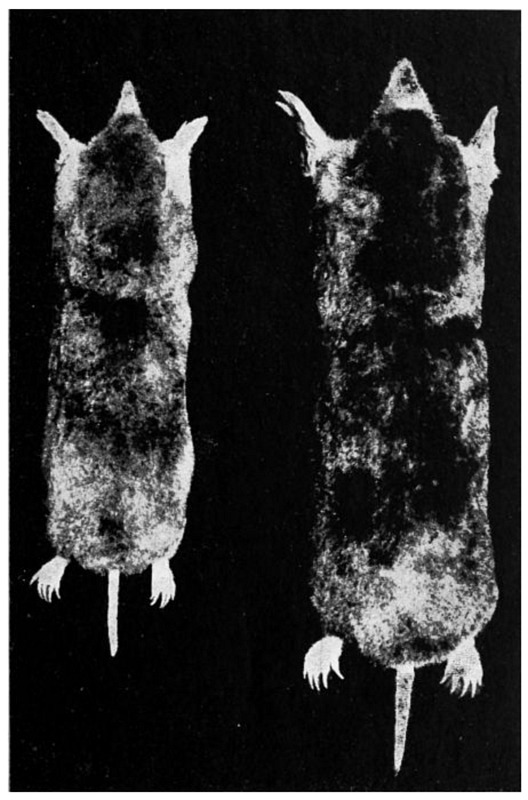
Fig. 23. Coast mole (Scapanus orarius orarius) left and Townsend mole (Scapanus townsendii) right; Puyallup. Washington, May, 1914. (Fish and Wildlife Service photo by T. H. Scheffer, No. B-18637.)
Moles are of stocky build and have cylindrical, rounded bodies. The eyes are tiny, nearly concealed in the fur. They have no external ears. The legs are short; the forefeet wide, spadelike, and armed with powerful claws. The fur is erect, not posteriorly directed. The color of the fur is deep bluish or brownish slate. The short, nearly naked tail is pale pink or whitish. Moles of this genus are found only along the Pacific Coast of North America from southern Canada south into Baja California.
Scapanus townsendii (Bachman) Townsend mole
Scalops townsendii Bachman. Jour. Acad. Nat. Sci. Philadelphia, 8 (pt. 1):58, 1839.
Scapanus tow[n]sendii Pomel. Arch. Sci. Phys. Nat., Geneva, 9 (ser. 4):247, 1848.
Scapanus Townsendii True. Proc. U. S. Nat. Mus., 7 (1881):607, 1885.
Type.—Probably obtained at Fort Vancouver. Clark County. Washington, by J. K. Townsend. A cotype was obtained on May 9. 1835; type in Academy of Natural Sciences of Philadelphia.
Measurements.—Three males and 6 females from southwestern Washington average, respectively: total length 221, 214; length of tail 51, 46; hind foot 28.3, 26; weight 147, 117 grams.
Distribution.—The lowlands of western Washington. Marginal occurrences are: Sauk (Jackson. 1915: 61); Skykomish (Jackson, 1915: 61) and Yacolt (M.V.Z.).
Remarks.—Scapanus townsendii occurs only in a narrow belt extending from southwestern British Columbia to northwestern California. It seems to prefer a generally damper habitat than the smaller-sized coast mole, although both species are sometimes found in the same locality. The larger mole is abundant in the meadows on the flood plains of rivers at low elevations, and on the glacial outwash prairies. It is often numerous in the fir forests, although its workings and mounds are less conspicuous there. The bodies of nine drowned individuals were found in a well by an old cabin in dense fir forest near Duvall, King County. Townsend moles occasionally occur in the Canadian Life-zone, as at Staircase on the north side of Lake Cushman in Mason County where workings were observed, but most records are from the Humid division of the Transition Life-zone.
The Townsend mole is mainly nocturnal. If ridges of its runways are crushed down, they usually remain so throughout the day and are rebuilt the following night. Only about ten per cent of the ridges that were crushed were rebuilt in the daytime, and most of these were repaired in the early morning. The species is almost completely subterranean. Some individuals are crushed on highways by cars, showing that these moles occasionally travel on the surface of the ground.
Townsend moles throw up numerous mounds, each usually containing about a cubic foot of earth. The mounds commonly are built just about as far apart as a man can step. The general direction as well as the twists and turns of a mole's burrow can usually be determined from the mounds. Townsend moles also construct ridges on the surface of the ground by pushing up sod in building a tunnel just below the grass roots. Smaller ridges are less commonly made by coast moles. More extensive tunnels, constructed deeper in the earth, serve as living quarters.
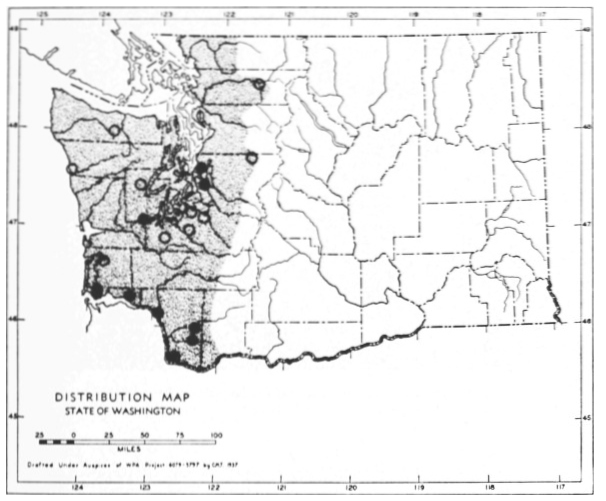
Fig. 24. Distribution of the Townsend mole, Scapanus townsendii, in Washington.
According to Wight (1928: 24), Scheffer (1922: 11) and Moore (1933: 39), the food of this large mole includes earthworms and ground-inhabiting insects, insect larvae, spiders, centipedes, flesh, and small amounts of soft vegetation. Scheffer (1922: 10) found that the large mole breeds in February and produces from two to four young at a litter, with an average of three.
Scapanus orarius Coast mole
Description.—The coast mole is almost identical with the larger mole in form of body but is smaller. Head and body are about 5-1/4 and tail about 1-1/2 inches in length.
The coast mole occupies all of the territory inhabited by the Townsend mole and ranges slightly farther northward, southward and eastward. However it does not range east of the boundaries of the three Pacific Coast states or British Columbia.
The mounds and workings of the coast mole are smaller than those of the Townsend mole and consequently are less noticed. It seems less prone to make numerous mounds, a pace apart, than the larger mole, and burrows tend to extend deeper in the ground. Upthrust ridges are less commonly built by orarius than by townsendii.
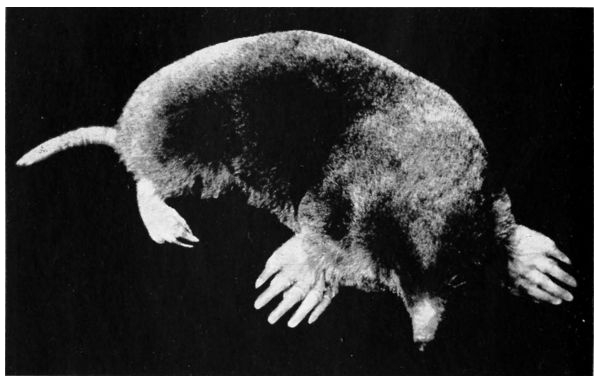
Fig. 25. Coast mole (Scapanus orarius orarius). Freshly killed; Seattle, Washington, June 9, 1938. (Fish and Wildlife Service photo by Victor B. Scheffer, No. 64.)
Jackson (1915: 62) mentions the possibility of ecologic differences between orarius and townsendii. There are some differences in habitat and habits. The coast mole seems to live deeper in the ground, prefers better drained soil, and is less colonial than the Townsend mole. These are average differences, however, and the two species commonly occur together. Another difference is that the larger mole rarely enters the dense deciduous woods, such as the brush-grown alder and dogwood jungles along the stream valleys. I have taken the coast mole in such localities, and often have found their workings there. The surface of a nearby meadow may be dotted with mounds of both species, but the larger mole seems not to enter ground that is thickly grown with brush. The coast mole ascends to greater altitudes in the Cascade Mountains than does the Townsend mole.
Like the larger mole the coast mole feeds principally on earthworms and insects (Moore, 1933: 38). On September 29, 1939, in a ravine at Seattle, in two baited traps set six inches apart, a creeping mouse (Microtus oregoni) and a coast mole were found. The mouse had come to the bait and been caught. The mole had seemingly emerged from the ground through a tunnel a foot away and had been attracted to the body of the mouse. It had eaten an area a half inch in diameter and three-quarters of an inch deep into the body of the mouse just behind the shoulder, when in shifting its position it had become caught in the unsprung trap behind it. When found the mole lay dead with its nose inside the body of the mouse and its back broken. This is the only case known to me of a coast mole appearing voluntarily on the surface of the ground. Never have I found coast moles crushed on the highway; several Townsend moles so killed have been found.
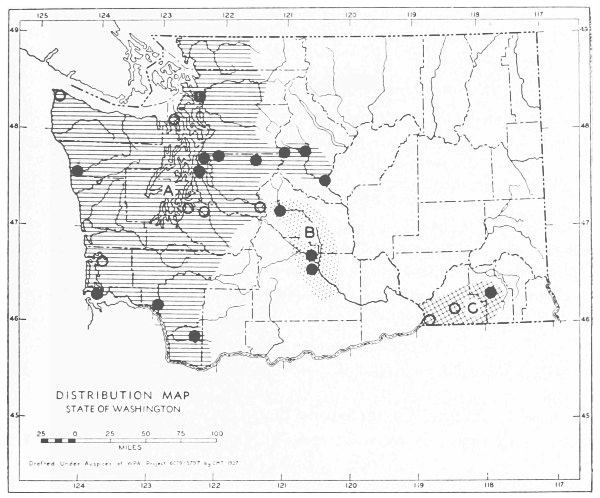
Fig. 26. Distribution of the coast mole in Washington. A. Scapanus orarius orarius. B. Scapanus orarius yakimensis. C. Scapanus orarius schefferi.
The coast mole seems to breed very early in the spring. Males with swollen testes are found late in January. The young usually number four and are born in late March or early April. The breeding season seems to be the same as that of townsendii but the number of young to a litter may average slightly greater.
Scapanus orarius orarius True
Scapanus orarius True. Proc. U. S. Nat. Mus., 19:52, December 21, 1896.
Scapanus orarius orarius Jackson, N. Amer. Fauna, 38:61, September 30, 1915.
Type.—Obtained at Shoalwater (= Willapa) Bay, Pacific County, Washington, by J. G. Cooper on August 30, 1855; type in United States National Museum.
Racial Characters.—Color dark bluish; frontal region of skull not inflated.
Measurements.—Eight males and two females from Seattle, King County, average, respectively: total length 159, 155; length of tail 33, 31; hind foot 20.7, 20.5; weight 58.5, 55.8.
Distribution.—Western Washington. Marginal occurrences are: Skykomish (B.S.C.), Merritt (B.S.C.), Wenatchee (B.S.C.), Lester (Jackson, 1915: 64) and Yacolt (M.V.Z.).
Scapanus orarius yakimensis Dalquest and Scheffer
Scapanus orarius yakimensis Dalquest and Scheffer, Murrelet, 25:27, September 19, 1944.
Type.—Obtained 3/4 mile north of Union Gap, Yakima County, Washington, by J. A. Gray, Jr., on July 3, 1941; type in Museum of Vertebrate Zoölogy.
Racial Characters.—Color pale, grayish; skull narrow with inflated frontal region.
Measurements.—Six specimens (males and females) from Selah, Yakima County, average: total length 164; length of tail 37; length of hind foot 21.5. The type specimen weighed 58 grams.
Distribution.—The Yakima Valley area; recorded from the type locality northwestward to Easton (B.S.C.).
Scapanus orarius schefferi Jackson
Scapanus orarius schefferi Jackson, N. Amer. Fauna, 38:63, September 30, 1915.
Type.—Obtained at Walla Walla, Walla Walla County, Washington, by T. H. Scheffer on August 8, 1914; type in United States National Museum.
Racial Characters.—Large size; pale color; large, wide skull with inflated frontal area.
Measurements.—Six topotypes average: total length 159; length of tail 35; hind foot 21.5.
Distribution.—Southeastern Washington; recorded from Fort Walla Walla (Jackson, 1915: 64), Walla Walla (Jackson, 1915: 64) and Dayton (M.V.Z.).
Genus Sorex Linnaeus Long-tailed shrews
Shrews have tiny eyes, almost concealed in the fur. The body is slim; the nose elongate and pointed. The legs are short and the feet small and weak. The fur is short but soft and posteriorly directed. The cinereous shrew, for example, is about 4 inches in length, of which the tail comprises 1-3/4 inches. The upper parts are dark grayish brown and the underparts dull gray.
Shrews of the genus Sorex are cosmopolitan in distribution. In North America they range from the arctic south to Central America. Three subgenera are recognized by Jackson (1928: 27), all three of which are represented in the state of Washington. The twelve subspecies present occupy numerous habitats, and their ranges include almost all of the state.
Jackson pointed out (1928: 1) that "No other group of American mammals having a wide distribution, and in many localities an abundance of individuals, is so little known to the nonprofessional mammalogist as the long-tailed shrews." In Washington, especially in the coastal area of western Washington, shrews are widespread and abundant in many habitats. In some places they are the most common mammal present. In spite of this their presence is often unsuspected by persons that are otherwise alert to the animal life around them. This is even more surprising when one takes into account the facts that long-tailed shrews are diurnal as well as nocturnal and are less apt to detect the presence of man than are most other species of mammals.
An important factor making long-tailed shrews inconspicuous is their small size, and contributing factors include their rapid movements and dull colors. On several occasions the writer, after seeing a long-tailed shrew vanish soundlessly under a log or into a patch of dead leaves, was left wondering if one actually had been seen or if instead his imagination had conjured up an animal from a dust mote or wind-blown leaf.
The environment of the long-tailed shrews, except for the water shrews, is the zone at the very surface of the earth, just beneath the layer of moss, grass, dead leaves, and decaying vegetation. The removal of the covering vegetative layer reveals a maze of tiny tunnels, the branchings and complexities of which are infinite. Tiny traps baited with oats or meat and set in these runways catch the long-tailed shrews that inhabit them.
The food of long-tailed shrews is varied. It is principally soft-bodied insects, insect pupae, and earthworms. At times a considerable quantity of soft vegetation and some seeds are eaten. Recent studies (Moore, 1940: 1942) have shown that by destroying seeds some shrews may adversely affect the reforestation of some coniferous trees. Shrews readily eat meat, and often destroy the small mammals, including other shrews, taken in the mammal collector's traps.
Hamilton (1940: 485) found that in one species of long-tailed shrew in the United States individuals rarely lived more than one year. This seems not to be true of at least some of the species found in Washington.
Parasites, internal or external, are not commonly found on long-tailed shrews. They are regularly eaten by owls and snakes, but most carnivorous mammals, though they readily kill them, rarely eat them.
Sorex cinereus Kerr Cinereous shrew
The cinereous shrew ranges over most of Alaska, Canada and the northern half of the United States. A number of subspecies have been described, of which two have been reported from Washington. The cinereous shrew is of medium size and difficult to distinguish from the dusky and wandering shrews, especially in eastern Washington, without studying the skulls. In cinereus the fourth unicuspid tooth is smaller than the third; in vagrans and obscurus it is larger. The relatively narrow rostrum of cinereus also serves to separate it from the other two species.
The cinereous shrew seems to be less restricted to the vicinity of streams and marshes than Sorex vagrans, resembling Sorex obscurus and Sorex trowbridgii in this respect. In Washington it seems to be rare and has not been taken by the writer. Published records for Sorex c. cinereus indicate that this race is, in Washington, confined to mountainous areas. The coastal race, streatori, seems to be confined to the humid area.
Sorex cinereus cinereus Kerr
Sorex arcticus cinereus Kerr. Anim. Kingd., p. 206, 1792.
Sorex cinereus cinereus Jackson. Jour. Mamm., 6: 56, February 9, 1925.
Type.—None. Name based on the account of a shrew seen at Fort Severn, Canada, by J. R. Forster in 1772.
Racial characters.—Small size and pale color.
Measurements.—Seven males and 8 females from Indian Point Lake, British Columbia, average, respectively: total length 99, 95; length of tail 43.5, 42.2; hind foot 12.7, 12.3.
Distribution.—Northeastern Washington (Metaline and Loon Lake, Jackson, 1928: 49) and the Cascades from Whatcom Pass (Jackson, 1928: 55) southward to Conrad Meadows (Jackson, 1928: 49). There is a specimen in the collection of the California Academy of Sciences, from Mt. Rainier.
Remarks.—This is the most wide-ranging subspecies of shrew, being recorded from Alaska, 10 Canadian provinces and 26 states (Jackson, 1928: 46-50). In the more northern and eastern parts of its range it is sometimes the commonest shrew.
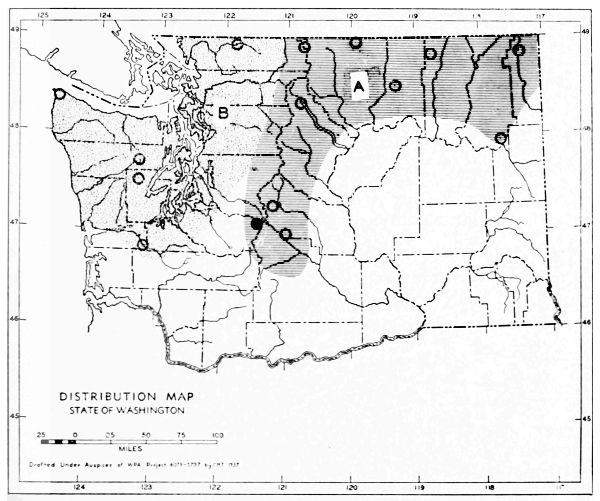
Fig. 27. Distribution of the cinereous shrew in Washington. A. Sorex cinereus cinereus. B. Sorex cinereus streatori.
Sorex cinereus streatori Merriam
Sorex personatus streatori Merriam. N. Amer. Fauna, 10:62, December 31. 1895.
Sorex cinereus streatori Jackson. Jour. Mamm., 6:56. February 9, 1925.
Type.—Obtained at Yakutat, Alaska, by C. P. Streator on July 9, 1895; type in the United States National Museum.
Racial characters.—Larger and darker than Sorex cinereus cinereus.
Measurements.—Five females from Alta Lake, British Columbia, average: total length 103; length of tail 45; hind foot 12.5.
Distribution.—The western part of the northern Cascades (Glacier, Jackson, 1928: 55) and the Olympic Peninsula (Neah Bay south to Cedarville, Jackson, 1928: 55).
Remarks.—This shrew seems to occupy the same range as Sorex obscurus setosus but is rare where obscurus is common.
Sorex merriami merriami Dobson Merriam shrew
Sorex merriami Dobson. Monogr. Insectivora, pt. 3, fasc. 1, pl. 23, fig. 6, May, 1890.
Sorex merriami merriami Benson and Bond. Jour. Mamm., 20: 348, August 14, 1939.
Type.—Obtained on Little Bighorn River, about a mile and a half above Fort Custer, Crow Indian Reservation, Montana, by Charles E. Bendire on December 26, 1884; type in United States National Museum.
Measurements.—Of type: total length 90; length of tail 35; hind foot 11.5 (after Jackson, 1928: 80).
Distribution.—A single specimen of this rare shrew is known from Washington. Jackson (1928: 81) states that it "was collected by George G. Cantwell, November 18, 1919, at the entrance to an old badger digging on top of a 'high bunch grass hill' at Starbuck (altitude 645 feet), Columbia County, Wash."
Description.—Similar to Sorex cinereus but upper parts pale grayish and underparts white.
The Merriam shrew has been recorded from but a few localities in the western United States. It is one of the rarest of the small mammals known to occur in North America. All the known specimens have been found in desert areas.
Sorex trowbridgii Baird Trowbridge shrew
Description.—The Trowbridge shrew closely resembles the cinereous shrew in body form but possesses a longer tail. The head and body of adults measure about 2-1/4 inches and the tail about 2 inches. The Trowbridge shrew may be separated from all other small shrews that occur in Washington by its dark bluish upper parts and bluish or slaty underparts. The tail is distinctly bicolor.
Trowbridge shrews occur from southern British Columbia south to central California. Their distribution, to the south, is more extensive than that of many members of the Pacific Coastal Fauna. They are forest animals, ranging widely over the dry ground beneath the fir forest, where they are usually the only shrews present. They are abundant in ravines and in some swampy woods when other shrews are absent, but they avoid open meadows or marshes. Vertically, they occur from the humid division of the Transition Life-zone to the Hudsonian Life-zone.
These little shrews do not live well in captivity and I have learned relatively little concerning their habits from live specimens. They seem to be slower-moving and less aggressive than the wandering shrew. Population studies showed that the Trowbridge shrew is unable to compete with the wandering shrew in ravine habitats (Dalquest, 1941A: 173). The principal food of the Trowbridge shrew includes soft-bodied insects and insect pupae.
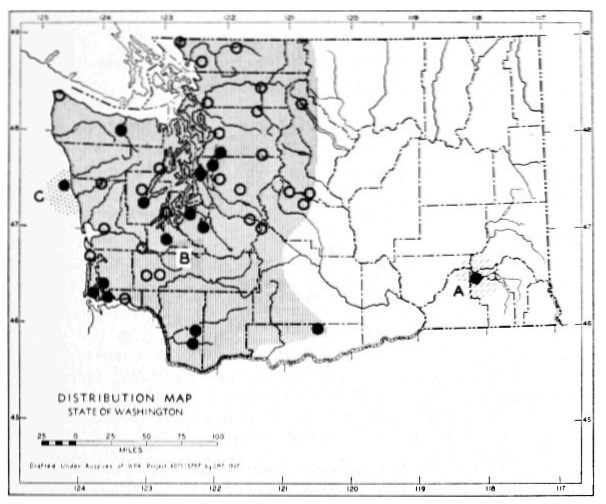
Fig. 28. Distribution of the Merriam and Trowbridge shrews in Washington. A. Sorex merriami merriami. B. Sorex trowbridgii trowbridgii. C. Sorex trowbridgii destructioni.
Moore (1942) has shown that shrews eat the seeds of the Douglas fir and may be a serious check on the reproduction of this important tree. The Trowbridge shrew is the most abundant shrew in the fir forests and probably constitutes the principal shrew that might be classed as a pest.
A specimen containing 4 embryos was taken near Shelton, Mason County, on April 23, 1937. Males with enlarged, greenish testes were taken in April of 1938, 1939 and 1940. Specimens obtained in other months showed no indications of breeding.
Sorex trowbridgii trowbridgii Baird
Sorex trowbridgii Baird, Rept. Pacific R. R. Survey, 8 (pt. 1):13, 1857.
Type.—Two cotypes were obtained at Astoria, Clatsop County, Oregon. The skin of one (the lectotype) was entered in the U. S. National Museum catalogue in July, 1855, and the skull in January, 1857. The other was obtained by J. Wayne on July 10, 1855.
Racial characters.—Small size and narrow skull.
Measurements.—The average measurements of 38 adults from King County, Washington, are: total length 115.3; length of tail 54.4; hind foot 13.4.
Distribution.—Forested areas from the Pacific Coast eastward through the Cascades to Stehekin (Jackson, 1928: 96), 2 mi. S. Blewitt Pass (Jackson, 1928: 96) and Satus Pass (M.V.Z.).
Sorex trowbridgii destructioni Scheffer and Dalquest
Sorex trowbridgii destructioni Scheffer and Dalquest, Jour. Mamm., 23:334, August 13, 1942.
Type.—Obtained on Destruction Island, Jefferson County, Washington, by V. B. Scheffer on April 22, 1941; type in United States National Museum.
Racial characters.—Large size and wide skull.
Measurements.—Thirty topotypes average: total length 122.5; length of tail 56.7; hind foot 14.3; weight 7.5 grams.
Distribution.—Known only from Destruction Island, 35 acres in area, lying 4 miles off the Washington Coast.
Sorex vagrans Baird Wandering shrew
Description.—This species closely resembles the cinereous shrew in body form. Its head and body measure about 2-1/4 inches; the tail slightly less than 2 inches. In summer the upper parts are reddish brown and the underparts gray tinged with brownish. In winter the upper parts are more dusky.
Several races of the wandering shrew range over western North America from southwestern British Columbia south to southern Mexico. Two races occur in the state of Washington.
Marshy areas and damp places are the habitat of the wandering shrew. Cattail and tule marshes, sphagnum bogs, and meadows are favored. They frequent streams through forests but rarely are taken in places away from water. On some of the San Juan Islands, wandering shrews were found along the beaches where they were feeding on the amphipods that live in the dead seaweed and litter at the high tide line. In a favorable habitat, wandering shrews may be the most abundant mammal present. Specimens are occasionally taken in 90 per cent or more of a mammal collector's traps.
The preference of the wandering shrew for damp areas makes it more or less independent of life-zones, for marshy areas, whether in Transition, Canadian, or Upper Sonoran life-zones, present comparable ecological conditions.
Broadbrooks (1939: 65) found that captives taken at Seattle ate rolled oats, apple, fresh or cooked meat, sow bugs, centipedes, earthworms, frogs (Hyla regilla), a salamander (Plethodon vehiculum), and small, black slugs (Arean arean). Wandering shrews proved incapable of destroying snails (Helisoma occidentalis) and large slugs. The captive shrews kept by Broadbrooks ate an average of 1.3 times their own weight in food each day.
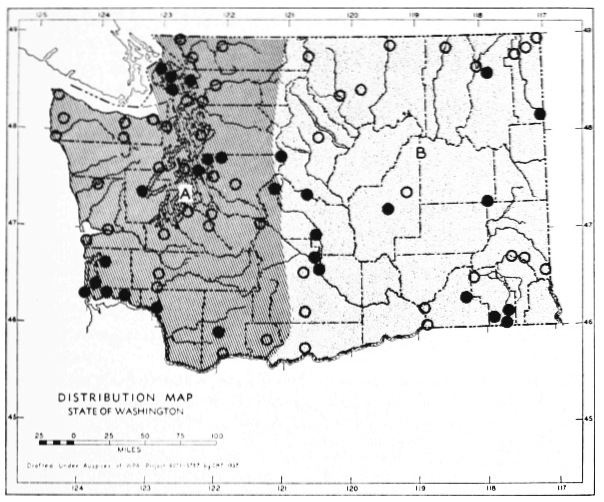
Fig. 29. Distribution of the wandering shrew in Washington. A. Sorex vagrans vagrans. B. Sorex vagrans monticola.
The wandering shrew changes from winter to summer pelage in a few days, seemingly in the second week of October (Dalquest, 1944: 147). The spring molt occurs rapidly but perhaps at a less regular date. Rarely a midsummer molt occurs.
The earliest evidence of breeding in a wandering shrew was discovered on January 27, 1937. Most adult females taken in February, March, April and May were pregnant. Embryos were less often found in summer and fall, but one pregnant female was taken in November. Embryos varied in number from 3 to 8 with an average of six.
Sorex vagrans vagrans Baird
Sorex vagrans Baird, Rept. Pacific R. R. Survey, 8 (pt. 1):15, 1857.
Sorex suckleyi Baird, Rept. Pacific R. R. Survey, 8 (pt. 1):18, 1857 (type from Steilacoom Pierce County, Washington).
Type.—Obtained at Willapa Bay [Shoalwater Bay], Pacific County, Washington, by J. G. Cooper; entered in U. S. Nat. Mus. catalogue on October 23, 1856.
Racial characters.—Dark color.
Measurements.—Twenty-five males and 25 females from Seattle, King County, average, respectively: total length 110.5, 107; length of tail 44.6, 45; hind foot 12.4, 12.4.
Distribution.—This is the common marsh shrew of western Washington and occurs from the Pacific Ocean east to the Cascades at Lake Keechelus (W.S.M.) and 15 mi. NW White Salmon (Jackson, 1928: 106).
Sorex vagrans monticola Merriam
Sorex monticolus Merriam, N. Amer. Fauna, 3:43, September 11, 1896.
Sorex vagrans monticola Merriam, N. Amer. Fauna, 10:69, December 31, 1895.
Type.—Obtained on San Francisco Mountain, 1150 ft. altitude, Coconino County, Arizona, by C. H. Merriam and V. Bailey on August 28, 1889; type in United States National Museum.
Racial characters.—Pale color.
Measurements.—Five males and 5 females from Selah, Yakima County, average, respectively: total length 100, 98.4; length of tail 40.6, 39.2; hind foot 12.2, 12.
Distribution.—Eastern Washington. The range of this shrew extends west to Bauerman Ridge (Jackson, 1928: 113), Merritt (W.W.D.) and Maryhill (M.V.Z.).
Remarks.—A series of shrews from Moses Lake, Grant County, differs from monticola in larger size and darker color. They agree rather closely with Sorex r. amoenus from California and Nevada. Because they are isolated from that subspecies it seems best to consider them a microgeographic race referable to monticola.
Sorex obscurus Merriam Dusky shrew
Description.—The dusky shrew is similar in form of body to the cinereous shrew. The length of head and body is about 2-1/4 inches. The tail is about 2-1/2 inches. The upper parts are rusty or reddish brown. The underparts are brownish gray. The dusky shrew differs from the wandering shrew in possessing a slightly longer body and longer tail, but in eastern Washington the two species are almost indistinguishable.
Dusky shrews range from northern Alaska to southern New Mexico, and from the Rocky Mountains to the Pacific Ocean. Thirteen subspecies are recognized by Jackson (1928: 115), of which two occur in Washington.
Records of the dusky shrew are not available from the arid subdivision of the Transition or the Upper Sonoran life-zones. It occurs sparingly in the humid subdivision of the Transition and is common in the Canadian and Hudsonian life-zones.
The habitat of the dusky shrew is varied. Near Seattle, King County, several specimens were trapped in marshes where Sorex vagrans was abundant. Near Stevens Pass, King County, two were taken in a marsh; two others were trapped in a dry, coniferous forest; one was taken in a small bed of heather on a barren mountain top; and another was found dead in a pan of pancake batter in camp. Two specimens were trapped along a small stream at Dewey Lake, Mt. Rainier, Yakima County. Four specimens were caught in traps set in a talus slope on a dry hillside at the North Fork of the Quinault River, Jefferson County. Three others were trapped in dense, rain-forest thickets along the ocean at La Push, Jefferson County. These records indicate that the dusky shrew has a wider environmental range than other Washington shrews. Despite this wide range of tolerance the dusky shrew is common only locally, except in the Hudsonian Life-zone.
Little is known of the habits of dusky shrews but they seem to be as diurnal as they are nocturnal. At Wolf Bar, North Fork of the Quinault River, Jefferson County, a dusky shrew was seen on the packed-earth floor of an old trapper's cabin. A hat was carefully dropped over the live animal but, when the hat was lifted, the shrew was found dead. In an old cabin at Stevens Pass, King County, a dusky shrew was found dead one morning in a pan of flapjack batter prepared the evening before. As this pan was on a table about three feet from the floor, the shrew must have climbed to the table by way of the rough cabin wall, but how the animal managed to scale the side of the pan is a mystery.
Slipp (1942: 211) discovered the nest of a dusky shrew between Round Pass and Lake George, 4200 feet elevation, in Mt. Rainier National Park, on July 25, 1937. The nest was in a rotten fir log 20 inches in diameter. The nest, a ball of dry grass the size of a man's fist, had no central cavity or passages, the occupants "merely pushed through wherever they wished." Seven young shrews were found in and near the nest. Though the eyes of the young were still closed, they were able to creep about and squeal.
A specimen obtained 5 miles west-southwest of Guler, Skamania County, contained 4 embryos on July 10, 1939.
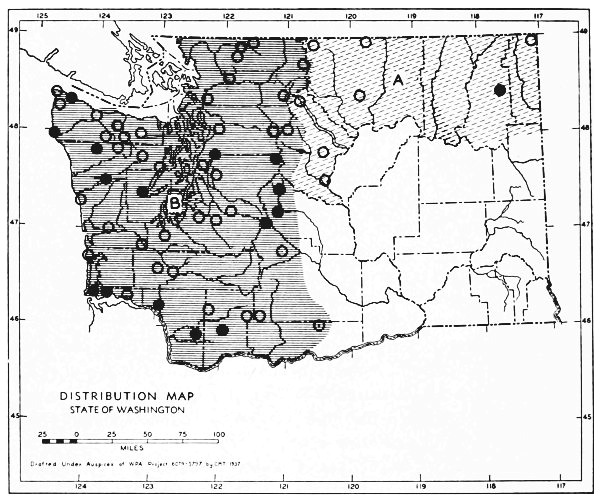
Fig. 30. Distribution of the dusky shrew in Washington. A. Sorex obscurus obscurus. B. Sorex obscurus setosus.
Sorex obscurus obscurus Merriam
Sorex vagrans similis Merriam, N. Amer. Fauna, 5: 34, July 30, 1891 (not of Hensel, 1855).
Sorex obscurus Merriam, N. Amer. Fauna, 10: 72, December 31, 1895 (substitute for similis Merriam).
Type.—Obtained on Timber Creek, 8,200 ft., Lemhi Mountains, Lemhi County, Idaho, by V. Bailey and B. H. Dutcher on August 26, 1890; type in United States National Museum.
Racial characters.—Tail relatively short, color pale.
Measurements.—Thirteen males and 10 females from Indian-point Lake, British Columbia, average, respectively: total length 105, 107; length of tail 45, 46; hind foot 13.3, 13.3.
Distribution.—Northeastern Washington west, according to Jackson (1928: 122), to Pasayten River, Stehekin and Wenatchee. Because specimens from Tye, King County, and Mt. Stuart, Easton and Lake Keechelus are clearly referable to S. o. setosus, the specimens recorded by Jackson (1928: 122), from Easton and Signal Peak, are mapped in the range of setosus.
Sorex obscurus setosus Elliot
Sorex setosus Elliot, Field Columb. Mus. Publ. 32. zoöl, ser., 1:274. March, 1899.
Sorex obscurus setosus Jackson, Proc. Biol. Soc. Washington. 31:127. November 29, 1918.
Sorex obscurus bairdi Jackson, N. Amer. Fauna, 51:140. July 24, 1928.
Type.—Obtained at Happy Lake, Clallam County, Washington, by D. G. Elliot on August 18, 1898; type in Field Museum of Natural History.
Racial characters.—Tail long, color dark.
Measurements.—Twelve males and 17 females from southwestern Washington average, respectively: total length 118, 119; length of tail 53, 53; hind foot 13.8, 13.7; weight 6.6, 5.2 grams.
Distribution.—Western Washington, east through the Cascades to Barron (Jackson, 1928: 137), Cascade River (Jackson 1928: 137) and Satus Pass (W. W. D.).
Sorex palustris navigator (Baird) Mountain water shrew
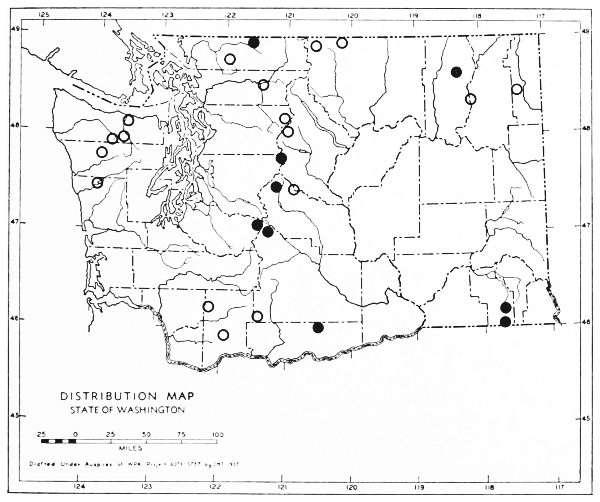
Fig. 31. Distribution of the mountain water shrew. Sorex palustris navigator, in Washington.
Neosorex navigator Baird, Rept. Pacific R. R. Survey, 8 (pt. I): 11, 1857.
Sorex (Neosorex) palustris navigator Merriam, N. Amer. Fauna, 10:92, December 31, 1895.
Sorex palustris navigator Stephens, California Mammals, p. 254, June, 1906.
Type.—Obtained at head of Yakima River, Kittitas County, Washington, by J. G. Cooper on August 31, 1853; type in United States National Museum.
Measurements.—Two males and 4 females from Washington average, respectively: total length 150, 150; length of tail 70, 74; hind foot 18.5, 20; weight?, 11.0 grams.
Distribution.—Mountainous areas of entire state, including the Olympic Mountains, from Elwah (Jackson, 1928: 188) south to Quinault River (Jackson, 1928: 189); the Cascades from Tomyhoi Lake (W. W. D.) south to 15 mi. N. Carson (Jackson, 1928: 189); northeastern Washington from Shovel Creek (W. W. D.) south to Gifford (Jackson, 1928: 189); the Blue Mountains at Godman Springs (M. V. Z.) and Hompeg Falls (M. V. Z.).
Description.—In general form of body the mountain water shrew resembles the cinereous shrew but is perhaps more stocky. It is a large shrew, nearly as large as a house mouse. The head and body measure about 3 inches; the tail also is about 3 inches long. The fur is exceedingly soft. The upper parts are blackish in color, lightly frosted with paler hairs. The underparts, from throat to vent, are whitish tinged with gray or brown. The stiff, curved fringe of bristles on the outer part of the hind foot serves as an aid in swimming.
Mountain water shrews range over much of Canada and in mountainous areas of the western United States extend south to Arizona. The subspecies found in Washington ranges over all of the western United States.
The mountain water shrew is primarily a mammal of the Hudsonian and Canadian life-zones. It sometimes descends to the Transition Life-zone along clear, cold streams where conditions are similar to those in the Canadian Life-zone.
The favored habitats of the mountain water shrew are the clear, cold streams of the alpine cirques and gushing streams on the mountain sides. In the pools and waterfalls, and among the rocks and mosses that border them, the larvae of aquatic insects, upon which the mountain water shrew feeds, are abundant. Svihla (1934: 45) observed that the fur of a swimming water shrew gathered air bubbles and "it had difficulty in forcing its way down to the bottom [of an aquarium]. On reaching the bottom it literally stood on its long flexible nose which was thrust into the sand and debris, searching for food, its feet kicking rapidly in order to maintain this position. A change in direction was brought about by a twist of the body. To come to the surface again it merely stopped kicking and immediately rose like a cork." The buoyancy of the water shrew allows it to float in the water, like a duck. Jackson (1928: 9) observed a water shrew run across the surface of a small pool. Near Stevens Pass a water shrew dashed from under a stone and ran, did not swim, across the surface of a small, deep pool to escape in a burrow on the other side. According to Jackson, an air bubble held in each foot supports the shrew on the surface of the water. A mountain water shrew observed at Shovel Creek, Ferry County, was as agile on land as any other species of shrew. In summary, water shrews are able to swim, dive, float like a duck, and walk on the surface of the water as well as walk on land.
The food of the mountain water shrew includes snails, leeches, and the larvae of aquatic insects. Mice caught in traps are sometimes eaten by water shrews. Svihla (loc. cit.) found a captive water shrew unable to capture pollywogs and minnows kept in the same aquarium.
Sorex bendirii (Merriam) Bendire water shrew
Description.—The Bendire water shrew is similar in form of body to the cinereous shrew but possesses a more stocky body which, with the head, measures about 3-1/2 inches long; the tail is about 2-3/4 inches long. The Bendire water shrew closely resembles also the mountain water shrew but has a longer body and shorter tail. The upper parts are blackish in color, not lightly frosted with gray hairs. The hind feet lack the fringe of stiff, curved bristles characteristic of the mountain water shrew. The underparts are black in the race S. b. bendirii. In the race albiventer the throat is blackish but the abdomen is pale gray tinged with brownish.
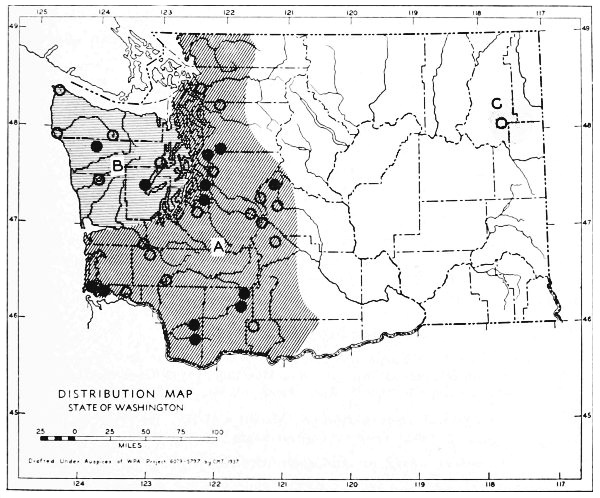
Fig. 32. Distribution of the Bendire water shrew and the pigmy shrew in Washington. A. Sorex bendirii bendirii. B. Sorex bendirii albiventer. C. Microsorex hoyi washingtoni.
Bendire water shrews are restricted to the Pacific Coast of North America from southern British Columbia to northern California. Generally they are found at elevations lower than are mountain water shrews. They are typically mammals of the humid division of the Transition Life-zone but often occur in the Canadian Life-zone. They occupy marshes, swamps, damp ravines, and the banks of slow-moving streams. Little is known of their habits, except what has been deduced from the circumstances of their capture. They seem less aquatic than the mountain water shrew. Near Jackson Guard Station on the Hoh River, Jefferson County, one was taken by setting traps on dense beds of water cress that floated in a slow-moving stream. The animal must have swum or walked on the surface of the mat of vegetation. Near Paradise Lake, King County, several were caught in a deep, dark, red cedar swamp. One was caught in a marsh nearby. Nothing is known of the food habits of the Bendire water shrew.
Sorex bendirii bendirii (Merriam)
Atophyrax bendirii Merriam, Trans. Linn. Soc. New York, 2:217, August 28, 1884.
Atophyrax Bendirei True, Proc. U. S. Nat. Mus., 7 (1884):606, 1885.
Sorex bendirii Dobson, Monog. Insectivora, part 3, fasc. 1, pl. 23, 1890.
Neosorex bendirii bendirii Miller, U. S. Nat. Mus. Bull., 79:22, December 31, 1912.
Type.—Obtained approximately 1 mile from Williamson River, 18 miles southeast of Fort Klamath, Klamath County, Oregon, by C. C. Bendire on August 1, 1882; type in United States National Museum.
Racial characters.—Underparts everywhere sooty black.
Measurements.—Ten males and 10 females from southwestern Washington average, respectively: total length 163.9, 161.0; length of tail 71.0, 72.6; hind foot 20.5, 20.3; weight 16.8, 14.5 grams.
Distribution.—The southern Cascades and the lowlands of western Washington, exclusive of the Olympic Peninsula. Marginal localities on the west include Mt. Vernon (Jackson, 1928: 196), Bothell (W.S.M.), Renton (M.V.Z.), Puyallup (W.W.D.), Steilacoom (Jackson, 1928: 196) and Oakville (Jackson, 1928: 196).
Sorex bendirii albiventer Merriam
Sorex (Atophyrax) bendirii albiventer Merriam, N. Amer. Fauna, 10:97, December 31, 1895.
Neosorex bendirii albiventer Miller, U. S. Nat. Mus. Bull., 79:22, December 31, 1912.
Sorex bendirii albiventer Jackson, N. Amer. Fauna, 51:198, July 24, 1928.
Type.—Obtained at Lake Cushman, Mason County, Washington, by C. P. Streator on July 7, 1894; type in United States National Museum.
Racial characters.—Area on abdomen whitish.
Measurements.—A male from near the type locality measures: total length 167; length of tail 69; hind foot 22. One from Potlatch, Mason County, measures 167; 69; 22.
Distribution.—The Olympic Peninsula of Washington. Marginal localities on the south are: Potlatch (M.V.Z.) and Lake Quinault (Jackson, 1928: 199).
Microsorex hoyi washingtoni Jackson Pigmy shrew
Microsorex hoyi washingtoni Jackson, Proc. Biol. Soc. Washington, 38:125, November 13, 1925.
Type.—Obtained at Loon Lake, Stevens County, Washington, by V. Bailey on September 26, 1897; type in United States National Museum.
Measurements.—Of type: total length 89; length of tail 27; hind foot 9.
Distribution.—In Washington, known only from the type specimen which was "found dead in a trail in dry pine woods" (Jackson, 1928: 4).
Description.—The pigmy shrew is similar in form of body to the cinereous shrew but smaller. The head and body are about 1-3/4 inches in length; the tail is about 1 inch long. The upper parts are reddish brown and the underparts are gray.
These tiny mammals range widely across central Canada and northern United States from the Atlantic nearly to the Pacific, and north to central Alaska. A single species is known, one race of which occurs in Washington. The subspecies is known from but two specimens: the type and an individual from Montana (Koford, 1938: 372.)
Genus Myotis Kaup Mouse-eared bats
Description.—The genus Myotis may be separated from all other bats that occur in Washington by the presence of 38 teeth (dental formula i. 2-2/3-3, c. 1-1/1-1, p. 3-3/3-3, m. 3-3/3-3 = 38). Their small size separates them from all other genera save Pipistrellus, from which Myotis may be distinguished by the straight, rather than hooked, anterior border of the tragus. Species of Myotis found in Washington vary considerably in size, but all are less than 100 mm. in total length. The upper parts are various shades of brown in color. The ears, when laid forward, always extend to the nostrils or beyond.
This genus is one of the most widely ranging groups of Recent mammals. It occurs on all continents, including Australia and many of the larger islands. Of the 19 American species recognized by Miller and Allen (1928), eight occur in the state of Washington. They are low-flying forms and as a rule appear relatively late in the evening. Their flight is rapid and erratic. They often hunt over the surfaces of streams, pools, and lakes. Some kinds hunt in the shade of forest trees and these are especially difficult to collect. Others hunt the brushy canyons and coulees of the desert areas of eastern Washington.
Grinnell (1918: 241-242) points out that, although bats are not subject to isolation by topographic barriers, as most wingless mammals are, they may be restricted by ecologic barriers in the same way as are other small mammals. This is particularly true of Myotis in Washington. Of the eight species in the state, five are represented by one subspecies west of the Cascade Mountains and another, paler subspecies in the more arid country east of the Cascades.
The mobility of bats makes it difficult to determine their origin and migrational history. Five of the Myotis found in Washington seem to belong to the Pacific Coastal Fauna, and to have been isolated south of the last continental glacier. Complete isolation is unlikely as these species occur in the Cascade Mountains as well as in the Pacific Coastal Faunal Area, and three occur also in the Blue Mountains of southeastern Washington. The differentiation of the Coastal type of Myotis may have come about through habitat selection, of the type discussed by Miller (1942: 25). One western Washington Myotis (M. keenii) seems to belong to a northern fauna, and to have extended its range south to Washington. All seven species of the desert-living Myotis found in eastern Washington have subspecies which seem to have been derived from the Great Basin Faunal Area.
Myotis lucifugus (Le Conte) Big myotis
Myotis lucifugus is represented by two geographic races in Washington. The species ranges across Canada and the United States, from the Atlantic to the Pacific and from the northern limit of tree growth to southern Mexico.
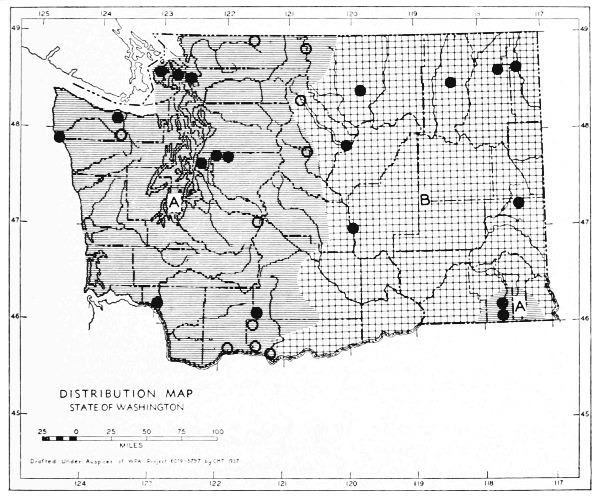
Fig. 33. Distribution of the big myotis in Washington. A. Myotis lucifugus alascensis. B. Myotis lucifugus carissima.
It usually proves rather difficult to separate Myotis lucifugus, on the basis of external features, from other species with which it may occur. Its large foot (9-10 mm.), short ear (when laid forward not extending past nose) and the absence of a keel on the calcar separate it from all species except Myotis yumanensis. From the latter species, lucifugus may be distinguished by the gradually rather than abruptly rising forehead, as seen in cleaned skulls, and by more shiny, metallic color of fur.
Little is known of the habits of this bat in Washington. It usually appears after dusk, and most specimens are shot over ponds or lakes, where the reflection of light from the sky on the water allows the hunter enough light to sight a gun. A few specimens were collected in deep forests. Its flight and feeding habits are not known to differ from those of other species with which it was associated, except at the south end of Lake Chelan, Chelan County, where two individuals were shot as they hovered near the tops of pine trees and seemed to be picking insects from the branches. I have never found this bat in its daytime retreat.
A specimen taken at Sportman's Lake, San Juan County, held one embryo on June 26, 1938.
Myotis lucifugus carissima Thomas
Myotis (Leuconoë) carissima Thomas, Ann. and Mag. Nat. Hist., 13 (ser. 7): 383, May, 1904.
Myotis lucifugus carissima Cary, N. Amer. Fauna, 42:43, October 3, 1917.
Type.—Obtained at Yellowstone Lake, Yellowstone National Park, Wyoming by J. Darling in September, 1903; type in British Museum.
Racial characters.—Color pale, rather "brassy" in tone; distal border of interfemoral membrane paler than proximal part.
Measurements.—Four specimens from eastern Washington average: total length 77; length of tail 33; hind foot 11; ear 13; height of tragus 7.3.
Distribution.—East of the eastern base of the Cascade Mountains, save for the Blue Mountains of southeastern Washington. Western records are Stehekin (Miller and Allen, 1928: 52) and Vantage (W. W. D.)
Myotis lucifugus alascensis Miller
Myotis lucifugus alascensis Miller, N. Amer. Fauna, 13:63, October 16, 1897.
Vespertilio gryphus lucifugus Allen, U. S. Nat. Mus. Bull., 43:78, March 14, 1894 (part specimens from Washington).
Type.—Obtained at Sitka, Alaska, by C. P. Streator on August 5, 1895; type in United States National Museum.
Racial characters.—Color dark, almost bronze; wing and tail membranes uniformly dark in color.
Measurements.—Five specimens from San Juan County, Washington, average: total length 80.9; length of tail 32.1; hind foot 12; ear 12; height of tragus 7; weight 5.4 grams.
Distribution.—From the eastern base of the Cascade Mountains west of the Pacific, and the Blue Mountains of southeastern Washington. Marginal occurrences listed by Miller and Allen (1928:49) are Chilliwack River, Lake Wenatchee, and Lyle.
Myotis yumanensis (H. Allen) Yuma myotis
Description.—The present species closely resembles Myotis lucifugus and specimens in worn pelage can not be distinguished from that species unless the cleaned skulls are examined. In fresh pelage, yumanensis is duller than lucifugus.
Myotis yumanensis ranges from southern British Columbia to central Mexico west of the Mississippi River. Four races are recognized by Miller and Allen (1928: 62).
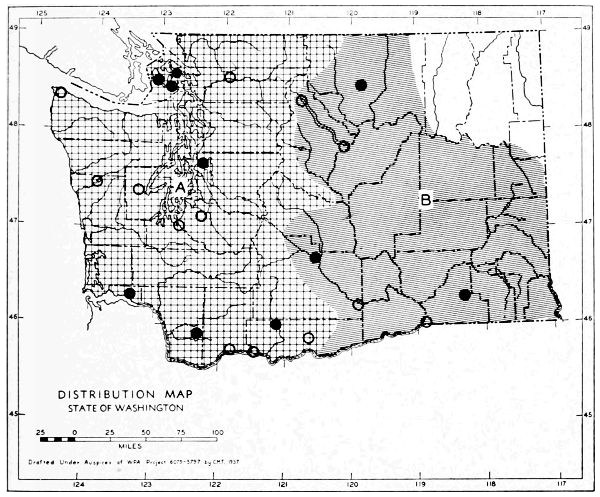
Fig. 34. Distribution of the Yuma myotis in Washington. A. Myotis yumanensis saturatus. B. Myotis yumanensis sociabilis.
The habits of Myotis yumanensis and Myotis lucifugus appear to be the same. In Washington the two species are commonly found together. In western Washington, Myotis yumanensis seems to be more common than Myotis lucifugus.
In the San Juan Islands a yumanensis was found hiding in the attic of an old cabin on Blakeley Island. A specimen of long-eared bat was taken at the same place. Another Yuma myotis was caught behind a door of a mill on Blakeley Island (Dalquest, 1940: 4).
This species shares with Myotis californicus the habit of apparently drinking salt water.
A specimen obtained at Sportsmans Lake, San Juan County, held one embryo on June 27, 1938. One from Peavine Pass, Blakeley Island, San Juan County, held one embryo on June 22, 1939.
Myotis yumanensis sociabilis H. W. Grinnell
Myotis yumanensis sociabilis H. W. Grinnell, Univ. California Publ. Zoöl., 12:318, December 4, 1914.
Type.—Obtained at old Fort Tejon, Kern County, California, by J. Grinnell on July 23, 1904; type in Museum of Vertebrate Zoölogy.
Racial character.—Color pale.
Measurements.—Two males and 2 females from Selah, Yakima County, average: total length 78; length of tail 36; hind foot 10; ear 14; height of tragus 7.
Distribution.—Eastern Washington generally. Marginal records on the west are: Stehekin (Miller and Allen, 1928: 69), and Selah (W.W.D.).
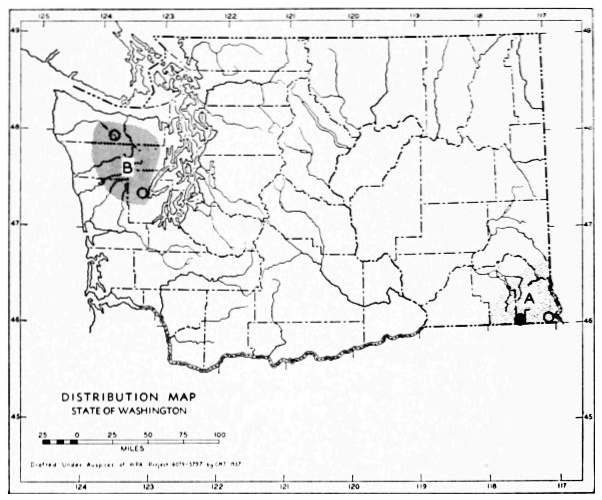
Fig. 35. Distribution of the fringe-tailed myotis and the Keen myotis in Washington. A. Myotis thysanodes thysanodes. B. Myotis keenii keenii.
Myotis yumanensis saturatus Miller
Myotis yumanensis saturatus Miller, N. Amer. Fauna, 13:68, October 16, 1897.
Type.—Obtained at Hamilton, Skagit County, Washington, by T. S. Palmer on September 13, 1889; type in United States National Museum.
Racial character.—Color dark.
Measurements.—Eighteen adults of both sexes from San Juan County, Washington, average: Total length 78.2; length of tail 34.4; hind foot 10.1; ear 15; height of tragus 7.4; weight 5.9 grams.
Distribution.—From the eastern base of the Cascade Mountains to the Pacific. This is the commonest Myotis found in western Washington. Marginal localities are: Hamilton (Miller and Allen, 1928: 71), and Goldendale (Miller and Allen, 1928: 71).
Myotis keenii keenii (Merriam) Keen myotis
Vespertilio subulatus keenii Merriam, Amer. Nat., 29:860, September, 1895.
Myotis subulatus keenii Miller, N. Amer. Fauna, 13:77, October 16, 1897.
Myotis keenii keenii Miller and Allen, U. S. Nat. Mus. Bull., 144:104, May 25, 1928.
Type.—Obtained at Masset, Graham Island, Queen Charlotte Islands, British Columbia, by J. H. Keen in 1894; type in United States National Museum.
Measurements.—Miller and Allen (1928: 109) list the measurements of a male from Sol Duc Hot Springs, Clallam County, and a specimen of unknown sex from Lake Cushman, Jefferson County, as, respectively: total length 89, 87; length of tail 34, 36; hind foot 8.4, 7.4; ear?, 14.6.
Distribution.—Only the Olympic Peninsula, where it has been recorded by Miller and Allen (1928: 104) from Sol Duc Hot Springs and Lake Cushman.
Description.—Myotis keenii is similar, in general, to Myotis lucifugus and Myotis yumanensis, but the ears are longer and when laid forward reach about 4 mm. past the nose rather than ending at the nostrils. The foot is of medium size (about 8 mm.) and no keel is present on the calcar.
The distribution of this species is given by Miller and Allen (1928: 101) as "northern North America from the limits of tree growth south in the east to South Carolina and Arkansas, and in the west to northwestern Washington."
I have not observed this bat in Washington and know nothing of its habits. Its distribution is most unusual. Its range seems to lie only in the glaciated area of western British Columbia and northern Washington.
Myotis evotis (H. Allen) Long-eared myotis
Description.—The distinguishing feature of Myotis evotis is its long ears, which, when laid forward, reach 5 mm. in front of the nose. Myotis thysanodes and Myotis keenii, other species in which the ears are rather long, have the ears ending less than 5 mm. anterior to the nose when laid forward. The foot of Myotis evotis is of moderate size (8 to 9 mm.).
This species ranges over the western United States, from British Columbia to central Mexico. Two subspecies of this interesting bat are recognized, both of which occur in Washington.
Though I have hunted for this species of bat in Washington on numerous occasions, I have taken no specimens. In the summer of 1939, Myotis identified as this species because of their large ears, were seen flying at midnight in the light of searchlights over Lake Washington Canal at Seattle. Mary Greer gave us a specimen which was struck by her auto near Baker Lake, Whatcom County. According to Miss Greer, the specimen was seen "hovering in the road, like a large moth." The time was about midnight. This evidence indicates that the species does its hunting late at night, when ordinary methods of hunting bats are useless, and may account for the scarcity of specimens from the state. Nevertheless, collectors from the California Museum of Vertebrate Zoölogy took specimens in the Blue Mountains where the bats flew slowly, in rather straight courses, 20 to 25 feet from the ground.
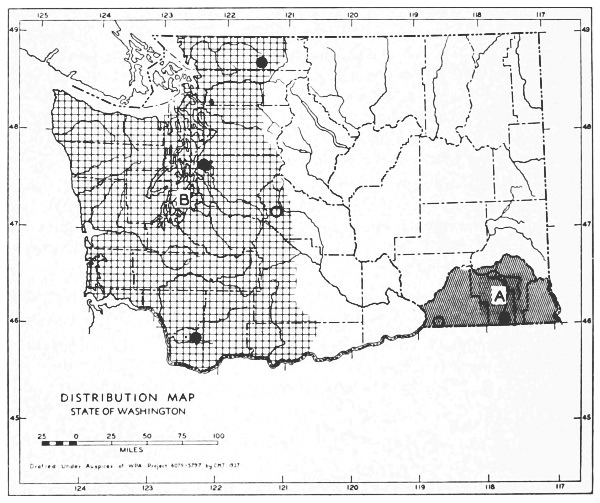
Fig. 36. Distribution of the long-eared myotis in Washington. A. Myotis evotis evotis. B. Myotis evotis pacificus.
This species has not, so far as is known, been taken in Washington in its daytime retreat. Daniel Bonell saved two specimens from under slabs of loose bark on old, dead snags near Tillamook, Oregon. Davis (1939: 214) reported them as hiding in the daytime in a cave in Craters of the Moon National Monument, Idaho. Whitlow and Hall (1933: 241) report specimens found in an old cabin near Pocatello, Idaho, two of them containing one embryo each.
Myotis evotis evotis (H. Allen)
Vespertilio evotis Allen, Smithsonian Misc. Coll., 7 (no. 165):48, June, 1864.
Myotis evotis Miller, N. Amer. Fauna, 13:77, October 16, 1897.
Myotis evotis evotis Miller and Allen, U. S. Nat. Mus. Bull., 144:114, April 14, 1928.
Type.—Description based on a series of specimens, one of which came from Monterey, California. This locality was designated the type locality by Miller (1897: 78).
Racial character.—Color pale.
Measurements.—Two males and 2 specimens of unknown sex from the Blue Mountains, Columbia County, average: total length 87; length of tail 40; hind foot 7.5; ear 20; height of tragus 11; weight 5.4 grams.
Distribution.—The Blue Mountains area, of southeastern Washington; recorded from South Touchet (Miller and Allen, 1928: 116) and Godman Springs (W. S. M.).
Remarks.—Miller and Allen (1928: 116) record the dark race of Myotis evotis from the Blue Mountains. Specimens examined by me are much paler than pacificus and most of them are indistinguishable from specimens of evotis from California.
Myotis evotis pacificus Dalquest
Vespertilio evotis Allen, Smithsonian Misc. Coll., 7 (no. 165):48, June, 1864 (part specimens from Puget Sound).
Myotis evotis evotis Miller and Allen, U. S. Nat. Mus. Bull., 144:114, May 25, 1928.
Myotis evotis pacificus Dalquest, Proc. Biol. Soc. Washington, 56:2, February 25, 1943.
Type.—Obtained from 3-1/2 miles east and 5 miles north of Yacolt, Clark County, Washington, by John Chattin on August 3, 1940; type in Museum of Vertebrate Zoölogy.
Racial character.—Color dark.
Measurements.—Five specimens from the type locality average: Total length 85; length of tail 41; hind foot 7.4; ear 19.4; height of tragus 10; weight 5.5 grams.
Distribution.—Western Washington from the Cascade Mountains westward. Marginal occurrences are: Baker Lake (W. W. D.) and Easton (Miller and Allen, 1928: 116).
Myotis thysanodes thysanodes Miller Fringe-tailed myotis
Myotis thysanodes Miller, N. Amer. Fauna, 13:80, October 16, 1897.
Myotis thysanodes thysanodes Miller and Allen, U. S. Nat. Mus. Bull., 144:126, May 25, 1928.
Type.—Obtained at Old Fort Tejon, Kern County, California, by T. S. Palmer on July 5, 1891; type in United States National Museum.
Measurements.—Two males and 3 females from Vernon, British Columbia, average, respectively: total length 90.5, 82; length of tail 41.5, 37; hind foot 10.5, 10; ear 18.5, 16; height of tragus 14, 13.
Distribution.—In Washington known only from the southeastern border of the state, namely from Dayton (W. S. M.) and Anatone (Miller and Allen, 1928: 127).
Description.—Myotis thysanodes resembles Myotis evotis, but differs in larger size, smaller ear (reaching less than 5 mm. past nose when laid forward), and in possessing a well developed fringe of hairs along the border of the caudal membrane.
This species of bat ranges over western North America from southern British Columbia to southern Mexico. Two geographic races are currently recognized, only one of which occurs in the United States. This bat is not recorded by Davis (1939) as occurring in Idaho and has been found only once in Oregon. The only published account of the habits of thysanodes seems to be that of Palmer (in Miller, 1897: 84, also Grinnell, 1918) who found adults and young of various sizes in company with Myotis yumanensis in the attic of an old adobe building near Old Fort Tejon, California, in July, 1891. The specimens obtained in Washington and British Columbia came from dry areas of pine forest.
Myotis volans (H. Allen) Hairy-winged myotis
Description.—This species, in Washington, may be easily recognized by its relatively large size and the presence of a distinct keel on the side of the calcar, posterior to the foot.
Four subspecies of Myotis volans are recognized by Miller and Allen (1928: 136). These range over western North America from southern Alaska to southern Mexico. Two subspecies occur in Washington.
The record stations in Washington for the pale, southern race are all in arid places and the dark, coastal race is a forest animal. Most of the specimens taken by me (all of the dark race) were in clearings or along roads through timber near the crests of hills. They appeared relatively late in the evening, after the big-brown and the silver-haired bats had been in the air for some time. Often they were taken in company with Myotis lucifugus and Myotis yumanensis. They were appreciably larger than those species and their flight was slower and less erratic. They usually flew in relatively straight lines or large circles at from ten to forty feet from the ground. At Lake Kapowsin, Pierce County, they were attracted by swishing a long pole in the air. At Renton, King County, one was shot as it hunted insects at a city street light several hours after dark.
Myotis volans longicrus (True)
Vespertilio longicrus True, Science, 8:588, 1886.
Vespertilio nitidus longicrus H. Allen, U. S. Nat. Mus. Bull., 43:103, March 14, 1894.
Myotis lucifugus longicrus Miller, N. Amer. Fauna, 13:64, October 16, 1897.
Myotis longicrus Lyon and Osgood, U. S. Nat. Mus. Bull., 62:271, January 28, 1909.
Myotis volans longicrus Miller and Allen, U. S. Nat. Mus. Bull., 144:140, May 25, 1928.
Type.—Obtained in the "vicinity of Puget Sound, Washington" by D. S. Jordan, and catalogued in the U. S. National Museum on December 16, 1886.
Racial character.—Color dark.
Measurements.—A female from 6 miles northeast of Kelso, Cowlitz County, measures: total length 95; length of tail 39; hind foot 8; ear 13; height of tragus 8.
Distribution.—From the eastern base of the Cascade Mountains to the Pacific. Marginal records (from Miller and Allen, 1928: 142) are Oroville, Entiat, and Carson.
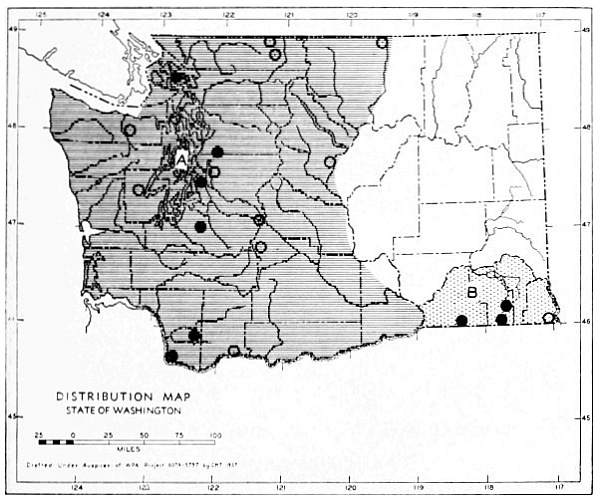
Fig. 37. Distribution of the hairy-winged myotis in Washington. A. Myotis volans longicrus. B. Myotis volans interior.
Myotis volans interior Miller
Myotis longicrus interior Miller, Proc. Biol. Soc. Washington, 27:211, October 31, 1914.
Myotis volans interior Miller and Allen, U. S. Nat. Mus. Bull., 144:142, May 25, 1928.
Type.—Obtained 5 miles south of Twining, Taos County, New Mexico, by Vernon Bailey on July 23, 1904; type in United States National Museum.
Racial characters.—Smaller and paler than Myotis v. longicrus.
Measurements.—Four males and a female from the Blue Mountains, Columbia County, average: total length 93; length of tail 41.5; hind foot?; ear 12; height of tragus 6.3.
Distribution.—Known only from the Blue Mountains area of the southeastern part of the state, from Walla Walla (E. S. B.) east to Anatone (Miller and Allen, 1928: 144).
Remarks.—Of 5 specimens available from the Blue Mountains, 4 are like interior and 1 is like longicrus.
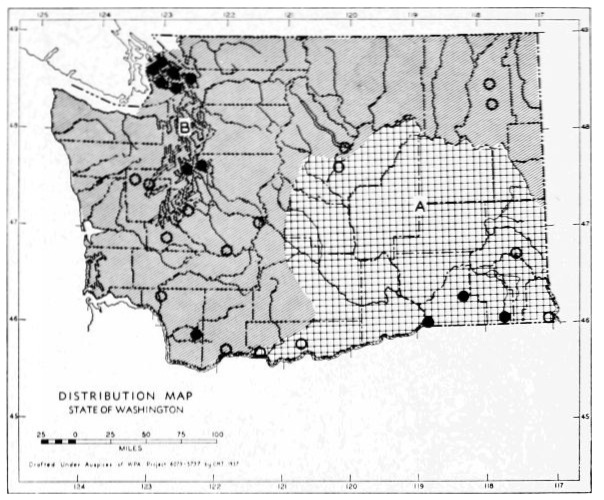
Fig. 38. Distribution of the California myotis in Washington. A. Myotis californicus californicus. B. Myotis californicus caurinus.
Myotis californicus (Audubon and Bachman) California myotis
Description.—Myotis californicus may be separated from all Myotis that occur in Washington, except Myotis subulatus, by its small foot (about 6 mm.). It is the only small-footed bat found in western Washington. In eastern Washington, where Myotis subulatus occurs, the cleaned skulls of the two species must be compared before certain identification of some specimens is possible. The skull of M. californicus possesses a higher cranium and more abruptly rising forehead than that of M. subulatus.
Four geographic races of this bat recognized by Miller and Allen (1928: 149) range from southern Alaska southward over western North America to southern Mexico. Two subspecies occur in Washington.
Myotis californicus, in western Washington, often occurs in company with Myotis yumanensis, lucifugus, and volans. In flight it cannot be distinguished from M. yumanensis or M. lucifugus. Most of our specimens were collected over water, for these bats usually fly rather late and can be shot most easily where their reflection on the water assists the hunter in aiming. They are usually not common, one or two being taken at a single locality. This species, like Myotis yumanensis, seems to drink salt water. On May 9, 1936, a living specimen was caught under a loose piece of bark on a dead tree.
Myotis californicus caurinus Miller
Vespertilio nitidus H. Allen, Proc. Acad. Nat. Sci. Philadelphia, p. 247, 1862 (part of the specimens were from Fort Steilacoom, Pierce Co., Washington).
Myotis californicus caurinus Miller, N. Amer. Fauna, 13:72, October 16, 1897.
Type.—Obtained at Masset, Graham Island, Queen Charlotte Islands, British Columbia, by J. H. Keen in 1895; type in United States National Museum.
Racial character.—Color reddish-brown.
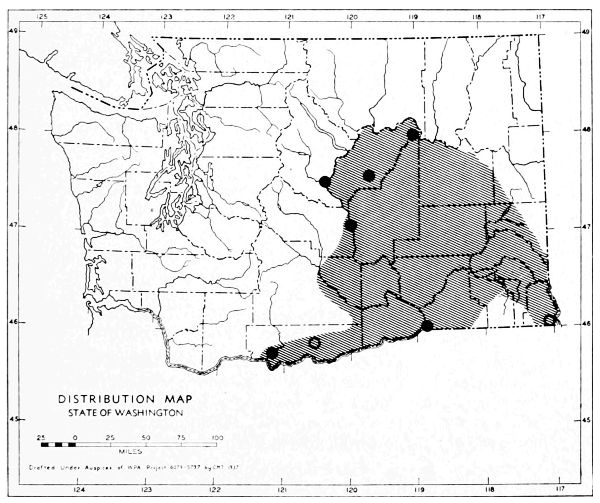
Fig. 39. Distribution of the small-footed myotis, Myotis subulatus melanorhinus, in Washington.
Measurements.—Eight specimens, including both sexes, from the San Juan Islands, San Juan and Skagit counties, average: total length 77.8; length of tail 36.7; hind foot 6.7; ear?; height of tragus 7.6; weight 5.2 grams.
Distribution.—Western Washington east through the northern Cascades to Chelan, Blue Creek and Colville (Miller and Allen, 1928: 156) in northeastern Washington, and, farther south, east to Mount Rainier (Miller and Allen, 1928: 156) and Carson (Miller and Allen, 1928: 156).
Myotis californicus californicus (Audubon and Bachman)
Vespertilio californicus Audubon and Bachman, Jour. Acad. Nat. Sci., Philadelphia, 8 (ser. 1, ser. 1, pt. 2):285, 1842.
Myotis californicus Miller, N. Amer. Fauna, 13:69, October 16, 1897.
Type.—None designated. Type locality fixed at Monterey, Monterey County, California, by Miller and Allen (1928: 153).
Racial character.—Color pale.
Measurements.—A female from Crooked River, Crook County, Oregon, measures: Total length 80; length of tail 40; hind foot 7; ear 13; height of tragus 5; weight 3.2 grams.
Distribution.—Recorded only from the eastern part of the state. Westernmost records, according to Miller and Allen (1928: 155) are: Orondo, Goldendale and Lyle.
Myotis subulatus melanorhinus (Merriam) Small-footed myotis
Vespertilio melanorhinus Merriam, N. Amer. Fauna, 3:46, September 11, 1890.
Myotis subulatus melanorhinus Miller and Allen, U. S. Nat. Mus. Bull., 144:169, May 25, 1928.
Type.—Obtained on San Francisco Mountain, 8250 ft. elevation, Coconino County, Arizona, by C. H. Merriam and V. Bailey on August 4, 1889; type in United States National Museum.
Measurements.—Three males and 2 females from eastern Washington average: total length 77; length of tail 37; hind foot 7; ear 15; height of tragus 8. One weighed 5.4 grams.
Distribution.—Desert areas of eastern Washington, including the Columbian Plateau and the lower Columbia River Valley. Marginal records are: 5 mi. S Grand Coulee Dam (W. W. D.) in the north, Wenatchee (W. W. D.) in the northwest, Lyle (W. W. D.) in the southwest, and Bly (Miller and Allen, 1928: 171) in the southeast.
Description.—Myotis subulatus is closely similar to Myotis californicus, but is more orange in color and has the skin on the face more nearly black. Specimens cannot be identified with certainty until the cleaned skulls are examined. The more flattened cranium and less abruptly rising forehead separate Myotis subulatus from M. californicus.
This species is confined to the United States and northern Mexico. Two races are recognized by Miller and Allen (1928), of which one occurs in Washington. It is the commonest bat in the desert of eastern Washington. It lives far from trees on plains and in sandy or rocky areas, emerging rather early in the evening. It is not difficult to shoot. Its flight is erratic. The animal usually hunts in large, irregular circles at 10 to 25 feet from the ground. It has not been found in its daytime retreat but may hide in crevices in rocky outcrops. Near Vantage, Grant County, individuals were shot as they hung up in a concrete underpass to digest food. The stomachs of specimens taken were so crammed with the remains of insects that their abdomens were greatly distended. The underpass seemed to be only a resting place, not inhabited by day. Others were taken when they came to rest in the loft of a barn at Selah, Yakima County. They usually did not arrive at the barn until an hour after sunset and were still present there at midnight.
Lasionycteris noctivagans (Le Conte) Silver-haired bat
V[espertilio]. noctivagans Le Conte, McMurtrie's Cuvier, Anim. Kingd., 1:431, 1831.
Vesperugo noctivagans True, Proc. U. S. Nat. Mus., 7:602, 1885.
Lasionycteris noctivagans Allen, U. S. Nat. Mus. Bull., 43:105, March 14, 1894.
Type.—None designated; described from a specimen obtained in the "eastern United States."
Measurements.—Five males from San Juan County, Washington, average: total length 96.2; length of tail 46.4; hind foot 8.5; ear 16; height of tragus 7.2; weight 8.2 grams.
Distribution.—Forested areas of the entire state. This species is migratory and first appears about the middle of May. September 15th is the latest recorded occurrence, when one was seen at Seattle, King County. Marginal records are: Sportsmans Lake (W. W. D.), in the northwest; Carson (Taylor and Shaw, 1929: 9) in the southwest; Pass Creek Pass (W. W. D.) in the northeast; and Bly (Taylor and Shaw, 1929: 9) in the southeast.
Remarks.—The chocolate-brown color phase of the silver-haired bat is most common east of the Cascade Mountains, while almost all specimens from western Washington represent the black phase.
This medium-sized bat is the darkest-colored species living in the state, ranging from chocolate-brown to nearly black. Numerous white-tipped hairs give the upper parts a frosted appearance. The upper surface of the interfemoral membrane is well furred, a character shared only with Lasiurus. The dental formula (i. 2-2/3-3, c. 1-1/1-1, p. 2-2/3-3, m. 3-3/3-3 = 36) is the same as that of Corynorhinus. The small ears and short tragus immediately distinguish the silver-haired bat from the long-eared bat.
The genus Lasionycteris contains but a single species, of which no geographic races have been described. It ranges across North America from coast to coast and from central Canada southward, in forested areas, nearly to Mexico. This species is known to be migratory, and southern records probably do not represent breeding individuals.
In Washington these bats have been taken in the Transition, Canadian, and Hudsonian life-zones. They were found near clearings in forests of open pine woods in the arid section of eastern Washington, near mountain hemlock thickets in the high mountains, and in the dense rain-forests of the Pacific Coastal area.
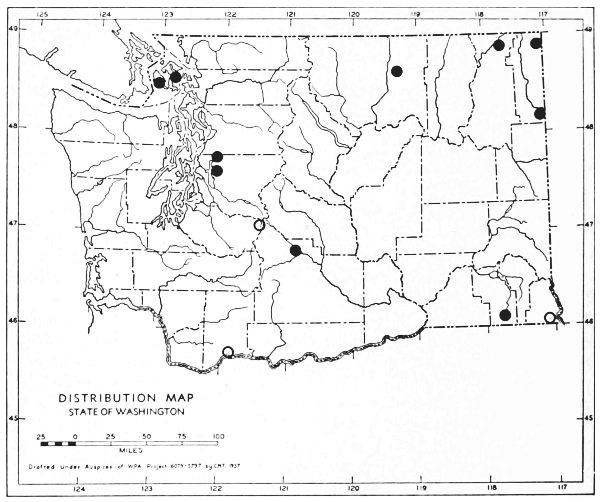
Fig. 40. Distribution of the silver-haired bat. Lasionycteris noctivagans, in Washington.
The size and flight of the silver-haired bats are distinctive, and after some experience it is possible to identify them in the air. It is an early flier, usually appearing just after the swallows roost. They fly at a considerable height, rarely coming within forty feet of the ground. The wings are moved with a "fluttery" motion, and their flight is interrupted by frequent short glides. They fly more rapidly than the big brown-bats, and twist and dart sideways more frequently. Compared with big brown-bats, silver-haired bats are relatively gregarious, and six to a dozen individuals were seen in the same area. They generally hunt in sweeping circles, from fifty to one hundred yards in diameter. In the daytime the silver-haired bats hide beneath slabs of loose bark on dead trees. Near Cottage Lake, King County, two individuals were found beneath the bark on an old, lightning-blasted stub. The dark color of the bats blended with the charred surface of the stub.
This species feeds mainly on forest insects and for this reason is probably of considerable value to man. The stomachs of specimens were usually crammed with the remains of small, soft-bodied insects.
Corynorhinus rafinesquii (Lesson) Long-eared bat
Description.—Diagnostic characters of the long-eared bat are: medium size (total length about 4 inches); dull, grayish-brown color; exceptionally long ears (over 1 inch from notch); thin, tissue-like membranes; and paired "lumps" on the rostrum. The dental formula is: i. 2-2/3-3, c. 1-1/1-1, p. 2-2/3-3, m. 3-3/3-3 = 36.
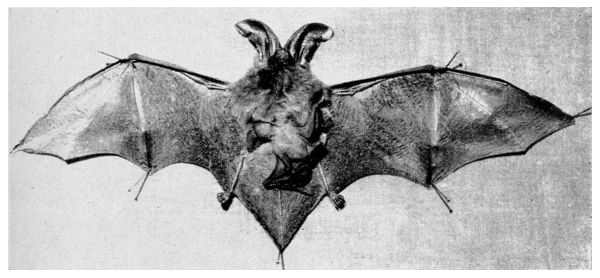
Fig. 41. Long-eared bat (Corynorhinus rafinesquii intermedius), female with young; Boulder Cave, Kittitas County, Washington, July 20, 1928. (Fish and Wildlife Service photo by T. H. Scheffer, No. B-33332.)
Long-eared bats range from southern British Columbia to southern Mexico. Three species are listed by Miller (1924: 82), one of which (rafinesquii) is divisible into five geographic races.
This bat is colonial and is not uncommonly found in caves, mine shafts, and darkened attics of old buildings. It is of scattered distribution throughout the state. In Washington its distribution in winter is unknown. A specimen from Friday Harbor, San Juan County, taken in March, 1936, indicates that it hibernates in the state. Whitlow and Hall (1933: 245) give a detailed account of individuals found hibernating in winter near Pocatello, Idaho.
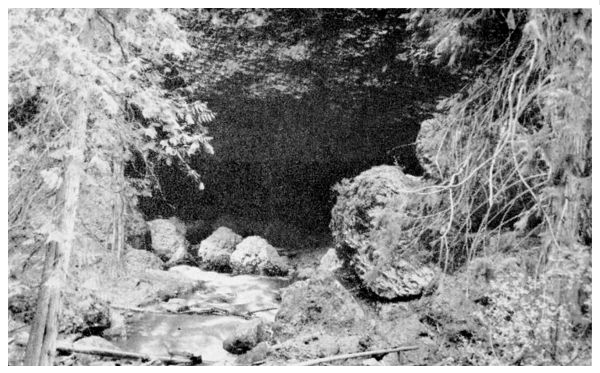
Fig. 42. Entrance to Boulder Cave, inhabited by long-eared bats (Corynorhinus); Kittitas County, Washington, May 26, 1938. (Fish and Wildlife Service photo by Victor B. Scheffer, No. 56.)
John K. Townsend (1839: 325) mentions that the "great-eared bat" at the forts of the Columbia River district (Fort Vancouver) were protected by the "gentlemen of the Hudson's Bay Company for their services in destroying the dermestes which abound in their fur establishments." Townsend mentions also that the long-eared bats seldom left the "storehouses attached to the forts," even at night. My own observations are similar, in that at Boulder Cave, Kittitas County, on July 7, 1936, when not less than 100 long-eared bats were present in the cave, I watched the entrances to the cave until an hour after dark but no bats were seen to emerge. All of the specimens available from Washington were caught in their daytime hiding place. The number of long-eared bats at Boulder Cave has decreased in recent years. On July 12, 1930, bats were so abundant that 90 were captured with a single sweep of a butterfly net (T. H. Scheffer, 1930: 11). On July 7, 1936, it was estimated that there were slightly more than 100 in the cave. On June 11, 1937, the number was less, probably about 75.
Little is known of the food habits of the long-eared bat. The stomach of a specimen from Blakeley Island, San Juan County, was crammed with the remains of insects, including the wing scales of Lepidoptera and the wings of small Diptera.
Scheffer noted that the long-eared bats at Boulder Cave were nearly ready to give birth to young on July 12, 1930, and were carrying naked young a week later. On July 7, 1936, at the same locality, females contained nearly full-term embryos.
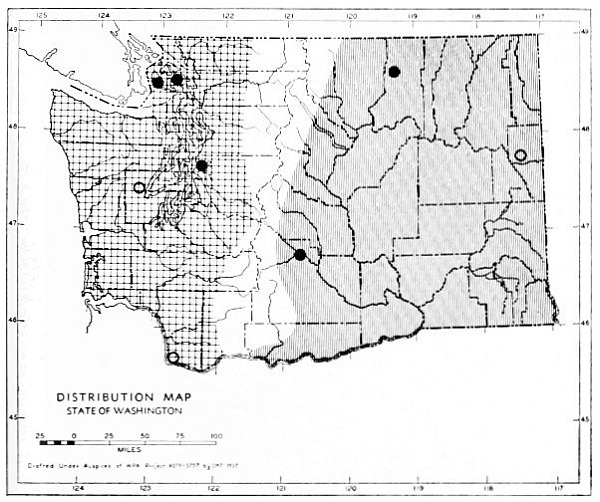
Fig. 43. Distribution of the long-eared bat in Washington. A. Corynorhinus rafinesquii townsendii. B. Corynorhinus rafinesquii intermedius.
Corynorhinus rafinesquii townsendii (Cooper)
Plecotus townsendii Cooper, Ann. Lyc. Nat. Hist. New York, 4:73, November, 1837.
Corynorhinus macrotis townsendii Miller, N. Amer. Fauna, 13:53, October 16, 1897.
Corynorhinus megalotis townsendii G. M. Allen, Bull. Mus. Comp. Zoöl., 60:344, April, 1916.
Corynorhinus rafinesquii townsendii Miller, U. S. Nat. Mus. Bull., 128:82, April 29, 1924.
Type.—Probably obtained at Fort Vancouver, Clark County, Washington; type not now in existence.
Racial character.—Dark color.
Measurements.—A male from Blakeley Island, San Juan County, measured: total length 83; length of tail 43; hind foot 8.5; ear 37.4; tragus 15.1; weight 10 grams.
Distribution.—Western Washington, from Blakeley Island (W. W. D.) in the north, south to Seattle (W. W. D.) and Fort Vancouver.
Corynorhinus rafinesquii intermedius H. W. Grinnell
Corynorhinus rafinesquii intermedius H. W. Grinnell, Univ. California Publ. Zoöl., 12:320, December 4, 1914.
Corynorhinus rafinesquii townsendii Dalquest, Jour. Mamm., 19:213, May 14, 1938.
Type.—Obtained at Auburn, Placer County, California, by J. C. Hawver on July 31, 1909; type in Museum of Vertebrate Zoölogy.
Racial characters.—Paler and duller than townsendii.
Measurements.—One male and 6 females from 15 miles east of Tonasket, Okanogan County, average: total length 96, length of tail 47; hind foot 11; ear 35.5; tragus 14.
Distribution.—Scattered localities in the arid subdivision of the Transition Life-zone of eastern Washington, from 15 mi. E Tonasket (W. W. D.) on the north to Boulder Cave (W. W. D.) on the west and Spokane (W. S. C.) on the east.
Remarks.—Of specimens in the University of Kansas, Museum of Natural History, those from Selah (not plotted on distribution map), Yakima County, are paler than those from Boulder Cave, Yakima County, but both series are paler than specimens from the coast of Oregon.
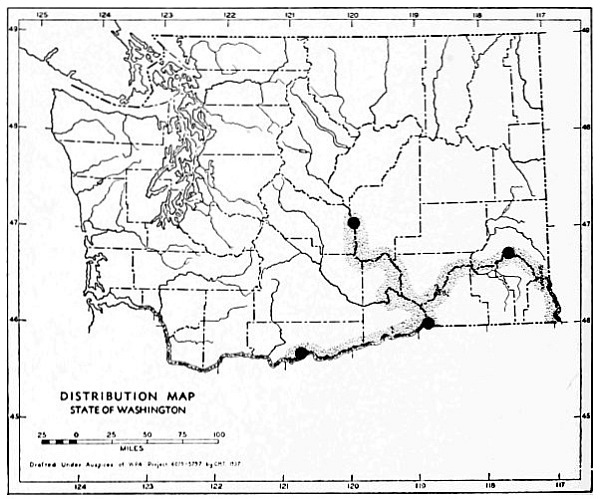
Fig. 44. Distribution of the western pipistrelle, Pipistrellus hesperus hesperus, in Washington.
Pipistrellus hesperus hesperus (H. Allen) Western pipistrelle
Scotophilus hesperus H. Allen, Smithsonian Misc. Coll., 7 (no. 165):43, June, 1864.
Vesperugo hesperus True, Proc. U. S. Nat. Mus., 7:602, 1885.
Pipistrellus hesperus Miller, N. Amer. Fauna, 13:88, October 16, 1897.
Type.—Obtained at Old Fort Yuma, Imperial County, California, by G. H. Thomas; catalogued in U. S. National Museum on October 31, 1861.
Measurements.—A specimen from Maryhill, Klickitat County, measures: total length 68; length of tail 27; hind foot 7; ear 10; height of tragus 3; weight 4.2 grams. Two males from Vantage, Grant County, average: 68.5; 27.5; 6; 11; 4.
Distribution.—Known only from along the Snake and Columbia rivers of south-central Washington; recorded from Vantage (W.W.D.), south to Maryhill (M.V.Z.), and east to Almota (Taylor and Shaw, 1929: 9).
Description.—This is the smallest bat found in Washington, its body being approximately 1-3/4 inches long and the tail 1-1/4. It may be separated from Myotis by the bent tragus and by the possession of 34 rather than 38 teeth. The dental formula is: i. 2-2/3-3, c. 1-1/1-1, p. 2-2/2-2, m. 3-3/3-3 = 34.
The genus Pipestrellus is cosmopolitan in distribution. The few records for the single subspecies found in Washington indicate that it is a casual, though probably regular, summer visitant from the south.
Two western pipistrelles were shot at Vantage, Grant County, on July 23, 1937. They flew in slow circles about 50 feet from the ground. No breeding records are known from the state.
Eptesicus fuscus bernardinus Rhoads Big brown-bat
Eptesicus fuscus bernardinus Rhoads, Proc. Acad. Nat. Sci. Philadelphia, 1901:619, February 6, 1902.
Eptesicus fuscus pallidus Engels, Amer. Midland Nat., 17:656, May, 1936 (part specimens from Washington).
Type.—Obtained near San Bernardino, San Bernardino County, California, by R. B. Herron on May 26, 1893; type in Academy of Natural Sciences of Philadelphia.
Measurements.—Three males and 5 females from Washington average: total length 117; length of tail 48; hind foot 11.5; ear 18.3; height of tragus 9.
Distribution.—Forested areas of the entire state of Washington. Marginal localities are San Juan Island (W.W.D.) in the northwest, Carson (Taylor and Shaw, 1929: 9), in the southwest, Newport (W.W.D.) in the northeast, and Grand Ronde River (Taylor and Shaw, 1929: 9) in the southeast.
Remarks.—Specimens from both eastern and western Washington vary greatly in color, and series of specimens from eastern Washington average little, if any, paler than series from western Washington. Washington specimens most closely resemble specimens from California of the race bernardinus and average darker than pallidus.
Description. The big brown-bat may be distinguished from other bats by its large size (about 4-1/2 inches), rich, brown color, and small ears (reaching only to nostril when laid forward). It possesses 32 teeth, the dental formula being: i. 2-2/3-3, c. 1-1/1-1, p. 1-1/2-2, m. 3-3/3-3 = 32.
Bats of the genus Eptesicus are cosmopolitan in distribution. A single species occurs in North America, of which Engels (1936) recognizes four races in western United States.
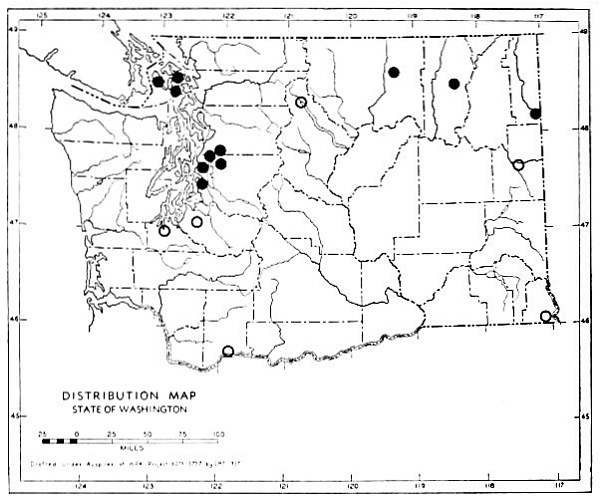
Fig. 45. Distribution of the big brown-bat, Eptesicus fuscus bernardinus, in Washington.
The big brown-bat appears early in the evening, often before the swallows have retired. This, and its large size, makes it relatively easy to study. It is principally a forest bat but also is found in towns and cities. It is common in Seattle and hunts around street lights and about the trees in the city parks. In its more natural habitat it flies over trees and clearings. Big brown-bats were repeatedly timed, with a car's speedometer, at 17 miles an hour as they flew down a road lined with tall trees. This is a greater speed than that at which they usually hunt. When the speed of the car was increased the bats dodged sideways, around the car. At lesser speeds they pulled ahead and escaped.
Big brown-bats are less gregarious, when hunting, than some bats. One or two may be found in a small area, the limits of which are definitely fixed. We noted this repeatedly near Cottage Lake, King County, where the big brown-bats hunted along roads through second-growth conifers. The bats patrolled back and forth along a section of a road about a quarter of a mile in length. When a bat reached the end of its personal territory, it would wheel and return. On six successive trips a bat turned, to retrace its course, at points less than 50 feet distant from the point of the first turn. When the bat approached the turning point on the seventh trip, a bat from the adjoining strip of road approached the area. The two animals fluttered about each other with shrill squeaks, audible 50 feet away. The fluttering and squeaking continued for nearly a minute, after which both bats resumed their hunting. Darkness concluded the observations.
On several occasions we stood on a road patrolled by a big brown-bat. The bat immediately detected the watcher and fluttered about his head and face. Big brown-bats ignore other species of bats hunting on their territory. Indeed, such comparatively slow flyers could scarcely drive the more speedy bats away.
Two Eptesicus, kept in captivity for several weeks, exhibited very different personalities. One was shy and sullen. It cowered in the back of its cage and attempted to bite when handled. It would eat only small quantities of finely scraped liver tendered to it on a spoon. If a bit of liver adhered to its face it would shake violently and refuse to eat more. When it had eaten its fill, it would seize the spoon in its teeth and spill the remaining food. The second specimen was tame and greedy. It ate insects, liver, earthworms, and even pieces of flesh. After two days in captivity it learned to come to the door of its cage at a person's approach and open its mouth, in anticipation of food. If it dropped bits of liver on which it was chewing it would descend from the top of its cage to retrieve them, squeaking indignantly while doing so. It also descended to the floor of the cage to lap water from a dish. It habitually hung head downward from the roof of its cage, but reversed its position when evacuating urine or feces. Engler (1943: 96) discovered that big brown-bats will kill and eat smaller bats, at least in captivity.
Lasiurus cinereus cinereus (Beauvois) Hoary bat
Vespertilio cinereus (misspelled linereus) Beauvois, Catal. Raisonné Mus. Peale, Philadelphia, 1796:18 (p. 15 of English edition by Peale and Beauvois).
Lasiurus cinereus H. Allen, Smithsonian Misc. Coll., 7 (no. 165): 21, 1864.
Atalapha cinerea True, Proc. U. S. Nat. Mus., 7:602, 1885.
Type.—None designated. Type locality Pennsylvania, probably near Philadelphia.
Measurements.—Ten specimens from California average: Total length 130.5; length of tail 54.8; hind foot 10.7; ear 16; height of tragus 9.5; weight (of 3) 20.4 grams.
Distribution.—Recorded from Seattle (W.S.M.) to the north, Westport (W.S.M.) to the west and Pullman (W.S.M.) to the east.
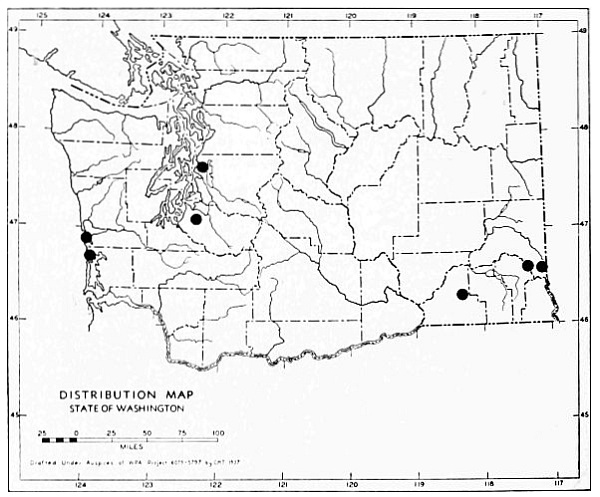
Fig. 46. Record stations for the hoary bat, Lasiurus cinerea, in Washington.
Remarks.—The hoary bat is the largest and most distinctively marked kind of bat in the state. Adults are usually more than 5 inches in total length. The fur is exceptionally long and soft. The wing-membranes are thick and leathery. The posterior half of the wing-membrane is black; the anterior half is pale. The interfemoral membrane is furred. Dorsally the color of the fur is mottled white and seal-brown, giving a silvery-gray effect. The ears are short and thick; the feet short and wide. The dental formula is: i. 1-1/3-3, c. 1-1/1-1, p. 2-2/2-2, m. 3-3/3-3 = 32.
The genus Lasiurus is found in North America, South America, and the Hawaiian Islands. Lasiurus cinereus ranges from British Columbia to southern South America. Osgood (1943: 53) records two subspecies from Chile.
Information on the natural history of the hoary bat is meager. It was observed in the Kettle River Mountains, but none was obtained. It flew erratically and rapidly and did not appear until darkness had set in. At least two were seen above a road through a forest of western larch and ponderosa pine. Probably it breeds in the mountains of northeastern Washington and in the northern Cascades.
The hoary bat is migratory, leaving the state in August and September, rarely lingering until early October. It winters along the coast of central and southern California (Dalquest, 1943: 23).
Antrozous pallidus cantwelli Bailey Pallid bat
Antrozous pallidus cantwelli Bailey, N. Amer. Fauna, 55:391, August 29, 1936.
Type.—Obtained at Rogersburg, Asotin County, Washington, by G. G. Cantwell on May 28, 1918; type in United States National Museum.
Measurements.—A male from the south bank of the Columbia River, opposite Fallbridge, Klickitat County, measures: total length 113; length of tail 40; hind foot 14; ear 36; height of tragus 13; weight 19.8 grams.
Distribution.—Recorded only from localities near the Columbia and Snake rivers in eastern Washington; from Wenatchee (W.W.D.) south and east to Bly and Rogersburg (Taylor and Shaw, 1929: 9).
Description.—Antrozous pallidus is more likely to be confused with Corynorhinus than with any other kind of bat and can be distinguished from Corynorhinus by its larger size (4-1/2 to 5 inches), lighter color, thick and leathery membranes, and shorter, wider ears. Antrozous lacks the prominent "lumps" on the rostrum, characteristic of the long-eared bat. The dental formula is: i. 1-1/2-2, c. 1-1/1-1, p. 1-1/2-2, m. 3-3/3-3 = 28.
The genus Antrozous is confined to western United States and northwestern Mexico. Two species are recognized by Miller (1924: 84). One of these (pallidus) includes three geographic races. A single race is known to occur in Washington.
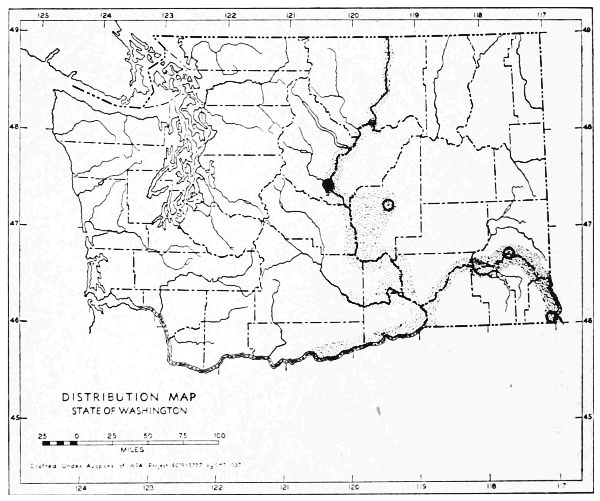
Fig. 47. Distribution of the pallid bat, Antrozous pallidus cantwelli, in Washington.
The pallid bat chooses a crevice in a cliff, cave, or building as its daytime hiding place. Like Corynorhinus, it is colonial. The basalt cliffs of eastern Washington offer such ideal hiding places that pallid bats are seldom seen and consequently little is known of their habits. In the southwestern United States, pallid bats are more abundant and better known. H. W. Grinnell (1918: 355) notes that the floor of a roost of pallid bats was strewn each morning with the heads, wings, and legs of insects. Most numerous were the remains of the Jerusalem cricket (Stenopelmatus), a flightless insect that the bats must have secured on the ground. Engler (1943: 96) found that in captivity, pallid bats would kill and eat smaller bats and lizards confined with them.
Bailey (1936: 392) believes that the young of this bat are born in late June and early July. One or two young constitute a litter.
Ursus americanus Pallas Black bear
Description.—The black bear is the largest carnivore found in Washington if the grizzly is extinct there. The exact size of the adult male black bear is somewhat in question. Few actual weights are on record of Washington bears. Grinnell, Dixon and Linsdale (1937: 101) paid special attention to the maximum weight of black bears in California and concluded that few ever exceeded 500 pounds. The total length of the largest black bear among specimens from the entire Pacific Coastal area, especially from California and Alaska, they give as 5 feet, 10 inches (op. cit., p. 102). It may safely be assumed that few individuals ever reach a length of six feet. Females are smaller; recorded weights of adults rarely exceed 350 pounds. The largest males have hind feet from 10 to 10-1/2 inches in length.
Fig. 48. Female black bear (Ursus americanus altifrontalis), and two cubs, near Big Four Inn, Mt. Baker National Forest, Washington, July, 1939. (Forest Service photo by R. L. Fromme.)
The black bear, including its closely related species, the Mexican bear, Ursus machetes, ranges over Alaska, Canada, the United States and northern Mexico. The distinction between the black and grizzly bears has been listed under the account of Ursus chelan.
The fur of black bears in the Cascade Mountains in the fall is long, sleek and glossy but rather stiff. In the spring and early summer the fur of animals at Mount Rainier often appeared coarse, wooly and patchy or rubbed on older animals. Some smaller bears possessed sleek, well-groomed pelts. Bears from the lowland areas are said to possess poor pelts because of constant abrasion in the forests. In the fall, when the salmon are spawning, the bears are said by trappers to roll in decayed fish until they "smell so bad you can't come near them" and their fur is matted and "crawling with lice."
It is now known that the cinnamon bear, sometimes called brown bear, is merely a color phase of the black bear. The brown phase varies in color from a rich, dark reddish brown to a pale cinnamon brown. Cowan (1938: 204) has recorded the geographic variation in the brown and black coats of the bears of British Columbia and, in part, of Washington. On the Olympic Peninsula the brown phase is rare. Old residents have told me of seeing but a few brown bears in their life. I have seen only black bears in the lowlands of western Washington. Cowan (loc. cit.) lists 1,197 black and 79 brown bears from Fort Nisqually, Pierce County, between 1834 and 1852. In the Cascade Mountains the brown phase is not uncommon, perhaps one out of five bears seen being brown. In northeastern Washington the brown and black phases are about equal in number, and some trappers state that the browns are more numerous. Cowan lists 3,813 black and 2,871 brown bears from Fort Colville between 1826 and 1856.
The black bear occurs in a variety of habitats in Washington. It seems to be absent only from the treeless areas of eastern Washington, and is most abundant in the Cascade Mountains and Olympic Mountains where food is abundant and men are few. It is not uncommon throughout the timbered lowlands of northeastern Washington and western Washington, however, and shows a surprising ability to exist unnoticed near the larger cities. In the dense, junglelike forests of southwestern Washington it is numerous. Jackson (1944: 1) estimates that 13,679 black bears live in Washington, more than in any other state.
The habits of the black bear have changed greatly where it has come into contact with man. At Mount Rainier National Park black bears now ignore people, save to beg for food. In the Cascades the bears are wild but so seldom see men that in many places they live much as they did hundreds of years ago. In the lowlands of western Washington they are in daily contact with evidence of man or his guns. As a result they are silent and shy, rarely being seen.
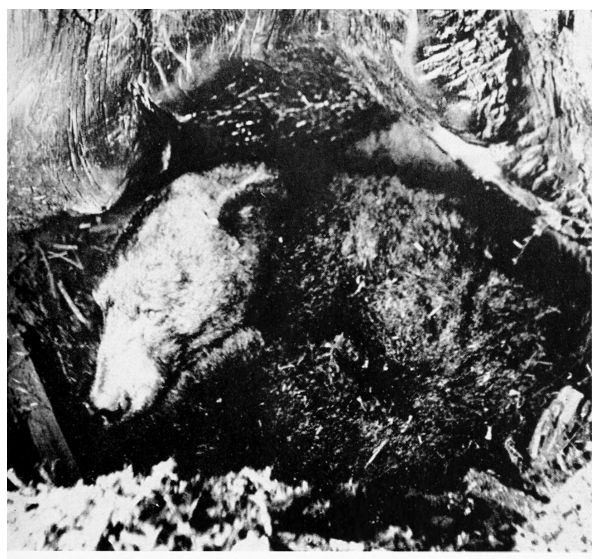
Fig. 49. Black bear (Ursus americanus altifrontalis), in "hibernation," Mt. Baker region, Washington, about 1936. (John E. Candle photo, courtesy "Field and Stream.")
The black bear in the mountains is active sometimes by day and sometimes by night. Probably it is principally nocturnal but active by day only when the food obtained at night is insufficient to meet the needs of the animal. In the lowlands it is almost completely nocturnal. In the mountains it enters upon its winter sleep with the first snows or, if the snows are late, when the huckleberries are gone. Ordinarily black bears are in "hibernation" by the middle of November. In the lowlands of western Washington they are active until after the salmon spawning season, and probably do not "hibernate" before the middle of December and may not do so at all. In the mountains they emerge from the winter sleep in May; in the lowlands they emerge in February or March.
The black bear is omnivorous in the truest sense of the word. Because the animal is of large size it requires much nourishment. This is obtained by eating large quantities of material with low food value. Material eaten passes rapidly through the digestive tract and often only easily digested parts seem to be utilized. Feces commonly contain complete and undigested berries and seeds or almost undigested pieces of apples or other fruit.
The principal food of the black bear in Washington is berries. Many species are eaten, but the huckleberry (Vaccinium sp.) is favored. Other food items are: Gaultheria shallon (pulpy fruit); Oregon grape, Berberis nervosa (flowers and fruit); salmonberry, Rubus parviflorus (leaves and fruit); leaves of several plants, including Rubus macropetalus and other thorny kinds; grass, succulent plants, and roots. Insects are eaten and most feces show remains of a few. In June, 1938, near Cle Elum, Kittitas County, a species of sword-tailed cricket fully two inches in length was abundant, and droppings of a bear there were composed entirely of the remains of these crickets. Fish, especially spawning salmon, are important food. When salmon are spawning the bears in the vicinity feed on nothing else. Warm-blooded vertebrates probably are eaten but none of the many bear droppings examined by me contained remains of birds or mammals. Bennett, English and Watts (1943: 30) found few mammals to be eaten by bears studied by them in Pennsylvania. Locally bears kill pigs and sheep, smash bee-hives and raid fruit trees.
The large size and sometimes awkward appearance of black bears combine to give a comic note to some of their natural actions. A bear in full flight, lumbering along a trail with head swinging from side to side and hind feet stretching past the forelegs at each stride, is more apt than not to amuse the observer. Near Stevens Pass, a large black bear was observed lying on its back in a mud wallow. This was an oval opening in the ground in a meadow of heather and huckleberry near a small stream. The wallow was approximately 5 feet long, 3 feet deep and 4 feet wide. The bear was immersed in muddy water with only its head and feet visible. It seemed well content and comfortable, shifting its bulk occasionally and waving its paws. When a stray breeze brought to the bear the scent of my companion and myself the animal's contentment vanished and it hastily made a frantic effort to depart. It had wedged itself deeply in the hole, and as it twisted and turned in attempting to sit up, waves of water gushed from the wallow. Eventually escaping from its wallow, the bear half ran and half rolled to the cover of alders 100 feet away. This particular wallow had been in use by bears for some time, as was attested by old droppings at its edge and by its well-worn condition.
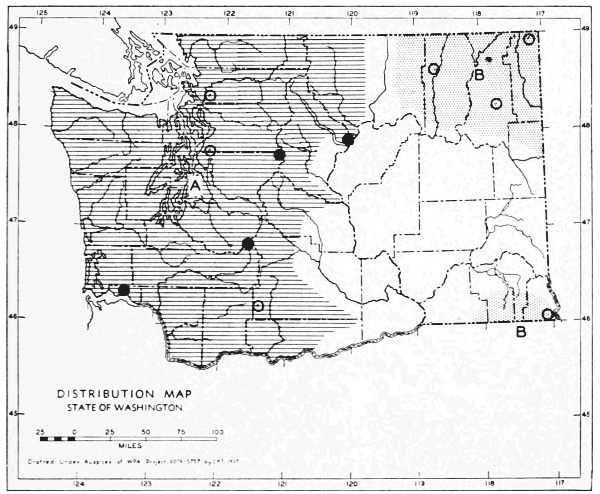
Fig. 50. Distribution of the black bear in Washington. A. Ursus americanus altifrontalis. B. Ursus americanus cinnamomum.
The fact that Washington has the largest population of black bears of the states in the union is due, largely, I feel, to abundant natural cover, food, such as salmon and huckleberries, and an intelligent game code. In California and some other states the black bear has been considered a fur bearer, to be trapped with steel traps. This is permitted in spite of the fact that their pelts bring but a few dollars, usually less than ten. Their sale scarcely repays the trapper for his labor in preparing the hide. Townsend (1887: 182) remarked on the ease with which bears could be trapped in California although in the same area they were so shy that they could seldom be shot. As a result of trapping, the number of bears in some states has been dangerously reduced. In Washington the bear is a game animal, to be hunted with a rifle for a few weeks in the fall when the pelt and flesh are at their best. As a result bears are numerous and can be hunted with fair chances of success.
Ursus americanus altifrontalis Elliot
Ursus altifrontalis Elliot, Field Columb. Mus. Publ. 80, zoöl. ser. 3:234, June, 1903.
Euarctos altifrontalis Miller, U. S. Nat. Mus. Bull., 128:90, April 29, 1924.
Ursus americanus americanus Taylor and Shaw, Mammals and Birds of Mount Rainier National Park, U. S. Nat. Park Service, Washington, p. 37, 1927.
Euarctos americanus altifrontalis Bailey, N. Amer. Fauna, 55:321, August 29, 1936.
Ursus americanus altifrontalis Hall, Univ. California Publ. Zoöl., 30:232, March 2, 1928.
Type.—Obtained at Lake Crescent, Olympic Peninsula, Clallam County, Washington, by D. G. Elliot in 1898; type in Field Museum of Natural History.
Racial characters.—Color dark, almost always black instead of brown; skull wide, high and heavy; molar teeth wide and heavy.
Distribution.—From the eastern base of the Cascade Mountains westward to the Pacific. Marginal occurrences are Chelan (W.W.D.) and Signal Peak (Taylor and Shaw, 1929: 10).
Ursus americanus cinnamomum Audubon and Bachman
Ursus americanus var. cinnamomum Audubon and Bachman, Quadrupeds of North America, 3:125, 1854.
Euarctos cinnamomum Miller, U. S. Nat. Mus. Bull., 128:91, April 29, 1924.
Euarctos americanus cinnamomum Bailey, N. Amer. Fauna, 55:319, August 29, 1936.
Ursus americanus cinnamomum Hall, Univ. California Publ. Zoöl., 30:232, March 2, 1928.
Type.—Obtained near the mouth of Jim Ford Creek, Lower Clearwater River, western Idaho (Bailey, 1936: 319) by Lewis and Clark on May 31, 1806.
Racial characters.—Resembling altifrontalis but skull and molar teeth narrower; color even in black phase paler and browner; brown and black phases of approximately equal incidence.
Distribution.—Northeastern Washington and the Blue Mountains of southeastern Washington, occurring westward as far as Republic (Taylor and Shaw, 1929: 10).