ACCOUNTS OF SPECIES AND SUBSPECIES (continued 5)
Reading edition
Peromyscus maniculatus oreas Bangs
Peromyscus oreas Bangs, Proc. Biol. Soc. Washington, 12:84, March 24, 1898.
Peromyscus akeleyi Elliot, Field Columb. Mus. Publ. 30., zoöl. ser., 1:226. February 1, 1899 (type from Elwha River, Olympic Mountains, Washington).
Peromyscus maniculatus oreas Osgood, N. Amer. Fauna, 28:51, April 17, 1909.
Type.—Obtained on Church Mountain, 6,500 ft., Mt. Baker Range, near the U. S. boundary, British Columbia, by Allan Brooks on August 29, 1896; type in Museum of Comparative Zoölogy.
Racial characters.—Size large; tail more than 50 per cent of total length; color of upper parts reddish.
Measurements.—Twenty-five males and 15 females average: total length 202; length of tail 110; hind foot 22.6; ear 18.7.
Distribution.—From the Cascade Mountains west to the Pacific Ocean, save for the Puget Sound area and a narrow band extending southward nearly to the Columbia River. Marginal localities along the west side of Puget Sound are: Deer Park (W.W.D.), Lake Cushman (W.W.D.), and Kelso (M.V.Z.). Marginal localities on the west side of the Cascade Mountains are: Tomyhoi Lake (W.W.D.), Forks of Skykomish River (W.W.D.), North Bend (W.W.D.), Mt. St. Helens (V.B.S.) and Yacolt (M.V.Z.). Marginal localities on the east slope of the Cascade Mountains are: Grouse Creek (W.W.D.), Lake Wenatchee (W.W.D.), Easton (W.W.D.), Morrison Springs Ranger Station (W.W.D.) and Wind River C.C.C. Camp (W.W.D.).
Peromyscus maniculatus hollisteri Osgood
Peromyscus maniculatus hollisteri Osgood, N. Amer. Fauna, 28:62, April 17, 1909.
Type.—Obtained at Friday Harbor, San Juan Island, San Juan County, Washington, by N. Hollister on October 23, 1903; type in United States National Museum.
Racial characters.—Similar to oreas but darker, less reddish, and with much shorter tail. Length of tail about 40 per cent of total length.
Measurements.—Populations of deer mice on the various islands vary slightly in average measurements. The average measurements of 10 males and 10 females from San Juan Island, 20 males and 15 females from Blakeley Island, and 20 males and 15 females from Cypress Island, are respectively: total length 189, 183, 179; length of tail 87, 82, 79; hind foot 22.8, 22, 19.5; ear 19.4, 18.7, 19.5; weight 33, 29, 32 grams.
Distribution.—The San Juan Islands, San Juan and Skagit counties, in northern Puget Sound.
Peromyscus maniculatus austerus (Baird)
Hesperomys austerus Baird, Proc. Acad. Nat. Sci. Philadelphia, 7:336, 1855.
Sitomys americanus austerus Allen, Bull. Amer. Mus. Nat. Hist., 5:192, August 18, 1893.
P[eromyscus]., austerus Bangs, Amer. Nat., 31:75, January 1, 1897.
Peromyscus maniculatus austerus Osgood, N. Amer. Fauna, 28:63, April 17, 1909.
Type.—Obtained at Old Fort Steilacoom, Pierce County, Washington, by J. G. Suckley, probably on January 20, 1854; type in United States National Museum.
Racial characters.—Similar to oreas but smaller with relatively shorter tail; tail narrower at base, less sharply bicolor; upper parts duller, browner, less reddish. In oreas the tail is usually more than 100 mm. In austerus the tail is usually less than 90 mm.
Measurements.—Twenty-seven males and 23 females from Seattle, King County, average: total length 180.5; length of tail 88.6; hind foot 21; ear 18. The average weight of 15 adults is 21 grams.
Distribution.—The Puget Sound area and south to the Columbia River in a narrow band through the lowlands. Marginal localities on the west side of Puget Sound are: Port Angeles (W.W.D.), Bremerton (W.W.D.), 4 miles north of Shelton (W.W.D.), Tenino (W.W.D.) and Mouth of Klama River (M.V.Z.). Marginal localities on the east side of Puget Sound are: Bellingham (W.W.D.), Arlington (W.W.D.), Everett (W.W.D.), 4 miles east of Monroe (W.W.D.), Fall City (W.W.D.), and Vancouver (W.W.D.).
Peromyscus maniculatus rubidus Osgood
Peromyscus oreas rubidus Osgood, Proc. Biol. Soc. Washington, 14:193, December 12, 1901.
Peromyscus maniculatus rubidus Osgood, N. Amer. Fauna, 28:65, April 17, 1909.
Type.—Obtained at Mendocino City, California, by J. A. Loring on November 17, 1897; type in United States National Museum.
Racial characters.—Closely similar to austerus but paler with longer skull. Specimens from Washington are almost purplish-brown in appearance.
Measurements.—Six males and 2 females from Puget Island, Wahkiakum County, average: total length 177; length of tail 89; hind foot 21.9; ear 18.7.
Distribution.—This is the deer mouse of the humid coastal belt of Oregon and California. It enters Washington only at Puget Island, Wahkiakum County, in the Columbia River.
Peromyscus maniculatus gambelii (Baird)
Peromyscus gambelii Baird, Mamm. N. Amer., Pacific R. R. Reports, 8:464, 1857.
Sitomys americanus gambelii Allen, Bull. Amer. Mus. Nat. Hist., 5:190, August 18, 1893.
P[eromyscus]., t[exanus]. gambelii Mearns, Proc. U. S. Nat. Mus., 18:446, March 25, 1896.
Peromyscus maniculatus gambeli Osgood, N. Amer. Fauna, 28:67, April 17, 1909.
Type.—Obtained at Monterey, Monterey County, California, by W. P. Trowbridge; skin catalogued on January 4, 1853; type in United States National Museum.
Racial characters.—Size small; tail short; color pale, varying from buffy gray to rich buff; rarely dark reddish brown.
Measurements.—Twenty-five males and 15 females average: total length 160; length of tail 71; hind foot 19.8; ear 17.7.
Distribution.—The Columbian Plateau. Intergradation with oreas occurs between the Columbia River and the Cascade Mountains. Marginal records on the west are: Chelan (W.W.D.), Leavenworth (W.W.D.), Cle Elum (W.W.D.), Satus Pass (W.W.D.), Lyle (V.B.S.). Marginal localities on the north are: Chelan (W.W.D.), 5 miles north of Coulee (W.W.D.), Sprague (V.B.S.) and Steptoe Butte (M.V.Z.).
Peromyscus maniculatus artemisiae (Rhoads)
Sitomys americanus artemisiae Rhoads, Proc. Acad. Nat. Sci. Philadelphia, p. 260, October 23, 1894.
Peromyscus texanus artemisiae Miller and Rehn, Proc. Boston Soc. Nat. Hist., 30:84, December, 1901.
Peromyscus maniculatus artemisiae Osgood, N. Amer. Fauna, 28:58, April 17, 1909.
Type.—Obtained at Ashcroft, British Columbia, by S. N. Rhoads on July 5, 1892; type in Philadelphia Academy of Sciences.
Racial characters.—Similar to gambelii but darker, more reddish; often with longer tail.
Measurements.—Ten males and 10 females from northeastern Washington average: total length 167; length of tail 80; hind foot 20; ear 17.8.
Distribution.—Northeastern Washington and the Blue Mountains of southeastern Washington, extending west, in northeastern Washington, to Conconully (W.W.D.) and south to Duly Lake (W.W.D.).
Neotoma cinerea Ord Bushy-tailed wood rat
Description.—The bushy-tailed wood rat is slightly larger than the common Norway or brown rat. The head and body measure about 12-1/2 inches and the tail about 3-1/2 inches. It resembles the deer mouse in general proportions. The ears are large and naked and the black eyes are large and protruding. The tail is bushy, squirrel-like. The feet are small and have furry soles. The fur is soft and silky. Adults are brownish gray above with white underparts and a gray tail. Young individuals have blue-gray upper-parts.
Wood rats range over most of North America. They exhibit great variation, especially in the southwestern United States. The bushy-tailed species occurs in the western United States and Canada. Wood rats are notorious for invading buildings in the mountains and in the desert. However, their natural habitat is broken rock or talus. This habitat preference accounts for their distribution in Washington, for talus is common except in the humid subdivision of the Transition Life-zone. Wood rats are probably most abundant in the talus slides of the Columbian Plateau, especially in the canyon of the Columbia River and in Moses and Grand coulees. They are common in all the mountainous areas in the state where high altitudes and steep slopes result in the accumulation of talus. Wood rats range from sea level to 10,000 feet elevation on Mount Rainier and from the Upper Sonoran to the Arctic-alpine life-zones. Great horned owls and probably all of the carnivores that share the range of the wood rat prey on it to some extent. Sperry (1941: 15) lists Neotoma in four per cent of 8,339 coyote stomachs gathered throughout the United States.
Wood rats in Washington are definitely nocturnal and are rarely seen in daylight. On January 10, 1939, however, near Colville, Stevens County, a companion and I were sitting on the porch of a deserted shack eating lunch. Suddenly a wood rat darted out of the open door into the full sunlight and tugged at a can, containing a few drops of tomato juice, which one of us was holding in his hand. When the rat looked up and saw the human, it hastily retreated. The wood rat has a habit of flattening its body tightly against the ground when observed and also of "drumming" with its feet when excited. This habit is shared by the snowshoe rabbit and the spotted skunk. A captive specimen "drummed" by lifting its back feet, alternately, about one-half inch from the surface of a piece of wood and striking downward with surprising power. The agility of the wood rat was demonstrated near Wallula where we watched a specimen by the light of a flashlight as it climbed an almost vertical rock wall, taking advantage of small fractures for toe-holds.
Wood rats are far from noiseless in their nocturnal activities. Near Moses Coulee, Douglas County, wood rats were heard from a distance of 50 feet as they scampered back and forth through a concrete culvert under the highway.
Many species of wood rats build complicated stick houses in which they live. In Washington, elaborate stick houses are sometimes built but are usually not occupied. In the attic of an old building near Pend Oreille Lakes, Stevens County, two large and complicated houses were discovered. These were built of sticks, paper and other debris and measured more than three feet in diameter. Three small, cup-shaped nests resembling those of a bird, made of soft grasses, moss, and shredded paper were found on the attic floor ten feet or more from the stick houses. These nests gave every indication of being used, while the piles of sticks contained no nests and seemed never to have been occupied. Near Moses Lake, Grant County, a wood rat house built in the rafters of an old shed was constructed entirely of tumbleweeds (Salsola pestifer). This house was spherical in shape and measured more than five feet in diameter. It appeared to be unoccupied and a wood rat, probably its builder, was living under the floor of the shed. Most wood rat houses consist of a half-dozen sticks arranged in a crevice in a rock pile or a cave. Wood rats were placing fresh material on a house in the Wenatchee National Forest on January 17, 1939, when there was two feet of snow on the ground and the temperature was hovering around zero. The house measured about one cubic yard and consisted of Ceanothus leaves and steins, with some twigs of fir (Abies). It was built under a bunk in a broken-down cabin left by deer hunters.
The collecting habit of the wood rat has gained it the name "pack-rat." Taylor (1920A: 91) lists the following materials from a wood rat nest on Mt. Rainier: Nesting material: rags, leaves, paper, thumb of a glove, string, thongs, oakum; Food: apple core, onion peel, bacon rind, raisins, 10 bars of chocolate, figs, puff balls, bread crust, meat scraps, cantaloupe rind, potatoes, dried apricots, lemons, mushrooms, beans, peanuts, banana, 15 lumps of sugar; Miscellaneous: dime, coffee can cover, paraffin from jelly glass, bones, 19 pieces of candles and several cakes of soap.
As a rule only one or two wood rats are trapped at a given locality, indicating that the species is not gregarious. The presence of wood rats in a building, cave, mine tunnel, or talus slide can be detected in several ways. The white, mineral-like incrustation formed by the urine of many generations of wood rats is usually conspicuous on rocks near their homes. A strong musky odor pervades the atmosphere in every habitat occupied by wood rats. Wood rat feces, consisting of hard, black cylinders one-half inch long and three-sixteenths of an inch in diameter, are invariably found scattered on stones or exposed areas of ground.
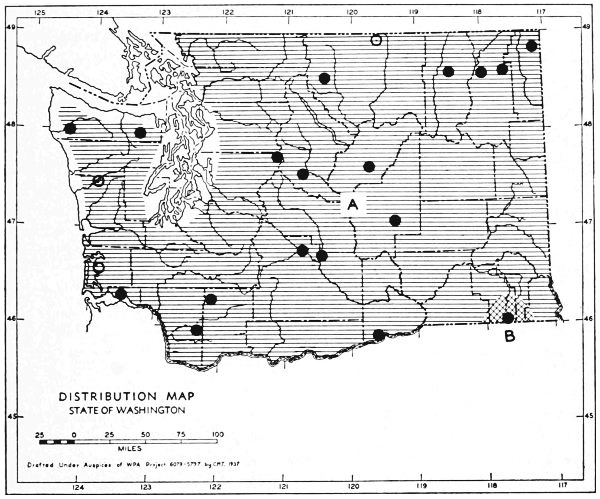
Fig. 108. Distribution of the bushy-tailed wood rat in Washington. A. Neotoma cinerea occidentalis. B. Neotoma cinerea alticola.
The food of the bushy-tailed wood rat is varied and includes insects and vegetation. A captive specimen that escaped in the University of Washington Zoölogical Laboratories killed and ate a number of lizards.
Embryos found from April 18 to June 14 varied in number from 3 to 5.
Neotoma cinerea occidentalis Baird
Neotoma occidentalis Baird, Proc. Acad. Nat. Sci. Philadelphia, p. 335, 1855.
Neotoma cinerea occidentalis Merriam, N. Amer. Fauna, 5:58, July 30, 1891.
Type.—Obtained at Shoalwater Bay (Willapa Bay), Pacific County, Washington, by J. G. Cooper, in June, 1854; type in United States National Museum.
Racial characters.—Size large; color of upper parts cinnamon brown.
Measurements.—A male and a female from Glade Creek, 1/2 mile north of the Columbia River, Benton County, measure, respectively: total length 425, 395; length of tail 181, 176; hind foot 50, 44; ear 32, 31; weight 532.5, 330.0 grams.
Distribution.—Throughout the state except in the Blue Mountains.
Remarks.—Specimens from the Olympic Mountains and western Washington are slightly duller-colored than specimens from eastern Washington and young from western Washington are more bluish, less gray, than young individuals from the Columbian Plateau. The specimens from the Columbian Plateau show some resemblance to alticola. Specimens from northeastern Washington are more like typical occidentalis.
Neotoma cinerea alticola Hooper
Neotoma cinerca alticola Hooper, Univ. California Publ. Zoöl., 42:409, May 17, 1940.
Type.—Obtained at Parker Creek, 5,500 ft., Warner Mountains, Modoc County, California, by N. B. Stern on June 22, 1916; type in Museum of Vertebrate Zoölogy.
Racial characters.—Similar to Neotoma c. occidentalis but slightly paler, with paler hind feet and narrower sphenopalatine vacuities.
Measurements.—A female from Stay-a-while Spring, Columbia County, measures: total length 387; length of tail 171; hind foot 43; ear 33; weight 330 grams.
Distribution.—Southeastern Washington, south of the Snake River.
Remarks.—The only adult specimen available from the Blue Mountains shows well the characters attributed to alticola.
Synaptomys borealis wrangeli Merriam Northern lemming mouse
Synaptomys (Mictomys) wrangeli Merriam, Proc. Biol. Soc. Washington, 10:63, March 19, 1896.
Synaptomys (Mictomys) truei Merriam, Proc. Biol. Soc. Washington, 10:62, March 19, 1896 (type from Skagit Valley, Skagit County, Washington).
Synaptomys borealis wrangeli Howell, N. Amer. Fauna, 50:26, June 30, 1927.
Type.—Obtained at Wrangel, Alexander Archipelago, Alaska, by C. P. Streator on September 6, 1895; type in United States National Museum.
Racial character.—Dark color.
Distribution.—The northwestern Cascades, from Mt. Baker northward.
Remarks.—The relationship of this race to artemisiae remains to be worked out.
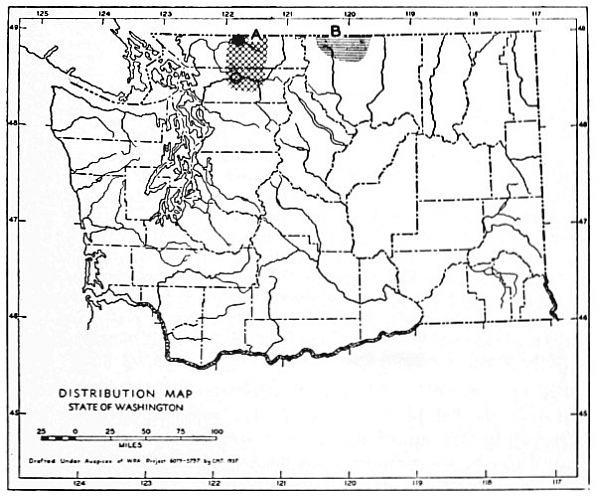
Fig. 109. Distribution of the northern lemming mouse in Washington. A. Synaptomys borealis wrangeli. B. Possible range of Synaptomys borealis artemisiae.
Description.—Lemming mice may be recognized by their short, thick bodies, slightly larger than the bodies of the common house mouse (Mus); short tails, which are less than 20 per cent of their total length; small, inconspicuous ears; and grooved upper incisors.
Mice of the genus Synaptomys range over much of boreal North America. Two species and eleven races are recognized by Howell (1927B: 9). Synaptomys borealis ranges westward across Canada from Labrador to the Pacific Coast and from Alaska south to Washington. The lemming mice are terrestrial and inhabit runways similar to those of meadow mice (Microtus). They are alpine in distribution. Shaw (1930: 7-10) found them among typical annual herbs in a cold, boggy mountain valley. Other than this, nothing is known of the species in Washington. Indeed little is known of the life history of any member of the genus.
The lemming mouse possesses four pairs of mammae, two pectoral and two inguinal. It is the most primitive of the microtines. It seems to be of boreal origin but is not known from the Old World. It was evidently forced southward by the Pleistocene glaciers into Washington and is now retreating northward in the wake of the ice. The only specimens recorded from Washington are from the northern border of the state.
Phenacomys intermedius Merriam Heather vole
Description.—Heather voles are heavy-bodied, short-legged mice, closely similar in general appearance to other microtines that occur in Washington. Their dull, brownish upper parts, lacking a distinct reddish dorsal stripe, separate them from the red-backed mice (Clethrionomys) and the lack of grooves on their upper incisors separates them from Synaptomys. Their relatively short tail (30 per cent or less of their total length) separates them from most meadow mice (Microtus). There are no external characters which serve to separate them from all species of Microtus and the teeth must be examined certainly to identify Phenacomys. In Microtus the angles between the cusps of the inner and outer sides of the lower molars are of approximately equal depth, but in Phenacomys the angles on the inner side of the lower molars are at least twice as deep as those of the outer side of the jaw. In addition the molars of Phenacomys are rooted while those of Microtus are not.
The heather voles and their relatives are primitive microtines that range through boreal North America including the higher parts of the Rocky Mountains and the cool area along the Pacific Coast. Several species are included in the genus: an arctic form (ungava), a lowland Pacific Coastal species (albipes), two tree-inhabiting species (longicaudus and silvicola) and a mountain species (intermedius). Thus far only intermedius has been found in Washington but further search may reveal that one or more of the arboreal species and possibly albipes are also present.
Heather voles are alpine animals, seldom occurring below the Hudsonian Life-zone. They are rare as compared with most microtines, and are seldom taken in traps, even by the experienced collector of small mammals. Evidence of their presence is most often found in the dense meadows of heather (Cassiope and Phyllodoce) high on the mountains. Here their feces, runways, and old winter nests are not uncommon, and heather voles may be far more abundant than trapping records indicate. They are not restricted to the vicinity of heather, however, for one of my specimens was taken in a marshy willow thicket near Stevens Pass in King County, one in a patch of skunk-cabbage in a grassy glacial cirque near Tomyhoi Lake in Whatcom County, and one at the edge of a snowbank on a steep hillside at Deer Park, Clallam County. In each of these places, however, there were heather meadows within a thousand yards. Shaw (1924A: 12-15) also found the heather mouse on "comparatively dry hill slopes" and reports that it "rather characteristically occurs in such log-tangled areas as former fire zones."
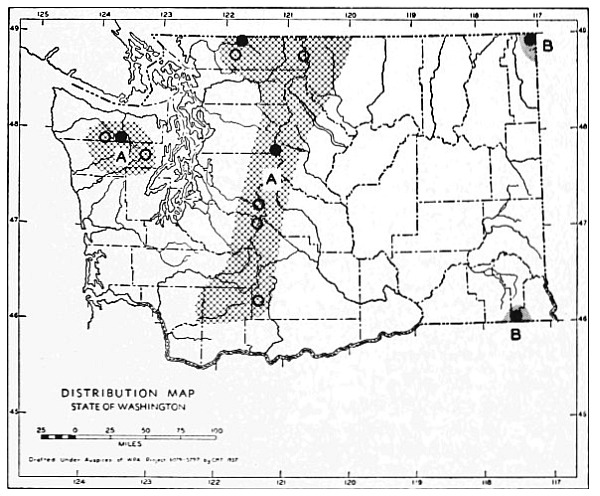
Fig. 110. Distribution of the heather vole in Washington. A. Phenacomys intermedius oramontis. B. Phenacomys intermedius intermedius.
The winter nests of Phenacomys intermedius are placed on the surface of the ground and in the season when occupied are deeply buried under the snow. They are spherical or oval in shape, six to eight inches in diameter and with a side entrance. One examined by Shaw was "formed of white heather twigs, the interstices being filled with leaves of huckleberry." It was "lined with finely shredded grass." All those examined by me were composed of grass and lichens.
The principal foods of the heather vole seem to be white heather (Cassiope mertensiana) and huckleberry (Vaccinium). Red heather (Phyllodoce empetriformis) is not eaten. Shaw also lists beargrass (Xerophyllum tenax) and lousewort (Pedicularis) as eaten.
A burrow excavated and figured by Shaw, was slightly more than a yard long and contained four young in a nest situated but a few inches from one of the three entrances. The nest was made of grass and moss. A female taken at Tye, King County, contained 4 embryos on May 28, 1939. One taken at Pass Creek Pass, Pend Oreille County, contained 3 small embryos on June 14, 1938.
Phenacomys intermedius intermedius Merriam
Phenacomys intermedius Merriam, N. Amer. Fauna, 2:32, October 30, 1889.
Phenacomys intermedius intermedius Howell, N. Amer. Fauna, 48:15, October 12, 1926.
Type.—Obtained 20 miles north-northwest of Kamloops, 5,500 ft. elevation, British Columbia, by G. M. Dawson on October 2, 1888; type in United States National Museum.
Racial characters.—Size small; color of upper parts brownish gray; skull small.
Measurements.—A female from Pass Creek Pass, Pend Oreille County, measured: total length 127; length of tail 29; hind foot 17; weight 25 grams.
Distribution.—Known only from extreme northeastern Washington at Pass Creek Pass (W.W.D.) and the Blue Mountains.
Phenacomys intermedius oramontis Rhoads
Phenacomys oramontis Rhoads, Amer. Nat., 29:941, October, 1895.
Phenacomys olympicus Elliot, Field Columb. Mus. Publ. 30, zoöl. ser., 1:225, February 1, 1899 (type from Happy Lake, 5,000 ft., Clallam County, Washington).
Microtus (Lagurus) pumilus Elliot, Field Columb. Mus. Publ. 30, zoöl. ser., 1:226, February 1, 1899 (type from Happy Lake, 5,000 ft., Clallam County, Washington).
Phenacomys intermedius olympicus Howell, N. Amer. Fauna, 48:21, October 12, 1926.
Phenacomys intermedius oramontis Anderson, Canadian Field Nat., 56:59, June 8, 1942.
Type.—Obtained on Church Mountain, 6,000 ft., Mt. Baker Range, British Columbia, just north of international boundary, by A. C. Brooks on August 6, 1895; type in Philadelphia Academy of Natural Sciences.
Racial characters.—Similar to intermedius but darker, browner above and deeper gray beneath; skull large and heavy.
Measurements.—A female from Tye, King County, measures: total length 152; length of tail 40; hind foot 19; ear 12. A female from Tomyhoi Lake, Whatcom County, measures: 170; 45; 20; 15.
Distribution.—The Cascade and Olympic mountains, from Tomyhoi Lake (W. W. D.) on the north, to Mt. Adams (Taylor and Shaw, 1929:23) on the south.
Clethrionomys gapperi (Vigors) Gapper red-backed mouse
Description.—Red-backed mice are heavy-bodied, short-tailed and short-legged mice, similar in general appearance to the meadow mice (Microtus). Unlike the meadow mice, they possess rooted molars, a primitive character. They do not have grooved incisors, like Synaptomys, or the great difference in the depth of the angles of the lower molars that characterizes both Synaptomys and Phenacomys. Externally Clethrionomys may be recognized by the broad red dorsal area from which they obtain their common name. Their sides are grayish or dusky and the undersides buffy white.
The red-backed mice, including more than one species, range over the boreal parts of the Old and New World. In America they are found in most of Alaska, Canada and the northern United States, and extend southward in the Rocky Mountains and along the Pacific Coast. The one species Clethrionomys gapperi ranges across southern Canada from the Atlantic to the Pacific, extending southward in forested areas to New Mexico. They usually live in clearings in the forest. In the Pend Oreille Mountains saturatus was common in damp, mossy talus slides, along with Microtus longicaudus and Phenacomys intermedius. The Clethrionomys outnumbered the two latter species combined by 25 to 1. In nearby forest, red-backed mice were scarce but no other microtines were found. In the Kettle River Mountains a week later, red-backed mice were rare. A single specimen was taken in a damp place in the forest; none was found in talus slides. Near Stevens Pass, King County, in the Cascades, cascadensis was taken in equal numbers in talus slides and under logs in the forest. Near Dewey Lake, Yakima County, in the Cascades, I took them only in an extensive grassy meadow. In the Blue Mountains I found idahoensis in the dense chaparral, far from forests.
Unlike Microtus, red-backed mice do not make runways, although they sometimes follow the runways of other mammals.
Taylor (1920B: 92) found red-backed mice breeding on Mount Rainier from early July to the middle of September. One female gave birth to four young in a nest in his duffle bag.
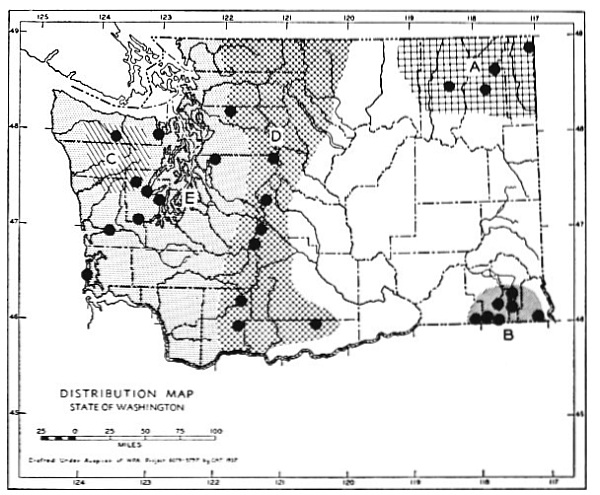
Fig. 111. Distribution of the Gapper and California red-backed mice in Washington. A. Clethrionomys gapperi saturatus. B. Clethrionomys gapperi idahoensis. C. Clethrionomys gapperi nivarius. D. Clethrionomys gapperi cascadensis. E. Clethrionomys californicus occidentalis.
Clethrionomys gapperi saturatus (Rhoads)
Evotomys gapperi saturatus Rhoads, Proc. Acad. Nat. Sci. Philadelphia, p. 284, October 23, 1894.
[Clethrionomys gapperi] saturatus Whitlow and Hall, Univ. California Publ. Zoöl., 40:265, September 30, 1933.
Type.—Obtained at Nelson, British Columbia, by S. N. Rhoads on August 27, 1892; type in Philadelphia Academy of Sciences.
Racial characters.—Size small, about 140 mm. in total length; tail short, about one-third of total length; ears large, projecting above fur; color of head and sides gray tinged with yellowish; back with distinct red stripe; underparts whitish tinged with buff.
Measurements.—Five males and 10 females from Pass Creek Pass, Pend Oreille County, average: total length 147; length of tail 43; hind foot 18.3; ear 14.
Distribution.—Northeastern Washington from Sherman Creek Pass (W. W. D.) on the west to Pass Creek Pass on the east.
Clethrionomys gapperi idahoensis (Merriam)
Evotomys idahoensis Merriam, N. Amer. Fauna, 5:66, July 30, 1891.
Clethrionomys gapperi idahoensis Whitlow and Hall, Univ. California Publ. Zoöl., 40:265, September 30, 1933.
Type.—Obtained at Sawtooth (Alturas) Lake, 7,200 ft., Blaine County, Idaho, by C. H. Merriam and V. Bailey, on October 4, 1890; type in United States National Museum.
Racial characters.—Similar to saturatus but brain case longer and narrower and dorsal area more reddish.
Measurements.—Seven males and 6 females from the Blue Mountains average, respectively: total length 138, 142; length of tail 41, 41; hind foot 18.7, 19.0; ear 13.6, 13.5; weight 20.5, 22.7 grams.
Distribution.—The Blue Mountains of southeastern Washington.
Clethrionomys gapperi cascadensis Booth
Evotomys gapperi saturatus Taylor and Shaw, Occ. Pap. Chas. R. Conner Mus., no. 2:23, December, 1929.
Clethrionomys gapperi cascadensis Booth, Murrelet, 26:27, August 10, 1945.
Type.—Obtained 2 miles south of Blewett Pass, 3,000 ft. elevation, Kittitas County, Washington, by G. G. Cantwell, on October 30, 1921; type in United States National Museum.
Racial characters.—Dark and dull with underparts dull buffy.
Measurements.—Ten adults from the Cascade Mountains average (Booth, 1945: 27): total length 162; length of tail 50; hind foot 19; ear 14.
Distribution.—The Cascade Mountains, according to Booth (loc. cit., p. 28), from Hannegan Pass south to Mount Adams. Marginal localities listed are: Swamp Creek, Glacier Peak, McKenna, and Mt. St. Helens. These, and other localities listed by Booth are not plotted on the accompanying distribution map (fig. 111).
Clethrionomys gapperi nivarius (Bailey)
Evotomys nivarius Bailey, Proc. Biol. Soc. Washington, 11:136, May 13, 1897.
Evotomys gapperi nivarius Taylor and Shaw, Occ. Papers Chas. R. Conner Mus., no. 2:23, 1929.
Clethrionomys nivarius Svihla, Murrelet, 12:54, May, 1931.
Type.—Obtained on the northwest slope of Mt. Ellinor, 4,000 ft. elevation, Mason County, Washington, by C. P. Streator, on July 9, 1894; type in United States National Museum.
Racial characters.—Similar to saturatus but paler throughout.
Measurements.—Two males and a female from 1 mile northwest of Lake Cushman, Mason County, average: total length 140; length of tail 42; hind foot 18; ear 13.
Distribution.—The Olympic Mountains, from Sol Duc Hot Springs (W.S.M.) south and west at least to Staircase, on Lake Cushman (W.W.D.).
Clethrionomys californicus occidentalis (Merriam) California red-backed mouse
Evotomys occidentalis Merriam, N. Amer. Fauna, 4:25, October 8, 1890.
Evotomys pygmaeus Rhoads, Proc. Acad. Nat. Sci. Philadelphia, p. 284, October 23, 1894 (type from mouth of Nisqually River, Pierce County, Washington).
Evotomys gapperi occidentalis Taylor and Shaw, Occ. Papers Chas. R. Conner Mus., no. 2:23, 1929.
Clethrionomys occidentalis Hall, Murrelet, 13:79, September, 1932.
Type.—Obtained at Aberdeen, Grays Harbor County, Washington, by T. S. Palmer, on August 16, 1889; type in United States National Museum.
Measurements.—Ten males and 10 females average: total length 137; length of tail 45; hind foot 18; ear 12.3.
Distribution.—The lowlands of western Washington, east at least to Cottage Lake (W. W. D.).
Remarks.—Specimens from the type locality of occidentalis and other places along the ocean coast are larger and brighter in color than specimens from farther inland, but the difference appears to me to be insufficient to warrant subspecific separation of the two lots.
Clethrionomys californicus resembles Clethrionomys gapperi but is darker and duller in color with the red dorsal area more obscured and forming less of a stripe. C. californicus is found in the forested lowlands of western Washington, Oregon, and northern California, and in the Cascades of Oregon. In Washington, it is confined entirely to the forest where it is trapped under logs and on the layer of dead needles at the bases of conifers. Mice of this species were numerous in the forest along the Pacific Coast on the Long Beach Peninsula and at Aberdeen, Grays Harbor County. At Lost Lake Prairie, Mason County, at the southeastern base of the Olympic Mountains, they were rather scarce, but were the only mammals taken in the deep woods. Near Shelton, Mason County, at the eastern edge of the Olympic Mountains, a number of specimens were taken along with twice as many Peromyscus maniculatus. At Cottage Lake, King County, near Seattle, they were rare, comprising about two per cent of the mammals taken in two weeks' trapping.
Almost nothing was learned of the habits of these mice. They seem to be rigidly restricted to a habitat where few plants other than trees grow. The stomachs examined contained pasty masses of finely chewed white vegetation with occasional gray particles that might have been bits of lichens. The mice do not make runways like those of Microtus.
Microtus pennsylvanicus (Ord) Pennsylvanian meadow mouse
Description.—The upper parts are dark blackish brown and the underparts grayish or whitish. The tail comprises about a fourth of the total length and the foot does not exceed 21 mm. These two features separate it from most other species of meadow mice. From Microtus oregoni it may be separated by its larger size, blackish color and well-developed eyes. From Microtus montanus it differs in being larger, darker, and in having a closed posterior loop on the innerside of the second upper molar.
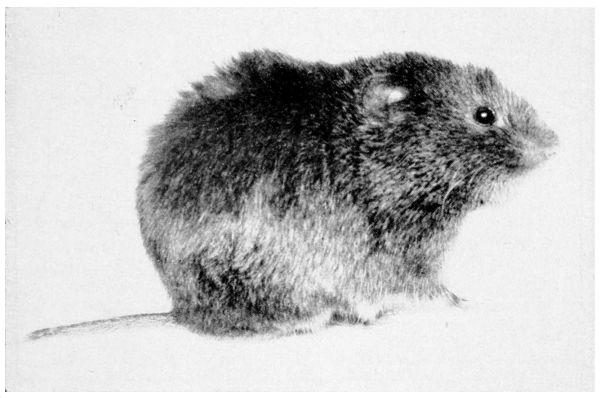
Fig. 112. Pennsylvania meadow mouse (Microtus pennsylvanicus kincaidi), from ten miles south of Moses Lake, Washington, April 28, 1940. (Fish and Wildlife Service photo by Victor B. Scheffer, No. 937.)
Microtus pennsylvanicus is the most common meadow mouse of the eastern United States. It ranges westward through Canada and southward in the Rocky Mountains. A number of races occur in this extensive range. In northeastern Washington the eastern meadow mouse is locally common, being confined to marshes and damp meadows. Well-used runways are made through the dense vegetation and piles of feces and blades of grass are deposited therein. A number of broods are raised in a season, for young of many different ages are taken together in midsummer.
On the Columbian Plateau this mouse lives in marshy areas about lakes and potholes. Narrow trails are constructed through the dense vegetation. It burrows in damp earth and some occupied burrows are half-full of seepage water. Cuttings found in runways show that the mice feed on a variety of plants, including sedge (Carex). In the Moses Lake area the breeding season begins in March. Embryos found March 24, 1940, varied from 4 to 7 in number. This species is cyclically abundant.
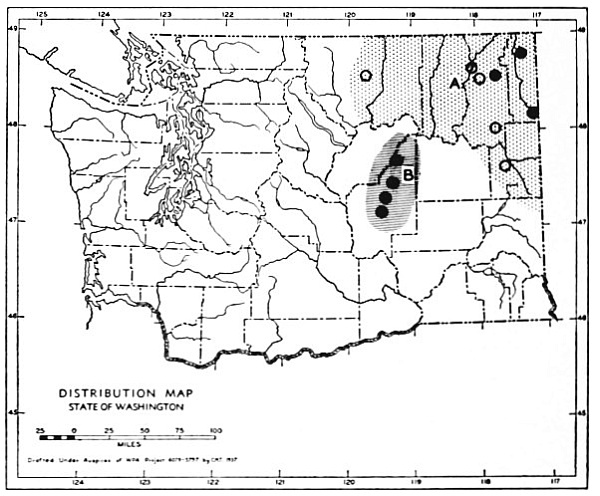
Fig. 113. Distribution of the Pennsylvania meadow mouse in Washington. A. Microtus pennsylvanicus funebris. B. Microtus pennsylvanicus kincaidi.
Microtus pennsylvanicus funebris Dale
Microtus pennsylvanicus modestus Bailey, N. Amer. Fauna, 17:20, June 6, 1900.
Microtus drummondii Bailey, N. Amer. Fauna, 17:22, June 6, 1900.
Microtus pennsylvanicus funebris Dale, Jour. Mamm., 21:338, August 13, 1940.
Type.—Obtained at Coldstream. 1,450 ft., 3-1/2 miles southeast of Vernon. British Columbia, by T. P. Maslin. Jr., on August 2, 1937; type in Museum of Vertebrate Zoölogy.
Racial characters.—Size medium; color reddish brown; fur short, harsh; skull small and narrow.
Measurements.—Three males from Newport, Pend Oreille County, average: total length 165; length of tail 40; hind foot 20; ear 15.3.
Distribution.—Northeastern Washington, west to Conconully (Taylor and Shaw, 1929: 24) and east to Newport (W. W. D.).
Remarks.—Specimens from northeastern Washington are larger and darker, more reddish and less gray, than drummondii. They are larger, more reddish, and have relatively narrower skulls, than modestus from Colorado and Idaho. They closely resemble funebris from south-central British Columbia, and are best referred to that race. Rand (1943: 123) considers funebris a synonym of modestus but I feel is incorrect in doing so.
Microtus pennsylvanicus kincaidi Dalquest
Microtus montanus kincaidi Dalquest, Proc. Biol. Soc. Washington, 54:145, September 30, 1941.
Type.—Obtained at The Potholes, 10 miles south of Moses Lake, Grant County, Washington, by W. W. Dalquest on March 24, 1940; type in Museum of Vertebrate Zoölogy.
Racial characters.—Large size; dark blackish color; long fur; wide, angular skull.
Measurements.—Six male and 12 female topotypes average, respectively: total length 176.6, 168.0; length of tail 45.1, 43.8; hind foot 20.8, 20.3; ear 14.0, 13.4.
Distribution.—The Columbian Plateau, in the Grand Coulee area.
Microtus montanus (Peale) Montane meadow mouse
Description.—Montane meadow mice have short tails, flaring zygomatic arches, and heavily ridged skulls. They are small, about 6-1/2 inches long, and buffy-gray in color. Their short tails, less than one-third the length of head and body, and gray color separate them from all other Washington meadow mice.
Montane meadow mice are widely distributed in the southwestern United States, where numerous races are found. They occupy damp meadows and marshes in the arid subdivision of the Transition Life-zone of eastern Washington. They seem to require deep, dense cover of grasses, reeds, or sedges, near water. They are usually associated with harvest mice (Reithrodontomys megalotis), wandering shrews (Sorex vagrans monticola), and muskrats (Ondatra zibethica). Hawks and owls are their principal enemies, but predatory mammals and snakes probably kill many.
Montane meadow mice evidently are both diurnal and nocturnal; specimens were taken in the daytime as well as at night, and captives were active periodically day and night. Captives were extremely quick in their movements. If disturbed they sat up on their haunches and chattered indignantly. It was almost impossible to handle them without being bitten.
The trails of montane meadow mice are narrower than those of other meadow mice, and appear to be used the year around. Burrows are numerous where the mice are plentiful. A heap of damp earth marks the entrance to each burrow. One nest of M. m. canescens near Lake Chelan, Chelan County, was under a log on a small knoll in a marsh. The nest was round, about 8 inches in diameter, and was composed of cattails, grasses, and moss.
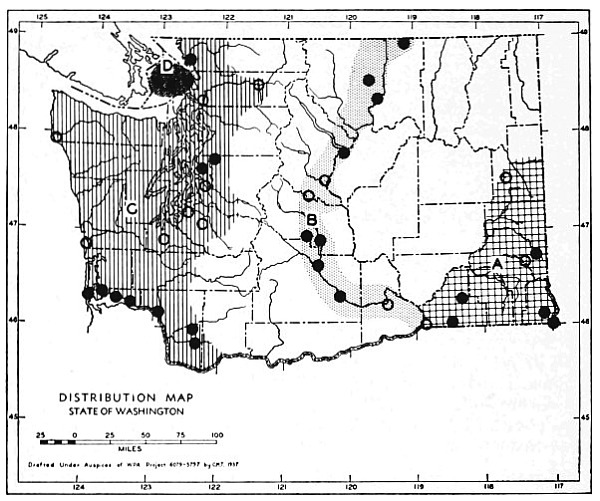
Fig. 114. Distribution of the montane and Townsend meadow mice in Washington. A. Microtus montanus nanus. B. Microtus montanus canescens. C. Microtus townsendii townsendii. D. Microtus townsendii pugeti.
Microtus montanus nanus (Merriam)
Arvicola (Mynomes) nanus Merriam, N. Amer. Fauna, 5:63, July 30, 1891.
Microtus nanus Miller, Proc. Biol. Soc. Washington, 11:67, April 21, 1897.
Microtus nanus nanus Miller, Bull. U. S. Nat. Mus., 128:409, April 29, 1924.
Microtus montanus nanus Hall, Proc. Biol. Soc. Washington, 51:133, August 23, 1938.
Type.—Obtained in the Pahsimeroi Mountains, 9,300 ft., Custer County, Idaho, by C. H. Merriam and V. Bailey on September 16, 1890; type in United States National Museum.
Racial characters.—Size medium; color of upper parts brownish gray; sides paler; underparts grayish white.
Measurements.—A large male from Prescott, Walla Walla County, measures: total length 168; length of tail 48; hind foot 20. A female from Prescott, Walla Walla County, and a female from Pullman, Whitman County, average: 133; 31; 18.5.
Distribution.—Southeastern Washington, westward as far as 5 miles east of Wallula (M.V.Z.).
Microtus montanus canescens Bailey
Microtus nanus canescens Bailey, Proc. Biol. Soc. Washington, 12:87, April 30, 1898.
Microtus montanus canescens Hall, Proc. Biol. Soc. Washington, 51:133, August 23, 1938.
Type.—Obtained at Conconully, Okanogan County, Washington, by J. A. Loring, on September 12, 1897; type in United States National Museum.
Racial characters.—Size small; color of upper parts pale brownish gray; sides yellowish gray. This race differs from Microtus m. nanus in generally paler, less brownish coloration. It does not differ from nanus in any distinctive cranial features.
Measurements.—Two male and 2 female topotypes average, respectively: total length 151, 143; length of tail 35, 33.5; hind foot, 19.5, 19.5. A series of 8 males and 6 females from Selah, Yakima County, average, respectively: total length 151.7, 150.5; length of tail 41.5, 40.1; hind foot 19.7, 18.8; ear 12.8, 13.0; weight 47.2, 36.8 grams.
Distribution.—The eastern foothills of the Cascade Mountains from the British Columbian boundary south, probably to the Columbia River. Recorded east to Benton City (Taylor and Shaw, 1929: 24).
Remarks.—A large series from Selah, Yakima County, is somewhat intermediate between nanus and canescens. These specimens from south of the Wenatchee Mountains are, however, more like canescens in color than they are like nanus.
Bailey (1900: 32) records a specimen of this race from North Yakima as Microtus canicaudus.
Microtus townsendii (Bachman) Townsend meadow mouse
Description.—The Townsend meadow mouse is a large-bodied, long-furred mouse with a tail of moderate length. Head and body measure about 8 inches, the tail about 2-1/2 inches. The legs are short and the ears scarcely project through the fur on the head. In summer the color is dark reddish-brown. The winter color is dark brownish-black. Underparts are paler, more grayish brown, than are the upper parts. The tail is sparsely haired.
Townsend meadow mice occur west of the Cascade Mountains in California, Washington, Oregon, British Columbia, and on some British Columbian and Washington islands. The habitats of the two races of the Townsend meadow mice found in Washington are wholly in the humid subdivision of the Transition Life-zone but vary somewhat in nature. The race townsendii lives in marshes or damp meadows, under cover of deep, rank vegetation. These mice avoid forested areas or dry brush, but sometimes occur in dry grass when it is deep enough to conceal them from enemies. The race pugeti has been recorded from meadows, salt marshes, driftwood strewn on sea-beaches, areas of sparse, dry grass, and piles of rocks.
Townsend meadow mice are as diurnal as they are nocturnal; specimens have been trapped at almost all hours of the day and night. Their ordinary method of traveling is a slow run. When startled they make a dash for the nearest cover, into which they dive headlong. They make considerable noise while moving about and often may be heard from several feet away. Captives in the laboratory seemed rather dull and stupid as compared with other meadow mice.
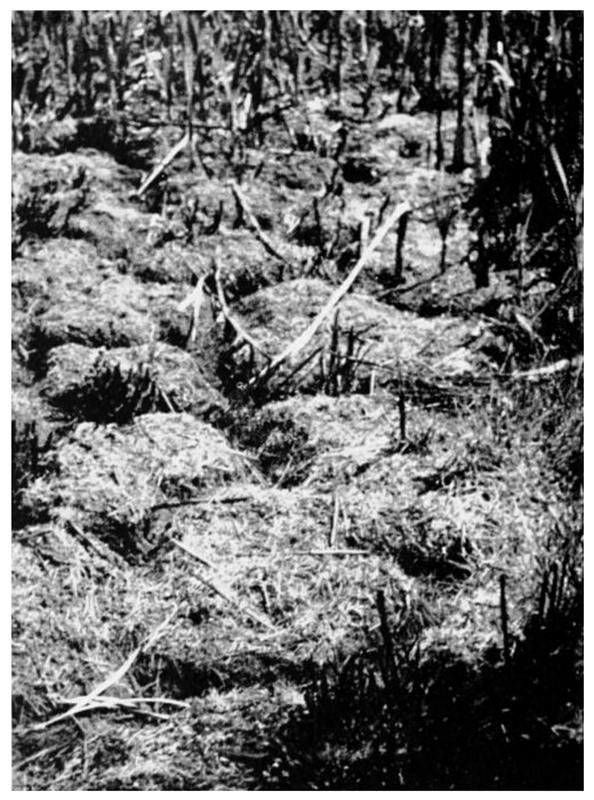
Fig. 115. Runways of Townsend meadow mice (Microtus townsendii) worn to grooves in the damp soil at Seattle; May 18, 1938; dense cover of cattails has been burned off (W. W. Dalquest photo).
In the fall, winter, and early spring the Townsend meadow mice keep to their runways. These runways are used by successive generations of mice, and often are worn into ditches several inches deep. In the late spring and summer, when the grass and other vegetation in their habitat is tall and rank, offering complete concealment, the runways are abandoned and cuttings of rejected food are found scattered over the surface of the ground.
The food of the Townsend meadow mice includes the succulent leaves and stems of many grasses and annuals. Near Seattle the staple summer food is the velvet grass (Holcus lanatus), although many other plants, including the horsetail (Equisetum arvense), are eaten. In winter the common cattail is eaten. Couch (1925: 200) found caches of the roots of mint (Mentha canadensis) stored by this species. As much as 14 quarts was found in a single cache.
The cup-shaped nests of Townsend meadow mice near Seattle were below ground. Embryos were found from May 4 to May 20 and varied in number from 5 to 8 with a mean of 7. In the San Juan Islands the nests of M. t. pugeti were under driftwood.
Microtus townsendii townsendii (Bachman)
Arvicola townsendii Bachman, Jour. Acad. Nat. Sci. Philadelphia, 8 (pt. 1):60, 1839.
Arvicola occidentalis Peale, U. S. Expl. Exped., Mammalogy, p. 45, 1848 (type from Puget Sound).
M[icrotus]. townsendi Miller, N. Amer. Fauna, 12:66, July 23, 1896.
Microtus townsendii townsendii Svihla and Svihla, Murrelet, 14:40, May, 1933.
Type.—Obtained on the Columbia River (probably on or near Sauvie Island, Multnomah County, Oregon); type in Philadelphia Academy of Natural Sciences.
Racial characters.—Size large; skull narrow in interorbital region.
Measurements.—Eight males and 5 females from Clark and Pacific counties, southwestern Washington, average, respectively: total length 208.0, 208.4; length of tail 65.7, 66.0; hind foot 26.5, 25.4; ear 15.0, 14.6; weight 80.8, 76.7 grams. Thirteen males and 9 females from Seattle average, respectively: 211.8, 209.0; 71.2, 68.6; 25.7, 26.0; 15.8, 15.4.
Distribution.—The lowlands of western Washington from Bellingham (J.M.E.) south to Puget Island (V.B.S.).
Microtus townsendii pugeti Dalquest
Microtus townsendii pugeti Dalquest, Murrelet, 21:7, April 1, 1940.
Type.—Obtained at Neck Point, northwest corner of Shaw Island, San Juan County, Washington, by D. H. Johnson, on July 10, 1938; type in Museum of Vertebrate Zoölogy.
Racial characters.—Size small; skull wide in interorbital region, averaging about 4.0 mm. (3.8-4.2); basi-sphenoid truncate posteriorly; upper incisors strongly curved.
Measurements.—Two males and 6 females average: total length 182.6; length of tail 50.3; hind foot 23.2; ear 15.0.
Distribution.—Found only on the San Juan Islands, San Juan and Skagit counties.
Remarks.—The islands occupied by this race of mouse were heavily glaciated by the last continental glacier (Vashon). Mice of the species townsendii apparently migrated to the islands early in the Recent era, and under isolation developed the differences which now separate them from the mainland population.
Microtus longicaudus (Merriam) Long-tailed meadow mouse
Description.—The several races of this species vary from small to large in size. Their bodies are relatively longer and slimmer than those of the other meadow mice that occur in Washington. Their most distinctive feature is the long tail, only slightly shorter than the head and body. Their fur is rather coarse. The color varies from grayish brown to dull reddish brown with a brighter brown dorsal stripe. The tail is bicolor; black or dark brown above, yellowish below. The underparts are whitish gray.
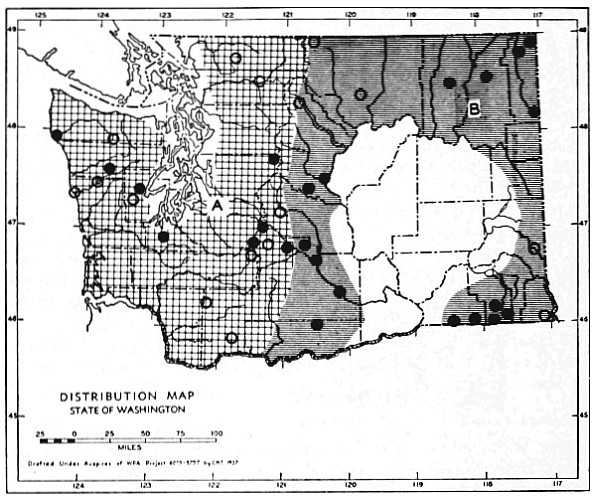
Fig. 116. Distribution of the long-tailed meadow mouse in Washington. A. Microtus longicaudus macrurus. B. Microtus longicaudus halli.
Long-tailed meadow mice are widely distributed over the western United States, Canada, and Alaska. In Washington the long-tailed meadow mouse has been taken in many habitats. One specimen was taken along a small, temporary stream through sagebrush in the Upper Sonoran Life-zone. Others were found in marshes and near water in the arid subdivision of the Transition Life-zone. In the humid subdivision of the Transition Life-zone they are not uncommon in damp areas along the ocean coast, but are rather rare in dry, grassy habitats. In the Canadian and Hudsonian life-zones they are fairly common in forest-free, grassy places, being most abundant near talus slides. Altitudinally they range from sea level to 6,000 feet.
Long-tailed meadow mice are rather rare. Several were taken in the daytime at Round Top Mountain, Pend Oreille County, and two others were taken in daytime two miles south of Tenino, Thurston County. However most of the specimens were caught at night.
Long-tailed meadow mice do not, at least ordinarily, make trails as do other meadow mice. Specimens are usually taken unexpectedly, and intensive trapping in the area where a specimen or two is taken rarely yields additional individuals.
Two specimens taken in the Cascade Mountains in September were pregnant; one contained two embryos and the other four.
Microtus longicaudus halli Ellerman
Microtus mordax angustus Hall, Univ. California Publ. Zoöl., 37:13, April 10, 1931 (not of Thomas, 1908).
Microtus longicaudus angustus Goldman, Jour. Mamm., 19:491, November 14, 1938.
Microtus mordax halli Ellerman, Fam. and Genera of Living Rodents, British Mus. Nat. Hist., 2:603, March 21, 1941 (new name for Microtus mordax angustus Hall).
Type.—Obtained at Godman Springs, 5,700 ft., Blue Mountains, Columbia County, Washington, by S. H. Lyman, on September 1, 1927; type in Museum of Vertebrate Zoölogy.
Racial characters.—Size small; color of sides pale grayish brown; brown dorsal stripe conspicuous; tail relatively short.
Measurements.—Four males and 5 females from eastern Washington average, respectively: total length 164.8, 166.6; length of tail 55.8, 55.8; hind foot 22.0, 21.4.
Distribution.—From the Blue Mountains of southeastern Washington north, along the eastern edge of the state, to British Columbia, and thence west, north of the Columbia River, to the Cascades, and south along the eastern edge of the Cascades to the Wenatchee Mountains. Marginal occurrences are: Pasayten River (Taylor and Shaw, 1929: 24), Hart Lake (Taylor and Shaw, 1929: 24), Blewett Pass (W.W.D.), Boulder Cave (W.W.D.), and Satus Pass (W.W.D.).
Remarks.—Four specimens from Satus Pass, Klickitat County, are somewhat intermediate between this race and macrurus, and indicate that halli crossed the Columbia River when an alpine meadow land extended from the Simcoe Anticline to southeastern Washington.
One specimen from Selah, Yakima County, is colored somewhat like halli, and is smaller than macrurus. Possibly the halli type of meadow mouse spread northward to the Yakima Valley. This specimen was taken in the Upper Sonoran Life-zone. A specimen from the Arid Transition Zone at Naches, Yakima County (taken in almost Canadian Life-zone habitat), is like macrurus-halli intergrades from the higher Cascade Mountains.
Microtus longicaudus macrurus Merriam
Microtus macrurus Merriam, Proc. Acad. Nat. Sci. Philadelphia, p. 353, October 4, 1898.
Microtus mordax macrurus Dice, Murrelet, 13:49, May, 1932.
Microtus longicaudus macrurus Goldman, Jour. Mamm., 19:491, November 14, 1938.
Type.—Obtained at Lake Cushman, Mason County, Washington, by C. P. Streator on June 26, 1894; type in United States National Museum.
Racial characters.—Size large; tail relatively long, almost as long as head and body; color of upper parts dull brown; dorsal stripe obscure; underparts gray.
Measurements.—Two males and 4 females from the Olympic Mountains and the coast of Washington, average, respectively: total length 212.5, 220.5; length of tail 82.5, 86.8; hind foot 25.5, 24.7; ear 15.0, 13.7.
Distribution.—The Olympic Mountains, the coast region of western Washington, and the Cascade Mountains, save in the southeastern part. Marginal occurrences are: Sauk (Taylor and Shaw, 1929: 24), Tye (W.W.D.), Naches River (W.W.D.), and Wind River (W.W.D.).
Remarks.—Specimens from the Cascade Mountains are referred to macrurus but are intermediate between that race and halli.
Microtus richardsoni (De Kay) Water rat
Description.—This is the largest meadow mouse found in Washington. It is too large to be called a mouse and the term water rat, applied to it by Merriam, suits it well. It is the only Washington microtine measuring more than 8 inches in total length. The upper parts are dark, reddish brown in color; the underparts are grayish brown. The tail comprises about one-third of the total length.
This species of meadow mouse ranges from Canada south to Colorado in the Rocky Mountains and in the Cascades south into Oregon. The water rats are strictly alpine animals, occurring about streams, marshes and damp meadows. In the Cascade Mountains they are most common in the glacial cirques where tiny streams flow through grassy meadows to plunge over the lip of the cirque on a rocky course of cascades to the valley below. Here their broad trails occur along the stream banks, commonly entering the water where it is swift. These trails are well-worn roads, usually about four inches wide but often wider. The burrows of the water rat are about three inches in diameter and are constructed with no effort at concealment; large mounds of earth mark their entrances. Freshly dug burrows are so abundant that it seems likely more are dug than are actually inhabited. Burrows are often dug beneath rocks.
The water rat is mainly nocturnal but not uncommonly is seen in the daytime. Twice I cornered a water rat away from its burrow and each time it escaped by swimming. The rats swam with great speed but with much splashing. One dived under the surface of a small pool and disappeared. Stones along the bank were pulled out until the rat was captured in a small chamber at the end of a burrow. The burrow entered the bank at the base of a large stone six inches beneath the surface. This burrow resembled a miniature muskrat burrow and apparently had been dug when the rat was under water.
Like Phenacomys, the water rat constructs sub-snow nests on the surface of the ground. These are recognizable by their large size and by piles of ovoid droppings a quarter of an inch in length. These nests are loosely built and fall apart soon after the snow melts.
The water rat is sometimes a pest to the mammal collector for they spring mouse traps set for other mammals without becoming caught. At times the greater part of an entire trap line was thus rendered ineffective by these mammals. Fully adult animals are uncommon in collections for a rat trap or steel trap is needed to take them and these items, when packed on back up mountains to water-rat habitat, are usually set for still larger animals. Racey (Racey and Cowan, 1935: H27) recounting his difficulty in securing specimens when no suitable traps were at hand, writes: "Killed one with my hands, shot another, and a third was stunned by a mouse trap."
Taylor and Shaw (1927: 76) list food eaten by the water rat on Mount Rainier as the avalanche lily, dogtooth violet, Ligusticum purpureum, Valeriana sitchensis, Polygonum bistortoides, Petasites frigida, Phyllodoce empetriformis, Potentilla flabellifolia, Aster sp., grass, wild clover, conifer seeds, two kinds of blueberry (Vacinnium) and Xerophyllum tenax. Racey and Cowan (1935) list foods eaten in the Cascades of southern British Columbia as Lupinus polyphyllus, Senecio balsamitae, Pedicularis bractiosa and Arnica alpinus.
A female from Dewey Lake, Yakima County, contained 4 embryos on September 1, 1940. One from Tye, King County, had 2 embryos on September 8, 1940.
Microtus richardsoni arvicoloides (Rhoads)
Aulacomys arvicoloides Rhoads, Amer. Nat., 28:182, February, 1894.
Microtus richardsoni arvicoloides Bailey, N. Amer. Fauna, 17:62, June 6, 1900.
Type.—Obtained at Lake Keechelus, Kittitas County, Washington, by A. Rupert in September, 1893. Rhoads gives the altitude as 8,000 ft. This apparently is an error, for the elevation of the lake is 2,458 ft. and the summit of Snoqualmie Pass, to the west, is 3,100 ft. Probably 3,000 ft. was intended; type in Philadelphia Academy of Natural Sciences.
Racial characters.—Size large; color of upper parts dark reddish brown; underparts paler.
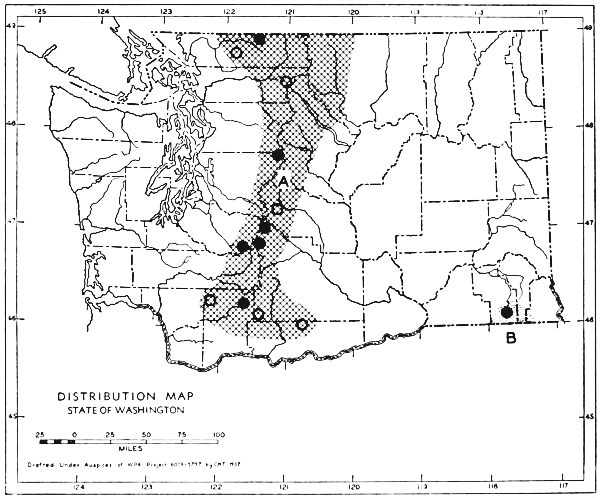
Fig. 117. Distribution of the water rat in Washington. A. Microtus richardsoni arvicoloides. B. Microtus richardsoni macropus.
Measurements.—A female from Tomyhoi Lake, Whatcom County, measured: total length 242; length of tail 68; hind foot 27; ear 17. A female from Tye, King County, measured: 257; 83; 26; 17.
Distribution.—The Cascade Mountains, from Tomyhoi Lake (W.W.D.) south to Potato Hill (Taylor and Shaw, 1929: 25).
Microtus richardsoni macropus (Merriam)
Arvicola (Mynomes) macropus Merriam, N. Amer. Fauna, 5:60, July 30, 1891.
Microtus richardsoni macropus Bailey, N. Amer. Fauna, 17:61, June 6, 1900.
Microtus richardsonii macropus Taylor and Shaw, Occ. Pap. Chas. R. Conner Mus., no. 2:25, December, 1929.
Type.—Obtained in the Pashimeroi Mountains, 9,700 ft., Custer County, Idaho, by C. H. Merriam and V. Bailey in 1890; type in United States National Museum.
Racial characters.—Similar to arvicoloides but slightly smaller and redder.
Measurements.—A female from Stay-a-while Spring, Columbia County, measures: total length 228; length of tail 73; hind foot 25; ear 14.
Distribution.—The Blue Mountains of southeastern Washington.
Microtus oregoni oregoni (Bachman) Creeping mouse
Arvicola oregoni Bachman, Jour. Acad. Nat. Sci. Philadelphia, 8:60, 1839.
Microtus oregoni Miller, N. Amer. Fauna, 12:9, July 23, 1896.
Microtus morosus Elliot, Field Columb. Mus. Publ. 30, zoöl. ser., 1:227, February 1, 1899 (type from Boulder Lake, 5,000 ft., Clallam County, Washington).
Microtus oregoni oregoni Miller, U. S. Nat. Mus. Bull., 79:227, December 31, 1912.
Microtus oregoni cantwelli Taylor, Jour. Mamm., 1:180, August 24, 1920 (type from Glacier Basin, 5,935 ft., Mt. Rainier, Pierce County, Washington).
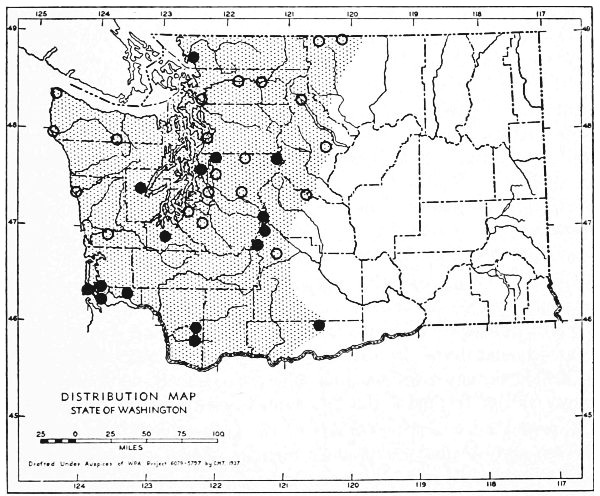
Fig. 118. Distribution of the creeping mouse, Microtus oregoni oregoni, in Washington.
Type.—Obtained at Astoria, Clatsop County, Oregon, by J. K. Townsend in 1836; type in Philadelphia Academy of Natural Sciences.
Measurements.—Ten males and 10 females from southwestern Washington, average, respectively: total length 133, 126; length of tail 35, 32; hind foot 16.9, 16.7; ear 9.8, 9.7; weight 19.3, 19.1 grams.
Distribution.—The Cascade Mountains, the Olympic Mountains, and the lowlands of western Washington.
Remarks.—A large series of topotypes of Microtus o. oregoni in the California Museum of Vertebrate Zoölogy, and the rather large series from Cowlitz County, Washington, show a wide range of variation in color, size, and cranial characters. Specimens from the Cascade and Olympic Mountains seem to average a bit paler than topotypes of oregoni, but are not worthy of recognition as distinct races. Too few topotypes of Microtus o. serpens from British Columbia are available to judge the status of that race with any certainty, but specimens from northwestern Washington are certainly oregoni.
Description.—The creeping mouse is a small species of general microtine form. The head and body measure about 4 inches and the tail about 1-1/2 inches. The ears are small and the eyes tiny, nearly buried in the fur. The fur is short and rather rough. It does not lie back smoothly, thereby giving a woolly appearance. The upper parts are reddish or grayish brown and the underparts are grayish white. The nondescript appearance suggests a young rather than adult mouse.
The creeping mouse (subgenus Chilotus) is restricted to the Pacific Coast and ranges from British Columbia to California. In Washington it occupies almost every conceivable "mouse" habitat in its range, including wet marshes, damp ravines, dry forest, damp, mossy forest, meadows, alpine meadows and fields of short grass. It is rare in all but the latter habitat. In fields of short or dry grass it is often abundant. In the Cascade Mountains it was in relatively dry places along streams or rock slides. Altitudinally it ranges from sea level to at least 6,000 feet, and from the Humid Transition well into the Hudsonian life-zones.
Creeping mice construct tiny tunnels among the grass roots and seldom venture out of them. In suitable habitat the surface of the ground beneath the grass is a maze of these tunnels, which cross, intersect, and divide in a complex network. An observer standing in a field occupied by creeping mice can scarcely conceive of the extent and perfection of the tiny tunnel system at his feet.
Creeping mice lived but a day or two in captivity. Save for the bits of grass blades left in their runways, little is known of their food or other life habits. Their nests are round balls of dry grasses placed in cavities under logs. None of the many examined possessed a lining of softer materials. Embryos found in pregnant females from April 10 to May 18 numbered from 2 to 4.
Lagurus curtatus pauperrimus (Cooper) Sagebrush vole
Arvicola pauperrima Cooper, Amer. Nat., 2:535, December, 1868.
Arvicola pauperrimus Merriam, N. Amer. Fauna, 5:64, July 30, 1891.
L[agurus]. pauperrimus Thomas, Ann. and Mag. Nat. Hist., ser. 8, 9:401, April, 1912.
Microtus pauperrimus Bailey, N. Amer. Fauna, 55:214, August 29, 1936.
Lemmiscus pauperrimus Davis, Recent Mamm. Idaho, Caxton Printers, p. 327, April 5, 1939.
Lemmiscus curtatus pauperrimus Goldman, Proc. Biol. Soc. Washington, 54:70, July 31, 1941.
Type.—Obtained on the "Plains of the Columbia" near the Snake River, southwestern Washington by J. G. Cooper on October 9, 1860. Probably from the Bunchgrass Hills near Wallula (Old Fort Walla Walla), Walla Walla County: type in United States National Museum.
Measurements.—Bailey (1900: 69) gives the average of 3 adults from the vicinity of Antelope, Oregon, as: total length 115; length of tail 20; hind foot 16.
Distribution.—Known in Washington only from the type and a specimen from Badger Mountains, 8 miles southwest of Waterville (Taylor and Shaw, 1929: 25).
Remarks.—This rare vole is the smallest microtine rodent in Washington. The head and body measure about 4 inches and the tail about 1 inch. The upper parts are grayish or yellowish brown and the underparts grayish. The upper incisors are not grooved and the inner and outer angles of the molars are about equal in length.
Mice of the genus Lagurus occur in Siberia and in prairie areas of the northwestern United States and Canada. The sagebrush vole inhabits the Upper Sonoran Life-zone. It prefers upland areas of low sagebrush with sparse grass. Poorly formed runways and small piles of feces indicate its presence. The type of Lagurus pauperrimus was obtained in southwestern Washington 80 years ago, and a single additional record has since been obtained. Nothing is known of its habits in Washington. The life history of related forms has been reported on by Hall (1928: 201-204) from Nevada and Moore (1943: 188-191) from Oregon.
Davis (1939: 326) raised the subgenus Lemmiscus Thomas (for American forms) to generic rank and Goldman (1941: 69) accepted this usage. Comparison of the Siberian and American species reveals but three impressive differences: the dorsal stripe of the Siberian mice, the greater development of prisms in the molars of the American species, and the presence of cement in the angles of the molars of the Siberian specimens and its lack in the American. These differences seem to be of no more than subgeneric value. Goldman (1941: 69) showed that all American Lagurus belong to a single species.
Ondatra zibethicus (Linnaeus) Muskrat
Description.—The muskrat is a large aquatic rodent. Head and body measure about 14 inches; the tail about 10 inches. The body is plump and the head small. Eyes and ears are relatively small. The forefeet are small and handlike with furred wrists. The hind feet are large with webbed toes and naked wrists. The tail is narrow, constricted at the base and flattened vertically. It is scaled and possesses scattered, stiff hairs. The underfur is dense and soft. The guard hair is stiff and shiny. The upper parts are rich, dark brown. The underparts are gray washed with cinnamon.
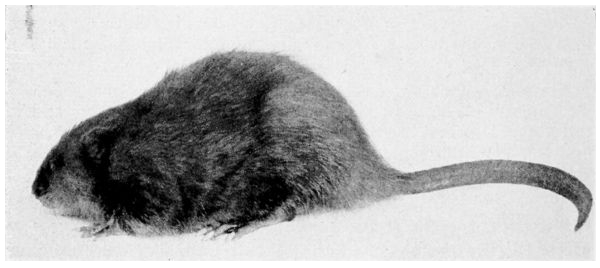
Fig. 119. Muskrat (Ondatra zibethicus osoyoosensis), male, Lake Washington, Seattle, October 13, 1939; weight 906 grams on November 4, 1939. (Fish and Wildlife Service photo by Victor B. Scheffer, No. 736.)
Muskrats are found in Canada and the United States. They are lowland animals, rarely ranging into the Canadian Life-zone. Their aquatic habitat makes them relatively independent of temperature, and consequently they occur in both the Transition and Upper Sonoran life-zones.
The muskrat is well adapted to aquatic life. The toes of the large hind feet are webbed at the base, the hind feet are turned slightly outward, a fringe of stiff bristles at the rear edge of each foot furnishes additional aid in swimming, and the laterally compressed tail makes it an efficient rudder. In the water the surface of the fur flattens down to entrap air in the dense underfur, keeping the body dry.
The typical habitat of the muskrat is slow-moving water or still water, such as in lakes, ponds, marshes and sluggish rivers and streams. Muskrats occur commonly, though not in large numbers, in more swiftly moving streams. In Puget Sound and the San Juan Islands they occupy a marine habitat.
In the extensive marshes along Lake Washington, King County, muskrats are abundant. They occupy sluggish water, often water polluted by garbage and sewage. In these marshes, banks suitable for the construction of burrows are absent and houses are made of cattail stalks and leaves. The food of these marsh-living muskrats consists principally of cattail and other marsh vegetation.
In contrast to the marsh-occupying muskrats, muskrats along the open, marsh-free shores of the lake live in deep clear water where waves lap the shore. These muskrats live exclusively in burrows dug in the banks and feed upon fresh-water mussels.
In still greater contrast were muskrats living 20 miles away, near Cottage Lake, King County. Here we found them in small clear streams, 4 to 10 feet wide. Depth of the water varied from a few inches to three feet. The streams flowed through meadows, pastures and junglelike, deciduous woods. Muskrats were slightly more common along wooded stretches than in open areas. Some were trapped where the streams flowed at high velocity over shallow, gravel bottoms. The animals lived in burrows and fed upon fresh-water mussels and a variety of plants.
Near Richmond Beach, Snohomish County, muskrats took up residence in a small tidal pool along Puget Sound. The nearest fresh water stream large enough to support a muskrat was two miles away. Two muskrats were trapped here. Investigation of a tidal pool a mile to the north disclosed unmistakable muskrat signs. Traps set in the culvert connecting the pool with Puget Sound at high tide took several specimens. Study showed that the muskrats were not living in the pool but among the large boulders forming the breakwater for the Great Northern Railroad, along the sound itself. They were feeding on marine mussels (Mytilus). These mussels lived in the salt water of the sound, not in the tidal pool.
At Peavine Pass, Blakely Island, in the San Juan Islands, muskrats were living in the swift tidal current and deep, marine waters. Several were seen in late afternoon. All were swimming parallel to the shore about 50 feet out. Here also they fed on Mytilus, but their homes were not discovered. Certainly they were not living in the tidal pool at Flat Point, a half-mile away.
In the interior of Blakely Island a colony of muskrats was discovered living in a marsh of about one acre. In the rainy season the ground of the marsh was covered with less than one inch of water. Residents said that in the dry season springs kept the ground moist. Muskrats were living in burrows whose entrances descended at a 45-degree angle and were filled with water. The ground about some occupied burrows was dry, the only water visible being in the burrow itself. A variety of marsh vegetation provided food.
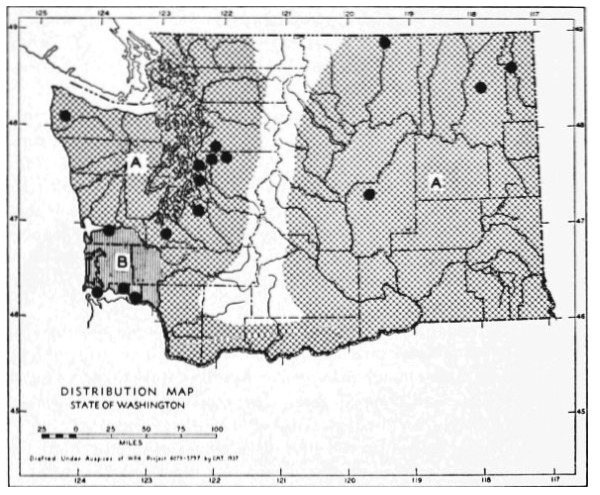
Fig. 120. Distribution of the muskrat in Washington. A. Ondatra zibethicus osoyoosensis. B. Ondatra zibethicus occipitalis.
Burrows of muskrats always have entrances under water. Usually they enter a vertical bank 6 to 15 inches below water line and occasionally 3 feet below it. About half the burrows excavated near Lake Washington, King County, had a single entrance. About 40 per cent had double or triple entrances situated 2 to 3 feet apart and converging within a yard to a single burrow. About 10 per cent had double burrows more than 3 feet in length. Burrows were from 5 to 8 inches in diameter. Nest chambers were from 12 to 15 inches in diameter, spherical, and from 6 to 30 feet from the burrow entrance. The nests themselves were bulky, loose masses of cattail leaves. Embryos found in late February and early March numbered 4 to 8.
Because it is abundant, widely spread and easy to trap, the muskrat is one of the most important fur bearers in the state. The fur is relatively stable in value. In recent years the average skin has brought the trapper slightly less than a dollar. Muskrat flesh is eaten and sold on the market in the eastern United States but has never been popular in Washington. The muskrat does little damage to agriculture, most complaints arising from its burrows which interfere with irrigation ditches.
Ondatra zibethicus osoyoosensis (Lord)
Fiber osoyoosensis Lord, Proc. Zoöl. Soc. London, p. 97, 1863.
F[iber]. z[ibethicus]. osoyoosensis Hollister, Proc. Biol. Soc. Washington, 23:1, February 2, 1910.
Ondatra zibethica osoyoosensis Miller, U. S. Nat. Mus. Bull., 79:231, December 31, 1912.
Type.—Obtained at Osoyoose Lake, British Columbia, on British Columbia-Washington boundary at head of Okanogan River, by J. K. Lord, in 1861 or 1862.
Racial characters.—Color of the upper parts rich, dark brown.
Measurements.—Two males and a female from Seattle, King County, average and measure respectively: total length 565, 555; length of tail 262, 257; hind foot 80.5, 79; weight 2 pounds 13 ounces and 2 pounds 3 ounces.
Distribution.—Eastern Washington generally and all but the southern part of western Washington. Specimens from as far southwest as Tenino (W.W.D.) are typical of osoyoosensis.
Ondatra zibethicus occipitalis (Elliot)
Fiber occipitalis Elliot, Field Columb. Mus. Publ. 74, zoöl. ser., 3:162, April, 1903.
Ondatra zibethica occipitalis Miller, U. S. Nat. Mus. Bull., 79:231, December 31, 1912.
Type.—Obtained at Florence, Lane County, Oregon, by E. Heller, in 1901; type in Chicago Natural History Museum.
Racial characters.—Similar to osoyoosensis but redder; fur shorter and interpterygoid spaces of skull narrower.
Measurements.—A male from Chinook, Pacific County, measures: total length 580; length of tail 248; hind foot 78; ear 21; weight 863 grams.
Distribution.—The southwestern corner of the state, extending north to Aberdeen (V.B.S.) and east to Cathlamet (V.B.S.).
Rattus rattus (Linnaeus) Roof rat
Description.—Size large, total length approximately 400 mm.; tail long, naked, comprising 50 per cent or more of total length; color sooty black or brown; in brown phase, whitish beneath.
The roof rat became established in Central America some 350 years ago, and entered the United States (English Colonies) late in the seventeenth century. Subsequent to the introduction of the Norway rat the roof rat decreased in numbers and is now found only in restricted areas.
Rattus rattus rattus (Linnaeus)
[Mus] rattus Linnaeus, Syst. Nat., 1 (ed. 10):61, 1758.
Rattus rattus Hollister, Proc. Biol. Soc. Washington, 26:126, June 6, 1916.
Type.—From Uppsala, Sweden.
Remarks.—In Washington I have taken specimens of the roof rat in the San Juan Islands and in the coniferous forests on the west slope of the Cascades. In the latter area it seems to be widely spread and to live in the wild.
Rattus rattus alexandrinus (Geoffroy)
Mus alexandrinus Geoffroy, Catal. Mam. du Mus. Nat. d'Hist. Nat. Paris, p. 192, 1803.
R[attus]. rattus alexandrinus Hinton, Jour. Bombay Nat. Hist. Soc., 26:63, December 20, 1918.
Type.—From Alexandria, Egypt.
Remarks.—This subspecies seems to be rare in Washington. My specimens are all from small, isolated islands in the San Juan group. All were taken in the vicinity of human habitations. R. r. alexandrinus resembles R. r. rattus, differing only in brown color of upper parts.
Rattus norvegicus norvegicus (Erxleben) Norway rat
[Mus] norvegicus Erxleben, Syst. Regni Anim., 1:381, 1777.
Rattus norvegicus Hollister, Proc. Biol. Soc. Washington, 29:126, June 6, 1916.
Type.—From Norway.
Description.—Larger, heavier-bodied and coarser-furred than the black rat or roof rat with shorter, heavier tail. The tail is less than 50 per cent of the total length. The color of the back is dull, reddish brown, the sides are paler and the underparts are dirty gray.
Remarks.—The Norway rat was absent from the Pacific Coast of the United States before 1851. It probably reached the coast slightly after that date. It is common about all large cities in Washington. In the western part of the state it lives along streams and marshes under feral conditions.
Mus musculus Linnaeus, subsp? House mouse
[Mus] musculus Linnaeus, Syst. Nat., 1 (ed. 10):62, 1758.
Description.—Size small; tail about 50 per cent of total length, naked; ears small, about 12 mm. in height; upper incisors not grooved; color of upper parts reddish or grayish brown; underparts brown or gray.
Remarks.—The house mouse became established in North America soon after its settlement by Europeans. It is now common throughout the state of Washington, principally near human habitations, but often lives in the wild.
Races of the house mouse have been dealt with by Schwartz and Schwartz (1943: 59-72), and by Nichols (1944: 82-89), but lack of adequate material prevents subspecific identification of house mice from Washington at this time.
Aplodontia rufa (Rafinesque) Mountain beaver
Description.—The mountain beaver is a stout-bodied animal about 14 inches in length, with a tiny tail that is almost invisible externally. The head is large, wide and low with small eyes, small ears and long vibrissae. The legs are short and heavy, but the forefeet are small and handlike; the hind feet are large and powerful. The claws of both forefeet and hind feet are long and strong. The pelage is short, coarse and rough. The upper parts are dark reddish brown and the underparts are grayish brown. The feet are pink.
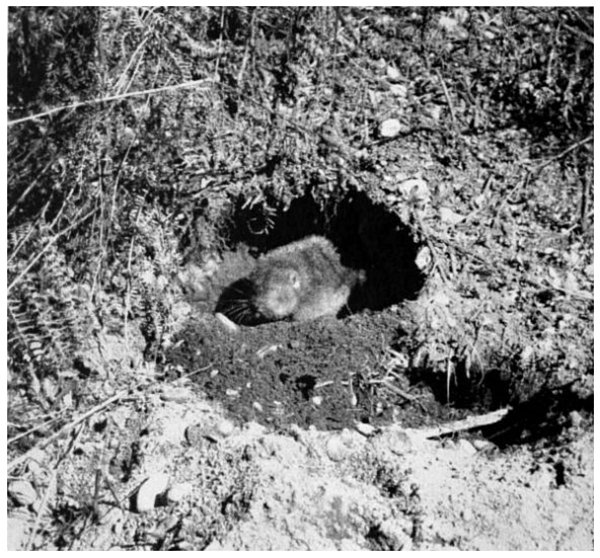
Fig. 121. Mountain beaver (Aplodontia rufa rufa), Seattle, Washington, March 19, 1940. (Fish and Wildlife Service photo by Victor B. Scheffer, No. 919.)
Mountain beavers are confined to the Pacific Coast and range from southern British Columbia to central California. The genus contains a single species of which Taylor (1918) recognized nine races. The principal habitat of the mountain beaver is clearings at the edge of coniferous forests. The animals are most abundant near springs, streams and damp places, although they are not aquatic. The tangled jungles of deciduous trees and shrubs that grow in the ravines and stream valleys of the Puget Sound area present optimum habitat. They occur also on hillsides, on logged-off land and along roadside clearings. In the mountains they occur in thickets and forests, always, in our experience, near streams.
The most conspicuous evidence of the presence of mountain beavers is their burrows. These are large tunnels, four to eight inches in diameter. To each set of tunnels there are numerous entrances, some partly concealed in brush or beside logs or stumps, and some are in the open. Those in the open are less used as entrances than as places for receiving the loose earth which the animals excavate. A pile may contain nearly a cubic yard of earth and stones. Many of the burrows are shallow, and cave-ins are common. Breaks in the roof of a burrow are not repaired, although debris is removed from the burrow itself. The burrows seem not to be constructed according to a system, but are extended to take in whatever brush, logs or other cover is available. They are commonly dug through damp or muddy soil. Small streams flow through some burrows. Such partly flooded runs seem to be favored by the animals.
The nest of a mountain beaver excavated by Scheffer (1929: 15), under the roots of a fallen tree, was oval in shape, twenty inches high and 13 inches wide. The nest was protected from flooding by a basal chamber, or basin, six inches beneath the nest. Two drainage tunnels lead away from this basal chamber. The nest was composed of the leaves and stems of bracken laced together with grass and fine twigs. Two other nests examined by Scheffer measured 17 by 18 inches and 19 by 17 inches. Both were about two feet beneath the surface.
Around Puget Sound the mountain beavers mate in early March. The young number two to three, rarely four, per litter and are born in early April.
Mountain beavers enter water readily but wade rather than swim. They are rather noisy, splashing in water and breaking twigs or rustling leaves on the ground. They climb bushes and saplings, clipping off branches for food as they ascend. According to Scheffer (1929: 15) they leave the stubs of branches attached to the trunk to facilitate their descent. Twice a mountain beaver was found several feet up in a sapling. In both saplings the animal had clipped the branches close to the trunk and was desperately reaching with its hind feet for missing branches. When the observer came near, one animal squealed, tumbled to the ground, and scurried frantically to its burrow.
Although principally nocturnal, mountain beavers are not infrequently active by day, especially in the fall. At this season they harvest food and spread it on logs to dry. The cured hay is removed to their burrows for nesting material and food. In winter mountain beavers are more restricted in habits and are rarely seen by day. Presumably they feed on stored food at this time but they forage somewhat. In winter they eat such evergreen shrubs as salal (Gaultheria shallon) and Oregon grape (Berberis nervosa). They eat also the bark of trees, especially that of the willow (Salix). Under cover of snow, in the mountains, they burrow to some extent and pack excavated earth in snow burrows. The melting of the snow in the spring reveals the earth core, six to eight inches in diameter and two to four feet long. Several such earth cores were forked, showing that part of the earth had been pushed into a branching burrow.
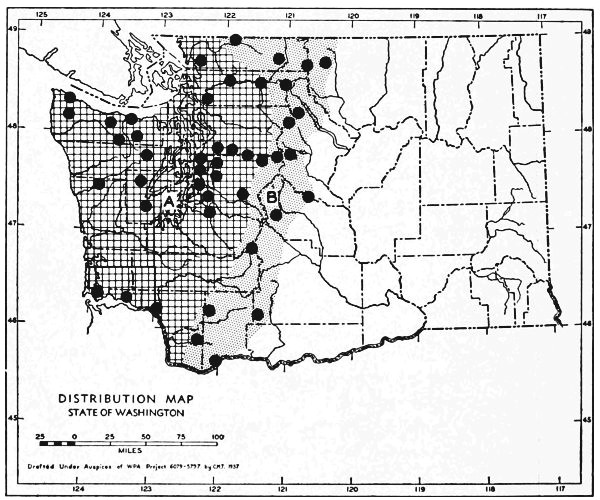
Fig. 122. Distribution of the mountain beaver in Washington. A. Aplodontia rufa rufa. B. Aplodontia rufa rainieri.
The mountain beaver holds its food in its forefeet, squirrel-like, when it eats. Its food consists of the leaves and bark of woody plants and entire herbs, including roots. The mountain beaver is the only mammal so far as known that eats the bracken fern. It feeds on the branches of coniferous trees, including Douglas fir, red cedar, and hemlock. Such thorny species as the blackberry, blackcap and devil's club are eaten. The odiferous skunk cabbage and the stinging nettle are on its bill of fare. A list of its food would include most plants found in its habitat, and we know of no species that it refuses as food.
The mountain beaver is more of a nuisance than a pest. In most of its range there is but little farming although where crops are raised the mountain beaver may do some damage. It undermines roads and trails and defiles springs and streams. Control is simple for the animals readily enter steel traps set in their burrows.
Aplodontia rufa rufa (Rafinesque)
Anisonyx? rufa Rafinesque, Amer. Monthly Mag., 2:45, November, 1817.
Haplodon rufus True, Proc. U. S. Nat. Mus., 7 (1884):596, 1885.
Aplodontia rufa Merriam, Ann. New York Acad. Sci., 3:316, May, 1886.
Aplodontia olympica Merriam, Proc. Biol. Soc. Washington, 13:20, January 31, 1899 (type from Lake Quiniault, Grays Harbor County, Washington).
Aplodontia rufa grisea Taylor, Univ. California Publ. Zoöl., 12:497, May 6, 1916 (type from Renton, King County, Washington).
Aplodontia rufa rufa Taylor, Univ. California Publ. Zoöl., 12:497, May 6, 1916.
Type.—None. Based on a description by Lewis and Clark. Taylor (1918: 455) regarded as typical specimens collected at "Marmot, Clackamas County, Oregon (western slope of Mount Hood, not far from the Columbia River)."
Racial characters.—Size small; skull small.
Measurements.—Eight males and 7 females, from the area about Puget Sound, average, respectively: total length 343, 338; length of tail 37.5, 33.5; hind foot 57.8, 56; ear 25, 24.5; weight 1342, 1300 grams.
Distribution.—Western Washington, between Puget Sound and the Cascade Mountains and southward. Marginal localities are: Bellingham (U.S.N.M.), Sauk (U.S.N.M.), Forks of Skykomish River (W.W.D.), North Bend (U.S.N.M.), and mouth of Klama River (M.V.Z.).
Remarks.—Individual variation in mountain beavers is considerable. Two weakly defined races are recognized in Washington.
Aplodontia rufa rainieri Merriam
Aplodontia major rainieri Merriam, Proc. Biol. Soc. Washington, 13:21, January 31, 1899.
[Haplodontia rufa] raineri Elliot, Field Columb. Mus. Publ. 45, zoöl. ser., 2:112, 1901.
[Aplodontia rufa] raineri Trouessart, Catal. Mamm., viv. foss., suppl. p. 348, 1904.
Aplodontia rufa columbiana Taylor, Univ. California Publ. Zoöl., 12:499, 1916 (type from Hope, British Columbia).
Type.—Obtained at Paradise Creek, 5, 200 ft., Mount Rainier, Pierce County, Washington, by V. Bailey on August 6, 1897; type in United States National Museum.
Racial characters.—Similar to rufa but larger with larger skull.
Measurements.—Three males and a female from Tye, King County, average and measure respectively: total length 352, 340; length of tail 35, 40; hind foot 60, 59; ear 24, 19.
Distribution.—The higher Cascade Mountains from the Columbia River northward to the Canadian boundary. Marginal localities are: Canyon Creek (U.S.N.M.), Cascade Pass (U.S.N.M.), Tye (W.W.D.), Mt. Rainier (U.S.N.M.), Mt. St. Helens (U.S.N.M.), and Yacolt (M.V.Z.).
Remarks.—Intergradation between rufa and raineri is seen in specimens from the area between Stevens Pass and Skykomish, King County.
Zapus princeps Allen Big jumping mouse
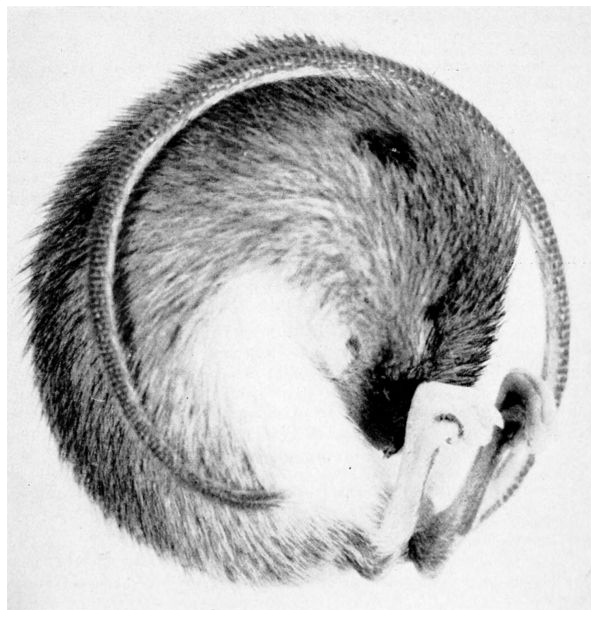
Fig. 123. Big jumping mouse (Zapus princeps trinotatus) in hibernation. Puyallup, Washington, January 30, 1939. (Fish and Wildlife Service photo by Victor B. Scheffer, No. 576.)
Description.—The big jumping mouse is a medium-sized mouse, slightly larger than the house mouse, with an exceptionally long, tapering tail. Head and body measure about 4 inches and the tail about 5 inches. The body is slender with a small head, small eyes and small, naked ears. The forefeet are small and handlike but the hind feet are large with long, powerful legs. The long, naked tail is smoothly tapering to a narrow point. The fur is short, posteriorly directed, stiff and bristlelike. The dorsal area is dusky, the sides are orange or yellow, and the underparts are creamy white. Each upper incisor tooth has a groove on its anterior face.
Jumping mice are boreal mammals occurring in wooded regions ranging from the Arctic region southward to North Carolina, New Mexico and California. Jumping mice are of rather general distribution in Washington, being only locally common. They are partial to damp, boggy areas but avoid true swamps. They occur in clearings in the forests in the Puget Sound area and in meadows in river bottoms and in jungles in ravines. They reach their greatest abundance in the boggy meadows and glacial cirques of the mountains and spread out from such areas to seemingly less favored habitat on dryer slopes and heather meadows. Unlike many species, they do not seem to inhabit talus slides. They are entirely absent from the eastern Washington desert.
Sometimes the jumping mouse walks on all four feet but the ordinary means of progression is by short hops on the hind feet alone. When startled they travel in great bounds, covering six feet or more at a jump. When jumping they make considerable noise, swishing or rustling through the grass and landing with an audible thud. The long tail serves as a balancing organ. A specimen whose tail had been lost was reported by Svihla and Svihla (1933: 133) to turn somersaults in the air and invariably to land on its back rather than its feet.
Jumping mice become very fat and hibernate in middle summer or early fall. In the lowlands they disappear by late July but in the mountains they remain active until the middle of September. They spend the winter in nests of grass several feet beneath the surface. A hibernating individual figured by Flahaut (1939: 17) was curled in a ball, head down with the tail wrapped completely around the greatest circumference of the ball.
Near Seattle the principal food of the jumping mouse was the velvet grass (Holchus lanatus), and the seeds of grasses and the broad-leaved dock. The fruit of the blackberry (Rubus macropetalus) is eaten and occasional individuals are seen with the chin stained a deep purple from the juice.
The new-born young of the jumping mouse were reported by Svihla and Svihla (1933: 132) to average 0.8 grams in weight. They are pink, hairless, lacking even the facial vibrissae, with eyes closed and ears folded.
Zapus princeps trinotatus Rhoads
Zapus trinotatus Rhoads, Proc. Acad. Nat. Sci. Philadelphia, 1894, p. 421, January 15, 1895.
Zapus imperator Elliot, Field Columb. Mus. Publ. 30, zoöl. ser., 1:228, February 1, 1899 (type from Sieg's Ranch, Elwha River, Olympic Mountains, Clallam County, Washington).
Type.—Obtained on Lulu Island, mouth of Fraser River, British Columbia, by S. N. Rhoads on May 31, 1892; type in Philadelphia Academy of Natural Sciences.
Racial characters.—Similar to oregonus but brighter; sides orange; underparts creamy white; buffy area often present on chest.
Measurements.—Twenty males and 15 females from western Washington average, respectively: total length 230, 233; length of tail 140, 140; hind foot 33, 32.8; ear 14.9, 16.3; weight 23.7, 25.7 grams.
Distribution.—Western Washington and the Cascade Mountains, east in the northern Cascades at least to Tomyhoi Lake (W.W.D.).
Remarks.—Actual intergrades between trinotatus and kootenayensis have not been examined but the differences separating the two forms are of the degree that usually distinguish subspecies. Since trinotatus occurs in the high Cascades as far east as Mount Baker, at least, and kootenayensis probably occurs in the northeastern Cascades, the two forms doubtless come together in the rugged, inaccessible area between these two localities. Further collecting will probably show a narrow zone of intergradation in extreme western Okanogan County.
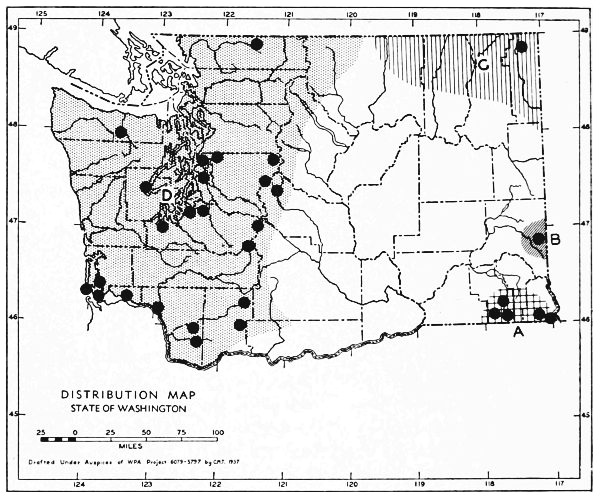
Fig. 124. Distribution of the big jumping mouse in Washington. A. Zapus princeps oregonus. B. Zapus princeps idahoensis. C. Zapus princeps kootenayensis. D. Zapus princeps trinotatus.
Zapus princeps kootenayensis Anderson
Zapus princeps kootenayensis Anderson, Ann. Rept. Nat. Mus. Canada for 1931, p. 108, November 24. 1932.
Type.—Obtained on Green Mountain, 6,000 ft., 10 miles north of Rossland, West Kootenay District, British Columbia, by R. M. Anderson, on July 18, 1929; type in National Museum of Canada.
Racial characters.—Similar to oregonus but paler; yellow more faded.
Measurements.—Twenty females, including 15 topotypes, average (Anderson, 1932: 109): total length 245; length of tail 140; hind foot 30.5.
Distribution.—Northeastern Washington. Specimens from Sullivan Lake (E.S.B.) have been examined.
Zapus princeps idahoensis Davis
Zapus princeps idahoensis Davis, Jour. Mamm., 15:221, August 10, 1934.
Type.—Obtained 5 miles east of Warm Lake, 7,000 feet elevation, Valley County, Idaho, by W. B. Davis; type in Museum of Vertebrate Zoölogy.
Racial characters.—Similar to kootenayensis but brighter in color, more ochraceous. Similar to oregonus but paler, more yellowish.
Measurements.—Davis (1939:339) gives the measurements of six adult topotypes as: total length 240; length of tail 144; hind foot 31.
Distribution.—A single specimen in the Charles R. Conner Museum from Kamiak Butte, Whitman County, is referable to this race.
Zapus princeps oregonus Preble
Zapus princeps oregonus Preble, N. Amer. Fauna. 15:24, August 8, 1899.
Type.—Obtained at Elgin, Union County, Oregon, by E. A. Preble, on May 29, 1896; type in United States National Museum.
Racial characters.—Small size, pale color.
Measurements.—Three males and 3 females from the Blue Mountains average, respectively: total length 233, 234; length of tail 138, 139; hind foot 31.8, 31.8; ear 16, 16; weight 29, 33 grams.
Distribution.—The Blue Mountains of southeastern Washington.
Erethizon dorsatum (Linnaeus) Porcupine
Description.—The porcupine is one of the largest rodents found in Washington, being exceeded in size only by the beaver. Its body is heavy and stocky, its legs short, its tail long and thick and its eyes small. It is best known for the modified hairs, or quills, of its tail and dorsal area. These vary in greatest diameter from one-sixteenth to three-sixteenths of an inch and from three-quarters of an inch to five inches in length. They are ivory-white with black tips. In addition to quills, the porcupine possesses wooly, black underfur and long, banded guard hair. The bands of the guard hairs are black and yellow, varying in width. Commonly they are of a single color, black, yellow or brown.
Porcupines range over virtually all wooded parts of North America north of Mexico, in and above the Transition Life-zone. The Canadian porcupines have been studied by Anderson and Rand (1943A) and intergradation between the eastern dorsatum and the western epixanthum has been shown.
The porcupines are commonly considered to be forest animals. However, they are rather rare in the denser coniferous forests. In the more open areas on the Cascade Mountains, especially on the eastern slopes, they are not uncommon. They are rather common in the coniferous forests of northeastern Washington and the Blue Mountains. They seem to be rather common also in desert areas at the southern edge of the Columbian Plateau.
The huge incisors of the porcupine are adapted to feeding on bark. They do feed on bark to a certain extent in Washington, but it is my observation that more herbs and bushes are eaten than bark. In areas where porcupines are common, trees are commonly girdled, usually close to the top. Trees girdled in this manner in the Kettle River Mountains included western larch, ponderosa pine, and grand fir. The tops of some trees were killed.
The ordinary walking gait of the porcupine is a slow deliberate walk in which he appears to waddle somewhat. They can increase their speed to a slow trot. They are slow, deliberate climbers, ascending and descending trees with head upward. They are able also to climb rocks and cliffs, sometimes being seen on the tops of large boulders.
Despite their large size, porcupines are not commonly seen. They are mainly nocturnal and, in the daytime, find concealment high in the branches of some conifer or a cave between the rocks in a talus slide.
While encamped near Sherman Creek Pass in the Kettle River Mountains my companion and I heard a crunching of gravel from the road fifty feet away. We listened intently, wondering what person would be abroad in the mountains at midnight. In the vicinity of our car, concealed from our view by trees, the noise stopped, to be followed a few minutes later by a rasping and clattering that could be heard far away. We raced to the car to discover a large porcupine crouched on the running board by a pile of "pick-up" antlers of the white-tailed deer left there by us. The "porkie" had been chewing on these, heedless of the noise made by the loose antlers clashing against the metal side of the car.
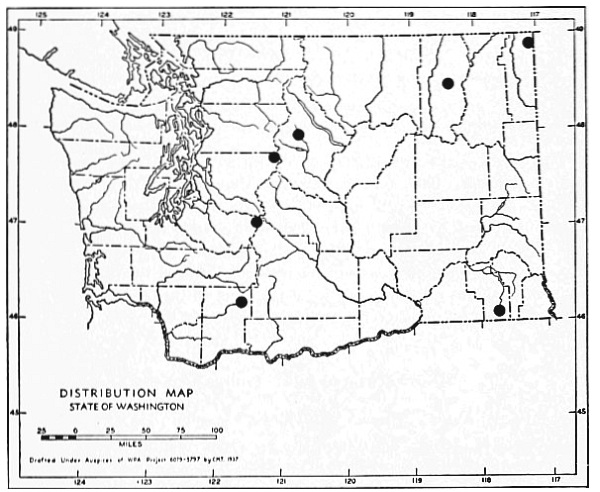
Fig. 125. Distribution of the porcupine, Erethizon epixanthum in Washington. Boundaries between ranges of subspecies are uncertain.
In Washington the single young is born late in May or early in June. There are two pairs of mammae, both pectoral, of which only the anterior are functional.
Erethizon dorsatum epixanthum Brandt
Erethizon epixanthus Brandt, Mem. Acad. Imp. Sci. St. Pétersbourg, ser. 6, 3 (Sci. Nat. vol. 1): 390, 1835.
Erethizon dorsatus epixanthus True, Proc. U. S. Nat. Mus., 7:600, 1885.
Erethizon epixanthum epixanthum Miller, U. S. Nat. Mus. Bull., 128:437, April 29, 1924.
Erethizon dorsatum epixanthum Anderson and Rand, Canadian Jour. Research, 21:293, September 24, 1943.
Type.—None. Type locality California.
Racial characters.—Size large, total length of adults approximately 30 inches; tail long (nearly one-third of total length), thick, heavy and spiny; body stout; legs short; claws long and curved; ears and eyes small; body spines short, thick and most abundant on posterior part of back, longer and more slender on sides and shoulders; guard hairs of shoulders and sides long, almost concealing spines; fur of underparts shorter; color variable, brown, black or yellow. In winter the fur is longer and woolly, concealing spines.
Distribution.—The Columbian Plateau and the Blue Mountains.
Remarks.—Anderson and Rand (1943A: 295) ascribe two races to Washington. With inadequate material myself to verify this ascription. I think it probable that the northern forest porcupine and the Great Basin animal are racially different. In consequence the available names, nigrescens and epixanthum, are here applied, pending a revision of the entire genus.
Erethizon dorsatum nigrescens Allen
Erethizon epixanthus nigrescens Allen, Bull. Amer. Mus. Nat. Hist., 19:558, October 10, 1903.
Erethizon epixanthum nigrescens Miller, U. S. Nat. Mus. Bull., 128:437, April 29, 1924.
Erethizon dorsatum nigrescens Anderson and Rand, Canadian Jour. Research, 21:293, September 24, 1943.
Type.—Obtained on the Shesley River, British Columbia, by M. P. Anderson on August 23, 1902; type in American Museum of Natural History.
Measurements.—A female from Sherman Creek Pass, Ferry County, measured: total length 770; length of tail 250; hind foot 95; ear 37. A female from Tye, King County, measured: 930; 280; 125; weight 20 pounds.
Distribution.—Forested parts of the state, exclusive of the Blue Mountains.
Remarks.—Porcupines are extremely rare west of the Cascades but are occasionally reported from as far west as the Olympic Peninsula.
Myocastor coypus (Molina) subsp? Coypu, nutria
Mus coypus Molina, Sagg. Stor. Nat. Chili, p. 287, 1782.
Myocastor coypus Kerr, Anim. Kingd., p. 225, 1792.
Type locality.—Chile.
Description.—Size large, slightly smaller than a beaver; color rich, reddish brown; tail long, round; hind feet webbed for swimming.
Remarks.—The nutria, a native of South America, has been brought to the United States and raised commercially on "fur farms." The species has become established in the wild in several localities in western Washington and at the Colville Indian Reservation in northeastern Washington. For further details see Larrison (1943).
Ochotona princeps (Richardson) Pika or cony
Description.—The pika is of guinea-pig size, with a short, chunky body about 200 mm. in length. The tail is represented externally merely by a tuft of white fur. The short, wide head has large, circular ears, large black eyes, and long whiskers. The legs are short and the soles of the feet are furred. The color of the Washington races varies from grayish-yellow to dark reddish brown. Like rabbits, all pikas have two pairs of upper incisors. The second pair, located just in back of the first, is small and delicate.
Ochotona is a wide-ranging genus with many more species in Asia and extreme eastern Europe than in North America. Three races of the species princeps occur in the state of Washington, where they are confined to the Cascade, Kettle River, and Pend Oreille Mountains. The ranges of all three races extend northward into British Columbia; one (brunnescens) occurs also in Oregon, and one (cuppes) in Idaho.
In Washington pikas live only in talus slides and rock piles, where they find refuge from most of the carnivores that prey on small mammals. Their distribution in the state seems to be regulated by the distribution of talus slides, and areas free of talus act as effective barriers to pikas. They are abundant throughout the Cascades but are absent from the Olympic Mountains although conditions there are well suited to them. Probably the lowlands of western Washington which, owing to moderate temperature and low relief, have little talus and exposed rock, serve as a barrier. The Columbian Plateau is also free of pikas. This may be due to the relative scarcity of talus as compared with mountainous areas, and the fact that much of the talus on the Plateau is composed of fragments of basalt too small to afford the shelter needed by pikas. The aridity of the Columbian Plateau may contribute to the absence of pikas, although this seems unlikely in view of the fact that they occur on arid lands in Nevada and elsewhere.
Altitudinally, pikas range from 300 feet, in Clark County, to 6,000 feet on Mt. Rainier, Pierce County, and on Round Top Mountain, Pend Oreille County. They occur from the arid subdivision of the Transition Life-zone, at Milk Creek, Kittitas County, to the upper edge of the Hudsonian Life-zone, at Glacier Basin, Mt. Rainier. Generally speaking, they are mammals of the mountains.
Common enemies of the pikas are the weasel (Mustela frenata), marten (Martes caurina), and hawks of several species. Pikas are active by day, especially in the early morning. Their call note is a short "eek!" which carries a long distance. This squeaking note is often heard throughout the night when rain threatens their drying hay.
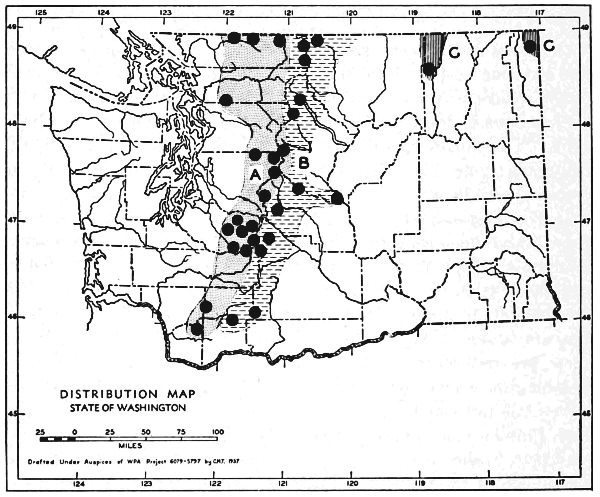
Fig. 126. Distribution of the pika in Washington. A. Ochotona princeps brunnescens. B. Ochotona princeps fenisex. C. Ochotona princeps cuppes.
Vegetation used as food, either for immediate consumption or for winter use, includes almost all grasses, vines, shrubs, and trees available near the pika's home. The subalpine lupines are especially favored. Even such a thorny growth as the devil's club (Oplopanax horridum) is eaten. Heather (Phyllodoce, Cassiope) has not been found in any of the numerous hay piles examined, even when it is the commonest plant in the vicinity. Large bundles of plants are carried in the pika's mouth. The forefeet do not assist in transporting the load. If intended for immediate consumption, the plants are deposited on one of last year's hay piles and are eaten at leisure. The eating habits of the pika are rabbitlike. A large leaf is seized at the tip and drawn into the mouth with rapid chewing motions without assistance from the forefeet. Plants destined to become hay are carefully spread out and exposed to the sun. In cloudy or rainy weather the exposed plants are gathered and stored under large rocks, to be reëxposed for curing when the weather improves. Large hay piles often include more than fifty pounds of perfectly cured grasses, annuals, bushes and evergreens.
No record of embryos is available for Washington pikas, but a male with enlarged testes was taken at Lake Keechelus, Kittitas County, on March 22, 1940. Half-grown young of fenisex were taken at Sawtooth Mountain, Skamania County, on July 13, 1939, and of brunnescens at Slate Creek, Whatcom County, on August 16, 1937. Nearly full-grown young of fenisex are reported taken at Bald Mountain, head of Ashnola River, Okanogan County, on September 16, 1920. Young cuppes of several sizes were taken at Sherman Creek Pass, Ferry County, on September 11, 1938. The breeding season possibly extends from March to August with a tendency to be earlier at lower elevations.
Ochotona princeps cuppes Bangs
Ochotona cuppes Bangs, Proc. New England Zoöl. Club, 1:40, June 5, 1899.
Ochotona princeps cuppes A. H. Howell, N. Amer. Fauna, 47:27, August 21, 1924.
Type.—Obtained by Allan Brooks at the Monashee Divide, 4,000 feet, Gold Range, British Columbia, on August 2, 1897; type in Museum of Comparative Zoölogy.
Racial characters.—Smallest and palest of the Washington pikas; total length less than 8 inches; color of upper parts grayish-yellow, grayest on posterior third of back; underparts pale buff; skull small, but with relatively wide zygomatic and interorbital regions.
Measurements.—Eight males and 3 females from Round Top Mountain, Pend Oreille County, average, respectively: total length 183.5, 181.5; hind foot 30.7, 31.0; ear 22.4, 23.7; one adult male from the same locality weighed 141.6 grams.
Distribution.—This pika has been found at Round Top Mountain (W.W.D.) and Pass Creek Pass (W.W.D.) in northeastern Washington.
Ochotona princeps fenisex Osgood
Lagomys minimus Lord, Proc. Zoöl. Soc. London, p. 98, 1863 (not of Schinz, 1821).
Ochotona minimus Bangs, Proc. New England Zoöl. Club, 1:39, June 5, 1899.
Ochotona fenisex Osgood, Proc. Biol. Soc. Washington, 26:80, March 22, 1913 (substitute for minimus Lord).
Ochotona princeps fenisex A. H. Howell, N. Amer. Fauna, 47:28, August 21, 1924.
Type.—Obtained by J. K. Lord at "Ptarmigan Hill," near head of Ashnola River, Cascade Range, British Columbia, in early fall of 1860 (?); type in British Museum.
Racial characters.—Size and color intermediate between brunnescens and cuppes; length about 8 inches; color of upper parts near Pinkish Cinnamon, becoming gray on posterior third of back; underparts washed with buff; skull of medium size and proportions.
Measurements.—Nine males and 5 females from Okanogan and Chelan counties average, respectively: total length 190.0, 197.4; hind foot 31.1, 32.8; ear 21.6, 22.0.
Distribution.—Specimens referable to this race occur from the British Columbian boundary south, through the eastern Cascade Mountains. Along the western border of its range, fenisex becomes larger and darker, merging into the race brunnescens. Marginal records are: Hidden Lakes (U.S.N.M.), Lyman Lake (U.S.N.M.), Mt. Stuart (W.W.D.), Easton (U.S.N.M.), Mt. Aix (U.S.N.M.), Steamboat Mt. (M.V.Z.).
Ochotona princeps brunnescens Howell
Ochotona fenisex brunnescens A. H. Howell, Proc. Biol. Soc. Washington, 32:108, May 20, 1919.
Ochotona princeps brunnescens A. H. Howell, N. Amer. Fauna. 47:31, August 21, 1924.
Type.—Obtained by George G. Cantwell at Lake Keechelus, Kittitas County, Washington, on August 23, 1917; type in United States National Museum.
Racial characters.—Largest and darkest of the three races of Washington pikas; total length 8 inches or more; color of upper parts rich cinnamon, heavily washed with blackish; posterior part of back slightly paler; underparts buffy cinnamon; skull large and heavy with wide zygomatic arches but relatively narrow interorbital region and relatively narrow across maxillary tooth rows.
Measurements.—Eight males and 9 females from within three miles of Stevens Pass, King and Chelan counties, average, respectively: total length 201.8, 208.3; hind foot 33.3, 33.0; ear 22.3, 22.6. The average weights of 4 males and 3 females from 3 mi. S E Tumtum Mountain, Clark County, are 178.0 and 174.3 grams, respectively.
Distribution.—From the British Columbia boundary south to the Columbia River and from the western Cascades east to the area of intergradation with fenisex. Marginal occurrences are: Whatcom Pass (U.S.N.M.), Stevens Pass (W.W.D.), Keechelus (U.S.N.M.), Cowlitz Pass (U.S.N.M.), Tumtum Mountain (M.V.Z.).
Lepus townsendii townsendii Bachman White-tailed jack rabbit
Lepus townsendii Bachman, Jour. Acad. Nat. Sci. Philadelphia, 8 (pt. 1):90, pl. 2, 1839.
Lepus campestris townsendi Merriam, Proc. Biol. Soc. Washington, 17:132, July 14, 1904.
Lepus townsendii townsendii Hollister, Proc. Biol. Soc. Washington, 28:70, March 12, 1915.
Type.—Obtained by J. K. Townsend at old Fort Walla Walla (present town of Wallula), Walla Walla County, Washington; type in Philadelphia Academy of Natural Sciences.
Measurements.—A male from Miller's Island, Klickitat County, in the Columbia River, measured: total length 564; length of tail 117; hind foot 156; ear 110; weight 337.5 grams.
Distribution.—Previously found over the grasslands of eastern Washington. Now restricted and scarce except in the Okanogan Valley.
Remarks.—The white-tailed jack rabbit is the largest rabbit in the state, adults measuring 24 or more inches in length. The long legs and long ears accentuate the impression of large size. Its body is more bulky than that of its relative, the black-tailed jack rabbit. In summer the pelage of the upper parts is dark gray and in winter it is white over nearly the entire body.
The white-tailed jack rabbit occurs from southern Saskatchewan south to extreme northern New Mexico, and from eastern Washington east to Wisconsin. A single race occurs in Washington. In eastern Washington "whitetails" favor the hilly, bunchgrass territory of the arid subdivision of the Transition and Upper Sonoran life-zones. In winter they descend to the lower sagebrush valleys.