V. THE ROMANTIC SCHOOL IN FRANCE (continued 4)
Mary Morison translation
In the end Indiana goes the length of discovering the ruthless egotism of the male sex in all the outward developments of society, even in the religion taught by men. They have made of God a man in their own image. She writes to her hypocritical lover: "I do not serve the same God as you, but I serve mine better and more purely. Yours is the man's God, a man, a king, the founder and the patron of your race; mine is the God of the universe, the creator, the preserver, and the hope of every living being. Yours has made everything for you alone; mine has made all his creatures for each other." Two things are noticeable in these words—a naïve protest against that order of society which is founded upon the subordination of woman to man, and the optimism of an innocent, youthfully trustful faith in God. This attitude George Sand did not long maintain. Only a few years later she brings Lélia to a conclusion with an outburst of despairing pessimism. Shortly before her death the heroine says: "Alas! despair reigns, and moans of suffering emanate from every pore of the created world. The wave casts itself writhing and moaning on the beach, the wind weeps and wails in the forest. All those trees which bend and only rise to fall again under the lash of the storm, suffer frightful torture. There exists one miserable, cursed being, terrible, immense—the world which we inhabit cannot contain him. This invisible being is in everything, and his voice fills space with one eternal sob. Imprisoned in the universe he writhes, strives, struggles, beats his head and his shoulders against the confines of heaven and earth. He cannot pass beyond them; everything crushes him, everything curses him, everything torments him, everything hates him. What is this being and whence does he come?... Some have called him Prometheus, others Satan; I call him desire; I, the hopeless sibyl, the spirit of departed ages.... I, the broken lyre, the dumb instrument whose sounds would not be understood by those who inhabit the earth to-day, but in whose breast the eternal harmonies lie murmuring; I, the priestess of death, who feel that I once was Pythia, that I wept then, that I spoke then, but who cannot remember the healing word! ... O truth, truth! to find thee I descended into abysses the very sight of which would make the bravest giddy with fear. But truth! thou hast not revealed thyself; I have sought thee for ten thousand years and have not found thee! For ten thousand years the only answer to my cries, the only consolation of my agony, has been the sound, audible throughout this whole accursed world, of that despairing sob of impotent desire! For ten thousand years I have shouted into infinity: Truth! Truth! For ten thousand years infinity has answered: Desire! desire! O miserable Sibyl! O dumb Pythia! dash thy head against the rocks of thy cave and mingle thy blood, which is foaming with rage, with the foam of the sea!"
In such an outburst as this, the soulful melancholy of those youthful years reaches its climax. Condensed as I have given it here—it is six times as long in the original—it is a beautiful, poetical expression of George Sand's fully developed youthful self-consciousness. At the time she wrote Indiana, neither her feeling of her own superiority nor her pessimism had reached this stage. That unpretending tale she composed as the sympathising spokeswoman of the victims of existing social conditions. In it she did not consciously attack any social institution—not even marriage, as the opponent of which she was at once stigmatised. She is evidently speaking the truth when (in the preface of 1842) she declares that long after writing the original preface to Indiana under the influence of a remnant of respect for existing social institutions, she continued her attempt to solve the insoluble problem, to find a means of securing the happiness and dignity of the individuals oppressed by society which should be consonant with the existence of society. And she is also perfectly truthful when, in a letter to Nisard (the last in Lettres d'un Voyageur), she maintains that she has only attacked husbands, and not marriage as a social institution. It was in the rôle of the psychologist and story-teller, not in that of the reformer, that she at first appeared before the public. In Indiana, as in Valentine, the fervour, the poetical impulses, the enthusiastic passions and stormy protests of youth, are the proper contents of the book; there is much psychological and little personal history. Nevertheless there was in the nature of the feelings described (feelings free from any trace of viciousness, yet at variance with the decrees of society), and still more in the reflections interspersed throughout the tale, something which actually struck at the foundations of society. Therefore it was not pure stupidity which found expression in the clumsy and violent attacks made upon these books and their author by the partisans of the existing order of things. Men had a foreboding that such feelings and thoughts would sooner or later remould the laws governing society. They have begun to do so, and their influence will increase day by day.
Their very idealism and enthusiasm makes these books essentially revolutionary. For, as only the inner world exists for the authoress, she allows it to develop freely without taking any thought of the possibility of its development destroying the outer world; and, depicting as she does, chiefly strong feelings, or rather only one, infinitely varied feeling—love, she shows how its laws and the laws of society perpetually come into conflict. Although she casts no doubt upon the necessity and indispensability of marriage in our days, she undermines the belief in its eternal continuance. She certainly at first only attacks husbands, but an examination of her demand for an ideal husband shows that it is a demand which cannot be satisfied under existing conditions. In much the same manner, at a somewhat later period, Kierkegaard undermines Christianity by making an extravagantly ideal demand of the individual Christian.
The French Naturalistic School of forty years later, which has often suffered from more or less groundless accusations of immorality, has, in revenge, re-directed the accusation against these enthusiastic early works of George Sand's. When Émile Zola made one of his periodical protests against the idealistic novel, he never omitted to point out the dangers for the family and for society which lie in this constant aspiring beyond the bounds which restrain the individual, this continual representation of a craving for greater intellectual and emotional liberty. He prided himself on never representing unlawful love in a beautiful or inviting light, but always bedraggled with mire. He might have added that he and his successors in the school of Balzac have never felt the need of a higher morality than that in common vogue, and never hold out the prospect of social conditions different from the present. They have imposed a crushing restriction on themselves by limiting themselves to the representation of the outward realities visible to their own eyes, and resolutely refusing to draw any conclusions from their observations. Hence it is that their boldness in representing social relations and situations which literature hitherto had been chary of approaching, is equalled by their weakness, nay insignificance, as thinkers and moralists. They are constantly reduced to seek support from the indubitable harmony of their morality with the universally accepted moral code; they plume themselves on calling vice what other people call vice, and on inspiring horror of that vice. They are not as that sinner George Sand. But it is time to observe that it is just in this "morality" of theirs that their literary weakness lies; and that the strength of George Sand's works, with their far more idealistic and chaste delineations, lies in their "immorality." In the apparently extremely audacious works of the Realistic School, there is not an utterance to compare in real audacity with that which George Sand has put into the mouth of one of the chief characters in Horace, and which gives admirably condensed expression to her ideas of morality in the matter of love: "I believe that that love should be defined as a noble passion, which elevates and strengthens us by beautiful feelings and thoughts, and that love as an evil passion, which makes us selfish and cowardly and gives us over to all the meannesses of blind instinct. Every passion, therefore, is lawful or criminal according to its production of one or the other of these results—it being a matter of no consequence that official society, which is not the supreme court of justice of humanity, sometimes legalises the evil, and condemns the beneficent passion."[1]
In Lélia and Jacques (1833 and 1834) their authoress's Byronic "Weltschmerz" and declamatory tendency reach high-water mark. In Lélia she represented her ideal great, unsensual, profoundly feeling woman, and provided her with an opposite in her sister, Pulchérie, a luxurious courtesan. Taking her own character and separating the two sides of it, she formed Lélia after the Minerva-image, Pulchérie after the Venus-image in her own soul; the result being, not unnaturally, rather two symbolic personages than two human beings of flesh and blood. In Jacques she approached the problem of marriage from a new side. In Indiana she had portrayed a brutal, in Valentine a refined, cold husband; but now she equipped the husband with the qualities which in her eyes were the highest, and wrecked his happiness upon the rock of his own elevated character, which his insignificant young wife is not capable of understanding and continuing to love. The authoress has endeavoured to impart additional force to her own opinions by putting them into the mouth of the wronged husband. He himself excuses his wife: "No human being can control love; and no one is guilty because he loves or ceases to loves. What degrades the woman is the lie; what constitutes the adultery is not the hour she grants her lover, but the night she spends in her husband's arms afterwards." Jacques feels it his duty to make way for his rival: "Borel, in my place, would calmly have beaten his wife, and would probably not have blushed to embrace that same night the woman degraded alike by his blows and his kisses. There are men who, in the Oriental fashion, calmly kill their faithless wives, because they regard them as their lawful property. Others challenge their rival, kill him or put him out of the way, and then beg the woman whom they declare they love, for kisses and caresses, which she either refuses or gives in despair. These are perfectly ordinary proceedings in conjugal love. It seems to me that the love of swine is less vile and coarse than such love." These truths, already regarded as elementary by people of the highest culture, were in 1830 the most atrocious heresy. They are the salt which has kept this youthful work from becoming stale in spite of its antiquated plot and the diffuseness of the tedious letter-style. The extravagance of Romanticism is most noticeable in the final catastrophe. Jacques can think of no better means of liberating Fernande than a suicide committed in a manner which to her will give it the appearance of an accident. This transports us at once into the region of unreality. But the unreality in this novel is, generally speaking, more apparent than actual. It is easy for modern criticism to point out the absence of any indications of locality, of real occupations, &c., &c.; the personages in George Sand's early novels have no occupation and no aim but to love. The reality of these books is a spiritual reality, the reality of feeling. Even this, however, has been disputed in our day. It is the fashion to regard emotions such as those here described—this wild despair caused by social conditions, this passionate, erotic tenderness, this pure, ardent friendship between man and woman—as unnatural and unreal.[2] But we must remember that George Sand's characters are not supposed to be average men and women. She describes unusually gifted beings. Indeed, in these early works she has done little else than delineate and explain her own emotional life. She places her own character in every variety of outward circumstance, and then, with a marvellous power of self-observation and unerring skill, draws the natural psychological conclusions. It is interesting to observe how the constant craving to find a masculine mind which is the equal of her own, leads her to a kind of self-duplication in two sexes. Ardently as she exalts love, strongly as she allows it to influence the life of the great woman and of the great man, nevertheless both of these, Jacques as well as Lélia, are inspired by a still stronger, still more ideal feeling, that of friendship for a noble member of the opposite sex, by whom they are understood. In comparison with this profound mutual understanding, Lélia's love for Sténio, Jacques' for Fernande, seem merely the weaknesses of these two great souls. Lélia has an understanding friend and equal in Trenmor, Jacques in Sylvia. Jacques would love Sylvia if she were not his half-sister, or rather if he were not compelled to suspect that she is; but there is a beauty in their mutual relationship, such as it is, to which merely erotic relations could hardly attain. I remember distinctly what a powerful impression this friendship between Jacques and Sylvia made upon me when I read the book (probably in 1867) for the first time. I saw plainly enough that Jacques is to a certain extent an unreal character—and Sylvia also; for she is nothing more than Jacques' understanding confidante; but the ideal current between them is real, and it electrified me. Sylvia has her origin in the distressful cry of the genius for its equal and mate; she is undoubtedly nothing more than the expression of the urgent craving and demand of the great, lonely heart—but what is poetry else than this? Imperfect as the novel otherwise may be, the friendship between Jacques and Sylvia lends it an atmosphere of real poetry; we feel, while reading of it, as if, above the low-lying world of the passions, we caught a glimpse of a higher one, where purer, yet still quite earthly beings, love and understand each other.
Characters such as these illustrate the strong instinct of friendship which George Sand possessed, and which was quite in the spirit of the youthful Romanticism of the period. Her Lettres d'un Voyageur, which follow the first group of novels, and begin immediately after the separation from Alfred de Musset in Venice, give us an insight into her friendships. These letters belong to the works in which she has most directly revealed her own personal feelings, although they are written with a reserve concerning actual events which makes them obscure to the uninitiated. In them we follow her from the days of her life with the handsome, stupid Italian, Dr. Pagello, for whom she gave up De Musset, to the period of her devotion to Everard (Michel de Bourges), her counsel in the divorce suit, who inspired her with the idea of the pretty tale, Simon. Between these two extremes lie all the good, cordial friendships, with François Rollinat, Jules Néraud, &c.—frank, clever men, with whom she felt a constant desire to exchange ideas and letters, with whom she studied, from whom she learned much, and whom, in the Romantic spirit of good fellowship, she addressed with the familiar "thou"; as also all the genuine artistic comradeships with Franz Liszt, the Comtesse d'Agoult, Meyerbeer, and many others—the men and women of genius of the day.
In no other of her works is she so eloquent, in none of the later ones do her periods flow in such long, lyrically rhetorical waves. Nowhere better than here can we study her personal style, as distinguished from the dialogue of her novels. Sonority is its most marked feature. It rolls onward in long, full rhythms, regular in its fall and rise, melodious in joy, harmonious even in despair. The perfect balance of George Sand's nature is mirrored in the perfect balance of her sentences—never a shriek, a start, or a jar; a sweeping, broad-winged flight—never a leap, nor a blow, nor a fall. The style is deficient in melody, but abounds in rich harmonies; it lacks colour, but has all the beauty that play of line can impart. She never produces her effect by an unusual and audacious combination of words, seldom or never by a fantastic simile. And there is just as little strong or glaring colour in her pictures as there is jarring sound in her language. She is romantic in her enthusiasms, in the way in which she yields unresistingly to feelings which defy rules and regulations; but she is severely classical in the regularity of her periods, in the inherent beauty of her form, and the sobriety of her colouring.[3]
The letters from Venice, and still more those written after her return to France, tell the understanding reader how humiliated George Sand felt by the loss of De Musset's friendship, how sadly she missed it, and what a fictitious account of the whole episode it was which she gave to the public some twenty years later in Elle et Lui. There is little doubt that there were times when she felt utterly overwhelmed with longing, shame, and grief. In a letter to Rollinat written in January 1835, there is a significant and, as far as I know, hitherto unnoticed passage, which, beautiful in itself, also contains a confession:
"Listen to a tale and weep! There was once an excellent artist, by name Watelet, who etched better than any other man of his day. He loved Marguerite Le Conte, and taught her to etch as well as himself. She left her husband, her home, and everything she possessed, to live with Watelet. The world condemned them, but, as they were poor and modest, it forgot them. Forty years later an idle wanderer in the neighbourhood of Paris found, in a little house called Moulin-Joli, an old man who etched and an old woman whom he called his 'meunière,' and who etched too, seated at the same table. The idler who made the wonderful discovery told others, and the fashionable world flocked to see this marvellous phenomenon—a love which had lasted for forty years; an occupation which had been pursued all that time with the same industry and the same devotion; two admirable twin talents. The thing made a great sensation. Fortunately the couple died of old age a few days later; the prying crowd would have spoilt everything. The last thing they etched was a drawing of Moulin-Joli, Marguerite's house.... It hangs in my room, above the portrait of a person whom no one here has ever seen. For a whole year he who left me this portrait sat working with me every night at a little table.... At daybreak each examined the other's work and criticised it, and we supped at the same little table, talking of art, of thoughts and feelings, and of the future. The future has broken its promise to us. Pray for me, O Marguerite Le Conte!"
This is perhaps the only occasion on which George Sand writes as if she owed anything to Alfred de Musset in her capacity as authoress.[4] I have already indicated the nature of his influence upon her. It was purely critical; it sharpened her aesthetic sense. His artistic method was powerless to affect her. To any direct influence upon her style George Sand was completely unreceptive. Madame Girardin's witty hit at her: "It is especially when the works of women authors are in question that we may say with Buffon, 'Le style, c'est l'homme,'" is as incorrect as it is amusing. For though it is, almost without exception, the case that each of George Sand's most important novels bears marks of the influence of a different man, yet the influence never extends to the style. Again and again she makes herself the organ of another's ideas, but never does she imitate another's style. Her talent was too independent for this, and she was moreover too little of the artist. She who was so silent, and, when she did speak, so laconic, was the improvisatrice when she wrote. She let her pen run over the paper without making preparatory studies, without thought of models, without conscious artistic aim; she never treated a given theme, or elaborated and completed a stylistic suggestion thrown out by another;—in short, she submitted to none of the conditions upon which purely technical progress in any art depends. In this she forms a marked contrast to De Musset. He was, at first, inspired by a spirit of revolt against conventions and rules in art, which was always incomprehensible to her. He intentionally spoiled the rhymes in his first poems, to make sure of annoying the Classicists. (In the first sketch of L'Andalouse, the Marchioness was called Amaémoni, which in French rhymes correctly with "bruni," but in the final version she received the name of Amaégui, which hardly rhymes.) When his creative capacity was on the wane, he calmly employed seven pages of Carmontelle's Proverbe, Le Distrait, in the manufacture of his weak little comedy, On ne saurait penser à tout. In his best period he was a master of the art of delicate plagiarism. I may mention, as an example, that I have found in the Prince de Ligne's works his stylistic model for the beautiful poem, "Après une lecture," quoted in a previous chapter.[5] A similar discovery in connection with George Sand would be an impossibility. She is incapable of polishing the rough diamonds of others into brilliants for the adornment of her own muse; she presents us that muse clad in simple white, with a wild flower in her hair.
Nowhere is the peculiar beauty of George Sand's style more fascinating than in the above quoted letter to Rollinat. The profound understanding of nature acquired in her youth by this revolutionary woman of genius, blends in marvellous unison with her restless, endless longing; and through both the longing for nature and the longing for happiness runs the undertone of a loving heart's lamentation over the disappointments it has caused and the disappointments it has suffered. And in this letter and the following one to Everard, we see how George Sand's political, republican, faith springs from the ruins of her youthful, erotic, castles-in-the-air. At first she is weak in the faith, too much engrossed with herself. The poor poetess undoubtedly "feels ill at ease under the umbrella of the monarchy," but all the same her thoughts are more occupied with the forms of violet and jasmine petals than with the institutions of society or forms of government. Yet one sees the spark of enthusiasm gradually beginning to glow in her breast. She envies her men friends their faith and the energy it begets, she, "who is only a poet, only une femmelette!" They, in the event of a revolution, would go forth to fight with the steadfast hope of winning liberty for their fellow-men; she could do nothing but let herself be killed in the hope of being useful for once, were it only by raising a barricade the height of her dead body. But she concludes thus: "Can any of you find a use for my present and future life? So long as I am employed in the service of an idea, and not of a passion, I consent to be bound by your laws. But, alas! I warn you that all I am fit for is to execute an order bravely and faithfully. I can act, but not plan; for I know nothing and am sure of nothing. I can only obey when I shut my eyes and stop my ears so as to see nothing and hear nothing which may make me doubtful; I can march with my friends like the dog who, seeing his master sailing away, jumps into the water and swims after the ship until he dies of fatigue. The ocean is wide, my friends, and I am weak. I am fit for nothing but to be a soldier—and I am not five feet high!
"But what of that! Dwarf as I am, I am yours. I am yours because I love you and esteem you. Truth dwells not among men; the kingdom of God is not of this world. But as much as man can steal from divinity of the ray of light which illumines the world, you, ye sons of Prometheus, ye lovers of naked truth and inflexible justice, have stolen. Forward, then! no matter what the shade of your banner, so long as your troops are marching in the direction of the republican future! Forward, in the name of Jesus, who has only one true apostle left on earth (Lamennais); in the name of Washington and of Franklin, who were unable to accomplish enough, and have left us their task to finish; in the name of Saint-Simon, whose sons—God be with them!—are attempting to solve the great and terrible social problem! Forward, so long as good is done, and those who believe prove that they do so! I am only a poor daughter of the regiment—take me with you!"
There are few such pure and heartfelt feminine outbursts of enthusiasm in literature. German literature presents something in the nature of a counterpart to it in Bettina's Goethes Correspondence with a Child (published the same year), which is the outcome of an equally exuberant enthusiasm; but in Bettina's case we do not receive the same impression of sincerity, and the feeling expressed is in itself narrower—it is purely aesthetic, the cult of one great genius. Bettina is a clever woman; her style is brilliant, with polished, and here and there pointed facets; but even in the feminine weakness of George Sand's enthusiasm there is greatness.
It was some years before the feelings, the birth of which we have witnessed, display themselves in her works. To these later works we shall come presently. We must first consider for a moment the more tranquil, purely poetic tales of the second period of her literary career.
Regarding these from the artistic standpoint, the little tale entitled La Marquise is, in my estimation, undoubtedly the best; indeed, taking nothing but art into consideration, it is possibly her most perfect work. I fancy it must have been inspired by the memory of her kind-hearted, dignified grandmother. It fascinates by its combination of the spirit and customs of the eighteenth century with the timid, more spiritually enthusiastic amatory passion of the nineteenth. It is a simple story of a high-born lady of the ancien régime, who has married as they married in those days, and has accepted a lover as they accepted lovers then, but whose lover bores her to death because he was not the choice of her heart, but simply the man whom the whole of good society conspired to force upon her. Young, inexperienced, beautiful, and innocent in so far that she does not know what love is, she falls in love with a poor, half-starving, dissipated actor, who on the stage appears to her an incarnation of manliness and poetry. She sees him, when he is not aware of her presence, off the stage, and is dismayed by the difference in his appearance. He has become aware of her interest in him, and now plays to her alone, and dreams of her alone. They hold their first and last rendezvous late one evening after the play. The Marquise, having been cupped in the morning, is fatigued. The actor has not had time to take off the costume of his part; the ideality of the stage still clings to him, and he is inspired, beautified, ennobled by his love, which raises him high above the ordinary conditions of his life. She is modest, he reverential; she is in love, enraptured by a poetical illusion; he loves her as she is, loves her longingly, passionately, but chivalrously; and, after a tempest of passionate words, they part, without any caress but the kiss she imprints on his brow as he kneels at her feet.
The old Marquise, who tells the story, is silent for a moment after concluding it, and then says: "Well, will you believe now in the virtue of the eighteenth century?" "Madame," replies the person addressed, "I have not the slightest desire to doubt it; nevertheless, if I were not so touched by your story, I might allow myself to observe that it was very wise of you to have yourself cupped that day." "You wretched men!" said the Marquise, "you are quite incapable of understanding the story of the heart."
George Sand has written nothing more graceful. The sly sarcasm in this conclusion, a quality which also distinguishes the equally charming and equally suggestive little tale, Teverino, but which is not frequently met with in her writings, is quite in the spirit of the eighteenth century; and the style has that conciseness which is, as a rule, an indispensable quality in a work destined to descend to future generations. La Marquise has a rightful claim to a place in every anthology of French masterpieces.
Amongst the works which George Sand now proceeds to write is a whole series in which she represents her conception of woman's nature when it is uncorrupted. The women she draws are chaste and proud and energetic, susceptible to the passion of love, but remaining on the plane above it, or retaining their purity even when they yield to it. She inclines to attribute to woman a moral superiority over man. But the natures of her heroes, too, are essentially fine, though in the ruling classes tainted by the inherited tendency to tyrannise over woman and the lower classes. Rousseau's conviction of the original goodness of nature and of the depravity of society lies at the foundation of all these works. Women like Fiamma in Simon, Edmée in Mauprat, Consuelo in the novel of the same name (of whom Madame Viardot was to a certain extent the original), are fine specimens of George Sand's typical young girl. Her rôle is to inspire, to heal, or to discipline the man. She knows not vacillation; resolution is the essence of her character; she is the priestess of patriotism, of liberty, of art, or of civilisation. Of the novels named, Consuelo is the longest and most famous; it begins in masterly fashion, but, like many of Balzac's, not to speak of Dumas', longer works, degenerates into romantic fantasticalness. The artistic theories of the day led in the direction of exaggeration and extravagance. It was not Victor Hugo alone who was apt to relapse into the formless.
Side by side with the books which have the high-minded young girl as heroine, we find one or two in which the mature woman is the central figure—in which George Sand has given a more direct representation of her own character. Such are Le Secrétaire intime, a comparatively weak story, and Lucrezia Floriani, one of the most remarkable productions of her pen. Of this latter book, it may with truth be said that it is not food for every one (Non hic piscis omnium). To most readers it will seem a forbidding or revolting literary paradox; for it aims at proving the modesty, nay, the chastity of an unmarried woman (an Italian actress and play-writer) who has four children by three fathers. But it is a book in which the authoress has successfully performed the difficult task she set herself, that of giving us an understanding of a woman's nature which is so rich and so healthy that it must always love, so noble that it cannot be degraded, so much that of the artist that it cannot rest content with a single feeling, and has the power to recover from repeated disappointments.
George Sand was successful because she simply presented her readers with the key to her own nature. Many who have heard of the authoress's irregular life, of her liaisons with Jules Sandeau, Alfred de Musset, Michel de Bourges, Chopin, Manceau, and half-a-dozen others, must have asked themselves how books that, with all their passion, are so pure and noble as hers, could be the outcome of such a disorderly and, according to accepted ideas, degraded life. And many have felt that the inherent curiosity of the artist nature (which she defined by saying that when the conversation turned upon cannibalism her first thought was: "I wonder what human flesh tastes like;") was not a sufficient explanation of her conduct. In Lucrezia Floriani she has given us an exhaustive study of her own character at the age of thirty. I shall endeavour to make the character intelligible with the help of passages culled from different parts of the book.
"Lucrezia Floriani by nature was—who would have believed it?—as chaste as is the soul of a little child. It certainly seems strange to hear this of a woman who had loved so much and so many.... It is probable that the sensual part of her organisation was especially powerfully developed; although to men who did not please her she seemed frigid.... In the rare intervals when her heart had been tranquil, her brain had been at rest; and if she could have been prevented from ever seeing the other sex, she would have made an excellent nun, calm and vigorous. This is as much as to say that nothing could be purer than her thoughts when she was alone, and that when she loved, all that was not her lover was to her, as far as the senses were concerned, solitude, emptiness, nonentity." Lucrezia says of love: "I know that it is said to be a sensual impulse; but this is not true in the case of clever women. With them it follows a regular course; it takes possession of the brain first, knocking at the door of the imagination. Without the golden key to that door it cannot enter. When it has established its mastery there, it descends into the lower regions; it insinuates itself into all our faculties; and then we love the man who rules us, as god, brother, husband, everything that a woman can love." The authoress explains how it was possible for Lucrezia's soul to be continually possessed afresh by the erotic illusion, and in particular how her last, ardently passionate attachment for Prince Karol (Chopin) came into being. "To these rich, strong natures the last love seems always the first; and certain it is, that if affection is to be measured by enthusiasm, Lucrezia had never loved so much. The enthusiasm she had felt for other men had been of short duration. They had been incapable of maintaining it or renewing it. Love had survived disillusionment for a certain time; then came the stage of generosity, solicitude, compassion, devotion, of the motherly feeling, to put it in a word. It was a marvel that passions so foolishly conceived should have lasted so long; although the world, judging only by appearances, was astonished and scandalised to see her breaking the ties so soon and so completely. In all these attachments she had been hardly a week happy and blind—and was not the absolute devotion of one, sometimes two, years, which followed on a love that she recognised to have been foolish and ill-bestowed, a supreme effort of heroism, greater than the sacrifice of a whole life for a being felt to be worthy of it?"
We can understand how it was that weak men had an attraction for Lucrezia. Her independent character in combination with her motherly instincts drew her to the weak. The idea of being protected was intolerable to her; and on occasions when she had felt the desire to lean upon those who were stronger than herself, she had too often been repelled by their coldness. She was therefore inclined to believe that love and energy were to be found in combination only in hearts which had suffered as much as her own.
Finally, we see how her relation to her children—and Lucrezia, like George Sand, is the tenderest, most affectionate of mothers—influenced her erotic life. "She had wished to be a mother to her lovers without ceasing to be the mother of her children, and the conflict between the two feelings had always ended in the extinction of the less obstinate passion. The children triumphed, and the lovers, who, to speak metaphorically, had been taken from the Foundling Hospital of civilisation, were obliged, sooner or later, to return there."
Lucrezia speaks of her attitude to the verdict of the world on her character and life in terms which are directly applicable to George Sand. "I have never sought notoriety. I may have caused scandal, but never knowingly or willingly. I have never loved two men at the same time. I have never, even in thought, belonged to more than one during any given time, that is, as long as my passion lasted. When I no longer loved a man, I did not deceive him. I broke off with him entirely. I had vowed, it is true, in my enthusiasm, to love him always; and I made the vow in absolute good faith. Every time I loved, it was so ardently and perfectly that I believed it was for the first and last time in my life. You cannot call me a respectable woman. But I myself am certain that I am one; I even lay claim to be a virtuous woman, though I know that, according to your ideas and public opinion, this is blasphemy. I submit my life to the verdict of the world without rebelling, without disputing the justice of its general laws, but not acknowledging that it is right in my case."[6]
The contrast between Lucrezia Floriani and the short series of simple, beautiful peasant stories which follow it after a short interval and bring us up to 1848, seems at first sight a very marked one. In reality, however, the gulf separating Lucrezia from La Mare au Diable, François le Champi, and La petite Fadette is not so wide as it appears. What attracted George Sand to the peasants of Berry, to the rustic idylls of her native province, was the very same Rousseau-like enthusiasm for nature that had lent impetus and weight to her protests against the laws of society. Her secretary and intimate friend, Müller-Strübing, a German, is said to have drawn her attention to Auerbachs earliest village stories, and thereby to have instigated her to the production of the works which, thanks to their simplicity and calm purity, no less than to their wealth of feeling, have gained her the widest circle of readers. Auerbach was consecrated peasant-annalist by Spinoza, the apostle of natural piety, George Sand by Rousseau, the worshipper of nature. Her French peasants are very certainly not "real" in the same sense as Balzac's in Les Paysans; they are not merely represented with a sympathy which is as strong as his antipathy, but are made out to be amiable, tender-hearted, and sensitively delicate in their feelings; they are to real French peasants what the shepherds of Theocritus were to the real shepherds of Greece. Nevertheless, these tales have one merit which they owe entirely to their subject-matter and which George Sand's other novels lack—they possess the charm, always rare, but doubly rare in French literature, of naïveté. All that there was of the peasant girl, of the country child, in George Sand; everything in her which was akin to the plants that grow, to the breeze that blows, knowing not whence it cometh nor whither it goeth; all that which, unconscious and dumb, was so legible in her countenance and behaviour, but was so often nullified in her works by sentimentality and phrase-mongering, revealed itself here in its childlike simplicity.
La Mare au Diable, written in 1841, is the gem of these village tales. In it idealism in French fiction reaches its highest level. In it George Sand gave to the world what she declared to Balzac it was her desire to write—the pastoral of the eighteenth century.
XII
BALZAC
Side by side with George Sand and her work we come upon the man whose art she herself characterised as the antipodes of her own. Whilst she, in this particular a genuine Romanticist, turned with repugnance from the social conditions of her day, more disposed to revile and escape from them than to examine and depict them, he, if he did not feel contented, at least felt quite at home in his surroundings, and almost from the beginning of his career regarded the society of his own day and the immediately preceding period as his artistic property, his inexhaustible mine. George Sand was a great character limner, but she was almost more essentially a great landscape painter; and she represented human beings as the landscape painter represents plants; what she showed was the part of humanity which seeks and bathes in the light. Balzac's point of view was the opposite: the part of the human plant which he understood and loved to paint was the root. What Victor Hugo, in La Légende des Siècles, says of the satyr, is applicable to Balzac:
"Il peignit l'arbre vu du côté des racines, Le combat meurtrier des plantes assassines."
In the exuberantly fertile province of Touraine, "the garden of France," the native province of Rabelais, Honoré de Balzac was born on a spring day in 1799—a man of an exuberantly fertile, full-blooded, warm-blooded nature, with plenty of heart and plenty of brain. Clumsy and tender, coarse and sensitive, the presentient dreamer, the minute observer, this man of curiously complex character combined sentiment, genuine and somewhat ponderous, with a marvellous keenness of vision, combined the seriousness of the scientific investigator with the light humour of the storyteller, the discoverer's perseverance and absorption in his idea with the artist's impulse to present to the eyes of all, in unabashed nakedness, what he had observed, felt, discovered or invented. He was as if created to divine and betray the secrets of society and humanity.
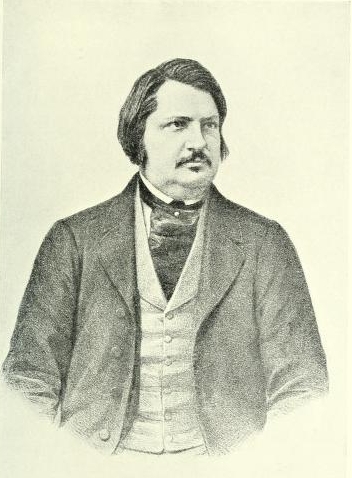
BALZAC
Balzac was a powerfully built, broad-shouldered man of middle height, corpulent in later life; the feminine whiteness of his strong, thick neck was his pride; his hair was black and as coarse as horse-hair, and his eyes shone like two black diamonds; they were lion-tamer's eyes, eyes that saw through the wall of a house what was happening inside, that saw through human beings and read their hearts like an open book. His whole appearance indicated a Sisyphus of labour.
He came as a youth to Paris, poor and solitary, drawn thither by his irresistible author's vocation and by the hope of winning fame. His father, like most fathers, was extremely unwilling that his son, whom no one credited with being a genius, should give up the profession of law for literature, and therefore left him entirely to his own resources. So there he sat in his garret, unwaited on, shivering with cold, his plaid wrapped round his legs, the coffee-pot on the table on one side of him, the ink-bottle on the other, staring out now and again over the roofs of the great city whose spiritual conqueror and delineator fate had destined him to be. The view was neither extensive nor beautiful—moss-grown tiles, shining in the sun or washed by the rain, roof-gutters, chimneys, and chimney-smoke. His room was neither comfortable nor elegant; the cold wind whistled through the chinks of its window and door. To sweep the floor, to brush his clothes, and to purchase the barest necessaries with the utmost economy, were the daily morning tasks of the young poet who was planning a great tragedy, to be called Cromwell. His recreation was a walk in the neighbouring cemetery of Père Lachaise, which overlooks Paris. From this vantage-ground young Balzac (like his hero, Rastignac) measured the great metropolis with his eye, and made a defiant wager with it that he would compel it to recognise and honour his unknown name.
The tragedy was soon given up; Balzac's genius was too modern, too vigorous, to put up with the rules and abstract characters of French tragedy. And, besides, it was imperative that the young hermit, who had only obtained conditional leave of absence from home, should make himself independent as quickly as possible.
He took to hurried novel-writing. As yet he had not the experience of life requisite to give his productions any lasting value; but he had a vivid, inexhaustibly productive imagination, and had read enough to be able to write stories in a certain passable style, the style of most of the light literature of the day. In 1822 he published, under different pseudonyms, no fewer than five such novels; and during the following three years he wrote others which he himself, with all his self-esteem, could not regard as anything but pot-boilers. In 1822 he writes to his sister: "I did not send you Birague, because it is perfect trash. ... In Jean Louis there is some character-drawing, but the plot is wretched. The one merit of these books, dear, is that they bring me in a thousand francs; but I have received the sum in bills which have a long time to run—will it ever be paid?" Those who have toiled through one or more of these early works of Balzac's, will not consider his verdict too harsh. They are distinguished by a certain vivacity—what the French call verve—that is all the good that can be said of them. That they possessed the merit which their author himself described as their only one is doubtful, not only because Balzac in his later novels (see Un grand Homme de Province à Paris) gives most unflattering descriptions of the publishers who pay with promissory notes, but also because in 1825 he suddenly, in despair, gave up authorship for the time being, in the hope of making a living as a bookseller and printer.
His brain, which was constantly conceiving plans of every description, had conceived that of bringing out one-volume editions of the classic authors. No such editions as yet existed, and he felt convinced that they would be a good business speculation. And he was right; but the profits of this, as of all Balzac's later speculations, were reaped by others; the projector invariably lost by them. In 1837, for example, when he was in Genoa, the idea occurred to him that the ancient Romans had probably not exhausted their silver mines in Sardinia. He spoke of his idea to a Genoese acquaintance, and determined to follow it up. Next year he spent valuable time in taking a fatiguing journey to the island, to examine the slag of the mines. The state of matters answered exactly to his expectations; but when he applied to the authorities at Turin for permission to work the mines, he found that his Genoese friend had been beforehand with him, had acquired the exclusive right to do so, and was already well on the way to become a rich man. Undoubtedly many of the practical speculations which suggested themselves to Balzac's busy brain were mere chimeræ; nevertheless, his genius reveals itself in them. Just as Goethe's was a nature so at one with nature that his poet's eye, falling accidentally on a palm, discovered the secret of the metamorphosis of plants (one and the same original form in every part of the plant), and that his casual examination of a split sheep's skull laid the foundation of philosophic anatomy, so Balzac's was to such a degree the nature of the inventor and discoverer, on the small as well as on the great scale, that he seemed, like the legendary characters possessed of second sight, to know instinctively where riches lay hidden, seemed, as it were, to carry a divining rod which bent of itself towards gold, the nameless, sexless hero of his works. He certainly was not successful in his attempts to secure the treasure; he was a magician, not a business man.
This first idea of his was as felicitous as it was daring; he was to be type-founder, printer, bookseller, and author in one; for he himself, full of enthusiasm for his grand projects, wrote the prefaces for his editions of the classics. But, after he had persuaded his parents to put the greater part of their capital into the undertaking, after he had set agoing a type-foundry and printing establishment, and printed good, illustrated, one-volume editions of Molière and La Fontaine, the French booksellers to a man combined against their would-be colleague, flatly refused to circulate his editions, and quietly awaited his commercial ruin, to take up his idea and profit by it themselves. At the end of three years Balzac was compelled to sell his books as waste-paper, and dispose of his printing machinery at a great loss. He himself underwent all the misfortunes of the poor inventive printer in Ève et David. He was left not only poor, but so overburdened with debt that he had to work all the rest of his life simply to pay his creditors, regain his independence, and restore his mother's fortune. And this debt, to demolish which he had no weapon but his pen, was not a passive enemy; it grew, and attacked him from new quarters; as for long his only means of meeting one engagement was to incur another. It was in the course of these transactions that he became acquainted with all the various types of Parisian money-lenders, of whom he has given such striking portraits in Gobseck and kindred characters; and the words: "My debts! my creditors!" are constantly in his thoughts and of constant recurrence in those letters to his intimate friends in which the warm heart of the heavily burdened man allows itself free expression. "Remorse," he writes in one of his novels, "is not so bad as debt, for it cannot clap us into prison." He actually had a short experience of life in a debtor's prison, and to avoid a repetition of it had often to hide, to change his place of residence, or have his letters sent to misleading addresses. The genuine poet, he lived with his debts as with an inexhaustible source of emotion; his imagination received, as it were, a daily spur to industry when the thought of his debts awoke him and he seemed, as soon as he opened his eyes, to see his promissory notes appearing out of every corner and jumping like grasshoppers all over the room.
He set to work with herculean energy, and worked, one may say without a pause, through all the years of his youth and manhood, until, at the age of fifty, he collapsed from over-exertion—fell as suddenly as the bull that has received its death-thrust on a Spanish arena. The reason of production being so little of a pleasure, so entirely a labour to him, is to be sought in the fact that, though his great and active imaginative power was unceasingly impelling him to write, it was not supported by any innate or early acquired stylistic skill. In mastery of form Balzac was not the equal of many of his contemporaries. He never succeeded in writing a pleasing poem (those which are to be found in his novels are the work of others—Madame de Girardin, Théophile Gautier, Charles de Bernard, Lasailly), and he and none other was the author of the much derided, halting line with which his Louis Lambert begins the epic of the Incas:
"O Inca! ô roi infortuné et malheureux!"
Novel after novel did he write under a pseudonym and repudiate before he attained to a style; his struggle to obtain the mastery of French prose was a desperate one; and it was one of his greatest griefs that the young Romanticists who followed in the steps of Victor Hugo long refused to acknowledge him as a real artist. The delicately sympathetic Gautier, ever ready to admire, was the only author to greet him with prompt recognition. But Balzac's astonishment was boundless when he saw young Gautier, without preparation or any great exertion, and without needing to make any corrections, fling off, at a desk in the printer's office, an article irreproachable in both style and matter. It was long before he could be persuaded that Gautier had not had his feuilleton ready in his head. At last he grasped the fact that there is such a thing as innate faculty of style, a faculty which had been denied him. How he toiled to acquire it! How ardently he admired Gautier when he really comprehended the quality of his plastic talent! We come upon a curious proof of this so late as the year 1839, when Balzac, in describing the principal female characters in his novel Beatrix, employs almost word for word descriptions from articles written by Gautier two years previously on Jenny Colon and Mademoiselle Georges, the actresses.[1] We feel, in comparing the passages, how eagerness when we see how commonplace and feeble the additions from his own vocabulary are.
Balzac was bound to fail in his attempt to rival Gautier in the latter's special province, for this reason, that he sees and feels in a perfectly different way. Gautier the stylist is an artist of the first rank, but Gautier the author, in spite of his poetic qualities, is cold and at times arid. His talent may be defined as the talent of the plastic artist who has won a place for himself in literature. Balzac, on the other hand, is an inferior stylist, but an author of the highest rank. He cannot place his characters before us with a few telling words, because he does not himself see them in one single plastic situation. When, conjured up by his imagination, they present themselves to the eye of his mind, he sees them, not gradually, but at once, in different stages of their lives and in different costumes; he overlooks their whole career; he observes all the multitude of their peculiar movements and gestures, and hears the sound of their voices in utterances so characteristic that they bring the speaker bodily before us. It is not, as in the case of the stylist, a single picture, the result of a single, perhaps subtle, but somewhat dry association of ideas, which reveals the character to us; no, Balzac's character is composed of a hundred thousand associations of ideas which unconsciously blend and form a unit, complicatedly rich as nature itself, as that real human unit, which consists of a strange mixture of innumerable physical and spiritual elements. It would require a whole book to give a sufficient number of examples of Balzac's incomparable power of bringing personalities vividly before us by means of their manner of expressing themselves, or even simply by some peculiarity in their dress, their household arrangements, and the like.[2] His difficulty lay in the proper disposal of the wealth of material which his memory and his inspirations thrust upon him. At one time he would compress too many ideas, the association between which was intelligible to himself alone, into a few words (as when he says of an innocent, unoffending lady that "her ears were the ears of the slave and the mother"); at another, he would write down, one after the other, all the observations and fancies which his prolific brain suggested every time he invented a fictitious personage, and lose himself in a diffuse, descriptive, argumentative flow of words, which conveyed no distinct impression to the reader—the reason being that the electric communication between the organs of poetic vision and poetic eloquence in the author's brain was faulty, and at times altogether broken off. Tenfold labour had to supply the bitterly felt deficiency.
When we remember that, in those days of collaboration, Balzac never had a collaborator, never even a copyist, we can understand what patience and what stupendous exertion were required to produce, in the course of twenty years, the novels, tales, and plays, more than a hundred in number, which proceeded from his pen.
Whilst Hugo writes as the artists of the Renaissance painted, surrounded by a company of youthful admirers and pupils, Balzac sits alone in his study. He allows himself little sleep. He goes to bed between seven and eight, gets up again at midnight and works in his white, Dominican monk's, habit, with a gold chain round his waist, until daybreak, when, feeling the want of exercise, he rushes off himself to the printer's to deliver his manuscript and correct proofs. His is no ordinary proof-correcting. He demands eight or ten impressions of each sheet. This is partly because he is not certain of having found the final, correct expressions, but also because it is his habit to complete the general outline of his story first, and fill in the details by degrees. Half, sometimes more than half, the payment he receives, goes into the pocket of the printer; but not even extreme need will induce him to allow his work to appear before it seems to him as perfect as he can make it. He is the despair of the type-setter, but his proof-reading is also his own most painful task. The first impression is set with wide spaces between the paragraphs, and gigantic margins; and both of these are by degrees filled to overflowing. When he has done with it, the page, with its dots and dashes, strokes and stars, looks like a picture of a firework. Then the heavily built, untidily dressed man with the crushed felt hat and the sparkling eyes, hurries home along the crowded street, every here and there respectfully made way for by some one who knows or guesses him to be a genius. More hours of work follow. Before dinner he seeks recreation in a call on a lady, or a raid on the old curiosity shops in search of a rare piece of furniture or an old painting. Not till evening comes again does this indefatigable worker think of rest.
"Sometimes," writes Gautier, "he would come to my house in the morning, groaning, exhausted, dizzy with the fresh air, like a Vulcan escaped from his forge, and fling himself down on the sofa. His long night's work had made him ravenously hungry, and he would pound sardines and butter into a kind of paste which reminded him of a dish he had been accustomed to at home, and which he ate spread upon bread. This was his favourite food. As soon as he had eaten he would fall asleep, begging me, before he closed his eyes, to wake him in an hour. Paying no attention to this request, I took care that no noise in the house should disturb this well-earned slumber. When he awoke at last and saw the evening twilight spreading its grey shadows over the sky, he would jump up and overwhelm me with abuse, call me traitor, robber, murderer. I had been the means of his losing 10,000 francs, for he would have earned as much as that with the novel which he would have planned if he had been awake, even leaving possible second and third editions out of the question; I was causing the most terrible catastrophes and most inconceivable complications; I had made him miss appointments with financiers, publishers, duchesses; he would not be in a position to meet his engagements; this fatal sleep would cost him millions.... I was consoled by seeing the fresh Touraine colour returning to his cheeks."
When, taking Charles de Lovenjoul's bibliographical work as a guide, we follow Balzac's labours week by week; when we see from his own letters how, never allowing himself to be distracted by those Parisian gaieties in which he nevertheless often took part, nor to be scared by the literary cannonades of his frequently envious critics, he steadily, stone by stone, raised the pyramid of his life's work, determined to make it as broad and as high as possible, we are inspired by a feeling of respect for the man and his courage. The good-natured, stout, noisy Balzac was no Titan; indeed, in that generation of heaven-storming Titans and Titanesses he appears a peculiarly earth-bound creature. But he is of the race of the Cyclopes; he was a mighty master-builder who worked with a giant's strength; and the uncouth, brick-laying, carpentering Cyclops raised his building as high as the two great lyric geniuses of the day, Victor Hugo and George Sand, mounted on their wings.
He had never any doubt of his own ability. A self-confidence which corresponded to his talent, and which sometimes displayed itself in naïve boastfulness, but never in petty vanity, carried him bravely through all the trials and struggles of the first years; and in the moments of depression which occurred in his, as they do in every artist's life, he was, as we understand from his letters, comforted and strengthened by faithful, secret love. A woman whose name he never mentioned to his friends, whom he only alludes to with reverence as "an angel," "a moral sun," and who to him was "more than a mother, more than a friend, more than one human being can be to another," supported him with her self-sacrificing devotion, with word and deed, in the many troubles which beset his youth. We know that he was acquainted with her in 1822, and for twelve years (she died in 1837) she managed from time to time "to steal away from duty, family, society, all the hampering ties of Parisian life," and spend two hours with him.[3] Balzac, always ardent in his praise, naturally employs the strongest expressions where he loves; what is really worthy of notice is the delicacy of feeling displayed by this man, who is so invariably decried for his cynical sensuality—the admiration and gratitude in which his love takes shape.
XIII
BALZAC
Balzac's earliest literary model was, as already mentioned, Sir Walter Scott, an author of whom he can never have reminded any one, and with whom, when his genius reaches its maturity, he has hardly anything in common. The writer of the Comédie Humaine was a man of far too modern a spirit to be able to remain faithful to historic fiction. He felt no home-sickness for any past century; he had amassed a vast wealth of observation, and involuntarily chose themes in which he could turn this to the best account. He was dimly conscious that the writer of historical novels, unless he be content simply to thrust the characters which he has before him as models into antiquated costumes, must take his modern, personal, psychological observations, and, as it were, force them back into a more primitive age—a difficult task, the attempt at which seldom resulted in more than a thinly disguised reproduction of the manners and customs of the writer's contemporaries, or at any rate of their ideas. It was not in Balzac's nature to collect information laboriously from old chronicles; he studied the living men and women of his own day.
La Physiologie du Mariage, the first of his works to arouse attention, supplemented Brillat-Savarin's harmless Physiologie du Goût with a half-jocose, half-scientific, wholly coarse analysis of that institution of society which French literature from time immemorial has treated as a butt for witticisms, an object of ironical homage, and a matter for unsparing investigation. Balzac regards it in the light of a tragi-comic social necessity, defends it, and assists it with good advice in its struggle with those destructive elements, masculine and feminine caprices and passions. Marriage has a special attraction for Balzac as being the battle-ground of two egoisms; he rushes with the ruthlessness of a wild boar through its boundless domain of attractions and repulsions, snuffing and poking his nose into everything. In France marriage has always been a tolerably external, public matter; it need not surprise us that Balzac has little reverence for its mysteries. He writes of them with Molière's outspokenness, but less healthily—more pessimistically and more grossly. The book is full of clever, coarse conceits and laughable anecdotes, and is often extremely amusing from the contrast between the frivolous, licentious matter and the professorial or father-confessor style in which it is expounded by the youthful lecturer on the science of marriage. It is, nevertheless, an immature production of a writer who has been early robbed of all beautiful illusions; and it must certainly be a repulsive book to most readers of the female sex, though we are told that a considerable proportion of its contents was communicated to the author by two women, neither of them young—Madame Hamelin and Madame Sophie Gay. La Physiologie du Mariage reveals none of Balzac's nobility of thought and delicacy of feeling—nothing but his gift of ruthless, searching analysis.
It would seem as if the opening of his authorial vein in this book had freed him for a long time from bad blood. His conception of life is henceforward a more elevated one, or rather, it divides itself into two conceptions, a serious and a sportive. The serious and the sensually cynic philosophy of human life, which in La Physiologie du Mariage blent into one repulsive whole, now separate, displaying themselves in the form of tragedy and satyric comedy. In 1831 he both writes his first philosophic novel, La Peau de Chagrin (which laid the foundation of his fame as an author) and begins, with La belle Impéria, the long series of the Contes drôlatiques, a collection of tales in the freest Renaissance style, reminiscent of Queen Marguerite and Brantôme in matter and of Rabelais in language. Told in the language of our own day, they would be both disgusting and dull; but the grand, simple, old-fashioned prose style, which lends more nobility to the subject than even the severest metrical forms, metamorphoses these deifications of the flesh into genuine works of art, burlesque as the tales told by one of those worldly-minded, handy, jovial monks who swarm in the legendary lore of every country.
In one of the masterly prologues to this collection of tales the author tells how, having lost his patrimony in his youth, and being reduced to the direst poverty, he cried to heaven, like the woodcutter in the fable who had lost his axe, in hopes that the gods might take pity on him and give him another axe. What Mercury threw down to him was an ink-horn, on which were engraved the three letters AVE. He stood turning the heavenly gift round and round in his hands until he caught sight of the letters backwards, EVA. What was Eva? What but all women in one? A heavenly voice had called to him: "Think of woman; she will heal thy woes and fill thy pockets; she is thy fortune, thy property. Ave, I salute thee! Eva, O woman!" Which, being interpreted, meant that what he was now to attempt was to win a smile from the unprejudiced reader by mad and merry love stories. And he succeeded. In none of his other writings did his style attain such brilliance and vigour; Rubens's colouring is not bolder nor richer, and Rubens hardly equals this herculean wantonness with his fauns and drunken bacchantes. But it is difficult to find ten successive lines that are fit for quotation or reading aloud.
La Peau de Chagrin is Balzac's first literary tussle with the reality of his age; it is a spirited, many-sided work, rich in germs and shoots; and with its fine, simple symbols it anticipates that almost comprehensive picture of modern society which its author was to give to the world in his complete works. The externalities of modern life, such as the theatre and the fashionable lady's boudoir; the dissatisfied and hopeless poverty of the talented young author thrown into relief by the orgies of wealthy journalists and women of the demi-monde; the contrast, in the two principal female characters, between the worldly and the loving heart—all this is shown us in a strange, fantastic light. The book consists of a few connected gaudy spectacular scenes; there is more reflection and symbolic art than plastic talent in it. The youthful hero, who is on the point of committing suicide in despair over his hopeless poverty, receives from an aged dealer in curiosities a piece of wild ass's skin, on which neither steel nor fire produces the smallest effect, and which secures to its possessor the fulfilment of his every wish, but which shrinks a line or two with the gratification of each; simultaneously with the final disappearance of the ass's skin the life of its owner comes to an end. The persuasive powers of a marvellous imagination have succeeded in imparting credibility to the supernatural part of this profound allegory. Balzac has given the fantastic element in it a form which permits of its blending with the modern realistic elements, Aladdin's lamp, when it was rubbed, instantly worked a direct miracle; even in Oehlenschläger's Aladdin it supersedes the law of cause and effect. Not so the ass's skin; it does nothing directly; it only ensures the fortunate issue of events, steadily shrinking the while. It seems to be made of the fabric of which our lives are composed. The gradual annihilation of the human being is brought about, we are told, by two instinctive actions, which exhaust its sources of life. "Deux verbes expriment toutes les formes que prennent ces deux causes de mort: vouloir et pouvoir. Vouloir nous brûle et pouvoir nous détruit." That is to say, we die at last because we go on killing ourselves every day.
The ass's skin is, like ourselves, at last annihilated by "vouloir et pouvoir." With real profundity Balzac shows in this powerful representation of the chief impulse of the younger generation of his day—to drink the cup of life greedily to the very dregs—what emptiness there is in satiety, how certain it is that death lies cowering in the satisfaction of desire. Youthful, fertile, suggestive, and vaguely melancholy, like all books produced by genius before the acquirement of personal experience, La Peau de Chagrin made its mark abroad as well as in France. Goethe read it during the last year of his life. Riemer (who attributes the authorship of the book to Victor Hugo) reports Goethe to have said on October 11, 1831: "I have been reading more of La Peau de Chagrin. It is an excellent work in the newest style, distinguished by the vigour and cleverness of its back-and-forward movement between the impossible and the painful, and by the logical manner in which the marvellous is employed in producing the most extraordinary chains of thought and events, of which, taken in detail, much that is favourable might be said." In a letter of the 17th November of the same year he writes of the same work: "This book, the production of an intellect of very high order, points to a deep-seated, incurable corruption in the French nation, which will spread steadily unless the provinces, which can neither read nor write, restore it to health again, as far as that is possible." (Goethe-Jahrbuch, 1880, pp. 287, 289.)
The novel contains not a little autobiography. Balzac knew from his own experience the feelings of the impecunious youth, who, descending from his garret, picks his way in his solitary pair of white silk stockings and dancing-shoes across the muddy street, in deadly fear of being splashed by a passing carriage, and consequently deprived of the sight of his beloved. But what interests us more, is the sum of inward experience which is contained in the book, and which amounts to this: Society detests misfortune and suffering, avoids them like infectious diseases, never hesitates in choosing between a misfortune and a crime. Let a misfortune be never so sublime, society will manage to belittle it, to make it ridiculous by some witty sally; it has no sympathy to spare for the fallen gladiator. To Balzac, in short, even now in his youth, society appears devoid of every higher religious or moral feeling; it shrinks from the old, the sick, and the poor; it does homage to luck, to strength, and, above all, to wealth; it tolerates no misfortune out of which it cannot by some means or other coin money.
Before Balzac's day the novel had occupied itself almost exclusively with one theme—love; but the god of Balzac's contemporaries was money; therefore in his books money, or rather the lack of money, the desire of money, is the pivot on which society turns. The idea was audacious and novel. To enter in a work of fiction, a romance, into accurate details regarding the incomes and expenditure of the principal characters, in short, to treat money as of prime importance, was a perfectly new departure; and many denounced it as prosaic, nay, coarse; for it is always considered coarse to say what every one thinks, and what consequently all have tacitly agreed to conceal or to prevaricate about—and especially coarse to proclaim it in an art which is often regarded as the art of beautiful lying.
XIV
BALZAC
But Balzac was young yet; his poet's soul, though winter fell early in it, had its spring; he, too, felt constrained to make love and woman the central interest of a whole series of novels; and he treated the old theme with an originality which made it seem quite new. The stories in which he most successfully varied it form a distinct group among his works.
It was not beauty, at least not plastic beauty, which Balzac worshipped in woman. And one thing that distinguished him from many of his contemporaries was, that beauty did not impress him most when seen through the medium of art. A great proportion of the Romantic literature of France, as well as of Germany and Scandinavia, was art literature. Such an art-loving author as, for instance, Gautier (who soon became the head of a whole school), was actually prevented by his love of art from appreciating reality. He himself has told how disappointed he was the first time he went to paint a female figure from the life in Rioult's studio, and this in spite of the unquestioned beauty of the model and the classical grace of her outlines. "I have always," he confesses, "preferred the statue to the woman, marble to flesh." Significant words! Picture Gautier and Balzac together in the museum of antiquities in the Louvre, in that holy of holies, where the Venus of Milo shines in solitary majesty. The plastic poet hears, resounding from the marble, the loveliest of all the hymns of Greek art to the perfection of the human form. Gazing at Venus, he forgets his surroundings. Not so Balzac! His attention is promptly diverted from the goddess by the first Parisian lady who stops in front of her, wearing, in the fashion of the day, a long shawl in which there is not a fold from neck to heel, a coquettish hat, and tightly fitting gloves. He takes in at a glance all the little artifices of the fashionable toilette, the secrets of which are no secrets to him.[1]
Here, then, we have the first characteristic feature in Balzac's work. No artistic tradition stands between him and the woman of the period. He studied no statue, worshipped no goddess, did no homage to ideal beauty; he saw and understood woman exactly as she was then, with her gowns, shawls, gloves, and hats, her caprices, virtues, temptations, and faults, her nerves and passions, with all their traces of unnaturalness, morbidness, and ennui. He loves her as she is. And he is not satisfied with studying her in the street, in the boudoir, or even in the bedchamber; he is not satisfied with analysing her soul; he inquires into the physiological causes of the psychological phenomena, into the sufferings and the diseases of women. He does more than merely indicate all that the weak and suffering sex silently endures.
The second characteristic feature is, that it is not the young girl, nor even the young married woman, whom Balzac represents as the object of love; his chief female type, which has taken its name from the title of one of his stories, is la femme de trente ans. He discovered and proclaimed the simple truth that in such a climate as that of the north of France, a woman is not at her best, either physically or spiritually, at the age of eighteen. He described the woman who has left her first youth behind her, who feels more profoundly, thinks more maturely, has already suffered disappointments, but is still capable of intense, unalloyed feeling. Life has already set its mark upon her—here a line of suffering, and there a wrinkle—but she is still in full possession of all the attractions of her sex. She is melancholy; she has tasted happiness and has tasted suffering, is misunderstood or lonely; she has often been deceived, but is still waiting, capable of inspiring the strong, ardent passions which draw their nourishment from compassion. And, curiously enough, she is not seen and described from the point of view of the man of her own age, but from that of a younger man, with little experience of life. The vernal emotion, the ardent desire, the naïve enthusiasm, the unconscious idealisation of youthful passion, surround this no longer perfectly youthful figure with a glorifying halo, embellish, rejuvenate, deify the woman whose real attractions are her refinement, her feminine seriousness, and the grace born of genuine passion. The delineation is never idealistic in the sense that George Sand's delineations are; for nothing is suppressed of what women, when they talk or write of their own sex, are accustomed to ignore—of what even George Sand passes over in silence when she is describing women for whom she desires to awaken sympathy and admiration. To George Sand woman is above all a soul; to Balzac she is a natural phenomenon, and therefore not flawless, either physically or spiritually. His idealisation is either purely external (the transfiguring power of certain lights, of the erotic situation, &c), or else it consists in passion for a certain limited time invalidating everything else, everything previous, and ennobling with its glow. Maternal love, wifely love, the bashful tenderness of the young girl, are painted by Balzac during this period with as masterly a touch as the unbridled erotic passion of the courtesan.[2]
He shows us the Frenchwoman of four different historical periods.
First, the Frenchwoman of the days of the Revolution. In that little masterpiece, Le Réquisitionnaire, one of his few perfectly proportioned stories, he represents, with the Reign of Terror as a background, a mother's love for her son. The little out-of-the-way town and Madame de Dey's curious house are drawn with a few strokes. Apprehension of the possible fate of a son who has been condemned to death; the expectation of his arrival in the disguise of a soldier who is to be quartered on her; the terrible anxiety, increasing from hour to hour till late at night; the apparently mysterious arrival of the young soldier who, unseen by the mistress of the house, is at once conducted to the bedchamber comfortably prepared for him; the mother's torturing restlessness and almost uncontrollable joy when she hears his steps in the room above, but feels obliged, in order not to betray his arrival, to continue her conversation in the drawing-room; her hurried entrance into his room, and the frightful discovery that the person who has arrived is not her son, but a real recruit—all this, compressed into a few pages, is described with extraordinary power and truth to nature.
Next Balzac paints the women of the Napoleonic period, upon a background of military pomp and splendour, in all the glow and warmth of their admiration for the successful warriors. His picture bears the impress of the restless, pleasure-seeking haste with which life was lived at a time when it was possible for the young woman "to become fiancée, wife, mother, and widow between a first and a fifth bulletin from the Grande Armée," and when the near prospect of widowhood or honours or an immortal name, made the women more reckless and the officers more seductive. A period and a distinct female type are represented in the description of the review in the Tuileries Gardens, and of the evening party at the time of the battle of Wagram (in La Femme de trente Ans and La Paix du Ménage).
But it is not until the plots of his stories are laid in the days of the restored Legitimist monarchy that Balzac finds his true province, and produces his most acutely observed, skilfully drawn female types and his most wonderful psychological analyses. Eminently fitted as he was, with his unshrinking eye and his hard hand, to paint the dullness and the dishonesty of the reign of the Citizen King, he was poet enough to look back regretfully from the prosaic days of the plutocracy to the refined elegance and freer, gayer tone of the days of the Legitimist Monarchy. That had still been an aristocratic period; and Balzac, who, without any proper claim to the title, regarded himself as an aristocrat, had no small respect for the aristocracy; the high-born, well-bred, beautiful woman was in his eyes the flower of humanity. He was of the generation that worshipped Napoleon; Napoleon's name appears on every tenth page of his novels, and (like Victor Hugo) he dreamed of rivalling, in his own domain of literature, the Emperor's world-wide dominion; in his study stood a statuette of Napoleon, and on the scabbard of the sword he had written: "What he has conquered with the sword I will conquer with the pen." But, granted all this, he nevertheless, with his dreams, his weaknesses, his vanities and his refinements, belonged to the Legitimist Monarchy, for which, moreover, the fact that his youth had been spent under it gave him a warmer feeling. In the days of gilded state-coaches and old French ceremonial, under the shelter of ecclesiasticism and frivolity, it had been possible for liberal ideas and humane morals to thrive in the higher classes of society; they disappeared when money ascended the throne. The social life of Paris lost that refined charm for which it had been so famous. It is not surprising, then, that Balzac painted the fair sinners of the Faubourg St. Germain with a lenient hand and flattering colours. One of the most eminent women of the day, the charming Delphine de Girardin, whose salon was a fashionable resort, was a true friend to Balzac as well as to Hugo and Gautier; but as far as his works are concerned, he undoubtedly learned more from the two duchesses who personified to him the greatness of Imperial France and the gay refinement of the ancien régime, and with whom he became intimate almost at the beginning of his literary career. These were Madame Junot, the Duchess of Abrantés, whom he assisted in her literary pursuits, and the Duchesse de Castries, who began their acquaintance by writing anonymously to him of her interest in his works, and to whom a probably unrequited passion on his side and violent jealousy on hers long bound him. She appears in his Histoire des Treize under the name of the Duchesse de Langeais.
At the beginning of the Thirties, Balzac has, of course, not yet begun to write of society under the Constitutional Monarchy, its women and their passions. This happens later. And when it does happen, what we observe is, that he as a rule envisages this new material much more gloomily and austerely. The feeling of spring has vanished. Woman and love still form the centre of interest in many of the books. But affection has become passion and passion has become depravity. We read little of unselfish feeling and innocent sympathies, much of self-interested calculation, on the part of women as well as of men, nay, especially on the part of women; even in love, and still more when it is only a substitute for love which is described. In many of these novels the courtesan thrusts the fine lady into the background, and occasionally the former is represented as more disinterested than the latter. Abysses of selfishness and vice open before the reader's eyes.
XV
BALZAC
Of the books published by Balzac in 1833 and 1834, two are especially deserving of notice—the delicately wrought, classic tale, Eugénie Grandet, and the powerful, fateful Père Goriot. In the first-mentioned work Balzac competes with Molière (l'Avare) in the second with no less a writer than Shakespeare (King Lear).
Eugénie Grandet does not represent the full measure of Balzac's talent, though he long went by the name of its author as a kind of title of honour. The book interested because of its careful and accurate descriptions of provincial life with its virtues and vices; it could be recommended for family reading, because the heroine was a chaste and noble-minded young girl; but its chief distinction lay in the wonderful manner in which Balzac's genius makes of covetousness and avarice, qualities of which hitherto only the comical side had been displayed, imposing vices. He shows how the instinct of amassing money, which it is the custom to regard as a laughable weakness, by degrees stifles every human feeling, and, raising its terrible Medusa head, tyrannises over the miser's surroundings; and he at the same time makes the miser himself a more human figure. To Balzac he is not the stereotyped comedy bourgeois, but a power-loving monomaniac, a petrified enthusiast, a poet, who at the sight of his gold revels in satisfied desire, but also in wild dreams. The miser is simply a man who is more thoroughly impressed than other men with the truth that money represents all human powers and pleasures. In the representation of such a character, Balzac displays his peculiar gift, which is that of producing a powerful effect with small means, with what others have overlooked or despised. From the symbolic standpoint the horizon of Eugénie Grandet is not narrow; but it was narrow in comparison with Balzac's characteristic and usual one.
In Père Goriot it widens. Here it is not an out-of-the-way provincial nook, but the great city of Paris which is studied, and which is unrolled, like a panorama, before our eyes. And there is no generalising and symbolising, as in La Peau de Chagrin; each class of society and each character in each class is provided with its own characteristic features. I have spoken of King Lear; but the story of the two cold-hearted daughters and their father, full of deep meaning and feeling as it is, is only in an external sense the theme of the book. The real theme is the comparatively uncorrupted provincial youth's introduction to the world of Paris, his gradual discovery of the real nature of that world, his horror at the discovery, his refusal to do what others do, his temptations, and his gradual, yet rapidly completed, education for the life that is being lived around him. Nothing more profound than this study of the development of Rastignac's character has been produced by Balzac, or indeed by any modern novelist. He shows with marvellous art how on every side, except where men's words are dictated by hypocrisy or extreme naïveté, the young man meets with the same conception of society and receives the same advice. His relative and protectress, the charming and distinguished Madame de Beauséant, says to him: "The more coldly you calculate, the higher you will rise. Think of men and women simply as post-horses to be left behind you, broken-winded, at each stage of your journey.... If you have any real feeling, hide it; never let it be suspected, or you are lost.... If you can manage to make women think you clever, men will soon believe that you are, unless you destroy their illusion too rudely.... You will find out what society is—a company of dupes and rogues. Be neither the one nor the other." And the escaped galley-slave Vautrin says to him: "One must either force a way for one's self into the heart of that crowd as a cannon-ball does, or sneak in like the plague. Honesty is of no use. Men bend and submit to the power of genius; they hate it, they try to calumniate it, because it takes without sharing; but they yield if it persists; they adore it on their bended knees if they have not succeeded in burying it in the mud.... I defy you to take two steps in Paris without stumbling on infernal machinations. Hence the honest man is the common enemy. But who do you suppose is the honest man? In Paris he is the man who keeps silence and refuses to share."
Rastignac is the typical young Frenchman of that period. He is talented, but not in any uncommon degree, and has no idealism beyond that which is begotten by the inexperience of youth. Profoundly impressed by all that he sees and experiences, he begins to aspire with steadily diminishing conscientiousness, steadily growing desire, after fortune's favours. How indignantly he repudiates the idea when Vautrin first puts the old hypothetical question to him—whether, if a mere act of will could do it, he would kill an unknown mandarin in China to obtain the millions he desires! Yet how short a time elapses before "the mandarin" is lying in his death-throes! Rastignac says to himself at first, as all men do in their youth, that to resolve to become great or wealthy at any cost is the same as to resolve to lie, cheat, and cringe to and flatter those who have lied, cheated, cringed, and flattered. Presently he dismisses the thought, determining not to think at all, but to follow the instincts of his heart. There comes a time when he is still too young to make definite calculations, but old enough to be haunted by vague ideas and hazy visions, which, if they could be chemically condensed, would leave no very pure deposit. His liaison with the fashionable lady, Delphine de Nucingen, Goriot's daughter, completes his education. And whilst he has been acquiring a full and perfect understanding of that sum of small and great meannesses which constitutes fashionable life, he has been influenced by Vautrin's satirical cynicism. "One or two more such political reflections, and you will see the world as it is. If he will but act an occasional little virtuous scene, the man of superior powers may satisfy all his fancies and receive loud applause from the fools in the pit.... I give you leave to despise me to-day, being certain that ere long you will love me. You will find in me those yawning abysses, those great concentrated feelings, which the foolish call vices; but you will never find me either cowardly or ungrateful."
Rastignac's eyes are opened; he sees all the shams by which he is surrounded, sees that morals and laws are simply screens behind which impudent vice acts unrestrainedly. Everywhere, everywhere, sham respectability, sham friendship, sham love, sham kindness, sham sacredness, sham marriages! With masterly skill Balzac has seized and immortalised that moment in the young man's life when, as I have already put it, his heart swells and becomes strangely heavy, and he feels, when he looks about him, as if a fountain of scorn were surging in his breast. "His reflections whilst he was dressing were of the saddest and most depressing. Society appeared to him like an ocean of mud, in which the man who dipped his foot at once sank up to the neck. 'In society men commit only mean crimes,' he said to himself; 'Vautrin is greater.'" In the end, after he has taken all the measurements of this hell, he settles down comfortably in it, and prepares to scale the heights of society, to rise to the elevated official position which we find him occupying when we meet him again in later novels.
Almost all Balzac's characteristic qualities stood him in good stead in the evolution of this broadly planned work. His almost animal liveliness, his inexhaustible flow of cutting epithet, lent themselves naturally to the reproduction of the conversation of the mixed, shabby, wanton, impudently clever company who sat at the table of the Pension Vauquer. There are hardly any noble characters in the book, and the author has consequently no opportunity of indulging in tasteless pathos; but the reader has countless opportunities of rejoicing in the unerring eye and the precision with which Balzac dissects the soul of a criminal, a coquette, a millionaire, an envious old maid. The neglected, disowned old father, from whom the book takes its title, is by no means an entirely successful character. Père Goriot is a victim, and Balzac always waxes sentimental over victims. With extremely bad taste he calls the old man "the Christ of paternal love"; and to the paternal love he imparts such a sensually hysterical character that he almost disgusts us with it.[1] Nevertheless the fact that the whole plot centres round this forsaken old man, upon whose heart his own daughters trample, gives to the composition a satisfactory unity and solidity. The whole Juvenal-like satire of society is concentrated, is compressed, as it were, into an epigram, in the passage which describes how Delphine does not visit her dying father because it is imperative, if she desires to mount a step higher on the social ladder, that she should avail herself of the long-coveted invitation to Madame Beauséant's ball—a ball to which "the whole of Paris" is crowding merely to spy with cruel curiosity for traces in the hostess's face of the pain caused her by the engagement of her lover, the news of which had only reached her that morning.
We follow Delphine as she drives, with Rastignac by her side, in her own carriage to the ball. The young man, who is well aware that she would drive over her father's corpse to show herself at this ball, but who is neither able to give her up nor brave enough to incur her displeasure by reproaching her, cannot refrain from saying a few words about the old man's pitiable condition. The tears come into her eyes. "I shall look ugly if I cry," she thinks; and they dry at once. "To-morrow morning I shall go to my father," she says, "and nurse him, and never leave his pillow." And she means what she says. She is not a radically bad woman, but she is a living picture of the discords of society; she belongs to the lower classes by birth, to the upper by marriage; she is rich, but the humiliating conditions of her marriage deprive her of the control of her fortune; she is pleasure-loving, empty-minded, and ambitious. Balzac's creative power was not equal to the production of a simple, pure, Shakespearean Cordelia; his region is not the region of the noble; but he has created a Regan and a Goneril who are more human and true to life than the great Englishman's.
XVI
BALZAC
One day in 1836 Balzac appeared in his sister's room in the wildest of spirits. Imitating the gestures of a drum-major with his thick cane (on the cornelian handle of which was engraved in Turkish a sultan's motto: "I am the destroyer of obstacles"), he shouted to her during the pauses of an accompaniment of martial music made with his tongue: "Congratulate me, little one, for I am on the point of becoming a genius." He had conceived the idea of combining all his novels, those already published and those yet to be written, into one great work—La Comédie Humaine.