V. THE ROMANTIC SCHOOL IN FRANCE (continued 5)
Mary Morison translation
The plan was stupendous and perfectly original; nothing of the kind existed in any known literature; it was a product of the same genius for systématisation which at the beginning of his career had inspired him with the idea of writing a series of historical romances embracing a succession of centuries. But this was a far more interesting and fertile idea. For, if the work were successful, it would possess the same force of illusion as if it dealt with historic facts, and it would, moreover, not merely be a little fragment of life symbolically and artistically enlarged into an image of the whole, but might justly lay claim to be, in the scientific sense of the word, a whole. In the Divina Commedia Dante had, as it were, focussed all the philosophy and experience of life of the Middle Ages; his ambitious rival purposed giving to the world by means of two to three thousand characters, which each represented hundreds of others, a complete psychology of all the different classes of French society, and thus, indirectly, of his age.
It is undeniable that the result was something unique.
Balzac's country has, like the real country, its ministers, its judges, its generals, its financiers, manufacturers, merchants, and peasants. It has its priests, its town and country doctors, its men of fashion, its painters, sculptors, and designers, its poets, prose authors, and journalists, its old and its newly created aristocracy, its vain and unfaithful, and its lovable, victimised wives, its authoresses of genius and its provincial blue-stockings, its old maids, its actresses, and its host of courtesans. And the illusion is astonishing and complete.
The personages reappear in one after another of the numerous novels; we make acquaintance with them in all the different stages of their lives; they are constantly being alluded to by other characters when they do not appear themselves; the descriptions of their appearance, dress, homes, habits, and daily life are as minute and exact as if they had been given by a dressmaker, a doctor, a tradesman, or a lawyer, and at the same time so vivid that we feel as if we must certainly find the person described either in the street and house indicated as his home, or else paying a call upon the distinguished lady whose salon is the rendezvous of all the people of fashion in the novels. It seems almost impossible that these beings, one and all, should be mere figments of the brain; we involuntarily think of the France of that day as peopled by them.
And it is the whole of France. For Balzac described in their turn towns and districts in every part of the country.[1] Far from despising the provinces, he took a pride in displaying his intimate knowledge of all the peculiarities of their stagnant life, of their virtues, all culminating in resignation, and their vices, the offspring of narrow-mindedness. But Paris in a very special manner lives in his pages. And Balzac's Paris is not the old city of Notre-Dame de Paris, the picturesque, medieval capital with its marked social contrasts, its animated street life, and its superstitious ecclesiasticism; still less is it Victor Hugo's ideal Paris, that impossible New Jerusalem of intellect and enlightenment; it is the real modern city with its joy, its sorrow, and its shame—the entrancing wonder of our own age, which throws the seven of antiquity into the shade—the gigantic polypus with the hundred thousand tentacles which drag everything, near and far, into its clutches—the great cancer eating into France. The Paris of the author's own day lives in his books, with its narrow streets, of which he gives Rembrandt-like etchings, with its rattle and shrieks, its street cries in the early morning and its mighty evening chorus of voices—a sea of sound which he reproduces for us with an orchestral effect, reminding us of the men initiated into the mysteries of old, who seemed to have eaten drums and drunk cymbals.[2] Balzac knows about everything in Paris—the architecture of the houses, the furniture of the rooms, the pedigrees of the fortunes, the successive owners of the valuable objects of art, the ladies' toilettes, the dandies tailors' bills, the lawsuits which divide families, the state of health, means of subsistence, needs, and desires of all the different classes of the population. He had absorbed the town through every pore. Contemporary novelists sought refuge from the mist-veiled sun of Paris and the commonplace modern Parisian, in Spain, or Africa, or the East; but to Balzac no sun was fairer than that which shone on Paris. Those about him endeavoured to conjure forth the shades of a distant or departed beauty: but to him ugliness was no more repulsive than the nettle is to the botanist, the snake to the zoologist, or disease to the doctor. He would never, in Faust's place, have called Helen from the grave; he would have been much more likely to send for his friend Vidocq, the Prefect of Police and quondam criminal, and get him to tell tales of what he had gone through and seen and heard.
By dint of observation he amasses an enormous collection of separate traits, and the cataloguing of these traits frequently makes the introductory part of his novel tiresome and confusing; at the end of an interminable description of a house, a figure, a face, a nose, the reader sees nothing, is simply bored. But then comes a moment when the author's glowing imagination melts and fuses together all these commonplace elements presented to it by his faithful memory, as Benvenuto Cellini melted down plates and spoons and from them cast his Perseus. Goethe says (in his diary of February 26, 1780): "The collecting and putting together of details does not help me to understand. But after I have long occupied myself in dragging together sticks and straws, and have attempted to warm myself in vain, although there is fire at the heart of the heap and smoke everywhere, suddenly the flame springs up and the whole is in a blaze." In Balzac's novels the descriptive parts are often smothered in smoke, but the flame never fails to burst forth.
For Balzac was not merely an observer; he was a seer. If he happened to meet a workman and his wife going home from the theatre between eleven and twelve at night, he as likely as not followed them the whole way to their little house beyond the outer boulevards. He heard them talk (the mother dragging their child after her by the hand) first of the play, then of their own affairs. They talked of the money that was to be paid them next day, spending it in imagination in twenty different ways, quarrelling during the process and revealing their characters in the squabble. And Balzac listened so intently to their complaints of the length of the winter, the dearness of potatoes, the rise in the price of turf, that he at last lived their life, and, as we are told in his Facino Cane, "felt their rags upon his back and walked with his feet in their soleless shoes." Their dreams, their necessities, entered into his soul, and he went about in a kind of waking dream. Whilst this mental intoxication lasted he gave up all his usual habits and became something different from himself, became the age. He did not only write his stories, he lived them; his fictitious characters were so vividly present to him that he spoke of them to his acquaintances as if they actually existed. When he undertook a journey to a place he wished to describe, he would say: "I am going to Alençon, where Mademoiselle Carmon lives; to Grenoble, where Dr. Bénassis lives." He used to give his sister the news of his imaginary world. "Do you know who it is Félix de Vandenesse is marrying? A Mademoiselle de Grandville. It is a good match, in spite of all Mademoiselle de Bellefeuille has cost the family." One day when Jules Sandeau was speaking of his sister, who was ill, Balzac, who had been listening absently for some time, suddenly said: "This is all very well, my friend; but now to return to realities—let us talk of Eugénie Grandet." It was necessary that the illusion in his own case should be as strong as this, if he was to communicate it to others with approximate strength. His imagination had the commanding power which allows no doubt to arise. It exercised this quality in practical matters too. Amongst the hundreds of projects which occurred to him as possible means of freeing himself from debt, was that of covering the bare fields surrounding the little country-house of Les Jardies (which he had bought that he might have a security to give his mother) with enormous forcing-houses, which, because of the entire absence of shelter from the sun's rays, would require very little artificial heat. In these forcing-houses a hundred thousand pine-apples were to be grown, which, sold at five francs each, instead of at the ordinary price of twenty, would yield the fortunate grower a yearly income of 400,000 francs "without his requiring to produce a scrap of manuscript." With such convincing eloquence did the originator of this plan demonstrate the absolute certainty of its success, that his friends actually looked out for a shop on one of the boulevards for the retail of the pine-apples, and consulted him as to the form and colour of the signboard. At another time he was firmly persuaded, I know not upon what grounds, that he had discovered the place in the outskirts of Paris where Toussaint Louverture had buried his treasure; and so successful was he in communicating his belief to his friends Sandeau and Gautier, neither of them particularly simple-minded persons, that these two gentlemen armed themselves with spades and stole like criminals out of Paris at five o'clock in the morning to dig at the spot indicated—naturally to find nothing. The expression, "the power of imagination," is peculiarly applicable in Balzac's case.
And this imagination which prevailed over others was his own tyrant. It gave him no peace. Not satisfied with the conception of plans, with the sweet, but barren joy of artistic dreams, it compelled him to be continually carrying out his plans, to keep himself in that habit of producing, without which inspiration so soon vanishes.
When, writing in La Cousine Bette of the gifted sculptor, Wenceslas Steinbockes idleness, he quotes these words of "a great writer": "I sit down to my work with despair and rise from it with sorrow," he is obviously in a half-modest way quoting himself. And he adds: "If the artist does not fling himself, without reflecting, into his work, as Curtius flung himself into the yawning gulf, as the soldier flings himself into the enemy's trenches, and if, once in this crater, he does not work like a miner on whom the walls of his gallery have fallen in; if he contemplates difficulties instead of overcoming them one by one ... he is simply looking on at the suicide of his own talent." The method of production which he describes is his own; but it is not the only, not even the highest method. More tranquil, less modern spirits have kept their heads clear and their eyes undimmed above the seething crater of their work; and by doing so have preserved a sound critical sense which has prevented them from ever becoming as tediously entangled in their material as the author of Le Curé de Village and Le Medicin de Campagne. But, on the other hand, a certain dull glow, a thrilling, enthralling something which has become a necessity to modern nerves, is too often lacking in their works.
In the long preface to the Comédie Humaine Balzac sets forth his intentions and his aim. He begins by expressing his contempt for the usual method of writing history. "In reading those dry and most unattractive registers of events which go by the name of history, we observe," he writes, "that the historians of all countries and ages have forgotten to give us the history of morals." This deficiency he intends, as far as it lies in his power, to supply. He purposes producing a record of the passions, virtues, and vices of society by condensing kindred characters into types—thus, with patience and perseverance, writing the book which Rome, Athens, Tyre, Memphis, and Persia "have unfortunately neglected to bequeath to us." We see what a low opinion Balzac has of history. His extremely slight acquaintance with it made it easier for him to be contemptuous. Nor was he himself really the historian of his age; he was, to use his own striking and correct expression, its naturalist. He followed the lead of Geoffroy St. Hilaire, who demonstrated the unity of structure of all the different species. Among scientists he felt himself a scientist, a professor of sociology. "Society produces from man, according to environment, as many different men as there are species in zoology. The difference between soldier, labourer, official, lawyer, idler, scientist, statesman, merchant, sailor, poet, priest, is, though more difficult to grasp, quite as great as the difference between wolf, lion, horse, raven, shark, seal, and cow." The analogy is not complete, partly because, as Balzac himself immediately admits, the wife and husband of society do not always correspond to each other as do the male and female of the zoologist, partly because it is in the power of the social individual to pass from one class or calling to another, whereas in nature transition from one species to another is impossible during the lifetime of an individual.
What Balzac really means, and what is perfectly true, is that the standpoint from which he views society corresponds exactly, as a rule, to the standpoint from which the scientist investigates nature. He never moralises and condemns; he never, in this unlike most of his fellows, allows himself to be led by disgust or enthusiasm to describe otherwise than truthfully; to him, as to the naturalist, nothing is too small, nothing too great to be examined and explained. Seen through the microscope, the spider is larger and more complicatedly organised than the hugest elephant; regarded from the scientific standpoint, the majestic lion is only a pair of jaws upon four legs. The kind of food determines the shape of tooth, jaw, shoulder-blade, muscle, and claw, and explains the majesty. And in exactly the same manner, that which under certain circumstances seems a foul, despicable crime, reveals itself, regarded from another standpoint, to be a miniature edition of one of the grand, brilliant vices of which history tells—and this is Balzac's standpoint.
Even in as early a work as Eugénie Grandet we come upon expressions which prove it. The time is approaching when Eugénie will be forced to confess to the miser who is her father that she no longer possesses her ducats, that she has actually given them away. "Three days later," writes Balzac, "a terrible drama was to be enacted—a bourgeois tragedy without poison, dagger, or bloodshed, yet more cruel than any of those which happened in the famous family of the Atrides." This is as much as to say: My middle-class novel is more tragic than your classic tragedy. In Père Goriot, when the mistress of the famous boarding-house is loudly and despairingly bewailing the departure of her boarders, Balzac remarks: "The lamentations which Lord Byron has put into the mouth of Tasso are beautiful, but they lack the profound truth of Madame Vauquer's." Which means: The pettiness and vulgarity which I describe, is, vigorously apprehended, more interesting than all your noble generalities. In César Birotteau Balzac not only makes jesting reference in his titles to Montesquieu's famous book on the Roman Empire, but, with the audacity of genius, compares his elaborate, lengthy description of a clever Parisian perfumer's successes and misfortunes with the story of the Trojan wars and the changeful fortunes of Napoleon. "Troy and Napoleon are only heroic epics. May this tale be an epic of middle-class life, of destinies to which no poet has turned his attention, so destitute of all greatness do they appear. Its subject is not a single man, but a whole host of sufferings." Which is as much as to say: In literature nothing is in itself little or great; in a poor hairdresser's struggle for existence I can read a heroic poem; I show how the events of a humble private life, if we connect them with their causes and trace these back to their source, are as important, as interesting and engrossing as the great revolutions in the lives of nations. And when, in that masterpiece, Un Ménage de Garçon, the cunning, handsome bravo, Max Gilet, is killed in a duel, the author observes: "Thus died one of those men who are capable of great things when their environment is favourable; a man whom nature had treated like a spoiled child, for she had given him the courage, the coolness, and the political sagacity of a Cæsar Borgia." So effective is the last of these reflections, that the reader feels as if he had not understood Max's character until now, when he sees it in the light of this name.
And virtue is in Balzac's eyes just as much of a result as vice. Although he is at times weakly sentimental and bombastic in his descriptions of dutifulness and benevolence, to which he moreover imparts a strong Roman Catholic colouring, he never fails to direct attention to the sources of the virtues he describes, which are to be found, now in a natural frigidity of the senses, now in pride, now in unconscious calculation, now in inherited nobility of sentiment, now in feminine remorse, masculine simple-mindedness, or the pious hope of reward in a future life.
Un Ménage de Garçon, Cousine Bette, and Les Illusions perdues are works which ought to be read by any one who is desirous of appreciating the growth of their author's literary powers during the last stage of his career.
The first, which is one of Balzac's least known and read novels, is an admirable psychological analysis of the life of a small country-town and of a family with branches there and in Paris. The chief character is a decayed officer of Napoleon's Guards, originally a strong, energetic character, now the personification of brutal, passionate egoism. He is the miles gloriosus of antiquity, except that in place of being cowardly he is vicious. The second novel mentioned, La Cousine Bette, a well-known and much read one, gives an incomparable realistic representation of the ruinous power of the erotic passion. Even Shakespeare (in Antony and Cleopatra) does not treat the theme in a more masterly and convincing manner. Les Illusions perdues is devoted to demonstrating the degrading results of the abuse of the press.
The title of this last novel is characteristic of Balzac. It might, in a manner, be the title of his complete works. But no other single book of his gives such a good general idea of his attitude to modern civilisation. The pernicious side of the influence of the newspaper press is treated as the dark side of public life generally.
Like most great authors who have not lived to be old, Balzac had little reason to rejoice over the criticism meted out to him by the press. He was not understood. Even the best critics, men of the type of Sainte-Beuve, were too unlike him and too near to him in time to understand his greatness. He lived a solitary life; contrary to Parisian custom he took no steps to get his books praised; and, as usually happens, such success as he earned procured him as much envy as fame. In Les Illusions perdues he gave a picture of the press which the insulted journalists never forgave him. The most eminent of them was Jules Janin. His portrait was, not exactly ill-naturedly, but far from flatteringly painted in the novel under the name of Etienne Lousteau. This made and still makes his criticism of the book very amusing. It appeared in the Revue de Paris, a periodical to which Balzac had been a regular contributor until he brought and gained a lawsuit against it, after which it naturally treated him as an outlaw. It is a malicious, trivial, witty piece of writing, which has not survived the book it was intended to ruin.
A young, poor provincial poet, beautiful as a god, but of weak character and mediocre talent, is brought to Paris by the Muse of the Department, an elegant, aristocratic bluestocking. They are in love with each other, and it has been the lady's intention to allow him to play the part of her accepted lover in the capital; but when she is received with open arms by the fashionable world, she suddenly sees herself and her knight in a new light. Coldness and neglect on her part ensue; Lucien is thrown into the shade by a more than middle-aged man of the world. And now we are called on to observe the stages of another of the many processes by which provincials are educated into Parisians. Lucien hopes to make his way as an author; he has written a novel in Sir Walter Scott's style and a volume of poems; he is received into a little circle of poor, proud young authors, artists, and scientific men, chosen spirits, to whom the future of France belongs. But the months of poverty, self-denial, laborious study, and ideal hope are too long for him; he pines for immediate pleasure and fame, for revenge upon all who humiliated him when he was the ignorant country prophet. The so-called "minor press" offers him the chance of completely satisfying his desire; his head is turned, and he plunges, without cause to advocate or principle to uphold, into daily journalism.
Lousteau takes him to the shop of a rich Palais-Royal bookseller and newspaper proprietor. "Each time the bookseller opened his lips he grew in Lucien's eyes; the young man seemed to see politics and literature converging towards this shop as their true centre. To find an eminent poet prostituting his muse to a journalist ... was a terrible lesson to the great man from the country.... Money! in that word lies the solution of every problem. He is lonely, unknown, has only a doubtful friendship to look to for happiness. He blames his true and sorrowing friends of the literary brotherhood for having painted the world to him in false colours and having hindered him from rushing, pen in hand, into the great mêlée." From the bookshop Lousteau and Lucien make their way to the theatre. Lousteau, as a journalist, is welcome everywhere. The manager tells them how a conspiracy against the play has been defeated by means of a free use of the purses of his two prettiest actresses' wealthy admirers. "During these last two hours Lucien had heard of nothing but money. Everything had resolved itself into money. At the theatre and in the bookshop, with publisher and with editor, there had been no question of art or real merit. He felt as if the huge stamping-machine of the mint were imprinting its mark with dull, heavy blows on his head and heart." His literary conscience evaporates, and he becomes the literary and dramatic critic of an impudent, stupid newspaper. Loved and supported by an actress, he sinks ever deeper in the life led by the man who has sold his pen. He goes over from the Liberals to the Conservatives. The depth of his degradation is most strongly borne in upon us in the scene where, having been compelled by his editor to write a malicious attack on an admirable book written by the best and noblest of his own friends (Balzac's ideal author), he is found knocking at this friend's door, on the evening before the article appears, to beg his forgiveness. Outward is soon added to inward misery. His mistress dies, and he is in such straits that he has to write obscene songs sitting by her death-bed, to raise the money for her funeral expenses. He ends by accepting from her maid a louis which the woman has just earned in a shameful manner, and with it paying his journey home to his native village. And all this bears the stamp of truth—horrible truth. In this one book Balzac renounces the impartiality of the scientific observer. Everywhere else he preserves his equanimity; here he chastises with scorpions.
XVII
BALZAC
In his history of France Michelet dates a new epoch in the intellectual life of that country from the period when coffee came into general use as a beverage. This is pushing an idea to the extreme; but there would be no exaggeration in asserting that in Voltaire's style we can trace an inspiration of coffee, just as we can trace an inspiration of wine in the style of earlier authors. Balzac's method of working obliged him to refresh himself during his long, fatiguing nights of labour with an injurious quantity of coffee. It has been aptly said: "He lived on 50,000 cups of coffee and died of 50,000 cups of coffee."
One is conscious in his works of his ceaseless toil and of his nervous excitement, but it is probable that if he had worked more calmly he would not have communicated the same life to them. While we are reading his pages we feel the confused tumult of the great capital, its furious competition, its fever of work and pleasure, the sleepless whirr of the great loom. All these hearths and lamps and furnaces have lent some of their fire to his books. He was in his native element when he had work before him and behind him and round him—when, like a sailor in mid-ocean who sees nothing but sea, he saw nothing but work as far as his sight could reach.
During the last seventeen years of his life his labours were interrupted and enlivened by intellectual intercourse with a lady who lived at a great distance from Paris, to whom he wrote almost every day. We have an account of this friendship, only slightly disguised, in Albert Savarus.
In February 1832 a young Polish Countess, Madame Evelina Hanska, then aged twenty-six or twenty-eight, wrote an anonymous letter to Balzac, in which she thanked him for his writings and tried to persuade him to look on things from a more spiritual point of view. This led to a correspondence between them. Madame Hanska, a gifted, highly educated woman, belonged by birth to the famous Rzewuski family; the eminent Polish author, Henri Rzewuski, was her brother. Her husband was a rich old man, an invalid, with a peculiar temper. They lived a very lonely life on their estate in Little Russia, and literature and Balzac were her only interests.
Balzac and she had first met at Neuchatel in Switzerland early in 1833, but on this occasion they were only for a few minutes alone together; in December of the same year, however, they spent six weeks together at Geneva, and, before they parted, agreed that they would marry whenever Countess Hanska became a widow. Henceforward they met almost every year, in Switzerland or Austria; and they carried on a constant correspondence. There is not the slightest doubt that Balzac was devotedly attached to Countess Hanska, although his devotion to her did not prevent his having numerous liaisons with other women. She was his guiding star, and he felt impelled to communicate all his thoughts and all the events of his life to her.
She undoubtedly loved him in return, with a love which was partly real passion, partly satisfied vanity; but Balzac's letters to her show that she never ceased tormenting him with her passionate jealousy. He had begun to cool when a meeting in Vienna in 1835, arranged by Countess Hanska, fanned the sinking fire of his passion into a blaze again. After this a number of years passed without their seeing each other. In 1841 Madame Hanska in her turn manifested a certain coldness, born of suspicion; and after Count Hanska's death, which happened in November of that year, she does not seem to have shown much inclination to marry Balzac. But the agreement remained in force, and Balzac's one wish was to marry the woman he loved. She held back. They did not meet till 1843 (in St. Petersburg). In 1845 they met in Paris, in 1847 at her home at Vierzchovnia; and there Balzac spent part of 1848 and the whole of 1849. But it was not till 1850, when his health was already undermined, that Madame Hanska consented to marry him. A fatal affection of the heart, the consequence of years of over-exertion, had declared itself before the wedding took place at Berditsjev in March 1850. Three months from that date Balzac was dead. He had furnished a beautiful house in Paris for himself. His friends were reminded of the Turkish proverb: "When the house is ready, Death enters."
Short as was the married life of the couple, it was long enough for Balzac to discover how mistaken had been his estimate of the woman he had worshipped and treated as a higher being for years. She seems to have been in reality a very heartless creature, with an ill-regulated mind; and her youthful passion for the great author had entirely evaporated. In Victor Hugo's book, Choses Vues, he tells how in June 1850, hearing disquieting reports of Balzac's condition, he went to inquire after him. The door was opened by a maid-servant, who said: "Monsieur is dying. Madame has gone to her own room." Hugo went up to Balzac's bedroom, and found an old woman, a nurse, and a man-servant standing by the bed. The old woman was Balzac's mother. His wife was not with him in his last moments.
It is difficult to define her influence upon him as a writer; but it was inconsiderable. To it we owe the fanciful Swedenborgian romance, Séraphita, and the delicately finished, clever story, Modeste Mignon.
Death came when Balzac's intellectual powers were in their zenith. He never wrote better than in the last year of his life. Hence his fame, too, was at its height. It had grown slowly. The first score of his novels gained him no widespread reputation among the general public; but they attracted the attention of the men of talent of the younger generation, who gathered round him and watched the progress of his literary career with the deepest interest. To those of them who wished to succeed in literature he recommended three things—diligence, a solitary life, and (this half in jest) the vow of chastity. He sanctioned correspondence with the object of their affections, because "letter-writing forms one's style." The young men were astonished to receive such advice from a man whose books were invariably greeted by the press with angry shrieks of offended morality; they had yet to learn that the charge of immorality is the invariable insult hurled by literary impotence at everything in literature that is vigorous and virile. In spite of all the attacks upon it, his name was held in ever more honourable repute, and at the time of his death his contemporaries had almost grasped the fact that in Balzac they possessed one of the really great authors who imbue a whole school of art with their spirit. Not only had he laid the foundation of the modern style of novel-writing, but—true son of a century during which science has penetrated ever farther into the domain of art—he had introduced a method of observation which could be followed by others. His name in itself was a great name, but the name of the founder of a school is Legion.
The fact that he did not obtain full recognition in his lifetime is explained by two deficiencies in his works.
His style was uncertain. It was at times vulgarly trivial, at times bombastic. And deficiency in the matter of style is a serious deficiency; because what distinguishes art from that which is not art, is just that determined exclusion of what is almost, but not quite right, to which we give the name of style. It is, moreover, a particularly objectionable deficiency in the eyes of Frenchmen, with their keen rhetorical sense. But after Balzac's death his works began to be much read abroad as well as in France, and foreigners made very light of this shortcoming of his. The man who understands a language well enough to read it, but has not sufficient knowledge to appreciate all its refinements, easily forgives sins of style when they are compensated for by rare and attractive qualities. And this was the position of the great novel-reading European public. Educated Italians, Austrians, Poles, Russians, &c., read Balzac with unalloyed pleasure, paying small heed to the inequality of his style. The fault will, however, undoubtedly affect the duration of his work. Nothing formless or only half-formed endures. The great Comédie Humaine (like the 10,000 stadia long painting which Aristotle maintained would not be a work of art at all) will not be regarded by posterity in the light of a single work, and the length of time during which its separate fragments retain their place in the literature of the world will be exactly proportioned to the degree of artistic perfection possessed by each. After the lapse of a few centuries they are not likely to be read simply because of the material they provide for the student of the history of civilisation.
To deficiency in the matter of form Balzac adds a much greater deficiency in the matter of abstract ideas. It was impossible that the man who was great only as a writer of fiction should receive full recognition in his lifetime. Men had become accustomed to see in the author the spiritual guide, and Balzac was certainly not that. His great powers as an analyst of the human soul were obscured by his total want of understanding of the emancipatory religious and social ideas of his age, ideas which so early aroused George Sand's enthusiasm, and had such a powerful influence on Victor Hugo, Lamartine, and others. His political and religious doctrines, which were a species of homage to absolutism and Catholic orthodoxy, were obnoxious to many. At first men smiled when the sensuous writer with the reformatory ideas quoted the dogmatists of the white banner, Joseph de Maistre and Bonald; but by degrees they comprehended the confusion that reigned in his mind.
The sensuousness of his temperament and the unbridled strength of his imagination inclined Balzac to mysticism in both science and religion. Animal magnetism, which from about 1820 onwards plays such a prominent part in literature, was a power in the influence of which over men's minds he had a strong belief. In La Peau de Chagrin, Séraphita, and Louis Lambert, will is defined as a force resembling steam, as "a fluid which according to its density can alter everything, even natural laws." In spite of the modernity of his intellect Balzac was enough of the Romanticist to believe in clairvoyance, and to have a leaning generally to the occult sciences. Nevertheless, in spite of the bias given to his mind by his age, the age of Romanticism, he belonged, as Victor Hugo said at his grave, "whether he knew it and desired it or not, to the mighty race of revolutionary authors."
His nature and education prepared him to understand life in all its fulness, and, by virtue of this understanding, to enjoy it; but, early initiated into the corruption of society, his horrified, order-loving mind sought for a bit and bridle for erring humanity, and could find it in nothing but the restored Church. Hence the painful contradiction between sensual and aesthetic tendencies which we so often find in Balzac's writings, especially when he is treating of the relations between the sexes. It is this contradiction which gives an unpleasant, impure tone to Le Lys dans la Vallée_(which Balzac himself considered his masterpiece) and Les Mémoires de deux jeunes Mariés. And it also explains how his philosophic principles and his ecclesiastical leanings so often contradict each other. In the preface to the complete edition of his works he first asserts that man is originally neither good nor bad, and that society invariably makes him better, thus unconsciously declaring himself directly opposed to the Church's fundamental doctrine of the corruption of man by sin; a few lines farther on he extols Catholicism as the "only perfect system for the suppression of the corrupt tendencies of humanity," and demands that the education of the nation shall be entrusted to the clergy. His conviction of the existence of those "corrupt tendencies" led him almost always to regard and represent the lower classes, servants and peasants, as the enemies of the propertied class (see his comic pathos on the subject of servants in Cousine Bette and his peasants in Les Paysans); and he enjoyed making sallies against the populace and democracy, the Liberals, the two Chambers, and parliamentary government, from the vantage ground of clericalism and absolutism.
With all his great and brilliant qualities there was something wanting in Balzac, the something which goes by the name of culture. He lacked its calm, or, to be more exact, his restless, perpetually producing imaginative mind never enjoyed the calm which is a condition of culture.
But he possessed what is more important in an author—profoundly penetrating, truth-loving genius. Those who seek merely the beautiful, describe only the stem and flower of the human plant; Balzac drew it with its roots; to him it was of most moment to trace all the ramifications and workings of that underground life of the plant which conditions its visible life. The flaws in his artistic and intellectual culture will not prevent posterity from recognising his genius.
XVIII
BEYLE
From the standpoint of our own day we see side by side with Balzac another French author whom it would never have occurred to any one in their day to couple with him, and whose literary existence was as quiet and unremarked as Balzac's was noisy and obtrusive. Curiously enough, Balzac was the only one of Henri Beyle's contemporaries who accorded him full, unqualified recognition. In the eyes of the younger generation of the France of to-day, Beyle and Balzac complement each other as unmistakably as do Lamartine and Victor Hugo. It may seem in so far inappropriate to couple the names of the two authors, that the one wrote close on a hundred novels, the other only two of any length; but the quality of Beyle's two is so remarkable that they entitle their author to rank with the father of the modern novel; and certain of his other works (he wrote, reckoning everything—novels, tales, critical and theoretical essays, biographies, and descriptions of travel—a score of volumes) have exercised as great a literary influence as have his novels.
Beyle's relation to Balzac is that of the reflective to the observant mind, of the thinker in art to the seer. We see into the hearts of Balzac's characters, into the "dark red mill of passion," which is the motive force of their actions; Beyle's characters receive their impulse from the head, "the open light-and-sound chamber";[1] the reason being that Beyle was a logician and Balzac a man of an effusively rich animal nature. Beyle stands to Victor Hugo in much the same position as Leonardo da Vinci to Michael Angelo. Hugo's plastic imagination creates a supernaturally colossal and muscular humanity, fixed in an eternal attitude of struggle and suffering; Beyle's mysterious, complicated, refined intellect produces a small series of male and female portraits which exercise an almost magic fascination on us with their far-away, enigmatic expressions and their sweet, seductive, wicked smiles. Of course, Michael Angelo towers as high above Victor Hugo as Leonardo does above Beyle; but just as there is a resemblance in Hugo's style to the style of Michael Angelo's Moses, so there is a kinship between Beyle's Duchess of Sanseverina and Leonardo's Mona Lisa; and, in spite of the immense superiority of the great Italians, the resemblance in the relative positions of the two artists and the two authors is striking. Beyle is the metaphysician among the French authors of his day, as Leonardo was the metaphysician among the great painters of the Renaissance.
We have already encountered Beyle as one of the leaders in the advanced-guard attacks upon the conventional French tragedy style and the patriotism of the Classicists, which ignored ail foreign literature simply as being foreign. In those engagements he was one of the first to break the enemy's ranks; no one dealt more crushing blows to the Imperialist men of letters than this writer, who in a manner was himself distinctly a Frenchman of the Empire. Indeed, the very circumstance that he was the only one of the great authors of 1830 who had really known the Empire, gives him a prominently peculiar position in the Romantic group. This man alone among them all had been present at the battle of Marengo and the entry into Milan, the battle of Jena and the entry into Berlin, had seen the burning of Moscow and shared in the horrors of the retreat through Russia. He alone among them all had spoken to Napoleon and had known Byron. He was only a year younger than Nodier; but Nodier as forerunner was not much more than a herald whose trumpet-blast announced and awakened, whereas Beyle as forerunner was a doughty trooper with lance and pennon, one of those Uhlans who capture a town single-handed. In Nodier's intellectual life the French Revolution was the great event which dominated everything—he never wearied of describing its heroes and its victims, its prison scenes, its conspiracies, secret societies, &c; in Beyle's, Napoleon's career and fall were the facts of vital importance.
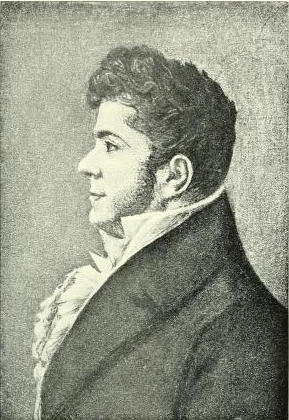
STENDHAL
Marie Henri Beyle was born at Grenoble on the 23rd of January 1783. His family belonged to the upper middle class, the aristocracy of the law. When only eight years old he lost his mother, a loss which he felt deeply and to which his thoughts perpetually recurred. His father was a reserved man, who took little notice of his children, and treated them with extreme severity. He entrusted the education of his son to needy abbés, whom the boy hated, regarding them as tyrants and hypocrites. Between him and his father there was early kindled a feeling of real animosity, which was never extinguished. Everything good that fell to Henri's lot in childhood came to him through his maternal grandfather, a clever and cultured doctor; but so strictly were his father's cruelly severe educational principles adhered to, that at the age of fourteen he was not acquainted with more than two or three children of his own age. This boy, in whose nature there lay germs of profound originality, in whose character determined independence was a main feature, whose energetic temperament begot a keen desire to do unusual deeds, and in whom the life of the senses stirred early and strongly, was subjected in the process of education to such severe, unrelieved, oppressive control, that passionate inward revolt was the inevitable consequence. Because the abbés, who lived in terror of the Revolution, educated him as a royalist and Catholic, he naturally developed into a revolutionist, a Bonapartist, and a freethinker in the extreme sense of the word. But the constant strife between his father's will and his own desires engendered, besides, a want of confidence, a distrust of humanity so deeply rooted that it was never eradicated. And ere long there was added to the fear of being deceived or exploited by others, the fear of deceiving himself, which bred in him the habit of being constantly on his guard, of constant self-examination and self-control.
A certain something in his character is traceable to the influence of the province in which he was born and in which his family had been settled for at least two centuries. The natives of Dauphiné are a keen, obstinate, argumentative race, as different from their neighbours of Provence as they are from the Parisians. The Provençal gives noisy or eloquent expression to his feelings; he rails and curses when he is angry or hurt; the Parisian is polite, witty, brilliantly superficial; the character of the native of Dauphiné is distinguished by a peculiar obstinacy; there is both depth and refinement in it; he remembers an insult and avenges it, but his anger never finds vent in abusive language. Beyle's mother, who read Dante and Ariosto in the original, a very uncommon accomplishment for a provincial lady in those days, was understood to be of Italian descent. This may in part explain Beyle's strong leaning to everything Italian; but it is also to be remembered that until 1349 Dauphiné did not form part of France, and was in its politics a semi-Italian state. It was one of Beyle's fancies that Louis XI, who, as Dauphin, governed the little country for several years, had imparted to its inhabitants something of his own distinguishing quality of prudence, of distrust of first inspirations. Improbable as this is, the surmise is in itself characteristic.
Circumstances early intensified the tendency to distrust with which Henri's home life had imbued him. When he at last attained to the liberty after which he had so long aspired, that is to say, when he was sent to school, a bitter disappointment awaited him. The little strong, thick-set, heavily built boy with the bright, speaking face (nicknamed "the walking tower" on account of his determined step, herculean limbs, and round Hercules head) was, in spite of the ironic expression of his mouth, an enthusiast. And in his schoolfellows he did not find the gay, amiable, noble-minded comrades he had pictured to himself, but a troop of selfish young whelps. When telling his friend Colomb this, he added: "It was a disappointment which has gone on repeating itself throughout my whole life." "Nor was I any luckier," he continued, "in the impression I made on my schoolfellows; I can see now that I displayed a ridiculous mixture of haughtiness and desire to amuse myself. To the other boys' coarse selfishness I responded with my Spanish hidalgo ideas of honour; and I was overwhelmed with despair when they went off to play together and simply ignored me." Compare this utterance with the bitter disappointment of young Fabrice (in La Chartreuse de Parme, published in 1839), when, during the battle of Waterloo, he begs some soldiers whom he meets for a piece of bread and is answered with a coarse jest: "These cruel words and the general laugh which followed were too much for Fabrice. War was not, then, it appeared, that noble, mutual impulse of souls who loved glory above everything, which Napoleon's proclamations had led him to understand it to be." We can easily imagine what memories of wild outbursts of animal selfishness Beyle brought back with him from his campaign; of these the tale of Fabrice's experiences is probably composed. He had formed too high an estimate of the comradeship existing among soldiers, just as he had over-estimated the comradeship of schoolboys.
About the year 1798 he began to devote himself with great ardour to the study of mathematics, for the characteristic reason, as he told his friends, that there was hypocrisy in every other science, but none, so far as he could discover, in the science of mathematics. But no doubt his ardour was stimulated by the growing fame of the young French general in Italy whom mathematics, practically applied in the science of artillery, had led from one great victory to another.
His studies at an end, Beyle arrived in Paris on the 10th of November 1799, the day following the 18th Brumaire. He had a letter of introduction to the Daru family, who were relatives, and when, after the coup d'état, Pierre Daru was made Secretary of War and Inspector of Reviews, he gave young Beyle a place in his office. I fancy I can trace reminiscences of this appointment in the episode of Julien's appointment as secretary to the Comte de la Mole in (Rouge et Noir). Colomb tells that on one of the first days after Beyle entered on his duties, when he was writing a letter to Daru's dictation, he absently spelled cela with two l's, and thereby brought on himself a playful, but none the less humiliating, reproof. A precisely similar incident occurs in the novel. But Daru was evidently a very much kinder and more considerate patron than the Comte de la Mole; he proved himself Beyle's faithful friend and benefactor. Besides his talent for military organisation, Daru had undoubted literary talent; his translations of Horace and his historical prose are excellent examples of the literary style of the Empire, and all the authors of that period looked up to him. It was a strange freak of fortune which determined that throughout most of his campaigns he should have in immediate attendance on him one of the literary pioneers of the following period—not that he had any suspicion of his protege's gifts, gifts of which the young man himself was scarcely conscious as yet.
When Daru and his younger brother, acting under Carnot, then Minister of War, had organised the memorable Italian campaign of 1800, and had themselves been ordered to Italy, they sent for Beyle to come to them there, though they had for the moment no definite appointment to offer him. The youth of seventeen, who was by nature as energetic as he was imaginative, and whose dreams were all of daring deeds and the First Consul, did not wait to be called twice. He packed a dozen standard works in his knapsack and started for Geneva; there, though he had never learned to ride, he mounted a horse which Daru had left behind ill, but which had recovered, and, encountering many difficulties, rode over the Saint Bernard on the 22nd of May, two days after Napoleon. On the 1st or 2nd of June he reached Milan, the city where he was to have his first experience of the joy of life, and which was always to loom largely on his mental horizon. He witnessed the outburst of rapturous joy with which the abolition of the hated supremacy of Austria was hailed, and on the 4th of July was present at the battle of Marengo. After holding an appointment in the commissariat for some months, he entered the seventh regiment of dragoons as sergeant (as we are reminded in a curious note to the fifth chapter of Rouge et Noir) was promoted to a lieutenancy at Romanego, and was shortly afterwards made adjutant to General Michaud. He distinguished himself in all the subsequent engagements, and especially at Castel-Franco, not only by courage; but by the ardour, accuracy, and intelligence with which he executed all the tasks entrusted to him. We have, evidently, a very exact account of young Beyle's feelings as a spectator of the battle of Marengo, in the description of Fabrice del Dongo's youthfully enthusiastic and heroic emotions as spectator of the battle of Waterloo, a description which undoubtedly owes much of its masterliness to its being a faithful reproduction of personal experiences. The period which begins with the youth's ride across the Alps and ends with his farewell to the army after the Peace of Amiens, was the period of his life to which Beyle looked back as that of perfect happiness; it was rich in every variety of romantic experience; during it he did daring deeds, fought a comical duel, had various youthful love affairs, and enjoyed the poetry of a soldier's life in a beautiful country, where the foreign conquerors were greeted as saviours and heroes by a careless, naïvely passionate people, who were prevented by no scruples from indulging their thirst for pleasure.
When Henri returned to Grenoble from this his first flight into the wide world, he found everything as he had left it. His family still revered what he despised, and detested all that he enthusiastically admired. After some violent altercations, the young Hotspur obtained permission to take up his abode in Paris. There he studied Montaigne, Montesquieu, and the eighteenth-century philosophers, more particularly Cabanis and De Tracy, with the latter of whom he was at a subsequent period to become intimately acquainted. (For De Tracy's Ideology Beyle had a profound admiration from his earliest youth.) He also took lessons in English.
In this quiet life of study, which lasted for a few years, there was an odd interlude. In 1805, during a visit to his native town, Henri fell in love with a beautiful young actress who was playing there. His love was returned, and, unable to endure the idea of separation from his beloved, he followed her to Marseilles, where she had obtained an engagement, and took a place as clerk in a large grocery business—the only possible means of earning a living which presented itself. He was quite happy on his office stool during the year his passion lasted; but, when the actress suddenly determined to marry a Russian, he returned to Paris and resumed his studies. Before long he received an invitation which he was incapable of refusing, to accompany Marshal Daru to the army. He fought in the battle of Jena, took part in Napoleon's triumphal entry into Berlin, and was appointed superintendent of the Imperial demesnes in Brunswick. This appointment he held for two years, during which he gained some knowledge of the German language and literature, and distinguished himself by his zeal in the Emperor's service. Receiving orders to levy a war tax of five millions, he levied seven. This was what they in those days called "being possessed of the sacred fire." When the Emperor was told, he said, "Well done!" and noted the assessor's name. But Beyle also won honour for himself in ways which appeal more to our sympathies. In 1809 he was left in a little German town, in charge of stores and of the wounded soldiers who were not fit to be removed. No sooner had the garrison departed than the citizens were summoned by the alarm-bell to attack the military hospital and seize the stores. The other officers lost their heads; but Beyle armed all the convalescents, every man who was able to be out of bed, posted the weakest at the windows (which he transformed into loopholes), and, placing himself at the head of the others, made a sortie and scattered the attacking mob.
He followed the army to Vienna, was employed in the negotiations which preceded Napoleon's marriage with Marie Louise, and afterwards received the appointment of inspector of the buildings and movable property belonging to the crown. In this capacity he appeared at court, and was introduced to the Empress.
After a stay in Milan he received permission, in 1812, to take part in the Russian campaign. His love of adventure had been more than satisfied by his previous campaigns; he had been sickened and pained by the sight of corpses, and whilst his carriage wheels passed over and mutilated them, he had tried to divert his mind by poetic fancies. But war always attracted him anew. We see the man whose books, written at a later period in his career, contain such store of delicate and profound insight into national psychology, studying, during the passage of the Niemen, the appearance and temperament of the soldiers of all lands who composed the Grand Army. But by the time Smolensk was reached he had had enough. From that town he writes:—
"How man changes! My old longing for novelty is quite gone. Since I have seen Milan and Italy, everything else repels me by its coarseness. Would you believe it? without any personal reason I am sometimes on the point of shedding tears. In this ocean of barbarism there is not a sound which finds its echo in my soul. Everything is coarse, foul, stinking, both literally and metaphorically. My one pleasure has been hearing a fellow, who is about as musical as I am pious, play a little on a piano which is terribly out of tune. Ambition has no longer any power over me; the most gorgeous order would be no compensation for what I am enduring. I represent to myself the summits on which my spirit dwells (planning books, listening to Cimarosa and loving Angela in a perfect climate) as beautiful heights; far below them on the plain lie the fetid marshes in which I am now sunk.... You will hardly believe it, but what really gives me pleasure is to attend to any Italian official business there is to transact. There has been some lately, and even though it is over, it continues to occupy my imagination like a romance."
In the diary he kept at Moscow we find traces of the same duality in his nature—the craving to occupy his imagination, and the desire to act and to be in the midst of action. During the great fire he writes: "The fire soon reached the house we had left. Our carriages stood for five or six hours on the boulevard. Tired of this inaction, I went to look at the fire, and spent an hour or two with Joinville ... we drank a bottle of wine, which restored us to life. I read a few lines of an English translation of Paul et Virginie_ which restored me to a feeling of intellectual life in the midst of the universal barbarism."
During the terrible retreat through Russia, Beyle was superintendent of the depots at Minsk, Vitebsk, and Mohilof; he did good service by supplying the army as it passed Orcha with provisions for three days, the only provisions served out to it between Moscow and Beresina. The coolness and determination which had characterised him from his childhood did not desert him now. It has been often told how, on one of the most calamitous days of the campaign, he made his appearance in Daru's quarters cleanly shaved and carefully dressed, and was greeted by his chief with the words: "You are a brave man, Monsieur Beyle; you have shaved to-day."
During the retreat he lost everything—horses, carriages, clothes, and money—even the sum with which he was provided for emergencies. Before he left, his sister had replaced all the buttons on one of his overcoats with pieces of twenty and forty francs, carefully covered with cloth. On his return she asked him if they had been useful to him. After much reflection, he remembered that somewhere in the neighbourhood of Wilna he had presented his coat to a waiter, considering it worn out. The incident is a characteristic one; for Beyle, who was quite as eager to excel in diplomacy as in literature, was extremely prudent, but at the same time extremely forgetful.
He re-entered on his official duties in Paris; in 1813, he was, as a member of the Emperor's staff, at Mainz, Erfurt, Lützen, and Dresden; and for a time he held the appointment of Commissary-General in Silesia. His health giving way, he went to recruit it by the Lake of Como, in the region to which he always returned as to an earthly Paradise, and where, as usual, he passed in blissful idleness such leisure as the pursuit of a happy love affair left him. He was once more actively employed under Napoleon in 1814; but the Emperor's fall blasted all his hopes of a successful official career. He lost everything—his appointment, his income, his position in society; and he bore the loss not merely without complaint, but with cheerfulness, resigning himself with philosophic equanimity to being henceforward simply the cosmopolitan, dilettante, and author.
From 1814 till 1821, except for a short absence in 1817, Beyle was an inhabitant of his beloved Milan. He did not leave it even during the Hundred Days, being convinced that Napoleon's fortunes were irretrievable. A passionate lover of Italian music and singing, he spent happy evenings at the La Scala Theatre. He was received into the best society of the town; in Count Porro's house, or in Lodovico de Brême's box at the theatre, he made acquaintance with the Italian authors and patriots—Silvio Pellico, Manzoni, &c.; and also with such famous travellers as Byron, Madame de Staël, Wilhelm Schlegel, and a whole host of other English and German notabilities. An attachment which lasted for several years made him, what he was capable of being, perfectly happy; but this happiness was rudely disturbed in the summer of 1821 by his summary banishment from Milan. The Austrian police suspected him, quite groundlessly, of intrigues with the Carbonari.
He returned once more to Paris in a state of the deepest dejection; and it was during the height of his grief at being separated from the woman he loved, that he wrote his famous book, De l'Amour. Hitherto he had written, or at least published, nothing but biographies of Haydn and Mozart, which were only adaptations of Italian and German works, and the Histoire de la Peinture en Italie, with its proudly humble dedication to the captive of St. Helena. None of these books had made any sensation; but the last-mentioned had won him the goodwill and friendship of De Tracy, the philosopher. Beyle at first felt himself completely isolated in Paris. Many of his old associates under the Empire were banished; others had forfeited his regard by cringing to the new Government. At De Tracy's house, however, he met the best of the good society of the day—Lafayette, the Comte de Ségur, Benjamin Constant, &c., &c.; and at such houses as Giuditta Pasta, the famous opera-singer's, he met the young authors, men like Mérimée and Jaquemont. Beyle remained in Paris, except for short visits to England and Italy, until 1830. From 1830 until his death in 1842, he was again in government employment, holding posts which were practically sinecures. The first year he was Consul at Trieste, a place which he disliked, and the rest of the time at Civita Vecchia, which was almost equivalent to being in Rome. Here he lived under the sky he had always loved and among the people he preferred to all others, but his solitude and idleness were unutterably wearisome to him. To such of his countrymen as sought him out and suited him, he was an amiable and most efficient cicerone; but he longed to be back in Paris, although the old martial spirit of the Empire forbade him to acknowledge himself a Frenchman after Louis Philippe's Government yielded (in 1840) to the verdict of Europe on the Eastern question without striking a blow. During the last years of his life his health was bad. He died suddenly of apoplexy while on leave in Paris.[2]
XIX
BEYLE
Henri Beyle's is, without doubt, one of the most complex minds of the rich period to which he belongs. What chiefly distinguishes him from his brethren of the Romantic School is his direct intellectual descent from the severely rational sensationalistic philosophers of the eighteenth century. Not even in any short youthful or transition period is there a trace to be found in his soul of the Romantic reverence for religious tradition so prevalent in his day. All his life long he was the unfaltering philosophic antagonist of everything in the great Romantic movement which was of the nature of a reaction against the spirit of the eighteenth century. He was absolutely uninfluenced by Chateaubriand and Madame de Staël—was neither a colourist like the former nor eloquent like the latter; and absolutely uninfluenced by André Chénier, Hugo, and Lamartine—for he was wanting in the sense of metre, and was neither lyric nor pathetic. His models as a Romantic writer were not French; and his allegiance to Condillac and Helvetius, philosphers despised by the Romanticists of every country, never for a moment wavered, even at the time when the prejudice against them was universal.
He was a passionate atheist; that is to say, there was in his conviction that the world is not governed by any God the Father, as it were an element of enmity towards the being in whom he did not believe, an indignation at the horrors of life, which found expression in the sad and witty saying: "What excuses God is that he does not exist." Beyle never let slip an opportunity of displaying his dislike of so-called revealed religion. If he had occasion to write "the one true religion," he did not forget to add in parenthesis "(the reader's);" and when he touched on the subject of Christian morality, he was fond of remarking that it might be reduced to the calculation: "It is advisable not to eat truffles; they give you a stomach-ache."
As moral philosopher (and private individual) he was a pronounced epicurean. He acknowledged no mainspring of action but self-interest, that is to say, the desire of pleasure and the fear of pain; and, in his opinion, no other was necessary to explain even so-called heroic actions, since fear of self-contempt—i.e. fear of something that is painful—is quite enough to make a man, let us say, jump into the water to save another.[1] By virtuous actions, he understands actions which are attended with inconvenience or suffering to the actor, but are beneficial to others.
Psychological phenomena engrossed his attention to the exclusion of everything else; as the observant traveller, as the student of old chronicles, as the author of novels and stories, he was the psychologist, and that alone. His one constant study was the human soul, and he is one of the first modern thinkers who regard history as being in its essence psychology. But to Beyle, with his utilitarian philosophy, the science of the human soul and the science of happiness are one and the same thing. All his thoughts turn on happiness. By a man's character he understood the particular manner of seeking happiness which had become habitual to him; and the reason of his pronounced partiality to the Italians as a people was, that Italian men and women seemed to him to have found the most certain and direct way to happiness.
A man of an independent, original, ardent nature, he regarded it as the first condition of happiness to be one's self. Everywhere throughout his works we find, endlessly varied, the same warning: Be distrustful! Believe only what you have seen; admire nothing that does not appeal to you personally; always take it for granted that your neighbour has been paid to lie! The charge which he never wearies of bringing against the French is that they are too vain to know what happiness is, or rather, that they are unsusceptible to any higher happiness than that of gratified vanity, which he, personally, values very cheaply. According to Beyle, the Frenchman is perpetually asking his neighbour if he, the questioner, is feeling pleasure, is happy, &c.; he dare not decide the question for himself. The fear of not being like others, or of what others will say, is, in Beyle's opinion, the Frenchman's dominant feeling. He himself, on the contrary, not content with his natural originality, cherished a dislike of resembling others which led him into oddity and affectation. The man who was constantly ridiculing others for thinking of the opinion of their neighbours, who loved and exalted frankness, self-forgetfulness, straightforwardness, and simple-mindedness, was constantly keeping guard over himself, observing himself, prescribing to himself such duties as defiance of this neighbour, revenge upon that—and not neglecting to fulfil them. The thought of what his neighbour might say or do plagued him quite as much as it plagued the veriest philistine, merely with this difference, that the philistine was haunted by the thought of his neighbour because he desired to imitate him, Beyle because he wished to defy or avoid him. This eternal antagonism to the philistine is a genuinely Romantic trait. And it is also characteristically Romantic, that the man who was perpetually preaching and lauding naturalness and unconstraint should all his life have had a passion for concealment, disguise, and mystification, for hiding his personal experiences and thoughts under layer upon layer of wrappings and drapery.
Beyle's early years had been passed in profound spiritual solitude. An overflowing fount of feeling had been turned inwards. The child who had lost his mother, and who hated and was hated by his father, learned early to look upon himself as different from others—no doubt also as superior to others, though he defined his superiority as unlikeness.[2] He was conscious that this unlikeness would exclude him from any general sympathy and prevent his being generally understood. Hence his desire that it were possible for him to write his books in a language which should only be understood by a chosen few—a sacred language. Hence also his wish to find "un lecteur unique, unique dans tous les sens," and his dedication of La Chartreuse de Parme: "To the happy few."
This, too, was the real source of the inclination to concealment. Not only did Beyle publish all his books under a pseudonym (all, with one exception, under the name of De Stendhal, presumably derived from Stendal in Prussia, the birthplace of Winckelmann), but in many of them, De l'Amour_among the rest, the pseudonymous author assumes any number of second pseudonyms. Any sentiment which he does not care to acknowledge as his own, any anecdote which might shed light upon his private life, is laid to the account of an Albéric, or a Lisio, or the amiable Colonel So and So. And he has given himself as many occupations as names; now he is a cavalry officer, now an ironmonger, now a customs officer, now a commercial traveller; here he figures as a man, there as a woman; at one time he is of noble, at another of plebeian birth; at one time English, at another Italian. He would have liked to write in a cipher language for the initiated. This delight in leading his readers on the wrong track is in part to be ascribed to the secretiveness of the diplomatist; but in his private correspondence it was also due to a suspicion of the police which almost amounted to a mania. In his youth Beyle had made acquaintance with both Napoleon's and the Austrian police, and he always retained a fear of his letters being seized and opened. Therefore he hardly ever signed a private letter with his name. I have counted in his correspondence more than seventy pseudonymous signatures, varying from the strangest to the most ordinary names—Conickphile, Arnolphe II, C. de Seyssel, Chopin d'Ornonville, Toricelli, François Durand, &c., &c. He sometimes subscribes himself captain, sometimes marquis, sometimes engineer; sometimes gives his age, or the name of his street and number of his house. Grenoble he calls Culars, Civita Vecchia, Abeille. It amuses him at times to append a misleading indication of locality to his fictitious signature: for example, Théodore Bernard (du Rhône); he actually signs such a document as a public petition to Louis Philippe's Government for a new coat-of-arms for France:
Olagnier, De Voiron (Isère).
Such satisfaction did it give him to make himself unrecognisable and hold himself aloof, that the words, Odi profanum vulgus et arceo, may be employed to express what to him was certainly one condition of happiness.
What did he himself regard as its conditions?—In his early days, evidently daring action and passionate love. The thrill with which a man, in his unbounded devotion to a cause or another man, risks his life; and the tremor communicated to the soul by happy love—these to him were the supreme moments of human existence. Writing of Milan in the introduction to La Chartreuse, he observes characteristically: "The departure of the last Austrian regiment marked the downfall of the old ideas. It became the fashion for men to hazard their lives. They saw that in order to be happy after centuries of hypocrisy and vapidity, they must love something with real passion, and be capable, on occasion, of risking their lives."
These two passions, love of war and love of woman, were in Beyle's case only two expressions of one fundamental passion, namely, love for what he was wont to call le divin imprévu—the passion which makes a poet of him. How war, especially war as conducted by Napoleon, satisfied his craving, requires no explanation. How women, and especially Italian women, satisfied it, Beyle tells us himself. In a letter from Milan, dated 4th September 1820, he writes: "As I have spent fifteen years in Paris, nothing on earth leaves me so completely indifferent as a pretty Frenchwoman. And my dislike of the commonplace and the affected often carries me beyond mere indifférence. When I meet a young Frenchwoman who has had the misfortune to have been well brought up, I am at once reminded of my own home and my sisters' upbringing; I foresee not only all her movements, but the most fugitive shades of her thoughts. That is why I am partial to bad company; it offers far more of the unforeseen. If I know myself at all, this is the chord in my soul which people and things in Italy set vibrating—the women first and foremost. Imagine my delight when I found out, what no writer of travels had deprived me of the pleasure of discovering, namely, that in that country it is in good society that there is most of the unforeseen. Nothing deters these remarkable geniuses except want of money or pure impossibility; if prejudices still exist, it is only in the lower classes."
In other words, what Beyle loves best is reckless energy, both in action and emotion—energy, whether revealing itself as the irresistibleness of the military genius or the boundless tenderness of the loving woman. Therefore he, the cold, dry cynic, positively worshipped Napoleon.[3] Therefore he loved the women of Milan. Therefore he understood and depicted the life of the fifteenth and sixteenth centuries in Italy much better even than modern Italian life. A work which he long purposed writing was a History of Energy in Italy; and it is not too much to say that his Italian Chronicles, copied, adapted, or imitated from old manuscripts, are equivalent to a psychological analysis of Italian energy.
One utterance will suffice to show that the same love of the unforeseen which had irresistibly attracted him to the war, made of him, when the war was over, a traveller, an emigrant, a cosmopolitan. In a letter in which he tells that he has been transferred to another post and is going unwillingly because of the tender ties which bind him to the place where he is living, he expressly mentions the pleasure which he nevertheless involuntarily feels, "the moment there is any talk of travelling and seeing new life." And it is equally evident that the same love of the unforeseen, the same strong personality, the same recklessness, or, taking it in a profounder sense, genius, which attracted him to woman and made him love more passionately and tenderly than others, reveals itself in the devotion to music and plastic art which made of him the enthusiastic dilettante, cicerone, and biographer. His love for Cimarosa and Correggio, Ariosto and Byron, was a passion. Take his attitude to Byron. His published criticism of the great English poet was severe and cold; he was haughty in personal intercourse with him, disputed with him on the subject of Napoleon, &c.; he actually left unanswered a most charming letter which Byron wrote him seven years after their meeting, because he fancied there was a trace of hypocrisy in the English poet's defence of Sir Walter Scott. But observe the way in which, when he is writing unreservedly, he describes his feelings on the occasion of his first meeting with Byron: "I was at the time wildly enthusiastic on the subject of Lara. My second look no longer showed me Lord Byron as he really was, but the author of Lara as I thought he ought to be. When the conversation in the box flagged, Monsieur de Brême tried to get me to speak; but I simply could not; I was too full of awe and tenderness. If I had dared, I should have kissed Lord Byron's hand and burst into tears.... My tenderness made me urge him to take a carriage."[4]
Many other men in every age and country have loved war and travel, women and art; but what is peculiarly characteristic and distinctly modern in Beyle is his tendency and his ability to examine himself in the moment of action or of passion. He is constantly observing himself, has, so to speak, constantly his hand on his pulse; and with unfailing coolness he renders account to himself of his condition under all different circumstances, and draws a whole chain of general inferences from it. Let us follow him into a battle. During the cannonade at Bautzen he writes in his journal:
"Between twelve and three we see remarkably well all that can be seen of a battle, that is to say, nothing. The entertainment consists in one's being slightly [the "slightly" is very characteristic] excited by the certainty that something dreadful is happening before one's eyes. The majestic roar of the cannons contributes greatly to this effect; if they made a whistling sound I do not believe that the same degree of emotion would be produced. The whistle might be as terrible, but could not be so grand."
Or let us listen to him when he is in love. He writes:—
OF THE BIRTH OF LOVE.
What takes place in the soul is:
1. Admiration.
2. One says to one's self: "What happiness it would be to kiss her, to be kissed by her, &c."
3. Hope.
One studies the perfections of the object of one's admiration ... the eyes of even the most reserved women flush in the moment of hope; the passion is so vehement, the pleasure so ardent, that it betrays itself by unmistakable signs.
4. Love is born.
To love is to have pleasure in seeing, touching, perceiving by all the senses, in as close contact as possible, a lovable person who loves us.
5. The first crystallisation begins.
One takes pleasure in adorning with a thousand perfections the woman of whose love one is sure; one rehearses all the details of one's happiness with infinite satisfaction.
Allow the brain of a lover to work for twenty-four hours, and the result will resemble what happens at Salzburg when a leafless branch is let down into the deserted depths of the salt mines. When it is drawn up again two or three months later, it is covered with sparkling crystals; the smallest twigs, those that are not thicker than a titmouse's claw, are decked with myriads of dazzling, twinkling diamonds; the original branch is unrecognisable. What I denominate crystallisation is the operation of the mind which, from everything that presents itself, draws the discovery of fresh perfections in the beloved object. A traveller speaks of the coolness of the orange groves near Genoa during the scorching summer heat—what a pleasure it would be to enjoy their coolness with her!... This phenomenon which I take the liberty of naming crystallisation, is a product of the nature which ordains that we shall feel pleasure and that the blood shall rush to our heads, of the feeling that our pleasure increases with the perfections of the beloved object, and of the idea: she is mine. The savage has not time to proceed further than the first step. He feels pleasure, but the energy of his brain is employed in the chase of the deer which is to provide him with food.... The man who is passionately in love sees every perfection in the woman he loves; nevertheless his attention may still be distracted, for the mind tires of everything that is monotonous, even of perfect happiness. But then comes what rivets attention:
6. Doubt is born.
After ten or twelve looks or any other series of actions have inspired the lover with hope and strengthened his hope ... he demands more positive proofs of his happiness. Coldness, indifference, or even anger is displayed if he shows too much assurance.... He begins to doubt his certainty of the happiness he had promised himself. He determines to solace himself with the other pleasures of life, but finds that they no longer exist for him. Fear of a dreadful misfortune attacks him, and his attention is concentrated.
7. Second crystallisation.
Its diamonds are confirmations of the idea: She loves me. Every quarter of an hour during the night which follows the birth of doubt, the lover, after a moment of terrible suffering, says to himself: Yes, she loves me; and he discovers new charms. Then doubt attacks him again; he sits up, forgets to breathe, asks himself: But does she really love me? And in the midst of these distressing and delightful reflections the poor lover feels with ever greater certainty: She would give me pleasures which she alone in all the world is capable of giving me."
Few such acute and delicate analyses of a passion exist. Not without reason have Beyle's descriptions of what happens in the human soul when it is under the influence of a passion, reminded his best critics, Taine and Bourget, of the third part of Spinoza's Ethics, the masterly De Affectibus. In this soldier, administrator, diplomatist, and lover there was a good deal of the philosopher. He endeavoured to resolve every phenomenon of emotional life into its elements, and, on the other hand, he showed the connection between the ideas and emotions, which, united into a system, constitute the disposition and character of the individual. He paid as much attention to the comparative strength of the emotions as to the variety of their connections and concatenations; he traced peculiarities of character to the deepest lying national and climatic causes; he sketched a psychology of race; and, though he did not adhere to strictly scientific methods, there was a strong scientific tendency in his psychological studies. He loved to define by the aid of numbers, measure, weight. Writing of a king's visit to a little town, he describes the procession, the Te Deum and clouds of incense within the church, the salvoes of artillery outside, and concludes: "The peasants were beside themselves with joy and piety; one such day undoes the work of a hundred issues of the Jacobin newspapers." In one of his books, an exiled revolutionist is telling how the revolt he headed failed because he would not consent to the execution of three men, and would not divide among his followers seven or eight millions of francs contained in a box of which he had the key. "Who wills the end must will the means," says Beyle's hero; "if, instead of being an atom, I were a power, I would hang three men to save four,"[5]—a stupid and indefensible theory, by the way, based on the childish premise that any four men are of more value than any three.
It is plain enough that in Beyle's case the final condition of happiness was understanding. The real aim and object of all his endeavour was a clear understanding of the state of his own mind, and insight into the mechanism of the human soul generally. He was of opinion that prosperity, happiness in love, happiness generally, clears the understanding and sharpens the critical faculty, but was equally convinced that nothing contributes so much to make a man unhappy as want of clear-sightedness. In a letter to a friend, dated Moscow, 1812, he writes characteristically: "The happiness you now enjoy ought to lead you back naturally to the principles of pure Beylism. I read Rousseau's Confessions last week. It was simply for want of two or three Beylean principles that he was so unhappy. The mania of seeing duties and virtues everywhere made his style pedantic, his life miserable. After three weeks of friendly intercourse with a man—crash! the duties of friendship, &c." Two years afterwards the man in question has forgotten him; Rousseau seeks and finds some pessimistic explanation. Beylism would have told him: "Two bodies approach each other; warmth and a fermentation result; but every such state is transitory. It is a flower to be voluptuously enjoyed." These words contain a fragment of excellent practical philosophy, and would testify to an unusually well-balanced mind if the practice of their writer's life had corresponded to his theory. But although Beyle was by nature a robust sensualist, and had accustomed himself to a cynical boldness of expression (he shocked George Sand by his cynicism when she and De Musset met him on their way to Italy), and although as a thinker he was what he required a philosopher to be, namely, clear-headed, unimpressionable, and free from illusions (he used to say that to have been a banker was to have gone through the best preparatory school for philosophy), there lay behind the robust temperament and the dryness of the logician an artistic receptivity to every impression, an irritability and feminine sensitiveness which did not fall far short of Rousseau's. And this sensitiveness Beyle retained to the end of his life. In the autobiography (Vie de Henri Brulard) which was found amongst his papers, we come upon the following confession: "My sensitiveness is excessive; what only grazes another man's skin draws blood from me. Such was I in 1799; such am I in 1840. But I have learned to hide it all under an irony which the vulgar do not understand."
Seldom has a character combined so great a love of spontaneity and straightforwardness with so much calculation and subterfuge; seldom has a mind been so truthful and at the same time so addicted to dissimulation, so ardent in its hatred of hypocrisy and yet so lacking in openness and straightforwardness.
XX
BEYLE
Prior to 1830 Beyle published no imaginative work of any importance except a novel entitled Armance, an unsuccessful book, the hero of which, a gifted young man, makes the woman he loves unhappy, because he suffers from a half-physical, half-mental ailment, the nature of which is not precisely defined, but which appears to resemble that which played a part in the lives of Swift and Kierkegaard. The year 1830, epoch-making in history, is also epoch-making in Beyle's literary career. It is the year in which he writes or plans both his great novels—Le Rouge et le Noir, published in 1831, and La Chartreuse de Parme, which was not completed till 1839, when it was published simultaneously with the most important of his Italian Chronicles, L'Abbesse de Castro.
Both of the novels deal with the period immediately succeeding Napoleon's fall, and both deal with it in the same spirit. The motto of both might be the passage from De Musset's Confession d'un Enfant du Siècle quoted in The Reaction in France: "And when the young men talked of glory they were answered: Become priests! and when they talked of honour: Become priests! and when they talked of hope, of love, of power, of life, it was always the same: Become priests!" The scene of Rouge et Noir is laid in France, that of La Chartreuse in Italy, but in both books the principal character is a young man with a secret enthusiasm for Napoleon, who would have been happy if he could have fought and distinguished himself under his hero in the bright sunlight of life, but who, now that that hero has fallen, has no chance of making a career except by playing the hypocrite. In this art the two young men gradually develop a remarkable degree of skill. Julien and Fabrice are cut out for cavalry officers; nevertheless both become ecclesiastics; the one passes through a Catholic seminary, the other rises to be a bishop. Not without reason have Beyle's novels been called handbooks of hypocrisy. The fundamental idea inspiring them is the profound disgust and indignation which the spectacle of triumphant hypocrisy aroused in their author. Desiring to work off this feeling he gave vent to it by simply, without any display of indignation, representing hypocrisy as the ruling power of the day, to which every one who desired to rise was compelled to do homage. And he tries to play the modern Macchiavelli by frequently applauding his heroes when their attempts at impenetrable hypocrisy succeed, and expressing disapproval when they allow themselves to be surprised or carried away, and unguardedly show themselves as they are. A certain unpleasant forcedness is inseparable from this ironic style of narration.[1]
As Beyle's was essentially a reasoning mind, with a gift of purely philosophic observation, externalities did not impress him strongly, and he had little skill in depicting them. His one interest is in emotional and intellectual processes, and, himself an adept in the observation of these processes, he endows almost all his characters with the same skill. They as a rule have an understanding of what is happening in their own souls which far surpasses that derived by ordinary mortals from experience. This conditions the peculiar construction of Beyle's novels, which consist in great part of connected monologues that are at times several pages long. He reveals all the silent working of his characters' minds, and lends words to their inmost thoughts. His monologues are never the lyric, dithyrambic outbursts which George Sand's often are; they are the questions and answers—short and concise, though entering into minute details—by which silent reflection progresses.
The fundamental characteristic of Beyle's principal personages, who, measured by the current standards of morality, have no conscience and no morals, is, that they have evolved a moral standard for themselves. This is what every human being ought to be capable of doing, but what only the most highly developed attain to; and it is this capacity of theirs which gives Beyle's characters their remarkable superiority over other characters whom we have met with in books or in real life. They keep an ideal, which they have created for themselves, constantly before their eyes, endeavour to follow it, and have no peace until they have won self-respect. Hence Julien, who is executed for an atrocious attempt to murder a defenceless woman, is able to comfort himself in the hour of his death with the thought that his life has not been a lonely life; the idea of "duty" has been constantly present with him.
It is evident that Beyle found this feature which he has bestowed on his heroes in his own character. In a letter written in 1820, after remarking that he detests large hotels because of the incivility shown in them to travellers, he adds: "A day in the course of which I have been in a passion is a lost day for me; and yet when I am insolently treated I imagine that I shall be despised if I do not get angry." This is precisely the manner in which Julien and Fabrice reason. With some such thought in his mind Julien compels himself to lay his hand caressingly on Madame de Rênal's, Fabrice compels himself defiantly to repeat the true but contemptuous words he had used in speaking of the flight of the French soldiers at Waterloo. Julien is French, and acts with full consciousness of what he is about; Fabrice is Italian and naïve, but they both possess the quality to which we may give the name of moral productivity. Julien says to himself in prison: "The duty which I, rightly or wrongly, prescribed to myself, has been like the trunk of a strong tree against which I have leaned during the storm"; the light-hearted Fabrice, reproaching himself with a momentary feeling of fear, says to himself: "My aunt tells me that what I need most is to learn to forgive myself. I am always comparing myself with a perfect model, a being who cannot possibly exist." Mademoiselle de la Mole in Rouge et Noir and Mosca in La Chartreuse de Parme are distinguished by the same superiority and self-reliance. Mosca, a character in whom Beyle's contemporaries naïvely saw a portrait of Metternich, is, in spite of his position as prime minister of a small legitimist state, quite as free from prejudice in his views of the system he serves as Beyle's young heroes are. The object of his private hero-worship is Napoleon, in whose army he held a commission in his youth. He jests as he puts on the broad yellow ribbon of his order. "It is not for us to destroy the prestige of power; the French newspapers are doing that quite fast enough; the reverence mania will scarcely last out our time."
But whether the personages described be eminently or only ordinarily gifted human beings, the manner in which their inner life is revealed is unique. We not only see into their souls, but we perceive (as in the writings of no other author) the psychological laws which oblige them to act or feel as they do. No other novelist offers his readers so much of the pleasure which is produced by perfect understanding.
Madame de Renal loves Julien, her children's tutor. We are told that "she discovered with shame and alarm that she loved her children more than ever because they were so devoted to Julien." Mathilde de la Mole tortures Julien by confiding to him her feelings for her former lovers. "If molten lead had been injected into his veins he would not have suffered so much. How was the poor fellow to guess that it was because she was talking to him that it gave Mademoiselle de la Mole so much pleasure to recall her flirtations with Monsieur de Caylus and Monsieur de Luz?" Both these passages elucidate a psychological law.
Julien has entered the Church from ambitious motives, and secretly detests the profession he has embraced. On the occasion of some festival he sees a young bishop kneeling in the village church, surrounded by charming young girls who are lost in admiration of his beautiful lace, his distinguished manners, and his refined, gentle face. "At this sight the last remnant of our hero's reason vanished. At that moment he would, in all good faith, have fought in the cause of the Inquisition." The addition "in all good faith" is especially admirable. A parallel passage is to be found in La Chartreuse. After the death of a Prince whom he has always despised and who has actually been poisoned by his (Mosca's) mistress, Mosca has been obliged to put himself at the head of the troops and quell a revolt against the young Prince, whose character is as despicable as his predecessor's. In the letter in which he communicates the occurrence to his mistress, he writes: "But the comical part of the matter is that I, at my age, actually had a moment of enthusiasm whilst I was making my speech to the guard and tearing the epaulettes from the shoulders of that coward, General P. At that moment I would, without hesitation, have given my life for the Prince. I confess now that it would have been a very foolish way of ending it." In both these passages we are shown with remarkable sagacity how an artificial enthusiasm dazzles and is, as it were, caught by infection.
No other novelist approaches Beyle in the gift of unveiling the secret struggles of ideas and of the emotions which the ideas produce. He shows us, as if through a microscope, or in an anatomical preparation where the minutest veins are made visible by the injection of colouring matter, the fluctuations of the feelings of happiness and unhappiness in acting, suffering human beings, and also their relative strength. Mosca has received an anonymous letter which tells him that his mistress loves another. This information, which he has several reasons for believing to be correct, at first utterly unmans him. Then, as a sensible man and a diplomatist, he involuntarily begins to take the letter itself into consideration and to speculate as to its probable writer. He determines that it has been composed by the Prince. "This problem solved, the little feeling of pleasure produced by the obviously correct guess was soon effaced by the return in full force of the painful mental apparition of his rival's fresh, youthful grace." Beyle has not neglected to note the momentary interruption of the pangs of jealousy by the satisfaction of discovery.—In the course of a few days Julien is to be executed. Meanwhile he is receiving constant visits from the woman he loves, but from whom he has been separated for years, and is absorbed by love to the exclusion of all thought of his imminent fate." One strange effect of this strong and perfectly unfeigned passion was that Madame de Renal almost shared his carelessness and gentle gaiety. This last bold touch speaks to me of extraordinarily profound observation. Beyle has correctly felt and expressed the power of a happy, absorbing passion to banish all gloomy thoughts (even the thought of certain death) as soon as they attempt to intrude themselves; he knows that passion wrestling with the idea of approaching calamity renders it powerless, when it does not succeed in dismissing it as utterly incredible. It is such passages as these which make other novelists seem shallow in comparison with Beyle.