V. THE ROMANTIC SCHOOL IN FRANCE (continued 3)
Mary Morison translation
And through all these poems there is a twitter and a hum, a sound as of the play of little children and their bird-like cries. The child rushes into the room, and the darkest brow, nay, even the guilty countenance, brightens; it interrupts the most serious converse with its questions, and the talk ends in a smile; it opens its young soul to every impression, and offers a kiss to strangers and to friends.
"Let the children stay! do not drive them from the poet's study; let them laugh and sing and mingle their childish clamour with the chorus of spirit voices whilst he writes and dreams at his desk. Their breath will not disperse the gay bubbles of his dream. Do you think that I fear, when these bright heads pass before my eyes in the midst of my visions of blood and fire, that my verses will take flight like a flock of birds startled by playing children? No, indeed! No image is destroyed by them. The painted, chased flowers of the gay Orientale expand more freely when they are near, the ballad grows more spirited, the winged lines of the ode mount with more ardent aspiration towards heaven."
A sad event which happened in 1843 carried the poet in riper years back to these youthful days and that happy family circle. In February 1843 his eldest daughter married; in September she was accidentally drowned, from a sailing-boat on the Seine. Her husband, Charles Vacquerie, jumped into the water after her, and when his and all attempts to save her proved fruitless, he drowned himself. The series of poems in Les Contemplations beginning with the verses, "Oh! je fus comme fou dans le premier moment!" ought to be read along with Feuilles d'Automne.
In this series we come upon simple scenes exquisitely reproduced and full of sincere feeling:
"Elle avait pris ce pli dans son âge enfantin De venir dans ma chambre un peu chaque matin; Je l'attendais ainsi qu'un rayon qu'on espère; Elle entrait et disait: 'Bonjour, mon petit père;' Prenait ma plume, ouvrait mes livres, s'asseyait Sur mon lit, dérangeait mes papiers et riait, Puis soudain s'en allait comme un oiseau qui passe. Alors je reprenais, la tête un peu moins lasse, Mon œuvre interrompue, et, tout en écrivant, Parmi mes manuscrits je rencontrais souvent Quelque arabesque folle et qu'elle avait tracée, Et mainte page blanche entre ses mains froissée Où, je ne sais comment, venaient mes plus doux vers. Elle aimait Dieu, les fleurs, les astres, les prés verts, Et c'était un esprit avant d'être une femme. Son regard reflétait la clarté de son âme. Elle me consultait sur tout à tous moments. Oh! que de soirs d'hiver radieux et charmants Passés à raisonner langue, histoire et grammaire, Mes quatre enfants groupés sur mes genoux, leur mère Tout près, quelques amis causant au coin du feu! J'appelais cette vie être content de peu!"
Almost more beautiful is the following poem:—
"O souvenirs! printemps! aurore! Doux rayon triste et réchauffant! —Lorsqu'elle était petite encore, Que sa sœur était tout enfant....— Connaissez-vous sur la colline Qui joint Montlignon à Saint-Leu Une terrasse qui s'incline Entre un bois sombre et le ciel bleu? C'est là que nous vivions.—Pénètre, Mon cœur, dans ce passé charmant!— Je l'entendais sous ma fenêtre Jouer le matin doucement. Elle courait dans la rosée, Sans bruit, de peur de m'éveiller; Moi, je n'ouvrais pas ma croisée, De peur de la faire envoler. Ses frères riaient ... Aube pure! Tout chantait sous ces frais berceaux, Ma famille avec la nature, Mes enfants avec les oiseaux!— Je toussais, on devenait brave; Elle montait à petits pas, Et me disait d'un air très-grave: 'J'ai laissé les enfants en bas.' Nous jouions toute la journée. O jeux charmants! chers entretiens! Le soir, comme elle était l'aînée, Elle me disait: Père, viens! 'Nous allons t'apporter ta chaise, Conte nous une histoire, dis!'— Et je voyais rayonner d'aise Tous ces regards de paradis. Alors, prodiguant les carnages, J'inventais un conte profond Dont je trouvais les personnages Parmi les ombres du plafond. Toujours, ces quatre douces têtes Riaient, comme à cet âge on rit, De voir d'affreux géants très bêtes Vaincus par des nains pleins d'esprit. J'étais l'Arioste et l'Homère D'un poëme éclos d'un seul jet; Pendant que je parlais, leur mère Les regardait rire, et songeait. Leur aïeul, qui lisait dans l'ombre, Sur eux parfois levait les yeux, Et moi, par la fenêtre sombre J'entrevoyais un coin des cieux!"
In the child's evening prayer, the famous "Prière pour tous," not only for father and mother, but for the poor, the forsaken, the bad—the idea of the family broadens into the idea of the whole great human family. Humanity finds its expression in Feuilles d'Automne, as did inhumanity in Les Orientales.
When the poet sits dreaming alone, he thinks first of those he loves; he sees his friends one after the other; then his acquaintances, intimate and slight; then all the multitude of those unknown to him—the whole of humanity, living and dead; he gazes, until his vision fails, upon the double ocean of time and space, the endless and the bottomless, the endless that is eternally falling into the bottomless. That sense of the infinite which Hugo's great forerunner, André Chénier, despised, that religious feeling which was non-existent in the child of the eighteenth century, reappears in Hugo, purified from the superstition of the reactionary period.
From a height near the shore the poet hears two voices, one from the sea and one from the land. Every wave has its murmur, every human being his distinct utterance, his sigh, his shriek; and the wave voices and the human voices form two great, pathetic choruses—the song of nature and the cry of humanity.
The infinity of these poems is no longer the monstrous thing of which we now and then catch a glimpse in Les Orientales; it is the ocean in which it is natural and, to employ Leopardi's expression, sweet for thought to suffer shipwreck.
In Chants du Crépuscule Hugo quits the domain of private life. The poems composing this volume are chiefly political. They constitute a kind of diary of the events of the few years preceding their publication. Hugo was a supporter of the constitutional monarchy; he was even made a peer of France by Louis Philippe, and he accepted the King's assistance when in 1845 it was proposed to eject him from the Chamber of Peers because of a notorious love-affair (with Madame Biard). He may be best described at this period as a royalist with a tendency to opposition.
His poems celebrate the days of July and their martyrs, and express indignation at the refusal of the Chamber of Deputies to allow the body of Napoleon to be brought back to France, a project to which the royal family offered no objection, and which was afterwards carried into execution by the Prince de Joinville. The poem directed against Deutz, who gave up the Duchess of Berry to Louis Philippe's government for money ("A l'homme qui a livré une femme "), strikes indirectly not only at Thiers, but at the King himself.
This is, however, an opposition based not upon political, but upon social sympathies. The disappointment of the proletariat at the insignificance of the result of the Revolution of July as far as they were concerned, and the sullen hatred of the well-to-do which was fermenting in the masses, find expression in such poems as "Sur le bal de l'hôtel de ville," with its masterly picture of the women of the people, who, gaudily decked out, beautiful and half-naked, like the ladies who are driving to the ball, stand "with flowers in their hair, dirt on their shoes, and hatred in their hearts," watching the carriages arrive. Vague anxiety and restlessness, warnings to the crowned heads of Europe to make for themselves friends betimes amongst their people, show that the poet has his hand on the pulse of his age.
Nothing could be a better proof of the close relation between Victor Hugo's writings and the spirit of the day than the circumstance that Louis Philippe's government prohibited the performance of his dramas quite as strictly as the Legitimist government had done. Hernani had, indeed, been played in the preceding reign, Charles X. cleverly replying to those who would have had him prohibit it, that, as far as the theatre was concerned, his place was amongst the audience. But, in spite of his personal partiality for Hugo, he had forbidden the performance of Marion Delorme because it was suggested to him that its representation of Louis XIII.'s attitude towards Richelieu, would be interpreted as satire of his own submissiveness to the clergy. This prohibition had long since been repealed, but now the government of Louis Philippe quite illegally forbade the representation of Le Roi s'amuse. During the lawsuit which ensued, Hugo made the following caustic remarks:
"Napoleon also was a despot, but his behaviour was very different. He employed none of the precautionary measures by means of which our liberties are now being juggled away, one after the other. He put out his hand and took everything at once. The lion does not behave like the fox. Things were done in the grand style then, gentlemen. Napoleon said: 'On such and such a day I will make my entry into such and such a capital,' and he made his entry on the day and at the very hour he had named. A proclamation in the Moniteur dethroned a dynasty. Kings had to sit crowded together waiting in the anterooms. If a column was desired, the Emperor of Austria was obliged to provide the bronze for it. The affairs of the Théâtre Français were certainly regulated in a somewhat arbitrary manner, but the regulations were dated from Moscow. That was the day of great things, this is the day of small."
These words convey a good general idea of Hugo's poetico-political attitude at the beginning of the Thirties.
Round about him his younger friends were working their way to fame. Almost all the frequenters of his house in time revealed themselves to be poets. Hugo would occasionally request Sainte-Beuve to recite, and after much pressing the latter, begging little Léopoldine and little Chariot to make plenty of noise the while, would repeat to the assembled company one or two of his charming, mannered poems. Alfred de Musset, a youth of seventeen, was brought to the house by Paul Foucher, Hugo's brother-in-law. One morning De Musset went up to Sainte-Beuve's garret, wakened him, and said with a shamefaced smile: "I too write verses."
The verses he wrote have attained world-wide fame.
If, amongst French laymen, one were to ask a man of the people—say an artisan, and amongst authors, either a Romanticist or a Parnassian: Who is the greatest modern French poet? the answer would undoubtedly be: Victor Hugo. But if the question were put to a member of the upper middle class—a public official, a savant, a man of the world, or amongst authors, to a member of the naturalistic school, or if one were to appeal to the ladies, in all probability the answer would be: Alfred de Musset. Whence this difference of opinion and what does it denote?
Alfred de Musset made his literary début in 1830, at the age of nineteen, with Contes d'Espagne et d'Italie, a series of tales in verse abounding in situations which it would be scarcely permissible to describe. In the longer ones (Don Paez, Portia, &c.) treachery runs riot; we have the wife who deceives her husband, the mistress who deceives her lover, the countess who knows nothing about hers except that he has killed her old husband; we have brutal pleasure, to obtain which men hack and hew at each other, youthful sensuality which knows neither ruth nor shame, senile depravity which employs love potions and listens to the death-rattle with voluptuous pleasure; and, scattered about amongst all this, songs, fiery sparks of passion, savagery, and arrogance. Shakespeare's earliest works are not more wanton than these, and these are, moreover, not naïvely, but refinedly wanton. There is also a constant parade of unbelief, with odd interruptions in the shape of unconscious confessions of weakness and spasmodic longings for the comforts of religion.
Some were scandalised by the book, more praised it enthusiastically. The young men of the literary circles were much struck by it. This was Romanticism of an entirely new kind, much less doctrinaire than Victor Hugo's. Here was a still more direct defiance of the classic rules of metre and style; but this defiance was frolicsome and witty, not martial like Hugo's. These attacks were enlivened by the presence of an element entirely wanting in Hugo's books, and that an essentially national element, what the French themselves call esprit. This jesting, jeering Romanticism was refreshing after Hugo's pompous, serious Romanticism. Here too the scenes were laid in Spain and Italy; here too were medieval backgrounds, sword-thrusts, and serenades; but it all gave twice as much pleasure with this addition of jollity, of subtle satire, of doubt which scarcely believed what it said itself. Take, for example, the notorious, offensively indecent ballad of the moon, which aggravated the Classicists by its metre and the Romanticists by its disrespectful attitude to its subject, their chief favourite. It was a ballad which parodied its own style; its writer seemed to be walking on his hands, kissing his toes to his readers.
Hugo's heroic bearing and giant's stride had compelled reverence; his imposing rhetoric roused respectful admiration; but this miraculous jaunty grace, this genius for shameless drollery, had both an emancipatory and a fascinating effect. There was a diabolical irresistibility about it, a quality which women as a rule are, and in this case were, the first to appreciate. De Musset wrote of women, always of women, and not, like Hugo, with precocious maturity, with chivalrous tenderness, with romantic gallantry—no, with a passion, a hatred, a bitterness, a fury, which showed that he despised and adored them, that they could make him writhe and scream in agony, and that he took his revenge in clamorous accusation and fiery scorn.
There is here no ripeness, wholesomeness, or moral beauty, but a youthful, seething, incredible intensity of life, any description of which would be no more successful than the description of scarlet given to the blind man, which drew forth the remark: "Then it is like the sound of a trumpet." And in this poetry there is, verily, a quality which suggests scarlet and the flourish of trumpets. That beauty in art is immortal is true; but there is something still more certainly immortal, namely, life. These first poems of De Musset lived. They were followed by his mature, beautiful works; and all men's eyes were opened to his merits. In the poem "Après une lecture" he has himself described his art:
"Celui qui ne sait pas, quand la brise étouffée Soupire au fond des bois son tendre et long chagrin, Sortir seul au hazard, chantant quelque refrain, Plus fou qu'Ophélia de romarin coiffée, Plus étourdi qu'un page amoureux d'une fée Sur son chapeau cassé jouant du tambourin; . . . . . . . . . . . . . . . . . . . Celui qui n'a pas l'âme à tout jamais aimante, Qui n'a pas pour tout bien, pour unique bonheur, De venir lentement poser son front rêveur Sur un front jeune et frais, à la tresse odorante, Et de sentir ainsi d'une tête charmante La vie et la beauté descendre dans son cœur; Celui qui ne sait pas, durant les nuits brûlantes Qui font pâlir d'amour l'étoile de Vénus, Se lever en sursaut, sans raison, les pieds nus, Marcher, prier, pleurer des larmes ruisselantes, Et devant l'infini joindre des mains tremblantes, Le cœur plein de pitié pour les maux inconnus; Que celui-là rature et barbouille à son aise; Il peut, tant qu'il voudra, rimer à tour de bras, Ravauder l'oripeau qu'on appelle antithèse, Et s'en aller ainsi jusqu'au Père-Lachaise, Traînant à ses talons tous les sots d'ici-bas; Grand homme, si l'on veut; mais poëte, non pas."
In the allusion to those who trick themselves out with the tinsel of antithesis we have a hit at Victor Hugo and his school, and the almost unconscious expression of the genuine lyric poet's feeling of superiority to the gifted rhetorician. The overpowering enthusiasm for poetry and the poetic self-consciousness remind us of Goethe's "Wanderers Sturmlied."
And as De Musset developed and approached the years of discretion, he continued to reveal qualities which outshone Victor Hugo's. He won the hearts of the reading public by his essential humanness. He confessed his weakness and faults; Victor Hugo felt it incumbent on him to be unerring. He was not the marvellous artificer of verse, could not, like Hugo, hammer the metal of language into fashion and put word gems into a setting of gold. He wrote carelessly, rhymed anyhow, even in more slipshod fashion than Heine; but he was never the rhetorician, always the human being. In his joy and his grief there seemed to be an immortal truth. One of his poems flung upon a pile of poems by other poets acted like aquafortis; everything else composing the pile burned up or evaporated, as being mere paper and words; it alone remained, and burned and rang in its piercing truth like a cry from a human breast.
How was it, then, that not he but Hugo became the leader of the young Romantic School?
This question may be answered by reversing the position of the words in the last line of the poem just quoted, and saying: "Poëte si l'on veut; mais grand homme non pas."
In spite of the extraordinary variety of the standpoints adopted by Hugo during the course of his long life, a certain unbroken line of progression is plainly evident in his political and religious development, and, what is almost of more importance, he acts with unfailing dignity. Victor Hugo was a hard worker, Alfred de Musset was exceedingly indolent; Hugo was an excellent economist, who made the most of his great gifts, and did not squander his talents, but carefully preserved both his physical and mental powers; De Musset was reckless in the extreme, neglectful of his health, addicted to narcotics even in his youth. Hugo had the faculty of making his personality a centre, of collecting other men round him and binding them to him, the faculty of the chief and leader; De Musset, the man of the world, was an excellent companion, but De Musset, the artist, was quite incapable of pulling in the traces with others. Hugo had the unbounded belief in himself which made others believe in him.
De Musset begins with an affectation of superiority, with a display of the extremist scepticism in religion and the extremest indifference in politics. But beneath this scepticism and this indifference we soon catch glimpses of an unmanly weakness, which in course of time reveals itself plainly.
Read his masked self-revelation in Confession d'un Enfant du Siècle. He tells how he was born at an unlucky moment. Everything was dead. Napoleon's day was past, and, as if there could be no glory except the glory of the Empire, we are told that the days of glory were at an end. Faith was dead. There was no longer even such a thing as two little pieces of black wood in the form of a cross before which one could devoutly fold one's hands; and therefore, as if there could be neither heart nor soul in those who are not attached to Catholic symbolism, we are told that soul was dead. Some who comprehended that the day of glory was past, proclaimed from the rostrum that liberty was a finer thing even than glory, and at these words the hearts of the youthful audience began to beat, as with a distant, terrible remembrance. "But on their way home these youths met a procession carrying three baskets to Clamart, and in the baskets they saw the corpses of three young men who had been too loud in their praises of liberty;" and, as if callous despair were the only mental attitude which the death of martyrs can produce, we are told that their lips curled with a strange smile, and that they forthwith plunged headlong into the maddest dissipation.
Such is the basis, the underlying idea, of a whole series of the cleverest masculine characters drawn by De Musset, that remarkable creation Lorenzaccio among the number. In his youth it produced Rolla, the most famous of his typical characters.
In none of De Musset's works does the unstable, vacillating, feminine quality in his philosophy display itself more markedly than in Rolla.
The introduction opens with the well-known wail of longing for the Greece of old with its freshness and beauty, and for the Christendom of old, with its pure aspiration and fervent faith, for the days when the cathedrals of Cologne and Strasburg, of Notre-Dame and St. Peter, knelt devoutly in their mantles of stone and the great organ of the nations pealed forth the hosanna of the centuries.
Upon this follows the still more famous passage:
"O Christ! je ne suis pas de ceux que la prière Dans tes temples muets amène à pas tremblants; Je ne suis pas de ceux qui vont à ton Calvaire, En se frappant le cœur, baiser tes pieds sanglants; Et je reste debout sous tes sacrés portiques, Quand ton peuple fidèle, autour des noirs arceaux, Se courbe en murmurant sous le vent des cantiques, Comme au souffle du nord un peuple de roseaux. Je ne crois pas, ô Christ! à ta parole sainte: Je suis venu trop tard dans un monde trop vieux. D'un siècle sans espoir naît un siècle sans crainte. . . . . . . . . . . . . . . . . . . . Les clous du Golgotha te soutiennent à peine; Sous ton divin tombeau le sol s'est dérobé: Ta gloire est morte, ô Christ! et sur nos croix d'ébène Ton cadavre céleste en poussière est tombée! Eh bien! qu'il soit permis d'en baiser la poussière Au moins crédule enfant de ce siècle sans foi, Et de pleurer, ô Christ! sur cette froide terre Qui vivait de ta mort, et qui mourra sans toi!'
Then comes the story.—Jacques Rolla is the most dissipated youth in the dissipated city of Paris. He sneers at everything and every one. "No son of Adam ever had a more supreme contempt for people and for king." His means are small, but his love of luxury and voluptuousness is great. Custom, which constitutes half the life of other men, is utterly obnoxious to him. Therefore he divides the small fortune left him by his father into three parts, three purses of money, each to last a year. He spends them in the company of bad women upon all manner of foolishness, making no secret of his intention to shoot himself at the end of the third year.
And De Musset, aged 22, calls Rolla great, intrepid, honourable, and proud. His love of liberty—and by liberty is understood freedom from every kind of activity, from every calling, every duty—ennobles him in the poet's eyes.
We have the description of the night of Rolla's suicide in the house of ill-fame, of the preparations for the orgy, of the girl of sixteen who is brought by her own mother; and then the poet begins his affecting lament over the terrible depravity of society—the mother who sells her child, the poverty which drives her to the trade of procuress, the cheap chastity and hypocritical virtue of fortunately situated women.
And now comes the most famous passage of the poem, the apostrophe to Voltaire:
"Dors-tu content, Voltaire, et ton hideux sourire Voltige-t-il encore sur tes os décharnés? Ton siècle était, dit-on, trop jeune pour te lire; Le nôtre doit te plaire, et tes hommes sont nés. Il est tombé sur nous, cet édifice immense Que de tes larges mains tu sapais nuit et jour. La Mort devait t'attendre avec impatience. Pendant quatre-vingts ans que tu lui fis ta cour. . . . . . . . . . . . . . . . . . . . . Vois-tu, vieil Arouet? cet homme plein de vie Qui de baisers ardents couvre ce sein si beau, Sera couché demain dans un étroit tombeau. Jetterais-tu sur lui quelques regards d'envie? Sois tranquille, il fa lu. Rien ne peut lui donner Ni consolation, ni lueur d'espérance."
What had Voltaire to do with the death of this contemptible spendthrift. Is the great worker to be held responsible for the suicide of the idle voluptuary? Is this world of fantastic fools and women without wills, the world of which Voltaire dreamed? Voltaire, who was reason incarnate, whose hands, if they were black, were blackened only with gunpowder, whose life was a determined struggle for light? Is all this misery his fault? And if so, why?
Because he had no dogmatic faith.
The want of dogmatic faith is Rolla's excuse for living like an animal and dying like a boy. See what has become in the course of a few years of the bold defiance with which the poet began his career. The defiance has turned into faint-hearted doubt, the atheism into hopeless despair.
How healthy, how determined and calm is Hugo's attitude compared with this! Is it not easy now to understand how, in spite of everything, he continued to hold the central place in French literature?
IX
DE MUSSET AND GEORGE SAND
Ere the Thirties were half over, the literary revolution inaugurated by Hugo and his friends was victorious. This assertion may be made with truth, though the victory was as yet only a spiritual one. A very small minority of the most cultivated men and most intelligent women of France recognised that the battle was decided, that classic tragedy was dead, that the Aristotelian rules were mistakes, that the men of the transition period had had their day, that Casimir Delavigne's vein was exhausted, and that the only literary aspirants who knew their own minds were the generation of 1830. The fact that a movement of exactly the same kind had begun in painting, sculpture, and music showed more plainly than anything else how deep-seated and irresistible the change was.
But those who apprehended this were, as already observed, a small minority. The stiff, formal literature of the days of the Empire had on its side custom, the fear of novelty, stupidity, envy; it was supported by the whole official class, the press (with the solitary exception of one daily newspaper, the Journal des Débats), and the government; all government appointments and pensions were bestowed exclusively on men of the old school, a fact which acted as a powerful temptation to the rising generation. And there was, moreover, a certain amount of weariness and discouragement in the new camp after the first great intellectual effort. The combatants were young; they had fancied that one mighty onslaught would be sufficient to capture the defences of prejudice; and it was with a feeling of disappointment that they found themselves after the attack still only at the foot of the redoubt, with their numbers greatly reduced. They lost patience and ardour for the fight. They had been quite prepared for an obstinate struggle, entailing losses, wounds, and scars, but upon the condition of its leading to a comparatively speedy victory, to a conspicuous triumph, with applause and flourish of trumpets. But this seemingly endless strife, the constant ridicule poured on them, the enemy's undisturbed occupation of all influential positions in the domains of literature and art, the continued indifference of the public to the new, and its enthusiasm for the superannuated school—all this aroused misgivings in the minds of the youthful forces. Some among them asked themselves if they had not gone too far in their youthful ardour, if His Majesty the public were not perhaps right, or at least partly right, after all; and they began to make excuses for their talent, and to try to win the forgiveness of the public for it by concessions and apostasy. Some deserted their friends, in order to gain admission to this, that, or the other distinguished circle of society. Others, with the Academy in view, began to regulate their behaviour so as not to spoil their chance of becoming members of it while still comparatively young men.
A nobler feeling too, the individual author's feeling of independence, contributed to break up the group. The ties by which it was at first attempted to hold it together were of too cramping a nature. The leaders had not been contented with indicating a general direction, announcing a guiding artistic principle; they had evolved a regular code of doctrines. And these inventors of artistic dogmas were not far-sighted, unbiassed thinkers, but poets, as one-sided as they were gifted. Sociable as men of the Latin race undoubtedly are in comparison with others, a literary association of this kind was nevertheless an impossibility in France. Men of science may agree upon a common line of action, but one of the requirements of art is the complete, absolute independence of the individual; only when the creative artist is completely himself, not when he gives up any part whatsoever of his valuable individuality for the sake of combination, does he produce the best which he is capable of giving to the world. Absolute individualism is, of course, impossible in art; consciously or unconsciously, voluntarily or involuntarily, groups are formed; and, certain as it is that the individual must be permitted to express himself freely, it is just as certain that only in artistic continuity, only with the support and inspiration of artistic tradition, or of kindred spirits—great predecessors or contemporaries, can he attain to the highest. Isolated, overstrained geniuses droop and decay. But where a school has a single acknowledged leader, that leader must have the capacity of imparting freedom. He must make allowance for everything except want of character and style. A man of Hugo's stamp could not impart freedom, and the more fanatical among his adherents interpreted the doctrines of the school in a much narrower fashion than he did. In the course of a few years the characteristics of the most distinguished young members of the school developed in a more marked manner than could have been foreseen while they were still in the germ, and the revolt of these notable personages was of advantage to the old Classic party.
Yet another circumstance aided the process of disintegration. The Revolution of July transferred a number of the youthful standard-bearers and champions of the literary camp to the political. It is significant that in 1830 the Globe ceased to be a literary organ and passed into the hands of the Saint-Simonists. Its founders and most important contributors, men like Guizot, Thiers, Villemain, and Vitet, became members of Parliament, public officials, or ministers of state. And since in our days the pursuit of politics leads much more quickly to fame than that of literature, even poets were tempted to mount the political platforms. Men like Hugo and Lamartine engaged actively in politics during the reign of Louis Philippe. The authors who continued to confine their attention to literature felt themselves distanced by those who combined politics with it, and could not help being at times irritated by the more noisy fame attained by these latter, and by seeing literature, their own all in all, regarded as an alternative good enough to have recourse to in time of need.
It was a severe blow to the Romantic School when Sainte-Beuve, its valiant, enthusiastic herald, withdrew from his post as one of Hugo's staff. He seems, with that curious mixture of humility and independence which distinguished his character, to have been long annoyed with himself for the attitude of submission to Hugo which he had assumed in his poetry, and to have nevertheless gone on unwillingly swinging his censer before the head of the school. The habit Hugo had got into of expecting or demanding huge doses of incense was obnoxious to him, and yet he was too weak to withhold his tribute. It was, however, undoubtedly less admiration for Hugo than for Hugo's young wife which kept Sainte-Beuve within the magic circle. The private rupture between him and Hugo in 1836 was the signal for a complete change in his literary attitude towards the poet of the Orientales. Sainte-Beuve's temperament led him to regard schools, systems, associations, parties, merely in the light of hotels in which he lodged for a time, never completely unpacking his trunk; he was always inclined to depreciate and satirise the one he had just left; hence he now began to write severe and for the most part depreciatory criticism of Hugo's works.
Alfred de Musset had at a still earlier date entertained himself by publishing abroad his defection. A man of such masterly and refined intellect could not be blind to the narrowness and imperfections of the doctrines of the school, still less to the childishness with which they were pushed to extremes by certain Hotspurs among its adherents. When he read aloud his poems for the first time in Hugo's house to an assembly of young Romanticists, only two passages were applauded. The one was the sentence in Don Paez: "Frères, cria de loin un dragon jaune et bleu qui dormait dans du foin." The "yellow and blue" enraptured them; it was what they called colour in style. The other passage was in the description of the huntsmen in "Le lever": a Et sur leur manches vertes les pieds noirs des faucons."
This elementary colour seemed of more value to the youthful audience than all the emotion, passion, and wit of the poems. For it was delineation such as this which distinguished them from the men of the old school, to whom it was only of importance that their readers should learn what happened, not what things were like. To these young men the all-important matter was that for De Musset the visible world existed; but it could not be the most important matter to De Musset himself, whose forte lay in a perfectly different direction, and who felt no desire to compete with Hugo or Théophile Gautier.
De Musset was, moreover, above everything else a young aristocrat, the fashionable man of the world who amused himself with literature in his leisure moments. He had no inclination for the companionship of long-haired poets in Calabrian headgear.
His earliest relations with the public had been of a somewhat uncertain description. He had tried to astonish and provoke it. Now it met him in the most cordial manner, ready, if he would only adopt another attitude towards it, to forgive him everything, even the ballad to the moon. And De Musset, eager to prove his independence, indifferent to parties, averse to dogma, in reality (as his spiritual kinship with Mathurin Régnier and Marivaux shows) classically inclined, yielded to a certain extent to the vague pressure. He captivated the reading world by the air of whimsical superciliousness with which he now wrote of his own and his late comrades' warlike deeds. In his poem, "Les secrètes Pensées de Rafaël, Gentilhomme français," he declares himself weary of the strife; he has, he says, fought on both sides; hundreds of scars have given him a venerable appearance, and he now—at the age of twenty-one—sits like a worn veteran upon his torn drum. Racine and Shakespeare meet upon his table and fall asleep there beside Boileau, who has forgiven them both. In another poem he writes:
"Aujourd'hui l'art n'est plus—personne n'y veut croire. Notre littérature a cent mille raisons Pour parler de noyés, de morts, et de guenilles. Elle-même est un mort que nous galvanisons. Elle entend son affaire en nous peignant des filles, . . . . . . . . . . . . . . . . . Elle-même en est une et la plus délabrée Qui de fard et d'onguents se soit jamais plâtrée."
This attack upon the fantastic immorality of the ultra-Romantic literary productions was so youthfully, recklessly sweeping that it seemed to be made upon the whole of contemporary literature. And it was possibly not purely an accident that it was written the same year in which Marion Delorme was published, that drama which with all its faults is most chaste and spiritual in conception, but which undeniably has a courtesan for its heroine. De Musset at the same time showed plainly that he was becoming ever more and more indifferent to youthful ideals. Almost all the poets of the young school, headed by Hugo, sided with struggling Greece; Alfred de Musset wrote admiringly of his Mardoche that "he had a greater regard for the Porte and Sultan Mahmoud than for the worthy Hellenic nation now staining the white marble of Paros with its blood."
What was the cause of this indifference and supercilious world-weariness?
Blood that was much too hot; a too passionate heart too early disappointed. In his first youth De Musset's faith in his fellow-men had been irreparably shaken, and distrust engendered bitterness and scorn. It is useless to seek the origin of his dark view of life in any single event, though he himself believed that it was to be accounted for by the fact, to which he constantly alludes, that he was betrayed in his early youth by a mistress and a friend. It was no doubt a severe blow to a youth of his honourable, truthful character to find himself thus deceived; but it is also certain that, whilst the wound was still fresh, he examined it through the poetic magnifying glass and made literary capital of it. It was the fashion to have love woes and to succeed in consoling one's self. But De Musset suffered more than many who read his wanton youthful effusions are apt to imagine. To conceal his sensitiveness, to evade the satire of cynics, he for a time affected extreme coldness and hardness. Such affected cynicism makes as unpleasant an impression as any other affectation. Taine wrote a famous essay on De Musset, the admiration in which is as blind as it is touching; it culminates in the exclamation: This man at least never lied! Unless we consider assumed superciliousness and cold-heartedness truthful, we can scarcely endorse the assertion.
But a turning-point in the spoilt, arrogant young man's life was at hand.
On the 15th of August 1833 Rolla appeared in what was then a new periodical, the Revue des deux Mondes. A few days afterwards its editor, Buloz, a Swiss, invited his collaborators to a dinner at the famous Palais-Royal restaurant, Les trois frères provençaux. The guests were numerous; among them was one lady. The host, introducing Alfred de Musset to Madame George Sand, requested him to take her in to dinner.
They were a handsome couple. He was slender and refined-looking, fair, with dark eyes, and a sharp, horse-like profile; she was dark, with luxuriant, wavy, black hair, a beautifully smooth, olive skin, faintly tinged with red in the cheeks, large, striking dark eyes, and perfectly shaped arms and hands. One felt that there was a whole world behind that forehead, and yet the lady was young and charming and as silent as if she had no pretensions to intellect. Her dress was simple, though somewhat fantastic; she wore a gold-embroidered Turkish jacket over her bodice and a dagger at her waist.
In Paris in 1870 I heard one of the few surviving guests at this dinner say that it was a piece of peasant cunning, a regular speculation on the part of Buloz, this bringing together of De Musset and George Sand. Buloz had said beforehand to one of his acquaintances: "He shall take her in to dinner. All women fall in love with him; all men consider it their duty to fall in love with her; they will certainly fall in love with each other—what manuscripts I shall get then!" And he rubbed his hands at the thought.
They were two extremely dissimilar beings who sat side by side at this table. Probably the only point of resemblance between them was that they were both authors.
Hers was a fertile, a maternal nature. Her mind was healthy, healthy even in its revolutionary outbursts, richly endowed and well-balanced. Her body was healthy too; she could stand the most fatiguing kind of life, could work most of the night, and content herself with a long morning sleep, which she commanded at will, and from which she awoke refreshed. Every great passion, every revolutionary idea which had moved the nineteenth century, had been housed by this woman in her soul, and yet she had retained her freshness, her tranquillity of mind, and her self-control. She could write calmly and carefully for six hours at a stretch. She had a gift of mental concentration which enabled her to take her pen and transfer her dreams to paper amidst the talking and laughing of a large company as if she were sitting in perfect solitude. And after doing it she would take part in what was going on, smiling, rather taciturn, hearing everything, understanding everything, absorbing everything that was said as a sponge absorbs water.
And he! His was in a far higher degree the artistic temperament. His work was a fever, his sleep was restless, his impulses and passions were uncontrollable. When he conceived an idea he did not sit brooding over it silent and sphinx-like as she did; he was overpowered and trembled, "plus étourdi qu'un page amoureux d'une fée," to quote an expression of his own. And when he seated himself at his desk to work out his idea he was constantly tempted to throw away his pen in despair. The process was so slow; the thoughts came crowding, demanding instant expression; violent palpitation of the heart was the result; and if the smallest temptation presented itself—an invitation to sup with friends and beautiful women, or a proposal to make a country excursion—he fled from his work as men flee from an enemy.
She "knitted" her novels; he wrote his works in a brief, burning, blissful ecstasy which gave place on the following day to disgust with what he had written. He thought it bad, and yet was incapable of re-writing it, for he hated his pen as the galley-slave hates his oar. In spite of all his youthful arrogance he writhed and moaned as if in constant anguish, and the reason was that within his slender, pliant frame dwelt a giant of an artist, who felt more deeply and strongly and lived harder and faster than the man in whom he was incorporate could bear, and who conceived greater ideas than the brain which was his organ could bring into the world without the most distressful birth-throes. When the poet flung himself into every kind of dissipation, it was chiefly from the need of deadening the suffering that his genius caused him.
He, the youth of two-and-twenty, the spoiled son of aristocratic parents, living at home, protected by a brother's vigilant affection, and with no real experience except of a few love affairs, had the knowledge of life, the suspiciousness, the bitterness, the misanthropy of a man of forty; and where his knowledge was insufficient, he eked it out with assumed indifference and cynicism.
She, the woman of twenty-eight, with Bohemian and royal blood in her veins (she was a great-granddaughter of Maurice of Saxony), with the gravest experiences of life behind her, now without family, fortune, home, or the support of any male relative, separated from her little children, reduced to elective affinities, leading the life of the literary Bohemian, bearing a man's name, wearing male attire, and living like a man among men, was, nevertheless, in the depths of her soul, naïve, passionless, enthusiastic, tender-hearted, and as eagerly receptive of everything new as if she had had no experiences to speak of, and had never been disillusioned.
He, so original in his art, so irregular in his life, was, nevertheless, in many ways narrow-minded. We men easily become so, especially those of us who, like De Musset, are born in a good position and learn early to reverence custom and to dread ridicule.
She, in whose technique there is nothing revolutionary, who follows the beaten track as far as the literary presentment of her theme is concerned, was in her mental attitude almost a prodigy. There was not a trace of narrow-mindedness in her. She had no prejudices. Women whose fate has brought them into direct contact with the cancerous sores of society, and who have faced the verdict of society without flinching, sometimes become more open-minded than men, for the reason that they have paid more for their openmindedness. George Sand examined things for herself, weighed them well, and in most cases estimated them at their proper value.
He was her superior in culture. With the artist's genius he combined an incorruptible masculine critical faculty; keen and flexible as a Damascene blade, it clove every hollow phrase it lighted on, transfixed and burst every bubble of thought or language.
She often yielded to the inclination of her sex to let the heart speak first and loudest. Any noble enthusiasm, any beautiful Utopian theory carried her away; she had the woman's instinctive desire to serve; in her youth she was always on the look-out for a banner borne by men with great and valiant hearts, that she might fight under it. It was not her ambition to charm the fashionable world as the famous concert-player; her desire was to beat the drum as the daughter of the regiment. Her want of cultivated reasoning power, however, led her to follow and worship vague dreamers as the men of the future, chief amongst them the foolish though sincere Pierre Leroux, a philosopher and socialist to whom for many years she looked up as a daughter to a father. De Musset's aristocratic intellect rejected the claims of these prophets who could not write twenty readable pages of prose; George Sand allowed herself to be infected with their tendency to emphatic and unctuous diction.
To conclude, then, she was his inferior as an artist, though as a human being she was greater and far stronger. She had not the masculine direct artistic intuition, the faculty by virtue of which a man says, giving no reason: "Thus it must be." When they looked at a painting together, he, who made no pretension to be a connoisseur, at once perceived the merits of the picture and the characteristic qualities of the artist, and described them in a few words. She arrived in some peculiar, slow, roundabout way at an understanding of the picture, and the expression of her feeling on the subject was often either vague or paradoxical. His intelligence was acute and nervous, hers diffuse, universally sympathetic. When they listened to an opera together, what affected him were the outbursts of heartfelt personal passion—the individual element. She, on the contrary, was affected by the choruses, the expression of the emotions of common humanity. It seemed as if a concourse of minds were required to set hers in motion.
Her writings lacked conciseness. Whilst every sentence that came from his pen was like a gold coin stamped on both sides and chiselled on the edge, hers were wordy to prolixity. The first thing De Musset involuntarily did when a copy of Indiana came into his hands, was to score out some twenty or thirty superfluous adjectives in the first few pages. George Sand saw the book afterwards, and she was, it is said, more annoyed than grateful.
Six months before they met, she had felt some uneasiness at the idea of making De Musset's acquaintance. She first requested Sainte-Beuve to bring him to see her, and then wrote in the postscript of a letter, dated March 1833: "On further reflection I have decided that I do not wish you to bring Alfred de Musset here; he is too much of the dandy; we should not suit one another. It was more curiosity than real interest which made me wish to see him. But it is not prudent to satisfy every feeling of curiosity." One perceives a touch of anxiety or foreboding in these words.
Alfred de Musset for his part had, like all authors, a certain dread of authoresses. It was undoubtedly a male member of the profession who nicknamed these ladies bluestockings. Nevertheless, there is no denying the great attraction which a remarkable feminine mind possesses for the masculine mind. The ecstatic feeling which accompanies a perfect intellectual understanding was in this case intensified a hundredfold by a suddenly conceived, violent mutual passion.
Looking at the liaison between these two remarkable people from the historic point of view, we are struck by the strong impress it bears of the spirit of the age, of that artistic intoxication recalling the carnival mood of the Renaissance, which took possession of men's minds while Romanticism prevailed in France. The born artist, whose first duty it always is to break with traditional convention within the domain of his art, feels himself in every age tempted to defy the conventions of society also; but the generation of 1830 was more youthfully naïve in its rebellion against conventionality than any preceding generation had been in France for centuries, or than any of its successors has been. In all artists there is something of the Bohemian or of the child; the artists of that day allowed the Bohemian and the child in them free play. It is characteristic that the first fancy which seizes these two chosen spirits after they have found each other, and the first breathless, burning ecstasy of bliss is past, is to dress themselves up and play tricks upon their acquaintances. The first time Paul de Musset is invited to spend an evening with the young couple, he finds Alfred in the garb of an eighteenth-century marquis, and George Sand in hoops and panniers. When George Sand gives her first dinner-party after she and De Musset become friends, he waits at table, unrecognised by the guests, in the dress of a young Norman servant girl; and as a suitable vis-à-vis for the guest of the evening, Monsieur Lerminier, a well-known professor of philosophy, she has invited Debureau, the famous Pierrot of the Funambules Theatre, whom no one present has seen except on the stage, and whom she introduces as an eminent member of the English House of Commons charged with secret despatches to the Austrian government. To give both him and Lerminier an opportunity to display their accomplishments, the conversation is turned upon politics. But Sir Robert Peel, Lord Stanley, and other such personages are mentioned in vain; the foreign diplomat either maintains an obstinate silence or answers in monosyllables. At last some one employs the expression, "the European balance of power." Then the Englishman speaks. "Would you like to know," he says, "what my idea of the European balance of power at this serious conjuncture in English and continental politics is?—This!" And the diplomat throws up his plate so that it spins round in the air, then cleverly catches it on the point of his knife and balances it as it whirls there. The astonishment of the other guests may be imagined. Does not a little anecdote like this show us the connection between De Musset and George Sand in a curious light of youthfulness and childishness? It is like a reflected gleam from the days of the Renaissance; we know at once that we are in the romantic France of the Thirties.
The connection has its commonplace, sordid side, of which enough has been made, and on which I shall not dwell. Every one knows that De Musset and George Sand travelled in Italy together, and that he tormented her with his jealousy, she him with a surveillance of his actions and habits to which he was totally unaccustomed; that their life together was not happy; that he was very ill in Venice (with delirium tremens, we are led to understand); and that during his illness she had a love affair with the Italian doctor, Pagello by name, who attended him, the consequence of which was that De Musset left her and went home in a state of extreme depression.
But there is yet another and more attractive aspect of the connection—namely, the psychological or aesthetic. The history of literature tells of many such intimacies between remarkable men and women; but in this one there is something unusual and new. A masculine genius of the highest rank, one stage of whose artistic career is already run, but who is still quite young—a feminine genius, great and complete in herself, in appraising whom it may safely be affirmed that no woman before her ever displayed such exuberant creative power—these two influence each other during the exaltation of a passionate attachment.
The science of psychology is still in such a backward condition that the difference between a man's imagination and a woman's has scarcely been determined; still less has it been clearly ascertained how they act upon each other. Here for the first time in modern civilisation the masculine literary creative mind and the feminine come into contact—the highest, finest development of each. The experiment (which was ere long to be repeated in England, on approximative lines, in the case of Robert and Elizabeth Barrett Browning) had never been made on so grand a scale. These are the Adam and Eve of Art. They meet and share the fruit of the tree of knowledge. The curse, that is to say the quarrel, follows; he goes his way, she hers. But they are no longer the same. The works they now produce are of a different stamp from those which they produced before they met.
He leaves her, his feelings lacerated, disappointed, despairing, with a new and heavy complaint against her sex, convinced that: Treachery! thy name is woman!
She leaves him, her soul torn with conflicting emotions, first half-consoled, then distracted with grief, but soon feeling the relief of being past a crisis which was pain to her calm, productive nature; she has a new feeling of woman's superiority to man, and is more strongly convinced than before that: Weakness! thy name is man!
He leaves her with his aversion for all enthusiasms, Utopias, and philanthropic projects strengthened, feeling more than ever convinced that for the artist art is everything. Nevertheless, the contact with the great feminine intellect has not been fruitless. The very suffering makes him truthful. He throws off his affected egotism; we no longer see him making a display of assumed hardness and coldness. The influence of her open-mindedness and charitableness and of her enthusiasm for ideals is plainly perceptible in the works which he now writes—in Lorenzaccio's enthusiastic republicanism, in Andrea del Sarto's whole character—possibly even in the vehement personal protest against Thiers' press laws.
She leaves him, more convinced than ever that the male sex is by nature narrow-minded and egotistical, more prone than ever to yield to the fascination of general ideas. In Horace she devotes her talent to the service of Saint-Simonism; she writes Le Compagnon du Tour de France in the interests of socialism; in 1848 she composes the bulletins for the Provisional Government. Nevertheless, it was contact with De Musset's virile, classic genius which finally moulded her pure and classic style. She learned to love form, to seek the beautiful for its own sake. Dumas, the younger, has said of a sentence of hers that "it is drawn by Leonardo and sung by Mozart"; he should have added that her hand was guided and her ear trained by Alfred de Musset.
After the separation, both artists are fully matured. Henceforward he is the poet with the burning heart, she the sybil with the eloquently prophetic tongue.
Into the gulf which opened between them she cast her immaturity, her tirades, her faults of taste, her man's clothes, and thenceforward was altogether feminine, altogether natural.
Into the same gulf he cast his Don Juan costume, his bravado, his admiration for Rolla, his boyish insolence, and thenceforward was the man, the emancipated intellectual force.
X
ALFRED DE MUSSET
Alfred de Musset lived to be forty-seven, but all his works, except three charming little plays and a few poems, were written before he was thirty.
The whole series of remarkable and admirable productions was given to the world during the six years following on his rupture with George Sand. Although she had deceived him, his inclination to dwell upon deceit and treachery becomes ever slighter; and along with it he loses his affectation of world-weariness. In his works, even in his choice of subjects, we can trace the author's personal struggle to throw off his mask of vice and to free himself from the attraction vice has for him.
The first important work De Musset produced after his return from Italy was the drama Lorenzaccio, the idea of which he had conceived in Florence. Lorenzo de Medici is cousin to Alexander de Medici, the bestially cruel and sensual Duke of Florence. By nature Lorenzo is a pure, high-strung, energetic character. He early determines, taking Brutus as his model, to rid the world of a tyrant. To attain his aim he plays the part of a heartless libertine, becomes Alexander's follower, tool, counsellor, and pander. As Hamlet assumed madness, Lorenzo assumes the mask of a weak, cowardly sensualism, in order to allay suspicion and secure his victim. But the disguise under which he conceals his real nature adheres to him like a Nessus garment; he gradually becomes nearly everything that he only desired to appear; against his will he inhales and absorbs the corruption with which he himself has assisted to impregnate the atmosphere of the court and capital; when he reflects on his life he loathes himself. And yet he is misunderstood; for through all the wickedness and the feigned, sickly cowardice, he is pursuing his plan of murdering Alexander at the right moment and re-establishing the Republic.
He is consumed by misanthropical scorn. He despises the Duke as a satyr and a bloodhound; the people, because they allow such a man to reign over them, and because they permit him, Lorenzaccio, to walk unassailed, unpunished along the streets of Florence; the Republicans, because they have no energy and no comprehension of the political situation. His dream is to purge himself of all the impurity of his life by a single, great, decisive deed, the assassination of the Duke; and the poet allows him thus to purify himself. Lorenzo throws off his assumed character and judges and punishes like an avenging angel. De Musset's political pessimism shows itself in what follows. Lorenzaccio falls by the hands of an assassin, who is tempted by the price set upon his head, and the Florentine republican leaders are too indifferent and unpractical, the mass of the citizens too degenerate, to profit by the death of the Duke; they sit still and allow themselves to be surprised and overpowered by another tyrant. The imperfectly concealed contempt of the author for the Republicans is undoubtedly due to impressions received in 1830. De Musset had himself seen a revolution which promised a Republic end in a Monarchy. In his play, however, the Republicans are represented in a more unfavourable light than they deserve. The evening before the assassination Lorenzaccio undoubtedly informs them at what hour he will kill the Duke, yet we can hardly blame them for not making their preparations. Is not the man who shouts this startling intelligence into their houses from the street, the Duke's inseparable comrade, his companion in guilt, his court-fool? What wonder that they shrug their shoulders and do nothing! In De Musset's injustice to them we are conscious of a personal feeling which has no connection with his literary subject. Of chief importance to him, however, has been the representation of Lorenzo's character, with its nobility under a repulsive mask. In Lorenzo's soul there is an ideal element, of which he is not ashamed; he aspires; he believes in the expiating power of deeds. What purifies him in the hour of his death is not an accident, like Rolla's pure kiss, but an action of which he has dreamed ever since he grew up.
In Le Chandelier we are still in very depraved company; but the principal character, the young clerk, Fortunio, stands out against the dark background, a figure of light, with his intense, boundless devotion to Jacqueline. He is badly used by her and her lover, who employ him as a screen, a blind, in their low intrigue. He finds them out, but goes on loving as before, and is ready to encounter certain death to hide the disgraceful amour of the woman he loves. This young page has the determination and courage of a hero, and the power of his pure devotion is so great that it moves and overcomes Jacqueline and wins her from Clavaroche. He is an ideal youthful lover.
Octave in Les Caprices de Marianne is a frivolous and in many ways depraved young man, who neither will nor can love any woman seriously. He declares that he disdains to spend more time on the conquest of a woman than it takes him to break the seal on his bottle of Grecian wine. But in one relation, that of friendship, he is as simple-hearted and trusting as a boy. He loves his friend, young Cœlio, with such ardour that he is ready to die for him or to revenge his death, with such fidelity that he scornfully rejects the favour of the lady whom Cœlio vainly worships. He is an ideal friend. A striking contrast to him is Cœlio, a character in whom De Musset, who in this drama divided his own personality, represented the other half of his nature. Cœlio is the youthful lover, whose love is a longing adoration, a passion so melancholy in its ardour that it will kill him if it remain unsatisfied. A halo of Shakespearean romance surrounds his head, his words are music, his hopes poetry. He describes himself in the words: "Il me manque le repos, la douce insouciance qui fait de la vie un miroir où tous les objets se peignent un instant et sur lequel tout glisse. Une dette pour moi est un remords. L'amour, dont vous autres vous faites un passe-temps, trouble ma vie entière."
We feel in these male characters how De Musset is maturing as an author. His desire is no longer only to delineate the seething instincts of youth, or the wild play of the passions with its accompaniment of deceit, treachery, and violence; he dwells long and with predilection on the innocent and deep feeling which is only made guilty by outward circumstances, on the love which in reality is pure, and which appears criminal only because it is an infraction of social laws, on the friendship which in its essence is heroic devotion, even when it assumes the degrading form of eloquent panderage—in short upon friendship and love in their purity, on those forces in human life which we are wont to call ideal.
Nor is it only De Musset's male characters who become purer and purer; his women undergo the same gradual transformation. In his early works they are either Delilahs or Eves. But his ever-increasing inclination to represent the spiritually beautiful and morally pure, leads him to idealise them also more and more. It is noteworthy that the first female character which he creates after his final breach with George Sand in 1835, namely, Madame Pierson in La Confession d'un Enfant du Siècle, is to a great extent a highly idealised portrait of that lady. His prose tales, of which at least three, Emmeline, Frédéric et Bernerette, and Le Fils du Titien, are among the best love-stories our century has produced, bear witness to their author's increasing tendency to ennoble and glorify love and, consequently, his female characters. He takes, for example, the outward semblance of some little grisette or other he has known, some sweet-tempered, frivolous, loose-living, gay young creature, and this figure he invests with a virginal charm which it has long lost, and makes of it a Mimi Pinson; or he paints for us a young girl as soulful, as naïve in all her mistakes and false steps, as beautiful and delicate in her manner of expressing herself, and as touchingly simple in the hour of her death as that Bernerette, whose last letter few have read without tears. To him, the love-poet, love is so autocratic a power that he subordinates even art to it. To be the lover and the beloved seems to him at last such a much greater thing than to be the artist, that his final conception of ideal art is: art consecrated and exclusively devoted to one person, the only beloved. In Le Fils du Titien the hero, a gifted young artist, is arrested in a dissolute career by a noble woman's love. He shows his gratitude by determining to paint one single picture, the portrait of his mistress. On it he concentrates all his powers, and by it alone he is to be known to posterity. In its honour he writes a sonnet, in which he praises the beauty and the pure soul of his beloved, tells why it is he has determined that his brush shall never be used in the service of another, and declares that, beautiful as the picture may be, it is as nothing compared with a kiss from its model.
But of all De Musset's stories, Emmeline is certainly the most charming. It was inspired by the author's own first worthy attachment after his quarrel with George Sand—a short but happy one, which in its main features resembled that of the story. A young man falls violently in love with a young married lady, whose charms are painted in the most delicate colours, but colours chosen with an accurately observing eye. There is nothing in recent literature which can be compared with this art except Turgenev's most delicate delineations of female character; but Turgenev's women are more spiritual, less real, are beheld with the lover's less critical eye and represented with less artistic boldness. After long admiring the lady without any hope of awakening her interest in him, the young man wins her love and she gives herself to him. Then they abruptly part for ever, because she is too truthful to deceive her husband, and her lover has too much delicacy of feeling to remain in her neighbourhood under such circumstances.
A poem in this story, which the young lover asks his lady to read, seems to me to be the most beautiful of the love poems of De Musset's second period. It speaks the language of ideal feeling. It is the well-known "Si je vous disais pourtant que je vous aime." One verse runs:
"J'aime, et je sais répondre avec indifférence; J'aime, et rien ne le dit; j'aime et seul je le sais; Et mon secret est cher, et chère ma souffrance; Et j'ai fait le serment d'aimer sans espérance, Mais non pas sans bonheur;—je vous vois, c'est assez."
Whilst he was bringing out these charming stories, which are as delicate as if they had been written upon flower petals, De Musset also wrote a few short plays, in which love appears as the terrible force with which man cannot trifle, as the fire with which he cannot play, as the electric flash which kills; and one or two others in which the wit of the aristocratic man of the world sparkles in the tissue of the soulful, highly emotional style.[1] Of these little plays, Un Caprice is the most finished and has the most sparkling dialogue. Not without reason is it included among the works the names of which are carved upon De Musset's tombstone in Père-Lachaise. In this play the erotic caprice, the momentary infatuation, is made to yield to the discipline of marriage. The man in this case is frivolous and untrustworthy; the women, who join forces, have their hearts in the right place, and one of them has, besides, all the charm of high-bred cleverness. Madame de Léry is a Parisienne. And no one drew the Parisienne of that day with such genius as De Musset. He stood on the same plane with her. She is the genuine fine lady, but also the genuine woman. The beautiful thing about this character is that in it we see unadulterated, genuine, fresh nature piercing through the extremest refinement of fashionable life—nature, in spite of all the sparkling and tinselly cleverness and all the premature experience and the ennui resulting therefrom; nature even in dissimulation, nature even in the little comedy which Madame de Léry is woman and actress enough to play. "Oh! how true it is," exclaims Goethe in one of his letters, "that nothing is wonderful except the natural, nothing great except the natural, nothing beautiful except the natural, nothing &c., &c.!" In the gay, supercilious, society art of this creation of De Musset's, nature is preserved. The idea underlying Un Caprice is a moral idea. But whereas many writers represent and conceive of love as something so firm and solid that it can be taken hold of and deposited here or there as if it were a piece of granite rock, to De Musset, even when he is most moral, it is always only the most delicately powerful, and consequently most volatile essence of life. At its full strength it can kill, but it can also evaporate.
In his last plays De Musset exalted the feminine fidelity and purity in which he believed, though it had not fallen to his lot to find them. In Barberine the idea of which he took from an old legend, he had already depicted an ideally faithful wife of the type of Shakespeare's Imogen. But the play was an uninteresting one. The heroines of the last two he writes are wonderfully beautiful creations. In the little masterpiece, Bettine, he has, apparently with the greatest ease, accomplished one of the most difficult tasks for a delineator of character. Bettine enters, and she has not spoken three or four times before we feel that we are in the presence of a strong, brave, tender-hearted, noble-minded woman; and we are conscious of more than this, for we feel certain that she is a woman of parts, an artist, accustomed to triumph, accustomed to feel herself intellectually superior to her surroundings; and to pay little heed to petty conventionalities. It is her wedding morning. She comes singing on to the stage, where the notary is waiting, goes straight up to him, and to his astonishment addresses him as thou: "Ah! te voilà, notaire, ô cher notaire, mon cher ami! As-tu tes paperasses?" His official dignity has so little existence for her that she has no hesitation in letting him see her delight because it is her wedding-day. The kindly happiness of her nature overflows on every occasion. She is not brilliant like the aristocratic woman of the world, but frank, large-minded, confident, like the true artist; and her healthy human nature affects us the more pleasantly from being seen against the background of that moral corruption which is represented by her cold and exacting bridegroom.
The beautiful little drama, Carmosine the idea of which is taken from a tale of Boccaccio, is intended to show how a strong, ardent, worshipful love, which outward circumstances separate from its object, can be cured by magnanimous kindness and tenderness. Carmosine, a young girl of the middle class, loves King Pedro of Arragon with a hopeless, consuming passion; this feeling makes it impossible for her to give her hand to her faithful and sorrowing adorer, Perillo. She determines to suffer silently and die. But the playfellow of her childhood, Minuccio the singer, is led by his compassion for her to tell the King and Queen of her love. Far from being indignant, the Queen goes to her in disguise and gradually alleviates her suffering with sisterly and queenly words. She tells her that a love so deep and great is too beautiful a thing to be torn out of the heart, and that the Queen herself wishes her to be made one of her ladies-in-waiting, so that she may see the King every day—because such a love, born of the soul's aspiration after the highest, ennobles:
"C'est moi, Carmosine, qui veut vous apprendre que l'on peut aimer sans souffrir, lorsque l'on aime sans rougir, qu'il n'y a que la honte ou le remords qui doivent donner de la tristesse, car elle est faite pour le coupable, et, à coup sûr, votre pensée ne l'est pas."
And the King comes, under pretext of wishing to see her father, and in the Queen's presence says to her:
"C'est donc vous, gentille demoiselle, qui êtes souffrante et en danger, dit-on? Vous n'avez pas le visage à cela.... Vous tremblez, je crois. Vous défiez-vous de moi?"
"Non, Sire."
"Eh bien, donc, donnez-moi la main. Que veut dire ceci, la belle fille? Vous qui êtes jeune et qui êtes faite pour réjouir le cœur des autres, vous vous laissez avoir du chagrin? Nous vous prions, pour l'amour de nous, qu'il vous plaise de prendre courage, et que vous soyez bientôt guérie."
"Sire, c'est mon trop peu de force à supporter une trop grande peine qui est la cause de ma souffrance. Puisque vous avez pu m'en plaindre, j'espère que Dieu m'en délivrera."
"Belle Carmosine, je parlerai en roi et en ami. Le grand amour que vous nous avez porté vous a, près de nous, mise en grand honneur; et celui qu'en retour nous voulons vous rendre, c'est de vous donner de notre main, en vous priant de l'accepter, l'époux que nous vous avons choisi. Après quoi nous voulons toujours nous appeler votre chevalier, et porter dans nos passes d'armes votre devise et vos couleurs, sans demander autre chose de vous, pour cette promesse, qu'un seul baiser."
The Queen, to Carmosine: "Donne-le mon enfant, je ne suis pas jalouse."
"Sire, la reine a répondu pour moi."
In what world does this happen? In what world do we breathe so pure an air? Where does such equity flourish? where is love at one and the same time so humble, so ardent, and so noble? and where are such chivalry, such fidelity, such freedom from jealousy, and such benignity to be found? Where such a king? Where such a queen?
The answer must undoubtedly be: In the land of the ideal; nowhere else. It is upon its coast that the wanton, cynical De Musset, in his capacity of author, lands at last. De Musset, the man, suffered shipwreck on other shores. He fell a victim to the abuse of narcotics. His undisciplined, ill-regulated character was his bane. In his writings he became ever more spiritual, ever more moral; in his life he sank ever deeper into mechanical sensual indulgence. He early lost control over himself; for a time he rose by the aid of his art above the ruin of his life; but in the end even the wings of art became powerless.
He had hoped much from the Constitutional Monarchy. He had expected from it, or under it, an art-loving court, a liberal policy, a revival of national glory, and a blossoming time in literature. We can imagine his disappointment. It is not impossible that a court with a keen appreciation of literature and art might have exercised a saving influence upon Alfred de Musset, have drawn him into its circle, compelled him to preserve his self-respect, and made his pleasures, and even his excesses, more refined. But Louis Philippe, that polished and well-educated peace-lover, had no real love of literature and no literary taste. He was even less capable of attaching Alfred de Musset than Victor Hugo to himself. De Musset wrote a sonnet on the occasion of Meunier's attempt to assassinate the King, in 1836. It was not printed, but the Duke of Orleans, who had been a school-fellow of De Musset's, saw it, thought it excellent, and read it to His Majesty. The King never knew who had written it; as soon as he heard that the author presumed to address him in the second person singular, he became so indignant that he would hear no more. To make amends for this slight, the Duke procured De Musset an invitation to the court balls. When the poet was presented to Louis Philippe, he was astonished by the reception he met with. The King came up to him with a smile of pleasant surprise and said: "You have just come from Joinville; I am very glad to see you." De Musset had too much savoir-vivre to betray any surprise. He made a low bow and tried to think what the King's words could mean. At last he remembered that a distant relation of his was inspector of forests on the crown property of Joinville. The King, who did not burden his memory with the names of authors, had a perfect acquaintance with all the names of the officials in charge of the crown lands. Every winter for eleven years in succession he saw the face of his supposed forest-inspector with the same pleasure, and favoured him with such gracious nods and smiles that many a courtier turned pale with envy. The honour was supposed to be shown to literature; but this much is certain, that Louis Philippe never knew that there lived in France during his reign a great poet who bore the same name as his inspector of forests.
Such a lack-lustre rule as Louis Philippe's could not but be abhorrent to De Musset. His haughty, wildly defiant answer to Becker's Rheinlied, points to lyric possibilities in him which might have developed under other political conditions. As things were, he felt himself restricted to being the poet of youth and love; and when youth was past he was incapable of reviving his powers. His virtues were as fatal to him as his vices. Proud and distinguished, he had not a trace of the ambition which leads a man to husband his intellectual resources, not an atom of the desire of gain which compels to industry, or of the egotism which makes the writer attribute supreme importance to his own work. He lived his life with such greedy haste that at forty he was as exhausted as a man of seventy, without having attained to either composure or wisdom. His premature physical exhaustion brought intellectual exhaustion in its train. He was destitute of that higher instinct which compels the author to live altogether for his art, and he had not a trace of the social or political instinct which bends the productive mind to the yoke of duty to others. He was so incapable of self-control that the slightest temptation proved irresistible. His life became as absolutely aimless as his art was; there was no cause he desired to advance, nothing that he was determined at any cost to say; and his character was too uncontrollable, too little reflective, for self-development, as Goethe understood it, to be the aim which rendered all others superfluous. When Alfred de Musset died in 1857, his creative capacity had been extinct for several years.
XI
GEORGE SAND
"I believe," writes George Sand in the introduction to La Mare au Diable, "that the mission of art is a mission of sentiment and love, and that the novel of our day ought to supply the place of the parable and fable of the childish days of old. The aim of the artist should be to awaken love for the objects he represents; and I, for my part, should not reproach him if he beautified them a little. Art is not an examination of the given reality, but a pursuit of the ideal truth." What the mature woman here proclaims as her aesthetic creed is what she had felt all her life. She had never regarded the calling of the author in any other light than that of an aspiration after the highest of which humanity is capable; or, to put it more correctly, she had considered it to be the author's calling to elevate the mind above the imperfection of the existing conditions of society, with the aim of giving it a wide horizon, and thereby imparting to it the power, when it descended to earth again, to combat in its own fashion the prejudices, the conventions, the coarseness of mind and hardness of heart to which that imperfection was due.
In the introduction to Le Compagnon du Tour de France she says: "Since when has it been obligatory for the novel to be a transcription of what is, of the hard and cold reality of contemporary men and things? It may be this, I know; and Balzac, a master to whose talent I have always done homage, has written the Comédie humaine. But, although I was united by the ties of friendship to that illustrious man, I saw human affairs under quite a different aspect. I remember saying to him: 'You are writing the Human Comedy, The title is a modest one. You might quite as well call it the Human Drama, the Human Tragedy.' 'Yes,' said he, 'and you, you are writing the Human Epic.' 'The title in this case,' I replied, 'would be too imposing. What I should like to write is the human pastoral, the human ballad, the human romance. To put it plainly, you have the desire and the ability to paint the human being as you see him. Good! I, on the other hand, feel impelled to paint him as I wish him to be, as I believe he ought to be.' And, as we were not competing with each other, we each recognised that the other was right."
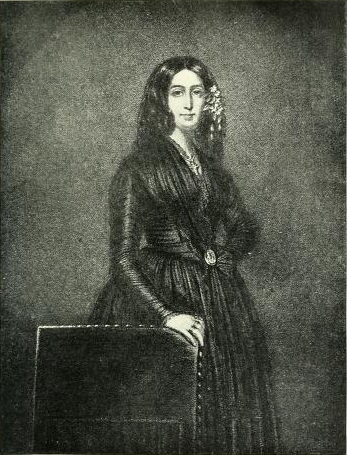
GEORGE SAND
The passage is part of a protest made by George Sand against the charge that it was her desire to flatter the lower classes by producing idealised representations of them—this explains how she came to give such pointed, dogmatic expression to the idealism of her nature. Most undoubtedly she was the idealist, all her life long; but it was not really the desire to delineate human beings as "they ought to be" which inspired her to write, but the desire to show what they could be if society did not hamper their spiritual growth, corrupt them, and destroy their happiness; hence, in her delineations of the representatives of "society" no leniency was shown. What George Sand originally meant to give was a picture of life as it is, of reality as she had experienced and observed it; what she gave was the feminine enthusiast's view of reality. The section she saw was a patch of earth with the brightness of heaven over it. Her clear-sightedness was the clear-sightedness of the poet.
The period was the period of enormous productivity. Victor Hugo, Balzac, Alexandre Dumas, wrote ceaselessly, piling work upon work. Dumas at last regularly manufactured books; he published four or five novels at a time, and with the help of numerous collaborators produced a good-sized shelf of volumes in a year. George Sand's productivity was almost as remarkable. Her works fill 110 closely printed volumes. I can make no attempt here to criticise them all. It is only of consequence that I should indicate the main features of the most important works, the ideas which permeate them, the results which remain even when the details of the books are forgotten.
The real life story lying behind the first group of George Sand's novels is familiar to every one. She was born in 1804; lost her father at an early age; had a foolish, passionate mother, and a wise, distinguished grandmother; grew up on the family property of Nohant in Berry, a regular country child, romping out of doors, loving nature and freedom, and mixing on equal terms with the children of the peasantry. Her tastes were the tastes of the people, but she was not the less romantic for that. As Chateaubriand in his early youth evolved for himself the image of an ideally charming woman, of whom he constantly dreamed, so George Sand's young imagination created a hero, to whom she built an altar of stone and moss in a corner of her garden, and whom she credited with all the wonderful deeds suggested by her fertile invention. At the age of thirteen she was sent to a convent school in Paris. At first she sadly missed the free country life; then she became for a time ardently religious; but even before she returned to Nohant this enthusiasm had been superseded by a lively interest in the stage and in political literature. In her country surroundings, the grown-up girl reads Rousseau for the first time, and is fascinated, as we all are, when our own nature is revealed to us. Henceforward, to her life's end, she is Rousseau's faithful disciple. His understanding and worship of nature, his faith in God, his belief in and love of equality, his defiant attitude towards so-called civilised society, appealed to all her instincts and, as it were, forestalled feelings that were slumbering in her soul. Shakespeare, Byron, and Chateaubriand also enrapture her; they cause her to feel solitary in her surroundings, and communicate to her that first, vague melancholy which in young, passionate, enthusiastic souls generally precedes the melancholy of real disappointment. In 1822 this girl, who, with her powerful intellect, her rich imagination, and her inability to live her life independently, would never have been satisfied with the companionship of one man, however noble his character and great his gifts, was married to a Monsieur Dudevant, a perfectly ordinary country gentleman, neither better nor worse than most of his kind. He was uncultivated and passionate, and quite incapable of understanding his wife; but it is evident that, even if he had been a much better husband, the ultimate consequences of the marriage would have been the same. Only the first three years were spent in peace and amity. By 1825, George Sand was beginning to look down upon her husband, and, with her natural craving for sympathetic understanding, to form friendships with other men, as a relief from what to her were the insulting and cruelly degrading conditions of her home life. Monsieur Dudevant, who was enough of the husband to be exasperated by intellectual independence in his wife, though he was far too insignificant a personage to be able to profit by that want of intellectual self-sufficiency which impelled her to seek a leader and guide, regarded even her most innocent interchange of sympathies with other men as a transgression of duty. Incessant conjugal friction and disputes at last put an end to all community of feeling. Even the two children who were the fruit of the marriage could not keep their parents together. In 1831 George Sand went to live in Paris alone.
The documents connected with the ensuing separation suit, as also George Sand's own letters, give us an adequate understanding of what her married life was. I have read in the Gazette des Tribunaux (30th July and 1st and 19th August 1836, and 28th June and 12th July 1837) the pleas advanced on both sides. They were horrible, disgraceful accusations which this great woman was obliged to hear from the lips of her husband's counsel. With her beautiful dark hair falling over a black velvet jacket, or else dressed, in the fashion of the day, in white, with a flowered shawl round her shoulders, George Sand sat and listened without a trace of emotion. Her husband accused her of having conceived and yielded to a criminal passion for another man within three years of her marriage. "Monsieur Dudevant soon discovered that he was being deceived by the woman he worshipped (!), but was magnanimous enough to forgive." The lawyer read a long letter from Madame Dudevant to her husband, in which she confessed, and reproached herself for, various faults, and attributed the misunderstanding between them to an incompatibility in their characters which by no means implied an absence of generosity and amiability on his part. This letter, Monsieur Dudevant's counsel most illogically argued, was equivalent to a confession of unfaithfulness on the lady's part. He went on to show how the couple had lived from 1825 to 1828 in voluntary separation, and how Madame Dudevant, even after she left her husband in 1831 to lead "the life of an artist," had carried on an amicable correspondence with him and accepted 300 francs (!) a year. (He did not mention that she had brought her husband a dowry of 500,000.) At the beginning of the year 1835 the couple had come to a private agreement each to take a child, to divide the fortune, and to allow each other full liberty of action; but before this agreement came into force George Sand had drawn back and sued for a judicial separation. (In the course of a dispute about their son, Monsieur Dudevant had tried to strike her, had even in the presence of witnesses taken up his gun to fire at her.) In spite of exaggerated accusations her application, the lawyer reminded the court, had been refused. Now it was Monsieur Dudevant's turn to complain. He denied all the charges brought against him, and brought others, of the gravest character, against his wife; he maintained that any woman who had written such immoral books as hers was unfit to educate her children; he accused her of intimacy with the secrets of "all the most shameful licentiousness." It was on account of these accusations, accusations which he, Monsieur Dudevant's counsel, asserted to be fully justified, that George Sand was once more suing for a separation. His eloquence reached its climax in the outburst: "It is, then, your opinion, Madame, that a woman has the right, if she chooses, to squander the half of a fortune, to embitter her husband's life, and to adopt, when she feels inclined to indulge still more freely in the most unbridled excesses, the convenient and simple plan of bringing against him in the court of justice a purely fictitious accusation of revolting conduct!"
It must have been hard for the proud woman to sit, the observed of all observers, listening to this besmirching of her name and fame. It cannot have afforded her much consolation that her counsel and friend, Michel de Bourges, immediately afterwards extolled her as a genius, and produced a profound impression by reading remarkably beautiful passages from her letters and recounting all the insulting words and brutal actions of which her husband had been guilty towards her. She was accustomed to see her novels reviled in the newspapers as so many shameless defences of immorality, but to hear her private life maligned in this style was a new experience. These public proceedings which terminated her married life, give us, however, as it were, a retrospective view of that life, and explain the indignation which finds its first expression in Indiana, Valentine, Lélia, and Jacques.
They are books, these, which possess little literary interest for the reader of to-day: the characters are vague idealisations; the plots are improbable, as in Indiana, or unreal, as in Lélia and Jacques_ the harmonious sonority of her style does not save the author from the reproach of frequent lapses into magniloquence; in the letters and monologues she is often the poetical sermoniser. And yet there is a fire in these works of George Sand's youth which gives light and warmth to this day; they struck a note which will go on sounding for ages. They emit both a wail and a war-cry, and where they penetrate they carry with them germs of feelings and thoughts, the growth of which this age has succeeded in checking, but which in the future will unfold and spread with a luxuriant vigour of which we can only form a faint conception.
Indiana is the young, full heart's first outburst of bitterness and woe. The youthful heroine is the embodiment of refined intellectality and noble-mindedness; her husband, Colonel Delmare, is a rather better-tempered Monsieur Dudevant; Indiana's affectionate, enthusiastic heart turns, wounded, from husband to lover. The originality of the book lies in its delineation of the latter's character. For to him even the husband is infinitely preferable. Raymon is the average young Frenchman under the restored Legitimist monarchy; he is what the society of the period has made him, emotional and calculating, love-sick and egotistical, influenced by public opinion and the verdict of society to such an extent that his hard-heartedness develops into heartlessness, his unreliability into worthlessness; his thorough mediocrity is at last plainly discernible through its glittering husk of brilliant qualities and talents. In this first work George Sand at once introduces us to several distinct types of male character. There is the man with the coarse nature, whom the power which society puts into his hands has made brutal, and the man with the weak nature, whom congenital irresolution and acquired submissiveness to the dictation of society have made unreliable and cowardly. Woman-like, she starts with a spirited exposure of man's egotism. But in this her first book she also at once presents us with her ideal man, in the person of the reserve lover, the apparently phlegmatic but really ardent Ralph, who, taciturn as George Sand herself, appears (like her) to the superficial observer stiff and cold, but is in reality the embodiment of self-sacrificing, noble, faithful love. This was a character she rang changes on for years. We find him in Lélia_in the noble and hardly tried Trenmor, the galley-slave who passes judgment on society with stoic calm; in Jacques he is the hero who with almost superhuman magnanimity commits suicide, that he may not stand in the way of his young wife's alliance with another; in Léone Léoni he is the quiet, manly Don Aleo, to the very last prepared to marry that unfortunate Juliette whom an almost magic fascination binds to the incredibly rascally Leone, a species of male Manon Lescaut. In Le Secrétaire Intime he is the modest German, Max, whose distinguishing qualities are naïve kind-heartedness and poetical enthusiasm, and who is secretly married to the princess whom every one worships; in Elle et Lui he is Palmer, the Englishman, the foil to the gifted and dissipated Parisian, Laurent; in Le Dernier Amour, he is called Sylvestre and is a weaker Jacques. All these figures have a fault which is not uncommon in ideals; they are bloodless. But the men of the Raymon type, the men who represent the world, the selfishness, the vanity, and the weaknesses of society, are much more successful creations. Raymon himself is much more real than the other characters in Indiana; the local colouring in his case is stronger, more definite. The authoress (in chapter x.) attributes his unmanliness to "the conciliatory and yielding tendency" of the age, which she calls the age "of mental reservations"; she shows how Raymon, who is the advocate of political moderation, imagines that because he is devoid of political passions he is also devoid of political self-interest, and therefore stands on a higher level than that of any party—the fact of the matter being, that the existing condition of society is too advantageous to him for him to wish it changed. He is "not so ungrateful to Providence as to reproach it with the misfortunes of others." The numerous successors of this character in George Sand's novels all bear witness to a penetrating and delicate observation of human nature, from Sténio, the poet in Lélia, and Octave, the lover in Jacques, slightly sketched, weak characters, mere playthings of passion, to the carefully drawn, distinctly characterised figures like the dissolute young Italian singer, Anzoleto, in Consuelo, the ultra-refined, morbidly nervous and self-centred Prince Karol (Chopin) in Lucrezia Floriani, and the extravagantly capricious young painter, Laurent (Alfred de Musset), in Elle et Lui.