V. THE ROMANTIC SCHOOL IN FRANCE
Mary Morison translation
THE MACMILLAN COMPANY
1904
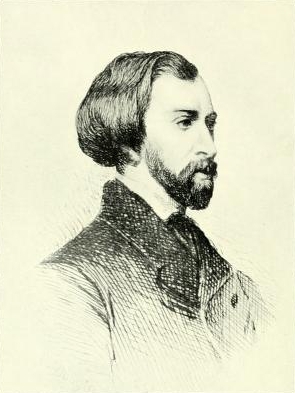
DE MUSSET
Dis-nous mil huit cent trente. Époque fulgurante, Ses luttes, ses ardeurs.... —TH. DE BANVILLE Nicht was lebendig, kraftvoll sich verkündigt Ist das gefährlich Furchtbare. Das ganz Gemeine ist's, das ewig Gestrige, Was immer war und immer wiederkehrt Und morgen gilt, weil's heute hat gegolten. —SCHILLER.
CONTENTS
I.THE POLITICAL BACKGROUND
II.THE GENERATION OF 1830
III.ROMANTICISM
IV.CHARLES NODIER
V.RETROSPECT—FOREIGN INFLUENCES
VI.RETROSPECT—INDIGENOUS SOURCES
VII.DE VIGNY'S POETRY AND HUGO'S "ORIENTALES"
VIII.HUGO AND DE MUSSET
IX.DE MUSSET AND GEORGE SAND
X.ALFRED DE MUSSET
XI.GEORGE SAND
XII.BALZAC
XIII.BALZAC
XIV.BALZAC
XV.BALZAC
XVI.BALZAC
XVII.BALZAC
XVIII.BEYLE
XIX.BEYLE
XX.BEYLE
XXI.MÉRIMÉE
XXII.BEYLE AND MÉRIMÉE
XXIII.MÉRIMÉE
XXXIV.MÉRIMÉE
XXV.MÉRIMÉE
XXVI.MÉRIMÉE AND GAUTIER
XXVII.THÉOPHILE GAUTIER
XXVIII.THÉOPHILE GAUTIER
XXIX.SAINTE-BEUVE
XXX.SAINTE-BEUVE
XXXI.SAINTE-BEUVE AND MODERN CRITICISM
XXXII.THE DRAMA: VITET, DUMAS, DE VIGNY, HUGO
XXXIII.LITERATURE IN ITS RELATION TO THE SOCIAL AND POLITICAL MOVEMENTS OF THE DAY
XXXIV.THE OVERLOOKED AND FORGOTTEN
XXXV.CONCLUSION
LIST OF PORTRAITS DE MUSSET GEORGE SAND BALZAC HENRY BEYLE (STENDHAL) MÉRIMÉE THÉOPHILE GAUTIER SAINTE-BEUVE
I
THE POLITICAL BACKGROUND
The literature produced in France between the years 1824 and 1828 is important and admirable. After the upheavals of the Revolution, the wars of the Empire, and the lassitude of the reign of Louis XVIII., there arose a young generation that applied itself with eager enthusiasm to those highest intellectual pursuits which had so long been neglected. During the Revolution and the wars of Napoleon the youths of France had had other vocations than the reformation of literature and art. The best energies of the nation had been diverted into the channels of politics, military enterprise, and civil administration. Now a great volume of intellectual force which had long been confined was suddenly set free.
The period of the restored Bourbon kings and the Monarchy of July may be defined as that of the decisive appearance of the bourgeoisie on the historical stage. With the fall of Napoleon the industrial period of history begins. Confining our attention to France, we observe that the new division of the national property which had been made during the Revolution, and which it had been Napoleon's economic mission to vindicate to the rest of Europe, now began to produce its natural consequences. All restrictions had been removed from industry and commerce; monopolies and privileges had been abolished; the confiscated lands of the Church and estates of the nobility, broken up and sold to the highest bidder, were now in the hands of at least twenty times as many owners as before. The result was that capital, free, floating capital, now began to be the moving power of society and consequently the object of the desires of the individual. After the Revolution of July the power of wealth gradually supersedes the power of birth and takes the power of royalty into its service. The rich man is received into the ranks of the nobility, acquires the privileges of a peer, and, by utilising the constitution, manages to draw ever-increasing profit from the monarchical form of government. Thus the pursuit of money, the struggle for money, the employment of money in great commercial and industrial enterprises, becomes the leading social feature of the period; and this prosaic engrossment, which contrasts so strongly with the revolutionary and martial enthusiasm of the foregoing period, helps, as background, to give the literature of the day its romantic, idealistic stamp. One only of its eminent authors, one of the greatest, Balzac, did not feel himself repelled by the period, but made the newborn power of capital, the new ruler of souls, money, the hero of his great epic; the other artists of the day, though it was often the prospect of material gain which inspired their labours, kept in their enthusiasms and their works at as great a distance as possible from the new reality.
The decade 1825-35, the most remarkable and most fertile period from the literary point of view, was from the political, colourless and inglorious. Its focus is the Revolution of July, but this Revolution is a solitary blood-spot amidst all the grey.
The first half of the decade, 1825-30, the reign of Charles X., is the period of the religious reaction. The three ministries—Villèle, Martignac, and Polignac—do not mark so much three stages of the reaction as three different tempos: Allegro, Andante, and Allegro furioso. During the Villèle ministry the Jesuits attained to almost unlimited power. The monasteries were restored; laws of mediæval severity regarding sacrilege were enforced (death, for example, being the punishment for the robbery of a church); aid was refused to all poor people who could not produce certificates of confession; and in 1827 a law circumscribing the liberty of the press was proposed which would have reduced the enemies of the Church to silence; but this proposal the Government was obliged to retract, owing to the opposition of the Chamber of Peers. The citizen troops were disbanded, the censorship was restored; then the ministry was defeated by a majority in the Chambers, and resigned in January 1828. The cabinet of uncompromising churchmen was followed by one which pursued the policy of concession; the Martignac ministry made a feeble endeavour to stem the power of the Jesuits, but the only result of this was that the King seized the opportunity of the first reverse the Government suffered in the Chambers, to dismiss it and replace it by a ministry whose leader, Polignac, previously ambassador to the court of England, was a man after his own heart. Polignac believed in the monarchy as God's shadow upon earth; believed (and was confirmed by visions in his belief) that he had received from God the mission to restore it to its ancient glory. But his Government was so unpopular that its one military achievement, the conquest of Algiers, was coldly received by the country and openly regretted by the strong Opposition. The dissolution of the Chambers led, in spite of the pastoral letters of the bishops and the personal interference of the King, to the re-election of the Opposition, and on this followed the coup d'état. There were three days of fighting, and the ministry was swept away by the wave of popular feeling which carried with it the throne and the house of Bourbon.
But although the first half of the decade was, politically speaking, a period of reaction, it presents a very different aspect when regarded from the social and intellectual point of view. In the first place, the oppression itself produced the desire for freedom. The bourgeoisie and the professional classes, who finally, with the aid of the populace of the capital and the students, dethroned the house of Bourbon, were during the whole period in a state of increasing discontent and opposition. One of the consequences of this was that literature, which at first was as fully inspired as politics with the spirit of reaction against the doctrines and doings of the close of the eighteenth century, and which started with any amount of enthusiasm for Catholicism, monarchy, and the Middle Ages, completely changed its tone. Chateaubriand's dismissal from the Villèle ministry gave the signal (see Main Currents, iii. 293). In the second place, it is to be observed that the intellectual life of those highest circles of society which prescribed the tone and style of literature, was only outwardly in sympathy with the political reaction. Regarded from one point of view, the Restoration was an aftermath of the eighteenth century in the nineteenth, of the age of humanity in the age of industry. From the powdered court emanated courtly manners and customs, from the salons of the old nobility emanated the free-thought on moral and religious subjects in which the eighteenth century had gloried. One of the strong points of that national tradition which these highest circles defended and endeavoured to continue, was the recognition of talent in every shape; they envisaged literature and art with many-sided culture and wide sympathy. A tolerant, sceptical spirit in religious matters, genial unrestraint and delicate forbearance in the domain of morality, was, so to speak, the atmosphere inhaled and exhaled by good society; and no atmosphere could be more favourable and more fructifying for a literature in active process of growth. As the oppression of the reaction begot liberalism in politics, so the culture of the best society allowed unpolitical literature free play both in the domain of feeling and that of thought, demanding nothing but refinement and perfection of form. Hence literature was in a most favourable position to give the reins, to give a start, to a new intellectual movement.
The July dynasty was founded, the tri-coloured citizen-monarchy was established, Louis Philippe was stealthily elevated to the throne of France, holding the difficult position of king by the grace of the Revolution.
The pregnant characteristics of his government revealed themselves during the first five years of his reign. There was, in the first place, that want of a decided, dignified foreign policy inevitable in a monarchy that was supported exclusively by the prosperous middle classes. The cautious, peace-loving King brought one humiliation after another upon France. For the sake of the peace of nations, he refused the throne offered by the Belgians to his second son, and with the same motive he quietly allowed Austria to suppress the Italian revolutions, which the French nation correctly regarded as the offspring of the Revolution of July. He was incapable of preventing the suppression of the Polish insurrection and the surrender of Warsaw, which occasioned real national mourning in France. The country, as one of the great powers, lost daily in prestige and influence. And in its internal relations the Government displayed an equal want of dignity. The constant demands for money which were made by the royal family and almost invariably refused by the Chambers produced a most disagreeable impression.
For a short time Louis Philippe was popular, popular as the soldier of Valmy and Gemappes, as the citizen King, the former exile and schoolmaster, whom Lafayette himself had called "the best republic." But he had not the faculty of preserving popularity, though he made an eager bid for it to begin with. He was a gifted and, essentially, a prudent man. His family life was admirable; he was thoroughly domestic, and regular in his habits; his sons attended the public schools; he himself, in the attire of an ordinary citizen, carrying the historical umbrella, walked unattended in the streets of Paris, always ready to return a bow or a "Vive le Roi!" with a friendly word or a shake of the hand. But the bourgeois virtues which he displayed are not those which Frenchmen value in their rulers. The cry: "We want rulers who ride," shouted at gouty Louis XVIII., describes one of the feelings which led to the dethronement of Louis Philippe.
For when Louis Philippe did ride, the spectacle was anything but an inspiring one. In June 1832, after one of the innumerable small insurrections in Paris, he declared the city to be in a state of siege, and on this occasion held a review of 50,000 citizen troops and regular soldiers, who were drawn up on each side of the boulevard. The King did not ride along the middle of the street, but first along the right side, where the citizen soldiers were stationed, leaning from his saddle the whole time to shake hands with as many of them as possible, and two hours later back in the same way along the line of the regular troops. He looked as if his ribs must inevitably be broken. He kept on smiling the whole time; his cocked hat slipped down over his forehead and gave him an unhappy look; his eyes wore a beseeching expression, as if he were entreating favour, and also forgiveness for having declared them all to be in a state of siege. What a spectacle for an impressionable, imaginative people, for a crowd of which the older members had seen Napoleon Bonaparte ride past "with his statuesque, Cæsar-like countenance, his fixed gaze, and his inapproachable ruler's hands."[1]
In spite of the King's eager endeavour to win popularity, there was a wider gulf between his court and the people than there had been between the people and the paternal monarchy of the Restoration. The old nobility kept away from the new court, and there was a more distinct separation of class from class. With enmity and disgust the landed proprietors saw the magnates of the stock-exchange usurping all power. Legitimists and the superior bourgeois class, politicians and artists, ceased to associate. One by one the salons of the old monarchy were closed, and with them disappeared the gaiety and naturalness of the refined beau monde. With the old form of government vanished its accompaniments of magnificent elegance and graceful frivolity, vanished the fine lady's lively wit and charming audacity. In the circle of the wealthy bankers whom the King patronised and the Crown Prince associated with before his marriage, the place of all this was taken by English sport and club fashions, a vulgar addiction to the pleasures of the table, and tasteless magnificence and luxury. The King was originally a Voltairian, and in his family alliances he had shown a leaning to Protestantism, but in his anxiety for the safety of his throne he made a hasty change of front; he humbled himself (in vain, as it proved) to win the favour of the clergy, and the tone of the court became pious. The upper middle classes simultaneously developed a half-anxious, half-affected piety, originating in fear of the Fourth Estate. Hypocrisy, which the aristocratic reactionary literature had fostered, now began to spread into the bourgeois class, and free-thought was considered "bad form" in a woman. Morals became outwardly stricter; a more English tone prevailed; but in reality men were less moral; society was lenient to the fraud of the millionaire, pharisaically severe to the woman whose heart had led her astray. "The previous generation had not," as one of the historians of the day observes, "placed under the ban of society either the priest who forsook his church or the woman who forsook her husband, so long as their motives were unselfish; now it was the sign of mauvais ton to desire the re-institution of divorce, not to mention the marriage of priests." The Faubourg St. Honoré, the quarter of the financiers, set the tone.
Little wonder that the umbrella soon became the symbol of this monarchy, and the expression Juste-milieu—which the King had once cleverly used in speaking of the policy that ought to be employed—the nickname for everything weak and inefficient, for a power without lustre and dignity.
If we take the decade 1825-35 as a whole, it is easy to understand how hopeless it must have seemed from the aesthetic point of view.
II
THE GENERATION OF 1830
It is against this grey background, this foil of Legitimist cowls and Louis-Philippe umbrellas—in this society where the new-born power of capital, strong as Hercules, has, even in its cradle, strangled all the external romance of life—on this stage upon the grey walls of which an invisible finger has written in grey letters the word Juste-milieu—that a fiery, glowing, noisy literature, a literature enamoured of scarlet and of passion, suddenly makes its appearance. All the conditions were present in combination which were certain to impel young, restless minds towards romantic enthusiasm, towards ardent contempt for public opinion, towards worship of unbridled passion and unrestrained genius. Hatred of the bourgeoisie (as in Germany a generation earlier hatred of the Philistines) becomes the watchword of the day. But whereas the word "Philistine" conjures up a picture of the chimney-corner and the pipe, the word "bourgeois" at once suggests the omnipotence of economic interests. Its essential antipathy to utilitarianism and plutocracy turned the intellectual current of the day, in the case of the men of talent already before the public, and still more strongly in the case of the budding geniuses, in the direction of antagonism to everything existing and accepted, at the same time mightily increasing the force of the current. The religion of art, and enthusiasm for liberty in art, suddenly took possession of all hearts. Art was the highest, art was light, art was fire, art was all in all; its beauty and audacity alone imparted value to life.
The young generation had heard in their childhood of the great events of the Revolution, had known the Empire, and were the sons of heroes or of victims. Their mothers had conceived them between two battles, and the thunder of cannon had ushered them into the world. To the young poets and artists of the day there were only two kinds of human beings, the flaming and the grey. On the one side there was the art which meant blood, scarlet, movement, audacity; on the other, a strictly regular, timid, bourgeois, colourless art. Everything in the life of their day seemed to them unpoetic, utilitarian, devoid of genius, grey; they desired to show their contempt for such a day, their admiration of genius, and their hatred of the bourgeois spirit. For now, since the middle-class had become the influential one, this spirit had become a power.
Seen from the point of view of our own day, the young men of those days appear to have been younger than youth generally is—younger, fresher, more richly gifted, more ardent and hot-blooded. And we see the youth of France, who in the days of the Revolution had by their devotion changed the political and social conditions of the country, and in the days of the Empire had risked their lives on every battlefield in France, Italy, Germany, Russia, and Egypt, now devoting themselves with the same ardour to the culture of literature and the arts. Here, too, there were revolutions to be made, victories to win, and countries to conquer. During the Revolution they had worshipped liberty, under Napoleon martial glory; now they worshipped art.
For the first time in France the word art came to be regularly applied to literature. In the eighteenth century literature had aimed at transforming itself into philosophy, and much was then included under this denomination to which we no longer apply the word; now it aimed at the name and dignity of art.
The explanation of the change is, that the analytical and reasoning tendency which distinguishes both the imaginative and reflective works of the classical period, had in the new century slowly made way for interest in the actually existing, in what is perceivable by the senses. And the deeper-lying reason of this new preference was that men now placed nature, original, unconscious, rustic, uncultivated nature, above all the culture of civilisation. Why? Because a historically minded age had succeeded to a rationalising one. A man no longer coveted the title of philosopher, for it was now considered a greater distinction to be original than to be a self-conscious thinker. The poetical literature of the eighteenth, nay, even that of the seventeenth century was despised, because it was purely intellectual; because, bloodless and elegant, it seemed to have been produced by attention to conventions and rules, not to have been born and to have grown. For whereas the eighteenth century had held thinking and acting to be the highest forms of activity, the children of the new age regarded origination, natural genesis, as the highest. It was a German idea, Herder's and Goethe's, by which men's minds were unconsciously occupied, and which produced in them an aversion for rules and academic principles. For how could art as unconscious, natural production be subjected to arbitrary external rules!
An intellectual movement had begun which recalled the Renaissance. It was as if the air which men breathed intoxicated them. In the long period during which France had been at an intellectual standstill her great neighbours, Germany and England, had hastened past her, had got a long start in the work of emancipation from old, hampering traditions. She felt this, felt it as a humiliation, and the feeling gave a sharp impulse to the new art enthusiasm. And now the works of foreign authors, both the new and the hitherto unknown older books, made their way into the country and revolutionised the minds of the young; every one read translations of Sir Walter Scott's novels, of Byron's Corsair and Lara, and devoured Goethe's Werther and Hoffmann's fantastic tales. All at once the votaries of the different arts felt that they were brothers. Musicians studied the literature both of their own country and of other nations; poets (such as Hugo, Gautier, Mérimée, Borel) drew and painted. Poems were read in painters' and sculptors' studios; Delacroix's and Devéria's pupils hummed Hugo's ballads as they stood at their easels. Certain of the great foreign authors, such as Scott and Byron, influenced poets (Hugo, Lamartine, Musset), musicians (Berlioz, Halévy, Félicien David), and painters (Delacroix, Delaroche, Scheffer). Artists attempt to overstep the limits of their own in order to embrace a kindred art. Berlioz writes Childe Harold and Faust symphonies, Félicien David a Desert symphony; music becomes descriptive. First Delacroix and then Ary Scheffer choose subjects from Dante, Shakespeare, and Byron; the art of the painter at times becomes illustration of poetry. But it was the art of painting which was most powerful in influencing the sister arts, especially poetry, and that distinctly for good. The lover no longer, as in the days of Racine, prayed his mistress "to crown his flame." The public demanded naturalness of the author, and refused to accept representations of impossibilities.
In 1824 Delacroix exhibits his Massacre of Scios, a picture with a Grecian subject and a reminiscence of Byron, in 1831 The Bishop of Liège, which illustrates Scott's Quentin Durward, in May 1831 Liberty at the Barricades. In February 1829, Auber's opera, La Muette de Portici, makes a great sensation; Meyerbeer's Robert le Diable follows in 1831. In February 1830 Victor Hugo's Hernani is played for the first time at the Théâtre Français; in 1831 Dumas' Antony is a grand success. The authors Dumas and Hugo, Delacroix the painter, the sculptor David d'Angers, the musical composers Berlioz and Auber, the critics Sainte-Beuve and Gautier, Frédéric Lemaître and Marie Dorval the scenic artists, and, corresponding to them, the two great dæmonic musical virtuosi Chopin and Liszt—all these make their appearance simultaneously. One and all proclaim the gospel of nature and of passion, and around them assemble groups of young men who apprehend and cultivate literature and art in a spirit akin to theirs.
These men did not always realise that in the eyes of posterity they would constitute a natural group. Some of the greatest of them felt as if they stood alone, and believed that the spirit and tendency of their work was different from that of their contemporaries', nay, actually antagonistic to it. Nor were they entirely wrong, for there are very essential points of difference between them. Yet common excellences, common prejudices, common aims, and common faults unite them and make of them a whole. And it happened much more frequently than is generally the case, that those whom reflection inclines us to class together actually did feel themselves drawn to each other; many of the best among them early joined hands and formed a league.
Seeking the connecting links we find, as it were, a chain which binds the group together.
When, after the lapse of many years, we dryly say or write the words, "they formed a school," we seldom take the trouble to conjure up any adequately vivid impression of what the formation of a school of literature and art signifies. There is a mysterious magic about the process. Some one remarkable man, after a long unconscious or half-conscious struggle, finally with full consciousness, frees himself from prejudices and attains to clearness of vision; then, everything being ready, the lightning of genius illuminates what he beholds. Such a man gives utterance (as did Hugo in a prose preface of some score of pages) to some thoughts which have never been thought or expressed in the same manner before. They may be only half true, they may be vague, but they have this remarkable quality that, in spite of more or less indefiniteness, they affront all traditional prejudices and wound the vanity of the day where it is most vulnerable, whilst they ring in the ears of the young generation like a call, like a new, audacious watchword.
What happens? Scarcely are these words spoken than there comes with the speed and precision of an echo a thousand-tongued answer from the wounded vanities and injured interests, an answer like the furious baying of a hundred packs of hounds. And what more? First one man, then another, then a third, comes to the spokesman of the new tendency, each with his own standpoint, each with his revolt, his ambition, his need, his hope, his resolve. They show him that the words he has spoken are incarnated in them. Some communicate directly with him, some with each other in his spirit and his name. Men who but lately were as unknown to each other as they still are to the public, who have been spiritually languishing, each in his separate seclusion, now meet and marvel to find that they understand each other, that they speak the same language, a language unknown to the rest of their contemporaries. They are young, yet all are already in possession of what to them constitutes life; the one has his dearly-bought joys, the other his bracing sufferings; and from these life-elements each has extracted his own portion of enthusiasm. Their meeting is electric; they exchange ideas with youthful haste, impart to each other their various sympathies and antipathies, enthusiasms and detestations; and all these well-springs of feeling flow together like the streams that form a river.
But the most beautiful feature in this crystallisation of artistic spirits into a school is the reverence, the awe which, in spite of the unanimity of their opinions, and in spite of their good comradeship, each feels for the other. Outsiders are apt to confuse this with what is satirically called "mutual admiration." But nothing is in reality more unlike the interested homage paid in periods of decadence than the naïve admiration of each other's talents exhibited by the men who are unconsciously forming a school. Their hearts are too young, too pure, not to admire in real earnest. One young productive mind regards the other as something marvellous, which holds surprises in store. To the one the workshop of the other's mind is like a sealed book; he cannot guess what will next appear from it, has no idea what pleasures his comrade has in store for him. They honour in one another something which they value higher than the personality, than the usually as yet undeveloped character, namely, the talent by virtue of which they are all related to the deity they worship—art.
Seldom, however, in the world's history has the mutual admiration accompanying an artistic awakening been carried to such a pitch as it was by the generation of 1830. It became positive idolatry. All the literary productions of the period show that the youth of the day were intoxicated with the feeling of friendship and brotherhood. Hugo's poems to Lamartine, Louis Boulanger, Sainte-Beuve, and David d'Angers; Gautier's to Hugo, Jehan du Seigneur, and Petrus Borel; De Musset's to Lamartine, Sainte-Beuve, and Nodier; and, very specially, Sainte-Beuve's to all the standard-bearers of the school; Madame de Girardin's articles; Balzac's dedications; George Sand's Lettres d'un Voyageur—all these testify to a sincere, ardent admiration, which entirely precluded the proverbial jealousy of authors.
They did not only praise one another, they communicated ideas to each other and helped each other. Now it is an inspiring influence, now an artistic criticism, now some actual service rendered, which knits the bond of friendship between two authors of this period. Émile Deschamps inspires Victor Hugo to borrow themes from the old Spanish Romancero; Gautier writes the beautiful tulip sonnet in Balzac's Un grand Homme de Province a Paris, and helps him to dramatise certain of his plots; Sainte-Beuve reads George Sand's manuscripts and aids her with his criticism; George Sand and De Musset influence one another powerfully at a certain stage of their career; Madame de Girardin, Méry, Sandeau, and Gautier collaborate in a novel written in letters; Mérimée is the bond of union between the realists Beyle and Vitet and the romanticists.
The short period during which all meet and combine is the blossoming time of literature. Before many years pass Nodier is in his grave, Hugo is living in exile in Jersey, Alexandre Dumas is turning literature into a trade, Sainte-Beuve and Gautier are to be found in Princess Mathilde's circle, Mérimée is presiding over the Empress Eugenie's courts of love, De Musset sits solitary over his absinthe, and George Sand has retired to Nohant.
One and all in their riper years made new connections, connections which aided their development; but their boldest and freshest, if not always their most refined and beautiful work was done at the time when they were holding their first meetings in Charles Nodier's quarters at the Arsenal, or in the apartments in the Rue Notre-Dame-des-Champs where Hugo and his pretty young wife kept house on their 2000 francs a year, or in Petrus Borel's garret, where the host's Hernani cloak decorated the wall in company with a sketch by Devéria and a copy of a Giorgione, and where, owing to lack of chairs, at least half of the company had to stand.
These young Romanticists felt like brothers, like fellow-conspirators; they felt that they were the sharers in a sweet and invigorating secret; and this gave to the works of the school a flavour, an aroma like that of the noble wines of a year when the vintage has been more than ordinarily good. Ah! that bouquet of 1830! There is no other in the century that can be compared with it.
In all the arts a break with tradition was aimed at and demanded. The inward fire was to glow through and dissolve the old musical forms, to devour lines and contours and transform painting into colour symphonies, to rejuvenate literature. In all the arts colour, passion, and style were aimed at and demanded—colour with such urgency that the most gifted painter of the period, Delacroix, neglected drawing for it; passion with such ardour that both lyric poetry and the drama were in danger of degenerating into hysteric foolishness; style with such artistic enthusiasm that some of the younger men, such as those two opposite poles, Mérimée and Gautier, neglected the human groundwork of their art and became devotees of style pure and simple.
The original, the unconscious, the popular was sought after and demanded. "We have been rhetoricians," men cried; "we have never understood the simple and the illogical—the savage, the people, the child, woman, the poet!"
Hitherto the people had only served as a background in literature—in Victor Hugo's dramas the passionate plebeian, the avenger and requiter, appeared on the scene as the hero. Hitherto the savage had talked like a Frenchman of the eighteenth century (Montesquieu, Voltaire)—Mérimée in Colomba and Carmen depicted savage emotions in all their wildness and freshness. Racine's child (in Athalie) had spoken like a miniature edition of a grown-up man—Nodier with a childlike heart put simple, innocent words into his children's mouths. In the French literature of an earlier period, woman had generally acted with full consciousness, arriving at conclusions like a man; see the works of Corneille, Racine, and Voltaire. Corneille paid homage to virtue, Crébillon the younger to frivolity and vice, but both the virtue and the vice were conscious and acquired. George Sand, on the contrary, depicted the innate nobility and natural goodness of a noble woman's heart. Madame de Staël in her Corinne had represented the gifted woman as a being of great and commanding talent—George Sand, in Lélia, represented her as a great sibyl. In olden days the poet had been a courtier, like Racine and Molière, or a man of the world, like Voltaire and Beaumarchais, or simply an ordinary decent citizen, like Lafontaine. Now he became the neglected step-child of society, the high-priest of humanity, often poor and despised, but with the starry brow and the tongue of fire. Hugo hymned him as the shepherd of the people, Alfred de Vigny represented him in Stello and Chatterton as the sublime child who prefers dying of hunger to degrading his muse by common work, and dies blessing his fellow-men, who acknowledge his worth when it is too late.
III
ROMANTICISM
At first Romanticism was, in its essence, merely a spirited defence of localisation in literature. The Romanticists admired and glorified the Middle Ages, which the culture of the eighteenth century had anathematised, and the poets of the sixteenth century—Ronsard, Du Bellay, &c.—who had been supplanted by the classic authors of the age of Louis XIV. They attacked pseudo-classicism, the tiresome and monotonous Frenchifying and modernising of all ages and nationalities. They took as their watchword "local colouring." By local colouring they meant all the characteristics of foreign nations, of far-off days, of unfamiliar climes, to which as yet justice had not been done in French literature. They felt that their predecessors had been led astray by the premise that every human being was simply a human being, and, moreover, more or less of a Frenchman. In reality, there was not such a thing as universal humanity; there were separate races, peoples, tribes, and clans. Still less was the Frenchman the typical human being. It was imperative, if they were to understand and represent human life, that they should free themselves from themselves. This idea gave the impulse to the art and criticism of nineteenth-century France.
Authors now made it their endeavour to train their readers to see things from this new point of view. They no longer wrote to please the public—and it is this fact which gives value to the books of the period. Therefore a critic who, like myself, is engaged in tracing the main currents of literature, must dwell upon many a seldom read and still more rarely bought Romantic work, and do little more than mention such a talented dramatist as Scribe, who for a whole generation dominated the stage in every country in Europe.
For if an author does not penetrate to the essential in the human soul, to its deepest depth; if he has not dared, or has not been able to write his book regardless of consequences; if he has not ventured to represent his ideas in statuesque nakedness, has not imaged human nature as it showed itself to him, improving nothing and modifying nothing, but has taken counsel with his public, been guided by its prejudices, its ignorance, its untruthfulness, its vulgar or sentimental taste—he may have been, probably has been, highly distinguished by his contemporaries, he may have won laurels and wealth by his talents; for me he does not exist, to what I call literature his work is valueless. All the offspring of the author's mariage de convenance with that doubtful character, public opinion, all those literary children which their author begets, giving a side-thought to the taste and morality of his public, are defunct a generation later. There was no real life and heat in them, nothing but timorous regard for a public which is now dead; they were nothing but the supply of a demand which has long ceased to exist. But every work in which an independent writer has, without any side-thought, uttered what he felt and described what he saw, is, and will continue to be, no matter how few editions of it may be printed, a valuable document.
There is only a seeming contradiction between this condemnation of the literary work produced to please the public, and the doctrine of the sound natural influence of society on the author. It is certain that the author cannot separate himself from his age. But the current of the age is not an undivided current; there is an upper and an under one. To let one's self drive with or be driven by the upper one is weakness, and ends in destruction. In other words, every age has its dominant and favourite ideas and forms, which are simply the results of the life of former ages, that were arrived at long ago and have slowly petrified; but besides these it owns another whole class of quite different ideas, which have not yet taken shape, but are in the air, and are apprehended by the greatest men of the age as the results which must now be arrived at. These last are the ideas which form the unifying element of the new endeavour.
In 1827 an English theatrical company visited Paris, and for the first time Frenchmen saw Shakespeare's masterpieces, King Lear, Macbeth, Othello, and Hamlet, admirably played. It was under the influence of these performances that Victor Hugo wrote that preface to Cromwell which is regarded as the programme of the new literature.
The literary war of liberation began with an assault upon French classical tragedy, the weakest and most exposed point in literary tradition. Hugo knew very little about the attacks upon its authority which had been made in other countries; and to those who have read the utterances delivered on the same subject many years previously by Lessing, Wilhelm Schlegel, and the English Romantic writers, his manifesto offers little that is new. But it was, of course, an important step to carry the war into France itself. The vigorous arguments expended in proving the unnaturalness of compressing the action of every drama into twenty-four hours and a single pillared hall, seem to the reader of to-day almost as uninteresting as the absurdities attacked; but he must remember that Boileau's authority was then still supreme, still unshaken in France.
Of interest as regards Hugo's own development are the passages in which he expounds his private theory of poetry; although he is so much of the poet and so little of the thinker that his arguments are, as a rule, sadly inconclusive.
What he attacks is the idealistic, pseudo-classic tendency of tragedy. This he does, oddly enough, in the name of Christianity, and by means of a great historical survey, made on as false a system as any of those of his contemporary, Cousin, of whom it reminds us. He distinguishes three great periods—the primitive, when poetry is lyric; the period of ancient civilisation, when it is epic; and the age of Christianity, which is the period of the drama. The peculiar characteristic of the poetry of the Christian, which he treats as synonymous with the modern, period is that it (having learned from religion that man consists of two elements, an animal and a spiritual, body and soul) makes place in the same work for the two elements which in literature have hitherto excluded each other, the sublime and the grotesque. It is no longer imperative that tragedy should be solemn throughout; it may venture to develop into drama.
If we pay less heed to what Hugo says than to what he really intends to say, we find that the sum and substance of this tolerably foolish argument is a naturalistic protest against pure beauty as the proper or highest subject of art. His idea is: We will renounce convention; we will not feel ourselves in duty bound to exclude everything from serious poetry which directly reminds us of the material world. We see this from the examples he gives. The judge is to be allowed to say: "Sentenced to death. And now let us dine." Queen Elizabeth is to be allowed to swear and speak Latin; Cromwell to say: "I have the Parliament in my bag and the King in my pocket." Cæsar in his triumphal car may be afraid of its upsetting. And Hugo calls Napoleon's exclamation: "There is only one step from the sublime to the ridiculous," the cry of anguish which is the summary of both drama and life.
Exaggerated as Hugo's language may be, his meaning is plain. What he asserts is the aesthetic value of the ugly. He maintains that the beautiful only comprehends form as absolute symmetry, form in its simplest relations and most intimate harmony with our being, whereas the ugly is a detail in a much greater, harmonious whole which we are unable fully to discern. He declares that the ugly has a thousand types, whereas the beautiful is poor, and has but one; which last theory we may be excused for calling one of the most absurd ever advanced by a poet. It was parodied by his opponents in the axiom: Le Laid c'est le Beau ("Foul is fair," as the witches sing in Macbeth), and combated with the objections which the Romanticists themselves offered in the Seventies to extreme realism.
Was not this French Romanticism, then, after all simply a thinly-veiled naturalism? What did Victor Hugo demand in the name of the young generation but nature—faithful reproduction, local and historical colour? Is not George Sand Rousseau's daughter? the preacher of a gospel of nature? And Beyle and Mérimée, are they not half-brutal, half-refined worshippers of nature? Is not Balzac nowadays actually honoured as the founder of a naturalistic school?
The answer is simple. Hugo's watchword was, undoubtedly, nature and truth, but it was at the same time, and first and foremost, contrast, picturesque contrast, antithesis founded upon the medieval belief in the confliction between body and soul; that is, a dualistic Romanticism. "The salamander heightens the charm of the water-nymph, the gnome lends beauty to the sylph," he says. He desired truth to nature, but he believed it was to be arrived at by making nature's extremes meet, by placing opposites in juxtaposition—Beauty and the Beast, Esmeralda and Quasimodo, the courtesan's past and the purest love in Marion Delorme, bloodthirstiness and maternal tenderness in Lucrèce Borgia.
In his early youth nature was to Victor Hugo a great Ariel-Caliban, the product of a superhuman ideality and an unnatural bestiality, the result obtained by the combination of two supernatural ingredients. But this conception of nature, which corresponded exactly with that of Germanic Romanticism, at times made way in Hugo's case for the magnificent pantheism which found typical expression in that profound and beautiful poem, "Le Satyre," in La Légende des Siècles.
The combination of love of nature with predilection for the unnatural, is to be traced far on into the new literature. All its authors chant the praises of nature. But what they detest and shun under the name of the prosaic and the commonplace is very often the simple nature that lies nearest them. Romantic nature alone is dear to them. George Sand escapes from the world of dreary, hard realities into that of beautiful dreams, Théophile Gautier into the world of art. George Sand in Lelia, Balzac in Père Goriot, make the ideal or the omnipotent galley-slave the judge of society; Balzac actually writes fantastic legends in Hoffmann's style. And they are even more inclined to shun the plain and simple in their language than in their characters. They soon evolved a pompous diction, which far outrivalled that of the classic periods. These were the golden days of the glowing, dazzling adjective. Picturesque, enthusiastic words, with which the narrative was inlaid as with so many transparent jewels, opened up endless vistas. In so far, therefore, it may be said that both the style and the predilections of these young authors were purely romantic. But only in so far.
In Victor Hugo, the founder of the school, the dual love of the natural and the unnatural was the result of a personal peculiarity. His eye naturally sought and found contrasts; his mind had an innate tendency towards antithesis. In Inez de Castro, the melodrama of his earliest youth, and later in Marie Tudor, we have the throne on one side of the stage, the scaffold on the other, the monarch and the executioner face to face. About the time when the preface to Cromwell was written, Hugo was, his wife tells us, in the habit of walking on the Boulevard Montparnasse. "There, just opposite the Cemetery, tight-rope dancers and jugglers had erected their booths. This contrast of shows and funerals confirmed him in his idea of a drama in which extremes meet; and it was there that the third act of Marion Delorme occurred to him, the act in which the tragic, fruitless attempt of the Marquis de Nangis to save his brother from the scaffold forms the counterpart to the antics of the jester." In the preface to Cromwell, when he is asserting the necessity of representing an action in the place where it actually happened, he writes: "Could the poet dare to have Rizzio murdered anywhere but in Mary Stuart's chamber? ... or to behead Charles I. or Louis XVI. anywhere but on these sorrowful spots within sight of Whitehall and the Tuileries, which seem as if they had been chosen in order that the scaffold might contrast with the palace?" In spite of all his asseverations this poet does not really see natural environments with an understanding eye. He does not see them act as formative influences upon the human soul; he employs them as great symbols of the tremendous reverses of fate; he arranges them like the stage scenery of a melodrama.
If we look deeper, what reveals itself to us in this? A characteristic which is to a certain extent distinctive of many of the French Romanticists, and which may be most briefly expressed thus: French Romanticism, in spite of all the elements it has in common with general European Romanticism, is in many ways a classic phenomenon, a product of classic French rhetoric.
Words undergo strange vicissitudes in this world of ours. When the word romantic was introduced into Germany it signified almost the same as Romanesque; it meant Romanesque flourishes and conceits, sonnets and canzonets; the Romanticists were enthusiastic admirers of the Roman Catholic Church and of the great Romanesque poet Calderon, whose works they discovered and translated and lauded. When, a century later, Romanticism reached France, the same word meant exactly the opposite thing—it meant the German-English tendency as opposed to the Greco-Latin Romanesque tendency; it meant Teutonic. The simple explanation of this is, that whatever is strange and foreign produces a romantic impression. The art and literature of a people of a homogeneous civilisation and culture, like the ancient Greeks, are classic; but when one civilised, cultured nation discovers another civilisation and culture which seem to it strange and wonderful, it is at once impressed by it as romantic, is affected by it as by a landscape seen through coloured glass. The Romanticists of France despised their own national excellences, the perspicuity and rational transparency of their own literature, and extolled Shakespeare and Goethe because these poets did not, like Racine and, to a certain extent, Corneille, break up human life into its separate elements, did not represent isolated emotions and passions which offered dramatic contrasts, but, without any rhetorical recurrence to the fundamental elements, flung real human life on the stage in all its complex cohesion. The Frenchmen determined to follow this great example.
But what was the result? Under their treatment, in the hands of Lamartine, Alfred de Vigny, George Sand, Sainte-Beuve, real life was dissolved and disintegrated anew. In the hands of Victor Hugo and Alexandre Dumas its extremes formed symmetrical contrasts, exactly as in classic tragedy. Order, moderation, aristocratic refinement, a transparent, severely simple style distinguished Nodier, Beyle, and Mérimée, exactly as they had done the classic authors of the eighteenth century. The light, free, airy fancy which intermingles all the most varied imaginations of the poetic mind, which unites near and far, to-day and hoary antiquity, the real and the impossible, in one and the same work, which combines the divine and the human, popular legend and profound allegory, making of them one great symbolic whole—this real romantic gift was not theirs. They never saw the dance of the elves, nor heard the thin, clear tones of their music floating across the meadows. Although Celts by birth, these men were Latins; they felt and wrote as Latins; and the word Latin is equivalent to classic. If we understand by Romanticism what is generally understood, that is, an overwhelming of the style by the subject-matter, contents uncontrolled by any laws of form, such as we have in the writings of Jean Paul and Tieck, and even in Shakespeare and Goethe (A Midsummer Night's Dream and the second part of Faust), then all the French Romanticists are classic writers—Mérimée, George Sand, Gautier, and even Victor Hugo himself. Hugo's romantic drama is as disintegrative, regular in construction, perspicuous, and eloquent as a tragedy of Corneille.
At the mention of this name my thoughts turn involuntarily and naturally from the characteristics common to the periods to the common characteristics of race. In Hugo, Corneille's apparent antagonist, Corneille lives again.
There are many veins in the French character. There is a vein of scepticism, jest, sarcasm—the line Montaigne, La Fontaine, Molière, Mathurin Régnier, Pierre Bayle, &c.; there is the true, thoroughbred Gallic vein—Rabelais, Diderot, Balzac; and amongst the rest there is the heroic vein, the vein of enthusiasm. It is this last which pulsates so strongly in Corneille; and in Victor Hugo the blood begins to course in it again. If we compare Hugo in his stateliness with other poets, we shall find that there is probably not one in the whole world whom he resembles so much as he does old Corneille. There is something Spanish about the French eloquence of both, and Spain had certainly made its impression on them both; in Corneille's case a literary impression, in Hugo's a personal, received in his childhood. The drama to which Corneille owes his fame is the Cid, in which a Spanish theme is treated in a Spanish spirit, in imitation of Spanish models. The drama which makes Hugo famous is Hernani, Spanish in its subject, and permeated by the spirit of Calderon's code of honour. But in both these dramas it is heroism pure and simple which is inculcated and exhibited. They are schools for heroes. It is not human nature in its manysidedness, but heroic human nature which Corneille represents; in Victor Hugo this same heroic human nature is merely symmetrically complemented by wildly passionate human nature.
Let us glance at this Hernani, round which the great conflict between the party of the future and the party of the past raged. The story of the first performance has often been told. Adherents of the old school listened at the doors during the rehearsals, and picked up single lines, which they caricatured; and a parody of the play was acted before the play itself. The author had a hard struggle with the censor; he had to fight for his play almost line by line. There was a long correspondence on the subject of the one line: "C'était d'un imprudent, seigneur roi de Castille, et d'un lâche." And the actors and actresses regarded the work with equal disfavour; only one of the company applied himself with goodwill to the study of his part. Hugo was determined to dispense with the paid claque, but he arranged to have three hundred places at his disposal for the first three nights. The most faithful of his followers, young men who, according to their own confession, spent their nights in writing "Vive Victor Hugo!" all over the arcade of the Rue de Rivoli, with no other aim than to annoy the respectable citizen, now enlisted a corps of young painters, architects, poets, sculptors, musicians, and printers, to whom Hugo gave the watchword Hierro, and who were prepared to present an iron front to the foe. The moment the curtain rose the storm burst, and every time the play was performed there was such an uproar in the theatre that it was with the greatest difficulty it could be acted to the end. A hundred evenings in succession was Hernani hissed, and a hundred evenings in succession was it received with storms of applause by young enthusiasts, who for their master's sake did not weary of listening to the same speeches evening after evening and defending them line by line against the hate, rage, envy, and superior power of his opponents. The fact may seem unimportant, yet it is worthy of observation, that France is the only country in which such esprit de corps, without the existence of any tangible corps, such unselfish devotion to the cause and honour of another, has ever been witnessed.
The enemy took boxes and left them unoccupied, in order that the newspapers might report an empty house; they turned their backs to the stage; they made disgusted grimaces, as if the play were more than they could stand; they affected to be absorbed in the newspapers; they slammed the box doors, or laughed loud and scornfully, or hooted and hissed and whistled; so that a resolute defence was absolutely necessary.
There is not an emotion in Hernani which is not strained to its extremest pitch. The hero is a noble-minded man of genius, the genius and noble-mindedness being of the type which exists in the imagination of a young man of twenty. His genius impels him to lead the life of a brigand chieftain, and out of pure high-mindedness and contempt for ordinary prudence he does the most foolish things—betrays himself, lets his mortal enemy escape, gives himself up again and again. As chieftain he exercises unbounded power over other men, but it seems to be his courage alone which gives him this, for all his actions are as unreasoning as a child's. Nevertheless there is life and reality in the play.
This noble and disinterested highwayman, who lives at war with society and is the leader of a band of faithful enthusiasts, reminds us of the poet himself, the literary outlaw, who filled pit and gallery with a band of young men quite as remarkable in appearance and attire as his brigand troop. Madame Hugo describes the contingent of spectators who appeared on the first evening in answer to her husband's invitation as "a troop of wild, extraordinary creatures, with beards and long hair, dressed in every fashion except that of the day—in woollen jerseys and Spanish cloaks, Robespierre waistcoats and Henry III. caps—displaying themselves in broad daylight at the doors of the theatre with the clothing of all ages and countries on their backs." Their frantic devotion to Hugo was as great as that of Hernani's band of robbers for its captain. They knew that Hugo had received an anonymous letter in which he was threatened with assassination "if he did not withdraw his filthy play," and, improbable as it was that the threat would be literally fulfilled, two of them accompanied him to and from the theatre every evening, though he and they lived in the farthest apart quarters of Paris.
Amongst Hugo's papers of this date there is a quaint note from the painter Charlet, which expresses the feelings of these youths.
"Four of my Janissaries offer me their strong arms. I send them to prostrate themselves at your feet, begging for four places for this evening, if it is not too late. I answer for my men; they are fellows who would gladly cut off heads for the sake of the wigs. I encourage them in this noble spirit, and do not let them go without my fatherly blessing. They kneel. I stretch out my hands and say: God protect you, young men! The cause is a good one; do your duty! They rise and I add: Now, my children, take good care of Victor Hugo. God is good, but He has so much to do that our friend must in the first instance rely upon us. Go, and do not put him you serve to shame.—Yours with life and soul,
"CHARLET."
Supported by such devoted enthusiasts as these in its struggle with fanatic opposition, romantic art stormed the enemy's first redoubt and won its first important victory.
What these young men heard from the stage was the expression of their own defiance and thirst for independence, of their courage and devotion, their ideal and erotic longings, only pitched in a still higher key; and their hearts melted within them.
The time was February 1830, five months before the Revolution of July. The dullest materialism made life colourless. France was as regularly ordered as the avenues of the gardens of Versailles; it was ruled by old men, who patronised only such young ones as had written Latin verse to perfection at school, and had since qualified themselves for office by absolute correctness of behaviour. There they sat, these correct, faultlessly-attired youths, with their neckcloths and stiff standing collars. Contrast with them the youths in the pit, one with locks reaching to his waist and a scarlet satin doublet, another with a Rubens hat and bare hands. These latter hated the powerful Philistine bourgeoisie as Hernani hated the tyranny of Charles V. They gloried in their position; they, too, were freebooters, poor, proud—one a cherisher of Republican dreams, most of them worshippers of art. There they stood, many of them geniuses—Balzac, Berlioz, Théophile Gautier, Gérard de Nerval, Petrus Borel, Préault—taking the measure of their opponents of the same generation. They felt that they themselves were at least not place-seekers, not tuft-hunters, beggars, and parasites like those others; they were the men who a few months later made the Revolution of July, and who in the course of a few years gave France a literature and art of the first rank.
We know how they regarded Hernani. What did they see in the second great character, King Charles of Spain? He repels at first. We cannot place much faith in this cold, cautious monarch's ardent love for Donna Sol; and he, moreover, employs violent and dishonourable means to get her into his power. But the poet soon raises him to a higher level, and makes us feel the great ambition which fills his soul.
It was Charles's tremendous monologue at the tomb of Charlemagne which decided the fate of the drama that evening. And this much criticised and ridiculed monologue is in reality the work of a young master. It is easy to perceive, even if we did not know, how untrue it is to history, how impossible it is that Charles V. should have thought thus; but we are fascinated by the faithfulness with which the political ideas and dreams of 1830 are mirrored, and by the marvellous political insight displayed. This is the historical insight which sometimes astonishes us in poets; Schiller showed it at the age of 21, in Fiesco. Listen to Don Carlos's description of Europe: A building with two human beings on its pinnacles, two elected chiefs, to whom every hereditary monarch must bow—the Emperor and the Pope. Almost all the states have hereditary rulers, and are, in so far, in the power of chance; but the people are at times able to elect their Pope or their Emperor; chance corrects chance, and the balance is restored. The Electors in their cloth of gold, the Cardinals in their scarlet, are the instruments by means of whom God chooses.
"Qu'une idée, au besoin des temps, un jour éclose; Elle grandît, va, court, se mêle à toute chose, Se fait homme, saisit les cœurs, creuse un sillon; Maint roi la foule aux pieds ou lui met un baîllon; Mais qu'elle entre un matin à la diète, au conclave, Et tous les rois soudain verront l'idée esclave Sur leurs têtes de rois que ses pieds courberont Surgir, le globe en main ou la tiare au front."
The poet was certainly not thinking of Charles V. when he wrote this, but of an Emperor much nearer his own day, the Emperor of whom he had just written in the Ode à la Colonne de la Place Vendôme, that his spurs outweighed Charlemagne's sandals. It must not be forgotten that men's enthusiasm for Napoleon in those days by no means implied that they were Bonapartists; it only signified that they belonged to the party of progress. The Napoleon they worshipped was not the tyrant of France, but the humiliator of kings and of hereditary authority. The Emperor, as compared with the King, was regarded as the personified people; therefore the young generation was deeply moved when Charles in his monologue exclaims: "Rois! regardez en bas! ... Ah! le peuple!—Océan! Vague qui broie un trône! Miroir où rarement un roi se voit en beau!"
They are, thus, revolutionary and perfectly modern reminiscences and comparisons which occur in rapid succession to Charles V. At the grave of Charlemagne he matures into the popular Emperor who has been so often dreamed of in modern times, and his passionate ambition is purified by his intense desire to solve gigantic problems and accomplish prodigious tasks. The man who was, to begin with, so obnoxious to the youthful part of the audience, whose brutal desire made him so inferior to his noble-minded rival Hernani and the proud lady they both love, ends, when he is Emperor, by renouncing his claims and showing mercy—and suddenly the two happy lovers seem small and insignificant beside him.
With his hand on his heart he says softly to himself:
"Éteins-toi, cœur jeune et plein de flamme! Laisse régner l'esprit que toujours tu troublas. Tes amours désormais, tes maîtresses, hélas! C'est l'Allemagne, c'est la Flandre, c'est l'Espagne!"
And with his eye on the imperial banner he adds:
"L'empereur est pareil à l'aigle, sa compagne. A la place du cœur, il n'a qu'un ecusson!"
Such words as these produced a powerful effect on the ambitious young men who were the real audience of the play. The drama, the tragedy, of ambition moved them as deeply as the drama of independence. They knew that great public aims are attained, great tasks accomplished only by manly resolution nourished upon the intensest emotions, longings, and joys of the heart, which have been offered as a burnt-offering on the altar of the aim—therefore they understood Carlos.
Nevertheless the fifth act, with the duet between the lovers, is in its purely lyric excellence the gem of the play. Here was love as those young men felt it and desired to have it represented. This dialogue on the threshold of the bridal chamber which the lovers are never to enter; this blending of a happiness so great and intense that, as Hernani says, it demands hearts of bronze on which to engrave itself, with all the horrors of annihilation; this sensual feeling, which is chaste and harmonious in her, pure and ardent in him, blissful in both; Donna Sol's supra-mundane enthusiasm; Hernani's longing to forget the past in the present and its peace—all this was Romanticism of the kind the youth of the day demanded and greeted with thunders of applause.
As a drama Hernani is extremely imperfect; it is a lyrical, rhetorical work, containing much that is extravagant. But it has the one, all-important merit, namely, that in it an independent and remarkable human soul has expressed itself unrestrainedly. From such a work it is possible to learn much of its author's mental idiosyncrasy. He is there with his genius, his limitations, his character, his whole past—with his conceptions of liberty and authority, of honour and nobility, of love and of death.
And the work presents to us not only Victor Hugo and a bit of the Spain of 1519, but the young generation of its own day and a piece of the France of 1830. Hernani is the essence of the spirit which inspired the youth of France at the time of the Revolution of July; it is an image of France which, seen in a romantic light, expands into an image of the world.
But when, instead of confining our attention to a single work, we proceed, as now, to study a whole literature, hosts of pictures of moods and thoughts, of portraits, and of images of the world, pass before us. We shall detain them to compare them with one another and see in what they agree, by this means attaining to a certainty of what the fundamental characteristic of the age is; then we shall let them pass before us in historical succession, and try, by carefully observing in what they differ from one another, to discover the law which produces these differences; we shall watch, as it were, the flight of the arrows which indicate the direction of the spiritual currents.
IV
CHARLES NODIER
From the year 1824 onwards Hugo, Dumas, Lamartine, Sainte-Beuve, De Musset, and De Vigny met almost every Sunday evening at the house of a friend who that year took up his residence in the outskirts of Paris, near the Arsenal, in a modest dwelling which went by the name of the Little Tuileries. Their host was a man who in point of age belonged to the previous generation (he was born in 1780), but who in his mental attitude had anticipated the nascent literature, which he consequently at once and without hesitation took under his protection. His name was Charles Nodier.
Nodier's life had been one of strange vicissitudes; he had been an emigré in the Jura, a newspaper editor in Illyria, and now he was a librarian in Paris.[1] His most remarkable characteristic as an author is that he is always from ten to twenty years in advance of every literary movement. His novel Jean Sbogar, the story of a species of Illyrian Karl Moor, which he planned in Illyria in 1812 and published in 1818, although improbable and uninteresting as a tale, is remarkable from the fact that its author, long before the days of Proudhon and modern communism, has put some of the most striking truths and untruths of the communistic faith into the mouth of his hero. Jean Sbogar writes:—
"The poor man's theft from the rich man would, if we were to go back to the origin of social conditions, prove to be merely the just return of a piece of silver or of bread from the hands of the thief to the hands of the man from whom it was stolen."
"Show me a power which dares to assume the name of law, and I shall show you theft assuming the name of property."
"What is that law which calls itself constitution and bears on its brow the name and seal of equality? Is it the agrarian law? No, it is the contract of sale, drawn up by intriguers and partisans who have desired to enrich themselves, which delivers a people into the hands of the rich."
"Liberty is not such a very rare treasure; it is to be found in the hand of the strong and the purse of the rich. You are master over my money. I am master of your life. Give me the money and you may keep your life."
Jean Sbogar is, we observe, not a common but a philosophic highwayman. The most natural thing about him is that he wears gold earrings, and this realistic trait Madame Nodier had almost succeeded in eliminating. Nodier allowed himself to be, as a rule, guided by his wife's taste and wishes. But when he once in a way felt inclined to rebel, and, to excuse himself, pled his submission on all other occasions, Madame Nodier always said: "Don't forget that you refused to sacrifice Jean Sbogar's earrings to me." This is declared to have been the one and only literary disagreement which ever occurred between the couple.
Men had forgotten the existence of such a book as Jean Sbogar, when Napoleon's memoirs came out and informed them that he had had it with him at St. Helena, and had read it with interest. The little novel belongs to Nodier's transition period. It was written before he had developed his characteristic individuality. This he did about the time of the formation of the Romantic School proper. He stood then, so to speak, at the open door of literature, and bade that school welcome. His review of Victor Hugo's boyish romance, Han d'Islande, is a little masterpiece of criticism, sympathetic and acute. It was the beginning of the warm friendship between the two authors. The appreciation of Hugo is so marvellously correct that in reading it to-day one can hardly believe that its writer was unacquainted with all the master's later works. It required no small amount of cleverness to foresee them in Han d'Islande.
The stories which Nodier now began to write possess a charm and attraction unique in French literature. They are distinguished by a mimosa-like delicacy of feeling. They treat chiefly of the first stirring of passion in the hearts of youths and maidens; the fresh dew of the morning of life is upon them; they remind us of the woods in spring. It is a well-known fact that there is some difficulty in finding French books of any literary value which are fit for young girls' reading; but such tales as Nodier's Thérèse Aubert, or the collection of stories entitled Souvenirs de Jeunesse, meet both requirements. The only risk run would be the risk of imbuing the young readers with fanciful platonic ideas; for these tales are as sentimental as they are chaste; the love which they describe may be a friendship with little of the sexual element in it, nevertheless it completely engrosses the little human being. It owes its charm to the fact that as yet no experience has made these minds suspicious and that no false or true pride prevents these hearts from revealing their emotions. As all the tales are founded on reality, on memories of their author's youth, the terrors of the Revolution form the dark background of them all, and they all end with a parting or the death of the loved one.
A childlike delicacy of feeling is the fundamental characteristic of Nodier's character. To the end of his days he remained a big, unworldly child, with a girlish shrinking not only from the impure, but even from the grown-up standpoint.
Above this groundwork of naïve freshness of feeling there rises, as second story, a wildly exuberant imagination. Nodier possessed such a gift of extravagant invention that one can hardly help believing that he must have been subject to visions and hallucinations; he had the dangerous quality peculiar to a certain type of poetic temperament, that of scarcely being able to speak the truth. No one, not even he himself, ever knew for a certainty whether what he was relating was truth or fiction. Jest is the mean between the two. Nodier was considered one of the most entertaining of Frenchmen, and he was not the least offended when he was told by his friends that they did not believe a word of what he was telling them.
On a tour which he and Hugo, accompanied by their wives, made together in the south of France, they arrived at an inn in the little town of Essonne, where they were to breakfast. It was in this inn that Lesurques had been arrested, a man who was executed in 1796 for a murder of which he was afterwards proved to have been innocent. Nodier, who had known him, or at any rate said he had, spoke of him with an emotion that brought tears into the eyes of the two ladies, and disturbed the cheerfulness of the repast. Noticing Madame Hugo's wet eyes, Nodier promptly began: "You know, Madame, that a man is not invariably certain of being the father of his child, but have you ever heard of a woman not knowing if she is her child's mother?" "Where did you hear of such a thing?" asked Madame Hugo. "In the billiard-room next door," was the reply. Pressed for an explanation, Nodier related with much gusto how, two years previously, a coachful of wet-nurses, coming from Paris with children who were to be reared in the country, stopped at this very inn. That they might breakfast in peace, the nurses deposited their charges for the time on the billiard-table. But whilst the women were in the salle-à-manger some carriers, coming in to play a game of billiards, lifted the children off the table and laid them at random on the bench. When the nurses returned they were in despair. How was each to recognise her own nursling? The children were all only a few days old, and indistinguishable one from the other. At last, merely making sure of the sex, each took one from the row; and now there were in France a score or so of mothers who discovered a likeness to beloved husbands or to themselves in children with whom they had no connection whatever.
"What a story!" said Madame Nodier. "Were the children's clothes not marked?"
"If you begin to inquire into the probability of a thing, you will never arrive at the truth," answered Nodier, nothing daunted, and quite satisfied with the effect produced.
He himself never inquired into probabilities. The world of probabilities was not his; he lived in the world of legend, of fantastic fairy-tale and ghost story. If a fairy has ever stood by the cradle of a mortal, that mortal was Charles Nodier. And in this fairy he believed all his life; he loved her as she loved him, and she had a part in all that he wrote. What though he was married by law and in earthly fashion to Madame Nodier! The marriage had no more spiritual significance than Dante's with Gemma Donati; his true bride and Beatrice was the fairy Bellas, once the Queen of Sheba, whose praises he and Gérard de Nerval so often sang.
The world in which he lives is the world in which Oberon and Titania dance, in which strains from the Thousand and One Nights blend with the melodies of Ariel's celestial orchestra, in which Puck makes his bed in a rosebud, whilst all the flowers perfume the summer night. It is a world in which all the personages of real, wide-awake life appear, but grotesquely magnified or grotesquely diminished, to suit the comprehension of the child and the requirements of the fantast.
Here, as Nodier himself somewhere says, we have Odysseus the far-travelled, but he has shrunk into Hop-o'-my-thumb, whose tremendous voyage consists in swimming across the milk-pail; here is Othello, the terrible wife-murderer, only his beard is not black but blue—he has turned into the notorious Bluebeard; here is Figaro, the nimble lackey who flatters the grandees so cleverly, only he is transformed into Puss in Boots, a less entertaining personage, though almost as interesting from the psychological point of view.
No author of the French Romantic period is more closely related to the German and English Romanticists than Nodier. Any one who does not know his works may form some idea of them by recalling Sir Walter Scott's ghost stories and Hoffmann's audacious fantasies. But these, of course, do not convey an idea of Nodier's artistic individuality. His peculiarity is, that in his representation of Romantic subjects he is not what we are in the habit of calling Romantic, but, on the contrary, severely Attic, classically simple, sparing in the matter of colour, and devoid of passion; there is none of the Scotch mist we are conscious of in Sir Walter, or of the fumes of the Berlin wine-vaults which we inhale in reading Hoffmann. His peculiarity as a stylist is that, whilst the young Romanticists around him were sensualising language and supplanting the idea by the picture, he himself transcribed his wildest Romantic fancies into the clear and simple language of Pascal and Bossuet. Enthusiastic champion as he was of the new tendency in literature, in the matter of style he remained old-fashioned, and expressed the fantastic imaginations of the nineteenth century in the severe, perspicuous language of the seventeenth. Audacious to the verge of insanity in his fantasies, he is sober and clear in his style. As Prosper Mérimée has cleverly said, a fanciful tale by Nodier is like "the dream of a Scythian, told by an old Greek poet."
His Inès de Las Sierras is a ghost-story the beauty of which renders it infinitely superior to the ordinary ghost-story. The horror produced by the unaccountable apparition is blent with the admiration aroused by the supernatural visitant's gentle grace; these feelings do not neutralise each other, but act in combination with a peculiar power; and it is this combination which is the secret of Nodier's effects. It is a pity that he has spoiled the beautiful story by a trivial and improbable conclusion, which explains away the ghost in the most commonplace manner. The apparition seen in the old castle at midnight is not the ghost of the young dancing-girl, murdered 300 years before, but a living Spanish maiden who happens to bear the same name, and whom a fantastic and incredible concatenation of circumstances has led to dance there, dressed in white. There is genuine Latin rationality in this solution of the mystery, but it is offered to us, as it were, ironically. A story like Inès de Las Sierras, however, is what most exactly demonstrates the poetic progress made since the eighteenth century, which was such an enemy of the supernatural, even in fiction, that Voltaire regarded himself as an audacious reformer when (in his Semiramis) he allowed the ridiculous ghost of Minus to howl some alexandrines through a speaking-trumpet in broad daylight.
La Fée aux Miettes seems to me the best of Nodier's fantastic tales. There is undoubtedly too much of it; it is not without an effort that one follows all the wild twists and turnings of a fantasy which occupies 120 quarto pages, even though much of it is both interesting and charming. A poor, harmless lunatic in the asylum of Glasgow tells the story of his life. This is the setting of the tale, but we forget it altogether in the marvellousness of the events related. All the chords of human life are touched, jarringly and wildly. It is as if life itself passed before one's eyes seen wrong side out, seen from the perfectly permissible standpoint of the dreamer or the delirious fever-patient.
In the little town of Granville in Normandy lives a worthy, simple-minded young carpenter, Michel by name. In the same town lives an old female dwarf, shrivelled and ugly, who, because she gathers up the scraps of the school-children's breakfasts, is called "la fée aux miettes." Four or five centuries ago she might have been seen in Granville, living in the same way, and she has made her appearance at intervals since. This being is assisted by the young carpenter with small sums of money, and she in return assists him with all manner of wise advice. She always speaks to him as if she were passionately in love with him, and she begs him to promise to marry her, so that by this means his money may in time return to him again. She gives him her portrait, a picture which does not resemble her at all, but represents the fairy Belkis, who in olden days was the Queen of Sheba beloved by Solomon. The youth falls in love with this picture of a beautiful, dazzling, bewitching woman. Wherever he goes her name meets him; when he determines to try his fortune in a foreign country, the ship he sails in is called the Queen of Sheba. He wanders about the world dreaming of Belkis, as we wander, one and all of us, dreaming of our castle in the air, our ideal, our fixed idea, which to our neighbours is madness.
Falsely accused of a murder committed in the room in which he had slept at an inn, poor Michel is sentenced to be hanged. He is carried through a hooting crowd to the gallows. There proclamation is made that, according to old custom, his life will be spared if any young woman will have pity on him and take him for her husband. And behold, Folly Girlfree, a merry, pretty girl who has always liked him, approaches the scaffold, prepared to save him. But he asks time for reflection. He likes Folly Girlfree, and she is both good and beautiful, but he does not love her; he has only one love, his ardently, secretly adored ideal, the Fairy Belkis. He looks tenderly and gratefully at Folly, deliberates, and—requests to be hanged. This deliberation with the rope round his neck, this conclusion that, as Shakespeare puts it, "many a good hanging prevents a bad marriage," is described with delightful humour, with a naïve philosophy which is unforgettable from the fact that some such idea has occurred at one time or other to all of us.
They are proceeding to hang Michel, when loud cries are heard, and the Crumb Fairy, followed by all the street boys, arrives breathless, bringing proofs of the prisoner's innocence. He marries her out of gratitude, but hardly has the door on the wedding night been hermetically closed between him and his aged wife, hardly has he shut his eyes than Belkis in her bridal veil approaches his couch.
"Alas! Belkis, I am married, married to the Crumb Fairy."
"I am she."
"Nay, that is impossible; you are almost as tall as I."
"That is because I have stretched myself."
"But this beautiful, curly, golden hair falling over your shoulders, Belkis? The Crumb Fairy has none of it."
"No, for I show it only to my husband."
"But the Fairy's two great teeth, Belkis; I do not see them between your fresh, fragrant lips?"
"No, they are a superfluity only permissible to old age."
"And this almost deadly feeling of bliss which takes possession of me in your embrace, Belkis? The Fairy never gave me this."
"No, naturally," is the laughing answer; "but 'at night all cats are grey.'"
Henceforward Michel lives a divided life; his days are spent with the wise old Fairy, his nights with the beautiful young Queen of Sheba, until at last he finds the singing mandragora, and, having made his escape from the madhouse, mounts to the Fairy's and Belkis's heaven on the wings of the mandragora's song.
This is madness, no doubt, but it is marvellous madness—madness instinct with soul. Who is this crumb-gathering fairy? Is she wisdom? Is she renunciation and duty? Is she the inexhaustible patience which suddenly reveals itself as genius? Is she fidelity turning into the happiness that is the reward of fidelity? She is probably a little of all of this; and therefore it is that she can transform herself into youth and beauty and bliss. In some such fashion Nodier has thought out, or dreamt his story.
At its maturity his imaginative faculty is more wanton and bold. No longer contented with producing shapeless, unordered material, he presents his material to us with a grotesque, loquacious, satirical explanation. No Frenchman comes so near having what Englishmen and Germans call humour as Nodier. At times he seems to be positively possessed by whimsicality. Then he not only turns the everyday world topsy-turvy in his stories, but plays with his own relation to the story, satirises contemporaries, makes a thousand innuendoes, philosophises over the illusions of life. He takes even the art of the printer into his service to heighten his fantastic effects; or, more correctly speaking, in order to prove the absolute power of his personality over his material, he leaves not a single thing, not even the purely mechanical means of communication, untouched by his mood. In his famous tale, Le Roi de Bohème et ses sept Châteaux, he exhausted the resources of the printing establishment. At his command the letters become so long that they stretch from top to bottom of the page; he commands again, and they dwindle into the tiniest of the tiny; he screams, and they stand up on end in terror; he becomes melancholy, and they hang their heads all along the lines; they are inseparably mixed up with illustrations; Latin and Gothic groups alternate, according to the mood of the moment; sometimes they stand on their heads, so that we have to turn the book upside down to read them; sometimes they follow the narrative so closely that a descent of the stairs is printed thus:
Hereupon our hero went dejectedly down the stairs.
It is interesting to trace in the account of Nodier's life written by his daughter, the foundations of fact upon which he built his fantastic tales. It rarely happens that, as in Inès de Las Sierras, something real (in this case an old castle which Nodier had visited in the course of a tour he made with his family in Spain in 1827) forms the groundwork. Sometimes, as for example in Trilby, the point of departure is a legend; and it is significant that this particular legend should have been told to Nodier by Pichot, the French translator of Scott and Byron. The idea of Smarra Nodier got from hearing the old porter of his house in Paris, who was too ill to sleep anywhere except sitting in his chair, relate his nightmares and dreams. The model for the Fée aux Miettes was an old woman who served in his father's house when he was a child, and who treated his father, a man of sixty, as if he were a giddy youth. This old Denise maintained that before entering the Nodiers' household she had been in the service of a Monsieur d'Amboise, governor of Château-Thierry. When she held forth on this subject, she mixed up with her own experiences reminiscences of the most extraordinary events and most antiquated customs; and the family, out of curiosity, caused inquiry to be made about this remarkable governor. The archives of the town showed that only one of the name had ever existed, and that he had died in 1557. One can see how the story of the fairy evolved itself out of this curious incident. The very slightest element of fact—a landscape, a legend, a dream, a lie, a mere mote—was enough for Nodier.
The amiable, clever man, whose house was for a number of years the rendezvous of the men of letters who made their début about 1830, the place where all the talented young beginners repaired to seek encouragement and, if possible, permission to read a ballad or a little piece of prose before the select company which assembled there on Sunday afternoons, this man in his proper person represents the extreme of Romantic fantasticality in the literature of the period. The fantastic supernaturalism which was the main characteristic of German Romanticism, is only one of the poles of French Romanticism; or, to speak more correctly, it is merely one of its elements—in some of the most notable men of the school a weak and subordinate, in others an important element, but an element always present. In Victor Hugo's case it announces itself at once, in his Ronde du Sabbat, and makes itself forcibly felt in the great Légende des Siècles, though in this latter the legend is only naïve history; we have a glimpse of it even in the rationalistic Mérimée (half explained away in La Vénus d'Ille, more distinct in La Vision de Charles XI. and Les âmes du purgatoire); it reigns, half-seraphic, half-sanguinarily sensual, in Lamartine's La chute d'un ange; it pervades Quinet's pantheistically vague Ahasvère; it appears in George Sand's old age in the pretty fairy-tales she writes for her grandchildren; it occupies even the plastic Gautier in the many tales in which he allows himself to be influenced by Hoffmann; and, as Swedenborgian spiritism, it actually, in a romance like Séraphitus-Séraphita, completes Balzac's great Comédie Humaine. But in no other author has it the naïve originality and the poetic force which distinguish Nodier.
V
RETROSPECT—FOREIGN INFLUENCES
The new literary and artistic movement had both foreign and indigenous sources. The foreign are the more clearly evident.
As has already been observed, the older foreign literature which had hitherto been kept out of France, and the new, which was captivating men's minds by its novelty, were simultaneously seized on and assimilated by the young generation, with an eagerness exactly proportioned to the vehemence with which the works in question repudiated the rules adhered to in earlier French literature. Before the eyes of the young school there was, as it were, a prism, which refracted all rays in a certain uniform manner. The rays which passed through changed their character in the process.
The name of Shakespeare early became the great rallying cry of the Romanticists. August Wilhelm Schlegel had prepared the way for Shakespeare; in his famous Lectures on Dramatic Art and Literature, which were published in French as well as German, he had been the first to extol and expound him. Mercier, the French "prophet of Romanticism," eagerly took up the cry; Villemain and Guizot followed suit; imitations and translations, the latter more faithful than those of the previous century, did what in them lay to popularise the name and art of the great Englishman. At the beginning of the Twenties, the progress that had been made was not sufficient to prevent a company of English actors who tried to play Shakespeare in the Porte-St. Martin theatre, being received with a shower of apples and eggs and cries of: "Speak French! Down with Shakespeare! He was one of Wellington's adjutants!"[1] But we have seen that their successors met with a most cordial reception only a few years later. In the interval Beyle had made his determined effort to procure Shakespeare due recognition; the Globe (published first three times a week, then daily) had made its appearance as the organ of the younger generation, and its ablest contributors had conducted the campaign of the new cause with remarkable skill.
Beyle who, in spite of his paradoxicalness, is one of the most clear-headed and original writers of his day, expresses profound admiration for Shakespeare without being guilty of any lack of piety towards Racine, whom he represents as the Englishman's antipodes. He shows that the moments of complete illusion which ought to occur during the course of every theatrical performance, occur more frequently during the representation of Shakespeare's than of Racine's plays, and also that the peculiar pleasure imparted by a tragedy depends upon these same seconds of illusion and the emotion which they leave in the spectator's mind. Nothing hinders illusion more than admiration of the beautiful verse of a tragedy. The question we have to answer is: What is the task of the dramatic poet? Is it to present us with a beautifully evolved plot in melodious verse, or is it to give a truthful representation of emotions? In his own answer to this question Beyle goes farther than Romantic tragedy, exemplified by Victor Hugo and Alexandre Dumas, subsequently did; for he unconditionally rejects verse as a vehicle for tragic drama. Granted, he says, that the aim of tragedy is to give a faithful representation of emotions, then its first requirement is distinct expression of thoughts and feelings. Such distinctness is detracted from by verse. He quotes Macbeth's words, spoken when he sees the ghost of Banquo sitting in his place: "The table's full;" and maintains that rhyme and rhythm can add nothing to the beauty of such a cry. It was obviously Vitet, not Hugo, who subsequently came up to Beyle's dramaturgic ideal.
He warns against imitation of Shakespeare. The master should only be followed in his understanding observation of the society in which he lived, and his skill in giving his contemporaries exactly the kind of tragedy which they needed; for to-day too, in 1820, the desire for a certain kind of tragic drama exists, even though the public, intimidated by the fame of Racine, does not venture to demand it of the poet. It is only when an author studies and satisfies his age that he is truly Romantic. For "Romanticism" is the art of providing nations with the literary works which in the existing condition of their ideas and customs are fitted to give them the greatest possible amount of pleasure, whereas "Classicism" offers them the literature which gave their greatgrandfathers the greatest possible amount of pleasure. In his own day Racine was a Romanticist. Shakespeare is a Romanticist, in the first place because he depicted for the Englishmen of 1590 the bloody struggles and the results of their civil wars, and in the second place because he has painted a series of masterly, subtly shaded pictures of the impulses of the human mind and the passions of the human heart. The teaching of Romanticism is, not that men should imitate England or Germany, but that each nation should have its own literature, modelled upon its own character, just as we all wear clothes cut and sewn for ourselves alone.
To Beyle, we observe, Romanticism is almost the exact equivalent of what we call modern art. Characteristic of that inveterate tendency of the Latin race to classicism which has already been alluded to, are his repeated assertions that the author should be "romantic" in all that concerns his subject-matter, this being "the requirement of the age," but that he should remain classic in his manner of presenting it, in vocabulary and style. For language is an established convention and therefore practically unchangeable. Men should try to write like Pascal, Voltaire, and La Bruyère.[2]
With characteristic variations the most eminent contributors to the Globe formulate their definitions of Romanticism in very fair harmony with each other and with Beyle. At the time when Hugo was still royalist, Christian, and conservative, the Globe was already revolutionary, philosophic, and liberal. The first to publish the programme of Romanticism in the Globewas Thiers. He proclaimed its watchwords to be nature and truth—those almost inevitable war-cries in every artistic and literary revolution. He opposes himself to the academic, the symmetrical in plastic art, and in dramatic poetry demands historic truth, which is the same as what was afterwards called local colouring. Duvergier de Hauranne, in an article On the Romantic, defines classicism as routine, Romanticism as liberty—that is to say, liberty for the most varied talents (Hugo and Beyle, Manzoni and Nodier) to develop in all their marked individuality. Ampère defines classicism as imitation, Romanticism as originality. But an anonymous writer (in all probability Sismondi) tries to give a more exact definition; he remarks that the word Romanticism has not been coined to designate the literary works in which any society whatever has given itself expression, but only that literature which gives a faithful picture of modern civilization. Since this civilisation is, according to his conviction, spiritual in its essence, Romanticism is to be defined as spirituality in literature. The future author of Les Barricades, Vitet, at this time a youth of twenty, tries to settle the matter with the impetuosity and audacity of his age. According to him it simply means independence in artistic matters, individual liberty in literary. "Romanticism is," he says, "Protestantism in literature and art;" and in saying so he is obviously thinking merely of emancipation from a kind of papal authority. He adds that it is neither a literary doctrine nor a party cry, but the law of necessity, the law of change and of progress. "Twenty years hence the whole nation will be Romantic; I say the whole nation, for the Jesuits are not the nation."
The reader can see for himself that there is only the merest shade of difference between these definitions and the conclusion arrived at by Victor Hugo: "Romanticism is Liberalism in literature;" and it will not surprise him to learn that the Globe greeted the preface to Cromwell with the exclamation: "The movement has now reached M. Hugo." Hugo's chief contribution to it was victory.[3]