V. THE ROMANTIC SCHOOL IN FRANCE (continued 7)
Mary Morison translation
XXVI
MÉRIMÉE AND GAUTIER
In a letter, dated 22nd November 1821, Mérimée the painter writes: "I have a big son of eighteen, of whom I should like to make a lawyer. He has such a gift for drawing that, though he has never copied anything, he sketches like a young student." Like many of the other notable French Romanticists, Prosper Mérimée never entirely gave up pictorial art. He painted in water-colours; but it was especially as the draughtsman that he was both indefatigable and gifted. His talent for drawing seems to have been near akin to his gift of literary style.
Prosper Mérimée and Théophile Gautier are the two authors of the generation of 1830 who supplement each other in the matter of style. Mérimée's strength lies in purity of line, Gautier's in glowing colour. Gautier seems to write with a brush rather than with a pen; he loves draperies and effects of light. His exuberant style is Venetian; it is velvet and brocade, which he bestrews with tinsel and spangles. Mérimée's simple, but extremely elegant presentment is in low-toned monochrome; it resembles an etching. His style, however, possesses a quality which no brilliancy of language can surpass—it is transparent; through it we see his vigorous, wild figures and characters as if they were alive. His defiant sharpness of outline reminds us of a painting or etching by Jacques Callot, an artist with whom he has much in common. One of Callot's youths, stepping out briskly with his long leather-sheathed sword dangling by his side, his plumed hat set jauntily on the side of his head, his buff coat fitting closely to his figure, his wide top-boots showing off his strong leg, his shining spurs clanking as he hastens to look on, with proud, defiant mien, at some deed of violence—such a figure would make an admirable frontispiece for a work like the Chronique du Règne de Charles IX.
The final evidence of Mérimée's discreet reserve is to be found in the classically elegant severity of his style. It is smooth and bright as polished steel—not an ornament, not a flower, not a fanciful decoration of any kind; every figure is of beaten metal, accurately proportioned, and as correctly attired as it is life-like. No contemporary French author displayed such aristocratic conservatism in the matter of new words and expressions as Mérimée, not even Charles Nodier. Mérimée used the language which he found ready to his hand, and set his mark upon every sentence he wrote, without employing a single out-of-the-way word, or a single ordinary word in an unusual manner. But he shunned conventional expressions, phrases which throw a veil over the thought, beneath which it looks larger and more important. What especially distinguishes him is his sure touch, his gift of producing with some simple, almost worn-out, word exactly the impression which he desires. Hugo's style is graphic and pathetic, Gautier's (and that of his followers) is sensuous and loaded with imagery—both tried to produce an effect by word-architecture. The masters were justified in the attempt; but the attempts of their imitators and pupils too often recall those magnificent aqueducts which the Romans built with a prodigious expenditure of money and labour to connect one height with another, because they did not know that the force of the water itself was sufficient to raise it from the valley. We admire these mighty erections, but our admiration would have been greater if instead of them we had found simple pipes carried along the ground. The artificial, high-flown expression is like the aqueduct, the simple word that goes straight to the point, like the humble pipe. Mérimée's style, like the pipe, keeps close to the ground, has no useless ornament and no unnecessary loftiness; there is no strength wasted. It is not on this account a style destitute of charm, but it has no other except that of exactly adequate strength. There is not a word too much, and every sentence is in the service of the whole. The old motto, Ne quid nimis, might have been the author's device.
Mérimée's aim in evolving such a style evidently was to make his small works of art, by the renunciation of everything superfluous, as invulnerable as possible to the tooth of time. His endeavour reminds us of what is told of Donatello. The characteristic position of that artist's incomparable St. George—arms and hands close to the body—is said to have been chosen after a careful investigation of the condition of the famous statues of antiquity with the view of ascertaining which parts of them had suffered most, and why. In much the same way, Mérimée has tried to insure his works against the change in taste which time brings about, by keeping them free from every ornamental projection, everything in the nature of a digression.
Yet it was not his style which prevailed and became that of the next generation of writers. It was not Mérimée but Gautier, who, as a stylist, was the founder of a school. And I am not of the number of those who regret that a more luxuriant and sensuous style was victorious, and that later French authors have aimed, not merely at making their periods distinct and faultlessly correct, but also at imparting to them, when possible, melody, colour, fragrance. The treatment of language introduced by Gautier, continued by Flaubert and the Goncourt brothers, and transmitted by them to Zola and Daudet, has undoubtedly its weak side; and this the most prominent recent master of the descriptive style has not been slow to recognise and acknowledge. Zola himself writes:
"The worst of it is, that I have arrived at the conviction that the jargon of our period, that part of our style which is merely fashionable and must become antiquated, will be known as one of the most atrocious jargons of the French language. It is possible to predict this with almost mathematical certainty. What is most liable to become antiquated is imagery. As long as it is new, the metaphor or simile charms. When it has been employed by one or two generations it becomes a commonplace, a disgrace to the author who employs it. Look at Voltaire, with his dry style, his vigorous period, destitute of adjectives, which relates and does not paint; he remains eternally young. Look at Rousseau, who is our father—look at his imagery, his passionate rhetoric; he has written pages which are perfectly intolerable.... A cheerful fate awaits us who have outbidden Rousseau, us, who on the top of literature pile all the other arts—paint and sing our periods, chisel them as if they were blocks of marble, and require of words to reproduce the perfume of things. All this titillates our nerves: we think it exquisite, perfect. But what will our great-grandchildren say to it? Their ideas will undoubtedly be different, and I am convinced that certain of our works will fill them with astonishment; almost everything in them will be antiquated."
The writer of this melancholy, self-condemnatory criticism obviously goes too far. It is highly probable that our descendants will not think much of our books; but it is not the style in which they are written that will be most to blame for that. Zola's utterance is, however, remarkable as the evidence of a literary colourist in favour of the sober, unimaginative style of which Mérimée is undoubtedly one of the greatest masters in our own century. The best of his works are masterpieces of literature. Seldom, indeed, have short prose pieces been written in such a style. It is the thing itself that stands before us, in clear sunlight, un-obscured by even the faintest mist of sentimentality. It would be unreasonable to regard it as a fault in the author of picturesque prose that his imagery loses by repetition, that he does not stand the ordeal of repeated re-reading; one might just as well blame a composer because his melodies become intolerable by being played on all the street organs. One thing, however, is undeniable—that a severe, unadorned style like Mérimée's survives the works written in the florid style, as surely as the bronze statue survives the blossoming tree.
Curiously enough, Mérimée's contemporaries at first set him down as a naturalist. In some lines in which he naïvely classes him with Calderon, the young Alfred de Musset gives us an excellent idea of the original impression made by his writings. It appeared to his contemporaries that he simply produced casts:
"L'un comme Calderon et comme Mérimée, Incruste un plomb brûlant sur la réalité, Découpe à son flambeau la silhouette humaine, En emporte le moule, et jette sur la scène Le plâtre de la vie avec sa nudité. Pas un coup de ciseau sur la sombre effigie, Rien qu'un masque d'airain, tel que Dieu l'a fondu."
"Not a stroke of the chisel" is comical, as applied to the work of the most energetic stylist of the period; but so much is clear—Alfred de Musset regarded Mérimée as above everything an imitator of nature. This conception was due to a fact which has already been alluded to, namely, that in Romanticism in its earliest stage there was an element of naturalism. The young Romanticists did not at once perceive the gulf between the two. The poetry of the plumed hat and the Toledo blade was undoubtedly more to their taste than the real life which they saw around them; but reality, too, might be represented poetically when there was colour and character in it, and passion and fire and exotic fragrance; and all this it had in Mérimée's books. The germs of naturalism are to be found in Mérimée as they are in the other Romanticists; but in them all the love of art was stronger than the inclination to imitate nature. Mérimée, nevertheless, with his partiality for brutal subjects and his artificial coldness, distinctly prognosticates the tendency of the succeeding literary generation. In Taine's Vie et Opinions de M. Graindorge (1867) we find a remark on the social life of the day, which applies equally to literature: "Depuis dix ans une nuance de brutalité complète l'élégance." We are conscious of it in almost all the most famous writers of the Second Empire—in the younger Dumas, in Flaubert, whom one might call the Mérimée of the next generation, and in Taine himself, who is delighted, like Mérimée, when he has "a fine murder" to describe, and who makes his Graindorge give the reader exact instructions in the most practical method of cutting the throat with a razor.[1]
To-day Mérimée passes for a Classicist. His perspicuous, transparent style, his determined avoidance of lyrical digressions, of metaphor and rhetoric, seem to insure him a place outside the Romantic School. But we have seen how, in a certain sense, all the French Romanticists are at the same time Classicists; and the fact that this is peculiarly observable in Mérimée's case does not give him a position altogether apart from theirs.
When we remember, moreover, that he, as well as Hugo and De Vigny, was influenced by Scott; that there is a distinct trace of Byronism, of the "Satanic," in some of his work; that, sober sceptic as he was, he wrote works (such as La Vision de Charles XI.) in Hoffmann's style; that he was Beyle's pupil; and that he almost always, in true Romantic fashion, chose foreign, unmodern subjects, we cannot but recognise in the author possessing so many features in common with the French Romanticists, a true child of the age.
Even if we deny him absolute artistic originality, his figure stands out sufficiently from among the gifted literary group of 1830. The others gallop into the lists clad in gaudily-decorated coats of mail, with gilded helmets and waving pennons. He is the Black Knight in the great Romantic tourney.
XXVII
THÉOPHILE GAUTIER
On a certain day in the beginning of January 1830, three young men might have been seen making their way along a newly paved road in the neighbourhood of the Champs Élysées in Paris, towards a solitary house, the first of a future street. One of them, a fair-haired youth of nineteen, with a slight stoop and a quick, bird-like walk, and with manuscripts sticking out of all his pockets, was the amiable, refined fantast, Gérard de Nerval, a poet whose chief occupation it was to run himself off his legs in the service of his friends. By his side walked, with stately bearing and Castilian gravity of countenance, the pale, black-bearded Petrus Borel, who as the eldest (already twenty-two) was the central figure of a group of young art enthusiasts. A little behind followed, with lagging steps and much inward perturbation, an olive-complexioned, regular-featured, handsome young fellow of eighteen, whom his two friends had promised to introduce to the master of the lonely house, Victor Hugo, in whose home they themselves were welcome guests, a piece of good fortune envied them by many.
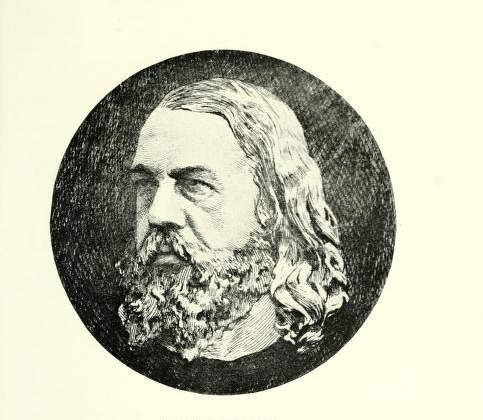
THÉOPHILE GAUTIER
Twice did young Gautier mount the steps behind De Nerval and Borel as if his shoes were weighted with lead. He was hardly able to breathe; the cold sweat stood on his brow, and he could hear the beating of his heart. Each time they reached the door and one of the others was about to ring the bell, he turned and rushed down again, pursued by his shouting, laughing companions. The third attempt was successful, as in the fairy tales. The young man, feeling as if his legs would hardly bear him, had just sat down for an instant on the top step to recover himself, when the door opened, and in a stream of light like that which forms the halo round Phœbus Apollo, Victor Hugo himself in all his honour and glory stood revealed to their gaze against the dark background of the stair, attired in a very ordinary black coat and grey trousers, and as carefully shaved as any common philistine. He smiled at the sight of the agitated youth, but did not seem much surprised; for he was accustomed to seeing young poets and painters blush, and turn pale, and stammer on his threshold. He was evidently about to walk out into the street like an ordinary mortal, which was a greater surprise to Gautier than it would have been to see him drive through the town on a triumphal car drawn by five white horses, with a goddess of victory holding a golden crown over his head. But he turned back to his study with the young men, and Théophile Gautier listened in silence to the conversation which followed; he was too embarrassed to take part in it, but it marked an epoch in his existence; from that hour till the day of his death he was Hugo's sworn adherent, ardent admirer, grateful pupil, and unwearied panegyrist. Never, not even momentarily, not even during separation lasting for years and the intellectual separation due to the difference in their political views, did he forget to be absolutely loyal to the man whom at this first meeting he in his heart called lord and master.
The young men's call was made in connection with the first performance of Hernani at the Théâtre Français. They came to fetch some packets of the little square red tickets, with "Hierro" printed on them. Gautier, who had read Les Orientales, was enthusiastic on the subject of the play, without having read it.
In the part of Paris where he lodged he had long been noted for his eccentricities. In every possible way he bade scornful defiance to the ordinary bourgeois, that personage detested above all others by the young Romanticists. He usually wore a black velvet jacket and yellow shoes, and went about bareheaded, with a parasol or an umbrella, his long, dark brown hair, which suited his olive complexion admirably, hanging down almost to his waist. Cigar in mouth, erect and youthfully dignified, he strolled along, utterly regardless of the contemptuous glances of the scandalised citizens or the jeers of the street boys.
But on the occasion of the first performance of Hernani, he felt it incumbent on him to prepare something more striking. He ordered "the red waistcoat," that waistcoat which was to become a historic garment. Its red was not the red which the revolutionists chose as their symbol, and which politicians think of when the colour is named; no, it was the flaming red which emblematised the hatred of the young artists of the period for grey. The colour tones of a particular piece of scarlet satin had fascinated the young painter and poet. He looked at it in the way we can imagine Veronese looking at a piece of silken stuff. When he had obtained possession of the treasure, he sent for his tailor and explained to him that of this material a waistcoat was to be made—yes, a waistcoat. It was to be shaped like a cuirass, to be full across the chest, and fasten at the back. "If," writes Gautier, "you were to pick out from a set of school drawing copies, representing the different expressions of the human countenance, one of those labelled Amazement, you would have an idea of the look upon the horror-stricken tailor's face." "But such a waistcoat is not fashionable, sir." "It will be—as soon as I have worn it." "But it is a style I know nothing about; it is more like a part of a theatrical costume than of a gentleman's ordinary dress; I am afraid of spoiling the stuff." "I shall give you a linen pattern, designed, cut out, and tacked together by myself." The waistcoat was made; and on that famous and stormy evening at the theatre, Gautier displayed perfect dignity and indifference when the philistines pointed him out to each other, and made him the target of all their opera-glasses. His name became inextricably connected with the legend of the red waistcoat, although he only wore it that one evening. For long little was known about him beyond the fact that he had worn it (I, myself, when in Paris in 1867, met people who believed that he wore it still); and it shines to this day in the history of French literature, a naïve symbol of the love of brightness and colour in life which distinguished that enthusiastic group of youths.
But the essentially luminous and flamboyant was art, pure art; and seldom has the boundless love of art as art taken such entire possession of a heart as it did of Gautier's. He was animated by it all his life, but in his youth he felt it with all the pleasures it brings, all the admiration it arouses, all the courage it imparts, and all the hatred it inspires.
It was this love which made the man who was himself a master, a sincerely, nobly modest admirer of other artists. He was Hugo's servant, Balzac's self-sacrificing friend. He was a poet, but admiration made him a critic; and to no one did a well-constructed line, a luminous word, a picturesque expression, or a bold flight of imagination give more pleasure. He was a painter before he became an author; and no one meted out such ample recognition as he to the powerful, if somewhat blundering, originality which produced that glory of colour in Delacroix's pictures, which blinds one to their deficiencies in the matter of drawing. With what passionate disapproval he fell upon Scribe's platitudes and Delavigne's cautious improvements, upon stupid vaudevilles and passionless tragedies—this man who worshipped style, and who infinitely preferred a performance at the circus to a bourgeois comedy at the Gymnase Theatre! At the circus, where they only shouted Hop! and Hé! they could not possibly commit all Scribe's sins against syntax and metre. With what fury he fell upon Delaroche when the latter (whose real talent developed late) charmed the half-educated with his laboured, highly finished representations of mediæval subjects, and taught them to prefer his Middle Ages to the Middle Ages of Hugo and Delacroix! To rank cautious talent above reckless, alarming genius was true sacrilege in Gautier's eyes; and the favour which these men of mere talent found in the eyes of the public roused in him a perfectly tiger-like fury. He confessed at a later period that he could have eaten Delaroche raw with the greatest of pleasure.
Art for art's sake! Art as its own end and aim! L'art pour l'art! This was Gautier's motto. And that he loved art for its own sake means (as it would mean in the case of anything else) that he loved it without any regard to its so-called morality or immorality, patriotic or unpatriotic tendency, utility or inutility.
Gautier's worship of art indicates an onward step in the development of Romanticism. In its first stage the literary renaissance was devotion to Catholicism and the old monarchy. When the movement, with Hugo at its head, made its second great advance, it undoubtedly entered upon the stage of enthusiasm for art as art; but in the case of the majority the step was an unconscious one; their enthusiasm for art concealed itself under enthusiasm for the Middle Ages, or for the sixteenth century, or for strength of passion, or for local colouring. Gautier alone was fully conscious of the principle which underlay all these manifestations; hence his name is synonymous with that phase of the Romantic movement during which poetry asserts its rights. If we were to judge by certain of Victor Hugo's prefaces (the preface to Les Orientales, for instance), it might seem as if Hugo's poetry, neglecting every other ideal, had no aim but the attainment of perfect liberty for itself; but Hugo was far too much of the agitator by nature to regard this struggle, this endeavour, as more than a preliminary step. It was reserved for the disciple whom the master loved best, to regard this stage as the final one. To Gautier, as to the German Romanticists, the combat of Romanticism with utilitarianism was equivalent to a proclamation of the absolute independence of art.
Théophile Gautier was born at Tarbes, in the south of France, on the 30th of August 1811. He came of a family of good standing and pronounced Royalist principles. Like Hugo and Dumas, he was descended from a brave officer. Hugo's father, as major in Napoleon's army in Italy, fought with Fra Diavolo, and as general and governor of a Spanish province under Joseph, with the brave Spanish rebels. Dumas' father was an athlete, who, according to tradition (strictly speaking, according to the younger Dumas), could crush a horse to death between his legs and bite through a helmet, and who held the bridge of Brixen alone against an advanced guard of twenty men. Gautier's grandfather won renown by being the first in the attack on Bergen-op-Zoom. He was a man of colossal strength and gigantic proportions, who lived in the open air, hunted every day, and was never seen without his gun, which he would fire into the air again and again if anything put him into specially good spirits. He lived to be a hundred. Théophile's father, who also lived to a great age, displayed his inherited vigour chiefly in intellectual matters. He was a well-educated man of many and varied acquirements. It speaks well for his literary taste and his freedom from prejudice, that he greatly admired the preface to Cromwell, and that he approved of his son's poetic tendencies; indeed, he was so delighted with the latter's audacious novel, Mademoiselle de Maupin, that, whilst the book was being written, he often locked the young man into his room with the words: "You don't come out until you have written some pages of Maupin." Théophile's mother, a stately beauty, who is said to have had Bourbon blood in her veins, united with his father in spoiling and worshipping the son whom nature had so bountifully endowed. He was one of those beings who are created to be admired and beloved, not only by their relatives and friends, but by every one—one of those on whom a pet-name is bestowed by a whole generation; for he was a great artist and a great child. How significant is the abbreviation, Théo, by which he is alluded to hundreds of times in contemporary literature! It was the familiarity of admiration which thus shortened his name.
To the particulars of his pedigree which seem to explain his character, another must be added, namely, that there was undoubtedly some Eastern blood in the family. This is interesting because, like the negro strain which accounts for much of the violence and force in the writings of Dumas the elder and of Pushkin, it is a physiological explanation of the Oriental impress which became observable in Gautier's personality and works as years went on. He was intended by nature to wear a fez or a turban, and to move slowly and with dignity, and it was natural that he should end by displaying as little emotion as possible in his works.
Théophile Gautier left the south of France and came to live in Paris as quite a child. It is a sign of the early development of his character, that at school he preferred the authors who wrote before or after the so-called Golden Age of their literatures to the classic and correct writers. In French literature his favourite authors were Villon and Rabelais; Corneille and Racine made little impression on him. In Latin literature he read with eager enjoyment only the poets and prose authors of the decadence—Claudian, Martial, Petronius, and Apuleius; these he imitated in his Latin verses in every possible metre; upon Cicero and Quintilian he looked down with perfect indifference. This attitude was due in the first place to the artist's love of a picturesque, exuberant style, and in the second place to the youth's aversion for all the imposing general truths and fine sentiments inevitably met with in the writings of every author whom we call classic. A Frenchman who was as wild and mad as Villon, or as exuberant and rich in colour as Rabelais, had in Gautier's eyes the inestimable advantage of being unaffected by the general polish of the great century; a Roman who had African blood in his veins, like Apuleius, or was of Egyptian origin, like Claudius, was necessarily more to his liking than the more tasteful orators and poets of the Augustan age; for he loved the peculiar, the piquant, the disconcerting, and was not repelled by artificiality and mannerism if any charm accompanied them; he liked his literature, so to speak, a little "high." The mature man retained the love of the boy for the authors of the Silver Age. To it we owe the excellent collection of criticisms which he published under the title of Les Grotesques, the aim of which was the rehabilitation of the whole group of minor poets whom Boileau had disgraced and dismissed in his L'Art poétique in order to make more room for the great authors who had observed the rules of Aristotle and the laws of taste. The poor fellows lay unread in the charnel-house of literature with a line of Boileau's upon their foreheads. Gautier, as the sworn enemy of everything regular and commonplace, undertook their defence. His love of the plastic and picturesque found no satisfaction in the study of the dignified authors who had sat writing with periwigs on their heads and lace ruffles at their wrists; but it gave him real pleasure to seek out all those forgotten, curious poets with the strange countenances and grimaces, in whose pages, for the most part sadly remarkable for their bad taste, there are nevertheless to be found many an amusing oddity, many a gleam of originality, many a witty or picturesque line, nay, whole poems as full of life as are the best of François Villon's and Théophile de Viau's. Though their muse was no beauty, there might nevertheless be said of her what Gautier wrote of an attractive woman:
"Elle a dans sa laideur piquante Un grain de sel de cette mer D'où jaillit nue et provocante L'âcre Vénus du gouffre amer."
And one of these poor poets of the fifteenth, sixteenth, or seventeenth century, who had lain drunk in the gutter, or hewn his way through the world with his rapier, or ended his life on the gallows, offered, with his mad humour and his verse, just such a silhouette, just such a characteristic, vivid profile as Gautier loved to sketch.
By his own wish young Théophile was taken from school and placed as a pupil in the studio of Rioult the painter. The youth himself, as well as his relatives, overestimated the talent he showed for drawing and painting, which was in reality merely the subordinate supplement to his absolutely unrivalled gift of picturesque writing. It was Victor Hugo who decided his career. When Hugo blew the horn of Hernani, Gautier answered to the call and forsook painting for literature. But he never lost the habit he had acquired of looking at things from the painter's point of view; and his conversation, and those parts of his writings (such as the preface to Mademoiselle de Maupin) where he expressed himself with the same freedom as in conversation, were always plentifully larded with that artistic slang for which the French studios are famous.
It was as a lyric poet that he made his first appearance. Five months after the famous first performance of Hernani, and unfortunately on the very day on which the Revolution of July broke out, he published his first book of poems. They were swept away and lost to sight in the stream of events; but even at a less troubled time they would hardly have attracted much attention. As a lyric poet Gautier is unpopular; his style is vigorous and faultless, but his is not the true lyric temperament; his attention is too much distracted by externals; he lacks intensity and soul. In his youthful poetry he is best when he is giving expression to his antique pagan, essentially Roman, epicureanism—when he tells of the three things that give happiness, "sunshine, a woman, a horse"; when (as in "La Débauche") he sings of the joy of life, and praises colour, song, and verse; or when (as in "Le premier rayon de mai") he reproduces the simple, almost sensual, at any rate perfectly incomplex, feeling of happiness produced by the close vicinity of the beloved one. Very fine, and quite typical of Gautier, is the little poem "Fatuité," the mocking title of which subtly wards off any attack upon its sentiments. It gives expression to the gay arrogance of youthful strength. The first two verses are as follows:
"Je suis jeune; la pourpre en mes veines abonde. Mes cheveux sont de jais et mes regards de feu. Et, sans gravier ni toux, ma poitrine profonde Aspire à pleins poumons l'air du ciel, l'air de Dieu. Aux vents capricieux qui soufflent de Bohême, Sans les compter, je jette et mes nuits et mes jours, Et, parmi les flacons, souvent l'aube au teint blême M'a surpris dénouant un masque de velours.
It was not until much later in life that Théophile Gautier made his mark as a lyric poet. In Émaux et Camées, a collection of poems in short, eight-syllabled lines, which in their forms are sometimes faintly reminiscent of Goethe's West-Oestlicher Divan and Heine's Buch der Lieder, we have the most characteristic exemplification of his personal style. The various subjects are treated entirely in the spirit of plastic art. The author's aim was, by means of vividness and careful blending of colour, perfection and delicacy of form, severe purity and general harmony of rhyme, in short by means of a skill which neglected nothing, not even the minutest trifle, to produce poetic equivalents of the miniature masterpieces in agate or onyx bequeathed to us by the ancients, or of the Italian or French enamel painting on gold of the days of the Renaissance. In these poems, along with which should be named "Musée secret," a most admirable poem, suppressed as indecent (to be found in Bergerat's Théophile Gautier), he attained to a beauty of language which may justly be called ideal. The only thing at all comparable to it is the plasticity of some of Leconte de Lisle's later poems. The poem "L'Art," the last in the book and, as regards language, a truly monumental work of art, contains his view of art carved, as it were, in stone. He so loved that art which he understood so well, that he placed it above everything else in this world, and saw in it the one thing that would endure through all the changes of time. He was, doubtless, too much inclined to estimate the value of a work of art by the difficulties overcome in producing it, but only because he believed that it was the struggle with difficulties which gave the finished work its strength, and made it proof against moth and rust. Hear his own words:
"Tout passe.—L'art robuste Seul a l'éternité. Le buste Survit à la cité. Et la médaille austère Que trouve un laboureur Sous terre Révèle un empereur. Les dieux eux-mêmes meurent, Mais les vers souverains Demeurent Plus forts que les airains."
—a saying, this last, which holds good of such verse as Gautier wrote.
XXVIII
THÉOPHILE GAUTIER
For a vivid, spirited picture of the young Bohemian Romanticist group which rallied round Hugo, a picture distinguished by its wanton self-caricature, we have only to turn to Théophile Gautier's Les Jeunes-France. The author intended his work to satirise Romanticism in much the same manner as Les Précieuses Ridicules had satirised the literary fantasticality of an earlier period; but unfortunately Les Jeunes-France is only the frolicsome effusion of a talented boy, whilst Les Précieuses is a mature work of enduring value. Les Jeunes-France was written almost immediately after Gautier's admission into the Romantic camp, and it, like the poetry of Petrus Borel and Philothée O'Neddy, gives us a good idea of the Bohemian camaraderie of the talented young men of the day. Gautier was the very man to write such a book; for not only then, but to the end of his life, he was the real artist—Bohemian; always more or less at variance with society and its notions of respectability; living in his youth, as painter, poet, journalist, and traveller, a Bohemian life in the general acceptation of the word, and in his later years settling down to live with his sisters and his children without a thought of marriage. Of his many liaisons, that with Ernesta Grisi, the mother of his daughters Judith and Estella, lasted longest. He was also for a long time passionately attached to her sister Carlotta. It was for Carlotta that he wrote his ballets. Though he was inconstant as a lover, he was an extremely affectionate brother and father. He gave his daughters a model education. One of his excellent ideas was to have them taught such languages as Japanese and Chinese, proficiency in which was so rare that it provided a woman who required to earn her living with the means of doing so. His daughter Judith reaped the benefit of his foresight.
But the book which gives us the best, completest impression of young Gautier's inner life is not Les Jeunes-France, but Mademoiselle de Maupin, the novel which he wrote immediately after that work (1836). In Mademoiselle de Maupin the champagne-froth of his youth seethes. It is a perfectly pagan and at times a perfectly indecent book—as indecent as a dialogue of Crébillon fils—but there is power in it; and though Swinburne exaggerates considerably when he calls it "the golden book of beauty," there is no doubt that it displays an extraordinary sense of beauty. It was an outlet for the young man's redundant vigour.
Théophile Gautier was originally very slightly built, and swimming was the only physical exercise in which he excelled; but he was bent on becoming an athlete, athletes and prize-fighters being above all other mortals the objects of his admiration. For several years he took fencing and boxing, riding and rowing lessons, until his physical condition was entirely changed, and he had the unutterable satisfaction on the day the Château Rouge was opened, of giving a perfectly new "Turk's head" a blow of 532 pounds weight, which has become historical. "This," he says with amiable vanity in his autobiographical sketch, "is the deed of my life of which I am proudest." And he is evidently quite sincere in his assertion; for even when he was an old man he used, when his friends were disputing his paradoxes and all contradicting him together, to command silence by shouting with his hoarse voice: "Moi, je suis fort; j'amène 530 sur une tête de Turc et je fais des métaphores qui se suivent. Tout est là." In Mademoiselle de Maupin we are conscious at one and the same time of the young dandy who can give the tremendous blow and the artist whose "metaphors hang together," that is to say, whose sentences shape themselves into pictures before our eyes. But what we are still more sensible of is the genuinely antique, plastic nature which distinguishes Gautier from all the other men of that gifted generation. He has painted himself in a passage in which he makes the hero describe his own character:
"I am a man of the Homeric age; the world in which I live is not my world, and I do not understand the society by which I am surrounded. Christ has not lived for me; I am as pagan as Alcibiades or Phidias. I have never gathered passion-flowers on Mount Golgotha, and the deep stream which flows from the side of the crucified one and encircles the world with a girdle of red has not laved me in its waves. My rebellious body refuses to recognise the supremacy of the soul; my flesh refuses to be mortified. To me this earth is as beautiful as heaven; and in my eyes perfection of form is virtue. Spirituality is not to my mind; I prefer a statue to a phantom, midday to twilight. Three things give me pleasure—gold, marble, and scarlet; brilliancy, solidity, colour. These are the things I dream of, and all my castles in the air are built of them.... I never imagine mist or vapour, or anything floating and uncertain. My sky has no clouds, or if it happen to have any, they are solid, chiselled out of the fragments of marble fallen from the statue of Jupiter ... for I love to be able to touch with my finger what I have seen, and to trace the contours into their most elusive folds.... This has always been my character. I look on women with the eyes of a sculptor and not of a lover. All my life the shape of the flask has interested me, not the quality of its contents. I believe that, if I had had Pandora's casket in my hands, I should not have opened it."
Théophile Gautier is one of the few French Romanticists who present a distinct parallel to the German. His story Fortunio, with its glorification of pleasure and idleness, is the French counterpart of Friedrich Schlegel's Lucinde; and he recalls the German Romanticists by his contempt for the distinctively poetic in poetry. He once said to Taine, who was comparing De Musset with Victor Hugo to the disadvantage of the latter: "Taine, I verily believe you are degenerating into bourgeois imbecility. Sentiment in poetry ... that is not the main thing. Radiant, resplendent words, rhythm, and melody—these are poetry. Poetry proves nothing and tells nothing. Take the beginning of Hugo's Ratbert, for instance; there is no poetry in the world like that; it is the very summit of the Himalayas. All Italy with its medieval heraldry is there—and nothing but words." Gautier resembles Tieck in his love of the poetry of pure form, guiltless of ideas; but there is this marked difference between them, that whereas Tieck aimed at volatilising words into tones, at diluting poetry into simple mood, into music, Gautier, the good Latin, aimed at making words produce light and colour, at condensing poetry into word-painting, word-sculpture.
He harmonised completely with the German Romanticists in his hatred of utilitarianism. His watchword, L'art pour l'art, was the outcome of this aversion. And, regarded from a certain standpoint, this principle of his, so eloquently propounded in the preface to Mademoiselle de Maupin, is absolutely incontestable.
It is incontestable when taken in the sense that art is not subject to the same laws of propriety as those which justly rule life, much less to those which rule it unjustly. It is, for instance, perfectly proper that a statue should stand naked in a crowd, though it offends our sense of the proper that a man or woman should do so—life and art stand in entirely different relations to morality. It was Gautier's constant endeavour to free art from subjection to moralising criticism. In the youthfully violent preface to Mademoiselle de Maupin he bursts out, addressing the utilitarian critics: "Non, imbéciles, non, crétins et goîtreux que vous êtes, un livre ne fait pas de la soupe à la gélatine;—un roman n'est pas une paire de bottes sans couture; un sonnet une seringue à jet continu; un drame n'est pas un chemin de fer, toutes choses essentiellement civilisantes." Of the perpetually scandalised critics, he says: "If there is nudity anywhere in a book or a picture, they make as straight for it as a sow for the mire," ... and with an allusion to Tartuffe, he continues: "Dorine, the pretty waiting-woman, is at perfect liberty to display her charms as far as I am concerned; I shall certainly not take my handkerchief from my pocket to cover that bosom which ought not to be seen. I look at it as I look at her face, and if it is white and shapely it gives me pleasure." And, defending himself against his critics' reiterated accusations of immorality, he writes: "An extremely curious variety of the so-called moral journalist is the journalist with female relations.... To set up as a journalist of this species a man must provide himself with a certain number of necessary utensils, such as two or three legitimate wives, some mothers, as many sisters as possible, a complete assortment of daughters, and innumerable cousins. The next requisites are a play or novel, a pen, ink, paper, and a printer.... Then he writes: It is impossible to take one's wife to see this play; or: It is a book which a man could not possibly put into the hands of a woman whom he respects.... The wife hides her blushes behind her fan, the sister, the cousin, &c. (The titles of relationship may be varied; all that is necessary is that the relatives should be female.)" Though Gautier's practice is not always defensible, he was right in theory. Poetry has its own morality, the morality which springs from that love of beauty and of truth, which, however indistinctly and indirectly it may be expressed, is its very nature; but it refuses to be bound by the conventions of society. Poetry is in itself a moral power, exactly as science is—such a science, for example, as physiology, which certainly does not confine itself to subjects that are considered fit topics of conversation in polite society. There are immoral poets as there are immoral surgeons, but their immorality has no connection with that regardlessness of convention which the aim of both art and science entails, and which is inherent in the nature of both.
A man of a plastic and artistic temperament like Gautier, who could not have satisfied the demands made of poetry in the name of morality without sacrificing his special talent, was peculiarly fitted to enforce this truth. His special gift is the reproducing of sensuous impressions in words. He was the first to show in the grand style that the doctrine propounded in Lessing's Laokoon is not the whole truth, for he has described much that Lessing regarded as indescribable. There was nothing for which Gautier lacked words—the beauty of a woman, the appearance of a town, nay, the taste of a dish, or the sound of a voice—he was equal to them all. "Since we have him," said Sainte-Beuve once, "the word inexpressible no longer exists in the French language." He had the usual Romantic-Classic aversion for new words, but he enriched modern French with a store of fifteenth and sixteenth century words which had undeservedly fallen into disuse, and with a host of accurately suggestive technical expressions. French dictionaries were his favourite reading. Undoubtedly his was a mind entirely concentrated upon externals; but great intensity and much artistic fervour go to the making of such externality as Gautier's. It was certainly not the aim of his art to touch feeling hearts; but even Goethe had moods in which he wrote:
"Ach, die zärtlichen Herzen! Ein Pfuscher vermag sie zu rühren; Sei es mein einziges Glück, dich zu berühren, Natur!"
Le Capitaine Fracasse, a novel which Gautier planned in his youth, but did not write until well on in life, gives the best idea of his prose. We see its personages as we see people in real life—their figures, their dress, their movements, their background of buildings or landscape.
The book begins with a chapter entitled Le Château de la Misère, which contains a description of the evening meal of a company of strolling players, which they are taking in one of the rooms of an impecunious young baron's dilapidated castle, a building of Louis XIII's time, by the light of two huge wooden stage candelabra, pasted over with gilt paper. It is a description which reminds us of the famous Rembrandt in Dresden known as "The Wedding of Esther." We see the light modelling the faces, and the shadows creeping up the walls. There is not a single emotional word in it, but such a subtle feeling of melancholy pervades the whole that we quite understand how Gautier said to Feydeau, who found him writing it: "It is an exact description of my state of mind."
Another chapter, entitled Effet de Neige, describes the players' waggon driving off at night through the deep snow. After a time the company miss one of their number, the Matamore (the bragging soldier), who had been following the waggon on foot. They search for him in vain, in vain shout his name at the top of their voices across the great snow plain. No answer. One of them carries a lantern, the red light of which moves along the snow; and we see the long, shapeless shadows following the men upon the white ground. The black dog belonging to the company follows them, howling. Suddenly the howls stop, and we are conscious of the death-like stillness which prevails when falling snow stifles every sound. At last the actor who has the sharpest eyes thinks he sees a curious figure lying beneath a tree, strangely, ominously still. It is he, the luckless Matamore. He is lying with his back against the tree, and his long, outstretched legs are half covered with the driving snow. His gigantic rapier, without which he was never seen, stands at such an odd angle to his breast that under any other circumstances one would have laughed. The lantern-bearer holds the lantern to his poor comrade's face, and gets such a shock that he almost drops it. The face is of a waxy whiteness; the ridge of the nose, which is pinched at the nostrils by the bony fingers of death, shines like a piece of cuttle-bone; the skin is tightened across the temples; snow-flakes lie on the eyebrows and lashes; the dilated eyes have a glassy stare. At each end of the heavy, pointed moustache gleams a little icicle, the weight of which drags down the hair. The seal of eternal silence has closed the lips which have delighted so many an audience with their merry brag; and a death's-head shows beneath the pale, thin face, on which the habit of making grimaces has carved furrows, now terrible in their comicality. "Alas!" says one of his comrades, "our poor Matamore is dead. Exhausted and stupefied by the driving snow, he must have sought shelter for a moment under this tree, and as he has not two ounces of flesh upon his bones, he has been frozen to the marrow in no time. When we were in Paris he reduced his rations every day in order to produce more effect, and he had made himself leaner than a greyhound in the coursing season. Poor Matamore! you are safe now from all the kicks and slaps and drubbings which your part obliged you to submit to! You are as stiff now as if you had swallowed your own dagger." The pathos of the situation is here brought out indirectly by a conscientious plastic treatment of the subject.
It was natural that such a degree of feeling as this seldom revealed itself in an art like Gautier's, and that in time he became entirely addicted to a species of descriptive writing which, perfect as it was in its kind, was ever more soulless. He had a passion for travelling; he visited Spain in 1840, Africa (in the company of the Duc d'Aumale) in 1845, Italy in 1850, Constantinople in 1852, Russia (penetrating as far as Novgorod) in the following year; and all these journeys he described, thanks to his fabulous memory for the appearance of things, with incomparable accuracy, though the descriptions were often written long after his return. One disappointment awaits the reader, namely, that everything in the different countries is described except their inhabitants. We are told that when Madame de Girardin had read his Tra los montes, she said to him: "But, Théo, are there no Spaniards in Spain?"—a criticism which is applicable to all his books of this kind. The inner man gradually ceased to exist for him, and even the outer man was at last lost to sight in his clothes. In Gautier's conversations with Bergerat, his son-in-law, we come upon the following comical and characteristic speech: "A royal tiger is a more beautiful creature than a man; but if out of the tiger's skin the man cuts himself a magnificent costume, he becomes more beautiful than the tiger, and I begin to admire him. In the same way, a town interests me only by virtue of its public buildings. Why? Because they are the collective result of the genius of its population. Let the inhabitants be utterly vile and the town a habitation of crime, what does it signify to me so long as I am not assassinated whilst I am inspecting the buildings?" This is the worship of beauty and art carried to a characteristic extreme. The human, the emotional, the modern, life itself, at last lost all interest for Gautier the artist and art-lover. In dramatic art he became indifferent to everything but the style, the costumes, and the scenery. He often maintained that it ought to be possible for a dramatist to produce all his effects by employing four Pierrots in different situations—for all that was wanted was "an impression of life, not life itself." "Life itself is too ugly," he used to add.
Thus he finally, as it were, criticised himself, showing distinctly to all except his blind admirers where his limitations lay. He exhibited in himself the weak side of his axiom, L'art pour l'art; proved that an art which does nothing but revolve round the axis of art itself, inevitably becomes barren and empty. Art enthusiasm creates a Galatea out of marble, but the personal stream of thought is the divine breath which breathes life into the statue.
Nevertheless Gautier did a great and a good work by labouring with unexampled energy to free art from unwarrantable claims, and by developing it in as characteristic a manner as it lay in his power to do. Though this was not enough for art, it was enough for one man to have done. It cannot, however, be said that Gautier's talent was appreciated as it deserved during his lifetime; the artistic circles formed his public; merely literary people, not to speak of the reading world at large, did not understand him. How often have I myself heard from the lips of French scientific men the foolish assertion that Gautier wrote his books out of dictionaries, without caring for anything but the sound of his words and their singularity.
This want of understanding is to a certain degree explained by the fact that, in the mind of the general public, Gautier the journalist had gradually supplanted Gautier the poet. As early as 1836 the man who had told the journalists such bitter truths had joined their ranks to earn his daily bread; and his connection with the press lasted until his death—thirty-six years. His facility in writing was of great advantage to him, and the tasks he accomplished as art and dramatic critic were herculean. According to his own and Bergerat's calculations, which must, however, be exaggerated, his works, if all his articles were collected, would fill three hundred volumes. He wrote for Girardin's paper, La Presse, for nineteen years, and afterwards, under the Empire, chiefly in the Moniteur officiel. His dramatic criticism, which he undertook unwillingly, is only valuable for its fine style. As an art critic he confined himself more and more, as time went on, to describing pictures, an art in which he was unapproachable. Weariness of his profession, disinclination to make enemies, compassion for beginners and the untalented, good-nature and indifference in equally large proportions, made him more and more indulgent. At last he praised everything and everyone with the same serene impassibility and in the same distinguished, ornate style. The general public knew him only as an art and literary critic.
But upon authors, both of poetry and prose, his influence was great. Paul de Saint-Victor, with his excellent prose, Leconte de Lisle, the most unemotional of modern poets, Baudelaire, the "Satanic" lyric poet, and the whole group of young poets who during the Second Empire formed themselves into a school under the name of "Les Parnassiens," are direct descendants of Théophile Gautier. Saint-Victor inherited his sense of form and colour, his devotion to plastic art, Leconte de Lisle his perfect comprehension of foreign civilisations and his Oriental serenity, Baudelaire his partiality for abnormal feelings and passions, and the Parnassians his faultless metre and rhyme.
But although Gautier's influence has thus extended far beyond the 1830 period, and beyond the term of his own life, his is one of the names most inseparably connected with the early, the fighting, days of Romanticism. It is significant and touching that the last, uncompleted article he wrote was a description of the audience on the night of the first performance of Victor Hugo's Hernani.
XXIX
SAINTE-BEUVE
Gautier's critical writings, though they form such an enormous proportion of his total production, are already almost forgotten; he survives as the novelist and poet. But one of his contemporaries, who like him was both a poet and a critic, and whose name during their lifetime was frequently coupled with his, has had a different fate. The rank which Sainte-Beuve won for himself as a critic is so elevated as completely to overshadow his position as a poet, and as a historian in the usual sense of the word. As a poet he showed himself to be possessed of delicate and original talent; but he was an epoch-making critic, one of the men who inaugurate a system and found a new branch of art. In a certain sense it may be said that he was a greater innovator in his province than the other authors of the period in theirs; for there was modern lyric poetry before Victor Hugo, but modern criticism in the strict acceptation of the word did not exist before Sainte-Beuve. At any rate he remodelled criticism as completely as Balzac did fiction. During the last years of his life his authority was undisputed; nevertheless, it was not until some ten years after his death that the literary public beyond the frontiers of France awoke to a full sense of his preeminence. An excellent foreign critic of French literature, the German historian, Karl Hillebrand, has pronounced Sainte-Beuve's to be the master-mind of the period, an assertion which, though it may be an exaggeration, can only be called absurd if criticism be regarded as in itself a lower branch of art than the drama or lyric poetry. This, however, is surely now an antiquated standpoint. To the author that branch of art is the highest in which his nature finds fullest expression; and though there may be an order of precedence among intellects, it is extremely doubtful if there is an order of precedence among arts, and most doubtful of all when an art or branch of art has been remoulded by a productive intellect into its own special, almost personal, organ. So much is certain, that in reasoning power (not only in critical acumen) Sainte-Beuve holds the first place in the generation of 1830.
The peculiar quality of his mind was its capacity of understanding and interpreting an extraordinary number of other minds. If superiority to the other prominent individuals of the group cannot be claimed for him, the reason lies in the limitations of his gift. Amongst the minds he understood were not numbered the minds of fertile, unrefined geniuses like Balzac, and great but eccentric geniuses like Beyle. And, far-reaching as was his vision, he was seldom able to take a comprehensive view; few historians and thinkers have had such unsystematic minds. This defect had its good side; his freedom from all inclination to systematise kept him fresh to the last, enabled him perpetually, as it were, to slough his skin; so that the man who in 1827 attracted Goethe's attention by his first articles in the Globe, in 1869 was not only in complete, understanding sympathy with the group of young scientists and artists who at the moment gave France her claim to the consideration of Europe, but was in a manner their leader. To the very last year of his life he was regarded by all the best men as the natural general, under whose eye the "young guard" was specially anxious to distinguish itself. But his lack of system, his inability to grasp his subject as a whole, not only prevented Sainte-Beuve from distinguishing his name by any single great work, but even from ever attaining in his writings to grandeur of proportion, to the grand style. His eye was formed to see details, characteristic, important details, but no whole. He saw these details in constant, perpetually varying movement, the movement which is life, and by imitating all this movement in his brain and with his pen he gave his pictures a more exact resemblance to life than had ever been seen before. But he had not sufficient mastery over his details; he did not possess the gift of tracing apparent to deeper-lying causes, and these to a first cause.
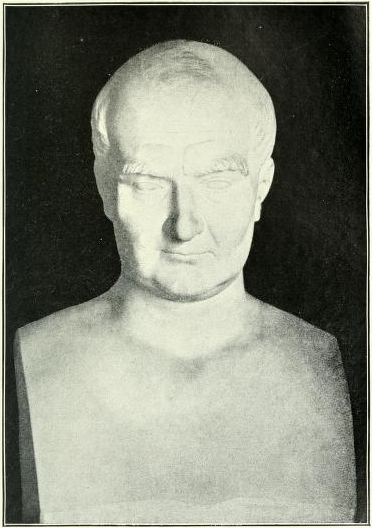
SAINTE-BEUVE
As a critic he was only capable of describing the isolated individual, and even of the individual he only very occasionally gave a complete, final idea (Talleyrand, Proudhon); he showed him now from this side, now from that, now at one, now at another age, now in one, now in another relation to society. Even his short articles display a lack of the power of concentration; he hid his best ideas in subordinate clauses, his most suggestive thoughts in notes. He broke his bread of life into crumbs. He hid his gold, as peasants used to do, in dark corners, in holes in the floors and walls, at the bottom of chests and in stockings; he was incapable of moulding it into figures.
The freedom from system which was his strong point had this great advantage, that it preserved his writings from artificial symmetry. He never sacrificed for the sake of the inward equilibrium of his work a syllable of what he thought ought to be said; and much less would he have done so to make his description and his style graphic. He had no aversion for the complicate, the intricate, the unfinished. But the result of his lack of that philosophic spirit which largely consists in a tendency to summarise and the love of a whole as whole, is that one never receives powerful, simple impressions from his works. The important and the less important too often occupy the same plane. Regarded as an artist, he reminds us of those Japanese painters, the great artistic value of whose work began to be acknowledged in Europe about the year 1880. One reason why the pictures of these artists surprise and delight is, that there is not a trace of academic symmetry in them; they never completely satisfy us because they despise perspective, but they bring living things before us as if they were alive.
Charles Augustin de Sainte-Beuve was born at Boulogne-sur-Mer on the 23rd of December 1804. His father, a clever government official and cultured gentleman, was fifty-two before he made up his mind to marry; and his mother at the time of her marriage was nearly forty. Monsieur Sainte-Beuve died before they had been married a year, two months before the birth of his son, whose critically reflective turn of mind was plainly an inheritance from the father he never saw. Sainte-Beuve the elder was interested in all kinds of literature, but especially in poetry; he left his books with their margins crowded with annotations and remarks, the spirit of which curiously anticipates the tendency of his son's writings.[1] Madame Sainte-Beuve, whose mother was an Englishwoman, taught her son English at an early age, and to her is doubtless due his taste (a very uncommon taste in France in those days) for English lyric poetry, for Bowles, Crabbe, Cowper, and especially for Wordsworth and those other poets of the Lake School whom he so often translated and quoted. Something melancholy and prematurely old in his temperament is in all probability attributable partly to the advanced age of both his parents, and partly to the effect produced on his mother's mind, before he was born, by the illness and death of her husband.
Sainte-Beuve was a timid, melancholy child. At the age of twelve, home influence had developed in him an almost alarming degree of childish piety; he served as an acolyte at the mass with extraordinary fervour. The fever of Catholicism was short, but it left its traces, which at one time in later life showed very plainly; and during all the earlier years of his youth the lad not only retained his reverence for Christianity, but dwelt much on religious doubts and theological questions. This lasted until, as a student, he felt himself at once drawn to the philosophers of the eighteenth century and to the living representatives of the sensationalistic philosophy, Tracy, Daunou, and Lamarck, with whose assistance he soon freed himself from the grasp of theology. His intellectual position on entering manhood was that of the pure empiricist; at a later period religious moods and tendencies reasserted themselves; but these again gave way to empiricism, which proved to be the final attitude of his mind. At school he had distinguished himself in history and languages; but, in spite of his strong literary tendencies, he determined, partly for the sake of his future, partly to counteract a too purely literary training, to study medicine. From 1823 to 1827, whilst by no means neglecting literature, he pursued the usual physiological and anatomical studies with ardour and interest. He was poor, but never in want; for he was frugal and extremely industrious.
The young medical student was anything but good-looking. His big round head, covered with fine and yet rough reddish hair, was almost too large for his body; and his figure was bad. But in the bright blue eyes, which seemed now large, now small, and which sometimes dilated strangely, there shone a thousand questions, smiled a mischievous wit, and dreamed a curiously ingratiating, half-poetic, half-sensual longing. As the poor, plain-looking student, his acquaintance with the fair sex was almost entirely limited to the frail sinners of the Quartier Latin. He had an ardently sensual, gross temperament, which demanded the immediate gratification of its desires; but with the gratification invariably came remorse and a strong feeling of humiliation. Quite as markedly developed as the sensuality was a dreamy, poetic imaginativeness, which, tinged as it was with a gentle melancholy, naturally took the direction of romanticism and mysticism. He had, perhaps, a little of the ugly man's involuntary jealous dislike of the men whose good looks capture feminine hearts at once, and yet he himself had something of their dangerously insinuating quality.
Early in 1827 Sainte-Beuve published in the Globe two articles on Victor Hugo's Odes et Ballades, which procured him admission to the Romanticist circle. Hugo came to thank him, but did not find him at home. A few days later Sainte-Beuve returned the call. He found Hugo and his wife at breakfast, and thus made at the same moment the acquaintance of the two persons who were to have most influence over his life for many years to come. He soon became the accredited critic of the Romantic School. His first important task was to prove the connection of the new school with the older French literature, to provide it, so to speak, with Gallic ancestors. This task he accomplished in his excellent critical work, Tableau de la Poésie française au XVIe Siècle (1827-28), the aim of which is to show plainly the thread which stretches across the classical age and connects the generation of 1830 with Ronsard, Du Bellay, Philippe des Portes, and those other authors of the Renaissance who had been so long and so unjustly despised. This book occupies the same position among Sainte-Beuve's works that Les Grotesques does among Théophile Gautier's. It was written before Les Grotesques, and is as thorough and critically discriminating as Gautier's work is plastic and eccentric.
In 1829 followed Sainte-Beuve's first lyric essay, Poésies de Joseph Delorme, a collection of curious, elaborate poems which made no small sensation. They purported to be written by a young medical student who had died of consumption; but in the preface, under the transparent pseudonym, Sainte-Beuve described himself and his own life. Joseph Delorme is of the race of Obermann—poor, gifted, full of compassion for the woes of humanity, a lustreless genius like the founder of the race, but of even a more complex character than he; for Joseph is a philosopher who is unhappy because of his scepticism, an idealist who with all his idealism is addicted to low dissipation. The hero is the usual despairing youth of the 1830 period, but there is more of the bourgeois in him than in the heroes of Saint-Beuve's contemporaries; his despair is less magnificent and more true to nature. As regards form, the poems are remarkable for their return to the charming old French metres of Ronsard and Charles d'Orléans, and also for the frequency with which the sonnet (beloved of Sainte-Beuve as of Wilhelm Schlegel) recurs. But they interest us chiefly because of the tendency to realism which their author already begins to display, a realism which, though it can sometimes be traced to the influence of the English poets of the Lake School, is yet as a rule, with its daring choice of subjects (in the poem "Rose" for example), original and essentially French. The ideal element is represented by the author's ecstatic effusions on the subject of the Cénacle, the little fraternal circle of poets and painters into which he had lately been admitted, and the members of which he panegyrises, now collectively, now singly. His admiration of his friends knows no bounds. Some of the poems at the time of their appearance were ridiculed for their affectation ("Les rayons jaunes" undoubtedly verges on the ridiculous) others were considered vulgar. Guizot characterised Joseph Delorme as "un Werther jacobin et carabin" (Werther as the Jacobin and "medical"). On the whole, however, the book may be said to have had the decided success which it deserved.
Sainte-Beuve's next collection of poems, Les Consolations (published in March 1830), his novel Volupté (published in 1834), and the first two volumes of Port-Royal, mark the emotional and somewhat pious period in the life of their author. Les Consolations is dedicated to Victor Hugo in terms of hysterical admiration coupled with expressions of Christian contrition, and Hugo's name occurs frequently in the book; but it was in reality quite as much an offering to Madame Hugo, who was the love of Sainte-Beuve's youth, and to whom the first poem and several others are addressed. Of his relations with her he wrote too openly in Le Livre d'Amour, a collection of poems which obviously treat of realities, and which, though printed, was never published.[2] And in the novel Volupté, too, we have no difficulty in recognising its author's relations with Victor Hugo and his household in Amaury's relations with the eminent politician, Monsieur de Couaën, and his wife.
Sainte-Beuve himself and many of his biographers have hinted that the works which he wrote during the period of his enthusiasm for Madame Hugo, all of which have a faint Catholic tinge or varnish, were directly inspired by that lady, who was a devout Catholic in her youth, though an ardent freethinker in later life, in the days when she wrote her husband's life to his dictation. It has been asserted that Sainte-Beuve, in his lover's ardour, went the length of accustoming himself to speak in her language and even to share her feelings. This explanation, however, I refuse to accept, as I feel convinced that Sainte-Beuve in his old age deceived both himself and others by speaking as he did of his youthful works. In a letter dated July 1863, he writes to Hortense Allart de Méritens, the authoress (Madame Saman): "I tried a little Christian mythology in my youth; but it has evaporated. It was for me the swan of Leda, a means of obtaining access to the fair and producing tenderness in them. Youth has time and employs every means." I object to this, to say the least of it, frivolous manner of explaining away a phenomenon which is plainly attributable to the natural attraction possessed by Catholicism for a youthfully pliant and dependent character, an attraction in this case strengthened by the general tendency of the period, which, as usually happens, was becoming a fashionable tendency before disappearing altogether. The period was the period of the revival of philosophic spiritualism. In 1828 Sainte-Beuve attended the lectures which Jouffroy, after his dismissal, gave in his own house; and he was also, like almost all the young men of his day, strongly influenced by Cousin. The fashionable philosophers converted him temporarily from sensationalism. Romanticism was still regarded by many of the younger men in the light in which it was originally regarded by Hugo, namely, as a reaction against the pagan art and literature of the Classicists; and one branch of the Romantic School was, from its eager desire for the poetic revival of mediævalism, so closely associated with the young Catholic party which rallied round Lamennais and founded the newspaper L'Avenir (to which Sainte-Beuve contributed articles), that it was not at all surprising that a few drops from the aspergill of the Neo-Catholics lighted upon the young Romantic writers, and found their way into their works. The part of Volupté which describes conventual life, was actually written by Lacordaire. The piety which prevails throughout Les Consolations—and which annoyed many, amongst others Beyle, a sincere admirer of Sainte-Beuve—and the incense fumes which permeate the second part of Volupté, vividly recall corresponding phenomena in German Romanticism.
In spite of its diffuseness and heaviness, Volupté is a delicately profound psychological study. It consists of confessions of the nature of Rousseau's, but recorded in a style which is richer in imagery, more saturated with colour, and more delicately shaded than Rousseau's; the emotionally lyric tone reminds us of Lamartine's Jocelyn, a work which treats the same kind of theme more chastely. Sainte-Beuve's book presents us with the life-story of a pleasure-seeking, dissipated youth, interspersed with many a profound, sagacious reflection. It represents the sensual and the tender impulses of the soul as equally destructive of the vigour and energy of youth. It treats mainly of those enervating friendships with young women, especially with young married women, in cultivating which clever young men often squander so much time. The word "squander" seems to me to convey Sainte-Beuve's meaning better than the word "lose"; for he himself reproaches a gifted writer whose vigorous style is lacking in shades, with having worked too hard and lived too lonely a life, with having injured himself by too seldom seeking the society "which is the best of all, and leads one to lose most time in the pleasantest way, the society of women."
Amaury, the hero of the book, is on intimate terms with three women. One, who is the wife of his teacher and chief, he loves more than he ventures to let her understand; the second, to whom he is betrothed, he gives up for the sake of the first; and yet at the very same time he allows himself to drift into an intimate friendship with the third, whom he alternately adores passionately, and pains by his cruel indifference—a friendship which neither satisfies him, nor saves him from indulging in the lowest debauchery. Intelligent, ambitious, and obstinately industrious as Amaury is, his intellectual vigour is gradually paralysed by all these entanglements, and he at last feels that there is no hope for him except in submission to the severest discipline of the Roman Catholic Church. His account of his life as a young man is given in the form of the confession of an ecclesiastic, and the unction of parts of it is insufferable; the outbursts of remorse, the moral and religious admonitions, the prayers and homilies, which interrupt the flow of the tale, are tiresome; but the reader is sufficiently compensated for them.
Two things make the book a remarkable one—in the first place, the perfect understanding which it displays of the development process and the diseases of the soul, an understanding which speaks of persistent self-examination, and foreshadows the coming critic; in the second place, the insight into feminine character, which reveals the feminine element in Sainte-Beuve's own nature, and prognosticates his unique success in the critical interpretation of the personalities of notable women. I append a few specimens of his keen observation and impressive reflections:—"How ungrateful youth is by nature! It throws away with a contemptuous gesture everything that has not been given to it by itself. It will only be bound by ties which it has formed itself, demands friends of its own choice, for itself alone, being certain that in its soul are treasures sufficient to buy hearts with, and life sufficient to fructify them. Hence we see it bestow itself for life on friends whom it did not know yesterday, and swear eternal devotion to women who are almost strangers." "How contemptible human friendships are! How they exclude one another! How they follow one another and drive one another away like waves! Alas! this house to which you repair every morning and every evening, which seems like your home and better than your home, and for which you neglect everything that hitherto has been sweet to you, this house, you may be quite certain, will some day lose favour in your eyes; you will avoid it as a fatal place, and if by chance your business leads you into its neighbourhood, you will take a long round to avoid seeing it. The cleverer you are, the stronger will be the feeling." Every one of a truthful disposition who has been under the painful necessity of concealing his or her real feeling, will understand the following sentence, and admire its brevity:—"I tried to express what I really felt, while apparently expressing what I did not feel—to be honest to myself and to mislead her." Here, again, is a mournful little picture of life:—"A brigade is marching slowly along a road. The enemy's troops, in ambush on both sides, make terrible havoc with their rifles, and in the end there is an open fight. The brigade succeeds in putting the enemy to flight, and when the general arrives in the evening at the nearest town with the lucky survivors of his force and the torn remnants of his flag, this is called a triumph. When some one part of our plans, our ambition, our love, has suffered less than the rest, we call this glory or success." And the following is an apt little simile. It is of jealous love Sainte-Beuve is writing;—"At this stage, when it desires absolute possession, when it is irritated and embittered by the slightest opposition, nay, even by the beloved object's affection for others, I can only compare it with those Asiatic despots who, in order to clear the way to the throne for themselves, assassinate all their nearest relations, even their own brothers."
With Les Pensées d'Août Sainte-Beuve closed his career as a poet. It is the only one of his poetical ventures which was quite unsuccessful, and the poems which the volume contains are certainly his coldest; yet it seems to me, though my opinion is unsupported by any other critic, that it is in this work he first displays marked originality. It is realistic to an extent which is quite unique in the lyric poetry of the Romantic School; no poet had yet ventured to make such free use of the language and the surroundings of daily life. In the North, where a poet even to-day would hardly have the courage to give an omnibus or a railway platform a place in a lyric poem, such a work as Les Pensées d'Août would still almost be regarded in the light of a specimen of the poetry of the future.
In it, as in Les Poésies de Joseph Delorme, we find several of the characteristics of the English Lake School transplanted to French soil. Sainte-Beuve, like the Englishmen, presents us with simple, sober pictures of real life, and his style, like theirs, is founded upon the conviction that there ought not to be any essential difference between the language of prose and of metrical compositions. But in Sainte-Beuve's poems we have, instead of the strange want of crispness and point of the English poems, a genuinely French dramatic tension. Each of them is a little drama developed within the limits of a short lyric narrative.
Take, as a good specimen, the poem entitled À Madame la Comtesse de T. The Countess to whom it is dedicated relates the story. She is travelling by steamer from Cologne to Mainz. To see the scenery better, she has seated herself in her carriage, which is in the fore part of the ship, and she is consequently beside the steerage passengers—servants, workmen and their wives, poor people of all descriptions. One of her children exclaims: "Mother, there is Count Paul!" She looks round and recognises the acquaintance named, a Polish political refugee (the year is 1831). His features are refined and his hands are white, but he is dressed in the old, shabby clothes of a working-man. He is in the company of a family of plain English workpeople. The husband is a coarse-looking man, who is always eating or smoking; his wife is, at the first glance, insignificant; they have a daughter with them, a pretty girl of about fourteen. The Countess's first idea is that the young Pole has been attracted by the girl; then she sees that it is the mother, whose eyes follow him wherever he goes. And this mother is no longer a young woman, though she must, not so long ago, have been very pretty; her figure, in spite of the poverty of her dress, is elegant, and her hair is beautiful. With a solicitude, which is not that of love, but of tenderness towards the being by whom one is beloved, the young man puts her cloak round her and holds the umbrella over her when it rains. He buys expensive grapes for her little boys. The Countess divines that in the distant town where he sought refuge he has found friends in this poor family. But he, like herself, is to go on shore at Mainz, and his friends are to continue their journey in the steamer.
"Montant sur le bateau, je suivis la détresse, Le départ jusqu'au bout! Il baise avec tendresse Les deux petits garçons, embrasse le mari, Prend la main à la fille (et l'enfant a souri, Maligne, curieuse, Ève déjà dans l'âme); Il prend, il serre aussi les deux mains à la femme, Évitant son regard.—C'est le dernier signal De la cloche! Il s'élance! O le moment final! Quand on ôte le pont et pendant qu'on démarre, Quand le cable encor crie, ô minute barbare! Au rivage mouvant, alors il fallait voir, De ce groupe vers lui, gestes, coups de mouchoir; Et les petits enfants, chez qui tout devient joie, Couraient le long du bord d'où leur cri se renvoie. Mais la femme, oh! la femme, immobile en son lieu, Le bras levé, tenant un mouchoir rouge-bleu Qu'elle n'agitait pas, je la vois là sans vie, Digne que, par pitié, le Ciel la pétrifie! . . . . . . . . . . . . . . . . . . . Je pensai: Pauvre cœur, veuf d'insensés amours, Que sera-ce demain, et ce soir, et toujours? Mari commun, grossier, enfants sales, rebelles; La misère; une fille aux couleurs déjà belles, Et qui le sait tout bas, et dont l'œil peu clément A, dans tout ce voyage, épié ton tourment: Quel destin!—Lui pourtant, sur qui mon regard plonge, Et qu'embarrasse aussi l'adieu qui se prolonge, Descendit.—Nous voguions. En passant près de lui, Une heure après: 'Monsieur, vous êtes aujourd'hui Bien seul,' dis-je.—'Oui,' fit-il en paroles froissées, 'Depuis Londres, voilà six semaines passées, J'ai voyagé toujours avec ces braves gens.' L'accent hautain notait les mots plus indulgents. —'Et les reverrez-vous bientôt?' osai-je dire. —'Jamais!' répliqua-t-il d'un singulier sourire; 'Je ne les reverrai certainement jamais; Je vais en Suisse; après, plus loin encor, je vais!'"
I would also call attention to a little poem which is a real work of genius, Monsieur Jean, Maître d'école. It is the story of a poor country schoolmaster, who, brought up in a foundling hospital, has known nothing of his parents until he one day suddenly finds out who his father is—no less a man than the famous Jean Jacques Rousseau, who, as his readers know, deposited the children of his wife Theresa (of whom he had no absolute certainty of being the father) in the Paris foundling hospital. The schoolmaster has not read Rousseau, but he begins now, and studies Émile, La nouvelle Héloïse, and all the other works with the deepest interest. He is more intensely conscious than other readers both of their fertile geniality and of the very slight feeling of personal responsibility displayed by their author. At last he can no longer resist the desire to make the acquaintance of his parents.
"Il part donc, il accourt au Paris embrumé; Il cherche au plein milieu, dans sa rue enfermé, Celui qu'il veut ravir; il a trouvé l'allée, Il monte;... à chaque pas son audace troublée L'abandonnait—Faut-il redescendre?—Il entend, Près d'une porte ouverte, et d'un cri mécontent, Une voix qui gourmande et dont l'accent lésine: C'était là! Le projet que son âme dessine Se déconcerte; il entre, il essaie un propos. Le vieillard écoutait sans tourner le dos, Penché sur une table et tout à sa musique. Le fils balbutiait; mais, avant qu'il s'explique, D'un regard soupçonneux, sans nulle question, Et comme saisissant sur le fait l'espion: 'Jeune homme, ce métier ne sied pas à ton âge; Epargne un solitaire en son pauvre ménage; Retourne d'où tu viens! ta rougeur te dément! 'Le jeune homme, muet, dans l'étourdissement, S'enfuit, comme perdu sous ces mots de mystère, Et se sentant deux fois répudié d'un père. Et c'était là celui qu'il voudrait à genoux Racheter devant Dieu, confesser devant tous! C'était celle.... O douleur! impossible espérance!"
And he hastens back to the country to practise in life as a poor schoolmaster some of the great precepts which are to be found in his father's works, but are set at naught by his practice. The good seed in Rousseau's Émile germinates in the education which the children entrusted to this schoolmaster receive.
Les Pensées d'Août was published in 1837. Thenceforward Sainte-Beuve was exclusively the critic.
XXX
SAINTE-BEUVE
It was to follow his own peculiar, undoubted vocation that Sainte-Beuve gave up the practice of the art of poetry. It was only the art he forsook; for poetry, like an underground spring, communicated life and freshness to his critical investigations of even the driest and most serious subjects.
It is interesting to observe all the steps of the somewhat intricate process by which the first great modern critic was prepared for the exercise of his vocation. At the time when the Romantic circle was broken up by the Revolution of July, Sainte-Beuve stood on such good terms with the Legitimist leaders that Polignac was on the point of offering him the post of secretary to Lamartine, who was then about to proceed as ambassador to Greece. It was a post which the young poet would have had no objection to accept from them; hence he involuntarily cherished a certain feeling of resentment against the new government, under which almost all his literary friends received political preferment. The democratic element which lay latent in his character (he gave up the de which he was entitled to prefix to his name), proclaimed itself; he became a species of interpreter of the naïvely ardent socialistic philosopher, Pierre Leroux, and continued to write in the Globe even after it had passed from the hands of the Romantic dogmatists into those of the Saint-Simonists, and was appearing as their organ, with the motto: À chacun selon sa vocation à chaque vocation selon ses œuvres. Like Heine, he had an enthusiastic admiration for Père Enfantin; and in an article written in 1831 he ranks the religious writings of Saint-Simon high above Lessing's Erziehung des Menschengeschlechts.
Hardly had he separated from the Saint-Simonists, after the break-up of their "family" in 1832, than he entered into relations with Armand Carrel, the literary chief of Republican France. Although Sainte-Beuve, in the article he wrote on Carrel in 1852, ignores his own close connection with him, it is quite certain that he wrote in Carrel's paper, the National, for three years, and on political as well as literary subjects. He enrolled himself among the Republicans, and made acquaintance with them, as he had previously done with the Saint-Simonists, the Romanticists, and the Legitimists. And it was about this same time that his friend, Ampère, procured him admission to the circle of the Abbaye des Bois, where the venerable Madame Récamier reigned and Chateaubriand was worshipped. After a quarrel with Carrel on the subject of an article on Ballanche, which Carrel considered too favourable to Legitimacy, Sainte-Beuve allied himself with Lamennais, who had made overtures of friendship. What attracted him to Lamennais, whose confidant and adviser he soon became, was partly that great churchman's sincere and ardent devotion to the people, partly sympathy with his main theory, that it was necessary, in order to keep the steadily rising stream of democracy within its banks, to oppose to its powerful, and to a certain extent irrefutable, principle one still more powerful, namely, the religious principle, which addressed itself with authority to the people, and with no less authority to their kings. So strongly did Lamennais' attitude before his defection from the Church of Rome appeal to Sainte-Beuve, that he in one of his articles addressed a public, though qualified, reproach to his friend on the subject of this defection, maintaining that a man who had so lately striven to submit other men's minds to the authority of the church had no right to figure as an anti-papal demagogue.
The years 1834-37 were the most painful of Sainte-Beuve's life. In 1837 the sudden termination of his relations with Madame Hugo simultaneously severed his connection with the Romantic circle and obliterated his religious tendencies. He retired to Lausanne, where, in 1837-38, he began the course of lectures which formed the basis of his great work, Port-Royal. They had been planned and partly written before; the fact that they were delivered to an audience which, though Protestant, was orthodox, to a certain extent determined their tone. It was also influenced by Sainte-Beuve's intimacy with the eminent Swiss pastor, Vinet, one of the few men whom he all his life continued to revere. Vinet's character and intellect were equally interesting to Sainte-Beuve; he was a strictly and sincerely religious man, and an exceedingly acute and subtle critic of French literature. His representation and vindication of Christianity as spirituality made an impression on Sainte-Beuve's mind, for which theological problems had a natural attraction! Vinet, seeing his friend such an attentive listener, thought that he had converted him, but Sainte-Beuve left Lausanne an unbeliever. After a tour in Italy he returned to Paris, where he resumed his occupation of critic, writing better than he had ever done before, and with this difference, that his criticism, instead of being as heretofore polemical, was now interpretative and instructive.
He became the highly esteemed literary critic of the Revue des deux Mondes, an influential man of the world, a welcome guest in aristocratic houses. He was regarded as a somewhat independent, but refined and dignified author; his politics were, generally speaking, those of the Right Centre. A lady, with whom he stood on terms of the closest friendship, ensured his position in the social world. This was Madame d'Arbouville, the authoress of some sad but pleasing stories; she was the widow of a General, and niece of Comte Molé, the Prime Minister. In winter Sainte-Beuve spent his leisure hours in her house or the houses of her friends, and in summer he paid visits to her relations in the country. He became Count Molé's friend and literary adviser, taking the part of this cultured nobleman and adherent of the Classic School against his own old Romantic allies, when these latter showed themselves wanting in taste and tact.[1] Supported by all the Monarchists and Classicists, he was elected a member of the French Academy in 1844, without having to submit to any preliminary defeat. (In one of the letters of Madame de Girardin, his clever enemy, a bitter attack is made on him apropos of this election.)[2] Particular piquancy was lent to the reception of the ex-Romanticist by the fact that it fell to the lot of Victor Hugo, who had been rejected three times before he was elected, to make the installation speech.
Sainte-Beuve, however, felt himself no more bound by his new social ties than by any previous ones. The circle was broken up by the Revolution of 1848; and as the victorious Republicans offended him mortally by publishing a perfectly imbecile charge against him, he felt more isolated than ever before.[3] He left France for the second time, and, settling in Liège, gave there the course of lectures out of which his book, Chateaubriand et son Groupe littéraire, was evolved, lectures the tone of which must have been very offensive to the Monarchical and Church party, and which point to the loss of cherished illusions.
Madame d'Arbouville died in 1830, and with her death the private ties which connected him with the old parties were severed. The democratic and socialistic instincts which had drawn him to Armand Carrel and the Saint-Simonists now drew him to the Second Empire. Like all the other men of 1830, with the solitary exception of Auguste Barbier, a poet of high principles but mediocre talent, Sainte-Beuve shared to a certain extent the popular enthusiasm for Napoleon; to him the Empire was an imperialism which had its support in the people and was inimical to the domination of the bourgeoisie; and now, in his famous and much abused article, Les Regrets, he not merely proclaimed his allegiance to Napoleon III., but wrote of Orleanists and Legitimists with a strangely oblivious scorn. He was a regular contributor to the Constitutionnel, then for a time wrote in the Moniteur officiel, afterwards resuming his connection with the Constitutionnel. During the last years of his life he wrote for the Opposition newspaper, the Temps. He was evidently perfectly honest; it was not for the sake of any advantage to himself that he changed his opinions; he simply now, as always, involuntarily allowed himself to be influenced—with the result of a clear gain of insight and understanding for his future criticism. He came very little into personal contact with the Emperor; in politics he was an adherent of the "Left"; Princess Mathilde and Prince Napoleon treated him as an honoured friend, and he turned the Princess's friendship to account in the most disinterested manner, namely, in the furtherance of unobtrusive, genuinely benevolent schemes.
It was not till the last stage of his career that Sainte-Beuve's talent attained to its full development. The chances are that an uncritical author will deteriorate as he grows older, but that a critic will improve; Sainte-Beuve improved year by year, to the very end of his life. The absolute truthfulness, which was naturally as marked a feature of his character as his industry, but which had often been held in check by one consideration or another, allowed itself ever freer play; and the capacity for work remained as great as in his youth. Sainte-Beuve's writings fill fifty volumes, and in all these volumes there is not a careless line, and inaccuracies are of the rarest occurrence. But it was not until the last stage of his career that he was courageous enough to give perfectly free expression to his real opinions on religious and philosophical subjects. He now eased his mind of everything that he had repressed since the youthful days when he studied the philosophers of the eighteenth century. His want of appreciation of Balzac and Beyle, the one a man of a much coarser, the other of a much more eccentric nature than his own, must not render us oblivious of the courage and determination with which he championed the rising generation of French authors, even such writers as Flaubert and the Goncourt brothers, whom he did not altogether understand. Nor ought it to be forgotten that he refused to write an article on Napoleon's Vie de César, and that in the Senate he distinguished himself as the solitary but determined opponent of clericalism.
In March 1867 he defended Renan and his Vie de Jésus. In June of the same year, when it was proposed (apropos of a complaint from the magnates of the town of Saint-Etienne) to exclude from the public libraries accessible to the people all literature objectionable to the clergy, including the works of Voltaire, Rabelais, &c., he was the solitary member of the servile, priest-ridden Senate who boldly championed intellectual liberty and warmly defended the honour of French literature. The students, who in 1855 had hissed him as an Imperialist, now honoured him with a deputation and a banquet. The lying rumours spread by the clerical press on the subject of a small dinner-party which he inadvertently happened to give on Good Friday, 1868, represented him in the light of an antichrist, of a reincarnated Voltaire; and when in May 1869 he made a last effort, and with a weak voice but stout heart spoke in the Senate in defence of liberty of the press and against the Catholic Universities Bill, his name became a war-cry, became the symbol of free thought. In January 1869 he renounced his allegiance to Imperialism. In October of the same year he died, after five years of illness and a long period of terrible suffering, borne with stoic fortitude.