II. THE HELLENIST APOSTLES.
Reading edition
SAUL, AFTERWARDS NAMED PAUL.
HIS COUNTRY.
On the farthest north-eastern part of the Mediterranean sea, where its waters are bounded by the great angle made by the meeting of the Syrian coast with the Asian, there is a peculiarity in the course of the mountain ranges, which deserves notice in a view of the countries of that region, modifying as it does, all their most prominent characteristics. The great chain of Taurus, which can be traced far eastward in the branching ranges of Singara, Masius and Niphates, running connectedly also into the distant peaks of mighty Ararat, here sends off a spur to the shore of the Mediterranean, which under the name of Mount Amanus meets its waters, just at their great north-eastern angle in the ancient gulf of Issus, now called the gulf of Scanderoon. Besides this connection with the mountain chains of Mesopotamia and Armenia on the northeast, from the south the great Syrian Lebanon, running very nearly parallel with the eastern shore of the Mediterranean, at the Issic angle, joins this common center of convergence, so insensibly losing its individual character in the Asian ridge, that by many writers, Mount Amanus itself is considered only a regular continuation of Lebanon. These, however, are as distinct as any of the chains here uniting, and the true Libanic mountains cease just at this grand natural division of Syria from the northern coast of the Mediterranean. A characteristic of the Syrian mountains is nevertheless prominent in the northern chain. They all take a general course parallel with the coast and very near it, occasionally sending out lateral ridges which mark the projections of the shore with high promontories. Of these, however, there are much fewer on the southern coast of Asia Minor; and the western ridge of Taurus, after parting from the grand angle of convergence, runs exactly parallel to the margin of the sea, in most parts about seven miles distant. The country thus fenced off by Taurus, along the southern coast of Asia Minor, is very distinctly characterized by these circumstances connected with its orography, and is in a very peculiar manner bounded and inclosed from the rest of the continent, by these natural features. The great mountain barrier of Taurus, as above described, stretches along the north, forming a mighty wall, which is at each end met at right angles by a lateral ridge, of which the eastern is Amanus, descending within a few rods of the water, while the western is the true termination of Taurus in that direction,――the mountains here making a grand curve from west to south, and stretching out into the sea, in a bold promontory, which definitely marks the farthest western limit of the long, narrow section, thus remarkably enclosed. This simple natural division, in the apostolic age, contained two principal artificial sub-divisions. On the west, was the province of Pamphylia, occupying about one fourth of the coast;――and on the east, the rest of the territory constituted the province of Cilicia, far-famed as the land of the birth of that great apostle of the Gentiles, whose life is the theme of these pages.
Cilicia,――opening on the west into Pamphylia,――is elsewhere inclosed in mountain barriers, impenetrable and impassable, except in two or three points, which are the only places in which it is accessible by land, though widely exposed, on the sea, by its long open coast. Of these two adits, the most important, and the one through which the vast proportion of its commercial intercourse with the world, by land, has always been carried on, is the eastern, which is just at the oft-mentioned great angle of the Mediterranean, where the mountains descend almost to the waters of the gulf of Issus. Mount Amanus, coming from the north-east, and stretching along the eastern boundary of Cilicia an impassable barrier, here advances to the shore; but just before its base reaches the water, it abruptly terminates, leaving between the high rocks and the sea a narrow space, which is capable of being completely commanded and defended from the mountains which thus guard it; and forming the only land passage out of Cilicia to the eastern coast of the Mediterranean, it was thence anciently called “the gates of Syria.” Through these “gates,” has always passed all the traveling by land between Asia Minor and Palestine; and it is therefore an important point in the most celebrated route in apostolic history. The other main opening in the mountain walls of this region, is the passage through the Taurus, made by the course of the Sarus, the largest river of the province, which breaks through the northern ridge, in a defile that is called “the gates of Cilicia.”
The boundaries of Cilicia are then,――on the north, mountainous Cappadocia, perfectly cut off by the impenetrable chain of Taurus, except the narrow pass through “the gates of Cilicia;”――on the east, equally well guarded by Mount Amanus, Northern Syria, the only land passages being through the famed “Syrian gates,” and another defile north of the coast, toward the Euphrates;――on the south, stretches the long margin of the sea, which in the western two-thirds of the coast takes the name of “the Cilician strait,” because it here flows between the mainland and the great island of Cyprus, which lies off the shore, always in sight, being less than thirty miles distant, the eastern third of the coast being bounded by the waters of the gulf of Issus;――and on the west Cilicia ends in the rough highlands of Pamphylia. The territory itself is distinguished by natural features, into two divisions,――Rocky Cilicia and “Level Cilicia,”――the former occupying the western third, and the latter the eastern part,――each district being abundantly well described by the term applied to it. Within the latter, lay the opening scenes of the apostle’s life.
Thus peculiarly guarded, and shut off from the world, it might be expected that this remarkable region would nourish, on the narrow plains of its fertile shores, and the vast rough mountains of its gigantic barriers, a race strongly marked in mental, as in physical characteristics. In all parts of the world, the philosophical observer may notice a relation borne by man to the soil on which he lives, and to the air which he breathes,――hardly less striking than the dependence of the inferior orders of created things, on the material objects which surround them. Man is an animal, and his natural history displays as many curious correspondences between his varying peculiarities and the locality which he inhabits, as can be observed between the physical constitution of inferior creatures, and the similar circumstances which affect them. The inhabitants of a wild, broken region, which rises into mighty inland mountains, or sends its cliffs and vallies into a vast sea, are, in all ages and climes, characterized by a peculiar energy and quickness of mind, which often marks them in history as the prominent actors in events of the highest importance to mankind in all the world. Even the dwellers of the cities of such regions, share in that peculiar vivacity of their countrymen, which is especially imbibed in the air of the mountains; and carry through all the world, till new local influences have again subjected them, the original characteristics of the land of their birth. The restless activity and dauntless spirit of Saul, present a striking instance of this relation of scenery to character. The ever-rolling waters of the tideless sea on one side presenting a boundless view, and on the other the blue mountains rearing a mighty barrier to the vision,――the thousand streams thence rolling to the former,――the white sands of the long plains, gemmed with the green of shaded fountains, as well as the active movements of a busy population, all living under these same inspiring influences,――would each have their effect on the soul of the young Cilician as he grew up in the midst of these modifying circumstances.
Along these shores, from the earliest period of Hellenic colonization, Grecian enterprise had planted its busy centers of civilization. On each favorable site, where agriculture or commerce could thrive, cities grew up in the midst of prosperous colonies, in which wealth and power in their rapid advance brought in the lights of science, art, literature, and all the refinements and elegances which Grecian colonization made the invariable accompaniments of its march,――adorning its solid triumphs with the graceful polish of all that could exalt the enjoyment of prosperity. Issus, Mopsuestia, Anchialus, Selinus and others, were among the early seats of Grecian refinement; and the more modern efforts of the Syro-Macedonian sway, had blessed Cilicia with the fruits of royal munificence, in such cities as Cragic Antioch, Seleucia the Rocky, and Arsinoe; and in still later times, the ever-active and wide-spreading beneficence of Roman dominion, had still farther multiplied the peaceful triumphs and trophies of civilization, by here raising or renewing cities, of which Baiae, Germanicia and Pompeiopolis are only a specimen. But of all these monuments of ancient or later refinement, there was none of higher antiquity or fame than Tarsus, the city where was born this illustrious apostle, whose life was so greatly instrumental in the triumphs of Christianity.
Tarsus stands north of the point of a wide indentation of the coast of Cilicia, forming a very open bay, into which, a few miles south, flow the waters of the classic Cydnus, a narrow stream which runs a brief course from the barrier of Taurus, directly southward to the sea. The river’s mouth forms a spacious and convenient harbor, to which the light vessels of ancient commerce all easily found safe and ready access, though most of the floating piles in which the productions of the world are now transported, might find such a harbor altogether inaccessible to their heavier burden.
Ammianus Marcellinus, the elegant historian of the decline of the Roman empire, speaks in high descriptive terms, both of the province, and the city which makes it eminent in Christian history. In narrating important events here performed during the times whose history he records, he alludes to the character of the region in a preliminary description. “After surmounting the peaks of Taurus, which towards the east rise into higher elevation, Cilicia spreads out before the observer, in far stretching areas,――a land, rich in all good things. To its right (that is the west, as the observer looks south from the summits of Taurus) is joined Isauria,――in equal degree verdant with palms and many fruits, and intersected by the navigable river Calycadnus. This, besides many towns, has two cities,――Seleucia, the work of Seleucus Nicator of Syria, and Claudiopolis, a colony founded by Claudius Caesar. Isauria however, once exceedingly powerful, has formerly been desolated for a destructive rebellion, and therefore shows but very few traces of its ancient splendor. But Cilicia, which rejoices in the river Cydnus, is ennobled by Tarsus, a splendid city,――by Anazarbus, and by Mopsuestia, the dwelling-place of that Mopsus, who accompanied the Argonauts. These two provinces (Isauria or ‘Cilicia the Rocky,’ and Cilicia proper or ‘level’) being formerly connected with hordes of plunderers in a piratical war, were subjugated by the proconsul Servilius, and made tributary. And these regions, placed, as it were, on a long tongue of land, are separated from the eastern world by Mount Amanus.”
This account by Ammianus Marcellinus is found in book XIV. of his history, (p. 19, edited by Vales.)
The native land of Saul was classic ground. Within the limits of Cilicia, were laid the scenes of some of the most splendid passages in early Grecian fable; and here too, were acted some of the grandest events in authentic history, both Greek and Roman. The very city of his birth, Tarsus, is said to have been founded by Perseus, the son of Jupiter and Danae, famed for his exploit at another place on the shore of this part of the Mediterranean. More authentic history however, refers its earliest foundation to Sardanapalus, king of Assyria, who built Tarsus and Anchialus in Cilicia, nine hundred years before Christ. Its origin is by others ascribed to Triptolemus with an Argive colony, who is represented on some medals as the founder. These two stories may be made consistent with each other, on the supposition that the same place was successively the scene of the civilizing influence of each of these attributed founders. So too, may be taken, the legend which Ammianus Marcellinus records and approves,――that it was founded by Sandan, a wealthy and eminent person from Ethiopia, who at some early period not specified, is said to have built Tarsus. It was however, at the earliest period that is definitely mentioned, subject to the Assyrian empire; and afterwards fell under the dominion of each of the sovranties which succeeded it, passing into the hands of the Persian and of Alexander, as each in turn assumed the lordship of the eastern world. While under the Persian sway, it is commemorated by Xenophon as having been honored by the presence of the younger Cyrus, when on his march through Asia to wrest the empire from his brother. On this occasion, he entered this region through the northern “gates of Cilicia,” and passed out through the “gates of Syria,” a passage which is, in connection with this event, very minutely described by the elegant historian of that famous expedition.
Sardanapalus.――The fact of the foundation both of Tarsus and Anchialus by this splendid but unfortunately extravagant monarch, the last of his line, is commemorated by Arrian, who refers to the high authority of an inscription which records the event.
“Anchialus is said to have been founded by the king of Assyria, Sardanapalus. The fortifications, in their magnitude and extent, still, in Arrian’s time, bore the character of greatness, which the Assyrians appear singularly to have affected in works of the kind. A monument, representing Sardanapalus, was found there, warranted by an inscription in Assyrian characters, of course in the old Assyrian language, which the Greeks, whether well or ill, interpreted thus: ‘Sardanapalus, son of Anacyndaraxes, in one day founded Anchialus and Tarsus. Eat, drink, play: all other human joys are not worth a fillip.’ Supposing this version nearly exact, (for Arrian says it was not quite so,) whether the purpose has not been to invite to civil order a people disposed to turbulence, rather than to recommend immoderate luxury, may perhaps reasonably be questioned. What, indeed, could be the object of a king of Assyria in founding such towns in a country so distant from his capital, and so divided from it by an immense extent of sandy desert and lofty mountains, and, still more, how the inhabitants could be at once in circumstances to abandon themselves to the intemperate joys which their prince has been supposed to have recommended, is not obvious; but it may deserve observation that, in that line of coast, the southern of Lesser Asia, ruins of cities, evidently of an age after Alexander, yet barely named in history, at this day astonish the adventurous traveler by their magnificence and elegance.” (Mitford’s Greece, Vol. IX. pp. 311, 312.)
Over the same route passed the conquering armies of the great Alexander. At Issus, within the boundaries of Cilicia, he met, in their mightiest array, the vast hosts of Darius, whom here vanquishing, he thus decided the destiny of the world. Before this great battle, halting to repose at Tarsus, he almost met his death, by imprudently bathing in the classic Cydnus, whose waters were famed for their extreme coldness. By a remarkable coincidence, the next conqueror of the world, Julius Caesar, also rested at Tarsus for some days before his great triumphs in Asia Minor. Cilicia had in the interval between these two visits passed from the Macedonian to the Roman dominion, being made a Roman province by Pompey, about sixty years before Christ, at the time when all the kingdoms of Asia and Syria were subjugated. After this it was visited by Cicero, at the time of his triumphs over the cities of eastern Cilicia; and its classic stream is still farther celebrated in immortal verse and prose, as the scene where Marcus Antony met Cleopatra for the first time. It was the Cydnus, down which she sailed in her splendid galley, to meet the conqueror, who for her afterwards lost the empire of the world. During all the civil wars which desolated the Roman empire through a long course of years in that age, Tarsus steadily adhered to the house of Caesar, first to the great Julius and afterwards to Augustus. So remarkable was its attachment and devotion to the cause of Julius, that when the assassin Cassius marched through Asia into Syria to secure the dominion of the eastern world, he laid siege to Tarsus, and having taken it, laid it waste with the most destructive vengeance for its adherence to the fortunes of his murdered lord; and such were its sufferings under these and subsequent calamities in the same cause, that when Augustus was at last established in the undivided empire of the world, he felt himself bound in honor and gratitude, to bestow on the faithful citizens of Tarsus the most remarkable favors. The city, having at the request of its inhabitants received the new name of Juliopolis, as a testimony of their devotion to the memory of their murdered patron, was lavishly honored with almost every privilege which the imperial Augustus could bestow on these most faithful adherents of his family. From the terms in which his acts of generosity to them are recorded, it has been inferred,――though not therein positively stated,――that he conferred on it the rank and title of a Roman colony, or free city, which must have given all its inhabitants the exalted privileges of Roman citizens. This assertion has been disputed however, and forms one of the most interesting topics in the life of the great apostle, involving the inquiry as to the mode in which he obtained that inviolable privilege, which, on more than one occasion, snatched him from the clutches of tyrannical persecutors. Whether he held this privilege in common with all the citizens of Tarsus, or inherited it as a peculiar honor of his own family, is a question yet to be decided. But whatever may have been the precise extent of the municipal favors enjoyed by Tarsus, it is certain that it was an object of peculiar favor to the imperial Caesars during a long succession of years, not only before but after the apostle’s time, being crowned with repeated acts of munificence by Augustus, Adrian, Caracalla and Heliogabalus, so that through many centuries it was the most favored city in the eastern division of the Roman empire.
The history of Cilicia since the apostolic age, is briefly this: It remained attached to the eastern division of the Roman empire, until about A. D. 800, when it first fell under the Muhammedan sway, being made part of the dominion of the Califs by Haroun Al Rashid. In the thirteenth century it reverted to a Christian government, constituting a province of the Armenian kingdom of Leo. About A. D. 1400, it fell under the sway of Bajazet II., Sultan of the Ottoman empire, and is at present included in that empire,――most of it in a single Turkish pashalic, under the name of Adana.
Roman citizens.――Witsius very fully discusses this point, as follows. (Witsius on the Life of Paul § 1. ¶ V.)
“It is remarkable that though he was of Tarsus, he should say that he was a Roman citizen, and that too by the right of birth: Acts xxii. 28. There has been some discussion whether he enjoyed that privilege in common with all the Tarsans, or whether it was peculiar to his family. Most interpreters firmly hold the former opinion. Beza remarks, ‘that he calls himself a Roman, not by country, but by right of citizenship; since Tarsus had the privileges of a Roman colony.’ He adds, ‘Mark Antony, the triumvir, presented the Tarsans with the rights of citizens of Rome.’ Others, without number, bear the same testimony. Baronius goes still farther,――contending that ‘Tarsus obtained from the Romans, the municipal right,’ that is, the privileges of free-born citizens of Rome; understanding Paul’s expression in Acts xxi. 39, to mean that he was a municeps of Tarsus, or a Tarsan with the freedom of the city of Rome. Now the municipal towns, or free cities, had rights superior to those of mere colonies; for the free-citizens were not only called Roman citizens as the colonists were, but also, as Ulpian records, could share in all the honors and offices of Rome. Moreover, the colonies had to live under the laws of the Romans, while the municipal towns were allowed to act according their own ancient laws, and country usages. To account for the distinction enjoyed by Tarsus, in being called a ‘municipium of Romans,’ the citizens are said to have merited that honor, for having in the civil wars attached themselves first to Julius Caesar, and afterwards to Octavius, in whose cause they suffered much. For so attached was this city to the side of Caesar, that, as Dion Cassius records, their asked to have their name changed from Tarsus to Juliopolis, in memory of Julius and in token of good will to Augustus; and for that reason they were presented with the rights of a colony or a municipium, and this general opinion is strengthened by the high testimony of Pliny and Appian. On the other hand Heinsius and Grotius strongly urge that these things have been too hastily asserted by the learned; for scarcely a passage can be found in the ancient writers, where Tarsus is called a colony, or even a municipium. ‘And how could it be a colony,’ asks Heinsius, ‘when writers on Roman law acknowledge but two in Cilicia? Ulpian (Liber I. De censibus) says of the Roman colonies in Asia Minor, “there is in Bithynia the colony of Apamea,――in Pontus, Sinope,――in Cilicia there are Selinus and Trajanopolis.” But why does he pass over Tarsus or Juliopolis, if that had place among them?’ Baronius proves it to have been a municipium, only from the Latin version of Acts, where that word is used; though the term in the original Greek (πολιτης) means nothing more than the common word, citizen, (as it is rendered in the English version.) Pliny also calls Tarsus not a colony, nor a municipium, but a free city. (libera urbs.) Book V. chap xxvii. Appian in the first book of the civil wars, says that Antony granted to the Tarsans freedom, but says nothing of the rights of a municipium, or colony. Wherefore Grotius thinks that the only point established is, that some one of the ancestors of Paul, in the civil wars between Augustus Caesar, and Brutus and Cassius, and perhaps those between this Caesar and Antony, received the grant of the privileges of a Roman citizen. Whence he concludes that Paul must have been of an opulent family. These opinions of Grotius have received the approval of other eminent commentators. These notions however, must be rejected as unsatisfactory; because, though some writers have but slightly alluded to Tarsus as a free city, yet Dio Chrysostom, (in Tarsica posteriore,) has enlarged upon it in a tone of high declamation. ‘Yours, men of Tarsus, was the fortune to be first in this nation,――not only because you dwell in the greatest city of Cilicia, and one which was a metropolis from the beginning,――but also because the second Caesar was remarkably well-disposed and gracious towards you. For, the misfortunes which befell the city in his cause, deservedly secured to you his kind regard, and led him to make his benefits to you as conspicuous as the calamities brought upon you for his sake. Therefore did Augustus confer on you everything that a man could on friends and companions, with a view to outdo those who had shown him so great good-will,――your land, laws, honors, the right of the river and of the neighboring sea.’ On which words Heinsius observes in comment, that by land is doubtless meant that he secured to them their own territory, free and undisturbed. By laws are meant such as relate to the liberty usually granted to free towns. Honor plainly refers to the right of citizenship, as the most exalted he could offer. The point then seems to be established, if this interpretation holds good, and it is evidently a rational one. For when he had made up his mind to grant high favors to a city, in return for such great merits, why, when it was in his power, should Augustus fail to grant it the rights of Roman citizenship, which certainly had been often granted to other cities on much slighter grounds? It would be strange indeed, if among the exalted honors which Dio proclaims, that should not have been included. This appears to be the drift, not only of Dio’s remarks, but also of Paul’s, who offers no other proof of his being a Roman citizen, than that he was a Tarsan, and says nothing of it as a special immunity of his own family, although some such explanation would otherwise have been necessary to gain credit to his assertion. Whence it is concluded that it would be rash to pretend, contrary to all historical testimony, any peculiar merits of the ancestors of Paul, towards the Romans, which caused so great an honor to be conferred on a Jewish family.”
But from all these ample and grandiloquent statements of Dio Chrysostom, it by no means follows that Tarsus had the privilege of Roman citizenship; and the conclusion of the learned Witsius seems highly illogical. The very fact, that while Dio was panegyrizing Tarsus in these high terms, and recounting all the favors which imperial beneficence had showered upon it, he yet did not mention among these minutiae, the privilege of citizenship, is quite conclusive against this view; for he would not, when thus seeking for all the particulars of its eminence, have omitted the greatest honor and advantage which could be conferred on any city by a Roman emperor, nor have left it vaguely to be inferred. Besides, there are passages in the Acts of the Apostles which seem to be opposed to the view, that Tarsus was thus privileged. In Acts xxi. 39, Paul is represented as distinctly stating to the tribune, that he was “a citizen of Tarsus;” yet in xxii. 24, 25, it is said, that the tribune was about proceeding, without scruple, to punish Paul with stripes, and was very much surprised indeed, to learn that he was a Roman citizen, and evidently had no idea that a citizen of Tarsus was, as a matter of course, endowed with Roman citizenship;――a fact, however, with which a high Roman officer must have been acquainted, for there were few cities thus privileged, and Tarsus was a very eminent city in a province adjoining Palestine, and not far from the capital of Judea. And the subsequent passages of chap. xxii. represent him as very slow indeed to believe it, after Paul’s distinct assertion.
Hemsen is very clear and satisfactory on this point, and presents the argument in a fair light. See his note in his “Apostel Paulus” on pp. 1, 2. He refers also to a work not otherwise known here;――John Ortwin Westenberg’s “Dissert. de jurisp. Paul. Apost.” Kuinoel in Act. Apost. xvi. 37. discusses the question of citizenship.
“It ought not to seem very strange, that the ancestors of Paul should have settled in Cilicia, rather than in the land of Israel. For although Cyrus gave the whole people of God an opportunity of returning to their own country, yet many from each tribe preferred the new country, in which they had been born and bred, to the old one, of which they had lost the remembrance. Hence an immense multitude of Jews might be found in almost all the dominions of the Persians, Greeks, Romans and Parthians; as alluded to in Acts ii. 9, 10. But there were also other occasions and causes for the dispersion of the Jews. Ptolemy, the Macedonian king of Egypt, having taken Jerusalem from the Syro-Macedonians, led away many from the hill-country of Judea, from Samaria and Mount Gerizim, into Egypt, where he made them settle; and after he had given them at Alexandria the rights of citizens in equal privilege with the Macedonians, not a few of the rest, of their own accord, moved into Egypt, allured partly by the richness of the land, and partly by the good will that Ptolemy had shown towards their nation. Afterwards, Antiochus the Great, the Macedonian king of Syria, about the thirtieth year of his reign, two hundred years before the Christian era, brought out two thousand Jewish families from Babylonia, whom he sent into Phrygia and Lydia with the most ample privileges, that they might hold to their duty the minds of the Greeks, who were then inclining to revolt from his sway. These were from Asia Minor, spread abroad over the surrounding countries, between the Mediterranean sea, the Euphrates and Mount Amanus, on the frontiers of Cilicia. Besides, others afterwards, to escape the cruelty of Antiochus Epiphanes, betook themselves to foreign lands, where, finding themselves well settled, they and their descendants remained. Moreover, many, as Philo testifies, for the sake of trade, or other advantages, of their own accord left the land of Israel for foreign countries: whence almost the whole world was filled with colonies of Jews, as we see in the directions of some of the general epistles, (James i. 1: 1 Peter i. 1.) Thus also Tarsus had its share of Jewish inhabitants, among whom were the family of Paul.” (Witsius in Vita Pauli, § 1. ¶ v.)
Nor were the solid honors of this great Asian city, limited to the mere favors of imperial patronage. Founded, or early enlarged by the colonial enterprise of the most refined people of ancient times, Tarsus, from its first beginning, shared in the glories of Helleno-Asian civilization, under which philosophy, art, taste, commerce, and warlike power attained in these colonies a highth before unequalled, while Greece, the mother country, was still far back in the march of improvement. In the Asian colonies arose the first schools of philosophy, and there is hardly a city on the eastern coast of the Aegean, but is consecrated by some glorious association with the name of some Father of Grecian science. Thales, Anaxagoras, Anaximander, and many others of the earliest philosophers, all flourished in these Asian colonies; and on the Mediterranean coast, within Cilicia itself, were the home and schools of Aratus and the stoic Chrysippus. The city of Tarsus is commemorated by Strabo as having in very early times attained great eminence in philosophy and in all sorts of learning, so that “in science and art it surpassed the fame even of Athens and Alexandria; and the citizens of Tarsus themselves were distinguished for individual excellence in these elevated pursuits. So great was the zeal of the men of that place for philosophy, and for the rest of the circle of sciences, that they excelled both Athens and Alexandria, and every other place which can be mentioned, where there are schools and lectures of philosophers.” Not borrowing the philosophic glory of their city merely from the numbers of strangers who resorted thither to enjoy the advantages of instruction there afforded, as is almost universally the case in all the great seats of modern learning; but entering themselves with zeal and enjoyment into their schools of science, they made the name of Tarsus famous throughout the civilized world, for the cultivation of knowledge and taste. Even to this day the stranger pauses with admiration among the still splendid ruins of this ancient city, and finds in her arches, columns and walls, and in her chance-buried medals, the solid testimonies of her early glories in art, taste and wealth. Well then might the great apostle recur with patriotic pride to the glories of the city where he was born and educated, challenging the regard of his military hearers for his native place, by the sententious allusion to it, as “NO MEAN CITY.”
“It appears on the testimony of Paul, (Acts xxi. 39,) that Tarsus was a city of no little note, and it is described by other writers as the most illustrious city of all Cilicia; so much so indeed, that the Tarsans traced their origin to Ionians and Argives, and a rank superior even to these;――referring their antiquity of origin not merely to heroes, but even to demi-gods. It was truly exalted, not only by its antiquity, situation, population and thriving trade, but by the nobler pursuits of science and literature, which so flourished there, that according to Strabo it was worthy to be ranked with Athens and Alexandria; and we know that Rome itself owed its most celebrated professors to Tarsus.” (Witsius. § 1, ¶ iv.)
The testimony of Strabo is found in his Geography, book XIV. Cellarius (Geog. Ant.) is very full on the geography of Cilicia, and may be advantageously consulted. Conder’s Modern Traveler (Syria and Asia Minor 2.) gives a very full account of its ancient history, its present condition, and its topography.
The present appearance of this ancient city must be a matter of great interest to the reader of apostolic history; and it can not be more clearly given than in the simple narrative of the enterprising Burckhardt, who wrote his journal on the very spot which he describes. (Life of Burckhardt, prefixed to his travels in Nubia, pp. xv. xvi.)
“The road from our anchoring place to Tarsus crosses the above-mentioned plain in an easterly direction: we passed several small rivulets which empty themselves into the sea, and which, to judge from the size of their beds, swell in the rainy season to considerable torrents. We had rode about an hour, when I saw at half an hour’s distance to the north of our route, the ruins of a large castle, upon a hill of a regular shape in the plain; half an hour further towards Tarsus, at an equal distance from our road, upon a second tumulus, were ruins resembling the former; a third insulated hillock, close to which we passed midway of our route, was over-grown with grass, without any ruins or traces of them. I did not see in the whole plain any other elevations of ground but the three just mentioned. Not far from the first ruins, stands in the plain an insulated column. Large groups of trees show from afar the site of Tarsus. We passed a small river before we entered the town, larger than those we had met on the road. The western outer gate of the town, through which we entered, is of ancient structure; it is a fine arch, the interior vault of which is in perfect preservation: on the outside are some remains of a sculptured frieze. I did not see any inscriptions. To the right and left of this gateway are seen the ancient ruined walls of the city, which extended in this direction farther than the town at present does. From the outer gateway, it is about four hundred paces to the modern entrance of the city; the intermediate ground is filled up by a burying ground on one side of the road, and several gardens with some miserable huts on the other. * * * * The little I saw of Tarsus did not allow me to estimate its extent; the streets through which I passed were all built of wood, and badly; some well furnished bazars, and a large and handsome mosque in the vicinity of the Khan, make up the whole register of curiosities which I am able to relate of Tarsus. Upon several maps Tarsus is marked as a sea town: this is incorrect; the sea is above three miles distant from it. On our return home, we started in a south-west direction, and passed, after two hours and a half’s march, Casal, a large village, half a mile distant from the sea-shore, called the Port of Tarsus, because vessels freighted for Tarsus usually come to anchor in its neighborhood. From thence turning towards the west, we arrived at our ship at the end of two hours. The merchants of Tarsus trade principally with the Syrian coast and Cyprus: imperial ships arrive there from time to time, to load grain. The land trade is of very little consequence, as the caravans from Smyrna arrive very seldom. There is no land communication at all between Tarsus and Aleppo, which is at ten journeys (caravan traveling) distant from it. The road has been rendered unsafe, especially in later times, by the depredations of Kutshuk Ali, a savage rebel, who has established himself in the mountains to the north of Alexandretta. Tarsus is governed by an Aga, who I have reason to believe is almost independent. The French have an agent there, who is a rich Greek merchant.”
A fine instance of the value of the testimony of the Fathers on points where knowledge of the Scriptures is involved, is found in the story by Jerome, who says that “Paul was born at Gischali, a city of Judea,” (in Galilee,) “and that while he was a child, his parents, in the time of the laying waste of their country by the Romans, removed to Tarsus, in Cilicia.” And yet this most learned of the Fathers, the translator of the whole Bible into Latin, did not know, it seems, that Paul himself most distinctly states in his speech to the Jewish mob, (Acts xxii. 3,) that he was “born in Cilicia,” as the common translation has it;――in Greek, γεγενημενος εν Κιλικια,――words which so far from allowing any such assertion as Jerome makes, even imply that Paul, with Tristram Shandy-like particularity, would specify that he was “begotten in Cilicia.” Jerome’s ridiculous blunder, Witsius, after exposing its inconsistency with Jewish history, indignantly condemns, as “a most shameful falsehood,” (putidissima fabula,) which is as hard a name as has been applied to anything in this book.
But if this blunder is so shameful in Jerome, what shall be said of the learned Fabricius, who (Bibliotheca Graeca, IV. p. 795,) copies this story from Jerome as authentic history, without a note of comment, and without being aware that it most positively contradicts the direct assertion of Paul? And this blunder too is passed over by all the great critical commentators of Fabricius, in Harles’s great edition. Keil, Kuinoel, Harles, Gurlitt, and others equally great, who revised all this, are involved in the discredit of the blunder. “Non omnes omnia.”
HIS GRECIAN LEARNING.
In this splendid seat of knowledge, Saul was born of purely Jewish parents. “A Hebrew of the Hebrews,” he enjoyed from his earliest infancy that minute religious instruction, which every Israelite was in conscience bound to give his children; and with a minuteness and attention so much the more careful, as a residence in a foreign land, far away from the consecrated soil of Palestine and the Holy city of his faith, might increase the liabilities of his children to forget or neglect a religion of which they saw so few visible tokens around them, to keep alive their devotion. Yet, though thus strictly educated in the religion of his fathers, Saul was by no means cut off by this circumstance from the enjoyment of many of the advantages in profaner knowledge, afforded in such an eminent degree by Tarsus; but must, almost without an effort, have daily imbibed into his ready and ever active mind, much of the refining influence of Grecian philosophy. There is no proof, indeed, that he ever formally entered the schools of heathen science; such a supposition, is, perhaps, inconsistent with the idea of his principles of rigid Judaism, and is rendered rather improbable by the great want of Grecian elegance and accuracy in his writings; which are so decidedly characterized by an unrhetorical style, and by irregular logic, that they never could have been the production of a scholar, in the most eminent philosophical institutions of Asia. But a mere birth and residence in such a city, and the incidental but constant familiarity with those so absorbed in these pursuits, as very many of his fellow-citizens were, would have the unavoidable effect of familiarizing him also with the great subjects of conversation, and the grand objects of pursuit, so as ever after to prove an advantage to him in his intercourse with the refined and educated among the Greeks and Romans. The knowledge thus acquired, too, is ever found to be of the most readily available kind, always suggesting itself upon occasions when needed, according to the simple principle of association, and thus more easily applied to ordinary use than that which is more regularly attained, and is arranged in the mind only according to formal systems. Thus was it, with most evident wisdom, ordained by God, that in this great seat of heathen learning, that apostle should be born, who was to be the first messenger of grace to the Grecian world, and whose words of warning, even Rome should one day hear and believe.
HIS FAMILY AND BIRTH.
The parents of Saul were Jews, and his father at least, was of the tribe of Benjamin. In some of those numerous emigrations from Judea which took place either by compulsion or by the voluntary enterprise of the people, at various times after the Assyrian conquest, the ancestors of Saul had left their father-land, for the fertile plains of Cilicia, where, under the patronizing government of some of the Syro-Macedonian kings, they found a much more profitable home than in the comparatively uncommercial land of Israel. On some one of these occasions, probably during the emigration under Antiochus the Great, the ancestors of Saul had settled in Tarsus, and during the period intervening between this emigration and the birth of Saul, the family seems to have maintained or acquired a very respectable rank, and some property. From the distinct information which we have that Saul was a free-born Roman citizen, it is manifest that his parents must also have possessed that right; for it has already been abundantly shown that it was not common to the citizens of Tarsus, but must have been a peculiar privilege of his family. After the subjugation of Cilicia, (sixty-two years before Christ,) when the province passed from the Syrian to the Roman sway, the family were in some way brought under the favorable notice of the new lords of the eastern world, and were honored with the high privilege of Roman citizenship, an honor which could not have been imparted to any one low either in birth or wealth. The precise nature of the service performed by them, that produced such a magnificent reward, it is impossible to determine; but that this must have been the reason, it is very natural to suppose. But whatever may have been the extent of the favors enjoyed by the parents of Saul, from the kindness of their heathen rulers, they were not thereby led to neglect the institutions of their fathers,――but even in a strange land, observed the Mosaic law with peculiar strictness; for Saul himself plainly asserts that his father was a Pharisee, and therefore he must have been bound by the rigid observances of that sect, to a blameless deportment, as far as the Mosaic law required. Born of such parents, the destined apostle at his birth was made the subject of the minute Mosaic rituals. “Circumcised the eighth day,” he then received the name of Saul, a name connected with some glorious and some mournful associations in the ancient Jewish history, and probably suggested to the parents on this occasion, by a reference to its signification, for Hebrew names were often thus applied, expressing some circumstance connected with the child; and in this name more particularly, some such meaning might be expected, since, historically, it must have been a word of rather evil omen. The original Hebrew means “desired,” “asked for,” and hence it has been rather fancifully, but not unreasonably conjectured that he was an oldest son, and particularly desired by his expecting parents, who were, like the whole Jewish race, very earnest to have a son to perpetuate their name,――a wish however, by no means peculiar to the Israelites.
The name Saul is in Hebrew, שאול the regular noun from the passive Kal participle of שאל (sha-al and sha-el) “ask for,” “beg,” “request;” and the name therefore means “asked for,” or “requested,” which affords ground for Neander’s curious conjecture, above given.
Of the time of his birth nothing is definitely known, though it is stated by some ancient authority of very doubtful character, that he was born in the second year after Christ. All that can be said with any probability, is, that he was born several years after Christ; for at the time of the stoning of Stephen, (A. D. 34,) Saul was a “young man.”
HIS TRADE.
There was an ancient Jewish proverb,――often quoted with great respect in the Rabbinical writings,――“He that does not teach his son a trade, trains him to steal.” In conformity with this respectable adage, every Jewish boy, high or low, was invariably taught some mechanical trade, as an essential part of his education, without any regard to the wealth of his family, or to his prospect of an easy life, without the necessity of labor. The consequence of this was, that even the dignified teachers of the law generally conjoined the practice of some mechanical business, with the refined studies to which they devoted the most of their time, and the surnames of some of the most eminent of the Rabbins are derived from the trades which they thus followed in the intervals of study, for a livelihood or for mental relaxation. The advantages of such a variation from intense mental labor to active and steady bodily exercise, are too obvious, both as concerns the benefit of the body and the mind, to need any elucidation; but it is a happy coincidence, worth noticing, that, the better principles of what is now called “Manual Labor Instruction,” are herein fully carried out, and sanctioned by the authority and example of some of the most illustrious of those ancient Hebrew scholars, whose mighty labors in sacred lore, are still a monument of the wisdom of a plan of education, which combines bodily activity and exertion with the full development of the powers of thought. The labors of such men still remain the wonder of later days, and form in themselves, subjects for the excursive and penetrating range of some of the greatest minds of modern times, throwing more light on the minute signification and local application of scripture, than all that has been done in any other field of illustrative research.
“In the education of their son, the parents of Saul thought it their duty according to the fashion of their nation, not only to train his mind in the higher pursuits of a liberal education, but also to accustom his hands to some useful trade. As we learn from Acts xviii. 3, ‘he was by trade a tent-maker,’ occupying the intervals of his study-hours with that kind of work. For it is well established that this was the usual habit of the most eminent Jewish scholars, who adopted it as much for the sake of avoiding sloth and idleness, as with a view to provide for their own support. The Jews used to sum up the duties of parents in a sort of proverb, that ‘they should circumcise their son, redeem him, (Leviticus chapter xxvii.) teach him the law and a trade, and look out a wife for him.’ And indeed the importance of some business of this kind was so much felt, that a saying is recorded of one of the most eminent of their Rabbins, that ‘he who neglects to teach his son a trade, does the same as to bring him up to be a thief.’ Hence it is that the wisest Hebrews held it an honor to take their surnames from their trades; as Rabbins Nahum and Meir, the scriveners or book writers,” (a business corresponding to that of printers in these times,) “Rabbi Johanan the shoemaker, Rabbi Juda the baker, and Rabbi Jose the currier or tanner. How trifling then is the sneer of some scoffers who have said that Paul was nothing but a stitcher of skins, and thence conclude that he was a man of the lowest class of the populace.” (Witsius § I. ¶ 12.)
The trade which the parents of Saul selected for their son, is described in the sacred apostolic history as that of a “tent-maker.” A reference to the local history of his native province throws great light on this account. In the wild mountains of Cilicia, which everywhere begin to rise from the plains, at a distance of seven or eight miles from the coast, anciently ranged a peculiar species of long-haired goats, so well known by name throughout the Grecian world, for their rough and shaggy aspect, that the name of “Cilician goat” became a proverbial expression, to signify a rough, ill-bred fellow, and occurs in this sense in the classic writers. From the hair of these, the Cilicians manufactured a thick, coarse cloth,――somewhat resembling the similar product of the camel’s hair,――which, from the country where the cloth was made, and where the raw material was produced, was called cilicium or cilicia, and under this name it is very often mentioned, both by Grecian and Roman authors. The peculiar strength and incorruptibility of this cloth was so well known, that it was considered as one of the most desirable articles for several very important purposes, both in war and navigation, being the best material for the sails of vessels, as well as for military tents. But it was principally used by the Nomadic Arabs of the neighboring deserts of Syria, who, ranging from Amanus and the sea, to the Euphrates, and beyond, found the tents manufactured from this stout cloth, so durable and convenient, that they depended on the Cilicians to furnish them with the material of their moveable homes; and over all the east, the cilicium was in great demand, for shepherd’s tents. A passage from Pliny forms a splendid illustration of this interesting little point. “The wandering tribes, (Nomades,) and the tribes who plunder the Chaldeans, are bordered by Scenites, (tent-dwellers,) who are themselves also wanderers, but take their name from their tents, which they raise of Cilician cloth, wherever inclination leads them.” This was therefore an article of national industry among the Cilicians, and afforded in its manufacture, profitable employment to a great number of workmen, who were occupied, not in large establishments like the great manufactories of modern European nations, but, according to the invariable mode in eastern countries, each one by himself, or at most with one or two companions. Saul, however, seems to have been occupied only with the concluding part of the manufacture, which was the making up of the cloth into the articles for which it was so well fitted by its strength, closeness and durability. He was a maker of tents of Cilician camlet, or goat’s-hair cloth,――a business which, in its character and implements, more resembled that of a sail-maker than any other common trade in this country. The details of the work must have consisted in cutting the camlet of the shape required for each part of the tent, and sewing it together into the large pieces, which were then ready to be transported, and to form, when hung on tent-poles, the habitations of the desert-wanderers.
This illustration of Saul’s trade is from Hug’s Introduction, Vol. II. note on § 85, pp. 328, 329, original, § 80, pp. 335, 336, translation. On the manufacture of this cloth, see Gloss. Basil, sub voc. Κιλικιος τραγος, &c. “Cilician goat,――a rough fellow;――for there are such goats in Cilicia; whence also, things made of their hair are called cilicia.” He quotes also Hesychius, Suidas, and Salmasius in Solinum, p. 347. As to the use of the cloths in war and navigation, he refers to Vegetius, De re milit. IV. 6, and Servius in Georgica III. 312.――The passage in Pliny, showing their use by the Nomadic tribes of Syria and Mesopotamia for shepherd’s tents, is in his Natural History, VI. 28. “Nomadas infestatoresque Chaldaeorum, Scenitae claudunt, et ipsi vagi, sed a tabernaculis cognominati quae ciliciis metantur, ubi libuit.” The reading of this passage which I have adopted is from the Leyden Hackian edition of Pliny, which differs slightly from that followed by Hug, as the critical will perceive. Hemsen quotes this note almost verbatim from Hug. (Hemsen’s “Apostel Paulus,” page 4.)
The particular species or variety of goat, which is thus described as anciently inhabiting the mountains of Cilicia, can not now be distinctly ascertained, because no scientific traveler has ever made observations on the animals of that region, owing to the many difficulties in the way of any exploration of Asia Minor, under the barbarous Ottoman sway. Neither Griffith’s Cuvier nor Turton’s Linnaeus contains any reference to Cilicia, as inhabited by any species or variety of the genus Capra. The nearest approach to certainty, that can be made with so few data, is the reasonable conjecture that the Cilician goat was a variety of the species Capra Aegagrus, to which the common domestic goat belongs, and which includes several remarkable varieties,――at least six being well ascertained. There are few of my readers, probably, who are not familiar with the descriptions and pictures of the famous Angora goat, which is one of these varieties, and is well-known for its long, soft, silky hair, which is to this day used in the manufacture of a sort of camlet, in the place where it is found, which is Angora and the region around it, from the Halys to the Sangarius. This tract of country is in Asia Minor, only three or four hundred miles north of Cilicia, and therefore at once suggests the probability of the Cilician goat being something very much like the Angora goat. (See Modern Traveler, III. p. 339.) On the other side of Cilicia also, in Syria, there is an equally remarkable variety of the goat, with similar long, silky hair, used for the same manufacture. Now Cilicia, being directly on the shortest route from Angora to Syria, and half-way between both, might very naturally be supposed to have another variety of the Capra Aegagrus, between the Angoran and the Syrian variety, and resembling both in the common characteristic of long shaggy or silky hair; and there can be no reasonable doubt that future scientific observation will show that the Cilician goat forms another well-marked variety of this widely diffused species, which, wherever it inhabits the mountains of the warm regions of Asia, always furnishes this beautiful product, of which we have another splendid and familiar specimen in the Tibet and Cashmere goats, whose fleeces are worth more than their weight in gold. The hair of the Syrian and Cilician goats, however, is of a much coarser character, producing a much coarser and stouter fibre for the cloth.
On the subject of Paul’s trade, the learned and usually accurate Michaelis was led into a very great error, by taking up too hastily a conjecture founded on a misapprehension of the meaning given by Julius Pollux, in his Onomasticon, on the word σκηνοποιος (skenopoios,) which is the word used in Acts xiii. 3, to designate the trade of Saul and Aquilas. Pollux mentions that in the language of the old Grecian comedy, σκηνοποιος was equivalent to μηχανοποιος, (mechanopoios,) which Michaelis very erroneously takes in the sense of “a maker of mechanical instruments,” and this he therefore maintains to have been the trade of Saul and Aquilas. But it is capable of the most satisfactory proof, that Julius Pollux used the words here merely in the technical sense of theatrical preparation,――the first meaning simply “a scene-maker,” and the second “a constructor of theatrical machinery,”――both terms, of course, naturally applied to the same artist. (Michaelis, Introduction, IV. xxiii. 2. pp. 183‒186. Marsh’s translation.――Hug, II. § 85, original; § 80, translation.)
The Fathers also made similar blunders about the nature of Saul’s trade. They call him σκυτοτομος, (skutotomos,) “a skin-cutter,” as well as σκηνορραφος, “a tent-maker.” This was because they were entirely ignorant of the material used for the manufacture of tents; for, living themselves in the civilized regions of Greece, Italy, &c. they knew nothing of the habitations of the Nomadic tent-dwellers. Chrysostom in particular, calls him “one who worked in skins.”
Fabricius gives some valuable illustrations of this point. (Bibliotheca Graeca, IV. p. 795, bb.) He quotes Cotelerius, (ad. Apost. Const. II. 63,) Erasmus, &c. (ad Acts xviii. 3,) and Schurzfleisch, (in diss. de Paulo, &c.) who brings sundry passages from Dio Chrysostom and Libanius, to prove that there were many in Cilicia who worked in leather, as he says; in support of which he quotes Martial, (epigraph xiv. 114,) alluding to “udones cilicii,” or “cilician cloaks,” (used to keep off rain, as water-proof,)――not knowing that this word, cilicium, was the name of a very close and stout cloth, from the goat’s hair, equally valuable as a covering for a single person, and for the habitation of a whole family. In short, Martial’s passage shows that the Cilician camlet was used like the modern camlet,――for cloaks. Fabricius himself seems to make no account of this leather notion of Schurzfleisch; for immediately after, he states (what I can not find on any other authority) that “even at this day, as late books of travels testify, variegated cloths are exported from Cilicia.” This is certainly true of Angora in Asia Minor, north-west of Cilicia, (Modern Traveler, III. p. 339,) and may be true of Cilicia itself. Fabricius notices 2 Corinthians v. 1: and xii. 9, as containing figures drawn from Saul’s trade.
HIS EDUCATION.
But this was not destined to be the most important occupation of Saul’s life. Even his parents had nobler objects in view for him, and evidently devoted him to this handicraft, only in conformity with those ancient Jewish usages which had the force of law on every true Israelite, whether rich or poor; and accordingly he was sent, while yet in his youth, away from his home in Tarsus, to Jerusalem, the fountain of religious and legal knowledge to all the race of Judah and Benjamin, throughout the world. To what extent his general education had been carried in Tarsus, is little known; but he had acquired that fluency in the Greek, which is displayed in his writings, though contaminated with many of the provincialisms of Cilicia, and more especially with the barbarisms of Hebrew usage. Living in daily intercourse, both in the way of business and friendship, with the active Grecians of that thriving city, and led, no doubt, by his own intellectual character and tastes, to the occasional cultivation of those classics which were the delight of his Gentile acquaintances, he acquired a readiness and power in the use of the Greek language, and a familiarity with the favorite writers of the Asian Hellenes, that in the providence of God most eminently fitted him for the sphere to which he was afterwards devoted, and was the true ground of his wonderful acceptability to the highly literary people among whom his greatest and most successful labors were performed, and to whom all of his epistles, but two, were written. All these writings show proofs of such an acquaintance with Greek, as is here inferred from his opportunities in education. His well-known quotations also from Menander and Epimenides, and more especially his happy impromptu reference in his discourse at Athens, to the line from his own fellow-Cilician, Aratus, are instances of a very great familiarity with the classics, and are thrown out in such an unstudied, off-hand way, as to imply a ready knowledge of these writers. But all these were, no doubt, learned in the mere occasional manner already alluded to in connection with the reputation and literary character of Tarsus. He was devoted by all the considerations of ancestral pride and religious zeal to the study of “a classic, the best the world has ever seen,――the noblest that has ever honored and dignified the language of mortals.”
HIS REMOVAL TO JERUSALEM.
Strabo, in speaking of the remarkable literary and philosophical zeal of the refined inhabitants of Tarsus, says that “after having well laid the foundations of literature and science in their own schools at home, it was usual for them to resort to those in other places, in order to zealously pursue the cultivation of their minds still further,” by the varied modes and opportunities presented in different schools throughout the Hellenic world,――a noble spirit of literary enterprise, accordant with the practice of the most ancient philosophers, and like the course also pursued by the modern German scholars, many of whom go from one university to another, to enjoy the peculiar advantages afforded by each in some particular department. It was therefore, only in a noble emulation of the example of his heathen fellow-townsmen, in the pursuit of profane knowledge, that Saul left the city of his birth and his father’s house, to seek a deeper knowledge of the sacred sources of Hebrew learning, in the capital of the faith. This removal to so great a distance, for such a purpose, evidently implies the possession of considerable wealth in the family of Saul; for a literary sojourn of that kind, in a great city, could not but be attended with very considerable expense as well as trouble.
HIS TEACHER.
Saul having been thus endowed with a liberal education at home, and with the principles of the Jewish faith, as far as his age would allow,――went up to Jerusalem to enjoy the instruction of Gamaliel. There is every reason to believe that this was Gamaliel the elder, grandson of Hillel, and son of Simeon, (probably the same, who, in his old age, took the child Jesus in his arms,) and father of another Simeon, in whose time the temple was destroyed; for the Rabbinical writings give a minute account of him, as connected with all these persons. This Gamaliel succeeded his ancestors in the rank which was then esteemed the highest; this was the office of “head of the college,” otherwise called “Prince of the Jewish senate.” Out of respect to this most eminent Father of Hebrew learning, as it is recorded, Onkelos, the renowned Chaldee paraphrast, burned at his funeral, seventy pounds of incense, in honor to the high rank and learning of the deceased. This eminent teacher was at first not ill-disposed towards the apostles, who, he thought, ought to be left to their own fate; being led to this moderate and reasonable course, perhaps, by the circumstance that the Sadducees, whom he hated, were most active in their persecution. The sound sense and humane wisdom that mark his sagely eloquent opinion, so wonderful in that bloody time, have justly secured him the admiration and respect of all Christian readers of the record; and not without regret would they learn, that the after doings of his life, unrecorded by the sacred historian, yet on the testimony of others, bear witness against him as having changed from this wise principle of action. If there is any ground for the story which Maimonides tells, it would seem, that when Gamaliel saw the new heretical sect multiplying in his own days, and drawing away the Israelites from the Mosaic forms, he, together with the Senate, whose President he was, gave his utmost endeavors to crush the followers of Christ, and composed a form of prayer, by which God was besought to exterminate these heretics; which was to be connected to the usual forms of prayer in the Jewish liturgy. This story of Maimonides, if it is adopted as true, on so slight grounds, may be reconciled with the account given by Luke, in two ways. First, Gamaliel may have thought that the apostles and their successors, although heretics, were not to be put down by human force, or by the contrivances of human ingenuity, but that the whole matter should be left to the hidden providence of God, and that their extermination should be obtained from God by prayers. Or, second,――to make a more simple and rational supposition,――he may have been so struck by the boldness of the apostles, and by the evidence of the miracle performed by them, as to express a milder opinion on them at that particular moment; but afterwards may have formed a harsher judgment, when, contrary to all expectation, he saw the wonderful growth of Christianity, and heard with wrath and uncontrollable indignation, the stern rebuke of Stephen. But these loose relics of tradition, offered on such very suspicious authority as that of a Jew of the ages when Christianity had become so odious to Judaism by its triumphs, may without hesitation be rejected as wholly inconsistent with the noble spirit of Gamaliel, as expressed in the clear, impartial account of Luke; and both of the suppositions here offered by others, to reconcile sacred truth with mere falsehood, are thus rendered entirely unnecessary.
At the feet of this Gamaliel, then, was Saul brought up. (Acts xxii. 3.) It has been observed on this passage, by learned commentators, that this expression refers to the fashion followed by students, of sitting and lying down on the ground or on mats, at the feet of their teacher, who sat by himself on a higher place. And indeed so many are the traces of this fashion among the recorded labors of the Hebrews, that it does not seem possible to call it in question. The labors of Scaliger in his “Elenchus Trihaeresii,” have brought to light many illustrations of the point; besides which another is offered in a well-known passage from פרקי אבות Pirke Aboth, or “Fragments of the Fathers.” Speaking of the wise, it is said, “Make thyself dusty in the dust of their feet,”――הוי מתאבק בעפר רגליהם――meaning that the young student is to be a diligent hearer at the feet of the wise;――thus raising a truly “learned dust,” if the figure may be so minutely carried out. The same thing is farther illustrated by a passage which Buxtorf has given in his Lexicon of the Talmud, in the portion entitled ברכית (Berachoth,) מנעו בניכם מן ההגיון והושיבום בין ברכי תלמידי חכמים “Take away your sons from the study of the Bible, and make them sit between the knees of the disciples of the wise;” which is equivalent to a recommendation of oral, as superior to written instruction. The same principle, of varying the mode in which the mind receives knowledge, is recognized in modern systems of education, with a view to avoid the self-conceit and intolerant pride which solitary study is apt to engender, as well as because, from the living voice of the teacher, the young scholar learns in that practical, simple mode which is most valuable and efficient, as it is that, in which alone all his knowledge of the living and speaking world must be obtained. It should be observed, however, that Buxtorf seems to have understood this passage rather differently from Witsius, whose construction is followed in the translation given above. Buxtorf, following the ordinary meaning of הגיבן (HEG-YON,) seems to prefer the sense of “meditation.” He rejects the common translation――“study of the Bible,” as altogether irreligious. “In hoc sensu, praeceptum impium est.” He says that other Glosses of the passage give it the meaning of “boyish talk,” (garritu puerorum.) But this is a sense perfectly contradictory to all usage of the word, and was evidently invented only to avoid the seemingly irreligious character of the literal version. But why may not all difficulties be removed by a reference to the primary signification, which is “solitary meditation,” in opposition to “instruction by others?”
We have in the gospel history itself, also, the instance of Mary. (Luke x. 39.) The passage in Mark iii. 32, “The multitude sat down around him,” farther illustrates this usage. There is an old Hebrew tradition, mentioned with great reverence by Maimonides, to this effect. “From the days of Moses down to Rabban Gamaliel, they always studied the law, standing; but after Rabban Gamaliel was dead, weakness descended on the world, and they studied the law, sitting.” (Witsius.)
HIS JEWISH OPINIONS.
Jerusalem was the seat of what may be called the great Jewish University. The Rabbins or teachers, united in themselves, not merely the sources of Biblical and theological learning, but also the whole system of instruction in that civil law, by which their nation were still allowed to be governed, with only some slight exceptions as to the right of punishment. There was no distinction, in short, between the professions of divinity and law, the Rabbins being teachers of the whole Mosaic system, and those who entered on a course of study under them, aiming at the knowledge of both those departments of learning, which, throughout the western nations, are now kept, for the most part, entirely distinct. Saul was therefore a student both of theology and law, and entered himself as a hearer of the lectures of one, who may, in modern phrase, be styled the most eminent professor in the great Hebrew university of Jerusalem. From him he learned the law and the Jewish traditional doctrines, as illustrated and perfected by the Fathers of the ♦Pharisaic order. His steady energy and resolute activity were here all made available to the very complete attainment of the mysteries of knowledge; and the success with which he prosecuted his studies may be best appreciated by a minute examination of his writings, which everywhere exhibit indubitable marks of a deep and critical knowledge of all the details of Jewish theology and law. He shows himself to have been deeply versed in all the standard modes of explaining the Scriptures among the Hebrews,――by allegory,――typology, accommodation and tradition. Yet though thus ardently drinking the streams of Biblical knowledge from this great fountain-head, he seems to have been very far from imbibing the mild and merciful spirit of his great teacher, as it had been so eminently displayed in his sage decision on the trial of the apostles. The acquisition of knowledge, even under such an instructor, was, in Saul, attended with the somewhat common evils to which a young mind rapidly advanced in dogmatical learning, is naturally liable,――a bitter, denunciatory intolerance of any opinions contrary to his own,――a spiteful feeling towards all doctrinal opponents, and a disposition to punish speculative errors as actual crimes. All these common faults were very remarkably developed in Saul, by that uncommon harshness and fierceness by which he was so strongly characterized; and his worst feelings broke out with all their fury against the rising heretics, who, without any regular education, were assuming the office of religious teachers, and were understood to be seducing the people from their allegiance and due respect to the qualified scholars of the law. The occasion on which these dark religious passions first exhibited themselves in decided action against the Christians, was the murder of Stephen, of which the details have already been fully given in that part of the Life of Peter which is connected with it. Of those who engaged in the previous disputes with the proto-martyr, the members of the Cilician synagogue are mentioned among others; and with these Saul would very naturally be numbered; for, residing at a great distance from his native province, he would with pleasure seek the company of those residents in Jerusalem who were from Cilicia, and join with them in the study of the law and the weekly worship of God. What part he took in these animated and angry discussions, is not known; but his well-known power in argument affords good reason for believing, that the eloquence and logical acuteness which he afterwards displayed in the cause of Christ, were now made use of, against the ablest defenders of that same cause. His fierce spirit, no doubt, rose with the rest in that burst of indignation against the martyr, who fearlessly stood up before the council, pouring out a flood of invective against the unjust destroyers of the holy prophets of God; and when they all rushed upon the preacher of righteousness, and dragged him away from the tribunal to the place of execution, Saul also was consenting to his death; and when the blood of the martyr was shed, he stood by, approving the deed, and kept the clothes of them who slew him.
HIS PERSECUTING CHARACTER.
The very active share which Saul took in this and the subsequent cruelties of a similar nature, is in itself a decided though terrible proof of that remarkable independence of character, which was so distinctly displayed in the greatest events of his apostolic career. Saul was no slave to the opinions of others; nor did he take up his active persecuting course on the mere dictation of higher authority. On the contrary, his whole behavior towards the followers of Jesus was directly opposed to the policy so distinctly urged and so efficiently maintained, in at least one instance, by his great teacher, Gamaliel, whose precepts and example on this subject must have influenced his bold young disciple, if any authority could have had such an effect on him. From Gamaliel and his disciples, Saul must have received his earliest impressions of the character of Christ and his doctrines; for it is altogether probable that he did not reach Jerusalem until some time after the ascension of Christ, and there is therefore no reason to suppose that he himself had ever heard or seen him. Nevertheless, brought up in the school of the greatest of the Pharisees, he would receive from all his teachers and associates, an impression decidedly unfavorable, of the Christian sect; though the uniform mildness of the Pharisees, as to vindictive measures, would temper the principles of action recommended in regard to the course of conduct to be adopted towards them. The rapid advance of the new sect, however, soon brought them more and more under the invidious notice of the Pharisees, who in the life-time of Jesus had been the most determined opposers of him and his doctrines; and the attention of Saul would therefore be constantly directed to the preparation for contest with them.
Stephen’s murder seems to have unlocked all the persecuting spirit of Saul. He immediately laid his hand to the work of persecuting the friends of Jesus, with a fury that could not be allayed by a single act. Nor was he satisfied with merely keeping a watchful eye on everything that was openly done by them; but under authority from the Sanhedrim, breaking into the retirement of their homes, to hunt them out for destruction, he had them thrown into prison, and scourged in the synagogues, and threatened even with death; by all which cruelties he so overcame the spirit of many of them, that they were forced to renounce the faith which they had adopted, and blaspheme the name of Christ in public recantations. This furious persecution soon drove them from Jerusalem in great numbers, to other cities. Samaria, as well as the distant parts of Judea, are mentioned as their places of refuge, and not a few fled beyond the bounds of Palestine into the cities of Syria. But even these distant exiles were not, by their flight into far countries, removed from the effects of the burning zeal of their persecutor. Longing for an opportunity to give a still wider range to his cruelties, he went to the great council, and begged of them such a commission as would authorize him to pursue his vindictive measures wherever the sanction of their name could support such actions. Among the probable inducements to this selection of a foreign field for his unrighteous work, may be reasonably placed, the circumstance that Damascus was at this time under the government of Aretas, an Arabian prince, into whose hands it fell for a short time, during which the equitable principles of Roman tolerance no longer operated as a check on the murderous spite of the Jews; for the new ruler, anxious to secure his dominion by ingratiating himself with the subjects of it, would not be disposed to neglect any opportunity for pleasing so powerful and influential a portion of the population of Damascus as the Jews were,――who lived there in such numbers, that in some disturbances which arose a few years after, between them and the other inhabitants, ten thousand Jews were slain unarmed, while in the public baths, enjoying themselves after the fatigues of the day, without any expectation of violence. So large a Jewish population would be secure of the support of Aretas in any favorite measure. Saul, well knowing these circumstances, must have been greatly influenced by this motive, to seek a commission to labor in a field where the firm tolerance of Roman sway was displaced by the baser rule of a petty prince, whose weakness rendered him subservient to the tyrannical wishes of his subjects. In Jerusalem the Roman government would not suffer anything like a systematic destruction of its subjects, nor authorize the taking of life by any religious tribunal, though it might pass over, unpunished, a solitary act of mob violence, like the murder of Stephen. It is perfectly incontestable therefore, that the persecution in Jerusalem could not have extended to the repeated destruction of life, and that passage in Paul’s discourse to Agrippa; which has been supposed to prove a plurality of capital punishments, has accordingly been construed in a more limited sense, by the ablest modern commentators.
Kuinoel on Acts xxv. 1, 10, maintains this fully, and quotes other authorities.
“It seems to some a strange business, that Paul should have had the Christians whipped through the synagogues. Why, in a house consecrated to prayer and religion, were sentences of a criminal court passed, and the punishment executed on the criminal? This difficulty seemed so great, even to the learned and judicious Beza, that in the face of the testimony of all manuscripts, he would have us suspect the genuineness of the passage in Matthew x. 17, where Christ uses the same expression. Such a liberty as he would thus take with the sacred text, is of course against all modern rules of sacred criticism. For what should we do then with Matthew xxiii. 34, where the same passage occurs again? Grotius, to explain the difficulty, would have the word synagogues understood, not in the sense of houses of prayer, but of civil courts of justice; since such a meaning may be drawn from the etymology of the Greek word thus translated. (συναγωγη, a gathering together, or assembling for any purpose.) But that too is a forced construction, for no instance can be brought out of the New Testament, where the word is used in that sense, or any other than the common one. What then? We cannot be allowed to set up the speculations which we have contrived to agree with our own notions, against accounts given in so full and clear a manner. Suppose, for a moment, that we could find no traces of the custom of scourging in the synagogues, in other writers; ought that to be considered doubtful, which is thus stated by Christ and Paul, in the plainest terms, as a fact commonly and perfectly well known in their time? Nor is there any reason why scourging in the synagogues should seem so unaccountable to us, since it was a grade of discipline less than excommunication, and less disgraceful. For it is made to appear that some of the most eminent of the wise, when they broke the law, were thus punished,――not even excepting the head of the Senate, nor the high priest himself.” (Witsius, § 1, ¶ xix.‒xxi.) Witsius illustrates it still farther, by the stories which follow.
“But there are instances of flagellation in synagogues found in other accounts. Grotius himself quotes from Epiphanius, that a certain Jew who wished to revolt to Christianity, was whipped in the synagogue. The story is to the following purport. ‘A man, named Joseph, a messenger of the Jewish patriarch, went into Cilicia by order of the patriarch, to collect the tithes and first-fruits from the Jews of that province; and while on his tour of duty, lodged in a house near a Christian church. Having, by means of this, become acquainted with the pastor, he privately begs the loan of the book of the gospels, and reads it. But the Jews, getting wind of this, were so enraged against him, that on a sudden they made an assault on the house, and caught Joseph in the very act of reading the gospels. Snatching the book out of his hands, they knocked him down, and crying out against him with all sorts of abuse, they led him away to the synagogue, where they whipped him with rods.’
“Very much like this is the more modern story which Uriel Acosta tells of himself, in a little book, entitled ‘the Pattern of Human Life.’ The thing took place in Amsterdam, about the year 1630. It seems this Uriel Acosta was a Jew by birth, but being a sort of Epicurean philosopher, had some rather heretical notions about most of the articles of the Jewish creed; and on this charge, being called to account by the rulers of the synagogue, stood on his trial. In the end of it, a paper was read to him, in which it was specified that he must come into the synagogue, clothed in a mourning garment, holding a black wax-light in his hand, and should utter openly before the congregation a certain form of words prescribed by them, in which the offenses he had committed were magnified beyond measure. After this, that he should be flogged with a cowskin or strap, publicly, in the synagogue, and then should lay himself down flat on the threshhold of the synagogue, that all might walk over him. How thoroughly this sentence was executed, is best learned from his own amusing and candid story, which are given in the very words, as literally as they can be translated. ‘I entered the synagogue, which was full of men and women, (for they had crammed in together to see the show,) and when it was time, I mounted the wooden platform, which was placed in the midst of the synagogue for convenience in preaching, and with a loud voice read the writing drawn up by them, in which was a confession that I really deserved to die a thousand times for what I had done; namely, for my breaches of the sabbath, and for my abandonment of the faith, which I had broken so far as even by my words to hinder others from embracing Judaism, &c. After I had got through with the reading, I came down from the platform, and the right reverend ruler of the synagogue drew near to me, and whispered in my ear that I must turn aside to a certain corner of the synagogue. Accordingly, I went to the corner, and the porter told me to strip. I then stripped my body as low as my waist,――bound a handkerchief about my head,――took off my shoes, and raised my arms, holding fast with my hands to a sort of post. The porter of the synagogue, or sexton, then came up, and with a bandage tied up my hands to the post. When things had been thus arranged, the clerk drew near, and taking the cowskin, struck my sides with thirty-nine blows, according to the tradition; while in the mean time a psalm was chanted. After this was over, the preacher approached, and absolved me from excommunication; and thus was the gate of heaven opened to me, which before was shut against me with the strongest bars, keeping me entirely out. I next put on my clothes, went to the threshhold of the synagogue and laid myself down on it, while the porter held up my head. Then all who came down, stepped over me, boys as well as old men, lifting up one foot and stepping over the lower part of my legs. When the last had passed out, I got up, and being covered with dust by him who helped me, went home.’ This story, though rather tediously minute in its disgusting particulars, it was yet thought worth while to copy, because this comparatively modern scene seemed to give, to the life, the old fashion of ‘scourging in the synagogues.’”
HIS JOURNEY TO DAMASCUS.
Thus equipped with the high commission and letters of the supreme court of the Jewish nation, Saul, breathing out threatenings and slaughter against the disciples of the Lord, went on his way to Damascus, where the sanction of his superiors would have the force of despotic law, against the destined victims of his cruelty. The distance from Jerusalem to this great Syrian city, can not be less than 250 or 300 miles, and the journey must therefore have occupied as many as ten or twelve days, according to the usual rate of traveling in those countries. On this long journey therefore, Saul had much season for reflection. There were indeed several persons in his company, but probably they were only persons of an inferior order, and merely the attendants necessary for his safety and speed in traveling. Among these therefore, he would not be likely to find any person with whom he could maintain any sympathy which could enable them to hold much conversation together, and he must therefore have been left through most of the time to the solitary enjoyment of his own thoughts. In the midst of the peculiar fatigues of an eastern journey, he must have had many seasons of bodily exhaustion and consequent mental depression, when the fire of his unholy and exterminating zeal would grow languid, and the painful doubts which always come in at such dark seasons, to chill the hopes of every great mind,――no matter what may be the character of the enterprise,――must have had the occasional effect of exciting repentant feelings in him. Why had he left the high and sacred pursuits of a literary and religious life, in the refined capital of Judaism, to endure the fatigues of a long journey over rugged mountains and sandy deserts, through rivers and under a burning sun, to a distant city, in a strange land, among those who were perfect strangers to him? It was for the sole object of carrying misery and anguish among those whose only crime was the belief of a doctrine which he hated, because it warred against that solemn system of forms and traditions to which he so zealously clung, with all the energy that early and inbred prejudice could inspire. But in these seasons of weariness and depression, would now occasionally arise some chilling doubt about the certain rectitude of the stern course which he had been pursuing, in a heat that seldom allowed him time for reflection on its possible character and tendency. Might not that faith against which he was warring with such devotedness, be true?――that faith which, amid blood and dying agonies, the martyr Stephen had witnessed with his very last breath? At these times of doubt and despondency would perhaps arise the remembrance of that horrible scene, when he had set by, a calm spectator, drinking in with delight the agonies of the martyr, and learning from the ferocity of the murderers, new lessons of cruelty. to be put in practice against others who should thus adhere to the faith of Christ. No doubt too, an occasional shudder of gloom and remorse for such acts would creep over him in the chill of evening, or in the heats of noon-day, and darken all his schemes of active vengeance against the brethren. But still he journeyed northward, and each hour brought him nearer the scene of long-planned cruelty. On the last day of his wearisome journey, he at length drew near the city, just at noon; and from the terms in which his situation is described, it is not unreasonable to conclude that he was just coming in sight of Damascus, when the event happened which revolutionized his purposes, hopes, character, soul, and his whole existence through eternity,――an event connected with the salvation of millions that no man can yet number.
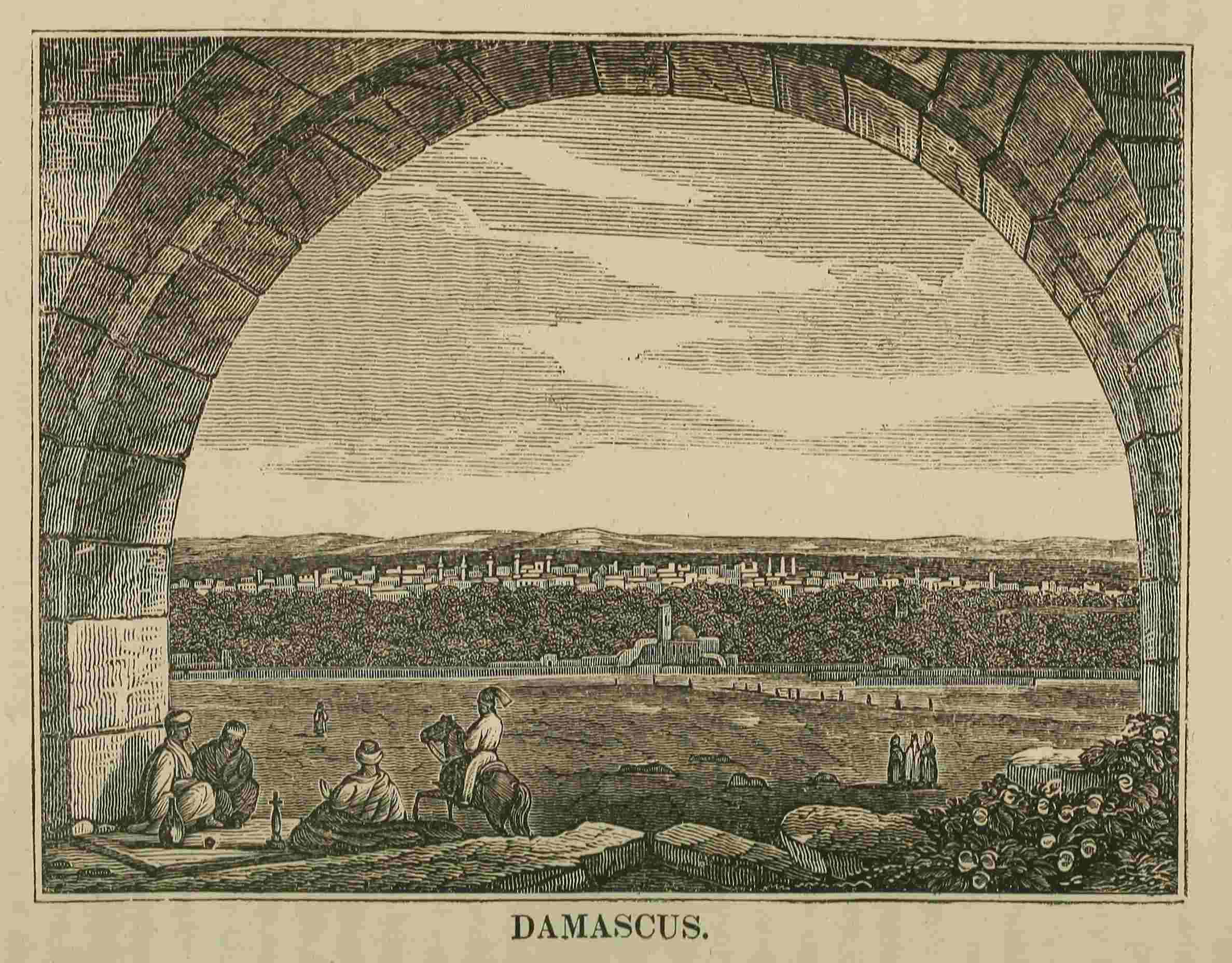
DAMASCUS.
Descending from the north-eastern slope of Hermon, over whose mighty range his last day’s journey had conducted him, Saul came along the course of the Abana, to the last hill which overlooks the distant city. Here Damascus bursts upon the traveler’s view, in the midst of a mighty plain, embosomed in gardens, and orchards, and groves, which, with the long-known and still bright streams of Abana and Pharphar, and the golden flood of the Chrysorrhoas, give the spot the name of “one of the four paradises.” So lovely and charming is the sight which this fair city has in all ages presented to the traveler’s view, that the Turks relate that their prophet, coming near Damascus, took his station on the mountain Salehiyeh, on the west of the hill-girt plain in which the city stands; and as he thence viewed the glorious and beautiful spot, encompassed with gardens for thirty miles, and thickly set with domes and steeples, over which the eye glances as far as it can reach,――considering the ravishing beauty of the place, he would not tempt his frailty by entering into it, but instantly turned away with this reflection: that there was but one paradise designed for man, and for his part, he was resolved not to take his, in this world. And though there is not the slightest foundation for such a story, because the prophet never came near to Damascus, nor had an opportunity of entering into it, yet the conspiring testimony of modern travelers justifies the fable, in the impression it conveys of the surpassing loveliness of the view from this very spot,――called the Arch of Victory, from an unfinished mass of stonework which here crowns the mountain’s top. This spot has been marked by a worthless tradition, as the scene of Saul’s conversion; and the locality is made barely probable, by the much better authority of the circumstance, that it accords with the sacred narrative, in being on the road from Jerusalem, and “nigh unto the city.”
“Damascus is a very ancient city, which the oldest records and traditions show by their accordant testimony to have been founded by Uz, the son of Aram, and grandson of Shem. It was the capital or mother city of that Syria which is distinguished by the name of Aram Dammesek or Damascene Syria, lying between Libanus and Anti-Libanus. The city stands at the base of Mount Hermon, from which descend the famous streams of Abana and Pharphar; the latter washing the walls of the city, while the former cuts it through the middle. It was a very populous, delightful, and wealthy place; but as in the course of its existence it had suffered a variety of fortune, so it had often changed masters. To pass over its earlier history, we will only observe, that before the Christian era, on the defeat of Tigranes, the Armenian monarch, it was yielded to the Romans, being taken by the armies of Pompey. In the time of Paul, as we are told in ♦2 Corinthians xi. 32, it was held under the (temporary) sway of Aretas, a king of the Arabians, father-in-law of Herod the tetrarch. It had then a large Jewish population, as we may gather from the fact, that in the reign of Nero, 10,000 of that nation were slaughtered, unarmed, and in the public baths by the Damascenes, as Josephus records in his history of the Jewish War, II. Book, chapter 25. Among the Jews of Damascus, also, were a considerable number of Christians, and it was raging for the destruction of these, that Saul, furnished with the letters and commission of the Jewish high priest, now flew like a hawk upon the doves.” (Witsius, § 2, ¶ 1.)
The sacred narrative gives no particulars of the other circumstances connected with this remarkable event, in either of the three statements presented in different parts of the book of Acts. All that is commemorated, is that at mid-day, as Saul with his company drew near to Damascus, he saw a light exceeding the sun in brightness, which flashed upon them from heaven, and struck them all to the earth. And while they were all fallen to the ground, Saul alone heard a voice speaking to him in the Hebrew tongue, and saying, “Saul! Saul! Why persecutest thou me? It is hard for thee to kick against thorns.” To this, Saul asked in reply, “Who art thou, Lord?” The answer was, “I am Jesus the Nazarene, whom thou persecutest.” Saul, trembling and astonished, replied, “Lord, what wilt thou that I should do?” And the voice said, “Rise and stand upon thy feet, and go into the city; there thou shalt be told what to do, since for this purpose I have appeared to thee, to make use of thee as a minister and a witness, both of what thou hast seen and of what I will cause thee to see,――choosing thee out of the people, and of the heathen nations to whom I now SEND thee,――to open their eyes,――to turn them from darkness to light, and from the dominion of Satan unto God, that they may receive remission of sins, and an inheritance among them that are sanctified, by faith in me.”
These words are given thus fully only in Saul’s own account of his conversion, in his address to king Agrippa. (Acts xxvi. 14‒18.) The original Greek of verse 17, is most remarkably and expressively significant, containing, beyond all doubt, the formal commission of Saul as the “Apostle of the Gentiles.” The first word in that verse is translated in the common English version, “delivering;” whereas, the original, Εξαιρουμενος, means also “taking out,” “choosing;” and is clearly shown by Bretschneider, sub voc. in numerous references to the usages of the LXX., and by Kuinoel, in loc., to bear this latter meaning here. Rosenmueller and others however, have been led, by the circumstance that Hesychius gives the meaning of “rescue,” to prefer that. Rosenmueller’s remark, that the context demands this meaning, is however certainly unauthorized; for, on this same ground, Kuinoel bases the firmest support of the meaning of “choice.” The meaning of “rescue” was indeed the only one formerly received, but the lights of modern exegesis have added new distinctness and aptness to the passage, by the meaning adopted above. Beza, Piscator, Pagninus, Arias Montanus, Castalio, &c., as well as the oriental versions, are all quoted by Poole in defense of the common rendering, nor does he seem to know of the sense now received. But Saul was truly chosen, both “out of the people” of Israel, (because he was a Jew by birth and religion,) “and out of the heathen,” (because he was born and brought up among the Grecians, and therefore was taken out from among them, as a minister of grace to them,) and the whole passage is thus shown to be most beautifully just to the circumstances which so eminently fitted him for his Gentile apostleship. The Greek verb used in the conclusion of the passage, is the consecrating word, αποστελλω, (apostello,) and makes up the formula of his apostolic commission, which is there given in language worthy of the vast and eternal scope of the sense,――words fit to be spoken from heaven, in thunder, amid the flash of lightnings, that called the bloody-minded, bitter, maddened persecutor, to the peaceful, devoted, unshrinking testimony of the cause, against the friends of which he before breathed only threatenings and slaughter.