I. THE GALILEAN APOSTLES.
Reading edition
SIMON CEPHAS, COMMONLY CALLED SIMON PETER.
HIS APOSTOLIC RANK.
The order in which the names of the apostles are arranged in this book, can make little difference in the interest which their history will excite in the reader’s mind, nor can such an arrangement, of itself, do much to affect his opinion of their comparative merits; yet to their biographer, it becomes a matter of some importance, as well as interest, to show not only authority, but reason, for the order in which he ranks them.
Sufficient authority for placing Simon Cephas first, is found in the three lists of the apostles given respectively by Matthew, Mark and Luke, which, though differing as to their arrangement in some particulars, entirely agree in giving to this apostle the precedence of all. But it would by no means become the earnest and faithful searcher into sacred history, to rest satisfied with a bare reference to the unerring word, on a point of so much interest. So far from it, the strictest reverence for the sacred record both allows and urges the inquiry, as to what were the circumstances of Peter’s life and character, that led the three evangelists thus unanimously and decidedly to place him at the head of the sacred band, on all whom, in common, rested the commissioned power of doing the marvelous works of Jesus, and spreading his gospel in all the world. Was this preference the result of mere incidental circumstances, such as age, prior calling, &c.? Or, does it mark a pre-eminence of character or qualifications, entitling him to lead and rule the apostolic company in the name of Christ, as the commissioned chief of the faithful?
The reason of this preference, as far as connected with his character, will of course be best shown in the incidents of his life and conduct, as detailed in this narrative. But even here much may be brought forward to throw light on the ground of Peter’s rank, as first of the apostles. It is no more than fair to remark, however, that some points of this inquiry have been very deeply, and at the same time, very unnecessarily involved in the disputes between Protestants and Papists, respecting the original supremacy of the church of Rome, as supposed to have been founded or ruled by this chief apostle.
Of the many suppositions which might be made to account for Peter’s priority of station on the apostolic list, it may be enough to notice the following: That he was by birth the oldest of the twelve. This assertion, however boldly made by some, rests entirely on conjecture, as we have no certain information on this point, either from the New Testament or any ancient writer of indisputable credit. Those of the early Christian writers who allude to this matter, are quite contradictory in their statements, some supposing Peter to be the oldest of the apostles, and some supposing Andrew to be older than his brother;――a discrepancy that may well entitle us to conclude that they had no certain information about the matter. The weight of testimony, however, seems rather against the assertion that Peter was the oldest, inasmuch as the earliest writer who alludes at all to the subject, very decidedly pronounces Andrew to have been the older brother. Enough, then, is known, to prevent our relying on his seniority as the true ground of his precedence. Still this point must be considered as entirely doubtful; so doubtful that it cannot be considered as proof, in the argument.
The oldest Christian writer, who refers in any way to the comparative age of Peter, is Epiphanius, bishop of Cyprus, as early as A. D. 368. In his great work against heresies, (book ii. vol. 1, heresy 51,) in narrating the call of Andrew and Peter, he says, “The meeting (with Jesus) happened first to Andrew, Peter being less than him in age,” (μικροτερου οντος τω χρονῳ της ἡλικιας.) “But afterwards, when their complete forsaking of all earthly things is mentioned, Peter takes precedence, since God, who sees the turn of all characters, and knows who is fit for the highest places, chose Peter as the chief leader (αρχηγον) of his disciples.” This, certainly, is a very distinct assertion of Peter’s juniority, and is plainly meant to give the idea that Peter’s high rank among the apostles was due to a superiority of talent, which put him above those who were older.
In favor of the assertion that Peter was older than Andrew, the earliest authority that has ever been cited, is John Chrysostom, bishop of Constantinople, about A. D. 400. This Father, in his homily on Matthew xvii. 27, (Homily 59,) says that Peter was a “first-born son,” (πρωτοτοκος.) In this passage, he is speaking of the tribute paid by Jesus and Peter for the expenses of the temple. He supposes that this tribute was the redemption-money due from the first-born sons of the Jews, for their exemption from the duties of the priesthood. But the account of this tax, in Numbers iii. 44‒51, shows that this was a tax of five shekels apiece, while that spoken of by Matthew, is called the didrachmon, a Greek coin equivalent to a half-shekel. Now the half-shekel tax was that paid by every Jew above the age of twenty years, for the expenses of the temple service, as is fully described in Exodus xxx. 12‒16; xxxviii. 26. Josephus also mentions this half-shekel tax, as due from every Jew, for the service of the temple. (See Hammond on Matthew xvii. 24.) Chrysostom is therefore wholly in the wrong, about the nature of the tax paid by Jesus and Peter; (verse 27, “give it for me and thee,”) and the reason which he gives for the payment, (namely, that they were both first-born sons,) being disproved, his belief of Peter’s seniority is shown to be based on an error, and therefore entitled to no credit whatever; more particularly, when opposed to the older authority of Epiphanius.
Lardner, in support of the opinion that Peter was the oldest, quotes also Cassian and Bede; but it is most manifest that a bare assertion of two writers, who lived, one of them 424, and the other 700 years after Christ,――an assertion unsupported by any proof whatever, cannot be received as evidence in the case. The most natural conjecture of any one who was accounting for the eminence of Peter, would be that he was older than the brother of whom he takes precedence so uniformly; and it is no more than just to conclude, therefore, that the ground of this notion was but a mere guess. But in the case of Epiphanius, besides the respect due to the early authority, it is important to observe, that he could have no motive for inventing the notion of Andrew’s seniority, since the uniform prominence of Peter would most naturally suggest the idea that he was the oldest. It is fair to conclude, then, that an opinion, so unlikely to be adopted without special proof, must have had the authority of uniform early tradition; for Epiphanius mentions it as if it were a universally admitted fact; nor does he seem to me to have invented the notion of Andrew’s seniority, to account for his being first known to Jesus, though he mentions these two circumstances in their natural connection. Yet Lampius, in his notes on John i. supposing that Epiphanius arranged the facts on the principle “post hoc, ergo, propter hoc,” has rejected this Father’s declaration of Andrew’s seniority, as a mere invention, to account for this apostle’s prior acquaintance with Jesus. The reader may judge between them.
Lardner, moreover, informs us that Jerome maintains the opinion, that Peter was preferred before the other apostles on account of his age. But a reference to the original passage, shows that the comparison was only between Peter and John, and not between Peter and the rest of the apostles. Speaking of Peter as the constituted head of the church, he says that was done to avoid dissensions, (ut schismatis tollatur occasio.) The question might then arise, why was not John chosen first, being so pure and free from connections that might interfere with apostolic duties? (Cur non Johannes electus est virgo? Aetati delatum est, quia Petrus senior erat; ne adhuc adolescens ac pene puer progressae aetatis hominibus praeferretur.) “It was out of regard to age, because Peter was older (than John;) nor could one who was yet immature, and little more than a boy, be preferred to a man of mature age.” The passage evidently does not touch the question of Peter’s being the oldest of all, nor does it contradict, in any way, the opinion that Andrew was older, as all which Jerome says is, merely, that Peter was older than John,――an opinion unquestionably accordant with the general voice of all ancient Christian tradition.
The character of Epiphanius, however, it must be acknowledged, is so low for judgment and accuracy, that his word is not of itself sufficient to establish any very doubtful fact, as certain. Yet in this case, there is no temptation to pervert facts on a point of so little interest or importance, and one on which no prejudice could govern his decision. We may therefore give him, in this matter, about all the credit due to his antiquity. Still, there is much more satisfactory proof of Peter’s not being the oldest apostle, founded on various circumstances of apostolic history, which will be referred to in their places.
Nor can priority of calling be offered as the reason of this apparent superiority; for the minute record given by the evangelist John, makes it undeniable that Andrew became acquainted with Jesus before Peter, and that the eminent disciple was afterwards first made known to Jesus, by means of his less highly honored brother.
The only reasonable supposition left, then, is, that there was an intentional preference of Simon Cephas, on the score of eminence for genius, zeal, knowledge, prudence, or some other quality which fitted him for taking the lead of the chief ministers of the Messiah. The word “first,” which accompanies his name in Matthew’s list, certainly appears, in the view of some, to have some force above the mere tautological expression of a fact so very self-evident from the collocation, as that he was first on the list. The Bible shows not an instance of a list begun in that way, with this emphatic word so vainly and unmeaningly applied. The analogies of expression in all languages, ancient and modern, would be very apt to lead a common reader to think that the numeral adjective thus prefixed, was meant to give the idea that Simon Peter was put first for some better reason than mere accident. Any person, in giving a list of twelve eminent men, all devoted to a common pursuit, and laboring in one great cause, whose progress he was attempting to record, would, in arranging them, if he disregarded the circumstances of seniority, &c., very naturally give them place according to their importance in reference to the great subject before him. If, as in the present case, three different persons should, in the course of such a work, make out such a list, an individual difference of opinion about a matter of mere personal preference, like this, might produce variations in the minor particulars; but where all three united in giving to one and the same person, the first and most honorable place, the ordinary presumption would unavoidably be, that the prior rank of the person thus distinguished, was considered, by them at least, at the time when they wrote, as decidedly and indisputably established. The determination of a point so trifling being without any influence on matters of faith and doctrine, each evangelist might, without detriment to the sanctity and authority of the record which he bears, be left to follow his own private opinion of the most proper principle of arrangement to be followed in enumerating the apostles. Thus, while it is noticeable that the whole twelve were disposed in six pairs by each of the evangelists, yet the order and succession of these is somewhat changed, by different circumstances directing the choice of each writer. Matthew modestly puts himself after Thomas, with whom he seems by all the gospel lists, to have some close connection; but Mark and Luke combine to give Matthew the precedence, and invert the order in which, through unobtrusiveness, he had, as it would seem, robbed true merit of its due superiority. And yet these points of precedence were so little looked to, that in the first chapter of Acts, Luke makes a new arrangement of these names, advancing Thomas to the precedency, not only of Matthew, but of Bartholomew, who, in all other places where their names are given, is mentioned before him. So also Matthew prefers to mention the brothers together, and gives Andrew a place immediately after Peter, although, in so many places after, he speaks of Peter, James and John together, as most highly distinguished by Christ, and favored by opportunities of beholding him and his works, on occasions when other eyes were shut out. Mark, on the contrary, gives these names with more strict reference to distinction of rank, and mentions the favored trio together, first of all, making the affinities of birth of less consequence than the share of favor enjoyed by each with the Messiah. Luke, in his gospel, follows Matthew’s arrangement of the brothers, but in the first chapter of Acts puts the three great apostles first, separating Andrew from his brother, and mentioning him after the sons of Zebedee. These changes of arrangement, while they show of how little vital importance the order of names was considered, yet, by the uniform preservation of Peter in the first rank, prove that the exalted pre-eminence of Peter was so universally known and acknowledged, that whatever difference of opinion writers might entertain respecting more obscure persons,――as to him, no inversion of order could be permitted.
How far Peter was by this pre-eminence endowed with any supremacy over the other apostles, may of course be best shown in those places of his history, which appear either to maintain or question this position.
That Simon Cephas, or Peter, then, was the first or chief of the apostles, appears from the uniform precedence with which his name is honored on all occasions in the Scriptures, where the order in which names are mentioned could be made to depend on rank,――by the universal testimony of the Fathers, and by the general impressions entertained on this point throughout the Christian world, in all ages since his time.
HIS BIRTH.
From two separate passages in the gospels, we learn that the name of the father of Simon Peter was Jonah, but beyond this we have no direct information as to his family. From the terms in which Peter is frequently mentioned along with the other apostles, we infer, however, that he must have been from the lowest order of society, which also appears from the business to which he devoted his life, before he received the summons that sent him forth to the world, on a far higher errand. Of such a humble family, he was born at Bethsaida, in Galilee, on or near the shore of the sea of Galilee, otherwise called lake Tiberias, or Gennesaret. Upon this lake he seems to have followed his laborious and dangerous livelihood, which very probably, in accordance with the hereditary succession of trades, common among the Jews, was the occupation of his father and ancestors before him. Of the time of his birth no certain information can be had, as those who were able to inform us, were not disposed to set so high a value upon ages and dates, as the writers and readers of later times. The most reasonable conjecture as to his age, is, that he was about the same age with Jesus Christ; which rests on the circumstances of his being married at the period when he was first called by Christ,――his being made the object of such high confidence and honor by his Master, and the eminent standing which he seems to have maintained, from the first, among the apostles. Still there is nothing in all these circumstances, that is irreconcilable with the supposition that he was younger than Christ; and if any reader prefers to suppose the period of his birth so much later, there is no important point in his history or character that will be affected by such a change of dates.
Bethsaida.――The name of this place occurs in several passages of gospel history, as connected with the scenes of the life of Jesus. (Matthew xi. 21; Mark vi. 45, viii. 22‒26; Luke ix. 10, x. 13; John i. 45, xii. 21.) The name likewise occurs in the writings of Josephus, who describes Bethsaida, and mentions some circumstances of its history. The common impression among the New Testament commentators has been, that the Bethsaida which is so often mentioned in the gospels, was on the western shore of lake Gennesaret, near the other cities which were the scenes of important events in the life of Jesus. Yet Josephus distinctly implies that Bethsaida was situated on the eastern shore of the lake, as he says that it was built by Philip the tetrarch, in Lower Gaulonitis, (Jewish war, book ii. chapter 9, section 1,) which was on the eastern side of the Jordan and the lake, though not in Peraea, as Lightfoot rather hastily assumes; for Peraea, though by its derivation (from περαν, peran, “beyond,”) meaning simply “what was beyond” the river, yet was, in the geography of Palestine, applied to only that portion of the country east of Jordan, which extends from Moab on the south, northward, to Pella, on the Jabbok. (Josephus, Jewish war, book iii. chapter 3, section 3.) Another point in which the account given by Josephus differs from that in the gospels, is, that while Josephus places Bethsaida in Gaulonitis, John (xii. 21,) speaks of it distinctly as a city of Galilee, and Peter, as well as others born in Bethsaida, is called a Galilean. These two apparent disagreements have led many eminent writers to conclude that there were on and near the lake, two wholly different places bearing the name of Bethsaida. Schleusner, Bretschneider, Fischer, Pococke, Reland, Michaelis, Kuinoel, Rosenmueller, and others, have maintained this opinion with many arguments. But Lightfoot, Cave, Calmet, Baillet, Macknight, Wells, and others, have decided that these differences can be perfectly reconciled, and all the circumstances related in the gospels, made to agree with Josephus’s account of the situation of Bethsaida.
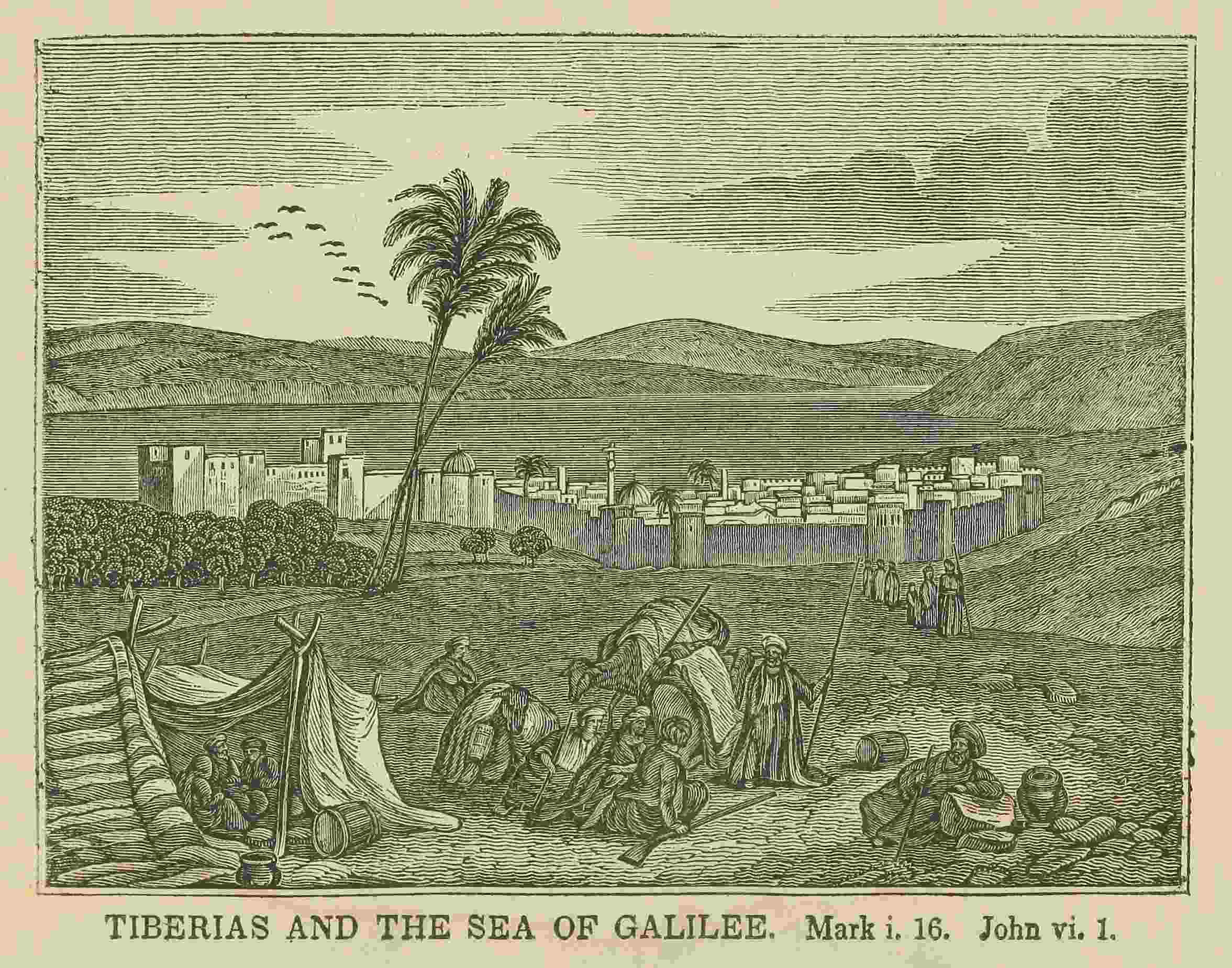
TIBERIAS AND THE SEA OF GALILEE. Mark i. 16. John vi. 1.
The first passage in which Josephus mentions this place, is in his Jewish Antiquities, book xviii. chapter 2, section 1. “And he, (Philip) having granted to the village of Bethsaida, near the lake of Gennesaret, the rank of a city, by increasing its population, and giving it importance in other ways, called it by the name of Julia, the daughter of Caesar,” (Augustus.) In his History of the Jewish War, book ii. chapter 9, section 1, he also alludes to it in a similar connection. Speaking, as in the former passage, of the cities built by Herod and Philip in their tetrarchies, he says, “The latter built Julias, in Lower Gaulanitis.” In the same history, book iii. chapter 9, section 7, describing the course of the Jordan, he alludes to this city. “Passing on (from lake Semechonitis,) one hundred and twenty furlongs farther, to the city Julias, it flows through the middle of lake Gennesar.” In this passage I translate the preposition μετα (meta,) by the English “to,” though Hudson expresses it in Latin by “post,” and Macknight by the English “behind.” Lightfoot very freely renders it “ante,” but with all these great authorities against me, I have the consolation of finding my translation supported by the antique English version of the quaint Thomas Lodge, who distinctly expresses the preposition in this passage by “unto.” This translation of the word is in strict accordance with the rule that this Greek preposition, when it comes before the accusative after a verb of motion, has the force of “to,” or “against.” (See Jones’s Lexicon, sub voc. μετα; also Hederici Lexicon.) But in reference to places, it never has the meaning of “behind,” given to it by Macknight, nor of “post,” in Latin, as in Hudson’s translation, still less of “ante,” as Lightfoot very queerly expresses it. The passage, then, simply means that the Jordan, after passing out of lake Semechonitis, flows one hundred and twenty furlongs to the city of Julias or Bethsaida, (not behind it, nor before it,) and there enters lake Gennesar, the whole expressing as clearly as may be, that Julias stood on the river just where it widens into the lake. That Julias stood on the Jordan, and not on the lake, though near it, is made further manifest, by a remark made by Josephus, in his memoirs of his own life. He, when holding a military command in the region around the lake, during the war against the Romans, on one occasion, sent against the enemy a detachment of soldiers, who “encamped near the river Jordan, about a furlong from Julias.” (Life of Josephus, section 72.)
It should be remarked, moreover, that, at the same time when Philip enlarged Bethsaida, in this manner, and gave it the name of Julia, the daughter of Augustus Caesar, his brother Herod Antipas, tetrarch of Galilee and Peraea, with a similar ambition to exalt his own glory, and secure the favor of the imperial family, rebuilt a city in his dominions, named Betharamphtha, to which he gave the name Julias also; but in honor, not of the daughter, but of the wife of Augustus, who bore the family name, Julia, which passed from her to her daughter. This multiplication of namesake towns, has only created new confusion for us; for the learned Lightfoot, in his Chorographic century on Matthew, has unfortunately taken this for the Julias which stood on the Jordan, at its entrance into the lake, and accordingly applies to Julias-Betharamphtha, the last two quotations from Josephus, given above, which I have applied to Julias-Bethsaida. But it would seem as if this most profound Biblical scholar was certainly in the wrong here; since Julias-Betharamphtha must have been built by Herod Antipas within his own dominions, that is, in Galilee proper, or Peraea proper, as already bounded; and Josephus expressly says that this Julias was in Peraea; yet Lightfoot, in his rude little wood-cut map, (Horae Hebraica et Talmudicae in Marci, Decas Chorographica chapter v.) has put this in Gaulanitis, far north of its true place, at the influx of the Jordan into the lake, (“ad ipsissimum influxum Jordanis in lacum Gennesariticum,”) and Julias-Bethsaida, also in Gaulanitis, some miles lower down, at the south-east corner of the lake, a position adopted by no other writer that I know of. This peculiarity in Lightfoot’s views, I have thus stated at length, that those who may refer to his Horae for more light, might not suppose a confusion in my statement, which does not exist; for since the Julias-Betharamphtha of Herod could not have been in Gaulanitis, but in Peraea, the Julias at the influx of the Jordan into the lake, must have been the Bethsaida embellished by Philip, tetrarch of Iturea and Trachonitis, (Luke iii. 1,) which included Gaulanitis, Batanea, &c. east of Jordan and the lake, and north of Peraea proper. The substance of Josephus’s information on this point, is, therefore, that Bethsaida stood on the eastern side of the Jordan, just where it enters lake Gennesar, or Gennesaret, (otherwise called lake Tiberias and the sea of Galilee,)――that it stood in the province of Gaulanitis, within the dominions of Philip, son of Herod the Great, and tetrarch of all that portion of Palestine which lies north of Peraea, on the east of Jordan, and the lake, as well as of the region north of Galilee, his tetrarchy forming a sort of crescent,――that this prince, having enlarged and embellished Bethsaida, raised it from a village to the rank of a city, by the name of Julias, in honor of Julia, daughter of Augustus Caesar. This was done during the reign of Augustus, (Josephus, in Jewish Antiquities book i. chapter 2, section 1,) and of course long before Jesus Christ began his labors, though after his birth, because it was after the death of Herod the Great.
The question now is, whether the Bethsaida mentioned by the evangelists is by them so described as to be in any way inconsistent with the account given by Josephus, of the place to which he gives that name. The first difficulty which has presented itself to the critical commentators, on this point, is the fact, that the Bethsaida of the gospels is declared in them to have been a city of Galilee, (John xii. 21,) and those who were born and brought up in it are called Galileans, (Mark xiv. 70, Luke xxii. 59, Acts i. 7, ii. 7.) Yet Josephus expressly tells us, that Bethsaida was in Gaulanitis, which was not in Galilee, as he bounds it, but was beyond its eastern boundary, on the eastern side of the river and lake. (Jewish war, book xviii. chapter 2, section 1.) This is therefore considered by many, as a diversity between the two accounts, which must make it impossible to apply them both to the same place. But there is no necessity for such a conclusion. The different application of the term Galilee, in the two books, must be noticed, in order to avoid confusion. Josephus is very exact in the use of names of places and regions, defining geographical positions and boundaries with a particularity truly admirable. Thus, in mentioning the political divisions of Palestine, he gives the precise limits of each, and uses their names, not in the loose, popular way, but only in his own accurate sense. But the gospel writers are characterized by no such minute particularity, in the use of names, which they generally apply in the popular, rather than the exact sense. Thus, in this case, they use the term Galilee, in what seems to have been its common meaning in Judea, as a name for all the region north of Samaria and Peraea, on both sides of the Jordan, including, of course, Gaulanitis and all the dominions of Philip. The difference between them and Josephus, on this point, is very satisfactorily shown in another passage. In Acts v. 37, Gamaliel, speaking of several persons who had at different times disturbed the peace of the nation, mentions one Judas, the Galilean, as a famous rebel. Now this same person is very particularly described by Josephus, (Jewis Antiquities book xv. chapter 1, section 1,) in such a manner that there can be no doubt of his identity with the previous description. Yet Josephus calls him distinctly, Judas the Gaulanite, and only once Judas the Galilean; showing him to have been from the city of Gamala, in the country east of Jordan and the lake; so that the conclusion is unavoidable, that the term Galilee is used in a much wider sense in the New Testament than in Josephus, being applied indiscriminately to the region on both sides of the lake. The people of southern Palestine called the whole northern section Galilee, and all its inhabitants, Galileans, without attending to the nicer political and geographical distinctions; just as the inhabitants of the southern section of the United States, high and low, call every stranger a Yankee, who is from any part of the country north of Mason and Dixon’s line, though well-informed people perfectly well know, that the classic and not despicable name of Yankee belongs fairly and truly to the ingenious sons of New England alone, who have made their long-established sectional title so synonymous with acuteness and energy, that whenever an enterprising northerner pushes his way southward, he shares in the honors of this gentile appellative. Just in the same vague and careless way, did the Jews apply the name Galilean to all the energetic, active northerners, who made themselves known in Jerusalem, either by their presence or their fame; and thus both Judas of Gaulanitis, and those apostles who were from the eastern side of the river, were called Galileans, as well as those on the west, in Galilee proper. Besides, in the case of Bethsaida, which was immediately on the line between Galilee and Gaulanitis, it was still more natural to refer it to the larger section on the west, with many of whose cities it was closely connected.
Besides, that the Jews considered Galilee as extending beyond Jordan, is most undeniably clear from Isaiah ix. 1, where the prophet plainly speaks of “Galilee of the nations, as being by the side of the sea, beyond Jordan.” This was the ancient Jewish idea of the country designated by this name, and the idea of limiting it to the west of Jordan, was a mere late term introduced by the Romans, and apparently never used by the Jews of the gospel times, except when speaking of the political divisions of Palestine. The name Gaulanitis, which is the proper term for the province in which Bethsaida was, never occurs in the bible. Kuinoel, Rosenmueller, &c. give a different view, however, of “beyond Jordan,” on Matthew iv. 15.
But a still more important difficulty has been suggested, in reference to the identity of the place described by Josephus, with that mentioned in the gospels. This is, the fact that in the gospels it is spoken of in such a connection, as would seem to require its location on the western side. A common, but very idle argument, in favor of this supposition, is, that Bethsaida is mentioned frequently along with Capernaum and other cities of Galilee proper, in such immediate connection as to make it probable that it was on the same side of the river and lake with them. But places separated merely by a river, or at most by a narrow lake, whose greatest breadth was only five miles, could not be considered distant from each other, and would very naturally be spoken of as near neighbors. The most weighty argument, however, rests on a passage in Mark vi. 45, where it is said that Jesus constrained his disciples to “get into a vessel, to go before him to the other side unto Bethsaida,” after the five thousand had been fed. Now the parallel passage in John vi. 17, says that they, following this direction, “went over the sea towards Capernaum,” and that when they reached the shore, “they came into the land of Gennesaret,” both which are understood to be on the western side. But on the other hand, we are distinctly told, by Luke, (ix. 10,) that the five thousand were fed in “a desert place, belonging to (or near) the city which is called Bethsaida.” On connecting these two passages, therefore, (in John and Mark,) according to the common version, the disciples sailed from Bethsaida on one side, to Bethsaida on the other, a construction which has been actually adopted by those who maintain the existence of two cities of the same name on different sides of the lake. But what common reader is willing to believe, that in this passage Luke refers to a place totally different from the one meant in all other passages where the name occurs, and more particularly in the very next chapter, (x. 13,) where he speaks of the Bethsaida which had been frequented before by Jesus, without a word of explanation to show that it was a different place? But in the expression, “to go before him to the other side, TO Bethsaida,” the word “TO” may be shown, by a reference to the Greek, to convey an erroneous idea of the situation of the places. The preposition προς, (pros,) may have, not merely the sense of to, with the idea of motion towards a place, but in some passages even of Mark’s gospel, may be most justly translated “near,” or “before,” (as in ii. 2, “not even about” or “before” the door, and in xi. 4, “tied by” or before “the door.”) This is the meaning which seems to be justified by the collocation here, and the meaning in which I am happy to find myself supported by the acute and accurate Wahl, in his Clavis Novi Testamenti under προς, which he translates in this passage by the Latin juxta, prope ad; and the German bey, that is, “by,” “near to,” a meaning supported by the passage in Herodotus, to which he refers, as well as by those from Mark himself, which are given above, from Schleusner’s references under this word, (definition 7.) Scott, in order to reconcile the difficulties which he saw in the common version, has, in his marginal references, suggested the meaning of “over against,” a rendering, which undoubtedly expresses correctly the relations of objects in this place, and one, perhaps, not wholly inconsistent with Schleusner’s 7th definition, which is in Latin ante, or “before;” since what was before Bethsaida, as one looked from that place across the river, was certainly opposite to that city. I had thought of this meaning as a desirable one in this passage, but had rejected it, before I saw it in Scott, for the reason, that I could not find this exact meaning in any lexicon, nor was there any other passage in Greek, in which this could be distinctly recognized as the proper one. The propriety of the term, however, is also noticed, in the note on this passage in the great French Bible, with commentaries, harmonies, &c. (Sainte Bible en Latin et Francois avec des notes, &c. Vol. xiv. p. 263, note,) where it is expressed by “l’autre cote du lac, vis-a-vis Bethsaide: c. a. d. sur le bord occidental opposé a la ville Bethsaide que etait sur le bord oriental,” a meaning undoubtedly geographically correct, but not grammatically exact, and I therefore prefer to take “near,” as the sense which both reconciles the geographical difficulties, and accords with the established principles of lexicography.
After all, the sense “to” is not needed in this passage, to direct the action of the verb of motion (προαγειν, proagein, “go before,”) to its proper object, since that is previously done by the former preposition and substantive, εις το περαν, (eis to peran.) That is, when we read “Jesus constrained his disciples to go before him,” and the question arises in regard to the object towards which the action is directed, “Whither did he constrain them to go before him?” the answer is in the words immediately succeeding, εις το περαν, “to the other side,” and in these words the action is complete; but the mere general direction, “to the other side,” was too vague of itself, and required some limitation to avoid error; for the place to which they commonly directed their course westward, over the lake, was Capernaum, the home of Jesus, and thither they might on this occasion be naturally expected to go, as we should have concluded they did, if nothing farther was said; therefore, to fix the point of their destination, we are told, in answer to the query, “To what part of the western shore were they directed to go?” “To that part which was near or opposite to Bethsaida.” The objection which may arise, that a place on the western side could not be very near to Bethsaida on the east, is answered by the fact that this city was separated from the western shore, not by the whole breadth of the lake, but simply by the little stream of Jordan, here not more than twenty yards wide, so that a place on the opposite side might still be very near the city. And this is what shows the topographical justness of the term, “over against,” given by Scott, and the French commentator, since a place not directly across or opposite, but down the western shore, in a south-westerly direction, as Capernaum was, would not be very near Bethsaida, nor much less than five miles off. Thus is shown a beautiful mutual illustration of the literal and the liberal translations of the word.
Macknight ably answers another argument, which has been offered to defend the location of Bethsaida on the western shore, founded on John vi. 23. “There came other boats from Tiberias, nigh unto the place where they did eat bread,” as if Tiberias had been near the desert of Bethsaida, and consequently near Bethsaida itself. “But,” as Macknight remarks, “the original, rightly pointed, imports only, that boats from Tiberias came into some creek or bay, nigh unto the place where they did eat bread.” Besides, it should be remembered that the object of those who came in the boats, was to find Jesus, whom they expected to find “nigh the place where they ate bread,” as the context shows; so that these words refer to their destination, and not to the place from which they came. Tiberias was down the lake, at the south-western corner of it, and I know of no geographer who has put Bethsaida more than half way down, even on the western shore. The difference, therefore, between the distance to Bethsaida on the west and to Bethsaida on the east, could not be at most above a mile or two, a matter not to be appreciated in a voyage of sixteen miles, from Tiberias, which cannot be said to be near Bethsaida, in any position of the latter that has ever been thought of. This objection, of course, is not offered at all, by those who suppose two Bethsaidas mentioned in the gospels, and grant that the passage in Luke ix. 10, refers to the eastern one, where they suppose the place of eating bread to have been; but others, who have imagined only one Bethsaida, and that on the western side, have proposed this argument; and to such the reply is directed.
For all these reasons, topographical, historical and grammatical, the conclusion of the whole matter is――that there was but one Bethsaida, the same place being meant by that name in all passages in the gospels and in Josephus――that this place stood within the verge of Lower Gaulanitis, on the bank of the Jordan, just where it passes into the lake――that it was in the dominions of Philip the tetrarch, at the time when it is mentioned in the gospels, and afterwards was included in the kingdom of Agrippa――that its original Hebrew name, (from בית beth, “house,” and צדה, tsedah, “hunting, or fishing,” “a house of fishing,” no doubt so called from the common pursuit of its inhabitants,) was changed by Philip into Julias, by which name it was known to Greeks and Romans.
By this view, we avoid the undesirable notion, that there are two totally different places mentioned in two succeeding chapters of the same gospel, without a word of explanation to inform us of the difference, as is usual in cases of local synonyms in the New Testament; and that Josephus describes a place of this name, without the slightest hint of the remarkable fact, that there was another place of the same name, not half a mile off, directly across the Jordan, in full view of it.
The discussion of the point has been necessarily protracted to a somewhat tedious length; but if fewer words would have expressed the truth and the reasons for it, it should have been briefer; and probably there is no reader who has endeavored to satisfy himself on the position of Bethsaida, in his own biblical studies, that will not feel some gratitude for what light this note may give, on a point where all common aids and authorities are in such monstrous confusion.
For the various opinions and statements on this difficult point, see Schleusner’s, Bretschneider’s and Wahl’s Lexicons, Lightfoot’s Chorographic century and decade, Wetstein’s New Testament commentary on Matthew iv. 12, Kuinoel, Rosenmueller, Fritzsche, Macknight, &c. On the passages where the name occurs, also the French Commentary above quoted,――more especially in Vol. III. Remarques sur le carte geographique section 7, p. 357. Paulus’s “commentar ueber das neue Testament,” 2d edition, Vol. II. pp. 336‒342. Topographische Erlaeuterungen.
Lake Gennesaret.――This body of water, bearing in the gospels the various names of “the sea of Tiberias,” and “the sea of Galilee,” as well as “the lake of Gennesaret,” is formed like one or two other smaller ones north of it, by a widening of the Jordan, which flows in at the northern end, and passing through the middle, goes out at the southern end. On the western side, it was bounded by Galilee proper, and on the east was the lower division of that portion of Iturea, which was called Gaulanitis by the Greeks and Romans, from the ancient city of Golan, (Deuteronomy iv. 43; Joshua xx. 8, &c.) which stood within its limits. Pliny (book I. chapter 15,) well describes the situation and character of the lake. “Where the shape of the valley first allows it, the Jordan pours itself into a lake which is most commonly called Genesara, sixteen (Roman) miles long, and six broad. It is surrounded by pleasant towns; on the east, it has Julias (Bethsaida) and Hippus; on the south, Tarichea, by which name some call the lake also; on the west, Tiberias with its warm springs.” Josephus also gives a very clear and ample description. (Jewish War, book 3, chapter 9, section 7.) “Lake Gennesar takes its name from the country adjoining it. It is forty furlongs (about five or six miles) in width, and one hundred and forty (seventeen or eighteen miles) in length; yet the water is sweet, and very desirable to drink; for it has its fountain clear from swampy thickness, and is therefore quite pure, being bounded on all sides by a beach, and a sandy shore. It is moreover of a pleasant temperature to drink, being warmer than that of a river or a spring, on the one hand, but colder than that which stands always expanded over a lake. In coldness, indeed, it is not inferior to snow, when it has been exposed to the air all night, as is the custom with the people of that region. In it there are some kinds of fish, different both in appearance and taste from those in other places. The Jordan cuts through the middle of it.” He then gives a description of the course of the Jordan, ending with the remark quoted in the former note, that it enters the lake at the city of Julias. He then describes, in glowing terms, the richness and beauty of the country around, from which the lake takes its name,――a description too long to be given here; but the studious reader may find it in section eighth of the book and chapter above referred to. The Rabbinical writers too, often refer to the pre-eminent beauty and fertility of this delightful region, as is shown in several passages quoted by Lightfoot in his Centuria Chorographica, chapter 79. The derivation of the name there given from the Rabbins, is גני סרים, ginne sarim, “the gardens of the princes.” Thence the name genne-sar. They say it was within the lands of the tribe of Naphtali; it must therefore have been on the western side of the lake, which appears also from the fact that it was near Tiberias, as we are told on the same authority. It is not mentioned in the Old Testament under this name, but the Rabbins assure us that the place called Cinnereth, in Joshua xx. 35; Chinneroth in xi. 2, is the same; and this lake is mentioned in xiii. 27, under the name of “the sea of Chinnereth,”――“the sea of Chinneroth,” in xii. 3, &c.
The best description of the scenery, and present aspect of the lake, which I can find, is the following from Conder’s Modern Traveler, Vol. 1. (Palestine) a work made up with great care from the observations of a great number of intelligent travelers.
“The mountains on the east of Lake Tiberias, come close to its shore, and the country on that side has not a very agreeable aspect; on the west, it has the plain of Tiberias, the high ground of the plain of Hutin, or Hottein, the plain of Gennesaret, and the foot of those hills by which you ascend to the high mountain of Saphet. To the north and south it has a plain country, or valley. There is a current throughout the whole breadth of the lake, even to the shore; and the passage of the Jordan through it, is discernible by the smoothness of the surface in that part. Various travelers have given a very different account of its general aspect. According to Captain Mangles, the land about it has no striking features, and the scenery is altogether devoid of character. ‘It appeared,’ he says, ‘to particular disadvantage to us, after those beautiful lakes we had seen in Switzerland; but it becomes a very interesting object, when you consider the frequent allusions to it in the gospel narrative.’ Dr. Clarke, on the contrary, speaks of the uncommon grandeur of this memorable scenery. ‘The lake of Gennesaret,’ he says, ‘is surrounded by objects well calculated to highten the solemn impression,’ made by such recollections, and ‘affords one of the most striking prospects in the Holy Land. Speaking of it comparatively, it may be described as longer and finer than any of our Cumberland and Westmoreland lakes, although perhaps inferior to Loch Lomond. It does not possess the vastness of the Lake of Geneva, although it much resembles it in certain points of view. In picturesque beauty, it comes nearest to the Lake of Locarno, in Italy, although it is destitute of any thing similar to the islands by which that majestic piece of water is adorned. It is inferior in magnitude, and in the hight of its surrounding mountains, to the Lake Asphaltites.’ Mr. Buckingham may perhaps be considered as having given the most accurate account, and one which reconciles, in some degree, the different statements above cited, when, speaking of the lake as seen from Tel Hoom, he says, ‘that its appearance is grand, but that the barren aspect of the mountains on each side, and the total absence of wood, give a cast of dulness to the picture; this is increased to melancholy, by the dead calm of its waters, and the silence which reigns throughout its whole extent, where not a boat or vessel of any kind is to be found.’
“Among the pebbles on the shore, Dr. Clarke found pieces of a porous rock, resembling toad-stone, its cavities filled with zeolite. Native gold is said to have been found here formerly. ‘We noticed,’ he says, ‘an appearance of this kind; but, on account of its trivial nature, neglected to pay proper attention to it. The water was as clear as the purest crystal; sweet, cool, and most refreshing. Swimming to a considerable distance from the shore, we found it so limpid that we could discern the bottom covered with shining pebbles. Among these stones was a beautiful, but very diminutive, kind of shell; a nondescript species of Buccinum, which we have called Buccinum Galilæum. We amused ourselves by diving for specimens; and the very circumstance of discerning such small objects beneath the surface, may prove the high transparency of the water.’ The situation of the lake, lying as it were in a deep basin between the hills which enclose it on all sides, excepting only the narrow entrance and outlets of the Jordan, at either end, protects its waters from long-continued tempests. Its surface is in general as smooth as that of the Dead Sea; but the same local features render it occasionally subject to whirlwinds, squalls, and sudden gusts from the mountains, of short duration, especially when the strong current formed by the Jordan, is opposed by a wind of this description, from the south-east; sweeping from the mountains with the force of a hurricane, it may easily be conceived that a boisterous sea must be instantly raised, which the small vessels of the country would be unable to resist. A storm of this description is plainly denoted by the language of the evangelist, in recounting one of our Lord’s miracles. ‘There came down a storm of wind on the lake, and they were filled with water, and were in jeopardy.... Then he arose, and rebuked the wind and the raging of the water; and they ceased, and there was a calm.’ (Luke viii. 23, 24.)”
The question of Peter’s being the oldest son of his father has been already alluded to, and decided by the most ancient authority, in favor of the opinion, that he was younger than Andrew. There surely is nothing unparalleled or remarkable in the fact, that the younger brother should so transcend the elder in ability and eminence; since Scripture history furnishes us with similar instances in Jacob, Judah and Joseph, Moses, David, and many others throughout the history of the Jews, although that nation generally regarded the rights of primogeniture with high reverence and respect.
HIS INTRODUCTION TO JESUS.
The earliest passage in the life of Peter, of which any record can be found, is given in the first chapter of John’s Gospel. In this, it appears that Peter and Andrew were at Bethabara, a place on the eastern bank of the Jordan, more than twenty miles south of their home at Bethsaida, and that they had probably left their business for a time, and gone thither, for the sake of hearing and seeing John the Baptist, who was then preaching at that place, and baptizing the penitent in the Jordan. This great forerunner of the Messiah, had already, by his strange habits of life, by his fiery eloquence, by his violent and fearless zeal in denouncing the spirit of the times, attracted the attention of the people, of all classes, in various and distant parts of Palestine; and not merely of the vulgar and unenlightened portion of society, who are so much more susceptible to false impressions in such cases, but even of the well taught followers of the two great learned sects of the Jewish faith, whose members flocked to hear his bold and bitter condemnation of their precepts and practices. So widely had his fame spread, and so important were the results of his doctrine considered, that a deputation of priests and Levites was sent to him, from Jerusalem, (probably from the Sanhedrim, or grand civil and religious council,) to inquire into his character and pretensions. No doubt a particular interest was felt in this inquiry, from the fact that there was a general expectation abroad at that time, that the long-desired restorer of Israel was soon to appear; or, as expressed by Luke, there were many “who waited for the consolation of Israel,” and “who in Jerusalem looked for redemption.” Luke also expressly tells us, that the expectations of the multitude were strongly excited, and that all men mused in their hearts whether he were the Christ or not. In the midst of this general notion, so flattering, and so tempting to an ambitious man, John vindicates his honesty and sincerity, by distinctly declaring to the multitude, as well as to the deputation, that he was not the Christ, and claimed for himself only the comparatively humble name and honors of the preparer of the way for the true king of Israel. This distinct disavowal, accompanied by the solemn declaration, that the true Messiah stood at that moment among them, though unknown in his real character, must have aggravated public curiosity to the highest pitch, and caused the people to await, with the most intense anxiety, the nomination of this mysterious king, which John was expected to make. Need we wonder, then, at the alacrity and determination with which the two disciples of John, who heard this announcement, followed the footsteps of Jesus, with the object of finding the dwelling place of the Messiah, or at the deep reverence with which they accosted him, giving him at once the highest term of honor which a Jew could confer on the wise and good,――“Rabbi,” or master? Nor is it surprising that Andrew, after the first day’s conversation with Jesus, should instantly seek out his beloved and zealous brother, and tell him the joyful and exciting news, that they had found the Messiah. The mention of this fact was enough for Simon, and he suffered himself to be brought at once to Jesus. The salutation with which the Redeemer greeted the man who was to be the leader of his consecrated host, was strikingly prophetical and full of meaning. His first words were the annunciation of his individual and family name, (no miracle, but an allusion to the hidden meaning of his name,) and the application of a new one, by which he was afterwards to be distinguished from the many who bore his common name. All these names have a deeply curious and interesting meaning. Translating them all from their original Aramaic forms, the salutation will be, “Thou art a hearer, the son of divine grace――thou shalt be called a rock.” The first of these names (hearer) was a common title in use among the Jews, to distinguish those who had just offered themselves to the learned, as desiring wisdom in the law; and the second was applied to those who, having past the first probationary stage of instruction, were ranked as the approved and improving disciples of the law, under the hopeful title of the “sons of divine grace.” The third, which became afterwards the distinctive individual name of this apostle, was given, no doubt, in reference to the peculiar excellences of his natural genius, which seems to be thereby characterized as firm, unimpressible by difficulty, and affording fit materials for the foundation of a mighty and lasting superstructure.
The name Simon, שמונ was a common abridgment of Simeon, שמעונ which means a hearer, and was a term applied technically as here mentioned. (For proofs and illustrations, see Poole’s Synopsis and Lightfoot.) The technical meaning of the name Jonah, given in the text, is that given by Grotius and Drusius, but Lightfoot rejects this interpretation, because the name Jonah is not fairly derived from יוחנא (which is the name corresponding to John,) but is the same with that of the old prophet so named, and he is probably right in therefore rejecting this whimsical etymology and definition.
With this important event of the introduction of Simon to Jesus, and the application of his new and characteristic name, the life of Peter, as a follower of Christ, may be fairly said to have begun; and from this arises a simple division of the subject, into the two great natural portions of his life; first, in his state of pupilage and instruction under the prayerful, personal care of his devoted Master, during his earthly stay; and second, of his labors in the cause of his murdered and risen Lord, as his preacher and successor. These two portions of his life may be properly denominated his discipleship and his apostleship; or perhaps still better, Peter the learner, and Peter the teacher.

THE FORDS OF THE JORDAN.
I. PETER’S DISCIPLESHIP; OR, PETER THE LEARNER AND FOLLOWER.
After his first interview with Christ, Peter seems to have returned to his usual business, toiling for his support, without any idea whatever of the manner in which his destiny was connected with the wonderful being to whom he had been thus introduced. We may justly suppose, indeed, that being convinced by the testimony of John, his first religious teacher and his baptizer, and by personal conversation with Jesus, of his being the Messiah, that he afterwards often came to him, (as his home was near the Savior’s,) and heard him, and saw some of the miracles done by him. “We may take it for granted,” as Lardner does, “that they were present at the miracle at Cana of Galilee, it being expressly said that Jesus and his disciples were invited to the marriage solemnity in that place, as described in the second chapter of John’s gospel. It is also said in the same chapter, ‘this beginning of miracles did Jesus in Cana of Galilee, and manifested forth his glory; and his disciples believed on him;’ that is, were confirmed in the persuasion that he was the Messiah.” And among the disciples of Jesus, Simon and his brother were evidently numbered, from the time when they received their first introduction to him, and were admitted to the honors of an intimate acquaintance. The formal manner in which Jesus saluted Simon, seems to imply his adoption, or nomination at least, as a disciple, by referring to the remarkable coincidence of meaning between his name and the character of a hopeful learner in the school of divine knowledge. Still the two brothers had plainly received no appointment which produced any essential change in their general habits and plans of life, for they still followed their previous calling, quietly and unpretendingly, without seeming to suppose, that the new honors attained by them had in any way exempted them from the necessity of earning their daily bread by the sweat of their brow. To this they devoted themselves, laboring along the same sea of Galilee, whose waters and shores were the witnesses of so many remarkable scenes of the life of Christ. Yet their business was not of such a character as to prevent their enjoying occasional interviews with their divine master, whose residence by the lake, and walks along its shores, must have afforded frequent opportunities for cultivating or renewing an acquaintance with those engaged on its waters. There is nothing in the gospel story inconsistent with the belief, that Jesus met his disciples, who were thus occupied, on more occasions than one; and had it been the Bible plan to record all the most interesting details of his earthly life, many instructive accounts might, no doubt, have been given of the interviews enjoyed by him and his destined messengers of grace to the world. But the multiplication of such narratives, however interesting the idea of them may now seem, would have added no essential doctrine to our knowledge, even if they had been so multiplied as that, in the paradoxical language of John, the whole world could not contain them; and the necessary result of such an increased number of records, would have been a diminished valuation of each. As it is, the scripture historical canon secures our high regard and diligent attention, and its careful examination, by the very circumstance of its brevity, and the wide chasms of the narrative;――like the mysterious volumes of the Cumaean Sybil, the value of the few is no less than that of the many, the price of each increasing in proportion as the number of the whole diminishes. Thus in regard to this interesting interval of Peter’s life, we are left to the indulgence of reasonable conjecture, such as has been here mentioned.
The next direct account given in the Bible, of any event immediately concerning him, is found in all the first three gospels. It is thought by some, that his father Jonah was now dead; for there is no mention of him, as of Zebedee, when his two sons were called. This however is only a mere conjecture, and has no more certainty than that he had found it convenient to make his home elsewhere, or was now so old as to be prevented from sharing in this laborious and perilous occupation, or that he had always obtained his livelihood in some other way; though the last supposition is much less accordant with the well-known hereditary succession of trades, which was sanctioned by almost universal custom throughout their nation. However, it appears that if still alive, their connection with him was not such as to hinder them a moment in renouncing at once all their former engagements and responsibilities, at the summons of Christ. Jesus was at this time residing at Capernaum, which is said by Matthew to be by the sea-coast, better translated “shore of the lake;” for it is not on the coast of the Mediterranean, as our modern use of these terms would lead us to suppose, but on the shore of the small inland lake Tiberias, or sea of Galilee, as it was called by the Jews, who, with their limited notions of geography, did not draw the nice distinctions between large and small bodies of water, which the more extended knowledge of some other nations of antiquity taught them to make. Capernaum was but a few miles from Bethsaida, on the other side of the lake, and its nearness would often bring Jesus in his walks, by the places where these fishermen were occupied, in whichever of the two places they at that time resided. On one of these walks he seems to have given the final summons, which called the first four of the twelve from their humble labors to the high commission of converting the world.
Capernaum.――Though no one has ever supposed that there were two places bearing this name, yet about its locality, as about many other points of sacred topography, we find that “doctors disagree,” though in this case without any good reason; for the scriptural accounts, though so seldom minute on the situations of places, here give us all the particulars of its position, as fully as is desirable or possible. Matthew, (iv. 13,) tells us, that Capernaum was upon “the shore of the lake, on the boundaries of Zebulon and Naphtali.” A reference to the history of the division of territory among these tribes, (Joshua xix.) shows that their possessions did not reach the other side of the water, but were bounded on the east by Jordan and the lake, as is fully represented in all the maps of Palestine. Thus, it is made manifest, that Capernaum must have stood on the western shore of the lake, where the lands of Zebulon and Naphtali bordered on each other. Though this boundary line cannot be very accurately determined, we can still obtain such an approximation, as will enable us to fix the position of Capernaum on the northern end of the western side of the lake, where most of the maps agree in placing it; yet some have very strangely put it on the eastern side. The maps in the French bible, before quoted, have set it down at the mouth of the Jordan, in the exact place where Josephus has so particularly described Bethsaida as placed. Lightfoot has placed it on the west, but near the southern end; and all the common maps differ considerably as to its precise situation, of which indeed we can only give a vague conjecture, except that it must have been near the northern end. Conder (Modern Traveler, Palestine,) gives the following account of modern researches after its site, among the ruins of various cities near the lake.
“With regard to Chorazin, Pococke says, that he could find nothing like the name, except at a village called Gerasi, which is among the hills west of the village called Telhoue, in the plain of Gennesaret. Dr. Richardson, in passing through this plain, inquired of the natives whether they knew such a place as Capernaum? They immediately rejoined, ‘Cavernahum wa Chorasi, they are quite near, but in ruins.’ This evidence sufficiently fixes the proximity of Chorazin to Capernaum, in opposition to the opinion that it was on the east side of the lake; and it is probable that the Gerasi of Pococke is the same place, the orthography only being varied, as Dr. Richardson’s Chorasi.”
HIS CALL.
In giving the minute details, we find that Luke has varied widely from Matthew and Mark, in many particulars. Taking the accounts found in each gospel separately, we make out the following three distinct stories.
1. Matthew, in his fourth chapter, says that Jesus, after leaving Nazareth, came and dwelt at Capernaum, where he began the great work for which he came into the world,――preaching repentance and making known the near approach of the reign of heaven on earth. In pursuance of this great object, it would seem that he went forth from the city which he made his home, and walked by the sea of Galilee, not for the sake of merely refreshing his body with the fresh air of that broad water, when languid with the confinement and closeness of the town, but with the higher object of forwarding his vast enterprise. On this walk he saw two brothers, Simon and Andrew, casting their net, or rather seine, into the sea; for they were fishermen by trade, and not merely occupied in this as an occasional employment, by way of diversion in the intervals of higher business. Jesus directly addressed them in a tone of unqualified command, “Follow me, and I will make you fishers of men.” And they, without questioning his authority or his purpose, immediately left their business at its most interesting and exciting part, (just at the drawing of the net,) and followed him, as it here seems at once, through Galilee, on his pilgrimage of mercy and love. Matthew gives no other particulars whatever, connected with the call of these two brothers; and had we been left to obtain the whole gospel-history from him alone, we should have supposed that, before this, Peter had no acquaintance, of a personal character at least, with Jesus; and that the call was made merely in a private way, without the presence of any other than ordinary accidental witnesses. From Matthew we hear nothing further respecting Peter, until his name is mentioned in the apostolic list, in the tenth chapter, except the mention in chapter eighth, of the illness of his mother in-law at his house. But the other gospel-writers give us many interesting and important particulars in addition, which throw new light on the previous circumstances, the manner and the consequences of the call.
2. Mark, in his first chapter, makes it appear as if, immediately after the temptation of Christ, and before his entrance into Capernaum, he met and summoned the two pairs of brothers, of which call the immediate circumstances are given there, in words which are a very literal transcript of those of Matthew, with hardly the slightest addition. But the events which followed the summons are given in such a manner, as to convey an impression quite different from that made by Matthew’s brief and simple narrative. After the call, they, both Jesus and his four disciples, entered into Capernaum, of which place Mark has before made no mention; and going at once into the synagogue, Jesus preached, and confirmed the wonderful authority with which he spoke, before the face of the people, by the striking cure of a demoniac. From the synagogue he went to the house of Simon and Andrew, by which it appears that they already resided in Capernaum. Here a new occasion was given for the display of the power and benevolence of the Messiah, in the case of Simon’s mother-in-law, who, laboring under an attack of fever, was instantly entirely relieved, upon the word of Jesus. This event is given by Matthew in a totally different connection. Very early in the next morning, Jesus retired to a neighboring solitude, to enjoy himself in meditation apart from the busy scenes of the sabbath, in which the fame of his power had involved him the evening before. To this place, Simon and those with him, no doubt his brother and the sons of Zebedee merely, (already it would seem so well acquainted with their great master as to know his haunts,) followed him, to make known to him the earnest wish of the admiring people for his presence among them. Jesus then went out with them through the villages of Galilee, in the earnest performance of the work for which he came. It is not till this place, in the story of the leper healed, that the statements of Matthew and Mark again meet and coincide. Mark evidently makes significant additions to the narrative, and gives us a much more definite and decided notion of the situation and conduct of those concerned in this interesting transaction.
3. Luke has given us a view of the circumstances, very different, both in order and number, as well as character, from those of the former writers. His account of the first call of the disciples, seems to amount to this; giving the events in the order in which he places them in his fourth and fifth chapters. The first mention which is here made of Simon, is in the end of the fourth chapter, where his name is barely mentioned in connection with the account of the cure of his mother-in-law, which is brought in without any previous allusion to any disciple, but is placed in other respects, in the same connection as in Mark’s narrative. After a full account of this case, which is given with the more minuteness, probably from the circumstance that this writer was himself a physician, he goes on to relate the particulars of Simon’s call, in the beginning of the fourth chapter, as if it was a subsequent event. The general impression from the two preceding narratives, would naturally be, that Jesus went out on his walk by the shore of the lake, by himself, without any extraordinary attendance. But it now appears, that as he stood on the shore, he was beset by an eager multitude, begging to hear from him the word of God. On this, casting his eyes about for some convenient place to address them, he noticed two fishing vessels drawn up near him by the shore, and the owners disembarked from them, engaged in washing their nets. He then first spoke to Simon, after going on board of his boat, to beg him to push off again a little from the land, and his request being granted, he sat down, and from his seat in the boat, taught the multitude gathered on the shore. After the conclusion of his discourse, perhaps partly, or in some small measure, with the design of properly impressing his hearers by a miracle, with the idea of his authority to assume the high bearing which so characterized his instructions, and which excited so much astonishment among them, he urged Simon to push out still further into deep water, and to open his nets for a draught. Simon, evidently already so favorably impressed respecting his visitor, as to feel disposed to obey and gratify him, did according to the request, remarking, however, that as he had toiled all night without catching any thing, he opened his net again only out of respect to his Divine Master, and not because, after so many fruitless endeavors, so long continued, it was reasonable to hope for the least success. Upon drawing in the net, it was found to be filled with so vast a number of fishes, that having been used before its previous rents had been entirely mended, it broke with the unusual weight. They then made known the difficulty to their friends, the sons of Zebedee, who were in the other boat, and were obliged to share their burden between the two vessels, which were both so overloaded with the fishes as to be in danger of sinking. At this event, so unexpected and overwhelming, Simon was seized with mingled admiration and awe; and reverently besought Jesus to depart from a sinful man, so unworthy as he was to be a subject of benevolent attention from one so mighty and good. As might be expected, not only Peter, but also his companions,――the sons of Zebedee,――were struck with a miracle so peculiarly impressive to them, because it was an event connected with their daily business, and yet utterly out of the common course of things. But Jesus soothed their awe and terror into interest and attachment, by telling Simon that henceforth he should find far nobler employment in taking men.
4. John takes no notice whatever of this scene by the lake of Galilee, but gives us, what is not found in the first three gospels, an interesting account, already quoted, of the first introduction of Peter to Christ, not choosing to incumber his pages with a new repetition or variation of the story of his direct call.
The office of an apostolic historian becomes at once most arduous and most important, and the usefulness of his labors is most fully shown in such passages as this, where the task of weaving the various threads and scraps of sacred history in one even and uniform text, is one to which few readers, taking the parts detailed in the ordinary way, are competent, and which requires for its satisfactory achievement, more aids from the long accumulated labors of the learned of past ages, than are within the reach of any but a favored few. To pass back and forth from gospel to gospel, in the search after order and consistency,――to bring the lights of other history to clear up the obscurities, and show that which fills up the deficiencies of the gospel story,――to add the helps of ancient and modern travelers in tracing the topography of the Bible,――to find in lexicons, commentaries, criticisms and interpretations, the true and full force of every word of those passages in which an important fact is expressed,――these are a few of the writer’s duties in giving to common readers the results of the mental efforts of the theologians of this and past ages, whose humble copyist and translator he is. Often aiming, however, at an effort somewhat higher than that of giving the opinions and thoughts of others, he offers his own account and arrangement of the subject, in preference to those of the learned, as being free from such considerations as are involved in technicalities above the appreciation of ordinary readers, and as standing in a connected narrative form, while the information on these points, found in the works of eminent biblical scholars, is mostly in detached fragments, which, however complete to the student, require much explanation and illustration, to make them useful or interesting to the majority of readers. Thus in this case, having given the three different accounts above, he next proceeds to arrange them into such a narrative as will be consistent with each, and contain all the facts. In the discussion of particular points, reference can be properly made to the authority of others, where necessary to explain or support.
Taking up the apostolic history, then, where it is left by John, as referred to above, and taking the facts from each gospel in what seems to be its proper place and time; the three narratives are thus combined into one whole, with the addition of such circumstances as may be inferred by way of explanation, though not directly stated.
Leaving Nazareth, Jesus had come to Capernaum, at the northwestern end of the lake, and there made his home. About this time, perhaps on occasion of his marriage, Simon had left Bethsaida, the city of his birth, and now dwelt in Capernaum, probably on account of his wife being of that place, and he may have gone into the possession of a house, inherited by his marriage, which supposition would agree with the circumstance of the residence of his wife’s mother in her married daughter’s family, which would not be so easily explainable on the supposition that she had also sons to inherit their father’s property, and furnish a home to their mother. It has also been suggested, that he probably removed to Capernaum after his introduction to Christ, in order to enjoy his instructions more conveniently, being near him. This motive would no doubt have had some weight. Here the two brothers dwelt together in one house, which makes it almost certain that Andrew was unmarried, for the peculiarity of eastern manners would hardly have permitted the existence of two families, two husbands, two wives in the same domestic circle. Making this place the center of their business, they industriously devoted themselves to honest labor, extending their fishing operations over the lake, on which they toiled night and day. It seems that the house of Simon and Andrew was Jesus’s regular place of abode while in Capernaum, of which supposition the manifest proofs occur in the course of the narrative. Thus when Jesus came out of the synagogue, he went to Simon’s house,――remained there as at a home, during the day, and there received the visits of the immense throng of people who brought their sick friends to him; all which he would certainly have been disposed to do at his proper residence, rather than where he was a mere occasional ♦visitor. He is also elsewhere mentioned, as going into Peter’s house in such a familiar and habitual kind of way, as to make the inference very obvious, that it was his home. On these terms of close domestic intimacy, did Jesus remain with these favored disciples for more than a year, during which time he continued to reside at Capernaum. He must have resided in some other house, however, on his first arrival in Capernaum, because, in the incident which is next given here, his conduct was evidently that of a person much less intimately acquainted with Simon than a fellow-lodger would be. The circumstances of the call evidently show, that Peter, although acquainted with Christ previously, in the way mentioned by John, had by no means become his intimate, daily companion. We learn from Luke, that Jesus, walking forth from Capernaum, along the lake, saw two boats standing by the lake, but the fishers having gone out of them, were engaged in putting their nets and other fishing tackle in order. As on his walk the populace had thronged about him, from curiosity and interest, and were annoying him with requests, he sought a partial refuge from their friendly attacks, on board of Simon’s boat, which was at hand, and begging him to push out a little from the land, he immediately made the boat his pulpit, in preaching to the throng on shore, sitting down and teaching the people out of the boat. When he had left off speaking, he said to Simon, “Launch out into the deep, and let down your nets for a draught.” And Simon answered, “Master, we have toiled all night and caught nothing; nevertheless, at thy word I will let down the net.” As soon as they did so, they took into the net a great multitude of fishes, and the net broke. They then beckoned to their partners, who were in the other vessel, that they should come and help them. And they came and filled both vessels, so that they began to sink. When Simon saw what was the result, he fell down at Jesus’s knees, saying, “Depart from me; for I am a sinful man, O Lord.” For both he, and they that were with him, Andrew, James and John, were astonished at the draught of fishes they had taken. But Jesus said to Simon, “Fear not; from henceforth thou shalt catch men;” and then gave both to him and his brother a distinct call, “Follow me――come after me, and I will make you fishers of men.” And as soon as they had brought their ships to land, they forsook their nets, ships and all, and followed him, not back into Capernaum, but over all Galilee, while he preached to wondering thousands the gospel of peace, and set forth to them his high claims to their attention and obedience, by healing all the diseased which his great fame induced them to bring in such multitudes. This was, after all, the true object of his calling his disciples to follow him in that manner. Can we suppose that he would come out of Capernaum, in the morning, and finding there his acquaintances about their honest business, would call on them, in that unaccountable manner, to follow him back into their home, to which they would of course, naturally enough, have gone of their own accord, without any divine call, for a simple act of necessity? It was evidently with a view to initiate them, at once, into the knowledge of the labors to which he had called them, and to give them an insight into the nature of the trials and difficulties which they must encounter in his service. In short, it was to enter them on their apprenticeship to the mysteries of their new and holy vocation. On this pilgrimage through Galilee, then, he must have been accompanied by his four newly chosen helpers, who thus were daily and hourly witnesses of his words and actions, as recorded by all the first three evangelists. (Matthew chapters iv.‒viii. Mark, chapters i.‒iii. &c. Luke, chapters v.‒vi.)
The accounts which Matthew and Mark give of this call, have seemed so strikingly different from that of Luke, that Calmet, Thoynard, Macknight, Hug, Michaelis, Eichhorn, Marsh, Paulus, (and perhaps some others,) have considered Luke’s story in v. 1‒11, as referring to a totally distinct event. See Calmet’s, Thoynard’s, Macknight’s, Michaelis’s, and Vater’s harmonies, in loc. Also Eichhorn’s introduction, 1. § 58, V. II.,――Marsh’s dissertation on the origin of the three gospels, in table of coincident passages,――Paulus’s “Commentar weber das Neue Testament.” 1 Theil xxiii. Abschnitt; compare xix. Abschnitt,――Hug’s “Einleitung in das Neue Testament,” Vol. II. § 40. “Erste auswanderung, Lucas, iii.,” compare Mark.
These great authorities would do much to support any arrangement of gospel events, but the still larger number of equally high authorities on the other side, justifies my boldness in attempting to find a harmony, where these great men could see none. Lightfoot, Le Clerc, Arnauld, Newcome, with all his subsequent editors, and Thirlwall, in their harmonies, agree in making all three evangelists refer to the same event. Grotius, Hammond, Wetstein, Scott, Clarke, Kuinoel, and Rosenmueller, in their several commentaries in loco,――also Stackhouse in his history of the Bible, and Horne in his introduction, with many others, all take the view which I have presented in the text, and may be consulted by those who wish for reasons at greater length than my limits will allow.
“Peter and Andrew dwell together in one house.”――This appears from Mark i. 29, where it is said that, after the call of the brothers by Jesus, “they entered the house of Simon and Andrew.”
“Sat down and taught the people out of the ship,” verse 3. This was a convenient position, adopted by Jesus on another occasion also. Matthew xiii. 2. Mark iv. 1.
“Launch out.”――Luke v. 4. Επαναγαγε, (Epanagage,) the same word which occurs in verse 3, there translated in the common English version, “thrust out.” It was, probably, a regular nautical term for this backward movement, though in the classic Greek, Εξαναγειν, (exanagein,) was the form always used to express this idea, insomuch that it seems to have been the established technical term. Perhaps Luke may have intended this term originally, which might have been corrupted by some early copyist into this word, which is in no other place used with this meaning.――“Let down,” (Χαλασατε, khalasate, in the plural; the former verb singular.) More literally, “loosen,” which is the primary signification of the verb, and would be the proper one, since the operation of preparing the net to take the fish, consisted in loosening the ropes and other tackle, which, of course, were drawn tight, when the net was not in use, closing its mouth. “Master, we have toiled,” &c. verse 5. The word Επιστατα, (Epistata,) here translated Master, is remarkable, as never occurring in the Testament, except in this gospel. Grotius remarks, (in loc.) that doubtless Luke, (the most finished and correct Greek scholar of all the sacred writers,) considered this term as a more faithful translation of the Hebrew רבי, (Rabbi,) than the common expressions of the other evangelists, Κυριε, (Kurie, Lord,) and διδασκαλε, (didaskale, teacher.) It was a moderate, though dignified title, between these two in its character, rather lower than “Lord,” and rather higher than “Teacher.” It is used in the Alexandrian version, as the proper term for a “steward,” a “military commander,” &c. (See Grotius theol. op. Vol. II. p. 372; or Poole’s Synopsis on this passage.) “Toiled all night.” This was the best time for taking the fish, as is well known to those who follow fishing for a living.
On this journey, they saw some of his most remarkable miracles, such as the healing of the leper, the paralytic, the man with the withered hand, and others of which the details are not given. It was also during this time, that the sermon on the mount was delivered, which was particularly addressed to his disciples, and was plainly meant for their instruction, in the conduct proper in them as the founders of the gospel faith. Besides passing through many cities on the nearer side, he also crossed over the lake, and visited the rude people of those wild districts. The journey was, therefore, a very long one, and must have occupied several weeks. After he had sufficiently acquainted them with the nature of the duties to which he had consecrated them, and had abundantly impressed them with the high powers which he possessed, and of which they were to be the partakers, he came back to Capernaum, and there entered into the house of Simon, which he seems henceforth to have made his home while in that city. They found, that, during their absence, the mother-in-law of Simon had been taken ill, and was then suffering under the heat of a violent fever. Jesus at once, with a word, pronounced her cure, and immediately the fever left her so perfectly healed, that she arose from her sick bed, and proceeded to welcome their return, by her grateful efforts to make their home comfortable to them, after their tiresome pilgrimage.
“Immediately the fever left her.”――Matthew viii. 15: Mark i. 31: Luke iv. 39. It may seem quite idle to conjecture the specific character of this fever; but it seems to me a very justifiable guess, that it was a true intermittent, or fever and ague, arising from the marsh influences, which must have been very strong in such a place as Capernaum,――situated as it was, on the low margin of a large fresh water lake, and with all the morbific agencies of such an unhealthy site, increased by the heat of that climate. The immediate termination of the fever, under these circumstances, was an abundant evidence of the divine power of Christ’s word, over the evil agencies, which mar the health and happiness of mankind.
During some time after this, Peter does not seem to have left his home for any long period at once, until Christ’s long journeys to Judea and Jerusalem, but no doubt accompanied Jesus on all his excursions through Galilee, besides the first, of which the history has been here given. It would be hard, and exceedingly unsatisfactory, however, to attempt to draw out from the short, scattered incidents which fill the interesting records of the gospels, any very distinct, detailed narrative of these various journeys. The chronology and order of most of these events, is still left much in the dark, and most of the pains taken to bring out the truth to the light, have only raised the greater dust to blind the eyes of the eager investigator. To pretend to roll all these clouds away at once, and open to common eyes a clear view of facts, which have so long confused the minds of some of the wisest and best of almost every Christian age, and too often, alas! in turn, been confused by them,――such an effort, however well meant, could only win for its author the contempt of the learned, and the perplexed dissatisfaction of common readers. But one very simple, and comparatively easy task, is plainly before the writer, and to that he willingly devotes himself for the present. This task is, that of separating and disposing, in what may seem their natural order, with suitable illustration and explanation, those few facts contained in the gospels, relating distinctly to this apostle. These facts, accordingly, here follow.
HIS FIRST MISSION.
The next affair in which Peter is mentioned, by either evangelist, is the final enrolling of the twelve peculiar disciples, to whom Jesus gave the name of apostles. In their proper place have already been mentioned, both the meaning of this title and the rank of Peter on the list; and it need here only be remarked, that Peter went forth with the rest, on this their first and experimental mission. All the first three gospels contain this account; but Matthew enters most fully into the charge of Jesus, in giving them their first commission. In his tenth chapter, this charge is given with such particularity, that a mere reference of the reader to that place will be sufficient, without any need of explanation here. After these minute directions for their behavior, they departed, as Mark and Luke record, and went through the towns, preaching the gospel, that men should repent. And they cast out many devils, and anointed with oil many that were sick, and healed them. How far their journey extended, cannot be positively determined, but there is no probability that they went beyond the limits of Galilee. Divided as they were into couples, and each pair taking a different route, a large space must have been gone over in this mission, however brief the time can be supposed to have been. As to the exact time occupied, we are, indeed, as uncertain as in respect to the distance to which they traveled; but from the few incidents placed by Mark and Luke between their departure and return, it could hardly have been more than a few weeks, probably only a few days. The only affair mentioned by either evangelist, between their departure and return, is, the notice taken by Herod of the actions of Jesus, to whom his attention was drawn by his resemblance to John the Baptist. They then say, that the apostles, when they were returned, gathered themselves together to Jesus, and told him all things,――both what they had done and what they had taught. As this report was received by Jesus, without any comment that is recorded, it is fair to conclude, that their manner of preaching, and the success of their labors, had been such as to deserve his approbation. In this mission, there is nothing particularly commemorated with respect to Peter’s conduct; but no doubt the same fiery zeal which distinguished him afterwards, on so many occasions, made him foremost in this his earliest apostolic labor. His rank, as chief apostle, too, probably gave him some prominent part in the mission, and his field of operations must have been more important and extensive than that of the inferior apostles, and his success proportionably greater.
It is deserving of notice, that on this first mission, Jesus seems to have arranged the twelve in pairs, in which order he probably sent them forth, as he certainly did the seventy disciples, described in Luke x. 1. The object of this arrangement, was no doubt to secure them that mutual support which was so desirable for men, so unaccustomed to the high duties on which they were now dispatched.
Their destination, also, deserves attention. The direction of Jesus was, that they should avoid the way of the heathen, and the cities of the Samaritans, who were but little better, and should go to the lost sheep of the house of Israel. This expression was quoted, probably, from those numerous passages in the prophets, where this term is applied to the Israelites, as in Jeremiah l. 6, Isaiah liii. 6, Ezekiel xxxiv. 6, &c., and was used with peculiar force, in reference to the condition of those to whom Jesus sent his apostles. It seems to me, as if he, by this peculiar term, meant to limit them to the provinces of Galilee, where the state and character of the Jews was such as eminently to justify this melancholy appellative. The particulars of their condition will be elsewhere shown. They were expressly bounded on one side, from passing into the heathen territory, and on the other from entering the cities of the Samaritans, who dwelt between Galilee and Judea proper, so that a literal obedience of these instructions, would have confined them entirely to Galilee, their native land. Macknight also takes this view. The reasons of this limitation, are abundant and obvious. The peculiarly abandoned moral condition of that outcast section of Palestine,――the perfect familiarity which the apostles must have felt with the people of their own region, whose peculiarities of language and habits they themselves shared so perfectly as to be unfitted for a successful outset among the Jews of the south, without more experience out of Galilee,――the shortness of the time, which seems to have been taken up in this mission,――the circumstance that Jesus sent them to proclaim that “the kingdom of heaven was at hand,” that is, that the Messiah was approaching, which he did in order to arouse the attention of the people to himself, when he should go to them, (compare Luke x. 1,) thus making them his forerunners; and the fact, that the places to which he actually did go with them, on their return, were all in Galilee, (Matthew xi., xix. 1, Mark vi. 7, x. 1, Luke ix. 1‒51,) all serve to show that this first mission of the apostles, was limited entirely to the Jewish population of Galilee. His promise to them also in Matthew x. 2, 3, “you shall not finish the cities of Israel, before the son of man come,” seems to me to mean simply, that there would be no occasion for them to extend their labors to the Gentile cities of Galilee, or to the Samaritans; because, before they could finish their specially allotted field of survey, he himself would be ready to follow them, and confirm their labors. This was mentioned to them in connection with the prediction of persecutions which they would meet, as an encouragement. For various other explanations of this last passage, see Poole’s Synopsis, Rosenmueller, Wetstein, Macknight, Le Sainte Bible avec notes, &c. in loc. But Kuinoel, who quotes on his side Beza, Bolten, and others, supports the view, which an unassisted consideration induced me to suggest.
“Anointed with oil.” Mark vi. 13. The same expression occurs in James v. 14, and needs explanation from its connection with a peculiar rite of the Romish church,――extreme unction, from which it differs, however, inasmuch as it was always a hopeful operation, intended to aid the patient, and secure his recovery, while the Romish ceremony is always performed in case of complete despair of life, only with a view to prepare the patient, by this mummery, for certain death. The operation mentioned as so successfully performed by the apostles, for the cure of diseases, was undoubtedly a simple remedial process, previously in long-established use among the Hebrews, as clearly appears by the numerous authorities quoted by Lightfoot, Wetstein, and Paulus, from Rabbinical Greek and Arabic sources; yet Beza and others, quoted in Poole’s Synopsis, as well as Rosenmueller, suggest some symbolical force in the ceremony, for which see those works in loc. See also Kuinoel, and Bloomfield who gives numerous references. See also Marlorat’s Bibliotheca expositionum, Stackhouse’s History of the Bible, Whitby, &c.