II. THE HELLENIST APOSTLES. (continued 3)
Reading edition
Witsius remarks, (Vita Pauli, iv. 16,) that the ancient Christian writers ascribe the greatest part of the blame of this quarrel to Barnabas, whom they consider as having been unduly influenced by natural affection for his kindred according to the flesh. “But”, as Witsius rather too cautiously remarks, “it may well be doubted whether Paul’s natural violence of temper did not carry him somewhat beyond the bounds of right. The Greeks have not unwisely remarked――Ὁ Παυλος ἐζητει το δικαιον, ὁ Βαρναβας το Πιλανθροπον ‘Paul demanded what was just――Barnabas, what was charitable.’ It might have been well enough if Barnabas had yielded to the zeal of Paul; but it would not have been bad if Paul had persuaded himself to allow something to the feelings of that most mild and amiable man. Meanwhile, it deserves notice, that God so ordered this, that it turned out as much for the individual benefit of Mark, as for the general benefit of the church. For the kind partiality of Barnabas was of advantage to Mark, in preventing him from being utterly cast off from apostolic companionship, and forsaken as unworthy; while to the church, this separation was useful, since it was the means of confirming the faith of more of the churches in the same time.” (Witsius.)
“From hence we may learn, not only that these great lights in the Christian church were men of the like passions with us, but that God, upon this occasion, did most eminently illustrate the wisdom of his providence, by rendering the frailties of two such eminent servants instrumental to the benefit of his church, since both of them thenceforward employed their extraordinary industry and zeal singly and apart, which till then had been united, and confined to the same place.” (Stanhope on the Epistles and Gospels, vol. 4.)
HIS SECOND APOSTOLIC MISSION.
After this unhappy dispute, the two great apostles of the Gentiles separated; and while Barnabas, accompanied by his favorite nephew, pursued the former route to Cyprus, his native island, Paul took a different direction, by land, north and west. In selecting a companion for a journey which he had considered as urgently requiring such blameless rectitude and firmness of resolution, he had set his heart upon Silas, the efficient Hellenist deputy from Jerusalem, whose character had been fully tested and developed during his stay in Antioch, where he had been so active in the exercise of those talents, as a preacher, which had gained for him the title of “prophet” before his departure from Jerusalem. Paul, during his apostolic association with him, had laid the foundation of a very intimate friendship; and being thus attached to him by motives of affection and respect, he now selected him as the companion of his missionary toils. Bidding the church of Antioch farewell, and being commended by them to the favor of God, he departed,――not by water, but through the cities of Syria, by land,――whence turning westward, he passed through the Syrian gates into Cilicia; in all these places strengthening the churches already planted, by making large additions to them from the Gentiles around them. Journeying northwest from Cilicia, he came by the Cilician gates of Taurus, to his old scenes of labor and suffering, in Lycaonia, at Derbe and Lystra, where he proceeded in the task of renewing and completing the good work which he had himself begun on his former tour with Barnabas; with whom he might now doubtless have effected vastly more good, and whose absence must have been deeply regretted by those who owed their hopes of salvation to the united prayers and labors of him and Paul. Among those who had been converted here by the apostles on their first mission, was a half-bred Jew, by name Timotheus, his father having been a Greek who married Eunice, a Jewess, and had maintained a high character among his countrymen in that region, both in Lystra and Iconium. Under the early and careful instructions of his pious mother, who had herself received a superior religious education under her own mother Lois, Timothy had acquired a most uncommon familiarity with the Scriptures, which were able to make him wise unto salvation; and that he had learned them and appreciated their meaning in a much more spiritual and exalted sense than most Jews, appears from the fact, that notwithstanding his early regard for the law as well as the prophets, he had never complied with the Mosaic rite of circumcision,――perhaps because his father may have been prejudiced against the infliction of such a sign upon his child. Paul becoming acquainted with Timothy, and seeing in the young man the germ of those talents which were afterwards so eminent in the gospel cause, determined to train him to be an assistant and associate with him in the apostolic ministry,――and in order to make him so far conform to all the rites of the ancient covenant, as would fit him for an acceptable ministry among the Jews as well as the Gentiles, he had him circumcised; and he was induced still farther to this step of conformity, by the consideration of the effect it would have on the Jews in that immediate neighborhood, who were already very suspicious that Paul was in reality aiming at the utter overthrow and extinction of all the Mosaic usages, and was secretly doing all that he could to bring them into contempt and disuse. Having made this sacrifice to the prejudices of his countrymen, he now considered Timothy as completely fitted for usefulness in the apostolic ministry, and henceforth made him his constant companion for years.
HIS WESTWARD JOURNEY.
With this accession to his company, Paul proceeded through the cities of that region which he had before visited, and communicated to them the decrees passed by the apostles and elders at Jerusalem, for the regulation of the deportment of professing Christians, in regard to the observance of Mosaic usages. They all, moreover, labored for the extension of the churches already founded, and thus caused them to be built up, so that they received fresh additions daily. Nor did Paul limit his apostolic labors to the mere confirmation of the work begun on his tour with Barnabas; but after traversing all his old fields of exertion, he extended his journey far north of his former route, through all Phrygia, and Galatia, a province which had never before been blessed with the presence of a Christian missionary,――and after laboring in his high vocation there, he was disposed to move west, to the Ionian or true Asian shore of the Aegean, but was checked by a direction which he could not resist; and passing northward of the true Asian cities, he came out of Phrygia into Mysia, the province that occupies the northwestern corner of all Asia Minor, bounded north by the Propontis and Hellespont, and west by the northern part of the Aegean,――the true Asia lying south of it, within the geographical division commonly named Lydia. Having entered Mysia, they were expecting to turn northeast into Bithynia, when again their own preferences and counsels were overruled by the same mysterious impulse as before, and they therefore continued their westward journey to the shore of the Hellespont and Aegean, arriving within the classic region of the Troad, at the modern city of Alexandria Troas, some miles south of that most glorious of all the scenes of Grecian poetical antiquity, where, thirteen hundred years before, “Troy was.” Here they rested for a brief space, and while they were undecided as to the course which they ought next to pursue, Paul had a remarkable vision, which gave a summons too distinct to be mistaken or doubted, to a field in which the most noble triumphs of the cross were destined to be won under his own personal ministration, and where through thousands of years the name of Christ should consecrate and re-exalt the land, over all whose hills, mountains, streams, valleys, and seas, then as now, clustered the rich associations of the most splendid antiquity that is marked in the records of the past, with the beautiful and the excellent in poetry, art, taste, literature, philosophy and moral exaltation. In the night, as Paul was slumbering at his stopping-place, in the Troad, there appeared to him a vision of a Macedonian, who seemed to cry out beseechingly to him――“Come over into Macedonia, and help us!” This voice of earnest prayer for the help of Christ, rolling over the wide Aegean, was enough to move the ardent spirit of Paul, and on waking he therefore summoned his companions to attend him in his voyage to this new field. He had been joined here by a new companion, as appears from the fact, that the historian of the Acts of the apostles now begins to speak in the first person, of the apostolic company, and it thence appears that besides Silas and Timotheus, Paul was now attended by Luke. Setting sail from Troas, as soon as they could get ready for this unexpected extension of their travels, the whole four were wafted by a fresh south-eastern breeze from the Asian coast, first to the large island of Samothrace; and on the second day, they came to Neapolis, a town on the coast of Macedonia, which is the seaport of the great city of Philippi.
HIS MISSION IN MACEDONIA.
They without delay proceeded to Philippi, the chief city of that part of Macedonia, taking its name from that sage monarch who laid the foundation of the Macedonian dominion over the Grecian world, and gave this city its importance and splendor, re-building it, and granting it the honors of his peculiar favor. Under the Roman conquest it had lost no part of its ancient importance, but had been endowed by Julius Caesar, in a special decree, with the high privileges of a Roman colony, and was in the apostolic age one of the greatest cities in that part of Europe. Here Paul and his companions staid for several days; and seeking on the sabbath, for some place where they could, in that heathen land, observe the worship, and celebrate the praises of the God of their fathers, they wandered forth from the great pagan city, and sat down, away from the unholy din of mirth and business, in a retired place on the banks of the little stream which ran by the town, being made up of numerous springs that rise at the foot of the hills north of it,――which gave it the name of Crenides, or “the city of springs;”――the common name of the town before its conquest by Philip. In such places, by the side of streams and other waters, the Jews were always accustomed to construct their places for social worship; and here, in this quiet place, a few Jewish residents of the city resorted for prayer, remembering the God of their fathers, though so far from his sanctuary. Those who thus kept up the worship of God in this place, are mentioned as being women only; for it may always be observed that it is among the softer sex that religion takes its deepest root, and among them a regard to its observances is always found, long after the indifference generated by a change of circumstances, or by the engrossing cares of business, has turned away the devotions of men. So was it in Philippi; while the sons of Judah had grown indifferent to those observances of their religion, which were inconvenient, by interfering with the daily arrangements of business intercourse with their heathen fellow-citizens, the daughters of Zion came still regularly together, to the place where prayer was wont to be made. Here the apostolic company met them, and preached to them the new word of grace, now revealed for all the scattered race of Israel, far and near,――and not for them only, but also for the Gentiles. Among these gentle auditors of the word of grace, now first proclaimed in Greece, was a Jewess, named Lydia, who had emigrated from Thyatira, in Lydian Asia, and now carried on in Philippi, a trade in the purple dye, for which the region from which she came was so famous, even from the time of Homer. While listening to the words of Paul, her heart was opened to the comprehension of the truth of the gospel, and she professed her faith in Jesus. Having been baptized with all her household, she was so moved with regard for those who had thus taught her the way of salvation, that she earnestly invited them to make her house their home. Complying with her benevolent and hospitable invitation, Paul, Silas, Timothy and Luke, took up their abode in her house, and remained there throughout their whole stay in Philippi.
Such was the beginning of the propagation of the gospel in Greece,――such was the foundation of the first church ever planted east of the Hellespont; and thus did Europe first receive the doctrines of that faith, which now holds in all that mighty division of the world, a triumphant seat, and constitutes the universal religion of the nations that hold within themselves the sources of art, learning,――all the refinements of civilization,――and of the dominion of half the globe. Four pilgrims entered the city of Philippi, unknown, friendless, and scorned for their foreign, half-barbarian aspect. Strolling about from day to day, to find the means of executing their strange errand, they at last found a few Jewish women, sitting in a little retired place, on the banks of a nameless stream. To them they made known the message of salvation;――one of the women with her household believed the gospel, and professed the faith of Jesus;――and from this beginning did those glorious results advance, which in their progress have changed the face of Europe, revolutionized the course of empires, and modified the destiny of the world!
An incident soon occurred, however, which brought them into more public notice, though not in a very desirable manner. As they went out to the usual place of prayer on the bank of the stream, they at last were noticed by a poor bedeviled crazy girl, who, being deprived of reason, had been made a source of profit to a set of mercenary villains, who taking advantage of the common superstition of their countrymen about the supernatural endowments of such unfortunate persons, pretended that she was a Pythoness, indued by the Pythian Apollo with the spirit of prophecy; for not only at Delphi, on his famous tripod, but also throughout Greece, he was believed to inspire certain females to utter his oracles, concerning future events. The owners and managers of this poor girl therefore made a trade of her supposed soothsaying faculty, and found it a very profitable business, through the folly of the wise Greeks of Philippi. This poor girl had her crazy fancy struck by the appearance of the apostolic company, as they passed along the streets to their place of prayer, and following them, perceived, under the impulse of the strange influence that possessed her, the real character of Paul and his companions; and cried out after them, “These men are the servants of the most high God, who show us the way of salvation.” This she did daily for a long time, till at last, Paul, annoyed by this kind of proclamation thus made at his heels, turned about, and by a single command subdued the demoniac influence that possessed her, and restored her to the freedom of sense and thought. Of course she was now no longer the submissive instrument of the will of her mercenary managers, and it was with no small vexation that they found all chance of these easy gains was forever gone. In their rage against the authors of what they deemed their calamity, they caught Paul and Silas, as the foremost of the apostolic company, and dragging them into the forum or courthouse, where the magistrates were in session, they presented their prisoners as a downright nuisance: “These men, who are Jews, do exceedingly trouble our city; and teach customs which are not lawful for us to adopt nor observe, if we are to maintain the privileges of Roman citizens.” What the latter part of the accusation referred to, in particular, it is not easy to say, and probably there was no very definite specification made by the accusers; for the general prejudice against the Jews was such, that the mob raised a clamor against them at once; and the magistrates seeing in the apostles only some nameless foreign vagabonds, who having come into the city without any reasonable object in view were disturbing the peace of the inhabitants, had no hesitation whatever in ordering them to be punished in the most ignominious manner, and without any question or defense, conforming to the dictation of that universally divine and immaculate source of justice,――the voice of the people,――instantly had them stripped and flogged at the discretion of their persecutors. After having thus shamefully abused them, they did not dismiss them, but cast them into prison, and set their feet in the stocks.
“Philippi was a city of Macedonia, of moderate extent, and not far from the borders of Thrace. It was formerly called Crenides, from its ♦numerous springs, from which arises a small stream, mentioned Acts xvi. 13, though it is commonly omitted in the maps. The name of Philippi it received from Philip, father of Alexander, who enlarged it, and fortified it as a barrier town against the Thracians. Julius Caesar sent hither a Roman colony, as appears from the following inscription on a medal of this city, COL. IUL. AUG. PHIL. quoted in Vaillant Num. æn. imp. T. I. p. 160, and from Spon Misc. p. 173. See also Pliny, L. IV. c. ii. and the authors in Wolfii Curae, πρωτη της μεριδος της Μακεδονιας πολις, ‘the first city of that district of Macedonia:’ but in what sense the word πρωτη, or ‘first,’ is here to be taken, admits of some doubt. Paulus Æmilius had divided Macedonia into four districts, and that in which Philippi was situated, was called πρωτη, or the first district. But of this district, Philippi does not appear to be entitled, in any sense, to the name of πρωτη πολις. For if πρωτη be taken in the sense of ‘first in respect to place,’ this title belonged rather to Neapolis, which was the frontier town of Macedonia, towards Thrace, as appears from Acts xvii. 1. And, if taken in the sense of ‘first in respect to rank,’ it belonged rather to Amphipolis, which was the capital of this district of Macedonia, as appears from the following passage Livii History Lib. XLV. 29. Capita regionum, ubi concilia fierent, primae regionis Amphipolin, secundae Thessalonicen, &c. But the difficulty is not so great as it appears to be. For, though Amphipolis was made the capital of the first district of ♠Macedonia in the time of Paulus Æmilius, and therefore entitled to the name of πρωτη, it is not impossible that in a subsequent age, the preference was given to Philippi. Or even if Amphipolis still continued to be the capital of the district, or the seat of the Roman provincial government, yet the title πρωτη may have been claimed by the city of Philippi, though it were not the very first in point of rank. We meet with many instances of this kind, on the medals of the Greek cities, on which we find that more than one city of the same province, assumed the title of πρωτη. St. Luke, therefore, who spent a long time at Philippi, and was well acquainted with the customs of the place, gave this city the title which it claimed, and which, according to the custom of the Greek cities, was inscribed probably on its coins. Hence it appears that the proposal made by Pierce to alter πρωτη της μεριδος to πρωτη μεριδος, is unnecessary.” (Michaelis’s Introduction, Vol. IV. pp. 152‒154. Marsh’s translation.)
“‘Where prayer was wont to be made.’ xvi. 13. This proseuchae signifies an oratory, a place appointed for prayer; in heathen countries, they were erected in sequestered retreats, commonly on the banks of rivers (as here) or on the sea-shore. Josephus has preserved the decree of the city of Halicarnassus, permitting the Jews to erect oratories, part of which is in the following terms:――‘We ordain that the Jews, who are willing, both men and women, do observe the Sabbaths and perform sacred rites according to the Jewish law, and build proseuchae by the seaside, according to the custom of their country; and if any man, whether magistrate or private person, give them any hinderance or disturbance, he shall pay a fine to the city.’ (Josephus, Antiquities, lib. xiv, cap. 10.) (Al. 24.)
“Many commentators, viz. Grotius, Drs. Whitby, Doddridge, and Lardner, agree with Josephus, Philo, and Juvenal, that these places of worship were synonymous with synagogues. But Calmet, Prideaux, and Hammond, contend that they were nearly the same, yet there was a real difference between them; the synagogues were within the cities, while the proseuchae were without, in retired spots, particularly in heathen countries, by the river-side, with galleries or the shades of trees for their only shelter. Prideaux considers them to be of greater antiquity than the synagogues, and that they were formed by the Jews in open courts, that those who lived at a distance from Jerusalem might offer their private worship as in the open courts of the Temple or Tabernacle. In the synagogues, Prideaux observes, public worship was performed, and in the proseuchae private prayer was used to be made. It is highly probable that these proseuchae were the same which are called in the Old Testament ‘high places.’ (Hammond on Luke vi. 12, and Acts xvi. 13‒16. Calmet’s Dictionary voce proseucha. Prideaux’s Connec, part i. book iv. sub anno 444. vol. I. pp. 387‒390. edition 1720.) (Horne’s Introduction.)
“‘And a certain woman named Lydia, a seller of purple, of the city of Thyatira.’ verse 14. It is a remarkable fact, that among the ruins of Thyatira, there is an inscription extant with the words ΟΙ ΒΑΦΕΙΣ, the dyers. Wheler’s Journey into Greece, vol. iii. p. 233. Spon, Miscellanea Eruditae Antiquitates, p. 113; from whence we learn that the art and trade of dyeing purple were carried on in that city.” (Horne’s Introduction.)
Here was fine business for the apostle and his companion! “Come over into Macedonia and help us!” Such were the words of deep agonizing entreaty, in which the beseeching Macedonian had, in the night-vision, summoned the great apostle of the Gentiles to this new field of evangelizing labor. Taking that summons for a divine command, he had obeyed it――had crossed the wide Aegean, and sought in this great city of Macedonia, the occasions and the means of “helping” the idolatrous citizens to a knowledge of the truth as it was in Jesus. Week after week they had been inoffensively toiling in the faithful effort to answer this Macedonian cry for help; and what was the result and the reward of all these exertions? For no crime whatever, and for no reason except that they had rescued a gentle and unfortunate spirit from a most degrading thraldom to demoniac agencies, and to men more vile and wicked than demons, they had been mobbed,――abused by a parcel of mercenary scoundrels,――stripped naked in the forum, and whipped there like thieves,――and at last thrown into the common jail among felons, with every additional injury that could be inflicted by their determined persecutors, being fettered so that they could not repose their sore and exhausted bodies. Was not here enough to try the patience of even an apostle? What man would not have burst out in furious vexation against the beguiling vision which had led them away into a foreign land, among those who were disposed to repay their assiduous “help,” by such treatment? Thus might Paul and Silas have expressed their vexation, if they had indeed been misled by a mere human enthusiasm; but they knew Him in whom they had trusted, and were well assured that He would not deceive them. So far from giving way to despondency and silence, they uplifted their voices in praise! Yes, praise to the God and Father of Jesus Christ, that he had accounted them worthy to suffer thus for the glory of his name. “At midnight Paul and Silas prayed and sang praises to God, and the prisoners heard them.” In the dreary darkness,――inclosed between massive walls, and bound in weighty fetters, their spirits rose in prayer,――doubtless for those persecutors whom they came over to “help,” and not for themselves,――since their souls were already so surely stayed on God. To him they raised their voices in praise, for their own peace and joy in believing. Not yielding like those inspired by the mere impulses of human ambition or wild enthusiasm,――they passed the dreary night, not
“In silence or in fear.――
They shook the depths of the prison gloom,
With their hymns of lofty cheer.――
Amid the storm they sang,”
for He whom they thus invoked did not leave them in their heroic endurance, without a most convincing testimony that their prayers and their songs had come up in remembrance before him. In the midst of their joyous celebration of this persecution, while their wondering fellow-prisoners, waked from their sleep by this very unparalleled noise, were listening in amazement to this manifestation of the manner of spirit with which their new companions were disposed to meet their distresses,――a mighty earthquake shook the city, and heaved the whole prison-walls on their foundations, so that all the firmly barred doors were burst open, and, what was more remarkable, all the chains fell from the prisoners. The jailer waking up amidst this horrible crash, and seeing all the prison-doors open, supposed that the prisoners had all escaped; and knowing how utterly certain would be his ruin if his charge should thus be broken,――in a fit of vexation and despair, he drew his sword, and would have instantly killed himself, had not Paul, seeing through the darkness the frenzied actions of the wretched man, called out to him in a loud voice, clear and distinct amid the dreadful din, “Do thyself no harm, for we are all here.”
Hearing these consolatory words, the jailer called for a light, and sprang in, and came trembling, and fell down before Paul and Silas, saying,――“Sirs! What must I do to be saved?” They replied――“Believe on the Lord Jesus Christ, and thou shalt be saved, with all thy house.” The jailer of course spoke of being saved merely from present danger,――and appalled by the shock of the earthquake, concluded at once that it had some connection with the prayers and songs of the two Jewish prisoners, whom he knew to have been unjustly punished and imprisoned. He supposed therefore, that from those who were the occasion of the awful occurrence, he might best learn the means of escaping its destructive consequences. But his alarmed inquiries were made instrumental in teaching him the way of escape from a peril of far greater magnitude, threatening his spirit with the eternal ruin that would fall at last on all the sinful opposers of the truth. The two imprisoned preachers then proclaimed to him the word of the Lord, and not only to him, but to all that were in his house. No sooner had the jailer thus learned, by their eloquent words, the real character and objects of his prisoners, than he immediately determined to make them all the atonement in his power, for the shameful treatment which they had received from his fellow-citizens. He took them that same hour of the night, and washed their stripes, and was baptized with all his house. Of course he could no longer suffer those who were the authors of his hopes of salvation, to lie any longer among felons; and he immediately brought them out of the jail into his own house, and gave them food, making it a sort of festal ♦occasion for himself and his whole family, who were all rejoicing with him in the knowledge of the gospel. When it was day the magistrates sent the officers of justice with a verbal order for the release of the two prisoners, of whose abominable usage they were now quite ashamed, after a night’s reflection, without the clamors of a mob to incite them; and perhaps also their repentance may have been promoted by the great earthquake during the night, for which the Greeks and Romans would, as usual, seek some moral occasion, looking on it of course, as a prodigy, expressive of the anger of the gods, who might be supposed perhaps, to be indignant at the flagrant injustice committed against these two friendless strangers. But however satisfactory this atonement might seem to the magistrates, Paul was by no means disposed to let them off so quietly, after using him and Silas in this outrageous manner, in absolute defiance of all forms of law and justice. To this permission thus given him to sneak off quietly, he therefore returned the indignant answer――“They have openly beaten us uncondemned, though we are Roman citizens, and they have cast us into prison; and now do they thrust us out so slily? No, indeed; but let them come themselves and fetch us out.” This was alarming news indeed, to the magistrates. Here they were found guilty of having violated “the sacred privilege of Roman citizenship!”――a privilege which always shielded its possessor from irregular tyranny, and required, throughout the Roman world, that he should never be subjected to punishment without the most open and formal investigation of the charge; a privilege too, whose violation would bring down on them the most remorseless vengeance of the imperial fountain of Roman power. So nothing would do, but they must submit to the uncomfortable necessity of bringing down their magisterial dignity, to the low business of visiting their poor, abused prisoners in the jail, and humbly apologizing for their own cruelty.
The magistrates of the great city of Philippi therefore came to the prison, and brought out their abused victims, respectfully requesting them to depart out of the city. The two prisoners accordingly consented to retire quietly from the city, without making any more trouble for their persecutors. Going first to the house of their kind hostess, Lydia, they saw the brethren who had believed the gospel there, during their apostolic ministrations, and having exhorted them, bade them farewell, and in company with their two companions, Timothy and Luke, left the city.
Turning southwestwards towards Greece proper, and keeping near the coast, they came next to Amphipolis, a Macedonian city on the river Strymon, near where it flows into the Strymonic gulf; but making no stay that is mentioned, they continued their journey in the same direction to Apollonia, an inland town on the river Chabrius, in the peninsula of Chalcidice; whence turning northwest they came next to Thessalonica, a large city at the head of the great Thermaic gulf. In this place was a synagogue of the Jews,――the first that they had found in their European travels; for in this thriving commercial place the Jews were, and always have been, in such large numbers, that they were abundantly able to keep their own house of worship and religious instruction, and had independence enough, as well as regard for the institutions of their fathers, to attend in large numbers weekly at this sanctuary. So zealous and successful indeed had they been in their devotion to their religion, that they had drawn into a profession of the faith of the God of Israel, a vast number of Greeks who attended worship with them; for such was the superior purity of the religion of the Jews, which regarded the one only living God, who was to be worshiped not in the debasing forms of statues, but in spirit and truth, that almost every place throughout the regions of Grecian civilization, in which the Jews had planted their little commercial settlements, and reared the houses of religious instruction, showed abundance of such instances as this, in which the bright intellectual spirit of the Greek readily appreciated the exalted character and the holy truth of the faith owned by the sons of Israel, and felt at once how far more suited to the conceptions of Hellenic genius was such a religion, than the degrading polytheism which the philosophy and poetry of a thousand years had striven in vain to redeem from its inherent absurdities. Among these intelligent but mixed congregations, Paul and his companions entered, and taking advantage of the freedom of religious discourse allowed to all by the order of a Jewish synagogue, they on three successive sabbaths reasoned with them out of the scriptures, on that great and all-absorbing point in the original apostolic theology,――that the Christ, the Messiah, so generally understood to be distinctly foretold in the Hebrew scriptures, was always described as destined to undergo great sufferings during his earthly career, and after a death of shame, was to rise from the grave;――and at last concluded with the crowning doctrine――“This Jesus, whom I preach to you, is this Christ.”
This glorious annunciation of a new and spiritual dispensation, was at once well received by a vast majority of the hearers――but more especially by the Greeks, whose conceptions of the religion which they had espoused, were far more rational and exalted than even the notions of the original Israelites, whose common ideas of a Redeemer being connected and mixed up, as their whole faith was, so much with what was merely national and patriotic in their feelings, had led them to disregard the necessarily spiritual nature of the new revelation expected, and had caused them almost universally to image the Messiah as a mere Jewish conqueror, who was to aim mainly at the restoration of the ancient dominion of long-humbled Judah. Therefore, while the Greeks readily and joyfully accepted this glorious completion of the faith whose beginnings they had learned under the old covenant,――the Jews for the most part scornfully rejected the revelation which presented to them as their Messiah, “a man of sorrows,”――a Galilean,――a Nazarene,――one without pomp or power; the grand achievment of whose earthly career was that most ignominious death on the cross. No: this was not the Messiah for whom they looked and longed, as the glorious restorer of Israel, and the bloody conqueror of the Gentiles; and it was therefore with the greatest indignation that they saw the great majority of those converts from heathenism, whom they had made with so much pains, now wholly carried away with the humbling doctrines of these new teachers. Thus “moved with envy,” the unbelieving Jews resorted to their usual expedient of stirring up a mob; and accordingly, certain low fellows of the baser sort among them, gathered a gang, and set the whole city on an uproar,――an effect which might seem surprising, from a cause apparently so trifling and inadequate, did not every month’s observation on similar occurrences, among people that call themselves the most enlightened and free on the globe, suffice to show every reader, that to “set a whole city in an uproar,” is the easiest thing in the world, and one more often done by “certain lewd fellows of the baser sort,” about the merest trifle, than in any other way. And here then again, is another of those fac-simile exhibitions of true human nature, with which the honest and self-evident story of Luke abounds; and in this particular instance what makes him so beautifully graphical and natural in his description of this manifestation of public opinion, is the fact that he himself was a spectator of the whole proceedings at Thessalonica,――and therefore gives an eye-witness story. The mob being thus gathered, immediately made a desperate assault on the house of Jason, where Paul and Silas were known to lodge, and sought to drag them out to the people. (One would think that this was a mere prophetic account of perfectly similar occurrences, that pass every month under the noses of modern Europeans.) Paul and Silas, however, had been wise enough to make off at the first alarm, and had found some place of concealment, beyond the reach of the mob. Provoked at not obtaining the prime object of the attack, the rascals then seized Jason and other Christians whom they found there, and dragged them before the magistrates, crying――“These that have turned the world upside down, have come hither also,――whom Jason has entertained; and they all do contrary to the statutes of Caesar, saying that there is another king,――one Jesus.” This communication of the mode in which the great mundane inversion had been effected by these four travelers and their new converts, excited no small commotion among all the inhabitants; for it amounted to a distinct charge of a treasonable conspiracy against the Roman government, and could not fail to bring down the most disagreeable consequences on the city, if it was made known, even though it should amount to nothing. However, the whole proceedings against Jason and his friends were conducted with a moderation truly commendable, and far above any mob-action in these enlightened times; for without any personal injury, they simply satisfied themselves with taking security of Jason and his companions, that they should keep the peace, and attempt nothing treasonable, and then quietly let them go. Who would expect any modern European mob to release their victims in this moderate and reasonable way?
“Amphipolis is a city of Macedonia, on the confines of Thrace, called so, as Thucydides informs us, (lib. iv. p. 321,) because the rivers encompassed it. Suidas and others place it in Thracia, giving it the name of the Nine Ways. It had the name likewise of Chrysopolis.” (Wells, Whitby.)
“Apollonia, a city of Macedonia, lying between Amphipolis and Thessalonica. Geographers affirm that there were fourteen cities, and two islands of that name. Stephanus reckons twenty-five.” (Whitby.)
Thessalonica, a large and populous city and sea-port of Macedonia, the capital of the four districts into which the Romans divided that country, after its conquest by Paulus Æmilius. It was situated on the Thermian Bay, and was anciently called Thermae; but, being rebuilt by Philip, the father of Alexander, after his victory over the Thessalians, it then received the name of Thessalonica.
“At the time of writing the Epistle to the Thessalonians, Thessalonica was the residence of the Proconsul who governed the province of Macedonia, and of the Quaestor who had the charge of the imperial revenues. Besides being the seat of government, this port carried on an extensive commerce, which caused a great influx of strangers from all quarters; so that Thessalonica was remarkable for the number, wealth, and learning of its inhabitants. The Jews were extremely numerous here. The modern name of this place is Salonichi; it is the chief port of modern Greece, and has a population of sixty thousand persons, twelve thousand of whom are Jews. According to Dr. Clarke, this place is the same now as it was then; a set of turbulent Jews constituted a very considerable part of its population; and when St. Paul came here from Philippi to preach the gospel to the Thessalonians, the Jews were numerous enough to ‘set all the city in an uproar.’” (Williams.)
After this specimen of popular excitement, it was too manifest that nothing could be done just then at Thessalonica by the apostolic ministers of Christ, and that very night therefore the brethren sent off Paul and Silas in the darkness, to Beroea, a city also in Macedonia, about fifty miles from Thessalonica, exactly west, being on the same parallel of latitude, standing on the south bank of the river Astroeus. Arriving there, they went into the synagogue of the Jews, who were here for the most part of a much better character than the mean Jews of the great trading city of Thessalonica, and being more independent and spiritual in their religious notions, were also much better prepared to appreciate the spiritual doctrines preached by Paul and Silas. They listened respectfully to the new preachers, and when the usual references were made to the standard passages in the Old Testament, universally supposed to describe the Messiah, they diligently examined the passages for themselves, and studied out their correspondence with the events in the life of Jesus, which were mentioned by his preachers as perfectly parallel with these distinct prophecies. The natural result of this nobly candid and rational examination of this great question was, that many of these fair-minded and considerate Jews of Beroea professed their perfect conviction that Jesus was the Christ, and had by the actions of his life fully answered and completed the prophetic types of the Messiah. Here, too, as in Thessalonica, the Greek proselytes to Judaism readily and heartily accepted the doctrines of Jesus. But the gospel messengers were not long allowed the enjoyment of this fine field of apostolic enterprise; for their spiteful foes in Thessalonica, hearing how things were going on in Beroea, took the pains and trouble to journey all the way to that place, for the express purpose of hunting out the preachers of Jesus by a new mob: and in this they were so successful, that the brethren, according to the established rules of Christian expediency, immediately sent away Paul to the south, because he seemed to be the grand object of the persecution; but Silas and Timothy being less obnoxious, still remained in Beroea.
“Beroea was a city of Macedonia; a great and populous city. Lucian de Asino, p. 639. D.” (Whitby.) It was situated to the west of Thessalonica, and not “south,” as Wells absurdly says, “almost directly on the way to Athens.”
HIS VISIT TO ATHENS.
Paul, thus obeying the command given by Jesus in his first charge to the original twelve, went on under the guidance of his Beroean brethren, according to his own request, by sea, to Athens, where he parted from them, giving them charge to tell Silas and Timothy to come on after him, as soon as their commission in Macedonia would allow. He then went about Athens, occupying the interval while he waited for them, in observations upon that most glorious of all earthly seats of art and taste. As he wandered on, an unheeded stranger, among the still splendid and beautiful, though then half-decaying works, which the combined devotion, pride and patriotism of the ancient Athenians had raised to their gods, their country, and its heroes,――in the beautifully picturesque yet simple expression of the apostolic historian, “Paul saw the city wholly given to idolatry.” How many splendid associations does it call up before the mental eye of the classical scholar who reads it? As the apostle wandered along among these thousand works of art, still so hallowed in the fond regard of the scholar, the antiquarian, the man of taste, the poet, and the patriot, his spirit was moved within him, when he every where saw how the whole city was given to idolatry. Not a spot but had its altar; every grove was consecrated to its peculiar nymphs, its Dryads and its Fauns; every stream and fountain had the votive marble for its own bright Naiad;――along the plain rose the splendid colonnades of the yet mighty temples of Jupiter, and all the Olympian gods; and above all, on the high Acropolis, the noble Parthenon rose over the glorious city, proclaiming to the eye of the distant traveler, the honors of the virgin goddess of wisdom, of taste and philosophic virtue, whose name crowned the city, of which she, was throughout all the reign of Polytheism, the guardian deity.
These splendid but mournful testimonies of the misplaced energies of that inborn spirit of devotion, which, all over the world in all times, moves the heart of man to the worship of that Eternal power of whose existence he is ever conscious, touched the spirit of Paul with other emotions than those of delight and admiration. The eye of the citizen of classical and splendid Tarsus, was not indeed blind to the beauties of these works of art, whose fame was spread throughout the civilized world, and with whose historic and poetic glories his eye and ear had long been made familiar; but over them all was cast a moral and spiritual gloom which darkened all these high and rich remembrances, otherwise so bright. Under the impulse of such feelings, he immediately sought occasion to make an attack on this dominant spirit of idolatry. He accordingly, in his usual theater of exertion,――the Jewish synagogue,――freely made known the new revelation of the truth in Jesus, both to the Jews, and to those Gentiles who reverenced the God of Israel, and listened to religious instruction in the Jewish house of worship. With such effect did he proclaim the truth, and with such fervid, striking oratory, that the Athenians, always admirers and cultivators of eloquence, soon had their attention very generally drawn to the foreign teacher, who was publishing these very extraordinary doctrines, in a style of eloquence so peculiar and irregular. The consequence was, that his audiences were soon extended beyond the regular attendants on the Jewish synagogue worship, and many of the philosophic sages of the Athenian schools sat listening to the apostle of Jesus. They soon undertook to encounter him in argument; and Paul now resorting to that most classic ground, the Athenian forum, or Agora, was not slow to meet them. On the spot where Socrates once led the minds of his admiring hearers to the noble conceptions of moral truth, Paul now stood uttering to unaccustomed ears, the far more noble conceptions of a divine truth, that as far outwent the moral philosophy of “Athena’s wisest son,” as did the life, and death, and triumphs of the crucified Son of Man, the course and fate of the hemlock-drinker. Greatly surprised were his philosophical hearers, at these very remarkable doctrines, before unheard of in Greece, and various were the opinions and comments of the puzzled sages. Some of those of the Epicurean and Stoic schools, more particularly, had their pride and scorn quite moved at the seeming presumption of this fluent speaker, who without diffidence or doubt uttered his strange doctrines, though characterized by a style full of irregularities, and a dialect remarkably distinguished by barbarous provincialisms, and scornfully asked, “What does this rattling fellow mean?” Others, observing that he claimed such divine honors for Jesus, the founder of his faith, remarked, that “he seemed to be a preacher of foreign deities.” At last, determined to have their difficulties resolved by the very highest authority, they took him before the very ancient and venerable court of the Areopagus, which was the supreme council in all matters that concerned religion. Here they invited him to make a full communication of the distinctive articles of his new faith, because they felt an honest desire to have the particulars of a subject never before introduced to their notice; and a vast concourse stood by to hear that grand object of life to the news-hunting Athenians,――“A NEW THING.”
“With regard to the application of babbler, Eustathius gives two senses of the word σπερμολόγος. 1. The Attics called those σπερμολόγοι who conversed in the market, and places of merchandise. (In Odys. B. ad finem.) And Paul was disputing with those he met in the market-place. 2. It is used of those who, from some false opinions, boasted unreasonably of their learning. (Idem.) Œcumenius says, a little bird that gathered up the seeds scattered in the market-place, was called σπερμολόγος; in this etymology, Suidas, Phavorinus, the scholiast upon Aristophanes de Avibus, p. 569, and almost all grammarians agree. (Cave’s Lives of the Apostles.) (Whitby’s Annotations.)
“18. σπερμολόγος. This word is properly used of those little insignificant birds which support a precarious existence by picking up seeds scattered by the sower, or left above ground after the soil has been harrowed. See Maximus of Tyre, Dissertations, 13, p. 133., Harpocrates, Aristophanes Av. 232., and the Scholiast, and Plutarch, T. 5, 50, edited by Reiske. It was metaphorically applied also to paupers who prowled about the market place, and lived by picking up any thing which might be dropped by buyers and sellers; and likewise to persons who gleaned in the corn fields. See Eustathius on Homer’s Odyssey ε 241. Hence it was at length applied to all persons of mean condition, who, as we say, “live on their wits.” Thus it is explained by Harpocrates εὐτελὴς, mean and contemptible. And so Philo 1021 c. χρησάμενος――δούλῳ σπερμολόγῳ περιτρίμματι.” (Bloomfield’s Annotations, Acts xvii. 18.)
“The Areopagus was a place in Athens, where the senate usually assembled and took its name (as some think) from Ἄρης which is the same as Mars, the god of war, who was the first person tried here, for having killed Apollo’s son. Others think that, because ἄρης sometimes signifies fighting, murder, or violence of any kind, and that παγὸς is properly a rock, or rising hill, it therefore seems to denote a court situated upon an eminence, (as the Areopagus was,) where causes of murder, &c. were tried. This court at present is out of the city, but in former times it stood almost in the middle of it. Its foundations, which are still standing, are built with square stones of prodigious size, in the form of a semi-circle, and support a terrace or platform, of about a hundred and forty paces, which was the court where this senate was held. In the midst of it, there was a tribunal cut in a rock, and all about were seats also of stone, where the senate heard causes in the open air, without any covering, and (as some say) in the night time, that they might not be moved to compassion at the sight of any criminal that was brought before them. This judicature was held in such high esteem for its uprightness, that when the Roman proconsuls ruled there, it was a very common thing for them to refer difficult causes to the judgment of the Areopagites. After the loss of their liberty, however, the authority of the senate declined, so that in the apostles’ times, the Areopagus was not so much a court of judicature as a common rendezvous, where all curious and inquisitive persons, who spent their time in nothing else, but either in hearing or telling some new thing, were accustomed to meet, Acts xvii. 21. Notwithstanding, they appeared still to have retained the privilege of canonizing all gods that were allowed public worship; and therefore St. Paul was brought before them as an assertor and preacher of a Deity, whom they had not yet admitted among them. It does not appear that he was brought before them as a criminal, but merely as a man who had a new worship to propose to a people religious above all others, but who took care that no strange worship should be received on a footing of a tolerated religion, till it had the approbation of a court appointed to judge such matters. The address of the court to St. Paul, ‘May we know what this doctrine is whereof thou speakest?’ implies rather a request to a teacher, than an interrogatory to a criminal; and accordingly his reply has not the least air of an apology, suiting a person accused, but is one continued information of important truths, such as it became a teacher or benefactor, rather than a person arraigned for crime, to give. He was therefore neither acquitted nor condemned, and dismissed as a man coram non judice. We are indeed told, that when they heard of ‘the resurrection of the dead,’ some mocked, and others said, ‘We will hear thee again of this matter,’ putting off the audience to an indefinite time; so that nothing was left him but to depart.” (Calmet’s Commentary. Beausobre’s and Hammond’s Annotations, and Warburton’s Divine Legation.)
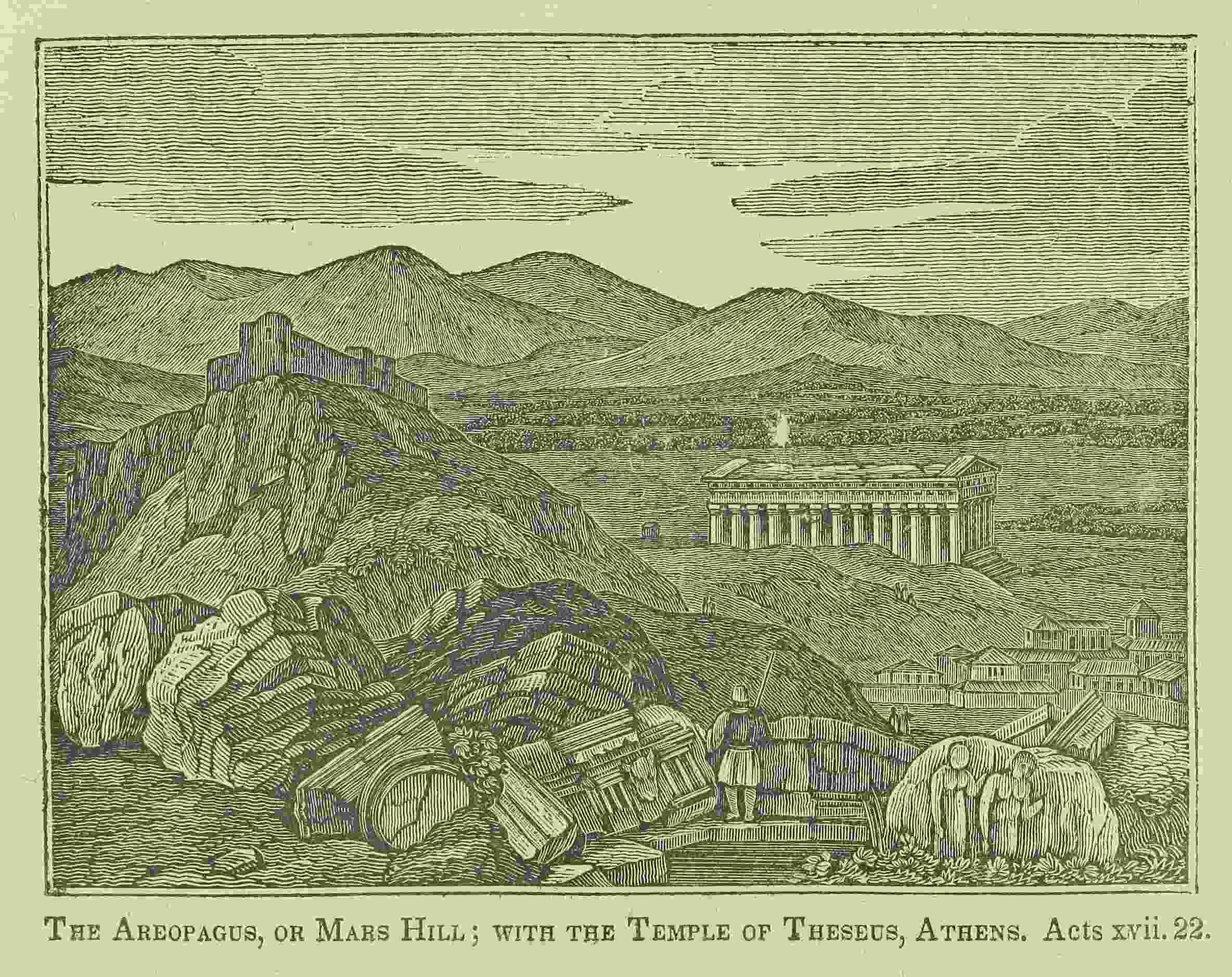
The Areopagus, or Mars Hill; with the Temple of Theseus, Athens. Acts xvii. 22.
“That Athens was wholly enslaved to idolatry, has been abundantly proved by our philological illustrators, especially the indefatigable Wetstein, from Pausanias Attic. 1, 24: Strabo 10. p. 472, c: Lucian, t. 1. Prometheus p. 180: Livy 45, 27. So also Pausanias in Attic. c. 18, 24. (cited by Pearce and Doddridge,) who tells us, that Athens had more images than all the rest of Greece; and Petronius Satyricon c. 17, who humorously says, ‘It was easier to find a god than a man there.’” (Bloomfield Annotations.)
“καὶ ἐν τῆ ἀγορᾶ. Of the market-places at Athens, of which there were many, the most celebrated were the Old and the New Forum. The former was in the Ceramicus, a very ample space, part within, and part without the city. See Meursius, dissertatione de Ceramico Gemino, § 46. and Potter’s Archaeology 1, 8. p. 30. The latter was outside of the Ceramicus, in a place called Eretria. See Meursius, Ath. Attic. l. 1. c. 6. And this seems to be the one here meant. For no forum, except the Ceramicus and the Eretriacum, was called, absolutely, ἄγορα, but had a name to denote which was meant, as Areopagiticum, Hippodamium, Piraeum, &c. In process of time, and at the period when Paul was at Athens, the forum was transferred from the Ceramicus into the Eretria; a change which, indeed, had been introduced in the time of Augustus; and that this was the most frequented part of the city, we learn from Strabo 10. p. 447. Besides, the Eretriac forum was situated before the στοὰ, or portico, in which the Stoics, of whom mention is just after made, used to hold their public discourses. It was moreover called κύκλος, from its round form.”
“Ἄρειον πάγον, Mars’ Hill. Πάγος signifies properly a high situation. This was a hill opposite to that of the citadel on the west; as we learn from Herodias 8, 52. [See the passages produced supra, to which I add Livy 26, 44. Tumulum quem Mercurii vocant. Editor.] It was so called, either because it had been consecrated to Mars (as the Campus Martius at Rome,) or because (as ♦Pausanias relates, Att. C. 28,) Mars, when he had slain Halyrrothius, son of Neptune, was the first who there pleaded a capital cause, which took place before the twelve gods. The judges used to sit by night, and sub dio; and whatever was done was kept very secret. [whence the proverb Ἀρεοπαγίτου σιωπηλότερος, to which may be compared ours, ‘as grave as a Judge.’ Editor.] They gave their judgment, not viva voce, but in writing. Nor were any admitted into the number of Areopagists but persons of noble birth, of unspotted morality, and eminent for justice and equity. See more in Meursius de Areopago.” (Kuinoel.) (Bloomfield Annotations.)
Paul taking his stand there, in that splendid scene, uttered in a bold tone and in his noblest style, the great truths which he was divinely consecrated to reveal. Never yet had Athens, in her most glorious state, heard a discourse which, for solemn beauty and lofty eloquence, could equal this brief declaration of the providence of God in the religion of his creatures. Never did the world see an orator in a sublimer scene, or in one that could awaken higher emotions in those who heard, or him who spoke. He stood on the hill of Mars, with Athens beneath and around him, and the mighty Acropolis rising with its “tiara of proud towers,” walls and temples, on the west,――bounding and crowning the view in that direction;――to the north-east lay the forum, the late scene of his discussions, and beyond lay the philosophic Academia, around and through which rolled the flowery Cephisus. Before him sat the most august and ancient court in the Grecian world, waiting for the revelation of his solemn commission respecting the new deities which he was expected to propose as an addition to their polytheistic list;――around him were the sages of the Athenian schools, listening in grave but curious attention, for the new things which the eastern stranger had brought to their ears. The apostle raised his eyes to all the monuments of Athenian devotion which met the view on every side. Before him on the high Acropolis was the mighty temple of the Athenian Minerva; on the plain beyond was the splendid shrine of the Olympian Jove; on his right was the temple of Theseus, the deified ancient king of Attica, who laid the first foundation of her glories; and near were the new piles which the later Grecian adulation had consecrated to the worship of her foreign conquerors――to the deified Caesars. Beginning in that tone of dignified politeness, which always characterized his address towards the great ones of earth, he won their hearts and their attention by a courteously complimentary allusion to the devout though misguided zeal, whose solid tokens everywhere surrounded him. “Ye men of Athens! I see in all places that you are VERY RELIGIOUS. For passing along and gazing at the shrines of your devotion, I found an altar on which was written,――‘To the unknown God;’――Him therefore, whom, not knowing, you worship, I preach to you.” The rest of this splendid, though brief discourse, need not be repeated, because it is given with tolerable fidelity in the common English translation; but it deserves notice how readily and completely, on all occasions, Paul accommodated himself to the circumstances of his hearers. His style on this occasion is remarkably protracted and rounded in its periods, highly cumulative in structure, and harmonious in its almost rhythmical flow;――the whole bearing the character which was best suited to the fancy and fashion of the Athenians,――though still very decidedly marked by the peculiarities of his eastern origin. Here too, he gave them a favorable impression of his knowledge of the Grecian classics, by his apt and happy quotation from Aratus, the philosophical poet of his native province, Cilicia. “For we also are his offspring.”
Very religious.――This is unquestionably the just meaning of xvii. 22. See Bloomfield and all the standard commentators. “Too superstitions” is insulting.
“‘To the Unknown God.’ (xvii. 23.)――It is very evident from the testimony of Laertius, that the Athenians had altars in their public places, inscribed to unknown gods or demons. He informs us, that when Athens was visited with a great plague, the inhabitants invited Epimenides the philosopher, to lustrate their city. The method adopted by him was to carry several sheep to the Areopagus; whence they were left to wander as they pleased, under the observation of persons sent to attend them. As each sheep lay down, it was sacrificed on the spot to the propitious god; (In vita Epimenides lib. xi.) and as the Athenians were ignorant of what god was propitious, they erected an altar with this inscription, ♦ΘΕΟΙΣ ΑΣΙΑΣ, ΚΑΙ ΕΥΡΩΠΗΣ, ΚΑΙ ΛΙΒΗΥΣ, ΘΕΩ ΑΓΝΩΣΤΩ ΚΑΙ ΞΕΝΩ:――To the gods of Asia, Europe, and Africa, to the strange and unknown god.
“On the architrave of a Doric portico at Athens, which was standing when that city was visited about sixty years since, by Dr. Chandler and Mr. Stuart, is a Greek inscription to the following purport:――‘The people’ [of Athens have erected this fabric] ‘with the donations to Minerva Archegetia,’ [or the conductress,] ‘by the god Caius Julius Caesar and his son the god Augustus, when Nicias was Archon.’ Over the middle of the pediment was a statue of Lucius Caesar, with this inscription:――‘The people’ [honor] ‘Lucius Caesar, the son of the Emperor Augustus Caesar, the son of the god.’ There was also a statue to Julia, the daughter to Augustus, and the mother of Lucius, thus inscribed:――‘The Senate of the Areopagus, and the Senate of the Six Hundred’ [dedicate this statue to] ‘the goddess Julia, Augusta, Provident.’ These public memorials supply an additional proof of the correctness of Paul’s observations on the Athenians, that they were too much addicted to the adoption of objects for worship and devotion.” (Hammond’s Annotations of Cave’s Lives of the Apostles, Horne’s Introduction.)
As he concluded however, with the solemn declaration of the great foundation-truth of Christianity,――that God had raised Jesus from the dead,――there was a very general burst of contempt from the more scornful portion of his audience, at the idea of anything so utterly against all human probability. Of the immortality of the soul, the divinest of their own philosophers had reasoned,――and it was by most of the Athenian sects, considered on the whole, tolerably well established; but the notion of the actual revivification of the perished body,――the recall of the scattered dust and ashes, to the same breathing, moving, acting, thinking form, which for ages had ceased to be,――all amounted to a degree of improbable absurdity,――that not the wildest Grecian speculator had ever dreamed of. So the proud Epicureans and Stoics turned sneeringly away from the barbarian stranger who had come so far to try their credulity with such a tale; and thus they for ever lost the opportunity to learn from this new-opened fountain of truth, a wisdom that the long researches of all the Athenian schools had never reached and could never reach, without the light of this truly divine eastern source, which they now so thoughtlessly scorned. But there were some, more considerate, among the hearers of the apostle, who had learned that it is the most decided characteristic of a true philosopher, to reject nothing at first sight or hearing, though it may happen to be contrary to his own personal experience and learning; and these, weighing the matter with respectful doubt, told Paul――“We will hear thee again about this.” Without any further attempt to unfold the truth at that time, Paul departed from the Areopagus, and no more uplifted his voice on the high places of Athens, in testimony of that solemn revelation of the Son of Man from the dead,――the conviction of whose truth, in spite of all philosophic sneers, was destined to oversweep the whole of that world which they knew, and a new one beyond it, and to exalt the name of that despised wanderer to a fame compared with which that of Socrates should be small. Paul was however afterwards visited by several of those who heard him before the Areopagus; and after a free, conversational discussion of the whole subject, and a more familiar exhibition of the evidences of his remarkable assertions, professed their satisfaction with the arguments, and believed. Among these, even one of the judges of the august Areopagus owned himself a disciple of Jesus. Besides him is mentioned a woman named Damaris; and others not specified, are said to have believed.
“‘Dionysius the Areopagite.’ Acts xvii. 34.――Dionysius is said to have been bred at Athens in all the arts and sciences: at the age of twenty-five he went into Egypt to learn astronomy. At the time of our Savior’s death he was at Heliopolis, where, observing the darkness that attended the passion, he cried out thus:――‘That certainly, at that time, either God himself suffered, or was much concerned for somebody that did.’ Returning to Athens he became one of the senators of the Areopagus; he was converted by St. Paul, and by him appointed bishop of Athens. Having labored and suffered much for the holy cause, he became a martyr to the faith, being burnt to death at Athens, in the 93d year of Christ.” (Cave’s Lives of the Apostles. Stanhope on Epistles and Gospels. Calmet’s Dictionary.)
From the grave manner in which this story is told, the reader would naturally suppose that these great writers had some authority for these incidents; but in reality, everything that concerns Dionysius the Areopagite, is utterly unknown; and not one of these impudent inventions can be traced back further than the sixth century.
After this tolerably hopeful beginning of the gospel in Athens, Paul left that city, and went southwestward to Corinth, then the most splendid and flourishing city of all Greece, and the capital of the Roman province of Achaia. It was famous, beyond all the cities of the world, for its luxury and refinement,――and the name of “Corinthian” had, long before the time of Paul, gone forth as a proverbial expression for what was splendid in art, brilliant in invention, and elegant in vice.
Here first arose that sumptuous order of architecture that still perpetuates the proverbial elegance of the splendid city of its birth, and the gorgeously beautiful style of the rich Corinthian column, “waving its wanton wreath,”――may be taken as an aptly expressive emblem of the general moral and internal, as well as external characteristics of this last home of true Grecian art. Here longest tarried the taste, art and refinement, which so eminently marked the first glories of Greece, and when the triumphs of that ancient excellence were beginning to grow dim in its brighter early seats in Attica and in Ionian Asia, they flashed out with a most dazzling beauty in the splendid city of the Isthmus,――but alas!――in a splendor that was indeed only a passing flash,――a last brilliant gleam from this glorious spot, before the lamp of Hellenic glory in art, went out forever. In the day of the apostle’s visit however, it was in its most “high and palmy state,”――the queen of the Grecian world. It was glorious too, in the dearest recollections of the patriotic history of Greece; for here was the center of that last brilliant Achaian confederacy, which was cherished by the noble spirits of Aratus and Philopoemen; and here too was made the last stand against the all-crushing advance of the legions of Rome: and when it fell at last before that resistless conquering movement,――“great was the fall of it.” The burning of Corinth by Mummius, (B. C. 144, the year of the fall of Carthage,) is infamous above all the most barbarous acts of Roman conquest, for its melancholy destruction of the works of ancient art, with which it then abounded. But from the ashes of this mournful ruin, it rose soon after, under the splendid patronage of Roman dominion, to a new splendor, that equalled, or perhaps outwent the glories of its former perfection, which had been ripening from the day when, as recorded by old Homer, in the freshness of its early power, it sent forth its noble armaments to the siege of Troy, or set afloat the earliest warlike navy in the world, or was made, through a long course of centuries, the center of the most brilliant of Grecian festivals, in the celebration of the Isthmian games before its walls. The Roman conquerors, as if anxious to make to this ancient seat of Grecian splendor, a full atonement for the barbarous ruin with which they had overwhelmed it, now showered on it all the honors and favors in their power. It was rebuilt as a Roman colony,――endowed by the munificence of senates, consuls, and emperors, and made the capital of the Roman province of Achaia, until the dismemberment of the empire. Shining in its gaudy fetters, it became what it has been described to be in the apostolic age, and was then beyond all doubt the greatest Grecian city in Europe, if not in the world. Athens was then mouldering in more than incipient decay――“the ghost of its former self;” for even Cicero, long before this, describes it as presenting everywhere spectacles of the most lamentable ruin and decline; but Corinth was in the highth of its glory,――its luxury,――its vice,――its heathen wickedness,――and may therefore be justly esteemed the most important scene of labor into which apostolic enterprise had ever yet made its way, and to have been well worthy of the attention which it ever after received from him, to the very last of his life, being made the occasion and object of a larger and a more splendid portion of his epistolary labors, than all with which he ever favored any other place in the world; nor can this protracted notice of its condition and character be justly blamed for its intrusion on this hurried narrative.
“Corinth.――There is scarcely any one of the seats of ancient magnificence and luxury, that calls up more vivid and powerful associations, than are awakened by the name of this once opulent and powerful city. Corinth, ‘the prow and stern of Greece,’ the emporium of its commerce, the key and bulwark of the Peloponnesus, was proverbial for its wealth as early as the time of Homer. Its situation was so advantageous for the inexperienced navigation of early times, that it became of necessity the center of trade. The first naval battle on record was fought between Corinth and its colony Corcyra, about 657 B. C. ‘Syracuse, the ornament of Sicily, Corcyra, some time sovran of the seas, Ambracia in Epirus, and several other cities more or less flourishing, owe their origin to Corinth.’ (Travels of ♦Anacharsis, vol. III. c. 37.) Thucydides states, that the Corinthian ship-builders first produced galleys with three benches of oars. The circumnavigation of the peninsula was tedious and uncertain to a proverb; while at the Isthmus, not only their cargoes, but, if requisite, the smaller vessels might be transported from sea to sea. By its port of Cenchreae, it received the rich merchandise of Asia, and by that of Lechaeum, it maintained intercourse with Italy and Sicily. The Isthmian Games, by the concourse of people which they attracted at their celebration, contributed not a little to its immense opulence; and the prodigality of its merchants rendered the place so expensive, that it became a saying, ‘It is not for every one to go to Corinth.’ Even after its barbarous destruction by the Romans, it must have been an extremely magnificent city. Pausanias mentions in and near the city, a theater, an odeum, a stadium, and sixteen temples. That of Venus possessed above a thousand female slaves. ‘The women of Corinth are distinguished by their beauty; the men by their love of gain and pleasure. They ruin their health by convivial debauches, and love with them is only licentious passion. Venus is their principal deity.... The Corinthians, who performed such illustrious acts of valor in the Persian war, becoming enervated by pleasure, sunk under the yoke of the Argives; were obliged alternately to solicit the protection of the Lacedaemonians, the Athenians, and the Thebans; and are at length reduced to be only the wealthiest, the most effeminate, and the weakest state in Greece.’” (Anacharsis.) (Modern Traveler, pp. 160, 161.)
The Hebrew stranger, entering without despondency, this new scene of labor, passed on unnoticed, and looking about for those with whom he might be bold to communicate, on the score of national and religious sympathies, he found among those who like himself were strangers, a Jew, by name Aquilas, who with his wife Priscilla had lately arrived from Italy, whence they had just been driven by a vexatious decree of Claudius Caesar, which, on some groundless accusation, ordered all the Jews to depart from Rome. Aquilas, though lately a resident in Italy, was originally from Pontus in the northern part of Asia Minor, not very far from Paul’s native province; and this proximity of origin joined to another circumstance arising out of it, drew the strangers together, in this foreign city. In Pontus even at this day is carried on that same famous manufacture of camlet articles for which Cilicia was also distinguished and proverbial, and it is therefore perfectly reasonable to suppose that in that age also, this business was common in the same region, because the variety of goat which produces the material, has always been confined within those limits. Being of the same trade, then, and both of them friendless strangers, seeking employment and support, Paul and Aquilas fell into one another’s company and acquaintance, and getting work at the same time, they seem to have set up a kind of partnership in their trade, living together, and working in the same way, from day to day. This, of course, gave constant opportunity for the freest communication on all subjects of conversation; and Aquila would not be long in finding out the great object, which had led Paul away from his country and friends, to a place where his necessities drove him to the laborious exercise of an occupation, which a person of his rank and character could not originally have acquired with any intention of gaining his livelihood thereby. That this was the sole motive of his present application to his tedious business, is abundantly testified in the epistles, which he afterwards wrote to this same place; for he expressly says, that he “was chargeable to no man,” but “labored with his own hands.” Yet the diligent pursuit of this laborious avocation, did not prevent him from appearing on the sabbath, in the synagogue, as a teacher of divine things; nor would the noble principles of Jewish education permit any man to despise the stranger on account of his necessitous and apparently humble circumstances. His weekly ministry was therefore pursued without hindrance, and with success; for “he persuaded the Jews and the Greeks.” Among those who received the most eminent advantage from his apostolic labors, was his fellow-workman Aquilas, who with his wife Priscilla, here imbibed such a portion of Christian knowledge, as ever after made both him and her, highly useful as teachers of the new faith, to which they were at this time converted. It would seem, however, that Paul did not, during the first part of his ministrations, very openly and energetically proclaim the grand doctrine of the faith; for it was not till after the arrival of Silas and Timothy from Macedonia, that he “pressed on in the word, and testified to the Jews that Jesus was the Messiah.” As had usually been the case, whenever he had proclaimed this solemn truth to his own countrymen, he was met by the Corinthian Jews, for the most part, with a most determined and scornful opposition; so that renouncing their fellowship in the expressive gesture of an Oriental,――shaking his raiment,――he declared――“Your blood be on your own heads:――I am clean. Henceforth, I will go to the Gentiles.” Leaving their company, he then went into the house of a religious friend, close to the synagogue, and there took up his abode. But not all the Jews were involved in the condemnation of this rejection. On the contrary, one of the most eminent men among them, Crispus, either then or formerly the ruling elder of the synagogue, professed the faith of Jesus, notwithstanding its unpopularity. Along with him his whole family were baptized, and many other Corinthians received the word in the same manner. In addition to these nobly encouraging results of his devoted labors, his ardor in the cause of Jesus received a new impulse from a remarkable dream, in which the Lord appeared to him, uttering these words of high consolation,――“Fear not, but speak, and hold not thy peace; for I am with thee, and no one shall hurt thee. I have many people in this city.” Under the combined influence of both natural and supernatural encouragements, he therefore remained zealously laboring in Corinth, and made that city his residence, as Luke very particularly records, for a year and six months.
“xviii. 5. συνείχετο τῳ λόγω, &c. The common reading is πνεύματι. Now since συννέχεσθαι, among other significations, denotes angi, maerore corripi, (see Luke ♦xii. 50, and the note on Matthew ♦iv. 24,) many Commentators, as Hammond, Mill, and Wolf, explain, “angebatur Paulus animo, dum docebat Judaeos, Jesum esse Messiam;” viz. “since he could produce no effect among them.” And they compare verse 6. But this interpretation is at variance with the context.
“Now this verb also signifies to incite, urge; as in 2 Corinthians v. 14. Hence Beza, Pricaeus, and others, explain: ‘intus et apud se aestuebat prae zeli ardore;’ which interpretation I should admit, if there were not reason to suppose, from the authority of MSS. and Versions, that the true reading, (though the more difficult one,) is λύγῳ, of which the best interpretation, and that most suitable to the context, is the one found in the Vulgate ‘instabat verbo.’ For συνέχεσθαι denotes also to be held, occupied by anything; as in Sappho 17, 20. Herodotus 1, 17, 22. Aelian, Varia Historia, 14, 22. This ♦signification of the word being admitted, the sense will be: ‘When they had approached whom Paul (who knew that combined strength is most efficacious) had expected as his assistants in promulgating the Christian doctrine, and of whom, in so large and populous a city there was need, then he applied himself closely to the work of teaching.’ Kuinoel. (Bloomfield’s Annotations, p. 593.)
HIS EPISTLES WRITTEN FROM CORINTH.
The period of his residence in this city is made highly interesting and important in the history of the sacred canon, by the circumstance that here he wrote some of the first of those epistles to his various missionary charges, which constitute the most controverted and the most doctrinal portion of the New Testament. In treating of these writings, in the course of the narrative of his life, the very contracted limits now left to his biographer, will make it necessary to be much more brief in his literary history, than in that of those other apostles, whose writings have claimed and received so full a statement, under their respective lives. Nor is there so much occasion for the labors of the apostolic historian on this part of the history of the apostolic works, as on those already so fully treated; for while the history of the writings of Peter, John, Matthew, James and Jude, has so seldom been presented to the eyes of common readers, the writings of Paul, which have always been the great storehouse of Protestant dogmatism, have been discussed and amplified in their history, scope, character, and style, more fully than all the rest of the Bible, for common readers; but in the great majority of instances, proving such a comment on the sadly prophetical words of Peter on these very writings, that the apostolic historian may well and wisely dread to immerse himself in such a sea of difficulties as presents itself to view; and he therefore cautiously avoids any intermeddling with discussions which will possibly involve him in the condemnation pronounced by the great apostolic chief, on those “unlearned and unstable,” who even in his time had begun to “wrest to their own destruction, the things hard to be understood in the epistles of his beloved brother Paul;” a sentence which seems to have been wholly overlooked by the great herd of dogmatizing commentators, who, very often, without either the “learning” or the “stability,” which Peter thought requisite for the safe interpretation of the Pauline epistles, have rushed on to the task of vulgarizing these noble and honest writings, to suit the base purposes of some popular system of mystical words and complex doctrines. If then, the “unlearned and unstable” have been thus distinctly warned by the highest apostolic authority, against meddling with these obscure and peculiar writings; and since the whole history of didactic theology is so full of melancholy comments on the undesignedly prophetical force of Peter’s denunciation,――it is no more than prudent to decline the slightest interference with a subject, which has been on such authority declared to require the possession of so high a degree of learning and stability, for its safe and just treatment. The few things which may be safely stated, will merely concern the place, time and immediate occasion of the writing of each of these epistles.
In the first place, as to the order in which these works of Paul are arranged in the common New Testament canon, it should be observed that it has reference neither to date, subject, nor anything whatever in their character or object, except the very arbitrary circumstance of the rank and importance of the places and persons that were the original objects of their composition. The epistle to the Romans is always placed first, because the imperial city to which it was directed was beyond all question the greatest in the world. The epistles to the Corinthians are next, because that city was the nearest in rank and importance to Rome, of all those which were the objects of Paul’s epistolary attentions. The epistle to the Galatians is next, because it was directed to a great province, inferior indeed in importance, to the two great cities before mentioned, but vastly above any of the other places to which Paul wrote. The epistle to the Ephesians comes next, because Ephesus ranked far above any of the cities which follow. Philippi was supposed, by those who arranged the canon, greater than Colosse and Thessalonica, because it was thought to have been a capital city. Thus all those epistles which are addressed to whole churches, are placed first; and those which are addressed to individuals in the same manner, form a class by themselves; that to Timothy being placed first of these, because he was the most eminent of all the apostle’s assistants,――Titus being inferior to him in dignity, and Philemon, a person of no account at all, except from the bare circumstance, that he was accidentally the subject of Paul’s notice. The epistle to the Hebrews is last of all, because it is altogether peculiar in its character, addressed neither to churches, nor to an individual, but to a whole nation, being published and circulated for their general benefit. The circumstance also that it was long denied a place in the canon, and considered as a spurious writing, improperly attributed to Paul, probably caused it to be put last of all his writings, when in the course of time, it was at length allowed a place in the canon.
FIRST EPISTLE TO THE THESSALONIANS.
That epistle which the great majority of all modern critics consider as the earliest of all those writings of Paul that are now preserved, is the first to the Thessalonians. It is directed to them from Paul, Silvanus, (or Silas,) and Timothy, which shows that it was written after Paul had been joined by these two brethren, which was not until some time after his arrival in Corinth. It appears by the second and third chapters, that the apostle, having been hindered by some evil agency of the wicked, from visiting Thessalonica, as he had earnestly desired to do, had been obliged to content himself with sending Timothy to the brethren there, to comfort them in their faith, and to inquire whether they yet stood fast in their first honorable profession; for he declares himself to have been anxious to know whether by some means the tempter might not have tempted them, and his labor have thus been in vain. But he now informs them how he has lately been greatly comforted by the good news brought from them by Timothy, who had assured the apostle of their faith and love, and that they had great remembrance of him always, desiring much to see him, as he them. Making known to them the great joy which these tidings had caused in him, he now affectionately re-assures them of his high and constant regard for them, and of his continued remembrance of them in his prayers. He then proceeds briefly to exhort them to a perseverance in the Christian course, in which they had made so fair an outset, urging upon them more especially, those virtues which were peculiarly rare among those with whom they were daily brought in contact,――purity of life, rigid honesty in business transactions, a charitable regard for the feelings of others, a quiet, peaceable, inoffensive deportment, and other minuter counsels, according to the peculiar circumstances of different persons among them. The greater portion of this brief letter, indeed, is taken up with these plain, practical matters, with no reference to any deep doctrinal subjects, the whole being thus evidently well-suited to the condition of believers who had but just begun the Christian course, and had been in no way prepared to appreciate any learned discussion of those obscure points which in later periods were the subject of so much controversy among some of Paul’s converts. Their dangers hitherto had also been mainly in the moral rather than in the doctrinal way, and the only error of mere belief, to which he makes reference, is one which has always been the occasion of a great deal of harmless folly among the ignorant and the weak minded in the Christian churches, from the apostolic age to this day. The evil however, was considered by the apostle of so much importance, that he thought it worth while to briefly expose its folly to the Thessalonians, and he accordingly discourses to them of the day of judgment, assuring them that those who might happen to be alive at the moment of Christ’s coming, would derive no peculiar advantage from that circumstance, because those who had died in Christ should rise first, and the survivors be then caught up to meet the Lord in the air. But as for “the times and the seasons,”――those endless themes for the discursive nonsense of the visionary, even to the present day and hour,――he assures them that there was no need at all that he should write to them, because they already well knew that the day of the Lord should come as a thief in the night, according to the words of Jesus himself. The only practical benefit which they could expect to derive then, from this part of their faith, was the conviction of the necessity of constantly bearing in mind the shortness and uncertainty of their earthly stay, and the importance of watchfulness and sobriety. After several sententious moral exhortations, he concludes with affectionate salutations, and with an earnest, solemn charge, that the letter should be read to all the brethren of the church.
It will be observed, that at the conclusion of the epistle is a statement that it was written from Athens,――an assertion perfectly absurd, and rendered evidently so by the statements contained in the epistle itself, as above shown. All the similar statements appended to his other epistles are equally unauthorized, and most of them equally false;――being written by some exceedingly foolish copyists, who were too stupid to understand the words which they transcribed. Yet these idle falsehoods are gravely given in all copies of the English translation, and are thus continually sent abroad to mislead common readers, many of whom, seeing them thus attached to the apostolic writings, suppose them to be also of inspired authority, and are deceived accordingly. And they probably will continue to be thus copied, in spite of their palpable and mischievous falsehood, until such a revolution in the moral sense of common people takes place, that they shall esteem a new negative truth more valuable and interesting, than an old, groundless blunder.
For some time after the writing of the first epistle to the Thessalonians, with these triumphs and other encouragements, Paul and his faithful helpers appear to have gone on steadily in their apostolic labors, with no special obstacle or difficulty, that is commemorated in the sacred record. But at last their old difficulties began to manifest themselves in the gradually awakened enmity of the Jews, who, though at his first distinct public ministrations they had expressed a decided and scornful opposition to the doctrine of a crucified Savior, yet suffered the new teachers to go on, without opposing them any farther than by scornful verbal hostility, blasphemy and abuse. But when they saw the despised heresy making such rapid advances, notwithstanding the contempt with which it was visited, they immediately determined to let it no longer take advantage of their inefficiency in resisting its progress. Of course, deprived themselves, of all political power, they had not the means of meeting the evil by physical violence, and they well knew that any attempt on their part to raise an illegal commotion against the strangers, would only bring down on the exciters of the disturbance, the whole vengeance of their Roman rulers, who were unsparing in their vengeance on those that undertook to defy the forms of their laws, for the sake of persecution, or any private ends; and least of all would a class of people so peculiar and so disliked as the Jews, be allowed to take any such treasonable steps, without insuring them a most dreadful punishment. These circumstances therefore compelled them to proceed, as usual, under the forms of law; and their first step against Paul therefore, was to apprehend him, and take him, as a violator of religious order, before the highest Roman tribunal,――that of the proconsul.
The proconsul of Achaia, holding his supreme seat of justice in Corinth, the capital of that Roman province, was Lucius Junius Gallio, a man well known to the readers of one of the classic Latin writers of that age,――Seneca,――as one of the most remarkable exemplifications of those noble virtues which were the great theme of this philosopher’s pen. Out of many beautiful illustrations which may be drawn from Roman and Jewish writers, to explain and amplify the honest and faithful apostolic history of Luke, there is none more striking and gratifying than the aid here drawn from this fine philosophical classic, on the character of the noble proconsul, who by his upright, wise, and clement decision, against the mean persecutors of Paul,――and by his indignant refusal to pervert and degrade his vice-regal power to the base ends of private abuse, has acquired the grateful regard and admiring respect of all Christian readers of apostolic history. The name of Lucius Junius Gallio, by which he is known to Roman writers as well as in apostolic history, was not his original family designation, and therefore gives the reader no idea of his interesting relationship to one of the finest moralists of the whole period of the Roman empire. His original family name was Marcus Annaeus Novatus Seneca,――which appellation he exchanged for his later one, on being adopted by Lucius Junius Gallio, a noble Roman, who being destitute of children, adopted, according to a very common custom of the imperial city, one of a family that had already given promise of a fine reward to those who should take its offspring as theirs. The famous philosopher before mentioned,――Lucius Annaeus Seneca,――was his own brother; both of them being the sons of Marcus Annaeus Seneca, a distinguished orator and rhetorician of the Augustan age. A strong and truly fraternal affection always continued to hold the two brothers together, even after they had been separated in name by the adoption of the older into the family of Gallio; and the philosopher often commemorates his noble brother, in terms of high respect; and dedicated to him one of the most perfect of those moral treatises which have immortalized the name of Seneca.
The philosopher Seneca, after having been for many years banished from Rome by Claudius, was at length recalled by that emperor in the ninth year of his reign, corresponding to A. D. 49. He was immediately made a senator, and was still further honored by being intrusted with the education of Domitius, the son of Agrippina, afterwards adopted by Claudius as heir to the throne, to which he succeeded on the emperor’s death, under the name of Nero, by which he has now become so infamous wherever the Roman name is known. Being thus elevated to authority and great influence with the emperor, Seneca made use of his power, to procure for his brother Gallio such official honors as his talents and character justly claimed. In the eleventh year of Claudius he was made consul, as is recorded in the Fasti Consulares; and was soon after sent into Greece, as proconsul of Achaia. Arriving at Corinth in the year 53, he was immediately addressed by the Jewish citizens of that place in behalf of their plot against Paul; for they naturally supposed that this would be the best time for the attempt to bend the new governor to their purposes, when he was just commencing his administration, and would be anxious to please the subjects of his power by his opening acts. But Gallio had no disposition to acquire popularity with any class of citizens, by any such abuse of power, and by his conduct on this occasion very fairly justifies the high character given him by his brother Seneca. When the Jews came dragging Paul before the proconsular tribunal, with the accusation――“This fellow persuades men to worship God in a manner contrary to the ritual,”――before Paul could open his mouth in reply, Gallio carelessly answered――“If it were a matter of crime or misdemeanor, ye Jews! it would be reasonable that I should bear with you; but if it be a question of words and names, and of your ritual, look ye to it; for I do not wish to be a judge of those things.” With this contemptuous reply, he cleared the court of them. The Jews thus found their fine scheme of abusing Paul under the sanction of the Roman tribunal, perfectly frustrated; nor was their calamity confined to this disappointment; for all the Greeks who were present at the trial,――indignant at the scandalous character of the proceeding,――took Sosthenes, the ruling elder of the synagogue, who had probably been most active in the persecution of Paul, as he was the regular legal chief of the Jews, and gave him a sound threshing in the court, before he could obey the orders of the Proconsul, and move off from the tribunal. Gallio was so far from being displeased at this very irregular and improper outbreak of public feeling, that he took no notice of the action whatever, though it was a shameful violation of the dignity of his tribunal; and it may therefore be reasonably concluded that he was very much provoked against the Jews, and was disposed to sympathize with Paul; otherwise he would have been apt to have punished the outrage of the Greeks upon Sosthenes.
“The name of this proconsul was Marcus Annaeus Novatus, but being adopted by Lucius Junius Gallio, he took the name of his adopted father; he was brother to the famous Seneca, tutor to Nero. That philosopher dedicated to Gallio his book, ‘De Vita Beata.’ The Roman historians concur in giving him the character of a sweet disposition, an enemy to all vice, and particularly a hater of flattery. He was twice made proconsul of Achaia, first by Claudius, and afterwards by Nero. As he was the sharer of his brother’s prosperity, so he was of his misfortunes, when he fell under Nero’s displeasure, and was at length put to death by the tyrant, as well as his brother.” (Calmet’s Commentary. Poole’s Annotations. Williams on Pearson.)
“In Acts xviii. 12‒16, we find Paul is brought before Gallio by the Jews, but this proconsul refused to judge any such matters, as not coming within his jurisdiction. The character for justice, impartiality, prudence, and mildness of disposition, which this passage gives to Gallio, is confirmed by Seneca, his brother, in these words:――Solebam tibi dicere, Gallionem fratrem meum (quem nemo non parum amat, etiam qui amare plus non potest,) alia vitia non nosse, hoc etiam, (i. e. adulationem,) odisse.――Nemo enim mortalium uni tam dulcis est, quam hic omnibus. Hoc quoque loco blanditiis tuis restitit, ut exclamares invenisse te inexpugnabilem virum adversus insidias, quas nemo non in sinum recipit. (Lucius Annaeus Seneca, Natural Questions, lib. iv. in preface, op. tom. iv. p. 267, edited by Bipont.) In our translation Gallio is styled the deputy, but the real Greek word is Ανθυπατευοντος, proconsul. The accuracy of Luke in this instance is very remarkable. In the partition of the provinces of the Roman empire, Macedonia and Achaia were assigned to the people and Senate of Rome. In the reign of Tiberius they were, at their own request, made over to the emperor. In the reign of Claudius, (A. U. C. 797. A. D. 44,) they were again restored to the Senate, after which time proconsuls were sent into this country. Nero afterwards made the Achaians a free people. The Senate therefore lost this province again. However, that they might not be sufferers, the emperor gave them the island of Sardinia, in the room of it. Vespasian made Achaia a province again. There is likewise a peculiar propriety in the name of the province of which Gallio was proconsul. The country subject to him was all Greece; but the proper name of the province among the Romans was Achaia, as appears from various passages of the Roman historians, and especially from the testimony of Pausanias. Καλουσι δε ουχ’ Ἑλλαδος, αλλα’ ♦Αχαιας ἡγεμονα οἱ Ῥωμαιοι διοτι εχειρωσαντο Ἑλληνας δε Αχαιων, τοτε του Ἑλληνικου προεστηκοτων. (Pausanias Description of Greece. lib. vii. p. 563. Lardner’s Works, 4to. vol. I. p. 19.)