II. THE HELLENIST APOSTLES. (continued 5)
Reading edition
“Rhodes, (verse 1,) an island, supposed to have taken its name απο των Ροδων from the many roses which were known to grow there. It lies south of the province of Caria, and it is accounted next to Cyprus and Lesbos, for its dignity among the Asiatic islands. It was remarkable among the ancients for the expertness of its inhabitants in navigation; for a college, in which the students were eminent for eloquence and mathematics; and for the clearness of its air, insomuch that there was not a day in which the sun did not shine upon it; and more especially celebrated for its prodigious statue of brass, consecrated especially to the sun, and called his Colossus. This statue was seventy cubits high, and every finger as large as an ordinary sized man, and as it stood astride over the mouth of the harbor, ships passed under its legs.” (Whitby’s Table and Wells’s Geography.) [Williams on Pearson, pp. 67, 68.]
LAST VISIT TO JERUSALEM.
Paul was now received in Jerusalem by the brethren with great joy, and going, on the day after his arrival, to see James, now the principal apostle resident in the Holy city, communicated to him and all the elders a full account of all his various labors. Having heard his very interesting communications, they were moved with gratitude to God for this triumph of his grace; but knowing as they did, with what rumors against Paul these events had been connected by common fame, they desired to arrange his introduction to the temple in such a manner, as would most effectually silence these prejudicial stories. The plan proposed by them was, that he should, in the company of four Jews of the Christian faith, who had a vow on them, go through with all the usual forms of purification prescribed under such circumstances for a Jew, on returning from the daily impurities to which he was exposed by a residence among the Gentiles, to a participation in the holy services of solemn worship in the temple. The apostles and elders, however, in recommending this course, declared to him, that they believed that the Gentiles ought not to be bound to the performance of the Jewish rituals, but should be exempt from all restrictions, except such as had formerly been decided on, by the council of Jerusalem. Paul, always devout and exact in the observance of the institutions of his national religion, followed their advice accordingly, and went on quietly and unpretendingly in the regular performance of the prescribed ceremonies, waiting for the termination of the seven days of purification, when the offering should be made for himself, and one for each of his companions, after which, they were all to be admitted of course, to the full honors of Mosaic purity, and the religious privileges of conforming Jews. But these ritual observances were not destined to save him from the calamities to which the hatred of his enemies had devoted him. Near the close of the seven days allotted by the Mosaic ritual for the purification of a regenerated Israelite, some of the Asian Jews, who had known Paul in his missionary journeys through their own country, and who had come to Jerusalem, to attend the festival, seeing their old enemy in the midst of the temple, against whose worship they had understood him to have been preaching to the Gentiles,――instantly raised a great outcry, and fell upon him, dragging him along, and shouting to the multitude around, “Men of Israel! help! This is the man, that every where teaches all men against the people, and the law, and this place; and he has furthermore, brought Greeks into the temple, and has polluted this holy place.” It seems they had seen Trophimus, one of his Gentile companions from Ephesus, with him in the city, and imagined also that Paul had brought him into the temple, within the sanctuary, whose entrance was expressly forbidden to all Gentiles, who were never allowed to pass beyond the outermost court. The sanctuary or court of the Jews could not be crossed by an uncircumcised Gentile, and the transgression of the holy limit was punished with death. Within this holy court, the scene now described took place; and as the whole sanctuary was then crowded with Jews, who had come from all parts of the world to attend the festival in Jerusalem, the outcry raised against Paul immediately drew thronging thousands around him. Hearing the complaint that he was a renegade Jew, who, in other countries, had used his utmost endeavors to throw contempt on his own nation, and to bring their holy worship into disrepute, and yet had now the impudence to show himself in the sanctuary, which he had thus blasphemed,――and had, moreover, even profaned it by introducing into the sacred precincts one of those Gentiles for whose company he had forsaken the fellowship of Israel,――they all joined in the rush upon him, and dragged him out of the temple, the gates of which were immediately shut by the Levites on duty, lest in the riot that was expected to ensue, the consecrated pavement should be polluted with the blood of the renegade. Not only those in the temple, but also all those in the city, were called out by the disturbance, and came running together to join in the mob against the profaner of the sanctuary, and Paul now seemed in a fair way to win the bloody crown of martyrdom.
The great noise made by the swarming multitudes who were gathering around Paul, soon reached the ears of the Roman garrison in castle Antonia, and the soldiers instantly hastened to tell the commanding officer, that “the whole city was in an uproar.” The tribune, Claudius Lysias, probably thinking of a rebellion against the Romans, instantly ordered a detachment of several companies under arms, and hurried down with them, in a few moments, to the scene of the riot. The mob meanwhile were ♦diligently occupied in beating Paul; but as soon as the military force made their way among the crowd, the rioters left off beating him, and fell back. The tribune coming near, and seeing Paul alone in the midst, who seemed to be the object and occasion of all the disturbance, without hesitation seized him, and putting him in chains, took him out of the throng. He then demanded what all this riot meant. To his inquiry, the whole mob replied with various accounts; some cried one thing and some another; and the tribune finding it utterly impossible to learn from the rioters who he was or what he had done, ordered him to be taken up to the castle. Castle Antonia stood at the northwestern angle of the temple, close by one of the great entrances to it, near which the riot seems to have taken place. To this, Paul was now taken, and was borne by the surrounding soldiers, to keep off the multitude, who were raging for his blood, like hungry wolves after the prey snatched from their jaws,――and they all pressed after him, shouting, “kill him!” In this way Paul was carried up the stairs which led to the high entrance of the castle, which of course the soldiers would not allow the multitude to mount; and when he had reached the top of the stairs, he was therefore perfectly protected from their violence, though perfectly well situated for speaking to them so as to be distinctly seen and heard. As they were taking him up the stairs, he begged the attention of the tribune, saying, “May I speak to thee?” The tribune hearing this, in some surprise asked, “Canst thou speak Greek? Art thou not that Egyptian that raised a sedition some time ago, and led away into the wilderness a band of four thousand cut-throats?” This alarming revolt had been but lately put down with great trouble, and was therefore fresh in the mind of Lysias, who had been concerned in quelling it, along with the whole Roman force in Palestine,――and from some of the outcries of the mob, he now took up the notion that Paul was the very ringleader of that revolt, and had now just returned from his place of refuge to make new trouble, and had been detected by the multitude in the temple. Paul answered the foolish accusation of the tribune, by saying, “I am a Jewish citizen of Tarsus, in Cilicia, which is no mean city; and I beg of thee, to let me speak to the people.” The tribune, quite glad to have his unpleasant suspicions removed, as an atonement for the unjust accusation immediately granted the permission as requested, and Paul therefore turned to the raging multitude, waving his hand in the usual gesture for requesting silence. The people, curious to hear his account of himself, listened accordingly, and he therefore uplifted his voice in a respectful request for their attention to his plea in his own behalf. “Men! Brethren! and Fathers! Hear ye my defence which I make to you!”
Those words were spoken in the vernacular language of Palestine, the true Hebraistic dialect of Jerusalem, and the multitude were thereby immediately undeceived about his character, for they had been as much mistaken about him, as the tribune was, though their mistake was of a very opposite character; for they supposed him to be entirely Greek in his habits and language, if not in his origin; and the vast concourse was therefore hushed in profound silence, to hear his address made in the true Jewish language. Before this strange audience, Paul then stood up boldly, to declare his character, his views, and his apostolic commission. On the top of the lofty rampart of Castle Antonia,――with the dark iron forms of the Roman soldiery around him, guarding the staircase from top to bottom, against the raging mob,――and with the enormous mass of the congregated thousands of Jerusalem, and of the strangers who had come up to the festival, all straining their fierce eyes in wrath and hate upon him, as a convicted renegade,――one feeble, slender man, now stood, the object of the most painful attention to all,――yet, less moved with passion and anxiety than any one present. Thus stationed, he began, and gave to the curious multitude an interesting account of the incidents connected with that great change in his feelings and belief, which was the occasion of the present difficulty. After giving them a complete statement of these particulars, he was narrating the circumstance of a revelation made to him in the temple, while in a devotional trance there, on his first return to Jerusalem, after his conversion. In repeating the solemn commission there confirmed to him by the voice of God, he repeated the crowning sentence, with which the Lord removed his doubts about engaging in the work of preaching the gospel, when his hands were yet, as it were, red with the blood of the martyred faithful,――“And he said to me, ‘Go: for I will send thee far hence, unto the Gentiles.’” But when the listening multitude heard this clear declaration of his having considered himself authorized to communicate to the Gentiles those holy things which had been especially consigned by God to his peculiar people,――they took it as a clear confession of the charge of having desecrated and degraded his national religion, and all interrupted him with the ferocious cry, “Take him away from the earth! for such a fellow does not deserve to live.” The tribune, finding that this discussion was not likely to answer any good purpose, instantly put a stop to it, by dragging him into the castle, and gave directions that he should be examined by scourging, that they might make him confess truly who he was, and what he had done to make the people cry out so against him,――a very foolish way, it would seem, to find out the truth about an unknown and abused person, to flog him until he should tell a story that would please them. While the guard were binding him with thongs, before they laid on the scourge, Paul spoke to the centurion, who was superintending the operation, and said in a sententiously inquiring way, “Is it lawful for you to scourge a Roman citizen without legal condemnation?” This question put a stop to all proceedings at once. The centurion immediately dropped the thongs, and ran to the tribune, saying, “Take heed what thou doest, for this man is a Roman citizen.” The tribune then came to Paul, in much trepidation, and with great solemnity said――“Tell me truly, art thou a Roman citizen?” Paul distinctly declared, “Yes.”
Desirous to learn the mode in which the prisoner had obtained this most sacred and unimpeachable privilege, the tribune remarked of himself, that he had obtained this right by the payment of a large sum of money,――perhaps doubting whether a man of Paul’s poor aspect could have ever been able to buy it; to which Paul boldly replied――“But I was BORN free.” This clear declaration satisfied the tribune that he had involved himself in a very serious difficulty, by committing this illegal violence on a person thus entitled to all the privileges of a subject of law. All the subordinate agents also, were fully aware of the nature of the mistake, and all immediately let him alone. Lysias now kept Paul with great care in the castle, as a place of safety from his Jewish persecutors; and the next day, in order to have a full investigation of his character and the charges against him, he took him before the Sanhedrim, for examination. Paul there opened his defence in a very appropriate and self-vindicating style. “Men! Brethren! and Fathers! I have heretofore lived before God with a good conscience.” At these words, Ananias the high priest, provoked by Paul’s seeming assurance in thus vindicating himself, when under the accusation of the heads of the Jewish religion, commanded those that stood next to Paul to slap him on the mouth. Paul, indignant at the high-handed tyranny of this outrageous attack on him, answered in honest wrath――“God shall smite thee, thou whited wall! For dost thou command me to be smitten contrary to the law, when thou sittest as a judge over me?” The other by-standers, enraged at his boldness, asked him, “Revilest thou God’s high priest?” To which Paul, not having known the fact that Ananias then held that office, which he had so disgraced by his infamous conduct, replied――“I knew not, brethren, that he was the high priest; for it is written, thou shalt not speak evil of the ruler of thy people.” Then, perceiving the mixed character of the council, he determined to avail himself of the mutual hatred of the two great sects, for his defense, by making his own persecution a kind of party question; and therefore called out to them――“I am a Pharisee, the son of a Pharisee. Of the hope of the resurrection of the dead, I am called in question.” These words had the expected effect. Instantly, all the violent party feeling between these two sects broke out in full force, and the whole council was divided and confused,――the scribes who belonged to the Pharisaic order, arising, and declaring, “We find no occasion of evil in this man. But if a spirit or an angel has spoken to him, let us not fight against God.” This last remark, of course, was throwing down the gauntlet at the opposite sect; for the Sadducees, denying absolutely the existence of either angel or spirit, could of course believe no part of Paul’s story about his vision and spiritual summons. They all therefore broke out against the Pharisees, who being thus involved, took Paul’s side very determinedly, and the party strife grew so hot that Paul was like to be torn in pieces between them. The tribune, seeing the pass to which matters had come, then ordered out the castle-guard, and took him by force, bringing him back to his former place of safety.
“The reason why St. Paul chose to speak in the Hebrew tongue, may be accounted for thus. There were at this time two sorts of Jews, some called by Chrysostom οἱ βαθεις Ἑβραιοι, profound Hebrews, who used no other language but the Hebrew, and would not admit the Greek Bible into their assemblies, but only the Hebrew, with the Jerusalem Targum and Paraphrase. The other sort spoke Greek, and used that translation of the scriptures; these were called Hellenists. This was a cause of great dissension among these two parties, even after they had embraced Christianity, (Acts vi. 1.) Of this latter sort was St. Paul, because he always made use of the Greek translation of the Bible in his writings, so that in this respect he might not be acceptable to the other party. Those of them who were converted to Christianity, were much prejudiced against him, (Acts xxi. 21,) which is given as a reason for his concealing his name in his Epistle to the Hebrews. And as for those who were not converted, they could not so much as endure him: and this is the reason which Chrysostom gives, why he preached to the Hellenists only. Acts ix. 28. Therefore, that he might avert the great displeasure which the Jews had conceived against him, he accosted them in their favorite language, and by his compliance in this respect, they were so far pacified as to give him audience.” (Hammond’s Annotations.) [Williams’s Pearson, p. 70.]
“Scourging was a method of examination used by Romans and other nations, to force such as were supposed guilty to confess what they had done, what were their motives, and who were accessory to the fact. Thus Tacitus tells us of Herennius Gallus, that he received several stripes, that it might be known for what price, and with what confederates, he had betrayed the Roman army. It is to be observed, however, that the Romans were punished in this wise, not by whips and scourges, but with rods only; and therefore it is that Cicero, in his oration pro Rabirio, speaking against Labienus, tells his audience that the Porcian law permitted a Roman to be whipped with rods, but he, like a good and merciful man, (speaking ironically,) had done it with scourges; and still further, neither by whips nor rods could a citizen of Rome be punished, until he were first adjudged to lose his privilege, to be uncitizened, and to be declared an enemy to the commonwealth, then he might be scourged or put to death. Cicero Oratio in Verres, says, ‘It is a foul fault for any praetor, &c. to bind a citizen of Rome; a piacular offense to scourge him; a kind of parricide to kill him: what shall I call the crucifying of such an one?’” (Williams’s notes on Pearson, pp. 70, 71.)
“Ananias, the son of Nebedaeus, was high priest at the time that Helena, queen of Adiabene, supplied the Jews with corn from Egypt, (Josephus Antiquities, lib. xx. c. 5. § 2,) during the famine which took place in the fourth year of Claudius, mentioned in the eleventh chapter of the Acts. St. Paul, therefore, who took a journey to Jerusalem at that period, (Acts xv.) could not have been ignorant of the elevation of Ananias to that dignity. Soon after the holding of the first council, as it is called, at Jerusalem, Ananias was dispossessed of his office, in consequence of certain acts of violence between the Samaritans and the Jews, and sent prisoner to Rome, (Josephus, Antiquities, lib. xx. c. 6. § 2,) whence he was afterwards released and returned to Jerusalem. Now from that period he could not be called high priest, in the proper sense of the word, though Josephus (Antiquities, lib. xx. c. 9. § 2, and Jewish War lib. ii. c. 17. § 9,) has sometimes given him the title of αρχιερευς, taken in the more extensive meaning of a priest, who had a seat and voice in the Sanhedrim; αρχιερεις in the plural number is frequently used in the New Testament, when allusion is made to the Sanhedrim;) and Jonathan, though we are not acquainted with the circumstances of his elevation, had been raised, in the mean time, to the supreme dignity in the Jewish church. Between the death of Jonathan, who was murdered (Josephus Antiquities of the Jews lib. xx. c. 8. § 5,) by order of Felix, and the high priesthood of Ismael, who was invested with that office by Agrippa, (Josephus Antiquities lib. xx. c. 8. § 3,) elapsed an interval in which this dignity continued vacant. Now it happened precisely in this interval, that St. Paul was apprehended at Jerusalem; and, the Sanhedrim being destitute of a president, he undertook of his own authority the discharge of that office, which he executed with the greatest tyranny. (Josephus Antiquities lib. xx. c. 9. § 2.) It is possible therefore that St. Paul, who had been only a few days at Jerusalem, might be ignorant that Ananias, who had been dispossessed of the priesthood, had taken upon himself a trust to which he was not entitled. He might therefore very naturally exclaim, ‘I wist not, brethren, that he was the high priest!’ Admitting him on the other hand to have been acquainted with the fact, the expression must be considered as an indirect reproof, and a tacit refusal to recognize usurped authority.” (Michaelis, Vol. I. pp. 51, 56.)
“The prediction of St. Paul, verse 3, ‘God shall smite thee, thou whited wall,’ was, according to Josephus, fulfilled in a short time. For when, in the government of Florus, his son Eleazar set himself at the head of a party of mutineers, who, having made themselves masters of the temple, would permit no sacrifices to be offered for the emperor; and being joined by a company of assassins, compelled persons of the best quality to fly for their safety and hide themselves in sinks and vaults;――Ananias and his brother Hezekias, were both drawn out of one of these places, and murdered, (Josephus Jewish War lib. ii. c. 17, 18,) though Dr. Lightfoot will have it that he perished at the siege of Jerusalem!” (Whitby’s Annotations.) [Williams on Pearson.]
During that night, the soul of Paul was comforted by a heavenly vision, in which the Lord exhorted him to maintain the same high spirit,――assuring him that as he had testified of him in Jerusalem, even so he should bear witness in Rome. His dangers in Jerusalem, however, were not yet over. The furious Jews, now cut off from all possibility of doing any violence to Paul, under the sanction of legal forms, determined to set all moderation aside, and forty of the most desperate bound themselves by a solemn oath, neither to eat nor drink, till they had slain Paul. In the arrangement of the mode in which their abominable vow should be performed, it was settled between them and the high-priest, that a request should be sent to the tribune to bring down Paul before the council once more, as if for the sake of putting some additional inquiries to him for their final and perfect satisfaction; and then, that these desperadoes should station themselves, where they could make a rush upon Paul, just as he was entering the council-hall, and kill him before the guard could bestir themselves in his defense, or seize the murderers; and even if some of them should be caught and punished, it never need be known, that the high priest was accessory to the assassination. But while they were arranging this hopeful piece of wickedness, they did not manage it so snugly as was necessary for the success of the plot; for it somehow or other got to the ears of Paul’s nephew,――a young man no where else mentioned in the New Testament, and of whose character and situation, nothing whatever is known. He, hearing of the plot, came instantly to his uncle, who sent him to communicate the tidings to the tribune. Lysias, on receiving this account of the utterly desperate character of the opposition to Paul, determined not to risk his prisoner’s life any longer in Jerusalem, even when guarded by the powerful defenses of castle Antonia. He dismissed the young man with the strongest injunctions, to observe the most profound secrecy, as to the fact of his having made this communication to him; and immediately made preparations to send off Paul, that very night, to Caesarea, designing to have him left there with the governor of the province, as a prisoner of state, and thus to rid himself of all responsibility about this very difficult and perilous business. He ordered two centurions to draw out a detachment, of such very remarkable strength, as shows the excess of his fears for Paul. Two hundred heavy-armed soldiers, seventy horsemen, and two hundred lancers, were detached as a guard for Paul, and were all mounted for speed, to take him beyond the reach of the Jerusalem desperadoes, that very night. He gave to that portion of the detachment that was designed to go all the way to Caesarea, a letter to be delivered to Felix the governor, giving a fair and faithful account of all the circumstances connected with Paul’s imprisonment and perils in Jerusalem.
RETURN TO CAESAREA.
The strong mounted detachment, numbering four hundred and seventy full-armed Roman warriors, accordingly set out that night at nine o’clock, and moving silently off from the castle, which stood near one of the western gates of the city, passed out of Jerusalem unnoticed in the darkness, and galloped away to the north-west. After forty miles of hard riding, they reached Antipatris before day, and as all danger of pursuit from the Jerusalem assassins was out of the question there, the mounted infantry and the lancers returned to Jerusalem, leaving Paul however, the very respectable military attendance of the seventy horse-guards. With these, he journeyed to Caesarea, only about twenty-five miles off, where he was presented by the commander of the detachment to Felix, the Roman governor, who always resided in Caesarea, the capital of his province. The governor, on reading the letter and learning that Paul was of Cilicia, deferred giving his case a full hearing, until his accusers had also come; and committed him for safe keeping in the interval, to an apartment in the great palace, built by Herod the Great, the royal founder of Caesarea.
After a delay of five days, the high priest and the elders came down to Caesarea, to prosecute their charges against Paul before the governor. They brought with them, as their advocate, a speech-maker named Tertullus, whose name shows him to have been of Roman connections or education, and who, on account of his acquaintance with the Latin forms of oratory and law, was no doubt selected by Ananias and his coadjutors, as a person better qualified than themselves to maintain their cause with effect, before the governor. Tertullus accordingly opened the case, and when Paul had been confronted with his accusers, began with a very tedious string of formal compliments to Felix, and then set forth a complaint against Paul in very bitter and abusive terms, stating his offense to be, the attempt to profane the temple, for which the Jews would have convicted and punished him, if Lysias had not violently hindered, and put them to the trouble of bringing the whole business before the governor, though a matter exclusively concerning their religious law. To all his assertions the Jews testified.
This presentation of the accusation being made, Paul was then called on for his defense, which he thereupon delivered in a tone highly respectful to the governor, and maintained that he had been guilty of none of the troublesome and riotous conduct of which he was accused: but quietly, without any effort to make a commotion among the people anywhere, had come into the city on a visit, after many years absence, to bring alms and offerings; and that when he was seized by the Asian Jews in the temple, he was going blamelessly through the established ceremonies of purification. He complained also, that his original accusers, the Asian Jews, were not confronted with him, and challenged his present prosecutors to bring any evidence against him. Felix, after this hearing of the case, on the pretence of needing Lysias as a witness on the facts, deferred his decision, and left both accusers and accused to the enjoyment of the delays and “glorious uncertainties of the law.” Meanwhile he committed Paul to the charge of a centurion, with directions that he should be allowed all reasonable liberty, and should not be in any particular restricted from the freest intercourse with his friends. The imprisonment of Paul at Caesarea was merely nominal; and he must have passed his time both pleasantly and profitably, with the members of the church at Caesarea, with whom he had formerly been acquainted, especially with Philip and his family. Besides these, he was also favored with the company of several of his assistants, who had been the companions of his toils in Europe and Asia; and through them he could hold the freest correspondence with any of the numerous churches of his apostolic charge throughout the world. He resided here for two whole years at least, of Felix’s administration; and during that time, was more than once sent for by the governor, to hold conversations with him on the great objects of his life, in some of which he expressed himself so forcibly on righteousness, temperance and judgment to come, that the wicked governor,――at that moment sitting in the presence of the apostle with an adulterous paramour,――trembled at the view presented by Paul of the consequences of those sins for which Felix was so infamous. But his repentant tremors soon passed off, and he merely dismissed the apostle with the vague promise, that at some more convenient season he would send for him. He did indeed, often send for him after this; but the motive of these renewals of intercourse seems to have been of the basest order, for it is stated by the sacred historian, that his real object was to induce Paul to offer him a bribe, which he supposed could be easily raised by the contributions of his devoted friends. But the hope was vain. It was no part of Paul’s plan of action to hasten the decision of his movements by such means, and the consequence was, that Felix found so little occasion to befriend him, that when he went out of the office which he had uniformly disgraced by tyranny, rapine, and murder, he thought it, on the whole, worth while to gratify the late subjects of his hateful sway, by leaving Paul still a prisoner.
“This Drusilla was the youngest daughter of Herod Agrippa. (Josephus lib. xix. c. 9. in.) Josephus gives the following account of her marriage with Felix:――‘Agrippa, having received this present from Caesar, (viz. Claudius,) gave his sister Drusilla in marriage to the Azizus, king of the Emesenes, when he had consented to be circumcised. For Epiphanes, the son of king Antiochus, had broken the contract with her, by refusing to embrace the Jewish customs, although he had promised her father he would. But this marriage of Drusilla with Azizus was dissolved in a short time, after this manner. When Felix was procurator of Judaea, having had a sight of her, he was mightily taken with her; and indeed she was the most beautiful of her sex. He therefore sent to her Simon, a Jew of Cyprus, who was one of his friends, and pretended to magic, by whom he persuaded her to leave her husband, and marry him; promising to make her perfectly happy, if she did not disdain him. It was far from being a sufficient reason; but to avoid the envy of her sister Bernice, who was continually doing her ill offices, because of her beauty, she was induced to transgress the laws of her country, and marry Felix.’” (Lardner’s Credibility, 4to. Vol. I. p. 16, 17, edition, London, 1815.) [Williams on Pearson, p. 78.]
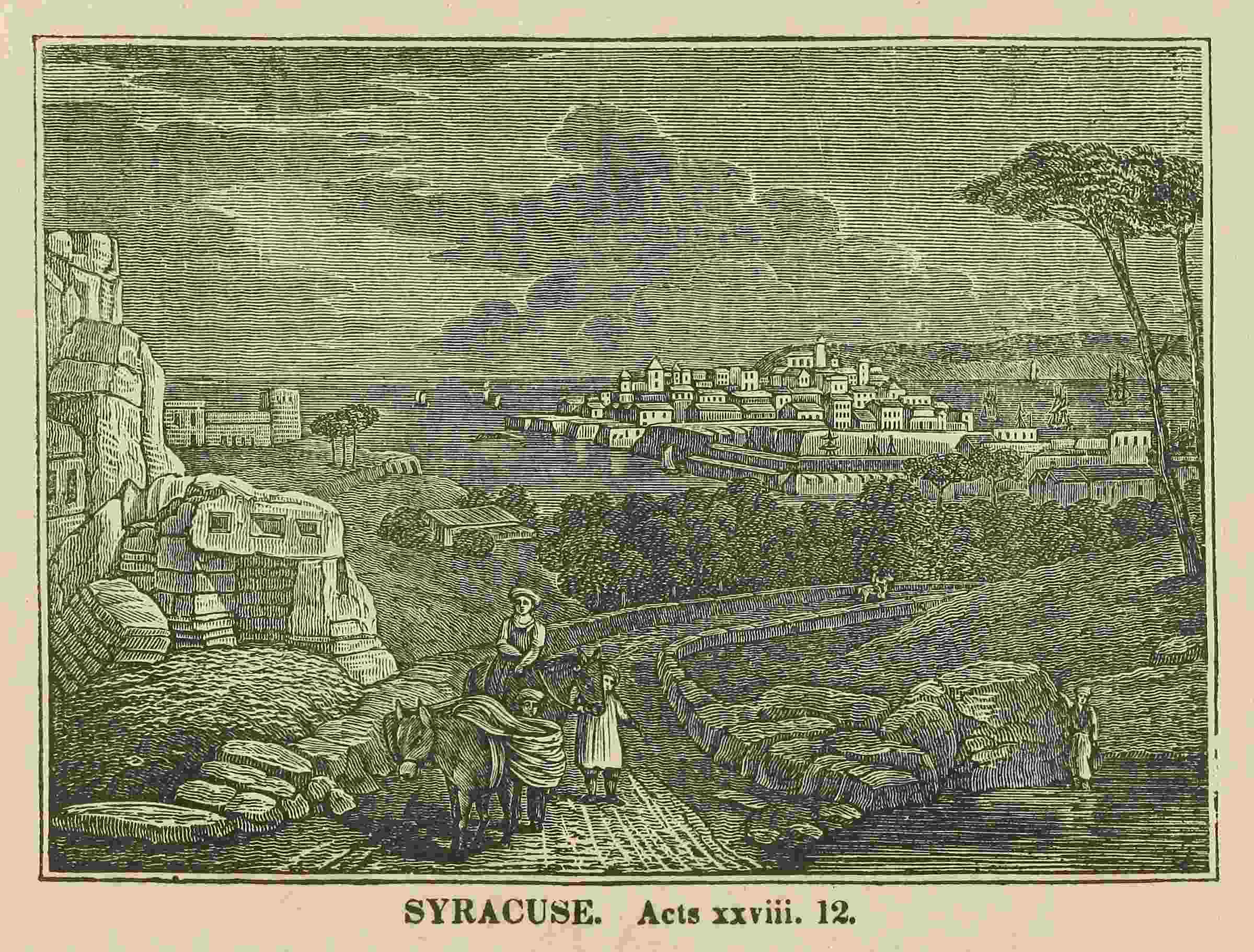
SYRACUSE. Acts xxviii. 12.
The successor of Felix in the government of Palestine, was Porcius Festus, a man whose administration is by no means characterized in the history of those times by a reputation for justice or prudence; yet in the case of Paul, his conduct seems to have been much more accordant with right and reason, than was that of the truly infamous Felix. Visiting the religious capital of the Jews soon after his first entrance into the province, he was there earnestly petitioned by the ever-spiteful foes of Paul, to cause this prisoner to be brought up to Jerusalem for trial, intending when Paul should enter the city, to execute their old plan of assassination, which had been formerly frustrated by the benevolent prudence and energy of Claudius Lysias. But Festus, perhaps having received some notification of this plot, from the friends of Paul, utterly refused to bring the prisoner to Jerusalem, but required the presence of the accusers in the proper seat of the supreme provincial administration of justice at Caesarea. After a ten days’ stay in Jerusalem, he returned to the civil capital, and with a commendable activity in his judicial proceedings, on the very next day after his arrival in Caesarea, summoned Paul and his accusers before him. The Jews of course, told their old story, and brought out against Paul many grievous complaints, which they could not prove. His only reply to all this accusation without testimony was――“Neither against the law of the Jews, nor against the temple, nor yet against Caesar, have I offended in any particular.” But Festus having been in some way influenced to favor the designs of the Jews, urged Paul to go up to Jerusalem, there to be tried by the supreme religious court of his own nation. Paul replied by a bold and distinct assertion of his rights, as a Roman citizen, before the tribunal of his liege lord and sovran: “I stand before Caesar’s judgment-seat, where I ought to be judged. To the Jews I have done no wrong, as thou very well knowest. If I am guilty of anything that deserves death, I refuse not to die; but if I have done none of these things of which they accuse me, no man can deliver me into their hands. I appeal to Caesar.” This solemn concluding formula put him at once far beyond the reach of all inferior tyranny; henceforth no governor in the world could direct the fate of the appellant Roman citizen, throwing before himself the adamantine aegis of Roman law. Festus himself, though evidently displeased at this turn of events, could not resist the course of law; but after a conference with this council, replied to Paul――“Dost thou appeal to Caesar? To Caesar shalt thou go.”
While Paul was still detained at Caesarea, after this final reference of his case to the highest judicial authority in the world, Festus was visited at Caesarea, by Herod Agrippa II. king of Iturea, Trachonitis, Abilene, and other northern regions of Palestine, the son of that Herod Agrippa whose character and actions were connected with the incidents of Peter’s life. He, passing through Judea with his sister Bernice, stopped at Caesarea, to pay their compliments to the new Roman governor. During their stay there, Festus, with a view to find rational entertainment for his royal guests, bethought himself of Paul’s case, as one that would be likely to interest them, connected as the prisoner’s fate seemed to be, with the religious and legal matters of that peculiar people to whom Agrippa himself belonged, and in the minutiae of whose law and theology he had been so well instructed, that his opinion on the case would be well worth having, to one as little acquainted with these matters as the heathen governor himself was. Festus therefore gave a very full account of the whole case to Agrippa, in terms that sufficiently well exhibited the perplexities in which he was involved, and in expressions which are strikingly and almost amusingly characteristic,――complaining as he does of the very abstruse and perplexing nature of the accusations brought by the Jews, as being “certain questions of their own religion, and of one Jesus, whom Paul affirmed to be alive.” Agrippa was so much interested in the case that he expressed a wish to hear the man in person; and Festus accordingly arranged that he should the next day be gratified with the hearing.
“‘King Agrippa and Bernice.’ Acts. xxv. 13. This Agrippa was the son of Herod Agrippa; St. Luke calls him king, which Josephus also does very often. (Antiquities lib. xx. c. viii. § 6, et passim.) But St. Luke does not suppose him to be king of Judaea, for all the judicial proceedings of that country relating to St. Paul, are transacted before Felix, and Festus his successor; besides, he says, that ‘Agrippa came to Caesarea to salute Festus,’ to compliment him on his arrival, &c. verse 1. When his father died, Claudius would have immediately put him in possession of his father’s dominions, but he was advised not to do so, on account of the son’s youth, then only seventeen; the emperor, therefore, ‘appointed Cuspius Fadus praefect of Judea and the whole kingdom, (Josephus Antiquities lib. xix. c. 9, ad fin.) who was succeeded by Tiberius, Alexander, Cumanus, Felix, and Festus, though these did not possess the province in the same extent that Fadus did.’ (Antiquities xx. Jewish War lib. ii.)
“Agrippa had, notwithstanding, at this time, considerable territories. ‘Herod, brother of king Agrippa the Great, died in the eighth year of the reign of Claudius. Claudius then gave his government to the young Agrippa.’ (Josephus Antiquities xx. p. 887.) This is the Agrippa mentioned in this twenty-fifth chapter. ‘The twelfth year of his reign being completed, Claudius gave to Agrippa the tetrarchy of Philip and Batanea, adding also Trachonitis with Abila. This had been the tetrarchy of Lysanias. But he took away from him Chalcis, after he had governed it four years.’ (Josephus Antiquities xx. p. 890, v. 25, &c.) ‘After this, he sent Felix, the brother of Pallas, to be procurator of Judea, Galilee, Samaria, and Peraea; and promoted Agrippa from Chalcis to a greater kingdom, giving him the tetrarchy which had been Philip’s. (This is Batanea, and Trachonitis, and Gaulonitis;) and he added, moreover, the kingdom of Lysanias, and the province that had been Varus’s.’ (Josephus War of the Jews lib. ii. c. 12. fin.) ‘Nero, in the first year of his reign, gave Agrippa a certain part of Galilee, ordering Tiberias and Tarichaea to be subject to him. He gave him also Julias, a city of Peraea, and fourteen towns in the neighborhood of it.’ (Antiquities xx. c. 7. § 4.) St. Luke is therefore fully justified in styling this Agrippa king at this time.” (Lardner’s Credibility, 4to. Vol. I. pp. 17, 18.) [Williams’s Pearson, p. 81, 82.]
On the next day, preparations were made for this audience, with a solemnity of display most honorable to the subject of it. The great hall of the palace was arrayed in grand order for the occasion, and, in due time, king Agrippa, with his royal sister, and the Roman governor, entered it with great pomp, followed by a train composed of all the great military and civil dignitaries of the vice-imperial court of Palestine. Before all this stately array, the apostolic prisoner was now set, and a solemn annunciation was made by Festus, of the circumstances of the prisoner’s previous accusation, trial, and appeal; all which were now summarily recapitulated in public, for the sake of form, although they had before been communicated in private, to Agrippa. The king, as the highest authority present, having graciously invited Paul to speak for himself, the apostle stretched forth his hand and began, in that respectful style of elaborately elegant compliment, which characterizes the exordiums of so many of his addresses to the great. After having, with most admirable skill, conciliated the attention and kind regard of the king, by expressing his happiness in being called to speak in his own defense before one so learned in Hebrew law, he went on; and in a speech which is well known for its noble eloquence, so resplendent, even through the disguise of a quaint translation, presented not merely his own case, but the claims of that revelation, for proclaiming which he was now a prisoner. So admirably did he conduct his whole plea, both for himself and the cause of Christ, that in spite of the sneer of Festus, Agrippa paid him the very highest compliment in his power, and pronounced him to be utterly guiltless of the charges. No part of this plea and its attendant discussions, needs to be recapitulated; but a single characteristic of Paul, which is most strikingly evinced, deserves especial notice. This is his profound regard for all the established forms of polite address. He is not satisfied with a mere respectful behavior towards his judges, but even distinguishes himself by a minute observance of all the customary phrases of politeness; nor does he suffer his courtly manner to be disturbed, even by the abrupt remark of Festus, accusing him of frenzy. In his reply, he styles his accuser “Most noble;” and yet every reader of Jewish history knows, and Paul knew, that this Festus, to whom he gave this honorable title, was one of the very wicked men of those wicked times. The instance shows then, that those who, from religious scruples, refuse to give the titles of established respect to those who are elevated in station, and reject all forms of genteel address, on the same ground, have certainly constructed their system of practical religion on a model wholly different from that by which the apostle’s demeanor was guided; and the whole impression made on a common reader, by Luke’s clear statement of Paul’s behavior before the most dignified and splendid audience that he ever addressed, must be, that he was complete in all the forms and observances of polite intercourse; and he must be considered, both according to the high standard of his refined and dignified hearers, and also by the universal standard of the refined of all ages,――not only a finished, eloquent orator, but a person of polished manners, delicate tact, ready compliment, and graceful, courtly address:――in short, A PERFECT GENTLEMAN.
VOYAGE TO ROME.
As Paul, however, had previously appealed to Caesar, his case was already removed from any inferior jurisdiction, and his hearing before Agrippa was intended only to gratify the king himself, and to cause the particulars of his complicated case to be more fully drawn out before his royal hearer, who was so accomplished in Hebrew law, that his opinion was very naturally desired by Festus; for, as the governor himself confessed, the technicalities and abstruse points involved in the charge, were altogether beyond the comprehension of a Roman judge, with a mere heathen education. The object, therefore, of obtaining a full statement of particulars, to be presented to his most august majesty, the emperor, being completely accomplished by this hearing of Paul before Agrippa,――there was now nothing to delay the reference of the case to Nero; and Paul was therefore consigned, along with other prisoners of state, to the care of a Roman officer, Julius, a centurion of the Augustan cohort. Taking passage at Caesarea, in an Adramyttian vessel, Julius sailed with his important charge from the shores of Palestine, late in the year 60. Following the usual cautious course of all ancient navigators,――along the shores, and from island to island, venturing across the open sea only with the fairest winds,――the vessel which bore the apostle on his first voyage to Italy, coasted along by Syria and Asia Minor. Of those Christian associates who accompanied Paul, none are known except Timothy, Luke, his graphically accurate historian, and Aristarchus of Thessalonica, the apostle’s long-known companion in travel. These, of course, were a source of great enjoyment to Paul on this tedious voyage, surrounded, as he was, otherwise, by strangers and heathen, by most of whom he must have been regarded in the light of a mere criminal, held in bonds for trial. He was, however, very fortunate in the character of the centurion to whose keeping he was entrusted, as is shown in more than one incident related by Luke. After one day’s sail, the vessel touching at Sidon, Julius here politely gave Paul permission to visit his Christian friends in that place,――thus conferring a great favor, both on the apostle and on the church of Sidon. Leaving this place, their course was next along the coast of Syria, and then eastwards, along the southern shore of Asia Minor, keeping in the Cilician strait between that province and the great island of Cyprus, on account of the violence of the southwesters. Coasting along by Pamphylia and Lycia, they next touched at Myra, a city in the latter province, where they were obliged to take passage in another vessel, bound from Alexandria to Italy. In this vessel, they also kept close to the coast, their course being still retarded by head winds, until they reached Cnidus, the farthest southeastern point of Asia Minor, and thence stretched across the Carpathian sea, to Crete, approaching it first at Cape Salmone, the most eastern point at the island, and then passing on to a place called “the Fair Haven,” near Lasea, probably one of the hundred cities of Crete, but mentioned in no other ancient writer. At this place, Paul, whose experience in former voyages was already considerable, having been twice ship-wrecked, had sagacity enough to see that any further navigation that season would be dangerous; for it was now the beginning of October, and the most dreadful tempests might be reasonably expected on the wintry sea, before they could reach the Italian coast. He warned the centurion accordingly, of the peril to which all their lives were exposed; but the owner and commander of the vessel, anxious to find a better place for wintering than this, persuaded Julius to risk the passage to the south side of the island, when they might find, in the port of Phoenix, a more convenient winter harbor. So, after the south wind had nearly died away, they attempted to take advantage of this apparent lull, and work their way, close to the shore along the south side of Crete; but presently they were caught by a tremendous Levanter, which carried them with great velocity away to the west, to the island of Clauda, which lies south of the west end of Crete. Here the danger of the ship’s breaking in pieces was so great, that having with much ado overhauled their boat, they undergirded the ship with cables, to keep it together,――a measure not unknown in modern navigation. Finding that they were in much danger of grounding among the quicksands on the coast of the island, they were glad to stand out to sea; and taking in all sail, scudded under bare poles for fourteen days, during a great part of which time, they saw neither sun, moon nor stars, the whole sky being constantly overcast with clouds, so that they knew nothing of their position. The wind of course carried them directly west, over what was then called the sea of Adria,――not what is now called the Adriatic gulf, but that part of the Mediterranean, which lies between Greece, Italy and Africa. In their desperation, the passengers threw over their own baggage, to lighten the ship; and they began to lose all hope of being saved from shipwreck. Paul, however, encouraged them by the narration of a dream, in which God had revealed to him that every one of them should escape; and they still kept their hopes alive to the fourteenth night, when the sailors, thinking that the long western course must have brought them near Sicily, or the main-land of Italy, which lay not far out of this direction, began to heave the lead, that they might avoid the shore; and at the first sounding, found but twenty fathoms, and at the next fifteen. Of course, the peril of grounding was imminent, and they therefore cast anchor, and waited for day. Knowing that they were now near some shore, the sailors determined to provide for their own safety, and accordingly undertook to let down the boat, to make their escape, and leave the passengers to provide for themselves. But Paul represented to the centurion the certainty of their destruction, if the ship should be left without any seamen to manage it; and the soldiers of the prisoners’ guard, determined not to be thus deserted, though they should all sink together, cut off the ropes by which the boat was held, and let it fell off. All being thus inevitably committed to one doom, Paul exhorted them to take food, and thus strengthen themselves for the effort to reach the shore. They did so accordingly, and then, as a last resort, flung out the wheat with which the ship was loaded, and at day-break, when land appeared, seeing a small creek, they made an effort to run the ship into it, weighing anchor and hoisting the mainsail; but knowing nothing of the ground, soon struck, and the overstrained ship was immediately broken by the waves, the bows being fast in the sandbank, while the stern was heaved by every surge. The soldiers, thinking first of their weighty charge, for whose escape they were to answer with their lives, advised to kill them all, lest they should swim ashore. But the more humane centurion forbade it, and gave directions that every man should provide for his own safety. They did so; and those that could not swim, clinging to the fragments of the wreck, the whole two hundred and seventy-six who were in the vessel, got safe to land.
“‘When sailing was now dangerous, because the fast was already past.’ verse 9. There is no question but that this is the great fast of expiation, Leviticus xvi. 29, the description of which we have in Isaiah lviii. under the name of a sabbath, verse 13. The precise time of this sabbatic fast is on the tenth day of the seventh month, Tizri, which falls on the same time very nearly with our September, the first day of Tizri on the seventh of that, and so the 10th of Tizri on the 16th of September, that is, thirteen days before our Michaelmas. This being premised, the apostle’s reasoning becomes clear; for it is precisely the same as though he should have said, because it was past the twentieth (the day Scaliger sets for the solemnization of the fast,) of September; it being observed by all sailors, that for some weeks before and after Michaelmas, there are on the sea sudden and frequent storms, (probably the equinoctial,) which have in modern times received the name of Michaelmas flaws, and must of course make sailing dangerous. Hesiod himself tells us, that at the going down of Pleiades, which was at the end of autumn, navigation was hazardous.” (Williams.)
“Undergirding the ship.’ verse 17. We learn from various passages in the Greek and Roman writers, that the ancients had recourse to this expedient, in order to save the ship from imminent danger; and this method has been used in modern times. The process of undergirding a ship is thus performed:――a stout cable is slipped under the vessel at the prow, which can be conducted to any part of the ship’s keel, and then fasten the two ends on the deck, to keep the planks from starting. An instance of this kind is mentioned in ‘Lord Anson’s Voyage round the World.’ Speaking of a Spanish man-of-war in a storm, the writer says, ‘They were obliged to throw overboard all their upper-deck guns, and take six turns of the cable round the ship, to prevent her opening.’ (p. 24, 4to. edition.) Bp. Pearce and Dr. Clarke, on Acts xxvii. 17. Two instances of undergirding the ship are noticed in the ‘Chevalier de Johnstone’s Memoirs of the Rebellion in 1745‒6, London, 1822, 8vo. pp. 421, 454.” (Williams’s notes on Pearson, p. 85.)
They now found that they had struck on the island of Melita, (now Malta,) which lies just south of Sicily, in the direct track in which the eastern gale must have blown them. The uncivilized inhabitants of this desolate spot received the shipwrecked voyagers with the kindest attention, and very considerately kindled a fire, to warm and dry them, after their long soaking in cold water. The dripping apostle took hold with the rest to make the fire blaze up, and gathered a bundle of dry sticks, for the purpose; but with them he unconsciously gathered a viper, which was sheltering itself among them from the cold, and roused by the heat of the fire, now crept out upon his hand. He, of course, as any other man would, gave a jerk, and shook it off, as soon as he saw it,――a very natural occurrence; but the superstitious barbarians thought this a perfect miracle, as they had before foolishly considered it a token of divine wrath; and having looked on him as an object of horror, and a wicked criminal, they now, with equal sense, adored him as a God.
Another incident of more truly miraculous character, occurred to Paul soon after, in the part of the island on which they were wrecked, which had the effect of gaining him a much more solid fame. The father of Publius, the Roman officer who governed the island, as the deputy of the praetor of Sicily, was at that time very sick of the dysentery; and Paul, going to see him, laid his hands on him and prayed,――thus effecting a complete recovery. This being known, other diseased persons were presented as the subjects of Paul’s miraculous powers, and the same cures following his words, he with his associates soon became the objects of a far more rational reverence than had been excited by the deliverance from the viper. The reverence too, was extended beyond mere empty honor. The shipwrecked apostolic company having lost all their baggage and provisions, were abundantly provided with everything that they needed, by the grateful contributions of the islanders;――and when, after a stay of three months, Paul and his companions departed, they were loaded with things necessary for the voyage.
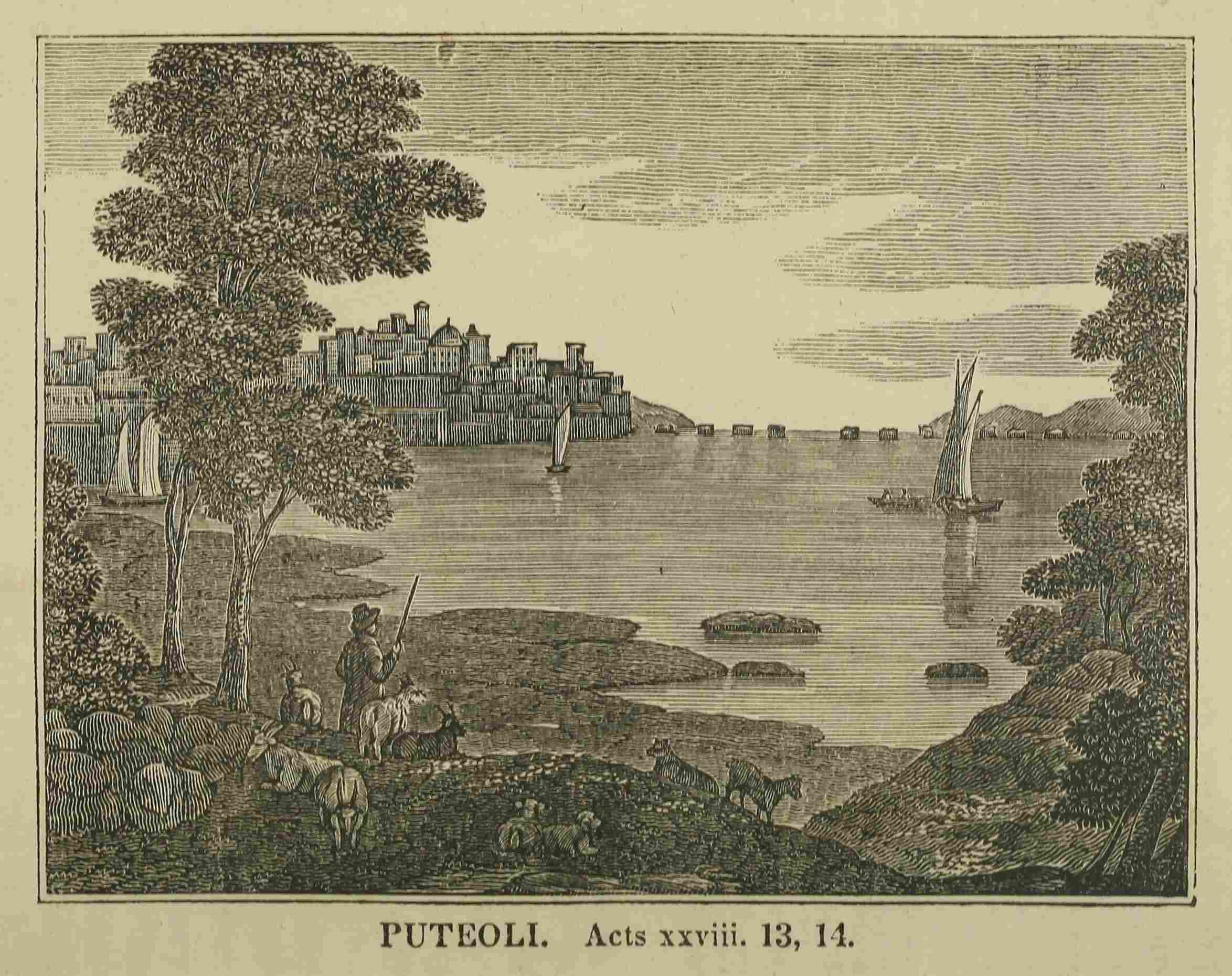
PUTEOLI. Acts xxviii. 13, 14.
Sailing, on the return of spring, in another Alexandrine vessel, of the same very common name borne by that in which they were shipwrecked, they came next to Syracuse, on the east side of the island of Sicily, and after a stay of three days, turned through the Sicilian strait to Rhegium, on the main-land directly opposite the island. There Paul first saw the soil of Italy, but did not leave the vessel for his land journey, till they came, with a fresh south wind, to Puteoli, a port in the bay of Naples. Here they found Christians, who invited them to rest among them for a week; after which they journeyed along the coast, on the noble road of Pozzuoli and Baiae, for about a hundred miles, to Appius’s Forum, a village about eighteen miles from Rome. At this place, they were met by a number of brethren from the church of Rome; and having journeyed along the Appian way, to the Three Taverns,――a little stopping place a few miles from the city,――they were received by still another deputation of Roman Christians, come out to greet the great apostle, whose name had long been known among them, and whose counsels and revelations they had already enjoyed by his writings. This noble testimony of the esteem in which they held him, was a most joyful assurance to Paul, that, even on this foreign shore, a stranger and a prisoner, he had many near and dear friends; and his noble spirit, before probably depressed and melancholy, in the dark prospect of his approach to the awful seat of that remorseless imperial power that was to decide his doom, now rose to feelings of exultation and gratitude. Entering the vast imperial city, the prisoners were remanded by the centurion to the custody of Burrhus, the noble and influential praefect of the praetorian guard, who was, ex-officio, the keeper of all prisoners of state, brought from the provinces to Rome. Burrhus however, was as kind and accommodating to Paul as Julius had been, and allowed him to live by himself in a private house, with only a soldier as an attendant guard.
After three days, Paul invited to his lodgings the chief men of the Jewish faith, in Rome, and made known to them the circumstances under which he had been sent thither, and his present relations to the heads of their religion in Jerusalem. In reply, they merely stated that they had received no formal communications respecting him, from Jerusalem, nor had those of their brethren who had arrived from Judea spoken ill of him. They expressed also a great desire to hear from him the peculiar doctrine, for entertaining which he had been thus denounced, of which they professed to know nothing, but that there was a universal prejudice against it. A day was accordingly appointed for a full conference on these very important subjects,――and at the set time, Paul, with no small willingness, discoursed at great length on his views of the accomplishment of all the ancient prophecies respecting the Messiah, in the life and death of Jesus of Nazareth. His hearers were very much divided in opinion about these points, after his discourse was over,――some believing and some disbelieving. Leaving them to meditate on what he had said, Paul dismissed them with a warning quotation from Isaiah, against their prejudices, and sternly reminded them, that though they did reject the truth, the waiting Gentiles were prepared to embrace it, and should receive the word of God immediately. They then left him, and made his words a subject of much discussion among themselves; but the results are unrecorded. Paul having hired a house in Rome, made that city the scene of his active labors for two whole years, receiving all that called to inquire into religious truth, and proclaiming the doctrines of Christianity with the most unhesitating boldness and freedom; and no man in Rome could molest him in making known his belief to as many as chose to hear him; for it was not till many years after, that the Christians were denounced and persecuted by Nero.
HIS EPISTLES WRITTEN FROM ROME.
With these facts the noble narrative of Luke ceases entirely, and henceforth no means are left of ascertaining the events of Paul’s life, except in those incidental allusions which his subsequent writings make to his circumstances. Those epistles which are certainly known and universally agreed to have been written from Rome during this imprisonment, are those to the Philippians, the Ephesians, the Colossians, and to Philemon. There are passages in all these which imply that he was then near the close of his imprisonment, for he speaks with great confidence of being able to visit them shortly, and very particularly requests preparation to be made for his accommodation on his arrival.
There is good reason to think that the epistles to the Ephesians, to the Colossians, and to Philemon, were written about the same time and were sent together. This appears from the fact, that Tychicus is spoken of in both the two former, as sent by the apostle, to make known to them all his circumstances more fully, and is also implied as the bearer of both, while Onesimus, the bearer of the latter, is also mentioned in the epistle to the Colossians as accompanying Tychicus.
THE EPISTLE TO THE EPHESIANS.
The most important question which has been raised concerning this epistle, regards the point, whether it was truly directed and sent by Paul, to the church in Ephesus, as the common reading distinctly specifies. Many eminent modern critics have maintained that it was originally sent to the church in Laodicea, and that the word Ephesus, in the direction and in the first verse, is a change made in later times, by those who felt interested to claim for this city the honor of an apostolic epistle. Others incline to the opinion, that it was directed to no particular church, but was sent as a circular to several churches in Asia Minor, among which were those of Ephesus and Laodicea, and that several copies were sent at the same time, each copy being differently directed. They suppose that when the epistles of Paul were first collected, that copy which was sent to Ephesus was the one adopted for this, and that the original manuscript being soon lost, all written trace of its original general direction disappeared also.
The prominent reason for this remarkable supposition, unsupported as it is by the authority of any ancient manuscript, is that Paul writes apparently with no local reference whatever to the circumstances of the Ephesians, among whom he had lived for three years, although his other epistles to places which he had visited are so full of personal and local matters; and that he speaks on the contrary as though he knew little of them except by hearsay. A reference to the particular details of the reasoning by which this opinion is supported, would altogether transcend the proper limits of this work; since even a summary of them fills a great many pages of those critical and exegetical works, to which these discussions properly belong; and all which can be stated here is the general result, that a great weight of authority favors the view that this was probably a circular epistle; but the whole argument in favor of either notion, rests on so slight a foundation, that it is not worth while to disturb the common impression for it.
The epistle certainly does not seem to dwell on any local difficulties, but enlarges eloquently upon general topics, showing the holy watchfulness of the apostle over the faith of his readers. He appears, nevertheless, to emphasize with remarkable force, the doctrines that Christ alone was the source and means of salvation, “the chief corner-stone,” and that in him all are united, both Jews and Gentiles, in one holy temple. There is something in many such passages, with which the epistle abounds, that seems peculiarly well fitted to the circumstances of mixed communities, made up of Jews and Gentiles, and as if the apostle wished to prevent the former from creating any distinctions in the church, in their own favor. Many passages in this epistle also, are very pointedly opposed to those heresies, which about that period were beginning to rise up in those regions, and were afterwards famous under the name of the Gnosis,――the first distinct sect that is known to have perverted the purity of Christian truth. Paul here aims with remarkable energy, to prove that salvation was to be attributed to Christ alone, and not to the intervention of any other superior beings, by whatever names they are called, whether principalities, or powers, or might or dominion, both in this world and the world to come,――in heavenly places as well as earthly. The apostle also is very full in the moral and practical part,――urging with great particularity the observance of those virtues which are the essentials of the Christian character, and specifying to each particular age, sex, rank and condition, its own peculiar duties.
THE EPISTLE TO THE COLOSSIANS.
In the first verse of the second chapter, the apostle expresses a peculiar anxiety for the spiritual safety of those Christians who have not seen his face in the flesh, among whom he appears to number the Colossians and Laodiceans. It seems quite evident that he had never been at Colosse; for though he traversed Phrygia, on two several occasions before this time, he is not said to have visited either Colosse or Laodicea;――but his route is so described, as to make it almost impossible for him to have taken either city directly in his way. This circumstance may account for the fact of his distinguishing in this manner a single city like Colosse, of no great size or importance; because as it appears from the general tenor of the epistle, certain peculiar errors had arisen among them, which were probably more dangerously rife, from the circumstance of their never having been blessed by the personal presence and labors of an apostle. The errors which he particularly attacks, seem to be those of the Judaizers, who were constantly insisting on the necessity of Mosaical observances, such as circumcision, sabbaths, abstinence from unclean meats, and other things of the same sort. He cautions them particularly against certain false doctrines, also referred to under the names of philosophy, vain deceit, the traditions of men, &c. which are commonly thought to refer to the errors of the Essenes, a Jewish sect characterised by Josephus in terms somewhat similar, and who are supposed to have introduced their ascetic and mystical doctrines into the Christian church, and to have formed one of the sources of the great system of Gnosticism, as afterwards perfected. The moral part of this epistle bears a very striking similarity, even in words, to the conclusion of that to the Ephesians,――a resemblance probably attributable in part, to the circumstance, that they were written about the same time. The circumstance that he has mentioned to the Colossians an epistle to be sent for by them from Laodicea, has given rise to a forged production, purporting to be this very epistle from Paul to the Laodiceans; but it is manifestly a mere brief rhapsody, collected from Paul’s other epistles, and has never for a moment imposed upon the critical. It has been supposed that the true epistle meant by Paul, is another, now lost, written by Paul to Laodicea; and the supposition is not unreasonable.
THE EPISTLE TO PHILEMON.
This was merely a private letter from Paul to a person otherwise not known, but appearing, from the terms in which he is herein mentioned, to have been at some time or other associated with Paul in the gospel work; since he styles him “fellow-laborer.” He appears to have been a man of some property and generosity, because he had a house spacious enough to hold a worshiping assembly, who were freely accommodated by him; and he is likewise mentioned as hospitably entertaining traveling Christians. The possession of some wealth is also implied in the circumstance which is the occasion of this epistle. Like almost all Christians of that age who were able to do so, he owned at least one slave, by name Onesimus, who had run away from him to Rome, and there falling under the notice of Paul, was made the subject of his personal attentions, and was at last converted by him to the Christian faith. Paul now sends him back to his old master, with this letter, in which he narrates the circumstances connected with the flight and conversion of Onesimus, and then with great earnestness, yet with mildness, entreats Philemon to receive him now, not as a slave, but as a brother,――to forgive him his offenses, and restore him to favor. Paul himself offers to become personally responsible for all pecuniary loss experienced by Philemon in consequence of the absence of his servant in Rome, where he had been ministering to Paul; and the apostle gives ♦his own note of hand for any reasonable amount which Philemon may choose to claim. Throughout the whole, he speaks in great confidence of the ready compliance of Philemon with these requests, and evidently considers him a most intimate friend, loving and beloved. He also speaks with great confidence of his own speedy release from his bonds, and begs Philemon to prepare him a lodging; for he trusts that through his prayers, he shall shortly be given to him.
THE EPISTLE TO THE PHILIPPIANS.
That this was written after the others that were sent from Rome by Paul during this imprisonment, is proved by several circumstances. Luke was certainly with him when he wrote to the Colossians and to Philemon; but no mention whatever is made of him in the epistle to the Philippians, who would, nevertheless, feel as much interest in him as in Timothy or any companion of Paul; because he had resided in Philippi many years, and must have had many acquaintances there, who would expect some account of him, and some salutation from him. Paul, moreover, says, that he trusts to send Timothy shortly to them, because he has no man with him who is like minded, or who will care for their state;――a remark which, if Luke had been with him, he could not have made with any justice to that faithful and diligent associate, who was himself a personal acquaintance of the Philippians. There were some circumstances connected with the situation of Paul, as referred to in this epistle, which seem to imply a different date from those epistles just mentioned. His condition seems improved in many respects, although before not uncomfortable, and his expectations of release still more confident, though before so strong. He speaks also of a new and remarkable field in which his preaching had been successful, and that is, the palace of the imperial Caesar himself, among whose household attendants were many now numbered among the saints who sent salutations to Philippi. The terms in which he mentions his approaching release, are still more remarkable than those in the former epistles. He says――“Having this confidence, I know that I shall abide and continue with you all,” &c. “that your rejoicing may be more abundant, by my coming to you again.” “I trust in the Lord that I shall myself also come shortly.”
The immediate occasion of this epistle was the return of Epaphroditus, the apostle or messenger of the Philippian church, by whom Paul now wrote this, as a grateful acknowledgment of their generosity in contributing to his support that money, of which Epaphroditus was the bearer. In the epistle, he also took occasion, after giving them an account of his life in Rome, to warn them against the errors of the Judaizers, whose doctrines were the occasion of so much difficulty in the Christian churches.
THE EPISTLE TO THE HEBREWS.
The release which Paul so confidently anticipated, probably happened shortly after the writing of the last epistle, and at this time, just before leaving Italy for another field of labor, it is commonly believed that he wrote his epistle to the Hebrews. Of the particular place, the time, the immediate object, and the persons who were the receivers of this epistle, nothing is with any certainty known; and the whole range of statements in standard works of exegetical and critical theology, on this writing, is the most appalling mass of vague speculations, unfounded conclusions and contradictory assertions, that presents itself to the historian of the apostolic works in any direction; and in respect to all these points, referring the critical to any or all of the thousand and one views, given in the learned and elaborate introductions and commentaries, which alone can with any justice so much as open the subject, the author excuses himself entirely from any discussion of this endless question, in the words used on one of these points, by one of the most learned, acute, ingenious and cautious critics of modern times. “Any thing further on this subject I am unable to determine, and candidly confess my ignorance as to the place where the epistle to the Hebrews was written. Nor do I envy any man who pretends to know more on this subject, unless he has discovered sources of intelligence, which have hitherto remained unknown. It is better to leave a question in a state of uncertainty, than, without foundation, to adopt an opinion which may lead to material errors.”
VOYAGE TO THE EAST.
On leaving Italy after this release, he seems to have directed his course eastward; but nothing whatever is known of his motions, except that from the epistle of Titus it is learned that he journeyed to Miletus, to Ephesus, to Troas, to Macedonia, to Crete and to Epirus,――and last of all, probably, to Rome. His first movements on his release were, doubtless, in conformity with his previous designs, as expressed in his epistles. He probably went first to Asia, visiting Ephesus, Miletus, Colosse, &c. On this voyage he might have left Titus in Crete, (as specified in his letter to that minister,) and on embarking for Macedonia, left Timothy at Ephesus, (as mentioned in the first epistle to him.) After visiting Philippi and other places in Macedonia, where he wrote to Timothy, he seems to have crossed over the country to the shore of the Ionian sea, to Nicopolis, whence he wrote to Titus, to come from Crete, and join him there. These two epistles, being of a merely personal character, containing instructions for the exercise of the apostolic functions of ordination, &c. in the absence of Paul, can not need any particular historical notice, being so simple in their object that they sufficiently explain themselves. Respecting that to Timothy, however, it may be specified that some of its peculiar expressions seem to be aimed at the rising heresy of the Jewish and Oriental mystics, who were then infecting the eastern churches with the first beginnings of that heresy which, under the name of the Gnosis, or science, (falsely so called,) soon after corrupted with its dogmas, a vast number in Asia Minor, Greece and Syria. The style and tenor of both of the epistles are so different from all Paul’s other writings, as to make it very evident that they were written at a different time, and under very different circumstances from the rest.
RETURN TO ROME.
The only real evidence of this movement of Paul is found in the tenor of certain passages in the second epistle to Timothy, which seem to show that it was written during the author’s imprisonment in Rome, but which cannot be connected with his former confinement there. In the former epistles written from Rome, Timothy was with Paul;――but this of course implies that he was absent. In them, Demas is declared to be with Paul;――in this he is mentioned as having forsaken him, and gone to Thessalonica. In the first epistle to Timothy, Mark was also with Paul, and joined in saluting the Colossians; in this, Timothy is instructed to bring him to Paul, because he is profitable to him in the ministry. In the fourth chapter, Paul says that “Erastus abode at Corinth;”――an expression which implies that Erastus abode in Corinth when Paul left it. But Paul took no journey from Corinth before his first imprisonment; for when he left that place for the last time before his journey to Jerusalem,――when he was seized and sent to Rome,――he was accompanied by Timothy; and there could therefore be no need of informing him of that fact. In the same passage of this epistle he also says, that he had left Trophimus sick at Miletus; but when Paul passed through Miletus, on that journey to Jerusalem, Trophimus certainly was not left behind at Miletus, but accompanied him to Jerusalem; for he was seen there with him by the Asian Jews. These two passages therefore, refer to a journey taken subsequent to Paul’s first imprisonment,――and the epistle which refers to them, and purports in other passages to have been written during an imprisonment in Rome, shows that he returned thither after his first imprisonment.
The most striking passage in this epistle also refers with great distinctness to his expectation of being very speedily removed from apostolic labors to an eternal apostolic reward. “I am now ready to be offered, and the time of my departure is at hand. I have fought the good fight; I have finished my course; I have kept the faith: henceforth, there is laid up for me a crown of life, which the Lord, the righteous judge, shall give me at that day.” All these expressions are utterly at variance with those hopes of release and of the speedy renewal of his labors in an eastern field; and show very plainly that all the tasks to which he once looked forward were now completed, and that he could hope for no deliverance, but that which should call him from chains and toils to an eternal crown.
HIS DEATH.
The circumstance of his being again in Rome a prisoner, after having been once set free by the mandate of the emperor himself, after a full hearing, must at once require a reference to a state of things, in which Paul’s religious profession and evangelizing labors, before esteemed so blameless that no man in Rome forbade him to preach the gospel there,――had now, by a mighty revolution in opinions, become a crime, since for these, he was now held in bondage, without the possibility of escape from the threatened death. Such a change actually did occur in the latter part of the reign of Nero, when, as already related in the history of Peter’s first epistle, the whole power of the imperial government was turned against the Christians, as a sect, and they were convicted on that accusation alone, as deserving of death. The date of this revolution in the condition of the Christians, is fixed by Roman history in the sixty-fourth year of Christ; and the time when Paul was cast into chains the second time, must therefore be referred to this year. His actual death evidently did not take place at once, but was deferred long enough to allow of his writing to Timothy, and for him to make some arrangements therein, for a short continuance of his labors. The date which is commonly fixed as the time of his execution, is in the year of Christ 65; but in truth, nothing whatever is known about it, nor can even a probability be confidently affirmed on the subject. Being a Roman citizen, he could not die by a mode so infamous as that of the cross, but was beheaded, as a more honorable exit; and with this view, the testimony of most of the early Fathers, who particularize his death, distinctly accords.
Of the various fictions which the monkish story-tellers have invented to gratify the curiosity which Christian readers feel about other particulars of the apostle’s character, the following is an amusing specimen. “Paul, if we may believe Nicephorus, was of a low and small stature, somewhat stooping; his complexion fair; his countenance grave; his head small; his eyes sparkling; his nose high and bending; and his hair thick and dark, but mixed with gray. His constitution was weak, and often subject to distempers; but his mind was strong, and endued with a solid judgment, quick invention, and prompt memory, which were all improved by art, and the advantages of a liberal education. Besides the epistles which are owned to be genuine, several other writings are falsely ascribed to him: as an epistle to the Laodiceans, a third to the Thessalonians, a third to the Corinthians, a second to the Ephesians, his letter to Seneca, his Acts, his Revelation, his voyage to Thecla, and his Sermons.” (Cave’s Lives of the Apostles.)
But the honors and saintship of Paul are recorded, not in the vague and misty traces of bloody martyr-death, but in the far more glorious achievements of a heroic life. In these, are contained the essence of his greatness; to these, all the Gentile world owes its salvation; and on these, the modern historian, following the model of the sacred writers, dwells with far more minuteness and particularity, than on a dull mass of uncertain tradition.
JOSEPH BARNABAS.
Of this apostle, so few circumstances are known, that are not inseparably connected with the life of Paul, in which they have been already recorded, that only a very brief space can be occupied with the events of his distinct life. The first passage in which he is mentioned, is that in the fourth chapter of Acts, where he is specified as having distinguished himself among those who sold their lands, for the sake of appropriating the avails to the support of the Christian community. Introduced to the notice of the reader under these most honorable circumstances, he is there described as of the tribe of Levi, and yet a resident in the island of Cyprus, where he seems to have held the land which he sacrificed to the purposes of religious charity. This island was for a long time, before and after that period, inhabited by great numbers of wealthy Jews, and there was hardly any part of the world, where they were so powerful and so favored, as in Cyprus; so that even the sacred order of the Levites might well find inducements to leave that consecrated soil to which they were more especially attached by the peculiar ordinances of the Mosaic institutions, and seek on this beautiful and fertile island, a new home, and a new seat for the faith of their fathers. The occasion on which Joseph (for that was his original name) left Cyprus to visit Jerusalem, is not known; nor can it even be determined whether he was ever himself a personal hearer of Jesus. He may very possibly have been one of the foreign Jews present at the Pentecost, and may there have been first converted to the Christian faith. On his distinguishing himself among his new brethren, both by good words and generous deeds, he was honored by the apostles with the name of Barnabas, which is interpreted in Greek by words that may mean either “son of consolation,” or “son of exhortation.” The former sense, of course, would aptly refer to his generosity in comforting the poor apostolic community, by his pecuniary contributions, as just before mentioned; and this has induced many to prefer that meaning; but the majority of critical translators and commentators have been led, on a careful investigation both of the original Hebrew word and of the Greek translation of it, to prefer the meaning of “son of exhortation” or “instruction,” a meaning which certainly well accords with the subsequent distinction attained by him in his apostolic labors. Both senses may, however, have been referred to, with an intentional equivoque.
“Acts, chapter iv. verse 37. ὑπάρχοντος αὐτῳ ἀγροῦ He could not have sold that which was his paternal inheritance as a Levite; but this might perhaps be some legacy, or purchase of land in Judea, to which he might have a title till the next jubilee, or perhaps some land in Cyprus. (Doddridge.) That it was lawful for the Levites to buy land, we learn from the example of Jeremiah himself, who was of the tribe of Levi. See Jeremiah xxxii. 17. It is observed by Bp. Pearce, that those commentators who contend that this land must have belonged to his wife, because, according to the law mentioned in Numbers xviii. 20, 23 and 24, a Levite could have no inheritance in Israel, seem to have mistaken the sense of that law, ‘which,’ says he, ‘means only that the Levites, as a tribe, were not to have a share in the division of Canaan among the other tribes. This did not hinder any Levite from possessing lands in Judea, either by purchase or by gift, as well as in right of his wife. Josephus was a Levite, and a priest too; and yet in his Life, chapter 76, he speaks of lands which he had lying about Jerusalem, and in exchange of which, Vespasian gave him others, for his greater benefit and advantage. After all, I see no reason why we may not suppose that this land, which Barnabas had and sold, was not land in Judea; and if so, the words of the law, “no inheritance in Israel,” did not, however understood, affect their case. His land might have been in his own country, Cyprus, an island of no great distance from Judea; and he might have sold it at Jerusalem to some purchaser there; perhaps to one of his own countrymen.’” (Bloomfield’s Annotations, Vol. IV. pp. 147, 148.)
In all the other passages of the New Testament in which he is mentioned, he is associated with Paul, and every recorded act of his life has been already given in the life of his great associate. His first acquaintance with him on his return to Jerusalem after his conversion,――his mission to Antioch and labors there in conjunction with Paul, when he had brought him from Tarsus,――their visit to Jerusalem,――their return to Antioch,――their first great mission through Asia Minor――their visit to Jerusalem at the council, and their joint report,――their second return to Antioch,――their proposed association in a new mission,――their quarrel and separation,――have all been fully detailed; nor is there any authentic source from which any facts can be derived, as to the subsequent incidents of his life. All that is related of him in the Acts, is, that after his separation from Paul, he sailed to Cyprus; nor is any mention made, in any of the epistles, of his subsequent life. The time and place of his death are also unknown.
JOHN MARK.
Of the family and birth of this eminent apostolic associate, it is recorded in the New Testament, that his mother was named Mary, and had a house in Jerusalem, which was a regular place of religious assembly, for the Christians in that city; for Peter on his deliverance from prison, went directly thither, as though sure of finding there some of the brethren; and he actually did find a number of them assembled for prayer. Of the other connections of Mark, the interesting fact is recorded, that Mary, his mother, was the sister of Barnabas; and he was therefore by the maternal line, at least, of Levite descent. From the mode in which Mary is mentioned, it would seem that her husband was dead at that time; but nothing else can be inferred about the father of Mark. The first event in which he is distinctly mentioned as concerned, is the return of Paul and Barnabas from Jerusalem to Antioch, after Peter’s escape. These two apostles, on this occasion, are said to have “taken with them, John whose surname was Mark;” and he is afterwards mentioned under either of these names, or both together. The former was his original appellation; but being exceedingly common among the Jews, and being, moreover, borne by one of the apostles, it required another distinctive word to be joined with it. It is remarkable that a Roman, heathen appellation, was chosen for this purpose;――Marcus, which is the true form in the original, being a name of purely Latin origin, and one of the commonest praenomens among the Romans. It might have been the name of some person connected with the Roman government in Jerusalem, who had distinguished himself as a friend or patron of the family: but the conjecture is hardly worth offering.
After returning with Paul and Barnabas to Antioch, he was next called to accompany them as an assistant in their apostolic voyage through Cyprus and Asia Minor; but on their coming to Perga, in Pamphylia, he suddenly left them and returned to Jerusalem;――a change of purpose which was considered, by Paul at least, as resulting from a want of resolution, steadiness, or courage, and was the occasion of a very serious difficulty; for Mark having returned to Antioch afterwards, was taken by Barnabas, as a proper associate on the proposed mission over the former fields of labor; but Paul utterly rejected him, because he had already, on the same route, once deserted them, when they needed his services, and he therefore refused to go in his company again. This difference was the occasion of that unhappy contention, the incidents of which have already been particularly detailed in the Life of Paul. Mark however, being resolutely supported by his uncle, accompanied him to Cyprus; but of his next movement, as little is known as in respect to Barnabas. The next occasion on which his name is mentioned, is by Paul, in his epistles to the Colossians and to Philemon, as being then with him in Rome; from which it appears, the great apostle had now for a long time been reconciled to him, and esteemed him as a valuable associate in the ministry. He is not mentioned in the epistle to the Philippians, which therefore makes it probable that he had then gone to the east. In the second epistle to Timothy, Paul requests that Mark may be sent to him, because he is profitable to him for the ministry; which is a most abundant testimony to his merits, and to the re-establishment of Paul’s confidence in his zeal, resolution, and ability. Whether he was actually sent to Rome as requested, does not appear;――but he is afterwards distinctly mentioned by Peter, in that epistle which he wrote from Babylon, as being then with him. The title of “son,” which Peter gives him, seems to imply a very near and familiar intimacy between them; and is probably connected with the circumstance of his being made the subject of the chief apostle’s particular religious instructions in his youth, in consequence of the frequent meetings of the brethren at the house of his mother, Mary. This passage is sufficient evidence that after Mark had finally left Rome, he journeyed eastward and joined Peter, his venerable first instructor, who, as has already been abundantly shown in his Life, was at this time in Babylon, whence, in the year 65, he wrote his first epistle.
“It is thought by Benson that Mark departed because his presence was required by the apostles for converting the Jews of Palestine. But why then should Paul have expressed indignation at his departure? The same objection will apply to the conjecture of others, that he departed on account of ill-health. The most probable opinion is that of Grotius, Wetstein, Bengel, Heumann, and others, that Mark was, at that time, somewhat averse to labors and dangers; this, indeed, is clear from the words, καὶ μὴ συνελθόντα αὐτοῖς εἰς τό ἔργον. Thus ἀφίστημι is used of defection in Luke viii. 13. 1 Timothy iv. 1. It should seem that Mark had now repented of his inconstancy; (and, as Bengel thinks, new ardor had been infused into him by the decree of the Synod at Jerusalem, and the free admission of the Gentiles;) and hence his kind-hearted and obliging relation Barnabas wished to take him as a companion of their present journey. But Paul, who had ‘no respect of persons,’ Galatians ii. 11, and thought that disposition rather than relationship should be consulted, distrusted the constancy of Mark, and was therefore unwilling to take him. This severity of Paul, however, rendered much service both to Mark and to the cause of Christianity. For Mark profited by the well-meant admonition, and was, for the future, more zealous and courageous; and the gospel, being preached in different places at the same time, was the more widely propagated. Nor were the bands of amity between Paul and Barnabas permanently separated by this disagreement. See 1 Corinthians ix. 6. Nay, Paul afterwards received Mark into his friendship. See Colossians iv. 10. 2 Timothy iv. 11. Philemon 23.” Kuinoel. (Bloomfield’s Annotations, Vol. IV. p. 504, 505.)
HIS GOSPEL.
The circumstance which makes this apostle more especially eminent, and makes him an object of interest to the Christian reader, is, that he is the author of an important portion of the historical sacred canon. Respecting the gospel of Mark, the testimony of some very early and valuable accounts given by the Fathers, is, that he wrote under the general direction and superintendence of his spiritual father, Peter; and from this early and uniform tradition, he accordingly bears the name of “Peter’s interpreter.” The very common story is also, that it was written in Rome, but this is not asserted on any early or trustworthy authority, and must be condemned, along with all those statements which pretend that the chief apostle ever was in Italy. Others affirm also, that it was published by him in Alexandria; but this story comes on too late authority to be highly esteemed. Taking as true, the very reasonable statement of the early Fathers, that when he wrote, he had the advantage of the personal assistance or superintendence of Peter, it is very fair to conclude, that Babylon was the place in which it was written, and that its date was about the same with that of the epistle of Peter, in which Mark is mentioned as being with him. Peter was then old; and Mark himself, doubtless too young to have been an intelligent hearer of Jesus, would feel the great importance of having a correct and well-authorized record prepared, to which the second generation of Christians might look for the sure testimonies of those divine words, whose spoken accounts were then floating in the parting breath of the few and venerable apostles, and in the memories of their favored hearers. As long as the apostles lived and preached, there was little or no need of a written gospel. All believers in Christ had been led to that faith by the living words of his inspired hearers and personal disciples. But when these were gone, other means would be wanted for the perpetuation of the authenticated truth; and to afford these means to the greatest possible number, and to those most especially in want of such a record, from the fact that they had never seen nor heard either Jesus or his personal disciples,――Mark chose the Greek as the proper language in which to make this communication to the world.
His gospel is so much like that of Matthew, containing hardly a single passage which is not given by that writer, that it has been very confidently believed by many theologians who suppose an early date to Matthew’s gospel, that Mark had that gospel before him when he wrote, and merely epitomized it. The verbal coincidences between the two gospels, in their present state, are so numerous and striking, that it has been considered impossible to account for them on any other supposition than this. But these and other questions have filled volumes, and have exercised the skill of critics for ages; nor can any justice be done them by a hasty abstract. It seems sufficient, however, to answer all queries about these verbal coincidences, without meddling with the question of prior date, by a reference to the fact that, during the whole period, intervening between the death of Christ, and the writing of the gospels, the apostles and first preachers had been proclaiming, week after week, and day after day, an oral or spoken gospel, in which they were constantly repeating before each other, and before different hearers, the narrative of the words and actions of Jesus. These accounts by this constant routine of repetition, would unavoidably assume a regular established form, which would at last be the standard account of the acts and words of the Savior. These, Mark, of course, adopted when he wrote, and the other evangelists doing the same, the coincidences mentioned would naturally result; and as different apostles, though speaking under the influence of inspiration, would yet make numerous slight variations in words, and in the minor circumstances expressed or suppressed, the different writers following one account or the other, would make the trifling variations also noticeable. The only peculiarity that can be noticed in Mark, is, that he very uniformly suppresses all those splendid testimonies to the merits and honors of Peter, with which the others abound,――a circumstance at once easily traceable to the fact that Peter himself was the immediate director of the work, and with that noble modesty, which always distinguished the great apostolic chief, would naturally avoid any allusion to matters which so highly exalted his own merits. Otherwise, the narrative of Mark can be characterized only as a plain statement of the incidents in the public life of Jesus, with very few of his discourses, and none of his words at so great length as in the other gospels; from which it is evident, that an account of his acts rather than his sermons,――of his doings rather than his sayings, is what he designed to give.