II. THE HELLENIST APOSTLES. (continued 4)
Reading edition
“The words Γαλλίωνος δε ἀνθυπατεύοντος ought to be rendered, with Heumann, Walch, Antiquities, Corinth, p. 35., and Reichard, (as indeed is required by the context,) ‘when Gallio had been made Proconsul,’ or ‘on Gallio’s entering on the Proconsulship.’ (Kuinoel.) In the same sense it was also taken by Beza and Piscator; and this appears to be the true one. The Jews, it seems, waited for the arrival of a new Proconsul to make their request, as thinking that they should then be less likely to meet with a refusal.” (Bloomfield’s Annotations, Vol. IV. p. 600.)
“‘Then all the Greeks took Sosthenes, the chief ruler of the synagogues.’ verse 17. In the 8th verse we read that Crispus was the chief ruler of the synagogue in Corinth. And from this we may suppose that there were more than one synagogue in that city, or that there might be more than one ruler in the same synagogue; or that Crispus, after his conversion to Christianity, might have been succeeded by Sosthenes; but then we are at a loss to know who the people are that thus beat and misused him; the Greek printed copies tell us that they were the Gentiles; and those that read the text imagine, that when they perceived the neglect and disregard wherewith the proconsul received the Jews, they, to insult them more, fell upon the ruler of their synagogue, whether out of hatred to them, or friendship to St. Paul, it makes no matter. But others think, that Sosthenes, however head of the synagogue, was nevertheless the friend of St. Paul, and that the other Jews, seeing themselves slighted by Gallio, might vent their malice upon him; for they suppose that this was the same Sosthenes, whose name St. Paul, in the beginning of his first Epistle to the Corinthians, written about three years after this time, joins with his own. This opinion, however, was not universally received, since, in the time of Eusebius, it was thought the Sosthenes mentioned in the epistle was one of the seventy disciples, and, consequently, could not be the chief of the synagogue at Corinth, twenty years after the death of Jesus Christ.” (Beausobre’s Annotations. Calmet’s Commentary and Dictionary.)
“‘xviii. 17. ἐπιλαβόμενοι δὲ πάντες οἱ Ἕλληνες There is here some variation of reading, and no little question raised as to the true one; which consequently leaves the interpretation unsettled. Two ancient MSS. and versions omit οἱ Ἕλληνες, and others read οἱ Ἰουδαῖοι. As to the latter reading, it cannot be tolerated; for why should the Jews have beaten him? Neither is it likely that they would have taken such a liberty before so solemn a tribunal. The words οἱ Ἕλληνες are thought by many critics, as Grotius, Mill, Pierce, Bengel, and Kuinoel, to be derived from the margin, like the last. Now those were Gentiles (say they) who beat Sosthenes; and hence some one wrote οἱ Ἕλληνες. As to the reason for the beating, it was to make the Jews go away the faster; and to this they were actuated partly by their hatred towards the Jews, and partly by a desire to please the Procurator.’ But this appears to be pressing too much on the word ἀπήλασεν, which has by no means any such meaning. Besides, it is strange that the words Ἕλληνες should have crept into nearly all the MSS; even into so many early ones. And, supposing Ἕλληνες to be removed, what sense is to be given to παντες? None (I think) satisfactory, or agreeable to the style of the New Testament. It must therefore be retained: and then the sense of πάντες will be as follows: ‘all the Greeks, both Gentiles and Christians:’ which is so evident, that I am surprised the commentators should not have seen it. Some explain it of the Gentiles, and others of the Gentile Christians. Both indeed had reason to take umbrage at the intolerance and bitter animosity of the Jews. It is not likely that any should have joined in the beating, merely to please the Proconsul, who was not a man to be gratified by such a procedure. So that the gnomes brought forward by Grotius on the base assentatio of courtiers, are not here applicable.
“By ἔτυπτον is merely to be understood beating, or thumping him with their fists, as he passed along. Anything more than that, we cannot suppose they would have ventured upon, or the Proconsul have tolerated.”
“By τούτων, (verse 17,) we may, I think, understand both the accusation brought forward, and the cuffs which followed; to neither of which the Proconsul paid much attention; and this from disgust at the litigious conduct of the Jews; as also from the custom, mentioned by Pricaeus, of the Roman governors, to pass by any conduct which did not directly tend to degrade the dignity of the Roman name, or weaken its influence, in order that the yoke might be as easy as possible to the provincials.” (Bloomfield’s Annotations, Vol. IV. pp. 603‒605.)
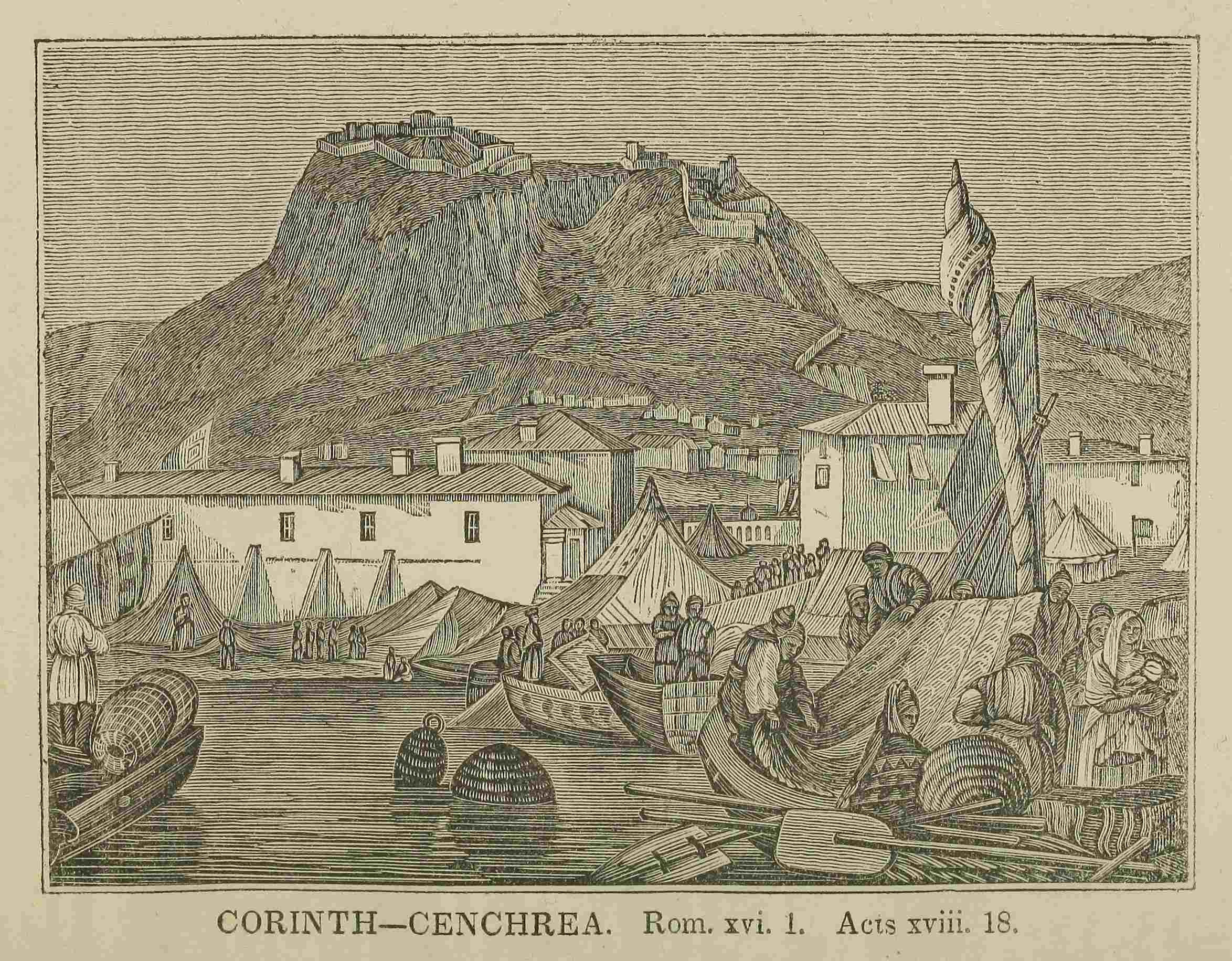
CORINTH――CENCHREA. Romans xvi. 1. Acts xviii. 18.
His character having been thus vindicated, and his safety thus assured him by the supreme civil authority, Paul resided for a long time in Corinth, steadily pursuing his apostolic work, without any direct hindrance or molestation from the Jews. There is no reason to suppose that he confined all his labor entirely to the city; on the contrary, it is quite certain, that the numerous smaller gospel fields throughout the adjacent country, must have attracted his attention, and it appears, from the commencement of his second epistle to the Corinthians, that many throughout all Achaia had received the gospel, and had been numbered among the saints. Corinth, however, remained the great center of his operations in Greece, and from this place he soon after directed another epistle to one of his apostolic charges in Macedonia,――the church of Thessalonica. Since his former epistle had been received by them, there had arisen a new occasion for his anxious attention to their spiritual condition, and in his second letter he alludes distinctly to the fact that there had been misrepresentations of his opinion, and seems to imply that a letter had been forged in his name, and presented to them, as containing a new and more complete account of the exact time of the expected coming of Christ, to which he had only vaguely alluded in the first. In the second chapter of his second epistle, he renews his warning against these delusions about the coming of Christ, alluding to the fact, that they had been deceived and disturbed by misstatements on this subject, and had been led into error, both by those who pretended to be inspired, and by those who attempted to show by prediction, that the coming of Christ was at hand, and also by the forged epistle pretending to contain Paul’s own more decisive opinions on the subject. He exhorts them to “let no man deceive them by any of these means.” He warns them moreover, against any that exalt themselves against the doctrines which he had taught them, and denounces all false and presumptuous teachers in very bitter terms. After various warnings against these and all disorderly persons among them, he refers to his own behavior while with them, as an example for them to follow, and reminds them how blamelessly and honestly he behaved himself. He did not presume on his apostolic office, to be an idler, or to eat any man’s bread for naught, but steadily worked with his own hands, lest he should be chargeable to any one of them; and this he did, not because his apostolic office did not empower him to live without manual labor, and to depend on those to whom he preached for his means of subsistence, but because he wished to make himself, and his fellow-laborers, Silas and Timothy, examples for their behavior after he was gone. Yet it seemed that, notwithstanding the pains he had taken to inculcate an honest and industrious course, several persons among them had assumed the office of teaching and reproving, and had considered themselves thereby excused from doing anything for their own support. In the conclusion, he refers them distinctly to his own signature and salutation, which authenticate every epistle which he writes, and without which, no letter was to be esteemed genuine. This he specifies, no doubt, for the sake of putting them on their guard against the repetition of any such deception as had been lately practised on them in his name.
HIS VOYAGE BACK TO THE EAST.
Soon after Paul had written his second epistle to the Thessalonians, he left Corinth, in the spring of A. D. 56, as it is commonly calculated, and after bidding the brethren farewell, journeyed back to Asia, from whose shores he had now been absent not less than three years. On his return journey, he was accompanied by his two acquaintances and fellow-laborers, Aquilas and Priscilla, who were now his most intimate friends, and henceforth were always esteemed among the important aids of the apostolic enterprise. Journeying eastward across the isthmus, they came to Cenchreae, the eastern port of Corinth, and at the head of the great Saronic gulf, about seven miles from the city itself. At this place Paul discharged himself of the obligation of a vow, which he had made some time before, in conformity with a common Jewish custom of thus giving force to their own sense of gratitude for the accomplishment of any desired object. He had vowed to let his hair grow until some unknown end was attained, and now, having seen the prayers which sanctioned that vow granted, he cut off his hair in token of the joyful completion of the enterprise on which he had thus solemnly and formally invoked the blessing of heaven. The actual purpose of this vow is not recorded,――but when the occasion on which he thus exonerated himself is considered, it seems most reasonable to suppose that now, embarking from the shores of Europe, after he had there passed so many years of very peculiar labor and trials, he was thus celebrating the prosperous and happy achievment of his first great western mission, and that this vow had been made for his safe return, when he first sailed from the eastern coast of the Aegean, at Alexandria Troas.
He sailed from Cenchreae to Ephesus, a great city of Ionic Asia, which had never been the scene of his apostolic labors, though he had traversed much of the country around it; for it will be remembered, that on his last journey through Asia Minor, when he had passed over Galatia and Phrygia, he was about to enter Asia Proper, but was hindered by a special impulse of the Spirit, which sent him in a different direction. But having thus achieved his great western enterprise, there was now no longer any more important commission to prevent him from gratifying his eyes with a sight of this very interesting region, and making here an experimental effort to diffuse the knowledge of the gospel through the numerous, wealthy, refined and populous cities of this, the most flourishing and civilized country in the world. He did not intend, however, to make anything more than a mere call at Ephesus; for the great object of his voyage from Europe was to return to Jerusalem and Syria, and give to his brethren, a full statement of all the interesting particulars of his long and remarkable mission in Macedonia and Greece. But he took occasion to vary this eastern route, so as to effect as much good as possible by the way; and therefore embarked first for Ephesus, where he landed with Aquilas and Priscilla, whom he left there, while he continued on his journey, southeastwards. He stopped with them however, a few days, with a view to open this new field of labor with them; and going into the synagogue, discoursed with the Jews. He was so well received by his hearers, that he was earnestly besought to prolong his stay among them; but he excused himself for his refusal of their kind invitation, by stating the great object which he had in view in leaving Europe at that particular time:――“I must by all means keep this coming feast at Jerusalem; but I will return to you,――God willing.” And bidding them farewell, he sailed away from Ephesus to Caesarea, on the coast of Palestine, where he landed. Thence he went up to Jerusalem, to salute the church. In this part of the history of Paul, Luke seems to be exceedingly brief; perhaps because he was not then with him, and had never received from him any account of this journey. There is therefore no way of ascertaining what was the particular motive or design of this visit. It would appear, however, from the very hurried manner in which the visit was noticed, that it was exceedingly brief, and his departure thence may, as Calvin conjectures, have been hastened by the circumstance, that possibly the business on which he went thither did not succeed according to his wishes. At any rate, there seems to have been something very mysterious about the whole matter, else there would not have been this very studied concealment of the motives and details of a journey, which he announced to the brethren of the church at Ephesus, as absolutely necessary for him to perform. This also may have been concealed for the same reason, which has been conjectured to have caused the visit to be so short, as would seem from the manner in which it is noticed. From Jerusalem he went down to Antioch, by what route is not specified,――but probably by way of Caesarea and the sea.
“xviii. 22. Caesarea. A town on the sea-coast. [See the note on p. 173.] Ἀναβὰς, ‘and having gone up.’ Whither? Some commentators, as Camerarius, De Dieu, Wolf, Calov., Heumann, Doddridge, Thaleman, Beck, and Kuinoel, refer it to Caesarea. But this requires the confirmation of examples. And we must take for granted that the city was built high above the port, (which is not likely,) or that the church was so situated; which would be extremely frigid. Neither is it certain that there was a church. Besides, how can the expression καταβαίνω be proper, as used of traveling from a seaport-town, like Caesarea, to Antioch? I therefore prefer the mode of interpretation adopted by some ancient and many modern commentators, as Beza, Grotius, Mor., Rosenmueller, Reichard, Schott, Heinrichs, and others, who supply εἰς Ἱεροσόλυμα. This may indeed seem somewhat harsh; yet it must be remembered that not a few things are so in the New Testament; and ἀναβαίνω is there often used absolutely of going up to Jerusalem, and καταβαίνω of going from thence. Nor is this unexampled in the classical writers. Xenophon uses the word in the very same sense, of those going from Greece to the capital of Persia. See Anabasis 1, 1, 2. Hist. 2, 1. 9, 10. Anabasis 1, 4, 12. Hist. 4, 1, 2. 1, 5, 1. 1, 4, 2. and many other passages referred to by Sturz in his Lexicon Xenophon in voce. Besides, as the words εἰς Ἱεροσόλυμα have just preceded, it is not very harsh to repeat them. Kuinoel, indeed, and some others, treat those words as not genuine; but their opinion rests on mere suspicion, unsupported by any proof.” (Bloomfield Annotations. Vol. IV. p. 607.)
From the very brief and general manner in which the incidents of this visit of Paul to the eastern continent are commemorated, the apostolic historian is left to gather nothing but the most naked circumstances, of the route pursued, and from the results, it is but fair to conclude that nothing of consequence happened to the apostle, as his duties consisted merely in a review and completion of the work he had gone over before. Luke evidently did not accompany Paul in this Asian journey, and he therefore only states the general direction of the apostle’s course, without a single particular. He says that Paul, after making ♦some stay in Antioch,――where, no doubt he greatly comforted the hearts of the brethren, by the glad tidings of the triumphs of Christ in Europe,――went in regular order over the regions of Galatia, and Phrygia, everywhere confirming the disciples. Beyond this, no incident whatever is preserved; yet here great amplification of the sacred record might be made, from the amusing narrative of that venerable monkish story-teller, who assumes the name of Abdias Babylonius. But from the specimens of his narrative already given, in the lives of Andrew and John, the reader will easily apprehend that they contain nothing which deserves to be intruded into the midst of the honest, authentic statements, of the original and genuine apostolic history; and all these with many other similar inventions are wholly dismissed from the life of Paul, of whose actions such ample records have been left in the writings of himself and his companions, that it is altogether more necessary for the biographer to condense into a modernized form, with proper illustrations, the materials presented on the authority of inspiration, than to prolong the narrative with tedious inventions. In this part of the apostolic history, all that Luke records is, that Paul, after the before-mentioned survey of the inland countries of Asia Minor, came down to the western shore, and visited Ephesus, according to the promise which ♠he had made them at his farewell, a few months before. Since that hasty visit made in passing, some events important to the gospel cause had happened among them. An Alexandrine Jew named Apollos, a man of great Biblical learning, (as many of the Jews of his native city were,) and indued also with eloquence,――came to Ephesus, and there soon distinguished himself as a religious teacher. Of the doctrines of Jesus Christ and his apostles, indeed, he had never heard; but he had somewhere been made acquainted with the peculiar reforming principles of his great forerunner, John the Baptist, and had been baptized, probably by some one of his disciples. With great fervor and power, he discoursed learnedly of the things of the Lord, in the synagogue at Ephesus, and of course, was brought under the notice of Aquilas and Priscilla, whom Paul had left to occupy that important field, while he was making his southeastern tour. They took pains to draw Apollos into their acquaintance, and found him, like every truly learned man, very ready to learn, even from those who were his inferiors in most departments of sacred knowledge. From them he heard with great interest and satisfaction, the peculiar and striking truths revealed in Jesus, and at once professing his faith in this new revelation, went forth again among the Jews, replenished with a higher learning and a diviner spirit. After teaching for some time in Ephesus, he was disposed to try his new powers in some other field; and proposing to journey into Achaia, his two Christian friends gave him letters of introduction and recommendation to the brethren of the church in Corinth. While he was there laboring with great efficiency in the gospel cause, Paul returning from his great apostolic survey of the inland and upper regions of Asia Minor, came to Ephesus. Entering on this work of perfecting and uniting the results of the various irregular efforts made by the different persons, who had before labored there, he found, among those who professed to hold the doctrines of a new revelation, about a dozen men, who knew very little of the great doctrines which Paul had been in the habit of preaching. One of his first questions to them, of course, was whether they had yet received that usual convincing sign of the Christian faith,――the Holy Spirit. To which they answered in some surprise, that they had not yet heard that there was any Holy Spirit;――thus evidently showing that they knew nothing about any such sign or its effects. Paul, in his turn considerably surprised, at this remarkable ignorance of a matter of such high importance, was naturally led to ask what kind of initiation they had received into the new dispensation; and learning from them, that they had only been baptized according to the baptism of John,――instantly assured them of the incompleteness of that revelation of the truth. “John truly baptized with the baptism of repentance, telling the people that they must believe on him that should come after him,――that is on Christ Jesus.” Hearing this, they consented to receive from the apostle of Jesus, the renewal of the sign of faith, which they had formerly known as the token of that partial revelation made by John; and they were therefore baptized in the name of the Lord Jesus,――a form of words which of course had never been pronounced over them before. Paul, then laying his hands on them, invoked the influence of the Holy Spirit, which was then immediately manifested, by the usual miraculous gifts which accompanied its effusion.
“xviii. 24. Apollos. A name contracted from Apollonius, (which is read in the Cod. Cant.) as Epaphras from Epaphroditus, and Artemas from Artemonius. Of this Apollonius, mention is also made in 1 Corinthians i. 12. iii. 5 seq. where Paul speaks of the labor he underwent in the instruction of the Corinthians. (1 Corinthians iv. 6. xvi. 12.) Γένει, by birth, i. e. country; as in 18, 2. The Jews of Alexandria were eminent for Biblical knowledge. That most celebrated city of Egypt abounded with men of learning, both Jews and Gentiles.” Kuinoel. (Bloomfield’s Annotations, Vol. IV. p. 608.)
“The Baptism of John is put, by synecdoche, for the whole of John’s ordinances. See the note on Matthew xxi. 25. (Kuinoel.) It is generally supposed that he had been baptized by John himself: but this must have been twenty years before; and it is not probable that during that time he should have acquired no knowledge of Christianity. It should rather seem that he had been baptized by one of John’s disciples; and perhaps not very long before the time here spoken of.” (Bloomfield’s Annotations, Vol. IV. p. 610.)
“With respect to the letters here mentioned, they were written for the purpose of encouraging Apollos, and recommending him to the brethren. This ancient ecclesiastical custom of writing letters of recommendation, (which seems to have originated in the necessary caution to be observed in times of persecution, and arose out of the interrupted and tardy intercourse which, owing to their great distance from each other, subsisted between the Christians,) has been well illustrated by a tract of Ferrarius de Epistolis Ecclesiasticis, referred to by Wolf.” (Bloomfield. Vol. IV. p. 611.)
“Ephesus was the metropolis of proconsular Asia. It was situated at the mouth of the river Cayster, on the shore of the Aegean sea, in that part anciently called Ionia, (but now Natolir,) and was particularly celebrated for the temple of Diana, which had been erected at the common expense of the inhabitants of Asia Proper, and was reputed one of the seven wonders of the world. In the time of Paul, this city abounded with orators and philosophers; and its inhabitants, in their gentile state, were celebrated for their idolatry and skill in magic, as well as for their luxury and lasciviousness. Ephesus is now under the dominion of the Turks, and is in a state of almost total ruin, being reduced to fifteen poor cottages, (not erected exactly on its original site,) and its once flourishing church is now diminished to three illiterate Greeks. (Revelation ii. 6.) In the time of the Romans, Ephesus was the metropolis of Asia. The temple of Diana is said to have been four hundred and twenty-five feet long, two hundred and twenty broad, and to have been supported by one hundred and twenty-seven pillars of marble, seventy feet high, whereof twenty-seven were most beautifully wrought, and all the rest polished. One Ctesiphon, a famous architect, planned it, and with so much art and curiosity, that it took two hundred years to finish it. It was set on fire seven times; once on the very same day that Socrates was poisoned, four hundred years before Christ.” (Horne’s Introduction. Whitby’s Table. Wells’s Geography. Williams on Pearson.)
After this successful effort to confirm and complete the conversions already effected, Paul went about his apostolic labors in the usual way,――going into the synagogue, and speaking boldly, disputing the antiquated sophistry of the Jews, and urging upon all, the doctrines of the new revelation. In this department of labor, he continued for the space of three months; but at the end of that time, he found that many obstacles were thrown in the way of the truth by the stubborn adherents of the established forms of old Judaism, who would not allow that the lowly Jesus was the Messiah for whom their nation had so long looked as the restorer of Israel. Leaving the hardened and obstinate Jews, he therefore, according to his old custom in such cases of the rejection of the gospel by them, withdrew from their society, and thenceforth went with those who had believed among the more candid Greeks, who, with a truly enlightened and philosophical spirit, held their minds open to the reception of new truths, even though they might not happen to accord with those which were sanctioned to them by the prejudices of education. After leaving the synagogue, his new place of preaching and religious instruction was the school of one Tyrannus,――doubtless one of those philosophical institutions with which every Grecian city abounded. This continued his field of exertion for two years, during which his fame became very widely established,――all the inhabitants of Ionic and Aeolic Asia, having heard of the word of the Lord Jesus, both Jews and Greeks. Among the causes and effects of this general notoriety, was the circumstance, that many miraculous cures were wrought by the hands of Paul; and many began even to attach a divine regard to his person;――handkerchiefs being brought to the sick from his body, which, on application to those afflicted, either with bodily or mental diseases, produced a perfect cure. This matter becoming generally known and talked of, throughout Ephesus, became the occasion of a ludicrous accident, which occurred to some persons who entertained the mistaken notion, that this faculty of curing diseases was transferable, and might be exercised by anybody that had enterprise enough to take the business in hand, and say over the form of words that seemed to be so efficacious in the mouth of Paul. A set of conjurers of Jewish origin, the seven sons of Sceva, who went about professedly following the trade of casting out devils, straightway caught up this new improvement on their old tricks, (for so they esteemed the divinely miraculous power of the apostle,) and soon found an opportunity to experiment with this, which they considered a valuable addition to their old stock of impositions. So, calling over the miserable possessed subject of their foolish experiment, they said――“We exorcise you by Jesus, whom Paul preaches.” But the devil was not slow to perceive the difference between this second-hand, plagiaristic mode of operation, and the commanding tone of divine authority with which the demoniacal possessions were treated by the apostle of Jesus. He therefore quite turned their borrowed mummery into a jest, and cried out through the mouth of the possessed man,――“Jesus I know, and Paul I know:――but who are ye?” Under the impulse of the frolicsome, mischievous spirit, the man upon whom they were playing their conjuring tricks, jumped up at once, and fell upon these rash doctors with all his might, and with all the energy of a truly crazy demoniac, beat the whole seven, tore their clothes off from them, and threshed them to such effect, that they were glad to stop their mummery, and make off as fast as possible, but did not escape till they were naked and wounded. The affair of course, was soon very generally talked of, and the story made an impression, on the whole, decidedly favorable to the true source of that miraculous agency, which, when foolishly tampered with, had produced such appalling results. Many, among both Jews and Greeks, were thereby led to repentance and faith, and more particularly those who had been in the way of practising these arts of imposition. A very general alarm prevailed among all the conjurers, and many came and confessed the mean tricks by which they had hitherto maintained their reputation as controllers of the powers of the invisible world. Many who had also, at great expense of time and money, acquired the arts of imposition, brought the costly books in which were contained all the mysterious details of their magical mummery, and burned them publicly, without regard to their immense estimated pecuniary value, which was not less than nine thousand dollars. In short, the results of this apparently trifling occurrence, followed up by the zealous preaching of Paul, effected a vast amount of good, so that the word of God mightily grew and prevailed.
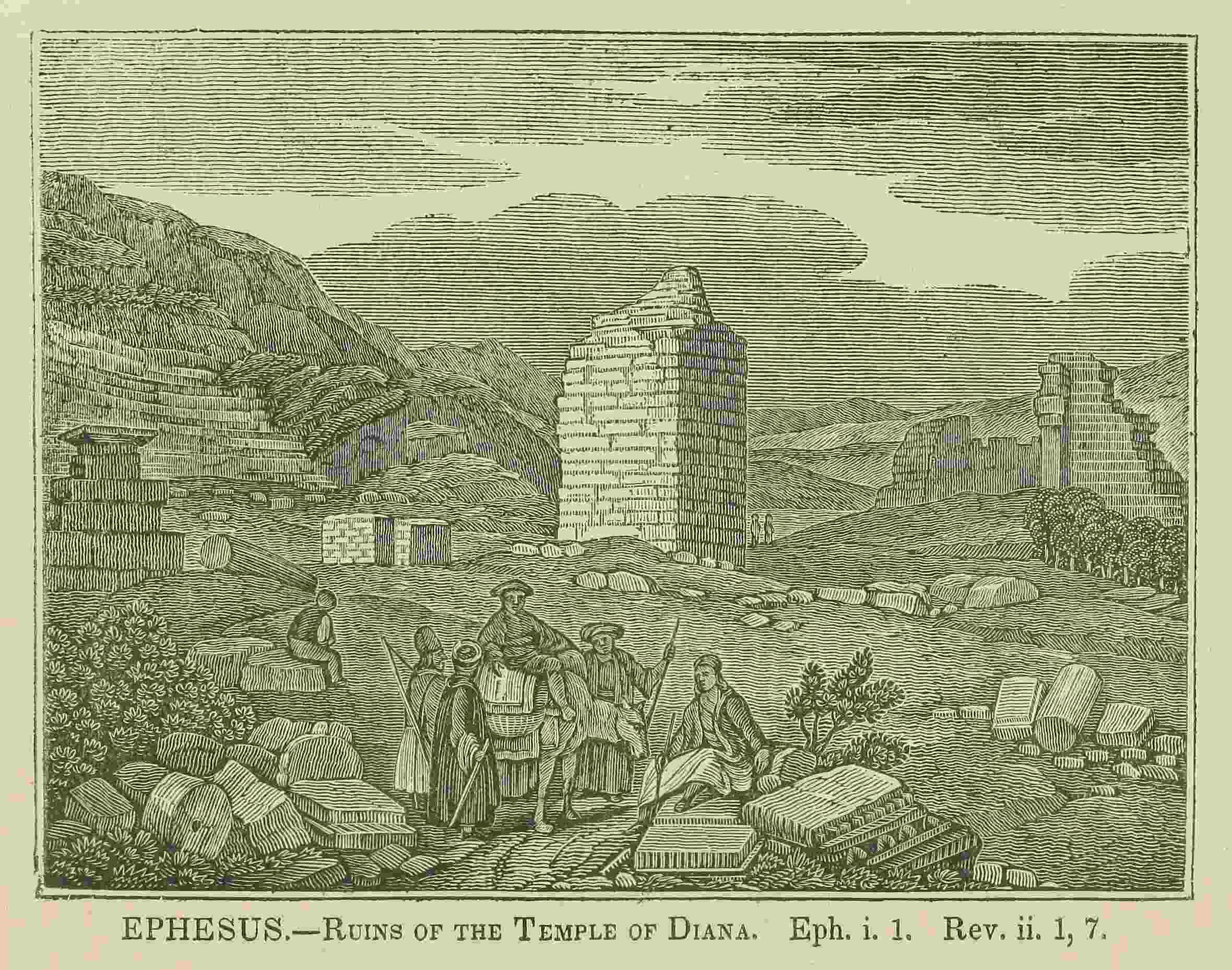
EPHESUS.――Ruins of the Temple of Diana. Ephesians i. 1. Revelation ii. 1, 7.
“In Acts xx. 31, the apostle says, that for the space of three years he preached at Ephesus. Grotius and Whitby hold that these three years are to be reckoned from his first coming to Ephesus, xviii. 19; that he does not specify his being in any other city; and that when it is said here, ‘So that all Asia heard the word,’ xix. 40, it arose from the concourse that, on a religious account, continually assembled in that city. The Jews also, from different parts of Asia, were induced by commerce, or obliged by the courts of judicature, to frequent it. Other commentators contend that, as only two years, with three months in the synagogue, are here mentioned, the remaining three-quarters of a year were partly engaged in a progress through the neighboring provinces. (Elsley, from Lightfoot and Doddridge.)
“While he was at Ephesus, ‘God wrought special miracles by the hands of Paul; so that from his body were brought unto the sick, handkerchiefs or aprons,’ &c. &c. Acts ♦xix. 11, 12. Σιμικίνθιον, aprons, is slightly changed from the Latin semicinctum, which workmen put before them when employed at their occupations, to keep their clothes from soiling. The difference which Theophylact and Oecumenius make between these and σουδάρια, is, that the latter are applied to the head, as a cap or veil, and the former to the hands as a handkerchief. ‘They carry them,’ says Oecumenius, ‘in their hands, to wipe off moisture from their face, as tears,’” &c. &c. (Calmet’s Commentary.)
“‘And they counted the price of them, [the books,] and found it to be fifty thousand pieces of silver,’ verse 19――αργυριον is used generally in the Old Testament, LXX. for the shekel, in value about 2s. 6d., or the total 6250l. as Numbers vii. 85. Deuteronomy xxii. 19. 2 Kings xv. 20. Grotius. If it means the drachma, as more frequently used by the Greeks at 9d. each, the sum will be 1875l.” [$9000.] Doddridge. Elsley’s Annotations. (Williams on Pearson, pp. 53‒55.)
THE EPISTLE TO THE GALATIANS.
There is hardly one of the writings of Paul, about the date of which there has been so much discussion, or so many opinions as this; but the results of all the elaborate investigations and argumentations of the learned, still leave this interesting chronological point in such doubt, that this must be pronounced about the most uncertain in date, of all the Pauline epistles. It may however, without any inconsistency with the historical narrative of the Acts, or with any passages in the other epistles, be safely referred to the period of this residence in Ephesus, probably to the later part of it. The epistle itself contains no reference whatever, direct or indirect, to the place in which he was occupied at the time of writing, and only bare probabilities can therefore be stated on it,――nor can any decisive objection be made to any one of six opinions which have been strongly urged. Some pronounce it very decidedly to have been the first of all the epistles written by Paul, and maintain that he wrote it soon after his first visit to them, at some time during the interval between Paul’s departure from Galatia, and his departure from Thessalonica. Others date it at the time of his imprisonment in Rome, according to the common subscription of the epistle. Against this last may, however, perhaps be urged his reproof to the Galatians, that they “were so soon removed from him that called them to the grace of Christ,”――an expression nevertheless, too vague to form any certain basis for a chronological conclusion. The great majority of critics refer it to the period of his stay in Ephesus,――a view which entirely accords with the idea, that it must have been written soon after Paul had preached to them; for on his last journey to Ephesus, he had passed through Galatia, as already narrated, confirming the churches. Some time had, no doubt, intervened since his preaching to them, sufficient at least to allow many heresies and difficulties to arise among them, and to pervert them from the purity of the truth, as taught to them by him. Certain false teachers had been among them since his departure, inculcating on all believers in Christ, the absolute necessity of a minute and rigid observance of Mosaic forms, for their salvation. They also directly attacked the apostolical character and authority of Paul,――declaring his opinion to be of no weight whatever, and to be opposed to that of the true original apostles of Jesus. These, Paul meets with great force in the very beginning of the epistle, entering at once into a particular account of the mode of his first entering the apostleship,――showing that it was not derived from the other apostles, but from the special commission of Christ himself, miraculously given. He also shows that he had, on this very question of Judaical rituals, conferred with the apostles at Jerusalem, and had received the sanction of their approbation in that course of open communion which he had before followed, on his own inspired authority, and had ever since maintained, in the face of what he deemed inconsistencies in the conduct of Peter. He then attacks the Galatians themselves, in very violent terms, for their perversion of that glorious freedom into which he had brought the Christian doctrine, and fills up the greater part of the epistle with reproofs of these errors.
His argument against the doctrines of the servile Judaizers is made up in his favorite mode of demonstration, by simile and metaphor, representing the Christian system under the form of the offspring of Abraham, and afterwards images the freedom of the true believers in Jesus, in the exalted privilege of the descendants of Sara, while those enslaved to forms are presented as analogous in their condition to the children of Hagar. He earnestly exhorts them, therefore, to stand fast in the freedom to which Christ has exalted them, and most emphatically condemns all observance of circumcision. Thus pointing out to them, the purely spiritual nature of that covenant, of which they were now the favored subjects, he urges them to a truly spiritual course of life, bidding them aim at the attainment of a perfect moral character, and makes the conclusion of the epistle eminently practical in its direction. He speaks of this epistle as being a testimony of the very particular interest which he feels in their spiritual prosperity, because, (what appears contrary to his practice,) he has written it with his own hand. To the very last, he is very bitter against those who are aiming to bring them back to the observance of circumcision, and denounces those as actuated only by a base desire to avoid that persecution which they might expect from the Jews, if they should reject the Mosaic ritual. Referring to the cross of Christ as his only glory, he movingly alludes to the marks of his conformity to that standard, bearing as he does in his own body, the scars of the wounds received from the scourges of his Philippian persecutors. He closes without any mention of personal salutations, and throughout the whole makes none of those specifications of names, with which most of his other epistles abound. In the opening salutation, he merely includes with himself those “brethren that are with him,” which seems to imply that they knew who those brethren were, in some other way,――perhaps, because he had but lately been among them with those same persons as his assistants in the ministry.
On this very doubtful point, I have taken the views adopted by Witsius, Louis Cappel, Pearson, Wall, Hug and Hemsen. The notion that it was written at Rome is supported by Theodoret, Lightfoot, and Paley,――of course making it a late epistle. On the contrary, Michaelis makes it the earliest of all, and dates it in the year 49, at some place on Paul’s route from Troas to Thessalonica. Marcion and Tertullian also supposed it to be one of the earliest epistles. Benson thinks it was written during Paul’s first residence in Corinth. Lenfant and Beausobre, followed by Lardner, conjecture it to have been written either at Corinth or at Ephesus, during his first visit, either in A. D. 52, or 53. Fabricius and Mill date it A. D. 58, at some place on Paul’s route to Jerusalem. Chrysostom and Theophylact, date it before the epistle to the Romans. Grotius thinks it was written about the same time. From all which, the reader will see the justice of my conclusion, that nothing at all is known with any certainty about the matter.
THE EPHESIAN MOB.
Paul having now been a resident in Ephesus for nearly three years, and having seen such glorious results of his labors, soon began to think of revisiting some of his former fields of missionary exertion, more especially those Grecian cities of Europe which had been such eventful scenes to him, but a few years previous. He designed to go over Macedonia and Achaia, and then to visit Jerusalem; and when communicating these plans to his friends at Ephesus, he remarked to them in conclusion――“And after that, I must also visit Rome.” He therefore sent before him into Macedonia, as the heralds of his approach, his former assistant, Timothy, and another helper not before mentioned, Erastus, who is afterwards mentioned as the treasurer of the city of Corinth. But Paul himself still waited in Asia for a short time, until some other preliminaries should be arranged for his removal. During this incidental delay arose the most terrible commotion that had ever yet been excited against him, and one which very nearly cost him his life.
It should be noticed that the conversion of so large a number of the heathen, through the preaching of Paul, had struck directly at the foundation of a very thriving business carried on in Ephesus, and connected with the continued prevalence and general popularity of that idolatrous worship, for which the city was so famous. Ephesus, as is well known, was the chief seat of the peculiar worship of that great Asian deity, who is now known, throughout all the world, where the apostolic history is read, by the name of “Diana of the Ephesians.” It is perfectly certain, however, that this deity had no real connection, either in character or in name, with that Roman goddess of the chase and of chastity, to whom the name Diana properly belongs. The true classic goddess Diana was a virgin, according to common stories, considered as the sister of Apollo, and was worshiped as the beautiful and youthful goddess of the chase, and of that virgin purity of which she was supposed to be an instance, though some stories present an exception to this part of her character. Upon her head, in most representations of her, was pictured a crescent, which was commonly supposed to show, that she was also the goddess of the moon; but a far more sagacious and rational supposition refers the first origin of this sign to a deeper meaning. But when the mythologies of different nations began to be compared and united, she was identified with the goddess of the moon, and with that Asian goddess who bore among the Greeks the name of Artemis, which is in fact the name given by Luke, as the title of the great goddess of the Ephesians. This Artemis, however, was a deity as diverse in form, character and attributes, from the classic Diana, as from any goddess in all the systems of ancient mythology; and they never need have been confounded, but for the perverse folly of those who were bent, in spite of all reason, to find in the divinities of the eastern polytheism, the perfect synonyms to the objects of western idolatry. The Asian and Ephesian goddess Artemis, had nothing whatever to do with hunting nor with chastity. She was not represented as young, nor beautiful, nor nimble, nor as the sister of Apollo, but as a vast gigantic monster, with a crown of towers, with lions crouching upon her shoulders, and a great array of pictured or sculptured eagles and tigers over her whole figure; and her figure was also strangely marked by a multitude of breasts in front. Under this monstrous figure, which evidently was no invention of the tasteful Greeks, but had originated in the debasing and grotesque idolatry of the orientals, Artemis of the Ephesians was worshiped as the goddess of the earth, of fertility, of cities, and as the universal principle of life and wealth. She was known among the Syrians by the name of Ashtaroth, and was among the early objects of Hebrew idolatry. When the Romans, in their all-absorbing tolerance of idolatry, began to introduce into Italy the worship of the eastern deities, this goddess was also added there, but not under the name of Diana. The classic scholar is familiar with the allusions to this deity, worshiped under the name of Cybele, Tellus and other such, and in all the later poets of Rome, she is a familiar object, as “the tower-crowned Cybele.” This was the goddess worshiped in many of the Grecian cities of Asia Minor, which, at their first colonization, had adopted this aboriginal goddess of those fertile regions, of whose fertility, civilization, agricultural and commercial wealth, she seemed the fit and appropriate personification. But in none of these Asian cities was she worshiped with such peculiar honors and glories as in Ephesus, the greatest city of Asia Minor. Here was worshiped a much cherished image of her, which was said to have fallen from heaven, called from that circumstance the Diopetos; which here was kept in that most splendid temple, which is even now proverbial as having been one of the wonders of the ancient world. Being thus the most famous seat of her worship, Ephesus also became the center of a great manufacture and trade in certain curious little images or shrines, representing this goddess, which were in great request, wherever her worship was regarded, being considered as the genuine and legitimate representatives, as well as representations of the Ephesian deity.
This explanation will account for the circumstances related by Luke, as ensuing in Ephesus, on the success of Paul’s labors among the heathen, to whose conversion his exertions had been wholly devoted during the two last years of his stay in Ephesus. In converting the Ephesians from heathenism, he was guilty of no ordinary crime. He directly attacked a great source of profit to a large number of artizans in the city, who derived their whole support from the manufacture of those little objects of idolatry, which, of course, became of no value to those who believed Paul’s doctrine,――that “those were no gods which were made with hands.” This new doctrine therefore, attracted very invidious notice from those who thus found their dearest interests very immediately and unfortunately affected, by the progress made by its preacher in turning away the hearts of Ephesians from their ancient reverence for the shrines of Artemis; and they therefore listened with great readiness to Demetrius, one of their number, when he proposed to remedy the difficulty. He showed them in a very clear, though brief address, that “the craft was in danger,”――that warning cry which so often bestirs the bigoted in defence of the object of their regard; and after hearing his artful address, they all, full of wrath, with one accord raised a great outcry, in the usual form of commendation of the established idolatry of their city,――“Great is Artemis of the Ephesians!” This noise being heard by others, and of course attracting attention, every one who distinguished the words, by a sort of patriotic impulse, was driven to join in the cry, and presently the whole city was in an uproar;――a most desirable condition of things, of course, for those who wished to derive advantage from a popular commotion. All bawling this senseless cry, with about as much idea of the occasion of the disturbance as could be expected from such a mob, the huddling multitudes learning the general fact, that the grand object of the tumult was to do some mischief to the Christians, and looking about for some proper person to be made the subject of public opinion, fell upon Gaius and Aristarchus of Macedonia, two traveling companions of Paul, who happened to be in the way, and dragged them to the theater, whither the whole mob rushed at once, as to a desirable scene for any act of confusion and folly which they might choose to commit. Paul, with a lion-like spirit, caring naught for the mob, proposed to go in and make a speech to them, but his friends, with far more prudence and cool sense than he,――knowing that an assembly of the people, roaring some popular outcry, is no more a subject of reason than so many raging wild beasts,――prevented him from going into the theater, where he would no doubt have been torn to pieces, before he could have opened his mouth. Some of the great magistrates of Asia, too, who were friendly to him, hearing of his rash intentions, sent to him a very urgent request, that he would not venture himself among the mob. Meanwhile the outcry continued,――the theater being crowded full,――and the whole city constantly pouring out to see what was the matter, and every soul joining in the religious and patriotic shout, “Great is Artemis of the Ephesians!” And so they went on, every one, of course, according to the universal and everlasting practice on such occasions, making all the noise he could, but not one, except the rascally silversmiths, knowing what upon earth they were all bawling there for. Still this ignorance of the object of the assembly kept nobody still; but all, with undiminished fervor, kept plying their lungs to swell the general roar. As it is described in the very graphic and picturesque language of Luke,――“Some cried one thing, and some, another; for the whole assembly was confused;――and the more knew not wherefore they were come together,”――which last circumstance is a very common difficulty in such assemblies, in all ages. At last, searching for some other persons as proper subjects to exercise their religious zeal upon, they looked about upon the Jews, who were always a suspected class among the heathen, and seized one Alexander, who seems to have been one of the Christian converts, for the Jews thrust him forward as a kind of scapegoat for themselves. Alexander made the usual signs soliciting their attention to his words; but as soon as the people understood that he was a Jew, they all drowned his voice with the general cry, “Great is Artemis of the Ephesians!” and this they kept up steadily for two whole hours, as it were with one voice. Matters having come to this pass, the recorder of the city came forward, and having hushed the people,――who had some reverence for the lawful authorities, that fortunately were not responsible to them,――and made them a very sensible speech, reminding them that since no one doubted the reverence of the Ephesians for the goddess Artemis, and for the Diopetos, there surely was no occasion for all this disturbance to demonstrate a fact that every body knew. He told them that the men against whom they were raising this disturbance had neither robbed their temples nor blasphemed the goddess; so that if Demetrius and his fellow-craft had anything justly against these men, as having injured their business, they had their proper remedy at law. He hinted to them also that they were all liable to be called to account for this manifest breach of Roman law, and this defiance of the majesty of the Roman government;――a hint which brought most of them to their senses; for all who had anything to lose, dreaded the thought of giving occasion to the awfully remorseless government of the province, to fine them, as they certainly would be glad to do on any valid excuse. They all dispersed, therefore, with no more words.
“‘Silver shrines,’ verse 24. The heathens used to carry the images of their gods in procession from one city to another. This was done in a chariot which was solemnly consecrated for that employment, and by the Romans styled Thensa, that is, the chariot of their gods. But besides this, it was placed in a box or shrine, called Ferculum. Accordingly, when the Romans conferred divine honors on their great men, alive or dead, they had the Circen games, and in them the Thensa and Ferculum, the chariot and the shrine, bestowed on them; as it is related of Julius Caesar. This Ferculum among the Romans did not differ much from the Graecian Ναὸς, a little chapel, representing the form of a temple, with an image in it, which, being set upon an altar, or any other solemn place, having the doors opened, the image was seen by the spectators either in a standing or sitting posture. An old anonymous scholiast upon Aristotle’s Rhetoric, lib. i. c. 15, has these words: Ναοποιοὶ οἱ τοὺς ναοὺς ποιοῦσι, ἤτοι εἱκονοστάσια, τινα μικρὰ ξύλινα ἅ πωλοῦσι, observing the ναοι here to be εικονοστάσια, chaplets, with images in them, of wood, or metal, (as here of silver,) which they made and sold, as in verse 25, they are supposed to do. Athenaeus speaks of the καδισκος, ‘which,’ says he ‘is a vessel wherein they place their images of Jupiter.’ The learned Casaubon states, that ‘these images were put in cases, which were made like chapels. (Deipnos. lib. ii. p. 500.) So St. Chrysostom likens them to ‘little cases, or shrines.’ Dion says of the Roman ensign, that it was a little temple, and in it a golden eagle, (Ρωμαικ, lib. 40.) And in another place: ‘There was a little chapel of Juno, set upon a table.’ Ρωμαικ, lib. 39. This is the meaning of the tabernacle of Moloch, Acts vii. 43, where by the σκηνη, tabernacle, is meant the chaplet, a shrine of that false god. The same was also the סכות דנות the tabernacle of Benoth, or Venus.” Hammond’s Annotations. [Williams on Pearson, p. 55.]
Robbers of temples.――Think of the miserable absurdity of the common English translation in this passage, (Acts xix. 37,) where the original ἱεροσυλοι is expressed by “robbers of churches!” Now who ever thought of applying the English word “church,” to anything whatever but a “Christian assembly,” or “Christian place of assembly?” Why then is this phrase put in the mouth of a heathen officer addressing a heathen assembly about persons charged with violating the sanctity of heathen places of worship? Such a building as a church, (εκκλησια, ecclesia) devoted to the worship of the true God, was not known till more than a century after this time; and the Greek word ἱερον, (hieron,) which enters into the composition of the word in the sacred text, thus mistranslated, was never applied to a Christian place of worship.
FIRST EPISTLE TO THE CORINTHIANS.
Paul’s residence in Ephesus is distinguished in his literary history, as the period in which he wrote that most eloquent and animated of his epistles,――“the first to the Corinthians.” It was written towards the close of his stay in Asia, about the time of the passover; according to established calculations, therefore, in the spring of the year of Christ 57. The more immediate occasion of his writing to the Corinthian Christians, was a letter which he had received from them, by the hands of Stephanas, Fortunatus and Achaicus. Paul had previously written to them an epistle, (now lost,) in which he gave them some directions about their deportment, which they did not fully understand, and of which they desired an explanation in their letter. Many of these questions, which this epistle of the Corinthians contained, are given by Paul, in connection with his own answers to them; and from this source it is learned that they concerned several points of expediency and propriety about matrimony. These are answered by Paul, very distinctly and fully; but much of his epistle is taken up with instructions and reproofs on many points not referred to in their inquiries. The Corinthian church was made up of two very opposite constituent parts, so unlike in their character, as to render exceedingly complicated the difficulties of bringing all under one system of faith and practice; and the apostolic founder was, at one time, obliged to combat heathen licentiousness, and at another, Jewish bigotry and formalism. The church also, having been too soon left without the presence of a fully competent head, had been very loosely filled up with a great variety of improper persons,――some hypocrites, and some profligates,――a difficulty not altogether peculiar to the Corinthian church, nor to those of the apostolic age. But there were certainly some very extraordinary irregularities in the conduct of their members, some of whom were in the habit of getting absolutely drunk at the sacramental table; and others were guilty of great sins in respect to general purity of life. Another peculiar difficulty, which had arisen in the church of Corinth, during Paul’s absence, was the formation of sects and parties, each claiming some one of the great Christian teachers as its head; some of them claiming Paul as their only apostolic authority; some again preferring the doctrines of Apollos, who had been laboring among them while Paul was in Ephesus; and others again, referred to Peter as the true apostolic chief, while they wholly denied to Paul any authority whatever, as an apostle. There had, indeed, arisen a separate party, strongly opposed to Paul, headed by a prominent person, who had done a great deal to pervert the truth, and to lessen the character of Paul in various ways, which are alluded to by Paul in many passages of his epistle, in a very indignant tone. Other difficulties are described by him, and various excesses are reproved, as a scandal to the Christian character; such as an incestuous marriage among their members,――lawsuits before heathen magistrates,――dissolute conformity to the licentious worship of the Corinthian goddess, whose temple was so infamous for its scandalous rites and thousand priestesses. Some of the Corinthian Christians had been in the habit of visiting this and other heathen temples, and of participating in the scenes of feasting, riot and debauchery, which were carried on there as a part of the regular forms of idolatrous worship.
The public worship of the Corinthian church had been disturbed also by various irregularities which Paul reprehends;――the abuse of the gift of tongues, and the affectation of an unusual dress in preaching, both by men and women. In the conclusion of his epistle he expatiates too, at great length, on the doctrine of the resurrection of the body, vehemently arguing against some Corinthian heretics, who had denied any but a spiritual existence beyond the grave. This argument may justly be pronounced the best specimen of Paul’s very peculiar style, reasoning as he does, with a kind of passion, and interrupting the regular series of logical demonstrations, by fiery bursts of enthusiasm, personal appeals, poetical quotations, illustrative similes, violent denunciations of error, and striking references to his own circumstances. All these nevertheless, point very directly and connectedly at the great object of the argument, and the whole train of reasoning swells and mounts, towards the conclusion, in a manner most remarkably effective, constituting one of the most sublime argumentative passages ever written. He then closes the epistle with some directions about the mode of collecting the contributions for the brethren in Jerusalem. He promises to visit them, and make a long stay among them, when he goes on his journey through Macedonia,――a route which, he assures them, he had now determined to take, as mentioned by Luke, in his account of the preliminary mission of Timothy and Erastus, before the time of the mob at Ephesus; but should not leave Ephesus until after Pentecost, because a great and effectual door was there opened to him, and there were many opposers. He speaks of Timothy as being then on the mission before mentioned, and exhorts them not to despise this young brother, if he should visit them, as they might expect. After several other personal references, he signs his ♦own name with a general salutation; and from the terms, in which he expresses this particular mark already alluded to in the second epistle to the Thessalonians, it is very reasonable to conclude, that he was not his own penman in any of these epistles, but used an amanuensis, authenticating the whole by his signature, with his own hand, only at the end; and this opinion of his method of carrying on his correspondence, is now commonly, perhaps universally, adopted by the learned.
“Chapter xvi. 10, 11. ‘Now, if Timotheus come, see that he may be with you without fear; for he worketh the work of the Lord, as I also do: let no man therefore despise him, but conduct him forth in peace, that he may come unto me, for I look for him with the brethren.’
“From the passage considered in the preceding number, it appears that Timothy was sent to Corinth, either with the epistle, or before it: ‘for this cause have I sent unto you Timotheus.’ From the passage now quoted, we infer that Timothy was not sent with the epistle; for had he been the bearer of the letter, or accompanied it, would St. Paul in that letter have said, ‘if Timothy come?’ Nor is the sequel consistent with the supposition of his carrying the letter; for if Timothy was with the apostle when he wrote the letter, could he say, as he does, ‘I look for him with the brethren?’ I conclude, therefore, that Timothy had left St. Paul to proceed upon his journey before the letter was written. Further, the passage before us seems to imply, that Timothy was not expected by St. Paul to arrive at Corinth, till after they had received the letter. He gives them directions in the letter how to treat him when he should arrive: ‘if he come,’ act towards him so and so. Lastly, the whole form of expression is more naturally applicable to the supposition of Timothy’s coming to Corinth, not directly from St. Paul, but from some other quarter; and that his instructions had been, when he should reach Corinth, to return. Now, how stands this matter in the history? Turn to the nineteenth chapter and twenty-first verse of the Acts, and you will find that Timothy did not, when sent from Ephesus, where he left St. Paul, and where the present epistle was written, proceed by a straight course to Corinth, but that he went round through Macedonia. This clears up everything; for, although Timothy was sent forth upon his journey before the letter was written, yet he might not reach Corinth till after the letter arrived there; and he would come to Corinth, when he did come, not directly from St. Paul, at Ephesus, but from some part of Macedonia. Here therefore is a circumstantial and critical agreement, and unquestionably without design; for neither of the two passages in the epistle mentions Timothy’s journey into Macedonia at all, though nothing but a circuit of that kind can explain and reconcile the expressions which the writer uses.” (Paley’s Horae Paulinae, 1 Corinthians No. IV.)
“Chapter v. 7, 8. ‘For even Christ, our passover, is sacrificed for us; therefore let us keep the feast, not with old leaven, neither with the leaven of malice and wickedness, but with the unleavened bread of sincerity and truth.’
“Dr. Benson tells us, that from this passage, compared with chapter xvi. 8, it has been conjectured that this epistle was written about the time of the Jewish passover; and to me the conjecture appears to be very well founded. The passage to which Dr. Benson refers us, is this: ‘I will tarry at Ephesus until Pentecost.’ With this passage he ought to have joined another in the same context: ‘And it may be that I will abide, yea, and winter with you:’ for, from the two passages laid together, it follows that the epistle was written before Pentecost, yet after winter; which necessarily determines the date to the part of the year, within which the passover falls. It was written before Pentecost, because he says, ‘I will tarry at Ephesus until Pentecost.’ It was written after winter, because he tells them, ‘It may be that I may abide, yea, and winter with you.’ The winter which the apostle purposed to pass at Corinth, was undoubtedly the winter next ensuing to the date of the epistle; yet it was a winter subsequent to the ensuing Pentecost, because he did not intend to set forwards upon his journey till after the feast. The words, ‘let us keep the feast, not with old leaven, neither with the leaven of malice and wickedness, but with the unleavened bread of sincerity and truth,’ look very much like words suggested by the season; at least they have, upon that supposition, a force and significancy which do not belong to them upon any other; and it is not a little remarkable, that the hints casually dropped in the epistle, concerning particular parts of the year, should coincide with this supposition.” (Paley’s Horae Paulinae. 1 Corinthians. No. XII.)
SECOND VOYAGE TO EUROPE.
After the disturbances connected with the mob raised by Demetrius had wholly ceased, and public attention was no longer directed to the motions of the preachers of the Christian doctrine, Paul determined to execute the plan, which he had for some time contemplated, of going over his European fields of labor again, according to his universal and established custom of revisiting and confirming his work, within a moderately brief period after first opening the ground for evangelization. Assembling the disciples about him, he bade them farewell, and turning northward, came to Troas, whence, six or seven years before, he had set out on his first voyage to Macedonia. The plan of his journey, as he first arranged it, had been to sail from the shores of Asia Minor directly for Corinth. He had resolved however, not to go to that city, until the very disagreeable difficulties which had there arisen in the church, had been entirely removed, according to the directions given in the epistle which he had written to them from Ephesus; because he did not desire, after an absence of years, to visit them in such circumstances, when his Corinthian converts were divided among themselves, and against him,――and when his first duties would necessarily be those of a rigid censor. He therefore waited at Troas, with great impatience, for a message from them, announcing the settlement of all difficulties. This he expected to receive through Titus, a person now first mentioned in the apostle’s history. Waiting with great impatience for this beloved brother, he found no rest in his spirit, and though a door was evidently opened by the Lord for the preaching of the gospel in Troas, he had no spirit for the good work there; and desiring to be as near the great object of his anxieties as possible, he accordingly took leave of the brethren at Troas, and crossed the Aegean into Macedonia, by his former route. Here he remained in great distress of mind, until his soul was at last comforted by the long expected arrival of Titus. Luke only says, that he went over those parts and gave them much exhortation. But though his route is not given, his apostolic labors are known to have extended to the borders of Illyricum. At this time also, he made another important contribution to the list of the apostolic writings.
THE SECOND EPISTLE TO THE CORINTHIANS.
There is no part of the New Testament canon, about the date of which all authorities are so well agreed, as on the place and time, at which Paul wrote his second epistle to the Corinthians. All authorities, ancient and modern, decide that it was written during the second visit of Paul to Macedonia; although as to the exact year in which this took place, they are not entirely unanimous. The passages in the epistle itself, which refer to Macedonia as the region in which the apostle then was, are so numerous indeed, that there can be no evasion of their evidence. A great topic of interest with him, at the time of writing this epistle, was the collecting of the contributions proposed for the relief of the Christian brethren in Jerusalem; and upon this he enlarges much, informing the Corinthians of the great progress he was making in Macedonia in this benevolent undertaking, and what high hopes he had entertained and expressed to the Macedonians, of the zeal and ability of those in Achaia, about the contributions. This matter had been noticed and arranged by him, in his former epistle to them, as already noticed, and he now proposed to send forward Titus and another person, (who is commonly supposed to be Luke,) to take charge of these funds, thus collected. He speaks of coming also himself, after a little time, and makes some allusions to the difficulties which had constituted the subject of the great part of his former epistle. Of their amendment in the particulars then so severely censured, he had received a full account through Titus, when that beloved brother came on from Corinth, to join Paul in Macedonia. Paul assures the Corinthians of the very great joy caused in him, by the good news of their moral and spiritual improvement, and renews his ardent protestations of deep affection for them. The incestuous person, whom they had excommunicated, in conformity with the denunciatory directions given in the former epistle, he now forgives; and as the offender has since appeared to be truly penitent, he now urges his restoration to the consolations of Christian fellowship, lest he should be swallowed up with too much sorrow. He defends his apostolic character for prudence and decision, against those who considered his change of plans about coming directly from Ephesus to Corinth, as an exhibition of lightness and unsettled purpose. His real object in this delay and change of purpose, as he tells them, was, that they might have time to profit by the reproofs contained in his former epistle, so that by the removal of the evils of which he so bitterly complained, he might finally be enabled to come to them, not in sorrow, nor in heaviness for their sins, but in joy for their reformation. This fervent hope had been fulfilled by the coming of Titus to Macedonia, for whom he had waited in vain, with so much anxiety at Troas, as the expected messenger of these tidings of their spiritual condition; and he was now therefore prepared to pass on to them from Macedonia, to which region he tells them he had gone from Troas, instead of to Corinth, because he had been disappointed about meeting Titus on the eastern side of the Aegean. With the exception of these things, the epistle is taken up with a very ample and eloquent exhibition of his true powers and office as an apostle; and in the course of this argument, so necessary for the re-establishment of his authority among those who had lately been disposed to contemn it, he makes many very interesting allusions to his own personal history. The date of the epistle is commonly supposed, and with good reason, to be A. D. 58, the fifth of Nero’s reign, and one year after the preceding epistle.
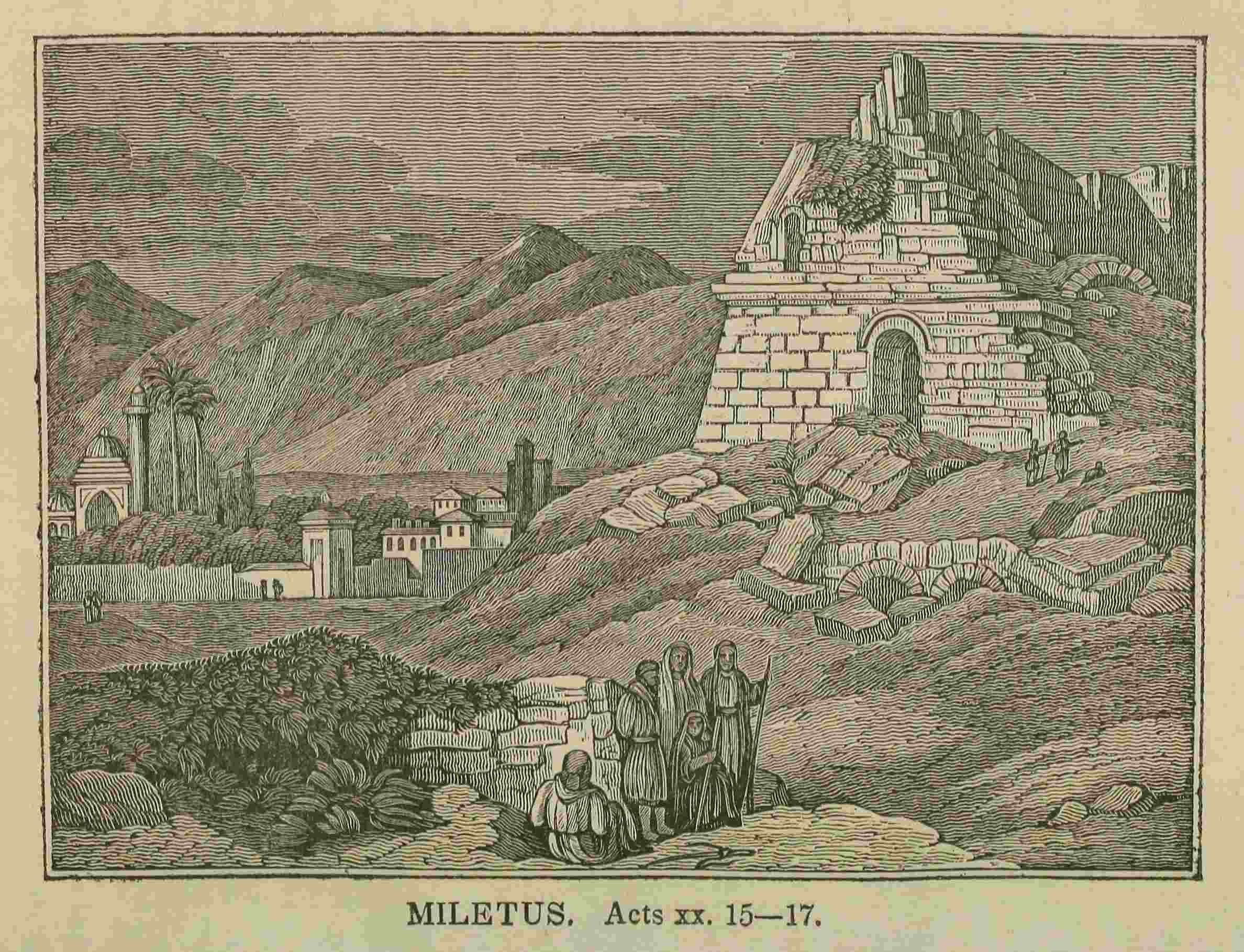
MILETUS. Acts xx. 15‒17.
“Chapter ii. 12, 13. ‘When I came to Troas to preach Christ’s gospel, and a door was opened unto me of the Lord, I had no rest in my spirit, because I found not Titus my brother; but taking my leave of them, I went from thence into Macedonia.’
“To establish a conformity between this passage and the history, nothing more is necessary to be presumed, than that St. Paul proceeded from Ephesus to Macedonia, upon the same course by which he came back from Macedonia to Ephesus, or rather to Miletus in the neighborhood of Ephesus; in other words, that, in his journey to the peninsula of Greece, he went and returned the same way. St. Paul is now in Macedonia, where he had lately arrived from Ephesus. Our quotation imports that in his journey he had stopped at Troas. Of this, the history says nothing, leaving us only the short account, ‘that Paul departed from Ephesus, for to go into Macedonia.’ But the history says, that in his return from Macedonia to Ephesus, ‘Paul sailed from Philippi to Troas; and that, when the disciples came together on the first day of the week, to break bread, Paul preached unto them all night; that from Troas he went by land to Assos; from Assos, taking ship and coasting along the front of Asia Minor, he came by Mitylene to Miletus.’ Which account proves, first, that Troas lay in the way by which St. Paul passed between Ephesus and Macedonia; secondly, that he had disciples there. In one journey between these two places, the epistle, and in another journey between the same places, the history makes him stop at this city. Of the first journey he is made to say, ‘that a door was in that city opened unto him of the Lord;’ in the second, we find disciples there collected around him, and the apostle exercising his ministry, with, what was even in him, more than ordinary zeal and labor. The epistle, therefore, is in this instance confirmed, if not by the terms, at least by the probability of the history; a species of confirmation by no means to be despised, because, as far as it reaches, it is evidently uncontrived.
“Grotius, I know, refers the arrival at Troas, to which the epistle alludes, to a different period, but I think very improbably; for nothing appears to me more certain, than that the meeting with Titus, which St. Paul expected at Troas, was the same meeting which took place in Macedonia, viz. upon Titus’s coming out of Greece. In the quotation before us, he tells the Corinthians, ‘When I came to Troas, I had no rest in my spirit, because I found not Titus, my brother; but, taking my leave of them, I went from thence into Macedonia.’ Then in the seventh chapter he writes, ‘When we were come into Macedonia, our flesh had no rest, but we were troubled on every side; without were fightings, within were fears; nevertheless, God, that comforteth them that are cast down, comforted us by the coming of Titus.’ These two passages plainly relate to the same journey of Titus, in meeting with whom St. Paul had been disappointed at Troas, and rejoiced in Macedonia. And amongst other reasons which fix the former passage to the coming of Titus out of Greece, is the consideration, that it was nothing to the Corinthians that St. Paul did not meet with Titus at Troas, were it not that he was to bring intelligence from Corinth. The mention of the disappointment in this place, upon any other supposition, is irrelative.” (Paley’s Horae Paulinae. 2 Corinthians No. VIII.)
SECOND JOURNEY TO CORINTH.
Among his companions in Macedonia, was Timothy, his ever zealous and affectionate assistant in the apostolic ministry, who had been sent thither before him to prepare the way, and had been laboring in that region ever since, as plainly appears from the fact, that he is joined with Paul in the opening address of the second epistle to the Corinthians,――a circumstance in itself sufficient to overthrow a very common supposition of the critics,――that Timothy returned to Asia; that Paul at that time “left him in Ephesus,” and at this time wrote his first epistle to Timothy from Macedonia. It is also most probable that Timothy was the personal companion of Paul, not only during the whole period of his second ministration in Macedonia, but also accompanied him from that province to Corinth; because Timothy is distinctly mentioned by Luke, among those who went with Paul from Macedonia to Asia, after his brief second residence in that city. No particulars whatever are given by Luke of the labors of Paul in Corinth. From his epistles, however, it is learned that he was at this time occupied in part, in receiving the contributions made throughout Achaia for the church of Jerusalem, to which city he was now preparing to go. The difficulties, of which so much mention had been made in his epistles, were now entirely removed, and his work there doubtless went on without any of that opposition which had arisen after his first departure. There is however, one very important fact in his literary history, which took place in Corinth, during his residence there.
THE EPISTLE TO THE ROMANS.
From the very earliest period of apostolic labor, after the ascension, there appear to have been in Rome, some Jews who professed the faith of Jesus. Among the visitors in Jerusalem at the Pentecost, when the Holy Spirit first descended, were some from Rome, who sharing in the gifts of that remarkable effusion, and returning to their home in the imperial city, would there in themselves constitute the rudiment of a Christian church. It is perfectly certain that they had never been blessed in their own city with the personal presence of an apostle and all their associated action as a Christian church, must therefore have been entirely the result of a voluntary organization, suggested by the natural desire to keep up and to spread the doctrines which they had first received in Jerusalem, under such remarkable circumstances. Yet the members of the church would not be merely those who were converted at the Pentecost; for there was a constant influx of Jews from all parts of the world to Rome, and among these there would naturally be some who had participated in the light of the gospel, now so widely diffused throughout the eastern section of the world. There is moreover distinct information of certain persons of high qualifications, as Christian teachers, who had at Rome labored in the cause of the gospel, and had no doubt been among the most efficient means of that advancement of the Roman church, which seems to be implied in the communication now first made to them by Paul. Aquilas and Priscilla, who had been the intimate friends of Paul at Corinth, and who had been already so active and distinguished as laborers in the gospel cause, both in that city and in Ephesus, had returned to Rome on the death of Claudius, when that emperor’s foolish decree of banishment, against the Jews, expired along with its author, in the year of Christ, 54. These, on re-establishing their residence in Rome, made their own house a place of assembly for a part of the Christians in the capital,――probably for such as resided in their own immediate neighborhood, while others sought different places, according as suited their convenience in this particular. Many other persons are mentioned by Paul at the close of this epistle, as having been active in the work of the gospel at Rome;――among whom Andronicus and Junias are particularly noticed with respect, as having highly distinguished themselves in apostolic labors. From all these evangelizing efforts, the church of Rome attained great importance, and was now in great need of the counsels and presence of an apostle, to confirm it, and impart to its members spiritual gifts. It had long been an object of attention and interest to Paul, and he had already expressed a determination to visit the imperial city, in the remarks which he made to the brethren at Ephesus, when he was making arrangements to go into Macedonia and Achaia. The way was afterwards opened for this visit, by a very peculiar providence, which he does not seem to have then anticipated; but while residing in Corinth, his attention being very particularly called to their spiritual condition, he could not wait till he should have an opportunity to see them personally, to counsel them; but wrote to them this very copious and elaborate epistle, which seems to have been the subject of more comment among dogmatic theologians, than almost any other portion of his writings, on account of its being supposed to furnish different polemic writers with the most important arguments for the peculiar dogmas of one or another, according to the fancy of each. It undoubtedly is the most doctrinal and didactic of all Paul’s epistles, alluding very little to local circumstances, which are the theme of so large a part of most of his writings, but attacking directly certain general errors entertained by the Jews, on the subject of justification, predestination, election, and many peculiar privileges which they attributed to themselves as the descendants of Abraham.
This epistle, like most of the rest, was written by an amanuensis, who is herein particularly named, as Tertius,――a word of Roman origin; but beyond this nothing else is known of him. It was carried to Rome by Phebe, an active female member of the church at Cenchreae, the port of Corinth, who happened to be journeying to Rome for some other purposes, and is earnestly recommended by Paul to the friendly regard of the church there.
RETURN TO ASIA.
After passing three months in Corinth, he took his departure from that city, on his pre-determined voyage to the east, the direction of which was somewhat changed by the information that the Jews of the place where he then was, were plotting some mischief against him, which he thought best to avoid by taking a different route from that before planned, which was a direct voyage to Syria. To escape the danger prepared for him by them, at his expected place of embarkation, he first turned northward by land, through Macedonia to Philippi, and thence sailed by the now familiar track over the Aegean to Troas. On this journey, he was accompanied by quite a retinue of apostolic assistants,――not only his faithful disciple and companion Timothy, but also Sosipater of Beroea, Aristarchus and Secundus of Thessalonica, Gaius, or Caius of Derbe, and Luke also, who now carries on the apostolic narrative in the first person, thus showing that he was himself a sharer in the adventures which he narrates. Besides these immediate companions, two brethren from Asia, Tychicus and Trophimus, took the direct route from Corinth to Troas, at which place they waited for the rest of the apostolic company, who took the circuitous route through Macedonia. The date of the departure of Paul is very exactly fixed by his companion Luke, who states that they left Philippi at the time of the passover, which was in the middle of March; and other circumstances have enabled modern critics to fix the occurrence in the year of Christ 59. After a five days’ voyage, arriving at Troas on Saturday, they made a stay of seven days in that place; and on the first day of the week, the Christians of that place having assembled for the communion usual on the Lord’s day, Paul preached to them: and as it was the last day of his stay, he grew very earnest in his discourse and protracted it very late, speaking two whole hours to the company, who were met in the great upper hall, where, in all Jewish houses, these festal entertainments and social meetings were always held. It was, of course, the evening, when the assembly met, for this was the usual time for a social party, and there were many lights in the room, which, with the number of people, must have made the air very warm, and had the not very surprising effect of causing drowsiness, in at least one of Paul’s hearers, a young man named ♦Eutychus, whose interest in what was said, could not keep his attention alive against the pressure of drowsiness. He fell asleep; and the occurrence must appear so very natural, (more particularly to any one, who has ever been so unfortunate as to be sleepy at an evening meeting, and knows what a painful sensation it is, though the drowsiness is wholly beyond the control of the reason,) that it can hardly be thought worth while to take pains, as some venerable commentators do, to suppose that the devil was very specially concerned in producing the sleep of Eutychus, and that the consequences which ensued, were an exhibition of divine wrath against the sleepy youth, for slumbering under the preaching of Paul. If the supposition holds equally good in all similar cases, the devil must be very busy on warm Sunday afternoons; and many a comfortable nap would be disturbed by unpleasant dreams, if the dozer could be made to think that his drowsiness was the particular work of the great adversary of souls, or that he was liable to suffer any such accident as Eutychus did, who, falling into a deeper sleep, and losing all muscular control and consciousness, sunk down from his seat, and slipping over the side of the gallery, in the third loft, fell into the court below, where he was taken up lifeless. But Paul hearing of the accident, stopped his discourse, and going down to the young man, fell on him and embraced him, saying, “Trouble not yourselves, for the life is in him.” And his words were verified by the result; for they soon brought him up alive, and were not a little comforted. Paul, certain of his recovery, did not suffer the accident to mar the enjoyment of the social farewell meeting; but going up and breaking bread with them all, talked with them a long time, passing the whole night in this pleasant way, and did not leave them till day-break, when he started to go by land over to Assos, about twenty-four miles south-east of Troas, on the Adramyttian gulf, which sets up between the north side of the island of Lesbos and the mainland. His companions, coming around by water, through the mouth of the gulf, took Paul on board at Assos, according to his plan; and then instead of turning back, and sailing out into the open sea, around the outside of Lesbos, ran up the gulf to the eastern end of the north coast of the island, where there is an other outlet to the gulf between the eastern shore of Lesbos and the continent. Sailing southward through this passage, after a course of between thirty and forty miles, they came to Mitylene, on the southeastern side of the island. Thence passing out of the strait, they sailed southwestwards, coming between Chios and the main-land, and arrived the next day at Trogyllium, at the southwest corner of Samos. Then turning their course towards the continent, they came in one day to Miletus, near the mouth of the ♠Meander, about forty miles south of Ephesus.
Landing here, and desiring much to see some of his Ephesian brethren before his departure to Jerusalem, he sent to the elders of the church in that city, and on their arrival poured out his whole soul to them in a parting address, which for pathetic earnestness and touching beauty, is certainly, beyond any doubt, the most splendid passage that all the records of ancient eloquence can furnish. No force can be added to it by a new version, nor can any recapitulation of its substance do justice to its beauty. At the close, took place a most affecting farewell. In the simple and forcible description of Luke, (who was himself present at the moving scene, seeing and hearing all he narrates,)――“When Paul had thus spoken, he kneeled down and prayed with them all.” The subjects of this prayer were the guardians of that little flock which he, amid perils and death, had gathered from the heathen waste of Ionic Asia, to the fold of Christ. When he left it last, the raging wolves of persecution and wrath,――the wild beasts of Ephesus,――were howling death and destruction to the devoted believers of Christ, and they were still environed with temptations and dangers, that threatened to overwhelm these feeble ones, left thus early without the fostering care of their apostolic shepherd. Passing on his way to the great scene of his coming trials, he could not venture among them to give them his parting counsels, and could now only intrust to their constituted guardians, this dear charge, with renewed exhortations to them to be faithful, as in the presence of their God, to those objects of his labors, his cares, his prayers, and his daily tears. Amid the sorrows of that long farewell, arose on the prophetic vision of the apostle some gloomy foreshadowings of future woes to fall on that Ephesian charge, and this deepened the melancholy feeling of his heart almost to agony. This no doubt was the burden of his last prayer, when with their elders, and for them, he kneeled down on the shore and sent up in earnest petition to God, that voice which they were doomed to hear no more forever.
Such passages as this in the life and words of Paul, constitute a noble addition to the reader’s idea of his character. They show how nobly were intermingled in the varied frame of his spirit, the affectionate, the soft, and the winning traits, with the high, the stern, and the bitter feelings that so often were called out by the unparalleled trials of his situation. They show ♦that he truly felt and acted out, to the life, that divine principle of Christian love which inspired the most eloquent effort of his pen;――and that he trusted not to the wonder-working powers that moved his lips, as with the eloquence of men and angels,――not to the martyr-spirit, that, sacrificing all earthly substance, devoted itself to the raging flames of persecution, in the cause of God,――not to the genius whose discursive glance searched all the mysteries of human and divine knowledge,――but to that pure, exalted and exalting spirit of ardent love for those for whom he lived like his Savior, and for whom he was ready to die like him, also. This was the inspiration of his words, his writings, and his actions,――the motive and spirit of his devotion,――the energy of his being. Wherever he went and whatever he did,――in spite of the frequent passionate outbreaks of his rougher nature, this honest, fervent, animated spirit of charity,――glowing not to inflame, but to melt,――softened the austerities of his character, and kindled in all who truly knew him, a deep and lasting affection for him, like that which was so strikingly manifested on this occasion. Who can wonder that to a man thus constituted, the lingering Ephesians still clung with such enthusiastic attachment? In the fervid action of that oriental clime, they fell on his neck and kissed him, sorrowing most of all for the words which he said,――that they should see his face no more. Still loth to take their last look at one so loved, they accompanied him to the ship, which bore him away from them, to perils, sufferings and chains.
“Assos was a sea-port town, situated on the south-west part of the province of Troas, and over against the island Lesbos. By land it is much nearer Troas than by sea, because of a promontory that runs a great way into the sea, and must be doubled to come to Assos, which was perhaps the reason that the apostle chose rather to walk it.” (Wells’s Geography and Calmet’s Commentary.)
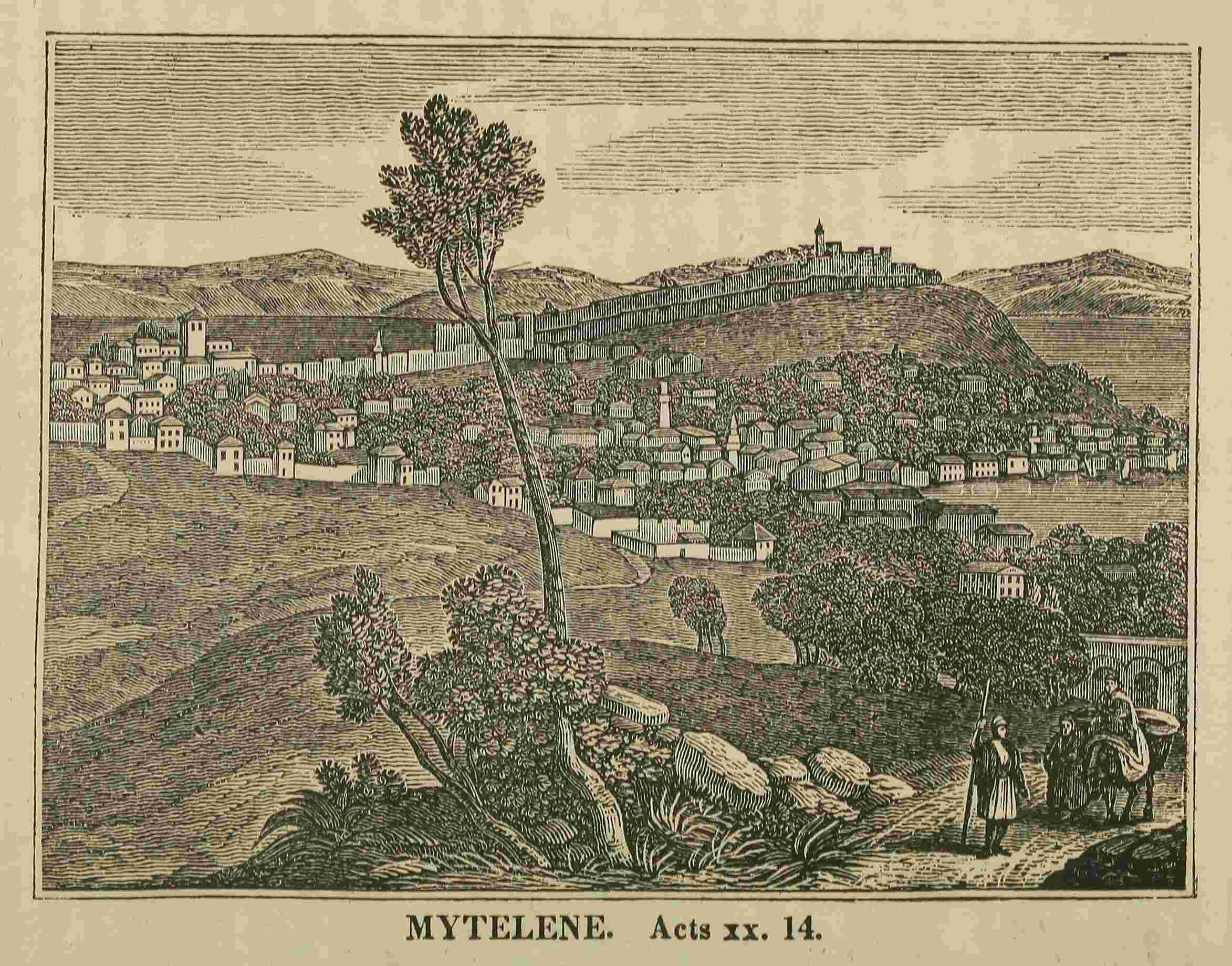
MYTELENE. Acts xx. 14.
“Mitylene, (chapter xx. verse 14,) was one of the principal cities in the island of Lesbos, situated on a peninsula with a commodious haven on each side; the whole island was also called by that name, as well as Pentapolis, from the five cities in it, viz. Issa or Antissa, Pyrrhe, Eressos, Arisba, and Mitylene. It is at present called Metelin. The island is one of the largest in the Archipelago, and was renowned for the many eminent persons it produced; such as Sappho, the inventress of Sapphic verses,――Alcaeus, a famous lyric poet,――Pittacus, one of the seven wise men of Greece,――Theophrastus, the noble physician and philosopher,――and Arion, the celebrated musician. It is now in the possession of the Turks. As mentioned by St. Luke, it may be understood either the island or the city itself.” (Wells’s Geography and Whitby’s Table.)
“Chios, (verse 15,) was an island in the Archipelago, next to Lesbos, both as to situation and size. It lies over against Smyrna, and is not above four leagues distant from the Asiatic continent. Horace and Martial celebrate it for the wine and figs that it produced. It is now renowned for producing the best mastic in the world.
“Sir Paul Ricaut, in his ‘Present State of the Greek Church,’ tells us, that there is no place in the Turkish dominions where Christians enjoy more freedom in their religion and estates than in this island, to which they are entitled by an ancient capitulation made with Sultan Mahomet II.” (Wells’s Geography.)
“Samos, (verse 15,) was another island of the Archipelago, lying south-east of Chios, and about five miles from the Asiatic continent. It was famous among heathen writers for the worship of Juno; for one of the Sibyls called Sibylla Samiana; for Pherecydes, who foretold an earthquake that happened there, by drinking of the waters; and more especially for the birth of Pythagoras. It was formerly a free commonwealth; at present, the Turks have reduced it to a mean and depopulated condition; so that ever since the year 1676, no Turk has ventured to live on it on account of its being frequented by pirates, who carry all whom they take into captivity.” (Wells’s Geography and Whitby’s Table.)
“Trogyllium, (verse 15,) is a promontory at the foot of Mount Mycale, opposite to, and five miles from Samos: there was also a town there of the same name, mentioned by Pliny, Lib. v, c. 29. p. 295.” (Whitby’s Table.)
“Miletus, (verse 15,) a sea-port town on the continent of Asia Minor, and in the province of Caria, memorable for being the birth-place of Thales, one of the seven wise men of Greece, and father of the Ionic philosophy; of Anaximander, his scholar; Timotheus, the musician; and Anaximenes, the philosopher. It is called now, by the Turks, Melas; and not far distant from it is the true Meander.” (Whitby’s Table and Wells’s Geography.) [Williams on Pearson. pp. 66, 67.]
Tearing himself thus from the embraces of his Ephesian brethren, Paul sailed off to the southward, hurrying on to Jerusalem, in order to reach there if possible, before the Pentecost. After leaving Miletus, the apostolic company made a straight course to Coos, and then rounding the great northwestern angle of Asia Minor, turned eastwardly to Rhodes, and passing probably through the strait, between that island and the continent, landed at Patara, a town on the coast of Lycia, which was the destination of their first vessel. They therefore at this place engaged a passage in a vessel bound to Tyre, and holding on southeastward, came next in sight of Cyprus, which they passed, leaving it on the left, and then steering straight for the Syrian coast, landed at Tyre, where their vessel was to unlade; so that they were detained here for a whole week, which they passed in the company of some Christian brethren who constituted a church there. These Tyrian disciples hearing of Paul’s plan to visit Jerusalem, and knowing the dangers to which he would there be exposed by the deadly hate of the Jews, were very urgent with him against his journey; but he still resolutely held on his course, as soon as a passage could be procured, and bade them farewell, with prayer on the shore, to which the brethren accompanied him with their women and children. Standing off from the shore, they then sailed on south, to Ptolemais, where they spent a day with the Christians in that place, and then re-embarking, and passing round the promontory of Carmel, reached Caesarea, where their sea-voyage terminated. Here they passed several days in the house of Philip the evangelist, one of the seven deacons, who had four daughters that were prophetesses. While they were resting themselves in this truly religious family, from the fatigues of their long voyage, they were visited by Agabus, a prophet from Jerusalem,――the same who had formerly visited Antioch when Paul was there, and who had then foretold the coming famine, which threatened all the world. This remarkable man predicted to Paul the misfortunes which awaited him in Jerusalem. In the solemnly impressive dramatic action of the ancient prophets, he took Paul’s girdle, and binding his own hands with it, said――“Thus says the Holy Spirit, ‘So shall the Jews at Jerusalem, bind the man that owns this girdle, and shall deliver him to the Gentiles.’” On hearing this melancholy announcement, all the companions of Paul and the Christians of Caesarea, united in beseeching Paul to give up his purpose of visiting Jerusalem. But he, resolute against all entreaty, declared himself ready not only to be bound, but to die in Jerusalem for the Lord Jesus. And when they found that he would not be persuaded, they all ceased to harass him with their supplications, and resigned him to Providence, saying,――“The will of the Lord be done.” They then all took carriages, and rode up to Jerusalem, accompanied by some brethren from Caesarea, and by Mnason, an old believer, formerly of Cyprus, but now of Jerusalem, who had engaged them as his guests in that city.
“Coos, (chapter xxi. verse 1,) an island in the Aegean or Icarian sea, near Mnydos and Cnidus, which had a city of the same name, from which Hippocrates, the celebrated physician, and Apelles, the famous painter, were called Coi. Here was a large temple of Aesculapius, and another of Juno. It abounded in rich wines, and is very often mentioned by the classic poets.” (Whitby’s Alphabetic Table.)
Witsius very absurdly defines the situation of this island by saying that it is “near Crete.”――“Coos, quae maris Mediterranei insula est prope Cretam.” It is in the Aegean sea properly, and not in the Mediterranean; and can not be less than one hundred and twenty miles from Crete, much farther off from it than is Rhodes,――the next island in Paul’s route, and there are many islands between Coos and Crete, so that the statement gives no just idea of the situation of the island. It would be as proper to say that Barbadoes is near Cuba, or the isle of Man near France.