I. THE GALILEAN APOSTLES. (continued 3)
Reading edition
THE ENTRY INTO THE CITY.
With these fruitless admonitions to his followers, Jesus passed on through Jericho to Bethphage, on the verge of the holy city. Here, the enthusiastic and triumphant rejoicings, which the presence of their Master called forth, from the multitudes who were then swarming to Jerusalem from all parts of Palestine, must have lifted up the hearts of the apostles, with high assurance of the nearness of the honors for which they had so long looked and waited. Their irrepressible joy and exultation burst out in songs of triumph, as Jesus, after the manner of the ancient judges of Israel, rode into the royal seat of his fathers. And as he went down the descent of the Mount of Olives, to go into the city, the whole train of the disciples began to rejoice and praise God, with a loud voice, for all the mighty works that they had seen; saying, “Blessed be the King of Israel, that cometh in the name of the Lord! Peace in heaven! Glory in the highest! Blessed be the kingdom of our father David! Hosanna!” These acclamations were raised by the disciples, and heartily joined in by the multitudes who knew his wonderful works, and more especially those who were acquainted with the very recent miracle of raising Lazarus. A great sensation of wonder was created throughout the city, by such a burst of shouts from a multitude, sweeping in a long, imposing train, with palm branches in their hands, down the mountain, on which they could have been seen all over Jerusalem. As he entered the gates, all the city was moved to say, “Who is this?” And the rejoicing multitude said, “This is Jesus, the prophet of Nazareth in Galilee.” What scorn did not this reply awaken in many of the haughty aristocrats of Jerusalem, to learn that all this solemn parade had been got up for no better purpose than merely to honor a dweller of that outcast region of mongrels, Galilee! And of all places, that this prophet, so called, should have come from Nazareth! A prophet from Galilee, indeed! Was it from this half-heathen district, that the favored inhabitants of the capital of Judaism were to receive a teacher of religion? Were the strict faith, and the rigid observances of their learned and devout, to be displaced by the presumptuous reformations of a self-taught prophet, from such a country? Swelling with these feelings, the Pharisees could not repress a remonstrance with Jesus, against these noisy proceedings. But he, evidently affected with pleasure at the honest tribute thus wrung out in spite of sectional feeling, forcibly asserted the propriety and justice of this free offering of praise. “I tell you, that if these should hold their peace, the stones would immediately cry out.”
With palm-branches in their hands.――This tree, the emblem of joy and triumph in every part of the world where it is known, was the more readily adopted on this occasion, by those who thronged to swell the triumphal train of Jesus of Nazareth, because the palm grew along the way-side where they passed, and the whole mount was hardly less rich in this than in the far famed olive from which it drew its name. A proof of the abundance of the palm-trees on Olivet is found in the name of the village of Bethany, בית חיני, (beth-hene,) “house of dates,” which shows that the tree which bore this fruit must have been plentiful there. The people, as they passed on with Jesus from this village whence he started to enter the city, would therefore find this token of triumph hanging over their heads, and shading their path every where within reach, and the emotions of joy at their approach to the city of God in the company of this good and mighty prophet, prompted them at once to use the expressive emblems which hung so near at hand; and which were alike within the reach of those who journeyed with Jesus, and those who came forth from the city to meet and escort him in. The presence of these triumphal signs would, of course, remind them at once of the feast of the tabernacles, the day on which, in obedience to the Mosaic statute, all the dwellers of the city were accustomed to go forth to the mount, and bring home these branches with songs of joy. (Leviticus xxiii. 40, Nehemiah viii. 15, 16.) The remembrance of this festival at once recalled also the beautifully appropriate words of the noble national and religious hymn, which they always chanted in praise of the God of their fathers on that day, (see Kuinoel, Rosenmueller, Wolf, &c.) and which was so peculiarly applicable to him who now “came in the name of the Lord,” to honor and to bless his people. (Psalm cxviii. 26.)
The descent of the Mount of Olives.――To imagine this scene, with something of the force of reality, it must be remembered that the Mount of Olives, so often mentioned in the scenes of Christ’s life, rose on the eastern side of Jerusalem beyond the valley of the Kedron, whose little stream flowed between this mountain and Mount Moriah, on which the temple stood. Mount Olivet was much higher than any part of the city within the walls, and the most commanding and satisfactory view of the holy city which modern travelers and draughtsmen have been able to present to us in a picture, is that from the more than classic summit of this mountain. The great northern road passing through Jericho, approaches Jerusalem on its north-eastern side, and comes directly over the top of Olivet, and as it mounts the ridge, it brings the holy city in all its glory, directly on the traveler’s view.
Hosanna.――This also is an expression taken from the same festal hymn, (Psalm cxviii. 25,) הושיעה־נא (hoshia-na) a pure Hebrew expression, as Drusius shows, and not Syriac, (See Poole’s Synopsis on Matthew xxi. 9,) but corrupted in the vulgar pronunciation of this frequently repeated hymn, into Hosanna. The meaning of the Hebrew is “save him” or “be gracious to him,” that is in connection with the words which follow in the gospel story, “Be gracious, O Lord, to the son of David.” This is the same Hebrew phrase which, in the psalm above quoted, (verse 25,) is translated “Save now.” The whole expression was somewhat like the English “God save the king,” in its import.
Nazareth.――This city, in particular, had an odious name, for the general low character of its inhabitants. The passage in John i. 46, shows in what estimation this city and its inhabitants were held, by their own neighbors in Galilee; and the great scorn with which all Galileans were regarded by the Jews, must have redoubled their contempt of this poor village, so despised even by the despicable. The consequence was that the Nazarenes acquired so low a character, that the name became a sort of byword for what was mean and foolish. (See Kuinoel on Matthew ii. 23, John i. 46. Also Rosenmueller on the former passage and Bloomfield on the latter.)
Galilee.――In order to appreciate fully, the scorn and suspicion with which the Galileans were regarded by the citizens of Jerusalem, a complete view of their sectional peculiarities would be necessary. Such a view will hereafter be given in connection with a passage which more directly refers to those peculiarities, and more especially requires illustration and explanation.
THE BLIGHTING OF THE FIG-TREE.
Having thus, by his public and triumphant entrance into Jerusalem, defied and provoked the spite of the higher orders, while he secured an attentive hearing from the common people, when he should wish to teach them,――Jesus retired at evening, for the sake of quiet and comfort, to the house of his friends, Lazarus, Mary and Martha, at Bethany, in the suburbs. The next morning, as he was on his way with his disciples, coming back from this place to Jerusalem, hungry with the fatigues of his long walk, he came to a fig-tree, near the path, hoping to find fruit for his refreshment, as it seemed from a distance flourishing with abundance of leaves, and was then near the season of bearing. But when he came near, he found nothing but leaves on it, for it was somewhat backward, and its time of producing figs was not yet. And Jesus, seizing the opportunity of this disappointment to impress his disciples with his power, personifying the tree, denounced destruction against it. “May no man eat fruit of thee hereafter, forever.” And his disciples heard it. They returned to Bethany, as usual, that evening, to pass the night,――but as they passed, probably after dark, they took no notice of the fig-tree. But the next morning, as they went back to the city, they saw that it had dried up from the roots. Simon Peter, always ready to notice the instances of his Master’s power, called out in surprise to Jesus, to witness the effect of his malediction upon its object. “Master, behold, the fig-tree which thou didst curse, is withered away.” Jesus noticing their amazement at the apparent effect of his words, in so small a matter, took occasion to turn their attention to other and higher objects of faith, on which they might exert their zeal in a spirit, not of withering denunciation and destroying wrath, such as they had seen so tremendously efficient in this case, but in the spirit of love and forgiveness, as well as of the holy energy that could overthrow and overcome difficulties, not less than to uproot Mount Olivet from its everlasting base and hurl it into the sea.
THE DISCUSSIONS WITH THE SECTARIES.
The disciples steadily remained the diligent and constant attendants of their heavenly teacher, in his long and frequent seasons of instruction in the temple, where he boldly met the often renewed attacks of his various adversaries, whether Herodians, scribes, Pharisees or Sadducees, and in spite of their long-trained subtleties, beat them out and out, with the very weapons at which they thought themselves so handy. The display of genius, of taste, of learning, of ready and sarcastic wit, and of heart-searching acuteness, was so amazing and super-human, that these few days of open discussion established his divinely intellectual superiority over all the elaborate science of his accomplished opponents, and at the same time secured the fulfilment of his destiny, by the spite and hatred which their repeated public defeats excited in them. Imagine their rage. Exposed thus before the people, by whom they had hitherto been regarded as the sole depositaries of learning, and adored as the fountains of right, they saw all their honors and power, to which they had devoted the intense study of their whole lives, snatched coolly and easily from them, by a nameless, untaught pretender, who was able to hold them up, baffled and disgraced, for the amusement of the jeering multitude. Here was ground enough for hatred;――the hatred of conceited and intolerant false learning, against the discerning soul that had stripped and humbled it;――the hatred of confident ambition against the heroic energy which had discomfited it, and was doing much to free a long enslaved people from the yoke which formal hypocrisy and empty parade had long laid on them. And again, the intolerable thought that all this heavy disgrace had been brought on the learned body of Judaism by a Galilean! a mere carpenter of the lowest orders, who had come up to Jerusalem followed by a select train of rude fishermen and outcast publicans;――and who, not being able to command a single night’s lodging in the city, was in the habit of boarding and lodging in a paltry suburb, on the charity of some personal friends, from which place he quietly walked in for the distance of two miles every morning, to triumph over the palace-lodged heads of the Jewish faith. From such a man, thus humbly and even pitiably circumstanced, such an invasion and overthrow could not be endured; and his ruin was rendered doubly easy by his very insignificance, which now constituted the chief disgrace of their defeat. Never was cause more closely followed by its effect, than this insulted dignity was by its cruel vengeance.
THE PROPHECY OF THE TEMPLE’S RUIN.
In preparing his disciples for the great events which were to take place in a few years, and which were to have a great influence on their labors, Jesus foretold to them the destruction of the temple. As he was passing out through the mighty gates of the temple on some occasion with his disciples, one of them, admiring the gorgeous beauty of the architecture and the materials, with all the devotion of a Jew now visiting it for the first time, said to him, “Master, see! what stones and what buildings!” To him, Jesus replied with the awful prophecy, most shocking to the national pride and religious associations of every Israelite,――that ere long, upon that glorious pile should fall a ruin so complete, that not one of those splendid stones should be left upon another. These words must have made a strong impression of wonder on all who heard them; but no farther details of the prophecy were given to the disciples at large. Not long afterwards, however, as he sat musingly by himself, in his favorite retirement, half-way up the Mount of Olives, over against the temple, the four most loved and honored of the twelve, Peter, James, John and Andrew, came to him, and asked him privately, to tell them when these things should be, and by what omen they should know the approach of the great and woful ruin. Sitting there, they had a full view of the enormous pile which rose in immense masses very near them, on the verge of mount Moriah, and was even terraced up, from the side of the slope, presenting a vast wall, rising from the depths of the deep ravine of Kedron, which separated the temple from mount Olivet, where they were. It was morning when the conversation took place, as we may fairly guess, for this spot lay on the daily walk to Bethany, where he lodged;――the broad walls, high towers, and pillars of the temple, were doubtless illuminated by the full splendors of the morning sun of Palestine; for Olivet was directly east of Jerusalem, and as they sat looking westward towards the temple, with the sun behind them, the rays, leaving their faces in the shade, would shine full and bright on all which crowned the highth beyond. It was at such a time, as the Jewish historian assures us, that the temple was seen in its fullest grandeur and sublimity; for the light, falling on the vast roofs, which were sheeted and spiked with pure gold, brightly polished, and upon the turrets and pinnacles which glittered with the same precious metal, was reflected to the eye of the gazer with an insupportable brilliancy, from the million bright surfaces and shining points which covered it. Here, then, sat Jesus and his four adoring chosen ones, with this splendid sight before them crowning the mountain, now made doubly dazzling by contrast with the deep gloom of the dark glen below, which separated them from it. There it was, that, with all this brightness and glory and beauty before them, Jesus solemnly foretold in detail the awful, total ruin which was to sweep it all away, within the short lives of those who heard him. Well might such words sink deep into their hearts,――words coming from lips whose perfect and divine truth they could not doubt, though the things now foretold must have gone wofully against all the dreams of glory, in which they had made that sacred pile the scene of the future triumphs of the faith and followers of Christ. This sublime prophecy, which need not here be repeated or descanted upon, is given at great length by all the first three evangelists, and is found in Matthew xxiv. Mark xiii. and Luke xxi.
The view of the temple.――I can find no description by any writer, ancient or modern, which gives so clear an account of the original shape of Mount Moriah, and of the modifications it underwent to fit it to support the temple, as that given by Josephus. (Jewish War, book V. chapter v.) In speaking of the original founding of the temple by Solomon, (Antiquities book VIII. chapter iii. section 2,) he says, “The king laid the foundations of the temple in the very depths, (at the bottom of the descent,) using stones of a firm structure, and able to hold out against the attacks of time, so that growing into a union, as it were, with the ground, they might be the basis and support of the pile that was to be reared above, and through their strength below, easily bear the vast mass of the great superstructure, and the immense weight of ornament also; for the weight of those things which were contrived for beauty and magnificence was not less than that of the materials which contributed to the highth and lateral dimension.” In the full description which he afterwards gives in the place first quoted, of the later temple as perfected by Herod, which is the building to which the account in the text refers, he enters more fully into the mode of shaping the ground to the temple. “The temple was founded upon a steep hill, but in the first beginning of the structure there was scarcely flat ground enough on the top for the sanctuary and the altar, for it was abrupt and precipitous all around. And king Solomon, when he built the sanctuary, having walled it out on the eastern side, (εκτειχισαντος, that is, ‘having built out a wall on that side’ for a terrace,) then reared upon the terraced earth a colonnade; but on the other sides the sanctuary was naked,――(that is, the wall was unsupported and unornamented by colonnades as it was on the east.) But in the course of ages, the people all the while beating down the terraced earth with their footsteps, the hill thus growing flat, was made broader on the top; and having taken down the wall on the north, they gained considerable ground which was afterwards inclosed within the outer court of the temple. Finally, having walled the hill entirely around with three terraces, and having advanced the work far beyond any hope that could have been reasonably entertained at first, spending on it long ages, and all the sacred treasures accumulated from the offerings sent to God from the ends of the world, they reared around it, both the upper courts and the lower temple, walling the latter up, in the lowest part, from a depth of three hundred cubits, (450 feet,) and in some places more. And yet the whole depth of the foundations did not show itself, because they had greatly filled up the ravines, with a view to bring them to a level with the streets of the city. The stones of this work were of the size of forty cubits, (60 feet,) for the profusion of means and the lavish zeal of the people advanced the improvements of the temple beyond account; and a perfection far above all hope was thus attained by perseverance and time.
“And well worthy of these foundations were the works which stood upon them. For all the colonnades were double, consisting of pillars twenty-five cubits (40 feet) in highth, each of a single stone of the whitest marble, and were roofed with fretwork of cedar. The natural beauty of these, their high polish and exquisite proportion, presented a most glorious show; but their surface was not marked by the superfluous embellishments of painting and carving. The colonnades were thirty cubits broad, (that is, forty-five feet from the front of the columns to the wall behind them;) while their whole circuit embraced a range of six stadia, (more than three-quarters of a mile!) including the castle of Antonia. And the whole hypethrum (ὑπαιθρον, the floor of the courts or inclosures of the temple, which was exposed to the open air, there being no roof above it) was variegated by the stones of all colors with which it was laid,” (making a Mosaic pavement.) Section 1.
“The outside of the temple too, lacked nothing that could strike or dazzle the mind and eye. For it was on all sides overlaid with massy plates of gold, so that in the first light of the rising sun, IT SHOT FORTH A MOST FIERY SPLENDOR, which turned away the eyes of those who compelled themselves (mid. βιαζομενους) to gaze on it, as from the rays of the sun itself. To strangers, moreover, who were coming towards it, it shone from afar like a complete mountain of snow: for where it was not covered with gold it was most dazzlingly white, and above on the roof it had golden spikes, sharpened to keep the birds from lighting on it. And some of the stones of the building were forty-five cubits long, five high, and six broad;”――(or sixty-seven feet long, seven and a half high, and nine broad.) Section 6.
“The Antonia was placed at the angle made by the meeting of two colonnades of the outer temple, the western and the northern. It was built upon a rock, fifty cubits high, and precipitous on all sides. It was the work of king Herod, in which, most of all, he showed himself a man of exalted conceptions.” Section 8.
In speaking of Solomon’s foundation, he also says, (Antiquities book VIII. chapter iii. section 9,)
“But he made the outside of the temple wonderful beyond account, both in description and to sight. For having piled up huge terraces, from which, on account of their immense depth, it was hardly possible to look down, and reared them to the highth of four hundred cubits, (six hundred feet!) he made them on the same level with the hill’s top on which the shrine (ναος) was built, and thus the open floor of the temple (ἱερον, or the outer court’s inclosure) was level with the shrine.”
I have drawn thus largely from the rich descriptions of this noble and faithful describer of the old glories of the Holy Land, because this very literal translation gives the exact naked detail of the temple’s aspect, in language as gorgeous as the most high-wrought in which it could be presented in a mere fancy picture of the same scene; and because it will prove that my conception of its glory, as it appeared to Christ and the four disciples who “sat over against it upon the Mount of Olives,” is not overdrawn, since it is thus supported by the blameless and invaluable testimony of him who saw all this splendor in its most splendid day, and afterwards in its unequaled beauty and with all its polished gold and marble, shining and sinking amid the flames, which swept it utterly away from his saddening eyes forever, to a ruin the most absolute and irretrievable that ever fell upon the works of man.
This was the temple on which the sons of Jonah and Zebedee gazed, with the awful denunciation of its utter ruin falling from their Lord’s lips, and such was the desolation to which those terrible words devoted it. This full description of its location shows the manner in which its terraced foundations descended with their vast fronts, six hundred feet into the valley of Kedron, over which they looked. To give as clear an idea of the place where they sat, and its relations to the rest of the scene, I extract from Conder’s Modern Traveler the following description of Mount Olivet.
“The Mount of Olives forms part of a ridge of limestone hills, extending to the north and the south-west. Pococke describes it as having four summits. On the lowest and most northerly of these, which, he tells us, is called Sulman Tashy, the stone of Solomon, there is a large domed sepulcher, and several other Mohammedan tombs. The ascent to this point, which is to the north-east of the city, he describes as very gradual, through pleasant corn-fields planted with olive-trees. The second summit is that which overlooks the city: the path to it rises from the ruined gardens of Gethsemane, which occupy part of the valley. About half way up the ascent is a ruined monastery, built, as the monks tell us, on the spot where the Savior wept over Jerusalem. From this point the spectator enjoys, perhaps, the best view of the Holy City. (Here Jesus sat, in our scene.)
“The valley of Jehoshaphat, which lies between this mountain and the hills on which Jerusalem is built, is still used as a burial-place by the modern Jews, as it was by their ancestors. It is, generally speaking, a rocky flat, with a few patches of earth here and there, about half a mile in breadth from the Kedron to the foot of Mount Olivet, and nearly of the same length from Siloa to the garden of Gethsemane. The Jews have a tradition, evidently founded on taking literally the passage Joel iii. 12, that this narrow valley will be the scene of the final judgment. The prophet Jeremiah evidently refers to the same valley under the name of the valley of the Son of Hinnom, or the valley of Tophet, the situation being clearly marked as being by the entry of the east gate. (Jeremiah xix. 2, 6.) Pococke places the valley of Hinnom to the south of Jerusalem, but thinks it might include part of that to the east. It formed part of the bounds between the tribes of Benjamin and Judah, (Joshua xv. 8. xviii. 16,) but the description is somewhat obscure.” [Modern Traveler Palestine, pp. 168, 172.]
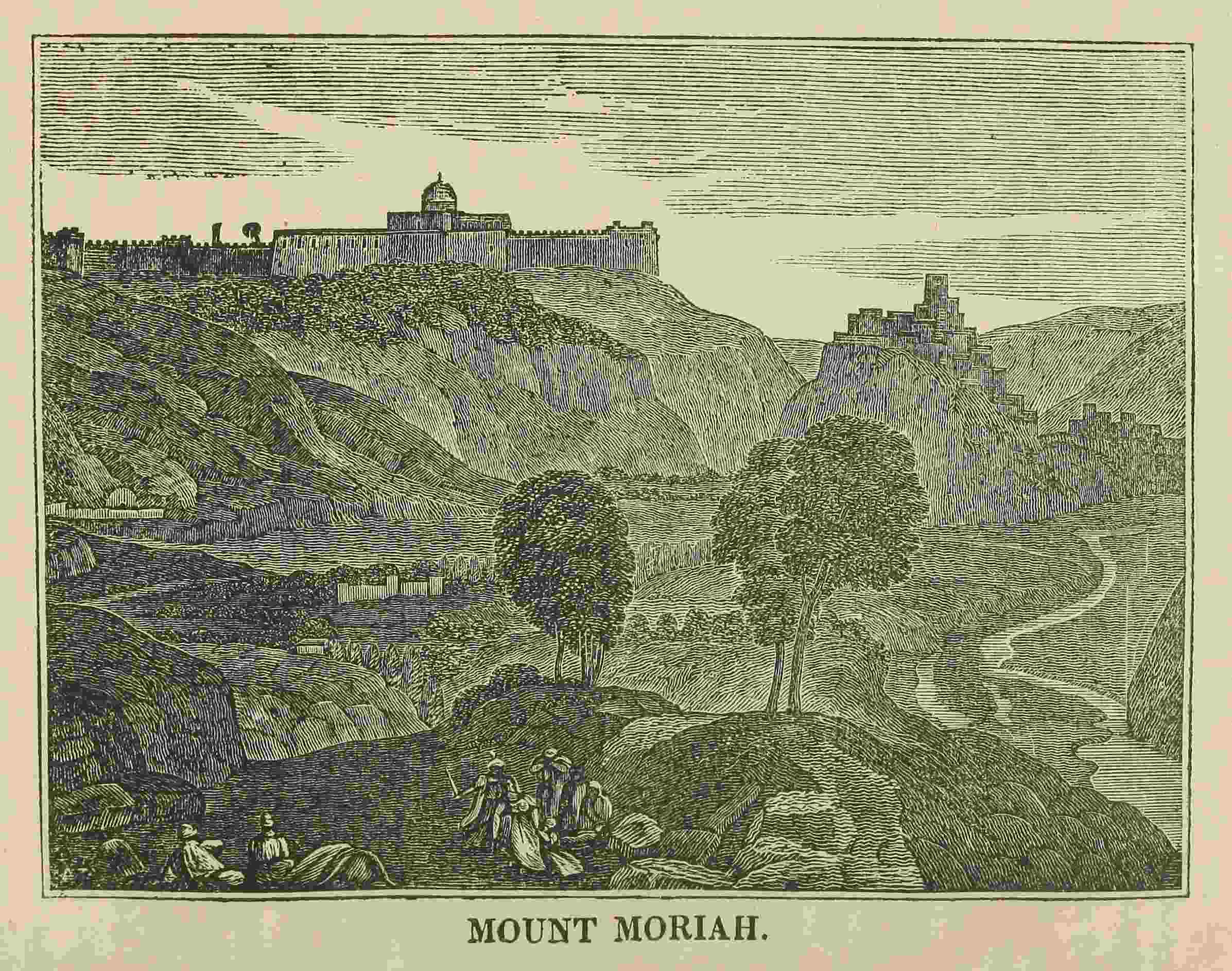
MOUNT MORIAH.
THE LAST SUPPER.
Meanwhile the offended and provoked dignitaries of Judaism were fast making arrangements to crush the daring innovator, who had done so much to bring their learning and their power into contempt. Some of the most fiery spirits among them, were for defying all risks, by seizing the Nazarene openly, in the midst of his audacious denunciations of the higher orders; and the attempt was made to execute this act of arbitrary power; but the mere hirelings sent upon the errand, were too much awed by the unequaled majesty of the man, and by the strong attachment of the people to him, to be willing to execute their commission. But there were old heads among them, that could contrive safer and surer ways of meeting the evil. By them it was finally determined to seize Jesus when alone or unattended by the throngs which usually encompassed him,――to hurry him at once secretly through the forms of law necessary for his commitment, and then to put him immediately into the hands of the Roman governor, as a condemned rioter and rebel, who would be obliged to order his execution in such a way as that no popular excitement would rescue the victim from the grasp of the soldiery. This was the plan which they were now arranging, and which they were prepared to execute before the close of the passover, if they could get intelligence of his motions. These fatal schemes of hate could not have been unknown to Jesus; yet the knowledge of them made no difference in his bold devotion to the cause for which he came into the world. Anxious to improve the few fast fleeting hours that remained before the time of his sufferings should come on, and desirous to join as a Jew in this great national festival, by keeping it in form with his disciples, he directed his two most confidential apostles, Peter and John, to get ready the entertainment for them in the city, by an arrangement made with a man already expecting to receive them. This commission they faithfully executed, and Jesus accordingly ate with his disciples the feast of the first day of the passover, in Jerusalem, with those who sought his life so near him. After the supper was over, he determined to use the brief remnant of time for the purpose of uprooting that low feeling of jealous ambition which had already made so much trouble among them, in their anxious discussions as to who should be accounted the greatest, and should rank as the ruler of the twelve. To impress the right view upon their minds most effectually, he chose the oriental mode of a ceremony which should strike their senses, and thus secure a regard and remembrance for his words which they might fail in attaining if they were delivered in the simple manner of trite and oft spoken oral truisms. He therefore rose after supper, and leaving his place at the head of the table, he laid aside his upper garments, which, though appropriate and becoming him as a teacher in his hours of public instruction, or social communion, were yet inconvenient in any active exertion which needed the free use of the limbs. Being thus disrobed, he took the position and character of a menial upon him, and girding himself with a towel, he poured water into a basin and began to wash the disciples’ feet in it, wiping them with his towel. He accordingly comes to Simon Peter, in the discharge of his servile office; but Peter, whose ideas of the majesty and ripening honors of his Master were shocked at this extraordinary action, positively refused to be even the passive instrument of such an indignity to one so great and good,――first inquiring “Lord, dost thou wash my feet?” Jesus in answer said to him, “What I do, thou knowest not now, but thou shalt know hereafter.” That is, “this apparently degrading act has a hidden, useful meaning, at this moment beyond your comprehension, but which you will learn in due time.” Peter, however, notwithstanding this plain and decided expression of Christ’s wise determination to go through this painful ceremony, for the instruction of those who so unwillingly submitted to see him thus degraded,――still led on by the fiery ardor of his own headlong genius,――manfully persisted in his refusal, and expressed himself in the most positive terms possible, saying to Jesus, “Thou shalt never wash my feet.” Jesus answered, “If I wash thee not, thou hast no part with me.” This solemn remonstrance had the effect of checking Peter’s too forward reverence, and in a tone of deeper submission to the wise will of his Master, he yielded, replying however, “Lord, wash not my feet only, but also my hands and my head.” Since so low an office was to be performed by one so venerated, he would not have the favor of his blessed touch confined to the baser limbs, but desired that the nobler parts of the body should share in the holy ablution. But the high purpose of Jesus could not accommodate itself to the whims of his zealous disciple; for his very object was to take the humblest attitude before them, by performing those personal offices which were usually committed to slaves. He therefore told Peter, “He that is washed needs not save to wash his feet, but is clean in every part;”――a very familiar and expressive illustration, alluding to the circumstance that those who have been to a bath and there washed themselves, will on their return find themselves wholly clean, except such dust as may cling to their feet as they have passed through the streets on their return. And any one may feel the force of the beautiful figure, who has ever gone into the water for the purposes of cleanliness and refreshment, on a warm summer’s day in this country, and has found by experience that after all possible ablution, on coming out and dressing himself, his wet feet in contact with the ground have become loaded with dirt which demands new diligence to remove it; and as all who have tried it know, it requires many ingenious efforts to return with feet as clean as they came to the washing; and in spite of all, after the return, an inspection may forcibly illustrate the truth, that “he that is washed, though he is clean in every part, yet needs to wash his feet.” Such was the figure with which Jesus expressed to his simple-minded and unlettered disciples, the important truth, that since they had been already washed, (baptized by John or himself,) if that washing had been effectual, they could need the repurification only of their feet――the cleansing away of such of the world’s impure thoughts and feelings as had clung to them in their journeyings through it. So, after he had washed their feet, and had taken his garments and sat down again, he said to them, “Know ye what I have done to you? Ye call me Master and Lord; and ye say well, for so I am. If I then, your Lord and Master, have washed your feet, ye also ought to wash one another’s feet. For I have given you this as an example, that ye should do as I have done to you. Truly the servant is not greater than his lord, neither is he that is sent greater than him that sent him. If ye know these things, happy are ye if ye do them.”――A charge so clear and simple, and so full, that it needs not a word of comment to show any reader the full force of this touching ceremony.
Shortly after, in the same place and during the same meeting, Jesus speaking to them of his near departure, affectionately and sadly said, “Little children, but a little while longer am I with you. Ye shall seek me; and as I said to the Jews, ‘whither I go, ye cannot come,’――so now I say to you.” To this Simon Peter soon after replied by asking him, “Lord whither goest thou?” Jesus answered him, “Whither I go thou canst not follow me now, but thou shalt follow me afterwards.” Peter, perhaps beginning to perceive the mournful meaning of this declaration, replied, still urging, “Lord, why cannot I follow thee now? I will lay down my life for thy sake.” Jesus answered, “Wilt thou lay down thy life for my sake? I tell thee assuredly, the cock shall not crow till thou hast denied me thrice.”――Soon after, at the same time and place, noticing the confident assurance of this chief disciple, Jesus again warned him of his danger and his coming fall. “Simon! Simon! behold, Satan has desired to have you (all) that he may sift you as wheat; but I have prayed for thee (especially) that thy faith fail not; and when thou art converted, strengthen thy brethren.” Never before had higher and more distinctive favor been conferred on this chief apostle, than by this sad prophecy of danger, weakness and sin, on which he was to fall, for a time, to his deep disgrace; but on him alone, when rescued from ruin by his Master’s peculiar prayers, was to rest the task of strengthening his brethren. But his Master’s kind warning was for the present lost on his immovable self-esteem; he repeated his former assurance of perfect devotion through every danger, “Lord, I am ready to go with thee into prison and to death.” Where was affectionate and heroic devotion ever more affectingly and determinedly expressed? What heart of common man would not have leaped to meet such love and fidelity? But He, with an eye still clear and piercing, in spite of the tears with which affection might dim it, saw through the veil that would have blinded the sharpest human judgment, and coldly met these protestations of burning zeal with the chilling prediction again uttered, “I tell thee, Peter, the cock shall not crow this day, before thou shalt thrice deny that thou knowest me.” Then making a sudden transition, to hint to them the nature of the dangers which would soon try their souls, he suddenly reverted to their former security. “When I sent you forth without purse, or scrip, or shoes, did ye need any thing?” And they said “Nothing.” Then said he to them “But now, let him that has a purse, take it, and likewise his scrip; and let him that has no sword sell his cloak and buy one.” They had hitherto, in their wanderings, every where found friends to support and protect them; but now the world was at war with them, and they must look to their own resources both for supplying their wants and guarding their lives. His disciples readily apprehending some need of personal defense, at once bestirred themselves and mustered what arms they could on the spot, and told him that they had two swords among them, and of these it appears that one was in the hands of Peter. It was natural enough that among the disciples these few arms were found, for they were all Galileans, who, as Josephus tells us, were very pugnacious in their habits; and even the followers of Christ, notwithstanding their peaceful calling, had not entirely laid aside their former weapons of violence, which were the more needed by them, as the journey from Galilee to Jerusalem was made very dangerous by robbers, who lay in wait for the defenseless traveler wherever the nature of the ground favored such an attack. Of this character was that part of the road between Jerusalem and Jericho, alluded to in the parable of the wounded traveler and the good Samaritan,――a region so wild and rocky that it has always been dangerous, for the same reasons, even to this day; of which a sad instance occurred but a few years ago, in the case of an eminent English traveler, who going down from Jerusalem to Jericho, fell among thieves and was wounded near the same spot mentioned by Christ, in spite of the defenses with which he was provided. It was in reference to such dangers as these, that two of his disciples had provided themselves with hostile weapons, and Peter may have been instigated to carry his sword into such a peaceful feast, by the suspicion that the danger from the chief priests, to which Christ had often alluded, might more particularly threaten them while they were in the city by themselves, without the safeguard of their numerous friends in the multitude. The answer of Jesus to this report of their means of resistance was not in a tone to excite them to the very zealous use of them. He simply said, “It is enough,” a phrase which was meant to quiet them, by expressing his little regard for such a defense as they were able to offer to him, with this contemptible armament.
Some have conjectured that this washing of feet (page 97) was a usual rite at the Paschal feast. So Scaliger, Beza, Baronius, Casaubon and other learned men have thought. (See Poole’s Synopsis, on John xiii. 5.) But Buxtorf has clearly shown the falsity of their reasons, and Lightfoot has also proved that it was a perfectly unusual thing, and that there is no passage in all the Rabbinical writings which refers to it as a custom. It is manifest indeed, to a common reader, that the whole peculiar force of this ablution, in this instance, consisted in its being an entirely unusual act; and all its beautiful aptness as an illustration of the meaning of Jesus,――that they should cease their ambitious strife for precedence,――is lost in making it anything else than a perfectly new and original ceremony, whose impressiveness mainly consisted in its singularity. Lightfoot also illustrates the design of Jesus still farther, by several interesting passages from the Talmudists, showing in what way the ablution would be regarded by his disciples, who like other Jews would look upon it as a most degraded action, never to be performed except by inferiors to superiors. These Talmudic authorities declare, that “Among the duties to be performed by the wife to her husband, this was one,――that she should wash his face, his hands and his feet.” (Maimonides on the duties of women.) The same office was due from a son to his father,――from a slave to his master, as his references show; but he says he can find no precept that a disciple should perform such a duty to his teacher, unless it be included in this, “The teacher should be more honored by his scholar than a father.”
He also shows that the feet were never washed separately, with any idea of legal purification,――though the Pharisees washed their hands separately with this view, and the priests washed their hands and feet both, as a form of purification, but never the feet alone. And he very justly remarks upon all this testimony, that “the farther this action of Christ recedes from common custom, the higher its fitness for their instruction,――being performed not merely for an example but for a precept.” (Lightfoot’s Horae Hebraica in Gospel of John xiii. 5.)
Laid aside his garments.――The simple dress of the races of western Asia, is always distinguishable into two parts or sets of garments,――an inner, which covered more or less of the body, fitting it tightly, but not reaching far over the legs or arms, and consisted either of a single cloth folded around the loins, or a tunic fastened with a girdle; sometimes also a covering for the thighs was subjoined, making something like the rudiment of a pair of breeches. (See Jahn Archaeologia Biblica § 120.) These were the permanent parts of the dress, and were always required to be kept on the body, by the common rules of decency. But the second division of the garments, (“superindumenta,” Jahn,) thrown loosely over the inner ones, might be laid aside, on any occasion, when active exertion required the most unconstrained motion of the limbs. One of these was a simple oblong, broad piece of cloth, of various dimensions, but generally about three yards long, and two broad, which was wrapped around the body like a mantle, the two upper corners being drawn over the shoulders in front, and the rest hanging down the back, and falling around the front of the body, without any fastenings but the folding of the upper corners. This garment was called by the Hebrews שמלה or שלמה, (simlah or salmah,) and sometimes בגד; (begedh;)――by the Greeks, ἱματιον. (himation.) Jahn Archaeologia Biblica. This is the garment which is always meant by this Greek word in the New Testament, when used in the singular number,――translated “cloak” in the common English version, as in the passage in the text above, where Jesus exhorts him that has no sword to sell his cloak and buy one. When this Greek word occurs in the plural, (ἱματια, himatia,) it is translated “garments,” and it is noticeable that in most cases where it occurs, the sense actually requires that it should be understood only of the outer dress, to which I have referred it. As in Matthew xxi. 8, where it is said that the people spread their garments in the way,――of course only their outer ones, which were loose and easily thrown off, without indecent exposure. So in Mark xi. 7, 8: Luke xix. 35. There is no need then, of supposing, as Origen does, that Jesus took off all his clothes, or was naked, in the modern sense of the term. A variety of other outer garments in common use both among the early and the later Jews, are described minutely by Jahn in his Archaeologia Biblica, § 122. I shall have occasion to describe some of these, in illustration of other passages.
My exegesis on the passage “He that is washed, needs not,” &c. may strike some as rather bold in its illustration, yet if great authorities are necessary to support the view I have taken, I can refer at once to a legion of commentators, both ancient and modern, who all offer the same general explanation, though not exactly the same illustration. Poole’s Synopsis is rich in references to such. Among these, Vatablus remarks on the need of washing the feet of one already washed, “scil. viae causa.” Medonachus says of the feet, “quos calcata terra iterum inquinat.” Hammond says, “he that hath been initiated, and entered into Christ, &c. is whole clean, and hath no need to be so washed again, all over. All that is needful to him is the daily ministering of the word and grace of Christ, to cleanse and wash off the frailties, and imperfections, and lapses of our weak nature, those feet of the soul.” Grotius says, “Hoc tantum opus ei est, ut ab iis se purget quae ex occasione nascuntur. Similitudo sumpta ab his qui a balneo nudis pedibus abeunt.” Besides these and many others largely quoted by Poole, Lampius also (in commentary in Gospel of John) goes very fully into the same view, and quotes many others in illustration. Wolfius (in Cur. Philology) gives various illustrations, differing in no important particular, that I can see, from each other, nor from that of Kuinoel, who calls them “contortas expositiones,” but gives one which is the same in almost every part, but is more fully illustrated in detail, by reference to the usage of the ancients, of going to the bath before coming to a feast, which the disciples no doubt had done, and made themselves clean in all parts except their feet, which had become dirtied on the way from the bath. This is the same view which Wolf also quotes approvingly from Elsner. Wetstein is also on this point, as on all others, abundantly rich in illustrations from classic usage, to which he refers in a great number of quotations from Lucian, Herodotus, Plato, Terence and Plutarch.
Sift you as wheat.――The word σινιαζω (siniazo) refers to the process of winnowing the wheat after threshing, rather than sifting in the common application of the term, which is to the operation of separating the flour from the bran. In oriental agriculture the operation of winnowing is performed without any machinery, by simply taking up the threshed wheat in a large shovel, and shaking it in such a way that the grain may fall out into a place prepared on the ground, while the wind blows away the chaff. The whole operation is well described in the fragments appended to Taylor’s editions of Calmet’s dictionary, (Hund. i. No. 48, in Vol. III.) and is there illustrated by a plate. The phrase then, was highly expressive of a thorough trial of character, or of utter ruin, by violent and overwhelming misfortune, and as such is often used in the Old Testament. As in Jeremiah xv. 7. “I will fan them with a fan,” &c. Also in li. 3. In Psalm cxxxix. 2. “Thou winnowest my path,” &c.; compare translation “Thou compassest my path.” The same figure is effectively used by John the Baptist, in Matthew iii. 12, and Luke iii. 17.
Galilean pugnacity.――Josephus, who was very familiar with the Galileans by his military service among them, thus characterizes them. “The Galileans are fighters even from infancy, and are every where numerous, nor are they capable of fear.” Jewish War, book III. chapter iii. section 2.
From Jerusalem to Jericho.――The English traveler here referred to, is Sir Frederic Henniker, who in the year 1820, met with this calamity, which he thus describes in his travels, pp. 284‒289.
“The route is over hills, rocky, barren and uninteresting; we arrived at a fountain, and here my two attendants paused to refresh themselves; the day was so hot that I was anxious to finish the journey, and hurried forwards. A ruined building situated on the summit of a hill was now within sight, and I urged my horse towards it; the janissary galloped by me, and making signs for me not to precede him, he rode into and round the building, and then motioned me to advance. We next came to a hill, through the very apex of which has been cut a passage, the rocks overhanging it on either side. Quaresmius, (book vi. chapter 2.) quoting Brocardus, 200 years past, mentions that there is a place horrible to the eye, and full of danger, called Abdomin, which signifies blood; where he, descending from Jerusalem to Jericho, fell among thieves. I was in the act of passing through this ditch, when a bullet whizzed by, close to my head; I saw no one, and had scarcely time to think, when another was fired some distance in advance. I could yet see no one,――the janissary was beneath the brow of the hill, in his descent; I looked back, but my servant was not yet within sight. I looked up, and within a few inches of my head were three muskets, and three men taking aim at me. Escape or resistance were alike impossible. I got off my horse. Eight men jumped down from the rocks, and commenced a scramble for me; I observed also a party running towards Nicholai. At this moment the janissary galloped in among us with his sword drawn.
“A sudden panic seized the janissary; he cried on the name of the Prophet, and galloped away. As he passed, I caught at a rope hanging from his saddle. I had hoped to leap upon his horse, but found myself unable;――my feet were dreadfully lacerated by the honey-combed rocks――nature would support me no longer――I fell, but still clung to the rope. In this manner I was drawn some few yards, till, bleeding from my ancle to my shoulder, I resigned myself to my fate. As soon as I stood up, one of my pursuers took aim at me, but the other casually advancing between us, prevented his firing; he then ran up, and with his sword, aimed such a blow as would not have required a second; his companion prevented its full effect, so that it merely cut my ear in halves, and laid open one side of my face; they then stripped me naked.
“It was now past mid-day, and burning hot; I bled profusely,――and two vultures, whose business it is to consume corpses, were hovering over me. I should scarcely have had strength to resist, had they chosen to attack me. At length we arrived about 3 P. M. at Jericho.――My servant was unable to lift me to the ground; the janissary was lighting his pipe, and the soldiers were making preparations to pursue the robbers; not one person would assist a half-dead Christian. After some minutes a few Arabs came up and placed me by the side of the horse-pond, just so that I could not dip my finger into the water. This pool is resorted to by every one in search of water, and that employment falls exclusively upon females;――they surrounded me, and seemed so earnest in their sorrow, that, notwithstanding their veils, I almost felt pleasure at my wound. One of them in particular held her pitcher to my lips, till she was sent away by the Chous;――I called her, she returned, and was sent away again; and the third time she was turned out of the yard. She wore a red veil, (the sign of not being married,) and therefore there was something unpardonable in her attention to any man, especially to a Christian; she however returned with her mother, and brought me some milk. I believe that Mungo Park, on some dangerous occasion during his travels, received considerable assistance from the compassionate sex.”
THE SCENES OF GETHSEMANE.
After much more conversation and prayer with his disciples in the supper-room, and having sung the hymn of praise which usually concluded the passover feast among the Jews, Jesus went with them out west of the city, over the brook Kedron, at the foot of the Olive mount, where there was a garden, called Gethsemane, to which he had often resorted with his disciples, it being retired as well as pleasant. While they were on the way, a new occasion happened of showing Peter’s self-confidence, which Jesus again rebuked with the prediction that it would too soon fail him. He was telling them all, that events would soon happen that would overthrow their present confidence in him, and significantly quoted to them the appropriate passage in Zechariah xiii. 7. “I will smite the shepherd, and the sheep shall be scattered.” Peter, glad of a new opportunity to assert his steadfast adherence to his Master, again assured him that, though all should be offended, or lose their confidence in him, yet would not he; but though alone, would always maintain his present devotion to him. The third time did Jesus reply in the circumstantial prediction of his near and certain fall. “This day, even this night, before the cock crow twice, thou shalt deny me thrice.” This repeated distrustful and reproachful denunciation, became, at last, too much for Peter’s warm temper; and in a burst of offended zeal, he declared the more vehemently, “If I should die with thee, I will not deny thee in any wise.” To this solemn protestation against the thought of defection, all the other apostles present gave their word of hearty assent.
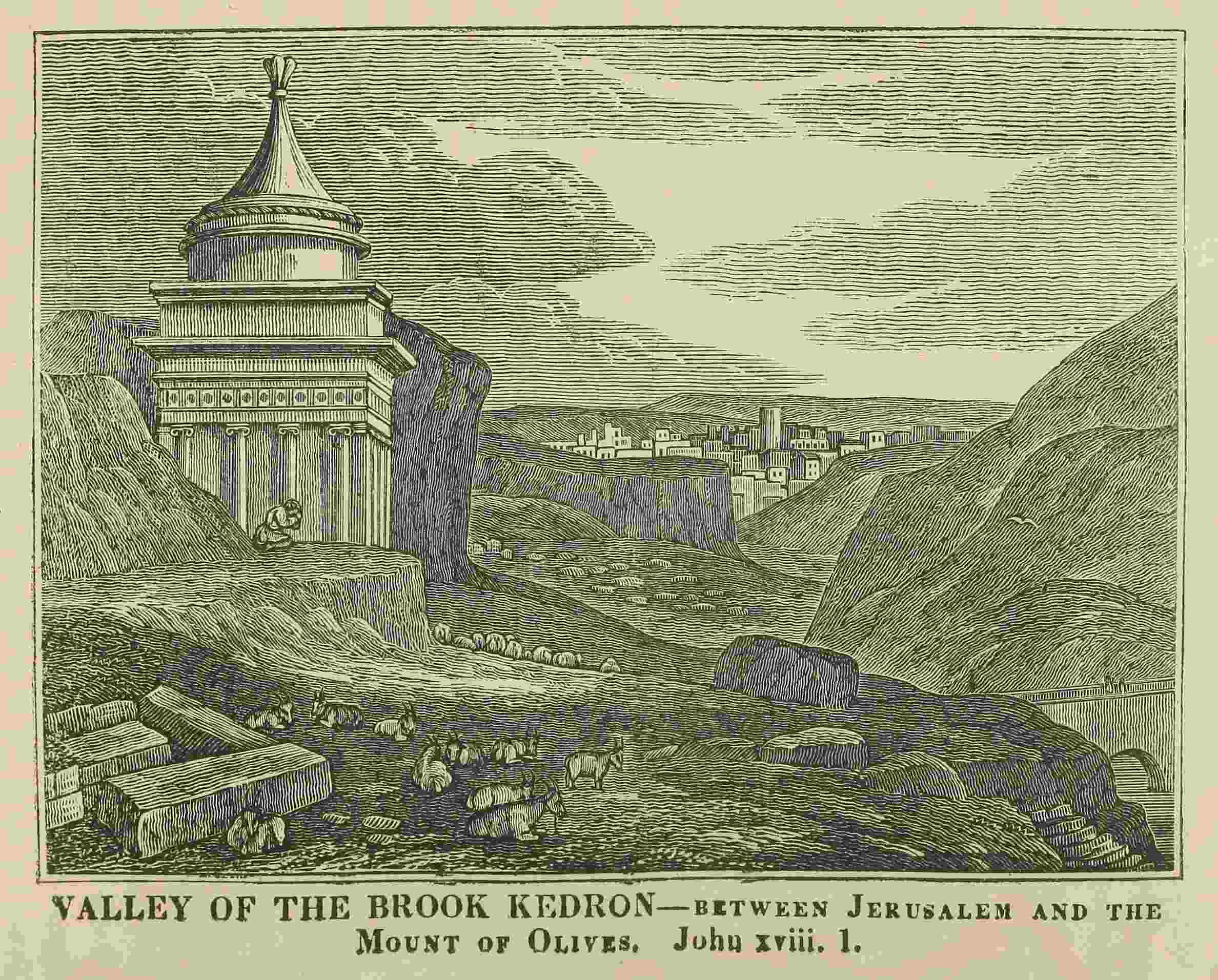
VALLEY OF THE BROOK KEDRON
between Jerusalem and the Mount of Olives. John xviii. 1.
They now reached the garden, and when they had entered it, Jesus spoke to all the disciples present, except his three chosen ones, saying, “Sit ye here, while I go and pray yonder.” He retired accordingly into some recess of the garden, with Peter and the two sons of Zebedee, James and John; and as soon as he was alone with them, begun to give utterance to feelings of deep distress and depression of spirits. Leaving them, with the express injunction to keep awake and wait for him, he went for a short time still farther, and there, in secret and awful woe, that wrung from his bowed head the dark sweat of an unutterable agony, yet in submission to God, he prayed that the horrible suffering and death to which he had been so sternly devoted, might not light on him. Returning to the three appointed watchers, he found them asleep! Even as amid the lonely majesty of Mount Hermon, human weakness had borne down the willing spirit in spite of the sublime character of the place and the persons before them; so here, not the groans of that beloved suffering Lord, for whom they had just expressed such deep regard, could keep their sleepy eyes open, when they were thus exhausted with a long day’s agitating incidents, and were rendered still more dull and stupid by the chilliness of the evening air, as well as the lateness of the hour of the night; for it was near ten o’clock. At this sad instance of the inability of their minds to overcome the frailties of the body, after all their fine protestations of love and zeal, he mildly and mournfully remonstrates with Peter in particular, who had been so far before the rest in expressing a peculiar interest in his Master. And he said to Peter, “Simon! sleepest thou? What! could ye not watch with me one hour? Watch ye and pray, lest ye enter into temptation. The spirit indeed is willing, but the flesh is weak.” Well might he question thus the constancy of the fiery zeal which had so lately inspired Peter to those expressions of violent attachment. What! could not all that warm devotion, that high pride of purpose, sustain his spirit against the effects of fatigue and cold on his body? But they had, we may suppose, crept into some shelter from the cold night air, where they unconsciously forgot themselves. After having half-roused them with this fruitless appeal, he left them, and again passed through another dreadful struggle between his human and divine nature. The same strong entreaty,――the same mournful submission,――were expressed as before, in that moment of solitary agony, till again he burst away from the insupportable strife of soul, and came to see if yet sympathy in his sorrows could keep his sleepy disciples awake. But no; the gentle rousing he had before given them had hardly broken their slumbers. For a few moments the voice of their Master, in tones deep and mournful with sorrow, might have recalled them to some sense of shame for their heedless stupidity; and for a short time their wounded pride moved them to an effort of self-control. A few mutual expostulations in a sleepy tone, would pass between them;――an effort at conversation perhaps, about the incidents of the day, and the prospect of coming danger which their Master seemed to hint;――some wonderings probably, as to what could thus lead him apart to dark and lonely devotion;――very likely too, some complaint about the cold;――a shiver――a sneeze,――then a movement to a warmer attitude, and a wrapping closer in mantles;――then the conversation languishing, replies coming slower and duller, the attitude meanwhile declining from the perpendicular to the horizontal, till at last the most wakeful waits in vain for an answer to one of his drowsy remarks, and finds himself speaking to deaf ears; and finally overcome with impatience at them and himself, he sinks down into his former deep repose, with a half-murmured reproach to his companions on his lips. In short, as every one knows who has passed through such efforts, three sleepy men will hardly keep awake the better for each other’s company; but so far from it, on the contrary, the force of sympathy will increase the difficulty, and the very sound of drowsy voices will serve to lull all the sooner into slumber. In the case of the apostles too, who were mostly men accustomed to an active life, and who were in the habit of going to bed as soon as it was night, whenever their business allowed them to rest, all their modes of life served to hasten the slumbers of men so little inured to self-control of any kind. These lengthy reasons may serve to excite some considerate sympathy for the weakness of the apostles, and may serve as an apology for their repeated drowsiness on solemn occasions; for a first thought on the subject might suggest to a common man, the irreverent notion, that those who could slumber at the transfiguration of the Son of God on Mount Hermon, and at his agony in Gethsemane, must be very sleepy fellows. On this occasion these causes were sufficient to enchain their senses, in spite of the repeated exhortations of Jesus, for on his coming to them the second time, and saying in a warning voice, “Rise and pray, lest ye enter into temptation; why sleep ye?” they wist not what to answer him, for their eyes were very heavy, and they slept for sorrow. Still again he retired about a stone’s throw from them, as before, and there, prone on the ground, he renewed the strife with his feelings. Alone and unsympathized with by his friends, did the Redeemer of men endure the agonies of that hour, yet not wholly alone nor unsupported; for as Luke assures us, there appeared to him an angel from heaven, strengthening him. At last the long struggle ceased. Distant voices coming over the glen through the stillness of the night, and the glare of torches flashing from the waters of the Kedron through the shades of the garden, gave him notice that those were near who came to drag him to a shameful death. Yet the repugnance of nature with which his late strife had been so dreadful, was now so overcome that he shrank not from the ♦approaching death, but calmly walked to meet it. Coming forward to his sleeping disciples, he said to them, “Sleep on now and take your rest; behold, the time is at hand when the son of man is betrayed into the hands of sinners. Arise, let us be going.” The rush of the armed bands of the temple guards followed his words, and when the apostles sprung to their feet, their drowsiness was most effectually driven off by the appalling sight of a crowd of fierce men, filling the garden and surrounding them. As soon as the villainous leaders of the throng could overcome the reverence which even the lowest of their followers had for the majestic person of the Savior, they brought them up to the charge, and a retainer of the high priest, by name Malchus, with the forward officiousness of an insolent menial, laid hold of Jesus. Now was the time for Galilean spunk to show itself. The disciples around instantly asked, “Lord, shall we smite with the sword?” But without waiting for an answer, Peter, though amazed by this sudden and frightful attack, as soon as he saw the body of his adored Master profaned by the rude hands of base hirelings, foremost in action as in word, regardless of numbers, leaped on the assailants with drawn sword, and with a movement too quick to be shunned, he gave the foremost a blow, which, if the darkness had not prevented, might have been fatal. As it was, there could not have been a more narrow escape, for the sword lighting on the head of the priest’s zealous servant, just grazed his temple and cut off his ear. But this display of courage was after all, fruitless; for he was surrounded by a great body of men, armed in the expectation of this very kind of resistance; and in addition to this, the remonstrance of Jesus must have been sufficient to damp the most fiery valor. He said to his zealous and fierce defender, “Put up thy sword again into its sheath, for they that take the sword shall perish by the sword. The cup which my Father hath given me, shall I not drink? Thinkest thou that if I should now pray to my Father, he would not instantly send me twelve legions of angels at a word? But how then shall the scriptures be fulfilled, which say that it must be thus?” Having thus stopped the ineffectual and dangerous opposition of his few followers, he quietly gave himself up to his captors, interceding however for his poor, friendless and unprotected disciples. “I am Jesus of Nazareth: if therefore you seek me, let these go their way.” This he said as it were in reference to a literal and corporeal fulfilment of the words which he had used in his last prayer with his disciples,――“Of them whom thou gavest me I lost none.” The disciples after receiving from Jesus such a special command to abstain from resistance, and perceiving how utterly desperate was the condition of affairs, without waiting the decision of the question, all forsaking him, fled; and favored by darkness and their familiar knowledge of the grounds, they all escaped in various directions.
Gethsemane.――This place has already been alluded to in the description of Mount Olivet. [Note on p. 96.] From the same source I extract a further brief notice of the present aspect of this most holy ground. “Proceeding along the valley of Kedron, at the foot of Mount Olivet, is the garden of Gethsemane: an even plat of ground, not above fifty-seven yards square, where are shown some old olive trees, supposed to identify the spot to which our Lord was wont to repair. John xviii. 1, 2.” [Modern Traveler, Palestine, p. 156.] It is also remarked by Dr. Richardson, [p. 78 of the same work,] that “the gardens of Gethsemane are still in the sort of a ruined cultivation; the fences are broken down, and the olive trees decaying, as if the hand that dressed and fed them was withdrawn.”
The etymology and meaning of the name Gethsemane, is given by Lightfoot, (Centuria Chorographica in Matthew, chapter 41.) The name is derived from the product of the tree which was so abundantly raised there, and which gave name also to the mountain. Gethsemane is compounded of גת, “a press,” and שמנא, “olive oil,”――“an oil-press;” because the oil was pressed out and manufactured on the spot where the olive was raised.
Ten o’clock.――This I conclude to have been about the time, because (in Matthew xxvi. 20) it is said that it was evening already, (that is, about 6 o’clock,) when Jesus sat down to supper with his disciples, and allowing time on the one hand for the events at the supper-table and on the walk, as well as those in the garden,――and on the other hand for those which took place before midnight, (cock crowing,) we must fix the time as I have above.
The glare of torches.――John (xviii. 3.) is the only evangelist who brings in this highly picturesque circumstance of the equipment of the band with the means of searching the dark shades and bowers of the garden.
HIS THREE-FOLD DENIAL.
Peter, however, had he not so soon forgot his zealous attachment to Jesus, as to leave him in such hands, without farther knowledge of his fate; but as soon as he was satisfied that the pursuit of the disciples was given up, he, in company with John, followed the band of officers at safe distance, and ascertained whither they were carrying the captive. After they had seen the train proceed to the palace of the high priest, they proceeded directly to the same place. Here John, being known to the high priest, and having friends in the family, went boldly in, feeling secure by his friendship in that quarter, against any danger in consequence of his connection with Jesus. Being known to the servant girl who kept the door, as a friend of the family, he got in without difficulty, and had also influence enough to get leave to introduce Peter, as a friend of his who had some curiosity to see what was going on. Peter, who had stood without the door waiting for the result of John’s maneuver, was now brought into the palace, and walked boldly into the hall where the examination of Jesus was going on, hoping to escape entirely unnoticed by keeping in the dimly lighted parts of the hall, by which he would be secure, at the same time that he would the better see what was going on near the lights. Standing thus out of the way in the back part of the room, he might have witnessed the whole without incurring the notice of anybody. But the servants and others, who had been out over the damp valley of the Kedron after Jesus, feeling chilled with the walk, (for the long nights of that season are in Jerusalem frequently in strong contrast with the warmth of mid-day,) made up a good fire of coal in the back part of the hall, where they stood looking on. Peter himself being, too, no doubt thoroughly chilled with his long exposure to the cold night air, very naturally and unreflectingly came forward to the fire, where he sat down and warmed himself among the servants and soldiers. The bright light of the coals shining directly on his anxious face, those who stood by, noticing a stranger taking such interest in the proceedings, began to scrutinize him more narrowly. At last, the servant girl who had let him in at the door, with the inquisitive curiosity so peculiarly strong in her sex, knowing that he had come in with John as his particular acquaintance, and concluding that he was like him associated with Jesus, boldly said to him, “Thou also art one of this man’s disciples.” But Peter, like a true Galilean, as ready to lie as to fight, thinking only of the danger of the recognition, at once denied him, forgetting the lately offensive prediction, in his sudden alarm. He said before them all, “Woman, I am not!――I know him not; neither do I understand what thou sayest.” This bold and downright denial silenced the forward impertinence of the girl, and for a time may have quieted the suspicions of those around. Peter, however, startled by this sudden attack, all at once perceived the danger into which he had unthinkingly thrust himself, and drawing back from his prominent station before the fire, which had made him so unfortunately conspicuous, went out into the porch of the building, notwithstanding the cold night air, preferring the discomfort of the exposure, to the danger of his late position. As he walked there in the open air, he heard the note of the cock sounding clear, through the stillness of midnight, announcing the beginning of the third watch. The sound had a sad import to him, and must have recalled to his mind some thought of his master’s warning; but before it could have made much impression, it was instantly banished altogether from his mind, by a new alarm from the inquisitiveness of some of the retainers of the palace, who, seeing a stranger lurking in a covert manner about the building at that time of night, very naturally felt suspicious enough of him to examine his appearance narrowly. Among those who came about him, was another of those pert damsels who seem to have been very numerous and forward about the house of the head of the Jewish faith. She, after a satisfactory inspection of the suspicious person, very promptly informed those that were there also about him, “This fellow also was with Jesus of Nazareth.” Peter’s patience being at last worn out with the pertinacious annoyances of these spiteful lasses, not only flatly contradicted the positive assertion of the girl, but backed his words with an oath, which seems to have had the decisive effect of hushing his female accusers entirely, and he considered himself to have turned off suspicion for a time so effectually, that, after cooling himself sufficiently in the porch, being distracted with anxiety about the probable fate of his beloved Master, he at last ventured again into the great hall of the palace, where the examination of Jesus was still going on. Here he remained a deeply interested spectator and auditor for about an hour, without being disturbed, when some of the bystanders who were not so much interested in the affair before them as to be prevented by it from looking about them, had their attention again drawn to the stranger who had been an object of such suspicion. There were probably more than one that recognized the active and zealous follower of the Nazarene, as Peter had been in such constant attendance on him throughout his whole stay in Jerusalem. But no one seems to have cared to provoke an irascible Galilean by an accusation which he might resent in the characteristic manner of his countrymen; till another of the servants of the high priest, a relation of Malchus, whose ear Peter had cut off, after looking well at him, and being provoked at the impudence of such a vagabond in thrusting himself into the home of the very man whom he had so shockingly mutilated and so nearly murdered, determined to bring the offender to punishment, and speaking to his fellow-servants, he indignantly and confidently affirmed, “This fellow also was with him, for he is a Galilean.” And turning to Peter, whom he had seen in Gethsemane, when engaged at the time of the capture of Jesus, he imperiously asked him, “Did I not see thee in the garden with him?” And others, joining in the charge, said decidedly to him, “Surely thou art one of them also: for thy very speech, thy accent, unquestionably, betrays thee to be a Galilean.” Peter began at last to see that his situation was growing quite desperate, and finding that his distress about his Lord had brought him within a chance of the same fate, determined to extricate himself by as unscrupulously using his tongue in his own defense as he had before used his sword for his Master. Besides, he had already told two flat lies within about three hours, and it was not for a Galilean in such a pass to hesitate about one more, even though seconded by a perjury. For he then began to curse and to swear, saying, “Man, I know not what thou sayest.――I know not the man of whom ye speak.” And immediately, while he was yet speaking, the cock crew the second time. At that moment, the Lord turned and looked upon Peter, and at the same sound the conscience-stricken disciple turning towards his Lord, met that glance. And what a look! He who cannot imagine it for himself, cannot conceive it from the ideal picture of another; but its effect was sufficiently dramatic to impress the least picturesque imagination. As the Lord turned and looked upon him, Peter remembered the word of the Lord, how he had said to him, “Before the cock shall crow twice this night, thou shalt deny me thrice.” And thinking thereon, he went out, and wept bitterly. Tears of rebuked conceit,――of self-humbled pride, over fallen glory and sullied honor,――flowed down his manly cheeks. Where was now the fiery spirit once in word so ready to brave death, with all the low malice of base foes, for the sake of Jesus? Where was that unshaken steadiness, that dauntless energy that once won him from the lips of his Master, when first his searching eye fell on him, the name of the ROCK,――that name by which again he had been consecrated as the mighty foundation-ROCK of the church of God? Was this the chief of the apostles?――the keeper of the keys of the kingdom of heaven?――binding and loosing on earth what should be bound or loosed in heaven? Where were the brave, high hopes of earthly glory to be won under the warlike banners of his kingly Master? Where was that Master and Lord? The hands of the rude were now laid on him, in insult and abuse,――his glories broken and faded,――his power vain for his own rescue from sufferings vastly greater than those so often relieved by him in others,――his followers dispirited and scattered,――disowning and casting out as evil the name they had so long adored. The haughty lords of Judaism were now exulting in their cruel victory, re-established in their dignity, and strengthened in their tyranny by this long-wished triumph over their deadly foe. He wept for bright hopes dimmed,――for crushed ambition,――but more than all, for broken faith,――for trampled truth,――and for the three-fold and perjured denial of his betrayed and forsaken Lord. Well might he weep――
“There’s bliss in tears,
When he who sheds them inly feels
Some lingering stain of early years
Effaced by every drop that steals.
The fruitless showers of worldly woe
Fall dark to earth and never rise;
But tears that from repentance flow,
In bright exhalement reach the skies.”
The soldiers, &c.――It has been supposed by some that this armed force was a part of the Roman garrison which was always kept in Castle Antonia, close by the temple; (see note on page 95;) but there is nothing in the expressions of either of the evangelists which should lead us to think so; on the contrary, their statement most distinctly specifies, that those concerned in the arrest were from a totally different quarter. Matthew (xxvi. 47) describes them as “a great throng, with swords and staves, from the chief priests and elders of the people.” The whole expression implies a sort of half-mob of low fellows, servants and followers of the members of the Sanhedrim, accompanying the ordinary temple-guard, which was a mere band of Levite peace-officers under the priests, whose business it was to keep order in the courts of the temple――a duty hardly more honorable than that of a sweeper or “doorkeeper in the house of the Lord,” from which office, indeed, it was probably not distinct. These watchmen and porters, for they were no better, were allowed by the Roman government of the city and kingdom, a kind of contemptuous favor in bearing swords to defend from profane intrusion their holy shrine, which Gentile soldiers could not approach as guards, without violating the sanctity of the place. Such a body as these men and their chance associates, are therefore well and properly described by Matthew, as a “throng with swords and clubs;” but what intelligent man would ever have thought of characterizing in this way, a regular detachment of the stately and well-armed legion which maintained the dignity and power of the Roman governor of Judea? Mark (xiv. 43) uses precisely the same expression as Matthew, to describe them: Luke (xxii. 52) represents Jesus as speaking to “the chief priests and captains of the temple and the elders, who had come against him, saying, ‘Have you come out as against a thief, with swords and clubs?’” John (xviii. 3) speaks of the band as made up in part of the servants of “the chief priests and Pharisees,” &c. So that the whole matter, unquestionably, was managed and executed entirely by the Jews; and the progress of the story shows that they did not call in the aid of the heathen secular power, until the last bloody act required a consummation which the ordinances of Rome forbade to the Jews, and then only did they summon the aid of the governor’s military force. Indeed, they were too careful in preserving their few peculiar secular privileges still left, to give up the smallest power of tyrannizing, permitted by their Roman lords.
The long nights in contrast with the heat of the day.――It should be remembered, that according to a just calculation, these events happened in the month of March, when the air of Palestine is uncomfortably cold. Conder, in his valuable topographical compilation, says, “during the months of May, June, July and August, the sky is for the most part cloudless; but during the night, the earth is moistened with a copious dew. Sultry days are not unfrequently succeeded by intensely cold nights. To these sudden vicissitudes, references are made in the Old Testament. Genesis xxxi. 40: Psalm cxxi. 6.” [Modern Traveler, Palestine, p. 14.]
The cold season, (קור Qor,) immediately following the true winter, (חרפ Hhoreph,) took in the latter part of the Hebrew month Shebeth, the whole of Adar, and the former half of Nisan; that is in modern divisions of time,――from the beginning of February to the beginning of April, according to the Calendarium Palestinae, in the Critica Biblica, Vol. III: but according to Jahn, (Archaeologia Biblica § 21,) from the middle of February to the middle of April, the two estimates varying with the different views about the dates of the ancient Hebrew months.
Galilean, ready to lie as to fight.――This may strike some, as rather too harsh a sentence to pass upon the general character of a whole people, but I believe I am borne out in this seeming abuse, by the steady testimony of most authorities to which I can readily refer. Josephus, whom I have already quoted in witness of their pugnacity, (on page 102,) seems to have been so well pleased with this trait, and also with their “industry and activity,” which he so highly commends in them, as well as the richness of the natural resources of the country, all which characteristics, both of the people and the region, he made so highly available in their defense during the war with the Romans, that he does not think it worth while to criticise their morals, to which, indeed, the season of a bloody war gives a sort of license, that made such defects less prominent, being apparently rather characteristic of the times than the people. But there is great abundance of condemnatory testimony, which shows that the Galileans bore as bad a character among their neighbors, as my severest remark could imply. Numerous passages in the gospels and Acts show this so plainly, as to convey this general impression against them very decidedly. Kuinoel (on Matthew ii. 23) speaks strongly of their proverbially low moral character. “All the Galileans were so despised by the dwellers of Jerusalem and Judea, that when they wished to characterize a man as a low and outcast wretch, they called him a Galilean.” On other passages also, (as on John vii. 52, and Matthew iv. 17,) he repeats this intellectual and moral condemnation in similar terms. Beza and Grotius also, in commenting on these passages, speak of Galilee as “contempta regio.” Rosenmueller also, (on John vii. 52,) says “Nullus, aiunt, Galilaeus unquam a Deo donatus est spiritu prophetico: gens est Deo despecta.” That is, “It was a saying among them, that no Galilean was ever indued with a spirit of prophecy: they are a people despised by God.” I might quote at great length from many commentators to the same effect, but these will serve as a specimen. It should be remarked, however, that the Galileans, though they might be worse than most Jews in their general character, were not very peculiar in their neglect of truth; for from the time of Abraham, Isaac and Jacob, to the present moment, the Asiatic races, generally, have been infamous for falsehood, and there are many modern travelers who are ready to testify that an Oriental, generally, when asked an indifferent question, will tell a lie at a venture, unless he sees some special personal advantage likely to result to him from telling the truth.
Yet in minute legal observances, the Galileans were, for the most part, much more rigid in interpreting and following the law of Moses, than the inhabitants of Judea, as is abundantly shown by Lightfoot in his numerous Talmudic quotations, (Centuria Chorographica chapter 86,) where the comparison is, on many accounts, highly favorable to such of the Galileans as pretended to observe and follow the Jewish law at all.
Thy accent betrays thee.――Lightfoot is very rich in happy illustrations of this passage, (Centuria Chorographica chapter 87.) He has drawn very largely here from the Talmudic writers, who are quite amusing in the instances which they give of the dialectic differences between the Galileans and the Judeans. Several of the puns which they give, would not be accounted dull even in modern times, and indeed, the Galilean brogue seems to have been as well marked, and to have given occasion for nearly as much wit as that of Ireland. The Galileans, thus marked by dialect as well as by manners, held about the same place in the estimation of the pure Judean race, as the modern Irish do among those of Saxon-English tongue and blood; and we cannot better conceive of the scorn excited in the refined Jews by the idea of a Galilean prophet with his simple disciples, than by imagining the sort of impression that would be made, by a raw Irishman attempting the foundation of a new sect in London or Boston, with a dozen rough and uneducated workmen for his preachers and main supporters.
The bright light of the fire shining on his face, &c.――This incident is taken from Luke xxii. 56, where the expression in the common version is, “a certain maid saw him as he sat by the fire.” But in the original Greek this last word is φῶς, (phos,) which means “light,” and not “fire;” and it is translated here in this peculiar manner, because it evidently refers to the light of the fire, from its connection with the preceding verse, where it is said that “Peter sat down among them ‘before’ the fire which they had kindled;” the word fire in this passage being in the Greek πυρ, (pur,) which is never translated otherwise. But the unusual translation of the word φῶς, by “fire” in the other verse, though it gives a just idea of Peter’s position, makes a common reader lose sight of the prominent reason of his detection, which was, that the “light of the fire” shone on his face.
In speaking of Peter’s fall and its attendant circumstances, Lampius (in Gospel of John xviii. 17,) seems to be most especially scandalized by the means through which Peter’s ruin was effected. “Sed ab ancilla Cepham vinci, dedecus ejus auget. Quanta inconstantia! Qui in armatos ordines paulo ante irruperat nunc ad vocem levis mulierculae tremit. Si Adamo probrosum, quod a femina conjuge seductus erat, non minus Petro, quod ab ancilla.” That is, “But that Cephas should have been overcome by a girl, increases his disgrace. How great the change! He who, but a little before, had charged an armed host, now trembled at the voice of a silly woman. If it was a shame to Adam, that he had been seduced by his wife, it was no less so to Peter, that he was by a girl.”
The cock crew.――By this circumstance, the time of the denial in all its parts is well ascertained. The first cock-crowing after the first denial marked the hour of midnight, and the second cock-crowing announced the first dawn of day. As Lampius says, “Altera haec erat αλεκτροφῶνια, praenuncia lucis, non tantum in terra, sed et in corde Petri, tenebris spississimis obsepto, mox iterum oriturae.” “This was the second cock-crowing, the herald of light, soon to rise again, not only on earth, but also in the heart of Peter, now overspread with the thickest darkness.”
And thinking thereon, he wept.――This expression is taken from Mark xiv. 72, and accords with our common translation, though very different from many others that have been proposed. The word thus variously rendered, is in the original Greek, επιβαλων, (epibalon,) and bears a great variety of definitions which can be determined only by its connections, in the passages where it occurs. Campbell says, “There are not many words in scripture which have undergone more interpretations than this term;” and truly the array of totally diverse renderings, each ably supported by many of the most learned Biblical scholars that ever lived, is truly appalling to the investigator. (1.) Those who support the common English translation are Kypke, Wetstein, Campbell and Bloomfield, and others quoted by the latter.――(2.) Another translation which has been ably defended is, “he began to weep.” This is the expression in the common German translation, (Martin Luther’s,) “ER HOB AN ZU WEINEN.” It is also the version of the Vulgate, (“Coepit flere,”) the Syriac, Gothic, Persian, and Armenian translations, as Kuinoel and Heinsius observe, who also maintain this rendering.――(3.) Another is, “He proceeded to weep,” (“Addens flevit.”) which is that of Grotius, LeClerc, Simon, Petavius and others.――(4.) Another is, “covering his head, he wept.” This seems to have begun with Theophylact, who has been followed by a great number, among whom Salmasius, Wolf, Suicer, Macknight, and Krebs, are the most prominent.――(5.) Another is, “rushing out, he wept.” This is maintained by Beza, Rosenmueller, Schleusner, Bretschneider and Wahl.――(6.) Another is, “Having looked at him,” (Jesus,) “he wept.” This is the version of Hammond and Palairet.――“Who shall decide when” so many “doctors disagree?” I should feel safest in leaving the reader, as Parkhurst does, to “consider and judge” for himself; but in defense of my own rendering, I would simply observe, that the common English version is that which is most in accordance with the rules of grammar, and is best supported by classic usage, while the second and third are justly objected to by Bloomfield and Campbell as ungrammatical, and unsupported by truly parallel passages, notwithstanding the array of classical quotations by Bp. ♦Bloomfield and others; and the fourth and fifth equally deserve rejection for the very tame and cold expression which they make of it, the fourth also being ungrammatical like the second and third. The sixth definition also may be rejected on grammatical grounds, as well as for lack of authorities and classic usage to support such an elliptical translation.――For long and numerous discussions of all these points, see any or every one of the writers whose names I have cited in this note.
CHRIST’S CRUCIFIXION.
From that moment we hear no more of the humbled apostle, till after the fatal consummation of his Redeemer’s sufferings. Yet he must have been a beholder of that awful scene. When the multitude of men and women followed the cross-bearing Redeemer down the vale of Calvary, mourning with tears and groans, Peter could not have sought to indulge in solitary grief. And since the son of Zebedee stood by the cross during the whole agony of Jesus, the other apostles probably had no more cause of fear than John, and Peter also might have stood near, among the crowd, without any danger of being further molested by those whom he had offended, since they now looked on their triumph as too complete to need any minor acts of vengeance, to consummate it over the fragments of the broken Nazarene sect. Still, it was in silent sorrow and horror that he gazed on this sight of woe, and the deep despair which now overwhelmed his bright dreams of glory was no longer uttered in the violent expressions to which his loquacious genius prompted him. He now had time and reason enough to apprehend the painfully literal meaning of the oft-repeated predictions of Christ about these sad events――predictions which once were so wildly unheeded or perversely misconstrued as best suited the ambitious disciples’ hopes of power, which was to be set up over all the civil, religious, and military tyrants of Palestine, and of which they were to be the chief partakers. These hopes all went out with the last breath of their crucified Lord, and when they turned away from that scene of hopeless woe, after taking a last look of the face that had so long been the source of light and truth to them, now fixed and ghastly in the last struggle of a horrible death, they must have felt that the delusive dream of years was now broken, and that they were but forlorn and desperate outcasts in the land which their proud thoughts once aspired to rule. What despairing anguish must have been theirs, as climbing the hillside with sad and slow steps, they looked back from its top down upon the cross, that might still be seen in the dark valley, though dim with the shades of falling night! Their Lord, their teacher, their guide, their friend,――hung there between the heavens and the earth, among thieves, the victim of triumphant tyranny; and they, owing their safety only to the contemptuous forbearance of his murderers, must now, strangers in a strange land, seek a home among those who scorned them.
The VALE of Calvary.――This expression will no doubt excite vast surprise in the minds of many readers, who have all their lives heard and talked of Mount Calvary, without once taking the pains to find out whether there ever was any such place. Such persons will, no doubt, find their amazement still farther increased, on learning that no Mount Calvary is mentioned in any part of the Bible, nor in any ancient author.
The whole account given of this name in the Bible, is in Luke xxiii. 33, where in the common translation it is said that Christ was crucified in “the place called Calvary.” In the parallel passages in the other gospels, the Hebrew name only is given, Golgotha, which means simply “a skull.” (Matthew xxvii. 33: Mark xv. 22: John xix. 17.) This particular place does not seem to be named and designated in any part of the Old Testament, but a very clear idea of its general situation can be obtained, from the consideration of the fact, that there was a place beyond the walls of Jerusalem, where all the dead were buried, and whither all the carcasses of slain animals were carried and left to moulder. This was that part of the valley of the Kedron which was called the valley of Tophet, or the vale of the son of Hinnom. This is often alluded to as the place of dead bodies. (Jeremiah vii. 32, &c.) Besides, all reason and analogy utterly forbid the supposition, that dead carcasses would be piled up on a “mount” or hill, to rot and send their effluvia all over the city in every favorable wind; while on the other hand, a deep valley like that of Hinnom would be a most proper place for carrying such offensive matters. Josephus, in his description of the temple, very particularly notices the fact, that all the blood and filth which flowed from the numerous sacrifices, was conveyed by a subterraneous channel or drain to this very valley.
THE RESURRECTION.
With such feelings they returned to Jerusalem, where the eleven, who were all Galileans, found places of abode with those of Christ’s followers who were dwellers in the city. Here they passed the Sabbath heavily and sorrowfully, no doubt, and their thoughts must now have reverted to their former business, to which it now became each one of them to return, since he who had called them from their avocations could now no more send them forth on his errands of love. On the day after the sabbath, while such thoughts and feelings must still have distressed them, almost as soon as they had risen, some of them received a sudden and surprising call from several of the alarmed women, who having faithfully ministered to all the necessities of Jesus during his life, had been preparing to do the last sad offices to his dead body. The strange story brought by these was, that having gone early in the morning to the sepulcher, in the vale of Calvary, with this great object, they had been horror-struck to find the place in which the body had been deposited on sabbath eve, now empty, notwithstanding the double security of the enormous rock which had closed the mouth of the cave, and the stout guard of Roman soldiers who were posted there by request of the Jews, to prevent expected imposition. On hearing this strange story, Peter and John, followed by Mary of Magdala, started at once for the sepulcher. As they made all possible haste, the youth of John enabled him to reach the place before his older companion; but Peter arrived very soon after him, and, outdoing his companion now in prompt and diligent examination, as he had before been outdone in bodily speed, he immediately made a much more thorough search of the spot, than John in his hurry and alarm had thought of. He had contented himself with looking down into the sepulcher, and having distinctly seen the linen clothes lying empty and alone, he went not in. But when Simon Peter came following him, he went into the sepulcher and saw the linen clothes lie; and the napkin that was about his head, not lying with the other clothes, but folded up carefully in a place by itself. Having thus made a thorough search, as this shows, into every nook and corner, he satisfied himself perfectly that the body had in some way or other been actually removed, and on his reporting this to his companion, he also came down into the cave, and made a similar examination, with the same result. The only conclusion to which these appearances brought their minds, was that some person, probably with the design of further insult and injury, had thus rifled the tomb, and dragged the naked body from its funeral vestments. For, as yet, they understood not the scripture, nor the words of Christ himself, that he must rise from the dead. The two disciples, therefore, overwhelmed with new distress, went away again to their own temporary home, to consult with the rest of the disciples, leaving Mary behind them, lingering in tears about the tomb.
Some time after their return, but before they had been able to explain these strange appearances, Mary followed them home, and as soon as she found them, added to their amazement immensely, by a surprising story of her actually having seen Jesus himself, alive, in bodily form, who had conversed with her, and had distinctly charged her to tell his disciples, and Peter especially, that he would go before them into Galilee, where he would meet them. When she came and told them this, they were mourning and weeping. But when they had heard that he was alive, though the story was confirmed with such a minute detail of attendant circumstances, and though assured by her that she had personally seen him, they yet believed not. So dark were their minds about even the possibility of his resurrection, that afterwards, when two of their own number, who had gone about seven miles into the country, to Emmaus, returned in great haste to Jerusalem, and told the disciples that they too had seen Jesus, and had a long talk with him, they would not believe even this additional proof, but supposed that they, in their credulous expectation, had suffered themselves to be imposed on by some one resembling Jesus in person, who chose to amuse himself by making them believe so palpable a falsehood. Yet some of them, even then, suffering their longing hopes to get the better of their prudent scepticism, were beginning to express their conviction of the fact, saying, “The Lord has risen indeed, and has appeared unto Simon.” Of this last-mentioned appearance, no farther particulars are any where given, though it is barely mentioned in 1 Corinthians xv. 5. and it is impossible to give any certain account of the circumstances. While assembled at their evening meal, and thus discussing the various strange stories brought to their ears in such quick succession, after they had fastened the doors for security against interruption from the Jews, all at once, without any previous notice, Jesus himself appeared standing in the midst, and said, “Peace be unto you.” They seeing the mysterious object of their conversation, so strangely and suddenly present among them, while they were just discussing the possibility of his existence, were much frightened, and in the alarm of the moment supposed that they were beholding a disembodied spirit. But he soon calmed their terrors, and changed their fear into firm and joyful assurance, that he was indeed the same whom they had so long known, and to prove that the body now before them was the same which they had two days before seen fastened expiring to the cross, he showed them his hands, his feet, and his side, with the very marks which the spear and nails had made in them. And while they yet could not soberly believe for joy, and stood wondering, he, to show them that his body still performed the functions of life, and required the same support as theirs, asked them for a share of the food on the table, and taking some from their hands, he ate it before them. He then upbraided them with their unbelief and stupidity in not believing those who had seen him after he was risen from the dead. He recalled to their minds his former repeated warnings of these very events, literally as they had been brought to pass. He said to them, “These are the words which I spake to you while I was yet with you, that all things must be fulfilled which are written in the law of Moses, and in the prophets, and in the psalms, concerning me.” Then opened he their understandings, that they might understand the scriptures. Then it was, that at last burst upon them the light so long shut out; they knew their own past blindness, and they saw in the clear distinctness of reality, all his repeated predictions of his humiliation, suffering, death, resurrection, and of their cowardice and desertion, brought before them in one glance, and made perfectly consistent with each other and with the result. So that, amid the rejoicings of new hope born from utter despair, at the same time expired their vain and idle notion of earthly glory and power under his reign. Their Master had passed through all this anguish and disgrace, and come back to them from the grave; yet, though thus vindicating his boundless power, he did not pretend to use the least portion of it in avenging on his foes all the cruelties which he had suffered from their hands. They could not hope, then, for a better fate, surely, than his; they were to expect only similar labors, rewarded with similar sufferings and death.