I. THE GALILEAN APOSTLES. (continued 8)
Reading edition
Asia.――It must be understood that there are three totally distinct applications of this name; and without a remembrance of the fact, the whole subject will be in an inextricable confusion. In modern geography, as is well known, it is applied to all that part of the eastern continent which is bounded west by Europe and Africa, and south by the Indian ocean. It is also applied sometimes under the limitation of “Minor,” or “Lesser,” to that part of Great Asia, which lies between the Mediterranean and the Black sea. But in this passage it is not used in either of these extended senses. It is confined to that very narrow section of the eastern coast of the Aegean sea, which stretches from the Caicus to the Meander, including but a few miles of territory inland, in which were the seven cities to which John wrote in the Apocalypse. The same tract also bore the name of Maeonia. Asia Minor, in the modern sense of the term, is also frequently alluded to in Acts, but no where else in the New Testament unless we adopt Griesbach’s reading of Romans xvi. 5, (Asia instead of Achaia.)
In the outset of his address, he greets them as “strangers” in all the various lands throughout which they were “scattered,”――bearing every where the stamp of a peculiar people, foreign in manners, principles and in conduct, to the indigenous races of the regions in which they had made their home, yet sharing, at the same time, the sorrows and the glories of the doomed nation from which they drew their origin,――a chosen, an “elect” order of people, prepared in the counsels of God for a high and holy destiny, by the consecrating influence of a spirit of truth. Pointing them to that hope of an unchanging, undefiled, unfading heritage in the heavens, above the temporary sorrows of the earth, he teaches them to find in that, the consolation needful in their various trials. These trials, in various parts of his work, he speaks of as inevitable and dreadful,――yet appointed by the decrees of God himself as a fiery test, beginning its judgments, indeed, in his own household, but ending in a vastly more awful doom on those who had not the support and safety of obedience to his warning word of truth. All these things are said by way of premonition, to put them on their guard against the onset of approaching evil, lest they should think it strange that a dispensation so cruel should visit them; when, in reality, it was an occasion for joy, that they should thus be made, in suffering, partakers of the glory of Christ, won in like manner. He moreover warns them to keep a constant watch over their conduct, to be prudent and careful, because “the accusing prosecutor” was constantly prowling around them, seeking to attack some one of them with his devouring accusations. Him they were to meet, with a solid adherence to the faith, knowing as they did, that the responsibilities of their religious profession were not confined within the narrow circle of their own sectional limits, but were shared with their brethren in the faith throughout almost the whole world.
From all these particulars the conclusion is inevitable, that there was in the condition of the Christians to whom he wrote, a most remarkable crisis just occurring,――one too of no limited or local character; and that throughout Asia Minor and the whole empire, a trying time of universal trouble was immediately beginning with all who owned the faith of Jesus. The widely extended character of the evil, necessarily implies its emanation from the supreme power of the empire, which, bounded by no provincial limits, would sweep through the world in desolating fury on the righteous sufferers; nor is there any event recorded in the history of those ages, which could thus have affected the Christian communities, except the first Christian persecution, in which Nero, with wanton malice, set the example of cruel, unfounded accusation, that soon spread throughout his whole empire, bringing suffering and death to thousands of faithful believers.
Accusing prosecutor.――The view which Hug takes of the scope of the epistle, throws new light on the true meaning of this passage, and abundantly justifies this new translation, though none of the great New Testament lexicographers support it. The primary, simple senses of the words also, help to justify the usage, as well as their similar force in other passages. A reference to any lexicon will show that elsewhere, these words bear a meaning accordant with this version. The first noun never occurs in the New Testament except in a legal sense. The Greek is Ὁ αντιδικος ὑμων διαβολος, (1 Peter v. 8,) in which the last word (diabolos) need not be construed as a substantive expression, but may be made an adjective, belonging to the second word, (antidikos.) The last word, under these circumstances, need not necessarily mean “the devil,” in any sense; but referring directly to the simple sense of its primitive, must be made to mean “calumniating,” “slanderous,” “accusing,”――and in connection with the technical, legal term, αντιδικος, (whose primary, etymological sense is uniformly a legal one, “the plaintiff or prosecutor in a suit at law,”) can mean only “the calumniating (or accusing) prosecutor.” The common writers on the epistle, being utterly ignorant of its general scope, have failed to apprehend the true force of this expression; but the clear, critical judgment of Rosenmueller, (though he also was without the advantage of a knowledge of its history,) led him at once to see the greater justice of the view here given; and he accordingly adopts it, yet not with the definite, technical application of terms justly belonging to the passage. He refers vaguely to others who have taken this view, but does not give names.
The time when this epistle was written is very variously fixed by the different writers to whom I have above referred. Lardner dating it at Rome, concludes that the time was between A. D. 63 and 65, because he thinks that Peter could not have arrived at Rome earlier. This inference depends entirely on what he does not prove,――the assertion that by Babylon, in the date, is meant Rome. The proofs of its being another place, which I have given above, will therefore require that it should have been written before that time, if Peter did then go to Rome. And Michaelis seems to ground upon this notion his belief, that it “was written either not long before, or not long after, the year 60.” But the nobly impartial Hug comes to our aid again, with the sentence, which, though bearing against a fiction most desirable for his church, he unhesitatingly passes on its date. From his admirable detail of the contents and design of the epistle, he makes it evident that it was written (from Babylon) some years after the time when Peter is commonly said to have gone to Rome, never to return. This is the opinion which I have necessarily adopted, after taking his view of the design of the epistle.
Another series of passages in this epistle refers to the remarkable fact, that the Christians were at that time suffering under an accusation that they were “evil-doers,” malefactors, criminals liable to the vengeance of the law; and that this accusation was so general, that the name, Christian, was already a term denoting a criminal directly liable to this legal vengeance. This certainly was a state of things hitherto totally unparalleled in the history of the followers of Christ. In all the accounts previously given of the nature of the attacks made on them by their enemies, it is made to appear that no accusation whatever was sustained or even brought against them, in reference to moral or legal offences; but they were always presented in the light of mere religious dissenters and sectaries. At Corinth, the independent and equitable Gallio dismissed them from the judgment-seat, with the upright decision that they were chargeable with no crime whatever. Felix and Festus, with king Agrippa II., also, alike esteemed the whole procedure against Paul as a mere theological or religious affair, relating to doctrines and not to moral actions. At Ephesus, even one of the high officers of the city did not hesitate to declare, in the face of a mob raging against Paul and his companions, that they were innocent of all crime. And even as late as the seventh year of Nero, the name of Christian had so little of an odious or criminal character, that Agrippa II. did not disdain to declare himself almost persuaded to assume the name and character. And the whole course of their history abundantly shows, that so far from the idea of attacking the Christian brotherhood in a mass, as guilty of legal offenses, and making their very name nearly synonymous with criminal, no trace whatever of such an attack appears, until three years after the last mentioned date, when Nero charged the Christians, as a sect, with his own atrocious crime, the dreadful devastation by fire of his own capital; and on this ground, every where instituted a cruel persecution against them. In connection with this procedure, the Christians are first mentioned in Roman history, as a new and peculiar class of people, called Christiani, from their founder, Christus; and in reference to this matter, abusive charges are brought against them.
Evil doers.――These passages are in ii. 12, iii. 16, iv. 15, where the word in Greek is κακοποιοι, (kakopoioi,) which means a malefactor, as is shown in John xviii. 30, where the whole point of the remark consists in the fact, that the person spoken of was considered an actual violator of known law; so that the word is evidently limited throughout, to those who were criminals in the eye of the law.
The name Christian denoting a criminal.――This is manifest from iv. 16, where they are exhorted to suffer for this alone, and to give no occasion whatever for any other criminal accusation.
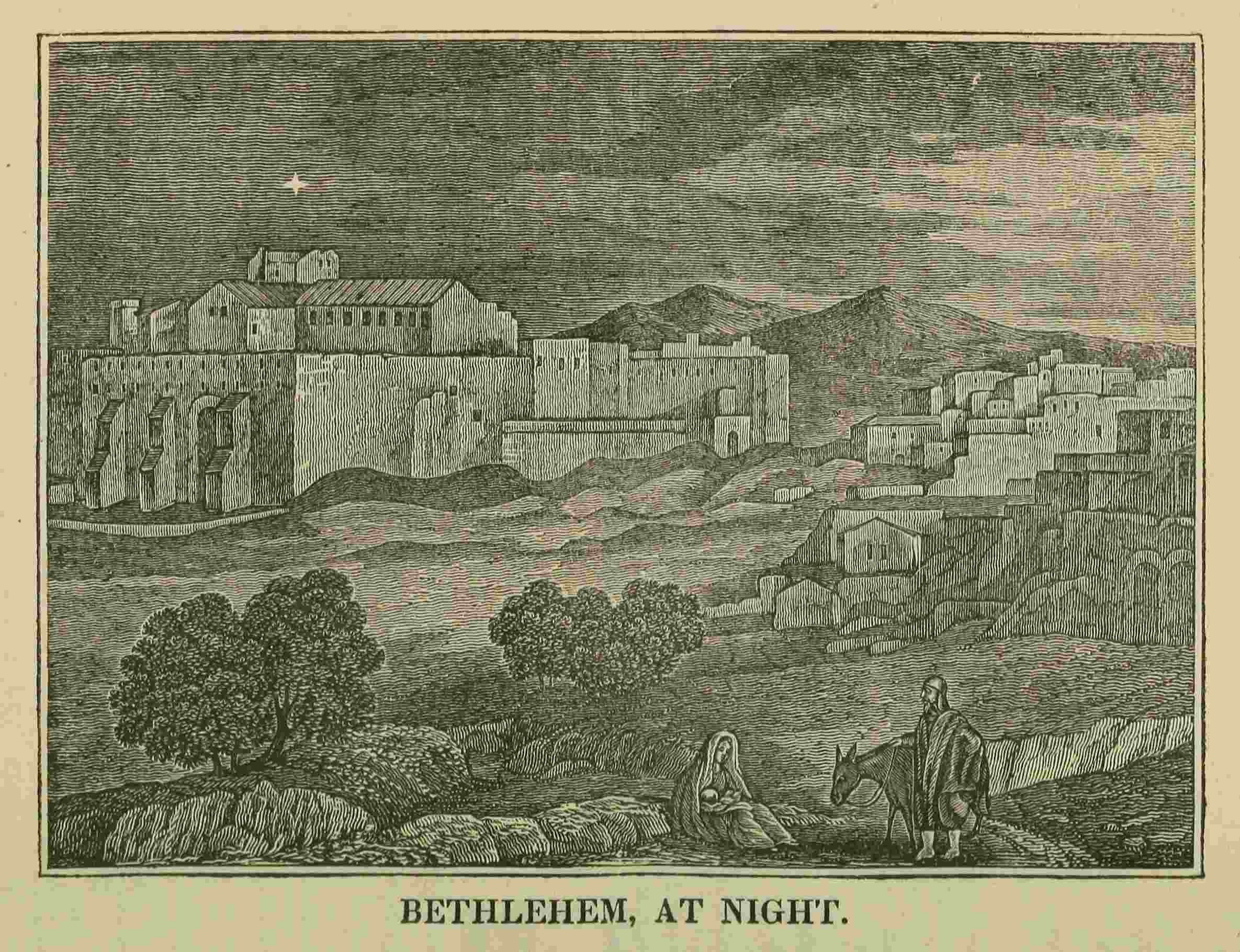
BETHLEHEM, AT NIGHT.
A third characteristic of the circumstances of those to whom this epistle is addressed, is, that they were obliged to be constantly on their guard against accusations, which would expose them to capital punishment. They were objects of scorn and obloquy, and were to expect to be dragged to trial as thieves, murderers, and as wretches conspiring secretly against the public peace and safety; and to all this they were liable in their character as Christians. The apostle, therefore, in deep solicitude for the dreadful condition and liabilities of his friends, warns those who, in spite of innocence, are thus made to suffer, to consider all their afflictions as in accordance with the wise will of God, and, in an upright course of conduct, to commit the keeping of their souls to him, as a faithful guardian, who would not allow the permanent injury of the souls which he had created. Now, not even a conjecture can be made, much less, any historical proof be brought, that beyond Palestine any person had ever yet been made to suffer death on the score of religion, or of any stigma attaching to that sect, before the time when Nero involved them in the cruel charge just mentioned. The date of the first instances of such persecutions was the eleventh year of the reign of Nero, under the consulships of Caius Lecanius Bassus, and Marcus Licinius Crassus, according to the Roman annals. The commencement of the burning of Rome, which was the occasion of this first attack on the Christians, was in the last part of the month of July; but the persecution did not begin immediately. After various contrivances to avert the indignation of the people from their imperial destroyer, the Christians were seized as a proper expiatory sacrifice, the choice being favored by the general dislike with which they were regarded. This attack being deferred for some time after the burning, could not have occurred till late in that year. The epistle cannot have been written before its occurrence, nor indeed until some time afterwards; because a few months must be allowed for the account of it to spread to the provinces of Asia, and it must have been still later when the news of the difficulty could reach the apostle, so as to enable him to appreciate the danger of those Christians who were under the dominion of the Romans. It is evident, then, that the epistle was not written in the same year in which the burning occurred; but in the subsequent one, the twelfth of Nero’s reign, and the sixty-fifth of the Christian era. By that time the condition and prospects of the Christians throughout the empire were such as to excite the deepest solicitude in the great apostle, who, though himself residing in the great Parthian empire, removed from all danger of injury from the Roman emperor, was by no means disposed to forget the high claims the sufferers had on him for counsel and consolation. This dreadful event was the most important which had ever yet befallen the Christians, and there would certainly be just occasion for surprise, if it had called forth no consolatory testimony from the founders of the faith, and if no trace of it could be found in the apostolic records.
Committing the keeping of their souls to God.――This view of the design of the epistle gives new force to this passage, (iv. 19.)
First mentioned in Roman history.――This is by Tacitus, (Annals xv. 44,) who thus speaks of them:――“Nero condendae urbis novae et cognomento suo appellandae gloriam quaerere, et sic jussum incendium credebatur. Ergo abolendo rumori subdidit reos, et quaesitissimis poenis affecit, quos per flagitia invisos, vulgus Christianos appellabat,” &c.――“It was believed that Nero, desirous of building the city anew, and of calling it by his surname, had thus caused its burning. To get rid of this general impression, therefore, he brought under this accusation, and visited with the most exquisite punishments, a set of persons, hateful for their crimes, commonly called Christians. The name was derived from Christus, who, in the reign of Tiberius, was seized and punished by Pontius Pilate, the procurator. The ruinous superstition, though checked for a while, broke out again, not only in Judea, the source of the evil, but also in the city, (Rome.) Therefore those who professed it were first seized, and then, on their confession, a great number of others were convicted, not so much on the charge of the arson, as on account of the universal hatred which existed against them. And their deaths were made amusing exhibitions, as, being covered with the skins of wild beasts, they were torn to pieces by dogs, or were nailed to crosses, or, being daubed with combustible stuff, were burned by way of light, in the darkness, after the close of day. Nero opened his own gardens for the show, and mingled with the lowest part of the throng, on the occasion.” (The description of the cruel manner in which they were burned, may serve as a forcible illustration of the meaning of “the fiery trial,” to which Peter alludes, iv. 12.) By Suetonius, also, they are briefly mentioned. (Nero, chapter 15.) “Afflicti suppliciis Christiani, genus hominum superstitionis novae et maleficae.”――“The Christians, a sort of men of a new and pernicious (evil doing) superstition, were visited with punishments.”
That this Neronian persecution was as extensive as is here made to appear, is proved by Lardner and Hug. The former in particular, gives several very interesting evidences, in his “Heathen testimonies,” especially the remarkable inscription referring to this persecution, found in Portugal. (Collection of Ancient Jewish and Heathen Testimonies, chapter iii.)
From the uniform tone in which the apostle alludes to the danger as threatening only his readers, without the slightest allusion to the circumstance of his being involved in the difficulty, is drawn another important confirmation of the locality of the epistle. He uniformly uses the second person when referring to trials, but if he himself had then been so situated as to share in the calamity for which he strove to prepare them, he would have been very apt to have expressed his own feelings in view of the common evil. Paul, in those epistles which were written under circumstances of personal distress, is very full of warm expressions of the state of mind in which he met his trials; nor was there in Peter any lack of the fervid energy that would burst forth in similarly eloquent sympathy, on the like occasions. But from Babylon, beyond the bounds of Roman sway, he looked on their sufferings only with that pure sympathy which his regard for his brethren would excite; and it is not to be wondered, then, that he uses the second person merely, in speaking of their distresses. The bearer of this epistle to the distressed Christians of Asia Minor, is named Silvanus, generally supposed to be the same with Silvanus or Silas, mentioned in Paul’s epistles, and in the Acts, as the companion of Paul in his journeys through some of those provinces to which Peter now wrote. There is great probability in this conjecture, nor is there anything that contradicts it in the slightest degree; and it may therefore be considered as true. Some other great object may at this time have required his presence among them, or he may have been then passing on his journey to rejoin Paul, thus executing this commission incidentally.
This view of the scope and contents of this epistle is taken from Hug, who seems to have originated it. At least I can find nothing of it in any other author whom I have consulted. Michaelis, for instance, though evidently apprehending the general tendency of the epistle, and its design to prepare its readers for the coming of some dreadful calamity, was not led thereby to the just apprehension of the historical circumstances therewith connected. (Hug, II. §§ 162‒165.――Michaelis Vol. IV. chapter xxvii. §§ 1‒7.)
THE SECOND EPISTLE.
After writing the former epistle to the Christians of Asia Minor, Peter probably continued to reside in Babylon, since no occurrence is mentioned which could draw him away, in his old age, from the retired but important field of labor to which he had previously confined himself. Still exercising a paternal watchfulness, however, over his distant disciples, his solicitude before long again excited him to address them in reference to their spiritual difficulties and necessities. The apprehensions expressed in the former epistle, respecting their maintenance of a pure faith in their complicated trials, had in the mean time proved well-grounded. During the distracting calamities of Nero’s persecution, false teachers had arisen, who had, by degrees, brought in pernicious heresies among them, affecting the very foundations of the faith, and ending in the most ruinous consequences to the belief and practice of some. This second epistle he wrote, therefore, to stir up those who were still pure in heart, to the remembrance of the true doctrines of Christianity, as taught by the apostles; and to warn them against the heretical notions that had so fatally spread among them. Of the errors complained of, the most important seems to have been the denial of the judgment, which had been prophesied so long. Solemnly re-assuring them of the certainty of that awful series of events, he exhorted them to the steady maintenance of such a holy conduct and godly life, as would fit them to meet the great change which he so sublimely pictured, whenever and however it should occur; and closed with a most solemn charge to beware lest they also should be led away by the error of the wicked, so as to fall from their former steadfast adherence to the truth. In the former part of the epistle he alluded affectingly to the nearness of his own end, as an especial reason for his urgency with those from whom he was so soon to be parted. “I think it meet as long as I am in this tabernacle, to stir you up to the remembrance of these things, knowing as I do that the putting off of my tabernacle is very near, according to what our Lord Jesus Christ made known to me.” This is an allusion to the prophecy of his Master at the meeting on the lake, after the resurrection, described in the last chapter of John’s gospel. “Therefore,” writes the aged apostle, “I will be urgent that you, after my departure, may always hold these things in your memory.” All which seems to imply an anticipated death, of which he was reminded by the course of natural decay, and by the remembrance of the parting prophecy of his Master, and not by anything very imminently dangerous or threatening in his external circumstances, at the time of writing. This was the last important work of his adventurous and devoted life; and his allusions to the solemn scenes of future judgment were therefore most solemnly appropriate. Those to whom he wrote could expect to see his face no more, and his whole epistle is in a strain accordant with these circumstances, dwelling particularly on the awful realities of a coming day of doom.
The first epistle of Peter has always been received as authentic, ever since the apostolic writings were first collected, nor has there ever been a single doubt expressed by any theologian, that it was what it pretended to be; but in regard to the epistle just mentioned as his second, and now commonly so received, there has been as much earnest discussion as concerning any other book in the sacred canon, excepting, perhaps, the epistle to the Hebrews and John’s Revelation. The weight of historical testimony is certainly rather against its authenticity, since all the early Fathers who explicitly mention it, speak of it as a work of very doubtful character. In the first list of the sacred writings that is recorded, this is not put among those generally acknowledged as of divine authority, but among those whose truth was disputed. Still, quotations from it are found in the writings of the Fathers, in the first, second and third centuries, by whom it is mentioned approvingly, although not specified as inspired or of divine authority. But even as late as the end of the fourth century there were still many who denied it to be Peter’s, on account of supposed differences of style observable between this and the former epistle, which was acknowledged to be his. The Syrian Christians continued to reject it from their canon for some time after; for in the old Syriac version, executed before A. D. 100, this alone, of all books supposed to have been written before that translation that are now considered a part of the New Testament, is not contained, though it was regarded by many among them as a good book, and is quoted in the writings of one of the Syrian Fathers, with respect. After this period, however, these objections were soon forgotten, and from the fifth century downwards, it has been universally adopted into the authentic canon, and regarded with that reverence which its internal evidences of truth and genuineness so amply justify. Indeed, it is on its internal evidence, almost entirely, that its great defense must be founded,――since the historical testimonies, (by common confession of theologians,) will not afford that satisfaction to the investigator, which is desirable on subjects of this nature; and though ancient usage and its long-established possession of a place in the inspired code may be called up in its support, still there will be occasion for the aid of internal reasons, to maintain a positive decision as to its authenticity. And this sort of evidence, an examination by the rigid standards of modern critical theology proves abundantly sufficient for the effort to which it is summoned; for though it has been said, that since the ancients themselves were in doubt, the moderns cannot expect to arrive at certainty, because it is impossible to get more historical information on the subject, in the nineteenth century, than ecclesiastical writers had within reach in the third and fourth centuries; still, when the question of the authenticity of the work is to be decided by an examination of its contents, the means of ascertaining the truth are by no means proportioned to the antiquity of the criticism. In the early ages of Christianity, the science of faithfully investigating truth hardly had an existence; and such has been the progress of improvement in this department of knowledge, under the labors of modern theologians, that the writers of the nineteenth century may justly be considered as possessed of far more extensive and certain means of settling the character of this epistle by internal evidence, than were within the knowledge of those Christian fathers who lived fourteen hundred years ago. The great objection against the epistle in the fourth century, was an alleged dissimilarity of style between this and the former epistle. Now, there can be no doubt whatever that modern Biblical scholars have vastly greater means for judging of a rhetorical question of this kind, than the Christian fathers of the fourth century, of whom those who were Grecians were really less scientifically acquainted with their own language, and no more qualified for a comparison of this kind, than those who live in an age when the principles of criticism are so much better understood. With all these superior lights, the results of the most accurate modern investigations have been decidedly favorable to the authenticity of the second epistle ascribed to Peter, and the most rigid comparisons of its style with that of the former, have brought out proofs triumphantly satisfactory of its identity of origin with that,――proofs so much the more unquestionable, as they are borrowed from coincidences which must have been entirely natural and incidental, and not the result of any deliberate collusion.
This account of the second epistle is also taken from Hug and Michaelis, to whom, with Lardner, reference may be made for the details of all the arguments for and against its authenticity.
As to the place and time of writing this epistle, it seems quite probable that it was written where the former one was, since there is no account or hint whatever of any change in Peter’s external circumstances; and that it was written some months after it, is unquestionable, since its whole tenor requires such a period to have intervened, as would allow the first to reach them and be read by them, and also for the apostle to learn in the course of time the effects ultimately produced by it, and to hear of the rise of new difficulties, requiring new apostolical interference and counsel. The first seems to have been directed mainly to those who were complete Jews, by birth or by proselytism, as appears from the terms in which he repeatedly addresses them in it; but the sort of errors complained of in this epistle seem to have been so exclusively characteristic of Gentile converts, that it must have been written more particularly with reference to difficulties in that part of the religious communities of those regions. He condemns and refutes certain heretics who rejected some of the fundamental truths of the Mosaic law,――errors which no well-trained Jew could ever be supposed to make, but which in motley assemblages of different races, like the Christian churches, might naturally enough arise among those Gentiles, who felt impatient at the inferiority in which they seemed implicated by their ignorance of the doctrines of the Jewish theology, in which their circumcised brethren were so fully versed. It seems to have been more especially aimed at the rising sect of the Gnostics, who are known to have been heretical on some of the very points here alluded to. Its great similarity, in some passages, to the epistle of Jude, will make it the subject of allusion again in the life of that apostle.
HIS DEATH.
Henceforth the writings of the New Testament are entirely silent as to the chief apostle. Not a hint is given of the few remaining actions of his life, nor of the mode, place, or time of his death; and all these concluding points have been left to be settled by conjecture, or by tradition as baseless. The only passage which has been supposed to give any hint of the manner of his death, is that in the last chapter of John’s gospel. “Jesus says to him――‘I most solemnly tell thee, when thou wast young, thou didst gird thyself and walk whither thou wouldst; but when thou shalt be old, another shall gird thee, and carry thee whither thou wouldst not.’ This he said, to make known by what sort of death he should glorify God.” It has been commonly said that this is a distinct and unquestionable prophecy that he should in his old age be crucified,――the expression, “another shall gird thee and carry thee whither thou wouldst not,” referring to his being bound to the cross and borne away to execution, since this was the only sort of death by which an apostle could be said, with much propriety or force, to glorify God. And the long-established authority of tradition coinciding with this view, or rather, suggesting it, no very minute examination into the sense of the passage has ever been made. But the words themselves are by no means decisive. Take a common reader, who has never heard that Peter was crucified, and it would be hard for him to make out such a circumstance from the bare prophecy as given by John. Indeed, such unbiased impressions of the sense of the passage will go far to justify the conclusion that the words imply nothing but that Peter was destined to pass a long life in the service of his Master,――that he should after having worn out his bodily and mental energies in his devoted exertions, attain such an extreme decrepid old age as to lose the power of voluntary motion, and die thus,――at least without necessarily implying any bloody martyrdom. Will it be said that by such a quiet death he could not be considered as glorifying God? The objection surely is founded in a misapprehension of the nature of those demonstrations of devotion, by which the glory of God is most effectually secured. There are other modes of martyrdom than the dungeon, the sword, the axe, the flame, and the stone; and in all ages since Peter, there have been thousands of martyrs who have, by lives steadily and quietly devoted to the cause of truth, no less glorified God, than those who were rapt to heaven in flame, in blood, and in tortures inflicted by a malignant persecution. Was not God truly glorified in the deaths of the aged Xavier, and Eliot, and Swartz, or the bright, early exits of Brainerd, Mills, Martyn, Parsons, Fisk, and hundreds whom the apostolic spirit of modern missions has sent forth to labors as devoted, and to deaths as glorious to God, as those of any who swell the deified lists of the ancient martyrologies? The whole notion of a bloody martyrdom as an essential termination to the life of a saint, grew out of a papistical superstition; nor need the enlightened minds of those who can better appreciate the manner in which God’s highest glory is secured by the lives and deaths of his servants, seek any such superfluous aids to crown the mighty course of the great apostolic chief, whose solid claims to the name and honors of Martyr rest on higher grounds than so insignificant an accident as the manner of his death. All those writers who pretend to particularize the mode of his departure, connect it also with the utterly impossible fiction of his residence at Rome, on which enough has been already said. Who will undertake to say, out of such a mass of matters, what is truth and what is falsehood? And if the views above given, on the high authority of the latest writers of even the Romish church, are of any value for any purpose whatever, they are perfectly decisive against the notion of Peter’s martyrdom at Rome, in the persecution under Nero, since Peter was then in Babylon, far beyond the vengeance of the Caesar; nor was he so foolish as ever after to have trusted himself in the reach of a perfectly unnecessary danger. The command of Christ was, “When you are persecuted in one city, flee into another,”――the necessary and unquestionable inference from which, was, that when out of the reach of persecution they should not wilfully go into it. This is a simple principle of Christian action, with which papist fable-mongers were totally unacquainted, and they thereby afford the most satisfactory proof of the utter falsity of the actions and motives which they ascribe to the apostles. One of these stories thus disproved is connected with another adventure with that useful character, Simon Magus, who, as the tale runs, after being first vanquished so thoroughly by Peter in the reign of Claudius, returned to Rome, in the reign of Nero, and made such progress again in his magical tricks, as to rise into the highest favor with this emperor, as he had with the former. This of course required a new effort from Peter, which ended in the disgrace and death of the magician, who, attempting to fly through the air in the presence of the emperor and people in the theater, was by the prayer of Peter caused to fall from his aspiring course, to the ground, by which he was so much injured as to die soon after. The emperor being provoked at the loss of his favorite, turned all his wrath against the apostle who had been directly instrumental in his ruin, and imprisoned him with the design of executing him as soon as might be convenient. While in these circumstances, or as others say, before he was imprisoned, he was earnestly exhorted by the disciples in Rome, to make his escape. He accordingly, though very desirous of being killed, (a most abominably irreligious wish, by the way,) began to move off, one dark night; but had hardly got beyond the walls of the city,――indeed he was just passing out of the gate-way,――when, whom should he meet but Jesus Christ himself, coming towards Rome. Peter asked, with some reasonable surprise, “Lord! where are you going?” Christ answered, “I am coming to Rome, to be crucified again.” Peter at once took this as a hint that he ought to have stayed, and that Christ meant to be crucified again in the crucifixion of his apostle. He accordingly turned right about, and went back into the city, where, having given to the wondering brethren an account of the reasons of his return, he was immediately seized, and was crucified, to the glory of God. Now it is a sufficient answer to this or any similar fable, to judge the blasphemous inventor out of his own mouth, and out of the instructions given by Christ himself to his servants, for their conduct, in all cases where they were threatened with persecution, as above quoted.
Referring to his being bound to the cross.――Tertullian seems to have first suggested this rather whimsical interpretation:――“Tunc Petrus ab altero cingitur, quum cruci adstringitur.” (Tertullian, Scorpiace, 15.) There seems to be more rhyme than reason in the sentence, however.
The rejection of this forced interpretation is by no means a new notion. The critical Tremellius long ago maintained that the verse had no reference whatever to a prophecy of Peter’s crucifixion, though he probably had no idea of denying that Peter did actually die by crucifixion. Among more modern commentators too, the prince of critics, Kuinoel, with whom are quoted Semler, Gurlitt and Schott, utterly deny that a fair construction of the original will allow any prophetical idea to be based on it. The critical testimony of these great commentators on the true and just force of the words, is of the very highest value; because all received the tale of Peter’s crucifixion as true, having never examined the authority of the tradition, and not one of them pretended to deny that he really was crucified. But in spite of this pre-conceived erroneous historical notion, their nice sense of what was grammatically and critically just, would not allow them to pervert the passage to the support of this long-established view; and they therefore pronounce it as merely expressive of the helplessness and imbecility of extreme old age, with which they make every word coincide. But Bloomfield, entirely carried away with the tide of antique authorities, is “surprised that so many recent commentators should deny that crucifixion is here alluded to, though they acknowledge that Peter suffered crucifixion.” Now this last circumstance might well occasion surprise, as it certainly did in me, when I found what mighty names had so disinterestedly supported the interpretation which I had with fear and trembling adopted, in obedience to my own long-established, unaided convictions; but my surprise was of a decidedly agreeable sort.
The inventors of fables go on to give us the minute particulars of Peter’s death, and especially note the circumstance that he was crucified with his head downwards and his feet uppermost, he himself having desired that it might be done in that manner, because he thought himself unworthy to be crucified as his Master was. This was a mode sometimes adopted by the Romans, as an additional pain and ignominy. But Peter must have been singularly accommodating to his persecutors, to have suggested this improvement upon his tortures to his malignant murderers; and must have manifested a spirit more accordant with that of a savage defying his enemies to increase his agonies, than with that of the mild, submissive Jesus. And such has been the evident absurdity of the story, that many of the most ardent receivers of fables have rejected this circumstance as improbable, more especially as it is not found among the earliest stories of his crucifixion, but evidently seems to have been appended among later improvements.
PETER’S MARTYRDOM.
The only authority which can be esteemed worthy of consideration on this point, is that of Clemens Romanus, who, in the latter part of the first century, (about the year 70, or as others say, 96,) in his epistle to the Corinthians, uses these words respecting Peter:――“Peter, on account of unrighteous hatred, underwent not one, or two, but many labors, and having thus borne his testimony, departed to the place of glory, which was his due,”――(ὁυτως μαρτυρησας επορευθη εις τον οφειλομενον τοπον δοξης.) Now it is by no means certain that the prominent word (marturesas) necessarily means “bearing testimony by death,” or martyrdom in the modern sense. The primary sense of this verb is merely “to witness,” in which simple meaning alone, it is used in the New Testament; nor can any passage in the sacred writings be shown, in which this verb means “to bear witness to any cause, by death.” This was a technical sense, (if I may so name it,) which the word at last acquired among the Fathers, when they were speaking of those who bore witness to the truth of the gospel of Christ by their blood; and it was a meaning which at last nearly excluded all the true original senses of the verb, limiting it mainly to the notion of a death by persecution for the sake of Christ. Thence our English words, martyr and martyrdom. But that Clement by this use of the word, in this connection, meant to convey the idea of Peter’s having been killed for the sake of Christ, is an opinion utterly incapable of proof, and moreover rendered improbable by the words joined to it in the passage. The sentence is, “Peter underwent many labors, and having thus borne witness” to the gospel truth, “went to the place of glory which he deserved.” Now the adverb “thus,” (ὁυτως,) seems to me most distinctly to show what was the nature of this testimony, and the manner also in which he bore it. It points out more plainly than any other words could, the fact that his testimony to the truth of the gospel was borne in the zealous labors of a devoted life, and not by the agonies of a bloody death. There is not in the whole context, nor in all the writings of Clement, any hint whatever that Peter was killed for the sake of the gospel; and we are therefore required by every sound rule of interpretation, to stick to the primary sense of the verb, in this passage. Lardner most decidedly mis-translates it in the text of his work, so that any common reader would be grossly deceived as to the expression in the original of Clement,――“Peter underwent many labors, till at last being martyred, he went,” &c. The Greek word, ὁυτως, (houtos,) means always, “in this manner,” “thus,” “so,” and is not a mere expletive, like the English phrase, “and so,” which is a mere form of transition from one part of the narrative to the other.
In the similar passage of Clemens which refers to Paul, there is something in the connection which may seem to favor the conclusion that he understood Paul to have been put to death by the Roman officers. His words are,――“and after having borne his testimony before governors, he was thus sent out of the world,” &c. Here the word “thus,” coming after the participle, may perhaps be considered, in view also of its other connections, as implying his removal from the world by a violent death, in consequence of the testimony borne by him before the governors. This however, will bear some dispute, and will have a fuller discussion elsewhere.
But in respect to the passage which refers to Peter, the burden of proof may fairly be said to lie on those who maintain the old opinion. Here the word is shown to have, in the New Testament, no such application to death as it has since acquired; and the question is whether Clemens Romanus, a man himself of the apostolic age, who lived and perhaps wrote, before the canon was completed, had already learned to give a new meaning to a verb, before so simple and unlimited in its applications. No person can pretend to trace this meaning to within a century of the Clementine age, nor does Suicer refer to any one who knew of such use before Clement of Alexandria (See his Thesaurus; Μαρτυρ.) Clement himself uses it in the same epistle (§ xvii.) in its unquestionable primary sense, speaking of Abraham as having received an honorable testimony,――(εμαρτυρηθη;) for who will say that Abraham was martyred, in the modern sense? The fact too that Clement nowhere else gives the least glimmer of a hint that Peter died any where but in his bed, fixes the position here taken, beyond all possibility of attack, except by its being shown that he uses this verb somewhere else, with the sense of death unquestionably attached to it.
There is no other early writer who can be said to speak of the manner of Peter’s death, before Dionysius of Corinth, who says that “Peter and Paul having taught in Italy together, bore their testimony” (by death, if you please,) “about the same time.” An argument might here also be sustained on the word εμαρτυρησαν, (emarturesan,) but the evidence of Dionysius, mixed as it is with a demonstrated fable, is not worth a verbal criticism. The same may be said of Tertullian and the rest of the later Fathers, as given in the note on pages 228‒233.
An examination of the word Μαρτυρ, in Suicer’s Thesaurus Ecclesiasticus, will show the critical, that even in later times, this word did not necessarily imply “one who bore his testimony to the truth at the sacrifice of life.” Even Chrysostom, in whose time the peculiar limitation of the term might be supposed to be very well established, uses the word in such applications as to show that its original force was not wholly lost. By Athanasius too, Shadrach, Meshach and Abed-nego are styled martyrs. Gregory Nazianzen also speaks of “living martyrs.” (ζωντες μαρτυρες.) Theophylact calls the apostle John a martyr, though he declares him to have passed through the hands of his persecutors unhurt, and to have died by the course of nature. Clemens Alexandrinus has similar uses of the term; and the Apostolical Constitutions, of doubtful date, but much later than the first century, also give it in such applications. Suicer distinctly specifies several classes of persons, not martyrs in the modern sense, to whom the Greek word is nevertheless applied in the writings of even the later Fathers; as “those who testified the truth of the gospel of Christ, at the peril of life merely, without the loss of it,”――“those who obeyed the requirements of the gospel, by restraining passion,” &c. In some of these instances however, it is palpable that the application of the word to such persons is secondary, and made in rather a poetical way, with a reference to the more common meaning of loss of life for the sake of Christ, since there is always implied a testimony at the risk or loss of something; still the power of these instances to render doubtful the meaning of the term, is unquestionable. (See Suicer’s Thesaurus Ecclesiasticus, Μαρτυρ, III. 2, 5, 6.)
Perhaps it is hardly worth while to dismiss these fables altogether, without first alluding to the rather ancient one, first given by Clemens Alexandrinus. (Stromata, 7. p. 736.) and copied verbatim by Eusebius, (Church History, III. 30.) Both the reverend Fathers however, introduce the story as a tradition, a mere on dit, prefacing it with the expressive phrase, “They say,” &c. (Φασι.) “The blessed Peter seeing his wife led to death, was pleased with the honor of her being thus called by God to return home, and thus addressed her in words of exhortation and consolation, calling her by name,――‘O woman! remember the Lord.’” The story comes up from the hands of tradition rather too late however, to be entitled to any credit whatever, being recorded by Clemens Alexandrinus, full 200 years after Christ. It was probably invented in the times when it was thought worth while to cherish the spirit of voluntary martyrdom, among even the female sex; for which purpose instances were sought out or invented respecting those of the apostolic days. That Peter had a wife is perfectly true; and it is also probable that she accompanied him about on his travels, as would appear from a passage in Paul’s writings; (1 Corinthians ix. 5;) but beyond this, nothing is known of her life or death. Similar fables might be endlessly multiplied from papistical sources; more especially from the Clementine novels, and the apostolical romances of Abdias Babylonius; but the object of the present work is true history, and it would require a whole volume like this to give all the details of Christian mythology.
In justification of the certainty with which sentence is pronounced against the whole story of Peter’s ever having gone to Rome, it is only necessary to refer to the decisive argument on pages 228‒233, in which the whole array of ancient evidence on the point, is given by Dr. Murdock. If the support of great names is needed, those of Scaliger, Salmasius, Spanheim, and Bower, all mighty minds in criticism, are enough to justify the boldness of the opinion, that Peter never went west of the Hellespont, and probably never embarked on the Mediterranean. In conclusion of the whole refutation of this long-established error, the matter cannot be more fairly presented, than in the words with which the critical and learned Bower opens his Lives of the Popes:
“To avoid being imposed upon, we ought to treat tradition as we do a notorious and known liar, to whom we give no credit unless what he says is confirmed to us by some person of undoubted veracity. If it is affirmed by him alone, we can at most but suspend our belief, not rejecting it as false, because a liar may sometimes speak truth; but we cannot, upon his bare authority, admit it as true. Now that St. Peter was at Rome, that he was bishop of Rome, we are told by tradition alone, which, at the same time tells us of so many strange circumstances attending his coming to that metropolis, his staying in it, his withdrawing from it, &c., that in the opinion of every unprejudiced man, the whole must savor strongly of romance. Thus we are told that St. Peter went to Rome chiefly to oppose Simon, the celebrated magician; that at their first interview, at which Nero himself was present, he flew up into the air, in the sight of the emperor and the whole city; but that the devil, who had thus raised him, struck with dread and terror at the name of Jesus, whom the apostle invoked, let him fall to the ground, by which fall he broke his legs. Should you question the truth of this tradition at Rome, they would show you the prints of St. Peter’s knees in the stone, on which he kneeled on this occasion, and another stone still dyed with the blood of the magician. (This account seems to have been borrowed from Suetonius, who speaks of a person that, in the public sports, undertook to fly, in the presence of the emperor Nero; but on his first attempt, fell to the ground; by which fall his blood sprung out with such violence that it reached the emperor’s canopy.)
“The Romans, as we are told, highly incensed against him for thus maiming and bringing to disgrace one to whom they paid divine honors, vowed his destruction; whereupon the apostle thought it advisable to retire for a while from the city, and had already reached the gate, when to his great surprise, he met our Savior coming in, as he went out, who, upon St. Peter’s asking him where he was going, returned this answer: ‘I am going to Rome, to be crucified anew;’ which, as St. Peter understood it, was upbraiding him with his flight; whereupon he turned back, and was soon after seized by the provoked Romans, and, by an order from the emperor, crucified.”
Nor do the fables about Peter, by the inveterate papists, cease with his death. In regard to the place of his tomb, a new story was needed, and it is accordingly given with the usual particularity. It is said that he was buried at Rome in the Vatican plain, in the district beyond the Tiber, in which he was said to have first preached among the Jews, and where stood the great circus of Nero, in which the apostle is said to have been crucified. Over this bloody spot, a church was afterwards raised, by Constantine the Great, who chose for its site part of the ground that had been occupied by the circus, and the spaces where the temples of Mars and Apollo had stood. The church, though of no great architectural beauty, was a building of great magnitude, being three hundred feet long, and more than one hundred and fifty feet wide. This building stood nearly twelve hundred years, when becoming ruinous in spite of all repairs, it was removed to give place to the present cathedral church of St. Peter, now the most immense and magnificent building in the world,――not too much praised in the graphic verse in which the pilgrim-poet sets it beyond all comparison with the greatest piles of ancient or modern art:
“But lo! the dome! the vast and wondrous dome,
To which Diana’s marvel was a cell;――
Christ’s mighty shrine above his martyr’s tomb.――
I have beheld the Ephesians’ miracle,
Its columns strew the wilderness, and dwell
The hyena and the jackall in their shade.
I have beheld Sophia’s bright roofs swell
Their glittering mass in the sun, and have surveyed
Its sanctuary, while the usurping Moslem prayed.
“But thou, of temples old, or altars new,
Standest alone, with nothing like to thee.
Worthiest of God, the holy and the true!
Since Zion’s desolation, when that He
Forsook his former city, what could be
Of earthly structures in his honor piled,
Of a sublimer aspect?”――
Within the most holy place of this vast sanctuary,――beneath the very center of that wonderful dome, which rises in such unequaled vastness above it, redounding far more to the glory of the man who reared it, than of the God whose altar it covers,――in the vaulted crypt which lies below the pavement, is a shrine, before which a hundred lamps are constantly burning, and over which the prayers of thousands are daily rising. This is called the tomb of the saint to whom the whole pile is dedicated, and from whom the great high priest of that temple draws his claim to the keys of the kingdom of heaven, with the power to bind and loose, and the assurance of heaven’s sanction on his decrees. But what a contrast is all this “pride, pomp and circumstance,” to the bare purity of the faith and character of the simple man whose life and conduct are recorded on these pages! If any thing whatever may be drawn as a well-authorized conclusion from the details that have been given of his actions and motives, it is that Simon Peter was a “plain, blunt” man, laboring devotedly for the object to which he had been called by Jesus, and with no other view whatever, than the advancement of the kingdom of his Master,――the inculcation of a pure spiritual faith, which should seek no support, nor the slightest aid, from the circumstances which charm the eye and ear, and win the soul through the mere delight impressed upon the senses, as the idolatrous priests who now claim his name and ashes, maintain their dominion in the hearts of millions of worse than pagan worshipers. His whole life and labors were pointed at the very extirpation of forms and ceremonies,――the erection of a pure, rational, spiritual dominion in the hearts of mankind, so that the blessings of a glorious faith, which for two thousand years before had been confined to the limits of a ceremonial system, might now, disenthralled from all the bonds of sense, and exalted above the details of tedious forms, of natural distinctions, and of antique rituals,――spread over a field as wide as humanity. For this he lived and toiled, and in the clear hope of a triumphant fulfilment of that plan, he died. And if, from his forgotten, unknown grave, among the ashes of the Chaldean Babylon, and from the holy rest which is for the blessed, the now glorified apostle could be called to the renewal of breathing, earthly life, and see the results of his energetic, simple-minded devotion,――what wonder, what joy, what grief, what glory, what shame, would not the revelation of these mighty changes move within him! The simple, pure gospel which he had preached in humble, faithful obedience to the divine command, without a thought of glory or reward, now exalted in the idolatrous reverence of hundreds of millions,――but where appreciated in its simplicity and truth? The cross on which his Master was doomed to ignominy, now exalted as the sign of salvation, and the seal of God’s love to the world!――(a spectacle as strange to a Roman or Jewish eye, as to a modern would be the gallows, similarly consecrated,) but who burning with that devotion which led him of old to bear that shameful burden? His own humble name raised to a place above the brightest of Roman, of Grecian, of Hebrew, or Chaldean story! but made, alas! the supporter of a tyranny over souls, far more grinding and remorseless than any which he labored to overthrow. The fabled spot of his grave, housed in a temple to which the noblest shrine of ancient heathenism “was but a cell!” but in which are celebrated, under the sanction of his sainted name, the rites of an idolatry, than which that of Rome, or Greece, or Egypt would seem more spiritual,――and of tedious, unmeaning ceremonies, compared with which the whole formalities of the Levitical ritual might be pronounced simple and practical!
These would be the first sights that would meet the eye of the disentombed apostle, if he should rise over the spot which claims the honors of his martyr-tomb, and the consecration of his commission. How mournfully would he turn from all the mighty honors of that idolatrous worship,――from the deified glories of that sublimest of shrines that ever rose over the earth! How earnestly would he long for the high temple of one humble, pure heart, that knew and felt the simplicity of the truth as it was in Jesus! How joyfully would he hail the manifestations of that active evangelizing spirit that consecrated and fitted him for his great missionary enterprise! His amazed and grieved soul would doubtless here and there feel its new view rewarded, in the sight of much that was accordant with the holy feeling that inspired the apostolic band. All over Christendom, might he find scattered the occasional lights of a purer devotion, and on many lands he would see the truth pouring, in something of the clear splendor for which he hoped and labored. But of the countless souls that owned Jesus as Lord and Savior, millions on millions,――and vast numbers too, even in the lands of a reformed faith,――would be found still clinging to the vain support of forms, and names, and observances,――and but a few, a precious few, who had learned what that means――“I will have mercy and not sacrifice”――works and not words,――deeds and not creeds,――high, simple, active, energetic, enterprising devotion, and not cloistered reverence,――chanceled worship,――or soul-wearying rituals. Would not the apostle, sickened with the revelations of such a resurrection, and more appalled than delighted, call on the power that brought him up from the peaceful rest of the blessed, to give him again the calm repose of those who die in the Lord, rather than the idolatrous honors of such an apotheosis, or the strange sight of the results of such an evangelization?――“Let me enter again the gates of Hades, but not the portals of these temples of superstition. Let me lie down with the souls of the humble, but not in the shrine of this heathenish pile. Leave me once more to rest from my labors, with my works still following; and call me not from this repose till the labors I left on earth unachieved, have been better done. We did not follow these cunningly-devised fables, when we made known to men the power and coming of our Lord Jesus Christ, but the simple eye-witness story of his majesty. We had a surer word of prophecy; and well would it have been, if these had turned their wandering eyes to it, as to a light shining in a dark place, and kept that steady beacon in view, through the stormy gloom of ages, until the day dawn and the day-star arise in their hearts. These are not the new heavens and the new earth, wherein dwelleth righteousness, for which we looked, according to God’s promise. Those must the faithful still look for, believing that Jehovah, with whom a thousand years are as one day, is not slack concerning his promise, but desires all to come to repentance, and will come himself at last in the achievment of our labors. Then call me.”
What a life was this! Its early recorded events found him a poor fisherman, in a rude, despised province, toiling day by day in a low, laborious business,――living with hardly a hope above the beasts that perish. By the side of that lake, one morning, walked a stranger, who, with mild words but wondrous deeds, called the poor fisherman to leave all, and follow him. Won by the commanding promise of the call, he obeyed, and followed that new Master, with high hopes of earthly glory for a while, which at last were darkened and crushed in the gradual developments of a far deeper plan than his rude mind could at first have appreciated. But still he followed him, through toils and sorrows, through revelations and trials, at last to the sight of his bloody cross; and followed him, still unchanged in heart, basely and almost hopelessly wicked. The fairest trial of his virtue proved him after all, lazy, bloody-minded, but cowardly,――lying, and utterly faithless in the promise of new life from the grave. But a change came over him. He, so lately a cowardly disowner of his Master’s name, now, with a courageous martyr-spirit dared the wrath of the awful magnates of his nation, in attesting his faith in Christ. Once a fierce, brawling, ear-cutting Galilean,――henceforth he lived an unresisting subject of abuse, stripes, bonds, imprisonment and threatened death. When was there ever such a triumph of grace in the heart of man? The conversion of Paul himself could not be compared with it, as a moral miracle. The apostle of Tarsus was a refined, well-educated man, brought up in the great college of the Jewish law, theology and literature, and not wholly unacquainted with the Grecian writers. The power of a high spiritual faith over such a mind, however steeled by prejudice, was not so wonderful as its renovating, refining and elevating influence on the rude fisherman of Bethsaida. Paul was a man of considerable natural genius, and he shows it on every page of his writings; but in Peter there are seen few evidences of a mind naturally exalted, and the whole tenor of his words and actions seems to imply a character of sound common sense, and great energy, but of perceptions and powers of expression, great, not so much by inborn genius, as by the impulse of a higher spirit within him, gradually bringing him to the possession of new faculties,――intellectual as well as moral. This was the spirit which raised him from the humble task of a fisherman, to that of drawing men and nations within the compass of the gospel, and to a glory which not all the gods of ancient superstition ever attained.
Most empty honors! Why hew down the marble mountains, and rear them into walls as massive and as lasting? Why raise the solemn arches and the lofty towers to overtop the everlasting hills with their heavenward heads? Or lift the skiey dome into the middle heaven, almost outswelling the blue vault itself? Why task the soul of art for new creations to line the long-drawn aisles, and gem the fretted roof? There is a glory that shall outlast all
“The cloud-capped towers,――the gorgeous palaces,
The solemn temples,――the great globe itself,――
Yea all which it inherit;”
――a glory far beyond the brightest things of earth in its brightest day; for “they that be wise shall shine as the firmament, and they that turn many to righteousness as the stars, for ever and ever.” Yet in this the apostle rejoices not;――not that adoring millions lift his name in prayers, and thanksgivings, and songs, and incense, from the noblest piles of man’s creation, to the glory of a God,――not even that over all the earth, in all ages, till the perpetual hills shall bow with time,――till “eternity grows gray,” the pure in heart will yield him the highest human honors of the faith, on which nations, continents and worlds hang their hopes of salvation;――he “rejoices not that the spirits” of angels or men “are subject to him,――but that HIS NAME IS WRITTEN IN HEAVEN.”
ANDREW.
HIS AUTHENTIC HISTORY.
The name of this apostle is here brought in directly after his eminent brother, in accordance with the lists of the apostles given by Matthew and Luke, in their gospels, where they seem to dispose them all in pairs; and very naturally, in this case, prefer family affinity as a principle of arrangement, putting together in this and the following instances, those who were sons of the same father. The most eminent son of Jonah, deservedly taking the highest place on all the lists, his brother might very properly so far share in the honors of this distinction, as to be mentioned along with him, without any necessary implication of the possession of any of that moral and intellectual superiority, on which Peter’s claim to the first place was grounded. These seem, at least, to have been sufficient reasons for Matthew, in arranging the apostles, and for Luke in his gospel; while in his history of the Acts of the Apostles he followed a different plan, putting Andrew fourth on the list, and giving the sons of Zebedee a place before him, as Mark did also. The uniform manner in which James and John are mentioned along with Peter on great occasions, to the total neglect of Andrew, seems to imply that this apostle was quite behind his brother in those excellences which fitted him for the leading place in the great Christian enterprise; since it is most reasonable to believe that, if he had possessed faculties of such a high order, he would have been readily selected to enjoy with him the peculiar privileges of a most intimate personal intercourse with Jesus, and to share the high honors of his peculiar revelations of glory and power.
The question of the relative age of the two sons of Jonah, has been already settled in the beginning of the life of Peter; and in the same part of the work have also been given all the particulars about their family, rank, residence, and occupation, which are desirable for the illustration of the lives and characters of both. So too, throughout the whole of the sacred narrative, everything that could concern Andrew has been abundantly expressed and commented on, in the life of Peter. The occasions on which the name of this apostle is mentioned in the New Testament, indeed, except in the bare enumeration of the twelve, are only three,――his first introduction to Jesus,――his actual call,――and the circumstance of his being present with his brother and the sons of Zebedee, at the scene on the mount of Olives, when Christ foretold the utter ruin of the temple. Of these three scenes, in the first only did he perform such a part, as to receive any other than a bare mention in the gospel history; nor even in that solitary circumstance does his conduct seem to have been of much importance, except as leading his brother to the knowledge of Jesus. From this circumstance, however, of his being specified as the first of all the twelve who had a personal acquaintance with Jesus, he has been honored by many writers with the distinguishing title of “THE FIRST CALLED,” although others have claimed the dignity of this appellation for another apostle, in whose life the particular reasons for such a claim will be mentioned.
The first called.――In Greek πρωτοκλητος, (protokletos,) by which name he is called by Nicephorus Callistus, (Church History, II. 39,) and by several of the Greek Fathers, as quoted by Cangius, (Gloss. in voc.) Suicer, however, makes no reference whatever to this term.
From the minute narrative of the circumstances of the call, given by John in the first chapter of his gospel, it appears, that Andrew, excited by the fame of the great Baptizer, had left his home at Bethsaida, and gone to Bethabara, (on the same side of the Jordan, but farther south,) where the solemn and ardent appeals of the bold herald of inspiration so far equalled the expectation awakened by rumor, that, along with vast multitudes who seem to have made but an indifferent progress in religious knowledge, though brought to the repentance and confession of their sins, he was baptized in the Jordan, and was also attached to the person of the great preacher in a peculiar manner, as it would seem, aiming at a still more advanced state of indoctrination, than ordinary converts could be expected to attain. While in this diligent personal attendance on his new Master, he was one day standing with him upon the banks of the Jordan, the great scene of the mystic sacrament, listening to the incidental instructions which fell from the lips of the holy man, in company with another disciple, his countryman and friend. In the midst of the conversation, perhaps, while discoursing upon the deep question then in agitation, about the advent of the Messiah, suddenly the great preacher exclaimed, “Behold the Lamb of God!” The two disciples at once turned their eyes towards the person thus solemnly designated as the Messiah, and saw walking by them, a stranger, whose demeanor was such as to mark him for the object of the Baptizer’s apostrophe. With one accord, the two hearers at once left the teacher, who had now referred them to a higher source of truth and purity, and both followed together the footsteps of the wonderful stranger, of whose real character they knew nothing, though their curiosity must have been most highly excited, by the solemn mystery of the words in which his greatness was announced. As they hurried after him, the sound of their hasty feet fell on the ear of the retiring stranger, who, turning towards his inquiring pursuers, mildly met their curious glances with the question, “Whom seek ye?”――thus giving them an opportunity to state their wishes for his acquaintance. They eagerly answered by the question, implying their desire for a permanent knowledge of him,――“Rabbi! (Master,) where dwellest thou?” He kindly answered them with a polite invitation to accompany him to his lodgings; for there is no reason to believe that they went with him to his permanent home in Capernaum or Nazareth; since Jesus was probably then staying at some place near the scene of the baptism. Being hospitably and familiarly entertained by Jesus, as his intimate friends, it being then four o’clock in the afternoon, they remained with him till the next day, enjoying a direct personal intercourse, which gave them the best opportunities for learning his character and his power to impart to them the high instructions which they were prepared to expect, by the solemn annunciation of the great Baptizer; and at the same time it shows their own earnestness and zeal for acquiring a knowledge of the Messiah, as well as his benignant familiarity in thus receiving them immediately into such a domestication with him. After this protracted interview with Jesus, Andrew seems to have attained the most perfect conviction that his newly adopted teacher was all that he had been declared to be; and in the eagerness of a warm fraternal affection, he immediately sought his dear brother Simon, and exultingly announced to him the great results of his yesterday’s introduction to the wonderful man;――“We have found the Messiah!” Such a declaration, made with the confidence of one who knew by personal experience, at once secured the attention of the no less ardent Simon, and he accordingly gave himself up to the guidance of the confident Andrew, who led him directly to Jesus, anxious that his beloved brother should also share in the high favor of the Messiah’s friendship and instruction. This is the most remarkable recorded circumstance of Andrew’s life; and on his ready adherence to Jesus, and the circumstance that he, first of all the disciples, declared him to be the Messiah, may be founded a just claim for a most honorable distinction of Andrew.
Bethabara.――Some of the later critics seem disposed to reject this now common reading, and to adopt in its place that of Bethany, which is supported by such a number of old manuscripts and versions, as to offer a strong defense against the word at present established. Both the Syriac versions, the Arabic, Aethiopic, the Vulgate, and the Saxon, give “Bethany;” and Origen, from whom the other reading seems to have arisen, confesses that the previously established word was Bethany, which he, with about as much sense of justice and propriety as could be expected from even the most judicious of the Fathers, rejected for the unauthorized Bethabara, on the simple ground that there is such a place on the Jordan, mentioned in Judges vii. 24,――while Bethany is elsewhere in the gospels described as close to Jerusalem, on the mount of Olives; the venerable Father never apprehending the probability of two different places bearing the same name, nor referring to the etymology of Bethany, which is בית אניה (beth anyah,) “the house (or place) of a boat,” equivalent to a “ferry.” (Origen on John, quoted by Wolf.) Chrysostom and Epiphanius are also quoted by Lampe, as defending this perversion on similar grounds. Heracleon, Nonnus and Beza are referred to in defense of Bethany; and among moderns, Mill, Simon and others, are quoted by Wolf on the same side. Campbell and Bloomfield also defend this view. Scultetus, Grotius and Casaubon, argue in favor of Bethabara. Lightfoot makes a long argument to prove that Bethany, the true reading, means not any village or particular spot of that name, but the province or tract, called ♦Batanea, lying beyond the Jordan, in the northern part of its course,――a conjecture hardly supported by the structure of the word, nor by the opinion of any other writer. This Bethany beyond the Jordan, seems to have been thus particularized as to position, in order to distinguish it from the place of the same name near Jerusalem. Its exact situation cannot now be ascertained; but it was commonly placed about fifteen or twenty miles south of Lake Gennesaret.
Lamb of God.――This expression has been the subject of much discussion, and has been amply illustrated by the labors of learned commentators. Whether John the Baptizer expected Jesus to atone for the sins of the world, by death, has been a question ably argued by Kuinoel and Gabler against, and by Lampe, Wolf, and Bloomfield, for the idea of an implied sacrifice and expiation. The latter writer in particular, is very full and candid: Wolf also gives a great number of references, and to these authors the critical must resort for the minutiae of a discussion, too heavy and protracted for this work. (See the above authors on John i. 29.)
After narrating the particulars of his call, in which he was merely a companion of his brother, and after specifying the circumstance of his being present at the prophecy of the temple’s destruction, the New Testament history takes not the slightest notice of any action of Andrew’s life; nor is he even mentioned in the Acts of the Apostles, except in the mere list of their names in the first chapter. For anything further, reference must be made to that most dubious of historical materials, the tradition of the Fathers; and the most reasonable opinion that can be pronounced upon all the rest of Andrew’s life is, that nothing whatever is known about it. He probably remained all his life in Palestine, quietly and humbly devoting himself to the trials and labors of the apostolic life, without reference to the production of any great admiration of his actions, or to the perpetuation of his fame. Being older than Peter, he probably died before him, and perhaps before the last great war of the Jews with the Romans, ending in the destruction of Jerusalem, which compelled the Christians to leave the city. He may, however, have gone eastward with his brother, and passed the last years of his life in Babylon.
HIS FABULOUS HISTORY.
But such a simple conclusion to this apostle’s life would by no means answer the purposes of the ancient writers on these matters; and accordingly the inquirer into apostolic history is presented with a long, long talk of Andrew’s journey into Europe, through Greece and Thrace, where he is said to have founded many churches, undergone many labors, and performed many miracles,――and at last to have been crucified in a city of Greece. The brief, but decided condemnation of all this imposition, however, is found in its absolute destitution of proof, or of truly ancient authority. Not the most antique particular of this tedious falsehood can be traced back to a date within two hundred years of the time of the pretended journey; and the whole story from beginning to end, was undoubtedly made up to answer the demands of a credulous age, when, after the triumphant diffusion of Christianity throughout the Roman empire, curiosity began to be greatly awakened about the founders of the faith,――a curiosity too great to be satisfied with the meager statements of the records of truth. Moreover, every province of Christendom, following the example of the metropolis, soon began to claim some one of the apostolic band, as having first preached the gospel in its territories; and to substantiate these claims, it was necessary to produce a record corresponding to the legend which at first floated about only in the mouths of the inventors and propagators. Accordingly, apocryphal gospels and histories were manufactured in vast numbers, to meet this new demand, detailing long series of apostolic labors and journeys, and commemorating martyrdoms in every civilized country under heaven, from Britain to India. Among these, the Grecian provinces must needs come in for their share of apostolic honor; and Andrew was therefore given up to them, as a founder and martyr. The numerous particulars of fictitious miracles and persecutions might be amusing, but cannot deserve a place in this work, to the exclusion of serious matters of fact. A cursory view of the fables, however, may be allowed, even by these contracted limits.
The earliest story about Andrew is, that he was sent to Scythia first, when the apostles divided the world into provinces of duty. His route is said to have been through Greece, Epirus, and then directly northward into Scythia. Another later writer however, makes a different track for him, leading from Palestine into Asia Minor, through Cappadocia, Galatia and Bithynia;――thence north through the country of the cannibals and to the wild wastes of Scythia;――thence south along the northern, western and southern shores of the Black sea, to Byzantium, (now Constantinople,) and after some time, through Thrace, southwestwards into Macedonia, Thessaly, and Achaia, in which last, his life and labors are said to have ended. By the same author, he is also in another passage said to have been driven from Byzantium by threats of the persecution, and therefore to have crossed over the Black sea to city of Argyropolis, on its southern coast, where he preached two years, and constituted Stachys bishop of a church which he there founded; and thence to Sinope in Paphlagonia. It is said by others that, on his great northern journey, he went not only into Scythia but into Sogdiana, (now Tartary,) and even to the Sacae, (near the borders of Thibet,) and to India.
The earliest mention made of the apostle Andrew, by any writer whatever, after the evangelists, is by Origen, (about A. D. 230 or 240,) who speaks of him as having been sent to the Scythians. (Commentary on Genesis, 1. 3.) The passage is preserved only in the Latin translation of his writings, the original Greek of that part having been lost. The date of the original however, is too late to deserve any credit. A story making its first appearance nearly two centuries after the occurrence which it commemorates, with no reference to authorities, is but poor evidence. Eusebius (Church History, III. 1.) mentions barely the same circumstance as Origen, (A. D. 315.) Gregory Nazianzen (orat. in Ar.) is the first who says that Andrew went to Greece. (A. D. 370.) Chrysostom also (Homily on xii. apostles) mentions this. (A. D. 398.) Jerom (Script. Ecc.) quotes Sophronius, as saying that Andrew went also to the Sogdians and Sacans. (A. D. 397.)
Augustin (the faith against Manichaeanism) is the first who brings in very much from tradition, respecting Andrew; and his stories are so numerous and entertaining in their particulars, as to show that before his time, fiction had been most busily at work with the apostles;――but the details are all of such a character as not to deserve the slightest credit. The era of his writings moreover, is so late, (A. D. 395,) that he along with his contemporaries, Jerom and Chrysostom, may be condemned as receivers of late traditions, and corrupters of the purity of historical as well as sacred truth.
But the later writers go beyond these unsatisfactory generalities, and enter into the most entertaining particulars, making out very interesting and romantic stories. The monkish apostolical novelists, of the fifth century and later, have given a great number of stories about Andrew, inconsistent with the earlier accounts, with each other, and with common sense. Indeed there is no great reason to think that they were meant to be believed, but written very honestly as fictitious compositions, to gratify the taste of the antique novel-readers. There is therefore, really, no more obligation resting on the biographer of the apostles to copy these fables, than on the historian of Scotland to transcribe the details of the romances of Scott, Porter and others, though a mere allusion to them might occasionally be proper. The most serious and the least absurd of these fictions, is one which narrates that, after having received the grace of the Holy Spirit by the gift of fiery tongues, he was sent to the Gentiles with an allotted field of duty. This was to go through Asia Minor, more especially the northern parts, Cappadocia, Galatia and Bithynia. Having traversed these and other countries as above stated, he settled in Achaia. Where, as in the other provinces, during a stay of many years, he preached divine discourses, and glorified the name of Christ by wonderful signs and prodigies. At length he was seized by Aegeas, the Roman proconsul of that province, and by him crucified, on the charge of having converted to Christianity, Maximilla, the wife, and Stratocles, the brother of the proconsul, so that they had learned to abhor that ruler’s wickedness.
This story is from Nicephorus Callistus, a monk of the early part of the fourteenth century. (See Lardner, Credibility of Gospel History chapter 165.) He wrote an ecclesiastical history of the period from the birth of Christ to the year 610, in which he has given a vast number of utterly fabulous stories, adopting all the fictions of earlier historians, and adding, as it would seem, some new ones. His ignorance and folly are so great, however, that he is not considered as any authority, even by the Papist writers; for on this very story of Andrew, even the credulous Baronius says, “Sed fide nutant haec, ob apertum mendacium de Zeuzippo tyranno,” &c. “These things are unworthy of credit, on account of the manifest lie about king Zeuzippus, because there was no king in Thrace at that time, the province being quietly ruled by a Roman president.” (Baronius, Annals, 44. § 31.) The story itself is in Nicephorus, Church History, II. 39.
One of the longest of these novels contains a series of incidents, really drawn out with considerable interest, narrating mainly his supposed adventures in Achaia, without many of the particulars of his journey thither. It begins with simply announcing that, at the time of the general dispersion of the apostles on their missionary tours, Andrew began to preach in Achaia. but was soon after interrupted for a time by an angelic call, to go a great distance, to a city called Myrmidon, to help the apostle Matthew out of a scrape, that he had fallen into of himself, but could not get out of without help. Where in the world this place was, nobody can tell; for there is a great clashing among the saintly authorities, whether it was in Scythia or Ethiopia; and as the place is never mentioned by any body else, they have the dispute all in their own hands. But since the story says he went all the way by ship, from Achaia to the city, it would seem most likely to have been in that part of Scythia which touched the northeastern border of the Black sea. Having finished this business, as will be elsewhere told, he went back towards Achaia, and resumed the good works, but just begun, soon gathering around him a throng of disciples. Walking out with them one day, he met a blind man, who made the singular request that the apostle would not restore him to sight, though confessedly able, but simply give him some money, victuals and clothes. The acute Andrew straightway smelt a devil, (and a mighty silly one too,) in this queer speech, and declaring that these were not the words of the blind man himself, but of a devil who had possessed him, ordered the foolish demon to come out, and restored the man to sight, supplying him also with clothes from the backs of his disciples. The fame of this and other miracles spread far and fast, and the consequence was that the apostle had as many calls as a rising quack doctor. Every body that was in any sort of trouble or difficulty, came to him as a thing of course, to get a miracle done to suit the case exactly. A rich man who had lost a favorite slave, by death, had him raised to life by Andrew. A young lad whose mother had wrongfully accused him, before the proconsul, also called for help or advice;――Andrew went into court and raised a terrible earthquake, with thunder and lightning, whereby all present were knocked down to the ground, and the wicked woman killed. The proconsul, as soon as he could get up, became converted, with all who had shared in the tumble. The apostle still increasing in business, soon had a call to Sinope, to see a whole family who were in a very bad way,――the old gentleman, Cratinus by name, being quite sick with a fever,――his wife afflicted with a dreadful dropsy, and his son possessed with a devil. These were all healed, with sundry charges about their secret sins, and some particulars as to the mode of cure, not worth translating, since it reads better in Latin than in English. He then went on through Asia to the city of Nicaea, in Bithynia, where his arrival was hailed with a universal shout of joy from the whole community, who were terribly pestered with seven naughty devils, that had taken up their quarters among the tombs close to the highway, where they sat with a large supply of grave-stones constantly on hand, for no earthly purpose but to pelt decent people as they went by, and doing it with such a vengeance that they had killed several outright,――besides broken bones not counted. Andrew, after exacting from the inhabitants a promise to become Christians if he cleared out this nuisance, brought out the seven devils, in spite of themselves, in the shape of dogs, before all the city; and after he had made them a speech, (given in very bad Latin, in the story, as it stands,) the whole seven gave a general yelp and ran off in the wilderness according to Andrew’s direction. The inhabitants of course, were all baptized; and Callistus was left bishop over them. Going on from Nicaea, Andrew came next to Nicomedia, the capital, where he met a funeral procession coming out of the city. Andrew immediately raised the dead person,――the scene being evidently copied from that of the widow’s son raised at Nain, considerably enlarged with new particulars. Going out from Nicomedia, the apostle embarked on the Black sea, sailing to Byzantium. On the passage there was occasion for a new miracle,――a great storm arising, which was immediately stilled by the apostle. Going on from Byzantium through Thrace, he came among a horde of savages, who made a rush at him, with drawn swords. But Andrew making the sign of the cross at them, they all dropped their swords and fell flat. He then passed over them, and went on through Thrace into Macedonia.
This story is literally translated from one of the “apostolical stories” of a monk of the middle ages, who passed them off as true histories, written by Abdias, said to have been one of the seventy disciples sent out by Jesus, (Luke x. 1,) and to have been afterwards ordained bishop of Babylon, (by Simon Zelotes and Jude.) It is an imposition so palpable however, in its absurdities, that it has always been condemned by the best authorities, both Protestant and Papist: as Melancthon, Bellarmin, Scultetus, Rivetus, the ♦Magdeburg centuriators, Baronius, Chemnitius, Tillemont, Vossius, and Bayle, whose opinions and censures are most of them fully given in the preface to the work itself, by Johann Albert Fabricius, (Codex apocrypha of the New Testament, part 2.)
Besides all these series of fictions on Andrew’s life, there are others, quoted as having been written in the same department. “The Passion of St. Andrew,” a quite late apocryphal story, professing to have been written by the elders and deacons of the churches of Achaia, was long extensively received by the Papists, as an authentic and valuable book, and is quoted by the eloquent and venerable Bernardus, with the most profound respect. It abounds in long, tedious speeches, as well as painfully absurd incidents. The “Menaei,” or Greek calendar of the saints, is also copious on this apostle, but is too modern to deserve any credit whatever. All the ancient fables and traditions were at last collected into a huge volume, by a Frenchman named Andrew de Saussay, who, in 1656, published at Paris, (in Latin,) a book, entitled “Andrew, brother of Simon Peter, or, Twelve Books on the Glory of Saint Andrew, the Apostle.” This book was afterwards abridged, or largely borrowed from, by John Florian Hammerschmid, in a treatise, (in Latin,) published at Prague, in 1699,――entitled “The Apostolic Cross-bearer, or, St. Andrew, the Apostle, described and set forth, in his life, death, martyrdom, miracles and discourses.”――Baillet’s Lives of the Saints, (in French,) also contains a full account of the most remarkable details of these fables. (Baillet, Vies de Saints, Vol. I. February 9th.)
By following these droll stories through all their details, the life of Andrew might easily be made longer than that of Peter; but the character of this work would be much degraded from its true historical dignity by such contents. The monkish novels and romances would undoubtedly make a very amusing, and in some senses, an instructive book; and a volume as large as this might be easily filled with these tales. But this extract will serve very well as a specimen of their general character. A single passage farther, may however be presented, giving a somewhat interesting fictitious account of his crucifixion.
After innumerable works of wonder, Andrew had come at last to Patras, a city in the northwestern part of Achaia, still known by that name, standing on the gulf of Lepanto, famous in modern Greek history as the scene of a desperate struggle with the Turks, during a long siege, in the war of Grecian independence. In this city, as the fable states, then resided the Roman proconsul of the province, whose name is variously given by different story-tellers; by some, Aegeas,――by others, Aegeates and Aegeatus, and by others, Egetes. The apostle was soon called on to visit his family, by a female servant, who had been converted by the preaching of one of Andrew’s disciples. She, coming to Andrew, fell at his feet, clasping them, and besought him in the name of the proconsul’s wife, Maximilla, her mistress, then very sick with a fever, to come to her house, that she might hear from him the gospel. The apostle went, therefore, and on entering the room found the proconsul in such an agony of despair about the sickness of his beloved wife, that he had at that moment drawn his sword to kill himself. Andrew immediately cried out, “Proconsul! do thyself no harm; but put up thy sword into its place, for the present. There will be a time for you to exercise it upon us, soon.” The ruler, without perceiving the point of the remark, gave way, in obedience to the word of the apostle. He then, drawing nigh the bed of the invalid, after some discourse, took hold of her hand, when she was immediately covered with a profuse sweat, the symptoms being all relieved and the fever broken up. As soon as the proconsul saw the wonderful change, he, in a spirit of liberal remuneration, which deserves the gratitude of the whole medical profession, ordered to be paid to the holy man the liberal fee of one hundred pieces of silver; but not appreciating this liberality, Andrew decidedly refused to receive any pay at all, not choosing to render such medical services with the view of any compensation, and would not so much as look at it,――exciting no small astonishment in the proconsul by such extraordinary disinterestedness. The apostle then leaving the palace, went on through the city, relieving the most miserable beggars lying in the dirt, with the same good will which he had shown in the family of the ruler. Passing on, he came to the water-side, and there finding a poor, wretched, dirty sailor, lying on the ground, covered with sores and vermin, cured him directly, lifted him up, and taking him into the water, close by, gave him a good washing, which at the same time served for both body and soul,――for the apostle at once making it answer for a baptism, pronounced him pure in the name of the Trinity. Soon after this occurrence, which gained him great fame, he was called to relieve a boy belonging to Stratocles, the brother of the proconsul, the apostle having been recommended to him as a curer of diseases, by Maximilla and her maid. The devil having been, of course, cast out of the boy, Stratocles believed, as did his brother’s wife, who was so desirous of hearing the apostle preach, that at last she took advantage of her husband’s absence in Macedonia, and had regular religious meetings in her husband’s great hall of state, where he held his courts,――quite an extraordinary liberty for any man’s wife to take with his affairs, behind his back. It happened at last, that the unsuspecting gentleman suddenly returned, when his wife had not expected him, and would have immediately burst into the room, then thronged with a great number of all sorts of people; but Andrew, foreseeing what was about to happen, managed, by a queer kind of miracle, to make it convenient for him to go somewhere else for a while, until every one of the audience having been made invisible with the sign of the cross, by Andrew, sneaked off unseen; so that the deceived proconsul, when he came in, never suspected what tricks had been played on him. Maximilla, being now prevented by her husband’s return from having any more meetings in his house, afterwards resorted to the apostle’s lodgings, where the Christians constantly met to hear him,――and became at last so assiduous in her attendance by day and by night, that her husband began to grow uneasy about her unseasonable absences, because he had no sort of pleasure with her since she had been so given up to her mysterious occupations, away from him almost constantly. He accordingly began to investigate the difficulty, and finding that it was the work of Andrew, who had been teaching the lady a new religion, which wholly absorbed her in devotion, to the exclusion of all enjoyment with her family, sent for him, and commanded him to take his choice between renouncing his troublesome faith, and crucifixion. But the apostle indignantly and intrepidly declared his readiness to maintain the doctrine of Jesus Christ, through all peril, and even to death, and then went on to give the sum and substance of his creed. The unyielding proconsul however, put him in prison immediately, where Andrew occupied himself all night in exhorting his disciples to stand fast in the faith. Being brought the next day before the proconsul’s tribunal, he renewed his refusal to sacrifice to idols, and was therefore dragged away to the cross, after receiving twenty-one lashes. The proconsul, enraged at his pertinacity, ordered him to be bound to the cross, instead of being nailed in the usual way;――(a very agreeable exchange, it would seem, for any one would rather have his hands and feet tied with a cord to a cross, than be nailed to it; and it is hard to see how this could operate to increase his torture, otherwise than by keeping him there till he starved to death.) On coming in sight of the cross, he burst out into an eloquent strain of joy and exultation, while yet at some distance,――exclaiming as they bore him along, “Hail! O cross! consecrated by the body of Christ, and adorned with the pearls of his precious limbs! I come to thee confident and rejoicing, and do thou receive, with exultation, the disciple of him who once hung on thee, since I have long been thy lover and have longed to embrace thee. Hail! O cross! that now art satisfied, though long wearied with waiting for me. O good cross! that hast acquired grace and beauty from the limbs of the Lord! long-desired and dearly loved! sought without ceasing, and long foreseen with wishful mind! take me from men and give me back to my Master, that by thee He may receive me, who by thee has redeemed me.” After this personifying address to the inanimate wood, he gave himself up to the executioners, who stripped him, and bound his hands and feet as had been directed, thus suspending him on the cross. Around the place of execution stood a vast throng of sympathizing beholders, numbering not less than twenty thousand persons, to whom the apostle, unmoved by the horrors which so distressed them, now coolly addressed them in the words of life, though himself on the verge of death. For two days and nights, in this situation, in fasting and agony, he yet continued without a moment’s cessation to exhort the multitude who were constantly thronging to the strange sight; till at last, on the third day, the whole city, moved beyond all control, by the miracle of energy and endurance, rushed in one mass to the proconsul, and demanded the liberation of the God-sustained apostle. The ferocious tyrant, overawed by the solemn power of the demand, coming from such an excited multitude, at last yielded; and to the great joy of the people, went out to the cross to release the holy sufferer, at the sight of whose enraptured triumph over pain and terror, the hard-hearted tyrant himself melted, and in sorrow and penitence he drew near the cross to exercise his new-born mercy. But Andrew, already on the eve of a martyr’s triumph, would not bear to be snatched back from such glories so nearly attained; and in earnest remonstrance cried out, praying, “O Lord Jesus Christ! do not suffer thy servant, who for thy name’s sake hangs on the cross, to be thus freed,――nor let me, O merciful God! when now clinging to thy mysteries, be given up again to human conversations. But take thou me, my Master! whom I have loved,――whom I have known,――whom I hold,――whom I long to see,――in whom I am what I am. Let me die then, O Jesus, good and merciful.” And having said these things for so long a time,――praising God and rejoicing, he breathed out his soul, amid the tears and groans of all the beholders.