I. THE GALILEAN APOSTLES. (continued 5)
Reading edition
Attendants.――The common English translation here gives the expression, “young men,” which is the primary meaning of the Greek νεανισκοι, (neaniskoi,) and is quite unobjectionable; but the connection here seems to justify and require its secondary use in application to “servants,” “attendants,” &c. This interpretation has the authority of the learned Mosheim, who considers the persons here mentioned, to have been regularly appointed officers, who performed the necessary duties about the assemblies of the disciples, and executed all the commands of the apostles. He says, “unless you suppose these young men to have been of this sort, it is hard to understand why they alone instantly rose up and carried out the bodies of Ananias and his wife, and buried them. But if you suppose them to have been men discharging an official duty in the public assembly, you see a reason why, even without orders, they took that sad duty upon themselves. And that there were public servants of this sort in the first Christian church, no one certainly can doubt, who will imagine for himself either its circumstances or the form of the assemblies of that age. For instance, there were the places of meeting to be cleaned,――the seats and tables to be arranged,――the sacred books to be brought and carried away,――the dishes to be set out and cleared off,――in short, there were many things to be done which absolutely required particular men.” (Mosheim, Commentary de rebus Christianorum ante Constantinum, p. 114, b.) This passage is quoted by Kuinoel, and is so clear in its representation of the circumstance, as to justify me in translating it entire.
THE INCREASING FAME OF THE APOSTLES.
The apostles, daily supported anew by fresh tokens of divine aid, went on in their labors among the people, encouraged by their increasing attention and favor. So deep was the impression of awe made by the late occurrence, that none of the rest of the church dared to mingle familiarly with the apostles, who now seemed to be indued with the power of calling down the vengeance of God at will, and appeared to be persons too high and awful for common men to be familiar with. Yet the number of the church members, both men and women, continued to enlarge, and the attendance of the people to increase, so that there was no place which would accommodate the vast crowd of hearers and beholders, except the great porch of Solomon, already described, where the apostles daily met the church and the people, to teach and strengthen them, and to work the cures which their Master had so often wrought. So high was the reputation of the apostles, and so numerous were those who came to solicit the favor of their healing power, for themselves or friends, that all could not get access to them even in the vast court of the temple which they occupied, insomuch that they brought the sick into the streets, and laid them on beds and couches, along the path which the apostles were expected to pass, that at least the shadow of Peter, passing by, might overshadow some of them. Nor was this wonderful fame and admiration confined to Jerusalem; for as the news was spread abroad by the pilgrims returning from the pentecost, there came also a multitude out of the cities round about Jerusalem, bringing sick folks and those who were affected by evil spirits, and they were healed, every one.
Mingle familiarly with them.――Commonly translated, “join himself to them,” which conveys a totally erroneous idea, since all their efforts were given to this end, of making as many as possible “join themselves to them.” The context (verse 14,) shows that their numbers were largely increased by such additions. “Yet no one of the common members (οἱ λοιποι) dared mingle familiarly (κολλασθαι) with them; but the people held them in great reverence.” Acts v. 13.
Met the church and people.――This distinction may not seem very obvious in a common reading of the Acts, but in v. 11, it is very clearly drawn. “Great fear was upon the whole church and on all the hearers of these things.” And throughout the chapter, a nice discrimination is made between ὁ λαος, (ho laos,) “the people,” or “the congregation,” and ἡ εκκλησια, (he ekklesia,) “the church.” See Kuinoel in v. 13, 14.
The shadow of Peter.――This is one of a vast number of passages which show that high and perfectly commanding pre-eminence of this apostolic chief. The people evidently considered Peter as concentrating all the divine and miraculous power in his own person, and had no idea at all of obtaining benefit from anything that the minor apostles could do. In him, alone, they saw the manifestations of divine power and authority;――he spoke and preached and healed, and judged and doomed, while the rest had nothing to do but assent and aid. Peter, then, was THE great pastor of the church, and it is every way desirable that over-zealous Protestants would find some better reason for opposing so palpable a fact, than simply that Papists support it.
THEIR SECOND SEIZURE AND TRIAL.
The triumphant progress of the new sect, however, was not unnoticed by those who had already taken so decided a stand against it. The Sadducees, who had so lately come out against them, were not yet disposed to leave the apostles to enjoy their boldness with impunity. The high priest Annas, who had always been the determined enemy of Christ, belonging to the Sadducean sect, was easily led to employ all his authority with his brethren, against the apostles. He at last, provoked beyond endurance at their steady and unflinching contempt of the repeated solemn injunction of the Sanhedrim, whose president and agent he was, rose up in all his anger and power, and, backed by his friends, seized the apostles and put them into the common jail, as inveterate disturbers of the peace of the city, and of the religious order of the temple. This commitment was intended to be merely temporary, and was to last only until a convenient time could be found for bringing them to trial, when the crowd of strangers should have retired from the city to their homes, and the excitement attendant on the preaching and miracles of the apostles should have subsided, so that the ordinary course of law might go on safely, even against these popular favorites, and they might be brought at last to the same fate as their Master. After the achievment of this project, “a consummation most devoutly to be wished” by every friend of the established order of things, the sect which was now making such rapid advances would fall powerless and lifeless, when its great heads were thus quietly lopped off. This seems to have been their well-arranged plan,――but it was destined to be spoiled in a way unlooked for; and this first step in it was to be made the means of a new triumph to the persecuted subjects of it. That very night, the prison doors were opened by a messenger of God, by whom the apostles were brought out of their confinement, and told, “Go, stand and speak in the temple, to the people, all the words of this life.” According to this divine command, they went into the temple and taught, early in the morning, probably before their luxurious tyrants had left their lazy pillows. While the apostles were thus coolly following their daily labors of mercy in the temple, the high priest and his train called the council together, and the whole senate of all the children of Israel, and having deliberately arrayed themselves in the forms of law, they ordered the imprisoned heretics to be brought forthwith into the awful presence of this grand council and senate of the Jewish nation and faith. The officers, of course, as in duty bound, went to execute the order, but soon returned to report the important deficiency of the persons most needed to complete the solemn preparation for the trial. Their report was simply, “The prison truly we found shut with all safety, and the keepers standing without, before the doors; but when we had opened, we found no man within.” Here was a non-plus, indeed; all proceedings were brought to a stand at once; and “when the high priest and the chief officer of the temple, and the chief priests heard these things, they doubted of them, whereunto they would grow.” But these eminent dignitaries were not left long to perplex their sage heads about the unworthy objects of their tender solicitude; for some faithful sycophant, rejoicing in such a glorious opportunity to serve the powers that were, came running to tell them, “Behold, the men whom ye put in prison are standing in the temple, and teaching the people.” This very simple but valuable piece of information relieved the grave judges very happily from their unfortunate quandary; and without further delay, a detachment of officers was sent to bring these unaccountable runaways to account. But as it appeared that the criminals were now in the midst of a vast assemblage of their friends, who were too perfectly devoted to them to suffer them to receive any violence, it was agreed to manage the thing as quietly and easily as might be, and to coax them away if possible to the tribunal. To insure the still and effectual performance of this order, the captain of the temple himself went with the officers, and quietly drew the apostles away, with their own consent, and without any violence; for the minions of the law knew perfectly well that the least show of injury towards these righteous men, would insure to those who attempted it, broken heads and bones, from the justly provoked people, whose deserved indignation would soon make the very stones to rise in mutiny for the defence of their beloved teachers and benefactors. The apostles themselves, however, showed no unwillingness whatever to appear before their bitter persecutors again, and presented themselves accordingly, with bold unflinching fronts, before the bar of the Sanhedrim. When they were fairly set before the council, the high priest, turning his lately perplexed face into “a look of austere dignity,” asked them, “Did we not particularly charge you, that you should not teach in his name? And now, indeed, in open contempt of our authority, you have filled all Jerusalem with your doctrine, and mean to bring this man’s blood upon us?” They, the high priest and his supporters, had, at no small pains and trouble, effected the death of Jesus, and had naturally hoped that there would be an end of him; but here now were his disciples constantly using his name to the excitable populace in their daily teachings, thus keeping alive the memory of these painful incidents which it was so desirable to forget, and slowly plotting the means of avenging upon the Sanhedrim the death of their Master. To this sort of address, Peter and all the other apostles, who now shared the fate of their two distinguished friends, replied, even as had been said on the previous summons, “We ought to obey God rather than men. The God of our fathers raised up Jesus, whom you slew and hanged on a tree: him now has God uplifted to sit beside his own right hand, to be a Prince and a Savior, to give to Israel a change of heart and views, and remission of sins. And we are his witnesses of these things, and what is far more, so also is the Holy Spirit, which God has given to those who obey him, as the reward and the sign of their obedience.” This bold and solemn speech, breathing nothing but resistance against all hindrances, and steady persistance in their course,――and denouncing, too, as murderers, the judges, while it exalted their victim to honors the highest in the universe, was not at all calculated to conciliate the friendly regard of the hearers of it, but roused them to the most violent and deadly hate. Deeply wounded and insulted as they were, they determined to try remonstrance no longer; but in spite of the danger of popular ferment, to silence these audacious bravers of their authority, in death. While they were on the point of pronouncing this cruel decision, the proceedings were stayed by Gamaliel, a man of vast learning and influence, an eminent Pharisee of great popularity, and beyond all the men of that age, in knowledge of the law of Moses and of Hebrew literature. This great man, rising up in the midst of their wrathful resolutions, moved to suspend the decision for a few minutes, and to withdraw the prisoners from the bar, until the court could form their opinions by deliberating with more freedom than they could in the presence of the subjects of the trial. As soon as the apostles were put out of the court, Gamaliel addressed them, prompted by a noble humanity, as well as by a deep knowledge of human nature, and acting in accordance, also, with the general principles of the Pharisees, who were very averse to cruelty and bloodshed, and were generally disposed to punish even criminals in the mildest ways. Possibly, too, he might have been affected by some jealousy of the forwardness of the rival sect. His words were these: “Men of Israel! take care what you do to these men. For you know that, not long ago, rose up Theudas, boasting himself to be somebody, and gathered a gang about him, to the number of four hundred. But as soon as the attention of our Roman masters was drawn to his outrageous doings, they put him entirely down at once, killing him and breaking up his band, by slaughter and banishment; so that without any trouble or exertion on our part, all this sedition was brought to nought. And when, after him, Judas the Galilean raised a great party about him, in the days of the taxing, this rebellion against the government met with the same inevitable fate, from the resistless soldiery of Rome; and all this was done without any need of interference from us. And now, with these remarkable instances in view, I warn you to let these men alone, and leave them to determine their fate by their own future conduct. For if, in all their active efforts of seeming benevolence, they have been prompted by any base ambition to head a faction, which may raise them to the supreme power in religious and political affairs, and by a revengeful wish to punish those concerned in the death of their Master;――if, in short, their plan or their work is a mere contrivance of men, it will come to nought of itself, without your interference, as did the two miserable riots which I have just mentioned. But if, inspired by a holier principle of action, they are laboring with pure love of their converts; if all these wonderful cures which you consider mere tricks and impostures, shall prove to be true miracles, wrought by the hand of God, and if their plan be of God,――you cannot overthrow it; and do you look to it, sirs, that you do not find yourselves at last fighting against God.” This noble and sensible speech, aided by the high rank and great weight of character which belonged to the speaker, instantly hushed all the lately outrageous proposals which had been made against the prisoners. If there were any in the council who did not feel satisfied with his reasoning, they were wise enough to acquiesce, with at least the appearance of content. They knew too well, that Gamaliel, supported by his unbounded popularity with the whole nation, and his eminently exalted character for justice and virtue, was abundantly able to put down every appearance of opposition, and set the apostles free, in spite of high priest and Sadducees. Adopting his resolution, therefore, they called in the apostles, and having vented their paltry malice by beating them, and having exposed themselves to new contempt by repeating their oft-despised command, that the apostles should not speak in the name of Jesus, they let them go, being fully assured that the first use the apostles would make of their freedom would be to break this idle injunction. For they went out of the judgment-hall, rejoicing that they were honored by suffering this shameful treatment in their Master’s name. They now recalled to mind his early words of encouragement, which he had given them in a wise determination to prepare them for evils of which they had then so little notion. The passage from the sermon on the mount was particularly appropriate to their present circumstances. “Blessed are they who are persecuted for righteousness’ sake, for theirs is the kingdom of heaven. Blessed are ye, when men shall revile you, and persecute you, and say all manner of evil against you falsely, for my name’s sake. Rejoice and be exceeding glad; for great is your reward in heaven; for so persecuted they the prophets who were before you.” Comforted by such words as these, they returned to their labors as before, and daily, in the temple, and moreover in private houses, ceased not to teach and to preach Jesus Christ, in the very face of the express prohibition of their thwarted persecutors.
Messenger.――This is a fair and literal interpretation of αγγελος, (angelos,) and one justifiable in every place where it occurs in the Bible. Wherever it is applied to a supernatural being sent from God, the connection will abundantly explain the term, without rendering it by a different word. Thus I have chosen to do, and to leave each reader to judge for himself, from the other attendant circumstances, of the character of the messenger. See Kuinoel in loc.
All the words of this life.――I here follow the common translation, though Kuinoel and most interpreters consider this as a hypallage, and transpose it into “all these words of life.” But it does not seem necessary to take such a liberty with the expression, since the common version conveys a clear idea. “The words of this life” evidently can mean only the words of that life which they had before preached, in accordance with their commission; that is, of life from the dead, as manifested in the resurrection of Jesus, which was in itself the pledge and promise of life and bliss eternal, to all who should hear and believe these “words.” This view is supported by Storr, and a similar one is advanced by Rosenmueller, in preference to any hypallage.
Change of heart.――I have in general given this translation of Μετανοειτε, (Metanoeite,) as more minutely faithful to the etymology of the word, and also accordant with popular religious forms of expression; though the common translation is unobjectionable.
Deeply wounded.――In the Greek, διεπριοντο, (dieprionto,) from διαπριω, “to saw through;” in the passive, of course, “to be sawn through,” or figuratively, “deeply wounded in the moral feelings.” This is the commonly translated, “cut to the heart,” which I have adopted, with such a variation of the words as will assimilate it most nearly to common modern forms of expression. But Kuinoel prefers the peculiar force of the middle voice, (where this word can be made, owing to the identity of the imperfect tenses of the two voices,) given by Hesychius, “to gnash the teeth,” doubtless taken from the similarity of sound between “sawing,” and “grating the teeth.” This sense being also highly appropriate here, to men in a rage, makes the passage perfectly ambiguous, and accordingly great authorities divide on the point. In such cases, it seems to me perfectly fair to consider the phrase as originally intended for an equivoque. Luke was Grecian enough, doubtless, to know the two meanings of this form, and must have been very careless if he did not think of it as he wrote it down; but either meaning is powerfully expressive of the idea here, and why should he reject or explain it? It is rather an advantage and a charm than otherwise, in a language, to possess this ambiguity, making occasionally a richly expressive play of meanings. It seems, however, more in accordance with Luke’s ordinary expressions, to prefer the passive sense, as in Acts vii. 54, ταις καρδιαις (“to their hearts”) is added, there, of course, requiring the passive. For similar forms of expression, see Luke ii. 35: Acts ii. 37.――Consult Bretschneider in loc. In favor of the passive sense, see Bloomfield, Rosenmueller, Wolf, Hammond and Gataker. On the middle sense, Kuinoel, Beza and Wetstein.
Gamaliel.――I shall give a full account of this venerable sage, in the beginning of the life of Paul.
In the temple and in private houses.――Acts vi. 42. In the Greek, κατ’ οἶκον, (kat’ oikon,) the same expression as in ii. 46, alluded to in my note on pages 139, 140. Here too occurs precisely the same connection with ἐν τῳ ἱερῳ, (en to hiero,) with the same sense of opposition in place, there alluded to. The indefinite sense, then, rather than the distributive, is proper here as there, showing that they preached and taught not only in their great place of assembly, under the eastern colonnade of the temple, (v. 12,) but also in private houses, that is, at their home, or those of their friends. The expression “from house to house,” however, is much less objectionable here, because in this passage it can give only an indefinite idea of place, without any particular idea of rotation; but in the other passage, in connection with “the taking of food,” it makes an erroneous impression of their mode of life, which the text is meant to describe.
THE APPOINTMENT OF DEACONS.
The successful progress of their labors had now gathered around them a great church, numbering among its members a vast throng both of Hebrew and of foreign Jews. The apostles being devoted wholly to their high duties of prayer and preaching, were unable to superintend particularly the daily distribution of the means of support to the needy, out of the charity-fund which had been gathered from the generous contributions of the wealthy members of the church. Among the foreign Jews who had joined the fraternity of the disciples, were many of those who, by education, language and manners, though not by race or religion, were Greeks. These, with the proselytes, being fewer than those who adhered to the genuine manners and language of Palestine, had comparatively little weight in the administration of the affairs of the church, and had no hand in the distribution to the church poor. Being a minority, and being moreover looked on with invidious eyes by the genuine Hebrews, as a sort of half renegades, they were overlooked and put back, in the daily ministration to the needy, and to such a degree, that even the helpless widows among them were absolutely suffering through this neglect. The natural consequence was, that murmurs and open complaints arose among them, at this shameful and unbrotherly partiality. As soon as the report of the difficulty reached the ears of the twelve, they immediately called a full church-meeting, and laid the matter before it in these words. “It is not proper that we should leave the preaching of the word of God, to wait on tables. Wherefore, brethren, look ye out among you seven reputable men, full of a holy spirit and of wisdom, whom we may intrust with this business; while we continue to give our time up wholly to prayer and the ministry of the word.” This wise plan pleased all parties, and the church proceeded to elect the proper persons for the charge. To soothe the feelings of the Hellenists, the whole seven were chosen from their number, as the names (which are all Greek) fully show. This makes it probable that there were already persons appointed from among the Hebrews, who had administered these charities from the beginning, and whose partial management of these matters had given offense to those whom they slighted. The seven Hellenists now chosen to this office, were Stephen, resplendent in spiritual and intellectual endowments; Philip, also highly distinguished afterwards by his successful preaching; Prochorus, Nicanor, Timon, Parmenas, and Nicolas, a proselyte of Antioch; by which last circumstance, (as well as by the case of Barnabas,) is shown the fact that some Hellenist converts, from a distance, had settled at Jerusalem, and permanently joined the followers of Christ. These seven being formally elected by the church, were brought in before the apostles, for approval and confirmation. And after they had prayed, they laid their hands on them, in token of imparting to them the blessing and the power of that divine influence which had inspired its previous possessors to deeds so energetic and triumphant. The efficiency of this prayer and benediction, in calling down divine grace on the heads thus touched by the hands of the apostles, was afterwards most remarkably demonstrated in the case of two of the seven, and in the case of the first of them, almost immediately.
Greeks.――The original word here is not Ἑλληνες, (Hellenes,) but Ἑλληνιστοι, (Hellenistoi,) which means not Grecians, but Grecizers; that is, those who imitated Grecian language or customs.
Genuine Hebrews.――By these are meant those who used the Hebrew language still in their synagogues, as the only sacred tongue, and looked with much scorn on the Hellenists, that is, those foreign Jews, who, from birth or residence in other lands, had learned the Greek as their sole language in common life, and were thus obliged to use the Greek translation, in order to understand the scriptures. This matter will have a fuller discussion in another place. Lightfoot has brought a most amazing quantity of learned and valuable illustration of this difference, from Talmudic literature. (Horae Hebraica et Talmudicae in Acts vi. 1.)
CHRIST’S FIRST MARTYR.
Stephen, after thus being set apart for the service of the church, though faithfully discharging the peculiar duties to which he was called, did not confine his labors to the mere administration of the public charities. The word of God had now so spread, under the ministry of the apostles, that the number of the disciples in Jerusalem was greatly enlarged, and that not merely from the lower and ignorant orders; but a great number of the priests, who, in their daily service in the temple, had been frequently unintentional hearers of the word preached in its courts, now professed themselves the submissive friends of the new faith. This remarkable increase excited public attention more and more, and required redoubled exertions to meet the increasing call for instruction. Stephen, therefore, immediately entered boldly and heartily on this good work; and, inspired by a pure faith, and the confidence of help from above, he wrought among the people such miracles as had hitherto followed only the ministry of the apostles. The bold actions of this new champion did not fail to excite the wrath of the enemies of the cause of Christ; but as the late decision of the Sanhedrim had been against any further immediate resort to violent measures, his opponents confined themselves to the forms of verbal debate for a while. As Stephen was one of those Jews who had adopted the Greek language and habits, and probably directed his labors more particularly to that class of persons, he soon became peculiarly obnoxious to those Hellenist Jews who still held out against the new doctrine. Of the numerous congregations of foreign Jews that filled Jerusalem, five in particular are mentioned as distinguishing themselves by this opposition,――that of the freed-men, or captive Jews once slaves in Rome, and their descendants,――that of the Cyrenians,――of the Alexandrians,――the Cilicians and the Asians. Some of the more zealous in all these congregations came out to meet Stephen in debate, with the polished points of Grecian logic which their acquaintance with that language enabled them to use against him. But not all the combined powers of sacred and profane literature availed any thing against their learned and inspired opponent. Prepared beforehand, thoroughly, in all sorts of wisdom, and borne on resistlessly, moreover, by that divine influence whose movements they could see but could not understand, he foiled them completely at all their own weapons, and exposed them, in their low bigotry and stupidity, baffled and silenced by his single voice. But among all the refinements and elegances with which their classical knowledge had made them acquainted, they had failed to learn that noblest effort of the rhetorical art, which is to know how to bear a fair defeat in open debate, gracefully. These low-minded, half-renegade bigots, burning with brutal rage for this defeat, which their base behavior made more disgraceful, determined to find a means of punishing him, which no logic nor rhetoric could resist. They found men base enough for their vile purposes, and instructed them to testify that they had heard him speak blasphemous words against Moses and against God. On the strength of this heinous charge, they made out to rouse some of the people, as well as the elders and the scribes, to a similar hostile feeling; and coming upon him with a throng of these, they seized him and dragged him away to the Sanhedrim, to undergo the form of a trial. They then brought forward their perjured witnesses, who testified only in vague terms of abuse, “This man ceases not to speak blasphemous words against this holy place and the law. For we have heard him say that this Jesus, the Nazarene, will destroy this place, and will do away with the customs which Moses delivered to us.” This was, after all, a kind of accusation which brought him more particularly under the invidious notice of the Pharisees, whose leader had lately so decidedly befriended the apostles; for that sect guarded with the most jealous care all the minute details of their religion, and were ever ready to punish, as a traitor to the national faith and honor, any one who spoke slightingly, or even doubtingly, of the perpetuity of the law of Moses, and its hallowed shrine. Perhaps there was no one of all the sayings of Jesus himself, which had given deeper offense than his remark about destroying the temple and re-building it in three days, which his silly hearers took up seriously, and construed into a serious, blasphemous insult of the chief glory of the Jewish name, and bore it in mind so bitterly, as to throw it back on him, in his last agonies on the cross. Such a saying, therefore, when laid to the charge of Stephen, could not but rouse the worst feelings against him, in the hearts of all his judges. But he, calm and undisturbed amid the terrors of this trial, as he had been in the fury of the dispute, bore such an aspect of composure, that all who sat in the council were struck with his angelic look. The high priest, however, having heard the accusation, solemnly called on the prisoner to say “whether these things were so.” Stephen then, with a determination to meet the charge by a complete exhibition of his views of the character and objects of the Jewish faith, ran over the general history of its rise and progress, and of the opinions which its founders and upholders had expressed concerning the importance and the perpetuity of those types and forms, and of the glorious temple which was their chief seat, when compared with the revelation to be expected through the prophet promised to them by God and foretold by Moses. Warming as he went on, he quoted the poetical words of Isaiah, on the dwelling-place of the Almighty, as not being confined to the narrow bounds of the building which was to them an object of such idolatrous reverence, as the sole place of Jehovah’s abode, but as being high in the heavens, whence his power and love spread their boundless grasp over sea and land, and all nations that dwelt beneath his throne. As the words of the prophet of the fire-touched lips rolled from the voice of Stephen, they kindled his soul into an ecstacy of holy wrath; and in open scorn of their mean cruelty, he broke away from the plan of his discourse, bursting out into burning expressions of reproach and denunciation, which carried their rage away beyond all bounds of reason. Conscious of their physical power to avenge the insult, the mob instantly rose up, and hurried him away from the court, without regard to the forms of law; and taking him without the city, they stoned him to death, while he invoked on them, not the wrath, but the mercy of their common God. In such prayers, gloriously crowning such labors and sufferings, he fell asleep, commending his spirit to the hands of that Lord and Savior, whom it was his exalted honor to follow, first of all, through the bitter agonies of a bloody death.
THE PERSECUTION.
Among the nameless herd of Stephen’s murderers and disputants, there was one only whose name has been preserved from the impenetrable oblivion which hides their infamy. And that name now is brought to the mind of every Christian reader, without one emotion of indignation or contempt, for its connection with this bloody murder. That man is now known to hundreds of millions, and has been for centuries known to millions of millions, as the bright leader of the hosts of the ransomed, and the faithful martyr who sealed with his blood the witness which this proto-martyr bore beneath the messengers of death to which his voice had doomed him. In the synagogue of the Cilicians, which was so active in the attack on Stephen, was a young man, who was not behind the oldest and the fiercest, in the steady, unrelenting hate which he bore to this devouring heresy. He gave his voice amid the clamors of the mob, to swell the cry for the death of the heretic; and when the stout murderers hurled the deadly missiles on the martyr’s naked head, it was he who took charge of the loose garments which they had thrown off, that they might use their limbs with greater freedom. Neither the sight of the saintly martyr, kneeling unresistingly to meet his bloody death, nor the sound of his voice, rising in the broken tones of the death-agony, in prayer for his murderers, could move the deep hate of this young zealot, to the least relenting; but the whole scene only led him to follow this example of merciless persecution, which he here viewed with such deep delight. Abundant opportunities for the exercise of this persecuting spirit soon occurred. In connection with the charge against Stephen, which, however unfounded, brought him to this illegal death, there was a general and systematic disturbance raised by the same persons, against the church in Jerusalem, more particularly directed, as it would seem, against the Hellenist members, who were involved, by general suspicion, in the same crime for which Stephen, their eminent brother, had suffered. Saul now distinguished himself at once above all others, by the active share which he took in this persecution. Raging against the faithful companions of the martyred Stephen, he, with the most inquisitorial zeal, sought them out, even in their own quiet dwellings, and violating the sanctity of home, he dragged out the inmates to prison, visiting even on helpless women the crime of believing as their consciences prompted, and without regard to delicacy or decency, shutting them up in the public dungeons. As soon as the storm began to burst on the new converts, those who were in any special danger of attack very properly sought safety in flight from the city, in accordance with the wise and merciful injunction laid upon the apostles by their Lord, when he first sent them forth as sheep in the midst of wolves,――“When they persecute you in one city, flee into another.” The consequences of this dispersion, however, were such as to turn the foolish rage of the persecutors to the solid advantage of the cause of Christ, and to show in what a variety of ways God can cause the wrath of man to praise him. For all those who were thus driven out of their peaceful homes, became missionaries of the word of truth, among the people of the various cities and countries through which they were scattered. All those of whose wanderings we have any account, seem to have journeyed northward and north-westward, probably all of them foreign Jews, who naturally returned home when driven out of Jerusalem. Some of these went, in this way, to the Phoenician coast, to Antioch, and to Cyprus, all laboring to extend the knowledge of that truth for which they were willing sufferers. But of all those who went forth on this forced mission, none appear to have been more successful than Philip, who stood next to the martyred Stephen on the list of the seven Hellenist servants of the church, and who appears to have been second not even to his great fellow-servant in ability and energy. His home was in Caesarea, on the sea-coast; but he had higher objects than merely to take refuge in his own domestic circle; for instead of thus indulging his feelings of natural affection, he also turned his course northward, and made his first sojourn in the city of Samaria, where he immediately began to preach Christ to them, as the common Messiah, so long desired by Samaritans as well as Jews. Here, the people being ruled by no tyrannical sectaries, like the Pharisees and Sadducees, and the various orders of ecclesiastical power in Jerusalem, were left entirely to follow the impulse of their better feelings towards the truth, without the fear of any inquisition into their movements. Under these happy circumstances of religious freedom, they all with one accord gave heed to the preaching of Philip, hearing and seeing the wonderful works of kindness which he did. For foul spirits, which, possessing many sufferers, had long wasted their bodies and deranged their minds, now at the word of this preacher of Christ, came out of many of them, crying with a loud voice in attestation of the irresistible power which had overcome them. Many also that were affected with palsies and that were lame, were healed in the same miraculous manner; so that, in consequence of this removal of so many bodily and spiritual evils, there was great joy in the city, at the arrival of this messenger of mercy. But before the coming of Philip, the people of Samaria had been the subjects of arts of a somewhat different kind, from a man who could claim for his works none of the holy character of disinterested humanity, which belonged to those of the preacher of Christ. This was one Simon, a man who, by the use of some magical tricks, had so imposed upon the simple-minded citizens, that they were profoundly impressed with the notion, which he was anxious to make them believe, namely, that he was a great man. To him they all, both young and old, paid the deepest reverence, in consequence of the triumphant ability displayed by him in the arts of sorcery; and so low were their notions of the nature of miraculous agency, that they concluded that the tricks which he played were tokens of divine interposition in his favor, and universally allowed that he was himself a personification of the mighty power of God. But when Philip came among them, and exhibited the genuine workings of the holy spirit of God, they immediately saw how much they had been mistaken in their previous estimate of its operations, and changed their degraded notions, for a more just appreciation of its character. On hearing the word of truth so fully revealed and supported, they believed in the new view which he gave them of the kingdom of God on earth, and in the name of Jesus Christ; and were baptized, both men and women. Even Simon himself, overwhelmed with the evidences of a higher power than any that he knew, confessed the fallacy of his own tricks, and submissively owned the power of God as manifested in the words and deeds of Philip, with whom he now remained, a humble and wondering observer of the miracles and signs wrought by him.
THE VISIT TO SAMARIA.
In the mean time, the apostles had remained at Jerusalem, apparently not directly affected by the persecution against Stephen and his friends, or at least not disturbed by it so as to be prevented from remaining at their original post, in the discharge of duty. For, a true regard for the instructions long ago given them by their Master, would have required them to leave Jerusalem, if the opposition to their preaching became so settled and extensive as to prevent them from advancing the cause of Christ there, more rapidly than they might in other places. The spirit with which they had been taught to meet tyrannical opposition, was not one of idle bravado or useless pertinacity, but of deliberate and calculating steadiness in their plan, which knew when to prudently give way, as well as when to boldly withstand. It is therefore fair to conclude, that the persecution here referred to, was so limited as not to be directed against the apostles themselves, nor to hinder their useful labors. If any of them had been imprisoned during this persecution, certainly the rest would have been blamable for not escaping; but the fact that they remained perfectly free, appears from their leaving the city without delay, on the occasion which now required their presence and assistance elsewhere. For as soon as they heard of the preaching of Philip at Samaria, and of the willingness with which the Samaritans had received and believed the first communications of the word, they immediately sent to them Peter and John, who, as the chief teachers of the doctrines of Christ, might give the new converts a fuller preparation for their duties in their calling, than could be expected from one so lately commissioned as the zealous preacher who had first awakened them. These two great apostles, having come down to Samaria, prayed for the believers there that they might receive the Holy Spirit; for this heavenly gift had not yet been imparted to them; the only sign of their acceptance into the new faith having been their baptism by the hands of Philip, who does not seem to have been empowered to indue others with the same divine spirit which he had so abundantly received on himself. But the apostles laying their hands on them, as they had before done with such powerful effect on Stephen, Philip and their fellow-servants, now also inspired these second fruits with the same divine energy, which was instantly made manifest in them, by the usual signs. As soon as Simon saw the display of the new powers, with which those were suddenly gifted who had been made the subjects of this simple ceremony, he immediately concluded that he had at last found out the means of acquiring those miraculous powers at which he had been so deeply amazed, and which he thought he could make vastly profitable to himself in his business, as a very decided improvement upon his old tricks. Thinking only of the motive which always moved his mind to the bestowment of such favors, he immediately took out the money he had gained by his impositions on the people, and offered the apostles a handsome share of it, if they would simply give him the valuable privilege of conferring this divine agency on all upon whom he should lay his hands, in the same manner as they. But his mercenary hopes were soon blasted by the indignant terms in which Peter rejected his insulting proposal. “Thy money perish with thee, because thou hast thought that the gift of God could be bought with money. Thou hast neither part nor lot in this matter; for thy heart is not right in the sight of God. Change thy mind, therefore, from this wickedness of thine, and ask God, if indeed there is any possibility, that the iniquity of thy heart may be forgiven thee; for I see that thou art still full of the bitterness of thy former poisons, and bound fast in the chains of thy old iniquities.” Simon, hushed and overawed in his impertinent offers by this stern rebuke, sunk into a penitent tone again, and begged of them that they would pray for him, that the doom to perish with his money, as declared by Peter, might not fall on him. Of the depth and sincerity of his penitence, no good testimony is left us; but his submissive conduct, at best, seems to have been rather the result of a personal awe of the apostles, as his superiors in supernatural powers, than prompted by any true regard for their pure faith, or any just appreciation of their character and motives. The apostles, however, waited no longer to enlighten the mind of one so dark in his views of the divine agency; but after they had borne witness to the truth of Philip’s words and doctrines by their own preaching, they returned to Jerusalem, proclaiming the gospel in many villages of the Samaritans, on the way. Philip also, having had his labors thus triumphantly crowned by the ministrations of the apostles, left Samaria, and turned his course southwards, towards Gaza, under the impulse and guidance of a divine spirit. On this journey, occurred his most interesting adventure with the lord high treasurer of the Ethiopian queen, after which Philip was found at Ashdod, on the sea, from which place, journeying northwards again, he went preaching through all the towns on the coast, till he arrived at his home, at Caesarea.
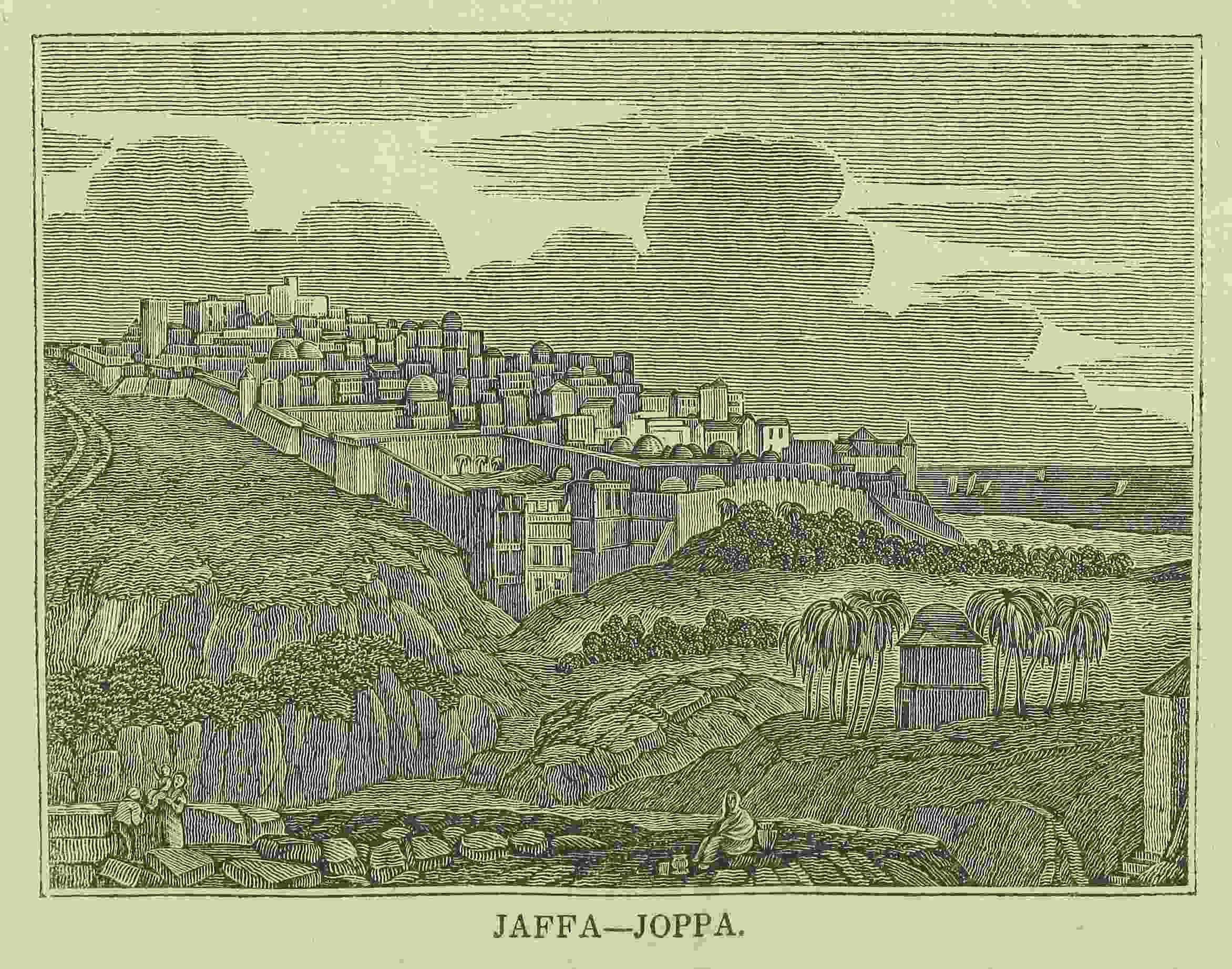
JAFFA――JOPPA.
THE BEGINNING OF PEACE.
Soon after the return of the apostles to Jerusalem, an event occurred, which had a more mighty influence on the progress of the Christian religion than any other that had occurred since the ascension of Jesus. The members of the church who still withstood the storm of persecution in the city, were struck with no small amazement by the sudden appearance, before them, of Saul of Tarsus, the most bloody persecutor of their Hellenist brethren, who, having exhausted the opportunities for the gratification of his spite against them in Jerusalem, had gone to Damascus, to seize such as there supposed themselves safe in following the new faith. This man, yet stained, as it were, with the blood of Stephen, now presented himself to them as a convert to the gospel, prepared to join them as a brother. The whole affair seemed to bear so decidedly the aspect of a palpable imposition, that they altogether refused to have any thing to do with him, and suspected the whole to be a deep-laid snare, on the part of this bloody foe of the gospel, who now appeared to be seeking, by false professions, to get into their confidence, that he might have the means of betraying them to utter ruin. But Barnabas, who was better acquainted with Saul, detailed to the church all the wonderful circumstances so fully, that they no longer hesitated to receive him as a brother and fellow-laborer. This remarkable conversion was of vast benefit to the cause of the gospel, not only by bringing to its aid the services of a laborer so competent, but also by removing from among its adversaries one who had been a leader and a contriver of every plot of mischief. As soon as he left the ranks of the foe, the vindictive persecution, which had raged ever since the death of Stephen, ceased, as though it had lost its great author and main support, by the defection of Saul of Tarsus. Indeed, the last act of this persecution, which is recorded, was directed against this very man, who had once been a leader in it, and drove him out of the city which had been the scene of his cruelties. Therefore, the churches had rest throughout all Judea, and Galilee, and Samaria, strengthening and advancing in piety, and filled with the impulses of the Holy Spirit. This opportunity of quiet seemed peculiarly favorable for a minute survey of the condition of these scattered churches, most of which had grown up without any direct agency of the apostles, and therefore needed their attention at this critical period.
THE SURVEY OF THE CHURCHES.
The most proper person for this responsible charge, was the great leader of the apostolic band; and Peter, therefore, taking the task readily upon himself, went through all the churches, to give them the advantages of the minute personal ministry of a chief apostle, who might organize them, and instruct the disciples in their peculiar duties as members of a new religious community. On this tour of duty, passing down from the interior towards the sea-coast, he came to Lydda, about forty or fifty miles from Jerusalem, and about twelve from the sea. Here there was a company of the faithful, whom he visited, to instruct them anew, and to enlarge their numbers, by his preaching and miracles. A particular case is recorded as having occurred here, which displayed both the compassion of Peter and his divine power to heal and strengthen. Among the friends of Christ whom he visited here, was an invalid, whose name, Aeneas, shows him to have been a Hellenist. This man had for the long period of eight years been deprived of the use of his limbs, by a palsy, which, during that tedious interval, confined him to his bed. Peter, on seeing him, said, “Aeneas, Jesus Christ heals thee. Arise, and make thy bed for thyself.” The command to spread and smooth the couch, which he now quitted in health, was given, that he might show and feel, at once, how fully strength was restored to his hands as well as his feet. This miracle soon became known, not only to the citizens of Lydda, but also to the people inhabiting the extensive and fertile plain of Sharon, which stretched to the northward of Lydda, along the coast, from Joppa to Caesarea, bounded on the west by the highlands of Samaria. The effect of this display of power and benevolence, was such, on their minds, that, without exception, they professed their faith in Christ.
Lydda.――This was a place of far more importance and fame, than would be supposed from the brief mention of its name in the apostolic narrative. It is often mentioned in the writings of the Rabbins, under the name of לוד (Ludh,) its original Hebrew name, and was long the seat of a great college of Jewish law and theology, which at this very period of Peter’s visit was in its most flourishing state. This appears from the fact that Rabbi Akiba, who raised the school to its greatest eminence, was contemporary with the great Rabban Gamaliel, who bears an important part in the events of the apostolic history. (The data of this chronological inference I find in Lightfoot.) It is easy to see, then, why so important a seat of Jewish theology should have been thought deserving of the particular notice and protracted stay of Peter, who labored with remarkable earnestness and effect here, inspired by the consciousness of the lasting and extensive good, that would result from an impression made on this fountain of religious knowledge. The members of the college, however, did not all, probably, profess themselves followers of Christ.
It is also described as possessing some importance in addition to its literary privileges. Josephus (Antiquities XX. vi. 3.) mentions “Lydda” as “a village not inferior to a city in greatness.” Its importance was, no doubt, in a great measure derived from the remarkably rich agricultural district which surrounded it. This was the plain of Sharon, so celebrated in the Hebrew scriptures for its fruitful fields and rich pastures,――its roses and its flocks. (Solomon’s Song ii. 1: Isaiah xxxiii. 9: xxxv. 2: lxv. 10: 1 Chronicles xxvii. 29.) “All this country is described by Pococke as very rich soil, throwing up a great quantity of herbage; among which he specifies chardons, rue, fennel, and the striped thistle, ‘probably on this account called the holy thistle.’ A great variety of anemonies, he was told, grow in the neighborhood. ‘I saw likewise,’ he adds, ‘many tulips growing wild in the fields (in March;) and any one who considers how beautiful those flowers are to the eye, would be apt to conjecture that these are the lilies to which Solomon, in all his glory, was not to be compared.’”――[Modern Traveler, p. 57.] Its distance from Jerusalem is ascertained, by Lightfoot, to be one day’s journey, as it is stated with some circumlocution in the Mishna. It was destroyed, as Josephus relates, by Cestius Gallus, the Roman general, who marched his army through that region, in the beginning of the war, which ended in the destruction of Jerusalem. Under the peaceful times of the later Roman sway in Palestine, it was rebuilt, and called Diospolis. But like many other such instances, it has lost its temporary heathen name, and is now called by its old scripture appellation, Ludd. Travelers describe it as now a poor village, though the stones to be seen in the modern buildings show that it has been a place of great consequence.
The New Testament name Lydda, (Λυδδα,) by which Josephus also mentions it, is only so much changed from the Hebrew Ludh, as was necessary to accommodate it to the regular forms and inflexions of the Greek language. Lightfoot well refutes the blunder of many modern geographers who make the two names refer to different places. This learned author is remarkably full in the description of this place, and is very rich in references to the numerous allusions which are made to it in the Talmudic writings. See his Centuria Chorographica, (Chapter 16,) prefixed to Horae Hebraica et Talmudicae in Matthew.
Aeneas.――This name is unquestionably Greek, which seems to show the man to have been a Hellenist; and that he was already a believer in Christ, would appear from the fact of Peter’s finding him among the brethren there.
THE VISIT TO JOPPA.
Hardly had this instance of divine favor occurred in Lydda, when a new occasion for a similar effort presented itself, in the neighboring seaport town of Joppa. A female disciple of the faith of Christ, in that city, by name Tabitha, or in the Greek, Dorcas, (both names meaning Gazelle,) had distinguished herself and honored her religious profession, by the generous and charitable deeds which constantly employed her hands. This lady, so respected by all, and so loved by the poor, who gave witness to her goodness,――such an honor to the religious community which she had joined,――seemed to have so nobly done her part in life, that the order of Providence had apparently called her to rest from these labors, in that sleep from which no piety nor usefulness can save or recall their possessor. After a few days of illness, she died, and was, after the usual funeral ablutions, laid in an upper chamber, to await the burial. In the midst of the universal grief for this sad loss, the members of the church at Joppa, knowing that Peter was in Lydda, within a few hours’ journey, sent two messengers to him, to beg his presence among them, as some consolation in their distress. Peter, on hearing of this occasion for his presence, with great readiness accompanied the messengers back, and on arriving at Joppa, went straight to the house of mourning. He was immediately led into the chamber, where he found a most affecting testimony to the nature of the loss which the afflicted community had suffered. Around the dead, stood the widows who, in their friendlessness, had been relieved by the sympathy of Dorcas, now pouring their tears and uttering their lamentations over her, and showing that even the garments which they wore were the work of her industrious hand,――that hand which, once so untiring in these labors of love, was now cold and motionless in death. From that resistless doom, what mortal voice could ever recall even one so amiable and useful? But, while they were sorrowing thus, Peter ordered them all to leave him alone with the dead; and when all witnesses were removed, he kneeled and prayed. The words of that prayer are not recorded; and it is only by its successful efficiency that we know it to have been that fervent effectual prayer of a righteous man, which availeth much. It was such a prayer as, of old, the son of Shaphat offered over the dead child of the Shunamite, when alone with him; and its effect was not less mighty. Rising at length, and turning towards the body, he said “Tabitha, arise!” Awaking from the unbreathing sleep of death, as from a light slumber of an hour, she opened her eyes, and when she saw the majestic man of God alone, and herself robed for the tomb, she sat up and gazed in amazement. Peter, then, giving her his hand, lifted her from the funeral couch, and calling in the brethren and the widows; he presented her to their astonished eyes, alive. Their overwhelming joy and wonder, we are left to imagine. The story, when made known through the city, brought many to acknowledge the truth of that religion whose minister could work such wonders; and many believed in Christ. The field of labor which now opened to Peter in this place, seemed so wide that he did not continue his journey any further at that time, but took up his abode, for several days, in Joppa, lodging in the house of Simon, a tanner, whose house stood by the sea, near the water.
Joppa, now called Jaffa.――This was from very early times a place of great importance, from the circumstance of its being the nearest seaport to Jerusalem. It is mentioned in reference to this particular of its situation, in 2 Chronicles ii. 17, where it is specified (in Hebrew יפו Japho) as the port to which the cedar timber from Lebanon should be floated down in rafts, to be conveyed to Jerusalem for building the temple. It stood within the territories of the tribe of Dan, according to Joshua xix. 46, and lies about East-North-east from Jerusalem. Strabo, (xvi.) in describing it, refers to it as the scene of the ancient Grecian fable of Andromeda rescued from the sea-monster by Perseus. He describes its site as “quite elevated,――so much so, indeed, that it was a common saying that Jerusalem might be seen from the place; the inhabitants of which city use it as their seaport, in all their maritime intercourse.” Josephus mentions that it was added to the dominions of Herod the Great by Augustus. Its present appearance is thus described by travelers.
“It is situated in latitude 32 degrees 2 minutes North, and longitude 34 degrees 53 minutes East, and is forty miles West of Jerusalem. Its situation, as the nearest port to the Holy City, has been the chief cause of its importance. As a station for vessels, according ♦to Dr. Clarke, its harbor is one of the worst in the Mediterranean. Ships generally anchor about a mile from the town, to avoid the shoals and rocks of the place. The badness of the harbor is mentioned, indeed, by Josephus. (Josephus, Antiquities, book xv. chapter 9.) * * * The road is protected by a castle built on a rock, and there are some storehouses and magazines on the sea-side. The coast is low, but little elevated above the level of the sea; but the town occupies an eminence, in the form of a sugar-loaf, with a citadel on the summit. The bottom of the hill is surrounded with a wall twelve or fourteen feet high, and two or three feet thick. * * * There are no antiquities in Jaffa: the place would seem to be too old to have any――to have outlived all that once rendered it interesting. The inhabitants are estimated at between four and five thousand souls, of whom the greater part are Turks and Arabs; the Christians are stated to be about six hundred, consisting of Roman Catholics, Greeks, Maronites, and Armenians.” [Modern Traveler, Palestine, pp. 41, 42.]
Dorcas.――This is the Greek translation of the old Hebrew צבי (Tsebi,) in the Aramaic dialect of that age, changed into תביתא (Tabitha,) in English, “gazelle,” a beautiful animal of the antelope kind, often mentioned in descriptions of the deserts of south-western Asia, in which it roams; and not unfrequently the subject of poetical allusion. The species to which it is commonly supposed to belong, is the Antilopa Dorcas of Prof. Pallas, who named it on the supposition that it was identical with this animal, called by the Greeks, Δορκας, (Dorkas,) from Δερκο, (Derko,) “to look,” from the peculiar brightness of “its soft black eye.”
THE CALL TO THE HEATHEN.
The apostles had now, with great zeal and efficiency, preached the gospel of Jesus Christ to the worshipers of the true God, beginning at Jerusalem, and spreading the triumphs of his name to the bounds of the land of Israel. But in all their devotion to their Master’s work, they had never had a thought of breaking over the bounds of the faith of their fathers, or of making their doctrine anything else than a mere completion or accompaniment to the law of Moses; nor did they imagine that they were ever to extend the blessings of the gospel to any who did not bow down to all the tedious rituals of the ancient covenant. The true power of their Lord’s parting command, “Go and teach all nations,” they had never felt; and even now, their great chief supposed that the change of heart and remission of sins, which he was commissioned to preach, were for none but the devout adherents of the Jewish faith. A new and signal call was needed, to bring the apostles to a full sense of their enlarged duties; and it is among the highest honors vouchsafed to Peter, that he was the person chosen to receive this new view of the boundless field now opened for the battles and triumphs of the cross. To him, as the head and representative of the whole band of the apostles, was now spread out, in all its moral vastness and its physical immensity, the coming dominion of that faith, whose little seed he was now cherishing, with but a humble hope; but whose stately trunk and giant branches were, from that small and low beginning, to stretch, in a mighty growth, over lands, and worlds, to him unknown. Thus far he had labored with a high and holy zeal, in a cause whose vastness he had never appreciated,――every moment building up, unwittingly, a name for himself, which should outlast all the glories of the ancient covenant; and securing for his Master a dominion which the religion of Moses could never have reached. He had never had an idea, that he with his companions was founding and spreading a new religion;――to purify the religion of the law and the prophets, and to rescue it from the confusion and pollutions of warring sectaries, was all that they had thought of; yet with this end in view, they had been securing the attainment of one so far above and beyond, that a full and sudden view of the consequences of their humble deeds, would have appalled them. But though the mighty plan had never been whispered nor dreamed of, on earth,――though it was too immense for its simple agents to endure its full revelation at once,――its certain accomplishment had been ordained in heaven, and its endless details were to be fully learned only in its triumphant progress through uncounted ages. But, limited as was the view which the apostles then had of the high destiny of the cause to which they had devoted themselves, it was yet greatly extended from the low-born notions with which they had first followed the steps of their Master. They now no longer entertained the vagary of a worldly triumph and a worldly reward; they had left that on the mount where their Lord parted from them, and they were now prayerfully laboring for the establishment of a pure spiritual kingdom in the hearts of the righteous. To give them a just idea of the exalted freedom to which the gospel brought its sons, and to open their hearts to a Christian fellowship, as wide as the whole human family, God now gave the apostolic leader an unquestionable call to tell to the world the glad tidings of salvation, for all men, through a new and living way, by change of heart and remission of sins. The incidents which led to this revelation are thus detailed.
The peace and good order of Palestine were now secured by several legions, whose different divisions, larger or smaller according to circumstances, were quartered in all the strong or important places in the country, to repress disorders, and enforce the authority of the civil power, when necessary. Besides this ordinary peace-establishment of the province, there was a cohort which took its name from the circumstance that it had been levied in Italy,――a distinction, now so rare, in consequence of the introduction of foreign mercenaries into the imperial hosts, as to become the occasion of an honorable eminence, which was signified by the title here given, showing that this division of the Roman armies was made up of the sons of that soil which had so long sent forth the conquerors of the world. Of all the variety of service required of the different detachments of the army, in the province which it guarded, by far the most honorable was that of being stationed next the person of the governor of the province, to maintain the military dignity of his vice-imperial court, and defend his representative majesty. Caesarea, on the sea-shore, was now the seat of the Roman government of Palestine; and here, in attendance on the person of the governor, was this aforesaid Italian cohort, at the head of a company in which, was a centurion named Cornelius. Though nothing is given respecting his birth and family but this single name, a very slight knowledge of Roman history and antiquities enables the historian to decide, that he was descended from a noble race of patricians, which had produced several of the most illustrious families of the imperial city. Eminent by this high birth and military rank, he must have been favored with an education worthy of his family and station. It is therefore allowable to conclude, that he was an intelligent and well-informed gentleman, whom years of foreign service, in the armies of his country must have improved by the combined advantages of a traveler and a disciplined warrior. Of his moral and religious character such an account is given, as proves that his principles, probably implanted in early life, had been of such firmness as to withstand the numerous temptations of a soldier’s life, and to secure him in a course of most uncommon rectitude in his duties towards God and towards man. In the merciful exercise of his power over the people whose safety and quiet he came to maintain, and, moreover, in the generous use of his pecuniary advantages, he passed his blameless life; and the high motive of this noble conduct, is discovered in the steady, pure devotion, in which he employed many hours of daily retirement, and in which he caused his whole family publicly to join, on proper occasions. Thus is he briefly and strongly characterized by the sacred historian: “devout, and fearing God with all his house; giving much alms, and praying to God always.”
Noble race of patricians.――The gens Cornelia, or “Cornelian race,” was unequaled in Rome for the great number of noble families sprung from its stock. The Scipios, the Sullas, the Dolabellas, the Cinnas, the Lentuli, the Cethegi, the Cossi, and many other illustrious branches of this great race, are conspicuous in Roman history; and the Fasti Consulares, record more than sixty of the Cornelian race, who had borne the consular dignity previous to the apostolic era. This is always a family name, and Ainsworth very grossly errs in calling it “the praenomen of several Romans.” Every Roman name of the middle and later ages of the commonwealth, had at least three parts, which were the praenomen, marking the individual,――the nomen marking the gens, (“race,” “stock,”) and the cognomen, marking the family or division of that great stock. Thus in the name “Publius Cornelius Scipio,” the last word shows that the person belonged to the Scipio family, which by the second word is seen to be of the great Cornelian stock, while the first shows that this member of the family was distinguished from his relations, by the name of Publius. (See Adams’s Roman Antiquities, on Names.) Wherever this name, Cornelius, occurs, if the whole appellation of the man is given, this comes in the middle, as the nomen, marking the race; as is the case with every one of those quoted by Ainsworth, in his blundering account of the word. See also Sallust, (The Catilinarian Conspiracy, 47, 55,) in defense of this peculiar limitation of the word to the gens. Not a single instance can be brought of its application to any person not of this noble patrician race, or of its use as a mere individual appellation. I am therefore authorized in concluding that this Cornelius mentioned in the Acts was related to this line of high nobility. It might, perhaps, be conjectured, that he had borrowed this name from that noble race, from having once been in the service of some one of its families, as was common in the case of freedmen, after they had received their liberty; but this supposition is not allowable; for he is expressly particularized as belonging to an Italian division of the army, which fact excludes the idea of that foreign origin which would belong to a slave. The Jews having but one name for each man, seldom gave all of a Roman’s name, unless of a very eminent man, as Pontius Pilate, Sergius Paulus, and other official characters; but selecting any one of the three parts which might be most convenient, they made that the sole appellative, whether praenomen, nomen, or cognomen. As in Luke ii. 2: Acts xxiii. 24: xxv. 1: xxvii. 1: xxviii. 7, &c.
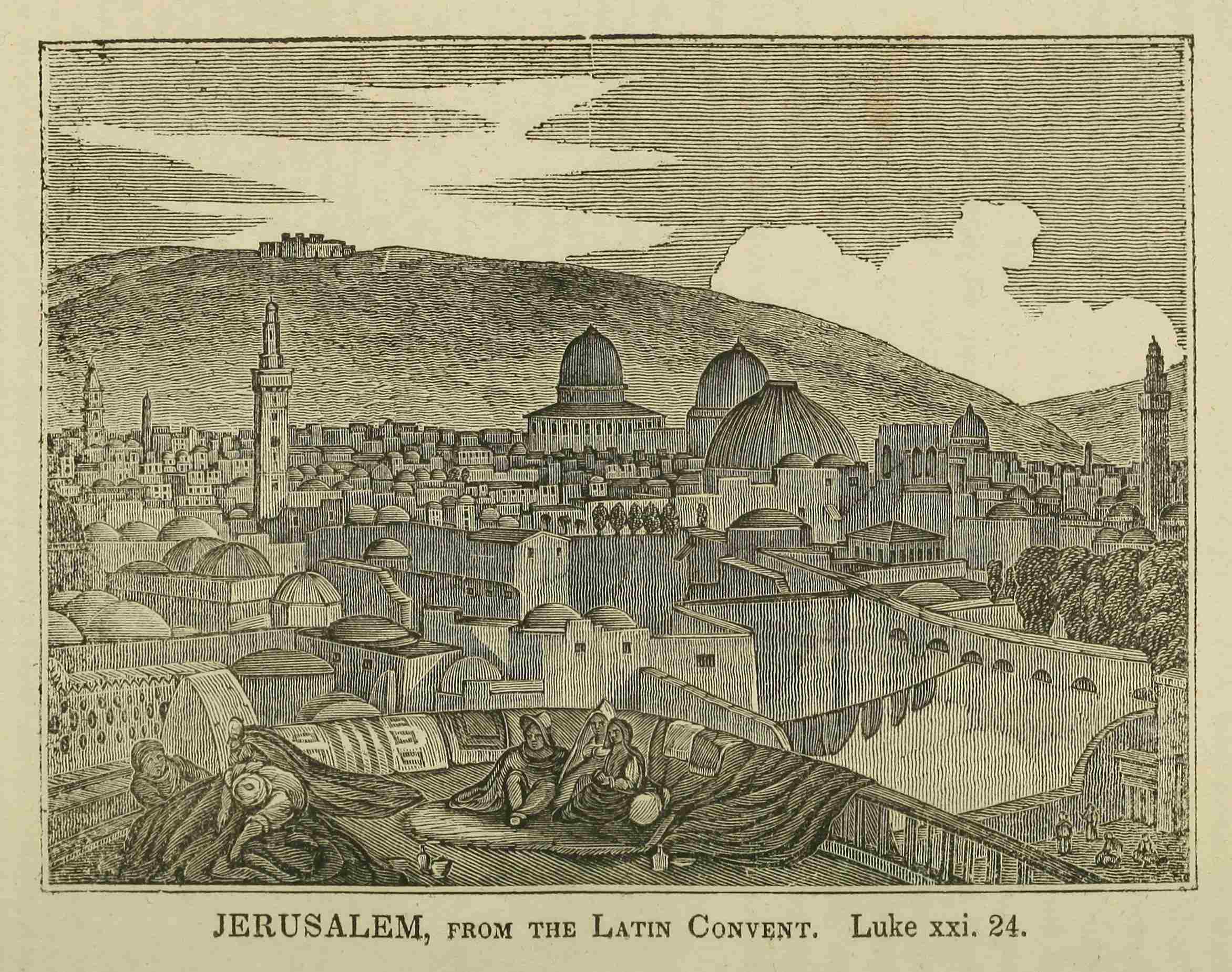
JERUSALEM, from the Latin Convent. Luke xxi. 24.
The Italian cohort.――The word Σπειρα (Speira) I translate “cohort,” rather than “legion,” as the older commentators did. Jerome translates it “cohortem,” and he must have known the exact technical force of the Greek word, and to what Latin military term it corresponded, from his living in the time when these terms must have been in frequent use. Those who prefer to translate it “legion,” are misled by the circumstance, that Tacitus and other writers on Roman affairs, mention a legion which had the distinctive appellation of “the Italian Legion;” while it has been supposed that these ancient authors make no mention of an Italian cohort. But the deeply learned Wetstein, with his usual vast classical research, has shown several such passages, in Arrian and others, in which mention is made of an Italian cohort; and in Gruter’s inscriptions, quoted by Kuinoel, there is an account of “a volunteer cohort of Italian soldiers in Syria;” and Palestine was at this time included with Syria, under the presidency of Petronius. This inscription, too, justifies my remark as to the high character of those who served in this corps. “Cohors militum Italicorum voluntaria” seems to imply a body of soldiers of a higher character than the ordinary mercenary mass of the army, being probably made up of volunteers from respectable families of Italy, who chose to enlarge their knowledge of the world by foreign military service, in this very honorable station of life-guard to the Roman governor, as Doddridge and others suppose this to have been. (See Doddridge on this passage; also C. G. Schwartz in Wolff, Cur. Philology in loc.) It is considered also as fairly proved that the “Italian legion” was not formed till a much later period; so that it is rendered in the highest degree probable and unquestionable, that this was a cohort, and, as Schwartz and Doddridge prove, not a mere ordinary cohort, making the tenth part of a common legion of 4200, but a distinct and independent corps, attached to no legion, and devoted to the exclusive honorable service above mentioned. (See Bloomfield, Kuinoel, Rosenmueller, &c.)
Devout.――Some have tried hard to make out that Cornelius was what they call “a proselyte of the gate;” that is, one who, though not circumcised, nor conforming to the rituals generally, yet was an observer of the moral law. But Lardner very fully shows that there were not two sorts of proselytes; all who bore that name fully conforming to the Jewish rituals, but still called “strangers,” &c.; because, though admitted to all the religious privileges of the covenant, they were excluded from the civil and political privileges of Jews, and could not be freeholders. Cornelius must then have been a mere Gentile. (See Lardner in his life of Peter; also Kuinoel and Bloomfield.)
Caesarea.――This is another of those cities enlarged or rebuilt by the princes of the Herodian line, and honored with the names of the imperial family. This city stood on the sea-shore, about 30 miles north of Joppa; and (Modern Traveler) 62 north-north-west from Jerusalem. (600 stadia Josephus.) It has been idly conjectured by the Rabbinical writers, that this was the same with Ekron, of the Old Testament, Zephaniah ii. 4; while the Arabic version gives it as Hazor, Joshua xi. 1,――both with about equal probability. The earliest name by which it can be certainly recognized, is Apollonia, which it bore when it passed from the Syro-Grecians to the Maccabean princes. Its common name, in the time of Herod the Great, was πυργος Στρατωνος, turris Stratonis, “Straton’s castle,” from the name of a Greek pirate who had built a strong hold here. Herod the Great made it the most splendid city in his dominions, and even in all the eastern part of the Roman empire; and in honor of Augustus Caesar, called it Caesarea Augusta. It was sometimes called Caesarea Palestinae, to distinguish it from Caesarea Philippi; for Palestine was then a name limited to the southern part of the coast of the Holy Land, and was bounded on the north by Phoenicia. This city was the capital of the whole Holy Land throughout the period of the later Herodian and Roman sway.
To this man was sent the first heavenly call, which ended in bringing in the Gentiles to the knowledge of the truth revealed by Jesus. After having fasted all day, he was employed in his regular devotions, at the usual hour of prayer, (three o’clock in the afternoon,) when his senses were overwhelmed by a vision, in which he had a distinct view of a messenger of God, in shining garments, coming to him; and heard him call him by his name, “Cornelius!” Looking at him as steadily as he was able in his great alarm, Cornelius asked, “What is it, Lord?” The heavenly visitant replied, in words of consolation and high praise, “Thy prayers and thy alms have come up in remembrance before God. And now send men to Joppa, and call for a man named Simon Peter, lodging with Simon, a tanner, whose house is by the sea-side. He, when he comes, shall tell thee what it is right that thou shouldst do.” When the surprising messenger had given this charge, he departed; and Cornelius, without delay, went to fulfil the minute directions he had received. He called two of his domestics, and a devout soldier of the detachment then on duty near him, and having related to them all that he had just seen and heard, he sent them to Joppa, to invite Peter according to the order. The distance between the two places is about thirty-five miles, and being too great to be easily traveled in one day, they journeyed thither during a part of two days, starting immediately when they received the command, though late in the afternoon. While they were continuing their journey, the next day, and were now near to the city of Joppa, Peter, without any idea of the important task to which he was soon to be summoned, went up, as usual, to the Alijah, or place of prayer, upon the house-top, at about twelve o’clock, mid-day. Having, according to the usual custom of the Jews, fasted for many hours, for the sake of keeping the mind clear from the effects of gross food on the body, and at length becoming sensible that he had pushed himself to the utmost limits of safe abstinence, he wished for food, and ordered his dinner. While the servants were preparing it, he continued above, in the place of prayer, where, enfeebled by fasting, and over-wrought by mental effort, he fell into a state of spiritual excitement, in which the mind is most susceptible of strong impressions of things beyond the reach of sense. In this condition, there appeared to him a singular vision, which subsequent events soon enabled him fully to interpret. It seemed to him that a great sheet was let down from the sky, to which it was fastened by the four corners, containing on its vast surface all sorts of animals that were forbidden as food by the Mosaic law. While the apostle gazed upon this vast variety of animals, which education had taught him to consider unclean, there came a voice to him, calling him by name, and commanding him to arise, kill, and eat. All his prejudices and early religious impressions were roused by such a proposal; and, resisting the invisible speaker as the agent of temptation to him in his bodily exhaustion, he replied, in all the pride of a scrupulous and unpolluted Jew, “By no means, Lord, because I have never eaten anything improper or unclean.” The mysterious voice again said, “What God hath cleansed, do not thou consider improper.” This impressive scene having been twice repeated, the whole was withdrawn back into heaven. This remarkable vision immediately called out all the energies of Peter’s mind, in its explanation. But before he had time to decide for himself what was meant by it, the messengers of Caesarea had inquired out the house of Simon, and, coming to the outside door, they called to learn whether Simon, who was surnamed Peter, lodged there. And while the mind of Peter was still intently occupied with the vision, he received an intimation from the unerring spirit, that his presence was required elsewhere. “Behold! three men are seeking thee, but rise up and go with them, without hesitation; for I have sent them.” Thus urged and encouraged, Peter went directly down to the men sent by Cornelius, and said, “Behold! I am he whom ye seek. What is your object in coming here?” They at once unfolded their errand. “Cornelius, a centurion, a just man, fearing God, and of good repute among all the Jews, was instructed by a holy messenger, to send for thee to his house, that he may hear something from thee.” Peter, already instructed as to the proper reception of the invitation, asked them in, and hospitably entertained them till the next day, improving the delay, no doubt, by learning as many of the circumstances of the case as they could give him. The news of this remarkable call was also made known to the brethren of the church in Joppa, some of whom were so highly interested in what they heard that evening, that they resolved to accompany Peter the next day, with the messengers, to see and hear for themselves the details of a business which promised to result so fairly in the glory of Christ’s name, and the wide enlargement of his kingdom. On the next day, the whole party set out together, and reached Caesarea, the second day of their journey; and going straight to the house of Cornelius, they found quite a large company there, awaiting their arrival. For Cornelius, expecting them, had invited his relations and his intimate friends, to hear the extraordinary communications which had been promised him, from his visitor. The kindred here alluded to were, perhaps, those of his wife, whom, according to a very common usage, he may have married in the place where he was stationed; for it is hardly probable that a Roman captain from Italy could have had any of his own blood relations about him, unless, perhaps, some of them might have enlisted with him, and now been serving with him on this honorable post. His near friends, who completed the assembly, were probably such of his brother officers as he knew to possess kindred tastes with himself, and to take an interest in religious matters. Such was the meeting that Peter found sitting in expectation of his coming; and so high were the ideas which Cornelius had formed of the character of his visitor, that, as soon as he met him on his entrance into the house, he fell down at his feet, and paid him reverence as a superior being;――an act of abasement towards the inhabitant of a conquered country, most rare and remarkable in a Roman officer, and one to which nothing but a notion of supernatural excellence could ever have brought him, since this was a position assumed not even by those who approached the emperor himself. Peter, however, had no desire to be made the object of a reverence so nearly resembling idolatry. Raising up the prostrate Roman, he said, “Stand up: for I myself am also a man.” Entering into familiar discourse with him, he now advanced into the house, and going with him to the great room, he there found a numerous company. He addressed them in these words: “You know how unlawful it is for a Jew to be familiar, or even to visit, with one of another nation; but God has taught me to call no man vulgar or unclean. Wherefore, I came at your summons, without hesitation. Now, then, I ask with what design have you sent for me?” And Cornelius said, “Four days ago, I was fasting till this hour; and at the ninth hour I was praying in my house;” and so having gone on to narrate all the circumstances of his vision, as given above, concluded in these words, “For this reason I sent for thee, and thou hast done well in coming, for we are all here, before God, to hear what has been imparted to thee, from God.” And Peter began solemnly to speak, and said, “Of a truth, I perceive that God is no respecter of persons; but that in every nation, he that fears him and does what is right, is approved by him.” With this solemn profession of a new view of this important principle of universal religion, as a beginning, he went on to satisfy their high expectations, by setting forth to them the sum and substance of the gospel doctrine, of whose rise and progress they had already, by report, heard a vague and partial account. The great and solemn truth which the Spirit had summoned him to proclaim, was that Jesus Christ the crucified was ordained by God the judge of both living and dead, and that through him, as all the prophets testified, every one that believed should have remission of sins. Of his resurrection from the dead, Peter declared himself the witness, as well as of his labors of good will towards man, when, anointed with the Spirit of God, he went about doing good. Thus did Peter discourse, excited by the novel and divinely appointed occasion, till the same divine influence that moved his heart and tongue was poured out on his charmed hearers, and they forthwith manifested the signs of change of heart and devout faith in Christ, as the Son of God and the judge of the world; and made known the delight of their new sensations, in words of miraculous power. At this display of the equal and impartial grace of God, the Jewish church-members from Joppa, who had accompanied Peter to Caesarea, were greatly amazed, having never before imagined it possible for the influences of the divine spirit to be imparted to any who had not devoutly conformed to all the rituals of the holy law of old given by God to Moses, whose high authority was attested amid the smoke and flame and thunder of Sinai. And what change was this? In the face of this awful sanction, these believing followers of Moses and Christ saw the outward signs of the inward action of that Spirit which they had been accustomed to acknowledge as divine, now moving with the same holy energy the souls and voices of those born and bred among the heathen, without the consecrating aid of one of those forms of purification, by which Moses had ordained their preparation for the enjoyment of the blessings of God’s holy covenant with his own peculiar people. Moved by that same mysterious and holy influence, the Gentile warriors of Rome now lifted up their voices in praise of the God of Israel and of Abraham,――doubtless too, their God and Father, though Abraham were ignorant of them, and Israel acknowledged them not; since through his son Jesus a new covenant had been sealed in blood, opening and securing the blessings of that merciful and faithful promise to all nations. On Jehovah they now called as their Father and Redeemer, whose name was from everlasting,――known and worshiped long ere Abraham lived. Never before had the great partition-wall between Jews and Gentiles been thus broken down, nor had the noble and equal freedom of the new covenant ever yet been so truly and fully made known. And who was he that had thus boldly trampled on the legal usages of the ancient Mosaic covenant, as consecrated by the reverence of ages, and had imparted the holy signs of the Christian faith to men shut out from the mysteries of the inner courts of the house of God? It was not a presumptuous or unauthorized man, nor one thoughtless of the vastly important consequences of the act. It was the constituted leader of the apostolic band, who now, in direct execution of his solemn commission received from his Master, and in the literal fulfilment of the prophetic charge given therewith at the base of distant Hermon, opened the gates of the kingdom of heaven to all nations. Bearing the keys of the kingdom of God on earth, he now, in the set time of divine appointment, at the call of his Master in heaven, so signally given to him both directly and indirectly, unlocked the long-closed door, and with a voice of heavenly charity, bade the waiting Gentiles enter. This was the mighty commission with which Jesus had so prophetically honored this chief disciple at Caesarea Philippi, and here, at Caesarea Augusta, was achieved the glorious fulfilment of this before mysterious announcement;――Simon Peter now, in the accomplishment of that divinely appointed task, became the Rock, on which the church of Christ was, through the course of ages, reared; and in this act, the first stone of its broad Gentile foundation was laid.
On duty about him.――This phrase is the just translation of the technical term προσκαρτερουντων, (proskarterounton,) according to Price, Kuinoel, Bloomfield, &c.
Of all the honors with which his apostolic career was marked, there is none which equals this,――the revolutionizing of the whole gospel plan as before understood and advanced by its devotees,――the enlargement of its scope beyond the widest range of any merely Jewish charity,――and the disenthralment of its subjects from the antique formality and cumbrous ritual of the Jewish worship. And of all the events which the apostolic history records, there is none which, in its far-reaching and long-lasting effects, can match the opening of Christ’s kingdom to the Gentiles. What would have been the rate of its advancement under the management of those, who, like the apostles hitherto, looked on it as a mere improvement and spiritualization of the old Mosaic form, to which it was, in their view, only an appendage, and not a substitute? Think of what chances there were of its extension under such views to those far western lands where, ages ago, it reached with its benign influences the old Teutonic hordes from whom we draw our race;――or of what possibility there was of ever bringing under the intolerable yoke of Jewish forms, the hundreds of millions who now, out of so many lands and kindreds and tongues, bear the light yoke, and own the simpler faith of Jesus, confessing him Lord, to the glory of God the Father. Yet hitherto, so far from seeing these things in their true light, all the followers of Christ had, notwithstanding his broad and open commission to them, steadily persisted in the notion, that the observance of the regulations laid down by Moses for proselytes to his faith, was equally essential for a full conversion to the faith of Christ. And now too, it required a new and distinctly repeated summons from above, to bring even the great chief of the apostles to the just sense of the freedom of the gospel, and to the practical belief that God was no respecter of persons. But the whole progress of the event, with all its miraculous attestations, left so little doubt of the nature of the change, that Peter, after the manifestation of a holy spirit in the hearts and voices of the Gentile converts, triumphantly appealed to the Jewish brethren who had accompanied him from Joppa, and asked them, “Can any one forbid the water for the baptizing of these, who have received the Holy Spirit as well as we?” Taking the unanimous suffrage of their silence to his challenge, as a full consent, he gave directions that the believing Romans should be baptized in the name of the Lord, as Jesus in his parting charge had constituted that ordinance for the seal of redemption to every creature, in all the nations to whom the gospel should be preached. Having thus formally enrolled the first Gentile converts, as the free and complete partakers of the blessings of the new covenant, he stayed among them several days, at their request, strengthening their faith, and enlarging their knowledge by his pastoral instruction; which he deemed a task of sufficient importance to detain him, for a while, from his circuit among the new converts, scattered about in other places throughout Palestine, and from any immediate return to his friends and converts at Joppa, where this call had found him.
Meanwhile, this mighty innovation on the established order of sacred things could not be long unknown beyond the cities of Caesarea and Joppa, but was soon announced by the varied voice of rumor to the amazed apostles and brethren at Jerusalem. The impression made on them by this vague report of their great leader’s proceedings, was most decidedly unfavorable; and there seem to have been not a few who regarded this unprecedented act of Peter as a downright abuse of the dignity and authority with which the special commission of his Master had invested him. Doubtless, in that little religious community, as in every other association of men ever gathered, there were already many human jealousies springing up like roots of bitterness, which needed but such an occasion as this, to manifest themselves in decided censure of the man, whose remarkable exaltation over them might seem like a stigma on the capacities or merits of those to whom he was preferred. Those in whose hearts such feelings had been rankling, now found a great occasion for the display of their religious zeal, in this bold movement of their constituted leader, who herein seemed to have presumed on his distinction and priority, to act in a matter of the very highest importance, without the slightest reference to the feelings and opinions of those, who had been with him chosen for the great work of spreading the gospel to all nations. And so much of free opinion and expression was there among them, that this act of the chief apostle called forth complaints both deep and loud, from his brethren, against this open and unexplained violation of the holy ordinances of that ancient law, which was still to them and him the seal and sign of salvation. Peter, at length, after completing his apostolic circuit among the churches, of which no farther account is given to us, returned to Jerusalem to meet these murmurs with the bold and clear declaration of the truth. As soon as he arrived, the grumblers burst out on him with open complaints of his offensive violations of the strict religious exclusiveness of demeanor, which became a son of Israel professing the pure reformed faith of Jesus. The unhesitating boldness with which this charge of a breach of order was made against Peter by the sticklers for circumcision, is a valuable and interesting proof, that all his authority and dignity among them, did not amount to anything like a supremacy; and that whatever he might bind or loose on earth for the high sanction of heaven, he could neither bind the tongues and opinions, nor loose the consciences of these sturdy and free-spoken brethren. Nor does Peter seem to have had the least idea of claiming any exemption from their critical review of his actions; but straightway addressed himself respectfully to them, in a faithful detail of his conduct, and the reasons of it. He distinctly recounted to them the clear and decided call which he considered himself to have received from heaven, by which he was summoned as the spiritual guide of the inquiring Gentiles. And after the honest recital of the whole series of incidents, and of the crowning act of the whole, the imparting to them the outward sign of inward washing from their sins, he boldly appealed to the judgments of his accusers, to say whether, in the face of such a sanction, they would have had him do otherwise. “When the Holy Ghost fell on them, as on us at the beginning, then remembered I the word of the Lord, how that he said,” (when parting from us, on the top of Olivet, to rise to the bosom of his father, prophetically announcing a new and holy consecration and endowment for our work,) “John indeed baptized with water, but ye shall be baptized with the Holy Ghost.” This peculiar gift thus solemnly announced, we had indeed received at the pentecost, and its outward signs we had thereby learned infallibly by our own experience; and even so, at Caesarea, I recognized in those Gentiles the same tokens by which I knew the workings of divine grace in myself and you. “Forasmuch, then, as God gave them the like gift as to us, who believed on the Lord Jesus Christ, what was I, that I should withstand God?”――This clear and unanswerable appeal silenced the clamors of the bold assertors of the inviolability of Mosaic forms; and when they heard these things, they held their peace, and, softened from their harsh spirit of rebuke, they, in a noble feeling of truly Christian triumph, forgot all their late exclusiveness, in a pure joy for the new and vast extension of the dominion of Christ, secured by this act, whose important consequences they were not slow in perceiving. They praised God for such a beginning of mighty results, and laying aside, in this moment of exultation, every feeling of narrow Jewish bigotry, they acknowledged that “to the Gentiles also, God had granted repentance unto life.”