I. THE GALILEAN APOSTLES. (continued 7)
Reading edition
Respecting these minute accounts of Peter’s stopping-places on this apocryphal journey, Baronius says, “Nobilia in iis remanserunt antiquitatis vestigia, sed traditiones potius quam scriptura firmata.” “There are in those places some noble remains of this ancient history, but rather traditions than well assured written accounts.” The part of the route from Antioch to Sicily he takes on the authority of the imaginative Metaphrastes; but the rest is made up from different local superstitions of a very modern date, not one of which can be traced farther back than the time when every fable of this sort had a high pecuniary value to the inventors, in bringing crowds of money-giving pilgrims to the spot which had been hallowed by the footsteps of the chief apostle. Even the devout Baronius, however, is obliged to confess at the end of this story, “Sed de rebus tam antiquis et incertis, quid potissimum affirmare debeamus, non satis constat.”――“But as to matters so ancient and uncertain, it is not sufficiently well established what opinion we may most safely pronounce.”
As to the early part of the route, speaking of the account given by Metaphrastes of Peter’s having on his way through Troy ordained Cornelius, the centurion, bishop of that place, Baronius objects to the truth of this statement, the assertion that Cornelius had been previously ordained bishop of Caesarea, where he was converted. A very valuable refutation of one fable by another as utterly unfounded.
Respecting the causes of this great journey of the apostle to the capital of the world, the opinions even of papist writers are as various as they are about the route honored by his passage. Some suppose his motive to have been merely a desire for a refuge from the persecution of Agrippa;――a most unlikely resort, however, for nothing could be more easy than his detection in passing over such a route, especially by sea, where every vessel could be so easily searched at the command of Agrippa, whose influence extended far beyond his own territory, supported as he was, by the unbounded possession of the imperial Caesar’s favor, which would also make the seizure of the fugitive within the great city itself, a very easy thing. Others, however, do not consider this journey as connected in any way with his flight from Agrippa, (for many suppose it to have been made after the death of that king,) and find the motive for such an effort in the vast importance of the field opened for his labors in the great capital of the world, where were so many strong holds of error to be assaulted, and from which an influence so wide and effectual might be exerted through numerous channels of communication to all parts of the world. Others have sought a reason of more definite and limited character, and with vast pains have invented and compiled a fable of most absurdly amusing character, to make an object for Peter’s labors in the distant capital. The story which has the greatest number of supporters, is one connected with Simon Magus, mentioned in the sacred record, in the account of the labors of Philip in Samaria, and the visit of Peter and John to that place. The fable begins with the assertion that this magician had returned to his former tricks after his insincere conformity to the Christian faith, and had devoted himself with new energy to the easy work of popular deception, adding to his former evil motives, that of deadly spite against the faith to which he appeared so friendly, at the time when the sacred narrative speaks of him last. In order to find a field sufficiently ample for his enlarged plans, he went to Rome, and there, in the reign of Claudius Caesar, attained a vast renown by his magical tricks, so that he was even esteemed a god, and was even so pronounced by a solemn decree of the Roman senate, confirmed by Claudius himself, who was perfectly carried away with the delusion, which seems thus to have involved the highest and the lowest alike. The fable proceeds to introduce Peter on the scene, by the circumstance of his being called by a divine vision to go to Rome and war against this great impostor, thus advancing in his impious supremacy, who had already in Samaria been made to acknowledge the miraculous efficacy of the apostolic word. Peter thus brought to Rome by the hand of God, publicly preached abroad the doctrine of salvation, and meeting the arch-magician himself, with the same divine weapons whose efficacy he had before experienced, overcame him utterly, and drove him in confusion and disgrace from the city. Nor were the blessings that resulted to Rome from this visit of Peter, of a merely spiritual kind. So specially favored with the divine presence and blessing were all places where this great apostle happened to be, that even their temporal interests shared in the advantages of the divine influence that every where followed him. To this cause, therefore, are gravely referred by papistical commentators, the remarkable success which, according to heathen historians, attended the Roman arms in different parts of the world during the second year of Claudius, to which date this fabulous visit is unanimously referred by all who pretend to believe in its occurrence.
Importance of the field of labor.――This is the view taken by Leo, (in sermon 1, in nat. apost. quoted by Baronius, Annales 44, § 26.) “When the twelve apostles, after receiving from the Holy Spirit the power of speaking all languages,” (an assertion, by the way, no where found in the sacred record,) “had undertaken the labor of imbuing the world with the gospel, dividing its several portions among themselves; the most blessed Peter, the chief of the apostolic order was appointed to the capital of the Roman empire, so that the light of truth which was revealed for the salvation of all nations, might from the very head, diffuse itself with the more power through the whole body of the world. For, what country had not some citizens in this city? Or what nation anywhere, could be ignorant of anything which Rome had been taught? Here were philosophical dogmas to be put down――vanities of worldly wisdom to be weakened――idol-worship to be overthrown,”――&c. “To this city therefore, thou, most blessed apostle Peter! didst not fear to come, and (sharing thy glory with the apostle Paul, there occupied with the arrangement of other churches,) didst enter that forest of raging beasts, and didst pass upon that ocean of boisterous depths, with more firmness than when thou walkedst on the sea. Nor didst thou fear Rome, the mistress of the world, though thou didst once, in the house of Caiaphas, dread the servant maid of the priest. Not because the power of Claudius, or the cruelty of Nero, were less dreadful than the judgment of Pilate, or the rage of the Jews; but because the power of love now overcame the occasion of fear, since thy regard for the salvation of souls would not suffer thee to yield to terror. * * * The miraculous signs, gifts of grace, and trials of virtue, which had already been so multiplied to thee, now increased thy boldness. Already hadst thou taught those nations of the circumcision who believed. Already hadst thou filled Pontus, Galatia, Cappadocia, Asia and Bithynia with the gospel; and now, without a doubt of the advance of the work, or of the certainty of thy own fate, thou didst plant the trophy of the cross of Christ upon the towers of Rome.” Arnobius is also quoted by Baronius to similar effect.
Simon Magus.――This fable has received a wonderfully wide circulation, and long maintained a place among the credible accounts of early Christian history, probably from the circumstance of its taking its origin from so early a source. Justin Martyr, who flourished from the year 140 and afterwards, in his apology for the Christian religion, addressed to the emperor Antoninus Pius, says, “Simon, a Samaritan, born in a village named Gitthon, in the time of Claudius Caesar, was received as a god in your imperial city of Rome, and honored with a statue, like other gods, on account of his magical powers there exhibited by the aid of demons; and this statue was set up in the river Tiber, between two bridges, and had this Latin inscription, Simoni deo sancto. Him too, all the Samaritans worship, and a few of other nations, acknowledging him as the highest god, (πρωτον θεον.) They also worship a certain Helena, who at that time followed him about,” &c. &c. &c. with more dirty trash besides, than I can find room for. And in another passage of the same work, he alludes to the same circumstances. “In your city, the mistress of the world, in the time of Claudius Caesar, Simon Magus struck the Roman senate and people with such admiration of himself, that he was ranked among the gods, and was honored with a statue.” Irenaeus, who flourished about the year 180, also gives this story with hardly any variation from Justin. Tertullian, about A. D. 200, repeats the same, with the addition of the circumstance, that not satisfied with the honors paid to himself, he caused the people to debase themselves still further, by paying divine honors to a woman called (by Tertullian) Larentina, who was exalted by them to a rank with the goddesses of the ancient mythology, though the good father gives her but a bad name. Eusebius, also, about A. D. 320, refers to the testimonies of Justin and Irenaeus, and adds some strange particulars about a sect, existing in his time, the members of which were said to acknowledge this Simon as the author of their faith, whom they worshiped along with this woman Helena, falling prostrate before the pictures of both of them, with incense and sacrifices and libations to them, with other rites, unutterably and unwritably bad. (See Eusebius, Church History, II. 13.)
In the three former writers, Justin, Irenaeus and Tertullian, this absurd story stands by itself, and has no connection with the life of Peter; but Eusebius goes on to commemorate the circumstance, previously unrecorded, that Peter went to Rome for the express purpose of putting down this blasphemous wretch, as specified above, in the text of my narrative, from this author. (Eusebius, Church History, II. 14.)
Now all this fine series of accounts, though seeming to bear such an overwhelming weight of testimony in favor of the truth and reality of Simon Magus’s visit to Rome, is proved to be originally based on an absolute falsehood; and the nature of this falsehood is thus exposed. In the year 1574, during the pontificate of Pope Gregory XIII., there was an excavation made for some indifferent purpose in Rome, on the very island in the Tiber, so particularly described by Justin, as lying in the center of the river between two bridges, each of which rested an abutment on it, and ran from it to the opposite shores. In the progress of this excavation, the workmen, as is very common in that vast city of buried ruins, turned up, among other remains of antiquity, the remnant of a statue with its pedestal, which had evidently once stood erect upon the spot. Upon the pedestal was an inscription most distinctly legible, in these words: Semoni sango deo fidio sacrum――Sex Pompeius s. p. f. col. mussianus――quinquennalis decur. bidentalis――donum dedit. (This was in four lines, each line ending where the blank spaces are marked in the copy.) In order to understand this sentence, it must be known, that the Romans, among the innumerable objects of worship in their complicated religion, had a peculiar set of deities which they called Semones. A Semo was a kind of inferior god, of an earthly character and office, so low as to unfit him for a place among the great gods of heaven, Jupiter, Juno, Apollo, &c., and was accordingly confined in his residence entirely to the earth; where the Semones received high honors and devout worship, and were commemorated in many places, both in city and country, by statues, before which the passer might pay his worship, if devoutly disposed. These statues were often of a votive character, erected by wealthy or distinguished persons for fancied aid, received from some one of these Semones, in some particular season of distress, or for general prosperity. This was evidently the object of the statue in question. Priapus, Hipporea, Vertumnus, and such minor gods were included under the general title of Semones; and among them was also ranked a Sabine divinity, named Sangus or Sancus, who is, by some writers, considered as corresponding in character to the Hercules of the Greeks. Sangus or Sancus is often alluded to in the Roman classics. Propertius (book 4) has a verse referring to him as a Sabine deity. “Sic Sancum Tatiae composuere Cures.” Ovid also, “Quaerebam Nonas Sanco fidio ne referrem.” As to this providentially recovered remnant of antiquity, therefore, there can be no doubt that it was a votive monument, erected by Sextus Pompey to Sangus the Semo, for some reason not very clearly expressed.
Baronius tells also that he had seen a stone similarly inscribed. “SANGO SANCTO SEMON.――DEO FIDIO SACRUM――DECURIO SACERDOTUM BIDENTALIUM――RECIPERATIS VECTIGALIBUS.” That is, “Sacred to Sangus, the holy Semo, the god Fidius,――a decury (company of ten) of the priests of the Bidental sacrifices have raised this in gratitude for their recovered incomes.” Dionysius Halicarnassaeus is also quoted by Baronius as referring to the worship of the Semo, Sangus; and from him and various other ancient writers, it appears that vows and sacrifices were offered to this Sangus, for a safe journey and happy return from a distance.
From a consideration of all the circumstances of this remarkable discovery, and from the palpable evidence afforded by the inherent absurdity of the story told by Justin Martyr and his copyists, the conclusion is justifiable and irresistible, that Justin himself, being a native of Syria, and having read the story of Simon Magus in the Acts, where it is recorded that he was profoundly reverenced by the Samaritans, and was silenced and rebuked by Peter when he visited that place,――with all this story fresh in his mind, (for he was but a new convert to Christianity,) came to Rome, and going through that city, an ignorant foreigner, without any knowledge of the religion, or superstitions, or deities, and with but an indifferent acquaintance with their language, came along this bridge over the Tiber to the island, where had been erected this votive statue to Semo Sangus; and looking at the inscription in the way that might be expected of one to whom the language and religion were strange, he was struck at once with the name Semon, as so much resembling the well-known eastern name Simon, and began speculating at once, about what person of that name could ever have come from the east to Rome, and there received the honors of a god. Justin’s want of familiarity with the language of the Romans, would prevent his obtaining any satisfactory information on the subject from the passers-by; and if he attempted to question them about it, he would be very apt to interpret their imperfect communications in such a way as suited the notion he had taken up. If he asked his Christian brethren about the matter, their very low character for general intelligence, the circumstance that those with whom he was most familiar, must have been of eastern origin, and as ignorant as he of the minute peculiarities of the Roman religion, and their common disposition to wilfully pervert the truth, and invent fables for the sake of a good story connected with their own faith, (of which we have evidences vastly numerous, and sadly powerful in the multitude of such legends that have come down from the Christians of those times,) would all conspire to help the invention and completion of the foolish and unfounded notion, that this statue here erected Semoni Sanco Deo, was the same as Simoni Deo Sancto, that is, “to the holy god Simon;” and as it was always necessary to the introduction of a new god among those at Rome, that the Senate should pass a solemn act and decree to that effect, which should be confirmed by the approbation of the emperor, it would at once occur to his own imaginative mind, or to the inventions of his fabricating informers, that Simon must of course have received such a decree from the senate and Caesar. This necessarily also implied vast renown, and extensive favor with all the Romans, which he must have acquired, to be sure, by his magical tricks, aided by the demoniac powers; and so all the foolish particulars of the story would be made out as fast as wanted. The paltry fable also appended to this by all the Fathers who give the former story, to the effect, that some woman closely connected with him, was worshiped along with him, variously named Helena, Selena and Larentina, has no doubt a similarly baseless origin; but is harder to trace to its beginnings, because it was not connected with an assertion, capable of direct ocular, as well as historical, refutation, as that about Simon’s statue most fortunately was. The second name, Selena, given by Irenaeus, is exactly the Greek word for the moon, which was often worshiped under its appropriate name; and this tale may have been caught up from some connection between such a ceremony and the worship of some of the Semones,――all the elegant details of her life and character being invented to suit the fancies of the reverend fathers. The story, that she had followed Simon to Rome from the Phoenician cities, Tyre and Sidon, suggests to my mind at this moment, that there may have been a connection between this and some old story of the importation of a piece of idolatry from that region, so famed for the worship of the
“mooned Ashtaroth,
Heaven’s queen and mother both.”
But this trash is not worth the time and paper I am spending upon it, since the main part of the story, concerning Simon Magus as having ever been seen or heard of in Rome, by senate, prince or people, in the days of Claudius, is shown, beyond all reasonable question, to be utterly false, and based on a stupid blunder of Justin Martyr, who did not know Latin enough to tell the difference between sanco and sancto, nor between Semoni and Simoni. And after all, this is but a fair specimen of Justin Martyr’s usual blundering way, of which his few pages present other instances for the inquiring reader to stumble over and bewilder himself upon. Take, for example, the gross confusion of names and dates which he makes in a passage which accidentally meets my eye, on a page near that from which the above extract is taken. In attempting to give an account of the way in which the Hebrew Bible was first translated into Greek, he says that Ptolemy, king of Egypt, sent to Herod, king of the Jews, for a copy of the Bible. But when or where does any history, sacred or profane, give any account whatever of any Ptolemy, king of Egypt, who was cotemporary with either of the Herods? The last of the Ptolemies was killed, while a boy, in the Egyptian war with Julius Caesar, before Herod had himself attained to manhood, or had the most distant thought of the throne of Palestine. The Ptolemy who is said to have procured the Greek translation of the Bible, however, lived about three hundred years before the first Herod. It is lamentable to think that such is the character of the earliest Christian father who has left works of any magnitude. Who can wonder that Apologies for the Christian religion, full of such gross blunders, should have failed to secure the belief, or move the attention of either of the Antonines, to whom they were addressed,――the Philosophic, or the Pious? And by a writer who pretended to tell the wisest of the Caesars, that in his imperial city, had been worshiped, from the days of Claudius, a miserable Samaritan impostor, who, an outcast from his own outcast land, had in Rome, by a solemn senatorial and imperial decree, been exalted to the highest god-ship, and that the evidence of this fact was found in a statue which that emperor well knew to be dedicated to the most ancient deities of Etruscan origin, worshiped there ever since the days of Numa Pompilius, but which this Syrian Christian had blunderingly supposed to commemorate a man who had never been heard of out of Samaria, except among Christians. And as for such martyrs, if there is any truth whatever in the story that his foolish head was cut off by the second Antonine, the only pity is, it was not done a little sooner, so as to have kept the Christian world from the long belief of all this folly about an invention so idle, and saved me the trouble of exposing it.
The fullest account ever given of this fable and all its progress, is found in the Annales Ecclesiastici of Caesar Baronius, (A. C. 44. § 51‒59.) who, after furnishing the most ample references to sacred and profane authorities, which palpably demonstrate the falsity of the story, returns with all the solemn bigotry of a papist, to the solemn conviction that the fathers and the saints who tell the story, must have had some very good reason for believing it.
The other copyists of Justin hardly deserve any notice; but it is interesting and instructive to observe how, in the progress of fabulous invention, one lie is pinned on to the tail of another, to form a glorious chain of historical sequences, for some distant ecclesiastical annalist to hang his servile faith upon. Eusebius, for instance, enlarges the stories of Justin and Irenaeus, by an addition of his own,――that in his day there existed a sect which acknowledged this same Simon as God, and worshiped him and Helena or Selena, with some mysteriously wicked rites. Now all that his story amounts to, is, that in his time there was a sect called by a name resembling that of Simon, how nearly like it, no one knows; but that by his own account their worship was of a secret character, so that he could, of course, know nothing certainly. But this is enough for him to add, as a solemn confirmation of a story now known to have been founded in falsehood. From this beginning, Eusebius goes on to say that Peter went to Rome in the second year of Claudius, to war against this Simon Magus, who never went there; so that we know how much this whole tale is worth by looking into the circumstance which constitutes its essential foundation. The idea of Peter’s visit to Rome at that time, is no where given before Eusebius, except in some part of the Clementina, a long series of most unmitigated falsehoods, forged in the name of Clemens Romanus, without any certain date, but commonly supposed to have been made up of the continued contributions of several impudent liars, during different portions of the second, third and fourth centuries.
Creuzer also, in his deep and extensive researches into the religions of antiquity, in giving a “view of some of the older Italian nations,” speaks of “Sancus Semo.” He quotes Augustin (De civitate Dei. XVIII. 19,) as authority for the opinion that he was an ancient king, deified. He also alludes to the passage in Ovid, (quoted above by Baronius,) where he is connected with Hercules, and alluded to under three titles, as Semo, Sancus and Fidius. (Ovid, Fasti, VI. 213, et seq.) But the learned Creuzer does not seem to have any correct notion of the character of the Semones, as a distinct order of inferior deities;――a fact perfectly certain as given above, for which abundant authority is found in Varro, (de Mystag.) as quoted by Fulgentius and Baronius. From Creuzer I also notice, in an accidental immediate connection with Semo Sancus, the fact that the worship of the moon (Luna) was also of Sabine origin; and being introduced along with that of Sancus, by Numa, may have had some relation to that Semo, and may have concurred in originating the notion of the fathers about the woman Selena or Helena, as worshiped along with Simon. He also just barely alludes to the fact that Justin and Irenaeus have confounded this Semo Sancus with Simon Magus. (See Creuzer’s Symbolik und Mythologie der alter Voelker, II. Theil. pp. 964‒965.)
The next conclusion authorized by those who support this fable is, that Peter, after achieving this great work of vanquishing the impostor Simon, proceeded to preach the gospel generally; yet not at first to the hereditary citizens of imperial Rome, nor to any of the Gentiles, but to his own countrymen the Jews, great numbers of whom then made their permanent abode in the great city. These foreigners, at that time, were limited in Rome to a peculiar section of the suburbs, and hardly dwelt within the walls of the city itself;――an allotment corresponding with similar limitations existing in some of the modern cities of Europe, Asia, and northern Africa, and even in London, though there, only in accordance with long usage, and with actual convenience, but not with any existing law. The quarter of Rome in which the Jews dwelt in the days of Claudius, was west of the central section of the city, beyond the Tiber; and to this suburban portion, the story supposes the residence and labors of Peter to have been at first confined. But after a time, the fame of this mighty preacher of a new faith spread beyond, from this despised foreign portion of the environs, across the Tiber, over the seven hills themselves, and even into the halls of the patrician lords of Rome. Such an extension of fame, indeed, seems quite necessary to make these two parts of this likely story hang together at all; for it is hard to see how a stranger, from a distant eastern land, could thus appear suddenly among them, and overturn, with a defeat so total and signal, the pretensions of one who had lately been exalted by the opinions of an adoring people to the character of a god, and had even received the solemn national sanction of this exaltation by a formal decree of the senate of Rome, confirmed by the absolute voice of the Caesar himself; and after such a victory, over such a person, be left long unnoticed in an obscure suburb. In accordance, therefore, with this reasonable notion, it is recorded in the continuation of the story, that when Peter, preaching at Rome, grew famous among the Gentiles, he was no longer allowed to occupy himself wholly among the Jews, but was thereafter taken by Pudens, a senator who believed in Christ, into his own house, on the Viminal Mount, one of the seven hills, but near the Jewish suburb. In the neighborhood of this house, as the legend relates, was afterwards erected a monument, called “the Shepherd’s,”――a name which serves to identify this important locality to the modern Romans to this day. Being thus established in these lordly patrician quarters, the poor Galilean fisherman might well have thought himself blessed, in such a pleasant change from the uncomfortable lodgings with which the royal Agrippa had lately accommodated him, and from which he had made so willing an exit. But the legend does the faithful and devoted apostle the justice, to represent him as by no means moved by these luxurious circumstances, to the least forgetfulness of the high commission which was to be followed through all sorts of self-denial,――no less that which drew him from the soft and soul-relaxing enjoyments of a patrician palace, than that which led him to renounce the simple, hard-earned profits of a fisherman, on the changeful sea of Gennesaret, or to calmly meet the threats, the stripes, the chains, and the condemned cell, with which the enmity of the Jewish magistrates had steadily striven to quench his fiery and energetic spirit. He is described as steadily laboring in the cause of the gospel among the Gentiles as well as the Jews, and with such success during the whole of the first year of his stay, that in the beginning of the following year he is said by papist writers to have solemnly and formally founded the church of Rome. This important fictitious event is dated with the most exact particularity, on the fifteenth of February, in the forty-third year of Christ, and the third year of the reign of the emperor Claudius. The empty, unmeaning pomposity of this announcement is a sufficient evidence of its fictitious character. According to the story itself, here Peter had been preaching nearly a whole year at Rome; and if preaching, having a regular congregation, of course, and performing the usual accompaniments of preaching, as baptism, &c. Now there is not in the whole apostolic history the least account, nor the shadow of a hint, of any such ceremony as the founding of a church, distinct from the mere gathering of an assembly of believing listeners, who acknowledged their faith in Jesus by profession and by the sacraments. The organization of this religious assembly might indeed be made more perfect at one time than at another; as for instance, a new church, which during an apostle’s stay with it and preaching to it, had been abundantly well governed by the simple guidance of his wise, fatherly care, would, on his departure, need some more regular, permanent provision for its government, lest among those who were all religious co-equals, there should arise disputes which would require a regularly constituted authority to allay them. The apostle might, therefore, in such advanced requirements of the church, ordain elders, and so on; but such an appendix could not, with the slightest regard to common sense or the rules of honest interpretation of language, be said to constitute the founding of a church. The very phrase of ordaining elders in a church, palpably implies and requires the previous distinct, complete existence of the church. In fact the entity of a church implies nothing more than a regular assembly of believers, with an authorized ministry; and if Peter had been preaching several months to the Jews of the trans-Tiberine suburb, or to the Romans of the Viminal mount, there must have been in one or both of those places, a church, to all intents, purposes, definitions and etymologies of a church. So that for him, almost a year after, to proceed to found a church in Rome, was the most idle work of supererogation in the world. And all the pompous statements of papist writers about any such formality, and all the quotations that might be brought out of the fathers in its support, from Clement downwards, could not relieve the assertion of one particle of its palpable, self-evident absurdity. But the fable proceeds in the account of this important movement, dating the apostolic reign of Peter from this very occasion, as above fixed, and running over various imaginary acts of his, during the tedious seven years for which the story ties him down to this one spot. Among many other unfounded matters, is specified the assertion, that from this city during the first year of his episcopate, he wrote his first epistle, which he addressed to the believers in Pontus, Galatia, Cappadocia, Asia and Bithynia,――the countries which are enumerated as visited by him in his fictitious tour. This opinion is grounded on the circumstance of its being dated from Babylon, which several later fathers understood as a term spiritually applied to Rome; but in the proper place this notion will be fully discussed, and the true origin of the epistle more satisfactorily given. Another important event in the history of the scriptures,――the writing of the gospel of Mark,――is also commonly connected with this part of Peter’s life, by the papist historians; but this event, with an account of the nature of this supposed connection, and the discussion of all points in this subject, can be better shown in the life of that evangelist; and to that it is therefore deferred. These matters and several others as little in place, seem to be introduced into this part of Peter’s life, mainly for the sake of giving him something particular to do, during his somewhat tedious stay in Rome, where they make him remain seven years after his first journey thither; and give him here the character, office and title of bishop,――a piece of nomenclature perfectly unscriptural and absurd, because no apostle, in the New Testament, is ever called a bishop; but on the contrary, the office was evidently created to provide a substitute for an apostle,――a person who might perform the pastoral duties to the church, in the absence of its apostolic founder, overseeing and managing all its affairs in his stead, to report to him at his visitations, or in reply to his epistolary charges. To call an apostle a bishop, therefore, implies the absurdity of calling a superior officer by the title of his inferior,――as to call a captain, lieutenant, or a general-in-chief, colonel, or even as to call a bishop, deacon. During the life-time of the apostles, “bishop” was only a secondary title, and it was not till the death of all those commissioned by Christ, that this became the supreme officer in all churches. But the papists not appreciating any difficulty of this kind, go on crowning one absurdity with another, which claims, however, the additional merit of being amusing in its folly. This is the minute particularization of the shape, stuff, accoutrements and so on, of the chair in which bishop Peter sat at Rome in his episcopal character. This identical wooden chair in which his apostolical body was seated when he was exerting the functions of his bishopric, is still, according to the same high papal authorities which maintain the fact of his ever having been bishop, preserved in the Basilica of the Vatican, at Rome, and is even now, on certain high occasions, brought out from its holy storehouse to bless with its presence the eyes of the adoring people. This chair is kept covered with a linen veil, among the various similar treasures of the Vatican, and has been eminent for the vast numbers of great miracles wrought by its presence. As a preliminary step, however, to a real faith in the efficacy of this old piece of furniture, it is necessary that those who hear the stories should believe that Peter was ever at Rome, to sit in this or any other chair there. It is observed, however, in connection with this lumbering article, in the papist histories, that on taking possession of this chair, as bishop of Rome, Peter resigned the bishopric of Antioch, committing that see to the charge of Euodius, it having been the original diocese of this chief apostle,――a story about as true, as that any apostle was ever bishop any where. The apostles were missionaries, for the most part, preaching the word of God from place to place, appointing bishops to govern and manage the churches in their absence, and after their final departure, as their successors and substitutes; but no apostle is, on any occasion whatever, called a bishop in any part of the New Testament, or by any early writer. The most important objection, however, to all this absurd account of Peter, as bishop of Rome, is the fact uniformly attested by those early fathers, who allude to his having ever visited that city, that having founded the church there, he appointed Linus the FIRST BISHOP,――a statement in exact accordance with the view here given of the office of a bishop, and of the mode in which the apostles constituted that office in the churches founded and visited by them.
The date of the foundation.――All this is announced with the most elaborate solemnity, in all the older papist writers, because on this point of the foundation of the Roman church by Peter, they were long in the habit of basing the whole right and title of the bishop of Rome, as Peter’s successor, to the supremacy of the church universal. The great authorities, quoted by them in support of this exact account of the whole affair, with all its dates, even to the month and day, are the bulls of some of the popes, enforcing the celebration of that day throughout all the churches under the Romish see, and the forms of prayer in which this occasion is commemorated even to this day. Moreover, a particular form is quoted from some of the old rituals of the church, not now in use, in which the ancient mode of celebrating this event, in prayer and thanksgiving, is verbally given. “Omnipotens sempiterne Deus, qui ineffabili sacramento, apostolo tuo Petro principatum Romae urbis tribuisti, unde se evangelica veritas per tota mundi regna diffunderet: praesta quaesumus, ut quod in orbem terrarum ejus praedicatione manavit, universitas Christiana devotione sequatur.”――“Almighty, eternal God, who by an ineffable consecration, didst give to thy apostle Peter the dominion of the city of Rome, that thence the gospel truth might diffuse itself throughout all the kingdoms of the world: grant, we pray, that what has flowed into the whole circuit of the earth by his preaching, all Christendom may devoutly follow.”――A prayer so melodiously expressed, and in such beautiful Latin, that it is a great pity it should have been a mere trick, to spread and perpetuate a downright, baseless lie, which had no other object than the extension of the gloomy, soul-darkening tyranny of the papal sway. Other forms of prayer, for private occasions, are also mentioned by Baronius, as commemorating the foundation of the church of Rome by Peter; and all these, as well as the former, being fixed for the fifteenth of February, as above quoted. Those records of fables, also, the old Roman martyrologies, are cited for evidence. The later Latin fathers add their testimony, and even the devout Augustin (sermons 15, 16, de sanct, &c.) is quoted in support of it. Baronius gives all these evidences, (Annales, 45, § 1,) and goes on to earn the cardinal’s hat, which finally rewarded his zealous efforts, by maintaining the unity and universality of this apostolic foundation, and the absolute supremacy consequently appertaining to the succession of Peter in the Roman see.
Peter’s chair.――This fable (page 225) is from Baronius, who wrote about 1580; but alas! modern accidental discoveries make dreadful havoc with papistical antiquities, and have done as much to correct the mistake in this matter, as in Justin’s blunder about Simon Magus. I had transcribed Baronius’s story into the text as above without knowing of the fact, till a glance at the investigations of the sagacious Bower gave me the information which I here extract from him.
“They had, as they thought, till the year 1662, a pregnant proof, not only of St. Peter’s erecting their chair, but of his sitting in it himself; for till that year, the very chair, on which they believed, or would make others believe, he had sat, was shown and exposed to public adoration on the 18th of January, the festival of the said chair. But while it was cleaning, in order to be set up in some conspicuous place of the Vatican, the twelve labors of Hercules unluckily appeared engraved on it. ‘Our worship, however,’ says Giacomo Bartolini, who was present at this discovery, and relates it, ‘was not misplaced, since it was not to the wood we paid it, but to the prince of the apostles, St. Peter.’ An author of no mean character, unwilling to give up the holy chair, even after this discovery, as having a place and a peculiar solemnity among the other saints, has attempted to explain the labors of Hercules in a mystical sense, as emblems representing the future exploits of the popes. (Luchesini catedra restituita a S. Pietro.) But the ridiculous and distorted conceits of that writer are not worthy our notice, though by Clement X. they were judged not unworthy of a reward.” (Bower’s Lives of the Popes, Vol. I. p. 7, 4to. ed. 1749.)
The next noticeable thing that Peter is made to do at Rome, is the sending out of his disciples from Rome to act as missionaries and bishops in the various wide divisions of the Roman empire, westward from the capital, which were yet wholly unoccupied by the preachers of the gospel of Jesus Christ. In his supposed character of keeper of the great flock of Christ, having now fully established the Roman see, he turned his eyes to those distant regions, and considering their religious wants and utter spiritual destitution, sent into them several disciples whom he is supposed to have qualified for such labors by his own minute personal instructions. Thus, as rays from the sun, and as streams from the fountain, did the Christian faith go forth through these from the see of Peter, and spread far and wide throughout the world. So say the imaginative papist historians, whose fancy not resting satisfied with merely naming the regions to which these new missionaries were now sent, goes on with a catalogue of the persons, and of the places where they became finally established in their bishoprics. But it would be honoring such fables too much, to record the long string of names which are in the papist annals, given to designate the missionaries thus sent out, and the particular places to which they were sent. It is enough to notice that the sum of the whole story is, that preachers of the gospel were thus sent not only into the western regions alluded to, but into many cities of Italy and Sicily. In Gaul, Spain and Germany, many are said to have been certainly established; and to extend the fable as far as possible, it is even hinted that Britain received the gospel through the preaching of some of these missionaries of Peter; but this distant circumstance is stated rather as a conjecture, while the rest are minutely and seriously given, in all the grave details of persons and places.
In various works of this character, Peter is said by the propagators of this fable to have passed seven years at Rome, during all which time he is not supposed to have gone beyond the bounds of the city. The occasion of his departure at the end of this long period, as stated by the fabulous records from which the whole story is drawn, was the great edict of Claudius Caesar, banishing all Jews from Rome, among whom Peter must of course have been included. This imperial sentence of general banishment, is not only alluded to in the Acts of the Apostles, but is particularly specified in the Roman and Jewish historians of those times; from which its exact date is ascertained to have been the ninth year of the reign of Claudius, from which, as Peter is supposed to have gone to Rome in the second year of that reign, the intervening time must have been, as above stated, seven years. The particulars of this general banishment, its motives and results, will be better given in that part of this work where important points in authentic true history are connected with the event. Under these circumstances, however, the great first bishop of Rome is supposed to have left this now consecrated capital of Christendom, and traveled off eastward, along with the general throng of Jewish fugitives. Some of the papist commentators on this story are nevertheless, so much scandalized at the thought of Peter’s running away in this seemingly undignified manner, (though this is in fact the part of the story which is most consistent with the real truth, since no apostle was ever taught to consider it beneath his dignity to get out of danger,) that they therefore strive to make it appear that he still stayed in Rome, in spite of the imperial edict, and boldly preached the gospel, without reference to danger, until, soon after, it became necessary for him to go to the east on important business. The majority, however, are agreed that he did remove from Rome along with the rest of the Jews, though while he remained there, he is supposed to have kept up the apostolic dignity by preaching at all risks. His journey eastward is made out in rather a circuitous manner, probably for no better reason than to make their stories as long as possible; and therefore it is enough to say, that he is carried by the continuation of the fable, from Rome first into Africa, where he erected a church at Carthage, over which he ordained Crescens, one of his Roman disciples, as bishop. Proceeding next along the northern coast of the continent, he is brought to Alexandria, where, of course, he founds a church, leaving the evangelist Mark in it, as bishop; and passing up the Nile to Thebes, constitutes Rufus there, in the same capacity. Thence the fabulous chroniclers carry him at once to Jerusalem; and here ends this tedious string of details, the story being now resumed from the clear and honest record of the sacred historian, to the great refreshment of the writer as well as the reader, after dealing so long in what is utterly unalloyed falsehood.
Peter, bishop of Rome.――The great question of his having ever visited this city, has two separate and distinct parts, resting on totally different grounds, since they refer to two widely distant periods of time; but that part which refers to his early visit, being connected with this portion of the history, I proceed in this place to the full examination of all the evidences, which have ever been brought in support of both divisions of this great subject in papal dogmatic history, from the supposed records of this event in the writings of the early Christian Fathers. On this head, instead of myself entering into a course of investigations among these writers, which my very slight acquaintance with their works would make exceedingly laborious to me, and probably very incomplete after all, I here avail myself of the learned and industrious research of my friend, the Rev. Dr. Murdock, widely and honorably known as the Translator and Annotator of Mosheim’s Ecclesiastical History. Through his kindness, I am allowed the free use of a long series of instructive lectures, formerly delivered by him as a professor of Ecclesiastical History, which having been subsequently modified to suit a popular audience, will bring the whole of this learned matter, with the fullest details of the argument, in a form perfectly intelligible and acceptable to my readers.
THE TESTIMONY OF THE EARLY FATHERS.
In the latter part of the first century, Clement, bishop of Rome, (Epistle I. to Corinth, § 5,) speaks of Paul and Peter as persecuted, and dying as martyrs. But he does not say when, or where. In the middle of the second century, Justin Martyr speaks of Simon Magus, his magic and his deification, at Rome; but makes no mention of Peter’s going to Rome, to combat him. Nor does any other father, so far as I know, till after A. D. 300. About twenty years after Justin Martyr, Irenaeus, (bishop of Lyons,) wrote his five books against the heretics; in which he confutes them, by the testimony of those churches which were said to have been founded immediately by the apostles. The following extract from him will fully illustrate that mode of reasoning, and also show us what Irenaeus knew of Peter’s being at Rome. He says: “The doctrine preached to all the world by the apostles, is now found in the church;――as all may see if they are willing to learn; and we are able to name the persons whom the apostles constituted the bishops of the churches, and their successors down to our times; who have never taught or known any such doctrine as the heretics advance. Now if the apostles had been acquainted with [certain] recondite mysteries, which they taught privately, and only to such as were the most perfect, they would certainly have taught them to those men to whom they committed the care of the churches; for they required them to be very perfect and blameless in all things, whom they made their successors and substitutes in office;――because, if they conducted aright, great advantage would result; but if they should go wrong, immense evils would ensue. But, as it would be tedious, in the present work, to enumerate the successions in all the churches, I will mention but one, viz. the greatest, most ancient, and well-known by all, the church founded and established at Rome, by the two most glorious apostles, Peter and Paul. The faith of this church was the result of apostolic teaching, and the same as was every where preached; and it has come down to us through a succession of bishops; and by this example we confound all those who, in any manner, either from selfish views and vain glory, or from blindness to truth and erroneous belief, hold forth false doctrine. For with this church, on account of its superior pre-eminence, every other church,――that is, the true believers every where,――must agree; because, in it has ever been preserved the doctrine derived immediately from the apostles, and which was every where propagated. The blessed apostles having founded and instructed this church, committed the episcopacy of it to Linus; who is mentioned by Paul in his epistle to Timothy. Anacletus succeeded Linus; and after him, the third bishop from the apostles, was Clement, who saw the apostles themselves, and conferred with them, while their preaching and instruction was still sounding in his ears.” Irenaeus then enumerates the succeeding bishops, down to Eleutherius, “who,” he says, “is now the twelfth bishop from the apostles.” In the preceding section, Irenaeus tells us that Matthew wrote his gospel “while Peter and Paul were preaching, and founding the church at Rome.”
Here is full and explicit testimony, that Paul and Peter, unitedly, preached and founded the church at Rome; and that they constituted Linus the first bishop there. The language excludes both Peter and Paul,――and excludes both equally, from the episcopal chair at Rome. “They committed the episcopacy to Linus;” who was the first bishop, as Clement was the third, and Eleutherius the twelfth. Contemporary with Irenaeus was Dionysius, bishop of Corinth. In reply to a monitory letter from the Romish church, of which Eusebius (Church History, II. 25,) has preserved an extract, Dionysius says: “By this your excellent admonition, you have united in one the planting, by Peter and Paul, of the Romans and Corinthians. For both of them coming to our Corinth, planted and instructed us;――and in like manner, going to Italy together,――after teaching there, they suffered martyrdom at the same time.” From this testimony we may learn how and when Peter went to Rome; as well as what relation he sustained to the church there. He and Paul came to Corinth together; and when they had regulated and instructed that church, they went on together to Italy, and did the same things at Rome as before at Corinth. Now this, if true, must have been after the captivity of Paul at Rome, mentioned in the book of Acts. For Paul never went directly from Corinth to Rome before that captivity, since he never was at Rome before he was carried there a prisoner, in the year A. D. 62. But, if released in the year 64, he might have visited Corinth afterwards, with Peter, and then have traveled with him to Rome. To the church of Rome, Peter and Paul sustained the same relation; and that was the same as they had sustained to the church of Corinth, viz. that of apostolic teachers and founders,――not that of ORDINARY BISHOPS. That is, Peter was no more the bishop of Rome than Paul was; and neither of them, any more the bishop of Rome than both were bishops of Corinth. Dionysius likewise, here affirms, that Peter and Paul suffered martyrdom “at the same time;” and probably at Rome, where they last taught. That Rome was the place is proved by Caius, a Romish ecclesiastic, about A. D. 200, as quoted by Eusebius, (Church History, II. 25.) “I am able,” says he, “to show the trophies [the sepulchers] of the apostles. For if you will go to the Vatican, or along the Via Ostia, you will find the trophies of those who established this church.”
The next father, Clement of Alexandria, (about A. D. 200,) reports it as tradition, that Mark wrote his gospel at Rome, while Peter was preaching there. (Eusebius, Church History, VI. 14.) In the forepart of the third century, lived Tertullian, a fervid and learned writer. He assailed the heretics with the same argument as Irenaeus did. “Run over,” says he, “the apostolic churches, in which the chairs of apostles still preside in their places, and in which the autographs of their epistles are still read. If you are near to Italy, you have Rome, a witness for us; and how blessed a church is that on which apostles poured out their whole doctrine, together with their blood! where Peter equaled our Lord in his mode of suffering; and where Paul was crowned, with the exit of John the Baptist.” (De praescriptione haereticorum c. 36.) In another work he says: “Let us see what the Romans hold forth; to whom Peter and Paul imparted the gospel sealed with their own blood.” (adversus Marcion, IV. c. 5.) Again he says: “Neither is there a disparity between those whom John baptized in the Jordan, and Peter in the Tiber.” (de Baptismo.) He moreover testifies that Peter suffered in the reign of Nero, (Scorpiac. c. 15,) and that this apostle ordained Clement bishop of Rome. (Praescriptione c. 32.) In the middle of the third century, Cyprian of Carthage, writing to the bishop of Rome, (Epistle 55, to Cornelius) calls the church of Rome “the principal church;” and that where “Peter’s chair” was;――and “whose faith was derived from apostolic preaching.” In the end of the third century or the beginning of the fourth, Lactantius (Divine Institutes, IV. c. 21,) speaks of “Peter and Paul” as having wrought miracles, and uttered predictions at Rome; and describes their prediction of the destruction of Jerusalem. And in his work on the Deaths of Persecutors, (chapter 2,) he says: “During the reign of Nero, Peter came to Rome; and having wrought several miracles by the power of God, which rested on him, he converted many to righteousness, and erected a faithful and abiding temple for God. This became known to Nero, who, learning that multitudes, not only at Rome but in all other places, were abandoning idolatry and embracing the new religion, and being hurried on to all sorts of cruelty by his brutal tyranny, set himself, the first of all, to destroy this religion, and to persecute the servants of God. So he ordered Peter to be crucified and Paul to be beheaded.” I have now detailed every important testimony which I could find in the genuine works of the fathers, in the three first centuries. The witnesses agree very well; and they relate nothing but what may be true. They make Peter and Paul to go from Corinth to Rome, in company, during the reign of Nero; and after preaching and strengthening the church at Rome, and ordaining Linus to be its first bishop,――both suffering martyrdom at Rome on the same day; Peter being crucified and Paul decapitated. There is no representation of Peter’s being any more bishop of Rome than Paul was;――and Irenaeus in particular, expressly makes Linus the first bishop, and to be ordained by the two apostles.
We now come to Eusebius, who wrote about A. D. 325. He quotes most of the fathers above cited, but departs widely from them, in regard to the time, and the occasion, of Peter’s going to Rome. He says it was in the reign of Claudius;――and for the purpose of opposing Simon Magus, (as the Clementine novels represented the matter.) Yet he does not make Peter to be bishop of Rome. The subsequent writers of the fourth and following centuries, agree with Eusebius as to the time and the occasion of Peter’s going to Rome; and most of them make Peter to be the first bishop of Rome. According to them, Peter remained in Judea only about four years after the ascension; then he was bishop of Antioch seven years, and in the second year of Claudius, A. D. 43, removed his chair to Rome, where he was bishop for twenty-five years, or until his death, A. D. 68. And this is the account generally given by the papists, quite down to the present times.
OBJECTIONS TO THE TRADITIONARY HISTORY OF PETER.
1. So far as the later fathers contradict those of the three first centuries, they ought to be rejected; because, they could not have so good means of information. Oral tradition must, in three centuries, have become worthless, compared with what it was in the second and third centuries;――and written testimony, which could be relied on, they had none, except that of the early fathers. Besides, we have seen how these later fathers were led astray. They believed the fable of Simon Magus’s legerdemain at Rome, and his deification there. They read the Clementine fictions, and supposed them to be novels founded on facts. In their eulogies of Peter, they were fond of relating marvelous and affecting stories about him, and therefore too readily admitted fabulous traditions. And lastly, the bishops of Rome and their numerous adherents had a direct and an immense interest depending on this traditional history;――for by it alone, they made out their succession to the chair of Peter, and the legitimacy of their ghostly power.
2. The later fathers invalidate their own testimony, by stating what is incredible, and what neither they nor their modern adherents can satisfactorily explain. They state that Linus succeeded Peter, for about twelve years; then followed Cletus or Anacletus, for about twelve years more; and then succeeded Clement. And yet they tell us, all the three were ordained by the hands of Peter. How could this be? Did Peter ordain three successive bishops, after he was dead?――or did he resign his office to these bishops, and retire to a private station, more than twenty-five years before his crucifixion? No, says Epiphanius, (Against Heresies, 27,) and after him most of the modern papists; (Nat. Alex. H. E. saecul. I. Diss. XIII. Burius, &c.) but Peter being often absent from Rome, and having a vast weight of cares, had assistant bishops; and Linus and Cletus were not the successors but the assistants of Peter. But Irenaeus, Eusebius, Jerome, and all the authorized catalogues of popes, explicitly make Linus and Cletus to be successors to Peter. Besides, why did Peter need an assistant any more than the succeeding pontiffs? And what age since has ever witnessed an assistant pope at Rome? A more plausible solution (but which the papists cannot admit) is given by Rufinus. (Preface to Clementine Recognitions) “As I understand it,” says he, “Linus and Cletus were the bishops of Rome in Peter’s life-time; so that they performed the episcopal functions, and he, those of an apostle. And, in this way the whole may be true,” says Rufinus. Granted, if this were the only objection; and if it could be made out that Peter went to Rome full twenty-four years before his martyrdom. But supposing it true, how can the successors of Linus and Cletus, the bishops, be successors of Peter, the apostle.
3. Peter removed his chair to Rome, (say the later fathers and most of the Catholics,) in the second year of Claudius, that is, A. D. 43; and he resided there twenty-four years, or till his death. But we have the best proof,――that of holy writ,――that Peter was resident at Jerusalem, as late as the year A. D. 44; when king Agrippa seized him there, and imprisoned him, with intent to kill him. (Acts xii. 3‒19.) And we have similar proof that he was still there in the year 51; when he deliberated and acted with the other apostles and brethren of Jerusalem, on the question of obliging Gentiles to observe the law of Moses. (Acts xv. 7, &c.; Galatians ii. 1‒9.) And, moreover, some time after this, as Paul tells us, (Galatians ii. 11‒14,) he came to Antioch, in Syria, and there dissembled about eating with the Gentiles. The common reply of the Catholics is, that Peter often made long journeys; and he might happen to be at Jerusalem, and at Antioch, at these times. But this solution is rejected by the more candid Romanists themselves, who agree with the early fathers, asserting that Peter first went to Rome in the reign of Nero. (See Pagi Critique of Baronius’s Annale, 43.)
4. Paul wrote his epistle to the Romans in the year 59, as is supposed. And from this epistle it is almost certain, Peter was not then at Rome; and highly probable he had never been there. Throughout the epistle, Peter’s name is not even mentioned; nor is that of Linus or Cletus, his supposed assistants, who always, it is said, supplied his place when he was absent. Indeed, so far as can be gathered from Paul’s epistle, the Romish Christians appear not to have had, at that time nor previously, any bishop or any ecclesiastical head. The epistle is addressed “To all that be in Rome, beloved of God, called to be saints.” (Romans i. 7.) It exhorts them to obey magistrates;――but not to reverence and obey their spiritual rulers. (Romans xiii. 1, &c.) It inculcates on them all, the duty of living in harmony,――of being modest and humble,――of using their different gifts for the common good; (Romans xii. 3, &c.;) but gives no intimation that they were amenable to any ecclesiastical authorities. It gives them rules for conducting their disciplinary acts, as a popular body, (Romans xiv. 1, &c.,) but does not refer to any regulations given them by St. Peter and his assistants. It contains salutations to near thirty persons, male and female, whom Paul knew personally, or by hearsay, (chapter xvi.) but neither Peter, nor Linus, nor Cletus is of the number; nor is any one spoken of as bishop, or elder, or pastor, or as clothed with any ecclesiastical authority. Priscilla and Aquila, and several others whom he had known in Greece or Asia, are named; and seem to be the leading persons in the church. Indeed, it would seem that no apostle had, as yet, ever been at Rome. Paul says he had “had a great desire, for many years,” to visit them, and he intended to do so as soon as possible. (Romans xv. 23.) And he tells them why he longed to see them, that he might impart to them “some spiritual gifts;”――that is, some of those miraculous gifts, which none but apostles could confer. (Romans i. 11.) I may add, that Paul gives them a whole system of divinity in this epistle; and crowds more theology into it, than into any other he ever wrote;――as if he considered this church as needing fundamental instruction in the gospel, more than any other. Now, how could all this be, if Peter had been there fifteen years, with an assistant bishop to aid him; and had completely organized, and regulated, and instructed this central church of all Christendom? What Catholic bishop, at the present day, would dare to address the church of Rome without once naming his liege lord, the pope; and would give them a whole system of theology, and numerous rules and regulations for their private conduct and for their public discipline, without even an intimation that they had any spiritual guides and rulers, to whom they were accountable?
5. Three years after this epistle was written, (that is, A. D. 62,) Paul arrived at Rome, and was there detained a prisoner for two years, or until A. D. 64. Now let us see if we can find Peter there, at or during this period. When it was known at Rome that Paul was approaching the city, the Christians there went twenty miles to meet him, and escort him;――so eager were they to see an apostle of Jesus Christ. Three days after his arrival, “Paul called the chief of the Jews together,” to have conversation with them. They had heard nothing against him, and they were glad to see him,――for they wished to hear more about the Christian sect; “for,” said they, “as concerning this sect, we know that it is every where spoken against;” and “we desire to hear of thee what thou thinkest.” (Acts xxviii. 22.) They appointed him a day, when they all assembled for the purpose, and he addressed them “from morning till evening.” Now could Peter, the apostle of the circumcision, have been near twenty years bishop of Rome, and so full of business as to employ an assistant bishop, and yet the Jews there be so ignorant of Christianity, and so glad to meet with one who could satisfy their curiosity to learn something about it? Moreover, Paul now continued to preach the gospel in “his own hired house,” at Rome, for two years; (Acts xxviii. 30, 31;) and it would seem, was very successful. During this time he wrote his epistles to the Ephesians, Philippians, Colossians, Philemon, and perhaps, that to the Hebrews. In these epistles he often speaks of his success in making converts, and of the brethren who labored with him;――but he does not once even name Peter, or Linus, or Cletus,――or intimate, at all, that there was a cathedral church at Rome, with an apostle or any bishop at its head. He sends numerous salutations from individuals whom he names, and from little companies of Christians in their houses,――but no salutations from Peter, or from any bishop, or other officer of the church there. The Catholics tell us, Peter might happen to be absent during this period. What! absent two whole years! and his assistant bishop also? Very negligent shepherds! But where was the church all this time,――the enlightened Christian community, and the elders and deacons, who governed and instructed it, from Sabbath to Sabbath? Were all these, too, gone a journey? No: it is manifest Paul was now the only regular preacher of the gospel at Rome: and he was breaking up fallow ground, that had never before been cultivated, and sown, and made to bear fruit.
[This closes the learned argument on the testimonies of the Fathers, extracted from Dr. Murdock’s manuscripts.]
Lardner also gives a sort of abstract of the passages in the fathers, which refer to this subject, but not near so full, nor so just to the original passages, as that of Dr. Murdock, although he refers to a few authors not alluded to here, whose testimony, however, amounts to little or nothing. Lardner’s disposition to believe all these long-established Roman fables, seems very great, and, on these points, his critical accuracy appears to fail in maintaining its general character. However, in the simple passage from Clemens Romanus, referred to above, he is very full, not only translating the whole passage relating to Peter and Paul, but entering into a very elaborate discussion of the views taken of it; but after all he fails so utterly in rearing an historical argument on this slender basis, that I cannot feel called on to do anything more than barely refer the critical reader to the passage in his life of Peter, (VII.)
Bower has given numerous quotations, too, from these sources, but nothing not contained in the abstract above, of which a great merit is, that it gives all the passages in full, in a faithful and highly expressive translation. (See Bower’s Lives of the Popes. “Peter.”)
THE COUNCIL OF THE APOSTLES AT JERUSALEM.
The last circumstance of Peter’s life and actions, recorded in the Acts of the Apostles, is one so deeply involved also in the conduct of others of the holy band, that the history of the whole affair can be best given in connection with their lives; more especially as the immediate occasion of it arose under the labors of these other persons. All the statement which is here necessary to introduce the part which Peter took in the sayings and doings on this occasion, is simply as follows. Paul and Barnabas, having returned to Antioch from their first great mission from that city, throughout almost the whole circuit of Asia Minor, were, soon after their arrival in that city, involved in a vexatious dispute with a set of persons, who, having come down from Jerusalem, had undertaken to give the Syrian Christians more careful instructions in the minutiae of religious duty, than they had received from those who had originally effected their conversion. These new teachers being directly from that holy city, which, having been the great scene of the instructions and sufferings of Jesus Christ, and still being the seat of the apostolic college, was regarded by all, as the true source of religious light, to Christians as well as Jews, throughout the world, therefore made no small commotion in the church of Antioch, when they began to inculcate, as essential to salvation, a full conformity to all the minute ritual observances of the Mosaic law. The church of Antioch, having been planted and taught by men of a more catholic spirit, had gathered within itself a large number of heathen from that Gentile city, who, led by their convictions of the truth and spirituality of the Christian faith, had renounced entirely all the idolatries in which they had been brought up, giving themselves, as it would seem, with honest resolution, to a life of such moral purity, as they considered alone essential to the maintenance of their new religious character. Still, they had never supposed, that in renouncing their idolatrous superstitions, they had bound themselves to throw off also those customs of their country, which could have no connection with moral purity of conduct, and had therefore still remained in national peculiarities, Gentiles; though in creed, and religious practice, Christians. In this course they had been encouraged by the liberal and enlarged views of their religious instructors, who had never once hinted at the necessity of imposing upon Gentile Christians the burden of the Jewish law, which all the impressions of education and previous habits of life would have made quite intolerable. The wisdom of this enlightened spirit was seen in the great accessions of Gentiles, who, being convinced of the necessity of a moral change, were not met by any ceremonial impediments to the full adoption of a pure religion. Paul and Barnabas were, therefore, not a little troubled with this new difficulty, brought in by these Jewish teachers, who, being fresh from the fountain of religious knowledge, claimed great authority in reference to all delicate points of this nature. At last, after long and violent disputes between these old-school and new-school theologians, it was resolved to refer the whole matter to the twelve apostles themselves, at Jerusalem, who might well be supposed qualified to say what they considered to be the essential doctrines and observances of Christianity. Paul and Barnabas, therefore, with some of the rest engaged in the discussion, went up to Jerusalem as a delegation, for this purpose, and presented the whole difficulty to the consideration of the apostles. So little settled, after all, were the views and feelings of these first preachers of Christianity about the degree of freedom to be enjoyed by the numerous Gentile converts, that all the Jewish prejudices of many of them burst out at once, and high ground was taken against any dispensation in favor of Gentile prejudices. After a long discussion, in full assembly of both apostles and church-officers, Peter arose in the midst of the debate, taking the superiority to which his peculiar commission and his long precedence among them entitled him, and in a tone of dignified decision addressed them. He reminded them, in the first place, of that unquestionable call by which God had chosen him from among all the apostles, to proclaim to the heathen the word of the gospel, and of that solemn sign by which God had attested the completeness of their conversion, knowing, as he did, the hearts of all his creatures. The signs of the Holy Spirit having been imparted to the heathen converts with the same perfection of regenerating influence that had been manifested in those of the Jewish faith who had believed, it was manifestly challenging the testimony of God himself, to try to put on them the irksome yoke of the tedious Mosaic ritual, a yoke which not even the Jewish disciples, nor their fathers before them, had been able to bear in all the appointed strictness of its observances; and much less, then, could they expect a burden so intolerable, to be supported by those to whom it had none of the sanctions of national and educational prejudice, which so much assisted its dominion over the feelings of the Jews. And all the disciples, even those of Jewish race, must be perfectly satisfied that their whole reliance for salvation should be, not on any legal conformity, but on that common favor of their Lord, Jesus Christ, in which the Gentile converts also trusted.
Challenge the testimony of God.――This is the substance of Kuinoel’s ideas of the force of this passage, (Acts xv. 10.) πειραζετε τον θεον, (peirazete ton Theon.) His words are, “Tentare Deum dicuntur, qui veritatem, omnipotentiam, omniscientiam, etc. Dei in dubium vocare, vel nova divinae potentiae ac voluntatis documenta desiderant, adeoque Deo obnituntur.”――“Those are said to tempt God who call in question God’s truth, omnipotence, omniscience, &c., or demand new evidences of the divine power or will, and thus strive against God.” He quotes Pott and Schleusner in support of this view of the passage. Rosenmueller and Bloomfield take the same view, as well as many others quoted by the latter and by Poole. Bloomfield is very full on the whole of Peter’s speech, and on all the discussion, with the occasions of it.
Chose me.――This passage has been the subject of much discussion, but I have given a free translation which disagrees with no one of the views of its literal force. The fairest opinion of the matter is, that the expression εξελεξατο εν ημιν, is a Hebraism. (See Vorstius and others quoted by Bloomfield.)
This logically clear statement of whole difficulty, supported by the decisive authority of the chief of the apostles, most effectually hushed all discussion at once; and the whole assembly kept silence, while Paul and Barnabas recounted the extent and success of their labors. After they had finished, James, as the leader of the Mosaic faction, arose and expressed his own perfect acquiescence in the decision of Simon Peter, and proposed an arrangement for a dispensation in favor of the Gentile converts, perfectly satisfactory to all. This conclusion, establishing the correctness of the tolerant and accommodating views of the chief apostle, ended the business in a prudent manner, the details of which will be given in the lives of those more immediately concerned in the results; and though so abrupt a conclusion may be undesirable here, it will be only robbing Peter to pay Paul.
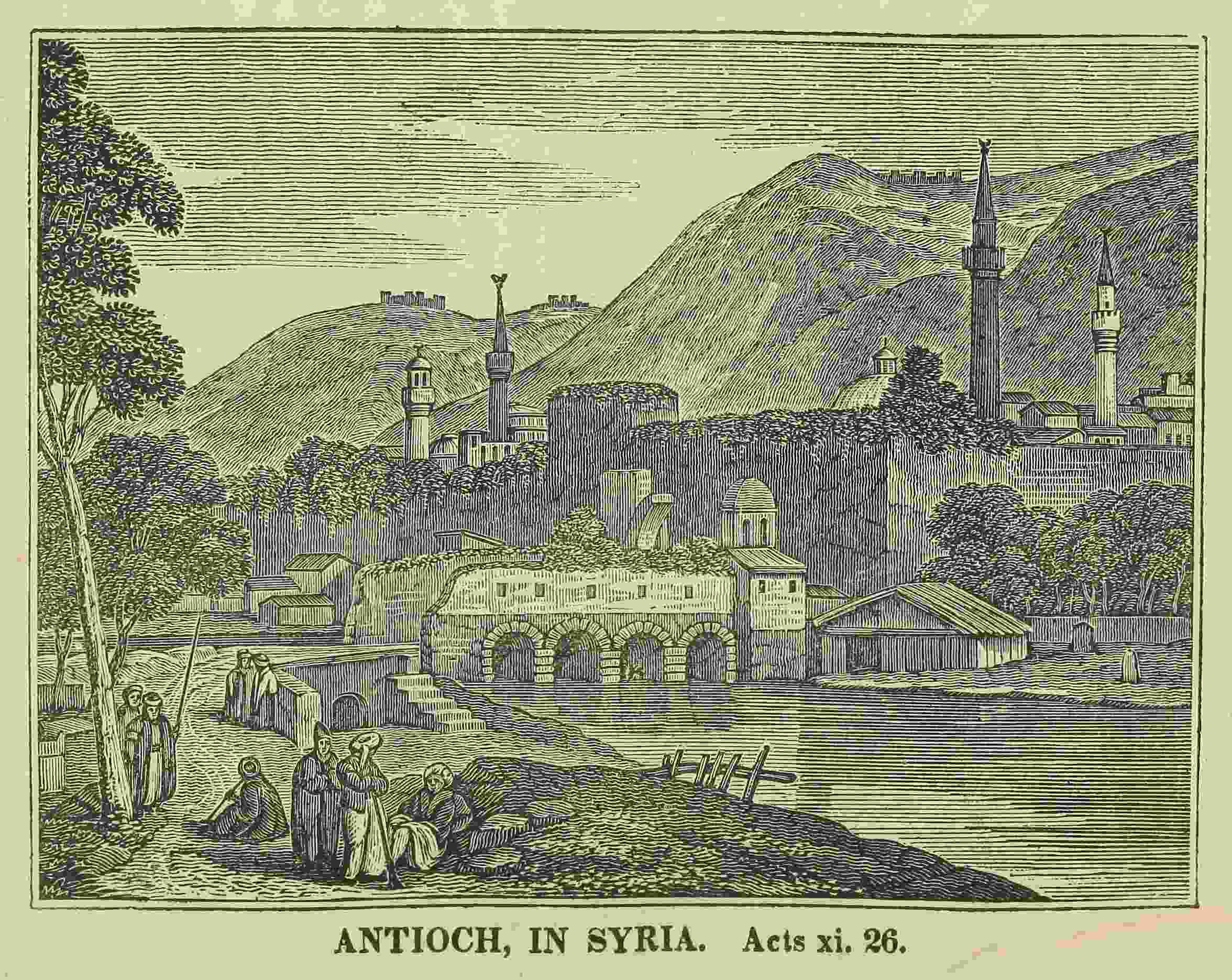
ANTIOCH, IN SYRIA. Acts xi. 26.
PETER’S VISIT TO ANTIOCH.
The historian of the Acts of the Apostles, after the narration of the preceding occurrence, makes no farther allusion to Peter; devoting himself wholly to the account of the far more extensive labors of Paul and his companions, so that for the remaining records of Peter’s life, reference must be had to other sources. These sources, however, are but few, and the results of investigations into them must be very brief.
From some passages in the first part of Paul’s epistle to the Galatians, in which he gives an account of his previous intercourse with the twelve apostles, having mentioned his own visit to Jerusalem and its results, as just described above, he speaks of Peter as coming down to Antioch, soon after, where his conduct, in some particulars, was such as to meet the very decided reprehension of Paul. On his first arrival in that Gentile city, Peter, in accordance with the liberal views taught him by the revelation at Joppa and Caesarea, mingled, without scruple, among all classes of believers in Christ, claiming their hospitalities and all the pleasures of social intercourse, making no distinction between those of Jewish and of heathen origin. But in a short time, a company of persons came down from Jerusalem, sent particularly by James, no doubt with a reference to some especial observations on the behavior of the chief apostle, to see how it accorded with the Jerusalem standard of demeanor towards those, whom, by the Mosaic law, he must consider improper persons for the familiar intercourse of a Jew. Peter, probably knowing that they were disposed to notice his conduct critically on these matters of ceremonial punctilio, prudently determined to quiet these censors by avoiding all occasion for any collision with their prejudices. Before their arrival, he had mingled freely with the Grecian and Syrian members of the Christian community, eating with them, and conforming to their customs as far as was convenient for unrestrained social intercourse. But he now withdrew himself from their society, and kept himself much more retired than when free from critical observation. The sharp-eyed Paul, on noticing this sudden change in Peter’s habits, immediately attacked him with his characteristic boldness, charging him with unworthy dissimulation, in thus accommodating his behavior to the whims of these sticklers for Judaical strictness of manners. The common supposition has been, that Peter was here wholly in the wrong, and Paul wholly in the right: a conclusion by no means justified by what is known of the facts, and of the characters of the persons concerned. Peter was a much older man than Paul, and much more disposed by his cooler blood, to prudent and careful measures. His long personal intercourse with Jesus himself, also gave him a great advantage over Paul, in judging of what would be the conduct in such a case most conformable to the spirit of his divine Master; nor was his behavior marked by anything discordant with real honesty. The precept of Christ was, “Be wise as serpents;” and a mere desire to avoid offending an over-scrupulous brother in a trifling matter, implied no more wariness than that divine maxim inculcated, and was, moreover, in the spirit of what Paul himself enjoined in very similar cases, in advising to avoid “offending a brother by eating meat which had been offered in sacrifice to idols.” There is no scriptural authority to favor the opinion that Peter ever acknowledged he was wrong; for all that Paul says is――“I rebuked him,”――but he does not say what effect it had on one who was an older and wiser man than his reprover, and quite as likely to be guided by the spirit of truth. It is probable, however, that Peter had something to say for himself; since it is quite discordant with all common ideas, to suppose that a great apostle would, in the face of those who looked up to him as a source of eternal truth, act a part which implied an unjustifiable practical falsehood. After all, the difference seems to have been on a point of very trifling importance, connected merely with the ceremonials of familiar intercourse, between individuals of nations widely different in manners, habits, prejudices, and the whole tenor of their feelings, as far as country, language and education, would affect them; and a fair consideration of the whole difficulty, by modern ethical standards, will do much to justify Peter in a course designed to avoid unnecessary occasions of quarrel, until the slow operations of time should have worn away all these national prejudices,――the rigid sticklers quietly accommodating themselves to the neglect of ceremonies, which experience would prove perfectly impracticable among those professing the free faith of Christ.
HIS RESIDENCE IN BABYLON.
The first epistle of Peter contains at the close a general salutation from the church in Babylon, to the Christians of Asia Minor, to whom it was addressed. From this, the unquestioned inference is, that Peter was in that city when he wrote. The only point mooted is, whether the place meant by this name was Babylon on the Euphrates, or some other city commonly designated by that name. The most irrational conjecture on the subject, and yet the one which has found most supporters, is, that this name is there used in a spiritual or metaphorical sense for Rome, whose conquests, wide dominion, idolatries, and tyranny over the worshipers of the true God, were considered as assimilating it to the ancient capital of the eastern world. But, in reference to such an unparalleled instance of useless allegory, in a sober message from one church to a number of others, serving as a convenient date for a letter, it should be remembered that at that time there were at least two distinct, important places, bearing the name of Babylon,――so well known throughout the east, that the simple mention of the name would at once suggest to a common reader, one of these as the place seriously meant. One of these was that which stood on the site of the ancient Chaldean Babylon, a place of great resort to the Jews, finally becoming to them, after the destruction of Jerusalem, a great city of refuge, and one of the two great capitals of the Hebrew faith, sharing only with Tiberias the honors of its literary and religious pre-eminence. Even before that, however, as early as the time of Peter, it was a city of great importance and interest in a religious point of view, offering a most ample and desirable field for the labors of the chief apostle, now advancing in years, and whose whole genius, feelings, religious education and national peculiarities, qualified him as eminently for this oriental scene of labor, as those of Paul fitted him for the triumphant advancement of the Christian faith among the polished and energetic races of the mighty west. Here, then, it seems reasonable and pleasant to imagine, that in this glorious “clime of the east,”――away from the bloody strife between tyranny and faction, that distracted and desolated the once blessed land of Israel’s heritage, during the brief delay of its awful doom,――among the scenes of that ancient captivity, in which the mourning sons of Zion had drawn high consolation and lasting support from the same word of prophecy, which the march of time in its solemn fulfilments had since made the faithful history of God’s believing people,――here the chief apostle calmly passed the slow decline of his lengthened years. High associations of historical and religious interest gave all around him a holy character. He sat amid the ruins of empires, the scattered wrecks of ages,――still in their dreary desolation attesting the surety of the word of God. From the lonely waste, mounded with the dust of twenty-three centuries, came the solemn witness of the truth of the Hebrew seers, who sung, over the highest glories of that plain in its brightest days, the long-foredoomed ruin that at last overswept it with such blighting desolation. Here, mighty visions of the destiny of worlds, the rise and fall of empire, rose on the view of Daniel and Ezekiel, whose prophetic scope, on this vast stage of dominion, expanded far beyond the narrow limits that bounded all the future in the eyes of the sublimest of those prophets, whose whole ideas of what was great were taken from the little world of Palestine. Like them, too, the apostolic chief lifted his aged eyes above the paltry commotions and troubles of his own land and times, and glanced far over all, to the scenes of distant ages,――to the broad view of the spiritual consummation of events,――to the final triumphs of a true and pure faith,――to the achievement of the world’s destiny.
Babylon.――The great Sir John David Michaelis enters with the most satisfactory fullness into the discussion of this locality;――with more fullness, indeed, than my crowded limits will allow me to do justice to; so that I must refer my reader to his Introduction to the New Testament, (chapter xxvii. § 4, 5,) where ample statements may be found by those who wish to satisfy themselves of the justice of my conclusion about the place from which this epistle was written. He very ably exposes the extraordinary absurdity of the opinion that this date was given in a mystical sense, at a time when the ancient Babylon, on the Euphrates, was still in existence, as well as a city on the Tigris, Seleucia, to which the name of modern Babylon was given. And he might have added, that there was still another of this name in Egypt, not far from the great Memphis, which has, by Pearson and others, been earnestly defended as the Babylon from which Peter wrote. Michaelis observes, that through some mistake it has been supposed, that the ancient Babylon, in the time of Peter, was no longer in being; and it is true that in comparison with its original splendor, it might be called, even in the first century, a desolated city; yet it was not wholly a heap of ruins, nor destitute of inhabitants. This appears from the account which Strabo, who lived in the time of Tiberius, has given of it. This great geographer compares Babylon to Seleucia, saying, “At present Babylon is not so great as Seleucia,” which was then the capital of the Parthian empire, and, according to Pliny, contained six hundred thousand inhabitants. The acute Michaelis humorously remarks, that “to conclude that Babylon, whence Peter dates his epistle, could not have been the ancient Babylon, because this city was in a state of decay, and thence to argue that Peter used the word mystically, to denote Rome, is about the same as if, on the receipt of a letter dated from Ghent or Antwerp, in which mention was made of a Christian community there, I concluded that because these cities are no longer what they were in the sixteenth century, the writer of the epistle meant a spiritual Ghent or Antwerp, and that the epistle was really written from Amsterdam.” And in the next section he gives a similar illustration of this amusing absurdity, equally apt and happy, drawn in the same manner from modern places about him, (for Goettingen was the residence of the immortal professor.) “The plain language of epistolary writing does not admit of figures of poetry; and though it would be very allowable in a poem, written in honor of Goettingen, to style it another Athens, yet if a professor of this university should, in a letter written from Goettingen, date it Athens, it would be a greater piece of pedantry than any learned man was ever yet guilty of. In like manner, though a figurative use of the word Babylon is not unsuitable to the animated and poetical language of the Apocalypse, yet in a plain and unadorned epistle, Peter would hardly have called the place whence he wrote, by any other appellation than that which literally and properly belonged to it.” (Michaelis, Introduction to the New Testament, Marsh’s translation, chapter xxvii. § 4, 5.)
The most zealous defender of this mere popish notion of a mystical Babylon, is, alas! a Protestant. The best argument ever made out in its defense, is that by Lardner, who in his account of Peter’s epistles, (History of the Apostles and Evangelists, chapter xix. § 3,) does his utmost to maintain the mystical sense, and may be well referred to as giving the best possible defense of this view. But the course of Lardner’s great work having led him, on all occasions, to make the most of the testimonies of the fathers, in connection with the establishment of the credibility of the gospel history, he seems to have been unable to shake off this reverence of every thing which came on authority as old as Augustin; and his critical judgment on the traditionary history of Christianity is therefore worth very little. Any one who wishes to see all his truly elaborate and learned arguments fairly met, may find this done by a mind of far greater originality, critical acuteness and biblical knowledge, (if not equal in acquaintance with the fathers,) and by a far sounder judgment, in Michaelis, as above quoted, who has put an end to all dispute on these points, by his presentation of the truth. So well settled is this ground now, that we find in the theology of Romish writers most satisfactory refutations of an error, so convenient for the support of Romish supremacy. The learned Hug (pronounced very nearly like “Hookh;” U sounded as in bull, and G strongly aspirated) may here be referred to for the latest defense of the common sense view. (Introduction vol. II. § 165.) In answer to the notion of an Egyptian Babylon, he gives us help not to be found in Michaelis, who makes no mention of this view. Lardner also quotes from Strabo what sufficiently shows, that this Babylon was no town of importance, but a mere military station for one of the three Roman legions which guarded Egypt.
The only other place that could in any way be proposed as the Babylon of Peter, is Seleucia on the Tigris; but Michaelis has abundantly shown that though in poetical usage in that age, and in common usage afterwards, this city was called Babylon, yet in Peter’s time, grave prose statements would imply the ancient city and not this. He also quotes a highly illustrative passage from Josephus, in defense of his views; and which is of so much the more importance because Josephus was a historian who lived in the same age with Peter, and the passage itself relates to an event which took place thirty-six years before the Christian era; namely, “the delivery of Hyrcanus, the Jewish high priest, from imprisonment, with permission to reside in Babylon, where there was a considerable number of Jews.” (Josephus, Antiquities, XV. ii. 2.) Josephus adds, that “both the Jews in Babylon and all who dwelt in that country, respected Hyrcanus as high priest and king.” That this was the ancient Babylon and not Seleucia, appears from the fact, that wherever else he mentions the latter city, he calls it Seleucia.
Wetstein’s supposition that Peter meant the province of Babylon, being suggested only by the belief that the ancient Babylon did not then exist, is, of course, rendered entirely unnecessary by the proof of its existence.
Besides the great names mentioned above, as authorities for the view which I have taken, I may refer also to Beza, Lightfoot, Basnage, Beausobre, and even Cave, in spite of his love of Romish fables.
To give a complete account of all the views of the passage referring to Babylon, (1 Peter v. 13,) I should also mention that of Pott, (on the cath. epist.,) mentioned by Hug. This is that by the phrase in the Greek, ἡ εν Βαβυλωνι συνεκλεκτη, is meant “the woman chosen with him in Babylon,” that is, Peter’s wife; as if he wished to say, “my wife, who is in Babylon, salutes you;” and Pott concludes that the apostle himself was somewhere else at the time. For the answer to this notion, I refer the critical to Hug. This same notion had been before advanced by Mill, Wall, and Heumann, and refuted by Lardner. (Supp. xix. 5.)
HIS FIRST EPISTLE.
Inspired by such associations and remembrances, and by the spirit of simple truth and sincerity, Peter wrote his first epistle, which he directed to his Jewish brethren in several sections of Asia Minor, who had probably been brought under his ministry only in Jerusalem, on their visits there in attendance on the great annual feasts, which in all years, as in that of the Pentecost on which the Spirit was outpoured, came up to the Holy city to worship; for there is no proof whatever, that Peter ever visited those countries to which he sent this letter. The character of the evidence offered, has been already mentioned. These believers in Christ had, during their annual visits to Jerusalem for many years, been in the habit of seeing there this venerable apostolic chief, and of hearing from his lips the gospel truth. But the changes of events having made it necessary for him to depart from Jerusalem to the peaceful lands of the east, the annual visitors of the Holy city from the west, no longer enjoyed the presence and the spoken words of this greatest teacher. To console them for this loss, and to supply that spiritual instruction which seemed most needful to them in their immediate circumstances, he now wrote to them this epistle; the main purport of which seems to be, to inspire them with courage and consolation, under some weight of general suffering, then endured by them or impending over them. Indeed, the whole scope of the epistle bears most manifestly on this one particular point,――the preparation of its readers, the Christian communities of Asia Minor, for heavy sufferings. It is not, to be sure, without many moral instructions, valuable in a mere general bearing, but all therein given have a peculiar force in reference to the solemn preparation for the endurance of calamities, soon to fall on them. The earnest exhortations which it contains, urging them to maintain a pure conscience, to refute the calumnies of time by innocence,――to show respect for the magistracy,――to unite in so much the greater love and fidelity,――with many others, are all evidently intended to provide them with the virtues which would sustain them under the fearful doom then threatening them. In the pursuance of the same great design, the apostle calls their attention with peculiar earnestness to the bright example of Jesus Christ, whose behavior in suffering was now held up to them as a model and guide in their afflictions. With this noble pattern in view, the apostle calls on them to go on in their blameless way, in spite of all that affliction might throw in the path of duty.
No proof that he ever visited them.――The learned Hug, truly catholic (but not papistical) in his views of these points, though connected with the Roman church, has honestly taken his stand against the foolish inventions on which so much time has been spent above. He says, “Peter had not seen the Asiatic provinces; they were situated in the circuit of Paul’s department, who had traveled through them, instructed them, and even at a distance, and in prison, did not lose sight of them.” (As witness his epistles to the Galatians, Ephesians, and Colossians, all which are comprehended within the circle to which Peter wrote.) “He was acquainted with their mode of life, foibles, virtues and imperfections; their whole condition, and the manner in which they ought to be treated.” The learned writer, however, does not seem to have fully appreciated Peter’s numerous and continual opportunities for personal communications with these converts at Jerusalem. In the brief allusion made in Acts ii. 9, 10, to the foreign Jews visiting Jerusalem at the pentecost, three of the very countries to which Peter writes, “Cappadocia, Pontus and Asia,” are commemorated with other neighboring regions, “Phrygia and Pamphylia.” Hug goes on, however, to trace several striking and interesting coincidences between this epistle and those of Paul to the Ephesians, to the Colossians and to Timothy, all which were directed to this region. (Hug’s introduction to New Testament, volume II. § 160.) He observes that “Peter is so far from denying his acquaintance with the epistles of Paul, that he even in express terms refers his readers to these compositions of his ‘beloved brother,’ (2 Peter iii. 15.) and recommends them to them.” Hug, also, in the succeeding section, (§ 161,) points out some still more remarkable coincidences between this and the epistle of James, which, in several passages, are exactly uniform. As 1 Peter i. 6, 7, and James i. 2:――1 Peter i. 24, and James i. 10:――1 Peter v. 5, 6, and James iv. 6‒10.