Volume 8 / Act 1 — THOMAS CARLYLE
Reading edition
(1795-1881)
BY LESLIE STEPHEN

he hundredth anniversary of the birth of Thomas Carlyle—(December 4th, 1795)—was lately commemorated. The house in Cheyne Walk, Chelsea, which he had occupied from 1834 till his death (February 4th, 1881), was handed over to trustees to be preserved as a public memorial. No house in the British islands has more remarkable associations. Thither Carlyle had come in his thirty-eighth year, still hardly recognized by the general public, though already regarded by a small circle as a man of extraordinary powers. There he went through the concluding years of the long struggle which ended by a hard-won and scarcely enjoyed victory. There he had been visited by almost all the most conspicuous men of letters of his time: by Jeffrey, Southey, and J. S. Mill; by Tennyson and Browning, the greatest poets, and by Thackeray and Dickens, the greatest novelists of his generation; by the dearest friends of his youth, Irving and Emerson and John Sterling, and by his last followers, Froude and Ruskin. There too had lived until 1866 the woman who had shared his struggles, whom he loved and admired without stint, and whom he was yet destined to remember with many bitter pangs of remorse. Their story, laid bare with singular fullness, has invested the scene of their joys and sorrows, their alienation and reconciliations, with extraordinary interest. Every one who has read the "Reminiscences" and the later mass of biographical matter must be glad to see the "sound-proof" room, and the garden haunted by the "demon-fowls" and the other dumb witnesses of a long tragi-comedy. No one was so keenly sensitive as Carlyle to the interest of the little gleams of light which reveal our ancestors not only stirred by the great passions, but absorbed like ourselves by the trivialities of the day. A similar interest will long attach to the scene of his own trials.
Carlyle's life was a struggle and a warfare. Each of his books was wrenched from him, like the tale of the 'Ancient Mariner,' by a spiritual agony. The early books excited the wrath of his contemporaries, when they were not ridiculed as the grotesque outpourings of an eccentric humorist. His teaching was intended to oppose what most people take to be the general tendency of thought, and yet many who share that tendency gladly acknowledge that they owe to Carlyle a more powerful intellectual stimulus than they can attribute even to their accepted teachers. I shall try briefly to indicate the general nature of his message to mankind, without attempting to consider the soundness or otherwise of particular views.
Carlyle describes what kind of person people went to see in Cheyne Row. "The very sound of my voice," he says, "has got something savage-prophetic: I am as a John the Baptist girt about with a leather girdle, whose food is locusts and wild honey." Respectable literary society at "aesthetic tea-parties" regarded him as the Scribes and Pharisees regarded the Hebrew prophet. He came among them to tear the mask from their hypocritical cant. Carlyle was not externally a Diogenes. Though the son of peasants, he had the appearance and manner of a thorough gentleman in spite of all his irritable outbreaks. But he was not the less penetrated to the core with the idiosyncrasies of his class. The father, a Davie Deans of real life, had impressed the son profoundly. Carlyle had begun life on the same terms as innumerable young Scots. Strict frugality had enabled him to get a college training and reach the threshold of the ministry. His mother could look forward to the exquisite pleasure of seeing "her own bairn wag his head in a pulpit!" But at this point Carlyle's individuality first asserted itself. He could not step into any of the ordinary grooves. His college teachers appeared to him to offer "sawdust" instead of manna from heaven. The sacred formulæ of their ancestral creed had lost their savor. Words once expressive of the strongest faith were either used to utter the bigotry of narrow pedants, or were adopted only to be explained away into insipid commonplace. Carlyle shared the intellectual movement of his time too much to profess any reverence for what he called the "Hebrew old-clothes." Philosophers and critics had torn them to rags. His quarrel however was with the accidental embodiment, not with the spirit of the old creeds. The old morality was ingrained in his very nature; nor was he shocked, like some of his fellows, by the sternness of the Calvinistic views of the universe and life. The whole problem was with him precisely to save this living spirit. The skeptics, he thought, were, in the German phrase, "emptying out the baby with the bath." They were at war with the spirit as well as with the letter; trying to construct a Godless universe; to substitute a dead mechanism for the living organism; and therefore to kill down at the root every noble aspiration which could stimulate the conscience, or strengthen a man to bear the spectacle of the wrongs and sufferings of mankind.
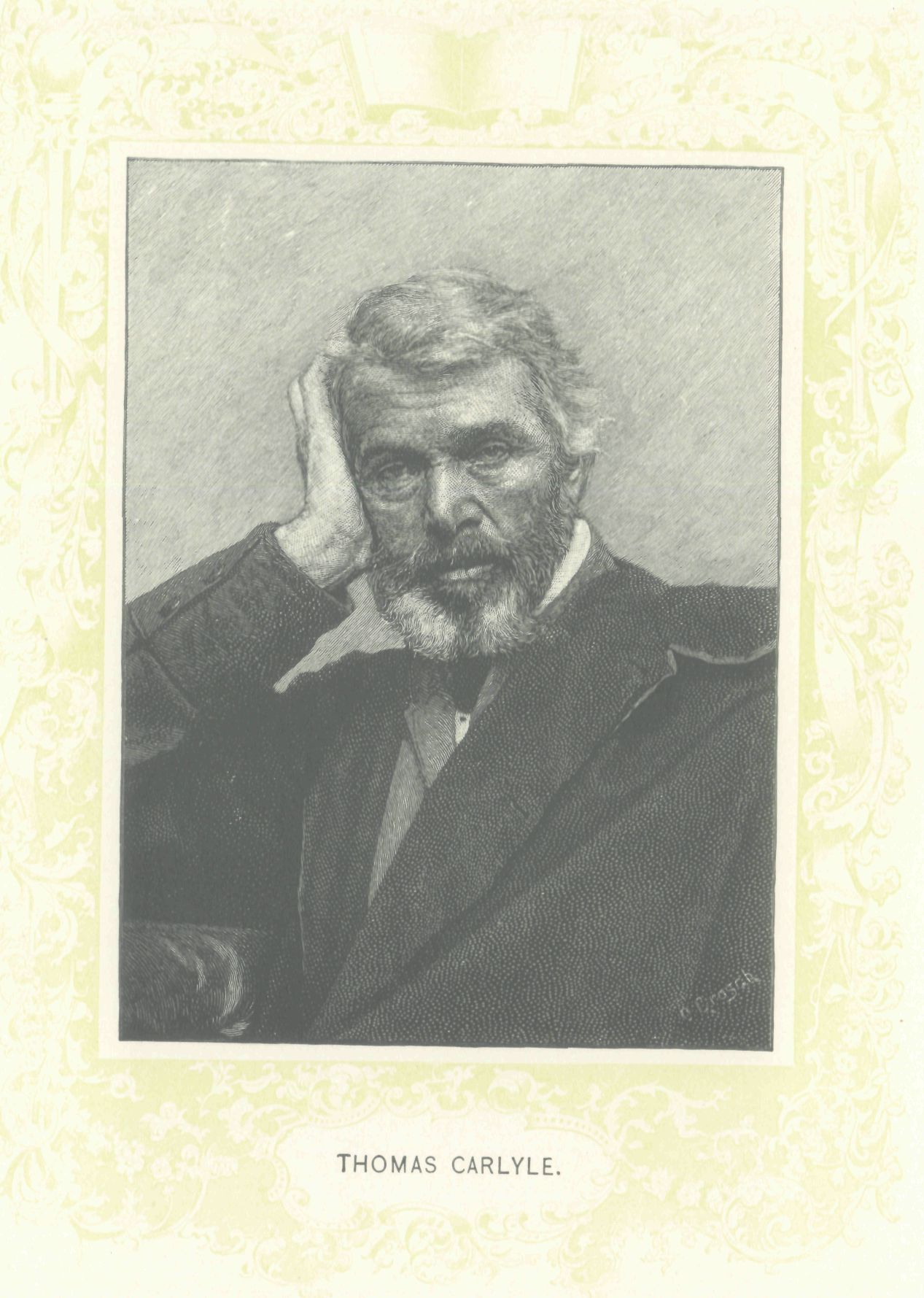
THOMAS CARLYLE.
The crisis of this struggle happened in 1821. After giving up the ministry, Carlyle had tried "schoolmastering" and found himself to be least fitted of mankind for a function which demands patience with stupidity. He had just glanced at the legal profession only to be disgusted with its chicaneries. Hack authorship was his only chance. The dyspeptic disorder which tormented him through life was tormenting him. "A rat was gnawing at the pit of his stomach." Then he was embittered by the general distress of his own class. Men out of work were threatening riots and the yeomanry being called out to suppress them. Carlyle was asked by a friend why he too did not come out with a musket. "Hm! yes," he replied, "but I haven't quite settled on which side." It was while thus distracted, that after three weeks of sleeplessness he experienced what he called his "conversion." The universe had seemed to him "void of life, of purpose, of volition, even of hostility; it was one huge and immeasurable steam-engine, rolling on in its dead indifference, to grind me limb from limb. Oh, the vast, gloomy, solitary Golgotha and mill of death!" And then he suddenly resolved to resist. Why go on trembling like a coward?—"As I so thought, there rushed a stream of fire over my whole soul, and I shook base fear away from me for ever. I was strong, of unknown strength; a spirit; almost a god: ever from that time the temper of my misery was changed; not fear or whining sorrow was in it, but indignation and grim, fell-eyed defiance." These are the phrases of his imaginary hero in 'Sartor Resartus.' In the 'Reminiscences' he repeats the statement in his own person. He had won "an immense victory"; he had escaped from the "foul mud gods" and soared into the "eternal blue of ether" where he had "for the spiritual part ever since lived." He could look down upon his fellow creatures still "weltering in that fatal element," "pitying the religious part of them and indignant against the frivolous"; enjoying an inward and supreme happiness which still remained to him, though often "eclipsed" in later years.
To understand this crisis is to understand his whole attitude. The change was not of the purely logical kind. Carlyle was not converted by any philosophical system. Coleridge, not long before, had found in Kant and Schelling an answer to similar perplexities. Carlyle, though he respected the German metaphysicians, could never find their dogmas satisfactory to his shrewd Scottish sense. His great helper, he tells us, in the strait, was not Kant but Goethe. The contrast between that serene prophet of culture and the rugged Scottish Puritan is so marked that one may be tempted to explain the influence partly by personal accident. Carlyle grew up at a time when the British public was just awaking to the existence of Germany; and not only promoted the awakening but was recognized by the great Goethe himself. He may well have been inclined in later years to exaggerate a debt due to so welcome a recognition. And yet it is intelligible that in Goethe, Carlyle saw what he most required. A man of the highest genius and a full representative of the most advanced thought could yet recognize what was elevating in the past as clearly as what was the true line of progress for us to pursue; and while casting aside the dead trappings as decidedly as Carlyle, could reach serene heights above the petty controversies where men wrangled over extinct issues. Goethe had solved the problem which vexed Carlyle's soul, and set an inspiring example of the true spirit and its great reward.
Carlyle, however, was not qualified by temperament or mental characteristics to follow Goethe's steps. If not primarily a reasoner, and too impatient perhaps for slow logical processes, he was also not a poet. Some of the greatest English teachers of his period embodied their conceptions of the world in poetry. Wordsworth and Shelley and Byron, in particular, were more effective representatives of the chief spiritual influences of the day than the few speculative writers. Carlyle thought for a time that he could utter himself in verse, or at least in prose fiction. He tried, only to feel his incompetence. As Froude observes, he had little ear for metrical composition. There were other and perhaps greater obstacles. A poet must be capable of detachment from the actual world in which he lives, however profound his interest in its great problems. He must be able to dwell with "seraph contemplation" and stand aside from the actual contest. To Carlyle such an attitude was partly impossible, partly contemptible. He had imbibed the Puritan aversion to æsthetic enjoyments. He had been brought up in circles where it was thought wrong for a child to read the 'Arabian Nights,' and where Milton could only obtain a doubtful admission as a versifier of the Scriptural narrative. Carlyle retained the prejudice. He always looked askance at poetry which had no immediate bearing upon conduct, and regarded "æsthetic" as equivalent to frivolous. "May the devil fly away with the fine arts" is a sentiment which he quotes with cordial sympathy. This view was congenial to his inborn characteristics.
One striking peculiarity was his extraordinary "receptivity" of all outward impressions. The strange irritability which he set down to the "hag Dyspepsia" made him resemble a patient in whom disease has produced a morbidly excessive sensibility. Little annoyances were magnified into tragic dimensions. The noises in a next-door house affected him as an earthquake might affect others. His memory was as retentive as his impressions were strong. Froude testifies that his account of a little trip to Paris, written forty years later without reference to memoranda, is verified down to the minutest details by contemporary letters. Scenes instantaneously photographed on his memory never faded. No one had a keener eye for country. When he visited Germany he brought back pictures of the scenes of Frederick's battles, which enabled him to reproduce them with such startling veracity that after reading you seem to remember the reality, not the book. In history he seeks to place before us a series of visions as distinct as actual eyesight: to show us Cromwell watching the descent of the Scottish army at Dunbar, or the human whirlpool raging round the walls of the Bastille. We—the commonplace spectators—should not, it is true, even at present see what was visible to Carlyle, any more than we see a landscape as Turner saw it. We may wish that we could. At any rate, we have the conviction of absolute truthfulness to the impression made on a powerful idiosyncrasy. We perceive, as by the help of a Rembrandt, vast chaotic breadths of gloomy confusion, with central figures thrown out by a light of extraordinary brilliancy. Carlyle, indeed, always has it in mind that what we call reality is but a film on the surface of mysterious depths. We are such stuff, to repeat his favorite quotation, as dreams are made of. Past history is a series of dreams; the magic of memory may restore them for an instant to our present consciousness. But the most vivid picture of whatever is not irrecoverably lost always brings, too, the pathetic sense that we are after all but ephemeral appearances in the midst of the eternities and infinities. Overwhelmed by this sense of the unsubstantiality even of the most real objects, Carlyle clutches, as it were with the energy of despair, every fading image; and tries to invest it with something of its old brightness. Carlyle was so desirous to gain this distinctness of vision that he could not be happy in personal descriptions till, if possible, he had examined the portrait of his hero and satisfied himself that he could reproduce the actual bodily appearance. The face, he holds, shows the soul. And then his shrewd Scottish sagacity never deserts him. If the hero sometimes becomes, like most heroes, a little too free from human infirmities, the actors in his dramas never become mere walking gentlemen. In Dryasdust he gives us lay figures, bedizened at times with shallow paradoxes; but Carlyle always deals in genuine human nature. His judgment may not be impartial, but at least it is not nugatory. He sees the man from within and makes him a credible individual, not a mere bit of machinery worked by colorless formulæ. With this eye for character goes the keen sense of grim humor which keeps him in touch with reality. Little incidents bring out the absurd side of even the heroic. The most exciting scenes of his 'French Revolution' are heightened by the vision of the shivering usher who "accords the grand entries" when the ferocious mob is rushing into the palace—not "finding it convenient," as Carlyle observes, "to refuse them"; and of the gentleman who continues for an hour to "demand the arrestment of knaves and dastards"—a most comprehensive of all known petitions. Carlyle's "mannerism" is one result of this strain to be graphic. It has been attributed to readings of Jean Paul, and by Carlyle himself, partly to Irving and partly to the early talk in his father's home. It appears at any rate as soon as Carlyle gets confidence enough in himself to trust to his own modes of impression; and if it may fairly be called a mannerism, was not an affectation. It was struck out in the attempt to give most effective utterance to his genuine thought, and may be compared, as Burke said of Johnson's conversation, to the "contortions of the Sibyl."
It is time, however, to try to say what was the prophetic message thus delivered. Carlyle, I have said, had no logical system of philosophy, and was too much of a "realist" (in one sense) to find poetry congenial. He has to preach by pictures of the past; by giving us history, though history transfused with poetry; an account of the external fact which shall reveal the real animating principle, quietly omitted by statisticians and constitutional historians. The doctrine so delivered appears to be vague. What, the ordinary believer may ask, would be left of a religion if its historical statements should turn out to be mere figments and its framework of dogmas to be nonsense? He would naturally reply, Nothing. Carlyle replies, Everything. The spirit may survive, though its whole visible embodiment should be dissolved into fiction and fallacy. But to define this spirit is obviously impossible. It represents a tone of thought, a mode of contemplating life and the world, not any distinct set of definite propositions. Carlyle was called a "mystic," and even, as he says, was made into a "mystic school." We may accept the phrase, so far as mysticism means the substitution of a "logic of the heart" for a "logic of the head"—an appeal to sentiment rather than to any definite reasoning process. The "mystic" naturally recognizes the inner light as shining through many different and even apparently contradictory forms. But most mystics retain, in a new sense perhaps, the ancient formulæ. Carlyle rejected them so markedly that he shocked many believers, otherwise sympathetic. His early friend Irving, who tried to restore life to the old forms, and many who accepted Coleridge as their spiritual guide, were scandalized by his utterances. He thought, conversely, that they were still masquerading in "Hebrew old-clothes," or were even like the apes who went on chattering by the banks of the Dead Sea, till they ceased to be human. He regards the "Oxford movement" with simple contempt. His dictum that Newman had "no more brain than a moderate-sized rabbit" must have been followed, as no one will doubt who heard him talk, by one of those gigantic explosions of laughter which were signals of humorous exaggeration. But it meant in all seriousness that he held Newman to be reviving superstitions unworthy of the smallest allowance of brain.
Yet Carlyle's untiring denunciation of "shams" and "unrealities" of this, as of other varieties, does not mean unqualified antipathy. He feels that the attempt to link the living spirit to the dead externals is a fatal enterprise. That may be now a stifling incumbrance, which was once the only possible symbol of a living belief. Accordingly, though Carlyle's insistence upon the value of absolute intellectual truthfulness is directed against this mode of thought, his attack upon the opposite error is more passionate and characteristic. The 'Sartor Resartus,' his first complete book (1833-4), announced and tried to explain his "conversion." To many readers it still seems his best work, as it certainly contains some of his noblest passages. It was unpopular in England, and (an Englishman must say it with regret) seems to have been first appreciated in America. It gave indeed many sharp blows at English society: it expresses his contempt for the upper literary strata, who like Jeffrey complained of him for being so "desperately in earnest"; and for the authors, who were not "prophets," but mere caterers to ephemeral amusement. But the satire, I cannot but think, is not quite happy. The humor of the "Clothes Philosophy" is a little strained; to me, I confess, rather tiresome: and the impressive passages just those where he forgets it.
His real power became obvious beyond all cavil on the publication of the 'French Revolution' (1837). Not for a hundred years, he declared, had the public received any book that "came more direct and flamingly from the heart of a living man." That expresses, as I think, the truth. The book is not to be "read for information." The facts would now require much restatement; and moreover, the narrative is too apt to overleap prosaic but necessary facts in order to fasten upon the picturesque passages. But considered as what it is, a "prose epic," a moving panorama, drawn with astonishing force and perception of the tremendous tragi-comedy involved, it is unequaled in English literature. The doctrine inculcated is significant. Carlyle's sympathies were in one sense with the Revolution. He felt, he says, that the Radicals were "guild-brothers," while the Whigs were mere "amateurs." He was even more thoroughly convinced than the Radicals that a thoroughgoing demolition of the old order was essential. The Revolution was but the first volcanic outburst of the great forces still active below the surface. Europe, he says ('Chartism'), lay "hag-ridden" and "quack-ridden." The quack is the most hideous of hags; he is a "falsehood incarnate." To blow him and his to the four winds was the first necessity. The French Revolution was "the inevitable stern end of much: the fearful but also wonderful, indispensable, and sternly beneficent beginning of much." So far, Carlyle was far more in agreement with Paine than with Burke. But what was to follow when the ground was cleared? When you have cut off your king's head and confiscated the estates of the nobility and the church, you have only begun. A new period is to be born with death-throes and birth-throes, and there are, he guesses ('French Revolution,' Book iv., chapter 4), some two centuries of fighting before "Democracy go through its dire, most baleful stage of 'Quackocracy.'" The radicals represent this coming "Quackocracy." What was their root error? Briefly (I try to expound, not to enlarge), that they were materialists. Their aim was low. They desired simply a multiplication of physical comforts, or as he puts it, a boundless supply of "pigs-wash." Their means too were futile. Society, on their showing, was a selfish herd hungering for an equal distribution of pigs-wash. They put unlimited faith in the mere mechanism of constitution-mongering; in ballot-boxes and manipulation of votes and contrivances by which a number of mean and selfish passions might be somehow so directed as to balance each other. It is not by any such devices that society can really be regenerated. You must raise men's souls, not alter their conventions. They must not simply abolish kings, but learn to recognize the true king, the man who has the really divine right of superior strength and wisdom, not the sham divine right of obsolete tradition. You require not paper rules, but a new spirit which spontaneously recognizes the voice of God. The true secret of life must be to him, as to every "mystic," that we should follow the dictates of the inner light which speaks in different dialects to all of us.
But this implies a difficulty. Carlyle, spite of his emergence into "blue ether," was constitutionally gloomy. He was more alive than any man since Swift to the dark side of human nature. The dullness of mankind weighed upon him like a nightmare. "Mostly fools" is his pithy verdict upon the race at large. Nothing then could be more idle than the dream of the revolutionists that the voice of the people could be itself the voice of God. From millions of fools you can by no constitutional machinery extract anything but folly. Where then is the escape? The millions, he says (essay on Johnson), "roll hither and thither, whithersoever they are led"; they seem "all sightless and slavish," with little but "animal instincts." The hope is that, here and there, are scattered the men of power and of insight, the heaven-sent leaders; and it is upon loyalty to them and capacity for recognizing and obeying them that the future of the race really depends. This was the moral of the lectures on 'Hero-Worship' (1840). Odin, Mahomet, Dante, Shakespeare, Luther, Cromwell, and Napoleon, are types of the great men who now and then visit the earth as prophets or rulers. They are the brilliant centres of light in the midst of the surrounding darkness; and in loyal recognition of their claims lies our security for all external progress. By what signs, do you ask, can they be recognized? There can be no sign. You can see the light if you have eyes; but no other faculty can supply the want of eyesight. And hence arise some remarkable points both of difference from and coincidence with popular beliefs.
In the 'Chartism,' 'Past and Present,' and 'Latter-Day Pamphlets' (1839, 1843, and 1850), Carlyle applied his theories to the problems of the day. They had the disadvantage which generally attaches to the writings of an outsider in politics. They were, said the average reader, "unpractical." Carlyle could not recommend any definite measures; an objection easy to bring against a man who urges rather a change of spirit than of particular measures. Yet it is noticeable that he recommends much that has since become popular. Much of his language might be used by modern Socialists. In 'Past and Present,' for example (Book iii., Chapter 8), he gives the principle of "land nationalization." The great capitalist is to be turned into a "captain of industry," and government is to undertake to organize labor, to protect health, and to enforce education. Carlyle so far sympathizes with the Socialist, not only as agreeing that the great end of government is the raising of the poor, but as denouncing the laissez-faire doctrine. The old-fashioned English Radical had regarded all government as a necessary evil, to be minimized as much as possible. When it had armed the policemen, it had fulfilled its whole duty. But this, according to Carlyle, was to leave the "dull multitude" to drift into chaos. Government should rest upon the loyalty of the lower to the higher. Order is essential; and good order means the spontaneous obedience to the heaven-sent hero. He, when found, must supply the guiding and stimulating force. The Socialist, like Carlyle, desires a strong government, but not the government of the "hero." Government of which the moving force comes from above instead of below will be, he thinks, a government of mere force. And here occurs the awkward problem to which Carlyle is constantly referring. He was generally accused of identifying "right" with "might." Against this interpretation he always protested. Right and Might, he says often, are in the long run identical. That which is right and that alone is ultimately lasting. Your rights are the expression of the divine will; and for that reason, whatever endures must be right. Work lasts so far as it is based upon eternal foundations. The might, therefore, is in the long run the expression of the right. The Napoleonic empire, according to a favorite illustration, could not last because it was founded upon injustice. The two tests then must coincide: what is good proves itself by lasting, and what lasts, lasts because good; but the test of endurance cannot, it is clear, be applied when it is wanted. Hence arises an ambiguity which often gives to Carlyle the air of a man worshiping mere success; when, if we take his own interpretation, he takes the success to be the consequence, not the cause, of the rightness. The hero is the man who sees the fact and disregards the conventional fiction; but for the moment he looks very like the man who disregards principles and attends to his own interest.
Here again Carlyle approximates to a doctrine to which he was most averse, the theory of the struggle for existence and the survival of the fittest. The Darwinian answers in this way Carlyle's problem, how it is to come to pass that the stupidity of the masses comes to blunder into a better order? Here and there, as in his accounts of the way in which the intensely stupid British public managed to blunder into the establishment of a great empire, Carlyle seems to fall in with the Darwinian view. That view shocked him because he thought it mechanical. To him the essence of history was to be found not in the blind striving of the dull, but in the lives of great men. They represent the incarnate wisdom which must guide all wholesome aspiration. History is really the biography of the heroes. All so-called philosophies of history, attempts to discover general laws and to dispense with the agency of great men, are tainted with materialism. They would substitute "blind laws" for the living spirit which really guides the development of the race. But if you ask how your hero is to be known, the only answer can be, Know him at your peril.
Carlyle's most elaborate books, the 'Cromwell' and the 'Frederick,' are designed to give an explicit answer to the "right" and "might" problem. Carlyle in both cases seems to be toiling amidst the dust-heaps of some ancient ruin, painfully disinterring the shattered and defaced fragments of a noble statue and reconstructing it to be hereafter placed in a worthy Valhalla. Cromwell, according to the vulgar legend, was a mere hypocrite, and Frederick a mere cynical conqueror. The success of both—that is his intended moral—was in proportion to the clearness with which they recognized the eternal laws of the universe. Cromwell probably is the more satisfactory hero, as more really sympathetic to his admirer. But each requires an interpreter. Cromwell's gifts did not lie in the direction of lucid utterance; and Frederick, if he could have read, would certainly have scorned, the doctrine of his eulogist. Carlyle, that is, has to dig out in the actions of great men a true significance, certainly not obvious to the actors themselves. Their recognition of the eternal laws was in one case embodied in obsolete formulæ, and in the other, it might seem, altogether unconscious. The hero's recognition of divine purposes does not imply then that his own vision is purged from error, or that his aim is distinctly realized. He may, like Mahomet or the Abbot Sampson, be full of superstition. His "veracity" does not mean that his beliefs are true; only that they are sincere and such a version of the truth as is possible in his dialect. This is connected with Carlyle's constant insistence upon the superiority of silence to speech. The divine light shines through many distracting media; it enlightens many who do not consciously perceive it. It may be recognized because it gives life; because the work to which it prompts is lasting. But even the hero who tries to utter himself is sure to interpolate much that is ephemeral, confused, and imperfect; and speech in general represents the mere perplexed gabble of men who take words for thought, and raise a hopeless clamor which drowns the still small voice of true inspiration. If men are mostly fools, their talk is mostly folly; forming a wild incoherent Babel in which it is hard to pick out the few scattered words of real meaning. Carlyle has been ridiculed for preaching silence in so many words; but then Carlyle was speaking the truth, and of that, he fully admits, we can never have too much. The hero may be a prophet, or a man of letters. He is bound to speak seriously, though not to be literally silent; and his words must be judged not by the momentary pleasure, but by their ultimate influence on life.
Carlyle's message to his fellows, which I have tried imperfectly to summarize, may be condemned on grounds of taste and of morality. Translated into logical formulæ it becomes inconsistent, and it embodies some narrow prejudices in exaggerated terms. Yet I think that it has been useful even by the shock it has given to commonplace optimism. It has been far more useful because in his own dialect, Carlyle—as I think—expresses some vital truths with surpassing force. Whatever our creeds, religious or political, he may stimulate our respect for veracity, in the form of respect for honest work or contempt for hypocritical conventions; our loyalty to all great leaders, in the worlds both of thought and action; and our belief that to achieve any real progress, something is required infinitely deeper than any mere change in the superficial arrangements of society. These lessons are expressed, too, as the merely literary critic must admit, by a series of historical pictures, so vivid and so unique in character that for many readers they are in the full sense fascinating. They are revelations of new aspects of the world, never, when once observed, to be forgotten. And finally, I may add that Carlyle's autobiographical writings—in which we must include the delightful 'Life of Sterling'—show the same qualities in a shape which, if sometimes saddening, is profoundly interesting. No man was more reticent in his life, though he has been made to deliver a posthumous confession of extraordinary fullness. We hear all the groans once kept within the walls of Cheyne Row. After making all allowance for the fits of temper, the harshness of judgment, and the willful exaggeration, we see at last a man who under extraordinary difficulties was unflinchingly faithful to what he took to be his vocation, and struggled through a long life, full of anxieties and vexations, to turn his genius to the best account.
LABOR
From 'Past and Present'
For there is a perennial nobleness, and even sacredness, in Work. Were he never so benighted, forgetful of his high calling, there is always hope in a man that actually and earnestly works: in Idleness alone is there perpetual despair. Work, never so Mammonish, mean, is in communication with Nature; the real desire to get Work done will itself lead one more and more to truth, to Nature's appointments and regulations, which are truth.
The latest Gospel in this world is, Know thy work and do it. "Know thyself": long enough has that poor "self" of thine tormented thee; thou wilt never get to "know" it, I believe! Think it not thy business, this of knowing thyself; thou art an unknowable individual: know what thou canst work at; and work at it like a Hercules! That will be thy better plan.
It has been written, "An endless significance lies in Work;" a man perfects himself by working. Foul jungles are cleared away, fair seed-fields rise instead, and stately cities; and withal the man himself first ceases to be jungle and foul unwholesome desert thereby. Consider how even in the meanest sorts of Labor, the whole soul of a man is composed into a kind of real harmony the instant he sets himself to work! Doubt, Desire, Sorrow, Remorse, Indignation, Despair itself, all these like hell-dogs lie beleaguering the soul of the poor day-worker, as of every man: but he bends himself with free valor against his task, and all these are stilled, all these shrink murmuring far off into their caves. The man is now a man. The blessed glow of Labor in him, is it not as purifying fire, wherein all poison is burnt up, and of sour smoke itself there is made bright blessed flame!
Destiny, on the whole, has no other way of cultivating us. A formless Chaos, once set it revolving, grows round and ever rounder; ranges itself by mere force of gravity into strata, spherical courses; is no longer a Chaos, but a round compacted World. What would become of the Earth did she cease to revolve? In the poor old Earth, so long as she revolves, all inequalities, irregularities, disperse themselves; all irregularities are incessantly becoming regular. Hast thou looked on the Potter's wheel,—one of the venerablest objects; old as the Prophet Ezekiel and far older? Rude lumps of clay, how they spin themselves up, by mere quick whirling, into beautiful circular dishes. And fancy the most assiduous Potter, but without his wheel; reduced to make dishes, or rather amorphous botches, by mere kneading and baking! Even such a Potter were Destiny, with a human soul that would rest and lie at ease, that would not work and spin! Of an idle unrevolving man the kindest Destiny, like the most assiduous Potter without wheel, can bake and knead nothing other than a botch; let her spend on him what expensive coloring, what gilding and enameling she will, he is but a botch. Not a dish; no, a bulging, kneaded, crooked, shambling, squint-cornered, amorphous botch,—a mere enameled vessel of dishonor! Let the idle think of this.
Blessed is he who has found his work; let him ask no other blessedness. He has a work, a life-purpose; he has found it, and will follow it! How, as a free-flowing channel, dug and torn by noble force through the sour mud-swamp of one's existence, like an ever-deepening river there, it runs and flows;—draining off the sour festering water gradually from the root of the remotest grass-blade; making, instead of pestilential swamp, a green fruitful meadow with its clear-flowing stream. How blessed for the meadow itself, let the stream and its value be great or small! Labor is Life: from the inmost heart of the Worker rises his God-given Force, the sacred celestial Life-essence breathed into him by Almighty God; from his inmost heart awakens him to all nobleness,—to all knowledge, "self-knowledge" and much else, so soon as Work fitly begins. Knowledge? The knowledge that will hold good in working, cleave thou to that; for Nature herself accredits that, says Yea to that. Properly thou hast no other knowledge but what thou hast got by working: the rest is yet all a hypothesis of knowledge; a thing to be argued of in schools, a thing floating in the clouds, in endless logic-vortices, till we try it and fix it. "Doubt, of whatever kind, can be ended by Action alone."
And again, hast thou valued Patience, Courage, Perseverance, Openness to light; readiness to own thyself mistaken, to do better next time? All these, all virtues, in wrestling with the dim brute Powers of Fact, in ordering of thy fellows in such wrestle, there, and elsewhere not at all, thou wilt continually learn. Set down a brave Sir Christopher in the middle of black ruined Stone-heaps, of foolish unarchitectural Bishops, red-tape Officials, idle Nell-Gwynn Defenders of the Faith; and see whether he will ever raise a Paul's Cathedral out of all that, yea or no! Rough, rude, contradictory, are all things and persons, from the mutinous masons and Irish hodmen up to the idle Nell-Gwynn Defenders, to blustering red-tape Officials, foolish unarchitectural Bishops. All these things and persons are there not for Christopher's sake and his Cathedral's; they are there for their own sake mainly! Christopher will have to conquer and constrain all these,—if he be able. All these are against him. Equitable Nature herself, who carries her mathematics and architectonics not on the face of her, but deep in the hidden heart of her,—Nature herself is but partially for him; will be wholly against him, if he constrain her not! His very money, where is it to come from? The pious munificence of England lies far-scattered, distant, unable to speak and say, "I am here";—must be spoken to before it can speak. Pious munificence, and all help, is so silent, invisible like the gods; impediments, contradictions manifold, are so loud and near! O brave Sir Christopher, trust thou in those, notwithstanding, and front all these; understand all these; by valiant patience, noble effort, insight, by man's strength, vanquish and compel all these,—and on the whole, strike down victoriously the last topstone of that Paul's Edifice; thy monument for certain centuries, the stamp "Great Man" impressed very legibly on Portland-stone there!
Yes, all manner of help, and pious response from Men of Nature, is always what we call silent; cannot speak or come to light, till it be seen, till it be spoken to. Every noble work is at first "Impossible." In very truth, for every noble work the possibilities will lie diffused through Immensity; inarticulate, undiscoverable except to faith. Like Gideon, thou shalt spread out thy fleece at the door of thy tent; see whether under the wide arch of Heaven there be any bounteous moisture, or none. Thy heart and life-purpose shall be as a miraculous Gideon's fleece, spread out in silent appeal to Heaven; and from the kind Immensities, what from the poor unkind Localities and town and country Parishes there never could, blessed dew-moisture to suffice thee shall have fallen!
Work is of a religious nature;—work is of a brave nature; which it is the aim of all religion to be. All work of man is as the swimmer's: a waste ocean threatens to devour him; if he front it not bravely, it will keep its word. By incessant wise defiance of it, lusty rebuke and buffet of it, behold how it loyally supports him, bears him as its conqueror along. "It is so," says Goethe, "with all things that man undertakes in this world."
Brave Sea-captain, Norse Sea-king,—Columbus, my hero, royalest Sea-king of all! it is no friendly environment, this of thine, in the waste deep waters; around thee mutinous discouraged souls, behind thee disgrace and ruin, before thee the equal, unpenetrated veil of Night. Brother, these wild water-mountains, bounding from their deep basin (ten miles deep, I am told), are not entirely there on thy behalf! Meseems they have other work than floating thee forward:—and the huge Winds, that sweep from Ursa-Major to the Tropics and Equators, dancing their giant-waltz through the kingdoms of Chaos and Immensity, they care little about filling rightly or filling wrongly the small shoulder-of-mutton sails in this cockle-skiff of thine! Thou art not among articulate-speaking friends, my brother; thou art among immeasurable dumb monsters, tumbling, howling, wide as the world here. Secret, far off, invisible to all hearts but thine, there lies a help in them: see how thou wilt get at that. Patiently thou wilt wait till the mad Southwester spend itself, saving thyself by dexterous science of defense, the while: valiantly, with swift decision, wilt thou strike in, when the favoring East, the Possible, springs up. Mutiny of men thou wilt sternly repress; weakness, despondency, thou wilt cheerily encourage: thou wilt swallow down complaint, unreason, weariness, weakness of others and thyself;—how much wilt thou swallow down! There shall be a depth of Silence in thee, deeper than this Sea, which is but ten miles deep: a Silence unsoundable; known to God only. Thou shalt be a great man. Yes, my World-Soldier, thou of the World Marine-service,—thou wilt have to be greater than this tumultuous unmeasured World here round thee is; thou, in thy strong soul, as with wrestler's arms shalt embrace it, harness it down; and make it bear thee on,—to new Americas, or whither God wills!
THE WORLD IN CLOTHES
From 'Sartor Resartus'
As Montesquieu wrote a 'Spirit of Laws,'" observes our Professor, "so could I write a 'Spirit of Clothes'; thus, with an 'Esprit des Lois,' properly an 'Esprit de Coutumes,' we should have an 'Esprit de Costumes.' For neither in tailoring nor in legislating does man proceed by mere Accident, but the hand is ever guided on by mysterious operations of the mind. In all his Modes, and habilatory endeavors, an Architectural Idea will be found lurking; his Body and the Cloth are the site and materials whereon and whereby his beautified edifice, of a Person, is to be built. Whether he flow gracefully out in folded mantles, based on light sandals; tower-up in high headgear, from amid peaks, spangles, and bell-girdles; swell-out in starched ruffs, buckram stuffings, and monstrous tuberosities; or girth himself into separate sections, and front the world an Agglomeration of four limbs,—will depend on the nature of such Architectural Idea: whether Grecian, Gothic, Later-Gothic, or altogether Modern, and Parisian or Anglo-Dandiacal. Again, what meaning lies in Color! From the soberest drab to the high-flaming scarlet, spiritual idiosyncrasies unfold themselves in choice of color: if the cut betoken Intellect and Talent, so does the Color betoken Temper and Heart. In all which, among nations as among individuals, there is an incessant, indubitable, though infinitely complex working of Cause and Effect: every snip of the Scissors has been regulated and prescribed by ever-active Influences, which doubtless to Intelligences of a superior order are neither invisible nor illegible.
"For such superior Intelligences a Cause-and-Effect Philosophy of Clothes, as of Laws, were probably a comfortable winter-evening entertainment: nevertheless, for inferior Intelligences, like men, such Philosophies have always seemed to me uninstructive enough. Nay, what is your Montesquieu himself but a clever infant spelling Letters from a hieroglyphical prophetic Book, the lexicon of which lies in Eternity, in Heaven?—Let any Cause-and-Effect Philosopher explain, not why I wear such and such a Garment, obey such and such a Law; but even why I am here, to wear and obey anything!—Much therefore, if not the whole, of that same 'Spirit of Clothes' I shall suppress as hypothetical, ineffectual, and even impertinent: naked Facts, and Deductions drawn therefrom in quite another than that omniscient style, are my humbler and proper province."
Acting on which prudent restriction, Teufelsdröckh has nevertheless contrived to take-in a well nigh boundless extent of field; at least, the boundaries too often lie quite beyond our horizon. Selection being indispensable, we shall here glance over his First Part only in the most cursory manner. This First Part is, no doubt, distinguished by omnivorous learning, and utmost patience and fairness: at the same time, in its results and delineations, it is much more likely to interest the Compilers of some Library of General, Entertaining, Useful, or even Useless Knowledge than the miscellaneous readers of these pages. Was it this Part of the Book which Heuschrecke had in view, when he recommended us to that joint-stock vehicle of publication, "at present the glory of British Literature"? If so, the Library Editors are welcome to dig in it for their own behoof.
To the First Chapter, which turns on Paradise and Fig-leaves, and leads us into interminable disquisitions of a mythological, metaphorical, cabalistico sartorial, and quite antediluvian cast, we shall content ourselves with giving an unconcerned approval. Still less have we to do with "Lilis, Adam's first wife, whom, according to the Talmudists, he had before Eve, and who bore him, in that wedlock, the whole progeny of aërial, aquatic, and terrestrial Devils,"—very needlessly, we think. On this portion of the Work, with its profound glances into the Adam-Kadmon, or Primeval Element, here strangely brought into relation with the Nifl and Muspel (Darkness and Light) of the antique North, it may be enough to say, that its correctness of deduction and depth of Talmudic and Rabbinical lore have filled perhaps not the worst Hebraist in Britain with something like astonishment.
But quitting this twilight region, Teufelsdröckh hastens from the Tower of Babel, to follow the dispersion of Mankind over the whole habitable and habilable globe. Walking by the light of Oriental, Pelasgic, Scandinavian, Egyptian, Otaheitean, Ancient and Modern researches of every conceivable kind, he strives to give us in compressed shape (as the Nürnbergers give an Orbis Pictus) an Orbis Vestitus; or view of the costumes of all mankind, in all countries, in all times. It is here that to the Antiquarian, to the Historian, we can triumphantly say: Fall to! Here is learning: an irregular Treasury, if you will; but inexhaustible as the Hoard of King Nibelung, which twelve wagons in twelve days, at the rate of three journeys a day, could not carry off. Sheepskin cloaks and wampum belts; phylacteries, stoles, albs; chlamydes, togas, Chinese silks, Afghan shawls, trunk-hose, leather breeches, Celtic philibegs (though breeches, as the name Gallia Braccata indicates, are the more ancient), Hussar cloaks, Vandyke tippets, ruffs, fardingales, are brought vividly before us,—even the Kilmarnock nightcap is not forgotten. For most part, too, we must admit that the Learning, heterogeneous as it is, and tumbled-down quite pell-mell, is true, concentrated and purified Learning, the drossy parts smelted out and thrown aside.
Philosophical reflections intervene, and sometimes touching pictures of human life. Of this sort the following has surprised us. The first purpose of Clothes, as our Professor imagines, was not warmth or decency, but ornament. "Miserable indeed," says he, "was the condition of the Aboriginal Savage, glaring fiercely from under his fleece of hair, which with the beard reached down to his loins, and hung round him like a matted cloak; the rest of his body sheeted in its thick natural fell. He loitered in the sunny glades of the forest, living on wild-fruits; or, as the ancient Caledonian, squatted himself in morasses, lurking for his bestial or human prey; without implements, without arms, save the ball of heavy Flint, to which, that his sole possession and defense might not be lost, he had attached a long cord of plaited thongs; thereby recovering as well as hurling it with deadly unerring skill. Nevertheless, the pains of Hunger and Revenge once satisfied, his next care was not Comfort but Decoration (Putz). Warmth he found in the toils of the chase; or amid dried leaves, in his hollow tree, in his bark shed, or natural grotto: but for Decoration he must have Clothes. Nay, among wild people, we find tattooing and painting even prior to Clothes. The first spiritual want of a barbarous man is Decoration, as indeed we still see among the barbarous classes in civilized countries.
"Reader, the heaven-inspired melodious Singer; loftiest Serene Highness; nay, thy own amber-locked, snow-and-rose-bloom Maiden, worthy to glide sylph-like almost on air, whom thou lovest, worshipest as a divine Presence, which, indeed, symbolically taken, she is,—has descended, like thyself, from that same hair-mantled, flint-hurling Aboriginal Anthropophagus! Out of the eater cometh forth meat; out of the strong cometh forth sweetness. What changes are wrought, not by Time, yet in Time! For not Mankind only, but all that Mankind does or beholds, is in continual growth, regenesis and self-perfecting vitality. Cast forth thy Act, thy Word, into the ever-living, ever-working Universe: it is a seed-grain that cannot die; unnoticed to-day (says one), it will be found flourishing as a Banyan-grove (perhaps, alas, as a Hemlock-forest!) after a thousand years.
"He who first shortened the labor of Copyists by device of Movable Types was disbanding hired Armies, and cashiering most Kings and Senates, and creating a whole new Democratic world: he had invented the Art of Printing. The first ground handful of Nitre, Sulphur, and Charcoal drove Monk Schwartz's pestle through the ceiling: what will the last do? Achieve the final undisputed prostration of Force under Thought, of Animal courage under Spiritual. A simple invention it was in the old-world Grazier,—sick of lugging his slow Ox about the country till he got it bartered for corn or oil,—to take a piece of Leather, and thereon scratch or stamp the mere Figure of an Ox (or Pecus); put it in his pocket, and call it Pecunia, Money. Yet hereby did Barter grow Sale, the Leather Money is now Golden and Paper, and all miracles have been out-miracled: for there are Rothschilds and English National Debts; and whoso has sixpence is sovereign (to the length of sixpence) over all men; commands cooks to feed him, philosophers to teach him, kings to mount guard over him,—to the length of sixpence.—Clothes too, which began in foolishest love of Ornament, what have they not become! Increased Security and pleasurable Heat soon followed: but what of these? Shame, divine Shame (Scham, Modesty), as yet a stranger to the Anthropophagous bosom, arose there mysteriously under Clothes; a mystic grove-encircled shrine for the Holy in man. Clothes gave us individuality, distinction, social polity; Clothes have made Men of us; they are threatening to make Clothes-screens of us.
"But, on the whole," continues our eloquent Professor, "Man is a Tool-using Animal (Handthierendes Thier). Weak in himself, and of small stature, he stands on a basis, at most for the flattest-soled, of some half-square foot, insecurely enough; has to straddle out his legs, lest the very wind supplant him. Feeblest of bipeds! Three quintals are a crushing load for him; the steer of the meadow tosses him aloft, like a waste rag. Nevertheless he can use Tools, can devise Tools: with these the granite mountain melts into light dust before him; he kneads glowing iron, as if it were soft paste; seas are his smooth highway, winds and fire his unwearying steeds. Nowhere do you find him without Tools; without Tools he is nothing, with Tools he is all."
Here may we not, for a moment, interrupt the stream of Oratory with a remark, that this Definition of the Tool-using Animal appears to us, of all that Animal-sort, considerably the precisest and best? Man is called a Laughing Animal: but do not the apes also laugh, or attempt to do it: and is the manliest man the greatest and oftenest laugher? Teufelsdröckh himself, as we said, laughed only once. Still less do we make of that other French Definition of the Cooking Animal: which, indeed, for rigorous scientific purposes, is as good as useless. Can a Tartar be said to cook, when he only readies his steak by riding on it? Again, what Cookery does the Greenlander use, beyond stowing-up his whale-blubber, as a marmot, in the like case, might do? Or how would Monsieur Ude prosper among those Orinoco Indians who, according to Humboldt, lodge in crow-nests, on the branches of trees; and, for half the year, have no victuals but pipe-clay, the whole country being under water? But on the other hand, show us the human being, of any period or climate, without his Tools: those very Caledonians, as we saw, had their Flint-ball, and Thong to it, such as no brute has or can have.
"Man is a Tool-using Animal," concludes Teufelsdröckh in his abrupt way; "of which truth Clothes are but one example: and surely if we consider the interval between the first wooden Dibble fashioned by man, and those Liverpool Steam-carriages, or the British House of Commons, we shall note what progress he has made. He digs up certain black stones from the bosom of the earth, and says to them, Transport me and this luggage at the rate of five-and-thirty miles an hour; and they do it: he collects, apparently by lot, six hundred and fifty-eight miscellaneous individuals, and says to them, Make this nation toil for us, bleed for us, hunger and sorrow and sin for us; and they do it."
DANTE
From 'Heroes and Hero-Worship'
Many volumes have been written by way of commentary on Dante and his Book; yet, on the whole, with no great result. His Biography is, as it were, irrevocably lost for us. An unimportant, wandering, sorrow-stricken man, not much note was taken of him while he lived; and the most of that has vanished, in the long space that now intervenes. It is five centuries since he ceased writing and living here. After all commentaries, the Book itself is mainly what we know of him. The Book;—and one might add that Portrait commonly attributed to Giotto, which, looking on it, you cannot help inclining to think genuine, whoever did it. To me it is a most touching face; perhaps of all faces that I know, the most so. Lonely there, painted as on vacancy, with the simple laurel wound round it; the deathless sorrow and pain, the known victory which is also deathless;—significant of the whole history of Dante! I think it is the mournfulest face that ever was painted from reality; an altogether tragic, heart-affecting face. There is in it, as foundation of it, the softness, tenderness, gentle affection as of a child; but all this is as if congealed into sharp contradiction, into abnegation, isolation, proud, hopeless pain. A soft, ethereal soul, looking-out so stern, implacable, grim-trenchant, as from imprisonment of thick-ribbed ice! Withal it is a silent pain too, a silent scornful one: the lip is curled in a kind of godlike disdain of the thing that is eating out his heart, as if it were withal a mean, insignificant thing, as if he whom it had power to torture and strangle were greater than it. The face of one wholly in protest, and lifelong, unsurrendering battle, against the world. Affection all converted into indignation: an implacable indignation; slow, equable, silent, like that of a god! The eye, too, it looks out in a kind of surprise, a kind of inquiry—Why the world was of such a sort? This is Dante: so he looks, this "voice of ten silent centuries," and sings us "his mystic unfathomable song."
The little that we know of Dante's life corresponds well enough with this Portrait and this Book. He was born at Florence, in the upper class of society, in the year 1265. His education was the best then going; much school-divinity, Aristotelian logic, some Latin classics,—no inconsiderable insight into certain provinces of things: and Dante, with his earnest intelligent nature, we need not doubt, learned better than most all that was learnable. He has a clear cultivated understanding, and great subtlety; this best fruit of education he had contrived to realize from these scholastics. He knows accurately and well what lies close to him; but in such a time, without printed books or free intercourse, he could not know well what was distant: the small clear light, most luminous for what is near, breaks itself into singular chiaroscuro striking on what is far off. This was Dante's learning from the schools. In life, he had gone through the usual destinies: been twice out campaigning as a soldier for the Florentine State; been on embassy; had in his thirty-fifth year, by natural gradation of talent and service, become one of the Chief Magistrates of Florence. He had met in boyhood a certain Beatrice Portinari, a beautiful little girl of his own age and rank, and grown-up henceforth in partial sight of her, in some distant intercourse with her. All readers know his graceful affecting account of this; and then of their being parted; of her being wedded to another, and of her death soon after. She makes a great figure in Dante's Poem; seems to have made a great figure in his life. Of all beings it might seem as if she, held apart from him, far apart at last in the dim Eternity, were the only one he had ever with his whole strength of affection loved. She died: Dante himself was wedded; but it seems not happily, far from happily. I fancy the rigorous earnest man, with his keen excitabilities, was not altogether easy to make happy.
We will not complain of Dante's miseries: had all gone right with him as he wished it, he might have been Prior, Podestà or whatsoever they call it, of Florence, well accepted among neighbors,—and the world had wanted one of the most notable words ever spoken or sung. Florence would have had another prosperous Lord Mayor; and the ten dumb centuries continued voiceless, and the ten other listening centuries (for there will be ten of them and more) had no 'Divina Commedia' to hear! We will complain of nothing. A nobler destiny was appointed for this Dante; and he, struggling like a man led towards death and crucifixion, could not help fulfilling it. Give him the choice of his happiness! He knew not, more than we do, what was really happy, what was really miserable.
In Dante's Priorship, the Guelf-Ghibelline, Bianchi-Neri, or some other confused disturbances rose to such a height, that Dante, whose party had seemed the stronger, was with his friends cast unexpectedly forth into banishment; doomed thenceforth to a life of woe and wandering. His property was all confiscated and more; he had the fiercest feeling that it was entirely unjust, nefarious in the sight of God and man. He tried what was in him to get reinstated; tried even by warlike surprisal, with arms in his hand: but it would not do; bad only had become worse. There is a record, I believe, still extant in the Florence Archives, dooming this Dante, wheresoever caught, to be burnt alive. Burnt alive; so it stands, they say: a very curious civic document. Another curious document, some considerable number of years later, is a Letter of Dante's to the Florentine Magistrates, written in answer to a milder proposal of theirs, that he should return on condition of apologizing and paying a fine. He answers, with fixed stern pride:—"If I cannot return without calling myself guilty, I will never return (nunquam revertar)."
For Dante there was now no home in this world. He wandered from patron to patron, from place to place; proving, in his own bitter words, "How hard is the path (Come è duro calle)." The wretched are not cheerful company. Dante, poor and banished, with his proud earnest nature, with his moody humors, was not a man to conciliate men. Petrarch reports of him that being at Can della Scala's court, and blamed one day for his gloom and taciturnity, he answered in no courtier-like way. Della Scala stood among his courtiers, with mimes and buffoons (nebulones ac histriones) making him heartily merry; when turning to Dante, he said:—"Is it not strange, now, that this poor fool should make himself so entertaining; while you, a wise man, sit there day after day, and have nothing to amuse us with at all?" Dante answered bitterly:—"No, not strange; your Highness is to recollect the Proverb, 'Like to Like;'"—given the amuser, the amusee must also be given! Such a man, with his proud silent ways, with his sarcasms and sorrows, was not made to succeed at court. By degrees, it came to be evident to him that he had no longer any resting-place, or hope of benefit, in this earth. The earthly world had cast him forth, to wander, wander; no living heart to love him now; for his sore miseries there was no solace here.
The deeper naturally would the Eternal World impress itself on him; that awful reality over which, after all, this Time-world, with its Florences and banishments, only flutters as an unreal shadow. Florence thou shalt never see: but Hell and Purgatory and Heaven thou shalt surely see! What is Florence, Can della Scala, and the World and Life altogether? Eternity: thither, of a truth, not elsewhither, art thou and all things bound! The great soul of Dante, homeless on earth, made its home more and more in that awful other world. Naturally his thoughts brooded on that, as on the one fact important for him. Bodied or bodiless, it is the one fact important for all men:—but to Dante, in that age, it was bodied in fixed certainty of scientific shape; he no more doubted of that Malebolge Pool, that it all lay there with its gloomy circles, with its alti guai, and that he himself should see it, than we doubt that we should see Constantinople if we went thither. Dante's heart, long filled with this, brooding over it in speechless thought and awe, bursts forth at length into "mystic unfathomable song"; and this his 'Divine Comedy,' the most remarkable of all modern Books, is the result.
It must have been a great solacement to Dante, and was, as we can see, a proud thought for him at times, that he, here in exile, could do this work; that no Florence, nor no man or men, could hinder him from doing it, or even much help him in doing it. He knew too, partly, that it was great; the greatest a man could do. "If thou follow thy star, Se tu segui tua stella,"—so could the Hero, in his forsakenness, in his extreme need, still say to himself: "Follow thou thy star, thou shalt not fail of a glorious haven!" The labor of writing, we find, and indeed could know otherwise, was great and painful for him; he says, "This Book, which has made me lean for many years." Ah yes, it was won, all of it, with pain and sore toil,—not in sport, but in grim earnest. His Book, as indeed most good Books are, has been written, in many senses, with his heart's blood. It is his whole history, this Book. He died after finishing it; not yet very old, at the age of fifty-six;—broken-hearted rather, as is said. He lies buried in his death-city Ravenna: Hic claudor Dantes patriis extorris ab oris. The Florentines begged back his body, in a century after; the Ravenna people would not give it. "Here am I, Dante, laid, shut-out from my native shores."
I said, Dante's Poem was a Song: it is Tieck who calls it "a mystic unfathomable Song"; and such is literally the character of it. Coleridge remarks very pertinently somewhere, that wherever you find a sentence musically worded, of true rhythm and melody in the words, there is something deep and good in the meaning too. For body and soul, word and idea, go strangely together here as everywhere. Song: we said before, it was the Heroic of Speech! All old Poems, Homer's and the rest, are authentically Songs. I would say, in strictness, that all right Poems are; that whatsoever is not sung is properly no Poem, but a piece of Prose cramped into jingling lines,—to the great injury of the grammar, to the great grief of the reader, for most part! What we want to get at is the thought the man had, if he had any; why should he twist it into jingle, if he could speak it out plainly? It is only when the heart of him is rapt into true passion of melody, and the very tones of him, according to Coleridge's remark, become musical by the greatness, depth, and music of his thoughts, that we can give him right to rhyme and sing; that we call him a Poet, and listen to him as the Heroic of Speakers,—whose speech is Song. Pretenders to this are many; and to an earnest reader, I doubt, it is for most part a very melancholy, not to say an insupportable business, that of reading rhyme! Rhyme that had no inward necessity to be rhymed:—it ought to have told us plainly, without any jingle, what it was aiming at. I would advise all men who can speak their thought, not to sing it; to understand that, in a serious time, among serious men, there is no vocation in them for singing it. Precisely as we love the true song, and are charmed by it as by something divine, so shall we hate the false song, and account it a mere wooden noise, a thing hollow, superfluous, altogether an insincere and offensive thing.
I give Dante my highest praise when I say of his 'Divine Comedy' that it is, in all senses, genuinely a Song. In the very sound of it there is a canto fermo; it proceeds as by a chant. The language, his simple terza rima, doubtless helped him in this. One reads along naturally with a sort of lilt. But I add, that it could not be otherwise; for the essence and material of the work are themselves rhythmic. Its depth, and rapt passion and sincerity, makes it musical;—go deep enough, there is music everywhere. A true inward symmetry, what one calls an architectural harmony, reigns in it, proportionates it all: architectural; which also partakes of the character of music. The three kingdoms, Inferno, Purgatorio, Paradiso, look-out on one another like compartments of a great edifice; a great supernatural world-cathedral, piled-up there, stern, solemn, awful; Dante's World of Souls! It is, at bottom, the sincerest of all Poems; sincerity, here too, we find to be the measure of worth. It came deep out of the author's heart of hearts; and it goes deep, and through long generations, into ours. The people of Verona, when they saw him on the streets, used to say, "Eccovi l' nom ch' è stato all' Inferno" (See, there is the man that was in Hell). Ah yes, he had been in Hell;—in Hell enough, in long severe sorrow and struggle; as the like of him is pretty sure to have been. Commedias that come-out divine are not accomplished otherwise. Thought, true labor of any kind, highest virtue itself, is it not the daughter of Pain? Born as out of the black whirlwind;—true effort, in fact, as of a captive struggling to free himself: that is Thought. In all ways we are "to become perfect through suffering."—But as I say, no work known to me is so elaborated as this of Dante's. It has all been as if molten, in the hottest furnace of his soul. It had made him "lean" for many years. Not the general whole only; every compartment of it is worked out, with intense earnestness, into truth, into clear visuality. Each answers to the other; each fits in its place, like a marble stone accurately hewn and polished. It is the soul of Dante, and in this the soul of the Middle Ages, rendered forever rhythmically visible there. No light task; a right intense one: but a task which is done.
Perhaps one would say, intensity, with the much that depends on it, is the prevailing character of Dante's genius. Dante does not come before us as a large catholic mind; rather as a narrow, and even sectarian mind: it is partly the fruit of his age and position, but partly too of his own nature. His greatness has, in all senses, concentred itself into fiery emphasis and depth. He is world-great not because he is world-wide, but because he is world-deep. Through all objects he pierces as it were down into the heart of Being. I know nothing so intense as Dante. Consider, for example, to begin with the outermost development of his intensity, consider how he paints. He has a great power of vision; seizes the very type of a thing; presents that and nothing more. You remember that first view he gets of the Hall of Dite: red pinnacle, red-hot cone of iron glowing through the dim immensity of gloom;—so vivid, so distinct, visible at once and forever! It is as an emblem of the whole genius of Dante. There is a brevity, an abrupt precision in him: Tacitus is not briefer, more condensed; and then in Dante it seems a natural condensation, spontaneous to the man. One smiting word; and then there is silence, nothing more said. His silence is more eloquent than words. It is strange with what a sharp decisive grace he snatches the true likeness of a matter: cuts into the matter as with a pen of fire. Plutus, the blustering giant, collapses at Virgil's rebuke; it is "as the sails sink, the mast being suddenly broken." Or that poor Brunette Latini, with the cotto aspetto, "face baked", parched brown and lean; and the "fiery snow" that falls on them there, a "fiery snow without wind," slow, deliberate, never-ending! Or the lids of those Tombs; square sarcophaguses, in that silent dim-burning Hall, each with its Soul in torment; the lids laid open there; they are to be shut at the Day of Judgment, through Eternity. And how Farinata rises; and how Cavalcante falls—at hearing of his Son, and the past tense "fue"! The very movements in Dante have something brief; swift, decisive, almost military. It is of the inmost essence of his genius, this sort of painting. The fiery, swift Italian nature of the man, so silent, passionate, with its quick abrupt movements, its silent "pale rages", speaks itself in these things.
For though this of painting is one of the outermost developments of a man, it comes like all else from the essential faculty of him; it is physiognomical of the whole man. Find a man whose words paint you a likeness, you have found a man worth something; mark his manner of doing it, as very characteristic of him. In the first place, he could not have discerned the object at all, or seen the vital type of it, unless he had, what we may call, sympathized with it,—had sympathy in him to bestow on objects. He must have been sincere about it too; sincere and sympathetic: a man without worth cannot give you the likeness of any object; he dwells in vague outwardness, fallacy and trivial hearsay, about all objects. And indeed may we not say that intellect altogether expresses itself in this power of discerning what an object is? Whatsoever of faculty a man's mind may have will come out here. Is it even of business, a matter to be done? The gifted man is he who sees the essential point, and leaves all the rest aside as surplusage: it is his faculty too, the man of business's faculty, that he discern the true likeness, not the false superficial one, of the thing he has got to work in. And how much of morality is in the kind of insight we get of anything; "the eye seeing in all things what it brought with it the faculty of seeing"! To the mean eye all things are trivial, as certainly as to the jaundiced they are yellow. Raphael, the Painters tell us, is the best of all Portrait-painters withal. No most gifted eye can exhaust the significance of any object. In the commonest human face there lies more than Raphael will take away with him.
Dante's painting is not graphic only, brief, true, and of a vividness as of fire in dark night; taken on the wider scale, it is every way noble, and the outcome of a great soul. Francesca and her Lover, what qualities in that! A thing woven as out of rainbows, on a ground of eternal black. A small flute-voice of infinite wail speaks there, into our very heart of hearts. A touch of womanhood in it too: della bella persona, che mi fu tolta; and how, even in the Pit of woe, it is a solace that he will never part from her! Saddest tragedy in these alti guai. And the racking winds, in that aer bruno, whirl them away again, to wail forever!—Strange to think: Dante was the friend of this poor Francesca's father; Francesca herself may have sat upon the Poet's knee, as a bright innocent little child. Infinite pity, yet also infinite rigor of law: it is so Nature is made; it is so Dante discerned that she was made. What a paltry notion is that of his 'Divine Comedy's' being a poor splenetic impotent terrestrial libel; putting those into Hell whom he could not be avenged upon on earth! I suppose if ever pity, tender as a mother's, was in the heart of any man, it was in Dante's. But a man who does not know rigor cannot pity either. His very pity will be cowardly, egoistic,—sentimentality, or little better. I know not in the world an affection equal to that of Dante. It is a tenderness, a trembling, longing, pitying love: like the wail of Æolian harps, soft, soft; like a child's young heart;—and then that stern, sore-saddened heart! These longings of his towards his Beatrice; their meeting together in the 'Paradiso'; his gazing in her pure transfigured eyes, hers that had been purified by death so long, separated from him so far:—one likens it to the song of angels; it is among the purest utterances of affection, perhaps the very purest, that ever came out of a human soul.
For the intense Dante is intense in all things; he has got into the essence of all. His intellectual insight as painter, on occasion too as reasoner, is but the result of all other sorts of intensity. Morally great, above all, we must call him; it is the beginning of all. His scorn, his grief are as transcendent as his love;—as indeed, what are they but the inverse or converse of his love? "A Dio spiacenti ed a' nemici sui, Hateful to God and to the enemies of God:" lofty scorn, unappeasable silent reprobation and aversion; "Non ragionam di lor, We will not speak of them, look only and pass." Or think of this: "They have not the hope to die, Non han speranza di morte." One day, it had risen sternly benign on the scathed heart of Dante, that he, wretched, never-resting, worn as he was, would full surely die; "that Destiny itself could not doom him not to die." Such words are in this man. For rigor, earnestness, and depth, he is not to be paralleled in the modern world; to seek his parallel we must go into the Hebrew Bible, and live with the antique Prophets there.
I do not agree with much modern criticism, in greatly preferring the Inferno to the two other parts of the 'Divina Commedia.' Such preference belongs, I imagine, to our general Byronism of taste, and is like to be a transient feeling. The 'Purgatorio' and 'Paradiso,'—especially the former, one would almost say, is even more excellent than it. It is a noble thing, that Purgatorio, "Mountain of Purification"; an emblem of the noblest conception of that age. If Sin is so fatal, and Hell is and must be so rigorous, awful, yet in Repentance too is man purified; Repentance is the grand Christian act. It is beautiful how Dante works it out. The tremolar dell' onde, that "trembling" of the ocean-waves, under the first pure gleam of morning, dawning afar on the wandering Two, is as the type of an altered mood. Hope has now dawned; never-dying Hope, if in company still with heavy sorrow. The obscure sojourn of dæmons and reprobates is underfoot; a soft breathing of penitence mounts higher and higher, to the Throne of Mercy itself. "Pray for me," the denizens of that Mount of Pain all say to him. "Tell my Giovanna to pray for me, my daughter Giovanna; I think her mother loves me no more!" They toil painfully up by that winding steep, "bent-down like corbels of a building," some of them,—crushed together so "for the sin of pride"; yet nevertheless in years, in ages and æons, they shall have reached the top, which is Heaven's gate, and by Mercy shall have been admitted in. The joy too of all, when one has prevailed; the whole Mountain shakes with joy, and a psalm of praise rises when one soul has perfected repentance and got its sin and misery left behind! I call all this a noble embodiment of a true, noble thought.
But indeed the Three compartments mutually support one another, are indispensable to one another. The 'Paradiso,' a kind of inarticulate music to me, is the redeeming side of the 'Inferno'; the 'Inferno' without it were untrue. All three make-up the true Unseen World, as figured in the Christianity of the Middle Ages; a thing forever memorable, forever true in the essence of it, to all men. It was perhaps delineated in no human soul with such depth of veracity as in this of Dante's; a man sent to sing it, to keep it long memorable. Very notable with what brief simplicity he passes out of the every-day reality, into the Invisible one; and in the second or third stanza, we find ourselves in the World of Spirits; and dwell there, as among things palpable, indubitable! To Dante they were so; the real world, as it is called, and its facts, was but the threshold to an infinitely higher Fact of a World. At bottom, the one was as preternatural as the other. Has not each man a soul? He will not only be a spirit, but is one. To the earnest Dante it is all one visible Fact; he believes it, sees it; is the Poet of it in virtue of that. Sincerity, I say again, is the saving merit, now as always.
Dante's Hell, Purgatory, Paradise, are a symbol withal, an emblematic representation of his Belief about this Universe:—some Critic in a future age, like some Scandinavian ones the other day, who has ceased altogether to think as Dante did, may find this, too, all an "Allegory," perhaps an idle Allegory! It is a sublime embodiment, or sublimest, of the soul of Christianity. It expresses, as in huge world-wide architectural emblems, how the Christian Dante felt Good and Evil to be the two polar elements of this Creation, on which it all turns; that these two differ not by preferability of one to the other, but by incompatibility, absolute and infinite; that the one is excellent and high as light and Heaven, the other hideous, black as Gehenna and the Pit of Hell! Everlasting Justice, yet with Penitence, with everlasting Pity,—all Christianism, as Dante and the Middle Ages had it, is emblemed here. Emblemed: and yet, as I urged the other day, with what entire truth of purpose; how unconscious of any embleming! Hell, Purgatory, Paradise: these things were not fashioned as emblems: was there in our Modern European Mind, any thought at all of their being emblems? Were they not indubitable awful facts, the whole heart of man taking them for practically true, all Nature everywhere confirming them? So is it always in these things. Men do not believe an Allegory. The future Critic, whatever his new thought may be, who considers this of Dante to have been all got up as an Allegory, will commit one sore mistake!—Paganism we recognize as a veracious expression of the earnest awe-struck feeling of man towards the Universe; veracious, true once, and still not without worth for us. But mark here the difference of Paganism and Christianism; one great difference. Paganism emblemed chiefly the Operations of Nature; the destinies, efforts, combinations, vicissitudes of things and men in this world; Christianism emblemed the Law of Human Duty, the Moral Law of Man. One was for the sensuous nature; a rude helpless utterance of the first Thought of men,—the chief recognized Virtue, Courage, Superiority to Fear. The other was not for the sensuous nature, but for the moral. What a progress is here, if in that one respect only!
And so in this Dante, as we said, had ten silent centuries, in a very strange way, found a voice. The 'Divina Commedia' is of Dante's writing; yet in truth it belongs to ten Christian centuries, only the finishing of it is Dante's. So always. The craftsman there, the smith with that metal of his, with these tools, with these cunning methods,—how little of all he does is properly his work! All past inventive men work there with him;—as indeed with all of us, in all things. Dante is the spokesman of the Middle Ages; the Thought they lived by stands here, in everlasting music.
CROMWELL
From 'Heroes and Hero-Worship'
Poor Cromwell,—great Cromwell! The inarticulate Prophet; Prophet who could not speak. Rude, confused, struggling to utter himself, with his savage depth, with his wild sincerity; and he looked so strange, among the elegant Euphemisms, dainty little Falklands, didactic Chillingworths, diplomatic Clarendons! Consider him. An outer hull of chaotic confusion, visions of the Devil, nervous dreams, almost semi-madness; and yet such a clear determinate man's energy working in the heart of that. A kind of chaotic man. The ray as of pure starlight and fire, working in such an element of boundless hypochondria, unformed black of darkness! And yet withal this hypochondria, what was it but the very greatness of the man? The depth and tenderness of his wild affections: the quantity of sympathy he had with things,—the quantity of insight he would yet get into the heart of things, the mastery he would yet get over things: this was his hypochondria. The man's misery, as man's misery always does, came of his greatness. Samuel Johnson too is that kind of man. Sorrow-stricken, half-distracted; the wide element of mournful black enveloping him,—wide as the world. It is the character of a prophetic man; a man with his whole soul seeing, and struggling to see.
On this ground, too, I explain to myself Cromwell's reputed confusion of speech. To himself the internal meaning was sun-clear; but the material with which he was to clothe it in utterance was not there. He had lived silent; a great unnamed sea of Thought round him all his days; and in his way of life little call to attempt naming or uttering that. With his sharp power of vision, resolute power of action, I doubt not he could have learned to write Books withal, and speak fluently enough;—he did harder things than writing of Books. This kind of man is precisely he who is fit for doing manfully all things you will set him on doing. Intellect is not speaking and logicizing; it is seeing and ascertaining. Virtue, Vir-tus, manhood, herohood, is not fair-spoken immaculate regularity; it is first of all, what the Germans well name it, Tugend (Taugend, dow-ing, or Dough-tiness), Courage and the Faculty to do. This basis of the matter Cromwell had in him.
One understands moreover how, though he could not speak in Parliament, he might preach, rhapsodic preaching; above all, how he might be great in extempore prayer. These are the free out-pouring utterances of what is in the heart: method is not required in them; warmth, depth, sincerity are all that is required. Cromwell's habit of prayer is a notable feature of him. All his great enterprises were commenced with prayer. In dark inextricable-looking difficulties, his Officers and he used to assemble, and pray alternately, for hours, for days, till some definite resolution rose among them, some "door of hope," as they would name it, disclosed itself. Consider that. In tears, in fervent prayers, and cries to the great God, to have pity on them, to make His light shine before them. They, armed Soldiers of Christ, as they felt themselves to be; a little band of Christian Brothers, who had drawn the sword against a great black devouring world not Christian, but Mammonish, Devilish,—they cried to God in their straits, in their extreme need, not to forsake the Cause that was His. The light which now rose upon them,—how could a human soul, by any means at all, get better light? Was not the purpose so formed like to be precisely the best, wisest, the one to be followed without hesitation any more? To them it was as the shining of Heaven's own Splendor in the waste-howling darkness; the Pillar of Fire by night, that was to guide them on their desolate perilous way. Was it not such? Can a man's soul, to this hour, get guidance by any other method than intrinsically by that same,—devout prostration of the earnest struggling soul before the Highest, the Giver of all Light; be such prayer a spoken, articulate, or be it a voiceless, inarticulate one? There is no other method. "Hypocrisy"? One begins to be weary of all that. They who call it so, have no right to speak on such matters. They never formed a purpose, what one can call a purpose. They went about balancing expediencies, plausibilities; gathering votes, advices; they never were alone with the truth of a thing at all.—Cromwell's prayers were likely to be "eloquent," and much more than that. His was the heart of a man who could pray.
But indeed his actual Speeches, I apprehend, were not nearly so ineloquent, incondite, as they look. We find he was, what all speakers aim to be, an impressive speaker, even in Parliament; one who, from the first, had weight. With that rude passionate voice of his, he was always understood to mean something, and men wished to know what. He disregarded eloquence, nay despised and disliked it; spoke always without premeditation of the words he was to use. The Reporters, too, in those days seem to have been singularly candid; and to have given the Printer precisely what they found on their own note-paper. And withal, what a strange proof is it of Cromwell's being the premeditative ever-calculating hypocrite, acting a play before the world, that to the last he took no more charge of his Speeches! How came he not to study his words a little, before flinging them out to the public? If the words were true words, they could be left to shift for themselves.
But with regard to Cromwell's "lying," we will make one remark. This, I suppose, or something like this, to have been the nature of it. All parties found themselves deceived in him; each party understood him to be meaning this, heard him even say so, and behold he turns-out to have been meaning that! He was, cry they, the chief of liars. But now, intrinsically, is not all this the inevitable fortune, not of a false man in such times, but simply of a superior man? Such a man must have reticences in him. If he walk wearing his heart upon his sleeve for daws to peck at, his journey will not extend far! There is no use for any man's taking-up his abode in a house built of glass. A man always is to be himself the judge how much of his mind he will show to other men; even to those he would have work along with him. There are impertinent inquiries made: your rule is, to leave the inquirer uninformed on that matter; not, if you can help it, misinformed, but precisely as dark as he was!
This, could one hit the right phrase of response, is what the wise and faithful man would aim to answer in such a case.
Cromwell, no doubt of it, spoke often in the dialect of small subaltern parties; uttered to them a part of his mind. Each little party thought him all its own. Hence their rage, one and all, to find him not of their party, but of his own party! Was it his blame? At all seasons of his history he must have felt, among such people, how if he explained to them the deeper insight he had, they must either have shuddered aghast at it, or believing it, their own little compact hypothesis must have gone wholly to wreck. They could not have worked in his province any more; nay perhaps they could not have now worked in their own province. It is the inevitable position of a great man among small men. Small men, most active, useful, are to be seen everywhere, whose whole activity depends on some conviction which to you is palpably a limited one; imperfect, what we call an error. But would it be a kindness always, is it a duty always or often, to disturb them in that? Many a man, doing loud work in the world, stands only on some thin traditionality, conventionality to him indubitable, to you incredible: break that beneath him, he sinks to endless depths! "I might have my hand full of truth," said Fontenelle, "and open only my little finger."
And if this be the fact even in matters of doctrine, how much more in all departments of practice! He that cannot withal keep his mind to himself cannot practice any considerable thing whatever. And we call it "dissimulation," all this? What would you think of calling the general of an army a dissembler because he did not tell every corporal and private soldier who pleased to put the question, what his thoughts were about everything?—Cromwell, I should rather say, managed all this in a manner we must admire for its perfection. An endless vortex of such questioning "corporals" rolled confusedly round him through his whole course; whom he did answer. It must have been as a great true-seeing man that he managed this too. Not one proved falsehood, as I said; not one! Of what man that ever wound himself through such a coil of things will you say so much?
But in fact there are two errors, widely prevalent, which pervert to the very basis our judgments formed about such men as Cromwell; about their "ambition," "falsity," and suchlike. The first is what I might call substituting the goal of their career for the course and starting-point of it. The vulgar Historian of a Cromwell fancies that he had determined on being Protector of England, at the time when he was plowing the marsh lands of Cambridgeshire. His career lay all mapped-out: a program of the whole drama; which he then step by step dramatically unfolded with all manner of cunning, deceptive dramaturgy, as he went on,—the hollow scheming [Greek: Ypochritês], or Play-actor, that he was! This is a radical perversion; all but universal in such cases. And think for an instant how different the fact is! How much does one of us foresee of his own life? Short way ahead of us it is all dim; an unwound skein of possibilities, of apprehensions, attemptabilities, vague-looming hopes. This Cromwell had not his life lying all in that fashion of Program, which he needed then, with that unfathomable cunning of his, only to enact dramatically, scene after scene! Not so. We see it so; but to him it was in no measure so. What absurdities would fall away of themselves, were this one undeniable fact kept honestly in view by History! Historians indeed will tell you that they do keep it in view;—but look whether such is practically the fact! Vulgar History, as in this Cromwell's case, omits it altogether; even the best kinds of History only remember it now and then. To remember it duly with rigorous perfection, as in the fact it stood, requires indeed a rare faculty; rare, nay impossible. A very Shakespeare for faculty; or more than Shakespeare; who could enact a brother man's biography, see with the brother man's eyes at all points of his course what things he saw; in short, know his course and him, as few "Historians" are like to do. Half or more of all the thick-plied perversions which distort our image of Cromwell, will disappear, if we honestly so much as try to represent them so; in sequence, as they were; not in the lump, as they are thrown down before us.
But a second error which I think the generality commit refers to this same "ambition" itself. We exaggerate the ambition of Great Men; we mistake what the nature of it is. Great Men are not ambitious in that sense; he is a small poor man that is ambitious so. Examine the man who lives in misery because he does not shine above other men; who goes about producing himself, pruriently anxious about his gifts and claims; struggling to force everybody, as it were begging everybody for God's sake, to acknowledge him a great man, and set him over the heads of men! Such a creature is among the wretchedest sights seen under this sun. A great man? A poor morbid prurient empty man; fitter for the ward of a hospital than for a throne among men. I advise you to keep out of his way. He cannot walk on quiet paths; unless you will look at him, wonder at him, write paragraphs about him, he cannot live. It is the emptiness of the man, not his greatness. Because there is nothing in himself, he hungers and thirsts that you would find something in him. In good truth, I believe no great man, not so much as a genuine man who had health and real substance in him of whatever magnitude, was ever much tormented in this way.
Your Cromwell, what good could it do him to be "noticed" by noisy crowds of people? God his Maker already noticed him. He, Cromwell, was already there; no notice would make him other than he already was. Till his hair was grown gray; and Life from the down-hill slope was all seen to be limited, not infinite but finite, and all a measurable matter how it went,—he had been content to plow the ground, and read his Bible. He in his old days could not support it any longer, without selling himself to Falsehood, that he might ride in gilt carriages to Whitehall, and have clerks with bundles of papers haunting him, "Decide this, decide that," which in utmost sorrow of heart no man can perfectly decide! What could gilt carriages do for this man? From of old was there not in his life a weight of meaning, a terror and a splendor as of Heaven itself? His existence there as man set him beyond the need of gilding. Death, Judgment, and Eternity: these already lay as the background of whatsoever he thought or did. All his life lay begirt as in a sea of nameless Thoughts, which no speech of a mortal could name. God's Word, as the Puritan prophets of that time had read it: this was great, and all else was little to him. To call such a man "ambitious," to figure him as the prurient wind-bag described above, seems to me the poorest solecism. Such a man will say: "Keep your gilt carriages and huzzaing mobs, keep your red-tape clerks, your influentialities, your important businesses. Leave me alone, leave me alone; there is too much of life in me already!" Old Samuel Johnson, the greatest soul in England in his day, was not ambitious. "Corsica Boswell" flaunted at public shows with printed ribbons round his hat; but the great old Samuel stayed at home. The world-wide soul, wrapt-up in its thoughts, in its sorrows;—what could paradings and ribbons in the hat, do for it?