Volume 8 / Act 1 — JACOB CATS
Reading edition
(1577-1660)

he life of Jacob Cats falls within the golden age of Dutch literature, represented in the north by Hooft, Roemer Visscher, and Joost van den Vondel, and in the south by the Zeeland circle of poets, among whom Cats was undoubtedly the greatest. There have been times when Cats's was the one name among Dutch poets; in homes where no other books were found, one might at least be sure of finding the Bible and "Father Cats." But it is doubtful whether he would be considered great outside of Holland. He is the most prosaic of poets, has limited power of language and a still more limited choice of versification; with these drawbacks he is, however, most characteristically Dutch, partly on account of his practical moral teachings and partly on account of the monotonous tic-tac of his verse. The erection of a monument in his honor in his native city, and the painting of his portrait by Rembrandt in 1635, were therefore well-deserved tributes to a man strangely representative of his nation. Yet, even in Holland, voices have been raised against his popularity. Busken Huet has called him "a miserable character, a personified mediocrity, a vulgar and vulgarizing spirit."
Jacob Cats
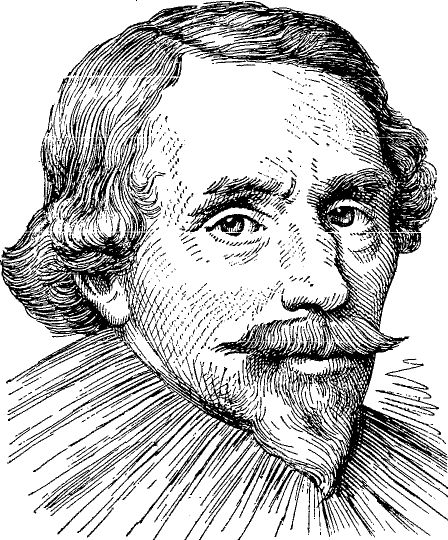
Jacob Cats, the youngest of four children, was born in Brouwershaven on the 10th of November, 1577. His mother died when he was only a few years old, and his father, member of the council in Brouwershaven, soon gave his children a stepmother. Cats praises her "good deeds and good management" in his verses; but it would seem as if her management were not in accordance with what the family considered beneficial to the children. One of the uncles adopted little Jacob, and sent him to the school of Master Dirk Kemp in Zierikzee. Here he met a young boy from Brabant who was cultivating poetry, and their daily comradeship awakened the same tastes in Cats. Master Kemp was a man who, although of good intentions, had not the power to carry them out; Jacob's uncle accordingly took him out of school and sent him to the University of Leyden to study law.
From Leyden he went to Orleans, where he took his degree, and then to Paris. When he had been here for some time, his uncle thought it wisest to call him back; and Cats's career dates from his return to The Hague, where he settled as a lawyer. Very soon after he had taken up his practice he succeeded in saving a woman accused of witchcraft, and won the case of a young man who, in defending his father from a murderous attack, had killed the assailant. These cases called attention to Cats; he soon made a name for himself. His activity was then suddenly interrupted by a severe illness. He was forced to leave the damp climate of Holland, and went to England to seek the counsel of Queen Elizabeth's famous physician Butler. The treatment gave him no relief, however; and he did not improve until after his return to Holland, where he met a learned alchemist, to whose skill he ascribed his cure. In 1603 he moved to Middelburg, and began life with new strength. He tells in one of his poems of his meeting in the French church with a young girl, with whom he fell in love at first sight; of his growing affection for her and his intention to marry her; of the report that her father had just lost all his money in a speculation; and he confesses with a most naïve and rather cynic frankness:—
"For her in very truth, with but the least of cause And with a joyful heart, I'd given up the ghost.— Look ye, this evil lot that to the father fell Has in an instant's time my heart of love bereft!"
Immediately after this incident, Cats married Elizabeth van Valkenburg, a rich girl from Antwerpen. Her good sense, faithfulness, and housewifely virtues found a warm expression in the following words:—
"She was a worthy woman, A foundation for a home, a model of truth."
This period of Cats's life, almost coincident with the twelve-years' armistice ending in 1621, when the war with Spain was resumed, was one of varied activity. Aside from the duties of his practice, he gave much time to the diking of grounds neglected during the war, now in great danger from the sea; and while at his country-place Grijpskerke near Middelburg, where his "flock of children played under the trees," he wrote the poems 'Emblemata of Sinnebeelden' (Emblemata or Emblems); 'Maeghdeplicht' (Maiden Duty), in 1618; 'Selfstryt' (Inward Strife), 1620; 'Toonel der Mannelycke Achtbaerheyd' (Scene of Manly Respectability), and 'Houwelyck' (Marriage).
With the beginning of the war his own peace was at an end. Several of the grounds reclaimed from the sea were once more flooded to prevent the advance of the enemy. In 1621 he accepted the office of pensionary of Middelburg, his first step toward official statesmanship. In 1623 he was elected pensionary of Dordrecht, and although he hesitated in leaving Zeeland, he finally decided to accept the office. In 1625 he added to his duties those of Curator of Leyden University. His literary work was consequently laid aside.
In 1627 Cats accompanied Albert Joachimi as ambassador to London to open negotiations for a navigation treaty. He was only partly successful in his mission, but was met with much consideration by Charles I., who decorated him with the order of St. Jovis. Shortly after his return he lost his wife after a brief illness.
While he was writing 'Trouwring' (Wedding Ring), a collection of epic and lyric poems, he was elected Secretary of State in 1636, and in 1645 Keeper of the Great Seal and Governor. But he had the experience in his public life that a crown may often be a crown of thorns; and in 1651 he begged to be released from his burdensome office. His demand was granted, and on this occasion Cats fell on his knees in the presence of the States-General and thanked God for taking away his heavy burden. He was once more persuaded to join an embassy to England. Cromwell had meanwhile come to power; Cats and his fellow-travelers returned with but little accomplished, and the old statesman and poet saw himself free to spend the last years of his life on his place Zorgvliet, which he had built outside of The Hague on the way to Scheveningen, in the midst of the Dunes. Although he may not have been a great statesman, he had felt the responsibility of his calling. He was never quite equal to it, and often felt himself helpless and small against the encroachment of the Powers. But honesty and patriotism were his to the fullest extent.
The last eight years of his life he spent in Zorgvliet in undisturbed peace. He returned to his literary labors and wrote 'Onderdom en Buitenleven' (Age and Country Life), 'Hofgedachtess' (Court Thoughts), and his rhymed autobiography 'Twee-entaghtig-jarig Leven' (A Life of Eighty-two Years). He seems to have kept his warm interest and joy in life to the very last.
FEAR AFTER THE TROUBLE
Awhile ago I read a tale methinks is curious. Perhaps to every one the story may be useful; Therefore in timeliness unto the light I drag it, In hope that all who read, in it will find a pleasure. A lord once lived of old, whose joy it was to wander In field and flowery mead, quite to his heart's contentment. A horse he had withal, so sage that, slept the rider, It home would wisely go, without the knight to waken. And so it came to pass that one day forthward faring, To dine, the cavalier by a good friend was bidden. He met with welcome glad; good wine went freely flowing. At last, for all such cheer, the guest must take his leave. Himself then he prepared to climb into his saddle, And turned his beast about, that home were soon attained. The day was bleak and raw; the sun of light was chary; Through clouds before its face, a pallid light descended. The wise steed careful stepped onward along the highway, Its sober rider borne, as custom was, unwearied. Anon the usual drowse closed up the rider's eyelids: His beast walked calmly on, in faithfulness of service; The man, profoundly sleeping, traveled as he was wonted; The time at last brought near when he should reach his dwelling. But lo! a friend is met, who questions him in wonder:— "How possible it was his steed had brought him thither?" The knight responded straight—"Why, I the way have ridden That, during seven years, I constantly have come; My beast on which I sit hath borne me duly houseward— The midnight's dark itself makes not his foot unsteady." "How, friend?" his questioner cried, "even when the bridge is broken? The stream to cross at all, no other means I know: This wondrous horse of thine old Perseus must have owned, Who fought the dragon once, and cut its head to pieces. Things sure are as they were! You came not flying hither! It seems to me, belike, a ghost has been your cheater. To take it otherwise, the joke to me seems pointless. Not possible it is, this story that you tell me. But that o'er such a thing no wrangling be between us, Come to the bridge with me; I gladly will be escort. The spot and fact themselves, in proof I straight will disclose, That you may note how ill goes with your word the matter." Whereto so long a speech? The Knight was well persuaded; The flood is reached again, the truth of things lies open! Bridge is there none indeed—rests but a strip of planking, Crossing the rushing wave, narrow and all unsteady. The foot of man must needs with prudence o'er it tiptoe, The nerve and will be firm to reach that further goal. The foot that is not true, that left or right shall waver, Drowns in the flood below the passenger unlucky. When now the man of naps marks all at once the bridge, Notes well the narrow path, marks the too slender footway, His shock in truth is great; loud his poor heart goes beating. In fear and shudders cold, the scene he stands and pictures; Sees with a frightened eye just how his path has served him. And more and more his soul sickens with tardy terror, More to his heart the blood, driven away, goes rushing;— That hour of fear to him brought him an endless illness. Look now, how odd it seems! He well in peace had ridden, Suffering no mishap, spared from the thing all mischief— Utterly downcast is, whereas his danger's over! Fear makes him sick at heart, deep in his being centred. Questions now any one what be this tale's life-lesson? Him shall I gladly give what in it lies, methinks; Speak out as best I can what as a maxim's plainest:— Friendly is never he sparing of bread and counsel. The man who rode his way safely and lost in slumber, He unto whom occurred just this strange bit of fortune, Like is he (it meseems) unto the lustful mortal, Evil in earthly course, given to sottish living, Wandering on, shut-eyed, lost in the way of pleasure, Taking no slightest notice of the abyss so open: Never with heed made blessed, not with his conscience warned: How at his side is Death, prompt to cut off the living! But with our Lord God's grace, suddenly on him bestowed, Opening wide his eye—then, not till then, he's awakened. Terror absorbs his soul, holy the fear that takes it; Now is the sinner roused, sees for the first his doings. Wondering see him stand, uttering loud his outcry:— "Awful has been my blindness, dreadful my soul's delusion. How could I be so tricked? how could my sleep so grip me? I who, in touch with death, careless my ease was taking!" Happy in truth the man fallen in no such peril, Since with a careful eye watches he every footstep, Blessed in that God himself insight to him has granted What was his danger to feel; how he has made escapement.
Translation through the German by E. Irenæus Stevenson.
"A RICH MAN LOSES HIS CHILD, A POOR MAN LOSES HIS COW"
Come hither, pray, O friends! Let me my sorrow tell you. Wordless such loss to bear, my heart indeed endures not: All that the soul downweighs seems to a man less bitter, If to the friendly ear sorrow can be but uttered. Dead is my neighbor's child: dead is my only cow. Comfort has fled from him; fled from me every joying. So do we sorrow, both, reft of our peace each bosom: He that his child is dead—I that my cow is taken. Look you now, friends! how strange ay, and how sad Fate's dealings! I well had spared a child—one cow he well had wanted. Turn things about, thou Death! Less evil seem thy doings. Full is my house—too full: surely is full his cow-house! Death, take his stalls for prey, or choose from out my seven! There have you, Death, full room; less to us too the trouble. Certain the pain's forgot—ay, and forgotten quickly, When, in the greater herd, one little wolf's a robber! What do I murmur thus? Ever is Death one earless. Lost on him good advice, argument on him wasted. Onward he moves, this Death, pallid and wholly blindly. Oftenest he a guest just where his call's least needed. Ah, who can calm my grief; who, pray, shall still my neighbor's? Just as we would not choose, so unto each it happens!— He who is rich must lose all that means nearest heirship, I, the poor man, O God! stripped of my one possession!
Translation through the German by E. Irenæus Stevenson.