Volume 8 / Act 1 — THOMAS CARLYLE (continued 2)
Reading edition
Ah yes, I will say again: The great silent men! Looking round on the noisy inanity of the world, words with little meaning, actions with little worth, one loves to reflect on the great Empire of Silence. The noble silent men, scattered here and there, each in his own department; silently thinking; silently working; whom no Morning Newspaper makes mention of! They are the salt of the Earth. A country that has none or few of these is in a bad way. Like a forest which had no roots; which had all turned into leaves and boughs;—which must soon wither and be no forest. Woe for us if we had nothing but what we can show, or speak. Silence, the great Empire of Silence: higher than the stars; deeper than the Kingdoms of Death! It alone is great; all else is small.—I hope we English will long maintain our grand talent pour le silence. Let others that cannot do without standing on barrel-heads, to spout, and be seen of all the market-place, cultivate speech exclusively,—become a most green forest without roots! Solomon says, There is a time to speak; but also a time to keep silence. Of some great silent Samuel, not urged to writing, as old Samuel Johnson says he was, by want of money and nothing other, one might ask, "Why do not you too get up and speak; promulgate your system, found your sect?" "Truly," he will answer, "I am continent of my thought hitherto; happily I have yet had the ability to keep it in me, no compulsion strong enough to speak it. My 'system' is not for promulgation first of all; it is for serving myself to live by. That is the great purpose of it to me. And then the 'honor'? Alas, yes;—but as Cato said of the statue: So many statues in that Forum of yours, may it not be better if they ask, Where is Cato's statue?"
But now, by way of counterpoise to this of Silence, let me say that there are two kinds of ambition: one wholly blamable, the other laudable and inevitable. Nature has provided that the great silent Samuel shall not be silent too long. The selfish wish to shine over others, let it be accounted altogether poor and miserable. "Seekest thou great things, seek them not:" this is most true. And yet, I say, there is an irrepressible tendency in every man to develop himself according to the magnitude which Nature has made him of; to speak out, to act out, what Nature has laid in him. This is proper, fit, inevitable; nay, it is a duty, and even the summary of duties for a man. The meaning of life here on earth might be defined as consisting in this: To unfold your self, to work what thing you have the faculty for. It is a necessity for the human being, the first law of our existence. Coleridge beautifully remarks that the infant learns to speak by this necessity it feels.—We will say therefore: To decide about ambition, whether it is bad or not, you have two things to take into view. Not the coveting of the place alone, but the fitness for the man of the place withal: that is the question. Perhaps the place was his, perhaps he had a natural right, and even obligation to seek the place! Mirabeau's ambition to be Prime Minister, how shall we blame it, if he were "the only man in France that could have done any good there"? Hopefuler perhaps had he not so clearly felt how much good he could do! But a poor Necker, who could do no good, and had even felt that he could do none, yet sitting broken-hearted because they had flung him out and he was now quit of it, well might Gibbon mourn over him.—Nature, I say, has provided amply that the silent great man shall strive to speak withal; too amply, rather!
Fancy, for example, you had revealed to the brave old Samuel Johnson, in his shrouded-up existence, that it was possible for him to do priceless divine work for his country and the whole world. That the perfect Heavenly Law might be made Law on this Earth; that the prayer he prayed daily, "Thy kingdom come," was at length to be fulfilled! If you had convinced his judgment of this; that it was possible, practicable; that he the mournful silent Samuel was called to take a part in it! Would not the whole soul of the man have flamed-up into a divine clearness, into noble utterance and determination to act; casting all sorrows and misgivings under his feet, counting all affliction and contradiction small,—the whole dark element of his existence blazing into articulate radiance of light and lightning? It were a true ambition this! And think now how it actually was with Cromwell. From of old, the sufferings of God's Church, true zealous Preachers of the truth flung into dungeons, whipt, set on pillories, their ears cropt off, God's Gospel-cause trodden under foot of the unworthy: all this had lain heavy on his soul. Long years he had looked upon it in silence, in prayer; seeing no remedy on Earth; trusting well that a remedy in Heaven's goodness would come,—that such a course was false, unjust, and could not last forever. And now behold the dawn of it; after twelve years' silent waiting, all England stirs itself; there is to be once more a Parliament, the Right will get a voice for itself: inexpressible well-grounded hope has come again into the Earth. Was not such a Parliament worth being a member of? Cromwell threw down his plow, and hastened thither.
He spoke there,—rugged bursts of earnestness, of a self-seen truth, where we get a glimpse of them. He worked there; he fought and strove, like a strong true giant of a man, through cannon-tumult and all else,—on and on, till the Cause triumphed, its once so formidable enemies all swept from before it, and the dawn of hope had become clear light of victory and certainty. That he stood there as the strongest soul of England, the undisputed Hero of all England,—what of this? It was possible that the Law of Christ's Gospel could now establish itself in the world! The Theocracy which John Knox in his pulpit might dream of as a "devout imagination," this practical man, experienced in the whole chaos of most rough practice, dared to consider as capable of being realized. Those that were highest in Christ's Church, the devoutest wisest men, were to rule the land: in some considerable degree, it might be so and should be so. Was it not true, God's truth? And if true, was it not then the very thing to do? The strongest practical intellect in England dared to answer, Yes! This I call a noble true purpose; is it not, in its own dialect, the noblest that could enter into the heart of Statesman or man? For a Knox to take it up was something; but for a Cromwell, with his great sound sense and experience of what our world was,—History, I think, shows it only this once in such a degree. I account it the culminating point of Protestantism; the most heroic phasis that "Faith in the Bible" was appointed to exhibit here below. Fancy it: that it were made manifest to one of us, how we could make the Right supremely victorious over Wrong, and all that we had longed and prayed for, as the highest good to England and all lands, an attainable fact!
Well, I must say, the vulpine intellect, with its knowingness, its alertness and expertness in "detecting hypocrites," seems to me a rather sorry business. We have had but one such Statesman in England; one man, that I can get sight of, who ever had in the heart of him any such purpose at all. One man, in the course of fifteen hundred years; and this was his welcome. He had adherents by the hundred or the ten; opponents by the million. Had England rallied all round him,—why, then, England might have been a Christian land! As it is, vulpine knowingness sits yet at its hopeless problem, "Given a world of Knaves, to educe an Honesty from their united action;"—how cumbrous a problem, you may see in Chancery Law Courts, and some other places! Till at length, by Heaven's just anger, but also by Heaven's great grace, the matter begins to stagnate; and this problem is becoming to all men a palpably hopeless one.
THE PROCESSION
From 'The French Revolution'
We dwell no longer on the mixed shouting Multitude, for now, behold, the Commons Deputies are at hand! Which of these Six Hundred individuals, in plain white cravat, that have come up to regenerate France, might one guess would become their king? For a king or leader they, as all bodies of men, must have, be their work what it may; there is one man there who, by character, faculty, position, is fittest of all to do it; that man, as future, not-yet-elected king walks there among the rest. He with the thick black locks, will it be? With the hure, as himself calls it, or black boar's-head, fit to be "shaken" as a senatorial portent? Through whose shaggy beetle-brows and rough-hewn, seamed, carbuncled face there look natural ugliness, small-pox, incontinence, bankruptcy,—and burning fire of genius, like comet-fire glaring fuliginous through murkiest confusions? It is Gabriel Honoré Riquetti de Mirabeau, the world-compeller; man-ruling Deputy of Aix! According to the Baroness de Staël, he steps proudly along, though looked at askance here, and shakes his black chevelure, or lion's mane, as if prophetic of great deeds.
Yes, Reader, that is the Type-Frenchman of this epoch, as Voltaire was of the last. He is French in his aspirations, acquisitions, in his virtues, in his vices; perhaps more French than any other man;—and intrinsically such a mass of manhood too. Mark him well. The National Assembly were all different without that one; nay, he might say, with the old Despot:—"The National Assembly? I am that."
Of a southern climate, of wild southern blood:—for the Riquettis, or Arrighettis, had to fly from Florence and the Guelfs, long centuries ago, and settled in Provence, where from generation to generation they have ever approved themselves a peculiar kindred, irascible, indomitable, sharp-cutting, true, like the steel they wore; of an intensity and activity that sometimes verged towards madness, yet did not reach it. One ancient Riquetti, in mad fulfillment of a mad vow, chains two Mountains together, and the chain, with its "iron star of five rays," is still to be seen. May not a modern Riquetti unchain so much, and set it drifting—which also shall be seen?
Destiny has work for that swart, burly-headed Mirabeau; Destiny has watched over him, prepared him from afar. Did not his Grandfather, stout Col-d'Argent (Silver-Stock, so they named him), shattered and slashed by seven-and-twenty wounds in one fell day, lie sunk together on the Bridge at Casano, while Prince Eugene's cavalry galloped and regalloped over him—only the flying sergeant had thrown a camp-kettle over that loved head; and Vendôme, dropping his spy-glass, moaned out, "Mirabeau is dead, then!" Nevertheless he was not dead; he awoke to breath and miraculous surgery—for Gabriel was yet to be. With his silver stock he kept his scarred head erect, through long years, and wedded, and produced tough Marquis Victor, the friend of men. Whereby at last in the appointed year, 1749, this long-expected, rough-hewn Gabriel Honoré did likewise see the light; roughest lion's-whelp ever littered of that rough breed. How the old lion (for our old Marquis, too, was lion-like, most unconquerable, kingly-genial, most perverse) gazed wondering on his offspring, and determined to train him as no lion had yet been! It is in vain, O Marquis! This cub, though thou slay him and flay him, will not learn to draw in dog-cart of Political Economy, and be a friend of men; he will not be Thou, but must and will be Himself, another than Thou. Divorce law-suits, "whole family save one in prison, and threescore lettres-de-cachet" for thy own sole use, do but astonish the world.
Our luckless Gabriel, sinned against and sinning, has been in the Isle of Rhé, and heard the Atlantic from his tower; in the Castle of If, and heard the Mediterranean at Marseilles. He has been in the Fortress of Joux; and forty-two months, with hardly clothing to his back, in the Dungeon of Vincennes;—all by lettre-de-cachet, from his lion father. He has been in Pontarlier Jails (self-constituted prisoner); was noticed fording estuaries of the sea (at low water), in flight from the face of men. He has pleaded before Aix Parlements (to get back his wife), the public gathering on roofs, to see, since they could not hear: "The clatter-teeth (claque-dents)!" snarls singular old Mirabeau; discerning in such admired forensic eloquence nothing but two clattering jaw-bones, and a head vacant, sonorous, of the drum species.
But as for Gabriel Honoré, in these strange wayfarings, what has he not seen and tried! From drill-sergeants to prime ministers, to foreign and domestic booksellers, all manner of men he has seen. All manner of men he has gained; for at bottom it is a social loving heart, that wild unconquerable one—more especially all manner of women. From the Archer's Daughter at Saintes to that fair young Sophie, Madame Monnier, whom he could not but "steal" and be beheaded for—in effigy! For indeed, hardly since the Arabian Prophet lay dead, to Ali's admiration, was there seen such a Love-hero, with the strength of thirty men. In War again, he has helped to conquer Corsica; fought duels, irregular brawls; horsewhipped calumnious barons. In Literature, he has written on 'Despotism,' on 'Lettres-de-Cachet'; Erotics Sapphic-Werterean, Obscenities, Profanities; Books on the 'Prussian Monarchy,' on 'Cagliostro,' on 'Calonne,' on 'The Water-Companies of Paris':—each book comparable, we will say, to a bituminous alarum-fire, huge, smoky, sudden! The fire-pan, the kindling, the bitumen, were his own; but the lumber, of rags, old wood, and nameless combustible rubbish (for all is fuel to him), was gathered from hucksters and ass-panniers of every description under heaven. Whereby, indeed, hucksters enough have been heard to exclaim: Out upon it, the fire is mine!
Nay, consider it more generally, seldom had man such a talent for borrowing. The idea, the faculty of another man, he can make his; the man himself he can make his. "All reflex and echo (tout de reflet et de réverbère)!" snarls old Mirabeau, who can see, but will not. Crabbed old Friend of Men! it is his sociality, his aggregative nature; and will now be the quality of qualities for him. In that forty years' "struggle against despotism," he has gained the glorious faculty of self-help, and yet not lost the glorious natural gift of fellowship, of being helped. Rare union: this man can live self-sufficing—yet lives also in the life of other men; can make men love him, work with him; a born king of men!
But consider further how, as the old Marquis still snarls, he has "made away with (humé, swallowed, snuffed-up) all Formulas"; a fact which, if we meditate it, will in these days mean much. This is no man of system, then; he is only a man of instincts and insights. A man, nevertheless, who will glare fiercely on any object, and see through it, and conquer it: for he has intellect, he has will, force beyond other men. A man not with logic-spectacles, but with an eye! Unhappily without Decalogue, moral Code or Theorem of any fixed sort; yet not without a strong living Soul in him, and Sincerity there; a Reality, not an artificiality, not a Sham! And so he, having struggled "forty years against despotism," and "made away with all formulas," shall now become the spokesman of a Nation bent to do the same. For is it not precisely the struggle of France also to cast off despotism, to make away with her old formulas,—having found them naught, worn out, far from the reality? She will make away with such formulas;—and even go bare, if need be, till she have found new ones.
Towards such work, in such manner, marches he, this singular Riquetti Mirabeau. In fiery rough figure, with black Samson-locks under the slouch hat, he steps along there. A fiery, fuliginous mass, which could not be choked and smothered, but would fill all France with smoke! And now it has got air; it will burn its whole substance, its whole smoke-atmosphere too, and fill all France with flame. Strange lot! Forty years of that smoldering, with foul fire-damp and vapor enough; then victory over that, and like a burning mountain he blazes heaven-high; and for twenty-three resplendent months, pours out, in flame and molten fire-torrents, all that is in him, the Pharos and Wonder-sign of an amazed Europe;—and then lies hollow, cold forever! Pass on, thou questionable Gabriel Honoré, the greatest of them all: in the whole National Deputies, in the whole Nation, there is none like and none second to thee.
But now, if Mirabeau is the greatest, who of these Six Hundred may be the meanest? Shall we say that anxious, slight, ineffectual-looking man, under thirty, in spectacles; his eyes (were the glasses off) troubled, careful; with upturned face, snuffing dimly the uncertain future time; complexion of a multiplex atrabiliar color, the final shade of which may be the pale sea-green. That greenish-colored (verdâtre) individual is an Advocate of Arras; his name is Maximilien Robespierre. The son of an Advocate; his father founded Mason-lodges under Charles Edward, the English Prince or Pretender. Maximilien, the first-born, was thriftily educated; he had brisk Camille Desmoulins for schoolmate in the College of Louis le Grand, at Paris. But he begged our famed Necklace-Cardinal, Rohan, the patron, to let him depart thence, and resign in favor of a younger brother. The strict-minded Max departed, home to paternal Arras; and even had a Law-case there, and pleaded, not unsuccessfully, "in favor of the first Franklin thunder-rod." With a strict, painful mind, an understanding small but clear and ready, he grew in favor with official persons, who could foresee in him an excellent man of business, happily quite free from genius. The Bishop, therefore, taking counsel, appoints him Judge of his diocese, and he faithfully does justice to the people: till behold, one day, a culprit comes whose crime merits hanging, and the strict-minded Max must abdicate, for his conscience will not permit the dooming of any son of Adam to die. A strict-minded, strait-laced man! A man unfit for Revolutions? whose small soul, transparent wholesome-looking as small-ale, could by no chance ferment into virulent alegar,—the mother of ever-new alegar;—till all France were grown acetous virulent? We shall see.
Between which two extremes of grandest and meanest, so many grand and mean roll on, towards their several destinies, in that Procession! There is Cazalès, the learned young soldier, who shall become the eloquent orator of Royalism, and earn the shadow of a name. Experienced Mounier, experienced Malouet, whose Presidential Parlementary experience the stream of things shall soon leave stranded. A Pétion has left his gown and briefs at Chartres for a stormier sort of pleading; has not forgotten his violin, being fond of music. His hair is grizzled, though he is still young; convictions, beliefs placid-unalterable, are in that man; not hindmost of them, belief in himself. A Protestant-clerical Rabaut-St.-Étienne, a slender young eloquent and vehement Barnave, will help to regenerate France. There are so many of them young. Till thirty the Spartans did not suffer a man to marry: but how many men here under thirty; coming to produce not one sufficient citizen, but a nation and a world of such! The old to heal up rents, the young to remove rubbish:—which latter is it not, indeed, the task here?
Dim, formless from this distance, yet authentically there, thou noticest the Deputies from Nantes? To us mere clothes-screens, with slouch-hat and cloak, but bearing in their pocket a Cahier of doléances with this singular clause, and more such, in it:—"That the master wigmakers of Nantes be not troubled with new guild-brethren, the actually existing number of ninety-two being more than sufficient!" The Rennes people have elected farmer Gérard, "a man of natural sense and rectitude without any learning." He walks there with solid step; unique, "in his rustic farmer-clothes;" which he will wear always, careless of short-cloaks and costumes. The name Gérard, or "Père Gérard, Father Gérard," as they please to call him, will fly far, borne about in endless banter, in Royalist satires, in Republican Didactic Almanacks. As for the man Gérard, being asked once what he did, after trial of it, candidly think of this Parlementary work,—"I think," answered he, "that there are a good many scoundrels among us." So walks Father Gérard, solid in his thick shoes, whithersoever bound.
And worthy Doctor Guillotin, whom we hoped to behold one other time? If not here, the Doctor should be here, and we see him with the eye of prophecy; for indeed the Parisian Deputies are all a little late. Singular Guillotin, respectable practitioner: doomed by a satiric destiny to the strangest immortal glory that ever kept obscure mortal from his resting-place, the bosom of oblivion! Guillotin can improve the ventilation of the Hall; in all cases of medical police and hygiène be a present aid: but greater far, he can produce his 'Report on the Penal Code,' and reveal therein a cunningly devised Beheading Machine, which shall become famous and world-famous. This is the product of Guillotin's endeavors, gained not without meditation and reading; which product popular gratitude or levity christens by a feminine derivative name, as if it were his daughter: La Guillotine! "With my machine, Messieurs, I whisk off your head (vous fais sauter la tête) in a twinkling, and you have no pain;"—whereat they all laugh. Unfortunate Doctor! For two-and-twenty years he, unguillotined, shall hear nothing but guillotine, see nothing but guillotine; then dying, shall through long centuries wander, as it were, a disconsolate ghost, on the wrong side of Styx and Lethe; his name like to outlive Cæsar's.
See Bailly, likewise of Paris, time-honored Historian of Astronomy Ancient and Modern. Poor Bailly, how thy serenely beautiful Philosophizing, with its soft moonshiny clearness and thinness, ends in foul thick confusion—of Presidency, Mayorship, diplomatic officiality, rabid Triviality, and the throat of everlasting Darkness! Far was it to descend from the heavenly Galaxy to the Drapeau Rouge: beside that fatal dung-heap, on that last hell-day, thou must "tremble", though only with cold—"de froid." Speculation is not practice: to be weak is not so miserable, but to be weaker than our task. Woe the day when they mounted thee, a peaceable pedestrian, on that wild Hippogriff of a Democracy, which, spurning the firm earth, nay, lashing at the very stars, no yet known Astolpho could have ridden!
In the Commons Deputies there are Merchants, Artists, Men of Letters; 374 Lawyers, and at least one Clergyman, the Abbé Sieyès. Him also Paris sends, among its twenty. Behold him, the light, thin man; cold, but elastic, wiry; instinct with the pride of Logic; passionless, or with but one passion, that of self-conceit. If indeed that can be called a passion, which in its independent concentrated greatness, seems to have soared into transcendentalism; and to sit there with a kind of godlike indifference, and look down on passion! He is the man, and wisdom shall die with him. This is the Sieyès who shall be System-builder, Constitution-builder General, and build Constitutions (as many as wanted) sky-high,—which shall all unfortunately fall before he get the scaffolding away. "La Politique", said he to Dumont, "polity is a science I think I have completed (achevée)." What things, O Sieyès, with thy clear assiduous eyes, art thou to see! But were it not curious to know how Sieyès, now in these days (for he is said to be still alive) looks out on all that Constitution masonry, through the rheumy soberness of extreme age? Might we hope, still with the old irrefragable transcendentalism? The victorious cause pleased the gods, the vanquished one pleased Sieyès (victa Catoni).
Thus, however, amid sky-rending vivats, and blessings from every heart, has the Procession of the Commons Deputies rolled by.
Next follow the Noblesse, and next the Clergy; concerning both of whom it might be asked What they specially have come for. Specially, little as they dream of it, to answer this question, put in a voice of thunder: What are you doing in God's fair Earth and Task-garden; where whosoever is not working is begging or stealing? Woe, woe to themselves and to all, if they can only answer; Collecting tithes, Preserving game! Remark, meanwhile, how D'Orléans affects to step before his own Order and mingle with the Commons. For him are vivats; few for the rest, though all wave in plumed "hats of a feudal cut," and have sword on thigh; though among them is D'Antraigues, the young Languedocian gentleman,—and indeed many a peer more or less noteworthy.
There are Liancourt and La Rochefoucault, the liberal Anglo-maniac Dukes. There is a filially pious Lally; a couple of liberal Lameths. Above all, there is a Lafayette; whose name shall be Cromwell-Grandison, and fill the world. Many a "formula" has this Lafayette, too, made away with; yet not all formulas. He sticks by the Washington-formula; and by that he will stick;—and hang by it, as by sure bower-anchor hangs and swings the tight war-ship, which, after all changes of wildest weather and water, is found still hanging. Happy for him, be it glorious or not! Alone of all Frenchmen he has a theory of the world, and right mind to conform thereto; he can become a hero and perfect character, were it but the hero of one idea. Note further our old parlementary friend, Crispin-Catiline d'Espréménil. He is returned from the Mediterranean islands, a red-hot royalist, repentant to the finger-ends;—unsettled-looking; whose light, dusky-glowing at best, now flickers foul in the socket; whom the National Assembly will by and by, to save time, "regard as in a state of distraction." Note lastly that globular Younger Mirabeau, indignant that his elder Brother is among the Commons; it is Viscomte Mirabeau; named oftener Mirabeau Tonneau (Barrel Mirabeau), on account of his rotundity, and the quantities of strong liquor he contains.
There, then, walks our French noblesse. All in the old pomp of chivalry; and yet, alas, how changed from the old position; drifted far down from their native latitude, like Arctic icebergs got into the Equatorial sea, and fast thawing there! Once these Chivalry Duces (Dukes, as they are still named) did actually lead the world,—were it only toward battle-spoil, where lay the world's best wages then; moreover, being the ablest leaders going, they had their lion's share, these Duces, which none could grudge them. But now, when so many Looms, improved Plow-shares, Steam-Engines, and Bills of Exchange have been invented; and for battle-brawling itself, men hire Drill-Sergeants at eighteen pence a day,—what mean these gold-mantled Chivalry Figures, walking there in "black-velvet cloaks," in high-plumed "hats of a feudal cut"? Reeds shaken in the wind!
The clergy have got up; with Cahiers for abolishing pluralities, enforcing residence of bishops, better payment of tithes. The Dignitaries, we can observe, walk stately, apart from the numerous Undignified,—who, indeed, are properly little other than Commons disguised in Curate-frocks. Here, however, though by strange ways, shall the Precept be fulfilled, and they that are greatest (much to their astonishment) become least. For one example out of many, mark that plausible Grégoire: one day Curé Grégoire shall be a Bishop, when the now stately are wandering distracted, as Bishops in partibus. With other thought, mark also the Abbé Maury; his broad bold face, mouth accurately primmed, full eyes, that ray out intelligence, falsehood,—the sort of sophistry which is astonished you should find it sophistical. Skillfulest vamper-up of old rotten leather, to make it look like new; always a rising man; he used to tell Mercier, "You will see; I shall be in the Academy before you." Likely indeed, thou skillfulest Maury; nay thou shalt have a Cardinal's hat, and plush and glory; but alas, also, in the long run—mere oblivion, like the rest of us, and six feet of earth! What boots it, vamping rotten leather on these terms? Glorious in comparison is the livelihood thy good old Father earns by making shoes,—one may hope, in a sufficient manner. Maury does not want for audacity. He shall wear pistols by-and-by; and at death-cries of "La lanterne, The Lamp-iron!" answer coolly, "Friends, will you see better there?"
But yonder, halting lamely along, thou noticest next Bishop Talleyrand-Perigord, his Reverence of Autun. A sardonic grimness lies in that irreverend Reverence of Autun. He will do and suffer strange things; and will become surely one of the strangest things ever seen, or like to be seen. A man living in falsehood and on falsehood; yet not what you can call a false man: there is the specialty! It will be an enigma for future ages, one may hope; hitherto such a product of Nature and Art was possible only for this age of ours—Age of Paper, and of the Burning of Paper. Consider Bishop Talleyrand and Marquis Lafayette as the topmost of their two kinds; and say once more, looking at what they did and what they were. O tempus ferax rerum!
On the whole, however, has not this unfortunate clergy also drifted in the Time-stream, far from its native latitude? An anomalous mass of men; of whom the whole world has already a dim understanding that it can understand nothing. They were once a Priesthood, interpreters of Wisdom, revealers of the Holy that is in Man; a true Clerus (or Inheritance of God on Earth): but now?—They pass silently, with such Cahiers as they have been able to redact; and none cries, God bless them.
King Louis with his Court brings up the rear: he cheerful, in this day of hope, is saluted with plaudits: still more Necker his Minister. Not so the Queen, on whom hope shines not steadily any more. Ill-fated Queen! Her hair is already gray with many cares and crosses; her first-born son is dying in these weeks: black falsehood has ineffaceably soiled her name—ineffaceably while this generation lasts. Instead of Vive la reine, voices insult her with Vive d'Orléans. Of her queenly beauty little remains except its stateliness; not now gracious, but haughty, rigid, silently enduring. With a most mixed feeling, wherein joy has no part, she resigns herself to a day she hoped never to have seen. Poor Marie Antoinette; with thy quick, noble instincts, vehement glancings, vision all-too fitful narrow for the work thou hast to do! O there are tears in store for thee, bitterest wailings, soft womanly meltings, though thou hast the heart of an imperial Theresa's Daughter. Thou doomed one, shut thy eyes on the future!
And so in stately Procession, have passed the Elected of France. Some toward honor and quick fire-consummation; most toward dishonor; not a few toward massacre, confusion, emigration, desperation: all toward Eternity!—So many heterogeneities cast together into the fermenting-vat; there, with incalculable action, counteraction, elective affinities, explosive developments, to work out healing for a sick, Moribund System of Society! Probably the strangest Body of Men, if we consider well, that ever met together on our Planet on such an errand. So thousandfold complex a Society, ready to burst up from its infinite depths; and these men, its rulers and healers, without life-rule for themselves,—other life-rule than a Gospel according to Jean Jacques! To the wisest of them, what we must call the wisest, man is properly an Accident under the sky. Man is without Duty round him; except it be "to make the Constitution." He is without Heaven above him, or Hell beneath him; he has no God in the world.
What further or better belief can be said to exist in these Twelve Hundred? Belief in high-plumed hats of a feudal cut; in heraldic scutcheons; in the divine right of Kings, in the divine right of Game-Destroyers. Belief, or what is still worse, canting half-belief; or worst of all, mere Machiavellic pretense-of-belief,—in consecrated dough-wafers, and the godhood of a poor old Italian Man! Nevertheless, in that immeasurable Confusion and Corruption, which struggles there so blindly to become less confused and corrupt, there is, as we said, this one salient point of a New Life discernible—the deep fixed Determination to have done with Shams. A determination which, consciously or unconsciously, is fixed; which waxes ever more fixed, into very madness and fixed-idea; which, in such embodiment as lies provided there, shall now unfold itself rapidly: monstrous, stupendous, unspeakable; new for long thousands of years!—How has the heaven's light, oftentimes in this Earth, to clothe itself in thunder and electric murkiness, and descend as molten lightning, blasting, if purifying! Nay, is it not rather the very murkiness, and atmospheric suffocation, that brings the lightning and the light? The new Evangel, as the old had been, was it to be born in the Destruction of a World?
THE SIEGE OF THE BASTILLE
From 'The French Revolution'
But, to the living and the struggling, a new, Fourteenth morning dawns. Under all roofs of this distracted City is the nodus of a Drama, not untragical, crowding toward solution. The bustlings and preparings, the tremors and menaces; the tears that fell from old eyes! This day, my sons, ye shall quit you like men. By the memory of your fathers' wrongs; by the hope of your children's rights! Tyranny impends in red wrath: help for you is none, if not in your own right hands. This day ye must do or die.
From earliest light, a sleepless Permanent Committee has heard the old cry, now waxing almost frantic, mutinous: Arms! Arms! Provost Flesselles, or what traitors there are among you, may think of those Charleville Boxes. A hundred-and-fifty thousand of us, and but the third man furnished with so much as a pike! Arms are the one thing needful: with arms we are an unconquerable man-defying National Guard; without arms, a rabble to be whiffed with grape-shot.
Happily the word has arisen, for no secret can be kept,—that there lie muskets at the Hôtel des Invalides. Thither will we: King's Procureur M. Ethys de Corny, and whatsoever of authority a Permanent Committee can lend, shall go with us. Besenval's Camp is there; perhaps he will not fire on us; if he kill us, we shall but die.
Alas! poor Besenval, with his troops melting away in that manner, has not the smallest humor to fire! At five o'clock this morning, as he lay dreaming, oblivious in the École Militaire, a "figure" stood suddenly at his bedside; "with face rather handsome, eyes inflamed, speech rapid and curt, air audacious:" such a figure drew Priam's curtains! The message and monition of the figure was that resistance would be hopeless; that if blood flowed, woe to him who shed it. Thus spoke the figure: and vanished. "Withal there was a kind of eloquence that struck one." Besenval admits that he should have arrested him, but did not. Who this figure with inflamed eyes, with speech rapid and curt, might be? Besenval knows, but mentions not. Camille Desmoulins? Pythagorean Marquis Valadi, inflamed with "violent motions all night at the Palais Royal"? Fame names him "Young M. Meillar"; then shuts her lips about him forever.
In any case, behold, about nine in the morning, our National Volunteers, rolling in long wide flood south-westward to the Hôtel des Invalides, in search of the one thing needful. King's Procureur M. Ethys de Corny and officials are there; the Curé of Saint-Étienne du Mont marches unpacific at the head of his militant Parish; the Clerks of the Basoche in red coats we see marching, now Volunteers of the Palais Royal;—National Volunteers, numerable by tens of thousands; of one heart and mind. The King's Muskets are the Nation's; think, old M. de Sombreuil, how, in this extremity, thou wilt refuse them! Old M. de Sombreuil would fain hold parley, send couriers, but it skills not: the walls are scaled, no Invalide firing a shot; the gates must be flung open. Patriotism rushes in tumultuous, from grunsel up to ridge-tile, through all rooms and passages; rummaging distractedly for arms. What cellar or what cranny can escape it? The arms are found; all safe there, lying packed in straw,—apparently with a view to being burnt! More ravenous than famishing lions over dead prey, the multitude, with clangor and vociferation, pounces on them; struggling, dashing, clutching,—to the jamming-up, to the pressure, fracture, and probable extinction of the weaker Patriot. And so, with such protracted crash of deafening, most discordant Orchestra-music, the Scene is changed; and eight-and-twenty thousand sufficient firelocks are on the shoulders of as many National Guards, lifted thereby out of darkness into fiery light.
Let Besenval look at the glitter of these muskets as they flash by! Gardes Françaises, it is said, have cannon leveled on him; ready to open, if need were, from the other side of the river. Motionless sits he; "astonished," one may flatter one's self, "at the proud bearing (fière contenance) of the Parisians." And now to the Bastille, ye intrepid Parisians! There grape-shot still threatens; thither all men's thoughts and steps are now tending.
Old De Launay, as we hinted, withdrew "into his interior" soon after midnight of Sunday. He remains there ever since, hampered, as all military gentlemen now are, in the saddest conflict of uncertainties. The Hôtel-de-Ville "invites" him to admit National Soldiers, which is a soft name for surrendering. On the other hand, his Majesty's orders were precise. His garrison is but eighty-two old Invalides, reinforced by thirty-two young Swiss; his walls, indeed, are nine feet thick; he has cannon and powder, but alas! only one day's provision of victuals. The city, too, is French, the poor garrison mostly French. Rigorous old De Launay, think what thou wilt do!
All morning, since nine, there has been a cry everywhere: To the Bastille! Repeated "deputations of citizens" have been here, passionate for arms, whom De Launay has got dismissed by soft speeches through port-holes. Towards noon, Elector Thuriot de la Rosière gains admittance, finds De Launay indisposed for surrender, nay, disposed for blowing up the place, rather. Thuriot mounts with him to the battlements; heaps of paving-stones, old iron, and missiles lie piled; cannon all duly leveled; in every embrasure a cannon,—only drawn back a little! But outwards, behold, O Thuriot, how the multitude flows on, welling through every street, tocsin furiously pealing, all drums beating the générale; the suburb Saint-Antoine rolling hitherward wholly as one man! Such vision (spectral, yet real) thou, O Thuriot, as from thy Mount of Vision, beholdest in this moment: prophetic of what other Phantasmagories and loud-gibbering Spectral Realities which thou yet beholdest not, but shalt! "Que voulez-vous?" said De Launay, turning pale at the sight, with an air of reproach, almost of menace. "Monsieur," said Thuriot, rising into the moral-sublime, "what mean you? Consider if I could not precipitate both of us from this height,"—say only a hundred feet, exclusive of the walled ditch! Whereupon De Launay fell silent. Thuriot shows himself from some pinnacle to comfort the multitude becoming suspicious, fremes-cent, then descends, departs with protest, with warning addressed also to the Invalides, on whom however it produces but a mixed, indistinct impression. The old heads are none of the clearest; besides, it is said, De Launay has been profuse of beverages (prodigue des buissons). They think they will not fire—if not fired on—if they can help it; but must, on the whole, be ruled considerably by circumstances.
Wo to thee, De Launay, in such an hour, if thou canst not, taking some one firm decision, rule circumstances! Soft speeches will not serve, hard grape-shot is questionable, but hovering between the two is unquestionable. Ever wilder swells the tide of men; their infinite hum waxing ever louder, into imprecations, perhaps into crackle of stray musketry,—which latter, on walls nine feet thick, cannot do execution. The Outer Drawbridge has been lowered for Thuriot; now deputation of citizens (it is the third and noisiest of all) penetrates that way into the Outer Court; soft speeches producing no clearance of these, De Launay gives fire; pulls up his drawbridge. A slight sputter, which has kindled the too combustible chaos, made it a roaring fire-chaos! Bursts forth Insurrection, at sight of its own blood (for there were deaths by that sputter of fire), into endless, rolling explosion of musketry, distraction, execration;—and over head, from the fortress, let one great gun, with its grape-shot, go booming, to show what we could do. The Bastille is besieged!
On, then, all Frenchmen that have hearts in your bodies! Roar with all your throats of cartilage and metal, ye Sons of Liberty; stir spasmodically whatsoever of utmost faculty is in you, soul, body, or spirit; for it is the hour! Smite thou, Louis Tournay, cartwright of the Marais, old-soldier of the Regiment Dauphiné; smite at that Outer Drawbridge chain, though the fiery hail whistles round thee! Never, over nave or felloe, did thy axe strike such a stroke. Down with it, man; down with it to Orcus: let the whole accursed edifice sink thither, and tyranny be swallowed up forever! Mounted, some say, on the roof of the guard-room, some "on bayonets stuck into joints of the wall," Louis Tournay smites, brave Aubin Bonnemère (also an old soldier) seconding him; the chain yields, breaks; the huge Drawbridge slams down, thundering (avec fracas). Glorious! and yet, alas! it is still but the outworks. The Eight Grim Towers, with their Invalide musketry, their paving-stones and cannon-mouths, still soar aloft intact;—Ditch yawning impassable, stone-faced; the inner Drawbridge with its back toward us; the Bastille is still to take!
To describe this Siege of the Bastille (thought to be one of the most important in History) perhaps transcends the talent of mortals. Could one but, after infinite reading, get to understand so much as the plan of the building! But there is open Esplanade at the end of the Rue Saint-Antoine; there are such Forecourts (Cour Avancé), Cour de l'Orme, arched gateway (where Louis Tournay now fights); then new drawbridges, dormant-bridges, rampart-bastions, and the grim Eight Towers: a labyrinthic Mass, high-frowning there, of all ages from twenty years to four hundred and twenty;—beleaguered, in this its last hour, as we said, by mere Chaos come again! Ordnance of all calibres; throats of all capacities; men of all plans, every man his own engineer; seldom since the war of Pygmies and Cranes was there seen so anomalous a thing. Half-pay Elie is home for a suit of regimentals; no one would heed him in colored clothes; half-pay Hulin is haranguing Gardes Françaises in the Place de Grève. Frantic patriots pick up the grape-shots; bear them, still hot (or seemingly so), to the Hôtel-de-Ville:—Paris, you perceive, is to be burnt! Flesselles is "pale to the very lips," for the roar of the multitude grows deep. Paris wholly has got to the acme of its frenzy; whirled, all ways, by panic madness. At every street-barricade, there whirls simmering a minor whirlpool,—strengthening the barricade, since God knows what is coming; and all minor whirlpools play distractedly into that grand Fire-Maelstrom which is lashing round the Bastille.
And so it lashes and it roars. Cholat the wine-merchant has become an impromptu cannoneer. See Georget of the marine service, fresh from Brest, ply the King of Siam's cannon. Singular (if we were not used to the like). Georget lay, last night, taking his ease at his inn; the King of Siam's cannon also lay, knowing nothing of him, for a hundred years; yet now, at the right instant, they have got together, and discourse eloquent music. For hearing what was toward, Georget sprang from the Brest Diligence, and ran. Gardes Françaises, also, will be here, with real artillery: were not the walls so thick!—Upward from the Esplanade, horizontally from all neighboring roofs and windows, flashes one irregular deluge of musketry, without effect. The Invalides lie flat, firing comparatively at their ease from behind stone; hardly through port-holes show the tip of a nose. We fall, shot; and make no impression!
Let conflagration rage; of whatsoever is combustible! Guardrooms are burnt, Invalides mess-rooms. A distracted "Peruke-maker with two fiery torches" is for burning "the saltpetres of the Arsenal," had not a woman run screaming; had not a Patriot, with some tincture of Natural Philosophy, instantly struck the wind out of him (butt of musket on pit of stomach), overturned barrels, and stayed the devouring element. A young beautiful lady, seized, escaping, in these Outer Courts, and thought falsely to be De Launay's daughter, shall be burnt in De Launay's sight; she lies, swooned, on a paillasse; but again a Patriot—it is brave Aubin Bonnemère, the old soldier—dashes in, and rescues her. Straw is burnt; three cartloads of it, hauled hither, go up in white smoke, almost to the choking of Patriotism itself; so that Elie had, with singed brows, to drag back one cart, and Réole the "gigantic haberdasher" another. Smoke as of Tophet; confusion as of Babel; noise as of the Crack of Doom!
Blood flows; the ailment of new madness. The wounded are carried into houses of the Rue Cerisaie; the dying leave their last mandate not to yield till the accursed Stronghold fall. And yet, alas! how fall? The walls are so thick! Deputations, three in number, arrive from the Hôtel-de-Ville; Abbé Fauchet (who was of one) can say with what almost superhuman courage of benevolence. These wave their Town-flag in the arched Gateway, and stand, rolling their drum, but to no purpose. In such Crack of Doom, De Launay cannot hear them, dare not believe them; they return, with justified rage, the whew of lead still singing in their ears. What to do? The Firemen are here, squirting with their fire-pumps on the Invalides cannon, to wet the touch-holes; they unfortunately cannot squirt so high; but produce only clouds of spray. Individuals of classical knowledge propose catapults. Santerre, the sonorous Brewer of the Suburb Saint-Antoine, advises rather that the place be fired by a "mixture of phosphorus and oil of turpentine spouted up through forcing-pumps." O Spinola-Santerre, hast thou the mixture ready? Every man his own engineer! And still the fire-deluge abates not; even women are firing, and Turks; at least one woman (with her sweetheart), and one Turk. Gardes Françaises have come; real cannon, real cannoneers. Usher Maillard is busy; half-pay Elie, half-pay Hulin, rage in the midst of thousands.
How the great Bastille clock ticks (inaudible) in its Inner Court, there, at its ease, hour after hour; as if nothing special, for it or the world, were passing! It tolled One when the firing began, and is now pointing toward Five, and still the firing slakes not.—Far down, in their vaults, the seven Prisoners hear muffled din as of earthquakes; their Turnkeys answer vaguely.
Woe to thee, De Launay, with thy poor hundred Invalides! Broglie is distant, and his ears heavy; Besenval hears, but can send no help. One poor troop of Hussars has crept, reconnoitring, cautiously along the Quais, as far as the Pont Neuf. "We are come to join you," said the Captain; for the crowd seems shoreless. A large-headed dwarfish individual, of smoke-bleared aspect, shambles forward, opening his blue lips, for there is sense in him; and croaks, "Alight then, and give up your arms!" The Hussar-Captain is too happy to be escorted to the barriers and dismissed on parole. Who the squat individual was? Men answer, It is M. Marat, author of the excellent pacific 'Avis au Peuple'! Great, truly, O thou remarkable Dogleech, is this thy day of emergence and new-birth; and yet this same day come four years!—But let the curtains of the Future hang.
What shall De Launay do? One thing only De Launay could have done: what he said he would do. Fancy him sitting, from the first, with lighted taper, within arm's-length of the Powder-Magazine; motionless, like old Roman Senator, or Bronze Lamp-holder; coldly apprising Thuriot, and all men, by a slight motion of his eye, what his resolution was:—Harmless he sat there, while unharmed; but the King's Fortress, meanwhile, could, might, would, or should in nowise be surrendered save to the King's Messenger; one old man's life is worthless, so it be lost with honor: but think, ye brawling canaille, how will it be when a whole Bastille springs skyward? In such statuesque, taper-holding attitude, one fancies De Launay might have left Thuriot, the red clerks of the Basoche, Curé of Saint-Stephen, and all the tagrag and bobtail of the world, to work their will.
And, yet, withal, he could not do it. Hast thou considered how each man's heart is so tremulously responsive to the hearts of all men? Hast thou noted how omnipotent is the very sound of many men? How their shriek of indignation palsies the strong soul; their howl of contumely withers with unfelt pangs? The Ritter Gluck confessed that the ground-tone of the noblest passage in one of his noblest Operas was the voice of the populace he had heard at Vienna, crying to their Kaiser, Bread! Bread! Great is the combined voice of men, the utterance of their instincts, which are truer than their thoughts; it is the greatest a man encounters, among the sounds and shadows which make up this World of Time. He who can resist that, has his footing somewhere beyond Time. De Launay could not do it. Distracted, he hovers between two; hopes in the middle of despair; surrenders not his Fortress; declares that he will blow it up, seizes torches to blow it up, and does not blow it. Unhappy old De Launay, it is the death-agony of thy Bastille and thee! Jail, Jailoring, and Jailor, all three, such as they may have been, must finish.
For four hours now has the World-Bedlam roared; call it the World-Chimæra, blowing fire! The poor Invalides have sunk under their battlements, or rise only with reversed muskets; they have made a white flag of napkins; go beating the chamade, or seeming to beat, for one can hear nothing. The very Swiss at the Portcullis look weary of firing; disheartened in the fire-deluge; a port-hole at the drawbridge is opened, as by one that would speak. See Huissier Maillard, the shifty man! On his plank swinging over the abyss of that stone Ditch; plank resting on parapet, balanced by weight of Patriots, he hovers perilous; such a Dove toward such an Ark! Deftly, thou shifty Usher; one man already fell; and lies smashed, far down there, against the masonry! Usher Maillard falls not; deftly, unerring, he walks, with out-spread palm. The Swiss holds a paper through his port-hole; the shifty Usher snatches it and returns. Terms of surrender, Pardon, immunity to all! Are they accepted? "Foi d'officier, On the word of an officer," answers half-pay Hulin, or half-pay Elie—for men do not agree on it—"they are!" Sinks the drawbridge,—Usher Maillard bolting it when down; rushes in the living deluge; the Bastille is fallen! Victoire! La Bastille est prise!
Why dwell on what follows? Hulin's foi d'officier should have been kept, but could not. The Swiss stand drawn up, disguised in white canvas smocks; the Invalides without disguise, their arms all piled against the wall. The first rush of victors, in ecstasy that the death peril is passed, "leaps joyfully on their necks"; but new victors rush, and ever new, also in ecstasy not wholly of joy. As we said, it was a living deluge, plunging headlong; had not the Gardes Françaises, in their cool military way, "wheeled round with arms leveled," it would have plunged suicidally, by the hundred or the thousand, into the Bastille-ditch.
And so it goes plunging through court and corridor; billowing uncontrollable, firing from windows—on itself; in hot frenzy of triumph, of grief and vengeance for its slain. The poor Invalides will fare ill; one Swiss, running off in his white smock, is driven back, with a death-thrust. Let all prisoners be marched to the Town-hall to be judged! Alas, already one poor Invalide has his right hand slashed off him; his maimed body dragged to the Place de Grève, and hanged there. This same right hand, it is said, turned back De Launay from the Powder-Magazine, and saved Paris.
De Launay, "discovered in gray frock with poppy-colored riband," is for killing himself with the sword of his cane. He shall to the Hôtel-de-Ville; Hulin, Maillard, and others escorting him, Elie marching foremost, "with the capitulation-paper on his sword's point." Through roarings and cursings; through hustlings, clutchings, and at last through strokes! Your escort is hustled aside, fell down; Hulin sinks exhausted on a heap of stones. Miserable De Launay! He shall never enter the Hôtel-de-Ville; only his "bloody hair-queue, held up in a bloody hand"; that shall enter, for a sign. The bleeding trunk lies on the steps there; the head is off through the streets, ghastly, aloft on a pike.
Rigorous De Launay has died; crying out, "O friends, kill me fast!" Merciful De Losme must die; though Gratitude embraces him, in this fearful hour, and will die for him, it avails not. Brothers, your wrath is cruel! Your Place de Grève is become a Throat of the Tiger, full of mere fierce bellowings, and thirst of blood. One other officer is massacred; one other Invalide is hanged on the Lamp-iron; with difficulty, with generous perseverance, the Gardes Françaises will save the rest. Provost Flesselles, stricken long since with the paleness of death, must descend from his seat, "to be judged at the Palais Royal"; alas, to be shot dead by an unknown hand at the turning of the first street!
O evening sun of July, how, at this hour, thy beams fall slant on reapers amid peaceful woody fields; on old women spinning in cottages; on ships far out on the silent main; on Balls at the Orangerie of Versailles, where high-rouged Dames of the Palace are even now dancing with double-jacketed Hussar-Officers;—and also on this roaring Hell-porch of a Hôtel-de-Ville! Babel Tower, with the confusion of tongues, were not Bedlam added with the conflagration of thoughts, was no type of it. One forest of distracted steel bristles, endless, in front of an Electoral Committee; points itself, in horrid radii, against this and the other accused breast. It was the Titans warring with Olympus; and they, scarcely crediting it, have conquered; prodigy of prodigies; delirious,—as it could not but be. Denunciation, vengeance; blaze of triumph on a dark ground of terror; all outward, all inward things fallen into one general wreck of madness!
CHARLOTTE CORDAY
From 'The French Revolution'
In the leafy months of June and July, several French Departments germinate a set of rebellious paper-leaves, named Proclamations, Resolutions, Journals, or Diurnals, "of the Union for Resistance to Oppression." In particular, the Town of Caen, in Calvados, sees its paper-leaf of Bulletin de Caen suddenly bud, suddenly establish itself as Newspaper there; under the Editorship of Girondin National Representatives!
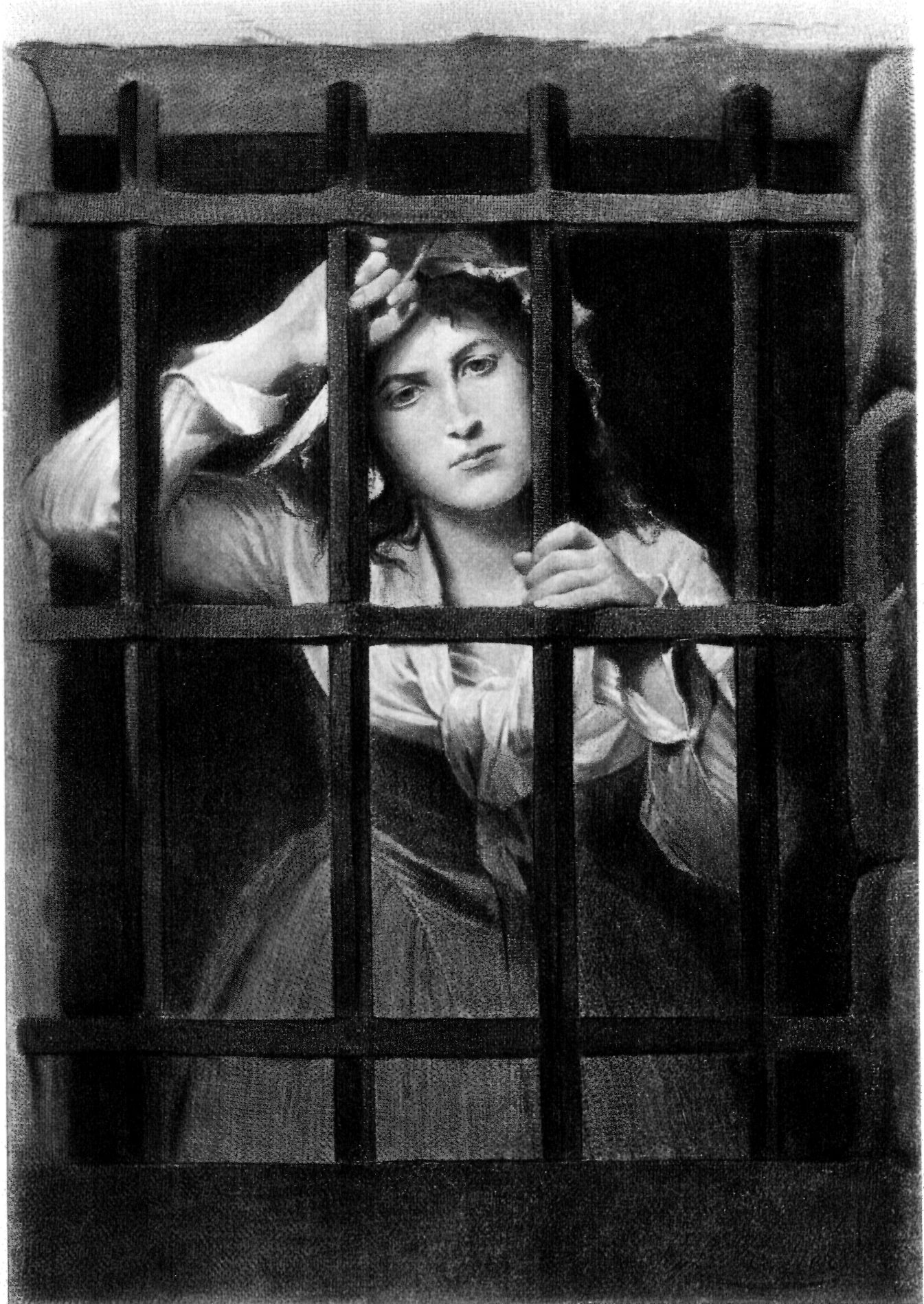
CHARLOTTE CORDAY IN PRISON.
Photogravure from a painting by C. L. Muller.
Original in the Corcoran Gallery of Art, Washington, D. C.
Marie Anne Charlotte Corday d'Armans, a French young woman of noble birth, filled with horror at the excesses of the Reign of Terror, gained admission to the private apartments of Marat and stabbed him to death July 13, 1793. She was convicted by the Revolutionary tribunal and died by the guillotine July 17, 1793.
For among the proscribed Girondins are certain of a more desperate humor. Some, as Vergniaud, Valazé, Gensonné, "arrested in their own houses," will await with stoical resignation what the issue may be. Some, as Brissot, Rabaut, will take to flight, to concealment; which, as the Paris Barriers are opened again in a day or two, is not yet difficult. But others there are who will rush, with Buzot, to Calvados; or far over France, to Lyons, Toulon, Nantes and elsewhither, and then rendezvous at Caen: to awaken as with war-trumpet the respectable Departments; and strike down an anarchic Mountain Faction; at least not yield without a stroke at it. Of this latter temper we count some score or more, of the Arrested, and of the Not-yet-arrested: a Buzot, a Barbaroux, Louvet, Guadet, Pétion, who have escaped from Arrestment in their own homes; a Salles, a Pythagorean Valady, a Duchâtel, the Duchâtel that came in blanket and night-cap to vote for the life of Louis, who have escaped from danger and likelihood of Arrestment. These, to the number at one time of Twenty-seven, do accordingly lodge here, in the "Intendance," or Departmental Mansion, of the town of Caen in Calvados; welcomed by Persons in Authority; welcomed and defrayed, having no money of their own. And the Bulletin de Caen comes forth, with the most animating paragraphs: How the Bordeaux Department, the Lyons Department, this Department after the other is declaring itself; sixty, or say sixty-nine, or seventy-two respectable Departments either declaring, or ready to declare. Nay, Marseilles, it seems, will march on Paris by itself, if need be. So has Marseilles Town said that she will march. But on the other hand, that Montélimart Town has said, No thoroughfare; and means even to "bury herself" under her own stone and mortar first,—of this be no mention in Bulletin de Caen.
Such animating paragraphs we read in this new Newspaper; and fervors and eloquent sarcasm: tirades against the Mountain, from the pen of Deputy Salles; which resemble, say friends, Pascal's "Provincials." What is more to the purpose, these Girondins have got a General in chief, one Wimpfen, formerly under Dumouriez; also a secondary questionable General Puisaye, and others; and are doing their best to raise a force for war. National Volunteers, whosoever is of right heart: gather in, ye National Volunteers, friends of Liberty; from our Calvados Townships, from the Eure, from Brittany, from far and near: forward to Paris, and extinguish Anarchy! Thus at Caen, in the early July days, there is a drumming and parading, a perorating and consulting: Staff and Army; Council; Club of Carabots, Anti-jacobin friends of Freedom, to denounce atrocious Marat. With all which, and the editing of Bulletins, a National Representative has his hands full.
At Caen it is most animated; and, as one hopes, more or less animated in the "Seventy-two Departments that adhere to us." And in a France begirt with Cimmerian invading Coalitions, and torn with an internal La Vendée, this is the conclusion we have arrived at: To put down Anarchy by Civil War! Durum et durum, the Proverb says, non faciunt murum. La Vendée burns; Santerre can do nothing there; he may return home and brew beer. Cimmerian bombshells fly all along the North. That Siege of Mentz is become famed;—lovers of the Picturesque (as Goethe will testify), washed country-people of both sexes, stroll thither on Sundays, to see the artillery work and counter-work; "you only duck a little while the shot whizzes past." Condé is capitulating to the Austrians; Royal Highness of York, these several weeks, fiercely batters Valenciennes. For, alas, our fortified Camp of Famars was stormed; General Dampierre was killed; General Custine was blamed,—and indeed is now come to Paris to give "explanations."
Against all which the Mountain and atrocious Marat must even make head as they can. They, anarchic Convention as they are, publish Decrees, expostulatory, explanatory, yet not without severity: they ray-forth Commissioners, singly or in pairs, the olive-branch in one hand, yet the sword in the other. Commissioners come even to Caen; but without effect. Mathematical Romme, and Prieur named of the Côte d'Or, venturing thither, with their olive and sword, are packed into prison: there may Romme lie, under lock and key, "for fifty days"; and meditate his New Calendar, if he please. Cimmeria, La Vendée, and Civil War! Never was Republic One and Indivisible at a lower ebb.
Amid which dim ferment of Caen and the World, History specially notices one thing: in the lobby of the Mansion de l'Intendance, where busy Deputies are coming and going, a young Lady with an aged valet, taking grave graceful leave of Deputy Barbaroux. She is of stately Norman figure: in her twenty-fifth year; of beautiful still countenance: her name is Charlotte Corday, heretofore styled D'Armans, while Nobility still was. Barbaroux has given her a Note to Deputy Duperret,—him who once drew his sword in the effervescence. Apparently she will to Paris on some errand? "She was a Republican before the Revolution, and never wanted energy." A completeness, a decision is in this fair female Figure: "By energy she means the spirit that will prompt one to sacrifice himself for his country." What if she, this fair young Charlotte, had emerged from her secluded stillness, suddenly like a Star; cruel-lovely, with half-angelic, half-demonic splendor; to gleam for a moment, and in a moment be extinguished: to be held in memory, so bright complete was she, through long centuries!—Quitting Cimmerian Coalitions without, and the dim-simmering twenty-five million within, History will look fixedly at this one fair Apparition of a Charlotte Corday; will note whither Charlotte moves, how the little Life burns forth so radiant, then vanishes swallowed of the Night.
With Barbaroux's Note of Introduction, and slight stock of luggage, we see Charlotte on Tuesday the 9th of July seated in the Caen Diligence, with a place for Paris. None takes farewell of her, wishes her Good-journey: her Father will find a line left, signifying that she is gone to England, that he must pardon her, and forget her. The drowsy Diligence lumbers along; amid drowsy talk of Politics, and praise of the Mountain; in which she mingles not: all night, all day, and again all night. On Thursday, not long before noon, we are at the bridge of Neuilly; here is Paris with her thousand black domes, the goal and purpose of thy journey! Arrived at the Inn de la Providence in the Rue des Vieux Augustins, Charlotte demands a room; hastens to bed; sleeps all afternoon and night, till the morrow morning.
On the morrow morning, she delivers her Note to Duperret. It relates to certain Family Papers which are in the Minister of the Interior's hands; which a Nun at Caen, an old Convent friend of Charlotte's, has need of; which Duperret shall assist her in getting: this then was Charlotte's errand to Paris? She has finished this, in the course of Friday:—yet says nothing of returning. She has seen and silently investigated several things. The Convention, in bodily reality, she has seen; what the Mountain is like. The living physiognomy of Marat she could not see; he is sick at present, and confined to home.
About eight on the Saturday morning, she purchases a large sheath-knife in the Palais Royal; then straightway, in the Place des Victoires, takes a hackney-coach: "To the Rue de l'École de Médecine, No. 44." It is the residence of the Citoyen Marat!—The Citoyen Marat is ill, and cannot be seen; which seems to disappoint her much. Her business is with Marat, then? Hapless beautiful Charlotte; hapless squalid Marat! From Caen in the utmost West, from Neuchâtel in the utmost East, they two are drawing nigh each other; they two have, very strangely, business together.—Charlotte, returning to her Inn, dispatches a short Note to Marat; signifying that she is from Caen, the seat of rebellion; that she desires earnestly to see him, and "will put it in his power to do France a great service." No answer. Charlotte writes another Note, still more pressing; sets out with it by coach, about seven in the evening, herself. Tired day-laborers have again finished their Week; huge Paris is circling and simmering, manifold according to its vague wont; this one fair Figure has decision in it; drives straight,—toward a purpose.
It is yellow July evening, we say, the 13th of the month; eve of the Bastille day,—when "M. Marat," four years ago, in the crowd of the Pont Neuf, shrewdly required of that Besenval Hussar-party, which had such friendly dispositions, "to dismount, and give up their arms, then"; and became notable among Patriot men. Four years: what a road he has traveled:—and sits now, about half-past seven of the clock, stewing in slipper-bath; sore afflicted; ill of Revolution Fever,—of what other malady this History had rather not name. Excessively sick and worn, poor man: with precisely eleven-pence-half-penny of ready-money, in paper; with slipper-bath; strong three-footed stool for writing on, the while; and a squalid—Washer-woman, one may call her: that is his civic establishment in Medical-School Street; thither and not elsewhither has his road led him. Not to the reign of Brotherhood and Perfect Felicity: yet surely on the way toward that?—Hark, a rap again! A musical woman's voice, refusing to be rejected: it is the Citoyenne who would do France a service. Marat, recognizing from within, cries, Admit her. Charlotte Corday is admitted.
Citoyen Marat, I am from Caen the seat of rebellion, and wished to speak with you.—Be seated, mon enfant. Now what are the Traitors doing at Caen? What Deputies are at Caen?—Charlotte names some Deputies. "Their heads shall fall within a fortnight," croaks the eager People's-friend, clutching his tablets to write: Barbaroux, Pétion, writes he with bare shrunk arm, turning aside in the bath: Pétion, and Louvet, and—Charlotte has drawn her knife from the sheath; plunges it with one sure stroke, into the writer's heart. "À moi, chère amie (Help, dear)!" no more could the Death-choked say or shriek. The helpful Washer-woman running in—there is no Friend of the People, or Friend of the Washer-woman, left; but his life with a groan gushes out, indignant, to the shades below!
And so Marat, People's-friend, is ended; the lone Stylites has got hurled down suddenly from his pillar—whitherward He that made him knows. Patriot Paris may sound triple and tenfold, in dole and wail; re-echoed by patriot France; and the Convention, "Chabot pale with terror, declaring that they are to be all assassinated," may decree him Pantheon Honors, Public Funeral, Mirabeau's dust making way for him; and Jacobin Societies, in lamentable oratory, summing up his character, parallel him to One, whom they think it honor to call "the good Sans-culotte,"—whom we name not here; also a Chapel may be made, for the urn that holds his Heart, in the Place du Carrousel; and new-born children be named Marat; and Lago-di-Como Hawkers bake mountains of stucco into unbeautiful Busts; and David paint his Picture, or Death-Scene; and such other Apotheosis take place as the human genius, in these circumstances, can devise: but Marat returns no more to the light of this Sun. One sole circumstance we have read with clear sympathy, in the old Moniteur Newspaper: how Marat's Brother comes from Neuchâtel to ask of the Convention, "that the deceased Jean-Paul Marat's musket be given to him." For Marat too had a brother and natural affections; and was wrapped once in swaddling-clothes, and slept safe in a cradle like the rest of us. Ye children of men!—A sister of his, they say, lives still to this day in Paris.
As for Charlotte Corday, her work is accomplished; the recompense of it is near and sure. The chère amie, and the neighbors of the house, flying at her, she "overturns some movables," intrenches herself till the gendarmes arrive; then quietly surrenders; goes quietly to the Abbaye Prison: she alone quiet, all Paris sounding, in wonder, in rage or admiration, round her. Duperret is put in arrest, on account of her; his Papers sealed,—which may lead to consequences. Fauchet, in like manner; though Fauchet had not so much as heard of her. Charlotte, confronted with these two Deputies, praises the grave firmness of Duperret, censures the dejection of Fauchet.
On Wednesday morning the thronged Palais de Justice and Revolutionary Tribunal can see her face; beautiful and calm: she dates it "fourth day of the Preparation of Peace." A strange murmur ran through the Hall, at sight of her; you could not say of what character. Tinville has his indictments and tape-papers: the cutler of the Palais Royal will testify that he sold her the sheath-knife; "All these details are needless," interrupted Charlotte; "it is I that killed Marat." By whose instigation?—"By no one's." "What tempted you, then?" "His crimes. I killed one man," added she, raising her voice extremely (extrêmement), as they went on with their questions, "I killed one man to save a hundred thousand; a villain to save innocents; a savage wild-beast to give repose to my country. I was a Republican before the Revolution; I never wanted energy." There is therefore nothing to be said. The public gazes astonished: the hasty limners sketch her features, Charlotte not disapproving: the men of law proceed with their formalities. The doom is Death as a murderess. To her Advocate she gives thanks; in gentle phrase, in high-flown classical spirit. To the Priest they send her she gives thanks; but needs not any shriving, any ghostly or other aid from him.
On this same evening, therefore, about half-past seven o'clock, from the gate of the Conciergerie, to a City all on tip-toe, the fatal Cart issues; seated on it a fair young creature, sheeted in red smock of Murderess; so beautiful, serene, so full of life; journeying toward death,—alone amid the World. Many take off their hats, saluting reverently; for what heart but must be touched? Others growl and howl. Adam Lux, of Mentz, declares that she is greater than Brutus; that it were beautiful to die with her; the head of this young man seems turned. At the Place de la Révolution, the countenance of Charlotte wears the same still smile. The executioners proceed to bind her feet; she resists, thinking it meant as an insult; on a word of explanation, she submits with cheerful apology. As the last act, all being now ready, they take the neckerchief from her neck, a blush of maidenly shame overspreads her fair face and neck; the cheeks were still tinged with it when the executioner lifted the severed head, to show it to the people. "It is most true," says Forster, "that he struck the cheek insultingly; for I saw it with my eyes; the Police imprisoned him for it."
In this manner have the Beautifulest and the Squalidest come in collision, and extinguished one another. Jean-Paul Marat and Marie-Anne Charlotte Corday both, suddenly, are no more. "Day of the Preparation of Peace"? Alas, how were peace possible or preparable, while for example, the hearts of lovely Maidens, in their convent-stillness, are dreaming not of Love-paradises and the light of Life, but of Codrus's-sacrifices and Death well-earned? That twenty-five million hearts have got to such temper, this is the Anarchy; the soul of it lies in this, whereof not peace can be the embodiment! The death of Marat, whetting old animosities tenfold, will be worse than any life. O ye hapless Two, mutually extinctive, the Beautiful and the Squalid, sleep ye well,—in the Mother's bosom that bore you both!
This is the History of Charlotte Corday; most definite, most complete: angelic-demonic: like a Star!
THE SCAPEGOAT
From the 'French Revolution'
To this conclusion, then, hast thou come, O hapless Louis! The Son of Sixty Kings is to die on the Scaffold by form of Law. Under Sixty Kings this same form of Law, form of Society, has been fashioning itself together these thousand years; and has become, one way and other, a most strange Machine. Surely, if needful, it is also frightful, this Machine; dead, blind; not what it should be; which, with swift stroke, or by cold slow torture, has wasted the lives and souls of innumerable men. And behold now a King himself, or say rather King-hood in his person, is to expire here in cruel tortures,—like a Phalaris shut in the belly of his own red-heated Brazen Bull! It is ever so; and thou shouldst know it, O haughty tyrannous man; injustice breeds injustice; curses and falsehoods do verily return "always home," wide as they may wander. Innocent Louis bears the sins of many generations: he too experiences that man's tribunal is not in this Earth; that if he had no Higher one, it were not well with him.
A King dying by such violence appeals impressively to the imagination; as the like must do, and ought to do. And yet at bottom it is not the King dying, but the man! Kingship is a coat: the grand loss is of the skin. The man from whom you take his Life, to him can the whole combined world do more? Lally went on his hurdle; his mouth filled with a gag. Miserablest mortals, doomed for picking pockets, have a whole five-act Tragedy in them, in that dumb pain, as they go to the gallows, unregarded; they consume the cup of trembling down to the lees. For Kings and for Beggars, for the justly doomed and the unjustly, it is a hard thing to die. Pity them all: thy utmost pity, with all aids and appliances and throne-and-scaffold contrasts, how far short is it of the thing pitied!
A Confessor has come; Abbé Edgeworth, of Irish extraction, whom the King knew by good report, has come promptly on this solemn mission. Leave the Earth alone, then, thou hapless King; it with its malice will go its way, thou also canst go thine. A hard scene yet remains: the parting with our loved ones. Kind hearts, environed in the same grim peril with us; to be left here! Let the Reader look with the eyes of Valet Cléry through these glass-doors, where also the Municipality watches; and see the cruelest of scenes:—
"At half-past eight, the door of the ante-room opened: the Queen appeared first, leading her Son by the hand; then Madame Royale and Madame Elizabeth: they all flung themselves into the arms of the King. Silence reigned for some minutes; interrupted only by sobs. The Queen made a movement to lead his Majesty towards the inner room, where M. Edgeworth was waiting unknown to them: 'No', said the King, 'let us go into the dining-room; it is there only that I can see you.' They entered there; I shut the door of it, which was of glass. The King sat down, the Queen on his left hand, Madame Elizabeth on his right, Madame Royale almost in front; the young Prince remained standing between his Father's legs. They all leaned toward him, and often held him embraced. This scene of woe lasted an hour and three-quarters; during which we could hear nothing; we could see only that always when the King spoke, the sobbing of the Princesses redoubled, continued for some minutes; and that then the King began again to speak." And so our meetings and our partings do now end! The sorrows we gave each other; the poor joys we faithfully shared, and all our lovings and our sufferings, and confused toilings under the earthly Sun, are over. Thou good soul, I shall never, never through all ages of Time, see thee any more!—Never! O Reader, knowest thou that hard word?
For nearly two hours this agony lasts; then they tear themselves asunder. "Promise that you will see us on the morrow." He promises:—Ah yes, yes; yet once; and go now, ye loved ones; cry to God for yourselves and me!—It was a hard scene, but it is over. He will not see them on the morrow. The Queen, in passing through the ante-room, glanced at the Cerberus Municipals; and with woman's vehemence, said through her tears, "Vous êtes tous des scélérats".
King Louis slept sound, till five in the morning, when Cléry, as he had been ordered, awoke him. Cléry dressed his hair: while this went forward, Louis took a ring from his watch, and kept trying it on his finger; it was his wedding-ring, which he is now to return to the Queen as a mute farewell. At half-past six, he took the Sacrament; and continued in devotion, and conference with Abbé Edgeworth. He will not see his Family: it were too hard to bear.
At eight, the Municipals enter: the King gives them his Will, and messages and effects; which they at first brutally refuse to take charge of; he gives them a roll of gold pieces, 125 louis; these are to be returned to Malesherbes, who had lent them. At nine, Santerre says the hour is come. The King begs yet to retire for three minutes. At the end of three minutes, Santerre again says the hour is come. "Stamping on the ground with his right foot, Louis answers: 'Partons' (Let us go)."—How the rolling of those drums comes in, through the Temple bastions and bulwarks, on the heart of a queenly wife; soon to be a widow! He is gone, then, and has not seen us? A Queen weeps bitterly; a King's Sister and Children. Over all these Four does Death also hover: all shall perish miserably save one; she, as Duchesse d'Angoulême, will live,—not happily.
At the Temple gate were some faint cries, perhaps from voices of pitiful women: "Grâce! Grâce!" Through the rest of the streets there is silence as of the grave. No man not armed is allowed to be there: the armed, did any even pity, dare not express it, each man overawed by all his neighbors. All windows are down, none seen looking through them. All shops are shut. No wheel-carriage rolls, this morning, in these streets, but one only. Eighty thousand armed men stand ranked, like armed statues of men; cannons bristle, cannoneers with match burning, but no word or movement: it is as a city enchanted into silence and stone: one carriage with its escort, slowly rumbling, is the only sound. Louis reads, in his Book of Devotion, the Prayers of the Dying: clatter of this death-march falls sharp on the ear in the great silence; but the thought would fain struggle heavenward, and forget the Earth.
As the clocks strike ten, behold the Place de la Révolution, once Place de Louis Quinze: the Guillotine, mounted near the old Pedestal where once stood the Statue of that Louis! Far round, all bristles with cannons and armed men: spectators crowding in the rear; D'Orléans Égalité there in cabriolet. Swift messengers, hoquetons, speed to the Town-hall, every three minutes: near by is the Convention sitting,—vengeful for Lepelletier. Heedless of all, Louis reads his Prayers of the Dying; not till five minutes yet has he finished; then the Carriage opens. What temper he is in? Ten different witnesses will give ten different accounts of it. He is in the collision of all tempers; arrived now at the black Maelstrom and descent of Death: in sorrow, in indignation, in resignation struggling to be resigned. "Take care of M. Edgeworth," he straitly charges the Lieutenant who is sitting with them: then they two descend.
The drums are beating: "Taisez-vous (Silence)!" he cries "in a terrible voice (d'une voix terrible)." He mounts the scaffold, not without delay; he is in puce coat, breeches of gray, white stockings. He strips off the coat; stands disclosed in a sleeve-waistcoat of white flannel. The Executioners approach to bind him: he spurns, resists; Abbé Edgeworth has to remind him how the Savior, in whom men trust, submitted to be bound. His hands are tied, his head bare; the fatal moment is come. He advances to the edge of the Scaffold, "his face very red," and says: "Frenchmen, I die innocent: it is from the Scaffold and near appearing before God that I tell you so. I pardon my enemies; I desire that France—" A General on horseback, Santerre or another, prances out, with uplifted hand: "Tambours!" The drums drown the voice. "Executioners, do your duty!" The Executioners, desperate lest themselves be murdered (for Santerre and his Armed Ranks will strike, if they do not), seize the hapless Louis: six of them desperate, him singly desperate, struggling there; and bind him to their plank. Abbé Edgeworth, stooping, bespeaks him: "Son of Saint Louis, ascend to Heaven." The Axe clanks down; a King's Life is shorn away. It is Monday, the 21st of January, 1793. He was aged Thirty-eight years four months and twenty-eight days.
Executioner Samson shows the Head: fierce shout of Vive la République rises, and swells; caps raised on bayonets, hats waving: students of the College of Four Nations take it up, on the far Quais; fling it over Paris. D'Orléans drives off in his cabriolet: the Town-hall Councillors rub their hands, saying, "It is done, It is done." There is dipping of handkerchiefs, of pike-points in the blood. Headsman Samson, though he afterward denied it, sells locks of the hair: fractions of the puce coat are long after worn in rings. And so, in some half-hour it is done; and the multitude has all departed. Pastry-cooks, coffee-sellers, milkmen sing out their trivial quotidian cries, the world wags on, as if this were a common day. In the coffee-houses that evening, says Prudhomme, Patriot shook hands with Patriot in a more cordial manner than usual. Not till some days after, according to Mercier, did public men see what a grave thing it was.
A grave thing it indisputably is; and will have consequences. On the morrow morning, Roland, so long steeped to the lips in disgust and chagrin, sends in his demission. His accounts lie all ready, correct in black-on-white to the utmost farthing: these he wants but to have audited, that he might retire to remote obscurity, to the country and his books. They will never be audited, those accounts: he will never get retired thither.
It was on Tuesday that Roland demitted. On Thursday comes Lepelletier St.-Fargeau's Funeral, and passage to the Pantheon of Great Men. Notable as the wild pageant of a winter day. The Body is borne aloft, half-bare; the winding-sheet disclosing the death-wound; sabre and bloody clothes parade themselves; a "lugubrious music" wailing harsh næniæ. Oak-crowns shower down from windows; President Vergniaud walks there, with Convention, with Jacobin Society, and all Patriots of every color, all mourning brother-like.
Notable also for another thing this Burial of Lepelletier; it was the last act these men ever did with concert! All parties and figures of Opinion, that agitate this distracted France and its Convention, now stand, as it were, face to face, and dagger to dagger; the King's Life, round which they all struck and battled, being hurled down. Dumouriez, conquering Holland, growls ominous discontent, at the head of Armies. Men say Dumouriez will have a King; that young D'Orléans Égalité shall be his King. Deputy Fauchet, in the Journal des Amis, curses his day more bitterly than Job did; invokes the poniards of Regicides, of "Arras Vipers" or Robespierres, of Pluto Dantons, of horrid Butchers Legendre and Simulacra d'Herbois, to send him swiftly to another world than theirs. This is Te-Deum Fauchet, of the Bastille Victory, of the Cercle Social. Sharp was the death-hail rattling round one's Flag-of-truce, on that Bastille day: but it was soft to such wreckage of high Hope as this; one's New Golden Era going down in leaden dross, and sulphurous black of the Everlasting Darkness!