Volume 8 / Act 1 — CERVANTES
Reading edition
(1547-1616)
BY GEORGE SANTAYANA

ervantes is known to the world as the author of 'Don Quixote' and although his other works are numerous and creditable, and his pathetic life is carefully recorded, yet it is as the author of 'Don Quixote' alone that he deserves to be generally known or considered. Had his wit not come by chance on the idea of the Ingenious Hidalgo, Cervantes would never have attained his universal renown, even if his other works and the interest of his career should have sufficed to give him a place in the literary history of his country. Here, then, where our task is to present in miniature only what has the greatest and most universal value, we may treat our author as playwrights are advised to treat their heroes, saying of him only what is necessary to the understanding of the single action with which we are concerned. This single action is the writing of 'Don Quixote': and what we shall try to understand is what there was in the life and environment of Cervantes that enabled him to compose that great book, and that remained imbedded in its characters, its episodes, and its moral.
There was in vogue in the Spain of the sixteenth century a species of romance called books of chivalry. They were developments of the legends dealing with King Arthur and the Knights of the Table Round, and their numerous descendants and emulators. These stories had appealed in the first place to what we should still think of as the spirit of chivalry: they were full of tourneys and single combats, desperate adventures and romantic loves. The setting was in the same vague and wonderful region as the Coast of Bohemia, where to the known mountains, seas, and cities that have poetic names, was added a prodigious number of caverns, castles, islands, and forests of the romancer's invention. With time and popularity this kind of story had naturally intensified its characteristics until it had reached the greatest extravagance and absurdity, and combined in a way the unreality of the fairy tale with the bombast of the melodrama.
Cervantes had apparently read these books with avidity, and was not without a great sympathy with the kind of imagination they embodied. His own last and most carefully written book, the 'Travails of Persiles and Sigismunda,' is in many respects an imitation of them; it abounds in savage islands, furious tyrants, prodigious feats of arms, disguised maidens whose discretion is as marvelous as their beauty, and happy deliverances from intricate and hopeless situations. His first book also, the 'Galatea,' was an embodiment of a kind of pastoral idealism: sentimental verses being interspersed with euphuistic prose, the whole describing the lovelorn shepherds and heartless shepherdesses of Arcadia.
But while these books, which were the author's favorites among his own works, expressed perhaps Cervantes's natural taste and ambition, the events of his life and the real bent of his talent, which in time he came himself to recognize, drove him to a very different sort of composition. His family was ancient but impoverished, and he was forced throughout his life to turn his hand to anything that could promise him a livelihood. His existence was a continuous series of experiments, vexations, and disappointments. He adopted at first the profession of arms, and followed his colors as a private soldier upon several foreign expeditions. He was long quartered in Italy; he fought at Lepanto against the Turks, where among other wounds he received one that maimed his left hand, to the greater glory, as he tells us, of his right; he was captured by Barbary pirates and remained for five years a slave in Algiers; he was ransomed, and returned to Spain only to find official favors and recognitions denied him; and finally, at the age of thirty-seven, he abandoned the army for literature.
His first thought as a writer does not seem to have been to make direct use of his rich experience and varied observation; he was rather possessed by an obstinate longing for that poetic gift which, as he confesses in one place, Heaven had denied him. He began with the idyllic romance, the 'Galatea' already mentioned, and at various times during the rest of his life wrote poems, plays, and stories of a romantic and sentimental type. In the course of these labors, however, he struck one vein of much richer promise. It was what the Spanish call the picaresque; that is, the description of the life and character of rogues, pickpockets, vagabonds, and all those wretches and sorry wits that might be found about the highways, in the country inns, or in the slums of cities. Of this kind is much of what is best in his collected stories, the 'Novelas Exemplares.' The talent and the experience which he betrays in these amusing narratives were to be invaluable to him later as the author of 'Don Quixote,' where they enabled him to supply a foil to the fine world of his poor hero's imagination.
We have now mentioned what were perhaps the chief elements of the preparation of Cervantes for his great task. They were a great familiarity with the romances of chivalry, and a natural liking for them; a life of honorable but unrewarded endeavor both in war and in the higher literature; and much experience of Vagabondia, with the art of taking down and reproducing in amusing profusion the typical scenes and languages of low life. Out of these elements a single spark, which we may attribute to genius, to chance, or to inspiration, was enough to produce a new and happy conception: that of a parody on the romances of chivalry, in which the extravagances of the fables of knighthood should be contrasted with the sordid realities of life. This is done by the ingenious device of representing a country gentleman whose naturally generous mind, unhinged by much reading of the books of chivalry, should lead him to undertake the office of knight-errant, and induce him to ride about the country clad in ancient armor, to right wrongs, to succor defenseless maidens, to kill giants, and to win empires at least as vast as that of Alexander.
This is the subject of 'Don Quixote.' But happy as the conception is, it could not have produced a book of enduring charm and well-seasoned wisdom, had it not been filled in with a great number of amusing and lifelike episodes, and verified by two admirable figures, Don Quixote and Sancho Panza, characters at once intimately individual and truly universal.
Don Quixote at first appears to the reader, and probably appeared to the author as well, as primarily a madman,—a thin and gaunt old village squire, whose brain has been turned by the nonsense he has read and taken for gospel truth; and who is punished for his ridiculous mania by an uninterrupted series of beatings, falls, indignities, and insults. But the hero and the author together, with the ingenuity proper to madness and the inevitableness proper to genius, soon begin to disclose the fund of intelligence and ideal passion which underlies this superficial insanity. We see that Don Quixote is only mad north-north-west, when the wind blows from the quarter of his chivalrous preoccupation. At other times he shows himself a man of great goodness and fineness of wit; virtuous, courageous, courteous, and generous, and in fact the perfect ideal of a gentleman. When he takes, for instance, a handful of acorns from the goat-herds' table and begins a grandiloquent discourse upon the Golden Age, we feel how cultivated the man is, how easily the little things of life suggest to him the great things, and with what delight he dwells on what is beautiful and happy. The truth and pathos of the character become all the more compelling when we consider how naturally the hero's madness and calamities flow from this same exquisite sense of what is good.
The contrast to this figure is furnished by that of Sancho Panza, who embodies all that is matter-of-fact, gross, and plebeian. Yet he is willing to become Don Quixote's esquire, and by his credulity and devotion shows what an ascendency a heroic and enthusiastic nature can gain over the most sluggish of men. Sancho has none of the instincts of his master. He never read the books of chivalry or desired to right the wrongs of the world. He is naturally satisfied with his crust and his onions, if they can be washed down with enough bad wine. His good drudge of a wife never transformed herself in his fancy into a peerless Dulcinea. Yet Sancho follows his master into every danger, shares his discomfiture and the many blows that rain down upon him, and hopes to the end for the governorship of that Insula with which Don Quixote is some day to reward his faithful esquire.
As the madness of Don Quixote is humanized by his natural intelligence and courage, so the grossness and credulity of Sancho are relieved by his homely wit. He abounds in proverbs. He never fails to see the reality of a situation, and to protest doggedly against his master's visionary flights. He holds fast as long as he can to the evidence of his senses, and to his little weaknesses of flesh and spirit. But finally he surrenders to the authority of Don Quixote, and of the historians of chivalry, although not without a certain reluctance and some surviving doubts.
The character of Sancho is admirable for the veracity with which its details are drawn. The traits of the boor, the glutton, and the coward come most naturally to the surface upon occasion, yet Sancho remains a patient, good-natured peasant, a devoted servant, and a humble Christian. Under the cover of such lifelike incongruities, and of a pervasive humor, the author has given us a satirical picture of human nature not inferior, perhaps, to that furnished by Don Quixote himself. For instance: Don Quixote, after mending his helmet, tries its strength with a blow that smashes it to pieces. He mends it a second time, but now, without trial, deputes it to be henceforth a strong and perfect helmet. Sancho, when he is sent to bear a letter to Dulcinea, neglects to deliver it, and invents an account of his interview with the imaginary lady for the satisfaction of his master. But before long, by dint of repeating the story, he comes himself to believe his own lies. Thus self-deception in the knight is the ridiculous effect of courage, and in the esquire the not less ridiculous effect of sloth.
The adventures these two heroes encounter are naturally only such as travelers along the Spanish roads would then have been likely to come upon. The point of the story depends on the familiarity and commonness of the situations in which Don Quixote finds himself, so that the absurdity of his pretensions may be overwhelmingly shown. Critics are agreed in blaming the exceptions which Cervantes allowed himself to make to the realism of his scenes, where he introduced romantic tales into the narrative of the first part. The tales are in themselves unworthy of their setting, and contrary to the spirit of the whole book. Cervantes doubtless yielded here partly to his story-telling habits, partly to a fear of monotony in the uninterrupted description of Don Quixote's adventures. He avoided this mistake in the second part, and devised the visit to the Duke's palace, and the intentional sport there made of the hero, to give variety to the story.
More variety and more unity may still, perhaps, seem desirable in the book. The episodes are strung together without much coherence, and without any attempt to develop either the plot or the characters. Sancho, to be sure, at last tastes the governorship of his Insula, and Don Quixote on his death-bed recovers his wits. But this conclusion, appropriate and touching as it is, might have come almost anywhere in the course of the story. The whole book has, in fact, rather the quality of an improvisation. The episodes suggest themselves to the author's fancy as he proceeds; a fact which gives them the same unexpectedness and sometimes the same incompleteness which the events of a journey naturally have. It is in the genius of this kind of narrative to be a sort of imaginary diary, without a general dramatic structure. The interest depends on the characters and the incidents alone; on the fertility of the author's invention, on the ingenuity of the turns he gives to the story, and on the incidental scenes and figures he describes.
When we have once accepted this manner of writing fiction—which might be called that of the novelist before the days of the novel—we can only admire the execution of 'Don Quixote' as masterly in its kind. We find here an abundance of fancy that is never at a loss for some probable and interesting incident; we find a graphic power that makes living and unforgettable many a minor character, even if slightly sketched; we find the charm of the country rendered by little touches without any formal descriptions; and we find a humorous and minute reproduction of the manners of the time. All this is rendered in a flowing and easy style, abounding in both characterization and parody of diverse types of speech and composition; and the whole is still but the background for the figures of Don Quixote and Sancho, and for their pleasant discourse, the quality and savor of which is maintained to the end. These excellences unite to make the book one of the most permanently delightful in the world, as well as one of the most diverting. Seldom has laughter been so well justified as that which the reading of 'Don Quixote' continually provokes; seldom has it found its causes in such genuine fancy, such profound and real contrast, and such victorious good-humor.
We sometimes wish, perhaps, that our heroes were spared some of their bruises, and that we were not asked to delight so much in promiscuous beatings and floggings. But we must remember that these three hundred years have made the European race much more sensitive to physical suffering. Our ancestors took that doubtful pleasure in the idea of corporal writhings which we still take in the description of the tortures of the spirit. The idea of both evils is naturally distasteful to a refined mind; but we admit more willingly the kind which habit has accustomed us to regard as inevitable, and which personal experience very probably has made an old friend.
'Don Quixote' has accordingly enjoyed a universal popularity, and has had the singular privilege of accomplishing the object for which it was written, which was to recall fiction from the extravagances of the books of chivalry to the study of real life. This is the simple object which Cervantes had and avowed. He was a literary man with literary interests, and the idea which came to him was to ridicule the absurdities of the prevalent literary mode. The rich vein which he struck in the conception of Don Quixote's madness and topsy-turvy adventures encouraged him to go on. The subject and the characters deepened under his hands, until from a parody of a certain kind of romances the story threatened to become a satire on human idealism. At the same time Cervantes grew fond of his hero, and made him, as we must feel, in some sort a representative of his own chivalrous enthusiasms and constant disappointments.
We need not, however, see in this transformation any deep-laid malice or remote significance. As the tale opened out before the author's fancy and enlisted his closer and more loving attention, he naturally enriched it with all the wealth of his experience. Just as he diversified it with pictures of common life and manners, so he weighted it with the burden of human tragedy. He left upon it an impress of his own nobility and misfortunes side by side with a record of his time and country. But in this there was nothing intentional. He only spoke out of the fullness of his heart. The highest motives and characters had been revealed to him by his own impulses, and the lowest by his daily experience.
There is nothing in the book that suggests a premeditated satire upon faith and enthusiasm in general. The author's evident purpose is to amuse, not to upbraid or to discourage. There is no bitterness in his pathos or despair in his disenchantment; partly because he retains a healthy fondness for this naughty world, and partly because his heart is profoundly and entirely Christian. He would have rejected with indignation an interpretation of his work that would see in it an attack on religion or even on chivalry. His birth and nurture had made him religious and chivalrous from the beginning, and he remained so by conviction to the end. He was still full of plans and hopes when death overtook him, but he greeted it with perfect simplicity, without lamentations over the past or anxiety for the future.
If we could have asked Cervantes what the moral of Don Quixote was to his own mind, he would have told us perhaps that it was this: that the force of idealism is wasted when it does not recognize the reality of things. Neglect of the facts of daily life made the absurdity of the romances of chivalry and of the enterprise of Don Quixote. What is needed is not, of course, that idealism should be surrendered, either in literature or in life; but that in both it should be made efficacious by a better adjustment to the reality it would transform.
Something of this kind would have been, we may believe, Cervantes's own reading of his parable. But when parables are such direct and full transcripts of life as is the story of Don Quixote, they offer almost as much occasion for diversity of interpretation as does the personal experience of men in the world. That the moral of Don Quixote should be doubtful and that each man should be tempted to see in it the expression of his own convictions, is after all the greatest possible encomium of the book. For we may infer that the truth has been rendered in it, and that men may return to it always, as to Nature herself, to renew their theories or to forget them, and to refresh their fancy with the spectacle of a living world.

TREATING OF THE CHARACTER AND PURSUITS OF DON QUIXOTE
In a village of La Mancha, the name of which I have no desire to call to mind, there lived not long since one of those gentlemen that keep a lance in the lance-rack, and an old buckler, a lean hack, and a greyhound for coursing. An olla of rather more beef than mutton, a salad on most nights, scraps on Saturdays, lentils on Fridays, and a pigeon or so extra on Sundays, made away with three-quarters of his income. The rest of it went in a doublet of fine cloth and velvet breeches and shoes to match for holidays, while on week-days he made a brave figure in his best homespun. He had in his house a housekeeper past forty, a niece under twenty, and a lad for the field and market-place, who used to saddle the hack as well as handle the bill-hook. The age of this gentleman of ours was bordering on fifty; he was of a hardy habit, spare, gaunt-featured, a very early riser and a great sportsman. They will have it his surname was Quixada or Quesada (for here there is some difference of opinion among the authors who write on the subject), although from reasonable conjectures it seems plain that he was called Quixana. This, however, is of but little importance to our tale; it will be enough not to stray a hair's breadth from the truth in the telling of it.
You must know then that the above-named gentleman, whenever he was at leisure (which was mostly all the year round) gave himself up to reading books of chivalry with such ardor and avidity that he almost entirely neglected the pursuit of his field-sports, and even the management of his property; and to such a pitch did his eagerness and infatuation go that he sold many an acre of tillage-land to buy books of chivalry to read, and brought home as many of them as he could get. But of all there were none he liked so well as those of the famous Feliciano de Silva's composition, for their lucidity of style and complicated conceits were as pearls in his sight, particularly when in his reading he came upon courtships and cartels, where he often found passages like:—"The reason of the unreason with which my reason is afflicted, so weakens my reason that with reason I murmur at your beauty;" or again:—"The high heavens, that of your divinity divinely fortify you with the stars, render you deserving of the desert your greatness deserves." Over conceits of this sort the poor gentleman lost his wits, and used to lie awake striving to understand them and worm the meaning out of them; what Aristotle himself could not have made out or extracted, had he come to life again for that special purpose. He was not at all easy about the wounds which Don Belianis gave and took, because it seemed to him that, great as were the surgeons who had cured him, he must have had his face and body covered all over with seams and scars. He commended however the author's way of ending his book with the promise of that interminable adventure; and many a time was he tempted to take up his pen and finish it properly as is there proposed, which no doubt he would have done, and made a successful piece of work of it too, had not greater and more absorbing thoughts prevented him.
Many an argument did he have with the curate of his village (a learned man, and a graduate of Siguenza) as to which had been the better knight, Palmerin of England or Amadis of Gaul. Master Nicholas the village barber, however, used to say that neither of them came up to the Knight of Phœbus, and that if there was any could compare with him it was Don Galaor, the brother of Amadis of Gaul, because he had a spirit that was equal to every occasion, and was no finikin knight, nor lachrymose like his brother, while in the matter of valor he was not a whit behind him. In short, he became so absorbed in his books that he spent his nights from sunset to sunrise, and his days from dawn to dark, poring over them; and what with little sleep and much reading his brains got so dry that he lost his wits. His fancy grew full of what he used to read about in his books—enchantments, quarrels, battles, challenges, wounds, wooings, loves, agonies, and all sorts of impossible nonsense; and it so possessed his mind that the whole fabric of invention and fancy he read of was true, that to him no history in the world had more reality in it. He used to say the Cid Ruy Diaz was a very good knight, but that he was not to be compared with the Knight of the Burning Sword, who with one back stroke cut in half two fierce and monstrous giants. He thought more of Bernardo del Carpio because at Roncesvalles he slew Roland in spite of enchantments, availing himself of the artifice of Hercules when he strangled Antæus the son of Terra in his arms. He approved highly of the giant Morgante, because although of the giant breed, which is always arrogant and ill-conditioned, he alone was affable and well-bred. But above all he admired Reinaldos of Montalban; especially when he saw him sallying forth from his castle and robbing every one he met, and when beyond the seas he stole that image of Mahomet which, as his history says, was entirely of gold. And to have a bout of kicking at that traitor of a Ganelon he would have given his housekeeper, and his niece into the bargain.
In short, his wits being quite gone, he hit upon the strangest notion that ever madman in this world hit upon: and that was that he fancied it was right and requisite, as well for the support of his own honor as for the service of his country, that he should make a knight-errant of himself, roaming the world over in full armor and on horseback in quest of adventures, and putting in practice himself all that he had read of as being the usual practices of knights-errant; righting every kind of wrong, and exposing himself to peril and danger from which, in the issue, he was to reap eternal renown and fame. Already the poor man saw himself crowned, by the might of his arm, Emperor of Trebizond at least; and so, led away by the intense enjoyment he found in these pleasant fancies, he set himself forthwith to put his scheme into execution.
The first thing he did was to clean up some armor that had belonged to his great-grandfather, and had been for ages lying forgotten in a corner, eaten with rust and covered with mildew. He scoured and polished it as best he could, but he perceived one great defect in it; that it had no closed helmet, nothing but a simple morion. This deficiency, however, his ingenuity supplied, for he contrived a kind of half-helmet of pasteboard which, fitted on to the morion, looked like a whole one. It is true that in order to see if it was strong and fit to stand a cut he drew his sword and gave it a couple of slashes, the first of which undid in an instant what had taken him a week to do. The ease with which he had knocked it to pieces disconcerted him somewhat, and to guard against that danger he set to work again, fixing bars of iron on the inside until he was satisfied with its strength; and then, not caring to try any more experiments with it, he passed it and adopted it as a helmet of the most perfect construction.
He next proceeded to inspect his hack, which, with more quartos than a real and more blemishes than the steed of Gonela, that "tantum pellis et ossa fuit," surpassed in his eyes the Bucephalus of Alexander or the Babieca of the Cid. Four days were spent in thinking what name to give him; because (as he said to himself) it was not right that a horse belonging to a knight so famous, and one with such merits of his own, should be without some distinctive name, and he strove to adapt it so as to indicate what he had been before belonging to a knight-errant, and what he then was; for it was only reasonable that, his master taking a new character, he should take a new name, and that it should be a distinguished and full-sounding one, befitting the new order and calling he was about to follow. And so after having composed, struck out, rejected, added to, unmade, and remade a multitude of names out of his memory and fancy, he decided upon calling him Rosinante,—to his thinking lofty, sonorous, and significant of his condition as a hack before he became what he now was, the first and foremost of all the hacks in the world.
Having got a name for his horse so much to his taste, he was anxious to get one for himself, and he was eight days more pondering over this point, till at last he made up his mind to call himself Don Quixote, whence, as has already been said, the authors of this veracious history have inferred that his name must have been beyond a doubt Quixada, and not Quesada as others would have it. Recollecting however that the valiant Amadis was not content to call himself curtly Amadis and nothing more, but added the name of his kingdom and country to make it famous, and called himself Amadis of Gaul: he, like a good knight, resolved to add on the name of his and to style himself Don Quixote of La Mancha; whereby he considered he described accurately his origin and country, and did honor to it in taking his surname from it.
So then, his armor being furbished, his morion turned into a helmet, his hack christened, and he himself confirmed, he came to the conclusion that nothing more was needed now but to look out for a lady to be in love with; for a knight-errant without love was like a tree without leaves or fruit, or a body without a soul. As he said to himself:—"If for my sins or by my good fortune I come across some giant hereabouts,—a common occurrence with knights-errant,—and overthrow him in one onslaught, or cleave him asunder to the waist, or in short, vanquish and subdue him, will it not be well to have some one I may send him to as a present, that he may come in and fall on his knees before my sweet lady and in a humble, submissive voice say:—'I am the giant Caraculiambro, lord of the island of Malindrania, vanquished in single combat by the never-sufficiently-extolled knight Don Quixote of La Mancha, who has commanded me to present myself before your Grace, that your Highness dispose of me at your pleasure'"? Oh, how our good gentleman enjoyed the delivery of this speech, especially when he had thought of some one to call his Lady! There was, so the story goes, in a village near his own a very good-looking farm-girl with whom he had been at one time in love, though so far as is known, she never knew it nor gave a thought to the matter. Her name was Aldonza Lorenzo, and upon her he thought fit to confer the title of Lady of his Thoughts; and after some search for a name which should not be out of harmony with her own, and should suggest and indicate that of a princess and great lady, he decided upon calling her Dulcinea del Toboso—she being of El Toboso—a name, to his mind, musical, uncommon, and significant, like all those he had already bestowed upon himself and the things belonging to him.
OF WHAT HAPPENED TO DON QUIXOTE WHEN HE LEFT THE INN
Day was dawning when Don Quixote quitted the inn, so happy, so gay, so exhilarated at finding himself dubbed a knight, that his joy was like to burst his horse-girths. However, recalling the advice of his host as to the requisites he ought to carry with him, especially that referring to money and shirts, he determined to go home and provide himself with all, and also with a squire; for he reckoned upon securing a farm-laborer, a neighbor of his, a poor man with a family, but very well qualified for the office of squire to a knight. With this object he turned his horse's head towards his village, and Rosinante, thus reminded of his old quarters, stepped out so briskly that he hardly seemed to tread the earth.
He had not gone far, when out of a thicket on his right there seemed to come feeble cries as of some one in distress; and the instant he heard them he exclaimed:—"Thanks be to heaven for the favor it accords me, that it so soon offers me an opportunity of fulfilling the obligation I have undertaken, and gathering the fruit of my ambition. These cries no doubt come from some man or woman in want of help, and needing my aid and protection;" and wheeling, he turned Rosinante in the direction whence the cries seemed to proceed. He had gone but a few paces into the wood when he saw a mare tied to an oak, and tied to another, and stripped from the waist upwards, a youth of about fifteen years of age, from whom the cries came. Nor were they without cause, for a lusty farmer was flogging him with a belt and following up every blow with scoldings and commands; repeating, "Your mouth shut and your eyes open!" while the youth made answer, "I won't do it again, master mine; by God's passion, I won't do it again, and I'll take more care of the flock another time."
Seeing what was going on, Don Quixote said in an angry voice, "Discourteous knight, it ill becomes you to assail one who cannot defend himself; mount your steed and take your lance" (for there was a lance leaning against the oak to which the mare was tied), "and I will make you know that you are behaving as a coward." The farmer, seeing before him this figure in full armor, brandishing a lance over his head, gave himself up for dead and made answer meekly:—"Sir Knight, this youth that I am chastising is my servant, employed by me to watch a flock of sheep that I have hard by; and he is so careless that I lose one every day, and when I punish him for his carelessness and knavery he says I do it out of niggardliness, to escape paying him the wages I owe him, and before God, and on my soul, he lies."
"Lies before me, base clown!" said Don Quixote. "By the sun that shines on us, I have a mind to run you through with this lance. Pay him at once, without another word; if not, by the God that rules us, I will make an end of you, and annihilate you on the spot; release him instantly."
The farmer hung his head, and without a word untied his servant, of whom Don Quixote asked how much his master owed him.
He replied, nine months at seven reals a month. Don Quixote added it up, found that it came to sixty-three reals, and told the farmer to pay it down immediately if he did not want to die for it.
The trembling clown replied that as he lived and by the oath he had sworn (though he had not sworn any) it was not so much; for there were to be taken into account and deducted three pairs of shoes he had given him, and a real for two blood-lettings when he was sick.
"All that is very well," said Don Quixote; "but let the shoes and the blood-lettings stand as a set-off against the blows you have given him without any cause; for if he spoiled the leather of the shoes you paid for, you have damaged that of his body, and if the barber took blood from him when he was sick, you have drawn it when he was sound; so on that score he owes you nothing."
"The difficulty is, Sir Knight, that I have no money here; let Andres come home with me, and I will pay him all, real by real."
"I go with him!" said the youth. "Nay, God forbid! no, señor, not for the world; for once alone with me, he would flay me like a Saint Bartholomew."
"He will do nothing of the kind," said Don Quixote; "I have only to command and he will obey me, and he has sworn to me by the order of knighthood which he has received. I leave him free, and I guarantee the payment."
"Consider what you are saying, señor," said the youth; "this master of mine is not a knight, nor has he received any order of knighthood; for he is Juan Haldudo the Rich, of Quintanar."
"That matters little," replied Don Quixote; "there may be Haldudos knights; moreover, every one is the son of his works."
"That is true," said Andres; "but this master of mine—of what work is he the son, when he refuses me the wages of my sweat and labor?"
"I do not refuse, brother Andres," said the farmer; "be good enough to come along with me, and I swear by all the orders of knighthood there are in the world to pay you as I have agreed, real by real, and perfumed."
"For the perfumery I excuse you," said Don Quixote; "give it to him in reals, and I shall be satisfied; and see that you do as you have sworn; if not, by the same oath I swear to come back and hunt you out and punish you; and I shall find you though you should lie closer than a lizard. And if you desire to know who it is lays this command upon you, that you may be more firmly bound to obey it, know that I am the valorous Don Quixote of La Mancha, the undoer of wrongs and injustices; and so God be with you, and keep in mind what you have promised and sworn under those penalties that have been already declared to you."
So saying, he gave Rosinante the spur and was soon out of reach. The farmer followed him with his eyes, and when he saw that he had cleared the wood and was no longer in sight, he turned to his boy Andres and said, "Come here, my son; I want to pay you what I owe you, as that undoer of wrongs has commanded me."
"My oath on it," said Andres, "your Worship will be well advised to obey the command of that good knight—may he live a thousand years!—for as he is a valiant and just judge, by Roque, if you do not pay me, he will come back and do as he said."
"My oath on it too," said the farmer; "but as I have a strong affection for you, I want to add to the debt in order to add to the payment;" and seizing him by the arm, he tied him up to the oak again, where he gave him such a flogging that he left him for dead.
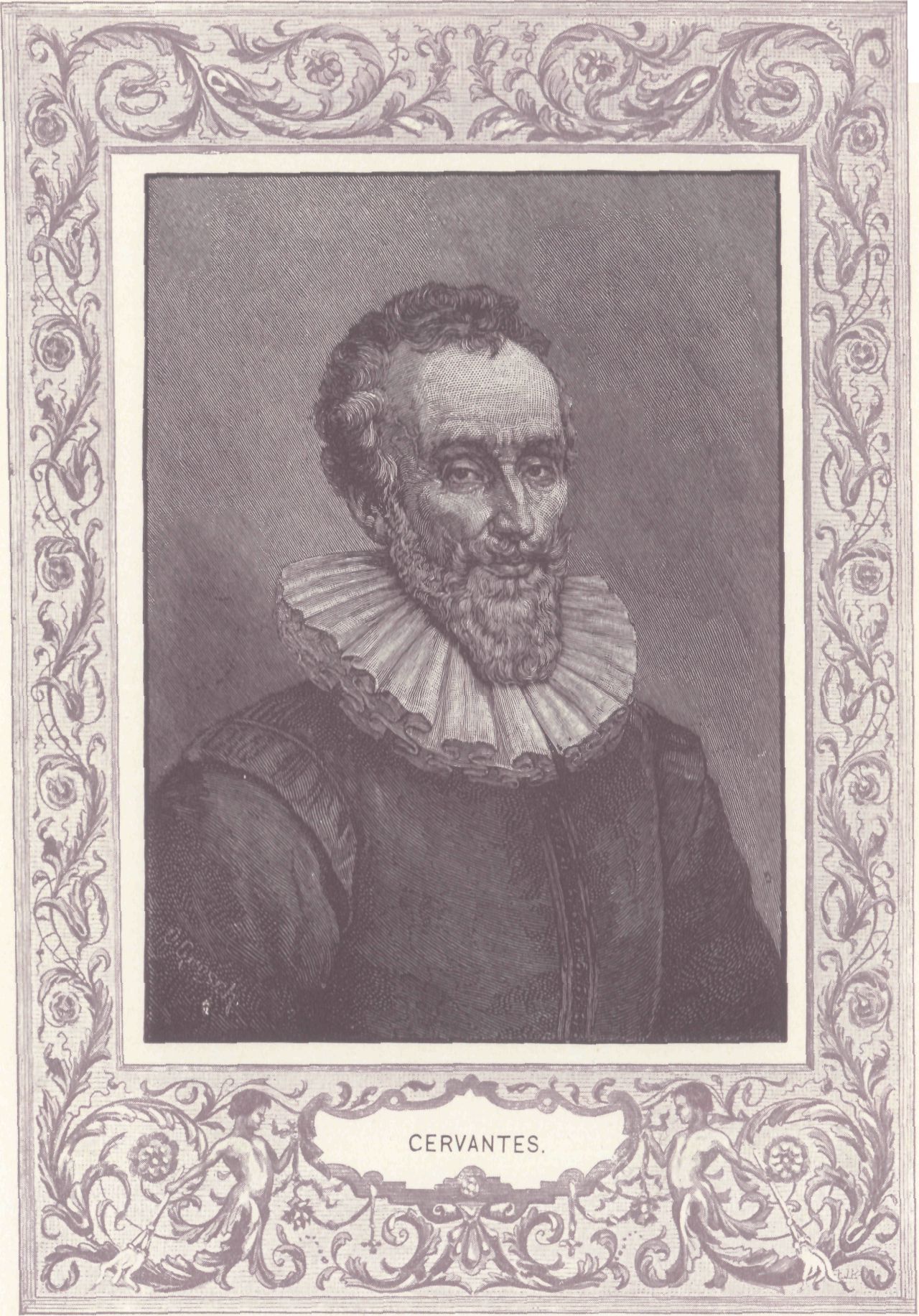
CERVANTES.
"Now, Master Andres," said the farmer, "call on the undoer of wrongs; you will find he won't undo that, though I am not sure that I have quite done with you, for I have a good mind to flay you alive as you feared." But at last he untied him, and gave him leave to go look for his judge in order to put the sentence pronounced into execution.
Andres went off rather down in the mouth, swearing he would go to look for the valiant Don Quixote of La Mancha and tell him exactly what had happened, and that all would have to be repaid him sevenfold; but for all that he went off weeping, while his master stood laughing.
Thus did the valiant Don Quixote right that wrong; and thoroughly satisfied with what had taken place, as he considered he had made a very happy and noble beginning with his knighthood, he took the road towards his village in perfect self-content, saying in a low voice:—"Well mayest them this day call thyself fortunate above all on earth, O Dulcinea del Toboso, fairest of the fair! since it has fallen to thy lot to hold subject and submissive to thy full will and pleasure a knight so renowned as is and will be Don Quixote of La Mancha, who as all the world knows, yesterday received the order of knighthood, and hath to-day righted the greatest wrong and grievance that ever injustice conceived and cruelty perpetrated; who hath to-day plucked the rod from the hand of yonder ruthless oppressor so wantonly lashing that tender child."
He now came to a road branching in four directions, and immediately he was reminded of those cross-roads where knights-errant used to stop to consider which road they should take. In imitation of them he halted for a while, and after having deeply considered it, he gave Rosinante his head, submitting his own will to that of his hack, who followed out his first intention, which was to make straight for his own stable. After he had gone about two miles Don Quixote perceived a large party of people, who as afterwards appeared were some Toledo traders, on their way to buy silk at Murcia. There were six of them coming along under their sun-shades, with four servants mounted, and three muleteers on foot. Scarcely had Don Quixote descried them when the fancy possessed him that this must be some new adventure; and to help him to imitate as far as he could those passages he had read of in his books, here seemed to come one made on purpose, which he resolved to attempt. So with a lofty bearing and determination he fixed himself firmly in his stirrups, got his lance ready, brought his buckler before his breast, and planting himself in the middle of the road, stood waiting the approach of these knights-errant, for such he now considered and held them to be; and when they had come near enough to see and hear, he exclaimed with a haughty gesture:—"All the world stand, unless all the world confess that in all the world there is no maiden fairer than the Empress of La Mancha, the peerless Dulcinea del Toboso."
The traders halted at the sound of this language and the sight of the strange figure that uttered it, and from both figure and language at once guessed the craze of their owner; they wished however to learn quietly what was the object of this confession that was demanded of them, and one of them, who was rather fond of a joke and was very sharp-witted, said to him:—"Sir Knight, we do not know who this good lady is that you speak of; show her to us, for if she be of such beauty as you suggest, with all our hearts and without any pressure we will confess the truth that is on your part required of us."
"If I were to show her to you," replied Don Quixote, "what merit would you have in confessing a truth so manifest? The essential point is that without seeing her you must believe, confess, affirm, swear, and defend it; else ye have to do with me in battle, ill-conditioned arrogant rabble that ye are: and come ye on, one by one as the order of knighthood requires, or all together as is the custom and vile usage of your breed; here do I bide and await you, relying on the justice of the cause I maintain."
"Sir Knight," replied the trader, "I entreat your Worship in the name of this present company of princes, that to save us from charging our consciences with the confession of a thing we have never seen or heard of, and one moreover so much to the prejudice of the Empresses and Queens of the Alcarria and Estremadura, your worship will be pleased to show us some portrait of this lady, though it be no bigger than a grain of wheat; for by the thread one gets at the ball, and in this way we shall be satisfied and easy, and you will be content and pleased: nay, I believe we are already so far agreed with you that even though her portrait should show her blind of one eye, and distilling vermilion and sulphur from the other, we would nevertheless, to gratify your Worship, say all in her favor that you desire."
"She distills nothing of the kind, vile rabble," said Don Quixote, burning with rage; "nothing of the kind, I say; only ambergris and civet in cotton; nor is she one-eyed or hump-backed, but straighter than a Guadarrama spindle: but ye must pay for the blasphemy ye have uttered against beauty like that of my lady."
And so saying he charged with leveled lance against the one who had spoken, with such fury and fierceness that, if luck had not contrived that Rosinante should stumble midway and come down, it would have gone hard with the rash trader. Down went Rosinante, and over went his master, rolling along the ground for some distance; and when he tried to rise he was unable, so incumbered was he with lance, buckler, spurs, helmet, and the weight of his old armor; and all the while he was struggling to get up, he kept saying, "Fly not, cowards and caitiffs! stay, for not by my fault, but my horse's, am I stretched here."
One of the muleteers in attendance, who could not have had much good-nature in him, hearing the poor prostrate man blustering in this style, was unable to refrain from giving him an answer on his ribs; and coming up to him he seized his lance, and having broken it in pieces, with one of them he began so to belabor our Don Quixote that, notwithstanding and in spite of his armor, he milled him like a measure of wheat. His masters called out not to lay on so hard and to leave him alone, but the muleteer's blood was up, and he did not care to drop the game until he had vented the rest of his wrath; and gathering up the remaining fragments of the lance he finished with a discharge upon the unhappy victim, who all through the storm of sticks that rained on him never ceased threatening heaven, and earth, and the brigands—for such they seemed to him. At last the muleteer was tired, and the traders continued their journey, taking with them matter for talk about the poor fellow who had been cudgeled. He, when he found himself alone, made another effort to rise; but if he was unable when whole and sound, how was he to rise after having been thrashed and well-nigh knocked to pieces! And yet he esteemed himself fortunate, as it seemed to him that this was a regular knight-errant's mishap, and entirely, he considered, the fault of his horse. However, battered in body as he was, to rise was beyond his power.
DON QUIXOTE AND SANCHO PANZA SALLY FORTH: AND THE ADVENTURE WITH THE WINDMILLS
He remained at home fifteen days very quietly, without showing any signs of a desire to take up with his former delusions; and during this time he held lively discussions with his two gossips, the curate and the barber, on the point he maintained, that knights-errant were what the world stood most in need of, and that in him was to be accomplished the revival of knight-errantry. The curate sometimes contradicted him, sometimes agreed with him, for if he had not observed this precaution he would have been unable to bring him to reason.
Meanwhile Don Quixote worked upon a farm-laborer, a neighbor of his, an honest man (if indeed that title can be given to him who is poor), but with very little wit in his pate. In a word, he so talked him over, and with such persuasions and promises, that the poor clown made up his mind to sally forth with him and serve him as esquire. Don Quixote, among other things, told him he ought to be ready to go with him gladly, because at any moment an adventure might occur, that might win an island in the twinkling of an eye and leave him governor of it. On these and the like promises Sancho Panza (for so the laborer was called) left wife and children, and engaged himself as esquire to his neighbor. Don Quixote next set about getting some money; and selling one thing and pawning another, and making a bad bargain in every case, he got together a fair sum. He provided himself with a buckler, which he begged as a loan from a friend, and restoring his battered helmet as best he could, he warned his squire Sancho of the day and hour he meant to set out, that he might provide himself with what he thought most needful. Above all, he charged him to take alforjas with him. The other said he would, and that he meant to take also a very good ass he had, as he was not much given to going on foot. About the ass, Don Quixote hesitated a little, trying whether he could call to mind any knight-errant taking with him an esquire mounted on ass-back, but no instance occurred to his memory. For all that, however, he determined to take him; intending to furnish him with a more honorable mount when a chance of it presented itself, by appropriating the horse of the first discourteous knight he encountered. Himself he provided with shirts and such other things as he could, according to the advice the host had given him; all which being settled and done, without taking leave, Sancho Panza of his wife and children, or Don Quixote of his housekeeper and niece, they sallied forth unseen by anybody from the village one night, and made such good way in the course of it that by daylight they held themselves safe from discovery, even should search be made for them.
Sancho rode on his ass like a patriarch, with his alforjas and bota, and longing to see himself soon governor of the island his master had promised him. Don Quixote decided upon taking the same route and road he had taken on his first journey, that over the Campo de Montiel, which he traveled with less discomfort than on the last occasion; for as it was early morning and the rays of the sun fell on them obliquely, the heat did not distress them.
And now said Sancho Panza to his master, "Your Worship will take care, Señor Knight-Errant, not to forget about the island you have promised me, for be it ever so big I'll be equal to governing it."
To which Don Quixote replied:—"Thou must know, friend Sancho Panza, that it was a practice very much in vogue with the knights-errant of old to make their squires governors of the islands or kingdoms they won, and I am determined that there shall be no failure on my part in so liberal a custom; on the contrary, I mean to improve upon it, for they sometimes, and perhaps most frequently, waited until their squires were old, and then when they had had enough of service and hard days and worse nights, they gave them some title or other, of count, or at the most marquis, of some valley or province more or less; but if thou livest and I live, it may well be that before six days are over I may have won some kingdom that has others dependent upon it, which will be just the thing to enable thee to be crowned king of one of them. Nor needst thou count this wonderful, for things and chances fall to the lot of such knights in ways so unexampled and unexpected that I might easily give thee even more than I promise thee."
"In that case," said Sancho Panza, "if I should become a king by one of those miracles your Worship speaks of, even Juana Gutierrez, my old woman, would come to be queen and my children infantes."
"Well, who doubts it?" said Don Quixote.
"I doubt it," replied Sancho Panza; "because for my part I am persuaded that though God should shower down kingdoms upon earth, not one of them would fit the head of Mari Gutierrez. Let me tell you, señor, she is not worth two maravedis for a queen; countess will fit her better, and that only with God's help."
"Leave it to God, Sancho," returned Don Quixote, "for he will give her what suits her best; but do not undervalue thyself so much as to come to be content with anything less than being governor of a province."
"I will not, señor," answered Sancho; "especially as I have a man of such quality for master in your Worship, who will be able to give me all that will be suitable for me and that I can bear."
At this point they came in sight of thirty or forty windmills that there are on that plain, and as soon as Don Quixote saw them he said to his squire, "Fortune is arranging matters for us better than we could have shaped our desires ourselves; for look there, friend Sancho Panza, where thirty or more monstrous giants present themselves, all of whom I mean to engage in battle and slay, and with whose spoils we shall begin to make our fortunes; for this is righteous warfare, and it is God's good service to sweep so evil a breed from off the face of the earth."
"What giants?" said Sancho Panza.
"Those thou seest there," answered his master, "with the long arms; and some have them nearly two leagues long."
"Look, your Worship," said Sancho; "what we see there are not giants but windmills, and what seem to be their arms are the sails that turned by the wind make the millstones go."
"It is easy to see," replied Don Quixote, "that thou art not used to this business of adventures; those are giants; and if thou art afraid, away with thee out of this and betake thyself to prayer, while I engage them in fierce and unequal combat."
So saying, he gave the spur to his steed Rosinante, heedless of the cries his squire Sancho sent after him, warning him that most certainly they were windmills and not giants he was going to attack. He however was so positive they were giants that he neither heard the cries of Sancho, nor perceived, near as he was, what they were; but made at them, shouting, "Fly not, cowards and vile beings, for it is a single knight that attacks you!"
A slight breeze at this moment sprang up, and the great sails began to move; seeing which, Don Quixote exclaimed, "Though ye flourish more arms than the giant Briareus, ye have to reckon with me."
So saying, and commending himself with all his heart to his lady Dulcinea, imploring her to support him in such a peril, with lance in rest and covered by his buckler, he charged at Rosinante's fullest gallop and fell upon the first mill that stood in front of him; but as he drove his lance-point into the sail the wind whirled it round with such force that it shivered the lance to pieces, sweeping with it horse and rider, who went rolling over on the plain in a sorry condition. Sancho hastened to his assistance as fast as his ass could go, and when he came up found him unable to move, with such a shock had Rosinante fallen with him.
"God bless me!" said Sancho, "did I not tell your Worship to mind what you were about, for they were only windmills? and no one could have made any mistake about it but one who had something of the same kind in his head."
"Hush, friend Sancho," replied Don Quixote; "the fortunes of war more than any other are liable to frequent fluctuations; and moreover I think, and it is the truth, that that same sage Friston who carried off my study and books has turned these giants into mills in order to rob me of the glory of vanquishing them,—such is the enmity he bears me; but in the end his wicked arts will avail but little against my good sword."
"God order it as he may," said Sancho Panza; and helping him to rise, got him up again on Rosinante, whose shoulder was half out; and then, discussing the late adventure, they followed the road to Puerto Lapice, for there, said Don Quixote, they could not fail to find adventures in abundance and variety, as it was a great thoroughfare.
SANCHO PANZA AND HIS WIFE TERESA CONVERSE SHREWDLY
The translator of this history, when he comes to write this fifth chapter, says that he considers it apocryphal, because in it Sancho Panza speaks in a style unlike that which might have been expected from his limited intelligence, and says things so subtle that he does not think it possible he could have conceived them; however, desirous of doing what his task imposed upon him, he was unwilling to leave it untranslated, and therefore he went on to say:—
Sancho came home in such glee and spirits that his wife noticed his happiness a bowshot off, so much so that it made her ask him, "What have you got, Sancho friend, that you are so glad?"
To which he replied, "Wife, if it were God's will, I should be very glad not to be so well pleased as I show myself."
"I don't understand you, husband," said she, "and I don't know what you mean by saying you would be glad, if it were God's will, not to be well pleased; for fool as I am, I don't know how one can find pleasure in not having it."
"Hark ye, Teresa," replied Sancho, "I am glad because I have made up my mind to go back to the service of my master Don Quixote, who means to go out a third time to seek for adventures; and I am going with him again, for my necessities will have it so, and also the hope that cheers me with the thought that I may find another hundred crowns like those we have spent; though it makes me sad to have to leave thee and the children; and if God would be pleased to let me have my daily bread, dry-shod and at home, without taking me out into the byways and cross-roads—and he could do it at small cost by merely willing it—it is clear my happiness would be more solid and lasting, for the happiness I have is mingled with sorrow at leaving thee; so that I was right in saying I would be glad, if it were God's will, not to be well pleased."
"Look here, Sancho," said Teresa; "ever since you joined on to a knight-errant you talk in such a roundabout way that there is no understanding you."
"It is enough that God understands me, wife," replied Sancho; "for he is the understander of all things; that will do: but mind, sister, you must look to Dapple carefully for the next three days, so that he may be fit to take arms; double his feed, and see to the pack-saddle and other harness, for it is not to a wedding we are bound, but to go round the world, and play at give-and-take with giants and dragons and monsters, and hear hissings and roarings and bellowings and howlings; and even all this would be lavender, if we had not to reckon with Yanguesans and enchanted Moors."
"I know well enough, husband," said Teresa, "that squires-errant don't eat their bread for nothing, and so I will be always praying to our Lord to deliver you speedily from all that hard fortune."
"I can tell you, wife," said Sancho, "if I did not expect to see myself governor of an island before long, I would drop down dead on the spot."
"Nay then, husband," said Teresa, "let the hen live, though it be with her pip; live, and let the devil take all the governments in the world: you came out of your mother's womb without a government, you have lived until now without a government, and when it is God's will you will go, or be carried, to your grave without a government. How many there are in the world who live without a government, and continue to live all the same, and are reckoned in the number of the people. The best sauce in the world is hunger, and as the poor are never without that, they always eat with a relish. But mind, Sancho, if by good luck you should find yourself with some government, don't forget me and your children. Remember that Sanchico is now full fifteen, and it is right he should go to school, if his uncle the abbot has a mind to have him trained for the Church. Consider, too, that your daughter Maria-Sancha will not die of grief if we marry her; for I have my suspicions that she is as eager to get a husband as you to get a government; and after all, a daughter looks better ill married than well kept."
"By my faith," replied Sancho, "if God brings me to get any sort of a government, I intend, wife, to make such a high match for Maria-Sancha that there will be no approaching her without calling her 'my lady.'"
"Nay, Sancho," returned Teresa, "marry her to her equal, that is the safest plan; for if you put her out of wooden clogs into high-heeled shoes, out of her gray flannel petticoat into hoops and silk gowns, out of the plain 'Marica' and 'thou' into 'Doña So-and-so' and 'my lady,' the girl won't know where she is, and at every turn she will fall into a thousand blunders that will show the thread of her coarse homespun stuff."
"Tut, you fool," said Sancho; "it will be only to practice it for two or three years, and then dignity and decorum will fit her as easily as a glove, and if not, what matter? Let her be 'my lady,' and never mind what happens."
"Keep to your own station, Sancho," replied Teresa; "don't try to raise yourself higher, and bear in mind the proverb that says, 'Wipe the nose of your neighbor's son, and take him into your house.' A fine thing it would be, indeed, to marry our Maria to some great count or grand gentleman who when the humor took him would abuse her, and call her 'clown-bred' and 'clodhopper's daughter' and 'spinning-wench.' I have not been bringing up my daughter for that all this time, I can tell you, husband. Do you bring home money, Sancho, and leave marrying her to my care: there is Lope Tocho, Juan Tocho's son, a stout, sturdy young fellow that we know, and I can see he does not look sour at the girl; and with him, one of our own sort, she will be well married, and we shall have her always under our eyes, and be all one family, parents and children, grandchildren and sons-in-law, and the peace and blessing of God will dwell among us; so don't you go marrying her in those courts and grand palaces where they won't know what to make of her, or she what to make of herself."
"Why, you idiot and wife for Barabbas," said Sancho, "what do you mean by trying, without why or wherefore, to keep me from marrying my daughter to one who will give me grandchildren that will be called 'your Lordship'? Look ye, Teresa, I have always heard my elders say that he who does not know how to take advantage of luck when it comes to him, has no right to complain if it gives him the go-by; and now that it is knocking at our door, it will not do to shut it out; let us go with the favoring breeze that blows upon us." (It is this sort of talk, and what Sancho says lower down, that made the translator of the history say he considered this chapter apocryphal.) "Don't you see, you animal," continued Sancho, "that it will be well for me to drop into some profitable government that will lift us out of the mire, and marry Mari-Sancha to whom I like; and you yourself will find yourself called 'Doña Teresa Panza,' and sitting in church on a fine carpet and cushions and draperies, in spite and in defiance of all the born ladies of the town? No, stay as you are, growing neither greater nor less, like a tapestry figure.—Let us say no more about it, for Sanchica shall be a countess, say what you will."
"Are you sure of all you say, husband?" replied Teresa. "Well, for all that, I am afraid this rank of countess for my daughter will be her ruin. You do as you like, make a duchess or a princess of her, but I can tell you it will not be with my will and consent. I was always a lover of equality, brother, and I can't bear to see people give themselves airs without any right. They called me Teresa at my baptism,—a plain, simple name, without any additions or tags or fringes of Dons or Doñas; Cascajo was my father's name, and as I am your wife, I am called Teresa Panza, though by right I ought to be called Teresa Cascajo; but 'kings go where laws like,' and I am content with this name without having the 'Don' put on top of it to make it so heavy that I cannot carry it; and I don't want to make people talk about me when they see me go dressed like a countess or governor's wife; for they will say at once, 'See what airs the slut gives herself! Only yesterday she was always spinning flax, and used to go to mass with the tail of her petticoat over her head instead of a mantle; and there she goes to-day in a hooped gown with her brooches and airs, as if we didn't know her!' If God keeps me in my seven senses, or five, or whatever number I have, I am not going to bring myself to such a pass; go you, brother, and be a government or an island man, and swagger as much as you like; for by the soul of my mother, neither my daughter nor I are going to stir a step from our village; a respectable woman should have a broken leg and keep at home, and to be busy at something is a virtuous damsel's holiday; be off to your adventures, along with your Don Quixote, and leave us to our misadventures, for God will mend them for us according as we deserve it. I don't know, I'm sure, who fixed the 'Don' to him, what neither his father nor grandfather ever had."
"I declare, thou hast a devil of some sort in thy body!" said Sancho. "God help thee, woman, what a lot of things thou hast strung together, one after the other, without head or tail! What have Cascajo, and the brooches and the proverbs and the airs, to do with what I say? Look here, fool and dolt (for so I may call you when you don't understand my words and run away from good fortune), if I had said that my daughter was to throw herself down from a tower, or go roaming the world, as the Infanta Doña Urraca wanted to do, you would be right in not giving way to my will; but if in an instant, in less than the twinkling of an eye, I put the 'Don' and 'my lady' on her back, and take her out of the stubble and place her under a canopy, on a daïs, and on a couch with more velvet cushions than all the Almohades of Morocco ever had in their family, why won't you consent and fall in with my wishes?"
"Do you know why, husband?" replied Teresa; "because of the proverb that says, 'Who covers thee, discovers thee.' At the poor man people only throw a hasty glance; on the rich man they fix their eyes; and if the said rich man was once on a time poor, it is then there is the sneering and the tattle and spite of backbiters; and in the streets here they swarm as thick as bees."
"Look here, Teresa," said Sancho, "and listen to what I am now going to say to you; maybe you never heard it in all your life; and I do not give my own notions, for what I am about to say are the opinions of his Reverence the preacher who preached in this town last Lent, and who said, if I remember rightly, that all things present that our eyes behold, bring themselves before us and remain and fix themselves on our memory much better and more forcibly than things past." (These observations which Sancho makes here are the other ones on account of which the translator says he regards this chapter as apocryphal, inasmuch as they are beyond Sancho's capacity.) "Whence it arises," he continued, "that when we see any person well dressed and making a figure with rich garments and retinue of servants, it seems to lead and impel us perforce to respect him, though memory may at the same time recall to us some lowly condition in which we have seen him, but which, whether it may have been poverty or low birth, being now a thing of the past has no existence; while the only thing that has any existence is what we see before us; and if this person whom fortune has raised from his original lowly state (these were the very words the padre used) to his present height of prosperity, be well-bred, generous, courteous to all, without seeking to vie with those whose nobility is of ancient date,—depend upon it, Teresa, no one will remember what he was, and every one will respect what he is, except indeed the envious, from whom no fair fortune is safe."
"I do not understand you, husband," replied Teresa; "do as you like, and don't break my head with any more speechifying and rhetoric; and if you have revolved to do what you say—"
"Resolved, you should say, woman," said Sancho, "not revolved."
"Don't set yourself to wrangle with me, husband," said Teresa; "I speak as God pleases, and don't deal in out-of-the-way phrases; and I say if you are bent upon having a government, take your son Sancho with you, and teach him from this time on how to hold a government; for sons ought to inherit and learn the trades of their fathers."
"As soon as I have the government," said Sancho, "I will send for him by post, and I will send thee money, of which I shall have no lack, for there is never any want of people to lend it to governors when they have not got it; and do thou dress him so as to hide what he is and make him look what he is to be."
"You send the money," said Teresa, "and I'll dress him up for you as fine as you please."
"Then we are agreed that our daughter is to be a countess," said Sancho.
"The day that I see her a countess," replied Teresa, "it will be the same to me as if I was burying her; but once more I say do as you please, for we women are born to this burden of being obedient to our husbands, though they be dogs;" and with this she began to weep in downright earnest, as if she already saw Sanchica dead and buried.
Sancho consoled her by saying that though he must make her a countess, he would put it off as long as possible. Here their conversation came to an end, and Sancho went back to see Don Quixote and make arrangements for their departure.
OF SANCHO PANZA'S DELECTABLE DISCOURSE WITH THE DUCHESS
The history records that Sancho did not sleep that afternoon, but in order to keep his word, came, before he had well done dinner, to visit the duchess; who, finding enjoyment in listening to him, made him sit down beside her on a low seat, though Sancho out of pure good breeding wanted not to sit down; the duchess however told him he was to sit down as governor and talk as squire, as in both respects he was worthy of even the chair of Cid Ruy Diaz the Campeador. Sancho shrugged his shoulders, obeyed, and sat down, and all the duchess's damsels and duennas gathered round him, waiting in profound silence to hear what he would say. It was the duchess however who spoke first, saying,—"Now that we are alone, and that there is nobody here to overhear us, I should be glad if the señor governor would relieve me of certain doubts I have, rising out of the history of the great Don Quixote that is now in print. One is: inasmuch as worthy Sancho never saw Dulcinea,—I mean the lady Dulcinea del Toboso,—nor took Don Quixote's letter to her,—for it was left in the memorandum-book in the Sierra Morena, how did he dare to invent the answer and all that about finding her sifting wheat,—the whole story being a deception and falsehood, and so much to the prejudice of the peerless Dulcinea's good name; a thing that is not at all becoming the character and fidelity of a good squire?"
At these words, Sancho, without uttering one in reply, got up from his chair, and with noiseless steps, with his body bent and his finger on his lips, went all round the room lifting up the hangings; and this done, he came back to his seat and said:—"Now, señora, that I have seen that there is no one except the bystanders listening to us on the sly, I will answer what you have asked me, and all you may ask me, without fear or dread. And the first thing I have got to say is, that for my own part I hold my master Don Quixote to be stark mad, though sometimes he says things that to my mind, and indeed everybody's that listens to him, are so wise and run in such a straight furrow that Satan himself could not have said them better; but for all that, really and beyond all question, it's my firm belief he is cracked. Well, then, as this is clear to my mind, I can venture to make him believe things that have neither head nor tail, like that affair of the answer to the letter, and that other of six or eight days ago which is not yet in history,—that is to say, the affair of the enchantment of my lady Dulcinea; for I made him believe she is enchanted, though there's no more truth in it than over the hills of Úbeda."
The duchess begged him to tell her about the enchantment or deception, so Sancho told the whole story exactly as it had happened, and his hearers were not a little amused by it; and then resuming, the duchess said:—"In consequence of what worthy Sancho has told me, a doubt starts up in my mind, and there comes a kind of whisper to my ears that says, 'If Don Quixote be mad, crazy, cracked, and Sancho his squire knows it, and notwithstanding serves and follows him, and goes trusting to his empty promises, there can be no doubt he must be still madder and sillier than his master; and that being so, it will be cast in your teeth, señora Duchess, if you give the said Sancho an island to govern; for how will he who does not know how to govern himself know how to govern others?'"
"My God, señora," said Sancho, "but that doubt comes timely; but your Grace may say it out, and speak plainly, or as you like; for I know what you say is true, and if I were wise I should have left my master long ago: but this was my fate, this was my bad luck; I can't help it, I must follow him; we're from the same village, I have eaten his bread, I'm fond of him, I'm grateful, he gave me his ass-colts, and above all I'm faithful; so it's quite impossible for anything to separate us except the pick-axe and shovel. And if your Highness does not like to give me the government you promised, God made me without it and maybe your not giving it to me will be all the better for my conscience; for fool as I am, I know the proverb 'To her hurt the ant got wings,' and it may be that Sancho the squire will get to heaven sooner than Sancho the governor. 'They make as good bread here as in France'; and 'By night all cats are gray'; and 'A hard case enough his, who hasn't broken his fast at two in the afternoon'; and 'There's no stomach a hand's-breadth bigger than another'; and the same can be filled 'with straw or hay,' as the saying is; and 'The little birds of the field have God for their purveyor and caterer'; and 'Four yards of Cuenca frieze keep one warmer than four of Segovia broadcloth'; and 'When we quit this world and are put underground, the prince travels by as narrow a path as the journeyman'; and 'The Pope's body does not take up more feet of earth than the sacristan's,' for all that the one is higher than the other; for when we go to our graves we all pack ourselves up and make ourselves small, or rather they pack us up and make us small in spite of us, and then—good-night to us. And I say once more, if your ladyship does not like to give me the island because I'm a fool, like a wise man I will take care to give myself no trouble about it; I have heard say that 'Behind the cross there's the devil,' and that 'All that glitters is not gold,' and that from among the oxen and the plows and the yokes, Wamba the husbandman was taken to be made king of Spain; and from among brocades and pleasures and riches, Roderick was taken to be devoured by adders, if the verses of the old ballads don't lie."
"To be sure they don't lie!" exclaimed Doña Rodriguez, the duenna, who was one of the listeners. "Why, there's a ballad that says they put King Rodrigo alive into a tomb full of toads and adders and lizards, and that two days afterwards the king, in a plaintive, feeble voice, cried out from within the tomb—
'They gnaw me now, they gnaw me now, There where I most did sin.'
And according to that, the gentleman has good reason to say he would rather be a laboring man than a king, if vermin are to eat him."
The duchess could not help laughing at the simplicity of her duenna, or wondering at the language and proverbs of Sancho, to whom she said:—"Worthy Sancho knows very well that when once a knight has made a promise he strives to keep it, though it should cost him his life. My lord and husband the duke, though not one of the errant sort, is none the less a knight for that reason, and will keep his word about the promised island in spite of the envy and malice of the world. Let Sancho be of good cheer; for when he least expects it he will find himself seated on the throne of his island and seat of dignity, and will take possession of his government that he may discard it for another of three-bordered brocade. The charge I give him is, to be careful how he governs his vassals, bearing in mind that they are all loyal and well-born."
"As to governing them well," said Sancho, "there's no need of charging me to do that, for I'm kind-hearted by nature, and full of compassion for the poor; 'There's no stealing the loaf from him who kneads and bakes'; and by my faith, it won't do to throw false dice with me; I am an old dog, and I know all about 'tus, tus'; I can be wide awake if need be, and I don't let clouds come before my eyes, for I know where the shoe pinches me; I say so, because with me the good will have support and protection, and the bad neither footing nor access. And it seems to me that in governments, to make a beginning is everything; and maybe after having been governor a fortnight, I'll take kindly to the work and know more about it than the field labor I have been brought up to."
"You are right, Sancho," said the duchess; "for no one is born ready taught, and the bishops are made out of men and not out of stones. But to return to the subject we were discussing just now, the enchantment of the lady Dulcinea: I look upon it as certain, and something more than evident, that Sancho's idea of practicing a deception upon his master, making him believe that the peasant girl was Dulcinea and that if he did not recognize her it must be because she was enchanted, was all a device of one of the enchanters that persecute Don Quixote. For in truth and earnest, I know from good authority that the coarse country wench who jumped up on the ass was and is Dulcinea del Toboso, and that worthy Sancho, though he fancies himself the deceiver, is the one that is deceived; and that there is no more reason to doubt the truth of this, than of anything else we never saw. Señor Sancho Panza must know that we too have enchanters here, that are well disposed to us, and tell us what goes on in the world, plainly and distinctly, without subterfuge or deception; and believe me, Sancho, that agile country lass was and is Dulcinea del Toboso, who is as much enchanted as the mother that bore her; and when we least expect it, we shall see her in her own proper form, and then Sancho will be disabused of the error he is under at present."
"All that's very possible," said Sancho Panza; "and now I'm willing to believe what my master says about what he saw in the cave of Montesinos, where he says he saw the lady Dulcinea del Toboso in the very same dress and apparel that I said I had seen her in when I enchanted her all to please myself. It must be all exactly the other way, as your ladyship says; because it is impossible to suppose that out of my poor wit such a cunning trick could be concocted in a moment, nor do I think my master is so mad that by my weak and feeble persuasion he could be made to believe a thing so out of all reason. But, señora, your Excellence must not therefore think me ill-disposed, for a dolt like me is not bound to see into the thoughts and plots of those vile enchanters. I invented all that to escape my master's scolding, and not with any intention of hurting him; and if it has turned out differently, there is a God in heaven who judges our hearts."
"That is true," said the duchess; "but tell me, Sancho, what is this you say about the cave of Montesinos, for I should like to know."
Sancho, upon this, related to her word for word what has been said already touching that adventure; and having heard it, the duchess said:—"From this occurrence it may be inferred that as the great Don Quixote says he saw there the same country wench Sancho saw on the way from El Toboso, it is no doubt Dulcinea, and there are some very active and exceedingly busy enchanters about."
"So I say," said Sancho; "and if my lady Dulcinea is enchanted, so much the worse for her, and I'm not going to pick a quarrel with my master's enemies, who seem to be many and spiteful. The truth is that the one I saw was a country wench, and I set her down to be a country wench; and if that was Dulcinea it must not be laid at my door, nor should I be called to answer for it or take the consequences. But they must go nagging at me at every step—'Sancho said it, Sancho did it; Sancho here, Sancho there,' as if Sancho was nobody at all, and not that same Sancho Panza that's now going all over the world in books, so Samson Carrasco told me, and he's at any rate one that's a bachelor of Salamanca; and people of that sort can't lie, except when the whim seizes them or they have some very good reason for it. So there's no occasion for anybody to quarrel with me; and then I have a good character, and as I have heard my master say, 'A good name is better than great riches'; let them only stick me into this government and they'll see wonders, for one who has been a good squire will be a good governor."
"All worthy Sancho's observations," said the duchess, "are Catonian sentences, or at any rate out of the very heart of Michael Verino himself, who florentibus occidit annis. In fact, to speak in his own style, 'Under a bad cloak there's often a good drinker.'"
"Indeed, señora," said Sancho, "I never yet drank out of wickedness; from thirst I have, very likely, for I have nothing of the hypocrite in me; I drink when I'm inclined, or, if I'm not inclined, when they offer it to me, so as not to look either strait-laced or ill-bred; for when a friend drinks one's health, what heart can be so hard as not to return it? But if I put on my shoes I don't dirty them; besides, squires to knights-errant mostly drink water, for they are always wandering among woods, forests, and meadows, mountains and crags, without a drop of wine to be had if they gave their eyes for it."
"So I believe," said the duchess; "and now let Sancho go and take his sleep, and we will talk by-and-by at greater length, and settle how he may soon go and stick himself into the government, as he says."
Sancho once more kissed the duchess's hand, and entreated her to be so kind as to let good care be taken of his Dapple, for he was the light of his eyes.
"What is Dapple?" said the duchess.
"My ass," said Sancho, "which, not to mention him by that name, I'm accustomed to call Dapple; I begged this lady duenna here to take care of him when I came into the castle, and she got as angry as if I had said she was ugly or old, though it ought to be more natural and proper for duennas to feed asses than to ornament chambers. God bless me! what a spite a gentleman of my village had against these ladies!"
"He must have been some clown," said Doña Rodriguez, the duenna; "for if he had been a gentleman and well-born he would have exalted them higher than the horns of the moon."
"That will do," said the duchess; "no more of this; hush, Doña Rodriguez, and let Señor Panza rest easy and leave the treatment of Dapple in my charge; for as he is a treasure of Sancho's, I'll put him on the apple of my eye."
"It will be enough for him to be in the stable," said Sancho, "for neither he nor I are worthy to rest a moment in the apple of your Highness's eye, and I'd as soon stab myself as consent to it; for though my master says that in civilities it is better to lose by a card too many than a card too few, when it comes to civilities to asses we must mind what we are about and keep within due bounds."
"Take him to your government, Sancho," said the duchess, "and there you will be able to make as much of him as you like, and even release him from work and pension him off."
"Don't think, señora duchess, that you have said anything absurd," said Sancho: "I have seen more than two asses go to governments, and for me to take mine with me would be nothing new."
Sancho's words made the duchess laugh again, and gave her fresh amusement, and dismissing him to sleep she went away to tell the duke the conversation she had had with him.
SANCHO PANZA AS GOVERNOR
The history says that from the justice court they carried Sancho to a sumptuous palace, where in a spacious chamber there was a table laid out with royal magnificence. The clarions sounded as Sancho entered the room, and four pages came forward to present him with water for his hands, which Sancho received with great dignity. The music ceased, and Sancho seated himself at the head of the table; for there was only that seat placed, and no more than the one cover laid. A personage, who it appeared afterwards was a physician, placed himself standing by his side, with a whalebone wand in his hand. They then lifted up a fine white cloth covering fruit and a great variety of dishes of different sorts; one who looked like a student said grace, and a page put a laced bib on Sancho, while another who played the part of head carver placed a dish of fruit before him. But hardly had he tasted a morsel when the man with the wand touched the plate with it, and they took it away from before him with the utmost celerity. The carver however brought him another dish, and Sancho proceeded to try it; but before he could get at it, not to say taste it, already the wand had touched it and a page had carried it off with the same promptitude as the fruit. Sancho seeing this was puzzled, and looking from one to another, asked if this dinner was to be eaten after the fashion of a jugglery trick.
To this he with the wand replied:—"It is not to be eaten, señor governor, except as is usual and customary in other islands where there are governors. I, señor, am a physician, and I am paid a salary in this island to serve its governors as such; and I have a much greater regard for their health than for my own, studying day and night and making myself acquainted with the governor's constitution, in order to be able to cure him when he falls sick. The chief thing I have to do is to attend at his dinners and suppers, and allow him to eat what appears to me to be fit for him, and keep from him what I think will do him harm and be injurious to his stomach: and therefore I ordered that plate of fruit to be removed as being too moist, and that other dish I ordered to be removed as being too hot and containing many spices that stimulate thirst; for he who drinks much kills and consumes the radical moisture wherein life consists."
"Well then," said Sancho, "that dish of roast partridges there that seems so savory will not do me any harm."
To this the physician replied, "Of those my lord the governor shall not eat so long as I live."
"Why so?" said Sancho.
"Because," replied the doctor, "our master Hippocrates, the pole-star and beacon of medicine, says in one of his aphorisms, Omnis saturatio mala, perdicis autem pessima; which means, 'All repletion is bad, but that of partridge is the worst of all.'"
"In that case," said Sancho, "let señor doctor see among the dishes that are on the table what will do me most good and least harm, and let me eat it, without tapping it with his stick: for by the life of the governor, and so may God suffer me to enjoy it, but I'm dying of hunger; and in spite of the doctor and all he may say, to deny me food is the way to take my life instead of prolonging it."
"Your worship is right, señor governor," said the physician; "and therefore your worship, I consider, should not eat of those stewed rabbits there, because it is a furry kind of food: if that veal were not roasted and served with pickles, you might try it; but it is out of the question."
"That big dish that is smoking farther off," said Sancho, "seems to me to be an olla-podrida; and out of the diversity of things in such ollas, I can't fail to light upon something tasty and good for me."
"Absit," said the doctor; "far from us be any such base thought! There is nothing in the world less nourishing than an olla-podrida; to canons, or rectors of colleges, or peasants' weddings with your ollas-podridas, but let us have none of them on the tables of governors, where everything that is present should be delicate and refined: and the reason is that always, everywhere and by everybody, simple medicines are more esteemed than compound ones; for we cannot go wrong in those that are simple, while in the compound we may, by merely altering the quantity of the things composing them. But what I am of opinion the governor should eat now, in order to preserve and fortify his health, is a hundred or so of wafer cakes and a few thin slices of conserve of quinces, which will settle his stomach and help his digestion."
Sancho on hearing this threw himself back in his chair and surveyed the doctor steadily, and in a solemn tone asked him what his name was and where he had studied.
He replied, "My name, señor governor, is Doctor Pedro Recio de Aguero; I am a native of a place called Tirteafuera, which lies between Caracuel and Almodóvar del Campo, on the right-hand side; and I have the degree of doctor from the university of Osuna."
To which Sancho, glowing all over with rage, returned, "Then let Doctor Pedro Recio de Mal-aguero, native of Tirteafuera, a place that's on the right-hand side as we go from Caracuel to Almodóvar del Campo, graduate of Osuna, get out of my presence at once! or I swear by the sun I'll take a cudgel, and by dint of blows, beginning with him, I'll not leave a doctor in the whole island: at least of those I know to be ignorant; for as to learned, wise, sensible physicians, them I will reverence and honor as divine persons. Once more I say, let Pedro Recio get out this, or I'll take this chair I am sitting on and break it over his head. And if they call me to account for it, I'll clear myself by saying I served God in killing a bad doctor—a general executioner. And now give me something to eat, or else take your government; for a trade that does not feed its master is not worth two beans...."
Sancho, fool, boor, and clown as he was, held his own against them all, saying to those round him, and to Doctor Pedro Recio, who as soon as the private business of the duke's letter was disposed of had returned to the room:—"Now I see plainly enough that judges and governors ought to be and must be made of brass, not to feel the importunities of the applicants that at all times and all seasons insist on being heard and having their business dispatched, and their own affairs and no others attended to, come what may; and if the poor judge does not hear them and settle the matter,—either because he cannot or because that is not the time set apart for hearing them,—forthwith they abuse him, run him down, and gnaw at his bones, and even pick holes in his pedigree. You silly stupid applicant, don't be in a hurry; wait for the proper time and season for doing business; don't come at dinner-hour or at bedtime: for judges are only flesh and blood, and must give to Nature what she naturally demands of them; all except myself, for in my case I give her nothing to eat, thanks to Señor Doctor Pedro Recio Tirteafuera here, who would have me die of hunger, and declares that death to be life; and the same sort of life may God give him and all his kind—I mean the bad doctors; for the good ones deserve palms and laurels."