Volume 8 / Act 1 — BLISS CARMAN
Reading edition
(1861-)
BY CHARLES G. D. ROBERTS

liss Carman was born at Fredericton, New Brunswick, on April 15th, 1861. On both sides of the house he belongs to that United Empire Loyalist stock which at the time of the American Revolution sacrificed wealth and ease to a principle, and angrily withdrew from the young republic to carve out new commonwealths in the wilds of Canada. His father was William Carman, Clerk of the Pleas, a man of influence and distinction in his Province. His mother was one of the Blisses of Fredericton, the Loyalist branch of that Connecticut family to which Emerson's mother belonged. Mr. Carman was educated at the Collegiate School and the University of New Brunswick, both at Fredericton. He distinguished himself in classics and mathematics, took his B. A. in 1881, his M. A. in 1884, and afterwards took partial courses at Edinburgh and Harvard. He has been connected editorially with several American periodicals, the Independent and the Chap-Book among them, but now devotes himself exclusively to literature. He divides his time between Boston and Washington, returning to the Maritime Provinces for the hot months of each year.
Bliss Carman
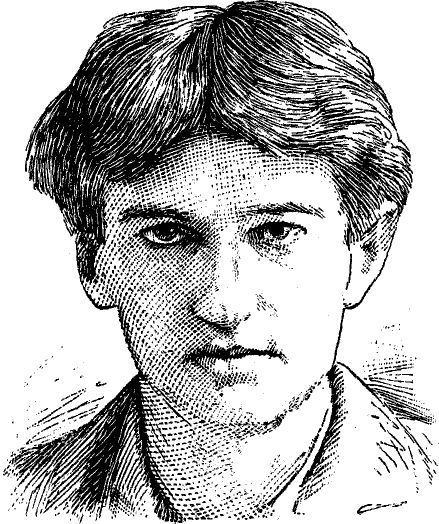
Mr. Carman issued his first volume of poems in 1893, when he had already won reputation as a contributor to the magazines. The volume was called 'Low Tide on Grand Pré: a Book of Lyrics.' It was published in New York and London, and ran quickly into a second edition. Equally successful was the volume called 'Songs from Vagabondia,' published in 1894. About half the poems in this volume are by Mr. Richard Hovey, whose name appears on the title-page with that of Mr. Carman. In 1895 appeared 'Behind the Arras: a Book of the Unseen.' Much of Mr. Carman's known work remains still uncollected.
In that outburst of intellectual energy which has of late won for Canada a measure of recognition in the world of letters, Mr. Carman's work has played a large part. The characteristics of the Canadian school may perhaps be defined as a certain semi-Sufristic worship of nature, combined with freshness of vision and keenness to interpret the significance of the external world. These characteristics find intense expression in Mr. Carman's poems. And they find expression in an utterance so new and so distinctive that its influence is already active in the verse of his contemporaries.
There are two terms which apply pre-eminently to Mr. Carman. These are Lyrist and Symbolist. His note is always the lyric note. The "lyric cry" thrills all his cadences. If it be true that poetry is the rhythmical expression in words of thought fused in emotion, then in his work we are impressed by the completeness of the fusion. Every phrase is filled with lyric passion. At its best, the result is a poem which not only haunts the ear with its harmonies but at the same time makes appeal to the heart and intellect. When the result is less successful it seems sometimes as if the thought were too much diluted with words,—as if, in fact, verbal music and verbal coloring were allowed to take the place of the legitimate thought-process. Even in such cases, the verse, however nebulous in meaning, is rarely without some subtlety of technique, some charm of diction, to justify its existence. But there are poems of Mr. Carman's, wherein what seems at first to be the obscurity of an over-attenuated thought is really an attempt to express thought in terms of pure music or pure color. In a curious and beautiful poem called 'Beyond the Gamut' he elaborates a theory of the oneness and interchangeability of form, sound, and color.
In the matter of conception and interpretation Mr. Carman is a symbolist. This word is not used here in any restricted sense, and must be divorced from all association with the shibboleths of warring schools. The true symbolist—and all the supreme artists of the world have been in this sense symbolists—recognizes that there are truths too vast and too subtle to endure definition in scientific phrase. They elude set words; as a faint star, at the coming on of evening, eludes the eye which seeks for it directly, while unveiling itself to a side glance. Mr. Carman conveys to us, by the suggestion of thrilling color or inimitable phrase, perceptions and emotions which a more strictly defined method could never capture.
In subject-matter Mr. Carman is simple and elemental. He looks at his themes curiously, often whimsically; but the themes are those of universal and eternal import,—life, love, and death, the broad aspects of the outer world, the "deep heart of man," and the spirit that informs them all. His song is sometimes in a minor key, plangent and piercing; sometimes in a large and virile major,—as for instance when he sings the 'War-song of Gamelba.' To his gifts of imagination, insight, and lyric passion he adds a fine humor, the outflowing of a broad and tolerant humanity. This is well exemplified in 'Resignation' and 'A More Ancient Mariner.' His chief defects, besides the occasional obscurity already referred to, are a tendency to looseness of structure in his longer poems, and once in a while, as in parts of 'The Silent Lodger,' a Browningesque lapse into hardness and baldness when the effect aimed at is colloquial simplicity.

HACK AND HEW
Hack and Hew were the sons of God In the earlier earth than now; One at his right hand, one at his left, To obey as he taught them how. And Hack was blind and Hew was dumb, But both had the wild, wild heart; And God's calm will was their burning will, And the gist of their toil was art. They made the moon and the belted stars, They set the sun to ride; They loosed the girdle and veil of the sea, The wind and the purple tide. Both flower and beast beneath their hands To beauty and speed outgrew,— The furious fumbling hand of Hack, And the glorying hand of Hew. Then, fire and clay, they fashioned a man, And painted him rosy brown; And God himself blew hard in his eyes: "Let them burn till they smolder down!" And "There!" said Hack, and "There!" thought Hew, "We'll rest, for our toil is done." But "Nay," the Master Workman said, "For your toil is just begun. "And ye who served me of old as God Shall serve me anew as man, Till I compass the dream that is in my heart And perfect the vaster plan." And still the craftsman over his craft, In the vague white light of dawn, With God's calm will for his burning will While the mounting day comes on, Yearning, wind-swift, indolent, wild, Toils with those shadowy two,— The faltering restless hand of Hack, And the tireless hand of Hew.
From 'Behind the Arras': copyrighted 1895, by Lamson, Wolffe and Company
AT THE GRANITE GATE
There paused to shut the door A fellow called the Wind. With mystery before, And reticence behind, A portal waits me too In the glad house of spring; One day I shall pass through And leave you wondering. It lies beyond the marge Of evening or of prime, Silent and dim and large, The gateway of all time. There troop by night and day My brothers of the field; And I shall know the way Their wood-songs have revealed. The dusk will hold some trace Of all my radiant crew Who vanished to that place, Ephemeral as dew. Into the twilight dun, Blue moth and dragon-fly Adventuring alone,— Shall be more brave than I? There innocents shall bloom, And the white cherry tree, With birch and willow plume To strew the road for me. The wilding orioles then Shall make the golden air Heavy with joy again, And the dark heart shall dare Resume the old desire,— The exigence of spring To be the orange fire That tips the world's gray wing. And the lone wood-bird—Hark! The whippoorwill, night-long, Threshing the summer dark With his dim flail of song!— Shall be the lyric lift, When all my senses creep, To bear me through the rift In the blue range of sleep. And so I pass beyond The solace of your hand. But ah, so brave and fond! Within that morrow-land, Where deed and daring fail, But joy forevermore Shall tremble and prevail Against the narrow door, Where sorrow knocks too late, And grief is overdue, Beyond the granite gate There will be thoughts of you.
From 'Behind the Arras': copyrighted 1895, by Lamson, Wolffe and Company
A SEA CHILD
The lover of child Marjory Had one white hour of life brim full; Now the old nurse, the rocking sea, Hath him to lull. The daughter of child Marjory Hath in her veins, to beat and run, The glad indomitable sea, The strong white sun.
Copyrighted by Bliss Carman.