Volume 8 / Act 1 — CATULLUS
Reading edition
(84-54 B.C.?)
BY J. W. MACKAIL

he last thirty years of the Roman Republic are, alike in thought and action, one of the high-water marks of the world's history. This is the age of Cicero and of Julius Cæsar. This brief period includes the conquest of Gaul, the invasion of Britain, the annexation of the Asiatic monarchies founded by Alexander's marshals; the final collapse of the Roman oligarchy which had subdued the whole known world; the development of the stateliest and most splendid prose that the world has ever seen or is ever likely to see; and lastly, a social life among the Roman upper classes so brilliant, so humane, so intimately known to us from contemporary historians, poets, orators, letter-writers, that we can live in it with as little stretch of imagination as we can live in the England of Queen Anne. Among the foremost figures of this wonderful period is Valerius Catullus, the first of Latin lyric poets, and perhaps the third, alongside of Sappho and Shelley, in the supreme rank of the lyric poets of the world.
Valerius Catullus
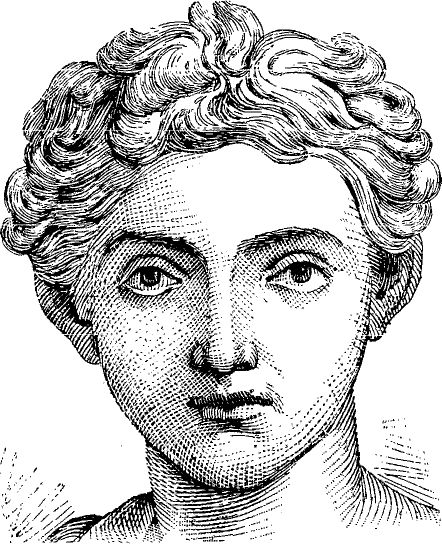
He represents in his life and his genius the fine flower of his age and country. He was born at Verona of a wealthy and distinguished family, while Italy was convulsed by the civil wars of Marius and Sulla; he died at the age of thirty, while Cæsar was completing the conquest of Gaul, and the Republic, though within a few days of its extinction, still seemed full of the pride of life. The rush and excitement of those thrilling years is mirrored fully in the life and poetry of Catullus. Fashion, travel, politics, criticism, all the thousandfold and ever-changing events and interests of the age, come before us in their most vivid form and at their highest pressure, in this brief volume of lyrics. But all come involved with and overshadowed by a story wholly personal to himself and immortal in its fascination: the story of an immense and ill-fated love that "fed its life's flame with self-substantial fuel," and mounted in the morning glories of sunrise only to go down in thunder and tempest before noon.
There are perhaps no love poems in the world like these. Of Sappho, seemingly the greatest poet of her sex, we can only dally with surmise from mutilated fragments. No one else in the ancient world comes into the account. The Middle Ages involved love inextricably with mysticism. When Europe shook the Middle Ages off, it had begun to think. Exquisite reflections on love, innocent pastorals, adorable imagery,—these it could produce; in the France of the Pleiade for instance, or in the England of Greene and Campion: but thought and passion keep ill company. Once only, a century ago, a genius as fierce and flame-like as that of Catullus rose to the height of this argument. An intractable language, sterilizing surroundings, bad models, imperfect education, left Burns hopelessly distanced; yet the quintessential flame that he shares with Catullus has served to make him the idol of a nation, and a household word among many millions of his race.
Clodia, the "Lady of the Sonnets" in Catullus, whom he calls Lesbia by a transparent fiction, has no ambiguous or veiled personality. She was one of the most famous and most scandalous women of her time. By birth and marriage she belonged to the innermost circle of that more than royal Roman aristocracy which had accumulated the wealth of the world into its hands, and sent out its younger sons carelessly to misgovern and pillage empires. When Catullus made her acquaintance, she was a married woman some six or seven years older than himself. "Through a little arc of heaven" the poems show his love running its sorrowful and splendid course. Rapture of tenderness, infatuation, revolt, relapse, re-entanglement, agonized stupor, the stinging pain of reviving life, fierce love passing into as fierce a hatred, all sweep before us in dazzling language molded out of pure air and fire.
So far, Burns alone, and Burns only at his rarer heights, can give a modern reader some idea of Catullus. But Burns had little education and less taste; and so when he leaves the ground of direct personal emotion,—that is to say, in nineteen-twentieths of his poetry,—he is constantly on the edge, and often over it, of tawdriness, vulgarity, commonplace. Catullus was master of all the technical skill then known to poetry. Without anything approaching the immense learning of Virgil or Milton, he had, like Shelley among English poets, the instincts and training of a scholar. It is this fine scholarship—the eye and hand of the trained artist in language—combined with his lucid and imperious simplicity, like that of some gifted and terrible child, that makes him unique among poets. When he leaves the golden fields of poetry and dashes into political lampoons, or insolent and unquotable attacks on people (men or women) who had the misfortune to displease him, he becomes like Burns again, Burns the satirist; yet even here nimbler witted, lighter of touch, with the keenness of the rapier rather than of the Northern axe-edge.
His scholarliness—like that of most scholars—was not without its drawbacks. His immediate literary masters, the Greeks of the Alexandrian school, were a coterie of pedants; it would be idle to claim that he remained unaffected by their pedantry. In the last years of his life he seems to have lost himself somewhat in technical intricacies and elaborate metrical experiments; in translations from that prince in preciosity, the Alexandrian Callimachus; and idyllic pieces of overloaded ornament studied from the school of Theocritus. The longest and most ambitious poem of these years, the epic idyl on 'The Marriage of Peleus and Thetis,' is full of exquisite beauties of detail, but taken in its whole effect is languid, cloying, and monotonous. He makes a more brilliant success in his other long poem, the famous 'Atys,' the single example in Latin of the large-scale lyric so familiar to Greece and England.
But indeed in every form of lyric poetry attempted by him, his touch is infallible. The lovely poems of travel which he wrote during and after a voyage to Asia are as unequaled in their sunny beauty as the love-lyrics are in fire and passion. Alongside of these there are little funny verses to his friends, and other verses to his enemies which they probably did not think funny in the least; verses of occasion and verses of compliment; and verses of sympathy, with a deep human throb in them that shows how little his own unhappy love had embittered him or shut him up in selfish broodings. Two of these pieces are pre-eminent beyond all the rest. The one is a marriage song written by him for the wedding of two of his friends, Mallius Torquatus and Vinia Aurunculeia. In its straightforward unassuming grace, in its musical clearness, in the picture it draws, with so gentle and yet so refined and distinguished a touch, of common household happiness, it is worthy of its closing place in the golden volume of his lyrics.
The other is a brief poem, only ten lines long, written at his brother's grave near Troy. It is one of the best known of Latin poems; and before its sorrow, its simplicity, its piteous tenderness, the astonishing cadence of its rhythms, praise itself seems almost profanation.
"Tenderest of Roman poets nineteen hundred years ago—" so Tennyson in one of his own beautiful lyrics addresses Catullus; and it is this unsurpassed tenderness that more than all his other admirable qualities, than his consummate technical skill, than his white heat of passion, than his "clearness as of the terrible crystal," brings him and keeps him near our hearts.
That wonderful Ciceronian age has left its mark as few ages have, deep upon human history. The conquests and legislation of Julius Cæsar determined the future of Europe and laid the foundation of the modern world. The prose invented by Cicero became and still remains the common language of civilized mankind. Among the poems of Catullus are verses addressed to both of these men; but his own young ivy-crowned brows shine out of the darkness and the distance, with no less pure a radiance and no less imperishable a fame.
Note.—In Mr. Mackail's closing phrase the lover of Ovid will note an echo from that poet's famous elegy suggested by the premature death of still another Roman singer, Tibullus. Among the kindred spirits—says Ovid—who will welcome the new-comer to the Elysian fields,—
"Thou, O learned Catullus, thy young brows ivy-encircled, Bringing thy Calvus with thee, wilt to receive him appear."
Ed.
DEDICATION FOR A VOLUME OF LYRICS
This dainty little book and new, Just polished with the pumice, who Shall now receive?—Cornelius, you! For these my trifles even then You counted of some value, when You only of Italian men Into three tomes had dared to cast The story of all ages past,— Learned, O Jupiter, and vast! So take it, prize it as you may. —And, gracious Virgin, this I pray: That it shall live beyond our day!
Translation of William C. Lawton.
A MORNING CALL
Varus would take me t'other day To see a little girl he knew,— Pretty and witty in her way, With impudence enough for two. Scarce are we seated, ere she chatters (As pretty girls are wont to do) About all persons, places, matters:— "And pray, what has been done for you?" "Bithynia, lady!" I replied, "Is a fine province for a prætor; For none (I promise you) beside, And least of all am I her debtor." "Sorry for that!" said she. "However, You have brought with you, I dare say, Some litter-bearers; none so clever In any other part as they. "Bithynia is the very place For all that's steady, tall, and straight; It is the nature of the race. Could you not lend me six or eight?" "Why, six or eight of them or so," Said I, determined to be grand; "My fortune is not quite so low But these are still at my command." "You'll send them?"—"Willingly!" I told her, Although I had not here or there One who could carry on his shoulder The leg of an old broken chair. "Catullus! what a charming hap is Our meeting in this sort of way! I would be carried to Serapis To-morrow!"—"Stay, fair lady, stay! "You overvalue my intention. Yes, there are eight ... there may be nine: I merely had forgot to mention That they are Cinna's, and not mine."
Paraphrase of W. S. Landor.
HOME TO SIRMIO
Dear Sirmio, that art the very eye Of islands and peninsulas, that lie Deeply embosomed in calm inland lake, Or where the waves of the vast ocean break; Joy of all joys, to gaze on thee once more! I scarce believe that I have left the shore Of Thynia, and Bithynia's parching plain, And gaze on thee in safety once again! Oh, what more sweet than when, from care set free, The spirit lays its burden down, and we, With distant travel spent, come home and spread Our limbs to rest along the wished-for bed! This, this alone, repays such toils as these! Smile, then, fair Sirmio, and thy master please,— And you, ye dancing waters of the lake, Rejoice; and every smile of home awake!
Translation of Sir Theodore Martin.
HEART-BREAK
With your Catullus ill it fares, alas! O Cornificius, and most wearily; Still worse with all the days and hours that pass. And with what greeting do you comfort me? The least of boons, and easiest to bestow; Wroth am I, that my love is answered so. A word of greeting, pray you; what you please; More sad than tear-drops of Simonides!
Translation of W. C. Lawton.
TO CALVUS IN BEREAVEMENT
If there be aught, my Calvus, that out of our sorrowing proffered Unto the voiceless dead grateful or welcome may be, When we revive with insatiate longing our ancient affection, When for the ties we lament, broken, that once have been ours, Though Quintilia grieve for her own untimely departure, Yet in thy faithful love greater, be sure, is her joy.
Translation of W. C. Lawton.
THE PINNACE
This pinnace, friends, which here you see, Avers erewhile she used to be Unmatched for speed, and could outstrip Triumphantly the fastest ship That ever swam, or breasted gale, Alike with either oar or sail. And this, she says, her haughty boast, The stormy Adriatic coast, The Cyclad islands, Rhodes the grand, Rude Thrace, the wild Propontic strand, Will never venture to gainsay; Nor yet the Euxine's cruel bay, Where in her early days she stood, This bark to be, a shaggy wood; For from her vocal locks full oft, Where o'er Cytorus far aloft The fitful mountain-breezes blow, She piped and whistled loud or low. To thee, Amastris, on thy rocks, To thee, Cytorus, clad with box, Has long been known, my bark avers, This little history of hers. In her first youth, she doth protest, She stood upon your topmost crest, First in your waters dipped her oars, First bore her master from your shores Anon unscathed o'er many a deep, In sunshine and in storm to sweep; Whether the breezes, as she flew, From larboard or from starboard blew, Or with a wake of foam behind, She scudded full before the wind. Nor to the gods of ocean e'er For her was offered vow or prayer, Though from yon farthest ocean drear She came to this calm crystal mere. But these are things of days gone past. Now, anchored here in peace at last, To grow to hoary age, lies she, And dedicates herself to thee, Who hast alway her guardian been, Twin Castor, and thy brother twin!
Translation of Sir Theodore Martin.
AN INVITATION TO DINNER
If the gods will, Fabullus mine, With me right heartily you'll dine. Bring but good cheer—that chance is thine Some days hereafter; Mind, a fair girl too, wit, and wine, And merry laughter. Bring these—you'll feast on kingly fare; But bring them—for my purse—I swear The spiders have been weaving there; But thee I'll favor With a pure love, or what's more rare, More sweet of savor, An unguent I'll before you lay The Loves and Graces t'other day Gave to my girl—smell it—you'll pray The gods, Fabullus, To make you turn all nose straightway. Yours aye, Catullus.
Translation of James Cranstoun.
A BROTHER'S GRAVE
Brother! o'er many lands and oceans borne, I reach thy grave, death's last sad rite to pay; To call thy silent dust in vain, and mourn, Since ruthless fate has hurried thee away: Woe's me! yet now upon thy tomb I lay— All soaked with tears for thee, thee loved so well— What gifts our fathers gave the honored clay Of valued friends; take them, my grief they tell: And now, forever hail! forever fare thee well!
Translation of James Cranstoun.
FAREWELL TO HIS FELLOW-OFFICERS
The milder breath of Spring is nigh; The stormy equinoctial sky To Zephyr's gentle breezes yields. Behind me soon the Phrygian fields, Nicæa's sun-beat realm, shall lie. To Asia's famous towns we'll hie. My heart, that craves to wander free, Throbs even now expectantly. With zeal my joyous feet are strong; Farewell, dear comrades, loved so long! Afar together did we roam; Now ways diverse shall lead us home.
Translation of W. C. Lawton.
VERSES FROM AN EPITHALAMIUM
And now, ye gates, your wings unfold! The virgin draweth nigh. Behold The torches, how upon the air They shake abroad their gleaming hair! Come, bride, come forth! no more delay! The day is hurrying fast away! But lost in shame and maiden fears, She stirs not,—weeping, as she hears The friends that to her tears reply,— Thou must advance, the hour is nigh! Come, bride, come forth! no more delay! The day is hurrying fast away!" Dry up thy tears! For well I trow, No woman lovelier than thou, Aurunculeia, shall behold The day all panoplied in gold, And rosy light uplift his head Above the shimmering ocean's bed! As in some rich man's garden-plot, With flowers of every hue inwrought, Stands peerless forth with drooping brow The hyacinth, so standest thou! Come, bride, come forth! no more delay! The day is hurrying fast away!
Soon my eyes shall see, mayhap, Young Torquatus on the lap Of his mother, as he stands Stretching out his tiny hands, And his little lips the while Half-open on his father smile. And oh! may he in all be like Manlius his sire, and strike Strangers, when the boy they meet, As his father's counterfeit, And his face the index be Of his mother's chastity! Him, too, such fair fame adorn, Son of such a mother born, That the praise of both entwined Call Telemachus to mind, With her who nursed him on her knee, Unparagoned Penelope! Now, virgins, let us shut the door! Enough we've toyed, enough and more! But fare ye well, ye loving pair, We leave ye to each other's care; And blithely let your hours be sped In joys of youth and lustyhed!
Translation of Sir Theodore Martin.
Note.—The remaining poems of our selection are all associated with the famous passion for Lesbia.
LOVE IS ALL
Let us, Lesbia darling, still Live our life, and love our fill; Heeding not a jot, howe'er Churlish dotards chide or stare! Suns go down, but 'tis to rise Brighter in the morning skies; But when sets our little light, We must sleep in endless night. A thousand kisses grant me, sweet: With a hundred these complete; Lip me a thousand more, and then Another hundred give again. A thousand add to these, anon A hundred more, then hurry one Kiss after kiss without cessation, Until we lose all calculation; So envy shall not mar our blisses By numbering up our tale of kisses.
Translation of Sir Theodore Martin.
ELEGY ON LESBIA'S SPARROW
Loves and Graces, mourn with me, Mourn, fair youths, where'er ye be! Dead my Lesbia's sparrow is, Sparrow that was all her bliss, Than her very eyes more dear; For he made her dainty cheer; Knew her well, as any maid Knows her mother; never strayed From her bosom, but would go Hopping round her to and fro. And to her, and her alone, Chirruped with such pretty tone. Now he treads that gloomy track Whence none ever may come back. Out upon you, and your power, Which all fairest things devour, Orcus's gloomy shades, that e'er Ye took my bird that was so fair! Ah, the pity of it! Thou Poor bird, thy doing 'tis, that now My loved one's eyes are swollen and red, With weeping for her darling dead.
Translation of Sir Theodore Martin.
"FICKLE AND CHANGEABLE EVER"
Never a soul but myself, though Jove himself were to woo her, Lesbia says she would choose, might she have me for her mate. Says—but what woman will say to a lover on fire to possess her, Write on the bodiless wind, write on the stream as it runs.
Translation of Sir Theodore Martin.
TWO CHORDS
I Hate and love—the why I cannot tell. But by my tortures know the fact too well.
Translation of Sir Theodore Martin.
LAST WORD TO LESBIA
O Furius and Aurelius! comrades sweet! Who to Ind's farthest shore with me would roam, Where the far-sounding Orient billows beat Their fury into foam; Or to Hyrcania, balm-breathed Araby, The Sacian's or the quivered Parthian's land, Or where seven-mantled Nile's swoll'n waters dye The sea with yellow sand; Or cross the lofty Alpine fells, to view Great Cæsar's trophied fields, the Gallic Rhine, The paint-smeared Briton race, grim-visaged crew, Placed by earth's limit line: To all prepared with me to brave the way, To dare whate'er the eternal gods decree— These few unwelcome words to her convey Who once was all to me. Still let her revel with her godless train, Still clasp her hundred slaves to passion's thrall, Still truly love not one, but ever drain The life-blood of them all. Nor let her more my once fond passion heed, For by her faithlessness 'tis blighted now, Like flow'ret on the verge of grassy mead Crushed by the passing plow.
Translation of James Cranstoun.