Volume 8 / Act 1 — GIOSUE CARDUCCI
Reading edition
(1836-)
BY FRANK SEWALL

arely in the history of ancient or modern literature has a writer, while living, been so generally recognized by his countrymen as their national prophet as has the Italian poet and essayist Carducci. In January, 1896, he completed his thirty-fifth year as Professor of Belles-Lettres in the University of Bologna; and the solemn and brilliant festivities with which the event was celebrated, extending over three days and including congratulatory addresses from the king, from the municipality, from the students and graduates, from foreign universities, and from distinguished scholars at home and abroad, testified to the remarkable hold this poet has gained on the affections and esteem of the Italian people, and the deep impress his writing has made on the literature of our time.
Born in northern Italy in the year 1836, and entering upon his literary career at a time coincident with the downfall of foreign power in Tuscany, the history of his authorship is a fair reflection of the growth of the new Italy of to-day. In an autobiographical sketch with which he prefaces his volume of 'Poesie' (1871) he depicts with the utmost sincerity and frankness the transition through which his own mind has passed, in breaking from the old traditions in which he had been nursed at his mother's knee, and in meeting the dazzling radiance of modern thought and feeling; the thrill of national liberty and independence,—no longer a glory dreamed of, as by Alfieri, nor sung in tones of despair, as by Leopardi, but as a living experience of his own time. He felt the awakening to be at once a literary, political, and religious one; and following his deep Hellenic instincts, the religious rebound in him was rather to the paganism of the ancient Latin forefathers than to the spiritual worship that had come in with the infusion of foreign blood.
"This paganism," he says, "this cult of form, was naught else but the love of that noble nature from which the solitary Semitic estrangements had alienated hitherto the spirit of man in such bitter opposition. My sentiment of opposition, at first feebly defined, thus became confirmed conceit, reason, affirmation; the hymn to Apollo became the hymn to Satan. Oh! the beautiful years from 1861 to 1865, passed in peaceful solitude and quiet study, in the midst of a home where the venerable mother, instead of fostering superstition, taught us to read Alfieri. But as I read the codices of the fourteenth century, the ideas of the Renaissance began to appear to me in the gilded initial letters like the eyes of nymphs in the midst of flowers, and between the lines of the spiritual laude I detected the Satanic strophe."
So long had Italy lived in passive dependence on the fame of her great writers of the times of Augustus and of the Medici, and in the apathy of a long-abandoned hope of political independence and achievement, that it required a man of powerful instinct and genius to rouse the people to a sense of their actual possession of a national life and of a literature that is not alone of the past, and so to throw off both the "livery of the slave and the mask of the courtesan." Such was the mission of Carducci. As Howells in his 'Modern Italian Poets' remarks of Leopardi:—"He seems to have been the poet of the national mood; he was the final expression of that hopeless apathy in which Italy lay bound for thirty years after the fall of Napoleon and his governments." So it may be said of Carducci that in him speaks the hope and joy of a nation waking to new life, and recalling her past glories, no longer with shame but a purpose to prove herself worthy of such a heritage.
A distinguished literary contemporary, Enrico Panzacchi, says of Carducci:—
"I believe that I do not exaggerate the importance of Carducci when I say that to him and to his perseverance and steadfast work we owe in great part the poetic revival in Italy."
Cesar Lombroso, in the Paris Revue des Revues, says:—"Among the stars of first magnitude shines one of greatest brilliance, Carducci, the true representative of Italian literary genius."
The poem that first attracted attention and caused no little flutter of ecclesiastical gowns was the 'Hymn to Satan,' which appeared in 1865 in Pistoja, over the signature "Enotrio Romaho," and bore the date "MMDCXVIII from the foundation of Rome." It is not indeed the sacrilegious invective that might be imagined from the title, but rather a hymn to Science and to Free Thought, liberated from the ancient thraldom of dogma and superstition. It reveals the strong Hellenic instinct which still survives in the Italian people beneath the superimposed Christianity, and which here, as in many other of Carducci's poems, stands out in bold contrast with the subjective and spiritual elements in religion. It is this struggle of the pagan against the Christian instinct that accounts for the commingled sentiment of awe and of rebellion with which Carducci contemplates his great master Dante; for while he must revere him as the founder of Italian letters and the immortal poet of his race, he cannot but see both in the spirituality of Dante's conception of the Church and in his absolute loyalty to the Empire, motives wholly foreign to the ancient national instinct. Referring again to his transition years, he writes:
"Meanwhile the shadow of Dante looked down reproachfully upon me; but I might have answered:—'Father and Master, why didst thou bring learning from the cloister to the piazza, from the Latin to the vulgar tongue? Thou first, O great public accuser of the Middle Ages, gavest the signal for the rebound of thought. That the alarm was sounded from the bells of a Gothic campanile mattered but little.'"
Without a formal coronation, Carducci may be regarded as the actual poet laureate of Italy. He is still, at sixty years of age, an active and hard-working professor at the University of Bologna, where his popularity with his students in the lecture-room is equal to that which his writings have gained throughout the land. A favorite with the Court, and often invited to lecture before the Queen, he is still a man of great simplicity, even to roughness, of manners, and of a genial and cordial nature. Not only do the Italians with one voice call him their greatest author, but many both in Italy and elsewhere are fain to consider him the foremost living poet in Europe.
The citations here given have been selected as illustrating the prominent features of Carducci's genius. His joy in mental emancipation from the thraldom of dogma and superstition is seen in the 'Roma' and in the 'Hymn to Satan.' His paganism and his "cult of form," as also his Homeric power of description and of color, are seen in 'The Ox' and in 'To Aurora.' His veneration for the great masters finds expression in the sonnets to Homer and Dante, and the revulsion of the pagan before the spiritual religious feeling is shown in the lines 'In a Gothic Church' and in the sonnet 'Dante.'
The poems of Carducci have appeared for the most part in the following editions only:—'Poesie,' embracing the 'Juvenilia,' 'Levia Gravia,' and the 'Decennali'; 'Nuove Poesie,' 'Odi Barbare,' 'Nuove Rime.' Zanichelli in Bologna publishes a complete edition of his writings. His critical essays have appeared generally in the Nuova Antologia, and embrace among the more recent a history and discussion of Tasso's 'Aminta,' and the 'Ancient Pastoral Poetry': a preface to the translation by Sanfelice of Shelley's 'Prometheus'; the 'Torrismondo' of Tasso: 'Italian Life in the Fifteenth Century,' etc. Eight 'Odes' of Carducci have been translated into Latin by Adolfo Gandiglo of Ravenna, and published by Calderini of that city in 1894.
HOMER. THE BLIND POET. Photogravure from a Painting by W. A. Bouguereau.
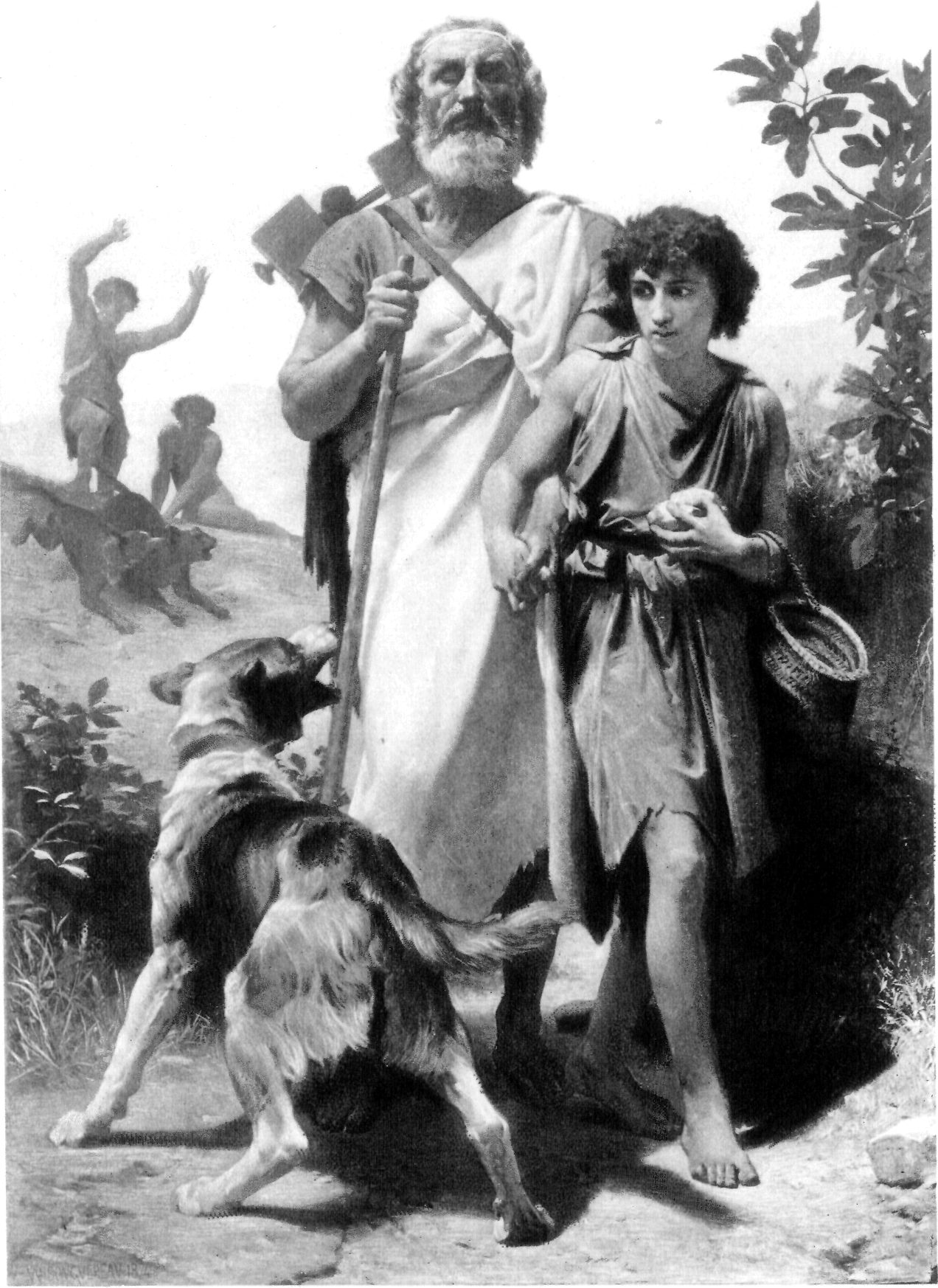
Translations from Frank Sewall's 'Giosue Carducci and the Hellenic Reaction in Italy' and 'Carducci and the Classic Realism.' By permission of Dodd, Mead and Company, copyright 1892.
ROMA
From the 'Poesie'
Give to the wind thy locks; all glittering Thy sea-blue eyes, and thy white bosom bared. Mount to thy chariot, while in speechless roaring Terror and Force before thee clear the way! The shadow of thy helmet, like the flashing Of brazen star, strikes through the trembling air. The dust of broken empires, cloud-like rising, Follows the awful rumbling of thy wheels. So once, O Rome, beheld the conquered nations Thy image, object of their ancient dread.[A] To-day a mitre they would place upon Thy head, and fold a rosary between Thy hands. O name! again to terrors old Awake the tired ages and the world!
HOMER
From the 'Levia Gravia'
And from the savage Urals to the plain A new barbarian folk shall send alarms, The coast of Agenorean Thebes again Be waked with sound of chariots and of arms; And Rome shall fall; and Tiber's current drain The nameless lands of long deserted farms: But thou like Hercules shalt still remain, Untouched by fiery Etna's deadly charms; And with thy youthful temples, laurel-crowned, Shalt rise to the eternal Form's embrace Whose unveiled smile all earliest was thine; And till the Alps to gulfing sea give place, By Latin shore or on Achæan ground, Like heaven's sun shalt thou, O Homer, shine!
IN A GOTHIC CHURCH
From the 'Poesie'
They rise aloft, marching in awful file, The polished shafts immense of marble gray, And in the sacred darkness seem to be An army of giants Who wage a war with the invisible; The silent arches soar and spring apart In distant flight, then re-embrace again And droop on high. So in the discord of unhappy men, From out their barbarous tumult there go up To God the sighs of solitary souls In Him united. Of you I ask no God, ye marble shafts, Ye airy vaults! I tremble—but I watch To hear a dainty well-known footstep waken The solemn echoes. 'Tis Lidia, and she turns, and slowly turning, Her tresses full of light reveal themselves, And love is shining from a pale shy face Behind the veil.
ON THE SIXTH CENTENARY OF DANTE
From the 'Levia Gravia'
I saw him, from the uncovered tomb uplifting His mighty form, the imperial prophet stand. Then shook the Adrian shore, and all the land Italia trembled as at an earthquake drifting. Like morning mist from purest ether sifting, It marched along the Apenninian strand, Glancing adown the vales on either hand, Then vanished like the dawn to daylight shifting. Meanwhile in earthly hearts a fear did rise, The awful presence of a god discerning, To which no mortal dared to lift the eyes. But where beyond the gates the sun is burning, The races dead of warlike men and wise With joy saluted the great soul's returning.
THE OX
From the 'Poesie'
I love thee, pious ox; a gentle feeling Of vigor and of peace thou giv'st my heart. How solemn, like a monument, thou art! Over wide fertile fields thy calm gaze stealing, Unto the yoke with grave contentment kneeling, To man's quick work thou dost thy strength impart. He shouts and goads, and answering thy smart, Thou turn'st on him thy patient eyes appealing. From thy broad nostrils, black and wet, arise Thy breath's soft fumes; and on the still air swells, Like happy hymn, thy lowing's mellow strain. In the grave sweetness of thy tranquil eyes Of emerald, broad and still reflected dwells All the divine green silence of the plain.
DANTE
From the 'Levia Gravia'
O Dante, why is it that I adoring Still lift my songs and vows to thy stern face, And sunset to the morning gray gives place To find me still thy restless verse exploring? Lucia prays not for my poor soul's resting; For me Matilda tends no sacred fount; For me in vain the sacred lovers mount, O'er star and star, to the eternal soaring. I hate the Holy Empire, and the crown And sword alike relentless would have riven From thy good Frederic on Olona's plains. Empire and Church to ruin have gone down, And yet for them thy songs did scale high heaven. Great Jove is dead. Only the song remains.
TO SATAN
From the 'Poesie'
To thee my verses, Unbridled and daring, Shall mount, O Satan, King of the banquet! Away with thy sprinkling, O Priest, and thy droning, For never shall Satan, O Priest, stand behind thee. See how the rust is Gnawing the mystical Sword of St. Michael; And how the faithful Wind-plucked archangel Falls into emptiness; Frozen the thunder in Hand of Jehovah. Like to pale meteors, or Planets exhausted, Out of the firmament Rain down the angels. Here in the matter Which never sleeps, King of phenomena, King of all forms, Thou, Satan, livest. Thine is the empire Felt in the dark eyes' Tremulous flashing, Whether their languishing Glances resist, or Glittering and tearful, they Call and invite. How shine the clusters With happy blood, So that the furious Joy may not perish, So that the languishing Love be restored, And sorrow be banished And love be increased. Thy breath, O Satan! My verse inspires, When from my bosom The gods I defy Of kings pontifical, Of kings inhuman. Thine is the lightning that Sets minds to shaking. For thee Arimane, Adonis, Astarte; For thee lived the marbles, The pictures, the parchments, When the fair Venus Anadyomene Blessed the Ionian Heavens serene. For thee were roaring the Forests of Lebanon, Of the fair Cypri Lover re-born; For thee rose the chorus, For thee raved the dances, For thee the pure shining Loves of the virgins, Under the sweet-odored Palms of Idume, Where break in white foam The Cyprian waves. What if the barbarous Nazarene fury, Fed by the base rites Of secret feastings, Lights sacred torches To burn down the temples, Scattering abroad The scrolls hieroglyphic? In thee find refuge The humble-roofed plebs, Who have not forgotten The gods of their household. Thence comes the power, Fervid and loving, that, Filling the quick-throbbing Bosom of woman, Turns to the succor Of nature enfeebled; A sorceress pallid, With endless care laden. Thou to the trance-holden Eye of the alchemist, Thou to the view of the Bigoted mago, Showest the lightning-flash Of the new time Shining behind the dark Bars of the cloister. Seeking to fly from thee, Here in the world-life Hides him the gloomy monk In Theban deserts. O soul that wanderest Far from the straight way, Satan is merciful.— See Heloisa! In vain you wear yourself Thin in rough gown; I Still murmur the verses Of Maro and Flaccus Amid the Davidic Psalming and wailing, And—Delphic figures Close at thy side— Rosy, amid the dark Cowls of the friars, Enters Licorida, Enters Glicera. Then other images Of days more fair Come to dwell with thee In thy secret cell. Lo! from the pages of Livy, the Tribunes All ardent, the Consuls, The crowds tumultuous, Awake; and the fantastic Pride of Italians Drives them, O Monk, Up to the Capitol; And you whom the flaming Fire never melted, Conjuring voices, Wickliffe and Huss, Send to the broad breeze The cry of the watchman:— "The age renews itself; Full is the time." Already tremble The mitres and crowns. Forth from the cloister Moves the rebellion. Under his stole, see, Fighting and preaching, Brother Girolamo Savonarola. Off goes the tunic Of Martin Luther; Off go the fetters That bound human thought. It flashes and lightens, Girdled with flame; Matter, exalt thyself; Satan has won! A fair and terrible Monster unchained Courses the ocean, Courses the earth. Flashing and smoking, Like the volcanoes, he Climbs over mountains, Ravages plains, Skims the abysses; Then he is lost In unknown caverns And ways profound, Till lo! unconquered, From shore to shore, Like to the whirlwind, He sends forth his cry. Like to the whirlwind Spreading his wings,... He passes, O people, Satan the great! Hail to thee, Satan; Hail the rebellion! Hail, of the reason the Great Vindicator! Sacred to thee shall rise Incense and vows. Thou hast the god Of the priest disenthroned!
TO AURORA
From the 'Odi Barbare'
Thou risest and kissest, O Goddess, with thy rosy breath, the clouds, Kissest the dusky pinnacles of marble temples. The forests feel thee, and with a cool shiver awake; Up soars the falcon, flashing in eager joy. Meanwhile amid the wet leaves mutter the garrulous nests, And far off the gray gull screams over the purple sea. First to delight in thee, down in the laborious plain, Are the streams which glisten amid the rustling poplars. Daringly the sorrel colt breaks away from his feeding, Runs to the brooks with high-lifted mane, neighing in the wind. Wakeful answer from the huts the great pack of the hounds, And the whole valley is filled with the noisy sound of their barking. But the man whom thou awakest to life-consuming labor, He, O ancient Youth, O Youth eternal, Still thoughtful admires thee, even as on the mountain The Aryan Fathers adored thee, standing amid their white oxen. Again upon the wing of the fresh morning flies forth The hymn which to thee they sang over their heaped-up spears:— "Shepherdess thou of heaven! from the stalls of thy jealous sister Thou loosest the rosy kine, and leadest them back to the skies; "Thou leadest the rosy kine, and the white herds, and the horses With the blond flowing manes dear to the brothers Asvini." Like the youthful bride who goes from her bath to her spouse, Reflecting in her eyes the love of him her lover, So dost thou smiling let fall the light garments that veil thee, And serene to the heavens thy virgin figure reveal. Flushed thy cheeks, with white breast panting, thou runnest To the sovereign of worlds, to the fair flaming Suria. And he joins, and, in a bow, stretches around his mighty neck Thy rosy arms; but at his terrible glances thou fleest. 'Tis then the Asvinian Twins, the cavaliers of heaven, Welcome thee rosily trembling in thy chariot of gold, And thither thou turnest where, measured the road of glory, Wearied, the god awaits thee in the dull gloaming of eve. "Gracious thy flight be above us! so invoked thee the fathers; Gracious the going of thy radiant car over our houses! "Come from the coasts of the East with thy good fortune, Come with thy flowering oats and thy foaming milk; "And in the midst of the calves, dancing, with yellow locks, All offspring shall adore thee, O Shepherdess of heaven!" So sang the Aryans. But better pleased thee Hymettus, Fresh with the twenty brooks whose banks smelt to heaven of thyme; Better pleased thee on Hymettus the nimble-limbed, mortal huntsman, Who with the buskined foot pressed the first dews of the morn. The heavens bent down. A sweet blush tinged the forest and the hills When thou, O Goddess, didst descend. But thou descendedst not; rather did Cephalus, drawn by thy kiss, Mount all alert through the air, fair as a beautiful god,— Mount on the amorous winds and amid the sweet odors, While all around were the nuptials of flowers and the marriage of streams. Wet lies upon his neck the heavy tress of gold, and the golden quiver Reaches above his white shoulder, held by the belt of vermilion. O fragrant kisses of a goddess among the dews! O ambrosia of love in the world's youth-time! Dost thou also love, O Goddess? But ours is a wearied race; Sad is thy face, O Aurora, when thou risest over our towers. The dim street-lamps go out; and without even glancing at thee, A pale-faced troop go home, imagining they have been happy. Angrily at his door is pounding the ill-tempered laborer, Cursing the dawn that only calls him back to his bondage. Only the lover, perhaps, fresh from the dreams of the loved one, His blood still warm from her kisses, salutes with joy, Beholds with delight thy face, and feels thy cool breathing upon him: Then cries, "O bear me, Aurora, upon thy swift courser of flame; "Bear me up into the fields of the stars, that there, looking down, I may behold the earth beneath thy rosy light smiling; "Behold my fair one, in the face of the rising day, Let fall her black tresses down over her blushing bosom."
RUIT HORA
O green and silent solitudes, far from the rumors of men Hither come to meet us true friends divine, O Lidia, Wine and love. O tell me why the sea, far under the flaming Hesperus Sends such mysterious moanings; and what songs are these, O Lidia, The pines are chanting. See with what longing the hills stretch their arms to the setting sun. The shadow lengthens and holds them; they seem to be asking A last kiss, O Lidia!
THE MOTHER
(A Group by Adrian Cecioni)
Surely admired her the rosy day-dawn, when, summoning the farmers to the still gray fields, it saw her barefooted, with quick step passing among the dewy odors of the hay. Heard her at mid-day the elm-trees white with dust, as, with broad shoulders bent o'er the yellow winrows, she challenges in cheery song the grasshoppers, whose hoarse chirping rings from the hot hillsides. And when from her toil she lifted her turgid bosom, her sun-browned face with glossy curls surrounded, how then thy vesper fires, O Tuscany, did richly tinge with color her bold figure! 'Tis then the strong mother plays at ball with her infant, the lusty child whom her naked breasts have just sated; tosses him on high and prattles sweetly with him, while he, with eye fixed on the shining eyes of his mother, His little body trembling all over with fear, holds out his tiny fingers imploring; then loud laughs the mother, and into the one great embrace of love lets him fall, clasped close to her bosom. Around her smiles the scene of homely labor; tremulous nod the oats on the green hillsides; one hears the distant mooing of the ox, and on the barn-roof the gay plumed cock is crowing.
Nature has her brave ones, who for her despise the masks of glory dear to the vulgar throng. 'Tis thus, O Adrian, with holy visions thou comfortest the souls of fellow-men. 'Tis thus, O artist, with thy blows severe thou putt'st in stone the ages' ancient hope, the lofty hope that cries, "Oh, when shall labor be happy, and faithful love secure from harm? "When shall a mighty nation of freemen say in the face of the sun, 'Shine no more on the idle ease and the selfish wars of tyrants, but on the pious justice of labor?'"