Volume 8 — JOHN CALVIN
Reading edition
(1509-1564)
BY ARTHUR CUSHMAN McGIFFERT
ohn Calvin was born in the village of Noyon, in northeastern France, on the 10th of July, 1509. He was intended by his parents for the priesthood, for which he seemed to be peculiarly fitted by his naturally austere disposition, averse to every form of sport or frivolity, and he was given an excellent education with that calling in view; but finally at the command of his father—whose plans for his son had undergone a change—he gave up his theological preparation and devoted himself to the study of law. Gifted with an extraordinary memory, rare insight, and an uncommonly keen reasoning faculty, he speedily distinguished himself in his new field, and a brilliant career was predicted for him by his teachers. His tastes however were more literary than legal, and his first published work, written at the age of twenty-three, was a commentary on Seneca's 'De Clementia,' which brought him wide repute as a classical scholar and as a clear and forceful writer.
Though he had apparently renounced forever all thoughts of a clerical life, he retained, even while he was engaged in the study of law and in the more congenial pursuit of literature, his early love for theology; and in 1532, under the influence of some of Luther's writings which happened to fall into his hands, he was converted to the Protestant faith and threw in his fortunes with the little evangelical party in Paris. His intellectual attainments made him a marked man wherever he went, and he speedily became the leading spirit in the circle to which he had attached himself. Compelled soon afterward by the persecuting measures of King Francis I. to flee the country, he took up his residence at Basle and settled down, as he hoped, to a quiet literary life. It was during his stay here that he published in 1536 the first edition of his greatest work, 'The Christian Institutes,' in which is contained the system of theology which has for centuries borne his name, and by which he is best known to the world at large. Probably no other work written by so young a man has ever produced such a wide-spread, profound, and lasting influence. In its original form, it is true, the work was only a brief and simple introduction to the study of the Scriptures, much less imposing and forbidding than the elaborate body of divinity which is now known to theologians as 'Calvin's Institutes': but all the substance of the last edition is to be found in the first; the theology of the one is the theology of the other—the Calvin of 1559 is the Calvin of 1536. The fact that at the age of twenty-six Calvin could publish a system of theology at once so original and so profound—a system, moreover, which with all his activity of intellect and love of truth he never had occasion to modify in any essential particular—is one of the most striking phenomena in the history of the human mind; and yet it is but one of many illustrations of the man's marvelous clearness and comprehensiveness of vision, and of his force and decision of character. His life from beginning to end was the consistent unfolding of a single dominant principle—the unwavering pursuit of a single controlling purpose. From his earliest youth the sense of duty was all-supreme with him; he lived under a constant imperative—in awe of, and in reverent obedience to, the will of a sovereign God; and his theology is but the translation into language of that experience; its translation by one of the world's greatest masters of logical thought and of clear speech.
Calvin's great work was accompanied by a dedicatory epistle addressed to King Francis I., which is by common consent one of the finest specimens of courteous and convincing apology in existence. A brief extract from it will be found in the selections given below.
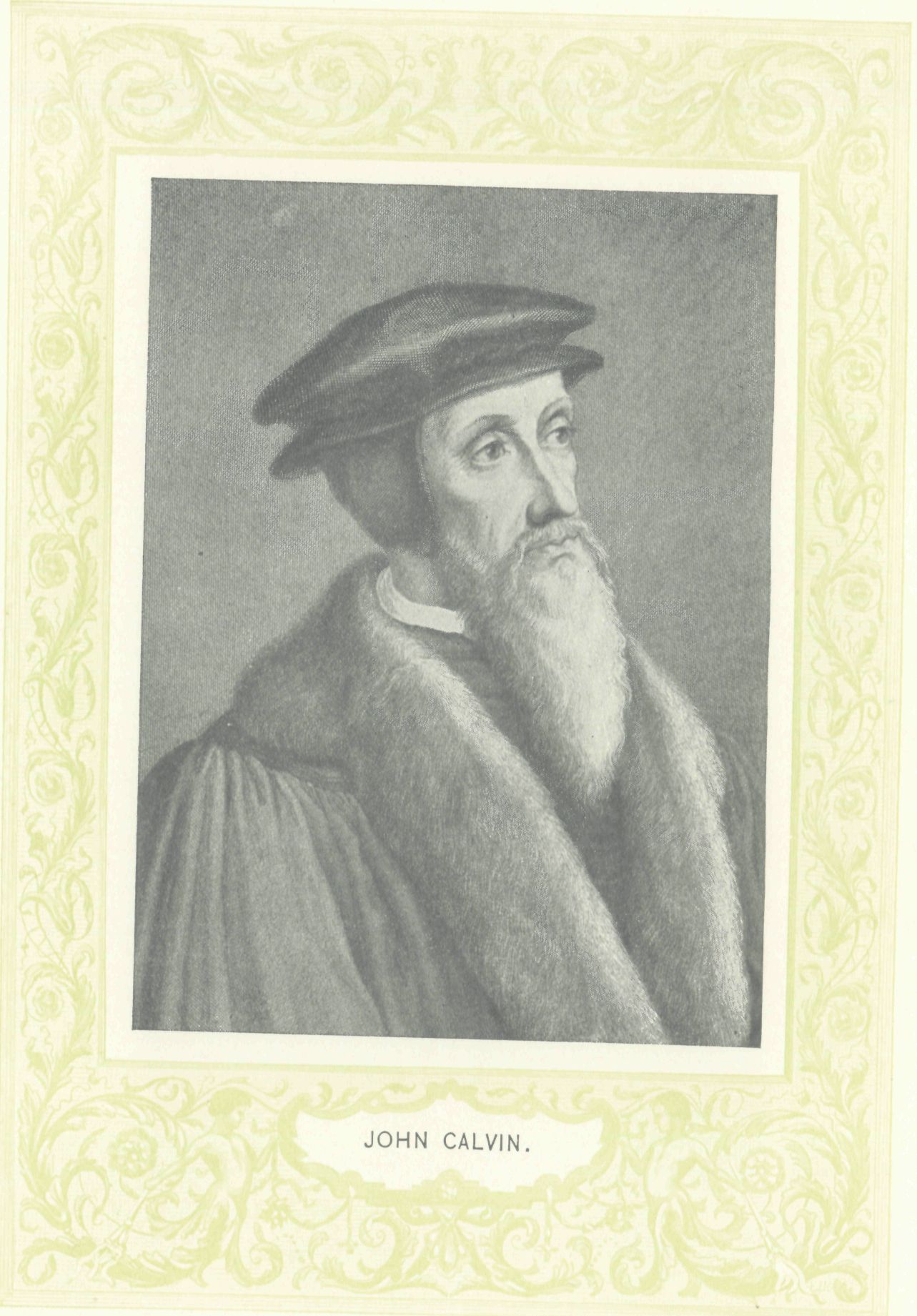
JOHN CALVIN.
Soon after the publication of the 'Institutes,' Calvin's plans for a quiet literary career were interrupted by a peremptory call to assist in the work of reforming the Church and State of Geneva; and the remainder of his life, with the exception of a brief interval of exile, was spent in that city, at the head of a religious movement whose influence was ultimately felt throughout all Western Europe. It is true that Calvin was not the originating genius of the Reformation—that he belonged only to the second generation of reformers, and that he learned the Protestant faith from Luther. But he became for the peoples of Western Europe what Luther was for Germany, and he gave his own peculiar type of Protestantism—that type which was congenial to his disposition and experience—to Switzerland, to France, to the Netherlands, to Scotland, and through the Dutch, the English Puritans, and the Scotch Presbyterians, to large portions of the New World. Calvin, to be sure, is not widely popular to-day even in those lands which owe him most, for he had little of that human sympathy which glorifies the best thought and life of the present age; but for all that, he has left his mark upon the world, and his influence is not likely ever to be wholly outgrown. His emphasis upon God's holiness made his followers scrupulously, even censoriously pure; his emphasis upon God's will made them stern and unyielding in the performance of what they believed to be their duty; his emphasis upon God's majesty, paradoxical though it may seem at first sight, promoted in no small degree the growth of civil and religious liberty, for it dwarfed all mere human authority and made men bold to withstand the unlawful encroachments of their fellows. Thus Calvin became a mighty force in the world, though he gave the world far more of law than of gospel, far more of Moses than of Christ.
Calvin's career as a writer began at an early day and continued until his death. His pen was a ready one and was seldom idle. In the midst of the most engrossing cares and occupations—the cares and occupations of a preacher, a pastor, a teacher of theology, a statesman, and a reformer to whom the Protestants of many lands looked for inspiration and for counsel—he found time, though he died at the early age of fifty-four, to produce works that to-day fill more than threescore volumes, and all of which bear the unmistakable impress of a great mind. In addition to his 'Institutes,' theological and ethical tracts, and treatises, sermons, and epistles without number, he wrote commentaries upon almost all the books of the Bible; which for lucidity, for wide and accurate learning, and for sound and ripe judgment, have never been surpassed. Among the most characteristic and important of his briefer works are his vigorous and effective 'Reply to Cardinal Sadolet,' who had endeavored after Calvin's exile from Geneva in 1539 to win back the Genevese to the Roman Church; his tract on 'The Necessity of Reforming the Church; presented to the Imperial Diet at Spires, A.D. 1544, in the cause of all who wish with Christ to reign'—an admirable statement of the conditions which had made a reformation of the Church imperatively necessary, and had led to the great religious and ecclesiastical revolution; another tract on 'The True Method of Giving Peace to Christendom and Reforming the Church,'—marked by a beautiful Christian spirit and permeated with sound practical sense; still another containing 'Articles Agreed Upon by the Faculty of Sacred Theology at Paris, with the Antidote', and finally an 'Admonition Showing the Advantages which Christendom might Derive from an Inventory of Relics.' Though Calvin was from boyhood up of a most serious turn of mind, and though his writings, in marked contrast to the writings of Luther, exhibit few if any traces of genial spontaneous humor, the last two works show that he knew how to employ satire on occasion in a very telling way for the overthrow of error and for the discomfiture of his opponents.
In addition to the services which Calvin rendered by his writings to the cause of Christianity and of sacred learning, must be recognized the lasting obligation under which as an author he put his mother tongue. Whether he wrote in Latin or in French, his style was always chaste, elegant, clear, and vigorous. His Latin compares favorably with the best models of antiquity; his French is a new creation. The latter language indeed owes almost as much to Calvin as the German language owes to Luther. He was unquestionably its greatest master in the sixteenth century, and he did more than any one else to fix its permanent character—to give it that exactness, that lucidity, that purity and harmony of which it justly boasts.
Calvin's writings bear throughout the imprint of his character. There appears in all of them the same horror of impurity and dishonor, the same stern sense of duty, the same respect for the sovereignty of the Almighty, the same severe judgment of human failings. To read them is to breathe the tonic air of snow-clad heights; but they are seldom if ever touched with the tender glow of human feeling or transfigured with the radiance of creative imagination. There is that in David, in Isaiah, in Paul, in Luther, which appeals to every heart and makes their words immortal; but Calvin was neither poet nor prophet,—the divine afflatus was not his,—and it is not without reason that his writings, vigorous, forceful, profound, as is their context, and pure and elegant as is their style, are read to-day only by theologians or historians.
PREFATORY ADDRESS TO THE 'INSTITUTES'
To Francis, King of the French, the most Christian Majesty, the most Mighty and Illustrious Monarch, his Sovereign,—John Calvin prays peace and salvation in Christ.
Sire:—When I first engaged in this work, nothing was further from my thoughts than to write what should afterwards be presented to your Majesty. My intention was only to furnish a kind of rudiments, by which those who feel some interest in religion might be trained to true godliness. And I toiled at the task chiefly for the sake of my countrymen the French, multitudes of whom I perceived to be hungering and thirsting after Christ, while very few seemed to have been duly imbued with even a slender knowledge of him. That this was the object which I had in view is apparent from the work itself, which is written in a simple and elementary form, adapted for instruction.
But when I perceived that the fury of certain bad men had risen to such a height in your realm that there was no place in it for sound doctrine, I thought it might be of service if I were in the same work both to give instruction to my countrymen, and also lay before your Majesty a Confession, from which you may learn what the doctrine is that so inflames the rage of those madmen who are this day with fire and sword troubling your kingdom. For I fear not to declare that what I have here given may be regarded as a summary of the very doctrine which, they vociferate, ought to be punished with confiscation, exile, imprisonment, and flames, as well as exterminated by land and sea.
I am aware indeed how, in order to render our cause as hateful to your Majesty as possible, they have filled your ears and mind with atrocious insinuations; but you will be pleased of your clemency to reflect that neither in word nor deed could there be any innocence, were it sufficient merely to accuse. When any one, with the view of exciting prejudice, observes that this doctrine of which I am endeavoring to give your Majesty an account has been condemned by the suffrages of all the estates, and was long ago stabbed again and again by partial sentences of courts of law, he undoubtedly says nothing more than that it has sometimes been violently oppressed by the power and faction of adversaries, and sometimes fraudulently and insidiously overwhelmed by lies, cavils, and calumny. While a cause is unheard, it is violence to pass sanguinary sentences against it; it is fraud to charge it, contrary to its deserts, with sedition and mischief.
That no one may suppose we are unjust in thus complaining, you yourself, most illustrious Sovereign, can bear us witness with what lying calumnies it is daily traduced in your presence; as aiming at nothing else than to wrest the sceptres of kings out of their hands, to overturn all tribunals and seats of justice, to subvert all order and government, to disturb the peace and quiet of society, to abolish all laws, destroy the distinctions of rank and property, and in short turn all things upside down. And yet that which you hear is but the smallest portion of what is said; for among the common people are disseminated certain horrible insinuations—insinuations which, if well founded, would justify the whole world in condemning the doctrine with its authors to a thousand fires and gibbets. Who can wonder that the popular hatred is inflamed against it, when credit is given to those most iniquitous accusations? See why all ranks unite with one accord in condemning our persons and our doctrine!
Carried away by this feeling, those who sit in judgment merely give utterance to the prejudices which they have imbibed at home, and think they have duly performed their part if they do not order punishment to be inflicted on any one until convicted, either on his own confession, or on legal evidence. But of what crime convicted? "Of that condemned doctrine," is the answer. But with what justice condemned? The very evidence of the defense was not to abjure the doctrine itself, but to maintain its truth. On this subject, however, not a whisper is allowed....
It is plain indeed that we fear God sincerely and worship him in truth, since, whether by life or by death, we desire his name to be hallowed; and hatred herself has been forced to bear testimony to the innocence and civil integrity of some of our people, on whom death was inflicted for the very thing which deserved the highest praise. But if any, under pretext of the gospel, excite tumults (none such have as yet been detected in your realm), if any use the liberty of the grace of God as a cloak for licentiousness (I know of numbers who do), there are laws and legal punishments by which they may be punished up to the measure of their deserts; only in the mean time let not the gospel of God be evil spoken of because of the iniquities of evil men.
Sire, that you may not lend too credulous an ear to the accusations of our enemies, their virulent injustice has been set before you at sufficient length: I fear even more than sufficient, since this preface has grown almost to the bulk of a full apology. My object however was not to frame a defense, but only with a view to the hearing of our cause, to mollify your mind, now indeed turned away and estranged from us,—I add, even inflamed against us,—but whose good will, we are confident, we should regain, would you but once with calmness and composure read this our Confession, which we desire your Majesty to accept instead of a defense. But if the whispers of the malevolent so possess your ear that the accused are to have no opportunity of pleading their cause; if those vindictive furies, with your connivance, are always to rage with bonds, scourgings, tortures, maimings, and burnings—we indeed, like sheep doomed to slaughter, shall be reduced to every extremity; yet so that in our patience we will possess our souls, and wait for the strong hand of the Lord, which doubtless will appear in its own time, and show itself armed, both to rescue the poor from affliction and also take vengeance on the despisers, who are now exulting so securely.
Most illustrious King, may the Lord, the King of kings, establish your throne in righteousness and your sceptre in equity.
Basle, August 1st, 1536.
ELECTION AND PREDESTINATION
From the 'Institutes of the Christian Religion'
The human mind when it hears this doctrine of election cannot restrain its petulance, but boils and rages as if aroused by the sound of a trumpet. Many, professing a desire to defend the Deity from an invidious charge, admit the doctrine of election but deny that any one is reprobated (Bernard, in 'Die Ascensionis,' Serm. 2). This they do ignorantly and childishly, since there could be no election without its opposite, reprobation. God is said to set apart those whom he adopts for salvation. It were most absurd to say that he admits others fortuitously, or that they by their industry acquire what election alone confers on a few. Those therefore whom God passes by he reprobates, and that for no other cause but because he is pleased to exclude them from the inheritance which he predestines to his children. Nor is it possible to tolerate the petulance of men in refusing to be restrained by the word of God, in regard to his incomprehensible counsel, which even angels adore.
We have already been told that hardening is not less under the immediate hand of God than mercy. Paul does not, after the example of those whom I have mentioned, labor anxiously to defend God by calling in the aid of falsehood; he only reminds us that it is unlawful for the creature to quarrel with its Creator. Then how will those who refuse to admit that any are reprobated by God, explain the following words of Christ? "Every plant which my heavenly Father hath not planted shall be rooted up" (Matth. xv. 13). They are plainly told that all whom the heavenly Father has not been pleased to plant as sacred trees in his garden are doomed and devoted to destruction. If they deny that this is a sign of reprobation, there is nothing, however clear, that can be proved to them. But if they will still murmur, let us in the soberness of faith rest contented with the admonition of Paul, that it can be no ground of complaint that God, "willing to show his wrath, and to make his power known, endured with much long-suffering the vessels of wrath fitted for destruction: and that he might make known the riches of his glory on the vessels of mercy, which he had afore prepared unto glory" (Rom. ix. 22, 23). Let my readers observe that Paul, to cut off all handle for murmuring and detraction, attributes supreme sovereignty to the wrath and power of God; for it were unjust that those profound judgments which transcend all our powers of discernment should be subjected to our calculation.
It is frivolous in our opponents to reply that God does not altogether reject those whom in lenity he tolerates, but remains in suspense with regard to them, if peradventure they may repent; as if Paul were representing God as patiently waiting for the conversion of those whom he describes as fitted for destruction. For Augustine, rightly expounding this passage, says that where power is united to endurance, God does not permit, but rules (August. Cont. Julian., Lib. v., c. 5). They add also, that it is not without cause the vessels of wrath are said to be fitted for destruction, and that God is said to have prepared the vessels of mercy, because in this way the praise of salvation is claimed for God; whereas the blame of perdition is thrown upon those who of their own accord bring it upon themselves. But were I to concede that by the different forms of expression Paul softens the harshness of the former clause, it by no means follows that he transfers the preparation for destruction to any other cause than the secret counsel of God. This indeed is asserted in the preceding context, where God is said to have raised up Pharaoh, and to harden whom he will. Hence it follows that the hidden counsel of God is the cause of hardening. I at least hold with Augustine, that when God makes sheep out of wolves he forms them again by the powerful influence of grace, that their hardness may thus be subdued; and that he does not convert the obstinate, because he does not exert that more powerful grace, a grace which he has at command if he were disposed to use it (August, de Prædest. Sanct., Lib. i., c. 2)....
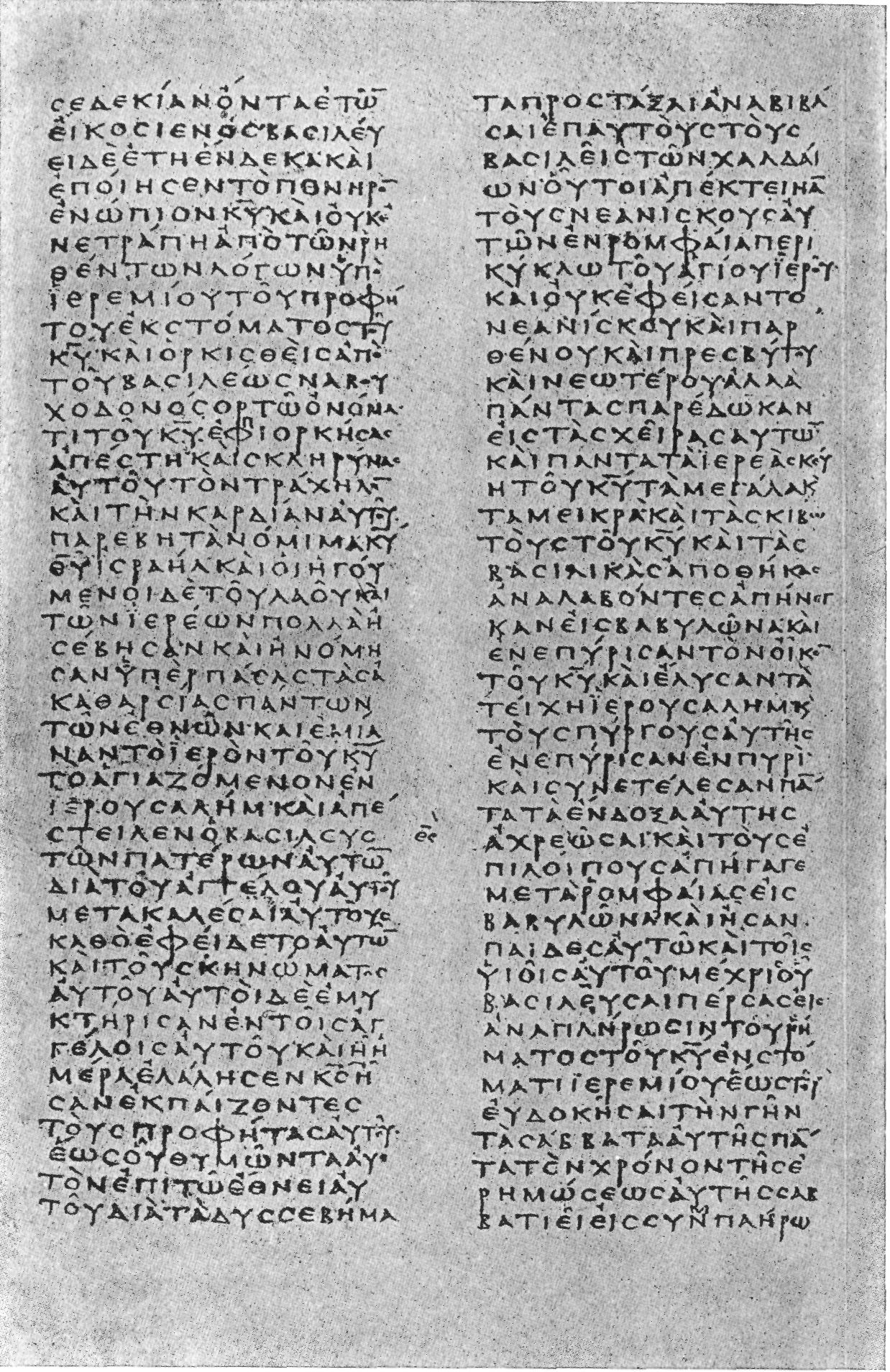
SEPTUAGINT.
Facsimile, somewhat reduced, of a page of the VATICAN MANUSCRIPT.
Fourth Century. Vatican Library.
The Septuagint is the Greek translation, by seventy elders, of the Hebrew Bible.
The earlier copies are all in uncial or "capital" letters, cursive or "lower-case" letters being a later invention.
This is a good specimen of the hand-work of the ecclesiastical scribes of the fourth century.
Accordingly, when we are accosted in such terms as these: Why did God from the first predestine some to death, when as they were not yet in existence, they could not have merited sentence of death?—let us by way of reply ask in our turn, What do you imagine that God owes to man, if he is pleased to estimate him by his own nature? As we are all vitiated by sin, we cannot but be hateful to God, and that not from tyrannical cruelty, but the strictest justice. But if all whom the Lord predestines to death are naturally liable to sentence of death, of what injustice, pray, do they complain? Should all the sons of Adam come to dispute and contend with their Creator, because by his eternal providence they were before their birth doomed to perpetual destruction: when God comes to reckon with them, what will they be able to mutter against this defense? If all are taken from a corrupt mass, it is not strange that all are subject to condemnation. Let them not therefore charge God with injustice, if by his eternal judgment they are doomed to a death to which they themselves feel that, whether they will or not, they are drawn spontaneously by their own nature. Hence it appears how perverse is this affectation of murmuring, when of set purpose they suppress the cause of condemnation which they are compelled to recognize in themselves, that they may lay the blame upon God. But though I should confess a hundred times that God is the author (and it is most certain that he is), they do not however thereby efface their own guilt, which, engraven on their own consciences, is ever and anon presenting itself to their view....
If God merely foresaw human events, and did not also arrange and dispose of them at his pleasure, there might be room for agitating the question, how far his foreknowledge amounts to necessity; but since he foresees the things which are to happen, simply because he has decreed that they are so to happen, it is vain to debate about prescience, while it is clear that all events take place by his sovereign appointment.
They deny that it is ever said in distinct terms, God decreed that Adam should perish by his revolt. As if the same God who is declared in Scripture to do whatsoever he pleases could have made the noblest of his creatures without any special purpose. They say that, in accordance with free will, he was to be the architect of his own fortune; that God had decreed nothing but to treat him according to his desert. If this frigid fiction is received, where will be the omnipotence of God, by which, according to his secret counsel on which everything depends, he rules over all? But whether they will allow it or not, predestination is manifest in Adam's posterity. It was not owing to nature that they all lost salvation by the fault of one parent. Why should they refuse to admit with regard to one man that which against their will they admit with regard to the whole human race? Why should they in caviling lose their labor? Scripture proclaims that all were, in the person of one, made liable to eternal death. As this cannot be ascribed to nature, it is plain that it is owing to the wonderful counsel of God. It is very absurd in these worthy defenders of the justice of God to strain at a gnat and swallow a camel. I again ask how it is that the fall of Adam involves so many nations with their infant children in eternal death without remedy, unless that it so seemed meet to God? Here the most loquacious tongues must be dumb. The decree, I admit, is dreadful; and yet it is impossible to deny that God foreknew what the end of man was to be before he made him, and foreknew because he had so ordained by his decree. Should any one here inveigh against the prescience of God, he does it rashly and unadvisedly. For why, pray, should it be made a charge against the heavenly Judge, that he was not ignorant of what was to happen? Thus, if there is any just or plausible complaint, it must be directed against predestination. Nor ought it to seem absurd when I say that God not only foresaw the fall of the first man, and in him the ruin of his posterity, but also at his own pleasure arranged it. For as it belongs to his wisdom to foreknow all future events, so it belongs to his power to rule and govern them by his hand.
FREEDOM OF THE WILL
From the 'Institutes of the Christian Religion'
God has provided the soul of man with intellect, by which he might discern good from evil, just from unjust, and might know what to follow or to shun, reason going before with her lamp; whence philosophers, in reference to her directing power, have called her [Greek: to hêgemonichon]. To this he has joined will, to which choice belongs. Man excelled in these noble endowments in his primitive condition, when reason, intelligence, prudence, and judgment not only sufficed for the government of his earthly life, but also enabled him to rise up to God and eternal happiness. Thereafter choice was added to direct the appetites and temper all the organic motions; the will being thus perfectly submissive to the authority of reason. In this upright state, man possessed freedom of will, by which if he chose he was able to obtain eternal life. It were here unseasonable to introduce the question concerning the secret predestination of God, because we are not considering what might or might not happen, but what the nature of man truly was. Adam, therefore, might have stood if he chose, since it was only by his own will that he fell; but it was because his will was pliable in either direction, and he had not received constancy to persevere, that he so easily fell. Still he had a free choice of good and evil; and not only so, but in the mind and will there was the highest rectitude, and all the organic parts were duly framed to obedience, until man corrupted its good properties, and destroyed himself. Hence the great darkness of philosophers who have looked for a complete building in a ruin, and fit arrangement in disorder. The principle they set out with was, that man could not be a rational animal unless he had a free choice of good and evil. They also imagined that the distinction between virtue and vice was destroyed, if man did not of his own counsel arrange his life. So far well, had there been no change in man. This being unknown to them, it is not surprising that they throw everything into confusion. But those who, while they profess to be the disciples of Christ, still seek for free-will in man, notwithstanding of his being lost and drowned in spiritual destruction, labor under manifold delusion, making a heterogeneous mixture of inspired doctrine and philosophical opinions, and so erring as to both. But it will be better to leave these things to their own place. At present it is necessary only to remember that man at his first creation was very different from all his posterity; who, deriving their origin from him after he was corrupted, received a hereditary taint. At first every part of the soul was formed to rectitude. There was soundness of mind and freedom of will to choose the good. If any one objects that it was placed, as it were, in a slippery position because its power was weak, I answer, that the degree conferred was sufficient to take away every excuse. For surely the Deity could not be tied down to this condition,—to make man such that he either could not or would not sin. Such a nature might have been more excellent; but to expostulate with God as if he had been bound to confer this nature on man, is more than unjust, seeing he had full right to determine how much or how little he would give. Why he did not sustain him by the virtue of perseverance is hidden in his counsel; it is ours to keep within the bounds of soberness. Man had received the power, if he had the will, but he had not the will which would have given the power; for this will would have been followed by perseverance. Still, after he had received so much, there is no excuse for his having spontaneously brought death upon himself. No necessity was laid upon God to give him more than that intermediate and even transient will, that out of man's fall he might extract materials for his own glory.