Volume 8 / Act 1 — BENVENUTO CELLINI
Reading edition
(1500-1571)

mong the three or four best autobiographies of the world's literature, the 'Memoirs' of Benvenuto Cellini are unique as the self-delineation of the most versatile of craftsmen, a bizarre genius, and a typical exponent of the brilliant period of the later Italian Renaissance. As a record of the ways of living and modes of thinking of that fascinating epoch, they are more lively and interesting than history, more entertaining, if more true to fact, than a romance. As one of his Italian critics, Baretti, put it:—"The life of Benvenuto Cellini, written by himself in the pure and unsophisticated idiom of the Florentine people, surpasses every book in our literature for the delight it affords the reader." This is high praise for the product of a literature that boasts of Boccaccio's 'Decameron,' and gave birth to the novelle, the parent of modern fiction. Yet the critics of other nations have echoed this praise. Auguste Comte, the positivist philosopher, included it in his limited list for the reading of reformed humanity, and Goethe, laying aside his own creative work, deemed it worth his time and attention to translate into German.
Benvenuto Cellini was born at Florence in 1500. The father, Giovanni Cellini, a musician and maker of musical instruments, intended that the boy should likewise become a musician; but young Benvenuto very early showed strong leaning toward the plastic art, and detested the flute he was forced to practice. The first chapters of the 'Memoirs' are a most lively description of the struggles between the wishes of the father and those of the son, until the latter finally prevailed, and at fifteen years of age he was apprenticed to a goldsmith of Florence. He made rapid progress, and soon attracted notice as a skilled craftsman. At the same time, to please his father, toward whom he everywhere professes the most filial feeling, he continued "that confounded flute-playing" as a side issue. This accomplishment, however, did him a good turn at the Papal court later on. After various youthful escapades, street broils, and quarrels with his father, he fled in monk's disguise to Rome in 1521. A vase made for the Bishop of Salamanca drew upon him the notice of Pope Clement VII., who appointed him court musician and also employed him in his proper profession of goldsmith. When the Constable de Bourbon attacked Rome, in 1527, Cellini was of great service to the Pope in defending the city. He boasts of having from the ramparts shot the Bourbon; and indeed, if one were to take him strictly at his word, his valor and skill as an engineer saved the castle of San Angelo and the Pope. However his lively imagination may have overrated his own importance, yet it is certain that his military exploit paved the way for his return to Florence, where for a time he devoted himself to the execution of bronze medals and coins. The most famous of the former are Hercules and the Nemean Lion, and Atlas supporting the world.
On the elevation of Paul III. to the Papacy we again find Cellini at Rome, working for the Pope and other eminent people. His extraordinary abilities brought him not only into the notice of the courts, but also drew him into the brilliant literary and artistic society of the Eternal City. With unrivaled vividness he flashes before us in a few bold strokes the artists of the decadent Renaissance, the pupils of Raphael, led by Giulio Romano, with their worship of every form of physical beauty and their lack of elevation of thought. In consequence of the plottings of his implacable enemy, Pier Luigi, natural son of Paul III., he was arrested on the charge of having during the sack of Rome embezzled Pontifical gold and jewels to the amount of eighty thousand ducats. Though the charge was groundless, he was committed to the castle of San Angelo. His escape is narrated in one of the most thrilling chapters of the 'Memoirs.' He went in hiding to the Cardinal Cornaro, but was delivered up again to the Pope by an act of most characteristic sixteenth-century Italian policy, and was cast into a loathsome underground dungeon of the castle. It was damp, swarming with vermin, and for two hours of the day only received light through a little aperture. Here he languished for many months, with only the chronicles of Giovanni Billani and an Italian Bible to solace him. Now at last his recklessness and bravado forsook him. He took on the airs of a saint, gave himself up to mysticism, grew delirious and had his famous visions—angels visiting him, who talked with him about religion.
In 1539 he was finally released at the intercession of the cardinal Ippolito d'Este, who came from France to invite him to enter the King's service. Cellini's account of his residence in France has great historic value as throwing vivid side-lights on that interesting period in the development of French social life, when Francis I. was laying the foundation of the court society which was later on brought to perfection by Louis XIV. Cellini was one among that crowd of Italian artists gathered at the court in Paris and Versailles, whose culture was to refine the manners of the French warrior barons. He worked for five years at Fontainebleau and in Paris. Among his works there, still extant, are a pair of huge silver candelabra, the gates of Fontainebleau, and a nymph in bronze, reposing among trophies of the chase, now in the Louvre. Among other marks of royal favor he was presented with a castle, Le Petit Nesle. His efforts to gain possession of this grant are among the amusing episodes of his narrative.
He had as usual numerous quarrels, and falling into disfavor with Madame d'Estampes, the King's favorite, he suddenly left Paris and returned alone to Florence. The remainder of his life he passed mainly in the service of Duke Cosimo de' Medici. The chapters of his narrative dealing with this portion give a most vivid picture of artist life at an Italian court in the sixteenth century. To this third and last period belongs the work on which his fame as sculptor rests, the bronze Perseus holding the head of Medusa, completed in 1554 and still standing in the Loggia de' Lanzi in Florence. It is a typical monument of the Renaissance, and was received with universal applause by all Italy. Odes and sonnets in Italian, Greek, and Latin were written in its praise. His minute description of its casting, and of his many trials during that process, are among the most interesting passages of the narrative.
In 1558 he began to write his memoirs, dictating them for the greater part to an amanuensis; and he carried them down to the year 1562. The events of the remaining nine years of his life are to be gathered from contemporary documents. In 1558 he received the tonsure and first ecclesiastical orders, but married two years later, and died in 1571. He was buried with great pomp in the Church of the Annunciata in Florence.
Besides his 'Memoirs' he also wrote treatises on the goldsmith's art and on sculpture, with especial reference to bronze-founding. They are of great value as manuals of the craftsmanship of the Renaissance, and excellent specimens of good Italian style as applied to technical exposition. And like all cultivated artists of his time Cellini also tried his hand at poetry; but his lack of technical training as a writer comes out even more in his verse than in his prose. The life of Benvenuto was one of incessant activity, laying hold of the whole domain of the plastic arts: of restless wanderings from place to place; and of rash deeds of violence. He lived to the full the life of his age, in all its glory and all its recklessness. As the most famous goldsmith of his time, he worked for all the great personages of the day, and put himself on a footing of familiar acquaintance with popes and princes. As an artist he came into contact with all the phases of Italian society, since a passion for external beauty was at that time the heritage of the Italian people, and art bodied forth the innermost life of the period. Furniture, plate, and personal adornments were not turned out wholesale by machinery as they are to-day, but engaged the individual attention of the most skilled craftsmen. The memory and the traditions of Raphael Sanzio were still cherished by his pupils when Cellini first came to Rome into the brilliant circle of Giulio Romano and his friends; Michelangelo's frescoes were studied with rapturous admiration by the young Benvenuto, and later on he proudly recorded some words of praise of the mighty genius whom he worshiped; and at this time, too, Titian and Tintoretto set the heart of Venice aglow with the splendor and color of their marvelous canvases. The contemporary though not the peer of those masters of the brush and the chisel, Cellini, endowed with a keen feeling for beauty, a dexterous hand, and a lively imagination, in his versatility reached out toward a wider sphere of activity, and laid hold of life at more points, than they.
He reflected the Renaissance, not merely on its higher artistic aspect, but he touched it also on its lower darker levels of brute passion, coarseness, and vindictiveness. He had more than one murder to his account, and he did not slur over them in his narrative, for in his make-up the bravo was equally prominent with the artist. Yet we must remember that homicides were of common occurrence in those days, defended by casuists and condoned by the Church. Avenging one's honor, or punishing an insult with the dagger, were as much a social custom as the adornment of the body with exquisitely wrought fabrics and jewelry. But just because Cellini was so thoroughly awake to all the influences about him, and so entirely bent on living his life, his 'Memoirs' are perennially fresh and attractive. They are the plain unvarnished annals of a career extraordinary even in that age of uncommon experiences; they were written, as he says, because "all men of whatever quality they be, who have done anything of excellence, or which may properly resemble excellence, ought, if they are persons of truth and honesty, to describe their life with their own hand; but they ought not to attempt so fine an enterprise till they have passed the age of forty."
BENVENUTO CELLINI.
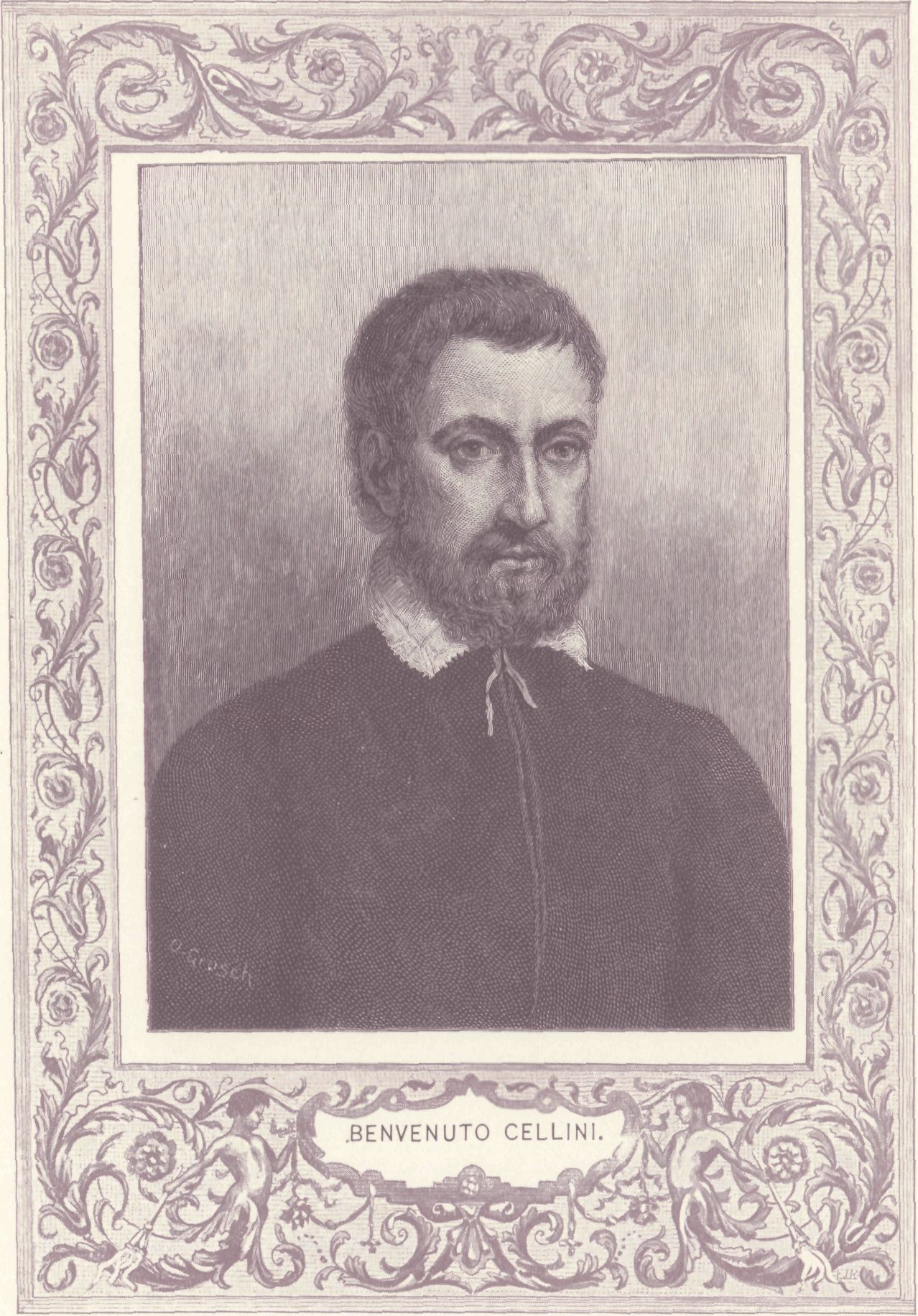
Cellini was past fifty-eight when he began writing, and going back to his earliest boyhood, he set down the facts of his long career as he remembered them. Of course he is the hero who recounts his own story, and like all heroes of romance he plays the leading part, is always in the right, and comes out handsomely in the end. Carping critics who tax him with lack of truth in dealing with his enemies, and with pleading his own cause too well, are apt to forget that he wrote long after the events were past, and that to an ever-active imagination ruminating over bygone happenings, facts become unconsciously colored to assume the hue the mind wishes them to have. Yet the fidelity and accuracy of his memory are remarkable, and his faculty for seeing, combined with his dramatic way of putting things most vividly, flashes before our eyes the scenes he recounts. He does not describe much; he indicates a characteristic feature, habit, or attitude; as for example, in referring to a man he disliked, as having "long spidery hands and a shrill gnat-like voice"—all that is needed to make us see the man from Cellini's point of view. Again, he adds much to the vivacity of the narrative by reporting conversation as a dialogue, even if he has it himself at second-hand. So in his trenchant, nervous manner this keen observer, while aiming to recount only the facts of his own life and to set himself on a becoming pedestal in the eyes of posterity, gives us at the same time flash-lights of the whole period in which he played a part. Popes Clement VII. and Paul III., Cosimo de' Medici and his Duchess, the King of France and Madame d' Estampes, cardinals, nobles, princes, and courtiers, artists of every description, burghers and the common folk,—all with whom he came in contact,—are brought before us in a living pageant. Looking back over his checkered career, he lives his intense life over again, and because he himself saw so vividly at the time, he makes us see now. We have here invaluable pictures, by an eye-witness and actor, of the sack of Rome, the plague and siege of Florence, the pomp of Charles V. at Rome. He withdraws the curtains from the Papal policies and court intrigues, not with a view to writing history, but because he happened to have some relations with those princes and wished to tell us about them. Again, he was no critic of the manners of his time, yet he presents most faithful pictures of artist life in Rome, Paris, and Florence. He was not given to introspection and self-criticism, but he describes himself as well as others, not by analysis but by deeds and words. He had no literary training; he wrote as he talked, and gained his effect by simplicity.
He was recognized as the first goldsmith of his time; yet as a man also his contemporaries speak well of him, for he embodied the virtues of his age, while his morals did not fall below the average code of the Renaissance. Vasari says:—"He always showed himself a man of great spirit and veracity; bold, active, enterprising, and formidable to his enemies; a man, in short, who knew as well how to speak with princes as to exert himself in his art."
J. A. Symonds, that inspiring student of the Italian Renaissance, sums up his impressions of the book and the man as follows:—
"I am confident that every one who may have curiously studied Italian history and letters will pronounce this book to be at one and the same time the most perfect extant monument of vernacular Tuscan prose, and also the most complete and lively source of information we possess regarding manners, customs, ways of feeling, and modes of acting, in the Court. Those who have made themselves thoroughly familiar with Cellini's Memoirs possess the substance of that many-sided epoch in the form of an epitome. It is the first book which a student of the Italian Renaissance should handle in order to obtain the right direction for his more minute researches. It is the last book to which he should return at the close of his exploratory voyages. At the commencement he will find it invaluable for placing him at the exactly proper point of view. At the end he will find it no less invaluable for testing and verifying the conclusion he has drawn from various sources and a wide circumference of learning. From the pages of this book the genius of the Renaissance, incarnate in a single personality, leans forth and speaks to us. Nowhere else, to my mind, do we find the full character of the epoch so authentically stamped. That is because this is no work of art or of reflection, but the plain utterance of a man who lived the whole life of his age, who felt its thirst for glory, who shared its adoration of the beautiful, who blent its paganism and its superstition, who represented its two main aspects of exquisite sensibility to form and almost brutal ruffianism. We must not expect from Cellini the finest, highest, purest accents of the Renaissance.... For students of that age he is at once more and less than his contemporaries: less, inasmuch as he distinguished himself by no stupendous intellectual qualities; more, inasmuch as he occupied a larger sphere than each of them singly. He was the first goldsmith of his time, an adequate sculptor, a restless traveler, an indefatigable workman, a Bohemian of the purest water, a turbulent bravo, a courtier and companion of princes; finally, a Florentine who used his native idiom with incomparable vivacity of style."
THE ESCAPE FROM PRISON
From the 'Memoirs': Symonds's Translation
The castellan was subject to a certain sickness, which came upon him every year and deprived him of his wits. The sign of its approach was that he kept continually talking, or rather jabbering, to no purpose. These humors took a different shape each year; one time he thought he was an oil-jar; another time he thought he was a frog, and hopped about as frogs do; another time he thought he was dead, and then they had to bury him; not a year passed but he got some such hypochondriac notions into his head. At this season he imagined that he was a bat, and when he went abroad to take the air he used to scream like bats in a high thin tone; and then he would flap his hands and body as though he were about to fly. The doctors, when they saw the fit was coming on him, and his old servants, gave him all the distractions they could think of; and since they had noticed that he derived much pleasure from my conversation, they were always fetching me to keep him company. At times the poor man detained me for four or five stricken hours without ever letting me cease talking. He used to keep me at his table, eating opposite to him, and never stopped chatting and making me chat; but during those discourses I contrived to make a good meal. He, poor man, could neither eat nor sleep; so that at last he wore me out. I was at the end of my strength; and sometimes when I looked at him, I noticed that his eyeballs were rolling in a frightful manner, one looking one way and the other in another.
He took it into his head to ask me whether I had ever had a fancy to fly. I answered that it had always been my ambition to do those things which offer the greatest difficulties to men, and that I had done them; as to flying, the God of Nature had gifted me with a body well suited for running and leaping far beyond the common average, and that with the talents I possessed for manual art I felt sure I had the courage to try flying. He then inquired what methods I should use; to which I answered that, taking into consideration all flying creatures, and wishing to imitate by art what they derived from nature, none was so apt a model as the bat.
No sooner had the poor man heard the name bat, which recalled the humor he was suffering under, than he cried out at the top of his voice:—"He says true—he says true; the bat's the thing—the bat's the thing!" Then he turned to me and said, "Benvenuto, if one gave you the opportunity, should you have the heart to fly?" I said that if he would set me at liberty, I felt quite up to flying down to Prato, after making myself a pair of wings out of waxed linen. Thereupon he replied:—"I too should be prepared to take flight; but since the Pope has bidden me guard you as though you were his own eyes, and I know you a clever devil who would certainly escape, I shall now have you locked up with a hundred keys in order to prevent you slipping through my fingers." I then began to implore him, and remind him that I might have fled, but that on account of the word which I had given him I would never have betrayed his trust; therefore I begged him for the love of God, and by the kindness he had always shown me, not to add greater evils to the misery of my present situation. While I was pouring out these entreaties, he gave strict orders to have me bound and taken and locked up in prison. On seeing that it could not be helped, I told him before all his servants: "Lock me well up, and keep good watch on me; for I shall certainly contrive to escape." So they took me and confined me with the utmost care. I then began to deliberate upon the best way of making my escape. No sooner had I been locked in, than I went about exploring my prison; and when I thought I had discovered how to get out of it, I pondered the means of descending from the lofty keep, for so the great round central tower is called. I took those new sheets of mine, which, as I have said already, I had cut in strips and sewn together; then I reckoned up the quantity which would be sufficient for my purpose. Having made this estimate and put all things in order, I took out a pair of pincers which I had abstracted from a Savoyard belonging to the guard of the castle. This man superintended the casks and cisterns; he also amused himself with carpentering. Now he possessed several pairs of pincers, among which was one both big and heavy. I then, thinking it would suit my purpose, took it and hid it in my straw mattress. The time had now come for me to use it; so I began to try the nails which kept the hinges of my door in place. The door was double, and the clinching of the nails could not be seen; so that when I attempted to draw one out, I met with the greatest trouble; in the end however I succeeded. When I had drawn the first nail, I bethought me how to prevent its being noticed. For this purpose I mixed some rust, which I had scraped from old iron, with a little wax, obtaining exactly the same color as the heads of the long nails which I had extracted. Then I set myself to counterfeit these heads and place them on the holdfasts; for each nail I extracted I made a counterfeit in wax. I left the hinges attached to their door-posts at top and bottom by means of some of the same nails that I had drawn; but I took care to cut these and replace them lightly, so that they only just supported the irons of the hinges.
All this I performed with the greatest difficulty, because the castellan kept dreaming every night that I had escaped, which made him send from time to time to inspect my prison. The man who came had the title and behavior of a catchpoll. He was called Bozza, a serving-man. Giovanni never entered my prison without saying something offensive to me. He came from the district of Prato, and had been an apothecary in the town there. Every evening he minutely examined the holdfasts of the hinges and the whole chamber, and I used to say:—"Keep a good watch over me, for I am resolved by all means to escape."
These words bred a great enmity between him and me, so that I was obliged to use precautions to conceal my tools; that is to say, my pincers and a great big poniard and other appurtenances. All these I put away together in my mattress, where I also kept the strips of linen I had made. When day broke, I used immediately to sweep my room out; and though I am by nature a lover of cleanliness, at that time I kept myself unusually spick and span. After sweeping up, I made my bed as daintily as I could, laying flowers upon it, which a Savoyard used to bring me nearly every morning. He had the care of the cistern and the casks, and also amused himself with carpentering; it was from him I stole the pincers which I used in order to draw out the nails from the holdfasts of the hinges.
Well, to return to the subject of my bed; when Bozza and Pedignone came, I always told them to give it a wide berth, so as not to dirty and spoil it for me. Now and then, just to irritate me, they would touch it lightly, upon which I cried: "Ah, dirty cowards! I'll lay my hand on one of your swords there, and will do you a mischief that will make you wonder. Do you think you are fit to touch the bed of a man like me? When I chastise you I shall not heed my own life, for I am certain to take yours. Let me alone then with my troubles and my tribulations, and don't give me more annoyance than I have already; if not, I shall make you see what a desperate man is able to do." These words they reported to the castellan, who gave them express orders never to go near my bed, and when they came to me, to come without swords; but for the rest to keep a watchful guard upon me.
Having thus secured my bed from meddlers, I felt as though the main point was gained; for there lay all things useful to my venture. It happened on the evening of a certain feast-day that the castellan was seriously indisposed; his humors grew extravagant; he kept repeating that he was a bat, and if they heard that Benvenuto had flown away, they must let him go to catch me up, since he could fly by night most certainly "as well or better than myself"; for it was thus he argued:—"Benvenuto is a counterfeit bat, but I am a real one; and since he is committed to my care, leave me to act; I shall be sure to catch him." He had passed several nights in this frenzy, and had worn out all his servants; whereof I received full information through divers channels, but especially from the Savoyard, who was my friend at heart.
On the evening of that feast-day, then, I made up my mind to escape, come what might; and first I prayed most devoutly to God, imploring his Divine Majesty to protect and succor me in that so perilous a venture. Afterwards I set to work at all the things I needed, and labored the whole of the night. It was two hours before daybreak when at last I removed those hinges with the greatest toil; but the wooden panel itself, and the bolt too, offered such resistance that I could not open the door; so I had to cut into the wood; yet in the end I got it open, and shouldering the strips of linen which I had rolled up like bundles of flax upon two sticks, I went forth and directed my steps toward the latrines of the keep. Spying from within two tiles upon the roof, I was able at once to clamber up with ease. I wore a white doublet with a pair of white hose and a pair of half-boots, into which I had stuck the poniard I have mentioned.
After scaling the roof, I took one end of my linen roll and attached it to a piece of antique tile which was built into the fortress wall; it happened to jut out scarcely four fingers. In order to fix the band, I gave it the form of a stirrup. When I had attached it to that piece of tile, I turned to God and said: "Lord God, give aid to my good cause; you know that it is good; you see that I am aiding myself." Then I let myself go gently by degrees, supporting myself with the sinews of my arms, until I touched the ground. There was no moonshine, but the light of a fair open heaven. When I stood upon my feet on solid earth, I looked up at the vast height which I had descended with such spirit; and went gladly away, thinking I was free. But this was not the case; for the castellan on the side of the fortress had built two lofty walls, the space between which he used for stable and hen-yard; the place was barred with thick iron bolts outside. I was terribly disgusted to find there was no exit from this trap; but while I paced up and down debating what to do, I stumbled on a long pole which was covered up with straw. Not without great trouble, I succeeded in placing it against the wall, and then swarmed up it by the force of my arms until I reached the top. But since the wall ended in a sharp ridge, I had not strength enough to drag the pole up after me. Accordingly I made my mind up to use a portion of the second roll of linen which I had there; the other was left hanging from the keep of the castle. So I cut a piece off, tied it to the pole, and clambered down the wall, enduring the utmost toil and fatigue. I was quite exhausted, and moreover had flayed the inside of my hands, which bled freely. This compelled me to rest awhile, and I bathed my hands in my own urine.
When I thought that my strength was recovered, I advanced quickly toward the last rampart, which faces toward Prato. There I put my bundle of linen lines down upon the ground, meaning to fasten them round a battlement, and descend the lesser as I had the greater height. But no sooner had I placed the linen than I became aware behind me of a sentinel, who was going the rounds. Seeing my designs interrupted and my life in peril, I resolved to face the guard. This fellow, when he noticed my bold front, and that I was marching on him with weapon in hand, quickened his pace and gave me a wide berth. I had left my lines some little way behind, so I turned with hasty steps to regain them; and though I came within sight of another sentinel, he seemed as though he did not choose to take notice of me. Having found my lines and attached them to the battlement, I let myself go. On the descent, whether it was that I thought I had really come to earth and relaxed my grasp to jump, or whether my hands were so tired that they could not keep their hold, at any rate I fell, struck my head in falling, and lay stunned for more than an hour and a half, so far as I could judge.
It was just upon daybreak, when the fresh breeze which blows an hour before the sun revived me; yet I did not immediately recover my senses, for I thought my head had been cut off, and fancied that I was in purgatory. With time, little by little my faculties returned, and I perceived that I was outside the castle, and in a flash remembered all my adventures. I was aware of the wound in my head before I knew my leg was broken; for I put my hands up and withdrew them covered with blood. Then I searched the spot well, and judged and ascertained that I had sustained no injury of consequence there; but when I wanted to stand up, I discovered that my right leg was broken three inches above the heel. Not even this dismayed me: I drew forth my poniard with its scabbard; the latter had a metal point ending in a large ball, which had caused the fracture of my leg; for the bone coming into violent contact with the ball, and not being able to bend, had snapped at that point. I threw the sheath away, and with the poniard cut a piece of the linen which I had left. Then I bound my leg up as well as I could, and crawled on all fours with the poniard in my hand toward the city gate. When I reached it, I found it shut; but I noticed a stone just beneath the door which did not appear to be very firmly fixed. This I attempted to dislodge; after setting my hands to it, and feeling it move, it easily gave way, and I drew it out. Through the gap thus made I crept into the town.
THE CASTING OF PERSEUS
From the 'Memoirs': Symonds's Translation
Abandoned thus to my own resources, I took new courage and banished the sad thoughts which kept recurring to my mind, making me often weep bitter tears of repentance for having left France; for though I did so only to revisit Florence, my sweet birthplace, in order that I might charitably succor my six nieces, this good action, as I well perceived, had been the beginning of my great misfortune. Nevertheless I felt convinced that when my Perseus was accomplished, all these trials would be turned to high felicity and glorious well-being.
Accordingly I strengthened my heart, and with all the forces of my body and my purse, employing what little money still remained to me, I set to work. First I provided myself with several loads of pine-wood from the forests of Serristori, in the neighborhood of Montelupo. While these were on their way, I clothed my Perseus with the clay which I had prepared many months beforehand, in order that it might be duly seasoned. After making its clay tunic (for that is the term used in this art) and properly arming it and fencing it with iron girders, I began to draw the wax out by means of a slow fire. This melted and issued through numerous air-vents I had made; for the more there are of these the better will the mold fill. When I had finished drawing off the wax, I constructed a funnel-shaped furnace all round the model of my Perseus. It was built of bricks, so interlaced, the one above the other, that numerous apertures were left for the fire to exhale it. Then I began to lay on wood by degrees, and kept it burning two whole days and nights.
At length when all the wax was gone and the mold was well baked, I set to work at digging the pit in which to sink it. This I performed with scrupulous regard to all the rules of art. When I had finished that part of my work, I raised the mold by windlasses and stout ropes to a perpendicular position, and suspending it with the greatest care one cubit above the level of the furnace, so that it hung exactly above the middle of the pit. I next lowered it gently down into the very bottom of the furnace, and had it firmly placed with every possible precaution for its safety. When this delicate operation was accomplished, I began to bank it up with the earth I had excavated; and ever as the earth grew higher I introduced its proper air-vents, which were little tubes of earthenware, such as folks use for drains and suchlike purposes. At length I felt sure that it was admirably fixed, and that the filling in of the pit and the placing of the air-vents had been properly performed. I also could see that my workpeople understood my method, which differed very considerably from that of all the other masters in the trade. Feeling confident then that I could rely upon them, I next turned to my furnace, which I had filled with numerous pigs of copper and other bronze stuff. The pieces were piled according to the laws of art; that is to say, so resting one upon the other that the flames could play freely through them, in order that the metal might heat and liquefy the sooner.
At last I called out heartily to set the furnace going. The logs of pine were heaped in, and what with the unctuous resin of the wood and the good draught I had given, my furnace worked so well that I was obliged to rush from side to side to keep it going. The labor was more than I could stand; yet I forced myself to strain every nerve and muscle. To increase my anxieties, the workshop took fire, and we were afraid lest the roofs should fall upon our heads; while from the garden such a storm of wind and rain kept blowing in that it perceptibly cooled the furnace.
Battling thus with all these untoward circumstances for several hours, and exerting myself beyond even the measure of my powerful constitution, I could at last bear up no longer, and a sudden fever of the utmost possible intensity attacked me. I felt absolutely obliged to go and fling myself upon my bed. Sorely against my will, having to drag myself away from the spot, I turned to my assistants,—about ten or more in all, what with master-founders, hand-workers, country fellows, and my own special journeymen; among whom was Bernandino Mannellini of Mugello, my apprentice through several years. To him in particular I spoke:—"Look, my dear Bernandino, that you observe the rules which I have taught you; do your best with all dispatch, for the metal will soon be fused. You cannot go wrong; these honest men will get the channels ready; you will easily be able to drive back the two plugs with this pair of iron crooks; and I am sure that my mold will fill miraculously. I feel more ill than I ever did in all my life, and verily believe it will kill me before a few hours are over." Thus with despair at heart I left them and betook myself to bed.
No sooner had I got to bed than I ordered my serving-maids to carry food and wine for all the men into the workshop; at the same time I cried, "I shall not be alive to-morrow." They tried to encourage me, arguing that my illness would pass over, since it came from excessive fatigue. In this way I spent two hours battling with the fever, which steadily increased, and calling out continually, "I feel that I am dying." My housekeeper, who was named Mona Fiore da Castel del Rio, a very notable manager and no less warm-hearted, kept chiding me for my discouragement; but on the other hand, she paid me every kind attention which was possible. However, the sight of my physical pain and moral dejection so affected her that in spite of that brave heart of hers, she could not refrain from shedding tears; and yet, so far as she was able, she took care I should not see them.
While I was thus terribly afflicted, I beheld the figure of a man enter my chamber, twisted in his body into the form of a capital S. He raised a lamentable, doleful voice, like one who announces their last hour to men condemned to die upon the scaffold, and spoke these words: "O Benvenuto! your statue is spoiled, and there is no hope whatever of saving it." No sooner had I heard the shriek of that wretch than I gave a howl which might have been heard from the sphere of flame. Jumping from my bed, I seized my clothes and began to dress. The maids, and my lad, and every one who came around to help me, got kicks or blows of the fist, while I kept crying out in lamentation, "Ah! traitors! enviers! This is an act of treason, done by malice prepense! But I swear by God that I will sift it to the bottom, and before I die will leave such witness to the world of what I can do as shall make a score of mortals marvel."
When I had got my clothes on, I strode with soul bent on mischief toward the workshop; there I beheld the men whom I had left erewhile in such high spirits, standing stupefied and downcast. I began at once and spoke:—"Up with you! Attend to me! Since you have not been able or willing to obey the directions I gave you, obey me now that I am with you to conduct my work in person. Let no one contradict me, for in cases like this we need the aid of hand and hearing, not of advice." When I had uttered these words, a certain Maestro Alessandro Lastricati broke silence and said, "Look you, Benvenuto, you are going to attempt an enterprise which the laws of art do not sanction, and which cannot succeed."
I turned upon him with such fury and so full of mischief, that he and all the rest of them exclaimed with one voice, "On then! Give orders! We will obey your last commands, so long as life is left in us." I believe they spoke thus feelingly because they thought I must fall shortly dead upon the ground. I went immediately to inspect the furnace, and found that the metal was all curdled; an accident which we express by "being caked." I told two of the hands to cross the road, and fetch from the house of the butcher Capretta a load of young oak-wood, which had lain dry for above a year; this wood had been previously offered me by Madame Ginevra, wife of the said Capretta. So soon as the first armfuls arrived, I began to fill the grate beneath the furnace. Now oak-wood of that kind heats more powerfully than any other sort of tree; and for this reason, where a slow fire is wanted, as in the case of gun foundry, alder or pine is preferred. Accordingly, when the logs took fire, oh! how the cake began to stir beneath that awful heat, to glow and sparkle in a blaze! At the same time I kept stirring up the channels, and sent men upon the roof to stop the conflagration, which had gathered force from the increased combustion in the furnace; also I caused boards, carpets, and other hangings to be set up against the garden, in order to protect us from the violence of the rain.
When I had thus provided against these several disasters, I roared out first to one man and then to another, "Bring this thing here! Take that thing there!" At this crisis, when the whole gang saw the cake was on the point of melting, they did my bidding, each fellow working with the strength of three. I then ordered half a pig of pewter to be brought, which weighed about sixty pounds, and flung it into the middle of the cake inside the furnace. By this means, and by piling on wood and stirring now with pokers and now with iron rods, the curdled mass rapidly began to liquefy. Then, knowing I had brought the dead to life again, against the firm opinion of those ignoramuses, I felt such vigor fill my veins that all those pains of fever, all those fears of death, were quite forgotten.
All of a sudden an explosion took place, attended by a tremendous flash of flame, as though a thunderbolt had formed and been discharged among us. Unwonted and appalling terror astonied every one, and me more even than the rest. When the din was over and the dazzling light extinguished, we began to look each other in the face. Then I discovered that the cap of the furnace had blown up, and the bronze was bubbling over from its source beneath. So I had the mouths of my mold immediately opened, and at the same time drove in the two plugs which kept back the molten metal. But I noticed that it did not flow as rapidly as usual, the reason being probably that the fierce heat of the fire we kindled had consumed its base alloy. Accordingly I sent for all my pewter platters, porringers, and dishes, to the number of some two hundred pieces, and had a portion of them cast, one by one, into the channels, the rest into the furnace. This expedient succeeded, and every one could now perceive that my bronze was in most perfect liquefaction, and my mold was filling; whereupon they all with heartiness and happy cheer assisted and obeyed my bidding, while I, now here, now there, gave orders, helped with my own hands, and cried aloud, "O God! thou that by thy immeasurable power didst rise from the dead, and in thy glory didst ascend to heaven!"... Even thus in a moment my mold was filled; and seeing my work finished, I fell upon my knees, and with all my heart gave thanks to God.
After all was over, I turned to a plate of salad on a bench there, and ate with hearty appetite, and drank together with the whole crew.
Afterwards I retired to bed, healthy and happy, for it was now two hours before morning, and slept as sweetly as though I had never felt a touch of illness. My good housekeeper, without my giving any orders, had prepared a fat capon for my repast. So that when I rose, about the hour for breaking fast, she presented herself with a smiling countenance and said, "Oh, is that the man who felt that he was dying? Upon my word, I think the blows and kicks you dealt us last night, when you were so enraged, and had that demon in your body as it seemed, must have frightened away your mortal fever! The fever feared that it might catch it too, as we did!" All my poor household, relieved in like measure from anxiety and overwhelming labor, went at once to buy earthen vessels in order to replace the pewter I had cast away. Then we dined together joyfully: nay, I cannot remember a day in my whole life when I dined with greater gladness or a better appetite.
After our meal I received visits from the several men who had assisted me. They exchanged congratulations and thanked God for our success, saying they had learned and seen things done which other masters judged impossible. I too grew somewhat glorious; and deeming I had shown myself a man of talent, indulged a boastful humor. So I thrust my hand into my purse and paid them all to their full satisfaction.
That evil fellow, my mortal foe, Messer Pier Francesco Ricci, major-domo of the Duke, took great pains to find out how the affair had gone. In answer to his questions, the two men whom I suspected of having caked my metal for me said I was no man, but of a certainty some powerful devil, since I had accomplished what no craft of the art could do; indeed, they did not believe a mere ordinary fiend could work such miracles as I in other ways had shown. They exaggerated the whole affair so much, possibly in order to excuse their own part in it, that the major-domo wrote an account to the Duke, who was then in Pisa, far more marvelous and full of thrilling incidents than what they had narrated.
After I had let my statue cool for two whole days, I began to uncover it by slow degrees. The first thing I found was that the head of Medusa had come out most admirably, thanks to the air-vents; for as I had told the Duke, it is the nature of fire to ascend. Upon advancing farther, I discovered that the other head, that, namely, of Perseus, had succeeded no less admirably; and this astonished me far more, because it is at a considerably lower level than that of the Medusa. Now the mouths of the mold were placed above the head of Perseus and behind his shoulders; and I found that all the bronze my furnace contained had been exhausted in the head of this figure. It was a miracle to observe that not one fragment remained in the orifice of the channel, and that nothing was wanting to the statue. In my great astonishment I seemed to see in this the hand of God arranging and controlling all.
I went on uncovering the statue with success, and ascertained that everything had come out in perfect order, until I reached the foot of the right leg on which the statue rests. There the heel itself was formed, and going further, I found the foot apparently complete. This gave me great joy on the one side, but was half unwelcome to me on the other, merely because I had told the Duke that it could not come out. However, when I reached the end, it appeared that the toes and a little piece above them were unfinished, so that about half the foot was wanting. Although I knew that this would add a trifle to my labor, I was very well pleased, because I could now prove to the Duke how well I understood my business. It is true that far more of the foot than I expected had been perfectly formed; the reason of this was that, from causes I have recently described, the bronze was hotter than our rules of art prescribe; also that I had been obliged to supplement the alloy with my pewter cups and platters, which no one else, I think, had ever done before.
Having now ascertained how successfully my work had been accomplished, I lost no time in hurrying to Pisa, where I found the Duke. He gave me a most gracious reception, as did also the Duchess; and although the major-domo had informed them of the whole proceedings, their Excellencies deemed my performance far more stupendous and astonishing when they heard the tale from my own mouth. When I arrived at the foot of Perseus, and said it had not come out perfect, just as I previously warned his Excellency, I saw an expression of wonder pass over his face, while he related to the Duchess how I had predicted this beforehand.
Observing the Princess to be so well disposed towards me, I begged leave from the Duke to go to Rome. He granted it in most obliging terms, and bade me return as soon as possible to complete his Perseus; giving me letters of recommendation meanwhile to his ambassador, Averardo Serristori. We were then in the first years of Pope Giulio de Monti.
A NECKLACE OF PEARLS
From the 'Memoirs': Symonds's Translation
I must beg your attention now, most gracious reader, for a very terrible event which happened.
I used the utmost diligence and industry to complete my statue, and went to spend my evenings in the Duke's wardrobe, assisting there the goldsmiths who were working for his Excellency. Indeed, they labored mainly on designs which I had given them. Noticing that the Duke took pleasure in seeing me at work and talking with me, I took it into my head to go there sometimes also by day. It happened upon one of those days that his Excellency came as usual to the room where I was occupied, and more particularly because he heard of my arrival. His Excellency entered at once into conversation, raising several interesting topics, upon which I gave my views so much to his entertainment that he showed more cheerfulness than I had ever seen in him before. All of a sudden one of his secretaries appeared, and whispered something of importance in his ear; whereupon the Duke rose, and retired with the official into another chamber.
Now the Duchess had sent to see what his Excellency was doing, and her page brought back this answer:—"The Duke is talking and laughing with Benvenuto, and is in excellent good humor." When the Duchess heard this, she came immediately to the wardrobe, and not finding the Duke there, took a seat beside us. After watching us at work a while, she turned to me with the utmost graciousness, and showed me a necklace of large and really very fine pearls. On being asked by her what I thought of them, I said it was in truth a very handsome ornament. Then she spoke as follows:—"I should like the Duke to buy them for me; so I beg you, my dear Benvenuto, to praise them to him as highly as you can." At these words, I disclosed my mind to the Duchess with all the respect I could, and answered:—"My lady, I thought this necklace of pearls belonged already to your illustrious Excellency. Now that I am aware you have not yet acquired them, it is right, nay more, it is my duty, to utter what I might otherwise have refrained from saying; namely, that my mature professional experience enables me to detect very grave faults in the pearls, and for this reason I could never advise your Excellency to purchase them."
She replied:—"The merchant offers them for six thousand crowns; and were it not for some of those trifling defects you speak of, the rope would be worth over twelve thousand."
To this I replied that, even were the necklace of quite flawless quality, I could not advise any one to bid up to five thousand crowns for it: for pearls are not gems; pearls are but fishes' bones, which in the course of time must lose their freshness. Diamonds, rubies, emeralds, and sapphires, on the contrary, never grow old; these four are precious stones, and these it is right to purchase. When I had thus spoken, the Duchess showed some signs of irritation, and exclaimed, "I have a mind to possess these pearls; so prithee, take them to the Duke and praise them up to the skies; even if you have to use some words beyond the bounds of truth, speak them to do me service; it will be well for you!"
I have always been the greatest friend of truth and foe of lies; yet compelled by necessity, unwilling to lose the favor of so great a princess, I took those confounded pearls sorely against my inclination, and went with them over to the other room, whither the Duke had withdrawn. No sooner did he set eyes upon me than he cried, "O Benvenuto, what are you about here?" I uncovered the pearls and said, "My lord, I am come to show you a most splendid necklace of pearls, of the rarest quality, and truly worthy of your Excellency; I do not believe it would be possible to put together eighty pearls which could show better than these do in a necklace. My counsel therefore is that you should buy them, for they are in good sooth miraculous." He responded on the instant, "I do not choose to buy them; they are not pearls of the quality and goodness you affirm; I have seen the necklace, and they do not please me." Then I added, "Pardon me, Prince! These pearls exceed in rarity and beauty any which were ever brought together for a necklace." The Duchess had risen, and was standing behind a door listening to all I said. Well, when I had praised the pearls a thousandfold more warmly than I have described above, the Duke turned toward me with a kindly look, and said, "O my dear Benvenuto, I know that you have an excellent judgment in all these matters. If the pearls are as rare as you certify, I should not hesitate about their purchase; partly to gratify the Duchess and partly to possess them, seeing I have always need of such things, not so much for her Grace as for the various uses of my sons and daughters." When I heard him speak thus, having once begun to tell fibs, I stuck to them with even greater boldness; I gave all the color of truth I could to my lies, confiding in the promise of the Duchess to help me at the time of need. More than two hundred crowns were to be my commission on the bargain, and the Duchess had intimated that I should receive so much; but I was firmly resolved not to touch a farthing, in order to secure my credit, and convince the Duke I was not prompted by avarice. Once more his Excellency began to address me with the greatest courtesy: "I know that you are a consummate judge of these things; therefore, if you are the honest man I always thought you, tell me now the truth." Thereat I flushed up to my eyes, which at the same time filled with tears, and said to him, "My lord, if I tell your most illustrious Excellency the truth, I shall make a mortal foe of the Duchess; this will oblige me to depart from Florence, and my enemies will begin at once to pour contempt upon my Perseus, which I have announced as a masterpiece to the most noble school of your illustrious Excellency. Such being the case, I recommend myself to your most illustrious Excellency."
The Duke was now aware that all my previous speeches had been, as it were, forced out of me. So he rejoined, "If you have confidence in me, you need not stand in fear of anything whatever." I recommenced, "Alas! my lord, what can prevent this coming to the ears of the Duchess?" The Duke lifted his hand in sign of troth pledge and exclaimed, "Be assured that what you say will be buried in a diamond casket." To this engagement upon honor I replied by telling the truth according to my judgment, namely, that the pearls were not worth above two thousand crowns. The Duchess, thinking we had stopped talking, for we now were speaking in as low a voice as possible, came forward and began as follows:—"My lord, do me the favor to purchase this necklace, because I have set my heart on them, and your Benvenuto here has said he never saw a finer row of pearls." The Duke replied, "I do not choose to buy them."—"Why, my lord, will not your Excellency gratify me by buying them?"—"Because I do not care to throw my money out of the window." The Duchess recommenced, "What do you mean by throwing your money away, when Benvenuto, in whom you place such well-merited confidence, has told me that they would be cheap at over three thousand crowns?" Then the Duke said, "My lady! my Benvenuto here has told me that if I purchase this necklace I shall be throwing my money away, inasmuch as the pearls are neither round nor well-matched, and some of them are quite faded. To prove that this is so, look here! look there! consider this one and then that. The necklace is not the sort of thing for me." At these words the Duchess cast a glance of bitter spite at me, and retired with a threatening nod of her head in my direction. I felt tempted to pack off at once and bid farewell to Italy. Yet my Perseus being all but finished, I did not like to leave without exposing it to public view. But I ask every one to consider in what a grievous plight I found myself!
HOW BENVENUTO LOST HIS BROTHER
From the 'Memoirs': Symonds's Translation
My brother at this period was also in Rome, serving Duke Alessandro, on whom the Pope had recently conferred the duchy of Penna. This prince kept in his service a multitude of soldiers, worthy fellows, brought up to valor in the school of that famous general Giovanni de' Medici; and among these was my brother, whom the Duke esteemed as highly as the bravest of them. One day my brother went after dinner to the shop of a man called Baccino della Croce, in the Banchi, which all those men-at-arms frequented. He had flung himself upon a settee and was sleeping. Just then the guard of the Bargello passed by; they were taking to prison a certain Captain Cisti, a Lombard, who had also been a member of Giovanni's troop, but was not in the service of the Duke. The captain, Cattivanza degli Strozzi, chanced to be in the same shop; and when Cisti caught sight of him he whispered, "I was bringing you those crowns I owed; if you want them, come for them before they go with me to prison." Now Cattivanza had a way of putting his neighbors to the push, not caring to hazard his own person. So, finding there around him several young fellows of the highest daring, more eager than apt for so serious an enterprise, he bade them catch up Captain Cisti and get the money from him, and if the guard resisted, overpower the men, provided they had pluck enough to do so.
The young men were but four, and all four of them without a beard. The first was called Bertino Aldobrandi, another Anguillotto of Lucca; I cannot recall the names of the rest. Bertino had been trained like a pupil by my brother, and my brother felt the most unbounded love for him. So then off dashed the four brave lads and came up with the guard of the Bargello,—upwards of fifty constables, counting pikes, arquebuses, and two-handed swords. After a few words they drew their weapons, and the four boys so harried the guard that if Captain Cattivanza had but shown his face, without so much as drawing, they would certainly have put the whole pack to flight. But delay spoiled all: for Bertino received some ugly wounds and fell; at the same time Anguillotto was also hit in the right arm, and being unable to use his sword, got out of the fray as well as he was able. The others did the same. Bertino Aldobrandi was lifted from the ground seriously injured.
While these things were happening we were all at table; for that morning we had dined more than an hour later than usual. On hearing the commotion one of the old man's sons, the elder, rose from table to go and look at the scuffle. He was called Giovanni; and I said to him, "For Heaven's sake, don't go! In such matters one is always certain to lose, while there is nothing to be gained." His father spoke to like purpose, "Pray, my son, don't go!" But the lad, without heeding any one, ran down the stairs. Reaching the Banchi, where the great scrimmage was, and seeing Bertino lifted from the ground, he ran towards home, and met my brother Cecchino on the way, who asked what was the matter. Though some of the bystanders signed to Giovanni not to tell Cecchino, he cried out like a madman how it was that Bertino Aldobrandi had been killed by the guard. My poor brother gave vent to a bellow which might have been heard ten miles away. Then he turned to Giovanni: "Ah me! but could you tell me which of those men killed him for me?" Giovanni said yes, that it was a man who had a big two-handed sword, with a blue feather in his bonnet. My poor brother rushed ahead, and having recognized the homicide by those signs, he threw himself with all his dash and spirit into the middle of the band, and before his man could turn on guard, ran him right through the guts, and with the sword's hilt thrust him to the ground. Then he turned upon the rest with such energy and daring that his one arm was on the point of putting the whole band to flight, had it not been that while wheeling round to strike an arquebusier, this man fired in self-defense and hit the brave unfortunate young fellow above the knee of his right leg. While he lay stretched upon the ground the constables scrambled off in disorder as fast as they were able, lest a pair to my brother should arrive upon the scene.
Noticing that the tumult was not subsiding, I too rose from table, and girding on my sword—for everybody wore one then—I went to the bridge of Sant' Agnolo, where I saw a group of several men assembled. On my coming up and being recognized by some of them, they gave way before me and showed me what I least of all things wished to see, albeit I made mighty haste to view the sight. On the instant I did not know Cecchino, since he was wearing a different suit of clothes from that in which I had lately seen him. Accordingly he recognized me first and said, "Dearest brother, do not be upset by my grave accident: it is only what might be expected in my profession; get me removed from here at once, for I have but few hours to live." They had acquainted me with the whole event while he was speaking, in brief words befitting such occasion. So I answered, "Brother, this is the greatest sorrow and the greatest trial that could happen to me in the whole course of my life. But be of good cheer; for before you lose sight of him who did the mischief, you shall see yourself revenged by my hand." Our words on both sides were to the purport, but of the shortest.
The guard was now about fifty paces from us; for Maffio, their officer, had made some of them turn back to take up the corporal my brother killed. Accordingly, I quickly traversed that short space, wrapped in my cape, which I had tightened round me, and came up with Maffio, whom I should most certainly have murdered; for there were plenty of people round, and I had wound my way among them. With the rapidity of lightning I had half drawn my sword from the sheath, when Berlinghier Berlinghieri, a young man of the greatest daring and my good friend, threw himself from behind upon my arms; he had four other fellows of like kidney with him, who cried out to Maffio, "Away with you, for this man here alone was killing you!" He asked, "Who is he?" and they answered, "Own brother to the man you see there." Without waiting to hear more, he made haste for Torre di Nona; and they said, "Benvenuto, we prevented you against your will, but did it for your good; now let us go to succor him who must die shortly." Accordingly we turned and went back to my brother, whom I had at once conveyed into a house. The doctors who were called in consultation treated him with medicaments, but could not decide to amputate the leg, which might perhaps have saved him.
As soon as his wound had been dressed, Duke Alessandro appeared and most affectionately greeted him. My brother had not as yet lost consciousness; so he said to the Duke, "My lord, this only grieves me, that your Excellency is losing a servant than whom you may perchance find men more valiant in the profession of arms, but none more lovingly and loyally devoted to your service than I have been." The Duke bade him do all he could to keep alive; for the rest, he well knew him to be a man of worth and courage. He then turned to his attendants, ordering them to see that the brave young fellow wanted for nothing.
When he was gone, my brother lost blood so copiously—for nothing could be done to stop it—that he went off his head and kept raving all the following night, with the exception that once, when they wanted to give him the communion, he said, "You would have done well to confess me before; now it is impossible that I should receive the divine sacrament in this already ruined frame; it will be enough if I partake of it by the divine virtue of the eyesight, whereby it shall be transmitted into my immortal soul, which only prays to Him for mercy and forgiveness." Having spoken thus, the Host was elevated; but he straightway relapsed into the same delirious ravings as before, pouring forth a torrent of the most terrible frenzies and horrible imprecations that the mind of man could imagine; nor did he cease once all that night until the day broke.
When the sun appeared above our horizon he turned to me and said, "Brother, I do not wish to stay here longer, for these fellows will end by making me do something tremendous, which may cause them to repent of the annoyance they have given me." Then he kicked out both his legs—the injured limb we had inclosed in a very heavy box—and made as though he would fling it across a horse's back. Turning his face round to me, he called out thrice, "Farewell, farewell!" and with the last word that most valiant spirit passed away.
At the proper hour, toward nightfall, I had him buried with due ceremony in the Church of the Florentines; and afterwards I erected to his memory a very handsome monument of marble, upon which I caused trophies and banners to be carved. I must not omit to mention that one of his friends had asked him who the man was that had killed him, and if he could recognize him; to which he answered that he could, and gave his description. My brother indeed attempted to prevent this coming to my ears; but I got it very well impressed upon my mind, as will appear in the sequel.
AN ADVENTURE IN NECROMANCY
From the 'Memoirs': Symonds's Translation
It happened through a variety of singular accidents that I became intimate with a Sicilian priest, who was a man of very elevated genius and well instructed in both Latin and Greek letters. In the course of conversation one day we were led to talk about the art of necromancy, apropos of which I said, "Throughout my whole life I have had the most intense desire to see or learn something of this art." Thereto the priest replied, "A stout soul and a steadfast must the man have who sets himself to such an enterprise." I answered that of strength and steadfastness of soul I should have enough and to spare, provided I found the opportunity. Then the priest said, "If you have the heart to dare it, I will amply satisfy your curiosity." Accordingly we agreed upon attempting the adventure.
The priest one evening made his preparations, and bade me find a comrade, or not more than two. I invited Vincenzio Romoli, a very dear friend of mine, and the priest took with him a native of Pistoja, who also cultivated the black art. We went together to the Coliseum; and there the priest, having arrayed himself in necromancer's robes, began to describe circles on the earth with the finest ceremonies that can be imagined. I must say that he had made us bring precious perfumes and fire, and also drugs of fetid odor. When the preliminaries were completed he made the entrance into the circle, and taking us by the hand, introduced us one by one inside it. Then he assigned our several functions; to the necromancer, his comrade, he gave the pentacle to hold; the other two of us had to look after the fire and the perfumes; and then he began his incantations. This lasted more than an hour and a half; when several legions appeared, and the Coliseum was all full of devils. I was occupied with the precious perfumes, and when the priest perceived in what numbers they were present he turned to me and said, "Benvenuto, ask them something." I called on them to reunite me with my Sicilian Angelica. That night we obtained no answer; but I enjoyed the greatest satisfaction of my curiosity in such matters. The necromancer said that we should have to go a second time, and that I should obtain the full accomplishment of my request; but he wished me to bring with me a little boy of pure virginity.
I chose one of my shop-lads, who was about twelve years old, and invited Vincenzio Romoli again; and we also took a certain Agnolino Gaddi, who was a very intimate friend of both. When we came once more to the place appointed, the necromancer made just the same preparations, attended by the same and even more impressive details. Then he introduced us into the circle, which he had reconstructed with art more admirable and yet more wondrous ceremonies. Afterwards he appointed my friend Vincenzio to the ordering of the perfumes and the fire, and with him Agnolino Gaddi. He next placed in my hand the pentacle, which he bid me turn toward the points he indicated, and under the pentacle I held the little boy, my workman. Now the necromancer began to utter those awful invocations, calling by name on multitudes of demons who are captains of their legions, and these he summoned by the virtue and potency of God, the Uncreated, Living, and Eternal, in phrases of the Hebrew, and also of the Greek and Latin tongues; insomuch that in a short space of time the whole Coliseum was full of a hundredfold as many as had appeared upon the first occasion. Vincenzio Romoli, together with Agnolino, tended the fire and heaped on quantities of precious perfumes. At the advice of the necromancer I again demanded to be reunited with Angelica. The sorcerer turned to me and said, "Hear you what they have replied—that in the space of one month you will be where she is?" Then once more he prayed me to stand firm by him, because the legions were a thousandfold more than he had summoned, and were the most dangerous of all the denizens of hell; and now that they had settled what I asked, it behoved us to be civil to them and dismiss them gently. On the other side, the boy, who was beneath the pentacle, shrieked out in terror that a million of the fiercest men were swarming round and threatening us. He said moreover that four huge giants had appeared, who were striving to force their way inside the circle. Meanwhile the necromancer, trembling with fear, kept doing his best with mild and soft persuasions to dismiss them. Vincenzio Romoli, who quaked like an aspen-leaf, looked after the perfumes. Though I was quite as frightened as the rest of them, I tried to show it less, and inspired them all with marvelous courage; but the truth is that I had given myself up for dead when I saw the terror of the necromancer. The boy had stuck his head between his knees, exclaiming, "This is how I will meet death, for we are certainly dead men." Again I said to him, "These creatures are all inferior to us, and what you see is only smoke and shadow; so then raise your eyes." When he had raised them he cried out, "The whole Coliseum is in flames, and the fire is advancing on us;" then covering his face with his hands, he groaned again that he was dead, and that he could not endure the sight longer. The necromancer appealed for my support, entreating me to stand firm by him, and to have asafetida flung upon the coals; so I turned to Vincenzio Romoli, and told him to make the fumigation at once. While uttering these words I looked at Agnolino Gaddi, whose eyes were starting from their sockets in his terror, and who was more than half dead, and said to him, "Agnolo, in time and place like this we must not yield to fright, but do the utmost to bestir ourselves; therefore up at once, and fling a handful of that asafetida upon the fire."... The boy, roused by that great stench and noise, lifted his face a little, and hearing me laugh, he plucked up courage, and said the devils were taking to flight tempestuously. So we abode thus until the matin bells began to sound. Then the boy told us again that but few remained, and those were at a distance. When the necromancer had concluded his ceremonies he put off his wizard's robe, and packed up a great bundle of books which he had brought with him; then all together we issued with him from the circle, huddling as close as we could to one another, especially the boy, who had got into the middle, and taken the necromancer by his gown and me by the cloak. All the while that we were going toward our houses in the Banchi he kept saying that two of the devils he had seen in the Coliseum were gamboling in front of us, skipping now along the roofs and now upon the ground. The necromancer assured me that often as he had entered magic circles, he had never met with such a serious affair as this. He also tried to persuade me to assist him in consecrating a book, by means of which we should extract immeasurable wealth, since we could call up fiends to show us where treasures were, whereof the earth is full; and after this wise we should become the richest of mankind: love affairs like mine were nothing but vanities and follies without consequence. I replied that if I were a Latin scholar I should be very willing to do what he suggested. He continued to persuade me by arguing that Latin scholarship was of no importance, and that if he wanted, he could have found plenty of good Latinists; but that he had never met with a man of soul so firm as mine, and that I ought to follow his counsel. Engaged in this conversation, we reached our homes, and each one of us dreamed all that night of devils.
As we were in the habit of meeting daily, the necromancer kept urging me to join in his adventure. Accordingly I asked him how long it would take, and where we should have to go. To this he answered that we might get through with it in less than a month, and that the most suitable locality for the purpose was the hill country of Norcia: a master of his in the art had indeed consecrated such a book quite close to Rome, at a place called the Badia di Farfa; but he had met with some difficulties there, which would not occur in the mountains of Norcia: the peasants also of that district are people to be trusted, and have some practice in these matters, so that at a pinch they are able to render valuable assistance.
This priestly sorcerer moved me so by his persuasions that I was well disposed to comply with his request; but I said I wanted first to finish the medals I was making for the Pope. I had confided what I was doing about them to him alone, begging him to keep my secret. At the same time I never stopped asking him if he believed that I should be reunited to my Sicilian Angelica at the time appointed; for the date was drawing near, and I thought it singular that I heard nothing about her. The necromancer told me that it was quite certain I should find myself where she was, since the devils never break their word when they promise, as they did on that occasion; but he bade me keep my eyes open and be on the lookout against some accident which might happen to me in that connection, and put restraint upon myself to endure somewhat against my inclination, for he could discern a great and imminent danger in it: well would it be for me if I went with him to consecrate the book, since this would avert the peril that menaced me and would make us both most fortunate.
I was beginning to hanker after the adventure more than he did; but I said that a certain Maestro Giovanni of Castel Bolognese had just come to Rome, very ingenious in the art of making medals of the sort I made in steel, and that I thirsted for nothing more than to compete with him and take the world by storm with some great masterpiece, which I hoped would annihilate all those enemies of mine by the force of genius and not the sword. The sorcerer on his side went on urging, "Nay, prithee, Benvenuto, come with me and shun a great disaster which I see impending over you." However, I had made my mind up, come what would, to finish my medal, and we were now approaching the end of the month. I was so absorbed and enamored by my work that I thought no more about Angelica or anything of that kind, but gave my whole self up to it.
BENVENUTO LOSES SELF-CONTROL UNDER SEVERE PROVOCATION
From the 'Memoirs': Symonds's Translation
It happened one day, close on the hours of vespers, that I had to go, at an unusual time for me, from my house to my workshop; for I ought to say that the latter was in the Banchi, while I lived behind the Banchi, and went rarely to the shop; all my business there I left in the hands of my partner, Felice. Having stayed a short while in the workshop, I remembered that I had to say something to Alessandro del Bene. So I arose, and when I reached the Banchi, I met a man called Ser Benedetto, who was a great friend of mine. He was a notary, born in Florence, son of a blind man who said prayers about the streets for alms, and a Sienese by race. This Ser Benedetto had been very many years at Naples; afterwards he had settled in Rome, where he transacted business for some Sienese merchants of the Chigi. My partner had over and over again asked him for some moneys which were due for certain little rings confided to Ser Benedetto. That very day, meeting him in the Banchi, he demanded his money rather roughly, as his wont was. Benedetto was walking with his masters, and they, annoyed by the interruption, scolded him sharply, saying they would be served by somebody else, in order not to have to listen to such barking.
Ser Benedetto did the best he could to excuse himself, swore that he had paid the goldsmith, and said he had no power to curb the rage of madmen. The Sienese took his words ill, and dismissed him on the spot. Leaving them, he ran like an arrow to my shop, probably to take revenge upon Felice. It chanced that just in the middle of the street we met. I, who had heard nothing of the matter, greeted him most kindly, according to my custom, to which courtesy he replied with insults. Then what the sorcerer had said flashed all at once upon my mind; and bridling myself as well as I was able, in the way he bade me, I answered:—
"Good brother Benedetto, don't fly into a rage with me, for I have done you no harm, nor do I know anything about these affairs of yours. Please go and finish what you have to do with Felice. He is quite capable of giving you a proper answer; but inasmuch as I know nothing about it, you are wrong to abuse me in this way, especially as you are well aware that I am not the man to put up with insults."
He retorted that I knew everything, and that he was the man to make me bear a heavier load than that, and that Felice and I were two great rascals. By this time a crowd had gathered round to hear the quarrel. Provoked by his ugly words, I stooped and took up a lump of mud—for it had rained—and hurled it with a quick and unpremeditated movement at his face. He ducked his head, so that the mud hit him in the middle of the skull. There was a stone in it with several sharp angles, one of which striking him, he fell stunned like a dead man; whereupon all the bystanders, seeing the great quantity of blood, judged that he was really dead.
While he was still lying on the ground, and people were preparing to carry him away, Pompeo the jeweler passed by. The Pope had sent for him to give orders about some jewels. Seeing the fellow in such a miserable plight, he asked who had struck him; on which they told him, "Benvenuto did it, but the stupid creature brought it down upon himself." No sooner had Pompeo reached the Pope than he began to speak: "Most blessed Father, Benvenuto has this very moment murdered Tobbia; I saw it with my own eyes." On this the Pope in a fury ordered the Governor, who was in the presence, to take and hang me at once in the place where the homicide had been committed; adding that he must do all he could to catch me, and not appear again before him until he had hanged me.