Volume 7 — SIR RICHARD F. BURTON
Reading edition
(1821-1890)

It has sometimes been said that the roving propensities of Sir Richard Burton are attributable to a slight infusion of gipsy blood; but if this pedigree were to be assumed for all instinctively nomadic Englishmen, it would make family trees as farcical in general as they often are now. At any rate, Burton early showed a love for travel which circumstances strengthened. Although born in Hertfordshire, England, he spent much of his boyhood on the Continent, where he was educated under tutors. He returned for a course at Oxford, after which, at twenty-one, he entered the Indian service. For nineteen years he was in the Bombay army corps, the first ten in active service, principally in the Sindh Survey, on Sir Charles Napier's staff. He also served in the Crimea as Chief of Staff to General Blatsom, and was chief organizer of the irregular cavalry. For nearly twenty-six years he was in the English consular service in Africa, Asia, South America, and Europe.
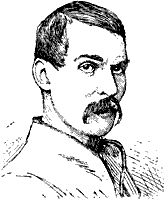
Richard Burton
In 1852, when upon leave, Captain Burton accomplished one of his most striking feats. Disguised as an Afghan Moslem, he went on a pilgrimage to Mecca and Medina, in the hope of finding out "something of the great eastern wilderness marked 'Ruba el Khala' (the Empty Abode) on our maps." For months he successfully braved the imminent danger of detection and death. Conspicuous among his explorations is his trip of 1856, when with Speke he discovered the lake regions of Central Africa. The bitter Speke controversy which followed, dividing geographers for a time into two contending factions, deprived Burton of the glory which he merited and drew upon him much unfriendly criticism.
He had the true ardor of the discoverer. In 'First Footsteps in Eastern Africa' he shows his unhesitating bravery again, when penetrating the mysterious, almost mythical walled city of Harar. After many dangers and exhausting experiences he sees the goal at last. "The spectacle, materially speaking, was a disappointment," he says. "Nothing conspicuous appeared but two gray minarets of rude shape. Many would grudge exposing their lives to win so paltry a prize. But of all that have attempted, none ever succeeded in entering that pile of stones."
Richard Burton carefully worded his varied experiences, and has left about fifty valuable and interesting volumes. Among the best known are 'Sindh,' 'The Lake Regions of Central Africa,' 'Two Trips to Gorilla Land,' and 'Ultima Thule.' With his knowledge of thirty-five languages and dialects he gained an intimate acquaintance with the people among whom he lived, and was enabled to furnish the world much novel information in his strong, straightforward style.
Perhaps his most noteworthy literary achievement was his fine translation of the 'Arabian Nights,' which appeared in 1885. Of this his wife wrote:—
"This grand Arabian work I consider my husband's Magnum Opus.... We were our own printers and our own publishers, and we made, between September 1885 and November 1888, sixteen thousand guineas—six thousand of which went for publishing and ten thousand into our own pockets, and it came just in time to give my husband the comforts and luxuries and freedom that gilded the five last years of his life. When he died there were four florins left, which I put into the poor-box."
This capable soldier and author was very inadequately recompensed. As a soldier, his bravery and long service brought him only the rank of Captain. In the civil service he was given only second-class consulates. The French Geographical Society, and also the Royal Geographical Society of England, each awarded him a gold medal, but the latter employed him upon only one expedition. At the age of sixty-five he was knighted. He had no other honors. This lack of recognition was undoubtedly a mortification, although toward the end of his career he writes philosophically:—
"The press are calling me 'the neglected Englishman,' and I want to express to them the feelings of pride and gratitude with which I have seen the exertions of my brethren of the press to procure for me a tardy justice. The public is a fountain of honor which amply suffices all my aspirations; it is the more honorable as it will not allow a long career to be ignored because of catechisms or creed."
He comforted himself, no doubt, with the belief that his outspoken skepticism was the cause of this lack of advancement, and that he was in some sort a martyr to freedom of thought; but one may be excused for discrediting this in the face of so many contrary instances. Capable men are too scarce to throw aside for such things in this century. The real and sufficient reason was his equally outspoken criticism of his superior officers in every department. A subordinate may and often does know more than his masters; but if he wishes the luxury of advertising the fact, he must pay for it with their ill-will and his own practical suppression.
Lady Burton was also an author; her 'Inner Life in Syria' and 'Arabia, Egypt, and India' are bright and entertaining. But her most important work is the 'Life of Sir Richard F. Burton,' published in 1892, two years after her husband's death. This unorganized mass of interesting material, in spite of carelessness and many faults of style and taste, shows her a ready observer, with a clever and graphic way of stating her impressions.
THE PRETERNATURAL IN FICTION
From the Essay on 'The Book of a Thousand Nights and a Night'
"As the active world is inferior to the rational soul," says Bacon, with his normal sound sense, "so Fiction gives to Mankind what History denies, and in some measure satisfies the Mind with Shadows when it cannot enjoy the Substance. And as real History gives us not the success of things according to the deserts of vice and virtue, Fiction corrects it and presents us with the fates and fortunes of persons rewarded and punished according to merit." But I would say still more. History paints or attempts to paint life as it is, a mighty maze with or without a plan; Fiction shows or would show us life as it should be, wisely ordered and laid down on fixed lines. Thus Fiction is not the mere handmaid of History: she has a household of her own, and she claims to be the triumph of Art, which, as Goethe remarked, is "Art because it is not Nature." Fancy, la folle du logis, is "that kind and gentle portress who holds the gate of Hope wide open, in opposition to Reason, the surly and scrupulous guard." As Palmerin of England says, and says well:—"For that the report of noble deeds doth urge the courageous mind to equal those who bear most commendation of their approved valiancy; this is the fair fruit of Imagination and of ancient histories." And last, but not least, the faculty of Fancy takes count of the cravings of man's nature for the marvelous, the impossible, and of his higher aspirations for the Ideal, the Perfect; she realizes the wild dreams and visions of his generous youth, and portrays for him a portion of that "other and better world," with whose expectation he would console his age.
The imaginative varnish of 'The Nights' serves admirably as a foil to the absolute realism of the picture in general. We enjoy being carried away from trivial and commonplace characters, scenes, and incidents; from the matter-of-fact surroundings of a workaday world, a life of eating and drinking, sleeping and waking, fighting and loving, into a society and a mise-en-scène which we suspect can exist and which we know do not. Every man, at some turn or term of his life, has longed for supernatural powers and a glimpse of Wonderland. Here he is in the midst of it. Here he sees mighty spirits summoned to work the human mite's will, however whimsical; who can transport him in an eye-twinkling whithersoever he wishes; who can ruin cities and build palaces of gold and silver, gems and jacinths; who can serve up delicate viands and delicious drinks in priceless chargers and impossible cups, and bring the choicest fruits from farthest Orient: here he finds magas and magicians who can make kings of his friends, slay armies of his foes, and bring any number of beloveds to his arms.
And from this outraging probability and outstripping possibility arises not a little of that strange fascination exercised for nearly two centuries upon the life and literature of Europe by 'The Nights,' even in their mutilated and garbled form. The reader surrenders himself to the spell, feeling almost inclined to inquire, "And why may it not be true?" His brain is dazed and dazzled by the splendors which flash before it, by the sudden procession of Jinns and Jinniyahs, demons and fairies, some hideous, others preternaturally beautiful; by good wizards and evil sorcerers, whose powers are unlimited for weal and for woe; by mermen and mermaids, flying horses, talking animals, and reasoning elephants; by magic rings and their slaves, and by talismanic couches which rival the carpet of Solomon. Hence, as one remarks, these Fairy Tales have pleased and still continue to please almost all ages, all ranks, and all different capacities.
Dr. Hawkesworth observes that these Fairy Tales find favor "because even their machinery, wild and wonderful as it is, has its laws; and the magicians and enchanters perform nothing but what was naturally to be expected from such beings, after we had once granted them existence." Mr. Heron "rather supposes the very contrary is the truth of the fact. It is surely the strangeness, the unknown nature, the anomalous character of the supernatural agents here employed, that makes them to operate so powerfully on our hopes, fears, curiosities, sympathies, and in short, on all the feelings of our hearts. We see men and women who possess qualities to recommend them to our favor, subjected to the influence of beings whose good or ill will, power or weakness, attention or neglect, are regulated by motives and circumstances which we cannot comprehend: and hence we naturally tremble for their fate with the same anxious concern as we should for a friend wandering in a dark night amidst torrents and precipices; or preparing to land on a strange island, while he knew not whether he should be received on the shore by cannibals waiting to tear him piecemeal and devour him, or by gentle beings disposed to cherish him with fond hospitality."
Both writers have expressed themselves well; but meseems each has secured, as often happens, a fragment of the truth and holds it to be the whole Truth. Granted that such spiritual creatures as Jinns walk the earth, we are pleased to find them so very human, as wise and as foolish in word and deed as ourselves; similarly we admire in a landscape natural forms like those of Staffa or the Palisades, which favor the works of architecture. Again, supposing such preternaturalisms to be around and amongst us, the wilder and more capricious they prove, the more our attention is excited and our forecasts are baffled, to be set right in the end. But this is not all. The grand source of pleasure in fairy tales is the natural desire to learn more of the Wonderland which is known to many as a word and nothing more, like Central Africa before the last half-century; thus the interest is that of the "personal narrative" of a grand exploration, to one who delights in travels. The pleasure must be greatest where faith is strongest; for instance, amongst imaginative races like the Kelts, and especially Orientals, who imbibe supernaturalism with their mothers' milk. "I am persuaded," writes Mr. Bayle St. John, "that the great scheme of preternatural energy, so fully developed in 'The Thousand and One Nights,' is believed in by the majority of the inhabitants of all the religious professions both in Syria and Egypt." He might have added, "by every reasoning being from prince to peasant, from Mullah to Badawi, between Marocco and Outer Ind."...
Dr. Johnson thus sums up his notice of 'The Tempest':—"Whatever might have been the intention of their author, these tales are made instrumental to the production of many characters, diversified with boundless invention, and preserved with profound skill in nature, extensive knowledge of opinions, and accurate observation of life. Here are exhibited princes, courtiers, and sailors, all speaking in their real characters. There is the agency of airy spirits and of earthy goblins, the operations of magic, the tumults of a storm, the adventures on a desert island, the native effusion of untaught affection, the punishment of guilt, and the final happiness of those for whom our passions and reason are equally interested."
We can fairly say this much and far more for our Tales. Viewed as a tout ensemble in full and complete form, they are a drama of Eastern life, and a Dance of Death made sublime by faith and the highest emotions, by the certainty of expiation and the fullness of atoning equity, where virtue is victorious, vice is vanquished, and the ways of Allah are justified to man. They are a panorama which remains ken-speckle upon the mental retina. They form a phantasmagoria in which archangels and angels, devils and goblins, men of air, of fire, of water, naturally mingle with men of earth; where flying horses and talking fishes are utterly realistic; where King and Prince meet fisherman and pauper, lamia and cannibal; where citizen jostles Badawi, eunuch meets knight; the Kazi hob-nobs with the thief; the pure and pious sit down to the same tray with the pander and the procuress; where the professional religionist, the learned Koranist, and the strictest moralist consort with the wicked magician, the scoffer, and the debauchee-poet like Abu Nowas; where the courtier jests with the boor, and where the sweep is bedded with the noble lady. And the characters are "finished and quickened by a few touches swift and sure as the glance of sunbeams." The whole is a kaleidoscope where everything falls into picture; gorgeous palaces and pavilions; grisly underground caves and deadly wolds; gardens fairer than those of the Hesperid; seas dashing with clashing billows upon enchanted mountains; valleys of the Shadow of Death; air-voyages and promenades in the abysses of ocean; the duello, the battle, and the siege; the wooing of maidens and the marriage-rite. All the splendor and squalor, the beauty and baseness, the glamor and grotesqueness, the magic and the mournfulness, the bravery and baseness of Oriental life are here: its pictures of the three great Arab passions—love, war, and fancy—entitle it to be called 'Blood, Musk, and Hashish.' And still more, the genius of the story-teller quickens the dry bones of history, and by adding Fiction to Fact revives the dead past; the Caliphs and the Caliphate return to Baghdad and Cairo, whilst Asmodeus kindly removes the terrace-roof of every tenement and allows our curious glances to take in the whole interior. This is perhaps the best proof of their power. Finally the picture-gallery opens with a series of weird and striking adventures, and shows as a tail-piece an idyllic scene of love and wedlock, in halls before reeking with lust and blood.
A JOURNEY IN DISGUISE
From 'The Personal Narrative of a Pilgrimage to El Medinah and Meccah'
The thoroughbred wanderer's idiosyncrasy I presume to be a composition of what phrenologists call "inhabitiveness" and "locality," equally and largely developed. After a long and toilsome march, weary of the way, he drops into the nearest place of rest to become the most domestic of men. For a while he smokes the "pipe of permanence" with an infinite zest; he delights in various siestas during the day, relishing withal a long sleep at night; he enjoys dining at a fixed dinner hour, and wonders at the demoralization of the mind which cannot find means of excitement in chit-chat or small talk, in a novel or a newspaper. But soon the passive fit has passed away; again a paroxysm of ennui coming on by slow degrees, Viator loses appetite, he walks about his room all night, he yawns at conversations, and a book acts upon him as a narcotic. The man wants to wander, and he must do so or he shall die.
After about a month most pleasantly spent at Alexandria, I perceived the approach of the enemy, and as nothing hampered my incomings and outgoings, I surrendered. The world was "all before me," and there was pleasant excitement in plunging single-handed into its chilling depths. My Alexandrian Shaykh, whose heart fell victim to a new "jubbeh" which I had given in exchange for his tattered zaabut, offered me in consideration of a certain monthly stipend the affections of a brother and religious refreshment, proposing to send his wife back to her papa, and to accompany me in the capacity of private chaplain to the other side of Kaf. I politely accepted the "brüderschaft," but many reasons induced me to decline his society and services. In the first place, he spoke the detestable Egyptian jargon. Secondly, it was but prudent to lose the "spoor" between Alexandria and Suez. And thirdly, my "brother" had shifting eyes (symptoms of fickleness), close together (indices of cunning); a flat-crowned head and large ill-fitting lips, signs which led me to think lightly of his honesty, firmness, and courage. Phrenology and physiognomy, be it observed, disappoint you often among civilized people, the proper action of whose brains and features is impeded by the external pressure of education, accident, example, habit, necessity, and what not. But they are tolerably safe guides when groping your way through the mind of man in his natural state, a being of impulse in that chrysalis stage of mental development which is rather instinct than reason. But before my departure there was much to be done.
The land of the Pharaohs is becoming civilized, and unpleasantly so: nothing can be more uncomfortable than its present middle state between barbarism and the reverse. The prohibition against carrying arms is rigid as in Italy; all "violence" is violently denounced; and beheading being deemed cruel, the most atrocious crimes, as well as those small political offenses which in the days of the Mamelukes would have led to a beyship or a bowstring, receive fourfold punishment by deportation to Faizoghli, the local Cayenne. If you order your peasant to be flogged, his friends gather in threatening hundreds at your gates; when you curse your boatman, he complains to your consul; the dragomans afflict you with strange wild notions about honesty; a government order prevents you from using vituperative language to the "natives" in general; and the very donkey-boys are becoming cognizant of the right of man to remain unbastinadoed. Still the old leaven remains behind; here, as elsewhere in "morning-land," you cannot hold your own without employing your fists. The passport system, now dying out of Europe, has sprung up, or rather revived, in Egypt with peculiar vigor. Its good effects claim for it our respect; still we cannot but lament its inconvenience. We, I mean real Easterns. As strangers—even those whose beards have whitened in the land—know absolutely nothing of what unfortunate natives must endure, I am tempted to subjoin a short sketch of my adventures in search of a Tezkireh at Alexandria.
Through ignorance which might have cost me dear but for my friend Larking's weight with the local authorities, I had neglected to provide myself with a passport in England; and it was not without difficulty, involving much unclean dressing and an unlimited expenditure of broken English, that I obtained from the consul at Alexandria a certificate declaring me to be an Indo-British subject named Abdullah, by profession a doctor, aged thirty, and not distinguished—at least so the frequent blanks seemed to denote—by any remarkable conformation of eyes, nose, or cheek. For this I disbursed a dollar. And here let me record the indignation with which I did it. That mighty Britain—the mistress of the seas—the ruler of one-sixth of mankind—should charge five shillings to pay for the shadow of her protecting wing! That I cannot speak my modernized "civis sum Romanus" without putting my hand into my pocket, in order that these officers of the Great Queen may not take too ruinously from a revenue of fifty-six millions! Oh the meanness of our magnificence! the littleness of our greatness!
My new passport would not carry me without the Zabit or Police Magistrate's counter-signature, said the consul. Next day I went to the Zabit, who referred me to the Muhafiz (Governor) of Alexandria, at whose gate I had the honor of squatting at least three hours, till a more compassionate clerk vouchsafed the information that the proper place to apply to was the Diwan Kharijiyeh (the Foreign Office). Thus a second day was utterly lost. On the morning of the third I started as directed for the place, which crowns the Headland of Figs. It is a huge and couthless shell of building in parallelogrammic form, containing all kinds of public offices in glorious confusion, looking with their glaring whitewashed faces upon a central court, where a few leafless wind-wrung trees seem struggling for the breath of life in an eternal atmosphere of clay, dust, and sun-blaze.
The first person I addressed was a Kawwas or police officer, who, coiled comfortably up in a bit of shade fitting his person like a robe, was in full enjoyment of the Asiatic "Kaif." Having presented the consular certificate and briefly stated the nature of my business, I ventured to inquire what was the right course to pursue for a visá.
They have little respect for Dervishes, it appears, at Alexandria! "M'adri" (Don't know), growled the man of authority, without moving anything but the quantity of tongue necessary for articulation.
Now there are three ways of treating Asiatic officials,—by bribe, by bullying, or by bothering them with a dogged perseverance into attending to you and your concerns. The latter is the peculiar province of the poor; moreover, this time I resolved for other reasons to be patient. I repeated my question in almost the same words. "Ruh!" (Be off) was what I obtained for all reply. By this time the questioned went so far as to open his eyes. Still I stood twirling the paper in my hands, and looking very humble and very persevering, till a loud "Ruh ya Kalb!" (Go, O dog!) converted into a responsive curse the little speech I was preparing about the brotherhood of El-Islam and the mutual duties obligatory on true believers. I then turned away slowly and fiercely, for the next thing might have been a cut with the Kurbaj [bastinado], and by the hammer of Thor! British flesh and blood could never have stood that.
After which satisfactory scene,—for satisfactory it was in one sense, proving the complete fitness of the Dervish's dress,—I tried a dozen other promiscuous sources of information,—policemen, grooms, scribes, donkey-boys, and idlers in general. At length, wearied of patience, I offered a soldier some pinches of tobacco and promised him an Oriental sixpence if he would manage the business for me. The man was interested by the tobacco and the pence; he took my hand, and inquiring the while he went along, led me from place to place till, mounting a grand staircase, I stood in the presence of Abbas Effendi, the governor's Naib or deputy.
It was a little whey-faced black-bearded Turk, coiled up in the usual conglomerate posture upon a calico-covered divan, at the end of a long bare large-windowed room. Without deigning even to nod the head which hung over his shoulder with transcendent listlessness and affectation of pride, in answer to my salams and benedictions, he eyed me with wicked eyes and faintly ejaculated "Minent?" Then hearing that I was a Dervish and doctor,—he must be an Osmanli Voltairian, that little Turk,—the official snorted a contemptuous snort. He condescendingly added, however, that the proper source to seek was "Taht," which, meaning simply "below," conveyed rather imperfect information in a topographical point of view to a stranger. At length however my soldier guide found out that a room in the custom-house bore the honorable appellation of "Foreign Office." Accordingly I went there, and after sitting at least a couple of hours at the bolted door in the noonday sun, was told, with a fury which made me think I had sinned, that the officer in whose charge the department was had been presented with an olive-branch in the morning, and consequently that business was not to be done that day. The angry-faced official communicated the intelligence to a large group of Anadolian, Caramanian, Bosniac, and Roumelian Turks,—sturdy, undersized, broad-shouldered, bare-legged, splay-footed, horny-fisted, dark-browed, honest-looking mountaineers, who were lounging about with long pistols and yataghans stuck in their broad sashes, head-gear composed of immense tarbooshes with proportionate turbans coiled round them, and two or three suits of substantial clothes—even at this season of the year—upon their shoulders.
Like myself they had waited some hours, but they were not patient under disappointment: they bluntly told the angry official that he and his master were a pair of idlers, and the curses that rumbled and gurgled in their hairy throats as they strode towards the door sounded like the growling of wild beasts.
Thus was another day truly Orientally lost. On the morrow however I obtained permission, in the character of Dr. Abdullah, to visit any part of Egypt I pleased, and to retain possession of my dagger and pistols.
And now I must explain what induced me to take so much trouble about a passport. The home reader naturally inquires, Why not travel under your English name?
For this reason. In the generality of barbarous countries you must either proceed, like Bruce, preserving the "dignity of manhood" and carrying matters with a high hand, or you must worm your way by timidity and subservience; in fact, by becoming an animal too contemptible for man to let or injure. But to pass through the Holy Land you must either be a born believer, or have become one; in the former case you may demean yourself as you please, in the latter a path is ready prepared for you. My spirit could not bend to own myself a Burma, a renegade—to be pointed at and shunned and catechized, an object of suspicion to the many and of contempt to all. Moreover, it would have obstructed the aim of my wanderings. The convert is always watched with Argus eyes, and men do not willingly give information to a "new Moslem," especially a Frank: they suspect his conversion to be a feigned or a forced one, look upon him as a spy, and let him see as little of life as possible. Firmly as was my heart set upon traveling in Arabia, by Heaven! I would have given up the dear project rather than purchase a doubtful and partial success at such a price. Consequently I had no choice but to appear as a born believer, and part of my birthright in that respectable character was toil and trouble in obtaining a tezkirah.
Then I had to provide myself with certain necessaries for the way. These were not numerous. The silver-mounted dressing-case is here supplied by a rag containing a miswak, a bit of soap, and a comb—wooden, for bone and tortoise-shell are not, religiously speaking, correct. Equally simple was my wardrobe: a change or two of clothing. The only article of canteen description was a zemzemiyah, a goatskin water-bag, which communicates to its contents, especially when new, a ferruginous aspect and a wholesome though hardly an attractive flavor of tanno-gelatine. This was a necessary; to drink out of a tumbler, possibly fresh from pig-eating lips, would have entailed a certain loss of reputation. For bedding and furniture I had a coarse Persian rug—which, besides being couch, acts as chair, table, and oratory,—a cotton-stuffed chintz-covered pillow, a blanket in case of cold, and a sheet, which does duty for tent and mosquito curtains in nights of heat. As shade is a convenience not always procurable, another necessary was a huge cotton umbrella of Eastern make, brightly yellow, suggesting the idea of an overgrown marigold. I had also a substantial housewife, the gift of a kind friend: it was a roll of canvas, carefully soiled, and garnished with needles and thread, cobblers' wax, buttons, and other such articles. These things were most useful in lands where tailors abound not; besides which, the sight of a man darning his coat or patching his slippers teems with pleasing ideas of humility. A dagger, a brass inkstand and penholder stuck in the belt, and a mighty rosary, which on occasion might have been converted into a weapon of offense, completed my equipment. I must not omit to mention the proper method of carrying money, which in these lands should never be intrusted to box or bag. A common cotton purse secured in a breast pocket (for Egypt now abounds in that civilized animal the pickpocket) contained silver pieces and small change. My gold, of which I carried twenty-five sovereigns, and papers, were committed to a substantial leathern belt of Maghrabi manufacture, made to be strapped round the waist under the dress. This is the Asiatic method of concealing valuables, and a more civilized one than ours in the last century, when Roderick Random and his companion "sewed their money between the lining and the waistband of their breeches, except some loose silver for immediate expense on the road." The great inconvenience of the belt is its weight, especially where dollars must be carried, as in Arabia, causing chafes and inconvenience at night. Moreover it can scarcely be called safe. In dangerous countries wary travelers will adopt surer precautions.
A pair of common native khurjin or saddle-bags contained my wardrobe, the "bed," readily rolled up into a bundle; and for a medicine chest I bought a pea-green box with red and yellow flowers, capable of standing falls from a camel twice a day.
The next step was to find out when the local steamer would start for Cairo, and accordingly I betook myself to the Transit Office. No vessel was advertised; I was directed to call every evening till satisfied. At last the fortunate event took place: a "weekly departure," which by-the-by had occurred once every fortnight or so, was in order for the next day. I hurried to the office, but did not reach it till past noon—the hour of idleness. A little dark gentleman, so formed and dressed as exactly to resemble a liver-and-tan bull-terrier, who with his heels on the table was dozing, cigar in mouth, over the last Galignani, positively refused after a time,—for at first he would not speak at all,—to let me take my passage till three in the afternoon. I inquired when the boat started, upon which he referred me, as I had spoken bad Italian, to the advertisement. I pleaded inability to read or write, whereupon he testily cried "Alle nove! alle nove!" (At nine! at nine!) Still appearing uncertain, I drove him out of his chair, when he rose with a curse and read "8 a.m." An unhappy Eastern, depending upon what he said, would have been precisely one hour too late.
Thus were we lapsing into the real good old Indian style of doing business. Thus Indicus orders his first clerk to execute some commission; the senior, having "work" upon his hands, sends a junior; the junior finds the sun hot, and passes on the word to a "peon"; the peon charges a porter with the errand; and the porter quietly sits or dozes in his place, trusting that fate will bring him out of the scrape, but firmly resolved, though the shattered globe fall, not to stir an inch.
The reader, I must again express a hope, will pardon the egotism of these descriptions: my object is to show him how business is carried on in these hot countries—business generally. For had I, instead of being Abdullah the Dervish, been a rich native merchant, it would have been the same. How many complaints of similar treatment have I heard in different parts of the Eastern world! and how little can one realize them without having actually experienced the evil! For the future I shall never see a "nigger" squatting away half a dozen mortal hours in a broiling sun, patiently waiting for something or for some one, without a lively remembrance of my own cooling of the calces at the custom-house of Alexandria.
At length, about the end of May, all was ready. Not without a feeling of regret I left my little room among the white myrtle blossoms and the oleander flowers. I kissed with humble ostentation my kind host's hand in presence of his servants, bade adieu to my patients, who now amounted to about fifty, shaking hands with all meekly and with religious equality of attention, and, mounted in a "trap" which looked like a cross between a wheel-barrow and dog-cart, drawn by a kicking, jibbing, and biting mule, I set out for the steamer.
EN ROUTE
From 'A Pilgrimage to El Medinah and Meccah'
At 3 p.m. we left El Zaribah, traveling towards the S.W., and a wondrously picturesque scene met the eye. Crowds hurried along, habited in the pilgrim garb, whose whiteness contrasted strangely with their black skins, their newly shaven heads glistening in the sun, and their long black hair streaming in the wind. The rocks rang with shouts of "Labbayk! Labbayk!" At a pass we fell in with the Wahhabis, accompanying the Baghdad caravan, screaming "Here am I"; and guided by a large loud kettle-drum, they followed in double file the camel of a standard-bearer, whose green flag bore in huge white letters the formula of the Moslem creed. They were wild-looking mountaineers, dark and fierce, with hair twisted into thin dalik or plaits: each was armed with a long spear, a matchlock, or a dagger. They were seated upon coarse wooden saddles, without cushions or stirrups, a fine saddle-cloth alone denoting a chief. The women emulated the men; they either guided their own dromedaries, or sitting in pillion, they clung to their husbands; veils they disdained, and their countenances certainly belonged not to a "soft sex." These Wahhabis were by no means pleasant companions. Most of them were followed by spare dromedaries, either unladen or carrying water-skins, fodder, fuel, and other necessaries for the march. The beasts delighted in dashing furiously through our file, which, being colligated, was thrown each time into the greatest confusion. And whenever we were observed smoking, we were cursed aloud for infidels and idolaters.
Looking back at El Zaribah, soon after our departure, I saw a heavy nimbus settle upon the hilltops, a sheet of rain being stretched between it and the plain. The low grumbling of thunder sounded joyfully in our ears. We hoped for a shower, but were disappointed by a dust-storm, which ended with a few heavy drops. There arose a report that the Bedouins had attacked a party of Meccans with stones,—classical Arabian missiles,—and the news caused men to look exceeding grave.
At 5 p.m. we entered the wide bed of the fiumara, down which we were to travel all night. Here the country falls rapidly towards the sea, as the increasing heat of the air, the direction of the water-courses, and signs of violence in the torrent-bed show. The fiumara varies in breadth from 150 feet to three-quarters of a mile; its course, I was told, is towards the southwest, and it enters the sea near Jeddah. The channel is a coarse sand, with here and there masses of sheet rock and patches of thin vegetation.
At about half-past 5 p.m. we entered a suspicious-looking place. On the right was a stony buttress, along whose base the stream, when there is one, flows; and to this depression was our road limited by the rocks and thorn-trees, which filled the other half of the channel. The left side was a precipice, grim and barren, but not so abrupt as its brother. Opposite us the way seemed barred by piles of hills, crest rising above crest into the far blue distance. Day still smiled upon the upper peaks, but the lower slopes and the fiumara bed were already curtained with gray sombre shade.
A damp seemed to fall upon our spirits as we approached this Valley Perilous. I remarked with wonder that the voices of the women and children sank into silence, and the loud Labbaykas of the pilgrims were gradually stilled. Whilst still speculating upon the cause of this phenomenon, it became apparent. A small curl of smoke, like a lady's ringlet, on the summit of the right-hand precipice, caught my eye, and simultaneous with the echoing crack of the matchlock a high-trotting dromedary in front of me rolled over upon the sands. A bullet had split his heart, throwing his rider a goodly somerset of five or six yards.
Ensued terrible confusion; women screamed, children shrieked, and men vociferated, each one striving with might and main to urge his animal out of the place of death. But the road being narrow, they only managed to jam the vehicles in a solid immovable mass. At every matchlock shot a shudder ran through the huge body, as when the surgeon's scalpel touches some more sensitive nerve. The irregular horsemen, perfectly useless, galloped up and down over the stones, shouting to and ordering one another. The Pacha of the army had his carpet spread at the foot of the left-hand precipice, and debated over his pipe with the officers what ought to be done. No good genius whispered "Crown the heights."
Then it was that the conduct of the Wahhabis found favor in my eyes. They came up, galloping their camels,—
"Torrents less rapid and less rash.—"
with their elf-locks tossing in the wind, and their flaring matches casting a strange lurid light over their features. Taking up a position, one body began to fire upon the Utaybah robbers, whilst two or three hundred, dismounting, swarmed up the hill under the guidance of the Sherif Zayd. I had remarked this nobleman at El Medinah as a model specimen of the pure Arab. Like all Sherifs, he is celebrated for bravery, and has killed many with his own hand. When urged at El Zaribah to ride into Meccah, he swore that he would not leave the caravan till in sight of the walls; and fortunately for the pilgrims, he kept his word. Presently the firing was heard far in our rear—the robbers having fled; the head of the column advanced, and the dense body of the pilgrims opened out. Our forced halt was now exchanged for a flight. It required much management to steer our desert-craft clear of danger; but Shaykh Masud was equal to the occasion. That many were lost was evident by the boxes and baggage that strewed the shingles. I had no means of ascertaining the number of men killed and wounded: reports were contradictory, and exaggeration unanimous. The robbers were said to be 150 in number; their object was plunder, and they would eat the shot camels. But their principal ambition was the boast "We, the Utaybah, on such and such a night stopped the Sultan's mahmal one whole hour in the pass."
At the beginning of the skirmish I had primed my pistols, and sat with them ready for use. But soon seeing that there was nothing to be done, and wishing to make an impression,—nowhere does Bobadil now "go down" but in the East,—I called aloud for my supper. Shaykh Nur, exanimate with fear, could not move. The boy Mohammed ejaculated only an "Oh, sir!" and the people around exclaimed in disgust, "By Allah! he eats!" Shaykh Abdullah, the Meccan, being a man of spirit, was amused by the spectacle. "Are these Afghan manners, Effendim?" he inquired from the shugduf behind me. "Yes," I replied aloud, "in my country we always dine before an attack of robbers, because that gentry is in the habit of sending men to bed supperless." The Shaykh laughed aloud, but those around him looked offended. I thought the bravado this time mal placé; but a little event which took place on my way to Jeddah proved that it was not quite a failure.
As we advanced our escort took care to fire every large dry asclepias, to disperse the shades which buried us. Again the scene became wondrous wild:—
"Full many a waste I've wander'd o'er, Clomb many a crag, cross'd many a shore, But, by my halidome, A scene so rude, so wild as this, Yet so sublime in barrenness, Ne'er did my wandering footsteps press, Where'er I chanced to roam."
On either side were ribbed precipices, dark, angry, and towering above, till their summits mingled with the glooms of night; and between them formidable looked the chasm, down which our host hurried with shouts and discharges of matchlocks. The torch-smoke and the night-fires of flaming asclepias formed a canopy, sable above and livid red below, which hung over our heads like a sheet, and divided the cliffs into two equal parts. Here the fire flashed fiercely from a tall thorn, that crackled and shot up showers of sparks into the air; there it died away in lurid gleams, which lit up a truly Stygian scene. As usual, however, the picturesque had its inconveniences. There was no path. Rocks, stone-banks, and trees obstructed our passage. The camels, now blind in darkness, then dazzled by a flood of light, stumbled frequently; in some places slipping down a steep descent, in others sliding over a sheet of mud. There were furious quarrels and fierce language between camel-men and their hirers, and threats to fellow-travelers; in fact, we were united in discord. I passed that night crying "Hai! Hai!" switching the camel, and fruitlessly endeavoring to fustigate Masud's nephew, who resolutely slept upon the water-bags. During the hours of darkness we made four or five halts, when we boiled coffee and smoked pipes, but man and beasts were beginning to suffer from a deadly fatigue.
Dawn found us still traveling down the fiumara, which here is about one hundred yards broad. The granite hills on both sides were less precipitous, and the borders of the torrent-bed became natural quays of stiff clay, which showed a water-mark of from twelve to fifteen feet in height. In many parts the bed was muddy, and the moist places, as usual, caused accidents. I happened to be looking back at Shaykh Abdullah, who was then riding in old Ali bin Ya Sin's fine shugduf; suddenly the camel's four legs disappeared from under him, his right side flattening the ground, and the two riders were pitched severally out of the smashed vehicle. Abdullah started up furious, and abused the Bedouins, who were absent, with great zest. "Feed these Arabs," he exclaimed, quoting a Turkish proverb, "and they will fire at Heaven!" But I observed that, when Shaykh Masud came up, the citizen was only gruff.
We then turned northward, and sighted El Mazik, more generally known as Wady Laymun, the Valley of Limes. On the right bank of the fiumara stood the Meccan Sherif's state pavilion, green and gold: it was surrounded by his attendants, and prepared to receive the Pacha of the caravan. We advanced half a mile, and encamped temporarily in a hill-girt bulge of the fiumara bed. At 8 a.m. we had traveled about twenty-four miles from El Zaribah, and the direction of our present station was S. W. 50°.
Shaykh Masud allowed us only four hours' halt; he wished to precede the main body. After breaking our fast joyously upon limes, pomegranates, and fresh dates, we sallied forth to admire the beauties of the place. We are once more on classic ground, the ground of the ancient Arab poets:—
"Deserted is the village—waste the halting place and home At Mina; o'er Rijam and Ghul wild beasts unheeded roam; On Rayyan hill the channel lines have left a naked trace, Time-worn, as primal Writ that dints the mountains flinty face;"—
and this wady, celebrated for the purity of its air, has from remote ages been a favorite resort of the Meccans. Nothing can be more soothing to the brain than the dark-green foliage of the limes and pomegranates; and from the base of the southern hill bursts a bubbling stream, whose
"Chiare, fresche e dolci acque"
flow through the garden, filling them with the most delicious of melodies, and the gladdest sound which nature in these regions knows.
Exactly at noon Masud seized the halter of the foremost camel, and we started down the fiumara. Troops of Bedouin girls looked over the orchard walls laughingly, and children came out to offer us fresh fruit and sweet water. At 2 p.m., traveling southwest, we arrived at a point where the torrent-bed turns to the right, and quitting it, we climbed with difficulty over a steep ridge of granite. Before three o'clock we entered a hill-girt plain, which my companions called "Sola." In some places were clumps of trees, and scattered villages warned us that we were approaching a city. Far to the left rose the blue peaks of Taif, and the mountain road, a white thread upon the nearer heights, was pointed out to me. Here I first saw the tree, or rather shrub, which bears the balm of Gilead, erst so celebrated for its tonic and stomachic properties. I told Shaykh to break off a twig, which he did heedlessly. The act was witnessed by our party with a roar of laughter, and the astounded Shaykh was warned that he had become subject to an atoning sacrifice. Of course he denounced me as the instigator, and I could not fairly refuse assistance. The tree has of late years been carefully described by many botanists; I will only say that the bark resembled in color a cherry-stick pipe, the inside was a light yellow, and the juice made my fingers stick together.
At 4 p.m. we came to a steep and rocky pass, up which we toiled with difficulty. The face of the country was rising once more, and again presented the aspect of numerous small basins divided and surrounded by hills. As we jogged on we were passed by the cavalcade of no less a personage than the Sherif of Meccah. Abd el Muttalib bin Ghalib is a dark, beardless old man with African features, derived from his mother. He was plainly dressed in white garments and a white muslin turban, which made him look jet-black; he rode an ambling mule, and the only emblem of his dignity was the large green satin umbrella borne by an attendant on foot. Scattered around him were about forty matchlock-men, mostly slaves. At long intervals, after their father, came his four sons, Riza Bey, Abdullah, Ali, and Ahmed, the latter still a child. The three elder brothers rode splendid dromedaries at speed; they were young men of light complexion, with the true Meccan cast of features, showily dressed in bright-colored silks, and armed, to denote their rank, with sword and gold-hilted dagger.
We halted as evening approached, and strained our eyes, but all in vain, to catch sight of Meccah, which lies in a winding valley. By Shaykh Abdullah's direction I recited, after the usual devotions, the following prayer. The reader is forewarned that it is difficult to preserve the flowers of Oriental rhetoric in a European tongue.
"O Allah! verily this is thy safeguard (Amn) and thy Sanctuary (Haram)! Into it whoso entereth becometh safe (Amin). So deny (Harrim) my flesh and blood, my bones and skin, to hell-fire. O Allah! Save me from thy wrath on the day when thy servants shall be raised from the dead. I conjure thee by this that thou art Allah, besides whom is none (thou only), the merciful, the compassionate. And have mercy upon our lord Mohammed, and upon the progeny of our lord Mohammed, and upon his followers, one and all!" This was concluded with the "Talbiyat," and with an especial prayer for myself.
We again mounted, and night completed our disappointment. About 1 a.m. I was aroused by general excitement. "Meccah! Meccah!" cried some voices. "The Sanctuary! O the Sanctuary!" exclaimed others; and all burst into loud "Labbayk," not unfrequently broken by sobs. I looked out from my litter, and saw by the light of the southern stars the dim outlines of a large city, a shade darker than the surrounding plain. We were passing over the last ridge by a "winding path" flanked on both sides by watch-towers, which command the "Darb el Maala," or road leading from the north into Meccah. Thence we passed into the Maabidah (northern suburb), where the Sherif's palace is built. After this, on the left hand, came the deserted abode of the Sherif bin Aun, now said to be a "haunted house."106 Opposite to it lies the Jannat el Maala, the holy cemetery of Meccah. Thence, turning to the right, we entered the Sulaymaniyah or Afghan quarter. Here the boy Mohammed, being an inhabitant of the Shamiyah or Syrian ward, thought proper to display some apprehension. These two are on bad terms; children never meet without exchanging volleys of stones, and men fight furiously with quarter-staves. Sometimes, despite the terrors of religion, the knife and sabre are drawn. But these hostilities have their code. If a citizen be killed, there is a subscription for blood-money. An inhabitant of one quarter, passing singly through another, becomes a guest; once beyond the walls, he is likely to be beaten to insensibility by his hospitable foes.
At the Sulaymaniyah we turned off the main road into a by-way, and ascended by narrow lanes the rough heights of Jebel Hindi, upon which stands a small whitewashed and crenellated building called a "fort." Thence descending, we threaded dark streets, in places crowded with rude cots and dusky figures, and finally at 2 a.m. we found ourselves at the door of the boy Mohammed's house.
We arrived on the morning of Sunday the 7th Zu'l Hijjah (11th September, 1853), and had one day before the beginning of the pilgrimage to repose and visit the Haram. From El Medinah to Meccah the distance, according to my calculation, was 248 English miles, which was accomplished in eleven marches.