Volume 7 — ROBERT BURTON
Reading edition
(1577-1640)

There are some books of which every reader knows the names, but of whose contents few know anything, excepting as the same may have come to them filtered through the work of others. Of these, Burton's 'Anatomy of Melancholy' is one of the most marked instances. It is a vast storehouse from which subsequent authors have always drawn and continue to draw, even as Burton himself drew from others,—though without always giving the credit which with him was customary. Few would now have the courage to read it through, and probably fewer still could say with Dr. Johnson that it "was the only book that ever took him out of bed two hours sooner than he wished to rise."
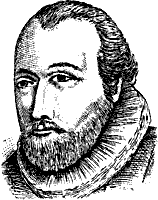
Robert Burton
Of Robert Burton himself very little is known. He was born in 1577, a few years later than Shakespeare,—probably at Lindley, in Leicestershire; and died at Oxford in 1640. He had some schooling at Sutton Coldfield in Warwickshire, and was sent to Brasenose College at Oxford in 1593; was elected a student at Christ Church College in 1599, and took his degree of B.D. in 1614. He was then thirty-seven years of age. Why he should have been so long in reaching his degree, does not appear. Two years later he was presented by the Dean and Chapter of Christ Church to the vicarage of St. Thomas in the suburbs of Oxford. To this, about 1630, through presentation by George, Lord Berkeley, was added the rectory of Segrave in Leicestershire, and he retained both livings until his death. This is about the sum and substance of his known history. Various legends remain regarding him; as, that he was very good and jolly company, a most learned scholar, very ready in quotations from the poets and classical authors,—and indeed no reader of the 'Anatomy' could imagine otherwise. Yet was he of a melancholy disposition, and it is said that "he composed this book with a view of relieving his own melancholy, but increased it to such a degree that nothing could make him laugh but going to the foot-bridge and hearing the ribaldry of the bargemen, which rarely failed to throw him into a violent fit of laughter." He says himself, "I write of melancholy, by being busie, to avoid melancholy." He was expert in the calculation of nativities, and cast his own horoscope; having determined in which, the time at which his death should occur, it was afterward shrewdly believed that he took measures to insure the fulfillment of the prophecy.
His life was almost wholly spent in his study at Oxford. He was a wide and curious reader, and the book to the composition of which he devoted himself quotes authorities without end. All was fish which came to his net: divines, poets, astrologists, doctors, philosophers, men of science, travelers, romancers—he draws from the whole range of literature; and often page after page—scores and hundreds of pages,—is filled with quotations, sometimes of two or three words only, sometimes translated and sometimes not, an almost inextricable network of facts, of fancies, and of phrases. He says: "As those old Romans rob'd all the cities of the world, to set out their bad-sited Rome, we skim off the cream of other men's wits, pick the choice flowers of their till'd gardens to set out our own steril plots."
Yet when he sets about it, his handling is steady and assured, and he has distinctly the literary touch, as well as the marks of genius; having a very great quaintness withal. The title of his famous book is 'The Anatomy of Melancholy. What It Is, with All the Kinds, Causes, Symptoms, Prognostics, and several Cures of it. In three Partitions. With their several Sections, Members, and Sub-sections, Philosophically, Medically, Historically Opened and Cut Up. By Democritus Junior.' The first edition appears to have been issued in 1621. He continued to modify and enlarge it from time to time throughout his life; and for the sixth edition, which appeared some years after his death, he prepared a long address to the reader, describing his student life, accounting for his choice of subject, and full of quaint fancies and scathing criticisms of the ill habits and weaknesses of mankind.
"Melancholy" means with Burton Melancholia, but it means also all sorts of insanity, and apparently all affections of the mind or spirit, sane or insane. On the one hand he heaps up, in page after page and chapter after chapter, all the horrid ills to which flesh is heir, or which it cultivates for itself, and paints the world as a very pandemonium of evil and outrage. And anon the air blows soft and sweet, the birds sing, both brotherly love and domestic happiness are possible, and
"God's in his heaven, all's right with the world."
To the first volume is prefixed 'The Author's Abstract of Melancholy,' beginning:—
"When I go musing all alone, Thinking of divers things foreknown, When I build castles in the ayr, Void of sorrow and void of feare Pleasing myself with phantasms sweet, Methinks the time runs very fleet. All my joys to this are folly, Naught so sweet as melancholy."
It does not need an expert to tell, after reading this, whence Milton drew the suggestion of 'L'Allegro' and 'Il Penseroso.'
CONCLUSIONS AS TO MELANCHOLY
Generally thus much we may conclude of melancholy: that it is most pleasant at first, I say, mentis gratissimus error, a most delightsome humor, to be alone, dwell alone, walk alone, meditate, lie in bed whole days, dreaming awake as it were, and frame a thousand phantastical imaginations unto themselves. They are never better pleased than when they are so doing; they are in Paradise for the time, and cannot well endure to be interrupt; with him in the Poet:—
"—pol! me occidistis, amici, Non servâstis, ait:"
you have undone him, he complains, if you trouble him: tell him what inconvenience will follow, what will be the event, all is one, canis ad vomitum, 'tis so pleasant he cannot refrain. He may thus continue peradventure many years by reason of a strong temperature, or some mixture of business, which may divert his cogitations: but at the last læsa imaginatio, his phantasy is crazed, & now habituated to such toys, cannot but work still like a fate; the Scene alters upon a sudden; Fear and Sorrow supplant those pleasing thoughts, suspicion, discontent, and perpetual anxiety succeed in their places; so little by little, by that shoeing-horn of idleness, and voluntary solitariness, Melancholy this feral fiend is drawn on, et quantum vertice ad auras Æthereas, tantum radice in Tartara tendit; "extending up, by its branches, so far towards Heaven, as, by its roots, it does down towards Tartarus;" it was not so delicious at first, as now it is bitter and harsh: a cankered soul macerated with cares and discontents, tædium vitæ, impatience, agony, inconstancy, irresolution, precipitate them unto unspeakable miseries. They cannot endure company, light, or life itself, some unfit for action, and the like. Their bodies are lean and dried up, withered, ugly; their looks harsh, very dull, and their souls tormented, as they are more or less entangled, as the humor hath been intended, or according to the continuance of time they have been troubled.
To discern all which symptoms the better, Rhasis the Arabian makes three degrees of them. The first is falsa cogitatio, false conceits and idle thoughts: to misconstrue and amplify, aggravating everything they conceive or fear: the second is falso cogitatio loqui, to talk to themselves, or to use inarticulate incondite voices, speeches, obsolete gestures, and plainly to utter their minds and conceits of their hearts, by their words and actions, as to laugh, weep, to be silent, not to sleep, eat their meat, &c.; the third is to put in practice that which they think or speak. Savanarola, Rub. II, Tract. 8, cap. 1, de ægritudine, confirms as much: when he begins to express that in words, which he conceives in his heart, or talks idly, or goes from one thing to another, which Gordonius calls nec caput habentia nec caudam [having neither head nor tail], he is in the middle way: but when he begins to act it likewise, and to put his fopperies in execution, he is then in the extent of melancholy, or madness itself. This progress of melancholy you shall easily observe in them that have been so affected, they go smiling to themselves at first, at length they laugh out; at first solitary, at last they can endure no company, or if they do, they are now dizzards, past sense and shame, quite moped, they care not what they say or do; all their actions, words, gestures, are furious or ridiculous. At first his mind is troubled, he doth not attend what is said, if you tell him a tale, he cries at last, What said you? but in the end he mutters to himself, as old women do many times, or old men when they sit alone; upon a sudden they laugh, whoop, halloo, or run away, and swear they see or hear Players, Devils, Hobgoblins, Ghosts, strike, or strut, &c., grow humorous in the end: like him in the Poet, sæpe ducentos sæpe decem servos [he often keeps two hundred slaves, often only ten], he will dress himself, and undress, careless at last, grows insensible, stupid or mad. He howls like a wolf, barks like a dog, and raves like Ajax and Orestes, hears Music and outcries which no man else hears....
Who can sufficiently speak of these symptoms, or prescribe rules to comprehend them? As Echo to the painter in Ausonius, vane, quid affectas, &c.—foolish fellow, what wilt? if you must needs paint me, paint a voice, et similem si vis pingere, pinge sonum; if you will describe melancholy, describe a phantastical conceit, a corrupt imagination, vain thoughts and different, which who can do? The four-and-twenty letters make no more variety of words in divers languages, than melancholy conceits produce diversity of symptoms in several persons. They are irregular, obscure, various, so infinite, Proteus himself is not so diverse; you may as well make the Moon a new coat, as a true character of a melancholy man; as soon find the motion of a bird in the air, as the heart of man, a melancholy man. They are so confused, I say, diverse, intermixt with other diseases. As the species be confounded (which I have shewed) so are the symptoms; sometimes with headache, cachexia, dropsy, stone, (as you may perceive by those several examples and illustrations, collected by Hildesheim, spicel. 2, Mercurialis, consil. 118, cap. 6 et 11), with headache, epilepsy, priapismus (Trincavellius, consil. 12, lib. I, consil. 49), with gout, caninus appetitus (Montanus, consil. 26, &c., 23, 234, 249), with falling-sickness, headache, vertigo, lycanthropia, &c. (J. Cæsar Claudinus, consult. 4, consult. 89 et 116), with gout, agues, hæmrods, stone, &c. Who can distinguish these melancholy symptoms so intermixt with others, or apply them to their several kinds, confine them into method? 'Tis hard I confess, yet I have disposed of them as I could, and will descend to particularize them according to their species. For hitherto I have expatiated in more general lists or terms, speaking promiscuously of such ordinary signs, which occur amongst writers. Not that they are all to be found in one man, for that were to paint a Monster or Chimæra, not a man; but some in one, some in another, and that successively, or at several times.
Which I have been the more curious to express and report, not to upbraid any miserable man, or by way of derision (I rather pity them), but the better to discern, to apply remedies unto them; and to shew that the best and soundest of us all is in great danger; how much we ought to fear our own fickle estates, remember our miseries and vanities, examine and humiliate ourselves, seek to God, and call to him for mercy, that needs not look for any rods to scourge ourselves, since we carry them in our bowels; and that our souls are in a miserable captivity, if the light of grace and heavenly truth doth not shine continually upon us; and by our discretion to moderate ourselves, to be more circumspect and wary in the midst of these dangers.
HORACE BUSHNELL
(1802-1876)
BY THEODORE T. MUNGER

Horace Bushnell was born in 1802 in Litchfield, Connecticut, and reared in New Preston, a hamlet near by. He was graduated at Yale College in 1827, and after a year of editorial service on the Journal of Commerce in New York he became tutor in Yale College, studied theology at the same time, and in 1833 was settled in the ministry over a Congregational church in Hartford, Connecticut. He resigned his charge in 1853 on account of ill health, but lived till 1876, filling the years to the last with arduous study and authorship. He published three volumes of sermons, two of essays and addresses, a treatise on Women's Suffrage, under the title 'A Reform against Nature,' and five treatises of a theological character. Each of the latter was a distinct challenge to the prevailing thought of his day, and involved him in suspicion and accusation that well-nigh cost him his ecclesiastical standing. It is now generally acknowledged that he led the way into the new world of theological thought which has since opened so widely, and thereby rendered great and enduring service to the Christian faith.
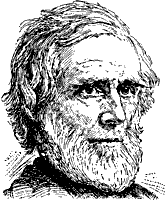
Horace Bushnell
It is enough to say of his work in this respect that it was characterized by a mingling of the thought of the first three centuries, and of the modern spirit which had found its way from Germany into England through Coleridge. The two did not always agree well, and the latter is the predominating feature in all his writings. He was the first theologian in New England to admit fully into his thought the modern sense of Nature, as it is found in the literature of the early part of the century, and notably in Wordsworth and Coleridge. Dr. Bushnell was not a student of this literature beyond a thorough and sympathetic study of 'The Aids to Reflection,' but through this open door the whole spirit of that great thought movement entered his mind and found a congenial home. The secret of this movement was a spiritual interpretation of nature. It was a step in the evolution of human thought; and appearing first in literature, its natural point of entrance, it was sure to reach all forms of thought, as in time to come it will reach all forms of social life. The thing that the world is rapidly learning is, that not only is the world God's but that God is in his world. Bushnell was by nature immensely open to this thought, and its undertone can be heard in almost every page of his writings. It was this that gave value to his works and made them exceptional in his day and place. Each of his great treatises is, with more or less distinctness, an effort to put natural things and divine things into some sort of relevance and oneness.
He took the path by which superior minds have always found their way into new realms of truth. They do not pass from one school to another, but instead rise into some new or some larger conception of nature and start afresh. All gains in philosophy and religion and civilization have been made by further inroads into nature, and never in any other way. Dr. Bushnell, with the unerring instinct of a discoverer, struck this path and kept it to the end. At the bottom of all his work lies a profound sense of nature, of its meaning and force in the realm of the spirit. He did not deny a certain antithesis between nature and the supernatural, but he so defined the latter that the two could be embraced in the one category of nature when viewed as the ascertained order of God in creation. The supernatural is simply the realm of freedom, and it is as natural as the physical realm of necessity. Thus he not only got rid of the traditional antinomy between them, but led the way into that conception of the relation of God to his world which more and more is taking possession of modern thought. In his essay on Language he says (and the thought is always with him as a governing principle):—"The whole universe of nature is a perfect analogon of the whole universe of thought or spirit. Therefore, as nature becomes truly a universe only through science revealing its universal laws, the true universe of thought and spirit cannot sooner be conceived." Thus he actually makes the revelation of spiritual truth wait on the unfolding of the facts and laws of the world of nature. There is something pathetic in the attitude of this great thinker sitting in the dark, waiting for disclosures in nature that would substantiate what he felt was true in the realm of the spirit. A generation later he would have seen the light for which he longed—a light that justifies the central point of all his main contentions.
His first and most important work, 'Christian Nurture,' contended that the training of children should be according to nature,—not in the poor sense of Rousseau, but that it should be divinely natural. So 'Nature and the Supernatural,' whatever place may be accorded to the book to-day, was an effort to bring the two terms that were held as opposite and contradictory, into as close relation as God is to his laws in nature. So in 'The Vicarious Sacrifice' his main purpose was to take a doctrine that had been dwarfed out of its proper proportions, and give to it the measure of God's love and the manner of its action in human life. Dr. Bushnell may or may not have thought with absolute correctness on these themes, but he thought with consummate ability, he wrote with great eloquence and power, and he left many pages that are to be cherished as literature, while theologically they "point the way we are going."
One of the most characteristic and interesting things about Dr. Bushnell is the method he took to find his way between this spiritual view of things and that world of theological orthodoxy where he stood by virtue of his profession. It was a very hard and dry world,—a world chiefly of definitions,—but it covered vital realities, and so must have had some connection with the other world. Dr. Bushnell bridged the chasm by a theory of language which he regarded as original with himself. It was not new, but he elaborated it in an original way and with great ability. In its main feature it was simply a claim to use in theology the symbolism of poetry; it regarded language as something that attempts to make one feel the inexpressible truth, rather than a series of definitions which imply that it can be exactly stated in words; it held that truth is larger than any form which attempts to express it; it images and reflects truth instead of defining it.
This theory might be assumed without so long explication as he gave, but it was greatly needed in the theological world, which at that time was sunk in a sea of metaphysical definition, and consumed with a lust for explaining everything in heaven and earth in terms of alphabetic plainness. Dr. Bushnell was not only justified by the necessity of his situation in resorting to his theory, but he had the right which every man of genius may claim for himself. Any one whose thought is broader than that about him, whose feeling is deeper, whose imagination is loftier, is entitled to such a use of language as shall afford him fullest expression; for he alone knows just how much of thought, feeling, and imagination, how much of himself, he puts into his words; they are coin whose value he himself has a right to indicate by his own stamp. There is no pact with others to use language in any given way, except upon some very broad basis as to the main object of language. The first object is not to secure definite and comprehensive understanding, but to give expression, and to start thought which may lead to full understanding—as the parable hides the thought until you think it out.
Dr. Bushnell's theory did not blind the ordinary reader. No writer is more easily apprehended by the average mind if he has any sympathy with the subjects treated; but it was an inconvenient thing for his theological neighbors to manage. While they insisted on "the evident meaning of the words,"—a mischievous phrase,—he was breathing his meaning into attentive souls by the spirit which he had contrived to hide within his words. It is a way that genius has,—as Abt Vogler says:—
"But God has a few of us whom he whispers in the ear: The rest may reason and welcome: 'tis we musicians know."
The first thing that brought Dr. Bushnell out of the world of theology into the world of literature was his oration before the Phi Beta Kappa Society at Harvard College in 1848. He had achieved a reputation as a preacher of remarkable insight for such as had ears to hear, and he was already in the thick of theological controversy; but his fine power of expression and breadth of thought had not been specially noticed. This oration introduced him into the world of letters. Mr. J. T. Fields—the most discerning critic of the day—said to the writer that the oration was heard with surprise and delight, and that it gave the speaker an assured place in the ranks of literature. That he should have been so readily welcomed by the literary guild is not strange, for the title of his oration—'Work and Play'—led the way into a discussion of the secret that underlies all works of genius. For once, the possessor of the divine gift heard its secret revealed and himself explained to himself; his work was set before him as the full play of his spirit. Beginning with nature, where our author always began, and finding there a free and sportive element, he carries it into human life; making the contention that its aim should be, and that its destiny will be, to free itself from the constraint of mere work and rise into that natural action of the faculties which may be called play—a moral and spiritual process. His conclusion is that—
"if the world were free,—free, I mean, of themselves; brought up, all, out of work into the pure inspiration of truth and charity,—new forms of personal and intellectual beauty would appear, and society itself reveal the Orphic movement. No more will it be imagined that poetry and rhythm are accidents or figments of the race, one side of all ingredient or ground of nature. But we shall know that poetry is the real and true state of man; the proper and last ideal of souls, the free beauty they long for, and the rhythmic flow of that universal play in which all life would live."
The key to Dr. Bushnell is to be found in this passage, and it is safe to say of him that in hardly a page of a dozen volumes is he false to it. He is always a poet, singing out of "the pure inspiration of truth and charity," and keeping ever in mind that poetry and rhythm are not figments outside of nature, but the real and true state of man and the proper and last ideal of souls.
The centrality of this thought is seen in his style. It is a remarkable style, and is only to be appreciated when the man is understood. It is made up of long sentences full of qualifying phrases until the thought is carved into perfect exactness; or—changing the figure—shade upon shade is added until the picture and conception are alike. But with all this piling up of phrases, he not only did not lose proportion and rhythm, but so set down his words that they read like a chant and sound like the breaking of waves upon the beach. Nor does he ever part with poetry in the high sense in which he conceived it. I will not compare his style, as to merit, with that of Milton and Jeremy Taylor and Sir Thomas Browne, but he belongs to their class; he has the same majestic swing, and like them he cannot forbear singing, whatever he may have to say. His theme may be roads, or city plans, or agriculture, or emigration, or the growth of law; yet he never fails of lifting his subject into that higher world of the imagination where the real truth of the subject is to be found, and is made to appear as poetry. It would be unjust to identify him so thoroughly with the poets if it should lead to the thought that he was not a close and rigorous thinker. It should not be forgotten that all great prose-writers, from Plato down to Carlyle and Emerson, stand outside of poetry only by virtue of their form and not by virtue of their thought; indeed, poet and thinker are interchangeable names. Dr. Bushnell wrote chiefly on theology, and the value and efficacy of his writings lie in the fact that imagination and fact, thought and sentiment, reason and feeling, are each preserved and yet so mingled as to make a single impression.
This combination of two realms or habits of thought appears on every page. He was, as Novalis said of Spinoza, "A God-intoxicated man," but it was God as containing humanity in himself. His theology was a veritable Jacob's ladder, on which the angels of God ascend and descend; and if in his thought they descended before they ascended, it was because he conceived of humanity as existing in God before it was manifest in creation; and if his head was among the stars, his feet were always firmly planted on the earth. This twofoldness finds a curious illustration in the sub-titles of several of his books. 'The Vicarious Sacrifice' does not spring alone out of the divine nature, but is 'Grounded in Principles of Universal Obligation.' 'Nature and the Supernatural'—the great antithesis in theology—constitute 'The One System of God.' 'Women's Suffrage' is 'The Reform against Nature'—the best book, I must be permitted to say, on either side of this much-debated question.
It is a popular impression of Dr. Bushnell that he was the subject of his imagination, and that it ran away with him in the treatment of themes which required only severe thought: the impression is a double mistake: theology does not call for severe thought, alone nor mainly; but first and chiefly for the imagination, and the seeing and interpreting eye that usually goes with it; its object is to find spirit under form, to discover what the logos expresses. For this the imagination is the chief requisite. It is not a vagrant and irresponsible faculty, but an inner eye whose vision is to be trusted like that of the outer; it has in itself the quality of thought, and is not a mere picture-making gift. Dr. Bushnell trained his imagination to work on certain definite lines, and for a definite end—namely, to bring out the spiritual meaning hidden within the external form. He worked in the spirit of Coleridge's words:—
"I had found That outward forms the loftiest, still receive Their finer influence from the Life within."
No analysis or recapitulation of his works can be given in these preliminary words. Perhaps his most influential book is the first, 'Christian Nurture'; while a treatise for the household, it was surcharged with theological opinions which proved to be revolutionary and epoch-making. 'The Vicarious Sacrifice' has most affected the pulpit. 'Nature and the Supernatural,' the tenth chapter of which has become a classic, has done great service in driving out the extreme dualism that invested the subject of God's relation to creation. His ablest essay is the treatise on Language; the most literary is that on 'Work and Play'; the most penetrating in its insight is 'Our Gospel a Gift to the Imagination'; the most personal and characteristic is 'The Age of Homespun.' His best sermon is always the one last read; and they are perhaps his most representative work. The sermon is not usually ranked as belonging to literature, but no canon excludes those preached by this great man. They are timeless in their truth, majestic in their diction, commanding in their moral tone, penetrating in their spirituality, and pervaded by that quality without which a sermon is not one—the divine uttering itself to the human. There is no striving and crying in the streets, no heckling of saints nor dooming of sinners, no petty debates over details of conduct, no dogmatic assumption, no logical insistence, but only the gentle and mighty persuasions of truth, coming as if breathed by the very spirit of God.
Language was to him "the sanctuary of thought," and these sermons are the uttered worship in that temple where reason and devotion are one.
WORK AND PLAY
From 'Work and Play'
Let me call to my aid, then, some thoughtful spirit in my audience: not a poet, of necessity, or a man of genius, but a man of large meditation, one who is accustomed to observe, and, by virtue of the warm affinities of a living heart, to draw out the meanings that are hid so often in the humblest things. Returning into the bosom of his family in some interval of care and labor, he shall come upon the very unclassic and certainly unimposing scene,—his children and a kitten playing on the floor together; and just there, possibly, shall meet him suggestions more fresh and thoughts of higher reach concerning himself and his race, than the announcement of a new-discovered planet or the revolution of an empire would incite. He surveys with a meditative feeling this beautiful scene of muscular play,—the unconscious activity, the exuberant life, the spirit of glee,—and there rises in his heart the conception that possibly he is here to see the prophecy or symbol of another and higher kind of play, which is the noblest exercise and last end of man himself. Worn by the toils of years, perceiving with a sigh that the unconscious joy of motion here displayed is spent in himself, and that now he is effectually tamed to the doom of a working creature, he may yet discover, in the lively sympathy with play that bathes his inward feeling, that his soul is playing now,—enjoying, without the motions, all it could do in them; manifold more than it could if he were down upon the floor himself, in the unconscious activity and lively frolic of childhood. Saddened he may be to note how time and work have changed his spirit and dried away the playful springs of animal life in his being; yet he will find, or ought, a joy playing internally over the face of his working nature, which is fuller and richer as it is more tranquil; which is to the other as fulfillment to prophecy, and is in fact the prophecy of a better and far more glorious fulfillment still.
Having struck in this manner the great world-problem of work and play, his thoughts kindle under the theme, and he pursues it. The living races are seen at a glance to be offering in their history everywhere a faithful type of his own. They show him what he himself is doing and preparing—all that he finds in the manifold experience of his own higher life. They have, all, their gambols; all, their sober cares and labors. The lambs are sporting on the green knoll; the anxious dams are bleating to recall them to their side. The citizen beaver is building his house by a laborious carpentry; the squirrel is lifting his sail to the wind on the swinging top of the tree. In the music of the morning, he hears the birds playing with their voices, and when the day is up, sees them sailing round in circles on the upper air, as skaters on a lake, folding their wings, dropping and rebounding, as if to see what sport they can make of the solemn laws that hold the upper and lower worlds together. And yet these play-children of the air he sees again descending to be carriers and drudges; fluttering and screaming anxiously about their nest, and confessing by that sign that not even wings can bear them clear of the stern doom of work. Or, passing to some quiet shade, meditating still on this careworn life, playing still internally with ideal fancies and desires unrealized, there returns upon him there, in the manifold and spontaneous mimicry of nature, a living show of all that is transpiring in his own bosom; in every flower some bee humming over his laborious chemistry and loading his body with the fruits of his toil; in the slant sunbeam, populous nations of motes quivering with animated joy, and catching, as in play, at the golden particles of the light with their tiny fingers. Work and play, in short, are the universal ordinance of God for the living races; in which they symbolize the fortune and interpret the errand of man. No creature lives that must not work and may not play.
Returning now to himself and to man, and meditating yet more deeply, as he is thus prepared to do, on work and play, and play and work, as blended in the compound of our human life; asking again what is work and what is play, what are the relations of one to the other, and which is the final end of all, he discovers in what he was observing round him a sublimity of import, a solemnity even, that is deep as the shadow of eternity.
I believe in a future age yet to be revealed, which is to be distinguished from all others as the godly or godlike age,—an age not of universal education simply, or universal philanthropy, or external freedom, or political well-being, but a day of reciprocity and free intimacy between all souls and God. Learning and religion, the scholar and the Christian, will not be divided as they have been. The universities will be filled with a profound spirit of religion, and the bene orâsse will be a fountain of inspiration to all the investigations of study and the creations of genius.
I raise this expectation of the future, not because some prophet of old time has spoken of a day to come when "the streets of the city shall be full of boys and girls playing in the streets thereof" (for I know not that he meant to be so interpreted), but because I find a prophecy of play in our nature itself which it were a violation of all insight not to believe will sometime be fulfilled. And when it is fulfilled it will be found that Christianity has at last developed a new literary era, the era of religious love.
Hitherto the passion of love has been the central fire of the world's literature. The dramas, epics, odes, novels, and even histories, have spoken to the world's heart chiefly through this passion, and through this have been able to get their answer. For this passion is a state of play, wherein the man loses himself in the ardor of a devotion regardless of interest, fear, care, prudence, and even of life itself. Hence there gathers round the lover a tragic interest, and we hang upon his destiny as if some natural charm or spell were in it. Now this passion of love, which has hitherto been the staple of literature, is only a crude symbol in the life of nature, by which God designs to interpret, and also to foreshadow, the higher love of religion,—nature's gentle Beatrice, who puts her image in the youthful Dante, by that to attend him afterwards in the spirit-flight of song, and be his guide up through the wards of Paradise to the shining mount of God. What then are we to think, but that God will sometime bring us up out of the literature of the lower love, into that of the higher?—that as the age of passion yields to the age of reason, so the crude love of instinct will give place to the loftier, finer, more impelling love of God? And then around that nobler love, or out of it, shall arise a new body of literature, as much more gifted as the inspiration is purer and more intellectual. Beauty, truth, and worship; song, science, and duty, will all be unfolded together in this common love.
FROM 'THE AGE OF HOMESPUN'
Most of all to be remembered are those friendly circles gathered so often round the winter's fire; not the stove, but the fire, the brightly blazing, hospitable fire. In the early dusk, the home circle is drawn more closely and quietly round it; but a good neighbor and his wife drop in shortly from over the way, and the circle begins to spread. Next, a few young folk from the other end of the village, entering in brisker mood, find as many more chairs set in as wedges into the periphery to receive them also. And then a friendly sleighful of old and young that have come down from the hill to spend an hour or two, spread the circle again, moving it still farther back from the fire; and the fire blazes just as much higher and more brightly, having a new stick added for every guest. There is no restraint, certainly no affectation of style. They tell stories, they laugh, they sing. They are serious and gay by turns, or the young folks go on with some play, while the fathers and mothers are discussing some hard point of theology in the minister's last sermon, or perhaps the great danger coming to sound morals from the multiplication of turnpikes and newspapers! Meantime the good housewife brings out her choice stock of home-grown exotics, gathered from three realms—doughnuts from the pantry, hickory-nuts from the chamber, and the nicest, smoothest apples from the cellar; all which, including, I suppose I must add, the rather unpoetic beverage that gave its acid smack to the ancient hospitality, are discussed as freely, with no fear of consequences. And then, as the tall clock in the corner of the room ticks on majestically towards nine, the conversation takes, it may be, a little more serious turn, and it is suggested that a very happy evening may fitly be ended with a prayer. Whereupon the circle breaks up with a reverent, congratulative look on every face, which is itself the truest language of a social nature blessed in human fellowship.
Such, in general, was the society of the homespun age....
Passing to the church, or rather I should say, to the meeting-house—good translation, whether meant or not, of what is older and more venerable than church, viz., synagogue—here again you meet the picture of a sturdy homespun worship. Probably it stands on some hill, midway between three or four valleys, whither the tribes go up to worship, and, when the snow-drifts are deepest, go literally from strength to strength. There is no furnace or stove save the foot-stoves that are filled from the fires of the neighboring houses, and brought in partly as a rather formal compliment to the delicacy of the tender sex, and sometimes because they are really wanted. The dress of the assembly is mostly homespun, indicating only slight distinctions of quality in the worshipers. They are seated according to age,—the old king Lemuels and their queens in front, near the pulpit, and the younger Lemuels farther back, inclosed in pews, sitting back to back, impounded, all, for deep thought and spiritual digestion; only the deacons, sitting close under the pulpit by themselves, to receive, as their distinctive honor, the more perpendicular droppings of the Word. Clean round the front of the gallery is drawn a single row of choir, headed by the key-pipe in the centre. The pulpit is overhung by an august wooden canopy called a sounding-board—study general, of course, and first lesson of mystery to the eyes of the children, until what time their ears are opened to understand the spoken mysteries.
There is no affectation of seriousness in the assembly, no mannerism of worship; some would say too little of the manner of worship. They think of nothing, in fact, save what meets their intelligence and enters into them by that method. They appear like men who have a digestion for strong meat, and have no conception that trifles more delicate can be of any account to feed the system. Nothing is dull that has the matter in it, nothing long that has not exhausted the matter. If the minister speaks in his great-coat and thick gloves or mittens, if the howling blasts of winter drive in across the assembly fresh streams of ventilation that move the hair upon their heads, they are none the less content, if only he gives them good strong exercise. Under their hard and, as some would say, stolid faces, great thoughts are brewing, and these keep them warm. Free-will, fixed fate, foreknowledge absolute, trinity, redemption, special grace, eternity—give them anything high enough, and the tough muscle of their inward man will be climbing sturdily into it; and if they go away having something to think of, they have had a good day. A perceptible glow will kindle in their hard faces only when some one of the chief apostles, a Day, a Smith, or a Bellamy, has come to lead them up some higher pinnacle of thought or pile upon their sturdy minds some heavier weight of argument—fainting never under any weight, even that which, to the foreign critics of the discourses preached by them and others of their day, it seems impossible for any, the most cultivated audience in the world, to have supported. These royal men of homespun—how great a thing to them was religion!
The sons and daughters grew up, all, as you will perceive, in the closest habits of industry. The keen jocky way of whittling out a living by small bargains sharply turned, which many suppose to be an essential characteristic of the Yankee race, is yet no proper inbred distinction, but only a casual result, or incident, that pertains to the transition period between the small, stringent way of life in the previous times of home-production and the new age of trade. In these olden times, these genuine days of homespun, they supposed, in their simplicity, that thrift represented work, and looked about seldom for any more delicate and sharper way of getting on. They did not call a man's property his fortune, but they spoke of one or another as being worth so much; conceiving that he had it laid up as the reward or fruit of his deservings. The house was a factory on the farm, the farm a grower and producer for the house. The exchanges went on briskly enough, but required neither money nor trade. No affectation of polite living, no languishing airs of delicacy and softness indoors, had begun to make the fathers and sons impatient of hard work out of doors, and set them at contriving some easier and more plausible way of living. Their very dress represented work, and they went out as men whom the wives and daughters had dressed for work; facing all weather, cold and hot, wet and dry, wrestling with the plow on the stony-sided hills, digging out the rocks by hard lifting and a good many very practical experiments in mechanics, dressing the flax, threshing the rye, dragging home, in the deep snows, the great woodpile of the year's consumption; and then when the day is ended—having no loose money to spend in taverns—taking their recreation all together in reading or singing or happy talk or silent looking in the fire, and finally in sleep—to rise again with the sun and pray over the family Bible for just such another good day as the last. And so they lived, working out, each year, a little advance of thrift, just within the line of comfort.
No mode of life was ever more expensive: it was life at the expense of labor too stringent to allow the highest culture and the most proper enjoyment. Even the dress of it was more expensive than we shall ever see again. Still it was a life of honesty and simple content and sturdy victory. Immoralities that rot down the vigor and humble the consciousness of families were as much less frequent as they had less thought of adventure; less to do with travel and trade and money, and were closer to nature and the simple life of home.
It was also a great point, in this homespun mode of life, that it imparted exactly what many speak of only with contempt—a closely girded habit of economy. Harnessed all together into the producing process, young and old, male and female, from the boy that rode the plow-horse to the grandmother knitting under her spectacles, they had no conception of squandering lightly what they all had been at work, thread by thread and grain by grain, to produce. They knew too exactly what everything cost, even small things, not to husband them carefully. Men of patrimony in the great world, therefore, noticing their small way in trade or expenditure, are ready, as we often see, to charge them with meanness—simply because they knew things only in the small; or, what is not far different, because they were too simple and rustic to have any conception of the big operations by which other men are wont to get their money without earning it, and lavish the more freely because it was not earned. Still, this knowing life only in the small, it will be found, is really anything but meanness.
THE FOUNDERS
From 'Work and Play'
There is a class of writers and critics in our country, who imagine it is quite clear that our fathers cannot have been the proper founders of our American liberties, because it is in proof that they were so intolerant and so clearly unrepublican often in their avowed sentiments. They suppose the world to be a kind of professor's chair, and expect events to transpire logically in it. They see not that casual opinions, or conventional and traditional prejudices, are one thing, and that principles and morally dynamic forces are often quite another; that the former are the connectives only of history, the latter its springs of life; and that if the former serve well enough as providential guards and moderating weights overlying the deep geologic fires and subterranean heavings of the new moral instincts below, these latter will assuredly burst up at last in strong mountains of rock, to crest the world. Unable to conceive such a truth, they cast about them accordingly to find the paternity of our American institutions in purely accidental causes. We are clear of aristocratic orders, they say, because there was no blood of which to make an aristocracy; independent of king and parliament, because we grew into independence under the natural effects of distance and the exercise of a legislative power; republican, because our constitutions were cast in the molds of British law; a wonder of growth in riches, enterprise, and population, because of the hard necessities laid upon us, and our simple modes of life.
There is yet another view of this question, that has a far higher significance. We do not understand, as it seems to me, the real greatness of our institutions when we look simply at the forms under which we hold our liberties. It consists not in these, but in the magnificent possibilities that underlie these forms as their fundamental supports and conditions. In these we have the true paternity and spring of our institutions; and these, beyond a question, are the gift of our founders.
We see this, first of all, in the fixed relation between freedom and intelligence, and the remarkable care they had of popular education. It was not their plan to raise up a body of republicans. But they believed in mind as in God. Their religion was the choice of mind. The gospel they preached must have minds to hear it; and hence the solemn care they had, even from the first day of their settlement, of the education of every child. And, as God would have it, the children whom they trained up for pillars in the church turned out also to be more than tools of power. They grew up into magistrates, leaders of the people, debaters of right and of law, statesmen, generals, and signers of declarations for liberty. Such a mass of capacity had never been seen before in so small a body of men. And this is the first condition of liberty—the Condensation of Power. For liberty is not the license of an hour; it is not the butchery of a royal house, or the passion that rages behind a barricade, or the caps that are swung or the vivas shouted at the installing of a liberator. But it is the compact, impenetrable matter of much manhood, the compressed energy of good sense and public reason, having power to see before and after and measure action by counsel—this it is that walls about the strength and liberty of a people. To be free is not to fly abroad as the owls of the night when they take the freedom of the air, but it is to settle and build and be strong—a commonwealth as much better compacted in the terms of reason, as it casts off more of the restraints of force.
Their word was "Reformation"—"the completion of the Reformation"; not Luther's nor Calvin's, they expressly say; they cannot themselves imagine it. Hitherto it is unconceived by men. God must reveal it in the light that breaks forth from him. And this he will do in his own good time. It is already clear to us that, in order to any further progress in this direction, it was necessary for a new movement to begin that should loosen the joints of despotism and emancipate the mind of the world. And in order to this a new republic must be planted and have time to grow. It must be seen rising up in the strong majesty of freedom and youth, outstripping the old prescriptive world in enterprise and the race of power, covering the ocean with its commerce, spreading out in populous swarms of industry,—planting, building, educating, framing constitutions, rushing to and fro in the smoke and thunder of travel along its mighty rivers, across its inland seas, over its mountain-tops from one shore to the other, strong in order as in liberty,—a savage continent become the field of a colossal republican empire, whose name is a name of respect and a mark of desire to the longing eyes of mankind. And then, as the fire of new ideas and hopes darts electrically along the nerves of feeling in the millions of the race, it will be seen that a new Christian movement also begins with it. Call it reformation, or formation, or by whatever name, it is irresistible because it is intangible. In one view it is only destruction. The State is loosened from the Church. The Church crumbles down into fragments. Superstition is eaten away by the strong acid of liberty, and spiritual despotism flies affrighted from the broken loyalty of its metropolis. Protestantism also, divided and subdivided by its dialectic quarrels, falls into the finest, driest powder of disintegration. Be not afraid. The new order crystallizes only as the old is dissolved; and no sooner is the old unity of orders and authorities effectually dissolved than the reconstructive affinities of a new and better unity begin to appear in the solution. Repugnances melt away. Thought grows catholic. Men look for good in each other as well as evil. The crossings of opinion by travel and books, and the intermixture of races and religions, issue in freer, broader views of the Christian truth; and so the "Church of the Future," as it has been called, gravitates inwardly towards those terms of brotherhood in which it may coalesce and rest. I say not or believe that Christendom will be Puritanized or Protestantized; but what is better than either, it will be Christianized. It will settle thus into a unity, probably not of form, but of practical assent and love—a Commonwealth of the Spirit, as much stronger in its unity than the old satrapy of priestly despotism, as our republic is stronger than any other government of the world.
RELIGIOUS MUSIC
From 'Work and Play'
As we are wont to argue the invisible things of God, even his eternal power and Godhead, from the things that are seen, finding them all images of thought and vehicles of intelligence, so we have an argument for God more impressive, in one view, because the matter of it is so deep and mysterious, from the fact that a grand, harmonic, soul-interpreting law of music pervades all the objects of the material creation, and that things without life, all metals and woods and valleys and mountains and waters, are tempered with distinctions of sound, and toned to be a language to the feeling of the heart. It is as if God had made the world about us to be a grand organ of music, so that our feelings might have play in it, as our understanding has in the light of the sun and the outward colors and forms of things. What is called the musical scale, or octave, is fixed in the original appointments of sound just as absolutely and definitely as the colors of the rainbow or prism in the optical properties and laws of light. And the visible objects of the world are not more certainly shaped and colored to us under the exact laws of light and the prism, than they are tempered and toned, as objects audible, to give distinctions of sound by their vibrations in the terms of the musical octave. It is not simply that we hear the sea roar and the floods clap their hands in anthems of joy; it is not that we hear the low winds sigh, or the storms howl dolefully, or the ripples break peacefully on the shore, or the waters dripping sadly from the rock, or the thunders crashing in horrible majesty through the pavements of heaven; not only do all the natural sounds we hear come to us in tones of music as interpreters of feeling, but there is hid in the secret temper and substance of all matter a silent music, that only waits to sound and become a voice of utterance to the otherwise unutterable feeling of our heart—a voice, if we will have it, of love and worship to the God of all.
First, there is a musical scale in the laws of the air itself, exactly answering to the musical sense or law of the soul. Next, there is in all substances a temperament of quality related to both; so that whatever kind of feeling there may be in a soul—war and defiance, festivity and joy, sad remembrance, remorse, pity, penitence, self-denial, love, adoration—may find some fit medium of sound in which to express itself. And, what is not less remarkable, connected with all these forms of substances there are mathematical laws of length and breadth, or definite proportions of each, and reflective angles, that are every way as exact as those which regulate the colors of the prism, the images of the mirror, or the telescopic light of astronomic worlds—mathematics for the heart as truly as for the head.
It cannot be said that music is a human creation, and as far as the substances of the world are concerned, a mere accident. As well can it be said that man creates the colors of the prism, and that they are not in the properties of the light, because he shapes the prism by his own mechanical art. Or if still we doubt; if it seems incredible that the soul of music is in the heart of all created being; then the laws of harmony themselves shall answer, one string vibrating to another, when it is not struck itself, and uttering its voice of concord simply because the concord is in it and it feels the pulses on the air to which it cannot be silent. Nay, the solid mountains and their giant masses of rock shall answer; catching, as they will, the bray of horns or the stunning blast of cannon, rolling it across from one top to another in reverberating pulses, till it falls into bars of musical rhythm and chimes and cadences of silver melody. I have heard some fine music, as men are wont to speak—the play of orchestras, the anthems of choirs, the voices of song that moved admiring nations. But in the lofty passes of the Alps I heard a music overhead from God's cloudy orchestra, the giant peaks of rock and ice, curtained in by the driving mist and only dimly visible athwart the sky through its folds, such as mocks all sounds our lower worlds of art can ever hope to raise. I stood (excuse the simplicity) calling to them, in the loudest shouts I could raise, even till my power was spent, and listening in compulsory trance to their reply. I heard them roll it up through their cloudy worlds of snow, sifting out the harsh qualities that were tearing in it as demon screams of sin, holding on upon it as if it were a hymn they were fining to the ear of the great Creator, and sending it round and round in long reduplications of sweetness, minute after minute; till finally receding and rising, it trembled, as it were, among the quick gratulations of angels, and fell into the silence of the pure empyrean. I had never any conception before of what is meant by quality in sound. There was more power upon the soul in one of those simple notes than I ever expect to feel from anything called music below, or ever can feel till I hear them again in the choirs of the angelic world. I had never such a sense of purity, or of what a simple sound may tell of purity by its own pure quality; and I could not but say, O my God, teach me this! Be this in me forever! And I can truly affirm that the experience of that hour has consciously made me better able to think of God ever since—better able to worship. All other sounds are gone; the sounds of yesterday, heard in the silence of enchanted multitudes, are gone; but that is with me still, and I hope will never cease to ring in my spirit till I go down to the slumber of silence itself.