Volume 7 — ROBERT BURNS
Reading edition
(1759-1796)
BY RICHARD HENRY STODDARD

There have been, there are, and there always will be, poets concerning whose lives it is not necessary that the world should know anything in order to understand their poetry; and there have been, there are, and there always will be, other poets concerning whose lives it is necessary that the world should know all there is to be known, before it can begin to understand their poetry. The difference between these two classes of poets is the difference between a company of accomplished actors, who by virtue of their training and practice are able to project themselves into imaginary characters on the public stage, and the originals of these characters in private personal life; or to put it in other words, the difference between art and nature. It is the privilege of art to dispense with explanations and extenuations; for if it be true to itself it is sufficient in itself, and anything added to it or taken from it is an impertinence or a deformity. When we read 'Hamlet' and 'Lear,' or 'As You Like It' and 'Much Ado About Nothing,' we do not ask ourselves what Shakespeare meant by them,—why some scenes were written in verse and other scenes in prose,—for it is not of Shakespeare that we are thinking as we read, but of his characters, for whom we feel that he is no more responsible than we are, since they move, live, and have their being in a world of their own, above the smoke and stir of this dim spot which men call Earth,—the world of pure, perfect, poetic art. If Shakespeare was conscious of himself when he wrote, he succeeded in concealing himself so thoroughly that it is impossible to discover him in his writing,—as impossible as it is not to discover other poets in their writings; for whatever is absent from the choir of British song, the note of personality is always present there. A low laugh in the gracious mouth of Chaucer, a harsh rebuke on the stern lips of Milton, a modish sneer in the smile of Pope,—it was now a stifled complaint, now an amorous ditty, and now a riotous shout with Burns, who was as much a poet through his personality as through his genius. He put his life into his song; and not to know what his life was, is not to know what his song is,—why it was a consolation to him while he lived, and why after his death it made his—
"One of the few, the immortal names, That were not born to die."
Early in the last half of the eighteenth century a staid and worthy man, named William Burness (as the name Burns was then spelled), a native of Kincardineshire, emigrated to Ayrshire in pursuit of a livelihood. He hired himself as a gardener to the laird of Fairlie, and later to a Mr. Crawford of Doonside, and at length took a lease of seven acres of land on his own account at Alloway on the banks of the Doon. He built a clay cottage there with his own hands, and to this little cottage, in December 1757, he brought a wife, the eldest daughter of a farmer of Carrick. There was a disparity in their ages, for he was about thirty-six and she some eight or nine years younger; and a disparity in their education, for he was an intelligent reader and lover of books, while she, though she had been taught as a child to read the Bible and to repeat the Psalms, was not able to write her name. She had a great respect for her husband, whose occupation was now that of a nurseryman. A little more than a year after their marriage, on the 25th of January, 1759, she bore him a son who was christened Robert, who was followed, as time went on, by brothers and sisters; and before many years were over, what with the guidman, the guidwife, and the bonny bairns, there was not much spare room in the little clay biggin at Alloway.
Poor as they were, the social condition of this Scottish family was superior to the social condition of most English families in the same walk of rustic life; this superiority resulting from certain virtues inherent in the national character,—the virtues of simple appetites and frugal habits, of patience and courage in adversity, and best of all, in affectionate hearts, reverential minds, and a thirst for knowledge which only books could supply. William Burness inherited respect for education from his father, who in his young manhood was instrumental in building a schoolhouse on his farm at Clockenhill. Accordingly, when his son Robert was in his sixth year he sent him to a little school at Alloway Mill, about a mile from his cottage; and not long after he took the lead in hiring a young teacher named Murdoch to instruct him and his younger brother Gilbert at some place near at hand. Their school-books consisted of the Shorter Catechism, the Bible, the spelling-book, and Fisher's 'English Grammar.' Robert was a better scholar than Gilbert, especially in grammar, in which he acquired some proficiency. The only book which he is known to have read outside of his primitive curriculum was a 'Life of Hannibal,' which was loaned him by his teacher. When he was seven the family removed to a small upland farm called Mount Oliphant, about two miles from Alloway, to and from which the boys plodded daily in pursuit of learning. At the end of two years the teacher obtained a better situation in Carrick; the school was broken up, and from that time onward William Burness took upon himself the education of his lads and lassies, whom he treated as if they were men and women, conversing with them on serious topics as they accompanied him in his labors on the farm, and borrowing for their edification, from a Book Society in Ayr, solid works like Derham's 'Physico- and Astro-Theology' and Ray's 'Wisdom of God in the Creation.' This course of heavy reading was lightened by the 'History of Sir William Wallace,' which was loaned to Robert by a blacksmith named Kilpatrick, and which forced a hot flood of Scottish feeling through his boyish veins. His next literary benefactor was a brother of his mother, who while living for a time with the family had learned some arithmetic by their winter evening's candle. He went one day into a bookseller's shop in Ayr to purchase a Ready Reckoner and a Complete Letter-Writer, but procured by mistake in place of the latter a small collection of 'Letters by Eminent Wits,' which proved of more advantage (or disadvantage) to his nephew than to himself, for it inspired the lad with a desire to excel in epistolary writing. Not long after this Robert's early tutor Murdoch returned to Ayr, and lent him Pope's Works; a bookish friend of his father's obtained for him the reading of two volumes of Richardson's 'Pamela' and another friendly soul the reading of Smollett's 'Ferdinand Count Fathom,' and 'Peregrine Pickle.' The book which most delighted him, however, was a collection of English songs called 'The Lark.'
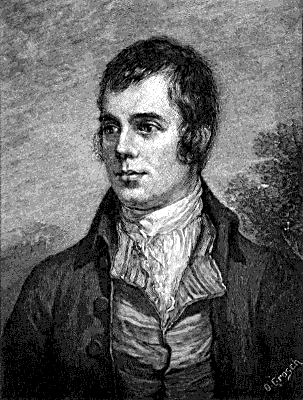
ROBERT BURNS.
Mount Oliphant taxed the industry and endurance of William Burness to the utmost; and what with the sterility of the soil, which was the poorest in the parish, and the loss of cattle by accidents and disease, it was with great difficulty that he managed to support his family. They lived so sparingly that butcher's meat was for years a stranger in the house, and they labored, children and all, from morning to night. Robert, at the age of thirteen, assisted in threshing the crop of corn, and at fifteen he was the principal laborer on the farm, for they could not afford a hired hand. That he was constantly afflicted with a dull headache in the evenings was not to be wondered at; nor that the sight and thought of his gray-haired father, who was turned fifty, should depress his spirits and impart a tinge of gloom to his musings. It was under circumstances like these that he composed his first song, the inspiration of which was a daughter of the blacksmith who had loaned him the 'History of Sir William Wallace.' It was the custom of the country to couple a man and woman together in the labors of harvest; and on this occasion his partner was Nelly Kilpatrick, with whom, boy-like,—for he was in his seventeenth year and she a year younger,—he liked to lurk behind the rest of the hands when they returned from their labors in the evening, and who made his pulse beat furiously when he fingered over her little hand to pick out the cruel nettle-stings and thistles. She sang sweetly, and among her songs there was one which was said to be composed by a small laird's son about one of his father's maids, with whom he was in love; and Robert saw no reason why he should not rhyme as well as he, for the author had no more school-craft than himself. Writing of this song a few years later, he called it puerile and silly; and his verdict as a poetical one was correct. Still, considered as a song, this artless effusion possessed one merit of which he himself was probably not conscious: it was inspired by his feeling and not by his reading, by the warmth and purity of his love of Nelly Kilpatrick, and not by his admiration of any amorous ditty in his collection of English songs. It was a poor thing, but it was certainly his own, and nowhere more so than in its recognition of the womanly personality of its heroine:—
"And then there's something in her gait Gars ony dress look weel."
This touch of nature, which no modish artist would have attempted, marked the hand of one who painted from the life.
William Burness struggled along for twelve years at Mount Oliphant, and then removed to Lochlea, in the parish of Tarbolton. Here he rented a larger farm, the soil of which promised a surer maintenance for himself and the hostages he had given to Fortune. And there these loving hostages began to put away childish things, and to become men and women. They were cheerful, in spite of the frugality which their poverty imposed upon them; and were merry in their simple homely way, singing and dancing among themselves and among their friendly neighbors. Their hearts expanded in the healthy air about them, particularly the heart of Robert, which turned to thoughts of love,—not lightly, as in his boyish fancy for Nelly Kilpatrick, but seriously, as beseemed a man; for he was now in his nineteenth year, and as conscious of what he was to woman as of what woman was to him. A born lover, and a born poet, he discovered himself and his song at Tarbolton. The custom of the country and the time sanctioned a freedom of manners, and a frequency of meeting on the part of rustic amorists, of which he was not slow to avail himself. The love affairs of the Scottish peasantry are thus described by one of his biographers:—"The young farmer or plowman, after his day of exhausting toil, would proceed to the home of his mistress, one, two, three, or more miles distant, there signal her to the door, and then the pair would seat themselves in the barn for an hour or two's conversation." Burns practiced this mode of courtship, which was the only one open to him, and among the only women whom he knew at Tarbolton. "He made no distinction between the farmer's own daughters and those who acted as his servants, the fact after all being that the servants were often themselves the daughters of farmers, and only sent to be the hirelings of others because their services were not needed at home." We should remember this habit of the Scottish peasantry if we wish to understand the early songs of Burns; for they were suggested by it, and vitalized by it, as much as by his impassioned genius. He painted what he saw; he sang what he felt. We have a glimpse of him in one of his winter courtships in 'My Nanie, O'; another and warmer glimpse of him in one of his summer courtships in 'The Rigs o' Barley'; and another and livelier glimpse of him in one of his mocking moods in 'Tibbie, I hae seen the day.' But he was more than the lover which these songs revealed: he was a man of sound understanding and fine, active intelligence, gifted with ready humor and a keen sense of wit. If he had been other than he was, he might and probably would have been elated by his poetic powers, of which he must have been aware; but being what he was, he was content to enjoy them and to exercise them modestly, and at such scanty intervals as his daily duties afforded. He composed his songs as he went about his work, plowing, sowing, reaping; crooning them as he strode along the fields, and correcting them in his head as the hours dragged on, until night came, and he could write them down in his little room by the light of his solitary candle. He had no illusions about himself: he was the son of a poor farmer, who, do what he might, was never prosperous; and poverty was his portion. His apprehension, which was justified by the misfortunes of the family at Mount Oliphant, was confirmed by their dark continuance at Tarbolton, where he saw his honored father, bowed with years of toil, grow older and feebler day by day, dying of consumption before his eyes. The end came on February 13th, 1784; and a day or two afterwards the humble coffin of William Burness, arranged between two leading horses placed after each other, and followed by relations and neighbors on horseback, was borne to Alloway and buried in the old kirkyard.
The funeral over, the family removed to Mossgiel, in the parish of Mauchline, where, at Martinmas, Robert and Gilbert had rented another farm. Having no means of their own, they and their sisters were obliged to rank as creditors of their dead father for the arrears of wages due them as laborers at Lochlea; and it was with these arrears, which they succeeded in wresting from their old landlord or his factor, that they stocked the new farm. The change was a beneficial one for all the family, who were now for the first time in their lives provided with a comfortable dwelling; and everything considered, especially so for their head,—which Robert, who was now in his twenty-sixth year, virtually became. He realized the gravity of the responsibility which rested upon him, and rightly judging that industry alone would not enable him to support it, resolved to work with the brains of others as well as his own hard hands. He read farming books, he calculated crops, he attended markets, but all to no purpose; for like his father before him, however much he may have deserved success, he could not command it. What he could and did command however was the admiration of his fellows, who were quick to perceive and ready to acknowledge his superiority. There was that about him which impressed them,—something in his temperament or talent, in his personality or character, which removed him from the roll of common men. What seemed to distinguish him most was the charm of his conversation, which, remarkable as it was for fluency and force, for originality and brilliancy, was quite as remarkable for good sense and good feeling. Grave or gay, as the occasion suggested and the spirit moved him, he spoke as with authority and was listened to with rapt attention. His company was sought, and go where he would he was everywhere welcomed as a good fellow. He had the art of making friends; and though they were not always of the kind that his well-wishers could have desired, they were the best of their kind in and about Mauchline. What he saw in some of them, other than the pleasure they felt in his society, it is hard to say; but whatever it was, he liked it and the conviviality to which it led,—which, occasionally coarsened by stories that set the table in a roar, was ever and anon refined by songs that filled his eyes with tears. His life was a hard one,—a succession of dull, monotonous, laborious days, haunted by anxiety and harassed by petty, irritating cares,—but he faced it cheerfully, manfully, and wrestled with it triumphantly, for he compelled it to forge the weapons with which he conquered it. He sang like a boy at Lochlea; he wrote like a man at Mossgiel. The first poetical note that he struck there was a personal one, and commemorative of his regard for two rustic rhymers, David Sillar and John Lapraik, to whom he addressed several Epistles,—a form of composition which he found in Ferguson and Ramsay, and of which he was enamored. That he thoroughly enjoyed the impulse which suggested and dictated these Epistles was evident from the spirit with which they were written. In the first of the two, which he addressed to Sillar, he discovered and disclosed for the first time the distinctive individuality of his genius. It was a charming and touching piece of writing; charming as a delineation of his character, and touching as a confession of his creed,—the patient philosophy of the poor. As his social horizon was enlarged, his mental vision was sharpened; and before long, other interests than those which concerned himself and his poetical friends excited his sympathies and stimulated his powers. It was a period of theological squabbles, and he plunged into them at once, partly no doubt because there was a theological strain in his blood, but largely because they furnished opportunities for the riotous exercise of his wit. He paid his disrespects to the fomenters of this holy brawl in 'The Twa Herds,' and he pilloried an old person who was obnoxious to him, in that savage satire on sanctimonious hypocrisy, 'Holy Willy's Prayer.' Always a poet, he was more, much more than a poet. He was a student of man,—of all sorts of men; caring much, as a student, for the baser sort which reveled in Poosie Nansie's dram-shop, and which he celebrated in 'The Jolly Beggars'; but caring more, as a man, for the better sort which languished in huts where poor men lodged, and of which he was the voice of lamentation in 'Man was Made to Mourn.' He was a student of manners, which he painted with a sure hand, his masterpiece being that reverential reproduction of the family life at Lochlea,—'The Cotter's Saturday Night.' He was a student of nature,—his love of which was conspicuous in his poetry, flushing his words with picturesque phrases and flooding his lines with the feeling of outdoor life. He was a student of animal life,—a lover of horses and dogs, observant of their habits and careful of their comfort. He felt for the little mouse which his plowshare turned out of its nest, and he pitied the poor hare which the unskillful fowler could only wound. The commoners of earth and air were dear to him; and the flower beside his path, the gowan wet with dew, was precious in his eyes. His heart was large, his mind was comprehensive, and his temper singularly sweet and sunny.
Such was Robert Burns at Mossgiel, and a very likable person he was. But all the while there was another Robert Burns at Mossgiel, and he was not quite so likable. He had a strange fascination for women, and a strange disregard of the consequences of this fascination. This curious combination of contradictory traits was an unfortunate one, as a young woman of Mauchline was destined to learn. She was the daughter of a mason, and her name was Jean Armour. He met her on a race day at a house of entertainment which must have been popular, since it contained a dancing-hall, admission to which was free, any man being privileged to invite to it any woman whom he fancied and for whose diversion he was willing to disburse a penny to the fiddler. He was accompanied on this occasion by his dog, who insisted on following him into the hall and persisted in keeping at his heels while he danced,—a proof of its fidelity which created considerable amusement, and which its master turned to his personal account by saying he wished he could get any of the lasses to like him as well as his dog. Jean heard his remark, and not long afterwards, as he was passing through the washing-green where she was bleaching clothes (from which she begged him to call off his troublesome follower), she reminded him of it by asking him if he had yet got any of the lasses to like him as well as did his dog? He got one there and then; for from that hour Jean was attached to him and he to Jean. He was reticent about his conquest, concealing it from his closest friends, and even from his dearest foe, the Muse; but however reticent, his conquest was not to be concealed, for Jean one day discovered that she was with child. What he felt when this calamity was made known to him we know not, for he kept his own counsel. What he wished his friends to feel, if they could and would, we may divine from a poem which he wrote about this time,—an address to the rigidly righteous, into whose minds he sought to instill the charity of which he and Jean were sorely in need:—
"Then gently scan your brother man, Still gentler sister woman; Though they may gang a kennin' wrang To step aside is human: "One point must still be greatly dark, The moving why they do it; And just as lamely can ye mark How far perhaps they rue it."
He wrote a paper which he gave Jean, in the belief that it constituted a marriage between them,—a belief which was perhaps justifiable in the existing condition of Scottish laws of marriage. But he counted without his host; for instead of accepting it as a manly endeavor to shield the reputation of his daughter and divert scandal from his family, the hot-headed father of Jean denounced it and demanded its destruction,—a foolish proceeding to which his foolish daughter consented. Whether its destruction could destroy his obligation need not be curiously considered; it is enough to know that he believed that it did, and that it was a proof of perfidy on the part of Jean. But they should see! She had forsaken him, and he would forsake her. So, the old love being off, he was straightway on with a new one. Of this new love little is known, except that she was, or had been, a servant in the family of one of his friends,—a nurserymaid or something of the sort,—and that she was of Highland parentage. Her name was Mary Campbell. He transferred his affections from Jean to Mary, and his fascination was so strong that she promised to become his wife. They met one Sunday in a sequestered spot on the banks of the Ayr, where, standing on each side of a little brook, they laved their hands in its limpid waters, plighted their troth, and exchanged Bibles,—she giving him her copy, which was a small one, he giving her his copy, which was a large one in two volumes, on the blank leaves of which he had written his name and two quotations from the sacred text, one being the solemn injunction to fidelity in Leviticus:—"And ye shall not swear by my name falsely. I am the Lord." They parted. She returned to her relatives, among whom she died a few months afterward of a malignant fever; he returned to his troubles at Mossgiel. They were not all of his own making. It was not his fault that the farm was an unproductive one; he could not impart fertility to barren acres nor compel the sun to ripen scanty crops. In the hope of bettering his fortunes he resolved to expatriate himself, and entered into negotiations with a man who had an estate in the West Indies, and who agreed to employ him as his factor. He had no money and no means of getting any, except by the publication of his poems, none of which had yet appeared in print. He issued a prospectus for their publication by subscription; and such was the reputation they had made for him through their circulation in manuscript, and the activity of his friends, that the necessary number of subscribers was soon obtained. They were published at Kilmarnock in the summer of 1786, and were read by all classes,—by the plowman as eagerly as by the laird, by the milkmaid in the dairy as eagerly as by her mistress in the parlor,—and wherever they were read they were admired. No poet was ever so quickly recognized as Burns, who captivated his readers by his human quality as well as his genius. They understood him at once. He sung of things which concerned them,—of emotions which they felt, the joys and sorrows of their homely lives, and, singing from his heart, his songs went to their hearts. His fame as a poet spread along the country and came to the knowledge of Dr. Blacklock, a blind poet in Edinburgh, who after hearing Burns's poetry was so impressed by it that he wrote or dictated a letter about it, which he addressed to a correspondent in Kilmarnock, by whom it was placed in the hands of Burns. He was still at Mossgiel, and in a perturbed condition of mind, not knowing whether he could remain there, or whether he would have to go to Jamaica. He resolved at last to do neither, but to go to Edinburgh, which he accordingly did, proceeding thither on a pony borrowed from a friend.
The visit of Burns to Edinburgh was a hazardous experiment from which he might well have shrunk. He was ignorant of the manners of its citizens,—the things which differentiated them as a class from the only class he knew,—but his ignorance did not embarrass him. He was self-possessed; manly in his bearing; modest, but not humble; courteous, but independent. He had no letters of introduction, and needed none, for his poetry had prepared the way for him. It was soon known among the best people in Edinburgh that he was there, and they hastened to make his acquaintance; one of the first to do so being a man of rank, Lord Glencairn. To know him was to know other men of rank, and to be admitted to the brilliant circles in which they moved. Burns's society was sought by the nobility and gentry and by the literary lords of the period, professors, historians, men of letters. They dined him and wined him and listened to him,—listened to him eagerly, for here as elsewhere he distinguished himself by his conversation, the charm of which was so potent that the Duchess of Gordon declared that she was taken off her feet by it. He increased his celebrity in Edinburgh by the publication of a new and enlarged edition of his Poems, which he dedicated to the noblemen and gentlemen of the Caledonian Hunt in a page of manly prose, the proud modesty and the worldly tact of which must have delighted them. "The poetic genius of my country found me," he wrote, "as the prophetic bard Elijah did Elisha, and threw her inspiring mantle over me. She bade me sing the loves, the joys, the rural scenes and rural pleasures of my native soil in my native tongue. I tuned my wild, artless notes as she inspired. She whispered me to come to this ancient metropolis of Caledonia and lay my songs under your honored protection. I now obey her dictates." His mind was not active at this time, for beyond a few trivial verses he wrote nothing worthy of him except a short but characteristic 'Epistle to the Guidwife of Wauchope House.' He spent the winter of 1786 and the spring of 1787 in Edinburgh; and summer being close at hand, he resolved to return for a time to Mossgiel. There were strong reasons for his return, some of which pertained to his impoverished family, whom he was now in a condition to assist, for the new edition of his Poems had proved profitable to himself, and others—for before his departure for Edinburgh, Jean had borne twins, a boy and a girl; and the girl was being cared for at Mossgiel. He returned therefore to his family and his child, and whether he purposed to do so or not, to the mother of his child. It was not a wise thing to do, perhaps, but it was a human thing, and very characteristic of the man, who, whatever else he was not, was very human. And the Armours were very human also, for old Armour received him into his house, and Jean received him into her arms. She was not a prudent young woman, but she was a fond and forgiving one.
The life of Burns during the next twelve months may be briefly described. He returned to Edinburgh, where in his most serious moods he held sessions of thought. It may have been a silent one, but it was not a sweet one; for while he summoned up remembrance of things past, he summoned up apprehensions of things to come. That he had won distinction as a poet was certain; what was not certain was the duration of this distinction. He was famous to-day; he might be forgotten to-morrow. But famous or forgotten, he and those dependent on him must have bread; and since he saw no reasonable prospect of earning it with his head, he must earn it with his hands. They were strong and willing. So he leased a farm at Ellisland in Dumfriesshire, and obtained an appointment from the Board of Excise: then, poet, farmer, and exciseman, he went back to Mauchline and was married to Jean. Leaving her and her child he repaired to Ellisland, where he was obliged to build a cottage for himself. He dug the foundations, collected stone and sand, carted lime, and generally assisted the masons and carpenters. Nor was this all, for he directed at the same time whatever labor the careful cultivation of a farm demanded from its tenant. He was happy at Ellisland,—happier than he had been at Mount Oliphant, where his family had been so sorely pinched by poverty, and much happier than he had been at Mossgiel, where he had wrought so much trouble for himself and others. A good son and a good brother, he was a good husband and a good father. It was in no idle moment that he wrote this stanza, which his conduct now illustrated:—
"To make a happy fireside chime To weans and wife, That's the true pathos and sublime Of human life."
His life was orderly; his wants were few and easily supplied; his mind was active, and his poetical vein more productive than it had been at Edinburgh. The best lyric that he wrote at Ellisland was the one in praise of his wife ('Of a' the airts the wind can blaw—'); the most important poem 'Tam o' Shanter.' Farmer and exciseman, he was very busy,—busier, perhaps, as the last than the first, for while his farming labors might be performed by others, his excise labors could only be performed by himself; the district under his charge covering ten parishes, the inspection of which required his riding about two hundred miles a week. The nature of his duties, and the spirit with which he went through them, may be inferred from a bit of his doggerel:—
"Searching auld wives' barrels, Och, hone, the day! That clarty barm should stain my laurels: But—what'll ye say— These movin' things ca'd wives and weans Wad move the very hearts o' stanes!"
A model exciseman, he was neither a model nor a prosperous farmer, for here as elsewhere, mother earth was an unkind stepmother to him. He struggled on, hoping against hope, from June 1788 to December 1791; then, beaten, worn out, exhausted, he gave up his farm and removed to Dumfries, exchanging his cozy cottage with its outlook of woods and waters for a mean little house in the Wee Vennel, with its inlook of narrow dirty streets and alleys. His life in Dumfries was not what one could wish it might have been for his sake; for though it was not without its hours of happiness, its unhappy days were many, and of a darker kind than he had hitherto encountered. They were monotonous, they were wearisome, they were humiliating. They could not be other than humiliating to a man of his proud, impulsive spirit, who, schooling himself to prudence on account of his wife and children, was not always prudent in his speech. Who indeed could be, unless he were a mean, cowardly creature, in the storm and stress of the great Revolution with which France was then convulsed? His utterances, whatever they may have been, were magnified to his official and social disadvantage, and he was greatly troubled. He felt his disfavor with the people of Dumfries,—as he could not help showing to one of his friends, who, riding into the town on a fine summer evening to attend a county ball, saw him walking alone on the shady side of the principal street, while the other side was crowded with ladies and gentlemen who seemed unwilling to recognize him. This friend dismounted, and joining him, proposed that they should cross the street. "Nay, nay, my young friend," said the poet, "that's all over now." Then, after a pause, he quoted two stanzas from a pathetic ballad by Lady Grizel Bailie:—
"His bonnet stood then fu' fair on his brow, His auld are looked better than mony ane's new; But now he lets 't wear ony way it will hing, And casts himself doure upon the corn bing. "O were we young now as we ance hae been, We should hae been galloping down on yon green, And linking it owre the lily-white lea— And werena my heart light I wad die."
The light heart of Burns failed him at last,—failed him because, enfeebled by disease and incapacitated from performing his excise duties, his salary, which had never exceeded seventy pounds a year, was reduced to half that beggarly sum; because he was so distressed for money that he was obliged to solicit a loan of a one-pound note from a friend: failed him, poor heart, because it was broken! He took to his bed for the last time on July 21st, 1796, and two days later, surrounded by his little family, he passed away in the thirty-eighth year of his age.
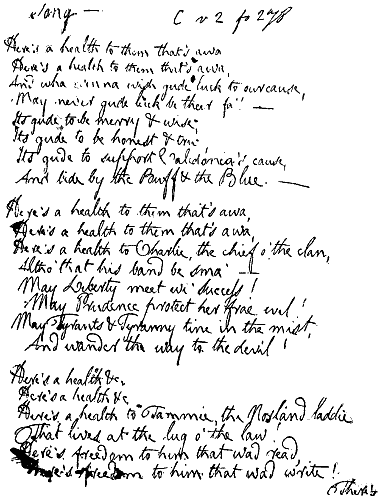
BURNS.
Facsimile of the original of his version of the Scottish song "Here's a Health to Them that's Awa."
Such was the life of Robert Burns,—the hard, struggling, erring, suffering, manly life, of which his poetry is the imperishable record. He was what his birth, his temperament, his circumstances, his genius made him. He owed but little to books, and the books to which he owed anything were written in his mother tongue. His English reading, which was not extensive, harmed him rather than helped him. No English author taught or could teach him anything. He was not English, but Scottish,—Scottish in his nature and genius, Scottish to his heart's core,—the singer of the Scottish people, their greatest poet, and the greatest poet of his time.
THE COTTER'S SATURDAY NIGHT
My loved, my honored, much respected friend! No mercenary bard his homage pays; With honest pride I scorn each selfish end; My dearest meed, a friend's esteem and praise: To you I sing, in simple Scottish lays, The lowly train in life's sequestered scene; The native feelings strong, the guileless ways; What Aiken in a cottage would have been; Ah! though his worth unknown, far happier there, I ween. November chill blaws loud wi' angry sugh1; The shortening winter day is near a close; The miry beasts retreating frae the pleugh; The blackening trains o' craws to their repose The toil-worn Cotter frae his labor goes; This night his weekly moil is at an end; Collects his spades, his mattocks, and his hoes, Hoping the morn in ease and rest to spend, And weary, o'er the moor his course does hameward bend. At length his lonely cot appears in view, Beneath the shelter of an aged tree; The expectant wee-things, toddlin, stacher2 through To meet their Dad, wi' flichterin noise an' glee. His wee bit ingle,3 blinking bonnily, His clean hearthstane, his thriftie wifie's smile, The lisping infant prattling on his knee, Does a' his weary carking cares beguile, An' makes him quite forget his labor an' his toil. Belyve4 the elder bairns come drapping in, At service out, amang the farmers roun'; Some ca' the pleugh, some herd, some tentie5 rin A cannie errand to a neebor town. Their eldest hope, their Jenny, woman grown, In youthfu' bloom, love sparkling in her e'e, Comes hame, perhaps, to shew a braw new gown, Or deposit her sair-won penny-fee, To help her parents dear, if they in hardship be. Wi' joy unfeigned brothers and sisters meet, An' each for other's weelfare kindly speirs6: The social hours, swift-winged, unnoticed fleet; Each tells the uncos7 that he sees or hears: The parents, partial, eye their hopeful years; Anticipation forward points the view. The mother, wi' her needle an' her shears, Gars8 auld claes look amaist as weel's the new; The father mixes a' wi' admonition due. Their masters' an' their mistresses' command, The yonkers a' are warnèd to obey; An' mind their labors wi' an eydent9 hand, An' ne'er, though out o' sight, to jauk10 or play: "An' O! be sure to fear the Lord alway! An' mind your duty duly, morn an' night! Lest in temptation's path ye gang astray, Implore His counsel and assisting might: They never sought in vain that sought the Lord aright!" But hark! a rap comes gently to the door; Jenny, wha kens the meaning o' the same, Tells how a neebor lad cam o'er the moor, To do some errands, and convoy her hame. The wily mother sees the conscious flame Sparkle in Jenny's e'e, and flush her cheek; With heart-struck anxious care, inquires his name, While Jenny hafflins11 is afraid to speak: Weel pleased, the mother hears it's nae wild, worthless rake. Wi' kindly welcome Jenny brings him ben,12 A strappan youth; he taks the mother's eye; Blithe Jenny sees the visit's no ill ta'en: The father cracks13 of horses, pleughs, and kye:14 The youngster's artless heart o'erflows wi' joy, But blate15 and laithfu',16 scarce can weel behave; The mother, wi' a woman's wiles, can spy What makes the youth sae bashfu' an' sae grave; Weel pleased to think her bairn's respected like the lave.17 O happy love, where love like this is found! O heartfelt raptures! bliss beyond compare! I've pacèd much this weary mortal round, And sage experience bids me this declare:— "If Heaven a draught of heavenly pleasure spare, One cordial in this melancholy vale, 'Tis when a youthful, loving, modest pair, In other's arms breathe out the tender tale, Beneath the milk-white thorn that scents the evening gale." Is there in human form, that bears a heart— A wretch! a villain! lost to love and truth! That can, with studied, sly, ensnaring art, Betray sweet Jenny's unsuspecting youth? Curse on his perjured arts! dissembling, smooth! Are honor, virtue, conscience, all exiled? Is there no pity, no relenting ruth, Points to the parents fondling o'er their child? Then paints the ruined maid, and their distraction wild? But now the supper crowns their simple board, The halesome parritch,18 chief o' Scotia's food: The soupe their only Hawkie19 does afford, That 'yont the hallan20 snugly chows her cood:21 The dame brings forth in complimental mood, To grace the lad, her weel-hained22 kebbuck,23 fell, An' aft he's prest, an' aft he ca's it guid; The frugal wifie, garrulous, will tell, How 'twas a towmond24 auld, sin' lint was i' the bell.25 The cheerfu' supper done, wi' serious face, They round the ingle form a circle wide: The sire turns o'er, wi' patriarchal grace, The big ha' Bible, ance his father's pride; His bonnet rev'rently is laid aside, His lyart haffets26 wearing thin an' bare; Those strains that once did sweet in Zion glide, He wales27 a portion wi' judicious care; And "Let us worship God!" he says, with solemn air. They chant their artless notes in simple guise, They tune their hearts, by far the noblest aim: Perhaps 'Dundee's' wild warbling measures rise, Or plaintive 'Martyrs,' worthy of the name; Or noble 'Elgin' beets28 the heavenward flame, The sweetest far of Scotia's holy lays: Compared with these, Italian trills are tame; The tickled ears no heartfelt raptures raise; Nae unison hae they with our Creator's praise. The priest-like father reads the sacred page, How Abram was the friend of God on high; Or Moses bade eternal warfare wage With Amalek's ungracious progeny; Or how the royal bard did groaning lie Beneath the stroke of Heaven's avenging ire; Or Job's pathetic plaint, and wailing cry; Or rapt Isaiah's wild, seraphic fire: Or other holy seers that tune the sacred lyre. Perhaps the Christian volume is the theme: How guiltless blood for guilty man was shed; How He who bore in heaven the second name Had not on earth whereon to lay his head: How his first followers and servants sped; The precepts sage they wrote to many a land; How he who, lone in Patmos banishèd, Saw in the sun a mighty angel stand; And heard great Bab'lon's doom pronounced by Heaven's command. Then kneeling down, to Heaven's Eternal King The saint, the father, and the husband prays: Hope "springs exulting on triumphant wing,"29 That thus they all shall meet in future days: There ever bask in uncreated rays, No more to sigh, or shed the bitter tear, Together hymning their Creator's praise, In such society, yet still more dear; While circling time moves round in an eternal sphere. Compared with this, how poor Religion's pride, In all the pomp of method and of art, When men display to congregations wide Devotion's every grace, except the heart! The Power, incensed, the pageant will desert, The pompous strain, the sacerdotal stole; But haply in some cottage far apart, May hear, well pleased, the language of the soul; And in his Book of Life the inmates poor enroll. Then homeward all take off their several way; The youngling cottagers retire to rest: The parent pair their secret homage pay, And proffer up to Heaven the warm request That He who stills the raven's clamorous nest, And decks the lily fair in flowery pride, Would, in the way His wisdom sees the best, For them and for their little ones provide; But chiefly in their hearts with grace divine preside. From scenes like these old Scotia's grandeur springs, That makes her loved at home, revered abroad; Princes and lords are but the breath of kings, "An honest man's the noblest work of God:"30 And certes, in fair virtue's heavenly road, The cottage leaves the palace far behind; What is a lordling's pomp! a cumbrous load, Disguising oft the wretch of human kind, Studied in arts of hell, in wickedness refined! O Scotia! my dear, my native soil! For whom my warmest wish to Heaven is sent! Long may thy hardy sons of rustic toil Be blest with health, and peace, and sweet content! And oh! may Heaven their simple lives prevent From Luxury's contagion weak and vile! Then, howe'er crowns and coronets be rent, A virtuous populace may rise the while, And stand a wall of fire around their much-loved Isle. O Thou! who poured the patriotic tide That streamed through Wallace's undaunted heart; Who dared to nobly stem tyrannic pride, Or nobly die, the second glorious part, (The patriot's God peculiarly thou art, His friend, inspirer, guardian, and reward!) O never, never, Scotia's realm desert; But still the patriot, and the patriot bard, In bright succession raise, her ornament and guard!
JOHN ANDERSON, MY JO
John Anderson, my jo, John, When we were first acquent, Your locks were like the raven, Your bonnie brow was brent; But now your brow is bald, John, Your locks are like the snaw; But blessings on your frosty pow, John Anderson, my jo. John Anderson, my jo, John, We clamb the hill thegither; And mony a canty day, John, We've had wi' ane anither: Now we maun totter down, John, But hand in hand we'll go; And sleep thegither at the foot, John Anderson, my jo.
MAN WAS MADE TO MOURN
A Dirge
When chill November's surly blast Made fields and forests bare, One evening, as I wandered forth Along the banks of Ayr, I spied a man, whose aged step Seemed weary, worn with care; His face was furrowed o'er with years, And hoary was his hair. "Young stranger, whither wanderest thou?" Began the reverend sage; "Does thirst of wealth thy step constrain, Or youthful pleasure's rage? Or haply, pressed with cares and woes, Too soon thou hast began To wander forth, with me, to mourn The miseries of man! "The sun that overhangs yon moors, Outspreading far and wide, Where hundreds labor to support A haughty lordling's pride;— I've seen yon weary winter sun Twice forty times return; And every time has added proofs That man was made to mourn. "O man! while in thy early years, How prodigal of time! Misspending all thy precious hours, Thy glorious youthful prime! Alternate follies take the sway, Licentious passions burn; Which tenfold force gives Nature's law, That man was made to mourn. "Look not alone on youthful prime, Or manhood's active might; Man then is useful to his kind, Supported is his right: But see him on the edge of life, With cares and sorrows worn, Then age and want—oh ill-matched pair!— Show man was made to mourn. "A few seem favorites of fate, In Pleasure's lap caressed; Yet think not all the rich and great Are likewise truly blest. But oh! what crowds in every land Are wretched and forlorn! Through weary life this lesson learn, That man was made to mourn. "Many and sharp the num'rous ills Inwoven with our frame; More pointed still we make ourselves Regret, remorse, and shame! And man, whose heaven-erected face The smiles of love adorn, Man's inhumanity to man Makes countless thousands mourn! "See yonder poor o'er-labored wight, So abject, mean, and vile, Who begs a brother of the earth To give him leave to toil; And see his lordly fellow-worm The poor petition spurn, Unmindful, though a weeping wife And helpless offspring mourn. "If I'm designed yon lordling's slave, By Nature's law designed, Why was an independent wish E'er planted in my mind? If not, why am I subject to His cruelty or scorn? Or why has man the will and power To make his fellow mourn? "Yet let not this too much, my son, Disturb thy youthful breast; This partial view of humankind Is surely not the best! The poor, oppressèd, honest man, Had never, sure, been born, Had there not been some recompense To comfort those that mourn. "O Death! the poor man's dearest friend— The kindest and the best! Welcome the hour my agèd limbs Are laid with thee at rest! The great, the wealthy, fear thy blow From pomp and pleasure torn; But, oh! a blest relief to those That weary-laden mourn!"
GREEN GROW THE RASHES
There's naught but care on every han', In every hour that passes, O: What signifies the life o' man, An 't werena for the lasses, O?
CHORUS
Green grow the rashes, O! Green grow the rashes, O! The sweetest hours that e'er I spent Were spent amang the lasses, O! The warly race may riches chase, An' riches still may fly them, O; An' though at last they catch them fast, Their hearts can ne'er enjoy them, O. But gi'e me a canny hour at e'en, My arms about my dearie, O; An' warly cares, an' warly men, May a' gae tapsalteerie, O! For you sae douce, ye sneer at this, Ye're nought but senseless asses, O; The wisest man the warl' e'er saw, He dearly loved the lasses, O. Auld Nature swears the lovely dears Her noblest work she classes, O; Her 'prentice han' she tried on man, An' then she made the lasses, O.
IS THERE FOR HONEST POVERTY
Is there for honest poverty That hangs his head, and a' that? The coward slave, we pass him by, We dare be poor for a' that! For a' that, and a' that, Our toil's obscure, and a' that: The rank is but the guinea's stamp, The man's the gowd for a' that. What though on hamely fare we dine, Wear hoddin gray, and a' that? Gi'e fools their silks, and knaves their wine, A man's a man for a' that; For a' that, and a' that, Their tinsel show, and a' that— The honest man, though e'er sae poor, Is king o' men for a' that. Ye see yon birkie,31 ca'd a lord, Wha struts, and stares, and a' that: Though hundreds worship at his word, He's but a coof32 for a' that: For a' that, and a' that, His riband, star, and a' that— The man of independent mind, He looks and laughs at a' that. A prince can mak' a belted knight, A marquis, duke, and a' that, But an honest man's aboon his might— Guid faith, he mauna fa' that! For a' that, and a' that, Their dignities, and a' that, The pith o' sense and pride o' worth Are higher ranks than a' that. Then let us pray that come it may— As come it will for a' that— That sense and worth, o'er a' the earth, May bear the gree, and a' that. For a' that, and a' that, It's comin' yet, for a' that,— That man to man, the warld o'er, Shall brothers be for a' that!
TO A MOUSE
Flying before a Plow
Wee, sleekit, cowrin', tim'rous beastie, Oh, what a panic's in thy breastie! Thou needna start awa' sae hasty, Wi' bick'ring brattle!33 I wad be laith to rin and chase thee, Wi' murd'ring pattle!34 I'm truly sorry man's dominion Has broken nature's social union, And justifies that ill opinion Which mak's thee startle At me, thy poor earth-born companion And fellow-mortal! I doubt na, whiles, but thou may thieve; What then? poor beastie, thou maun live! A daimen icker in a thrave35 'S a sma' request: I'll get a blessin' wi' the lave, And never miss 't! Thy wee bit housie, too, in ruin! Its silly36 wa's the win's are strewin'! And naething now to big37 a new ane O' foggage38 green! And bleak December's winds ensuin', Baith snell39 and keen! Thou saw the fields laid bare and waste, And weary winter comin' fast, And cozie here, beneath the blast Thou thought to dwell, Till, crash! the cruel coulter past Out through thy cell. That wee bit heap o' leaves and stibble Has cost thee mony a weary nibble! Now thou's turned out for a' thy trouble, But house or hauld,40 To thole41 the winter's sleety dribble, And cranreuch42 cauld! But, Mousie, thou art no thy lane43 In proving foresight may be vain! The best-laid schemes o' mice and men Gang aft agley, And lea'e us naught but grief and pain For promised joy. Still thou art blest, compared wi' me! The present only toucheth thee; But och! I backward cast my e'e On prospects drear! And forward, though I canna see, I guess and fear.
TO A MOUNTAIN DAISY
On Turning One Down with the Plow
Wee, modest, crimson-tippèd flower, Thou's met me in an evil hour; For I maun crush amang the stoure44 Thy slender stem; To spare thee now is past my power, Thou bonnie gem. Alas! it's no thy neebor sweet, The bonnie lark, companion meet! Bending thee 'mang the dewy weet, Wi' spreckled breast, When upward-springing, blithe, to greet The purpling east. Cauld blew the bitter biting north Upon thy early, humble birth, Yet cheerfully thou glinted45 forth Amid the storm, Scarce reared above the parent earth Thy tender form. The flaunting flowers our gardens yield, High shelt'ring woods and wa's maun shield; But thou beneath the random bield46 O' clod or stane, Adorns the histie47 stibble-field, Unseen, alane. There, in thy scanty mantle clad, Thy snawy bosom sunward spread, Thou lifts thy unassuming head In humble guise; But now the share uptears thy bed, And low thou lies! Such is the fate of artless maid, Sweet flow'ret of the rural shade! By love's simplicity betrayed, And guileless trust, Till she, like thee, all soiled, is laid Low i' the dust. Such is the fate of simple bard, On life's rough ocean luckless starred! Unskillful he to note the card Of prudent lore, Till billows rage, and gales blow hard, And whelm him o'er! Such fate to suffering worth is given, Who long with wants and woes has striven, By human pride or cunning driven To mis'ry's brink, Till wrenched of every stay but Heaven, He, ruined, sink! Ev'n thou who mourn'st the Daisy's fate, That fate is thine—no distant date; Stern Ruin's plowshare drives, elate, Full on thy bloom, Till crushed beneath the furrow's weight Shall be thy doom!
TAM O' SHANTER
When chapman billies48 leave the street, And drouthy49 neebors neebors meet, As market days are wearing late, An' folk begin to tak' the gate50; While we sit bousing at the nappy,51 An' getting fou and unco happy, We think na on the lang Scots miles, The mosses, waters, slaps,52 and stiles, That lie between us and our hame, Whaur sits our sulky, sullen dame, Gathering her brows like gathering storm, Nursing her wrath to keep it warm. This truth fand honest Tam o' Shanter, As he frae Ayr ae night did canter (Auld Ayr, wham ne'er a town surpasses, For honest men and bonny lasses). O Tam! hadst thou but been sae wise, As ta'en thy ain wife Kate's advice! She tauld thee weel thou was a skellum,53 A blethering,54 blustering, drunken blellum55; That frae November till October, Ae market-day thou was nae sober; That ilka melder,56 wi' the miller, Thou sat as lang as thou had siller; That every naig was ca'd a shoe on,57 The smith and thee gat roaring fou on; That at the Lord's house, ev'n on Sunday, Thou drank wi' Kirkton Jean58 till Monday. She prophesied that, late or soon, Thou would be found deep drowned in Doon; Or catched wi' warlocks in the mirk, By Alloway's auld haunted kirk. Ah, gentle dames! it gars me greet,59 To think how mony counsels sweet, How many lengthened sage advices, The husband frae the wife despises! But to our tale:—Ae market-night, Tam had got planted unco right; Fast by an ingle,60 bleezing finely, Wi' reaming swats,61 that drank divinely; And at his elbow, Souter62 Johnny, His ancient, trusty, drouthy crony: Tam lo'ed him like a vera brither; They had been fou for weeks thegither. The night drave on wi' sangs an' clatter, And aye the ale was growing better; The landlady and Tam grew gracious, Wi' favors, secret, sweet, and precious; The Souter tauld his queerest stories; The landlord's laugh was ready chorus; The storm without might rair63 and rustle. Tam did na mind, the storm a whistle. Care, mad to see a man sae happy, E'en drowned himself amang the nappy; As bees flee hame wi' lades o' treasure, The minutes winged their way wi' pleasure: Kings may be blest, but Tam was glorious, O'er a' the ills o' life victorious! But pleasures are like poppies spread, You seize the flower, its bloom is shed! Or like the snowfall in the river, A moment white—then melts for ever; Or like the Borealis race, That flit ere you can point their place; Or like the rainbow's lovely form Evanishing amid the storm. Nae man can tether time or tide; The hour approaches Tam maun ride: That hour, o' night's black arch the keystane, That dreary hour he mounts his beast in: And sic a night he tak's the road in, As ne'er poor sinner was abroad in. The wind blew as 'twad blawn its last; The rattlin' showers rose on the blast; The speedy gleams the darkness swallowed; Loud, deep, and lang the thunder bellowed: That night, a child might understand, The de'il had business on his hand. Weel mounted on his gray mare Meg (A better never lifted leg), Tam skelpit64 on through dub and mire, Despising wind, and rain, and fire; Whiles holding fast his guid blue bonnet, Whiles crooning o'er some auld Scots sonnet, Whiles glow'ring round wi' prudent cares, Lest bogles65 catch him unawares; Kirk-Alloway was drawing nigh, Whaur ghaists and houlets66 nightly cry. By this time he was 'cross the ford, Whaur in the snaw the chapman smoored;67 And past the birks and meikle stane, Whaur drunken Charlie brak's neck-bane; And through the whins, and by the cairn, Whaur hunters fand the murdered bairn; And near the thorn, aboon the well, Whaur Mungo's mither hanged hersel'. Before him Doon pours all his floods; The doubling storm roars through the woods; The lightnings flash from pole to pole; Near and more near the thunders roll; When, glimmering through the groaning trees, Kirk-Alloway seemed in a bleeze; Through ilka bore68 the beams were glancing; And loud resounded mirth and dancing. Inspiring, bold John Barleycorn! What dangers thou canst mak' us scorn! Wi' tippenny69 we fear nae evil; Wi' usquabae70 we'll face the devil! The swats71 sae reamed72 in Tammie's noddle, Fair play, he cared na de'ils a boddle.73 But Maggie stood right sair astonished, Till, by the heel and hand admonished She ventured forward on the light; And wow! Tam saw an unco sight! Warlocks and witches in a dance; Nae cotillion brent new frae France, But hornpipes, jigs, strathspeys, and reels Put life and mettle in their heels. At winnock-bunker74 in the east, There sat auld Nick, in shape o' beast;— A towzie tyke,75 black, grim, and large; To gi'e them music was his charge: He screwed the pipes and gart them skirl,76 Till roof and rafters a' did dirl!77 Coffins stood round, like open presses, That shawed the dead in their last dresses; And by some devilish cantrip78 slight, Each in its cauld hand held a light, By which heroic Tam was able To note upon the haly table A murderer's banes in gibbet airns;79 Twa span-lang, wee unchristened bairns; A thief new-cutted frae a rape, Wi' his last gasp his gab80 did gape; Five tomahawks, wi' bluid red-rusted; Five scimitars wi' murder crusted; A garter which a babe had strangled; A knife a father's throat had mangled, Whom his ain son o' life bereft— The gray hairs yet stack to the heft: Wi' mair o' horrible and awfu', Which ev'n to name wad be unlawfu'. As Tammie glow'red,81 amazed and curious, The mirth and fun grew fast and furious: The piper loud and louder blew; The dancers quick and quicker flew; They reeled, they set, they crossed, they cleekit,82 Till ilka carlin83 swat and reekit,84 And coost85 her duddies86 to the wark, And linket87 at it in her sark!88 Now Tam, O Tam! had they been queans A' plump and strapping, in their teens; Their sarks, instead o' creeshie flannen,89 Been snaw-white seventeen-hunder linen90, Thir breeks91 o' mine, my only pair, That ance were plush, o' guid blue hair, I wad hae gi'en them off my hurdies, For ane blink o' the bonnie burdies! But withered beldams old and droll, Rigwoodie92 hags wad spean93 a foal, Lowping and flinging on a crummock,94 I wonder didna turn thy stomach. But Tam kenned what was what fu' brawlie: "There was ae winsome wench and walie,"95 That night inlisted in the core (Lang after kenned on Carrick shore! For mony a beast to dead she shot, And perished mony a bonnie boat, And shook baith meikle corn and bear,96 And kept the country-side in fear), Her cutty sark,97 o' Paisley harn,98 That while a lassie she had worn, In longitude though sorely scanty, It was her best, and she was vauntie.99 Ah! little kenned thy reverend grannie, That sark she coft100 for her wee Nannie, Wi' twa pund Scots ('twas a' her riches), Wad ever graced a dance of witches! But here my muse her wing maun cour101; Sic flights are far beyond her power: To sing how Nannie lap and flang (A souple jade she was and strang), And how Tam stood like ane bewitched, And thought his very een enriched; Even Satan glow'red and fidged fu' fain, And hotched and blew wi' might and main: Till first ae caper, syne anither, Tam tints102 his reason a'thegither, And roars out, "Weel done, Cutty-sark!" And in an instant all was dark; And scarcely had he Maggie rallied, When out the hellish legion sallied. As bees bizz out wi' angry fyke,103 When plundering hords assail their byke104; As open pussie's mortal foes When, pop! she starts before their nose; As eager runs the market-crowd, When "Catch the thief!" resounds aloud; So Maggie runs, the witches follow, Wi' mony an eldritch105 screech and hollow. Ah, Tam! ah, Tam, thou'll get thy fairin'! In hell they'll roast thee like a herrin'! In vain thy Kate awaits thy comin'! Kate soon will be a woefu' woman! Now, do thy speedy utmost, Meg, And win the keystane of the brig; There at them thou thy tail may toss,— A running stream they dare na cross. But ere the keystane she could make, The fient a tail she had to shake! For Nannie, far before the rest, Hard upon noble Maggie prest, And flew at Tam wi' furious ettle; But little wist she Maggie's mettle— Ae spring brought off her master hale, But left behind her ain grey tail: The carlin claught her by the rump, And left poor Maggie scarce a stump! Now, wha this tale o' truth shall read, Ilk man and mother's son, take heed: Whene'er to drink you are inclined, Or cutty sarks run in your mind, Think, ye may buy the joys o'er dear— Remember Tam o' Shanter's mare.
BRUCE TO HIS MEN AT BANNOCKBURN
Scots wha hae wi' Wallace bled, Scots wham Bruce has aften led; Welcome to your gory bed, Or to victorie! Now's the day, and now's the hour; See the front o' battle lour: See approach proud Edward's pow'r— Chains and slaverie! Wha will be a traitor-knave? Wha can fill a coward's grave? Wha sae base as be a slave? Let him turn and flee! Wha for Scotland's king and law Freedom's sword will strongly draw, Freemen stand, or freemen fa', Let him follow me! By oppression's woes and pains! By our sons in servile chains! We will drain our dearest veins, But they shall be free! Lay the proud usurpers low! Tyrants fall in every foe! Liberty's in every blow!— Let us do or die!
HIGHLAND MARY
Ye banks and braes and streams around The castle o' Montgomery, Green be your woods, and fair your flowers, Your waters never drumlie! There Simmer first unfald her robes, And there the langest tarry; For there I took the last fareweel O' my sweet Highland Mary. How sweetly bloomed the gay green birk, How rich the hawthorn's blossom! As underneath their fragrant shade, I clasped her to my bosom! The golden hours, on angel wings, Flew o'er me and my dearie; For dear to me as light and life Was my sweet Highland Mary. Wi' mony a vow and locked embrace Our parting was fu' tender; And, pledging aft to meet again, We tore oursel's asunder; But oh! fell Death's untimely frost, That nipt my flower sae early! Now green's the sod and cauld's the clay That wraps my Highland Mary! Oh pale, pale now those rosy lips, I aft hae kissed so fondly! And closed for aye the sparkling glance, That dwelt on me sae kindly; And moldering now in silent dust That heart that lo'ed me dearly! But still within my bosom's core Shall live my Highland Mary.
MY HEART'S IN THE HIGHLANDS
My heart's in the Highlands, my heart is not here; My heart's in the Highlands, a-chasing the deer; Chasing the wild deer, and following the roe— My heart's in the Highlands wherever I go. Farewell to the Highlands, farewell to the North! The birthplace of valor, the country of worth; Wherever I wander, wherever I rove, The hills of the Highlands for ever I love. Farewell to the mountains high covered with snow! Farewell to the straths and green valleys below! Farewell to the forests and wild-hanging woods! Farewell to the torrents and loud-pouring floods! My heart's in the Highlands, my heart is not here, My heart's in the Highlands a-chasing the deer; Chasing the wild deer, and following the roe— My heart's in the Highlands wherever I go.
THE BANKS O' DOON
Ye banks and braes o' bonnie Doon, How can ye bloom sae fresh and fair? How can ye chant, ye little birds, And I sae weary fu' o' care? Thou'll break my heart, thou warbling bird, That wantons through the flowering thorn; Thou minds me o' departed joys, Departed—never to return! Oft ha'e I roved by bonnie Doon, To see the rose and woodbine twine; And ilka bird sang o' its luve, And fondly sae did I o' mine. Wi' lightsome heart I pu'd a rose, Fu' sweet upon its thorny tree; And my fause lover stole my rose, But ah! he left the thorn wi' me.
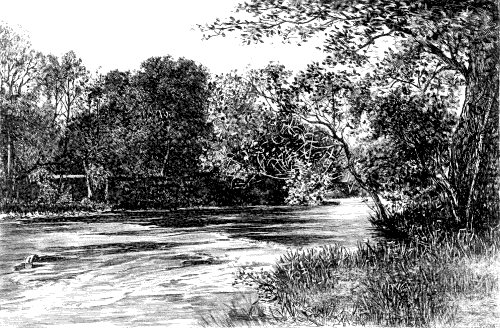
"THE BANKS AND BRAES O' BONNIE DOON."
Oft hae I roved by bonnie Doon, To see the rose and woodbine twine; And ilka bird sang o' his luve. And fondly sae did I o' mine.
Etching from a Photograph.