Volume 7 — FERNAN CABALLERO
Reading edition
(CECILIA BÖHL DE FABER)
(1796-1877)

England, France, and Spain have each produced within this century a woman of genius, taking rank among the very first writers of their respective countries. Fernan Caballero, without possessing the breadth of intellect or the scholarship of George Eliot, or the artistic sense of George Sand, is yet worthy to be named with these two great novelists for the place she holds in Spanish literature. Interesting parallels might be drawn between them, aside from the curious coincidence that each chose a masculine pen-name to conceal her sex, and to gain the ear of a generation suspicious of feminine achievements. Each portrayed both the life of the gentleman and that of the rustic, and each is at her best in her homelier portraitures.
Unlike her illustrious compeers, Fernan Caballero did not grow up amid the scenes she drew. In the scanty records of her life it does not appear whether, like George Sand, she had first to get rid of a rebellious self before she could produce those objective masterpieces of description, where the individuality of the writer disappears in her realization of the lives and thoughts of a class alien to her own. Her inner life cannot be reconstructed from her stories: her outward life can be told in a few words. She was born December 25th, 1796, in Morges, Switzerland, the daughter of Juan Nicholas Böhl de Faber, a German merchant in Cadiz, who had married a Spanish lady of noble family. A cultivated man he was, greatly interested in the past of Spain, and had published a collection of old Castilian ballads. From him Cecilia derived her love of Spanish folk-lore. Her earliest years were spent going from place to place with her parents, now Spain, now Paris, now Germany. From six to sixteen she was at school in Hamburg. Joining her family in Cadiz, she was married at the age of seventeen. Left a widow within a short time, she married after five years the wealthy Marquis de Arco-Hermaso. His palace in Seville became a social centre, for his young wife, beautiful, witty, and accomplished, was a born leader of society. She now had to the full the opportunity of studying those types of Spanish ladies and gentlemen whose gay, inconsequent chatter she has so brilliantly reproduced in her novels dealing with high life. The Marquis died in 1835, and after two years she again married, this time the lawyer De Arrom. Losing his own money and hers, he went as Spanish consul to Australia, where he died in 1863. She remained behind, retired to the country, and turned to literature. From 1857 to 1866 she lived in the Alcazar in Seville, as governess to the royal children of Spain. She died April 7th, 1877, in Seville,—somewhat solitary, for a new life of ideas flowing into Spain, and opposing her intense conservatism, isolated her from companionship.
Fernan Caballero began to publish when past fifty, attained instant success, and never again reached the high level of her first book. 'La Gaviota' (The Sea-Gull) appeared in 1849 in the pages of a Madrid daily paper, and at once made its author famous. 'The Family of Alvoreda,' an earlier story, was published after her first success. Washington Irving, who saw the manuscript of this, encouraged her to go on. Her novels were fully translated, and she soon had a European reputation. Her work may be divided into three classes: novels of social life in Seville, such as 'Elia' and 'Clemencia'; novels of Andalusian peasant life, as 'The Family of Alvoreda' ('La Gaviota' uniting both); and a number of short stories pointing a moral or embodying a proverb. She published besides, in 1859, the first collection of Spanish fairy tales.
Fernan Caballero created the modern Spanish novel. For two hundred years after Cervantes there are few names of note in prose fiction. French taste dominated Spanish literature, and poor imitations of the French satisfied the reading public. A foreigner by birth and a cosmopolitan by education, the clever new-comer cried out against this foreign influence, and set herself to bring the national characteristics to the front. She belonged to the old Spanish school, with its Catholicism, its prejudices, its reverence for the old, its hatred of new ideas and modern improvements. She painted thus Old Spain with a master's brush. But she especially loved Andalusia, that most poetic province of her country, with its deep-blue luminous sky, its luxuriant vegetation, its light-hearted, witty populace, and she wrote of them with rare insight and exquisite tenderness. Tasked with having idealized them, she replied:—"Many years of unremitting study, pursued con amore, justify me in assuring those who find fault with my portrayal of popular life that they are less acquainted with them than I am." And in another place she says:—"It is amongst the people that we find the poetry of Spain and of her chronicles. Their faith, their character, their sentiment, all bear the seal of originality and of romance. Their language may be compared to a garland of flowers. The Andalusian peasant is elegant in his bearing, in his dress, in his language, and in his ideas."
Her stories lose immensely in the translation, for it is almost impossible to reproduce in another tongue the racy native speech, with its constant play on words, its wealth of epigrammatic proverbs, its snatches of ballad or song interwoven into the common talk of the day. The Andalusian peasant has an inexhaustible store of bits of poetry, coplas, that fit into every occurrence of his daily life. Fernan Caballero gathered up these flowers of speech as they fell from the lips of the common man, and wove them into her tales. Besides their pictures of Andalusian rural life, these stories reveal a wealth of popular songs, ballads, legends, and fairy tales, invaluable alike to the student of manners and of folk-lore. She has little constructive skill, but much genius for detail. As a painter of manners and of nature she is unrivaled. In a few bold strokes she brings a whole village before our eyes. Nor is the brute creation forgotten. In her sympathy for animals she shows her foreign extraction, the true Spaniard having little compassion for his beasts. She inveighs against the national sport, the bull-fight; against the cruel treatment of domestic animals. Her work is always fresh and interesting, full of humor and of pathos. A close observer and a realist, she never dwells on the unlovely, is never unhealthy or sentimental. Her name is a household word in Spain, where a foremost critic wrote of 'La Gaviota':—"This is the dawn of a beautiful day, the first bloom of a poetic crown that will encircle the head of a Spanish Walter Scott."
Perhaps the best summary of her work is given in her own words, where she says:—
"In composing this light work we did not intend to write a novel, but strove to give an exact and true idea of Spain, of the manners of its people, of their character, of their habits. We desired to sketch the home life of the people in the higher and lower classes, to depict their language, their faith, their traditions, their legends. What we have sought above all is to paint after nature, and with the most scrupulous exactitude, the objects and persons brought forward. Therefore our readers will seek in vain amid our actors for accomplished heroes or consummate villains, such as are found in the romances of chivalry or in melodramas. Our ambition has been to give as true an idea as possible of Spain and the Spaniards. We have tried to dissipate those monstrous prejudices transmitted and preserved like Egyptian mummies from generation to generation. It seemed to us that the best means of attaining this end was to replace with pictures traced by a Spanish pen those false sketches sprung from the pens of strangers."
THE BULL-FIGHT
From 'La Gaviota'
When after dinner Stein and his wife arrived at the place assigned for the bull-fight, they found it already filled with people. A brief and sustained animation preceded the fête. This immense rendezvous, where were gathered together all the population of the city and its environs; this agitation, like to that of the blood which in the paroxysms of a violent passion rushes to the heart; this feverish expectation, this frantic excitement,—kept, however, within the limits of order; these exclamations, petulant without insolence; this deep anxiety which gives a quivering to pleasure: all this together formed a species of moral magnetism; one must succumb to its force or hasten to fly from it.
Stein, struck with vertigo, and his heart wrung, would have chosen flight: his timidity kept him where he was. He saw in all eyes which were turned on him the glowing of joy and happiness; he dared not appear singular. Twelve thousand persons were assembled in this place; the rich were thrown in the shade, and the varied colors of the costumes of the Andalusian people were reflected in the rays of the sun.
Soon the arena was cleared.
Then came forward the picadores, mounted on their unfortunate horses, who with head lowered and sorrowful eyes seemed to be—and were in reality—victims marching to the sacrifice.
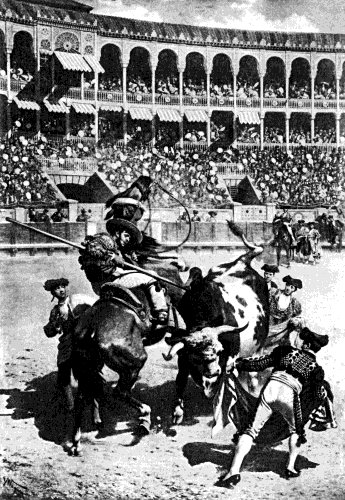
THE BULL-FIGHT.
Photogravure from a painting by Alexander Wagner.
Stein, at the appearance of these poor animals, felt himself change to a painful compassion; a species of disgust which he already experienced. The provinces of the peninsula which he had traversed hitherto were devastated by the civil war, and he had had no opportunity of seeing these fêtes, so grand, so national, and so popular, where were united to the brilliant Moorish strategy the ferocious intrepidity of the Gothic race. But he had often heard these spectacles spoken of, and he knew that the merit of a fight is generally estimated by the number of horses that are slain. His pity was excited towards these poor animals, which, after having rendered great services to their masters,—after having conferred on them triumph, and perhaps saved their lives,—had for their recompense, when age and the excess of work had exhausted their strength, an atrocious death which by a refinement of cruelty they were obliged themselves to seek. Instinct made them seek this death; some resisted, while others, more resigned or more feeble, went docilely before them to abridge their agony. The sufferings of these unfortunate animals touched the hardest heart; but the amateurs had neither eyes, attention, nor interest, except for the bull. They were under a real fascination, which communicated itself to most of the strangers who came to Spain, and principally for this barbarous amusement. Besides, it must be avowed—and we avow it with grief—that compassion for animals is, in Spain, particularly among the men, a sentiment more theoretical than practical. Among the lower classes it does not exist at all.
The three picadores saluted the president of the fête, preceded by the banderilleros and the chulos, splendidly dressed, and carrying the capas of bright and brilliant colors. The matadores and their substitutes commanded all these combatants, and wore the most luxurious costumes.
"Pepe Vera! here is Pepe Vera!" cried all the spectators. "The scholar of Montés! Brave boy! What a jovial fellow! how well he is made! what elegance and vivacity in all his person! how firm his look! what a calm eye!"
"Do you know," said a young man seated near to Stein, "what is the lesson Montés gives to his scholars? He pushes them, their arms crossed, close to the bull, and says to them, 'Do not fear the bull—brave the bull!'"
Pepe Vera descended into the arena. His costume was of cherry-colored satin, with shoulder-knots and silver embroidery in profusion. From the little pockets of his vest stuck out the points of orange-colored scarfs. A waistcoat of rich tissue of silver and a pretty little cap of velvet completed his coquettish and charming costume of majo.
After having saluted the authorities with much ease and grace, he went like the other combatants to take his accustomed place. The three picadores also went to their posts, at equal distance from each other, near to the barrier. There was then a profound, an imposing silence. One might have said that this crowd, lately so noisy, had suddenly lost the faculty of breathing.
The alcalde gave the signal, the clarions sounded, and as if the trumpet of the Last Judgment had been heard, all the spectators arose with most perfect ensemble; and suddenly was seen opened the large door of the toril, placed opposite to the box occupied by the authorities. A bull whose hide was red precipitated himself into the arena, and was assailed by a universal explosion of cheers, of cries, of abuse, and of praise. At this terrible noise the bull, affrighted, stopped short, raised his head; his eyes were inflamed, and seemed to demand if all these provocations were addressed to him; to him, the athletic and powerful, who until now had been generous towards man, and who had always shown favor towards him as to a feeble and weak enemy. He surveyed the ground, turning his menacing head on all sides—he still hesitated: the cheers, shrill and penetrating, became more and more shrill and frequent. Then with a quickness which neither his weight nor his bulk foretold, he sprang towards the picador, who planted a lance in his withers. The bull felt a sharp pain, and soon drew back. It was one of those animals which in the language of bull-fighting are called "boyantes," that is to say, undecided and wavering; whence he did not persist in his first attack, but assailed the second picador. This one was not so well prepared as the first, and the thrust of his lance was neither so correct nor so firm; he wounded the animal without being able to arrest his advance. The horns of the bull were buried in the body of the horse, who fell to the ground. A cry of fright was raised on all sides, and the chulos surrounded this horrible group; but the ferocious animal had seized his prey, and would not allow himself to be distracted from his vengeance. In this moment of terror, the cries of the multitude were united in one immense clamor, which would have filled the city with fright if it had not come from the place of the bull-fight. The danger became more frightful as it was prolonged.
The bull tenaciously attacked the horse, who was overwhelmed with his weight and with his convulsive movements, while the unfortunate picador was crushed beneath these two enormous masses. Then was seen to approach, light as a bird with brilliant plumage, tranquil as a child who goes to gather flowers, calm and smiling at the same time, a young man, covered with silver embroidery and sparkling like a star. He approached in the rear of the bull; and this young man of delicate frame, and of appearance so distinguished, took in both hands the tail of the terrible animal, and drew it towards him. The bull, surprised, turned furiously and precipitated himself on his adversary, who without a movement of his shoulder, and stepping backward, avoided the first shock by a half-wheel to the right.
The bull attacked him anew; the young man escaped a second time by another half-wheel to the left, continuing to manage him until he reached the barrier. There he disappeared from the eyes of the astonished animal, and from the anxious gaze of the public, who in the intoxication of their enthusiasm filled the air with their frantic applause; for we are always ardently impressed when we see man play with death, and brave it with so much coolness.
"See now if he has not well followed the lesson of Montés! See if Pepe Vera knows how to act with the bull!" said the young man seated near to them, who was hoarse from crying out.
The Duke at this moment fixed his attention on Marisalada. Since the arrival of this young woman at the capital of Andalusia, it was the first time that he had remarked any emotion on this cold and disdainful countenance. Until now he had never seen her animated. The rude organization of Marisalada was too vulgar to receive the exquisite sentiment of admiration. There was in her character too much indifference and pride to permit her to be taken by surprise. She was astonished at nothing, interested in nothing. To excite her, be it ever so little, to soften some part of this hard metal, it was necessary to employ fire and to use the hammer.
Stein was pale. "My lord Duke," he said, with an air full of sweetness and of conviction, "is it possible that this diverts you?"
"No," replied the Duke; "it does not divert, it interests me."
During this brief dialogue they had raised up the horse. The poor animal could not stand on his legs; his intestines protruded and bespattered the ground. The picador was also raised up; he was removed between the arms of the chulos. Furious against the bull, and led on by a blind temerity, he would at all hazards remount his horse and return to the attack, in spite of the dizziness produced by his fall. It was impossible to dissuade him; they saw him indeed replace the saddle upon the poor victim, into the bruised flanks of which he dug his spurs.
"My lord Duke," said Stein, "I may perhaps appear to you ridiculous, but I do not wish to remain at this spectacle. Maria, shall we depart?"
"No," replied Maria, whose soul seemed to be concentrated in her eyes. "Am I a little miss? and are you afraid that by accident I may faint?"
"In such case," said Stein, "I will come back and take you when the course is finished." And he departed.
The bull had disposed of a sufficiently good number of horses. The unfortunate courser which we have mentioned was taken away—rather drawn than led by the bridle to the door, by which he made his retreat. The others, which had not the strength again to stand up, lay stretched out in the convulsions of agony; sometimes they stretched out their heads as though impelled by terror. At these last signs of life the bull returned to the charge, wounding anew with plunges of his horns the bruised members of his victims. Then, his forehead and horns all bloody, he walked around the circus affecting an air of provocation and defiance: at times he proudly raised his head towards the amphitheatre, where the cries did not cease to be heard; sometimes it was towards the brilliant chulos who passed before him like meteors, planting their banderillos in his body. Often from a cage, or from a netting hidden in the ornaments of a banderillero, came out birds, which joyously took up their flight. The first inventor of this strange and singular contrast could not certainly have had the intention to symbolize innocence without defense, rising above the horrors and ferocious passions here below, in its happy flight towards heaven. That would be, without doubt, one of those poetic ideas which are born spontaneously in the hard and cruel heart of the Spanish plebeian, as we see in Andalusia the mignonette plant really flourish between stones and the mortar of a balcony.
At the signal given by the president of the course, the clarions again sounded. There was a moment of truce in this bloody wrestling, and it created a perfect silence.
Then Pepe Vera, holding in his left hand a sword and a red-hooded cloak, advanced near to the box of the alcalde. Arrived opposite, he stopped and saluted, to demand permission to slay the bull.
Pepe Vera perceived the presence of the Duke, whose taste for the bull-fight was well known; he had also remarked the woman who was seated at his side, because this woman, to whom the Duke frequently spoke, never took her eyes off the matador.
He directed his steps towards the Duke, and taking off his cap, said, "Brindo (I offer the honor of the bull) to you, my lord, and to the royal person who is near you."
At these words, casting his cap on the ground with an inimitable abandon, he returned to his post.
The chulos regarded him attentively, all ready to execute his orders. The matador chose the spot which suited him the best, and indicated it to his quadrilla.
"Here!" he cried out to them.
The chulos ran towards the bull and excited him, and in pursuing them met Pepe Vera, face to face, who had awaited his approach with a firm step. It was the solemn moment of the whole fight. A profound silence succeeded to the noisy tumult, and to the warm excitement which until then had been exhibited towards the matador.
The bull, on seeing this feeble enemy, who had laughed at his fury, stopped as if he wished to reflect. He feared, without doubt, that he would escape him a second time.
Whoever had entered into the circus at this moment would sooner believe he was assisting in a solemn religious assembly, than in a public amusement, so great was the silence.
The two adversaries regarded each other reciprocally.
Pepe Vera raised his left hand: the bull sprang on him. Making only a light movement, the matador let him pass by his side, returned and put himself on guard. When the animal turned upon him the man directed his sword towards the extremity of the shoulder, so that the bull, continuing his advance, powerfully aided the steel to penetrate completely into his body.
It was done! He fell lifeless at the feet of his vanquisher.
To describe the general burst of cries and bravos which broke forth from every part of this vast arena, would be a thing absolutely impossible. Those who are accustomed to be present at these spectacles alone can form an idea of it. At the same time were heard the strains of the military bands.
Pepe Vera tranquilly traversed the arena in the midst of these frantic testimonials of passionate admiration and of this unanimous ovation, saluting with his sword right and left in token of his acknowledgments. This triumph, which might have excited the envy of a Roman emperor, in him did not excite the least surprise—the least pride. He then went to salute the ayuntamiento; then the Duke and the "royal" young lady.
The Duke then secretly handed to Maria a purse full of gold, and she enveloped it in her handkerchief and cast it into the arena.
Pepe Vera again renewed his thanks, and the glance of his black eyes met those of the Gaviota. In describing the meeting of these looks, a classic writer said that it wounded these two hearts as profoundly as Pepe Vera wounded the bull.
We who have not the temerity to ally ourselves to this severe and intolerant school, we simply say that these two natures were made to understand each other—to sympathize. They in fact did understand and sympathize.
It is true to say that Pepe had done admirably.
All that he had promised in a situation where he placed himself between life and death had been executed with an address, an ease, a dexterity, and a grace, which had not been baffled for an instant.
For such a task it is necessary to have an energetic temperament and a daring courage, joined to a certain degree of self-possession, which alone can command twenty-four thousand eyes which observe, and twenty-four thousand hands which applaud.
IN THE HOME CIRCLE
From 'La Gaviota'
A month after the scenes we have described, Marisalada was more sensible, and did not show the least desire to return to her father's. Stein was completely re-established; his good-natured character, his modest inclinations, his natural sympathies, attached him every day more to the peaceful habits of the simple and generous persons among whom he dwelt. He felt relieved from his former discouragements, and his mind was invigorated; he was cordially resigned to his present existence, and to the men with whom he associated.
One afternoon, Stein, leaning against an angle of the convent which faced the sea, admired the grand spectacle which the opening of the winter season presented to his view. Above his head floated a triple bed of sombre clouds, forced along by the impetuous wind. Those lower down, black and heavy, seemed like the cupola of an ancient cathedral in ruins, threatening at each instant to sink down. When reduced to water they fell to the ground. There was visible the second bed, less sombre and lighter, defying the wind which chased them, and which separating at intervals sought other clouds, more coquettish and more vaporous, which they hurried into space, as if they feared to soil their white robes by coming in contact with their companions.
"Are you a sponge, Don Frederico, so to like to receive all the water which falls from heaven?" demanded José, the shepherd of Stein. "Let us enter; the roofs are made expressly for such nights as these. My sheep would give much to shelter themselves under some tiles."
Stein and the shepherd entered, and found the family assembled around the hearth.
At the left of the chimney, Dolores, seated on a low chair, held her infant; who, turning his back to his mother, supported himself on the arm which encircled him like the balustrade of a balcony; he moved about incessantly his little legs and his small bare arms, laughing and uttering joyous cries addressed to his brother Anis. This brother, gravely seated opposite the fire on the edge of an empty earthen pan, remained stiff and motionless, fearing that losing his equilibrium he would be tossed into the said earthen pan—an accident which his mother had predicted.
Maria was sewing at the right side of the chimney; her granddaughters had for seats dry aloe leaves,—excellent seats, light, solid, and sure. Nearly under the drapery of the chimney-piece slept the hairy Palomo and a cat, the grave Morrongo,—tolerated from necessity, but remaining by common consent at a respectful distance from each other.
In the middle of this group there was a little low table, on which burned a lamp of four jets; close to the table the Brother Gabriel was seated, making baskets of the palm-tree; Momo was engaged in repairing the harness of the good "Swallow" (the ass); and Manuel, cutting up tobacco. On the fire was conspicuous a stew-pan full of Malaga potatoes, white wine, honey, cinnamon, and cloves. The humble family waited with impatience till the perfumed stew should be sufficiently cooked.
"Come on! Come on!" cried Maria, when she saw her guest and the shepherd enter. "What are you doing outside in weather like this? 'Tis said a hurricane has come to destroy the world. Don Frederico, here, here! come near the fire. Do you know that the invalid has supped like a princess, and that at present she sleeps like a queen! Her cure progresses well—is it not so, Don Frederico?"
"Her recovery surpasses my hopes."
"My soups!" added Maria with pride.
"And the ass's milk," said Brother Gabriel quietly.
"There is no doubt," replied Stein; "and she ought to continue to take it."
"I oppose it not," said Maria, "because ass's milk is like the turnip—if it does no good it does no harm."
"Ah! how pleasant it is here!" said Stein, caressing the children. "If one could only live in the enjoyment of the present, without thought of the future!"
"Yes, yes, Don Frederico," joyfully cried Manuel, "'Media vida es la candela; pan y vino, la otra media.'" (Half of life is the candle; bread and wine are the other half.)
"And what necessity have you to dream of the future?" asked Maria. "Will the morrow make us the more love to-day? Let us occupy ourselves with to-day, so as not to render painful the day to come."
"Man is a traveler," replied Stein; "he must follow his route."
"Certainly," replied Maria, "man is a traveler; but if he arrives in a quarter where he finds himself well off, he would say, 'We are well here; put up our tents.'"
"If you wish us to lose our evening by talking of traveling," said Dolores, "we will believe that we have offended you, or that you are not pleased here."
"Who speaks of traveling in the middle of December?" demanded Manuel. "Goodness of heaven! Do you not see what disasters there are every day on the sea?—hear the singing of the wind! Will you embark in this weather, as you were embarked in the war of Navarre? for as then, you would come out mortified and ruined."
"Besides," added Maria, "the invalid is not yet entirely cured."
"Ah! there," said Dolores, besieged by the children, "if you will not call off these creatures, the potatoes will not be cooked until the Last Judgment."
The grandmother rolled the spinning-wheel to the corner, and called the little infants to her.
"We will not go," they replied with one voice, "if you will not tell us a story."
"Come, I will tell you one," said the good old woman. The children approached. Anis took up his position on the empty earthen pot, and the grandma commenced a story to amuse the little children.
She had hardly finished the relation of this story when a great noise was heard. The dog rose up, pointed his ears, and put himself on the defensive. The cat bristled her hair and prepared to fly. But the succeeding laugh very soon was frightful: it was Anis, who fell asleep during the recital of his grandmother. It happened that the prophecy of his mother was fulfilled as to his falling into the earthen pan, where all his little person disappeared except his legs, which stuck out like plants of a new species. His mother, rendered impatient, seized with one hand the collar of his vest, raised him out of this depth, and despite his resistance held him suspended in the air for some time—in the style represented in those card dancing-jacks, which move arms and legs when you pull the thread which holds them.
As his mother scolded him, and everybody laughed at him, Anis, who had a brave spirit,—a thing natural in an infant,—burst out into a groan which had nothing of timidity in it.
"Don't weep, Anis," said Paca, "and I will give you two chestnuts that I have in my pocket."
"True?" demanded Anis.
Paca took out the two chestnuts, and gave them to him. Instead of tears, they saw promptly shine with joy the two rows of white teeth of the young boy.
"Brother Gabriel," said Maria, "did you not speak to me of a pain in your eyes? Why do you work this evening?"
"I said truly," answered brother Gabriel; "but Don Frederico gave me a remedy which cured me."
"Don Frederico must know many remedies, but he does not know that one which never misses its effect," said the shepherd.
"If you know it, have the kindness to tell me," replied Stein.
"I am unable to tell you," replied the shepherd. "I know that it exists, and that is all."
"Who knows it then?" demanded Stein.
"The swallows," said José.
"The swallows?"
"Yes, sir. It is an herb which is called 'pito-real,' which nobody sees or knows except the swallows: when their little ones lose their sight the parents rub their eyes with the pito-real, and cure them. This herb has also the virtue to cut iron—everything it touches."
"What absurdities this José swallows without chewing, like a real shark!" interrupted Manuel, laughing. "Don Frederico, do you comprehend what he said and believes as an article of faith? He believes and says that snakes never die."
"No, they never die," replied the shepherd. "When they see death coming they escape from their skin, and run away. With age they become serpents; little by little they are covered with scales and wings: they become dragons, and return to the desert. But you, Manuel, you do not wish to believe anything. Do you deny also that the lizard is the enemy of the woman, and the friend of man? If you do not believe it, ask then of Miguel."
"He knows it?"
"Without doubt, by experience."
"Whence did he learn it?" demanded Stein.
"He was sleeping in the field," replied José. "A snake glided near him. A lizard, which was in the furrow, saw it coming, and presented himself to defend Miguel. The lizard, which was of large form, fought with the snake. But Miguel not awaking, the lizard pressed his tail against the nose of the sleeper, and ran off as if his paws were on fire. The lizard is a good little beast, who has good desires; he never sleeps in the sun without descending the wall to kiss the earth."
When the conversation commenced on the subject of swallows, Paca said to Anis, who was seated among his sisters, with his legs crossed like a Grand Turk in miniature, "Anis, do you know what the swallows say?"
"I? No. They have never spoken to me."
"Attend then: they say—" the little girl imitated the chirping of swallows, and began to sing with volubility:—
"To eat and to drink! And to loan when you may; But 'tis madness to think This loan to repay. Flee, flee, pretty swallow, the season demands, Fly swift on the wing, and reach other lands."
"Is it for that they are sold?"
"For that," affirmed his sister.
During this time Dolores, carrying her infant in one hand, with the other spread the table, served the potatoes, and distributed to each one his part. The children ate from her plate, and Stein remarked that she did not even touch the dish she had prepared with so much care.
"You do not eat, Dolores?" he said to her.
"Do you not know the saying," she replied laughing, "'He who has children at his side will never die of indigestion,' Don Frederico? What they eat nourishes me."
Momo, who found himself beside this group, drew away his plate, so that his brothers would not have the temptation to ask him for its contents. His father, who remarked it, said to him:—
"Don't be avaricious; it is a shameful vice: be not avaricious; avarice is an abject vice. Know that one day an avaricious man fell into the river. A peasant who saw it, ran to pull him out; he stretched out his arm, and cried to him, 'Give me your hand!' What had he to give? A miser—give! Before giving him anything he allowed himself to be swept down by the current. By chance he floated near to a fisherman: 'Take my hand!' he said to him. As it was a question of taking, our man was willing, and he escaped danger."
"It is not such wit you should relate to your son, Manuel," said Maria. "You ought to set before him, for example, the bad rich man, who would give to the unfortunate neither a morsel of bread nor a glass of water. 'God grant,' answered the beggar to him, 'that all that you touch changes to this silver which you so hold to.' The wish of the beggar was realized. All that the miser had in his house was changed into metals as hard as his heart. Tormented by hunger and thirst, he went into the country, and having perceived a fountain of pure water, clear as crystal, he approached with longing to taste it; but the moment his lips touched it the water was turned to silver. He would take an orange and the orange was changed to gold. He thus died in a frenzy of rage and fury, cursing what he had desired."
Manuel, the strongest minded man in the assembly, bowed down his head.
"Manuel," his mother said to him, "you imagine that we ought not to believe but what is a fundamental article, and that credulity is common only to the imbecile. You are mistaken: men of good sense are credulous."
"But, my mother, between belief and doubt there is a medium."
"And why," replied the good old woman, "laugh at faith, which is the first of all virtues? How will it appear to you if I say to you, 'I have given birth to you, I have educated you, I have guided your earliest steps—I have fulfilled my obligations!' Is the love of a mother nothing but an obligation? What say you?"
"I would reply that you are not a good mother."
"Well, my son, apply that to what we were speaking of: he who does not believe except from obligation, and only for that, cannot cease to believe without being a renegade, a bad Christian; as I would be a bad mother if I loved you only from obligation."
"Brother Gabriel," interrupted Dolores, "why will you not taste my potatoes?"
"It is a fast-day," replied Brother Gabriel.
"Nonsense! There is no longer convent, nor rules, nor fasts," cavalierly said Manuel, to induce the poor old man to participate in the general repast. "Besides, you have accomplished sixty years: put away these scruples, and you will not be damned for having eaten our potatoes."
"Pardon me," replied Brother Gabriel, "but I ought to fast as formerly, inasmuch as the Father Prior has not given me a dispensation."
"Well done, Brother Gabriel!" added Maria; "Manuel shall not be the demon tempter with his rebellious spirit, to incite you to gormandize."
Upon this, the good old woman rose up and locked up in a closet the plate which Dolores had served to the monk.
"I will keep it here for you until to-morrow morning, Brother Gabriel."
Supper finished, the men, whose habit was always to keep their hats on in the house, uncovered, and Maria said grace.