Volume 7 — FRANCES BURNEY (MADAME D'ARBLAY)
Reading edition
(1752-1840)

There is a suggestion of the 'Ugly Duckling' story in Fanny Burney's early life. The personality of the shy little girl, who was neither especially pretty nor precocious, was rather merged in the half-dozen of gayer brothers and sisters. The first eight years of her life were passed at Lynn Regis in Norfolk; then the family moved to London, where her father continued his career as an important writer on music and a fashionable music-master. Soon after, Mrs. Burney died. All the children but young Fanny were sent away to school. She was to have been educated at home, but received little attention from the learned, kind, but heedless Dr. Burney, who seems to have considered her the dull member of his flock. "Poor Fanny!" he often said, until her sudden fame overwhelmed him with surprise as well as exultation. Only his friend, her beloved "Daddy Crisp" of the letters, appreciated her; himself a disappointed dramatic author, soured by what he felt to be an incomprehensible failure, yet of fine critical talent, with kind and wise suggestions for his favorite Fanny.
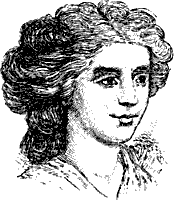
Frances Burney
But while her book-education was of the slightest, her social advantages were great. Pleasure-loving Dr. Burney had a delightful faculty of attracting witty and musical friends to enliven his home. Fanny's great unnoticed gift was power of observation. The shy girl who avoided notice herself, found her social pleasure in watching and listening to clever people. Perhaps a Gallic strain—for her mother was of French descent—gave her clear-sightedness. She had a turn for social satire which added humorous discrimination to her judgments. She understood people better than books, and perceived their petty hypocrisies, self-deceptions, and conventional standards, with witty good sense and love of sincerity. Years of this silent note-taking and personal intercourse with brilliant people gave her unusual knowledge of the world.
She was a docile girl, ready always to heed her father and her "Daddy Crisp," ready to obey her kindly stepmother, and try to exchange for practical occupations her pet pastime of scribbling.
But from the time she was ten she had loved to write down her impressions, and the habit was too strong to be more than temporarily renounced. Like many imaginative persons, she was fond of carrying on serial inventions in which repressed fancies found expression. One long story she destroyed; but the characters haunted her, and she began a sequel which became 'Evelina.' In the young, beautiful, virtuous heroine, with her many mortifying experiences and her ultimate triumph, she may have found compensation for a starved vanity of her own.
For a long time she and her sisters enjoyed Evelina's tribulations; then Fanny grew ambitious, and encouraged by her brother, thought of publication. When she tremblingly asked her father's consent, he carelessly countenanced the venture and gave it no second thought. After much negotiation, a publisher offered twenty pounds for the manuscript, and in 1778 the appearance of 'Evelina' ended Fanny Burney's obscurity. For a long time the book was the topic of boundless praise and endless discussion. Every one wondered who could have written the clever story, which was usually attributed to a society man. The great Dr. Johnson was enthusiastic, insisted upon knowing the author, and soon grew very fond of his little Fanny. He introduced her to his friends, and she became the celebrity of a delightful circle. Sir Joshua Reynolds and Burke sat up all night to finish 'Evelina.' The Thrales, Madame Delaney,—who later introduced her at court,—Sheridan, Gibbon, and Sir Walter Scott, were among those who admired her most cordially.
It was a happy time for Fanny, encouraged to believe her talent far greater than it was. She wrote a drama which was read in solemn judgment by her father and "Daddy Crisp," who decided against it as too like 'Les Précieuses Ridicules,' a play she had never read. A second novel, 'Cecilia,' appeared in 1782, and was as successful as its predecessor. Later readers find it less spontaneous, and after it she never resumed her early style except in her journal and correspondence. Her ambition was fully astir. She had every incentive from her family and friends. But the old zest in composition had departed. The self-consciousness which had always tormented her in society seized her now, when she was trying to cater to public taste, and made her change her frank, free, personal expression for a stilted artificial formality of phrase.
Her reputation was now at its height, and she was very happy in her position as society favorite and pride of the father whom she had always passionately admired, when she made the mistake of her life. Urged by her father, she accepted a position at court as Second Keeper of the Queen's Robes. There she spent five pleasureless and worse than profitless years. In her 'Diary and Letters,' the most readable to-day of all her works, she has told the story of wretched discomfort, of stupidly uncongenial companionship, of arduous tasks made worse by the selfish thoughtlessness of her superiors. She has also given our best historical picture of that time; the every-day life at court, the slow agony of King George's increasing insanity. But the drudgery and mean hardships of the place, and the depression of being separated from her family, broke down her health; and after much opposition she was allowed to resign in 1791.
Soon afterwards she astonished her friends by marrying General D'Arblay, a French officer and a gentleman, although very poor. As the pair had an income of only one hundred pounds, this seems a perilously rash act for a woman over forty. Fortunately the match proved a very happy one, and the situation stimulated Madame D'Arblay to renewed authorship. 'Camilla,' her third novel, was sold by subscription, and was a very remunerative piece of work. But from a critical point of view it was a failure; and being written in a heavy pedantic style, is quite deficient in her early charm. With the proceeds she built a modest home, Camilla Cottage. Later the family moved to France, where her husband died and where her only son received his early education. When he was nearly ready for an English university she returned to England, and passed her tranquil age among her friends until she died at eighty-eight.
What Fanny Burney did in all unconsciousness was to establish fiction upon a new basis. She may be said to have created the family novel. Fielding, Smollett, and Sterne had bequeathed their legacy impregnated with objectionable qualities, in spite of strength and charm; they were read rather secretly, and tabooed for women. On the other hand, the followers of Richardson were too didactic to be readable. Fanny Burney proved that entertaining tales, unweighted by heavy moralizing, may be written, adapted to young and old. Her sketches of life were witty, sincere, and vigorous, yet always moral in tone. 'Evelina,' the work of an innocent, frank girl, could be read by any one.
A still greater source of her success was her robust and abounding, though sometimes rather broad and cheap, fun. In her time decent novels were apt to be appallingly serious in tone, and not infrequently stupid; humor in spite of Addison still connoted much coarseness and obtrusive sexuality, and in fiction had to be sought in the novels written for men only. As humor is the deadly foe to sentimentalism and hysterics, the Richardson school were equally averse to it on further grounds. Fanny Burney produced novels fit for women's and family reading, yet full of humor of a masculine vigor—and it must be added, with something of masculine unsensitiveness. There is little fineness to most of it; some is mere horseplay, some is extravagant farce: but it is deep and genuine, it supplied an exigent want, and deserved its welcome. De Morgan says it was like introducing dresses of glaring red and yellow and other crude colors into a country where every one had previously dressed in drab—a great relief, but not art. This is hard measure, however: some of her character-drawing is almost as richly humorous and valid as Jane Austen's own.
Fanny Burney undoubtedly did much to augment the new respect for woman's intellectual ability, and was a stimulus to the brilliant group which succeeded her. Miss Ferrier, Maria Edgeworth, and Jane Austen all owe her something of their inspiration and more of their welcome.
EVELINA'S LETTER TO THE REV. MR. VILLARS
From 'Evelina'
Holborn, June 17th
Yesterday Mr. Smith carried his point of making a party for Vauxhall, consisting of Madame Duval, M. Du Bois, all the Branghtons, Mr. Brown, himself,—and me!—for I find all endeavors vain to escape anything which these people desire I should not.
There were twenty disputes previous to our setting out; first as to the time of our going: Mr. Branghton, his son, and young Brown, were for six o'clock, and all the ladies and Mr. Smith were for eight;—the latter, however, conquered. Then as to the way we should go: some were for a boat, others for a coach, and Mr. Branghton himself was for walking; but the boat at length was decided upon. Indeed, this was the only part of the expedition that was agreeable to me; for the Thames was delightfully pleasant.
The garden is very pretty, but too formal; I should have been better pleased had it consisted less of straight walks, where
"Grove nods at grove, each alley has its brother."
The trees, the numerous lights, and the company in the circle round the orchestra make a most brilliant and gay appearance; and had I been with a party less disagreeable to me, I should have thought it a place formed for animation and pleasure. There was a concert, in the course of which a hautbois concerto was so charmingly played that I could have thought myself upon enchanted ground, had I had spirits more gentle to associate with. The hautbois in the open air is heavenly.
Mr. Smith endeavored to attach himself to me, with such officious assiduity and impertinent freedom that he quite sickened me. Indeed, M. Du Bois was the only man of the party to whom, voluntarily, I ever addressed myself. He is civil and respectful, and I have found nobody else so since I left Howard Grove. His English is very bad; but I prefer it to speaking French myself, which I dare not venture to do. I converse with him frequently, both to disengage myself from others and to oblige Madame Duval, who is always pleased when he is attended to.
As we were walking about the orchestra, I heard a bell ring; and in a moment Mr. Smith, flying up to me, caught my hand, and with a motion too quick to be resisted, ran away with me many yards before I had breath to ask his meaning; though I struggled as well as I could to get from him. At last, however, I insisted upon stopping. "Stopping, ma'am!" cried he, "why, we must run on, or we shall lose the cascade!"
And then again he hurried me away, mixing with a crowd of people, all running with so much velocity that I could not imagine what had raised such an alarm. We were soon followed by the rest of the party; and my surprise and ignorance proved a source of diversion to them all which was not exhausted the whole evening. Young Branghton, in particular, laughed till he could hardly stand.
The scene of the cascade I thought extremely pretty, and the general effect striking and lively.
But this was not the only surprise which was to divert them at my expense; for they led me about the garden purposely to enjoy my first sight of various other deceptions.
About ten o'clock, Mr. Smith having chosen a box in a very conspicuous place, we all went to supper. Much fault was found with everything that was ordered, though not a morsel of anything was left, and the dearness of the provisions, with conjectures upon what profit was made by them, supplied discourse during the whole meal.
When wine and cyder were brought, Mr. Smith said, "Now let's enjoy ourselves; now is the time, or never. Well, ma'am, and how do you like Vauxhall?"
"Like it!" cried young Branghton; "why, how can she help liking it? She has never seen such a place before, that I'll answer for."
"For my part," said Miss Branghton, "I like it because it is not vulgar."
"This must have been a fine treat for you, Miss," said Mr. Branghton; "why, I suppose you was never so happy in all your life before?"
I endeavored to express my satisfaction with some pleasure; yet I believe they were much amazed at my coldness.
"Miss ought to stay in town till the last night," said young Branghton; "and then, it's my belief, she'd say something to it! Why, Lord, it's the best night of any; there's always a riot,—and there the folks run about,—and then there's such squealing and squalling!—and there, all the lamps are broke,—and the women run skimper-scamper—I declare, I would not take five guineas to miss the last night!"
I was very glad when they all grew tired of sitting, and called for the waiter to pay the bill. The Miss Branghtons said they would walk on while the gentlemen settled the account, and asked me to accompany them; which however I declined.
"You girls may do as you please," said Madame Duval, "but as to me, I promise you, I sha'n't go nowhere without the gentlemen."
"No more, I suppose, will my cousin," said Miss Branghton, looking reproachfully towards Mr. Smith.
This reflection, which I feared would flatter his vanity, made me most unfortunately request Madame Duval's permission to attend them. She granted it; and away we went, having promised to meet in the room.
To the room, therefore, I would immediately have gone: but the sisters agreed that they would first have a little pleasure; and they tittered and talked so loud that they attracted universal notice.
"Lord, Polly," said the eldest, "suppose we were to take a turn in the dark walks?"
"Ay, do," answered she; "and then we'll hide ourselves, and then Mr. Brown will think we are lost."
I remonstrated very warmly against this plan, telling them it would endanger our missing the rest of the party all the evening.
"O dear," cried Miss Branghton, "I thought how uneasy Miss would be, without a beau!"
This impertinence I did not think worth answering; and quite by compulsion I followed them down a long alley, in which there was hardly any light.
By the time we came near the end, a large party of gentlemen, apparently very riotous, and who were hallooing, leaning on one another, and laughing immoderately, seemed to rush suddenly from behind some trees, and meeting us face to face, put their arms at their sides and formed a kind of circle, which first stopped our proceeding and then our retreating, for we were presently entirely enclosed. The Miss Branghtons screamed aloud, and I was frightened exceedingly; our screams were answered with bursts of laughter, and for some minutes we were kept prisoners, till at last one of them, rudely seizing hold of me, said I was a pretty little creature.
Terrified to death, I struggled with such vehemence to disengage myself from him that I succeeded, in spite of his efforts to detain me: and immediately, and with a swiftness which fear only could have given me, I flew rather than ran up the walk, hoping to secure my safety by returning to the lights and company we had so foolishly left; but before I could possibly accomplish my purpose, I was met by another party of men, one of whom placed himself directly in my way, calling out, "Whither so fast, my love?"—so that I could only have proceeded by running into his arms.
In a moment both my hands, by different persons, were caught hold of, and one of them, in a most familiar manner, desired when I ran next to accompany me in a race; while the rest of the party stood still and laughed. I was almost distracted with terror, and so breathless with running that I could not speak; till another, advancing, said I was as handsome as an angel, and desired to be of the party. I then just articulated, "For Heaven's sake, gentlemen, let me pass!"
Another, then rushing suddenly forward, exclaimed, "Heaven and earth! what voice is that?"
"The voice of the prettiest little actress I have seen this age," answered one of my persecutors.
"No,—no,—no,—" I panted out, "I am no actress—pray let me go,—pray let me pass—"
"By all that's sacred," cried the same voice, which I then knew for Sir Clement Willoughby's, "'tis herself!"
A MAN OF THE TON
From 'Cecilia'
At the door of the Pantheon they were joined by Mr. Arnott and Sir Robert Floyer, whom Cecilia now saw with added aversion; they entered the great room during the second act of the concert, to which, as no one of the party but herself had any desire to listen, no sort of attention was paid; the ladies entertaining themselves as if no orchestra was in the room, and the gentlemen, with an equal disregard to it, struggling for a place by the fire, about which they continued hovering till the music was over.
Soon after they were seated, Mr. Meadows, sauntering towards them, whispered something to Mrs. Mears, who, immediately rising, introduced him to Cecilia; after which, the place next to her being vacant, he cast himself upon it, and lolling as much at his ease as his situation would permit, began something like a conversation with her.
"Have you been long in town, ma'am?"
"No, sir."
"This is not your first winter?"
"Of being in town, it is."
"Then you have something new to see; oh charming! how I envy you!—Are you pleased with the Pantheon?"
"Very much; I have seen no building at all equal to it."
"You have not been abroad. Traveling is the ruin of all happiness! There's no looking at a building here after seeing Italy."
"Does all happiness, then, depend upon sight of buildings?" said Cecilia, when, turning towards her companion, she perceived him yawning, with such evident inattention to her answer that, not choosing to interrupt his reverie, she turned her head another way.
For some minutes he took no notice of this; and then, as if suddenly recollecting himself, he called out hastily, "I beg your pardon, ma'am, you were saying something?"
"No, sir; nothing worth repeating."
"Oh, pray don't punish me so severely as not to let me hear it!"
Cecilia, though merely not to seem offended at his negligence, was then beginning an answer, when looking at him as she spoke, she perceived that he was biting his nails with so absent an air that he appeared not to know he had asked any question. She therefore broke off, and left him to his cogitation.
Some time after, he addressed her again, saying, "Don't you find this place extremely tiresome, ma'am?"
"Yes, sir," said she half laughing, "it is indeed not very entertaining!"
"Nothing is entertaining," answered he, "for two minutes together. Things are so little different one from another, that there is no making pleasure out of anything. We go the same dull round forever; nothing new, no variety! all the same thing over again! Are you fond of public places, ma'am?"
"Yes, sir, soberly, as Lady Grace says."
"Then I envy you extremely, for you have some amusement always in your own power. How desirable that is!"
"And have you not the same resources?"
"Oh no! I am tired to death! tired of everything! I would give the universe for a disposition less difficult to please. Yet, after all, what is there to give pleasure? When one has seen one thing, one has seen everything. Oh, 'tis heavy work! Don't you find it so, ma'am?"
This speech was ended with so violent a fit of yawning that Cecilia would not trouble herself to answer it: but her silence as before passed unnoticed, exciting neither question nor comment.
A long pause now succeeded, which he broke at last by saying, as he writhed himself about upon his seat, "These forms would be much more agreeable if there were backs to them. 'Tis intolerable to be forced to sit like a schoolboy. The first study of life is ease. There is indeed no other study that pays the trouble of attainment. Don't you think so, ma'am?"
"But may not even that," said Cecilia, "by so much study become labor?"
"I am vastly happy you think so."
"Sir?"
"I beg your pardon, ma'am, but I thought you said—I really beg your pardon, but I was thinking of something else."
"You did very right, sir," said Cecilia, laughing, "for what I said by no means merited any attention."
"Will you do me the favor to repeat it?" cried he, taking out his glass to examine some lady at a distance.
"Oh no," said Cecilia, "that would be trying your patience too severely."
"These glasses shew one nothing but defects," said he; "I am sorry they were ever invented. They are the ruin of all beauty; no complexion can stand them. I believe that solo will never be over! I hate a solo; it sinks, it depresses me intolerably."
"You will presently, sir," said Cecilia, looking at the bill of the concert, "have a full piece; and that I hope will revive you."
"A full piece! oh, insupportable! it stuns, it fatigues, it overpowers me beyond endurance! no taste in it, no delicacy, no room for the smallest feeling."
"Perhaps, then, you are only fond of singing?"
"I should be, if I could hear it; but we are now so miserably off in voices, that I hardly ever attempt to listen to a song, without fancying myself deaf from the feebleness of the performers. I hate everything that requires attention. Nothing gives pleasure that does not force its own way."
"You only, then, like loud voices, and great powers?"
"Oh, worse and worse!—no, nothing is so disgusting to me. All my amazement is that these people think it worth while to give concerts at all—one is sick to death of music."
"Nay," cried Cecilia, "if it gives no pleasure, at least it takes none away; for, far from being any impediment to conversation, I think everybody talks more during the performance than between the acts. And what is there better you could substitute in its place?"
Cecilia, receiving no answer to this question, again looked round to see if she had been heard; when she observed her new acquaintance, with a very thoughtful air, had turned from her to fix his eyes upon the statue of Britannia.
Very soon after, he hastily arose, and seeming entirely to forget that he had spoken to her, very abruptly walked away.
Mr. Gosport, who was advancing to Cecilia and had watched part of this scene, stopped him as he was retreating, and said, "Why, Meadows, how's this? are you caught at last?"
"Oh, worn to death! worn to a thread!" cried he, stretching himself and yawning; "I have been talking with a young lady to entertain her! oh, such heavy work! I would not go through it again for millions!"
"What, have you talked yourself out of breath?"
"No; but the effort! the effort!—Oh, it has unhinged me for a fortnight!—Entertaining a young lady!—one had better be a galley-slave at once!"
"Well, but did she not pay your toils? She is surely a sweet creature."
"Nothing can pay one for such insufferable exertion! though she's well enough, too—better than the common run—but shy, quite too shy; no drawing her out."
"I thought that was to your taste. You commonly hate much volubility. How have I heard you bemoan yourself when attacked by Miss Larolles!"
"Larolles! Oh, distraction! she talks me into a fever in two minutes. But so it is for ever! nothing but extremes to be met with! common girls are too forward, this lady is too reserved—always some fault! always some drawback! nothing ever perfect!"
"Nay, nay," cried Mr. Gosport, "you do not know her; she is perfect enough, in all conscience."
"Better not know her then," answered he, again yawning, "for she cannot be pleasing. Nothing perfect is natural,—I hate everything out of nature."
MISS BURNEY'S FRIENDS
From the 'Letters'
But Dr. Johnson's approbation!—it almost crazed me with agreeable surprise—it gave me such a flight of spirits that I danced a jig to Mr. Crisp, without any preparation, music, or explanation—to his no small amazement and diversion. I left him, however, to make his own comments upon my friskiness, without affording him the smallest assistance.
Susan also writes me word that when my father went last to Streatham, Dr. Johnson was not there, but Mrs. Thrale told him that when he gave her the first volume of 'Evelina,' which she had lent him, he said, "Why, madam, why, what a charming book you lent me!" and eagerly inquired for the rest. He was particularly pleased with the snow-hill scenes, and said that Mr. Smith's vulgar gentility was admirably portrayed; and when Sir Clement joins them, he said there was a shade of character prodigiously well marked. Well may it be said, that the greatest minds are ever the most candid to the inferior set! I think I should love Dr. Johnson for such lenity to a poor mere worm in literature, even if I were not myself the identical grub he has obliged.
Susan has sent me a little note which has really been less pleasant to me, because it has alarmed me for my future concealment. It is from Mrs. Williams, an exceeding pretty poetess, who has the misfortune to be blind, but who has, to make some amends, the honor of residing in the house of Dr. Johnson; for though he lives almost wholly at Streatham, he always keeps his apartments in town, and this lady acts as mistress of his house.
July 25.
"Mrs. Williams sends compliments to Dr. Burney, and begs he will intercede with Miss Burney to do her the favor to lend her the reading of 'Evelina.'"
Though I am frightened at this affair, I am by no means insensible to the honor which I receive from the certainty that Dr. Johnson must have spoken very well of the book, to have induced Mrs. Williams to send to our house for it.
I now come to last Saturday evening, when my beloved father came to Chesington, in full health, charming spirits, and all kindness, openness, and entertainment.
In his way hither he had stopped at Streatham, and he settled with Mrs. Thrale that he would call on her again in his way to town, and carry me with him! and Mrs. Thrale said, "We all long to know her."
I have been in a kind of twitter ever since, for there seems something very formidable in the idea of appearing as an authoress! I ever dreaded it, as it is a title which must raise more expectations than I have any chance of answering. Yet I am highly flattered by her invitation, and highly delighted in the prospect of being introduced to the Streatham society.
She sent me some very serious advice to write for the theatre, as she says I so naturally run into conversations that 'Evelina' absolutely and plainly points out that path to me; and she hinted how much she should be pleased to be "honored with my confidence."
My dear father communicated this intelligence, and a great deal more, with a pleasure that almost surpassed that with which I heard it, and he seems quite eager for me to make another attempt. He desired to take upon himself the communication to my Daddy Crisp; and as it is now in so many hands that it is possible accident might discover it to him, I readily consented.
Sunday evening, as I was going into my father's room, I heard him say, "The variety of characters—the variety of scenes—and the language—why, she has had very little education but what she has given herself—less than any of the others!" and Mr. Crisp exclaimed, "Wonderful!—it's wonderful!"
I now found what was going forward, and therefore deemed it most fitting to decamp.
About an hour after, as I was passing through the hall, I met my daddy [Crisp]. His face was all animation and archness; he doubled his fist at me and would have stopped me, but I ran past him into the parlor.
Before supper, however, I again met him, and he would not suffer me to escape; he caught both my hands and looked as if he would have looked me through, and then exclaimed, "Why, you little hussy—you young devil!—ain't you ashamed to look me in the face, you Evelina, you! Why, what a dance have you led me about it! Young friend, indeed! O you little hussy, what tricks have you served me!"
I was obliged to allow of his running on with these gentle appellations for I know not how long, ere he could sufficiently compose himself, after his great surprise, to ask or hear any particulars; and then he broke out every three instants with exclamations of astonishment at how I had found time to write so much unsuspected, and how and where I had picked up such various materials; and not a few times did he with me, as he had with my father, exclaim "Wonderful!"
He has since made me read him all my letters upon this subject. He said Lowndes would have made an estate had he given me £1000 for it, and that he ought not to have given less! "You have nothing to do now," continued he, "but to take your pen in hand; for your fame and reputation are made, and any bookseller will snap at what you write."
I then told him that I could not but really and unaffectedly regret that the affair was spread to Mrs. Williams and her friends.
"Pho," said he: "if those who are proper judges think it right that it should be known, why should you trouble yourself about it? You have not spread it, there can no imputation of vanity fall to your share, and it cannot come out more to your honor than through such a channel as Mrs. Thrale."
London, August.—I have now to write an account of the most consequential day I have spent since my birth; namely, my Streatham visit.
Our journey to Streatham was the least pleasant part of the day, for the roads were dreadfully dusty, and I was really in the fidgets from thinking what my reception might be, and from fearing they would expect a less awkward and backward kind of person than I was sure they would find.
Mr. Thrale's house is white, and very pleasantly situated in a fine paddock. Mrs. Thrale was strolling about, and came to us as we got out of the chaise.
She then received me, taking both my hands, and with mixed politeness and cordiality welcoming me to Streatham. She led me into the house, and addressed herself almost wholly for a few minutes to my father, as if to give me an assurance she did not mean to regard me as a show, or to distress or frighten me by drawing me out. Afterwards she took me up stairs, and showed me the house, and said she had very much wished to see me at Streatham; and should always think herself much obliged to Dr. Burney for his goodness in bringing me, which she looked upon as a very great favor.
But though we were some time together, and though she was so very civil, she did not hint at my book, and I love her much more than ever for her delicacy in avoiding a subject which she could not but see would have greatly embarrassed me.
When we returned to the music-room, we found Miss Thrale was with my father. Miss Thrale is a very fine girl, about fourteen years of age, but cold and reserved, though full of knowledge and intelligence.
Soon after, Mrs. Thrale took me to the library; she talked a little while upon common topics, and then at last she mentioned 'Evelina.'
"Yesterday at supper," said she, "we talked it all over, and discussed all your characters; but Dr. Johnson's favorite is Mr. Smith. He declares the fine gentleman manqué was never better drawn, and he acted him all the evening, saying 'he was all for the ladies!' He repeated whole scenes by heart. I declare I was astonished at him. Oh, you can't imagine how much he is pleased with the book; he 'could not get rid of the rogue,' he told me. But was it not droll," said she, "that I should recommend it to Dr. Burney? and tease him so innocently to read it?"
I now prevailed upon Mrs. Thrale to let me amuse myself, and she went to dress. I then prowled about to choose some book, and I saw upon the reading-table 'Evelina.' I had just fixed upon a new translation of Cicero's Lælius, when the library door was opened, and Mr. Seward entered. I instantly put away my book because I dreaded being thought studious and affected. He offered his services to find anything for me, and then in the same breath ran on to speak of the book with which I had myself "favored the world"!
The exact words he began with I cannot recollect, for I was actually confounded by the attack; and his abrupt manner of letting me know he was au fait equally astonished and provoked me. How different from the delicacy of Mr. and Mrs. Thrale!
When we were summoned to dinner, Mrs. Thrale made my father and me sit on each side of her. I said that I hoped I did not take Dr. Johnson's place;—for he had not yet appeared.
"No," answered Mrs. Thrale, "he will sit by you, which I am sure will give him great pleasure."
Soon after we were seated, this great man entered. I have so true a veneration for him, that the very sight of him inspires me with delight and reverence, notwithstanding the cruel infirmities to which he is subject; for he has almost perpetual convulsive movements, either of his hands, lips, feet, or knees, and sometimes of all together.
Mrs. Thrale introduced me to him, and he took his place. We had a noble dinner, and a most elegant dessert. Dr. Johnson, in the middle of dinner, asked Mrs. Thrale what was in some little pies that were near him.
"Mutton," answered she, "so I don't ask you to eat any, because I know you despise it!"
"No, madam, no," cried he; "I despise nothing that is good of its sort; but I am too proud now to eat of it. Sitting by Miss Burney makes me very proud to-day!"
"Miss Burney," said Mrs. Thrale, laughing, "you must take great care of your heart if Dr. Johnson attacks it; for I assure you he is not often successless."
"What's that you say, madam?" cried he; "are you making mischief between the young lady and me already?"
A little while after he drank Miss Thrale's health and mine, and then added:—
"'Tis a terrible thing that we cannot wish young ladies well without wishing them to become old women!"
"But some people," said Mr. Seward, "are old and young at the same time, for they wear so well that they never look old."
"No, sir, no," cried the doctor, laughing; "that never yet was: you might as well say they are at the same time tall and short."